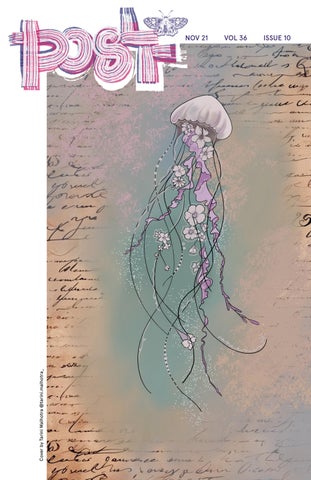
Cover by Tarini Malhotra @tarini.malhotra_
NOV 21 VOL 36 ISSUE 10
LETTER FROM THE EDITOR
Table of
Contents feature
moments in-between
1
dry tears
3
shipping rakhis
5
thought enough to carry
7
weapons and the world we inherited
9
chasing the ease of childhood
11
night at the museum
13
containment, connection, and the spaces between
15
post-pourri
thanksgiving recipes
17
crossword
bundle of joy
19
narrative
arts & culture lifestyle
BA Bie s
1. Renesmee 2. Yoda 3. NOT the Four Seasons Atlanta baby (SYBAU) 4. The little punk who sat next to me on the plane 5. Mom I frew up 6. Big one. Large. Just like humongous. 7. Hit me one more time 8. The Chinese baby on Instagram Reels that eats all his food in size order 9. Benjamin Button as an “adult” 10. Jack-Jack
4
post–
“Jellyfish are just rocks that hurt more.” “There are no gay brothers, just gay lovers.”
letter from the editor Dear Readers, We’re SO close…Close to the end of the semester, close to the winter holidays, and close to a well-deserved break next week! With Thanksgiving swiftly approaching, we’re in the final push of the semester. So, if you’re finding yourself in the trenches amidst your fifty-bajillionth midterm of the semester, chin up soldier! We’re almost there! Aside from Thanksgiving bringing a few extra days to finish all of the work I’ve been procrastinating on, I truly do love the holiday for inspiring everyone to remember what they’re thankful for. Yes, I know, it sometimes feels cheesy to go around the dinner table talking about your highlights of the year or the little things that keep you going, but it’s something that warms my cold heart as we’re trudging into the start of winter. I know that I’m personally feeling very thankful for another semester of new classes and clubs, new and old friends, and lots of memories made. Something I’m especially thankful for is the never-ending creativity and brilliance of our lovely post- writers and illustrators. In this weeks’ issue, Violet shares a piece on therapy, post-grad life, and all the small day-to-day moments that
make her stop to ponder. Also in Feature, Francis reflects on the complexity of grief. In Narrative, Samaira and Mar both write about relationships they treasure. In Arts & Culture, Jack discusses the political relevance of Weapons to Gen Z and Madison gives her thoughts on nostalgia and why spinoffs are failing to impress us. In Lifestyle, Sara shares some observations from a late-night study sesh and Liv meditates on vessels and space. Before you go, make sure to complete Lily’s cold weather-themed crossword and enjoy Alayna’s Thanksgiving “recipes”— are they recipes for meals, fun, or disaster? Read on to find out! Every Wednesday night, I make my way to our cozy little office at 88 Benevolent Street and spend a few hours with some really wonderful people. I am so thankful for this highlight of my week that breaks up the stress of assignments and exams with a (sometimes silly, sometimes unhinged) “Top 10” debate and the company of some of the most creative minds on campus (perhaps I’m a bit biased). I am forever impressed by the creations I get to consume and edit on prod night, and it fills my cup to know that every issue is imbued with pieces of those of us that sit around the table. But anyways, enough about me and everything I’m thankful for this year…Dear reader, what are YOU most thankful for? Feeling the holiday spirit,
Jessica Lee Copy Chief
FEATURE
FEATURE
moments in between an exploration of post-grad psyches
by violet chernoff Illustration by selena zhu
As 22-year-olds, we take ourselves pretty seriously. We’re convinced that our two romantic decisions (anything before tenth grade is negligible) indicate a lifelong pattern to which we are bound, irrevocably so. We’re sure that, despite results of an allergy test that say otherwise, we are allergic to pine nuts and cannot possibly eat them, not even in pesto. We are beholden to political memes and reels, caught in a damnedif-you-do, damned-if-youdon’t cycle of activism, or performative activism, or whatever you want to call it. We’re dressed—the “best” of us—in ivory blouses and Mary Janes, posing as demure (but somehow not downtrodden) 30-year-old women who actually know what the fuck they want in life. In a recent survey published by Gallup and the Walton Family Foundation, just 15 percent of 18- to 26-year-olds “said their mental health was excellent.” Granted, ‘excellent’ is a high bar, but even so, the figure marks a sharp decline from both 2013 and 2003, when more than half of respondents were practically frothing rainbows. Such is the rise of teenage and 20-something angst, I suppose. The majority of my friends are in therapy, and I am in therapy, too. My mom spends hundreds of dollars every month—a handful of
dollars a minute—so I can discuss my love life and LinkedIn inbox with a seasoned professional. Sure, my dad’s diagnosis (earlyonset dementia with Lewy bodies) is broached occasionally, along with my routine qualms and need to swipe out of social media apps 47 times a day. But primarily, I get to talk to a 50-year-old woman about my fluctuating emotions and [insert name of the person I’m currently seeing] monomania once a week. So like, is this entirely necessary? Through hours of psychoanalysis, starting in late adolescence, are we becoming overly therapized? Or are we getting ahead of later issues, getting to know ourselves before it is too late? If you—yes, you, ambiguous reader—have the money for it, and it’s accessible, I think you might as well go to therapy. Self-awareness rarely hurts, and it is semi-nice when everyone in your one-mile social radius is equipped with professional language and strategies to scrutinize normal 20-something behavior.
It is also semi-nice when all of the boys you sleep with are on Lexapro, attuned to noxious emotional patterns, and able to last longer in bed. Maybe we will be better than our parents. I suppose that’s the perennial hope, the cycle of life, or whatever. The thing is, even when my dad criticizes how I sit (knee up, hunchback at the dining room table), or my mom stoically clings to the most annoying non-truth, I think my parents are pretty good, if not great. Being better than them is both undesirable, and, frankly, unrealistic. My mom published a book on date rape at age 24 and is more emotionally perspicacious than anyone else I know. She has survived 57 complicated years without the diagnosis of “adjustment disorder with anxiety,” which sits atop my insurance claims and does absolutely nothing for me. A New York Times op-ed argues that the underlying goal of therapy is, through probing one’s past, to identify and dislodge real trauma. Doing so reduces the risk that it—whatever childhood event or attachment pattern—will go unacknowledged and pervade other realms of life. But real trauma differs from just any tumultuous event or occurrence, and “[if ] we fail as a culture to acknowledge the wellestablished long-term consequences, both physical and psychological, of legitimate trauma, we will wind up creating more people who identify as victims, not fewer.” This isn’t a victim complex, per se, but it isn’t far off. In other words, haphazardly invoking the word ‘trauma,’ or exaggerating one’s needs as a patient, can obscure—or even undermine— the very point of therapy. I will probably, most likely, be fine, despite whatever semi-upsettingbut-not-devastating thing happened to eightyear-old me. And so will Katie, Rachel, and
every other similarly privileged girl who beats a dead (or, at least, severely wounded) horse with her therapist every week. Therapeutic dialogue and self-awareness are valuable, but not when they drift into overpathologization. After Brown, I want to work in psychology. I want to spend my days, all of them, speaking to all sorts of people about all sorts of things: former drug addicts about their new, healthier infatuation with ginger beer; domestic violence survivors about the coercive cycle of patterned abuse; worried mothers about their not-sonice sons who recurrently goad other middle schoolers to their breaking points. Notice I haven’t mentioned people like myself—white, post-adolescent, socioeconomically stable, privileged in most senses of the word. I haven’t mentioned my best friend Owen, who, for what it’s worth, has done a lot with the past five years of biweekly life coaching, supplemented by therapy and medication. (Owen—love him to death—is your archetypal blonde, basketballplaying Tulane graduate). It’s not that I don’t take my, or his, or our problems seriously; it’s
more that I don’t yet know what to make of them. As a ’25.5er (transfer, gap semester, long story), I have one semester more than most of my friends. It’s a buffer between college life and the real world, a three-month stretch where I get to watch my friends adjust to their new work lives, while I’m still a student. “I miss Brown” and “same old, same old” have already become commonplace responses to my queries about their days. It’s kind of scary! What, I wonder, replaces the very distinct thought patterns and communicative modes you cultivate in college? What happens when you leave your special little
stratosphere—the world of Thayer street, of Blue Room rendezvous, of clustered desks in the SciLi basement—for the bigger, broader world? Perhaps this is a me problem, but I’ve never had a job so immersive, so engrossing that I forget all else. When I imagine my friends in their nine-to-fives, when I imagine myself in mine, I’m curious about the moments in-between. The stretches between tasks, on the subway to work, when you’re not walking through the Main Green, enwrapped in a familiar social landscape with familiar faces literally everywhere. Instead of running into Professor Y or spotting Acquaintance Z, with whom you drank far too much on Saturday night, you see Strangers A, B, and C. It doesn’t really matter; there’s nothing to mull or muse over during your daily wanderings. I worry that without the constant stimulation of Brown’s campus—or the looming prospect of returning, which keeps you enthralled in, or in thrall to, your little world—things will feel like “same old, same old.” As we enter a new stage of development, just two or three years from prefrontal maturity instead of a whopping four or five, I wonder what will replace the on-campus characters and daily musings of college life. For some of us, I imagine it will, for a while, be a fair amount of anxiety. Growing pains, maybe. What I do know for a fact is that most people listen to music—and will continue to do so, probably forever after. Being a chronically bad texter and living in Europe, I reckon I could guess at my friends’ playlists better than some of their interior lives (give or take). My best friend, who is with me in Amsterdam now, with whom I’ve shared innumerable conversations over bitterballen and white wine, says he wishes emotions were as literal and demonstrable as a gash on your cheek or a bruise on your thigh. I’m not sure I agree. I don’t wish my mood fluctuations were visible for everyone to see, probably for the same reason girls don’t wish for erections. I do, however, wish they were more easily expressible. At this stage in life, finding someone with a similar emotional range or calibration of reactivity to you is difficult. Friend J spirals like I do; Friend K obsesses like I do; Friend L writes like I do. But everything would feel a lot less crazy—and seem a lot less crazy, for that matter—if we had a more generationally agreed-upon form of expression. ‘Emotional’ is not supposed to be synonymous with crazy, but the two become interchangeable when emotions are expressed (or processed)
that loves you.” Over the past few days, I’ve watched a specific ’97 Stevie Nicks and Lindsay Buckingham performance of the song upwards of 19 times. My fixation may be unsurprising, perhaps even unoriginal: Their musical rapport is coveted by thousands, if not millions, and they are widely regarded as lyrical geniuses. But Big Sean is not, and once I listened to his song “I Know” 23 times in a school day. That’s around 104 minutes of the same song in one day. All because I liked his harmonies with Jhené Aiko and the way I felt when he sang “dancin’, dancin’ dancin’ like you fucking got a reason.” These songs become part of popular culture because they feel strangely and specially relatable. Someone like Jay-Z or Taylor Swift, like Virginia Woolf or Alain de Botton, is able to articulate and make legible the feelings of falling in love, of isolation, of loneliness—along with our daily neuroses. It seems every girl, regardless of her romantic arsenal, can find something relatable in “And there we are again when nobody had to know / You kept me like a secret, but I kept you like an oath,” or “Carve your name into my bedpost / I don’t want you like a best friend.” My question is: If we all find these songs relatable, if we all listen to them for solace, why aren’t we better able to relate to each other? And I don’t ask this in a simplistic, grossly, and somehow sweetly condescending second grade teacher way. I’m just genuinely wondering why 20-somethingyear-olds, and people writ large, feel so alone in their emotions when it is overwhelmingly clear that many of our peers feel the same way. The concept of a generationally agreedupon form of expression is naive, but I wish that I, personally, had a better emotional outlet and more confidence in the non-annihilation of the moments in-between. I love my long bike rides with my earphones in and Frou Frou on loop as much as the next person, but I truly think overreflection or incessant rumination—especially without a steady stream of new stimuli—can be detrimental. Maybe, as we reach 23, these moments are filled only with The Daily, Pod Save America, or even silence, set against a mental backdrop of unceasing job worries. Maybe I’ll discuss these thoughts with my therapist.
without grace. Sometimes I get hyperfixated on song lyrics. Like books, they distill complex emotional phenomena into appealing little sentences. They make you feel seen and heard and understood in ways that only art can (and sometimes, in ways that only Taylor Swift’s art can, which explains the teenage girl demographic ideé fix). My perpetual fixation is Fleetwood Mac’s “Silver Springs,” specifically the lyrics “time cast a spell on you, / but you won’t forget me” and “you’ll never get away from the sound of the woman 1
post–
November 21, 2025
2
FEATURE
dry tears on grief and unconventional expressions of love
by FRAncis gonzalez Illustration by Cayden Garrett
My mother gestures me into the room. As I walk in, I look around—it’s vastly different from the last time I was here. I used to spend multiple days a week here, where we had our movie nights, where I had my band practices, where my parents forced me to go with my friends because my dad didn’t want guests upstairs. Now my windows are shut, my drum kit gone, the couch replaced with a hospital bed. My mom brings me to the bedside. She places a thousand-peso bill in my late grandmother’s hand. “Take it,” she tells me. I look back, confused. Then I look at Ama. Her hands grip the bill as if she’s still alive, as if she needs it. Hesitantly, I reach out. As I take the bill, I can’t help but notice that she looks the same. If I hadn’t seen the text from my dad at 3 a.m. that morning in 2021, I wouldn’t even know she was gone. I look back at my mom, the thousand-peso bill now firmly in my hand. “You need to laminate that money.” I give her a puzzled look. She continues: “You can’t ever spend that money. It’s lucky money.” I nod and put the bill into my pocket. I step out of the room, and my cousin Andy enters after me. Outside in my garden, I walk up to my other cousin Jacob—he went in before me. “Weird tradition,” he tells me. I chuckle in agreement. To this day, I don’t know where I put that bill. 17 was so long ago. I don’t think I’ve used it, but I also never laminated it. I hope it’s still in my room somewhere. 3
post–
*** While in an online class the day before, I see my aunts, uncles, and cousins crowding around Ama’s room downstairs. During my lunch break, I go down to see them. “What’s going on?” I ask Jacob. “Ama kicked us out. Doesn’t want us to see her.” “Oh.” *** Later that night, my dad packs my two siblings, my cousin Jessie, and me into a car. He drives us to Jessie’s house, a five-minute walk away. “Kids, you guys are gonna stay here tonight, okay?” My siblings don’t care. It’s a sleepover with their favorite cousin, and they can maybe even skip their online classes tomorrow. Jessie takes the lead and brings them into her house. I don’t move. Once my siblings are gone, my dad starts talking. “Ama thinks she might pass soon. She wants the kids out of the house because it’s apparently bad luck to be in the same house when someone dies.” I look at him. “You don’t care about bad luck?” He shrugs. “I don’t believe in that stuff. You know the Chinese proverb about luck?” I nod slowly, surprised. My mom’s the Chinese one, not my dad. I only ever heard it from her, and I forgot that she could tell him things too.
He pauses for a moment, then tells me: “Even if it’s real, we’ve been lucky so far. We can take a few years of bad luck.” “I see.” “You’re old enough to decide for yourself. If you want to avoid that, you can stay here.” He gestures to my cousin’s house. “If not, you can come back home.” I ponder the decision for a moment. “I’ll go home.” My dad nods and starts driving. I think then that she will probably die tonight. In my head, for some reason, there is something noble about going home—about taking the bad luck just so I can be with Ama in her last moments. She’s been living in our house for months now, ever since her cancer diagnosis. Not once have I visited her room. That doesn’t change tonight. *** Back when we were kids, Jacob and I used to sleep over at Ama’s place together. He was my favorite cousin and introduced me to most of the video games I’ve played. That’s all we ever did at Ama’s house. We had our mattresses on the ground, and she’d lend us her iPad, or we’d bring our 3DSs, and we’d game until 1 a.m. while she lay on her bed watching K-dramas. Then we’d wake up at 6 a.m. and game again until Jacob got picked up. He was always picked up before me. My immediate extended family (meaning first cousins) used to go to Ama’s house on Sundays for dinner. Slowly, people stopped
FEATURE showing up, and after a while, it was replaced with lunch at a restaurant, which we would pregame by praying the rosary at my grandfather’s tomb. But slowly, people stopped showing up to that too. After a few years, only two families had dinner with Ama regularly: mine and my uncle’s family of five, but they lived in Ama’s house. Only my family visited her. All of Ama’s grandchildren were asked to prepare a short eulogy, which would be compiled into a video that would be shown at her virtual wake and subsequent funeral. I couldn’t come up with anything, so I made a joke about how she’d let me stay up later than my mom ever did. My cousins laughed at that. But then I heard them talk. They talked about endless shopping sprees, about Ama fighting their parents for being too strict, about Ama paying their college tuition. I didn’t have any such stories. Weeks after Ama’s passing, I finally found the courage to approach Jacob. “You know, back when we’d sleep over at Ama’s, I feel like we never really spent time with her. Like, ever.” He pondered that for a moment, then responded. “Yeah, I was thinking about that. But then I remember I tried before, and she’d shoo me away and tell me to play my games, then she’d keep watching her K-dramas. That’s just how she was.” “True,” I nodded. I believed him. But while he might have done so, I had never tried to spend time with Ama when ***I was there. *** The Chinese proverb my dad mentioned, as told by my mom, goes like this: There was a Chinese peasant. He had a horse. One day, the horse runs away. People of the village offer him condolences for his bad luck. He responds: “Good luck, bad luck, who knows?” The next day, the horse returns with 12 more wild horses. People of the village congratulate him on his good luck. He responds: “Good luck, bad luck, who knows?” At some point, while training one of the wild horses, the peasant’s son falls off and breaks his leg. People of the village once more offer him condolences. He responds: “Good luck, bad luck, who knows?” One day, the emperor’s army marches into the village. They announce that a war has started, and that they are conscripting all of the young men in the village. As the peasant’s son has a broken leg, he is left alone. Hence the proverb: “Good luck, bad luck, who knows?” *** When Andy steps out of my Ama’s room, Jacob tells me that we may need to comfort him. He looks red, teary-eyed. We sit at a table in silence. As I’m thinking of something to say, I hear the door open. The first person I see is my Ama’s brother. Then her sister. One by one, my extended extended family—Ama had 12 siblings—pour into my house to see her. Normally, guests outside of my immediate extended family aren’t allowed at my place—especially not while we’re still in lockdown. But we let them in anyway. “They can’t go to her funeral,” my dad tells me later. I look at him confused, then realize. “Oh, because they’re above 60?”
“Yeah.” I watch them from a distance as they pay their respects. I haven’t seen them interact with one another in a while—at least a year and a half, since the lockdown started. I don’t think I remember any interactions between them while Ama was still alive. I’m sure they loved her, though. *** I found out Ama’s cancer came back the first time she visited during the lockdown. This must have been late 2020—we had been extremely cautious up until then. I wasn’t there, but my mom recalls her saying that she had ulcers. When asked why she hadn’t told anyone, she shrugged. “Even if I did, what could we do?” The first time Ama got cancer, she was treated in Singapore. The second time, she was stuck with us in Manila, her treatment delayed because of the lockdown, her hospital visits made risky because of the pandemic. I think that without this lockdown, she might have survived. I always thought that it was such bad luck that this pandemic took my Ama from me. But it was even worse for her siblings—the lockdown took not just their sister, but also their ability to properly send her off. *** There came a point when I hadn’t slept at Ama’s in a while. When she saw me again, she asked me excitedly: “When are you sleeping over again? I don’t have any company.” *** My immediate cousins can be separated into two different batches. The older group, which I am part of, consists of 10 of us, including Andy and Jacob. The first was born in 1997, while the last was born in 2004, just a month after me. While not everyone was born back-toback, there was a stretch of a few years where we had at least one person graduating from high school annually. This was capped off in 2022, with three of us graduating at once. After us, there were three years before the next, Jessie, was born. That gap marks the generational cutoff. My cousins were banned from eating Spam at their houses for health reasons. They loved it, though. Whenever they’d come visit my family, the second someone mentioned Spam, they’d perk up. We fed them Spam like we were giving them drugs. No better way to entertain children than by helping them cheat their parents’ rules. The first of my cousins to study in America left in 2015. The next did so in 2018, but he took a gap year during the pandemic. Then 2019, 2020, and so on. By 2021, while there were still eight of us in the Philippines, two were on temporary academic leave, one was set to graduate that year, and three of us the next. Of the eight, six of us were in the house the night Ama passed. That night, while the younger batch stayed in their homes (with the exception of my siblings, who stayed at Jessie’s house), most of the older batch, alongside our parents, stayed at mine. There we were, six cousins sitting at my kitchen counter, accompanied by my dad and a few uncles, all talking about something I can’t remember now. For those few hours, we forgot why we were there. But I could tell. It was clear to me, because so many of us had some form of school or work the next day, that all of us wanted to be there when it happened. We knew it was coming, and we knew that Ama
would not let us see her, but we waited anyway. Close to midnight, we started to get hungry. My dad got up and cooked a bowl of instant ramen, ajitama, and Spam for each of us. Simple. Nostalgic. To this day, that was the best meal of my life. *** It’s almost 3 a.m., the time when my dad texts me about Ama’s passing. Most of my cousins have gone home. As they leave, I feel some impending sense of dread—not that she might pass tonight, but rather that I won’t ever be able to sleep because I want to be there when she does. There is something in me, some desire for my life to be poetic, some need to feel every loss as hard as possible. I know then that if she passes tonight, I won’t feel anything—only satisfaction that I was right about her passing today and relief that the wait is over. Some stay, though. Andy asks to sleep over, and my eldest cousin, Mia, crashes on my couch. As Andy and I are about to get ready for bed, the clock strikes, and my dad’s text sends. We walk back down. Jacob, upon hearing the news, walks back to my place. All of Ama’s children stayed over. My living room is cluttered with people and blankets. My mom, aunts, and uncle sit around one another, deliberating over what to write on her death certificate. Andy wants to hit something. Mia looks sad, but calm. I don’t feel much, and it’s a relief to me when Jacob arrives, because he looks like he doesn’t feel much either. But I’ve always had this impression of him as unfeeling, or at least outwardly so. This was never something anyone said about me. I spend the next few hours silently beating myself up. Perhaps my bad luck is that I can no longer feel anything. *** The morning after my Ama’s passing, I wake up at 7:40 a.m., ready for my online class. I refuse to use her as an excuse to skip, knowing that I’m not even grieving. I log onto the Zoom, perfectly on time. It’s an English class. We’re reading Ovid’s Metamorphoses, I think. I try to pay attention, but I’ve stayed up all night and haven’t paid attention to this class for at least a month. Naturally, I have no clue what’s going on. I make it all of 10 minutes before I leave the call. I send a quick message to my teacher. I pace around my desk for a little while, debating going back to my room. I walk. And walk. And walk. And then I stop. I lean against the wall. I cry.
November 21, 2025
4
NARRATIVE
NARRATIVE
shipping rakhis hot milk, newspaper, and favourites
by Samaira Mohunta Illustrated by Lila Vianna @jademademoon_art
Ma won’t make poha for us on Sunday evenings anymore, and even on the rare occasions that she does, she won’t serve those golden-yellow grains alongside a glass full of steaming hot milk. I no longer ride behind your metallic cycle on my pastel one every school morning. I go by car, the one you scratched with your badminton racket. Nobody can sing me to sleep the way you used to, and no one likes to call strangers past
5
post–
midnight; they think it’s kiddish. Maybe you found it kiddish, too, but you called anyway. Do you not remember how just yesterday you were packing your suitcase and how today you’re already sleeping on new pillows in a new house with new roommates? Every morning I wake up and am reminded that you’re in a different country on a different continent surrounded by different people, and that makes me feel pain like nothing an
X-ray could ever show. Ma will stop serving poha and steaming hot milk altogether. Papa will start reading the newspaper on the mobile app. Dadi will start calling me her favourite. I want to tie a rakhi on your wrist and not just ship it to you—can you just come back home? Twice a year for just two weeks is too little. Too little, bhaiya. It is too little.
November 21, 2025
6
NARRATIVE
NARRATIVE Still, she keeps them. One day, she will figure it out, she thinks. On her walls, there are no empty spaces. Every movie, every artist, every song she’s ever loved—they’re all up there. She enjoys collecting objects too. Trinkets, magnets, lighters, pretty pens. Someone once told her that her room looks like “where the thinking happens.” She laughed. She enjoyed hearing that. There is no place for newness, but at least she’s not missing anything, she thinks. M leaves her room and stops by A’s before stepping out. A’s room is right next to hers, and they like living together. A and M are best
M just looks out the window. She knows A is expecting an answer. “You should get an apple,” A suggests. “You know, since you like apples so much.” M looks at her then, smiling. She can never quite tell if A is being serious. A can always make her smile. “I am getting the entire handwritten letter that my grandpa wrote to my grandma the night before they got married, in his exact handwriting, all over my back.” A looks M in the eyes, almost challenging her. She chooses not to say anything yet, in case M is being serious. There’s no way.
still smelled like her. A thought it smelled like dirt. M enjoys keeping old things. As they make their way from the kiosk, M confronts her: “This is what happens when you treat your body like a sketchbook. What do you mean grapes represent freedom?” “It’s not that deep, M. My thigh-sized grape tattoo felt right when I got it.” M offers a smile in contempt. She disagrees. M only has three tattoos: her dog’s face on her shoulder, the title of her all-time favorite song on her wrist, and a moon matching her sister’s on her neck. She does not understand what makes grapes worth immortalizing. “Do you see my point, though?” M asks A. “My wrist represents me. Every time I look at it, I’m reminded of something special.” “Well, at least my grapes are simple. Memories can turn sour. What if your sister betrayed you?” “It would still be less painful than getting laser every few weeks for not thinking about my choices.” “Oh.” That stings. It began with a sweater. A sweater, a feeling of warmth, a sense of comfort, a piece of joy. M remembers her lime green childhood sweater, her first favorite item. She remembers its replacement too, after outgrowing the first one, and how she pretended it was just as comfortable. It wasn’t. She remembers the hallway of her first home, walls full of framed family pictures. She remembers trying to remember the color of the frames after moving homes. She forgets whether they were beige or gray. She remembers her first best friend, her first crush, her favorite teacher. They are all gone now. M promised herself to keep her memories close. She wishes to make them stay. M goes home after her conversation with A, wondering if she thinks too deeply about things.
friends. A once told M she thinks they balance each other out. M said she hoped that was a good thing. When M walks into A’s room to check if she’s back home, she is greeted by color. The decorations are so contrasting that they somehow complement each other. Some brighter, some darker, some smaller, some bigger, some modern, some antique. A changes her mind about them often. Change keeps the room fresh, she says, or something like that. M thinks she just hasn’t found anything she likes enough. A always leaves her flashing rainbow lights on by accident. Indeed, a room with color everywhere. A isn’t home, and M walks outside. She sits on her porch and smokes a cigarette. Two cigarettes. By the third one, she is crying. Too much, she thinks. Too much. M goes to get a tattoo on her own the next morning. On the way there, she revisits the elaborate justifications she plans to tell the tattoo artist. “Yeah, so it’s a bird from my favorite poem. A hummingbird, specifically. A good friend showed me the poem a long time ago, and it really stuck with me. It’s about birdwatching and the meaning of awareness and attention to detail and—” What she actually means is: “I’ve thought enough about it to choose to carry it forever.” M takes pleasure in having her intellect and responsibility validated by professionals. She’s in the waiting room, and A walks through the door. “How did you know I had the appointment?” M asks. “You put it on our shared calendar a month ago.” “Ah.” Sitting in the waiting room, they are the only two people there. They attempt to read the magazines that are available, but they are
“God, A. I’m obviously joking,” says M as she sits closer to A, away from the window. “You would,” A responds mockingly. M rests her head on A’s shoulder then, and A hugs her with one arm. “What if the bad is too bad?” A asks her. What she means is: “What’s the need to face everything in all its profoundness, risking some inevitable negativity? Why not be full of plain joy?” M, staring at the center table, just shrugs. “This tattoo, this sweater, the trinkets, the frames, the posters—they are my own. It’s the act of thoughtfully choosing them that gives them meaning. I know who I am.” “Never said you didn’t.” M thinks A isn’t getting her idea. Or maybe she just isn’t agreeing with her, failing to understand her necessity for symbolic reconception. Either way, M thinks A isn’t giving the matter enough consideration. M thinks she can out-think anything. A is not a complicated girl. “Well, don’t worry,” A tells her, sensing M’s lack of response. “I’m sure your tattoos and all your object-reminders will remain positive memories.” M thinks that’s not the point. I can never forget who I am.
If her physical preservation of memories and feelings is counterproductive. If she is purposefully hurting A’s feelings to make her point. If her words sting more than the laser she was hoping to save A from. Her room greets her as she walks in, the same as every day: the smell of her vanilla candle, the unfinished yogurt bowl from the morning, the unmade bed, the half-opened blinds. She looks toward the picture of her with her mom and dad atop her bedside table and smiles. She hasn’t seen them in months. She walks over to the bookshelf and stares at her books. She can never decide whether to organize them by size, color, or alphabetically, and no option feels right enough.
boring. A week ago today, they were over at a friend’s game night, and one of the games was trivia, and one of the questions was: “What three words describe you best.” M answered confidently because she loves these types of questions. A let the others answer. That night, A opened her journal and wrote: “Who am I.” The next morning, M texted her before she woke up: “Curious, bright, genuine.” It’s been 20 minutes and they are still in the waiting room. A is impatient, and she crosses and uncrosses her legs every eight seconds. “So, what are you going to get?” A asks M, attempting to make conversation, but also out of genuine curiosity.
thought enough to carry
the appeal of empty belongings by Mar Falcon Illustrated by Kyra Chen
7
post–
On the way to the appointment, they talk about their New Year’s plans. It’s December, and A is getting her tattoos removed. M is driving her because she is the only friend A trusts enough to witness the betrayal of her former belief in permanency. M also just likes to drive her places pretty often. The tattoos no longer represent her. They are both 22. M parks in front of the kiosk a block away from the tattoo removal center. They get the classic: a blueberry muffin and a raspberry lollipop. M will give it to A after the appointment because A is brave. A faces things. One week earlier, they had argued over M refusing to wash her dead aunt’s shirt because she said it
M puts her hands in her pockets. In a way, A’s remarks, along with her affinity for simplicity, excite her. In a way, it gives her a strange sense of hope that there are other ways of thinking. She knows this. Disagreements are inevitable. So are regretful tattoos. Just then, M’s name is called. “I’ll be back out in 30?” she says to A, standing up from the couch. “Okay.” “Okay.”
November 21, 2025
8
A&C
A&C
weapons and the world we inherit ed what weapons tells gen z about a country losing control by Jack DiPrimio Illustrated by Candace Park
Although Zach Cregger’s Weapons (2025) is marketed as a horror film, this classification only partially reflects the film’s broader ambitions. While the film employs the genre’s familiar aesthetics, its central concern is the gradual and corrosive breakdown of civic life in contemporary America. Cregger reinterprets horror conventions to align with the genre’s recent emphasis on social commentary, constructing a political fable centered on a town that unravels following the disappearance of 17 children. Initial shock and grief rapidly curdle into accusation, conspiracy, and paranoia, mirroring everything from QAnon-style mythmaking to the kind of localized conflicts that grow out of deep community distrust. In the tradition of recent films such as Get Out, Us, Midsommar, The Babadook, and It Follows, Weapons employs horror to examine a distinctly contemporary form of social anxiety. Cregger depicts a generation formed by disorder rather than agency, influenced by events like 9/11, active-shooter drills, digital echo chambers, and institutions that increasingly fail to provide protection or meaning. Similar to how Get Out interrogates systemic racism and Midsommar transforms grief and patriarchal manipulation into ritualized catharsis, Weapons addresses other anxieties that characterize Gen Z. To youth growing up with the spectre of mass shootings and witnessing the erosion of institutional credibility, the concept of safety appears unattainable. In Weapons, horror is manifested through the film’s stark depictions of abandonment and eroded support systems: schools unable to safeguard students, adults who are physically present yet emotionally disengaged, and institutions like the police that fail to intervene during critical moments. The sense of dread arises not from a specific threat, but rather from the gradual realization that individuals need to confront catastrophe in isolation. For Gen Z, Weapons feels less like fiction and more like an unvarnished reflection of daily life. As adults withdraw, the younger generation is left to face the consequences of a fractured society. We’ve come of age in a constant state of national crisis, where school shootings are processed through nihilistic memes and TikTok video essays. Friendship 9
post–
forms and radicalization takes root side by side on the same digital platforms. Disaster becomes routine; every tragedy and every threat grows increasingly abstract, just another post to swipe away. Cregger’s decision to withhold clear motives for the violence intensifies Weapons’s pervasive mysteries. At the outset, the villainous Aunt Gladys seems driven by a desperate, almost primal desire for longevity. While this motive is accessible to viewers, it does not fully account for the subsequent horror. In the movie, the horror materializes when Aunt Gladys employs dark ritual magic to gain control over the children. The film reveals her use of occult symbols, chants, and ritual objects to lure the children and imprison them in her basement, where she feeds on their youthful souls to prevent her own aging. However, the director deliberately withholds her backstory, offering only fragments and never fully disclosing her origins or identity. Ultimately, her actions appear as less a coherent plan than manifestations of a larger, inscrutable force. She arrives at the family’s home claiming illness and seeking assistance. Once inside, she employs ritual magic to immobilize the parents, thereby seizing control of the household. Her influence subsequently expands: She uses this dark magic to ensnare the children, and any townspeople who become suspicious meet a sudden and uncanny end when she snaps a charmed twig. Where does her dark magic come from? Why does she want to live longer? Is she a human or a demon? This ambiguity positions her as an embodiment of the film’s central mystery and shifts control over fate from the human protagonists to an uncontrollable external force. Weapons is unsettling in its recognition that civic collapse seldom manifests as spectacle. Instead, it emerges through the gradual erosion of individual agency. The film spotlights parents who avoid difficult conversations and comply with authorities far beyond their understanding. This act of surrender is portrayed as consequential rather than neutral. The story frames it as a pervasive harm, a form of quiet violence that leaves lasting effects. Aunt Gladys is depicted as a quietly formidable outsider who exploits the community’s deliberate blindness. She is an opportunist who benefits from the collective refusal to acknowledge reality. Her presence suggests that she occupies the moral void that others in the community choose to ignore. The authorities, trapped in a state of inertia, deflect scrutiny toward a blameless teacher instead—a diversionary maneuver emblematic of a society adept at displacing culpability rather than interrogating its own complicity. The film refrains from overt policy polemics, yet its critique is unmistakable. It depicts adults who raise concern too late while evading accountability, mirroring the conduct of contemporary leaders (particularly those on the political right) in relation to gun violence. These individuals publicly lament exigencies that are within their capacity to address, yet remain largely inactive. Although the official rhetoric is replete with the language of protection, the lived reality is marked by
systemic neglect. The film makes this tension palpable through surreal imagery, particularly in a dream sequence where an assault rifle hovers above one of the child victim’s houses. The weapon is neither fired nor touched; it remains suspended, representing a persistent threat and underscoring that protective rhetoric often conceals a willingness to accept harm for political advantage. In this context, the gun functions as a metaphor for both the weaponization of children and the threat posed to children, especially in adult political discourse. In real-world contemporary discourse, the political right frequently emphasizes children's vulnerability as a rhetorical strategy, presenting themselves as protectors. However, they often disregard or impede initiatives aimed at mitigating the significant risks that firearms present to children. The townspeople are not portrayed as villains, but rather as casualties of civic fatigue. Neighbors exchange polite nods as rumors
circulate regarding the missing children. These concerns are mentioned only briefly in public spaces before daily routines resume. Politeness functions as a barrier to discomfort. By avoiding conflict, the community allows Gladys to persist without opposition. Weapons resonates with Gen Z because it dismantles the myth of adult competence. This theme is particularly impactful for young people whose formative years are marked by political paralysis. They observe national leaders issuing warnings about existential threats while legislative bodies remain inactive. School officials incorporate active shooter drills as routine elements of mandatory safety curricula. Politicians pledge to regulate social media, yet harmful content continues to proliferate. Institutional accountability is consistently deflected, resulting in persistent inaction. Cregger’s most striking accomplishment lies in his consistent refusal to grant redemption to the adult characters, who fail to demonstrate any collective act of courage. Instead, the burden of redemption is imposed upon the
children, who have been left powerless and are ultimately compelled to hold Aunt Gladys accountable through a brutal act of violence. The narrative’s conclusion embodies a stark acceptance of loss, underscoring the horror experienced by a generation disconnected from notions of fate or agency. This creative choice, while potentially unsatisfying for audiences seeking catharsis, aligns with the pervasive sense of unease characterizing contemporary American society. The film's final message is clear: a nation that ignores its own problems ultimately loses any sense of its future.
N Aovember pril 25, 2025 21, 2025 3
10
A&C
A&C
chasing the ease of childhood on nostalgia and the spinoff epidemic by Madison Diaz Illustrated by Jenny Chen
There’s no feeling quite like returning to my hometown after being away at college. When I begin to recognize my surroundings again, when I notice the road I took to get to my high school job, when I see the familiar trees lining my block: It’s like being born again. It’s simultaneously beautiful and painful. It’s a reminder of the life I left behind and the world that keeps going even though I am no longer an active part of it. I experienced this rebirth most recently in October, when I drove home to New Jersey for the three-day weekend. Accompanied by two of my closest friends, we entered unassuming suburbia with more excitement than I had ever felt in my 12 years of living there. It is my third year at Brown, and I love it deeply, but still: There’s no place like home. At school, independence is second nature. I have come to relish this independence because along with it comes freedom. Yes, it is stressful to have to decide what to eat for dinner (and don’t even get me started on actually having to cook a meal and clean it up after), but it’s also exhilarating—so many choices, and the world is in your hands. This adult capability, however, seems to disappear the second I enter 11
post–
my hometown. When I spend a weekend at home, especially amidst a busy semester, I inevitably experience what I would (dramatically) call age regression. Eating my mother’s home-cooked meals and watching cable television, I attempt to return to my old life, when everything that felt so significant and important was actually, in hindsight, completely inconsequential. Nostalgia takes over, and I chase the ease of early adolescence, unmarked by responsibility and existential crisis. During that three-day weekend, I had a friend stay with me, and we took it upon ourselves not to catch up on our assignments, but to instead indulge in the most powerful drug of all: nostalgia. Disney Channel, Nickelodeon, old music videos, movies—all of the media that we once loved, consumed in a single weekend of couch rotting and channel surfing. For three straight days, we succumbed to the powers of memory. Among our binge list were several Disney Channel classics from our childhood, including Austin & Ally, Girl vs. Monster, and nearly every musical number from High School Musical 2. We began every sentence with, “Do you remember…” and tapped into our deepest, most specific memories. The answer was always, “Of course, I remember.” 2010's Pillow Pet commercials, Silly Bandz, Nickelodeon’s Worldwide Day of Play. We remembered everything. We laughed at poorly written jokes and bad acting, and wondered if we could’ve been child actors. As fun as this marathon was, I couldn’t help but shake the feelings of guilt and even sadness. Perhaps it was the thought of imminent deadlines and exams that plagued my mind, or perhaps it was the sudden realization that I was trying to chase the feeling of juvenile carelessness that no longer
exists. I was home and yet homesick, not for the physical place, but instead for the specific feeling of being there. It was during a far too passionate debate about the logistics of the Disney Channel crossover universe that I had a sobering thought. “We’re 20 years old,” I blurted out. It wasn’t exactly news, of course, and we laughed at our own silliness, but deep down, I knew that this moment would stick with me for a long time. No amount of television could ever make me eight years old again, when my largest concern was whether or not I’d get the voice-activated Password Journal I wanted for Christmas. And what scared me even more was the thought that one day, I’ll be just as nostalgic for the moment I am living in right now. I think the song “Cross Your Mind” by Shelly articulates this feeling perfectly: Hard to recreate The way I felt when I was 17 I’ll keep trying if it kills me, baby I can keep trying, but unfortunately, there is no way to recreate the saturated colors of adolescence, no matter how many episodes of Good Luck Charlie I binge. As a society, we seem desperate to revisit the media that defined our childhoods in an attempt to return to a simpler time. In Hollywood, nostalgia is a form of currency. Production studios line up to create sequels and spinoffs, reunite old castmates, and capitalize on reminiscence. In the last two years, several revival films and shows have been released: That ’90s Show, Wizards Beyond Waverly Place, Karate Kid: Legends, Freakier Friday, I Know What You Did Last Summer. If a piece of media was successful and widely loved in its time, it likely has been or will be brought back to life. What tends to happen, unfortunately, is that the revivals don’t live up to the status of their source material. Disenchanted
(2022) proved to be a disappointing sequel to the venerated Disney film Enchanted (2007), with a Rotten Tomatoes score of just 38 percent compared to the original’s 97 percent. According to its reviews, a combination of poor writing and lack of emotion within the characters made it, like so many other long-awaited sequels, pale in comparison to its antecedent. In 2026, Netflix is slated to release Hollywood Arts, a spinoff of the beloved Nickelodeon sitcom Victorious, which ended in 2013. The story will follow Trina as she returns to her old high school, now as a substitute teacher, with original cast member Daniella Monet reprising her role. But when it comes to reviving childhood and preteen favorites, who is the target audience? Studios use nostalgia as bait, often creating reboots in hopes of attracting fans of the original film or series. They pull in former cast members, reference iconic jokes, and continue unfinished storylines in the hope of appealing to the audience’s sentimentality. The success of these spinoffs largely relies on viewership from the original fans, who are often deeply dedicated to maintaining the film or show’s original legacy. I find it interesting, then, when spinoffs are created as if their audience has been frozen in time. Wizards Beyond Waverly Place (2024), for example, is a spinoff of the fan-favorite Wizards of Waverly Place (2007). Both shows were created by Disney, and both shows are rated PG, geared towards kids and preteens. The audience of the original series grew up in the early 2000s and is likely in their 20s now. This creates a discrepancy between the show’s target audience and its actual plot, humor, and themes, which often makes it difficult for me
to enjoy these revivals. Watching them feels like trying to fit into clothing that doesn’t fit anymore, or trying a snack I loved as a child and realizing that it’s disgustingly sugary. It’s harrowing to see my favorite characters grow up because it’s a reminder that I’ve grown up too. Each time I watch a spinoff or sequel of a childhood favorite, I can’t help but feel that something is missing. Perhaps it’s that I can no longer tolerate the bad acting, or the characters feel like hollowed versions of their past selves, or that I simply do not feel the “magic” anymore. Perhaps it’s me who’s lost the magic. Hollywood continues to create spinoffs, sequels, and remakes because society loves to live in the past, and justifiably so. Who can blame us for wanting to return to a simpler time? The present is hard to live in, especially as young adults navigating a stressful and challenging world. The desire for a Victorious spinoff is actually just a desire for youth. And while there is nothing wrong with giving into nostalgia every now and then (in fact, I encourage it), there is something to be said for this obsession with bringing old media back. In reality, the naivete we look for can’t be found in a spinoff series. This is not to say that there is no way to carry the freedom of adolescence with you in everyday life. I think that childlike wonder and curiosity have to come from within, in the attitudes you present to the world. I find that it’s best to express my inner child by staying kind and open-minded and curious. And, every once in a while, bingewatching Austin & Ally.
November 21, 2025
12
LIFESTYLE
LIFESTYLE
night at the museum observations of nighthawks by Sara Harley Illustrated by ina ma @1ma1na
13
post–
I see London; I see France; I see a pair of old, faded blue-andwhite striped boxers peeking out of some pure-math-super-nerd’s sweatpants, as he reaches even higher on the whiteboard, working on a problem that probably takes more patience than I am willing to expend writing about it. It’s midnight at the library, the very best time for peoplewatching. It’s only with the return of the monsoon— final exams—that juvenile undergraduates spend their Sunday evenings in burrows behind their computer screens. They can be observed working during the deep hours of the night drafting essays, parsing dense reading material, and finishing dreaded p-sets. In the wild, they can also be found at vending machines and water fountain watering holes seeking sustenance. Night owls are simple creatures. Most prefer solitude during the wee hours, donning noise-canceling headphones and hoodies to drown out the occasional echoes of group project chatter. Notable adaptations for late night studying include a mastery of fighting off sleepiness and a large supply of caffeinated beverages. In only a few weeks, they will migrate to their native habitats and finally begin their biannual hibernation. They may be students,
but they are human. The evening began the same way it always does. Two tote bags looped over my arm and a steeping milky black tea. During these dark days, time feels liminal and spendable when the sun sets before dinner. Long nights feel like a cozy blanket, Hell’s threatening damnation looming over my to-do list. As the hours draw on, I complete what simultaneously feels like a hero's journey and an absolute waste of my time. Particularly late nights usually mean I’m either writing a paper or dilly-dallying. Short study breaks send me tumbling down rabbit holes about the Dalai Lama and the Mormon migration to Utah. Clicking and typing into oblivion, I still wonder how I got tendonitis in my wrists. I try to slide my finger down the ladder of the page to read faster, but my eyes skim the page with a mind of their own. Fatigued, the little reader’s voice inside my head decides to take five. I give up and look around the room to reunite my consciousness with my vision. The old, sterile ceiling light in the far right corner is dimmer than the others—unsatisfying. I tend to sit on the ground floor because the stacks get eerie when it’s late. There’s a great view up here, but it vanished hours ago. Now, I can only manage to make out the outline of the steeple of the first Baptist church in America. No kidding. It’s sparse tonight. There are about a dozen
other students sprinkled about, just far enough apart from one another to give everybody personal space. Between the iPads, graph paper, and intense focus, I’m holding down the fort on behalf of the humanities. My old friend Captain Underpants is still confined in a little glass cell all by his lonesome, working on problems that take up most of the greasy whiteboard. The black ink stands out against the white table and chairs around him. He needs to work on his penmanship. Or maybe I don’t know enough calculus. I can just make out a few Greek letters and the spooky derivative function. My graphing calculator and I ended our stalemate long ago with a treaty stating I’d never take statistics again. To his left, somebody wearing a black hoodie slouches in one of those fancy ergonomic office chairs, the ones with the thin mesh that curves to the shape of your spine. I can’t see their face from here, but their all-black outfit makes them look stealthy. I watch them glance up and down up and down from their electronic pad of paper to their computer. Whatever they’re writing looks incredibly important. All of the tables are white, shellacked with a kind of varnish that makes them shiny. It’s satisfying for those of us who appreciate smooth surfaces. It’s also easy to inspect if they’re clean. I tend to dodge the ones with fingerprints. There are stacks of printed publications in the corner,
next to the bookshelf with copies of books by professors. Besides the covers, the room is a world of beige, black, and white. I’ve looked over there before, in hopes of seeing a familiar name, but they’re all about economic theory and horribly depressing things only psychopaths would want to read about in their leisure time. It always seemed to me that academia is more about advancing people’s egos than creating literature. Scratching another dog’s head so they’ll scratch yours. Across the room, a pair sits squished on the same side of the desk. Using big black headphones to hold back her curly brownish hair, a strand hangs over her notebook like a lamp. Her back hunches into a semi-circle, a sign of the times. The boy next to her reads a book quietly, intermittently checking his phone to send texts. He looks like he’s waiting for her to finish so they can walk home together. If they’re not already dating, they will be soon. There’s something uniquely human about being bored. That’s not to say that other mammals and animals don’t have the same capacity, but people, it seems, are experts. It’s an act of protest against one’s responsibilities to stare off into space, not a waste of time. A fleeting moment. I look back down and turn the page. November 21, 2025
14
LIFESTYLE
LIFESTYLE
containment, connect ion, and the spaces between
by LIV MOON Illustrated by angelina so
a meditation on the emotional dimensions of comfort and confinement
15
post–
This world is made of boxes. Steel and glass stack against the horizon. Streets slice the city into grids. Inside our homes are rooms filled with cabinets, containers, screens glowing like digital cubes of light. Even our thoughts seem to have corners. We draw lines, build frames, and define boundaries everywhere. Everything holds something. Our obsession with vessels is ancient. According to the knowledge we have today, the earliest form of containers dates as far back as 18,000 B.C. in ancient East Asia, where the first potters’ hands shaped materials not just to hold grain, but to promise that there would be something worth keeping. Across millennia, the shape and form of containers have evolved, growing to a level of intangibility, even: amphorae became jars, shelves became servers, memories became data. The Cloud, our latest Tupperware, is all at once invisible, untouchable, and infinite. Yet even this modern vessel carries the same enduring desire to preserve what may otherwise vanish. But there’s a paradox in this geometry of control. Life seeps through cracks, in the form of breath and all that refuses to fit neatly inside a box. Still, we continue to build, believing that order might save us from the chaos of being human. In order to hold something well—to shape the experience of holding and being held—a vessel must contain space. Such an emptiness is not absence. Designers call it negative space; we might call it rest. It can be said with certainty that this vacancy carries possibility. Yet we live in an age that fears the idea of emptiness—of quiet rooms, blank calendars, unfilled silence. We crowd our houses with furniture, our days with noise, our minds with screens. But this space is essential; without it, a home cannot invite life in. The still moment that arrives with a cup of tea extends an invitation for us to pause and to hold something gently without the urge to own. An active awareness of the warmth meets the palm of the hand, breath rising with the steam as the cup is lifted carefully, so as to not spill even a drop. Perhaps containment is more tender than it initially seems. Perhaps it is about presence,
about allowing a single moment to pour itself completely into you. As our vessels grow lighter and more abstract with age and experience, it becomes easy to forget the weight of what they hold. The opened trunk of a moving van shows us an array of cardboard boxes, yet it is not the boxes that the movers are concerned with. Rather, these boxes are simply protectors of the carefully bubble-wrapped pieces of someone’s life. We don’t immediately notice the effort, the time, or the care put into keeping these items safe. Perhaps that’s why we still love to wrap presents. Storage is not immortality—it’s another form of care. There is a certain joy in tying ribbon, in creating suspense around what is hidden. A gift box becomes a performance of hope, promising that something inside matters. The ritual becomes the message—I thought of you—and so, the vessel itself becomes part of the gift. In the end, all vessels lead back to the first and final one: the body. We are walking attics of emotion, carrying boxes within boxes—each labeled with care or buried in dust. Some we revisit often. Others, we seal tight. There is a sort of comfort that can be found in containment—to hold is to know a beginning and an end. The body remembers not just in the mind but in muscle, in breath, in heartbeat, through the soft boundary of skin which keeps you together, all the while letting the world in. Every sigh is a small act of release; every inhale, a gathering in. Maybe the secret to all good design, and all good living, is learning to hold without clinging, and to contain without trapping. To learn what to release, to keep, to let breathe. To accept the fragility of containment. Boxes wear down, seams soften. Something always leaks. Sweat, tears, words, love. In those leaks, we are reminded that containment is never perfect, that the heart, too, has storage limits. What matters most isn’t what we keep inside with the intention of forever, but the grace through which we make space for what’s coming next. The act of holding becomes an art in itself. We are vessels always in motion, constantly being filled and emptied.
November 21, 2025
16
POST-POURRI
POST-POURRI POST-POURRI
O P U T R S R O P I BEFORE YOU GO
thanksgiving recipes
diet-friendly, high-protein, organic, keto, grass-fed by Alayna Chen | Illustrated by Emily Chao
Going Home 2-3 days missed class
Instructions 1.
Combine joy and reunion in a stand mixer.
2.
Add turkey slices into the bowl one at a time,
2 Uber rides
making sure each one is fully incorporated.
1 overpacked suitcase
3.
Sprinkle in drama as desired.
1 hug, for decoration
4.
Pour the mixture into a pan and bake at 350℉
1 plane
until golden brown. 5.
Serve with mystery food on the side.
Instructions: 1. 2.
Pop open one of the Uber rides and carefully
Notes:
stuff with the overpacked suitcase.
If you like spice, add a dash of politics.
Let rest for around 15 minutes, or until arrival at the airport.
3.
“Break”
Remove suitcase from the Uber and bake in the plane until desired doneness.
2 gallons exams
4.
Transfer to the unused Uber and let cool.
3 cups papers
5.
Top with a warm welcome-home hug.
1 portfolio ½ cup presentations
Notes: For extra crusty results, let rest at the airport for an
Instructions
additional 4 hours.
1.
Chop exams into small, manageable chunks.
2.
Add exams and paper to an oiled pan. Sauté on
Family Dinner
high heat for 2-3 minutes. 3.
Add portfolio and presentations.
1 whole turkey, sliced
4.
Stir vigorously to combine.
3 cups joy
5.
Leave it on the stove and watch it burn.
2 cups reunion 1 tablespoon mystery food
Notes:
Drama to taste
The beauty of this dish is that it can be made using any ingredients and a heat source.
17
post–
November 21, 2025
18
CROSSWORD
bundle of joy post- mini crossword
by Lily Coffman illustrated by Junyue Ma
1
2
3
4
Thank you for reading
5
6 magazine. New issues every week.
7
8
19
Across
Down
1. Cold weather accessory that is always on top 4. Way to access an account 6. "That's a wrap!" one could say about this cold weather accessory 7. Turkish name meaning "highly praised" 8. Cake levels
1. Minh of Vietnamese revolution 2. Peak performance 3. One who exhausts 4. Exam for a future JD 5. Certificate of digital ownership and an equally stupid cousin to cryptocurrency
post–
EDITOR-IN-CHIEF Emilie Guan
“‘With the pastel blue peeler—its slightly rusted metal speckled with black, remnants of the countless fruits and vegetables eaten, cooked, and shared by my mom and grandma—I shaved the ombrés of scarlet red and golden yellow off seemingly innumerable apples.”
— Lynn Nguyen, “a love letter to apples” 11.22.24
“In my thickset blue and purple sneakers, I watched its kingly flaps, wanting to dig my soles into the ground and bury myself up to my ankles and become immobile. Creatures so vast render human beings into nothing—at least if you look at them for long enough.”
— Ellyse Givens, “deserted” 11.30.23
FEATURE Managing Editor Elaina Bayard Section Editors Anika Kotapally Chloe Costa Baker ARTS & CULTURE Managing Editor AJ Wu Section Editors Lizzy Bazldjoo Sasha Gordon NARRATIVE Managing Editor Gabi Yuan
Section Editors Chelsea Long Maxwell Zhang
COPY CHIEF Jessica Lee
LIFESTYLE Managing Editor Daniella Coyle
Copy Editors Indigo Mudbhary Lindsey Nguyen Rebecca Sanchez Tatiana von Bothmer
Section Editors Hallel Abrams Gerber Nahye Lee
LAYOUT CHIEF Amber Zhao
POST-POURRI Managing Editor Michelle Bi
Layout Designers Emma Scneider Emma Vachal James Farrington Tiffany Tsan
Section Editor Tarini Malhotra HEAD ILLUSTRATORS Junyue Ma Lesa Jae
SOCIAL MEDIA Rebecca Sanchez Yana Giannoutsos Yeonjai Song