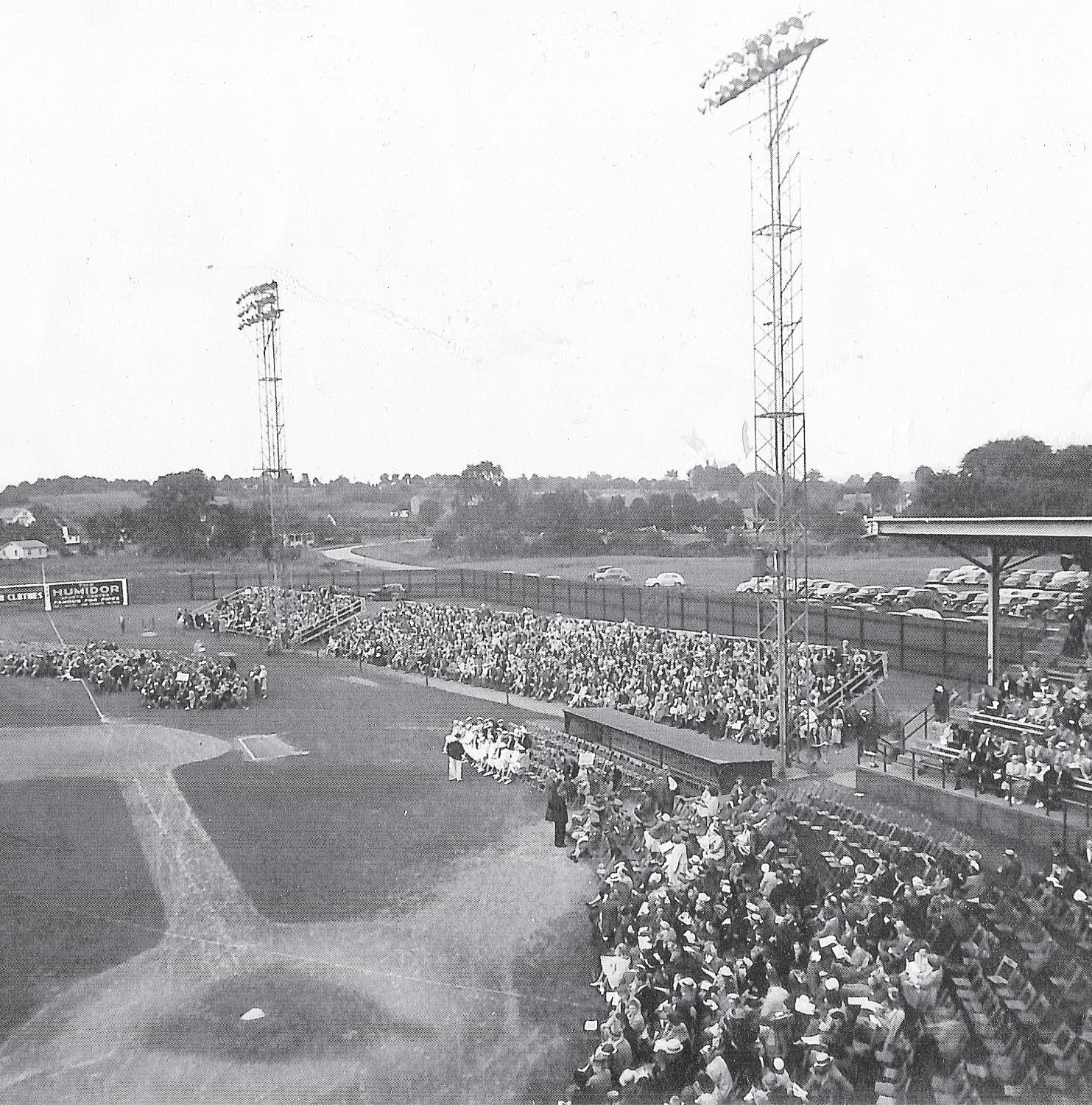
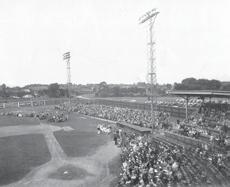
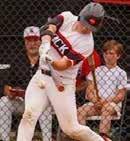
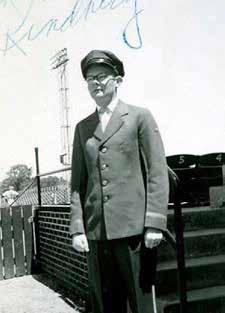
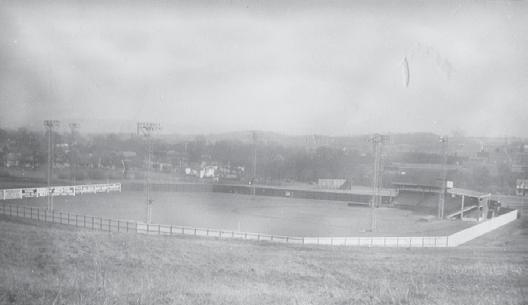
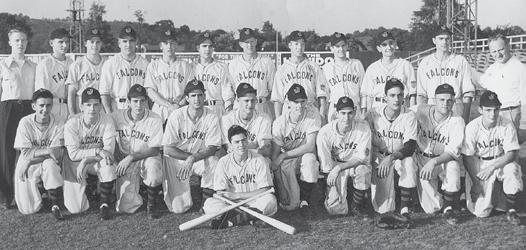
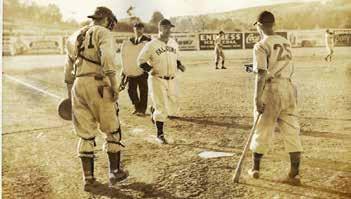
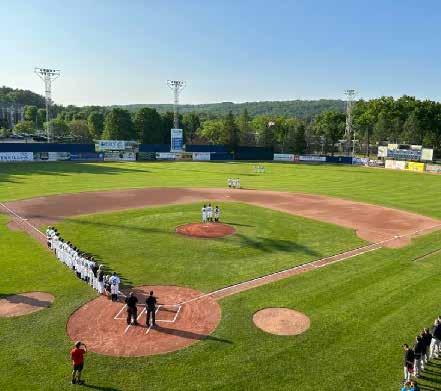
The first game ever played at Municipal Stadium — now Diethrick Park — was on May 6, 1941.
Photo courtesy of the Chautauqua Sports Hall of Fame
ADVERTISING DIRECTOR
Debra Brunner
716.487.1111 ext. 222 dbrunner@post-journal.com
SPORTS EDITOR
Scott Kindberg
716.487.1111 ext. 247 skindberg@post-journal.com
ART DIRECTOR/DESIGNER
Tesla Grobaski 716.487.1111 ext. 299 tgrobaski@post-journal.com
ADVERTISING REPRESENTATIVES
David Kircher
716.499.1165 dkircher@post-journal.com
Anna Vik 716.499.7460 avik@post-journal.com
PRINTED BY 15 West Second Street Jamestown, NY 14701
716.487.1111
Tarp Skunks
2026 PROGRAM JAMESTOWN COMMUNITY BASEBALL
TEAM ROSTER
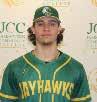
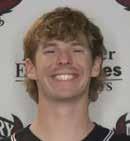
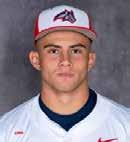
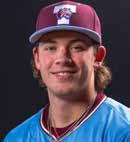
NAME: MATTHEW DUMAS
SCHOOL: ERSKINE COLLEGE POSITION: OUTFIELDER
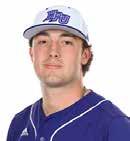
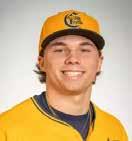
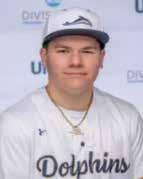
NAME: COHEN HARRIS
SCHOOL: HIGH POINT UNIVERSITY
POSITION: PITCHER
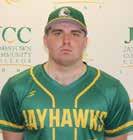
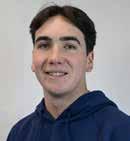
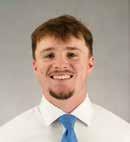
NAME: KOLDEN VINCENT MCCALL SCHOOL: JAMESTOWN CC POSITION: PITCHER
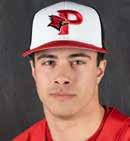
NAME: ERIC WEEKS
SCHOOL: CANISIUS UNIVERSITY
POSITION: SECOND BASE, THIRD BASE, OUTFIELD
NAME: SANTINO MUSONE
SCHOOL: JAMESTOWN CC POSITION: UTILITY
NAME: SEAN SPITALERI
SCHOOL: ST. BONAVENTURE POSITION: UTILITY
NAME: BLAKE HERMAN SCHOOL: CANISIUS UNIVERSITY POSITION: UTILITY
TEAM ROSTER 2026 PROGRAM
NAME: LOGAN PRICE
SCHOOL: COLLEGE OF SAINT SCHOLASTICA
POSITION: PITCHER
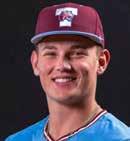
NAME CAMP CHURCHILL
SCHOOL: MCMURRY UNIVERSITY
POSITION: PITCHER
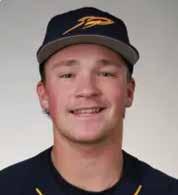
NAME: BRANSTON LINDQUIST
SCHOOL: TOLEDO POSITION: CATCHER
NAME: ROCCO ALMONTE
SCHOOL: LAKELAND CC
POSITION: PITCHER
2026 PROGRAM JAMESTOWN COMMUNITY BASEBALL
TEAM ROSTER
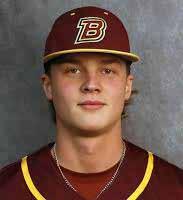
NAME: ANTHONY TROMMER SCHOOL: BLOOMSBURG UNIVERSITY POSITION: OUTFIELD
NAME: JAMES DIXON SCHOOL: SUNY BROCKPORT POSITION: UTILITY
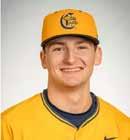
NAME: GRANT MOORE SCHOOL: CANISIUS UNIVERSITY POSITION: OUTFIELD
NAME: MIKE GUNN JR. SCHOOL: OLNEY CENTRAL POSITION: OUTFIELD
NAME: PAUL DULANTO SCHOOL: STONY BROOK UNIVERSITY POSITION: UTILITY
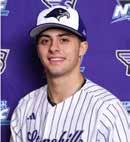
NAME: JACKSON ENDERS SCHOOL: STONEHILL POSITION: INFIELD
NAME: COLLIN PENCE SCHOOL: TRINITY UNIVERSITY POSITION: PITCHER
2026 PROGRAM JAMESTOWN COMMUNITY BASEBALL TEAM ROSTER
NAME: HEATH FETCHIK
SCHOOL: SETON HILL
UNIVERSITY POSITION: UTILITY
NAME: TAIT JOHNSON SCHOOL: TRINITY UNIVERSITY
POSITION: PITCHER
NAME: ZACH MCLEAN
SCHOOL: SETON HILL
UNIVERSITY
POSITION: PITCHER
NAME: JOSEPH SANTOS
SCHOOL: UNIVERSITY OF MOUNT SAINT VINCENT
POSITION: PITCHER
NAME: CALEB JORDAN
SCHOOL: LINCOLN MEMORIAL POSITION: UTILITY
NAME: JACK CASTILLO SCHOOL: SUNY PLATTSBURGH POSITION: PITCHER
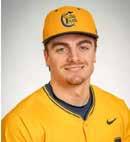
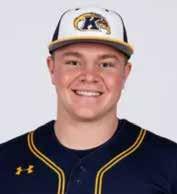
NAME: NATE MUNCY SCHOOL: KENT STATE UNIVERSITY
POSITION: FIRST BASE, OUTFIELD
2026 PROGRAM JAMESTOWN COMMUNITY
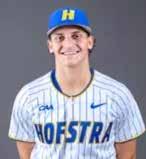
NAME: RENO SPAGNOLI
SCHOOL: HOFSTRA UNIVERSITY
POSITION: PITCHER
NAME: CJ DUGAN
SCHOOL: LINCOLN MEMORIAL UNIVERSITY
POSITION: OUTFIELDER
NAME:
SCHOOL:
POSITION: OUTFIELDER
NAME:
SCHOOL:
POSITION:
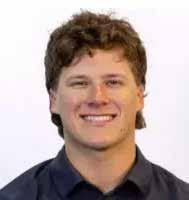
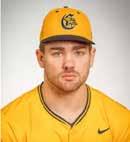
NAME: AIDAN GRUBER
SCHOOL: CLARION UNIVERSITY POSITION: PITCHER
NAME: JACK SANTI
SCHOOL: LINCOLN MEMORIAL UNIVERSITY
POSITION: PITCHER
NAME: JOAQUIN RODRIGUEZCOSTA
SCHOOL: UNIVERSITY OF DELAWARE
POSITION: FIRST BASE
NAME: NOLAN SMITH
SCHOOL: SUNY CORTLAND POSITION: FIRST BASE
NAME: ELI BRYANT
SCHOOL: KENT STATE POSITION: UTILITY
NAME: CHASE BERAN
SCHOOL: SETON HILL POSITION: PITCHER
2026 PROGRAM JAMESTOWN COMMUNITY
THE FIRST SEASON OF TARP SKUNKS’ BASEBALL WAS PRETTY SPECIAL
EDITOR’S NOTE: The following article first appeared in July 2021, the day after the Tarp Skunks’ final game of that season.
By Scott Kindberg skindberg@post-journal.com
I walked to Diethrick Park on Friday.
On any other day, it would take me five minutes, but late yesterday afternoon I decided to take the scenic route.
So, at just before 6 p.m., I ventured up Dearing Avenue to Frink Avenue where I made a left turn. Upon reaching the third house on the north side of the street, I paused for a moment, because that home — a stone’s throw from Ring Elementary School — is where my dad, Gunnard “Kinky” Kindberg, grew up.
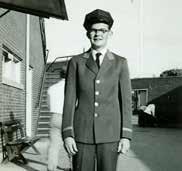
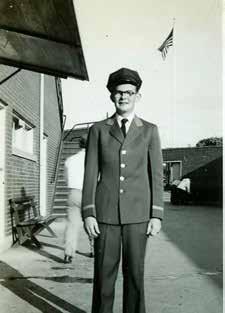
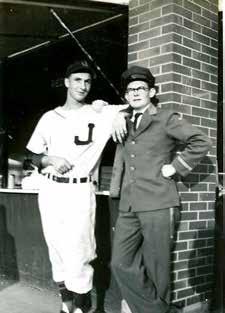
It was from there that — as a teenager in the 1940s — he would walk down Frink, cross Curtis Street and head for the ballpark, then known as Municipal Stadium, for Jamestown’s minor league games. Dad was a vendor and ticket taker during those years. Heck, he even had a uniform.
Those were the best days of his young life. I know that because he told me so. The son of Thore and Svea Kindberg could name the players without the benefit of a scorecard. He not only knew them by how they performed on the field, but he also knew them off it. His stories never got old, and the twinkle in his eye when he told them made the experience even more meaningful.
It’s for that reason that I wanted to walk to the Falconer Street ballpark last night. I wanted to see the excited fans beginning to arrive for the Jamestown Tarp Skunks’ Perfect Game Collegiate Baseball League playoff contest, imagining that was how my dad
and his brother, Harold “Pinky” Kindberg, felt as they likely ran to that piece of hallowed ground nearly 80 years ago.
My hope is that the youngsters who have turned out to see the “Skunks” play this summer will be able to one day tell their kids and grandkids about the Summer of 2021, a two-month baseball odyssey that everyone had hoped for, but — if they were honest — could never have expected.
I know the players and manager Jordan Basile won’t forget it.
That was evident when Basile saw a bunch of his players run out to shallow left field during pregame of the regular-season finale on Wednesday night. With third baseman Danny Hosley doing the honors, a cell phone “selfie” was taken with the nearly filled bleachers as a background. Smiles covered the faces of the young men who have called Jamestown home for the last 60 days.
My dad, who passed away in 2006, would have loved these guys. Just like he rooted for Johnny Newman, Ted Wyberanec Sr., Lyle Parkhurst and John O’Neil, the “kid from Frink” would have embraced these ballplayers and would have likely wanted to hang around for a postgame chat each night to get to know them better.
Because that’s the way he came to love the game as a teenager and it’s a gift he passed along to me.
The Tarp Skunks’ 4-3 loss over Geneva last night means their season is over, but regardless of the outcome, this summer has been pretty special.
The stroll to the ballpark on a beautiful July day was, too. Thanks, Dad.
as a TeenageR in The 1940s, gunnaRd “KinKy” KindbeRg woRKed as a vendoR and a TicKeT TaKeR foR JamesTown falcons’ games aT municipal sTadium. Photos courtesy of the chautauqua sPorts hall of fame
2026 PROGRAM JAMESTOWN COMMUNITY BASEBALL
PONY LEAGUE CAREER OF THE JAMESTOWN FALCONS HAD HUMBLE BEGINNINGS
EDITOR’S NOTE: The following is the first article tracing the history of the Jamestown baseball club in the PONY League. This is a recap of the 1939 season.
By Waite Forsyth sports@post-journal.com
So brilliant has been the PONY League career of the Jamestown Falcons that many a Jamestowner has all but forgotten the humble beginning and the lowly estate of the 1939 Jamestown Pirates, the city’s first representative club in the Pennsylvania-Ontario-New York League, organized in the fading months of winter and early spring that year.
And, indeed, from the vantage point of that 1939 campaign, it would have taken a seventh son of a seventh son to foresee the glowing future of Jamestown’s league entry, a future which encompassed a gate of 147,000 in 1942, the all-time minor league attendance record, two league pennants, possession of the Govenor’s Cup once and the participation in the postsea-
son playoff series for five consecutive seasons. The league was organized with six clubs, Jamestown, Bradford, Olean, Batavia, Nigara Falls and Hamilton, Ontario, and a 105-game schedule was adopted.
To begin at the beginning, there were lightning shifts in the executive management of the Jamestown club in those pioneer days. The first set of officers comprised Stuart C. Maguire, president; George F. Dodds, secretary; and Clayton A. Rugg, treasurer. William G. Broadhead of Chautauqua was named president of the Jamestown Baseball and Exhibition Co., shortly thereafter.
UNDER BUCS
The season was a week old when the Pittsburgh National League Pirates acquired the local club under an agreement to operate it as a farm team, with James F. Matthews as business manager. The deal was put through by J. G. Campbell, Dr. Charles F. Goodell, Oliver French, president of the Rochester Red Wings and “father” of the league, and Robert C. Stedler of Buffalo, president of the PONY League, negotiating with Matthews and Joe Schultz, head of the Pittsburgh club’s farm system.
Lewis Napoleon “Mickey” LaLonge of Buffalo, former major league catcher, was named manager of the locals, whose first nickname was “Jockeys,” which was changed to “Pirates” after the deal with Pittsburgh.
WIN FIRST TWO
The Jamestowners opened bravely enough, winning their league inaugural on Wednesday, May 10, at Batavia by defeating the Clippers, 9-4, behind the seven-hit pitching of Al Mucha. They also won their second game, defeating Niagara Falls, 6-1, with Dick Hine, Warren, Pennsylvania right-hander, on the mound. Then the Cataract City entry blasted out a 10-6 victory at the expense of Don Newark, native of Brocton.
From that point on, most of the news from the local fans’ viewpoint was sad. The NF win started the Pirates on Skidmore Road, the locals dropping 14 consecutive games. The LaLongemen hit the league bottom on the fourth day and remained anchored there the remainder of the season, right down to Labor Day, when they lost their final game to the Batavians. Naturally, with the tide running against him all the way, the desperate LaLonge tried every experiment known to man to sail his Pirate craft into the calm harbor of victory and the talent turnover was something with which to conjure. The pitching situation became so bad at a late stage of the race that Joe Black, a catcher, went to the mound and pitched a winning game. It was nothing unusual in Mickey’s book to switch a pitcher to one of the outfield spots, as he strove to instill a victory spark.
2026 PROGRAM
POLLOCK IN LINEUP
The Jockeys’ lineup (remember, this was a week before the Pittsburgh acquisition), in the opening game at Batavia included: Doman rf, Les James 3b, Cicarel lf, Merlin Peterson cf, Dave Aguina 1b, George Goodell 2b, Eley ss, Johnny Pollock c, Al Mucha p. James and Peterson were Falconer High School products, Goodell a graduate of Jamestown High School and Amherst College.
Along towards the middle of the pennant chase, the lineup shook down to this: Merlin Peterson cf, Johnny Lukon ss, George Goodell 2b (he also played third and finished playing first base), Joe Price and Hank Buzzinotti, catchers, Eddie Carmichael lf, Chuck Taylor rf, Paul Peterson 3b, Steve Gera 1b. Bobby Barnhart came on the scene and remained as third baseman for about two-thirds of the season, being displaced by Herbie Kam late in the campaign. Jack Lange bobbed up to play short for about a month, but was shifted to the Hutchinson, Kansas Class C farm of the Pittsburgh club.
OILERS WIN PENNANT
The Jamestown mound corps was paced by Stan Zatusky, who won eight games, lost nine and was sold to Knoxville of the Southern Association at the close of the season. Other pitchers included Bill Black, Don Newark, Al Krist, Ralph Mee of Falconer, Perry “Lefty” Hall of Jamestown, Chuck Ireland, Mike Legin, Eddie Welch (who came back for a trial with the Falcons in ‘43), Leon Skidgel, Paul Wiskup and Lefy Leo Murray, a 17-year-old who had everything a pitcher needs in his business but control. Zatursky, Black, Welch, Wiskup and Murray were on hand at the close of the season.
Goodell, who was the slugger of the team, and who set up a fielding record as a first baseman which still stands, was struck in the face by a one-bounce smash from the bat of manager Don Hurst of Hamilton, suffering a broken nose and being forced to retire from action after playing through 97 successive games.
Manager Jake Pitler’s Olean Oilers won the ‘39 pennant and the Governor’s Cup, defeating Hamilton in the playoff finals. In winning the flag, the Oilers compiled a record of 66 victories and 38 defeats for a .635 percentage, while Jamestown, at the bottom of the ladder, won 32 and lost 71 for a .311 average. The order of finish: Olean, Hamilton, Bradford, Batavia, Niagara Falls, Jamestown.
continued from page 14 2
2026 PROGRAM JAMESTOWN COMMUNITY BASEBALL
PIRATES MOVED OUT, BISGEIER BROUGHT NIAGARA FRANCHISE TO JAMESTOWN DURING TURBULENT 1940
EDITOR’S NOTE: The following is the second article tracing the history of the Jamestown baseball club in the PONY League. This is a recap of the 1940 season.
By Waite Forsyth sports@post-journal.com
Jamestown’s tenure in professional baseball, destined to be one of the most distinguished in minor league history of the country, swung with pendulum motion from the nadir to the zenith during the 1940 pennant race, the second in the annals of the Pennsylvania-Ontario-New York Class D League.
The lowest point came when the Pittsburgh National League club yanked its franchise from the city as the outgrowth of a dispute over improvement of the park and facilities at Celoron Park, transferring their rights to London, Ontario The transfer was made during the winter following the local club’s participation in the league’s first pennant race.
The zenith was reached when Harry Bisgeier, president of the Niagara Falls Rainbows Baseball Club, obtained permission from the Cataract City’s governing body to terminate his one-year lease of Hyde Park in the middle of the season, thus clearing the way to Bisgeier’s transfer of the league franchise to Jamestown.
LOSES $15,000
Bisgeier had dropped a reported $15,000 during his seasonand-one-half of operation of the Niagara Falls franchise, owing to lack of attendance, and was confronted with a situation which called either for seeking of a new operating base or of going broke. He held a natural aversion to the latter course.
Jamestown’s baseball-conscious citizens, from the city’s official family, headed by Leon F. Roberts, then mayor, down through the ranks of the most influential, down to the smallest kid ballplayer, having had a taste of organized ball and desiring more, pitched in with a will to cooperate in every way possible with Bisgeier and league president Robert C. Stedler to make the transfer a successful operation.
STADIUM MOVE
Already the movement to provide a $66,000 Municipal Stadium was under way here, headed by a citizen’s committee comprising Ernest C. Kessler, Municipal Judge Allen E. Bargar and Harry A. Taber. The city council members, various civic, fraternal and patriotic organizations, luncheon clubs and the leagues making up the Jamestown Baseball Association, plus scores of private individuals joined in making the project a truly community enterprise.
But the stadium would not be ready for use until the opening of the 1941 season, so Allen Park, where two diamonds had been used by Muny League teams for several years and which was in fine condition, was settled on as the temporary stamping grounds of Jamestown’s new PONY League entry. It was a new deal all around — and one that was fated to be successful in every respect. Additional bleachers were added at Allen Park, boosting the seating accommodations from 1,500 to 2,000, the field was surveyed and marked out according to league requirements by Joe Brown, then superintendent of the Buffalo Bison’s Offermann Stadium, and the playing field
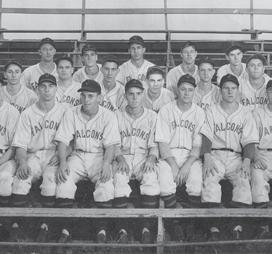
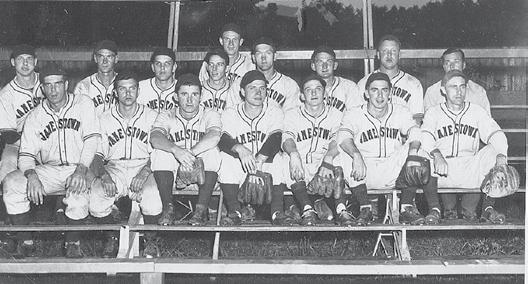
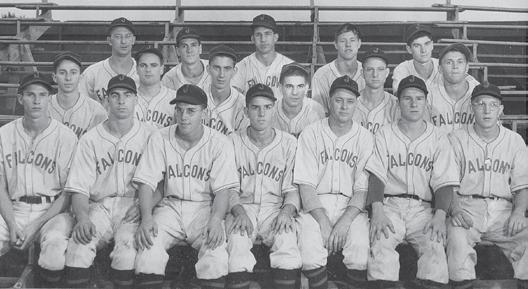
above is The 1940 JamesTown falcons Team.
Photo courtesy of the chautauqua sPorts hall of fame
2026 PROGRAM JAMESTOWN COMMUNITY BASEBALL
groomed to a gloss of perfection.
SET UP OFFICE
The club’s office was established in Room 22 of the Allen Square Building (where it was maintained until the conclusion of the 1945 campaign) and William J. Buckley, newly named business manager, was installed. Buckley had been similarly employed by the McKeesport club of the Pennsylvania State League earlier that year and, in 1939, had been the business manager at Batavia.
The nickname of Falcons was bestowed on the Jamestown club through vote of the fans, after such handles as Mustangs, Allen Mitts, Orphans and Spiders had been advanced, the final selection being made by a committee composed of Augustus F. Allen, Clive L. Wright and Wilbur J. Harris.
The Niagara Falls Rainbows made their last appearance in Hyde Park on July 12. Manager Joe O’Rourke and the 15 players making up the squad pranced through their first practice session at Allen Park on July 15 and they played their first home game as the Falcons on Friday, July 19, bowing to the Hamilton Red Wings, 7-5, before a crowd estimated at 3,000, but figured as 2,154 box office count.
1940 LINEUP
Samuel A. Stroth, then president of the city council, threw out the first ball at the inaugural, Judge Bargar was in the batter’s box and Ernest C. Kessler was behind the plate, Fred A. Chindgren, chairman of the City Council’s recreation committee, was prominent in the opening ceremonies, and Spencer C. Harris, president of the Olean Baseball Club and vice presi-
dent of the league, was present.
The Falcon lineup consisted of Meade Coyle ss, Hank Nowak cf, a new acquisition from the Bisons; Nick Lemone 2b, Frankie Heller 1b, Bill Harnick rf, Johnny Newman lf, Bobby Blanchard 3b, Dick Offenhamer c, Walt Balash p, southpaw Art Cuccurullo, now of the Pittsburgh Pirates, relieved Balash in the ninth inning with two men on and none out. Balash, by the way, had pitched the league’s first no-hit, no-run game in the PL against London earlier that season.
Besides Balash and Cuccurullo, the Falcons’ mound staff was composed of Dick Schmidt and Duane Shaffer, both now residents of Jamestown, Charley Munger and Frank Smrekar. Schmidt had a great year in 1940, incidentally, emerging the league’s strikeout king with 173. The first time Schmidt pitched wearing the new Jamestown uniform, he twirled a onehit 8-0 victory over the Bradford Bees.
COYLE CUT LOOSE
Shortstop Coyle was the first Falcon to draw a release. He became embroiled in an argument with manager O’Rourke concerning his right to go into deep left-center after a fly ball in the third inning of a game played here July 28, was benched. Nowak was moved to short and Cuccurullo went to center to finish the game, which Jamestown won, 18-15, over London. Al Bradley, a likeable stripling, joined the Falcons a few days later, taking over the short field assignment.
The Falcons had arrived in town riding in fourth place in the standings of the six-club league and shortly thereafter bounced into third place trailing Batavia and Olean. It might as well be said right here that Jake Pitler’s Olean Oilers grabbed their second flag in succession, zooming all the way from the league cellar to first place during the last half of the season, helped no little by the injection of seven players, obtained when a Dodger farm club in the west was dismantled in midseason.
EDGED BY LONDON
With the pitchers turning in consistent five-star performances and the team playing grand defensive ball, the Falcons clung to their third-place berth by a margin no wider than a razor’s edge right down to the final day of the race, Labor Day, when they dropped both decisions in a doubleheader at London.
The double defeat pushed them into fifth place, behind Olean, Batavia, London and Hamilton, and out of the Governor’s Cup playoffs by three or four percentage points.
It was one of the ironic twists of the baseball fates that the Falcons were elbowed out of the playoffs by manager Jimmy Jordan’s London Pirates, the team that had represented Jamestown in 1939. Jordan’s feat in driving his Baby Bucs into the playoffs is regarded as one of the finest managerial jobs in PL history.
Olean eliminated Hamilton and Batavia took London in the playoff semifinals. Then the Olean Oilers racked up their second “Big Mug” triumph in succession by winning four games of six from the Clippers.
Owner Bisgeier, manager O’Rourke and business manager Buckley comprised a disappointed — not to say crestfallen trio — when they assembled in the Jamestown club office following that disastrous holiday trip to London. They had little say.
But better days were in store for the Falcons — and they were not far away.
2026 PROGRAM JAMESTOWN COMMUNITY BASEBALL
FALCONS’ BANNER SEASON BROUGHT THEM THEIR FIRST PONY LEAGUE PENNANT TO JAMESTOWN
EDITOR’S NOTE: The following is an article tracing the history of the Jamestown baseball club in the PONY League. This is a recap of the 1941 season.
By Waite Forsyth sports@post-journal.com
The season of 1941 always will be regarded by this writer as the most momentous in the baseball history of the City of Jamestown.
The 1941 Falcons, under the inspired leadership of Gregory “Moe” Mulleavy, whom Falcon owner Harry Bisgeier brought here from Buffalo to manage the club, dispelled all doubts. They enacted their role in the local diamond drama by winning the league pennant in the most exciting race of the 3-year-old circuit and establishing a number of individual league records, several of which still stand.
The fans did their part, too, by making the turnstiles click most merrily. So well did they turn out for the home games of the Flock that they established Jamestown as the capital of the league, in box office figures, which, after all, in any business enterprise is the ultimate answer.
Bisgeier’s choice of Mulleavy, veteran shortstop of the Buffalo Bisons and a former Chicago White Sox infielder, proved as sound as a U.S. Treasury note. Popular with players and public alike, Mr. Moe had a hustling, scrappy club on the road to Pennantville in the early stage of the race and the word was soon passing around the loop the Falcons were the team to beat.
After spring training at Waynesboro, Virginia, the Men of Mulleavy opened the schedule by soundly thwacking skipper Jack
Sanford’s Batavia Clippers, 9-2, in Jamestown’s spanking-new Municipal Stadium, a baseball plant which, with its surroundings, was not only efficient from a utilitarian viewpoint, but as a photogenic as the most glamorous movie star.
The official attendance for the inaugural was reported at 3,959. The contract of Johnny Pollock, who had caught for a few games for the 1939 Jamestown club, then a Pittsburgh Pirate farm, and who had been the regular catcher for the London, Ontario Pirates of 1940, had been purchased by Bisgeier, and he banged a triple, double and single that day (Pollock, back from the war, is slated to handle the first-string catching job for the 1946 Flock).
Jamestown’s infield was made up of Frankie Heller at first base, Mulleavy at second, Johnny “Scooter” O’Neil at short and Al Bradley at third on opening day. With the exception of Bradley, that was the inner cordon when the team came down the stretch. Frank Carswell, a powerful young fellow from Texas, arrived in May, supplanting Bradley at the hot corner.
By the middle of May, the Falcons were rolling. Bill Hardin had come on from the Midwest and Johnny “Cy” Williams, from the deep south, had arrived to share the outfield patrol with “Joltin’ John” Newman, who was destined to set up a league record of 29 homers that year, a record that still stands.
About the second week of June, a young fellow blew in from Detroit, on option from the Tigers. His name was Pete Angell and he was a pitcher by trade. He could also hit and play the outfield, talents which he was called on to use from time to time. Pete went on to win 14 games, lose 3, for an average of .824, best in the league. He pitched in 19 games, 152 innings, had an earned run average of 3.73 and struck out 102 batters. He also paced the league’s pitchers in fielding, handling 48 chances without an error.
Stan “Little Giant” Rogala, the little fellow with the strong arm and the “live” ball, was another factor in the Flock’s pennant
continued on page 20
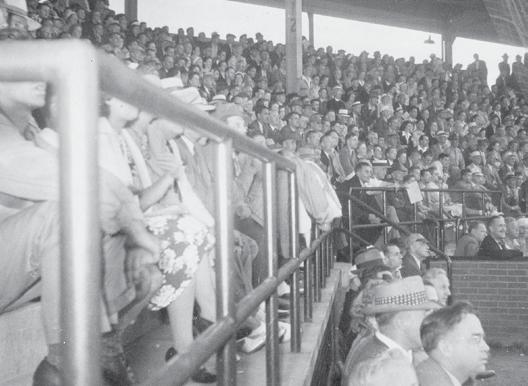
JamesTown falcons fans pacKed municipal sTadium in The 1940s. Photo courtesy of the chautauqua sPorts hall of fame
continued from page 19
parade. One of the most effective pinch pitchers of all time in the PL, the Niagara Falls youth finished the most games, 23, a new record; posted a 2.79 earned run average in a total of 30 games; and pitched an even 100 innings. His won-lost record was not impressive at four victories and seven losses, but he was the victim of faulty support in four of his reverses.
The first night game at Municipal Stadium was played June 6, Del Bissonette’s Bradford Bees winning a 6-3 decision. Right along here the Falcons’ mound corps suffered a lapse, but Jamestown was in second place, trailing Batavia, on June 17. Williams fractured his ankle, sliding into third base on a triple in a night game June 24, and his right field spot was finally turned over to Earl Rapp, a raw-boned, loose-jointed kid, who came here from Oneonta of the Canadian-American League. Then Pollock broke his finger and was replaced by Haskell.
The Falcons jumped into first place on July 15, lost it to Bradford, regained the peak on July 29. Newman hit his 26th homer, setting a league record, on Aug. 11. Jamestown clinched the pennant Aug. 29, and entered the semifinal series of the playoffs with Hamilton with this lineup: O’Neil ss, Hardin cf, Newman lf, Heller 1b, Rapp rf, Mulleavy 2b (spelled by Ray Borowicz because of an ailing back), Carswell 3b and Frank Smrekar p.
Hamilton eliminated Jamestown from the playoffs, four games to two, but exhausted its pitching staff in doing so, failing easy prey to Bradford, which had taken the measure of Batavia,
Bissonette’s Bees, grabbing the Governor’s Cup, four games to one.
O’Neil, Mulleavy and Heller led the league in fielding at their respective positions, and Carswell placed second among the third basemen.
Newman was the record maker of them all. He won the batting championship with a .358 average; scored the most runs with 112 for a new mark; drew the most bases on balls (101), a new record; hit for the most total bases (265); most home runs (29); and led in runs batted in (96).
FALCONER VAC SHOP
municipal sTadium in 1941.
Photo courtesy of the chautauqua sPorts hall of fame
2026 PROGRAM JAMESTOWN COMMUNITY BASEBALL
FALCONS DREW 147,000 IN 1942, BEAT OLEAN TO WIN PENNANT AND CUP PLAYOFF
EDITOR’S NOTE: The following is an article tracing the history of the Jamestown baseball club in the PONY League. This is a recap of the 1942 season.
By Waite Forsyth sports@post-journal.com
The PONY League pennant race of 1942 — lusty, brawling, brash, packed to the seams with vitamins, vigorous and vibrant — signalized the coming of age of the league, full-blown now with eight clubs, Jamestown, Olean, Bradford, Batavia, Hornell, Wellsville, Lockport and Hamilton.
In my book, the 1942 campaign was the greatest, the most colorful in the history of the league.
Several factors contributed to the explosive quality of the flag chase. Probably the most important of these was the hell-forleather, win-the-pennant-and-the-cost-be-hanged-attitude of the operators of at least five of the clubs.
The league had been well-heeled from the beginning, and the policy of planting a couple of dollars here and there in the uncovering of talent and improvement of the circuit’s physical properties was paying off in a big way.
Secondly, there was an abundance of young ballplayers in the land — not only young but teeming with diamond talent that was as impressive as it was startling to the analysts.
FIRST WAR SEASON
And, finally, there was a war on, and the whole country realized it. There was a feeling prevalent that this might be the last season the fans would have to look at organized baseball for a long time. The reaction of the public was natural: crowds
flocked to the league stadia, and worked themselves to a frenzy that at times became almost hysterical as they cheered and exhorted their favorites to bring home the little three-cornered piece of blue bunting with white numerals.
And the champion Jamestown Falcons were the hub of this feverish, whirling, swirling maelstrom. With Greg Mulleavy at the helm for the second straight year, the Flock, as swashbuckling a crew as the famous Gas House Gang that was the St. Louis Cardinals, battled tooth and fingernail, no holds barred, from the very first to the very last day to nose out “Sundown Jake” Pitler’s Olean Oilers for the pennant and to go on to win the playoffs from the Oleanders. The margin in the fight for the gonfalon was a game and a half and it took a grand-slam homer by catcher George Zimmerman as part of a ninth-inning, seven-run rally that provided the Men of Mulleavy with a 10-9 victory to clinch the “Big Mug.”
DREW
147,000
The Jamestown club drew 147,000 fans, a record for small
continued on page 22
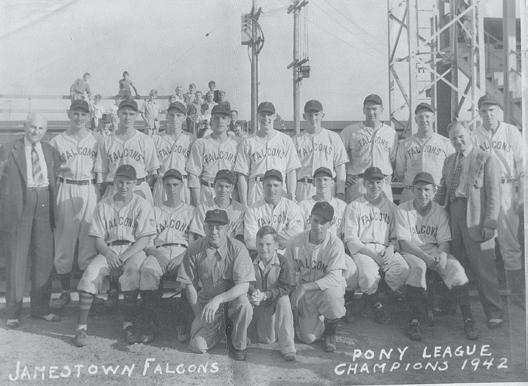
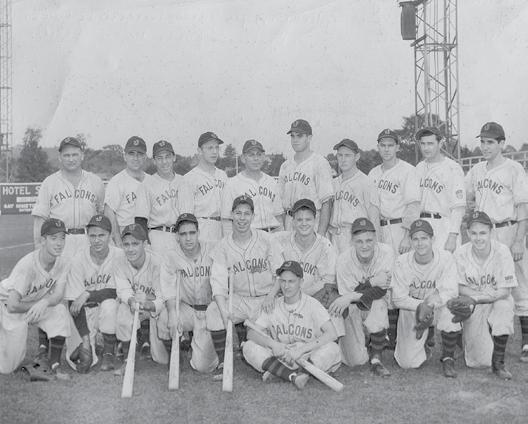
above is The 1942 JamesTown falcons Team.
Photo courtesy of the chautauqua sPorts hall of fame
minor leagues.
2026 PROGRAM JAMESTOWN COMMUNITY
The Falcons, as in 1941, trained in Waynesboro, Virginia. It was a skeleton of the pennant-winning Jamestown club that went through the spring grind: Mulleavy, pitchers Duane Shaffer, Bob Swanson, Stan Rogala. Johnny Newman, the league’s batting champion and home run king, Lyle Parkhurst, a pitching prospect, product of the local sandlots, made the trip — and the team.
The Mulleavymen opened the schedule inauspiciously, losing at Batavia, 8-3, with Rogala, whiffer of 11 batsmen, the victim of atrocious support. The Falcon lineup that day: George Homenuk, lf; George Lerchen, cf; Louis Antonio, rf; Elmer “The Great” Weinschreider, 1b; Mulleavy, 2b; Chet Kareka, 3b; Ted Wyberanec, ss (with the Falcons again this year); Red Dulaney, c; and Rogala, p.
PLAY BATAVIA
The home opener, with Jack Sanford’s Batavia Clippers, was rained out in the second inning and rescheduled for the next day. Jamestown won the two-part opener, 15-6, before a twoday howling crowd of 6,700 fans.
Pat McNair, a brother of Big Leaguer Eric, broke in at shortstop for the locals that day and made four hits, one a homer. Newman was back in left field, a fellow named Al Suberville catching and Shaffer pitching. That was on Saturday. On Sunday, at Olean, the Oilers keynoted their Falcon platform by taking an 11-3 decision. Charley Schupp, a right-hand smooth-
PIKE’S
ie who could do everything on the diamond and who had caught in the International League, tamed the Pitlerites, 5-0, starting a campaign that was to see him establish an all-time league record of 24 victories and seven defeats.
continued on page 23
Johnny newman
2026 PROGRAM JAMESTOWN COMMUNITY BASEBALL
continued from page 22
Jamestown afforded the competition for the Lockport White Sox as the Lock City club opened its fine new Outwater Stadium, losing a 7-1 game before 3,000 witnesses, with Eddie Welch (1940 Falcon) and Johnny Ramirez on the hillock. A kid from Baltimore, Charley Plitt, the oyster shucker, a righthander, joined the club May 17 and a youth named Engle was playing right field.
TAKE FIRST MAY 26
The Falcons displaced the Oilers in first place May 26, Schupp subduing the Oleanders, 5-3. A few days later, the Mulleavymen trimmed Batavia, 10-5, six home runs rattling off the bats of the power-laden locals. Tommy Sass (with the team again this year), now the regular right fielder, Suberville, Lerchen and Weinschreider each blasted round-trippers and Newman hammered two.
The locals and Olean settled down to their cat-and-dog fight for first place in earnest now and from here on out the margin separating the two was seldom greater than one-anda-half games. Newman, too, was engaged in a mad battle for league batting and homer honors with Bradord’s Connie Creedon, a belting outfielder.
Jamestown bowed to the Boston Braves, 4-3, in an exhibition game before 4,400 fans in Municipal Stadium on July 7, with Rogala and Dulaney comprising the battery. On July 8, Olean was in first place by half a game. Suberville was called to the Navy and Zimmerman replaced him at this stage of the proceedings and Charley Medlar, a mountain of a man, joined the mound corps.
NEWMAN GETS 27 HRS
Newman hit his 27th homer, last one of the season for him, as Jamestown downed Lockport, 7-3, behind Plitt on Aug. 25. The Flock defeated Olean in both ends of a doubleheader, with Schupp gaining both verdicts by pitching the opener and saving the 11-inning nightcap on Aug. 26. The largest crowd in Jamestown’s history, estimated from 5,500 to 6,000, was in attendance.
The Falcons clinched the pennant by nicking Batavia, 9-5, on Sunday, Sept. 6, with Plitt and Schupp hurling, the
Flocker’s margin over Olean being the now familiar game and a half.
Jamestown eliminated Hornell three games to none, and Olean crushed Batavia just as decisively in the Cup semifinals. The Olean-Jamestown finals see-sawed this way: Olean 1, Jamestown 0, in 13 innings; Jamestown 5, Olean 4; Jamestown 6, Olean 0; Olean 10, Jamestown 8; Jamestown 11, Olean 6; Jamestown 10, Olean 9, thanks to the aforementioned Zimmerman grand-slam homer.
The Mulleavymen ended their career as a unit with a 9-1 thumping of an all-star county Muny nine in the local playstead.
But war clouds were blacker and every baseball fan in the land was filled with doubt concerning the fate of the national game come another season.
2026 PROGRAM JAMESTOWN COMMUNITY BASEBALL
WAR-RIDDLED FALCONS WERE PLAYOFF CLUB IN 1943
EDITOR’S NOTE: The following is an article tracing the history of the Jamestown baseball club in the PONY League. This is a recap of the 1943 season.
By Waite Forsyth sports@post-journal.com
The impact of World War II struck the national baseball picture with full force by the time the 1943 season rolled around, and the number of operating leagues, both major and minor, dropped with a resounding thud from some 40 to 10, including one Class E circuit.
The fans of Jamestown and vicinity heaved a collective sigh of thanksgiving when it became known definitely and finally that the PONY League would be one of the Class D loops which would be kept in the active ranks. The Appalachian League was the other Class D wheel which was kept in operating gear.
But, while the baseball addicts were assured that the PONY League and the Jamestown Falcons would carry on despite the war, conditions of the times forced a new setup in the local club’s management. Club owner Harry Bisgeier had been called to the Army late in the preceding fall.
Desiring the Falcons to continue their career and impelled by a deep-rooted conviction that he should keep faith with
the Jamestown fans, Bisgeier arranged to have the Jamestown franchise declared inactive and then worked out an agreement with Sam Breadon to have the St. Louis Cardinals (who had closed their Hamilton plant for the duration) operate their franchise in Jamestown.
BRADFORD OUT
Another development had blocked out Bradford from participation in the 1943 race, the Boston National League club having withdrawn from operation of the Braford club. Thus, the PL was again reduced to a six-club league, with Jamestown, Olean, Hornell, Batavia, Lockport and Wellsville on the roster. Oliver French, “father” of the league and president of the Rochester Red Wings, became president of the local club, and Andy French, brother of Oliver, became the business manager, succeeding Jack Darling. Bisgeier, who had been eyeing the managerial job done at Batavia by Jack Sanford from the time the fiery Georgian took over early in the 1939 season, succeeded in coaxing Sanford from a wartime job in Buffalo, hiring him for the Falcons manager.
Jamestown trained at Lynchburg, Virginia, and in one of his first interviews with the local newspapermen on the return of the squad to Jamestown, stressed the point he would base his team’s attack on the running game.
above is The 1943 JamesTown falcons Team.
Photo courtesy of the chautauqua sPorts hall of fame
1944: FALCONS SEASON A SUCCESS
EDITOR’S NOTE: The following is an article tracing the history of the Jamestown baseball club in the PONY League. It first appeared in The Post-Journal in September 1944.
By Waite Forsyth sports@post-journal.com
The six-season history of the PONY League has been packed with drama, melodrama, humor and burlesque. It’s a colorful league, in addition to having gained national recognition as the leading Class D League in the nation.
There have been tight races for the championship in the last four seasons, invariably the battling for playoff berths has had the fans hanging on to their hats and the edges of their seats in every campaign.
But, for sheer downright blazing finishes and a hair-breadth
above is The 1944 JamesTown falcons Team.
Photo courtesy of the chautauqua sPorts hall of fame
win of a playoff berth, as exemplified by the Jamestown Falcons’ half-game margin over the Batavia Clippers for second place in the final standings, you may quote me as saying the 1944 season is tops.
Not only was the campaign, concluded yesterday, wholly satisfactory from the viewpoint of the Jamestown club, but it afforded the Falcon rooters with a schedule-long suspenseful struggle, and spine-tingling finish such as has not been the lot of local fans before, even when Falcon catcher George Zimmerman connected for that grand-slam homer at Olean which gave the Falcons the 1942 gonfalon.
The recording of two shutouts in a row by one pitcher is sufficiently rare to make headlines in “box car” letters in the nation’s daily newspapers, but when two such games are put together in the semifinal and final games of a league seasons, and when the pitcher in the case is striving for his 20th victory of the season in his second endeavor — and against the same club, which is assumed to be a lot tougher to conquer during that second “trip to the well” — the event becomes one for the use of superlatives only.
So lefty Lyle Parkhurst, Jamestown’s own, is rightfully entitled to a niche in the PONY League pitchers’ Hall of Fame, alongside such fellows as the Falcons’ Charley Schupp of ‘42, Hornell’s Gebrian of ‘43, Hamilton’s George Dockins of 1940 and 1941, Lockport’s Phil Poole, et al. continued from page 25
2026 PROGRAM JAMESTOWN COMMUNITY BASEBALL
BATTLE-SCARRED VETERAN HURLS FOR THE FALCONS WITH PLATE IN HEAD AND PARALYZED LEFT ARM
By Frank Hyde sports@post-journal.com
Mother’s cooking and a love of life and sports has brought one veteran of this war back from that panorama of the living and the dead that was the Saint-Lo breakthrough.
This pleasant-faced chap is laboring through the grist mill of organized baseball with part of a sustainer plate in his skull, a semi-paralyzed left arm and hand, and a numb side because he still loves sports — especially baseball.
The kid is Robert Vetter, right-hand pitcher of the Jamestown Falcons.
We talked to Buffalo Bob in the noisy confines of The Post-Journal editorial rooms with typewriters cluttering out their ceaseless monotone to partly drown out his low, well-modulated voice — a voice that arose only in a tense sort of way when he told us (under constant prodding) of this battle that will live forever as a solid symbol of the “Blood and Tears” Winston Churchill told the world would win this struggle for a free man’s way of life.
This was the fifth action-scarred veteran we had interviewed since the Japanese punched below the belt at Pearl Harbor, and they are all the same. There is no bluster, no bravado, no “Big I” — just a quiet, convincing way of telling you they have been to and returned from a strange, unreal world where men live and die by the grace of God. … Where you throw your best pitch with the bags loaded and recall your babyhood prayers.
BLASTED AT SAINT-LO
For the benefit of those who may not have followed the history of this war as closely as they should have, the Saint-Lo breakthrough was one of its briefest battles. By the same token, it was one of the bloodiest.
The military freely admit now the Germans knew the Allied strategy for taking the village of Saint-Lo, a warm, friendly little French town of smiling peasants and grape arbors during the peace years, and were ready with a mailed fist.
Quite a bunch of American boys moved through the wraithlike morning mists on Saint-Lo — a lot of Tom’s and Joe’s and Bill’s and Bob’s. The kind of boys who delivered your groceries
yesterday or tossed a stone at your cat or pilfered a melon from your garden. And out of that bunch the official archives show Robert Vetter came back — Vetter and two others.
We asked Jamestown owner Harry Bisgeier to send Bob around so we could get this story. It took a long time, even for a convincing guy like H.B, but one day the bespectacled hurler strolled in, sank in a chair and said, “What do you want to know about me?” … Just like that, see.
Robert Vetter is 20. He frankly admits his mother is the world’s greatest cook and his dad, Louis Vetter, the world’s greatest guy. Both are residents of Buffalo, where the senior Vetter is a mechanic. A married sister, Mrs. Edna Milbrant, completes the family circle.
JOINS FALCONS IN 1943
Young Vetter displayed an intense desire to throw something from the day he caromed his first pitch (bottle, nipple and all) off the chandelier after getting a solid stance on the “pitching rubber” — the foot of his crib.
As the years passed, the kid talked two things: baseball, then more baseball. Unlike the storybook youngsters who had to run away to make a career over their parents’ objections, then come back just in time to pay off the mortgage on the old homestead and kick the villain out the back door, Rapid Robert had a solid background. Mom and Pop were all for it.
“Let him go, and find out right now if he’s going to be a ball player or not,” they chorused.
Possessing a natural submarine and sidearm delivery, Robert made his first mound start in a Muny league game in Buffalo. He got by all right, but decided he needed more throwing practice, so he fired rocks at and over everything that would pass for a home plate.
Finally, in the spring of 1943, he attended spring training with the Rochester Red Wings of the International League, eventually getting in one game as a relief hurler. Later, he was optioned to the Falcons for seasoning.
continued on page 28
above is The 1945 JamesTown falcons Team.
Photo courtesy of the chautauqua sPorts hall of fame
Connecting You With Better Hearing
continued from page 27
HANDS BATAVIA NO-NO
Pitching a no-hit, no-run game against Batavia in 1943, gave him his biggest thrill. The feat is nothing short of sensational when one considers he was hurling to a pickup catcher, a resident of Olean signed expressly for this game when the regular flock grabber became sick and was unable to take his turn.
More of that later, though.
Vetter had a 7-4 record in 1943, but baseball was laid aside, for Hirohito had cast his eyes northward and things were happening.
After entering the service late in 1943, Vetter was sent to North Camp Hood, Texas, and from there went on maneuvers into Tennessee and, later, to Camp Butner, North Carolina debarkation point for Europe. His company left the United States on May 12, 1944, and landed in England 15 days later.
“We went across into Germay a few days after the Normandy Beach Head and landed at a place called Omaha Beach,” he said slowly, digging his heel against the floor as if placing the rubber before continuing.
How Vetter came through the Saint-Lo slaughter and returned to play baseball again cannot be told in a few words, even in these paper-saving days of boiled-down writing, so the story continues.
“We were supposed to move on Saint-Lo, screened by a roving barrage,” he explained slowly, speaking so low it was hard to distinguish his words at times.
The barrage was to have lifted at intervals to give up a chance to go in and mop up, but his mission was just like a ballgame where someone bobbles the first grounder. Everything goes wrong after that. Guess that’s the way it was at Saint-Lo.
“In the first place, the Germans were smart. They moved back with the first barrage and planned one of their own with the advantage of knowing every foxhole and barrier since they had just deserted them. When we moved into that pocket-marked slaughter pen you can imagine what happened.”
What happened is now history. Men went down like chaff in a Texas tornado.
Vetter was wounded with the first burst as a shell came over and killed his platoon sergeant, who was standing beside him. Men staggered, fell and returned fired in a savage turmoil of death and destruction. Ammunition was soon exhausted and practically every man in the outfit was down.
Then came the American barrage, adding to the confusion and horror as it fell directly in the ranks of the battered Yanks. Desperate phone calls failed to make contact, and finally the lines went dead, leaving the bloody little group alone in a shrapnel-torn world of their own — in miniature “Lost Battalion.”
GERMANS POUR IT ON
“Everyone was down but a couple of us,” Vetter said. “We finally decided to get out of there because we could see Americans falling back on both sides of us as the smoke cleared at intervals.
“Then they really tossed the book at us. Mortars, machine guns, bazookas — the works, if you get what I mean.
“I was lying on my back when I came around. A fellow named Bonzar from Lowell, Massachusetts came rolling down into my ditch. I could only wiggle my hand a little and my mouth was hanging open. I remember trying to shut it so I could shout something, but it was no dice. My whole face was paralyzed, but I sensed being hit several times. Later, I learned it was in the head, chest, stomach and side.
continued on page 29
2026 PROGRAM JAMESTOWN COMMUNITY BASEBALL
“Shells were nicking the trees and it was fascinating to lie there on your shoulder blades and watch them. A burst would come over, sending down a little cascade of clipped leaves and wood splinters.”
Men are said to undergo mental flashbacks in such times of stress which paint a picture of many incidents in their lives. If so, it is likely Buffalo Bob thought of the quiet trees of his native New York state, disturbed only by Lake Erie’s soft breezes; of mom and pop and sis and of that first Muny league game; of a baseball career that seemed so far away now — of the thousands and thousands of little things that go into the American way of life.
“Well,” he continued slowly, “we finally decided to try and move out. My helmet, glasses and canteen were gone and I remember wanting a drink of water awfully bad. About that time, a fellow named Newberry came up the gully, walking straight up in shellshocked rigidity. He was laughing out loud in a strange and terrifying sort of way as he headed straight for the German lines. I never saw him again.”
FINDS HAND GRENADES
“A Corporal Kent finally joined us, and between he and Bonzar they plastered me with a few first-aid dressings,” Vetter continued. “They said I was hit pretty hard in the right side, but my left side was numb. That’s the way it is today, seems to affect the opposite side.
Pretty soon a first-aid man came through the smoke and took over. I never saw Kent or Bonzar after that, but heard they got out. The first-aid man started along a shell-swept ridge as we headed back for our stations. I sure figured this was the end, but he said the Germans wouldn’t fire on a Red Cross worker. They didn’t either, although we must have been in plain sight.
“We worked down into a gully where they had a jeep backed up. They put me in the front seat and laid another fellow on the hood. I held his head. Guess he was about done in. That’s how we reached a temporary hospital set up in a hedge grove.
“Something happened then that seems sort of funny now. They left me sitting on the ground for a few minutes. I had on a regulation field jacket turned inside out to keep it from reflecting the sun’s rays. A big lump under the jacket aroused my curiosity and I kept working at it in a dazed sort of way. Suddenly, out fell eight hand grenades! Hate to think what would have happened had a shell knocked off a pin during all that shooting. Anyway, I picked up one and was holding it in my hand when a big sergeant spotted me. He let out a war whoop like a Comanche and dove at me head first, grabbing the grenade and brushing the others out of reach. Guess he thought I was daffy and was going to blow up the whole bunch of us.”
STARTS LONG COMEBACK
From then on out, the story of Bob Vetter is the story of a kid who laid in service hospitals for weeks and weeks, staring at the ceiling and thinking of parents, home and baseball. A career on the diamond seemed like a fantastic dream during that long period in England convalescing units.
Finally came a day when young Vetter could be up and around, which led him to the hospital table tennis room. Today the husky right-hander gives table tennis credit for bringing him a considerable way along the comeback road. There followed an air trip back to the United States, landing at New York, examinations in Ashford General Hospital and a hitch at White Sulphur Springs where two operations were performed on his head. An honorable discharge on Nov. 18, 1944, only a few days after observances were held commemorating the ending of the first World War 26 years before, climaxed Bob Vetter’s military career.
Baseball called again and the 1945 season found Vetter in the Cardinal chain and en route to Winston Salem, where he appeared in five games as a relief pitcher without being credited with a victory or charged with a loss. He eventually wired President Harry Bisgeier of the Falcons, who responded immediately, asking him to report.
“Those fellows (Bisgeier and manager Jim Levey) had a lot of faith in me,” Vetter revealed. “They taught me to have faith in myself. It’s a long way and I’ve got a lot to learn, but now I am sure I’ll make it.”
RECALLS THE NO-HITTER
Going back to that no-hitter against Batavia, Vetter turned it in on June 17, 1943, to become the first and only Falcon to date to fire a no-no in the PONY league.
Jamestown rolled into Batavia for the game minus a catcher through some unforeseen last-minute incident. Someone mentioned the stadium electrician, Al Bermingham, had been a pretty good grabber in his day. Al, father of five children and away from baseball for several years, agreed to lend a hand and wound up on the receiving end of a no-hit, no-run game as Vetter completely stifled the Clippers, 9-0.
Recalling the incident to the writer, Vetter referred to Bermingham as a “swell catcher, steady as they come and plenty smart back there, too. I took every sign he offered without shaking him off once, and he sure came through in fine style as Batavia failed to get the ball out of the infield.”
So Bob Vetter comes back to baseball to add another to the many examples that are being set today throughout our land as our fighting men return to the fields of friendly strife.
2026 PROGRAM JAMESTOWN COMMUNITY BASEBALL
JOHN NEWMAN, BABE RUTH OF THE PONY LEAGUE, IS LIVING LEGEND HERE AS HOMER HITTER
EDITOR’S NOTE: The following article on Jamestown Falcon Johnny Newman first appeared in The Post-Journal on Dec. 31, 1952.
By Frank Hyde sports@post-journal.com
John Henry Newman (family name Nyman), who has become a legend in these parts as did Babe Ruth on a world-wide scale because of his ability to hit a baseball farther than anyone else, thinks his PONY League homer mark, which has stood for a decade, will be broken some day.
But Big Jawn, now a city bus driver, adds a quick rider — “if it is, it will be be in either Olean or Hornell. Those fences are too short.”
Few people know it, but Newman actually holds three home run records.
He belted 33 for a record while with Owensboro, Ky., of the Kitty League in 1939, hit 29 to better the PONY mark in 1941
and the following year hit 30 to fracture his own record. He won the PONY batting title both seasons with .358 and .353 averages.
It took some doings to get those 30 circuit blows of ‘42 in the books, however. Somewhere along the line, the league’s official scorer had dropped three homers giving the big fence-buster credit for 27 when the season closed. Several years later the writer launched a checkup, after Newman insisted he had hit 30, and sure enough, the official reports, then with the Elias Bureau in New York, failed to check out with box score accounts and three more circuit smashes were dug up. Today, they are part of the official records.
John Henry Newman got his first taste of professional baseball with Terre Haute in the old Three I League in 1935. John was born in Chicago and was becoming quite a personage on the Windy City sandlots because of his ability to lay the wood to the baseball.
Milt Galatzer, the former Cleveland outfielder, spotted him one day and soon had him under contract and on his way to Terre Haute. But the league folded and Newman returned home, remaining out of baseball until 1937, when he returned to Terre Haute.
Walt Houck, who had replaced Walt Burwell as skipper at Terre Haute, wanted Newman to shift his hitting stance. Houck had been some shakes as a hitter in his day and he felt the big Chicago belter could enhance his long ball with a style change.
As happens so often, it didn’t work.
“Danged if he didn’t have me down to about .219 in a short while then he up and released me,” Newman laughs today, rancor over the incident long forgotten.
The little pink slip proved to be a blessing in disguise, for John
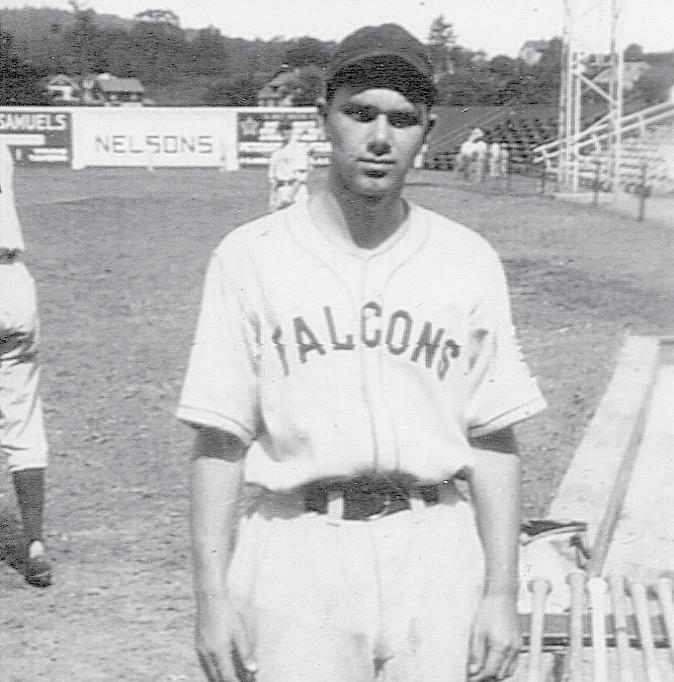
Johnny newman cRosses The plaTe afTeR hiTTing The fiRsT home Run aT municipal sTadium in 1941. phoTo couRTesy of The chauTauqua spoRTs hall of fame
2026 PROGRAM JAMESTOWN COMMUNITY BASEBALL
continued from page 30
promptly called his old skipper, Burwell, who then had the Rock Island, Illinois club.
“Report right away and hit any way you want to,” Burwell told him.
The fold-up “hants” continued to dog Big Jawn, for Rock Island also called it quits with Newman hitting .355, robbing him of enough trips to the plate to win the batting crown, although his average led the league.
Burwell went to Minneapolis as a coach and took Newman along, but hard luck hung right with him. The Millers had a pretty solid garden combine composed of Carl Reynolds in left, Stan Spence in center and Dusty Cook in right. John was being used as a pinch hitter when he broke his leg sliding.
The busted gam was ready in 1939, however, and he was shipped to Rocky Mount, S.C., of the Piedmont League, where he was hitting .319 when he was traded to Spartanburg of the Sally.
An umpire was the big boy’s next barrier.
John threw his bat down one day in one of those mild fits of anger all ball players display at times. It hit the ump right on his toe.
“Everything would have been alright,” John explains, still chortling at the memory, “If I hadn’t laughed. But it sure looked funny, him bouncing up and down on one foot, holding the other one and howling like a coon dog. So I just busted right out laughing and that busted me right out of baseball.”
32
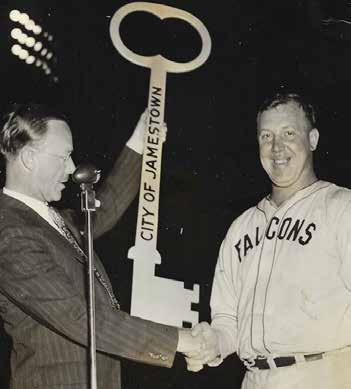
Johnny newman Receives The Key To The ciTy in 1941. phoTo couRTesy of The chauTauqua spoRTs hall of fame continued on page
2026 PROGRAM JAMESTOWN COMMUNITY BASEBALL
He was suspended for a year. The penalty was soon lifted, but John was told he could not play in the Sally anymore and the club handed him his release.
A guy who can powder the ball isn’t idle for long, so Newman headed for Owensboro, Ky., lush with an oil boom and an important key in the Kitty League.
Newman went right to work at his trade, blasting out 33 homers for an all-time league record, and picking up his top baseball thrill in the all-star game.
“I hit two homers and a double and drove in six runs that day for the biggest kick I ever got out of one ball game because down there the leading team (that was us) played the all-stars selected from the rest of the loop.”
Newman was with three clubs in 1940 – one of them was Niagara Falls of the PONY. He was sold to Greenville, Mississippi to start the “traveling” year, and then was traded to Winston-Salem. About that time, Harry Bisgeier of the Niagara Falls club was looking for a hitting outfielder. Someone tipped him off to the giant from Chicago who could behead an infielder with a line drive, so John would up in the ‘Falls livery.
Al Vincent, who had the Buffalo club in ‘42, was going over the ground rules with Greg Mulleavy, the Falcons’ skipper.
“If a ball is hit against the scoreboard, it is a home run,” Mulleavy explained.
“Hell, man, forget it,” Vincent cut in. “No one is going to hit a ball to that board on the fly.”
A few innings later, Newman knocked a numeral right out of the board with a line smash. Vincent refused to come out of the dugout the rest of the game.
But hard as he could belt the ball, one pitcher had John’s number. He was Jack Heller, a right-hander with Bradford.
“Everyone else in the league had good days against that fellow,” John will tell you today. “But when I’d come up he actually laughed. I even tried to bat left-handed and didn’t do a bit better. He had a slow semi-side-arm with a good sinker and I couldn’t do a thing with it.”
One day Newman finally connected against Heller. It felt good and Big Jawn let out a triumphant war whoop – “It’s about time” – he shouted at Heller. But alas, the shortstop leaped high in the air and made the best grab of his career on the liner that was headed for the fence.
When the Niagara Falls franchise was shifted in July of 1940, John Newman arrived on the Jamestown scene.
Stories of the big fellow’s hitting are legend – talk baseball anywhere in the PONY and it’s like speaking of Ruth to an old American Leaguer. Sooner or later a new one about his prowess at the plate is certain to be spun.
But John himself says the hardest ball he ever hit was at Bradford in 1941 – a line drive that cleared the centerfield wall at the scoreboard, a 395-foot smash.
He hit one over the left-center light tower at Municipal Stadium and a line-drive into the scoreboard (405 feet) against Buffalo in an exhibition.
Newman went into the service in ‘43, served with a tank unit in the South Pacific and returned to pick up the baseball threads as manager of the 1946 Hamilton club. He had the Cards two years, finally stepping out of baseball for good.
“I always told my mother I’d play ball until I found a town I liked,” he explains. “I’ve found it – Jamestown.”
John is married with no children. His wife is the former Myrtle Smith, an Owensboro girl – “a red-headed, left-handed Irishwoman,” John laughs.
The big fellow’s hand was back in baseball last season in a minor sense. He coached one of the Little League units in the newly formed circuit for small fry.
One day John was called on to give a youngster some instruction in hitting. Naturally, Ed Lesser went on to become the home run champ of the LL circuit.
carom.
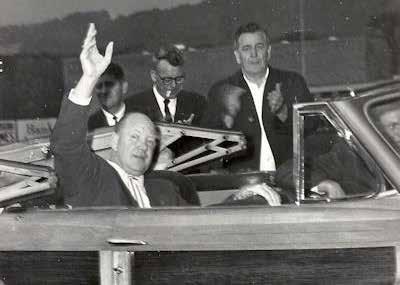
in This aug. 10, 1964 file phoTo, Johnny newman waves To The cRowd on Johnny newman nighT aT municipal sTadium. phoTo couRTesy of The chauTauqua spoRTs hall of fame
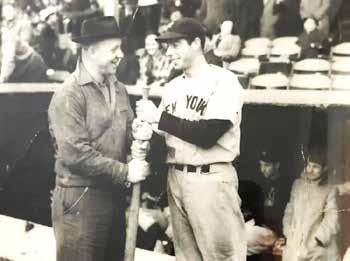
Johnny newman chaTs wiTh Joe dimaggio of The new yoRK yanKees in owensboRo, Ky. phoTo couRTesy of The chauTauqua spoRTs hall of fame
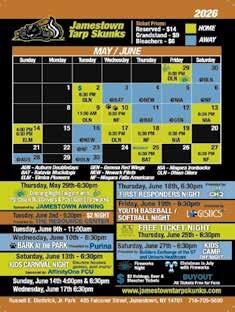
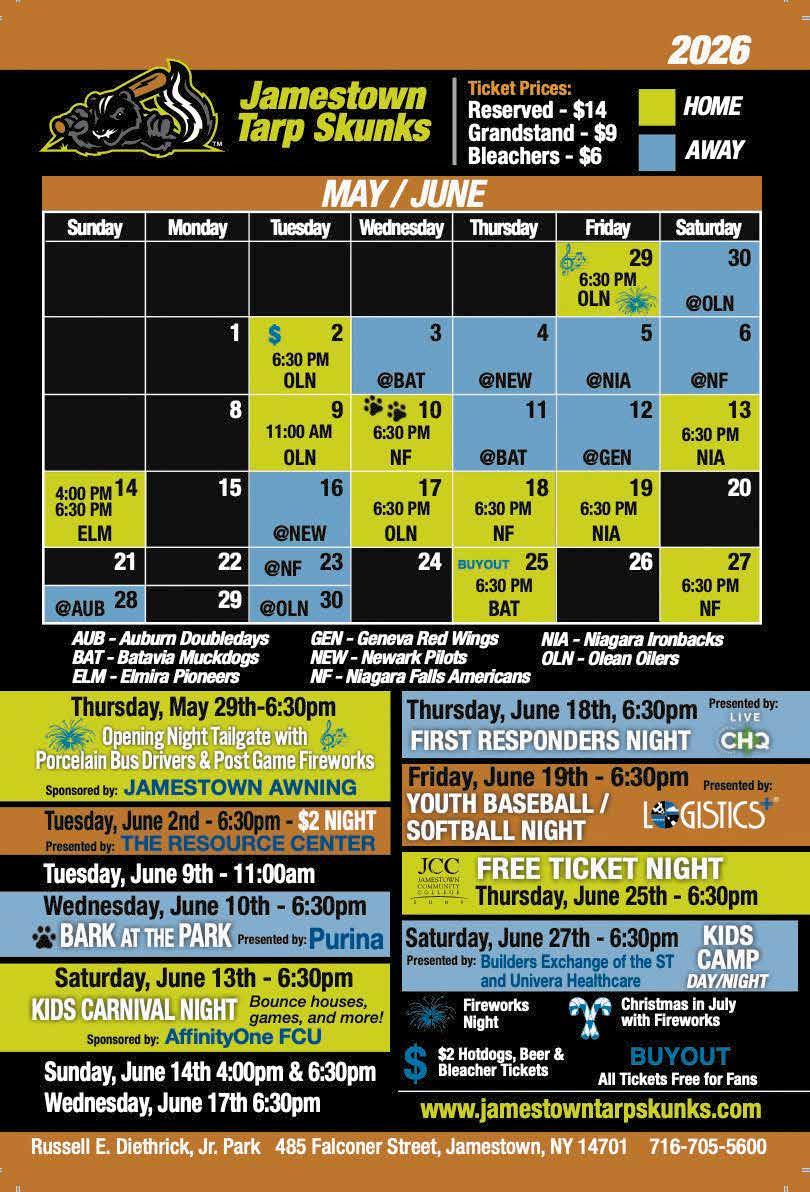
Jamestown Tarp Skunks
2026 SCHEDULE - SUMMER BASEBALL FEVER!
Fri. May 29 - 6:30 PM
Tues. June 2 - 6:30 PM
Wed. June 10 - 6:30 PM
Sat. June 13 - 6:30 PM
Thurs. June 18 - 6:30 PM
Opening Night and Postgame Fireworks; Tailgate Concert with Band Porcelain Bus Drivers at 5PM Presented by Jamestown Awning
$2 Night! - $2 Hot Dogs, Beer, and Bleacher tickets Presented by The Resource Center
Bark at the Park Presented by Purina Bring your Pooch to the Park!
Kids Carnival Night - Presented by AffinityOne FCU - Join us for bounce houses, games, face painting and more!
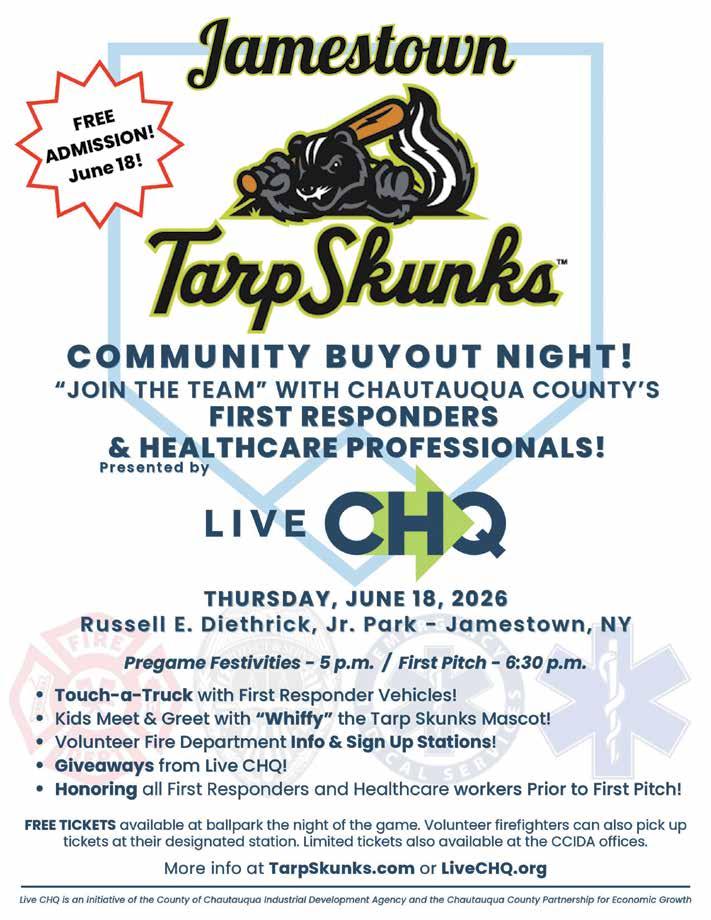
First Responders and Medical Healthcare Professionals Night Presented by Live CHQ Free Tickets to All Fans!
Fri. June 19 - 6:30 PM Logistics Plus Youth Baseball and Softball Night - Honoring all youth players with FREE Admission
Thurs. June 25 - 6:30 PM
Sat. June 27 - 6:30 PM
JCC Community Buyout Night Free Tickets to All Fans!
Tarp Skunks Kids Camp Day - Instructional Camp for Kids in the morning followed by a game at night! Presented by Univera Healthcare and Southerntier Builders Exchange
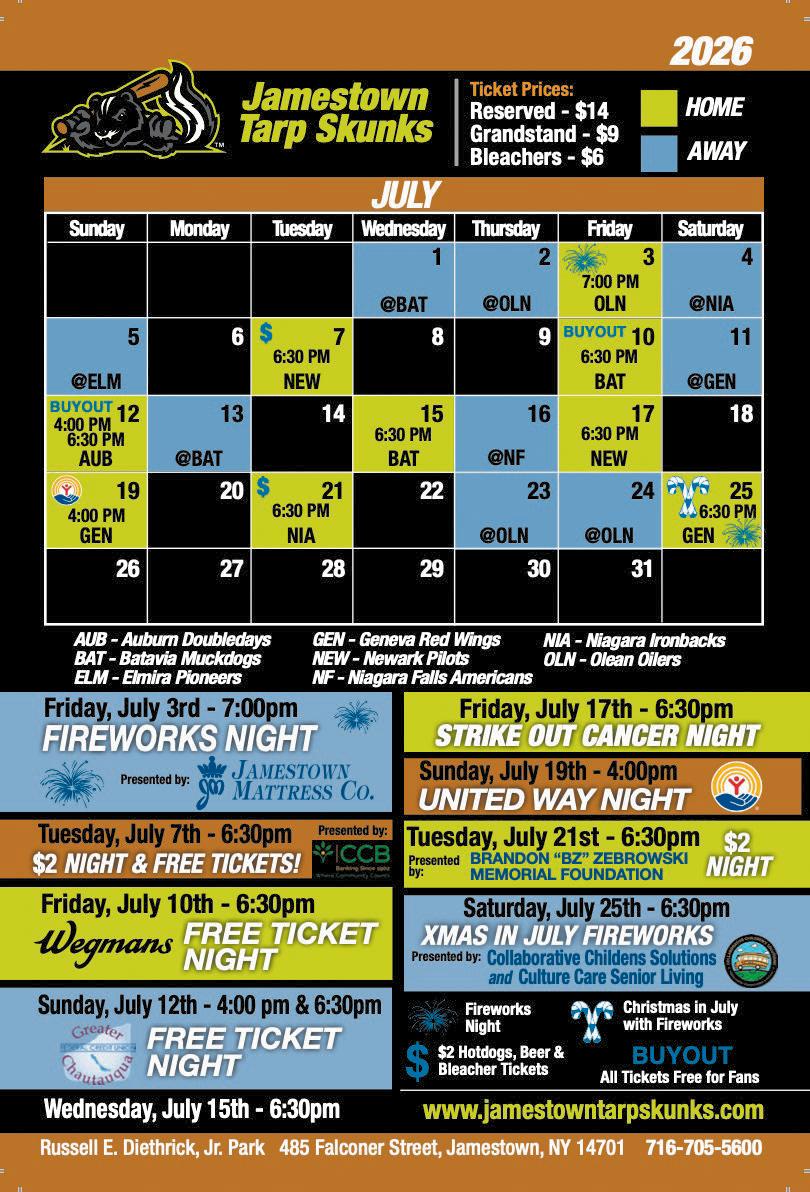
Fri. July 3 - 7:00 PM Fireworks Night Presented by Jamestown Mattress
Tues. July 7 - 6:30 PM $2 Night! - $2 Hot Dogs, Beer, and FREE tickets - Presented by CCB
Fri. July 10 - 6:30 PM
Sun. July 12 - 4:00 PM and 6:30 PM
Fri. July 17 - 6:30 PM
Sun. July 19 - 4:00 PM
Community Buyout Game Free Tickets to All Fans!
Strike Out Cancer Night - Pink Tarp Skunks Jersey Raffle for fans - Game Sponsorred by Prevention Works and CASA Trinity GCFCU Community Buyout Night Free Tickets to All Fans!
Tues. July 21 - 6:30 PM United Way Night - Come and meet and support the businesses in our community!
Sat. July 25 - 6:30 PM
$2 Night! - $2 Hot Dogs, Beer, and Bleacher tickets - Presented by Brandon “BZ” Zebrowski Memorial Foundation
Xmas In July Fireworks presented by Collaborative Children’s Solutions and Culture Care Senior Living
Support Summer Baseball In Jamestown
Russell E. Diethrick Jr. Park, 485 Falconer Street, Jamestown, NY 14701