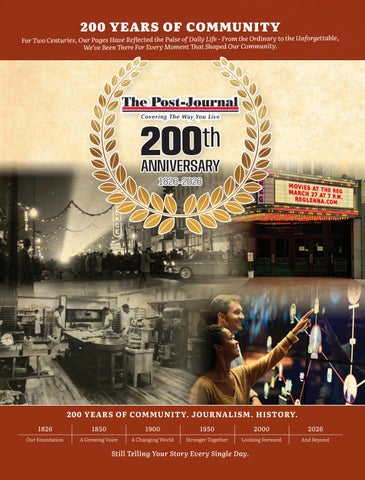
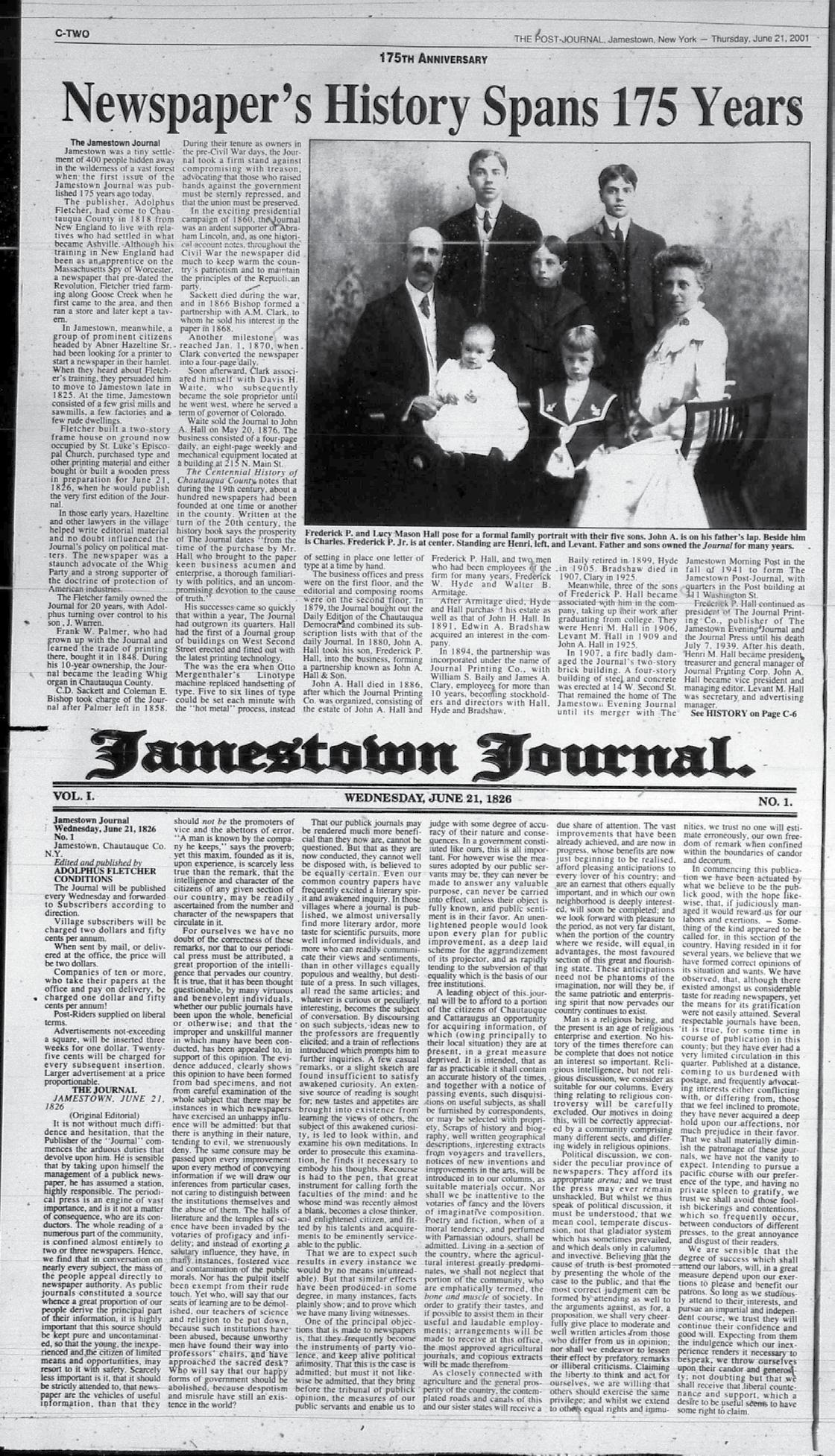
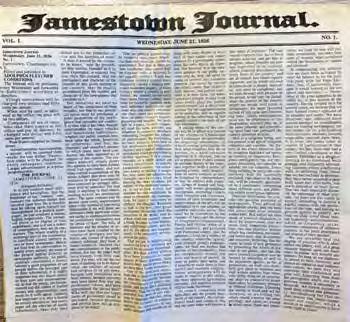
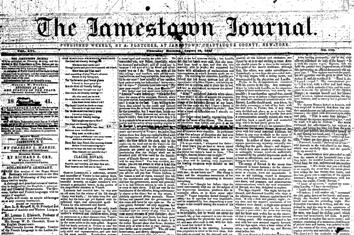
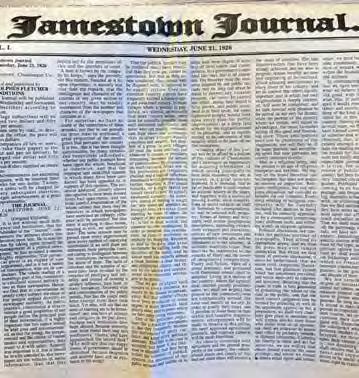
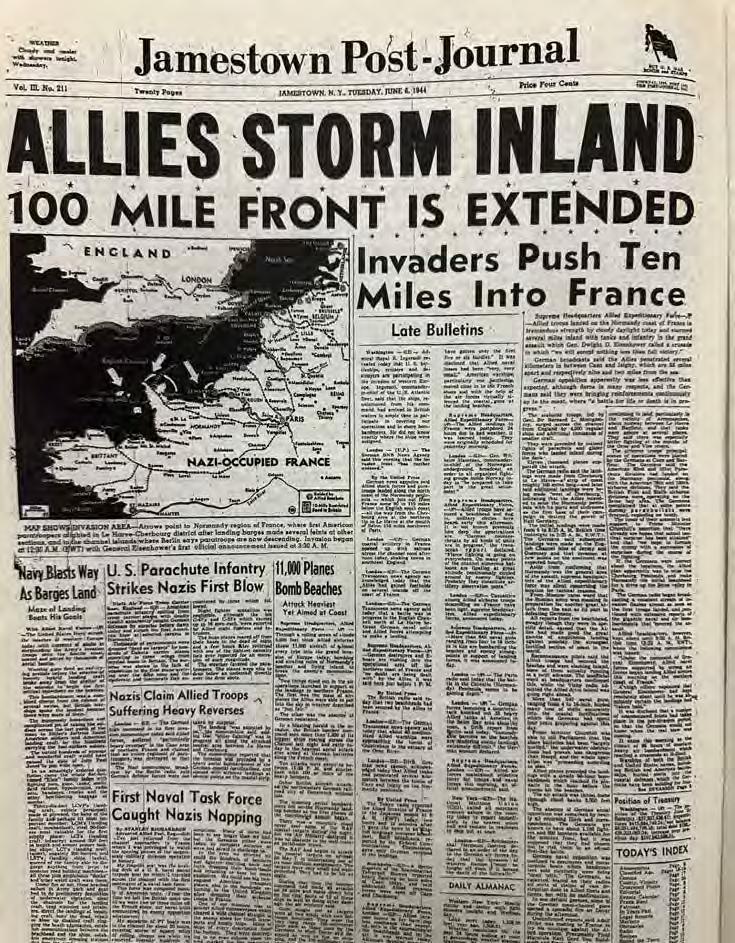
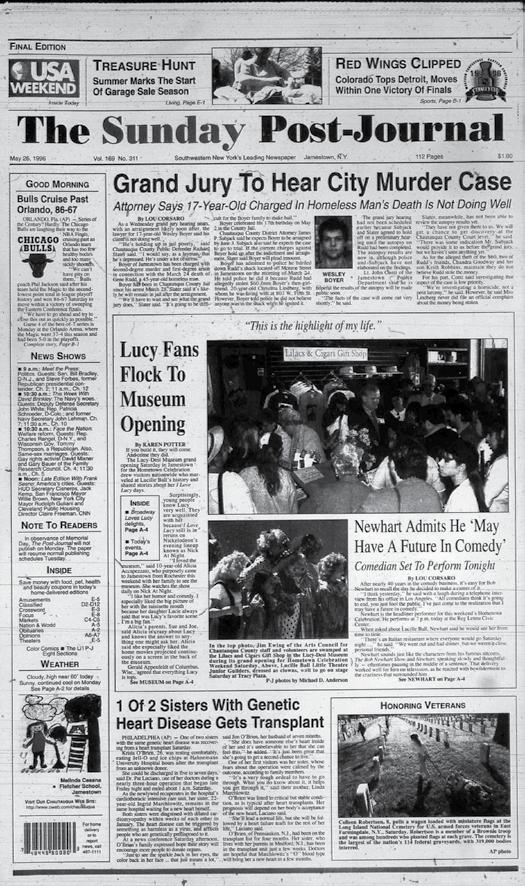
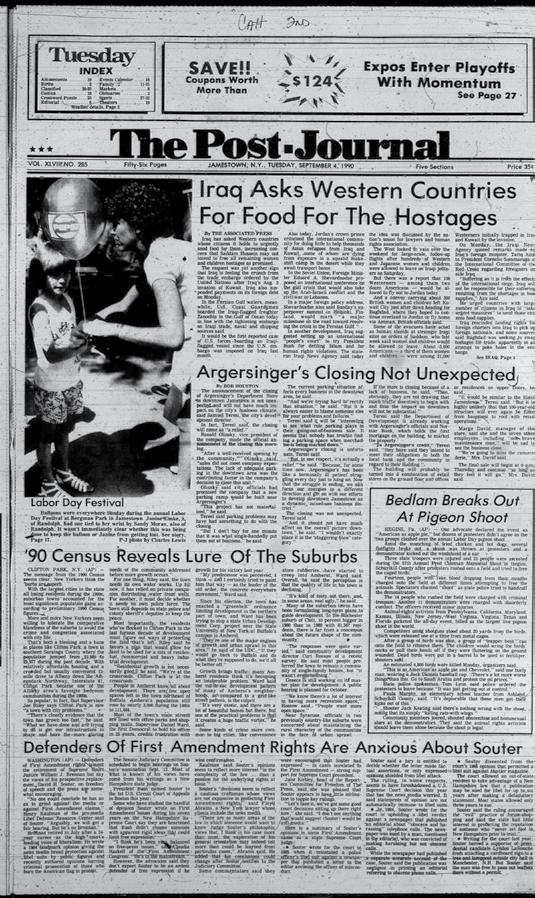
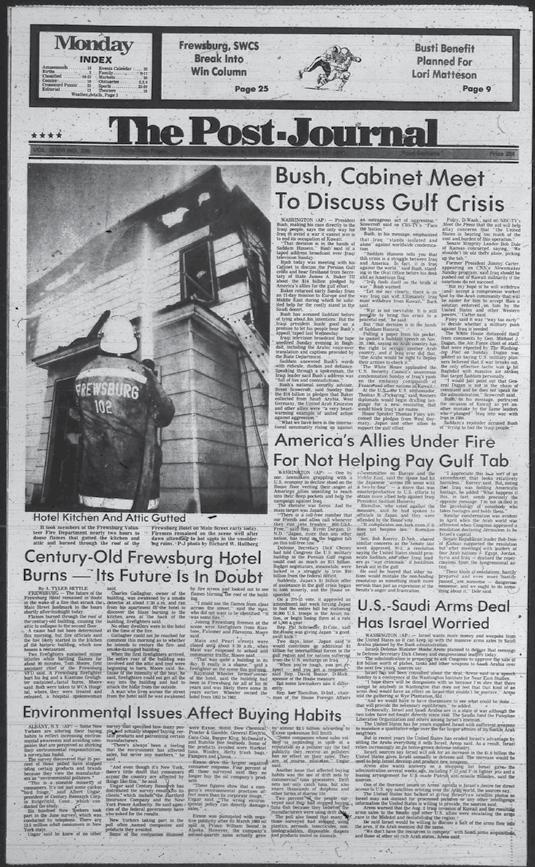
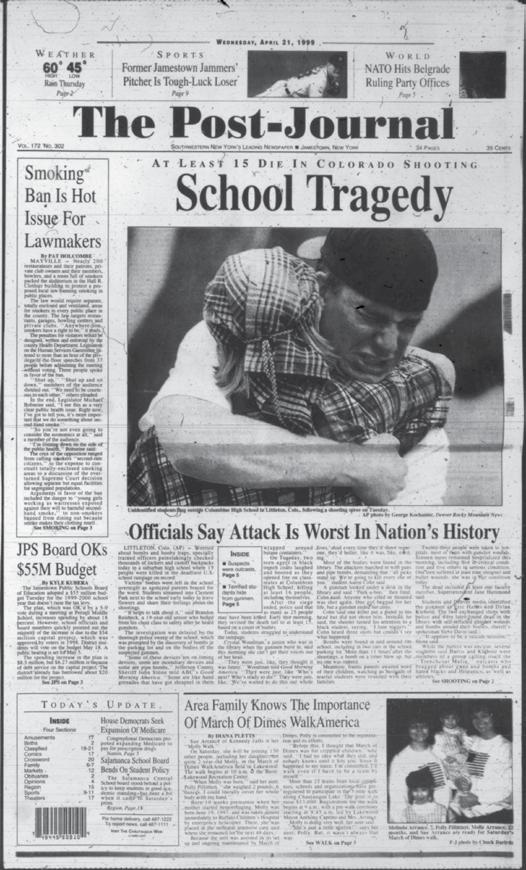
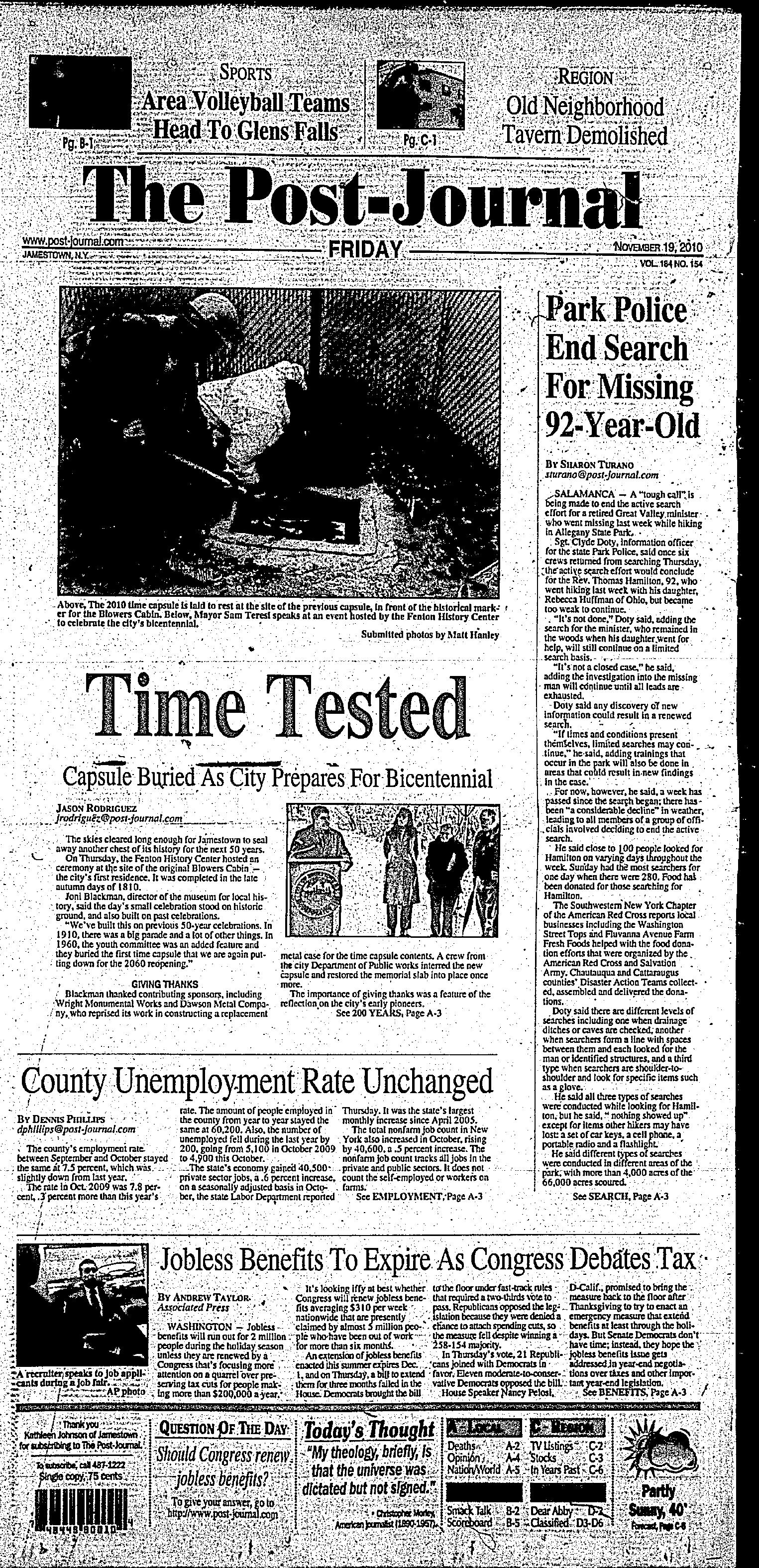
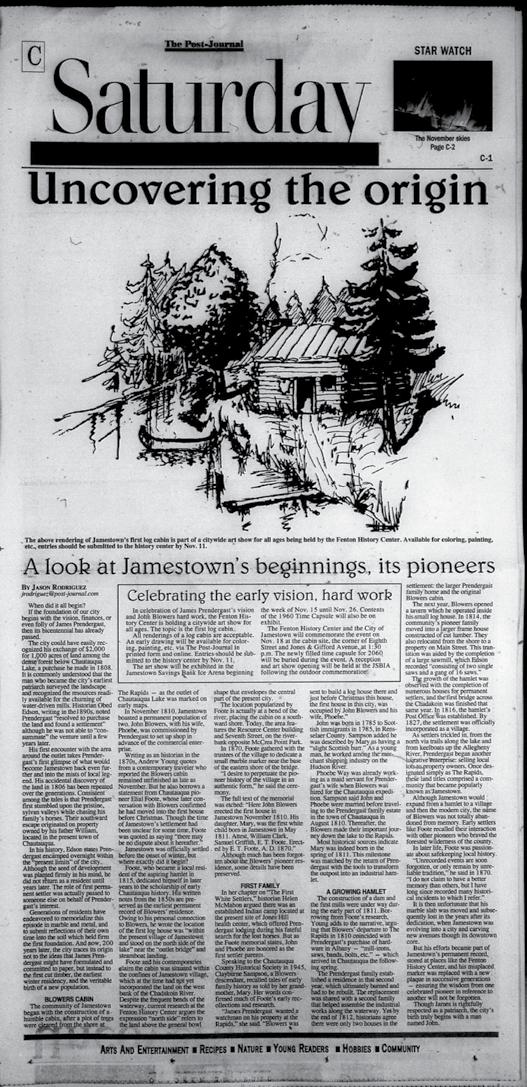
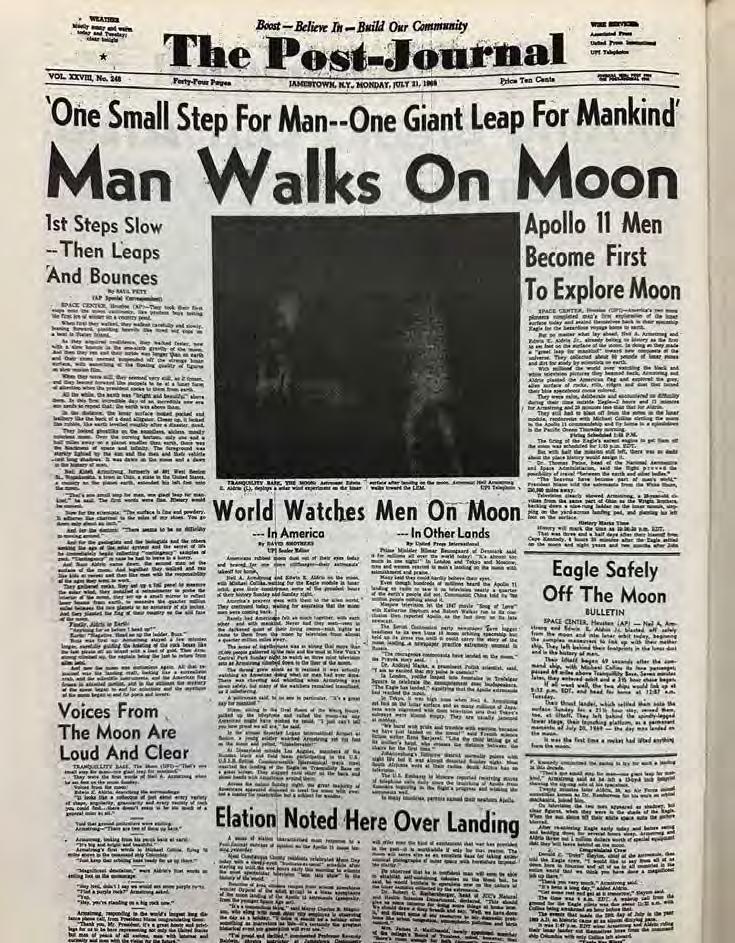
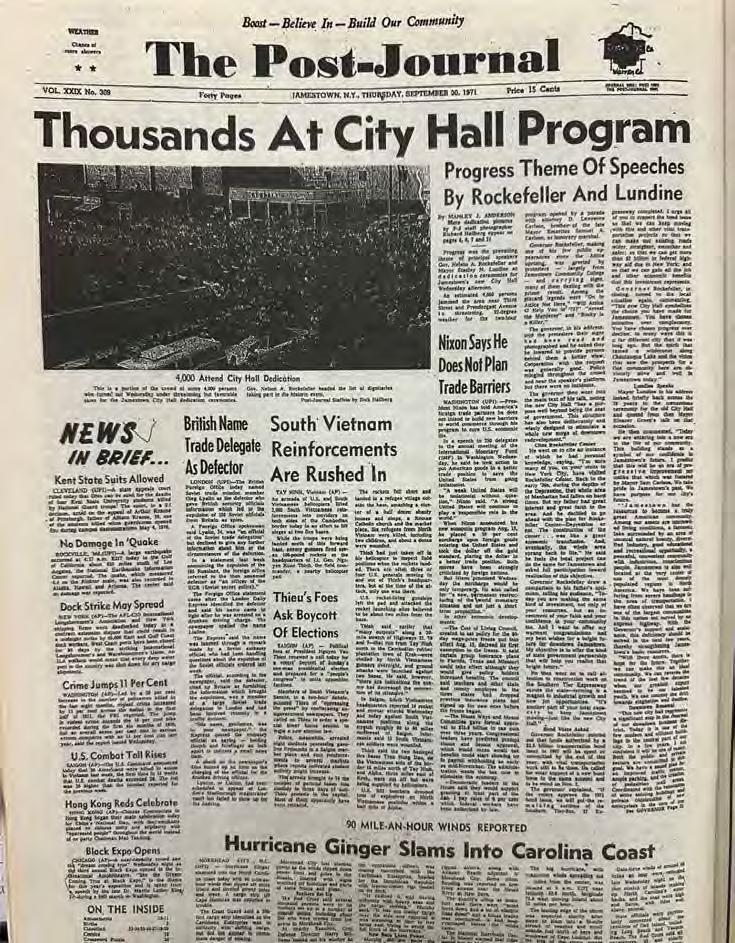
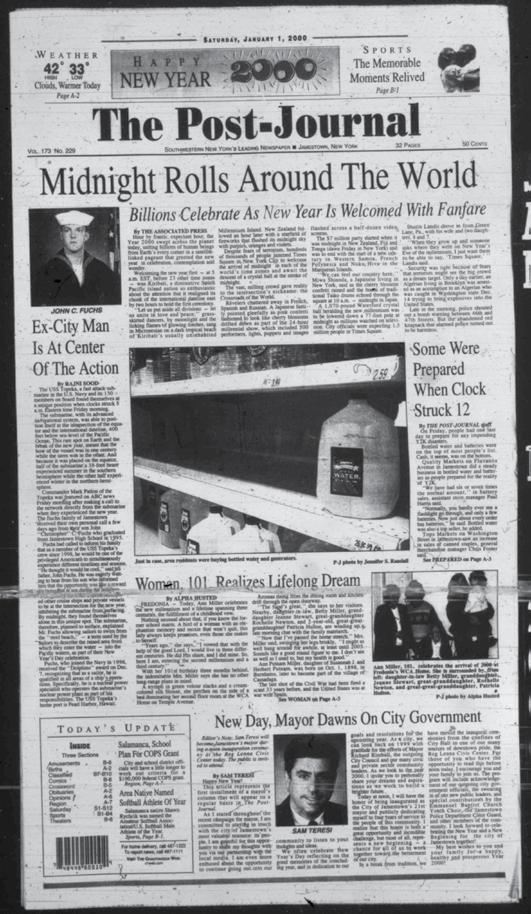
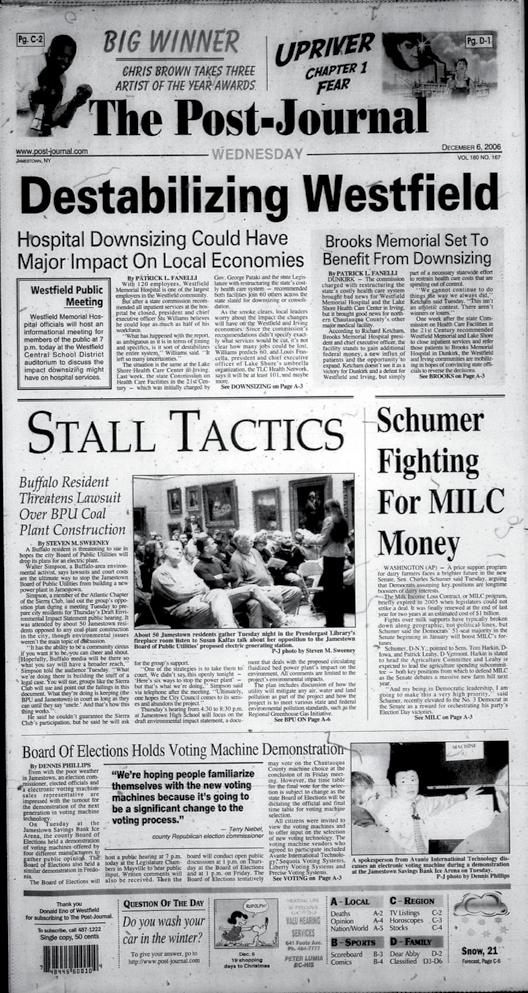
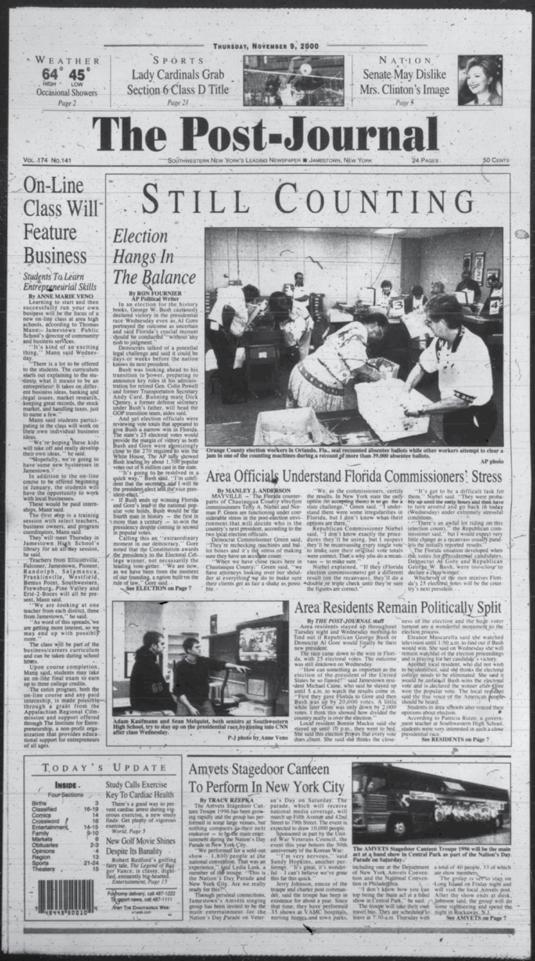
The Post Journal, this month celebrating its 200th anniversary of service and dedication to the community, had roots in the country before the American Revolution, and in Jamestown long before it was an established city. Adolphus Fletcher worked with a newspaper pre-dating the Revolution before coming here and establishing the Jamestown Journal. Jamestown, NY was then a hamlet with less than 400 people living within it. On Wednesday June 21st, 1826 came the premiere of the Jamestown Journal. Throughout that first edition, Fletcher firmly stated the objective of the paper and confidence in the community’s support of it saying “We are sensible that the degree of success which shall attend our labors, will in a great measure depend upon our exertions to please and benefit our patrons. So long as we studiously attend to their interests and pursue an impartial and independent course, we trust they will continue their confidence and good will.” He clearly stressed the importance of a newspaper to the community, and the responsibility and dedication of those providing it saying that he was “sensible that by taking upon himself the management of a public newspaper, has assumed a station highly responsible. The periodical press is an engine of vast importance, and is not a matter of small consequence, who are his conductors.” Strengthening these firm views, commitments, and promises to the readers of the paper, Fletcher stated, “Newspapers are the vehicles of useful information. The intelligence and character of any given section of our county may be readily ascertained from the number and character of the newspapers that circulate in it.”
ANNIVERSARY
Pushing forward through two centuries, the newspaper has experienced ownership changes, name changes, format and structure changes, delivery changes, major setbacks of fire destroying their building, and great strides forward within a rapidly growing, changing and thriving community. It has been both the bedrock and cornerstone of its community, while at the same time its vehicle and accelerator of change, growth, development and success. Within years and waves of swirling change and growth, one thing has remained constant though – the paper’s steadfast dedication, promise, and commitment to its community as demanded by Adolphus Fletcher 200 years ago.
150 Years
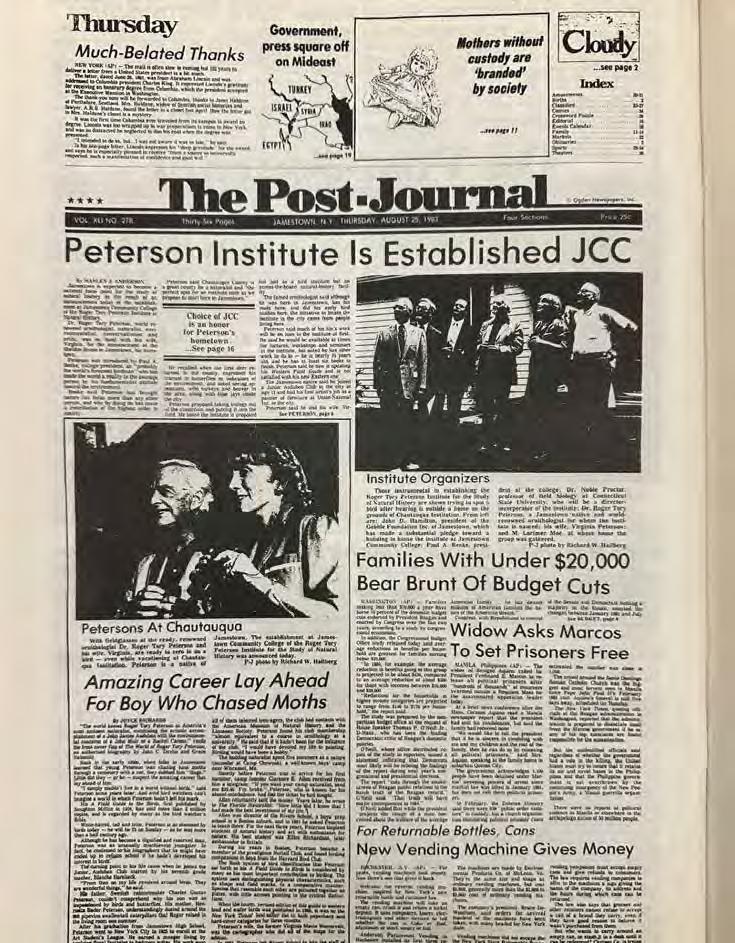
The Monday June 21, 1976 edition of The Post Journal celebrated its 150th year anniversary. While the country was celebrating its bicentennial birthday, Jamestown was celebrating its sesquicentennial.
If reading only one page of the paper on this day, there could be no doubt in the reader’s mind of the pride and appreciation of the paper from all facets of the community and how integral of a part it plays, and has played for 150 years, in the daily lives of people of the community. The paper’s commitment to an appreciation of its supporters, readers, and community also exudes from the pages. A picture of Earl S. Champlin, then Publisher of the paper features the caption of thanks to the community – “On behalf of the staff and employees of The Post Journal, I wish to thank each and every advertiser and subscriber for the support you have given us over the past 150 years.” He concludes with the declaration, “we look forward to serving you in a most gracious manner during the next 150 years.”
This June, 1976 details the growth of the paper and milestones it reached from the release of its first copy in 1826, through years of changes. The article features an image of that very first edition. An article titled “Exciting Day, Historic Era” delivers a first-hand account of the day the first paper was introduced in 1826. It tells that “a number of prominent citizens had collected in the street” and that they were “anxiously waiting to get to get the first issue of their first village paper.”
The June 1976 anniversary edition also include a piece of fun and interesting history of the paper. An arti-
continued on page 7
200 Years - Anniversaries
from page 4
cle titled “Greeley Worked Here – Too Freely” tells of Horace Greeley, former Clymer man who continued to be a highly successful journalist known to the nation and world, once working as for the Jamestown Journal. The article quotes from an article in the Journal’s centennial edition telling Greeley’s story. “For 10 days during the summer of 1830, Horace Greeley, the man whose pen later wrote itself more deeply in the mind of America than has any other editorial pen since, worked as a compositor for the Jamestown Journal.”
The article continues that after working only a short time, Greeley left Jamestown seeking larger cities and larger opportunities – which he found – the only person with roots in Chautauqua County to ever run for President of the United States. He went on from Jamestown to found the New York Tribune and had extensive correspondence with President Lincoln. He ran for president in 1872 against President Grant and is credited with being one of the founders of the Republican Party. An article in the January 9th, 2021 issue of The Post Journal details his story and legacy.
An article written by John A. Hall – former Vice President and Editor rang of thankfulness for being part of the paper, as well as admiration and respect for the 150 years of hard work and dedication that the paper was now celebrating. Mr. Hall said “From it’s beginning as the sorely needed newspaper of the tiny community of Jamestown in 1826 up to the present day of the metropolitan daily newspaper of 1976, it has been an institution dedicated to giving leadership and service.”
Messages of thanks, admiration, respect and compliments of a job done very wonderfully done for 150 continued with articles and letters from agencies societies, and businesses in the community, as well as from the Congress of the United States. Laurence S. Hale, President of the NYS Society of Newspaper Editors submitted an article featured in the June 1976 edition filled with admiration, compliments and congratulations. K.W. Strickler, President of the Chautauqua County Chamber of Commerce also wrote a letter of gratitude and congratulations to the paper closing with “Please accept our best wishes for continued success in the years ahead.”
Mayor Steven B. Carlson an article of thanks and congratulations, thanking them for the many “public benefit
ment, dedication and importance. He remarked that “The newspaper and the name have earned places of respect in this community.” He continued, “During the growth and progress of Jamestown, the Journal has not only provided an unparalleled historical record but has played an important part in the plans and lifestyles of its people.”
“Newspapers are the vehicles of useful information. The intelligence and character of the citizens of any given section of our county may be readily ascertained from the number and character of the newspapers that circulate in it.” – Adolphus Fletcher, June 21st, 1826.
June 21st, 2001 marked 175 years of The Post Journal’s steadfast persistence and dedication to this original statement of purpose.
175 Years
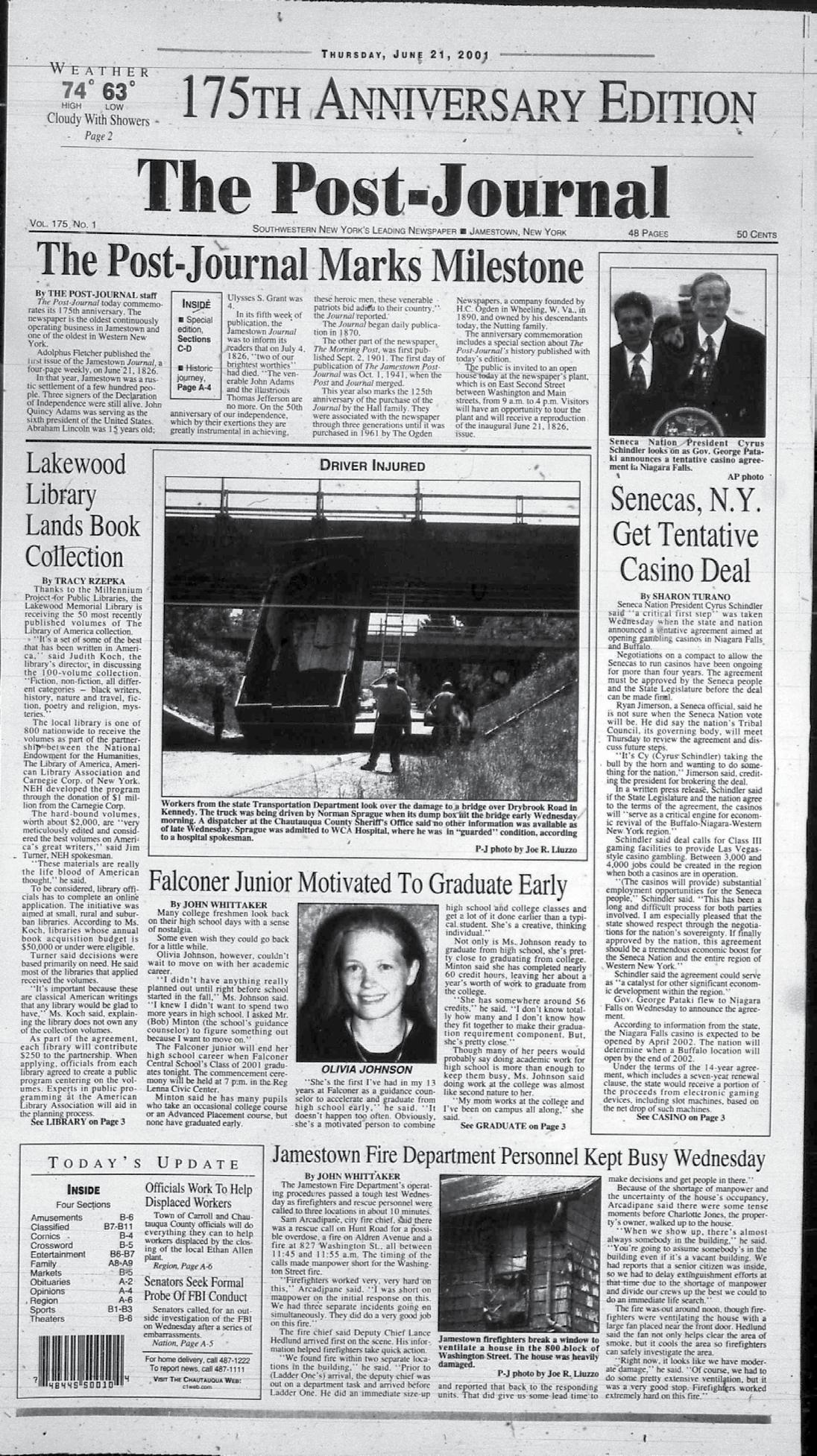
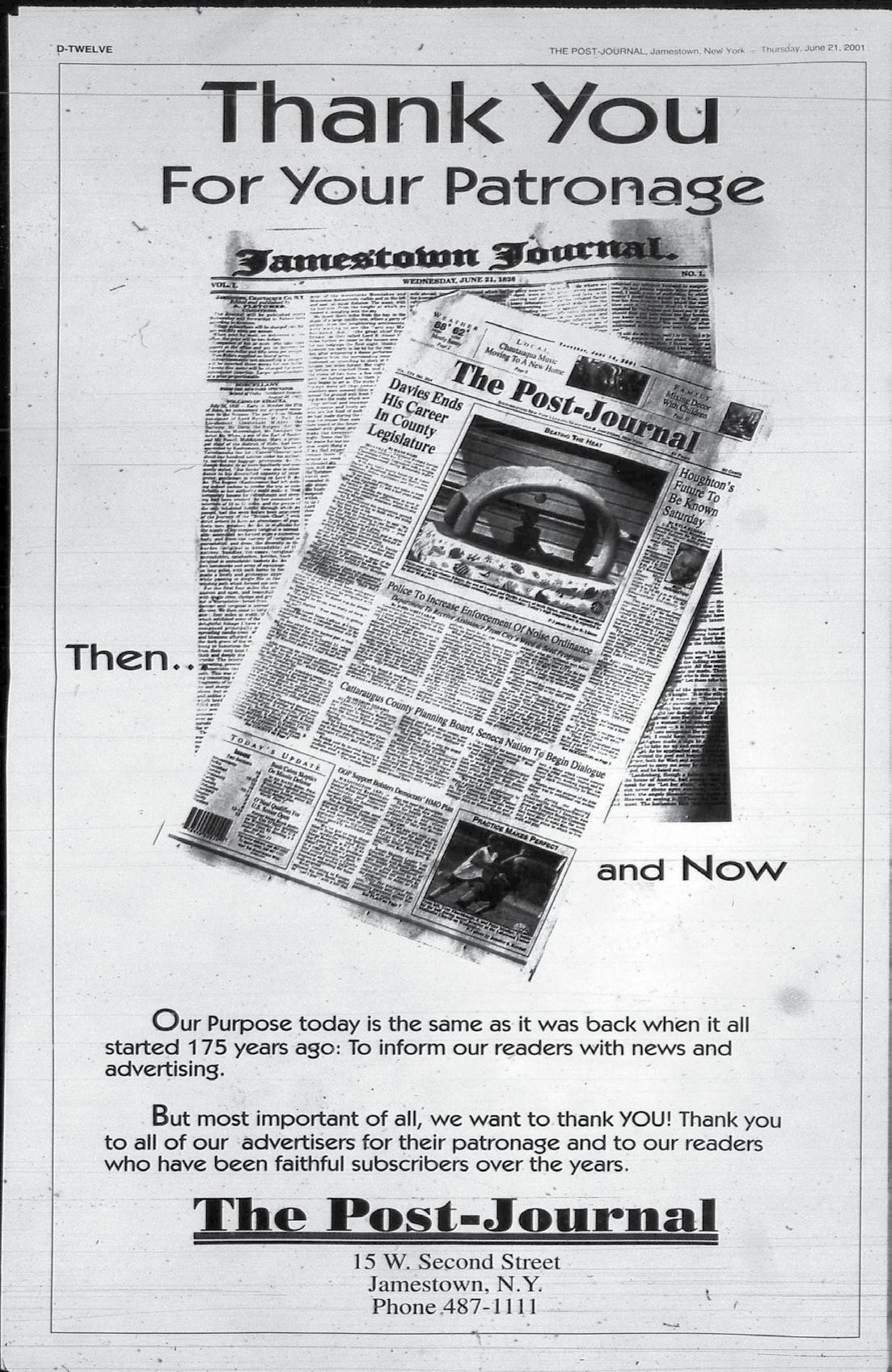
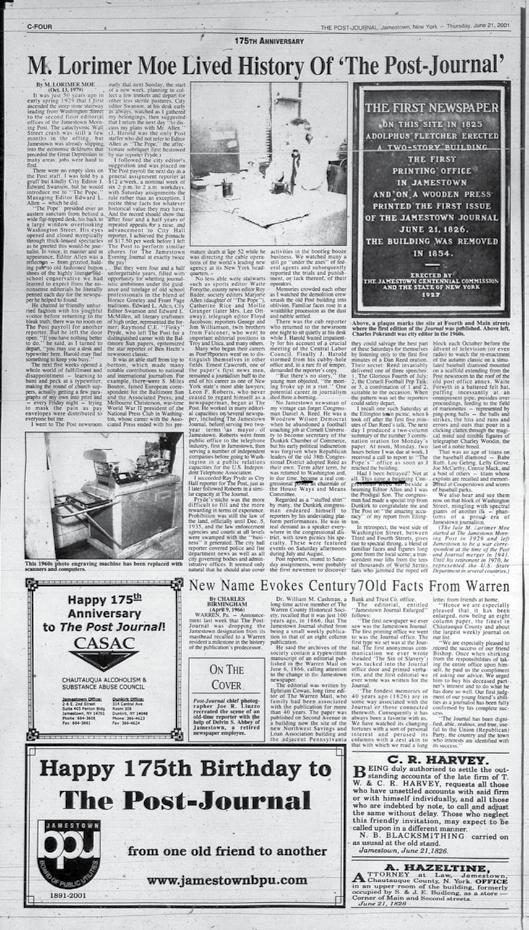
The Thursday, June 21, 2001, 175th Anniversary Edition of The Post Journal marked 175 years of dedication
continued on page 12
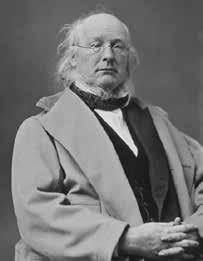
Horace Greeley
200 Years - Anniversaries
continued from page 7
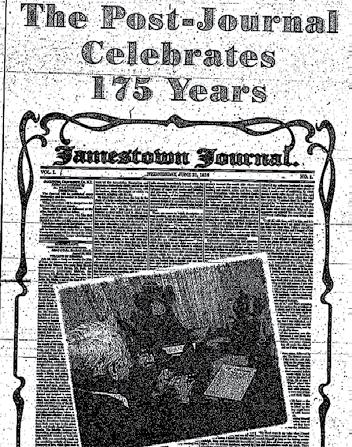
and service to Jamestown and surrounding Chautauqua County. The line under “The Post Journal” title reads “Southwestern New York’s Leading Newspaper.” This has faithfully proven to be true for 175 years on this Thursday in 2001. The front-page article effectively puts the span of years that the paper has operated in perspective stating the publishing of the first issue in 1826, for a “rustic settlement of a few hundred people. It continues, “Three signers of the Declaration of Independence were still alive, John Quincy Adams was serving as the sixth president of the United States. Abraham Lincoln was 15 years old. Ulysses S. Grant was 4.” The article continues with a timeline of publication, changes, and the 1941 merger of The Morning Post and Journal. The article points out that June 21st, 2001, also marks the 125th anniversary of the purchase of the Journal by the hall family who owned it for three generations until 1961. Inside the paper a picture of the family is featured. A text box directs readers to “Special Edition” and “Historic Journey” sections of that day’s paper. The front-page piece closes with an invitation to the community to an open house being held that day at the newspaper’s plant. Visitors were invited to tour the plant and would receive a reproduction of the “inaugural June 21, 1826, issue.
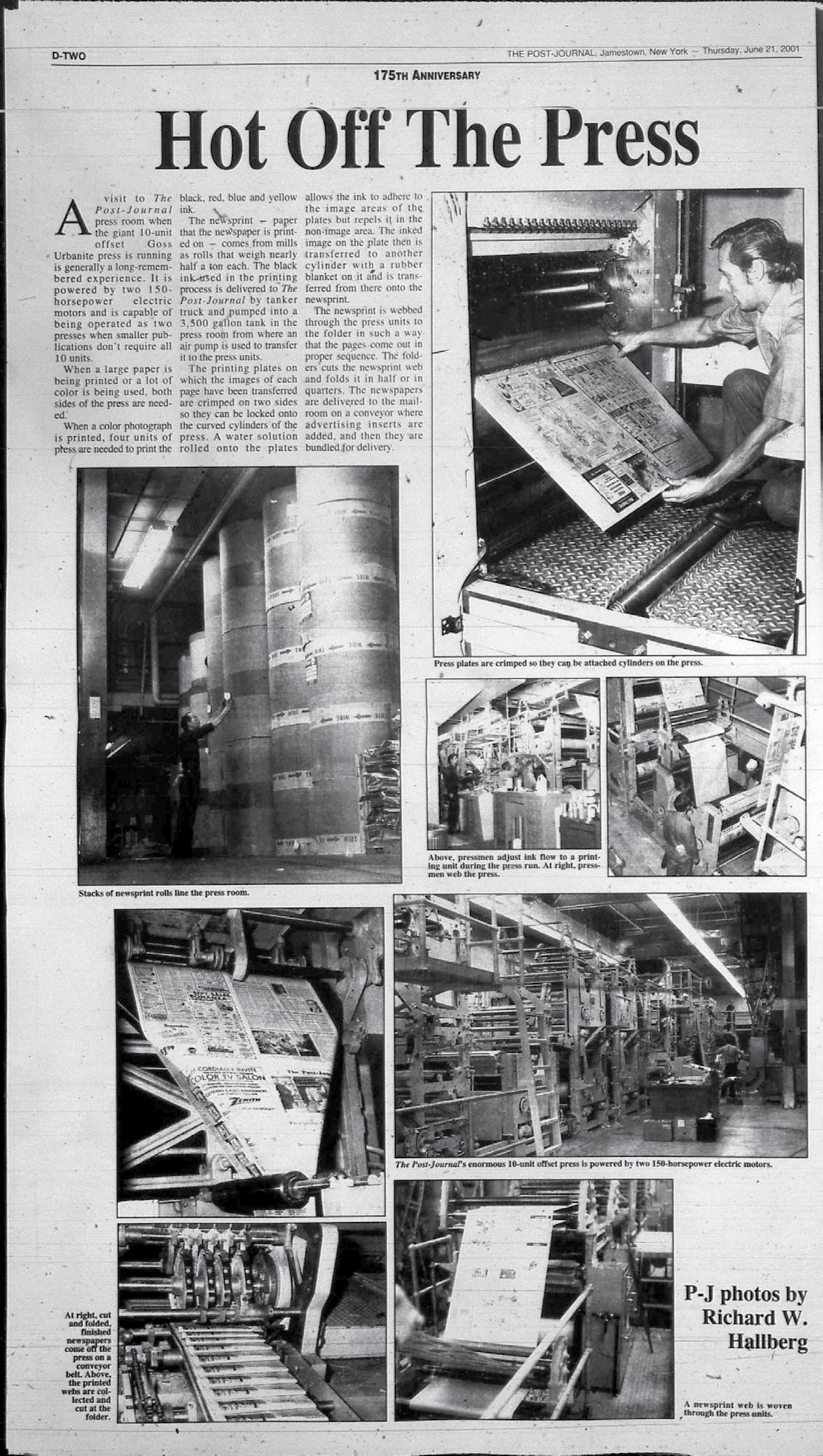
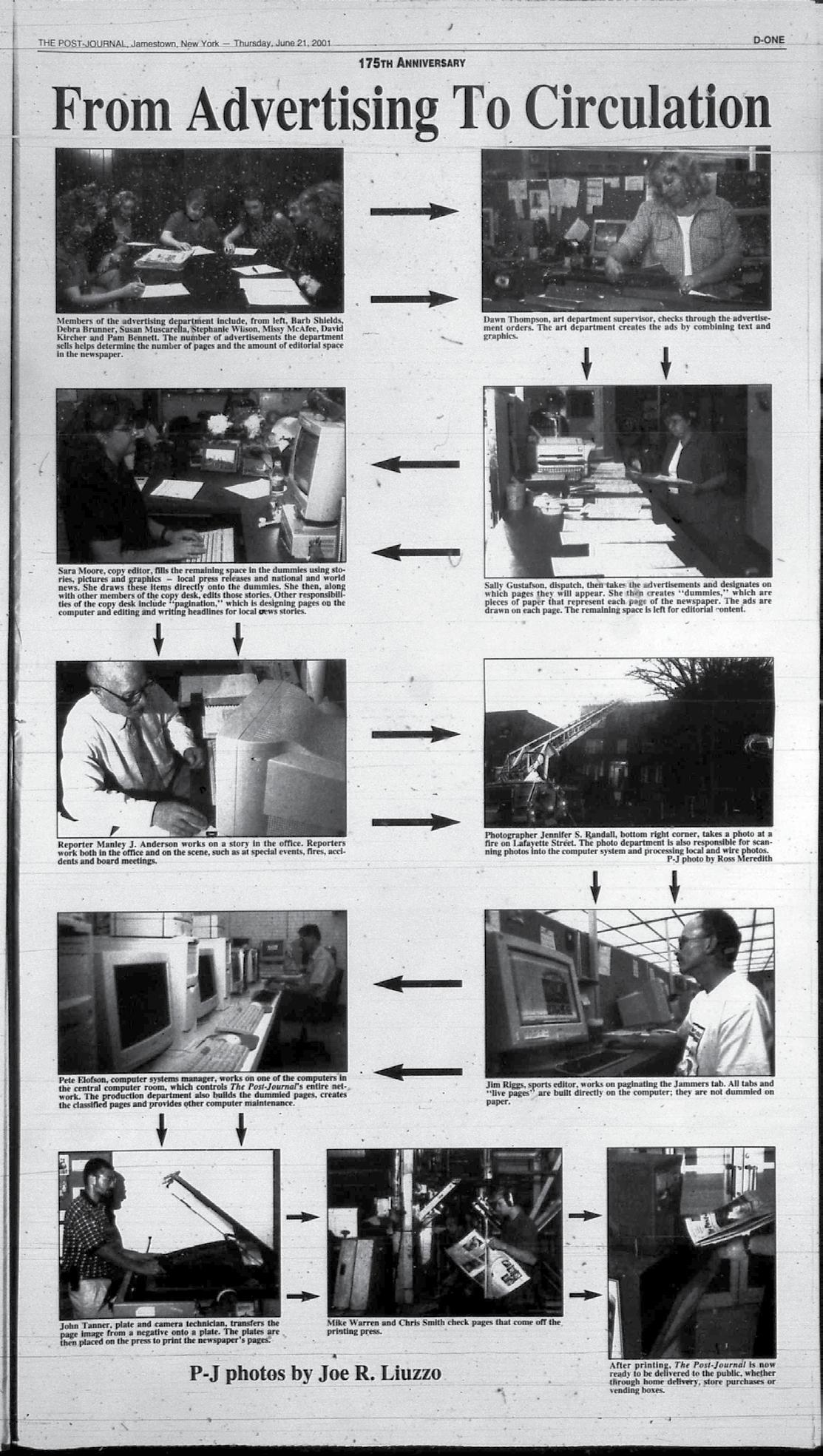
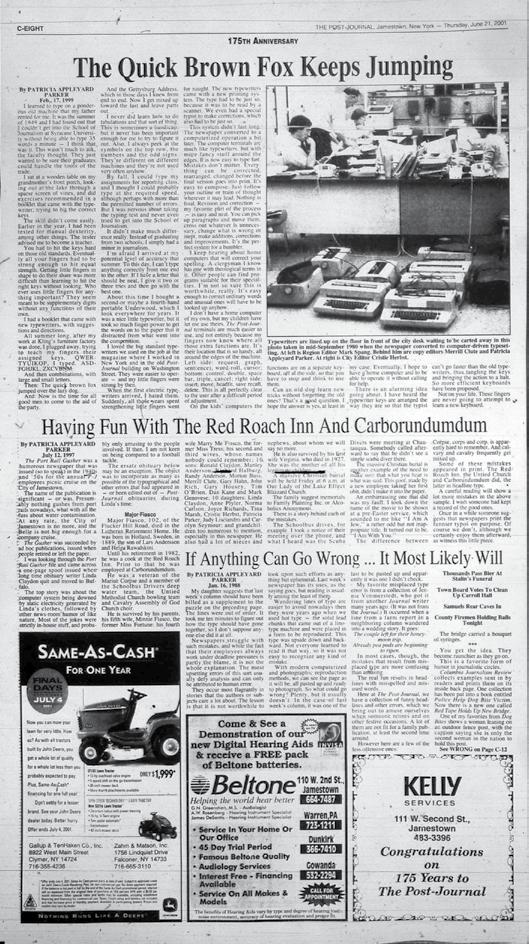
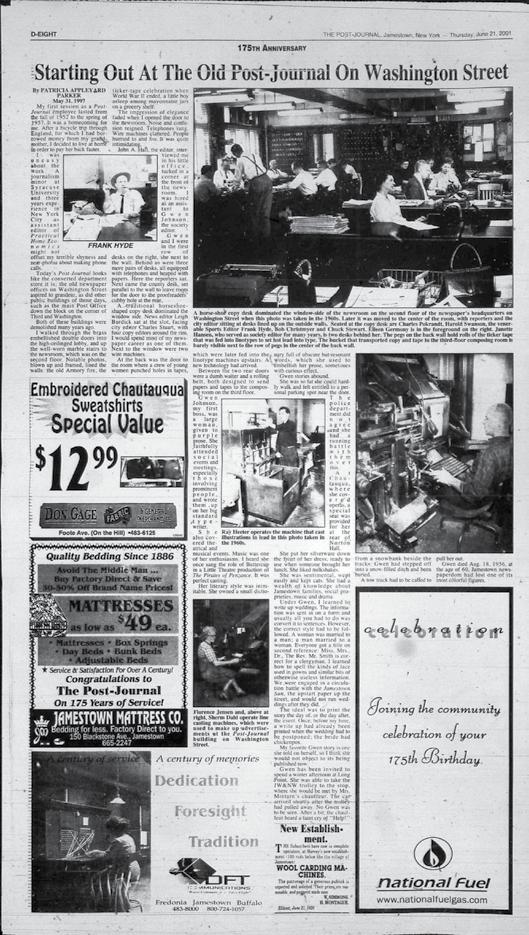
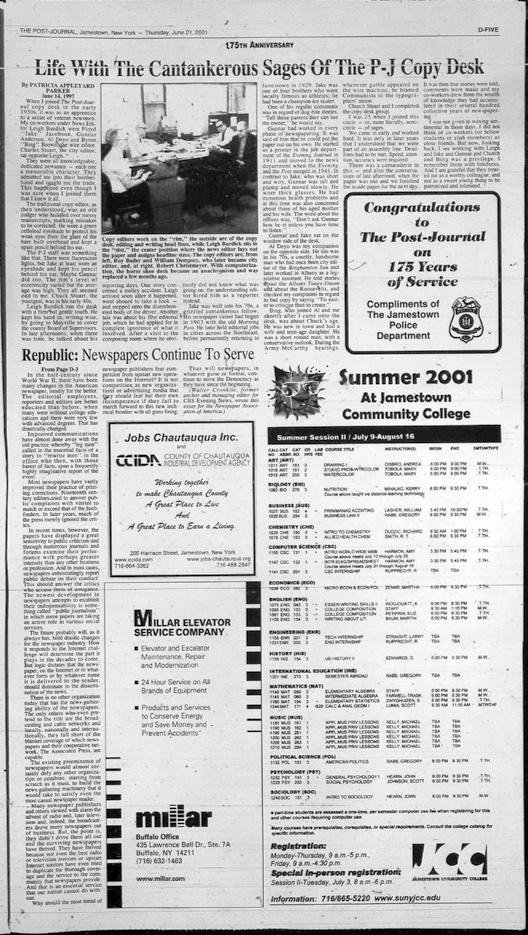
Two sections of the 175th anniversary edition were filled with stories and photos of changes in the paper, operations, and production over a long span of years. Photos from the 1950’s and 1960’s depict employees and machines working to produce the paper of their time. Previous and current employees of The Post Journal tell first-hand accounts of the newsroom, their daily responsibilities and admiration and respect for both the company and the paper. Pages of photographs under the title “From Advertising to Circulation” illustrate the huge changes and progressions that the paper has successfully navigated over 175 years of reporting, printing, and distributing the news. A photograph on Page C-8 illustrates a big technology shift in 1980 when typewriters were being replaced by “computer-driven typesetting.” The picture shows typewriters on the floor “waiting to be carted away.”
Throughout the June 21st, 2001, Anniversary Edition, scattered on nearly every page, are testaments to the admiration, respect, and gratitude of the community for the paper. From large to small, submissions from individuals to businesses, to other papers in the region, shared words, thanks, and congratulations that exuded positivity on every page. Right alongside those were messages of thanks and appreciation from The Post Journal to the community. In headlines, subtitles, captions, and photos, to a full page dedicated to thanking its “friends” and “partners” the resounding message of admiration, respect and appreciation was returned by the paper to the community it had served for 175 years on that day in our history.
From Post Riders to E-Paper
By Rebekah Sorenson
On June 21st, 1826, the very first edition of the Jamestown Journal rolled off the wooden hand press. The Jamestown Journal made its debut as a semi-weekly, 56-column newspaper. Publisher Adolphus Fletcher printed the paper on the second floor of his shop.
Locals walked or rode to the publisher’s wooden building to get their copy. Readers living out of town in the rural Chautauqua County wilderness relied on mounted carriers who traveled rough terrain to deliver newspapers to scattered homes and settlements. For those living even further away, the U.S. Mail system was the method of delivery. Papers frequently traveled in 200-pound mail sacks by horseback, stagecoach, or on early waterways.
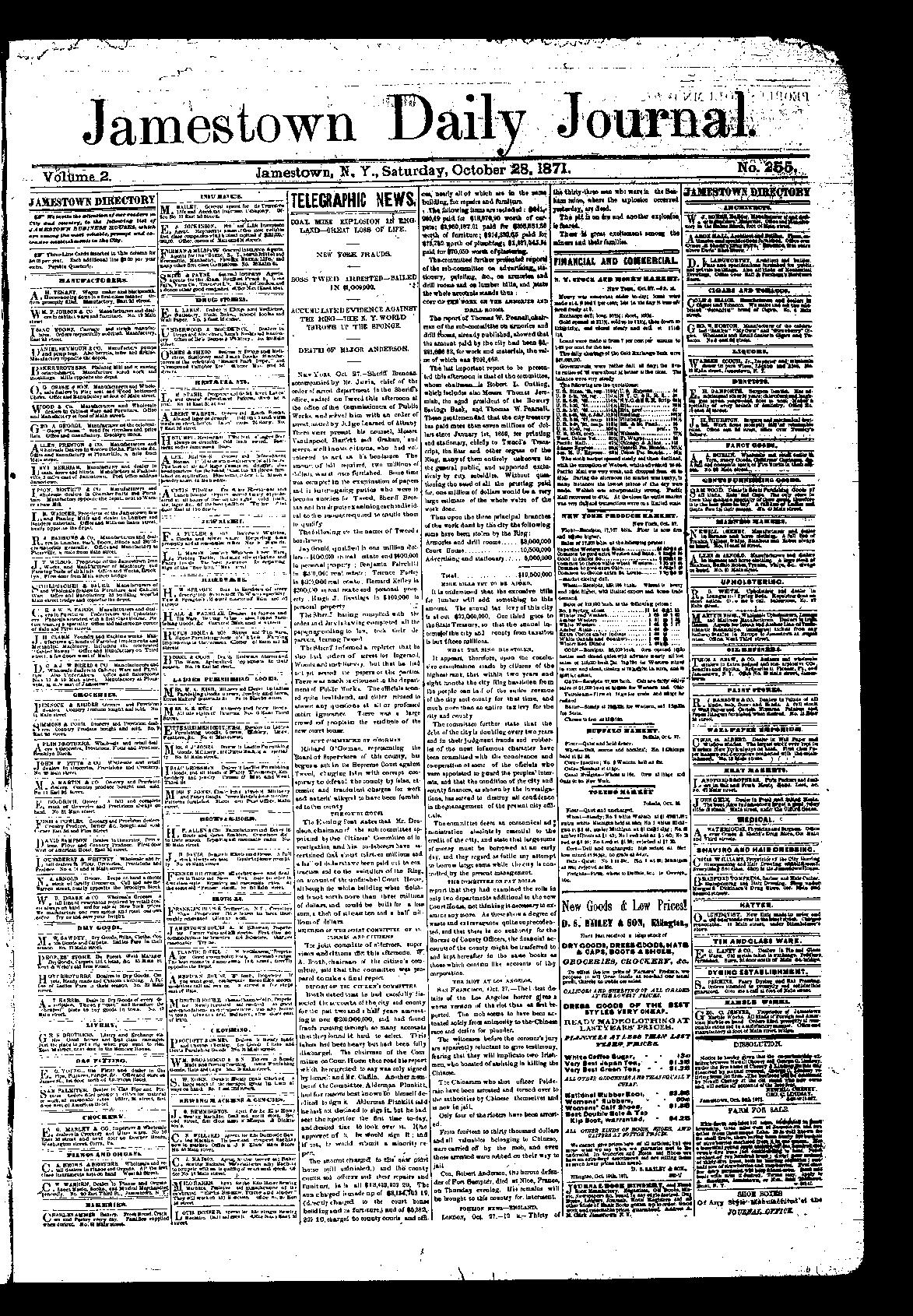
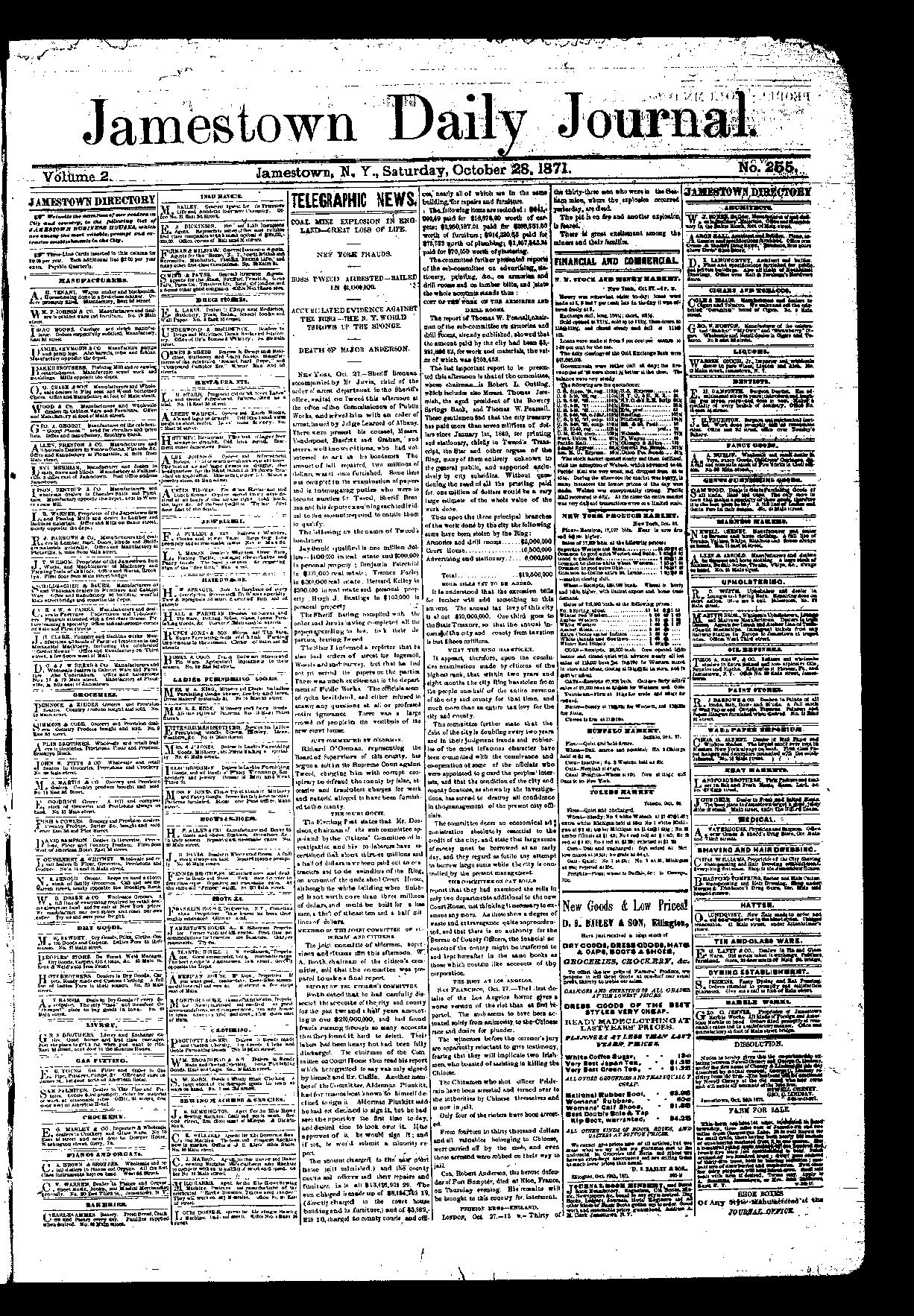
In 1870, the Jamestown Journal officially transitioned from a weekly publication to a daily newspaper – the Jamestown Daily Journal. This called for more frequent and efficient delivery of the paper. Distribution relied heavily on local newsboys, youth carriers, and postal mail.
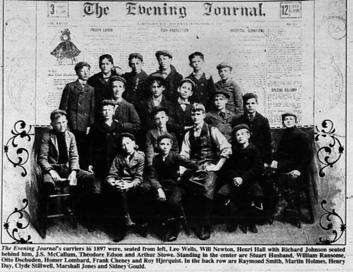
Paperboys, and later paper carriers, operated as young independent contractors. They handled the entire logistical chain of getting, preparing, and delivering the paper. The daily process of the paperboy followed a very specific routine. In the early morning, or afternoon if carrying The Evening Journal, delivery
trucks dropped off tightly bound bundles of newspapers. Before setting out, the paperboy had to unwrap the wire or twine from the bundles and fold them to fit inside a rubber band or sometimes plastic sleeves for Western New York weather. Additional circulars or ad sections had to sometimes be inserted in the paper too. Carriers loaded the folded papers into lopsided canvas shoulder bags over their shoulders or in baskets mounted to the handlebars of their bicycles. Moving through the hilly streets and neighborhood blocks of the city, the paper was tossed on the front porch or driveway.
The young entrepreneurs bought the papers from the publisher at a wholesale rate and so weekly or monthly, door-to-door collection of cash or check payments for the paper from the readers on their route was also part of the job. Carriers kept track of who paid using a route book or a metal ring bound with thick punch cards. When a customer paid, the paperboy would use a hole punch to mark off the paid week or tear out a small paper receipt stamp for the customer. Tips were often kept in a metal coin changer worn on their belts. Delivery of the paper outside of the city relied, as it had for decades, on carriers driving routes – by car now rather than horse or stagecoach. The 1990’s and early 2000’s saw paperboys disappear for the most part, taken over by driving routes.
The 2000’s brought with it the digital transformation worldwide As the internet reshaped media consumption, The Post Journal launched its website. Undergoing changes from the early 2000’s to 2016, coupled with the Post Journal App, readers now had access to the paper from the electronic device of their choice.
Today the Post Journal maintains its physical print copy, while offering a digital “E-Paper and smartphone apps for on-the-go reading and accessibility. Adapting to modern distribution, the print version of the paper has now transitioned to the U.S. Postal Service. 200 years of delivery, from post rider, stagecoach, and waterway to your smartphone – The Post Journal has shifted an adapted with the days, decades, and centuries – holding steadfast to Adolphus Fletcher’s original declaration in 1826 – “Newspapers are the vehicles of useful information.”
200 Years – Where We Were and What We’ve Shared
By Rebekah Sorenson
Wednesday June 21, 1826
The “Jamestown Journal” – Volume 1, No. 1 – met, for the first time, the eyes, minds and hearts of its readers. The Jamestown of June 1826 was a tiny settlement of 400 people tucked in and hidden within a seemingly boundless wilderness. Firsthand accounts
recorded of that time tell of” a number of prominent citizens had collected in the street” and that they were “anxiously waiting to get to get the first issue of their first village paper.” Adolphus Fletcher, the first editor and publisher of the Jamestown Journal, came to Chautauqua County in 1818 from New England. Joining forces with a group of distinguished citizens of Jamestown, the Jamestown Journal was born and built.
August 1841 – Navigating Troubled Waters
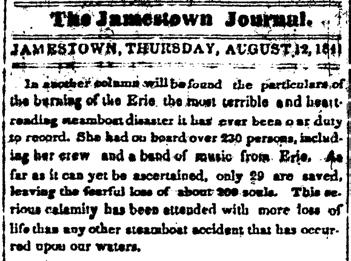
The August 12th, 1841 edition of the Jamestown Journal covered and shared information with its readers about the current tumultuous national political situation, and
was also covering what would become national news, troubled waters much closer to home – the steamboat Erie disaster. On the evening of August 9th, 1841, the steamboat Erie left Buffalo harbor with 343 passengers – including 38 crew and 8 band members from Erie, PA to entertain the passengers. The Erie was a steamship operating as a passenger freighter on the Great Lakes. She was a cruise ship of her time, vast in size, weighing close to 500 tons. Passenger cabins and state rooms could accommodate roughly 300 passengers. The evening of August 9th, 1841, would be her final voyage.
The steamboat Erie tragedy quickly became national news and was covered only by the Jamestown Journal and the Niagara County Extra. The August 12th Jamestown Journal provided early accounts of the fire and the crew and passengers heroic attempts to escape the fire. Follow-up coverage was provided by the Journal on August 19th including more detailed testimonies and updates on the cause of the fire. The Journal also published transcripts of the coroner’s jury investigation and witness testimony from survivors. The Jamestown Journal was read
continued from page 16
nationally. Then just over 15 years old – the Jamestown Journal continued to cover and deliver the latest news and updates to its trusting readers and the nation.
Jamestown in June of 1851
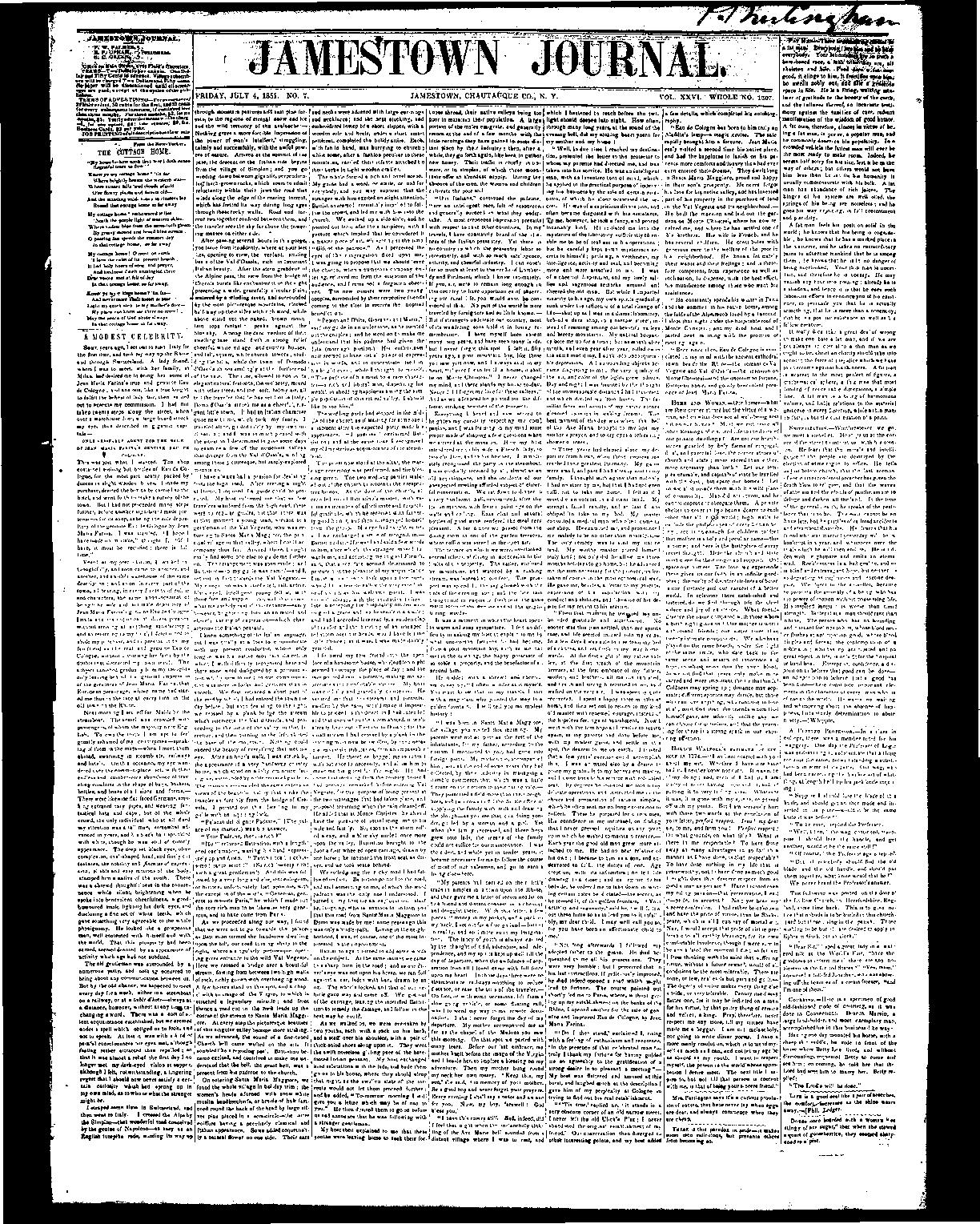
The July 4th, 1851, edition of the Jamestown Journal encapsulates the energy, excitement, growth, and prospects of that day and time in our history on every page. Page one features “A Modest Celebrity” – a story of traveling to Italy and the adventures along the way to entertain
readers – the prospect of travel and adventure now a reality to readers -in tune with the changing times. Page two of the 1851 July 4th edition was dedicated to the anticipated railroad construction. A headline titled “The Railroad Meeting” detailed an initial meeting about the upcoming railroad construction, informing readers who was in attendance, what was discussed and the encouraging note that the meeting went well moving with the quote that the meeting was “characterized by the right kind of spirit.” A brief glance across pages three and four of the July 4th, 1851, edition of the Jamestown Journal, brimming with ads for and announcements of
continued on page 18
new stores, new schools, new services, new medical remedies and “cures”, and new opportunities speaks volumes of Jamestown’s booming growth and the excitement within it. Cover to cover-a vivid snapshot of 1851 Jamestown - growing, changing with the world around it, excitement, opportunity, and eager anticipation of all that the railroad would soon bring.
1861 – Turmoil and Ashes
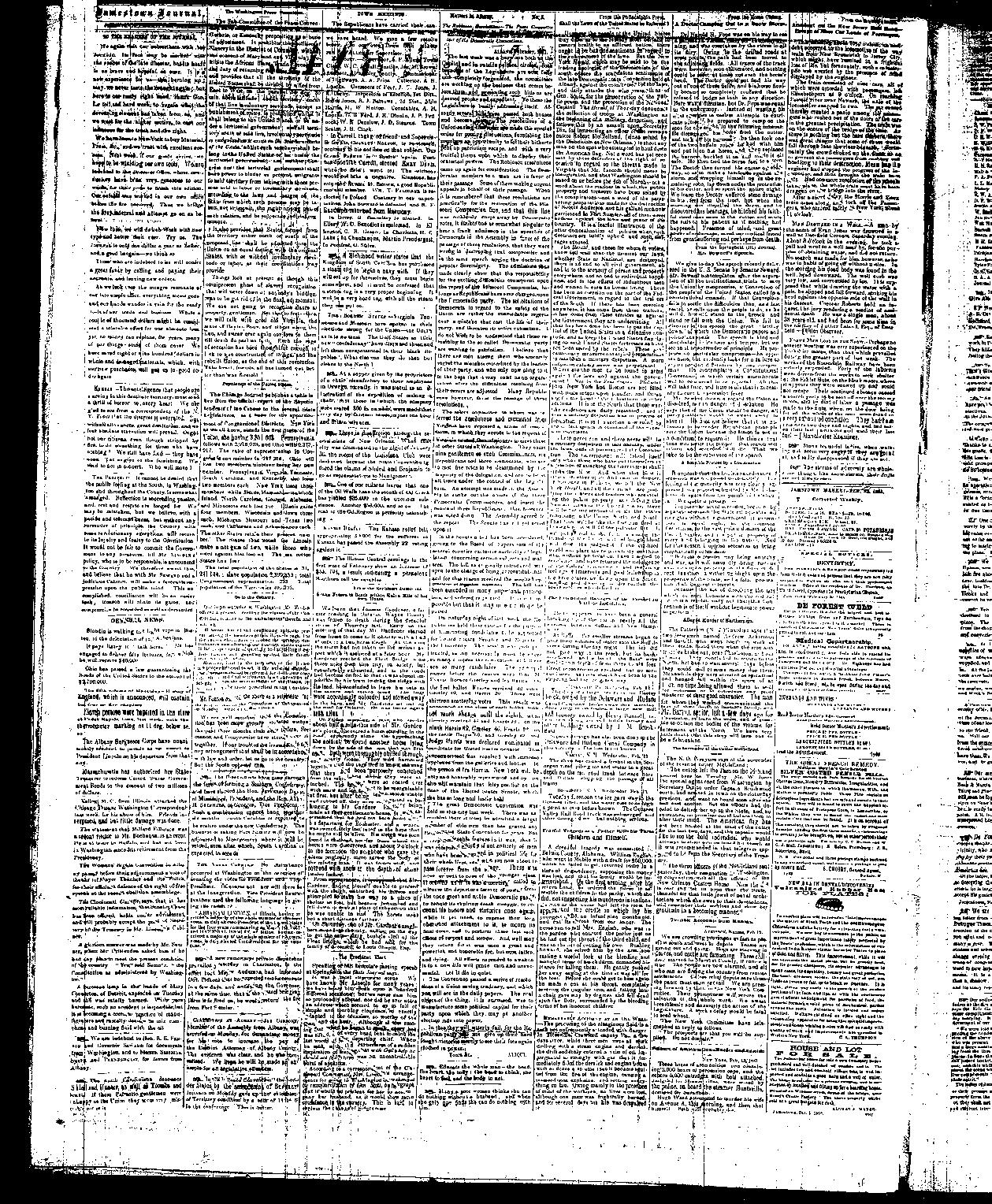
Here at home in Jamestown, while still growing and evolving from a small settlement towards becoming a city – disaster swept through – the Great Fire of 1861. On January 31st, an arson fire, devoured buildings on both sides of North Main Street between 2nd and 3rd Streets, and part of 3rd Street. Businesses and stores were consumed and destroyed. Also taken by the fire were the offices and printing operations of the Jamestown Journal that were in a building on what was then Main Street. Down, but by no means out – the Jamestown Journal printed and distributed its February 1st, 1861 edition, rising quite literally from the ashes, in the wake of loss and devastation. Using a borrowed printing press, the Journal didn’t miss a beat, responding to tragedy by moving forward, business as usual, committed to delivering to its readers the news, the facts, and messages of hope, resilience, and brighter days ahead.
Page One of the February 1st paper opens with local
as was the usual. Page 2 begins with a section titled “To The Readers Of The Journal” that captures the spirit of that day - loss and sadness, coupled with strength, forging on, and reassurance to the community. The section reads “ We again visit our subscribers with the Journal, Its face may be marked with the ashes of the late disaster, but its heart is as brave and hopeful as ever ,It is a new experience for us – this burning up-may we never taste the draught again; but here is our ready right hand, thank God, for toil and hard work, to regain what the devouring element has taken from us, and we trust for the higher motive, to cast our influence for the truth and the right.” The section continues to share with readers their recent purchases to regain normal operations and concludes by saying that the Journal will continue “with new type and better than ever.” This section concluded, again reflecting both sadness and strength saying “As we look over the meagre remnants of our late ample office, everything seems gone and our hands wander in vain for the ready tools of our trade and business.” and that “no money can replace, for years, many of our things – some of them never.”
1871 – A New Era & A New Look
Here at home, things were changing and shifting as well. Jamestown was introduced to a change in their reliable
ised in its first edition in 1826 – capturing the pulse of the rapidly-growing and changing city and community of Jamestown that it served.
The 1880’s Era – Growing With The Nation - From Pearl Ash Producer to Manufacturing Hub
Here at home, Jamestown was rapidly growing as an industrial hub, experiencing modernization in technology and expansion of its renowned furniture industry. The first electric generator arrived in Jamestown in 1881, marking a major technological turning point and paving the way for the Jamestown Electric Light and Power Company established a few years later. The A.C. Norquist Company was founded in 1881 and became one of Jamestown’s long-lasting furniture manufacturers, beginning and contributing to the city’s reputation as “The Furniture Capital of the U.S.” and “Pearl City.” The town was experiencing substantial population growth during this era, continually transforming from a small town into a city solidifying its name as a hub of industry. Jamestown would be incorporated as a city April 19th, 1886.
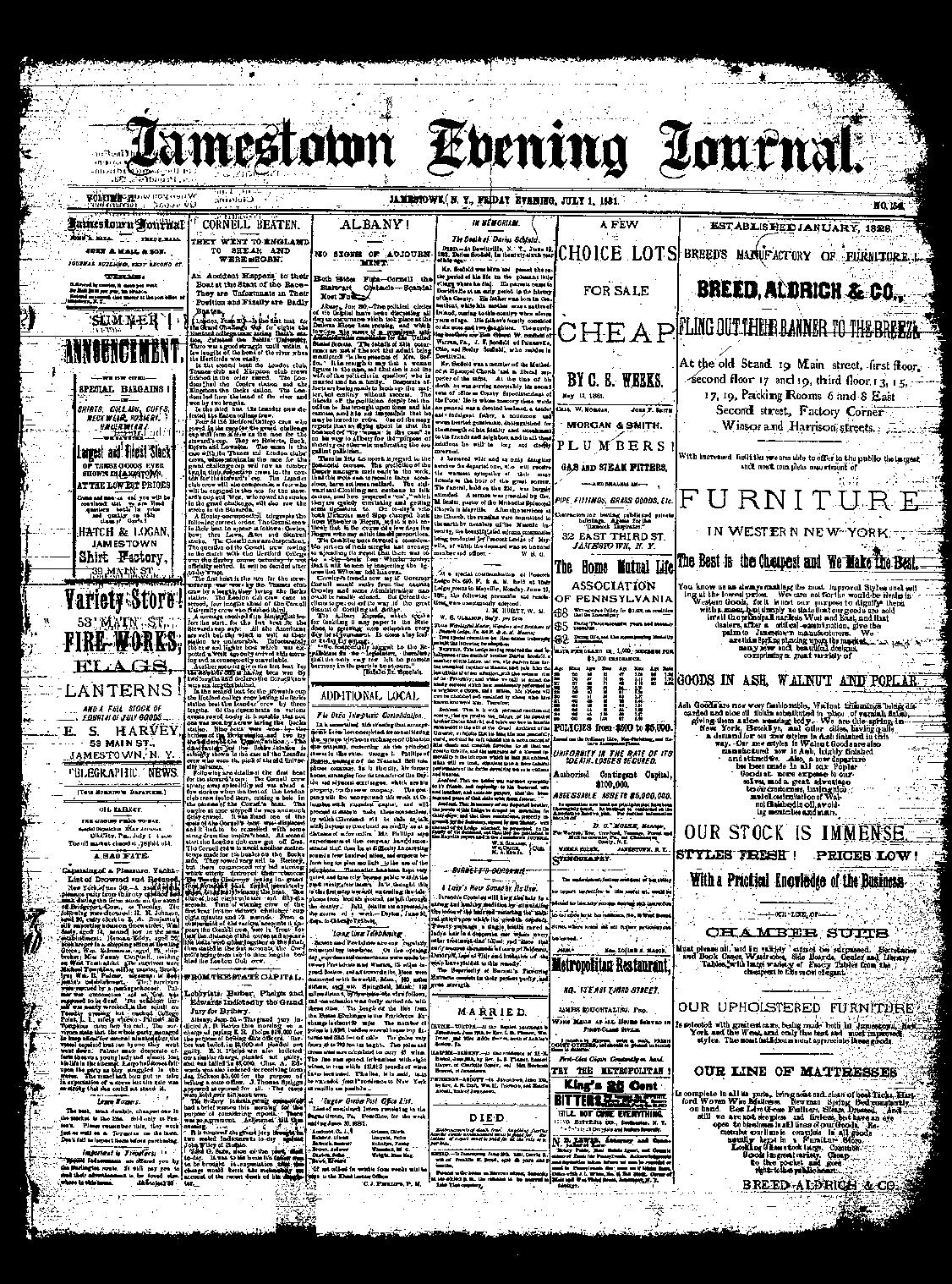
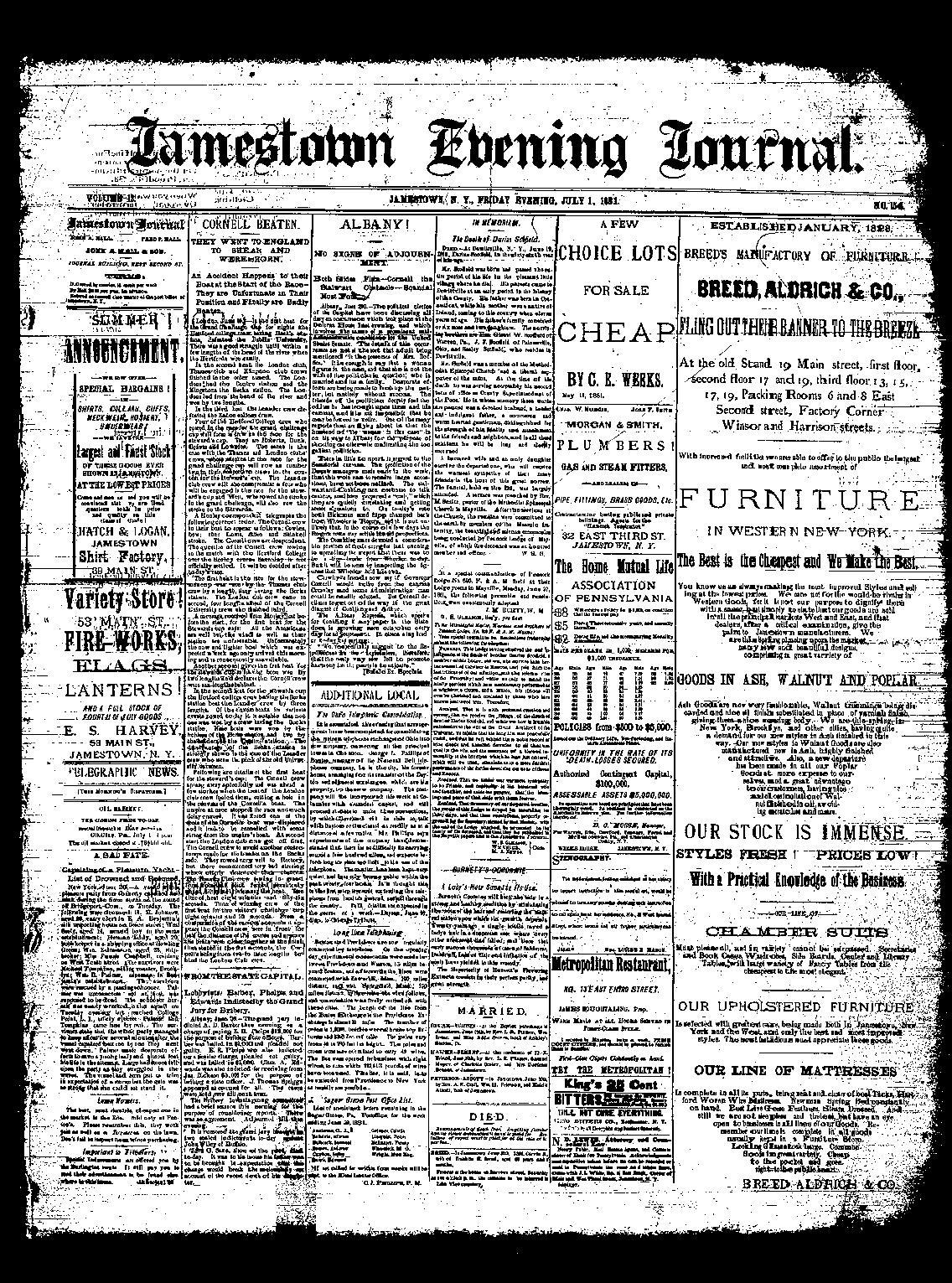
On July 1st, 1881 Jamestown Daily Journal readers were
www.rilesandwoolleyfuneralhome.com
Dignified, thoughtful, personalized service to all faiths. Helping families in their time of need.
Mark L. Woolley, Director
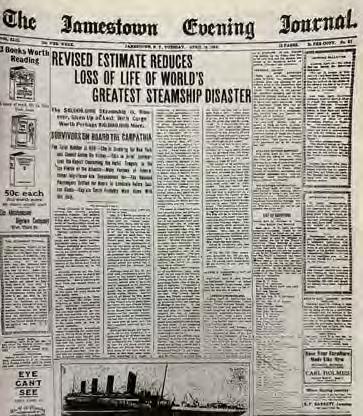
introduced to another change to their reliable local and national news source, that they’d came to love and trust for fifty-five years. The Jamestown Daily Journal published its last issue under that name on June 30th, 1881, and introduced the Jamestown Evening Journal name and edition. The first edition of the paper under this title was issued on July 1st, 1881. The Evening Journal’s introduction to the new name and face of the paper read, “Jamestown Evening Journal – the above is the new title of our daily which we assume today. It states more clearly what the JOURNAL is and the style of letter employed is, we believe, an improvement upon the one which has done service for so long a time.”
1891 – Soaring Through Changes
The sweeping changes and shifts of industrialization across the nation were vividly seen and felt here at home, in sync with the rest of the country. Jamestown, NY, officially incorporated as a city for five years in 1891 – a direct result of a period of booming growth in population and the building of industry. The city was continually and rapidly developing its furniture manufacturing industry and establishing itself as “The Pearl City”, a major center for manufacturing.
Oscar F. Price served as Mayor of Jamestown
Where We Were and What We’ve Shared continued from page 19 continued on page 21
until 1894. James Murray was appointed the first Chief of Police, leading a force of six police officers. While still booming with continuing growth, Jamestown smoothly and with many notable changes and contributions shifted into the Progressive Era – the Evening Journal accompanying every step of the way.
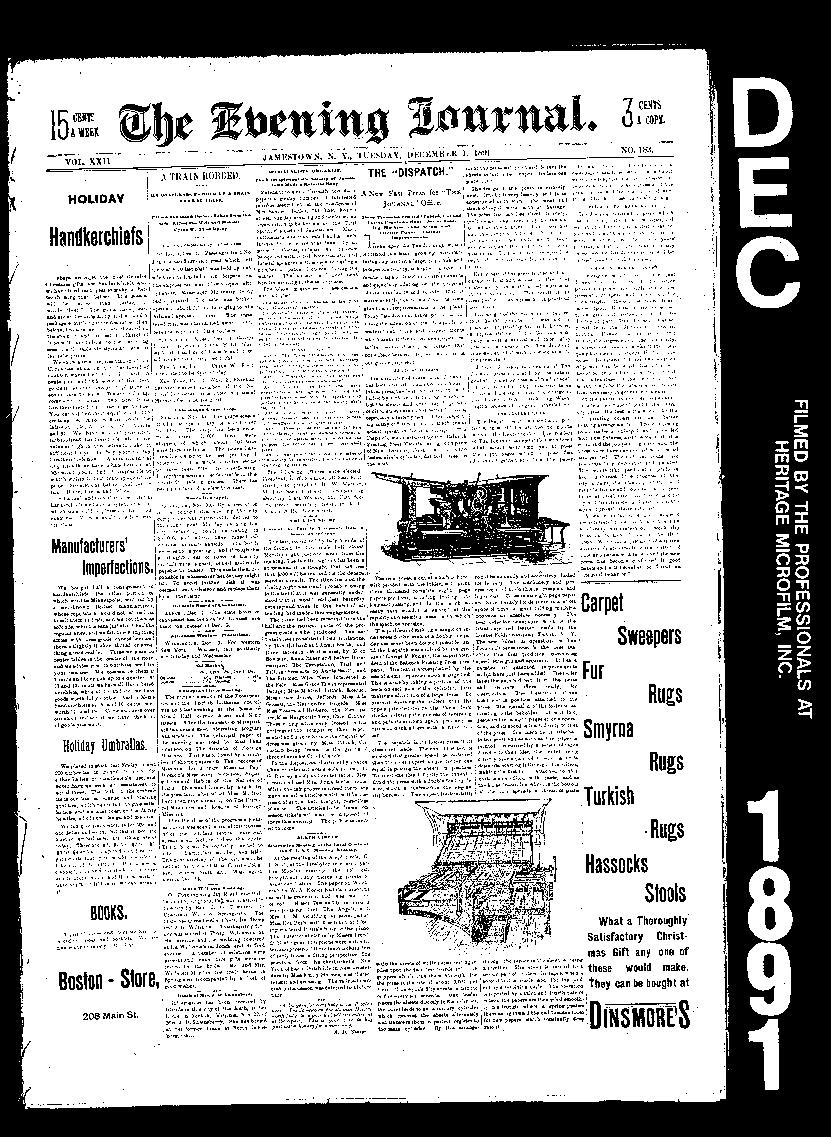
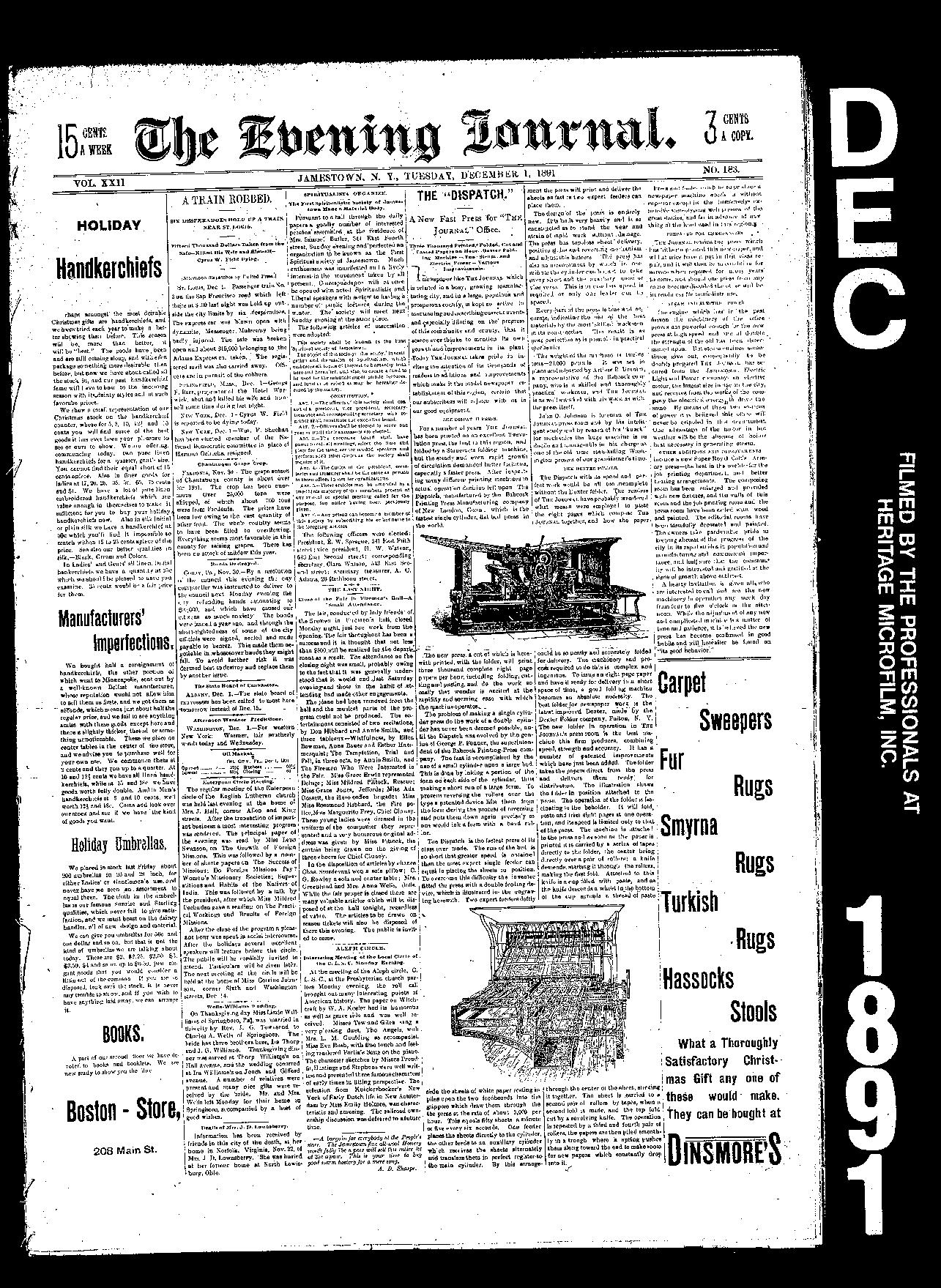
The October 21, 1891 edition of The Evening Journal was the first with this name, changed from The Jamestown Evening Journal. The December 1, 1891 edition of The Evening Journal, as previous editions since October, had eight pages, each encapsulating the pulse, changes, and growth of both the local community and the country.
The front-page story on December 1st, 1891, edition of The Evening Journal spotlights the excited and pridefilled announcement of new equipment and operations at the Journal office to meet increasing demand of the paper efficiently. Explaining this, the feature section begins by stating, “A newspaper like The Journal, which is printed in a busy, growing manufacturing city and in a large populous and prosperous county, is kept so active in mentioning and describing current events, that it scarcely thinks to mention its own growth and improvement in the plant.” The introduction continues, “Today The Journal takes pride in inviting the attention of its thousands of readers to additions and improvements which make it the model newspaper establishment of this
region, certain that our subscribers will rejoice with us in our good equipment.”
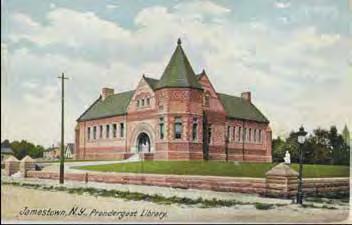
1891 also marks a monumental addition to Jamestown –the opening of the James Prendergast Library. The December 1st, 1891 issue of The Evening Journal spotlights the greatness and value of the gift of the library to the community, saying that its opening “marks an important epoch in our local history.” Continuing, the article warmly shares that “few communities can boast so magnificent a public gift.” Compliments of the building, and the treasures of books and paintings within it, are highlighted and the importance of books, reading, and culture is accentuated. The article concludes with a heartfelt thank you to Mary and Alexander Prendergast for the great gift
Where We Were and What We’ve Shared continued from page 20
of the library, mentioning their late son, James Prendergast whose vision and wish of a free library in Jamestown was carried out by his parents. In a memorandum found after his death, James wished that the income from his business interests would be used to establish a free library in Jamestown.
1901 – Growth & Loss – National Tragedy Close to Home
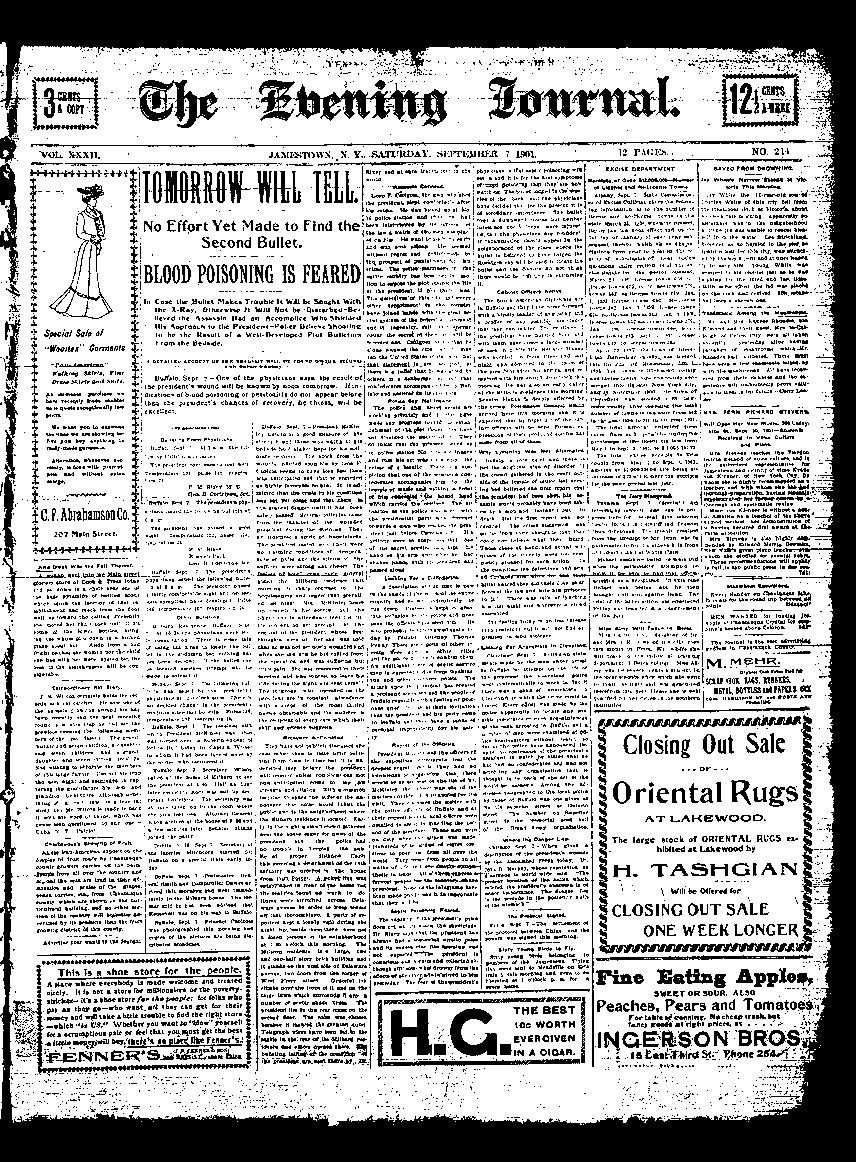
A tragic stain on 1901 is the assassination of President McKinley. President McKinley’s assassination was close to home for many reasons, foremost because the shooting occurred at the Pan-American Exposition in nearby Buffalo, NY on September 6, 1901. Both Jamestown and Chautauqua County were participating in and providing goods on a large scale to the Exposition. Numerous editions of The Evening Journal prior to September highlighted, with great pride, the upcoming Exposition and community members and local businesses planning to attend and contribute. Reporters and correspondents were also planning to attend and cover the events.
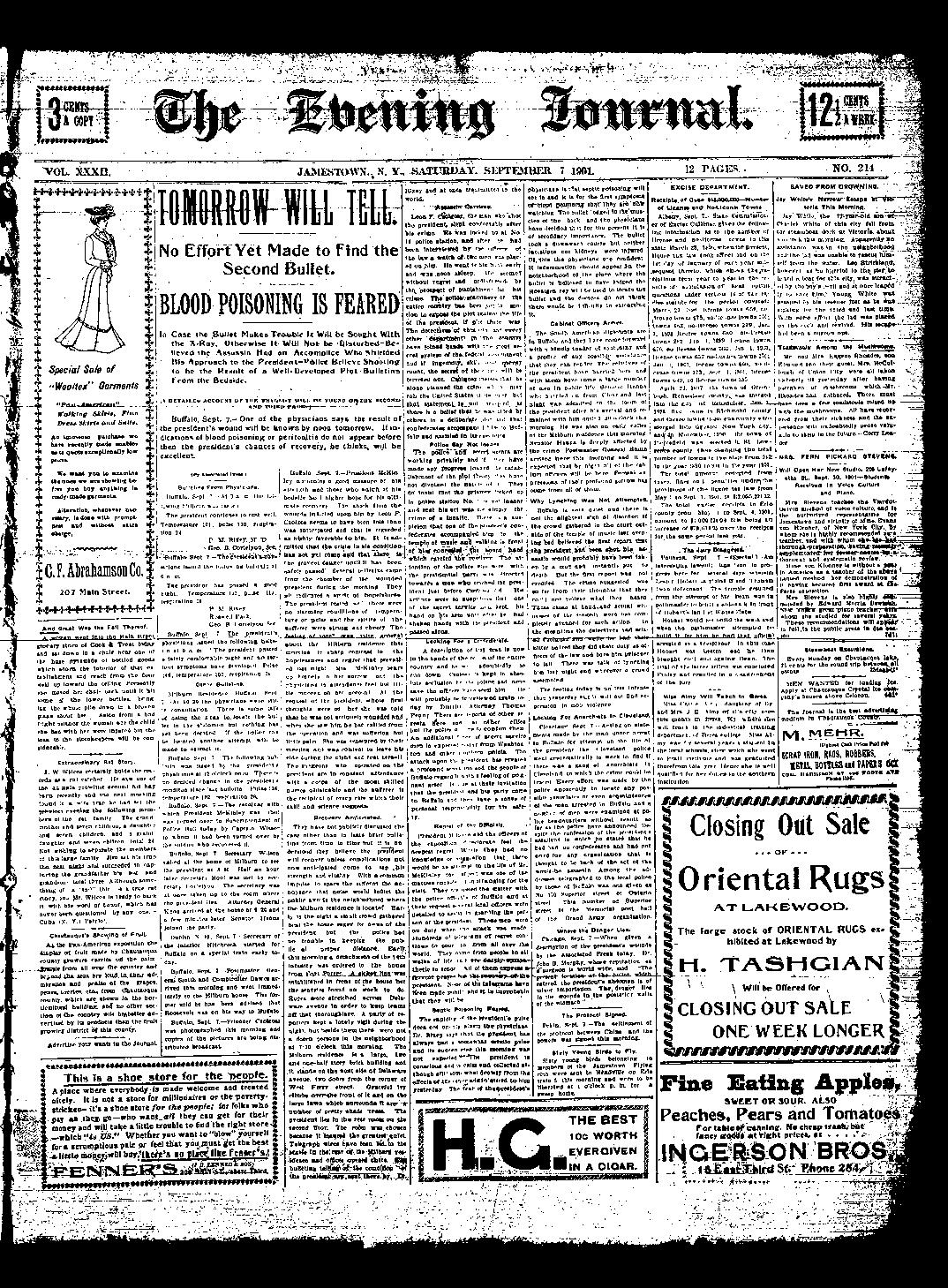
In response to the tragic turn of events at the Exposition, the Evening Journal quickly printed and distributed a 12-page edition on September 7, 1901. This issue detailed President McKinley’s condition, statements from his physicians – “Bulletins From the Bedside” - and shared hopes and prayers for his recovery. Among the columns and pages are messages of hope and good news - ads and images for new shops and businesses – reflecting a part of Jamestown’s burst of growth at the turn of the century – earning the name of “The Furniture Capital of the World.” Articles report the growth of electric power, water and septic systems, and expanding paving of the streets. Ads and classified throughout the 12 pages paint a clear picture of Jamestown’s modernization. “New Medicines” and “New Remedies” to treat illnesses were spotlighted with bold print and images. A large ad for a “New Century Typewriter” stands out.
1911 – “Disaster and Development”
Growth, change, and innovation continued to propel Jamestown and its surrounding communities forward –many of these seen and known nationally and across the
globe. The city was the leading manufacturer of metal furniture in the nation, to name only one great accomplishment – but there were many others.
In 1907, Karl Peterson founded the Crescent Tool Company where the still-famous crescent wrench was first produced. The Automatic Voting Machine Company, calling Jamestown home, manufactured the automatic lever voting machine. This machine dominated the lever voting machine industry across the nation from 1907 to 1983.
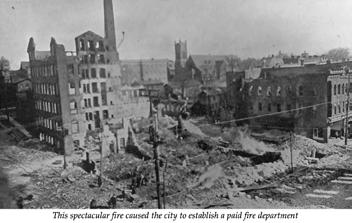
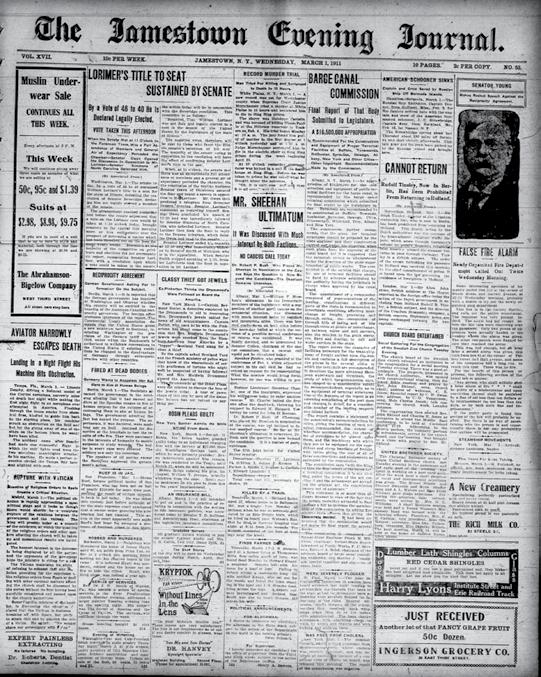
Tragedy struck Jamestown though, on Saturday, March 12, 1910, when the Gokey Fire broke out. The fire burned the interior of a seven-story brick building on the east side of Cherry Street between Third and Fourth Streets, occupied by the Gokey Shoe Company. Embers from the fire, fanned by strong winds the following morning, caused a second fire which completely destroyed the shoe factory, the adjacent Gokey Building of stores and offices on Third Street, and the Sherman House across Third Street. Jamestown volunteer firemen, with help from Celeron, Lakewood, and Falconer volunteers battled the blaze, but strong winds and fire worked against them. This fire led to the decision by the city to establish a paid fire department, which became effective March 1st, 1911.
The March 1st, 1911 edition of the Jamestown Journal highlighted and detailed, down to the smallest nicety, a grand banquet to recognize and honor the volunteer firemen who served.
1921 – Jamestown Renowned for Furniture & Hosting Babe Ruth
In the 1920’s, Jamestown reached its
continued on page 22
peak as a furniture manufacturing hub, with at one point over 50 factories in the city. Jamestown was the 2nd largest furni-ture producer in the United States. A second milestone reached by Jamestown in 1921 was the beginning of construction on the Grand Union switch, for Jamestown’s trolley system. This was a major engineering achievement for the city’s public transportation and a huge leap forward strengthening its infrastructure.
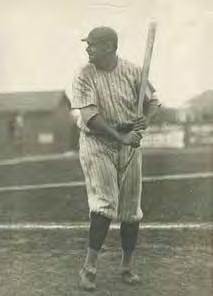
forever in the history books, was on October 18, 1921the day Babe Ruth came to Jamestown. The Jamestown Evening Journal’s announcement of the event in the October 17th issue read “Babe Ruth is Coming to City.”
The Wednesday, October 19, 1921 Jamestown Evening Journal captured and reported the highlights of the game under the headlines “Ruth’s Stars Defeat Locals” and “Meusel’s Home Run Scoring “Babe” Feature of Game.” The Evening Journal went on to report “Babe Ruth made good on his promise to knock one into the lake, but it did not come during the game.
1931 – The Power to Grow Amidst the Great Depression
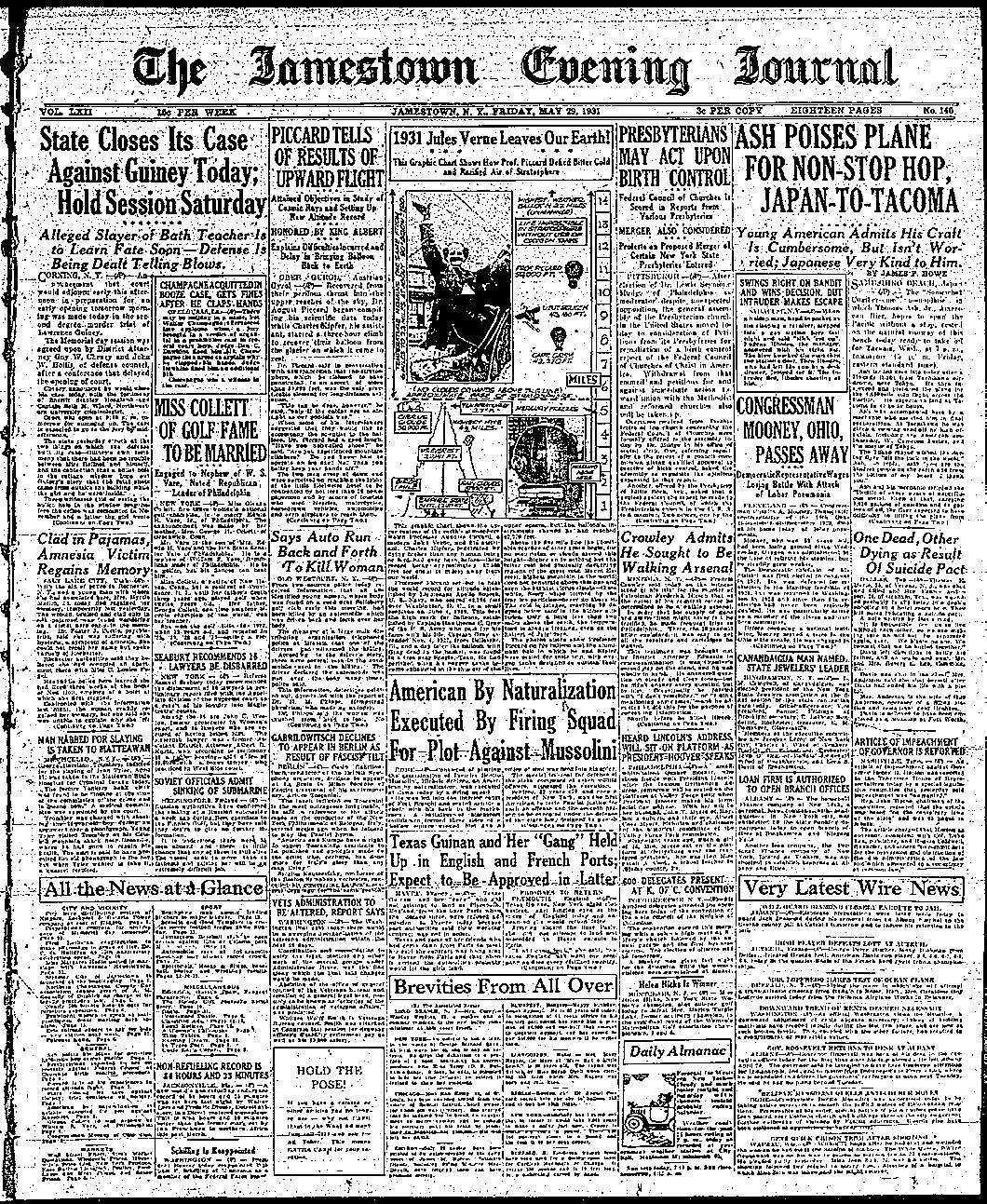
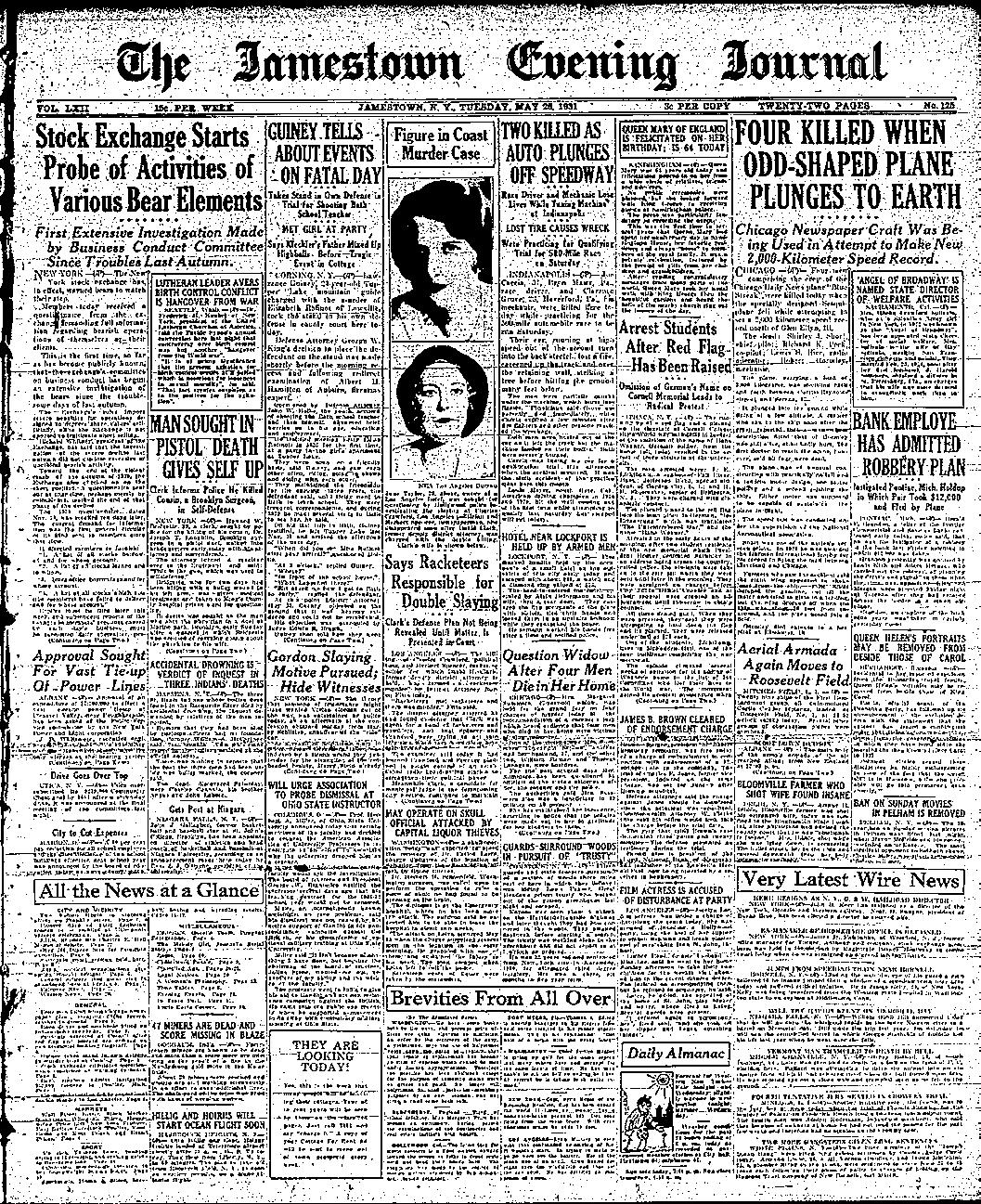
Here at home in Jamestown, while not isolated from the impacts, hardships and challenges that the Great Depression brought to the entire country, the city continued to grow, shift, and modernize. Jamestown reached its peak population of 45,000 in 1930. During 1931 the city ex-
perienced many shifts in infrastructure, media, and the political climate.
Between 1925-1926 the West Third Street Bridge was completed, which was a major infrastructure milestone. The bridge spanned the Chadakoin River and was key in expanding the city from the downtown area where people worked, to the west side, where people resided. Jamestown also grew in terms of its media and broadcasting growth. The local radio station WOCL (today WJTN) doubled its power and began a 12-hour daily broadcasting schedule. Jamestown also adopted Daylight Savings Time for the first time in 1931. While growing and advancing, Jamestown simultaneously faced and navigated hardships in 1931. A significant fire destroyed the Martyn Factory, a huge loss for the city’s industrial landscape, during an already difficult economic time. Impacted also by the national political unrest of the Great Depression, communists stormed a Jamestown City Council meeting on February 9, 1931.
One of the most impactful and significant events in 1931 for Jamestown, both at the time, and still affecting residents today, is the expansion of municipal power. The city officially purchased Niagara, Lockport, and Ontario Power Company in 1931.
1945 – New Beginnings Build and Loss Touches Down
A joint tribunal of France, the Soviet Union, the United Kingdom, and the United States in Nuremberg Germany. This tribunal was established to conduct international
Where We Were and What We’ve Shared continued from page 22
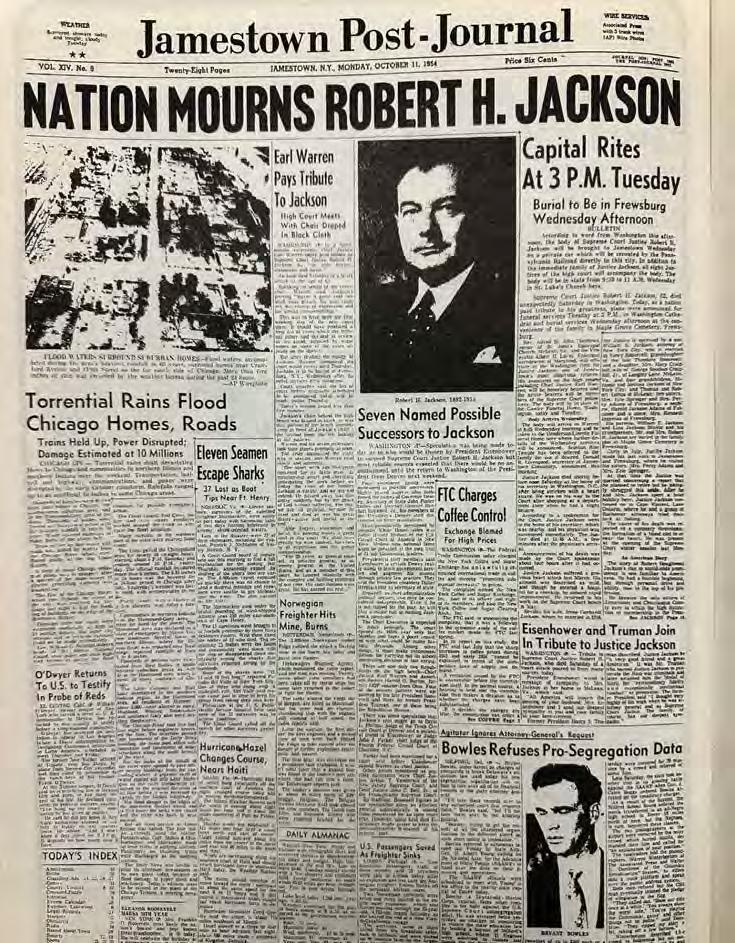
criminal trials for plotting and carrying out war crimes. Jamestown native, local prosecutor, and U.S. Supreme Court Justice Robert H. Jackson lead the Nuremberg Trials and is known for his precedent-setting and landmark contributions to shifting the landscape of international law.
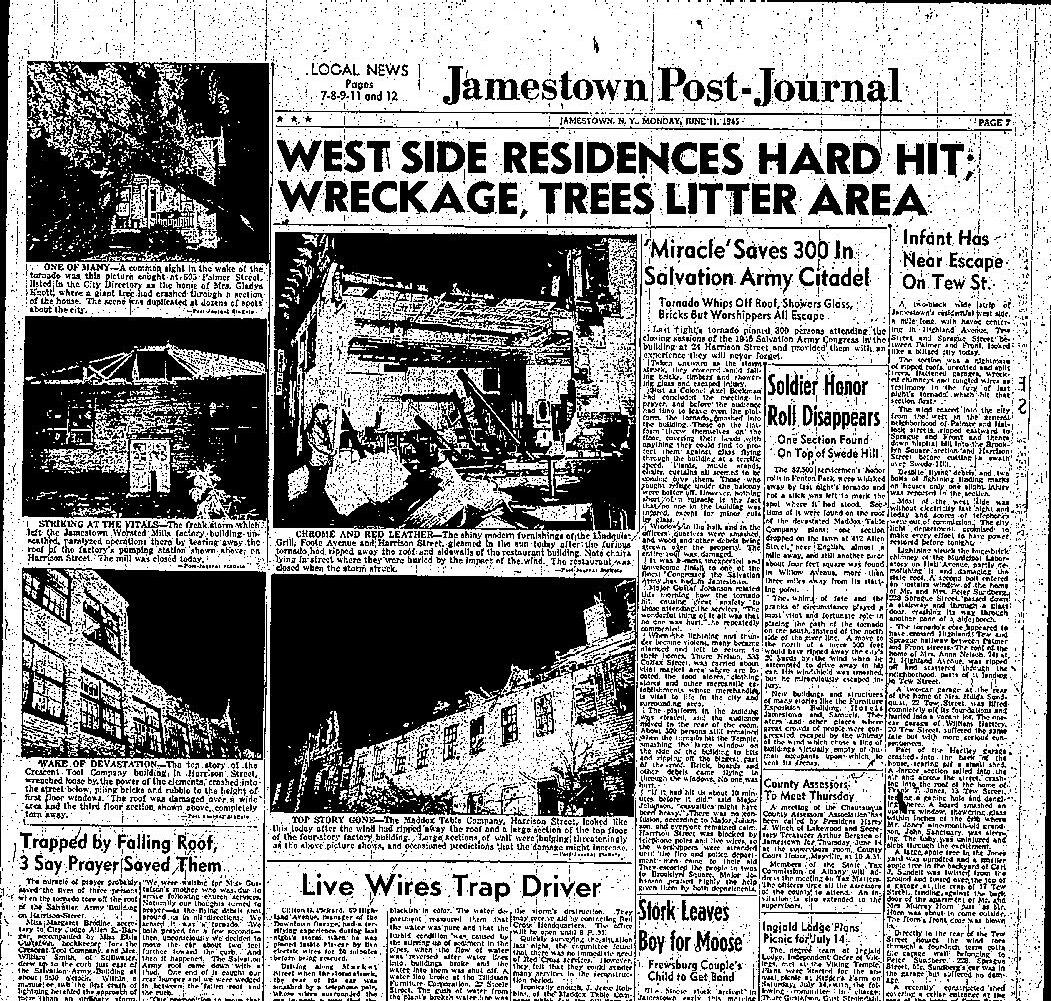
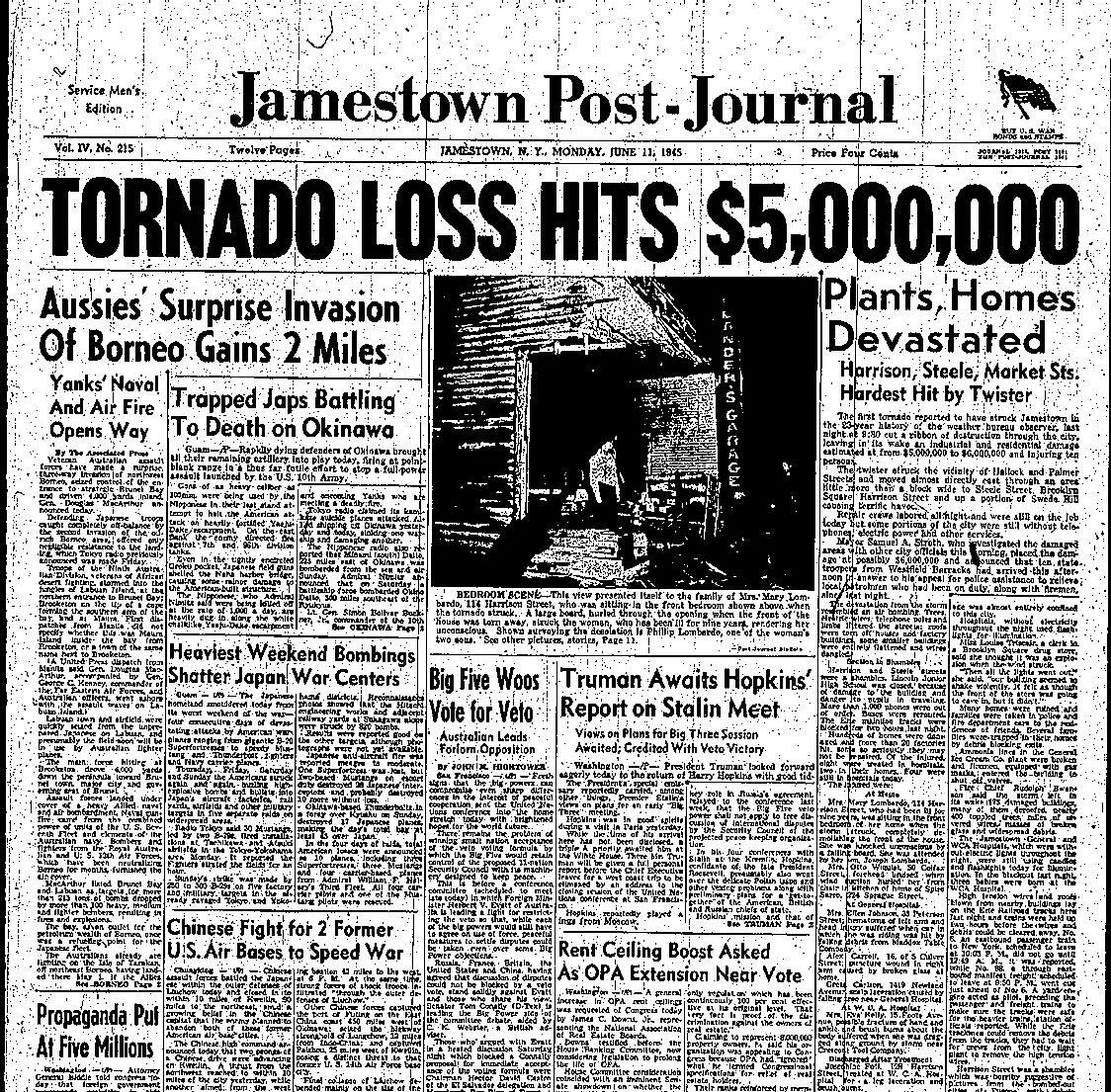
On the evening of June 10, 1945, a devastating tornado ripped through Jamestown. According to recorded accounts of the tragedy, following a beautiful weekend of weather, at 9:31 p.m., as sunset was well underway, the tornado began west of the city near Third Street and Harding Avenue. The June 11, 1945 edition of the Post Journal reported that at Harrison Street, the Salvation Army Church was just concluding their 1945 Congress when the tornado struck there. It reported, “Just as Colonel Axel Beckman had concluded the meeting in prayer and before the audience of 300 had time to even leave even the platform, the tornado smashed into the building.” Damage was also reported to the Maddox Table Company on Harrison Street. The Post Journal also reported the loss of the servicemen’s honor roll in Fenton Park was demolished with the headline, “Soldier Honor Roll Disappears.” The article reported that “not a stick was left to mark the spot where it had stood.”
1956 – Lucy Comes Home Welcomed by Thousands
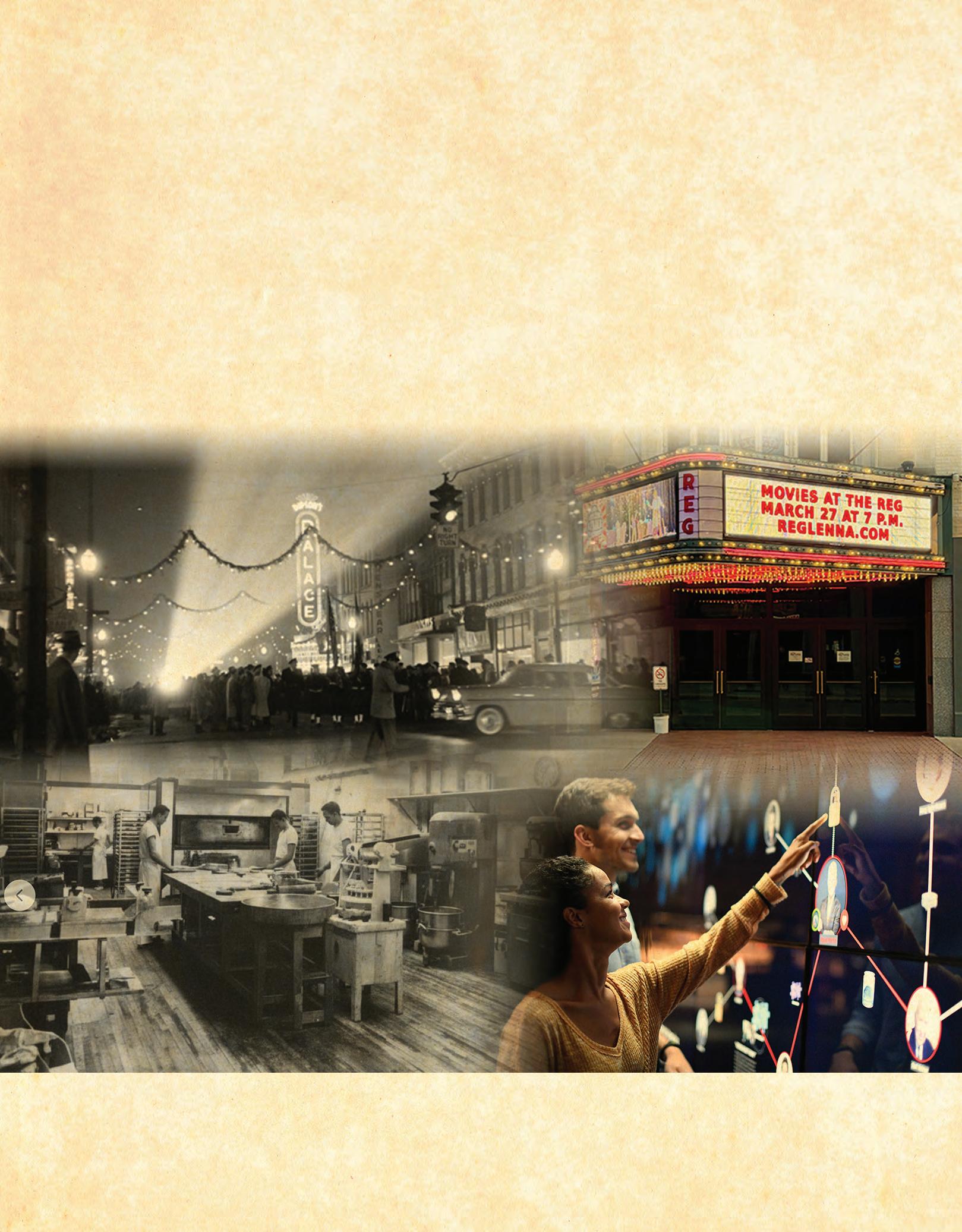
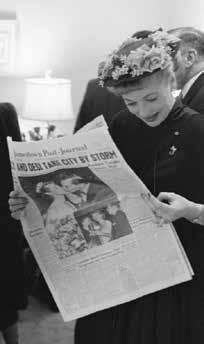
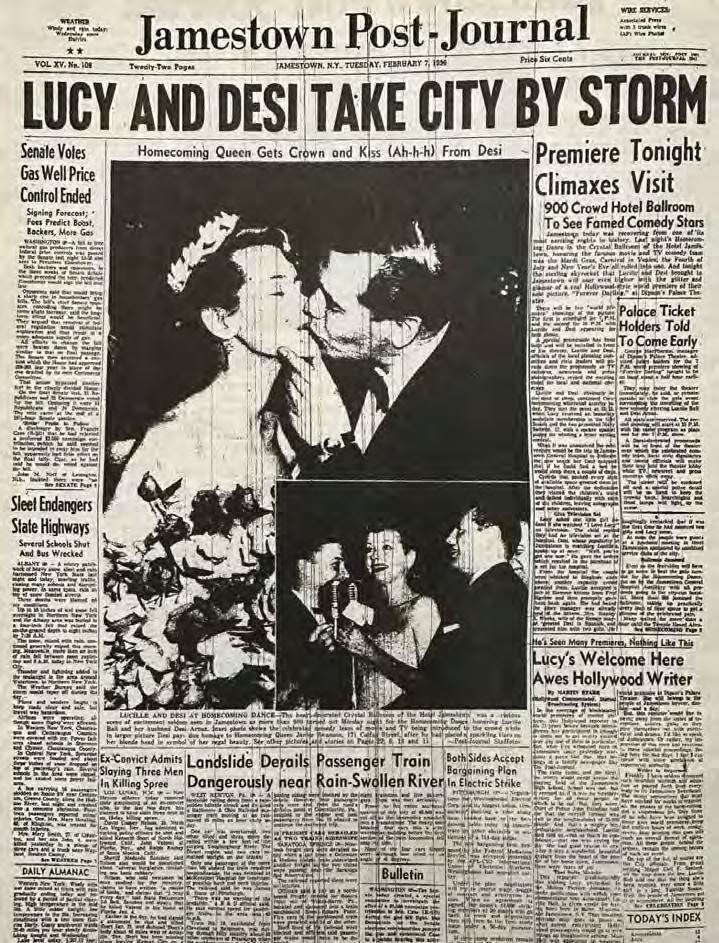
The most significant cultural event of 1956 in Jamestown by far was in early February, when Lucille Ball and Desi Arnaz came to Jamestown. On February 7th, the couple premiered their new feature film, “Forever, Darling” at Dipson’s Palace Theater, which is now the Reg Lenna Center for the Arts. The Post Journal was there for every stop of their visit, extensively covering every detail, from their arrival to all the highlights throughout their stay.
continued on page 24
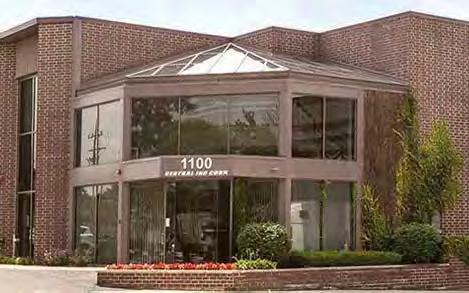
As Central Ink Corporation enters into its 83rd year of manufacturing ink, the company is embracing business strategies to prepare for the next 83 years. With new ideas and continued commitment to excellence, Central Ink Corporation is preparing itself to introduce new product lines to enter new markets. Diversification of products and markets ensures a stable future for the company, every employee, and their dependents.
Our customers need the ability to make a choice and Central Ink Corporation, an entrepreneurial company, provides the printing industry with a choice. Central Ink is determined to make a difference in the printing industry
Where We Were and What We’ve Shared
The Post Journal continued their coverage of this historic event in the February 8th, 1956 edition. This paper included transcripts of their interviews and stage appearance at the Palace Theater where the move premiere unfolded. Lucy expressed in an interview with The Post Journal her pride in the town’s reception.
Transformations & The Storm of ‘66
continued from page 23
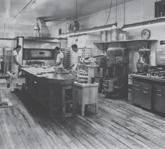
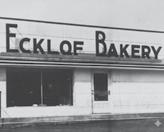
Businesses and stores that were well established were going strong and new ones opened that would be relied on by the community for years to come, like Ecklof Bakery. Opening its doors in 1956, Ecklof bakery is a family-run Swedish bakery that has stood the test of time. When the bakery first opened in 1956, they gave a free cookie to all the children who came with
their parents – The Post Journal was there. The August 30, 1956 Jamestown Post Journal highlighted the grand opening of the bakery. The edition featured photos of both the inside and outside of the building. A caption under the photo of the bakery complimented it pointing out the “modern baking machinery” and its “well lighted, well ventilated, clean, bright interior.”
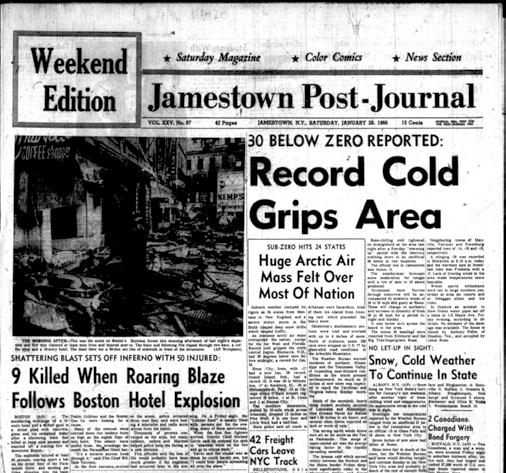
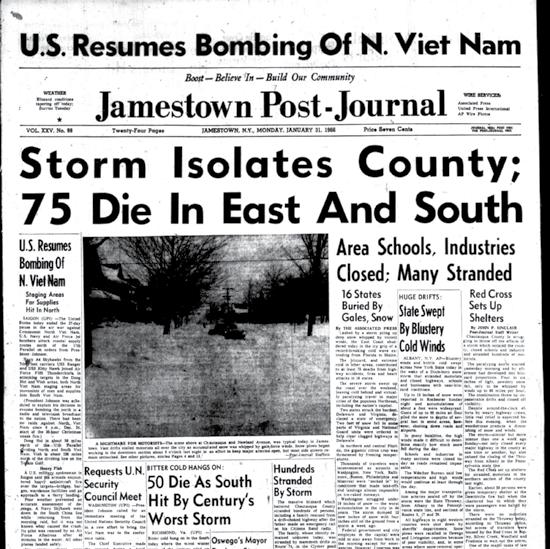
January 29, 1966, marks the beginning of one of the worst weather events ever seen by our region. The Saturday January 29th, 1966, Weekend Edition of the Jamestown Post Journal headlined “30 BELOW ZERO REPORTED: Record Cold Grips Area on its front page. The article details both the storm’s impact across the nation, as well as in Jamestown, saying that a “bone-chilling cold tightened its stranglehold on the area” the night before, “with the mercury stabbing down to an unofficial 30 below at two locations.” The article continues forecasting more snow and cold for the region with “NO LET-UP IN SIGHT.”
1976 – Celebrations & Setbacks
The nation’s 200th anniversary was being celebrated across the country in 1976 and here at home the same spirit of celebration of growth, successes, and the bedrock of community and businesses that Jamestown was made from exuded. 1976 found Jamestown building and expanding upon their solid community and economy.
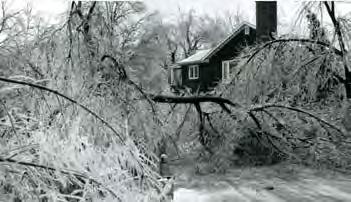
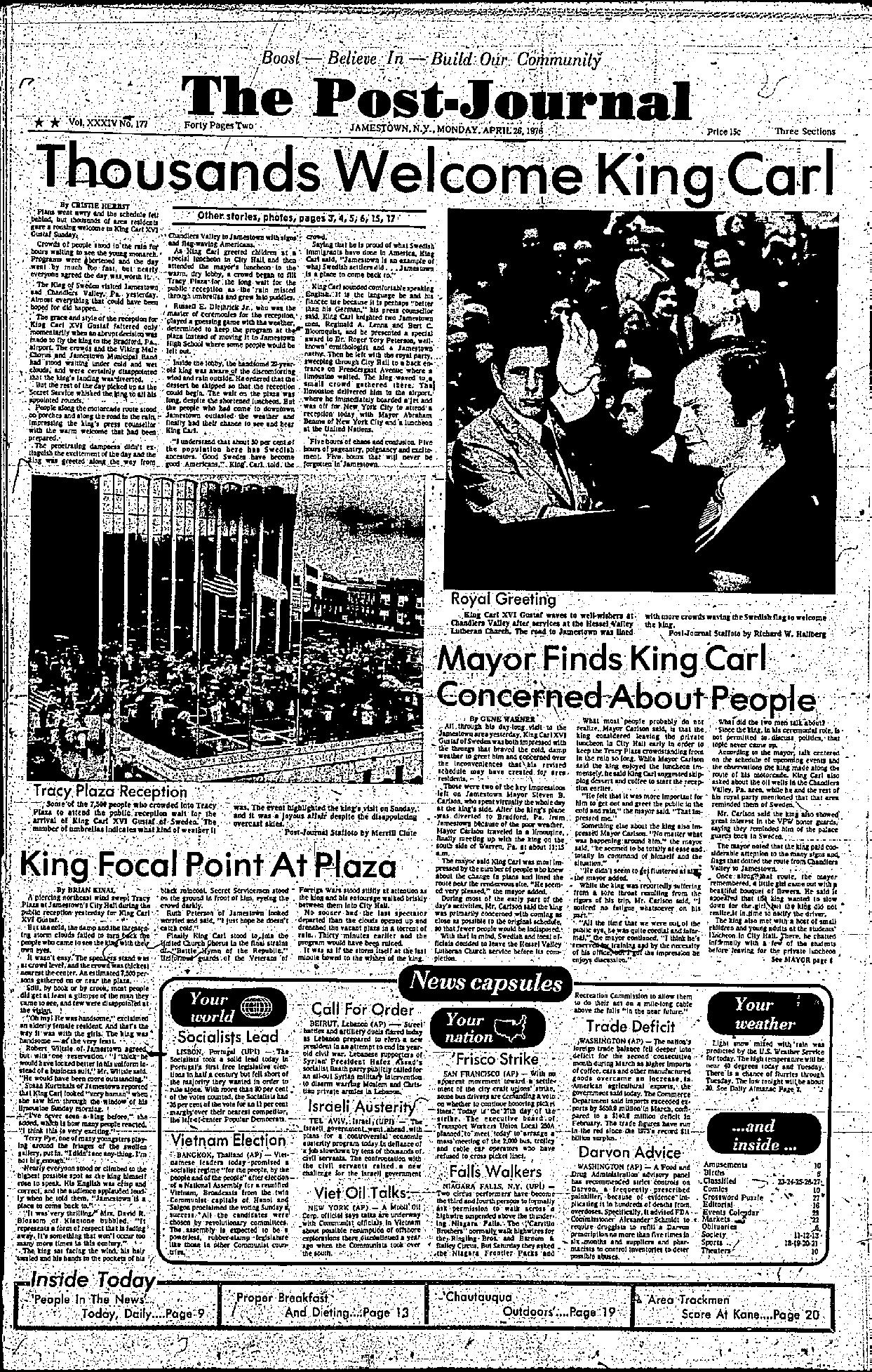
One notable expansion this year was of the James Prendergast Library. On January 19th, 1976, U.S. Senator Robert F. Kennedy visited Jamestown to announce a $153,000 federal grant for the library expansion. The January 20th edition of the Post Journal reported on his visit, detailing his itinerary and community excitement. On March 2nd-3rd, 1976. A major ice storm hit Western New York over these two days, which is still described as one of the most severe and costliest ice storms in Western New York’s history. In the aftermath of the ice storm in 1976, the weather brought yet another challenge. Around March 5th, the area of Brooklyn Square experienced significant flooding and affected the central commercial areas of the city. The March 5th edition of the Post Journal detailed the flooding and damage documenting it with a photograph. Jamestown also joined in the nation’s bicentennial celebrations famously - hosting King Carl XVI Gustaf, the reigning monarch of Sweden.
1986 – A Year of Centennial Celebrations
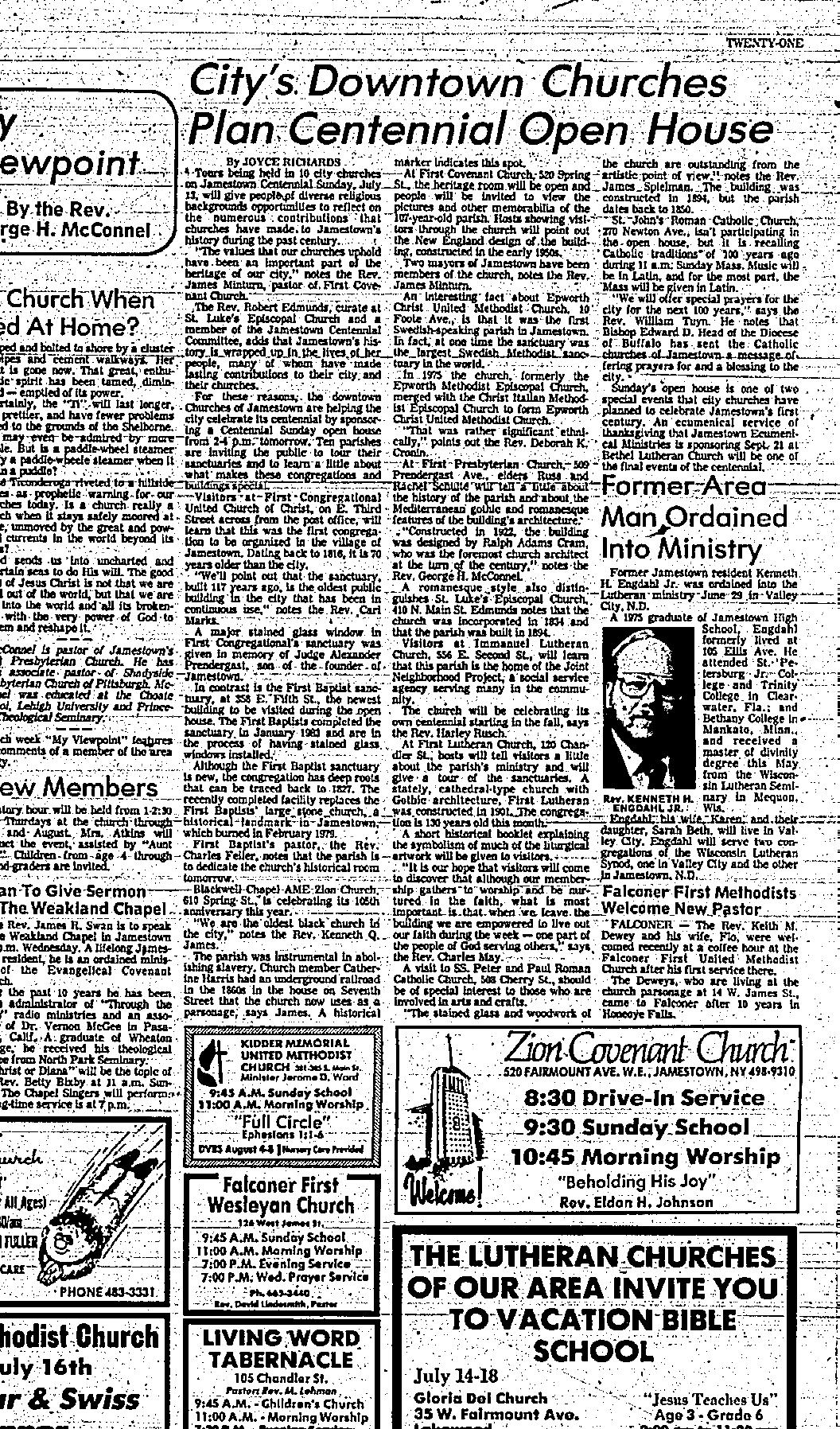
Festivities celebrating the city’s 100th anniversary took place throughout 1986, but the height of the community-wide celebrations occurred from July 21st through the 29th. A major event of the festivities of the year was
continued on page 25
Where We Were and What We’ve Shared continued from page 24
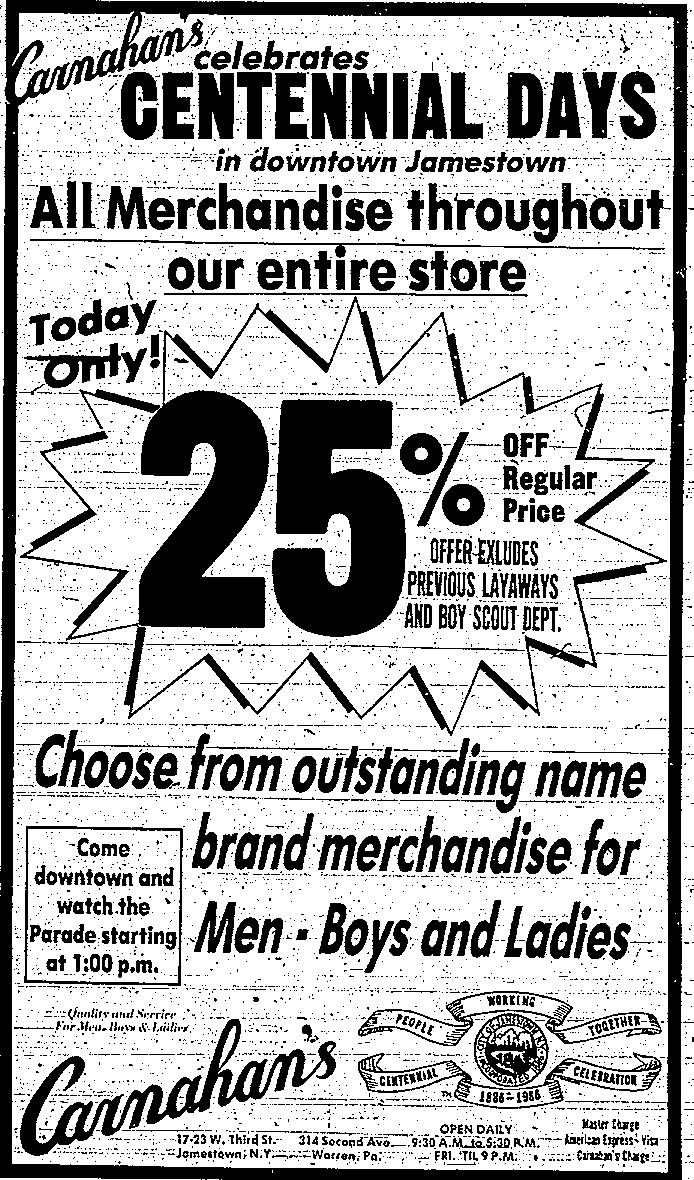
the Centennial Parade. A July issue of The Post Journal featured a lineup of the parade listing 105 entries, ordered into seven “divisions” participating. Documenting both this year and the remarkable and unique history of Jamestown, New York was the historical marker program. In celebration of the Jamestown Centennial, a major initiative of the Jamestown Centennial Committee, in collaboration with New York State, resulted in the installation of numerous plaques across the city to commemorate its incorporation as a city in 1886.
1996 -New Beginnings – Honoring Legends
While moving into the future, Jamestown also honored its past in many ways. One was the formal recognition of its oldest tree, the “Jamestown Oak.” The white oak on Buffalo Street, estimated to have sprouted around 1820, was honored with a historical marker on Arbor Day, 1996. The tree was also formally named to the New York State Historic Tree Registry on this day.
Cultural milestones in Jamestown in 1996 included the dedication of the Robert H. Jackson statue, honoring Supreme Court Justice and
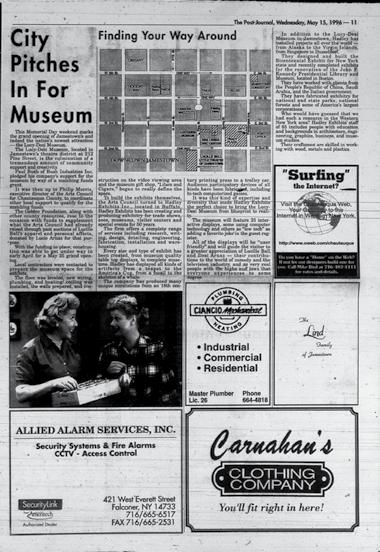
Nuremberg prosecutor who was a native of Jamestown and maintained strong ties to the region. Also in 1996, very notably and impactful to the city, region, and community, was the opening of the Lucille Ball-Desi Arnaz Museum. The museum was established in Lucy’s hometown to honor the “First Couple of Comedy” and Jamestown native Lucille Ball. Numerous editions of The Post Journal throughout May 1996 contain ads and messages throughout, from local businesses, reflecting the welcoming spirit of the community. A reader could not pick up or quickly glance through a copy of The Post Journal in May, 1996 without seeing news of the approaching opening of the museum and all of the details surrounding it. From cover to cover, from ads, to feature articles, to photographs and art, the paper exuded and captured the excitement and pride of the welcoming community of Lucy, the museum and its opening.
2006 – A Strong Community
St. Susan’s Center, Jamestown’s soup kitchen needed to change locations and launched a major relocation cam-
continued on page 26
Where We Were and What We’ve Shared continued from page 25
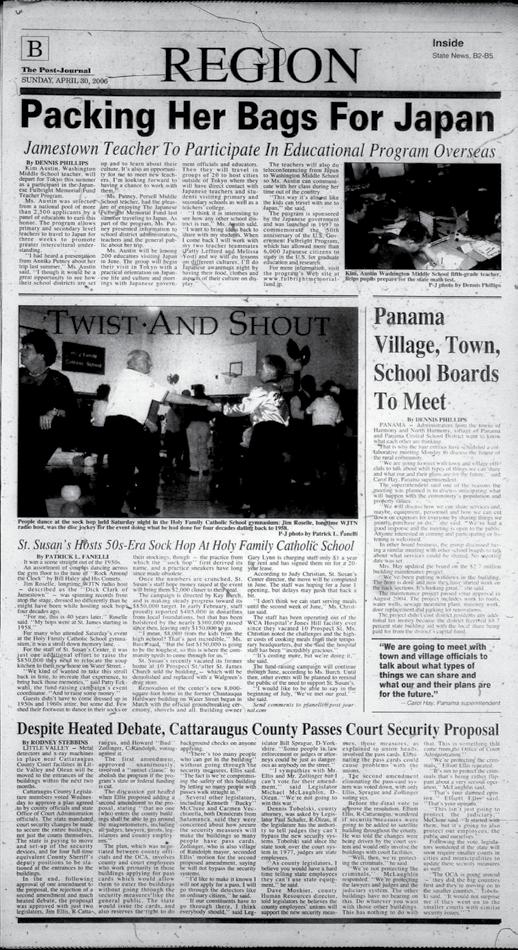
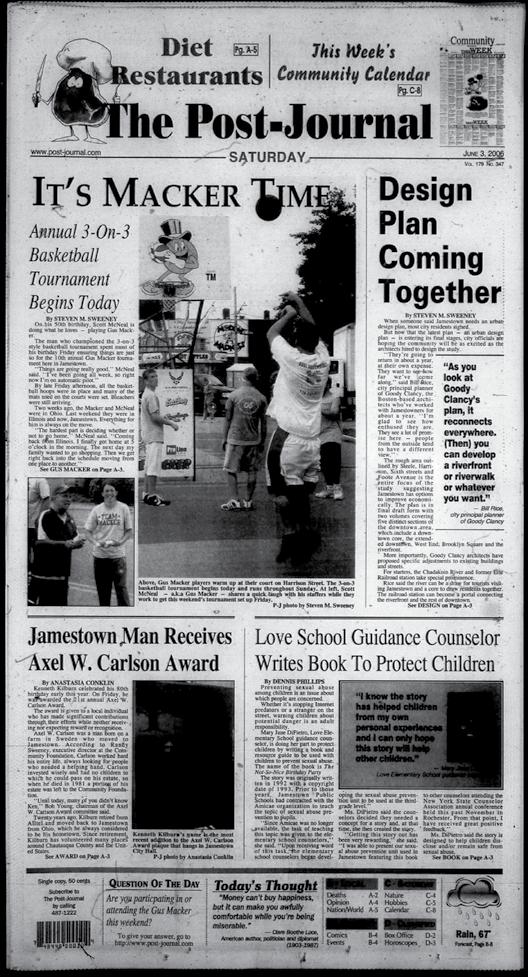
paign. The campaign continued to make steady progress thanks to fundraising and community/foundation donations. The April 30, 2006, edition of The Post Journal reported on a throwback “sock hop” fundraiser. “It was a scene straight out of the 1950’s” the article said. The dance was held at Holy Family Catholic Church, hosting attendees dancing to hits from the 1950’s and 1960’s. The article conveyed that the event was a fun-filled success, getting St. Susan’s about $2,000 closer to their goal. While the community and organizations within it were banding together to help others, efforts were being made to make major improvements to the city and buildings within it. In 2006, the Jamestown Renaissance Corporation (JRC) was established. The Saturday, June 3rd, 2006, edition of The Post Journal conveys the excitement and optimism for the proposed restorations to the city. The article also detailed the many areas and buildings within the city included in the renovation plan and projection of when the plan would be completed.
2016 – Admiring & Preserving History
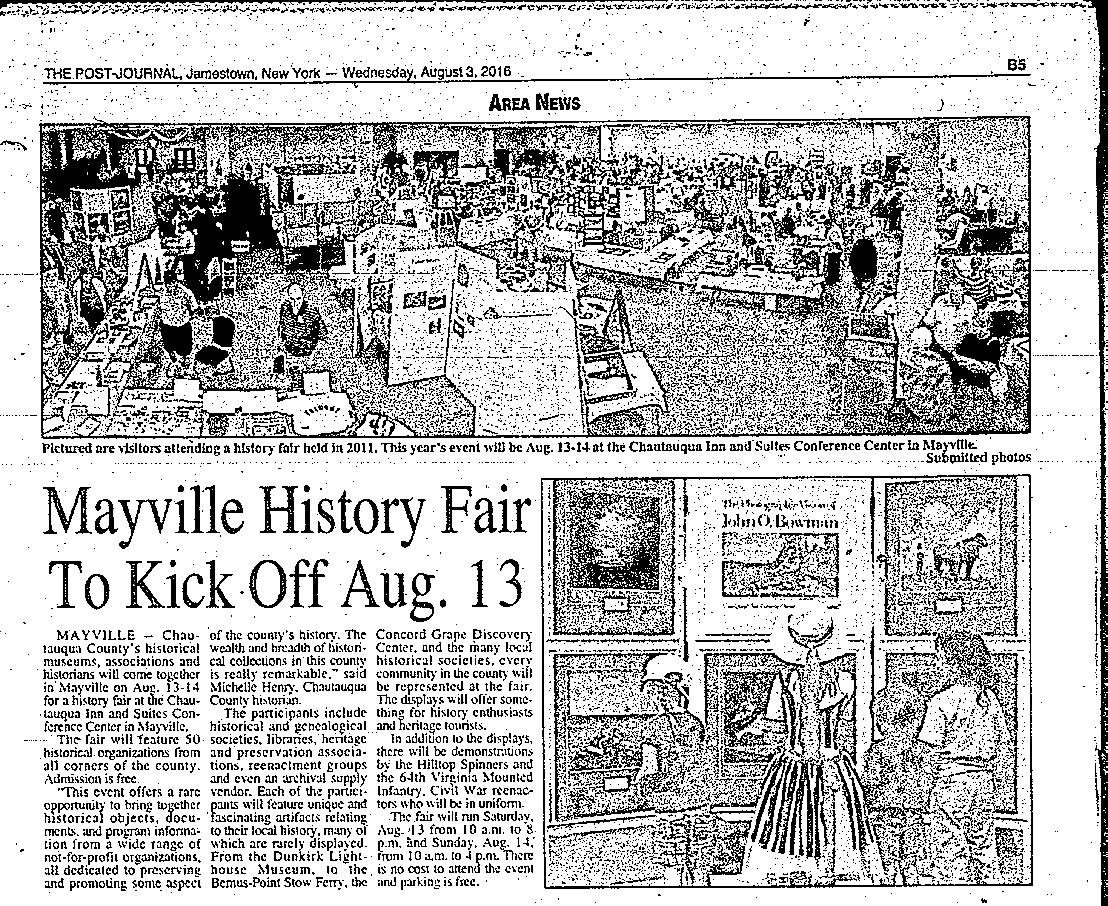
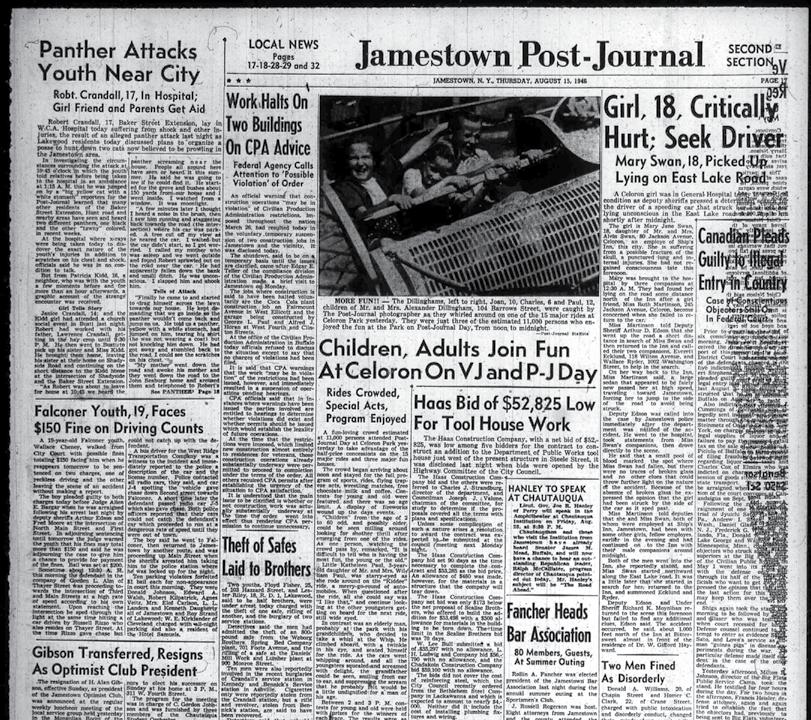
The 2016 Chautauqua County History Fair was a major weekend-long event held August 13-14. The fair brought together more than 50 local historical societies, museums, and heritage groups and was organized by the Chautauqua County Historian’s Office. In anticipation of
The Jackson Center. 2016 marked many milestones for The Jackson Center and subsequently many community events. Throughout all of 2016, The Post Journal covered the milestones and events of The Jackson Center. January editions featured pieces on the center’s legacy and contributions and highlighted their participation in the Doors Open Jamestown event. Late October editions featured the announcements and schedules for the Judgement and Nuremberg anniversary events.
2026 – Reflecting, Remembering, and Commemorating Our History
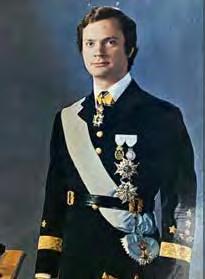
Here at home, our anniversaries and histories are being remembered, observed, and honored as well. 2026 marks the 50th anniversary of King Carl XVI Gustaf of Sweden’s visit to Jamestown, NY, which was on April 25th, 1976. This was the first state visit by a monarch of Sweden to
the event, the August 3rd, 2016 issue of The Post Journal featured pictures of the previous 2011 history fair and detailed the features and details of the upcoming 2016 fair. The article shared insight from Michelle Henry, Chautauqua County historian who said “This event offers a rare opportunity to bring together historical objects, documents, and program information from a wide range of not-for-profit organizations.” She then continued stat ing, “The wealth and breadth of historical collections in this county is really remarkable.”
Of the same goals and spirit of preserving and appreciating history and awareness, while creating change is
continued on page 27
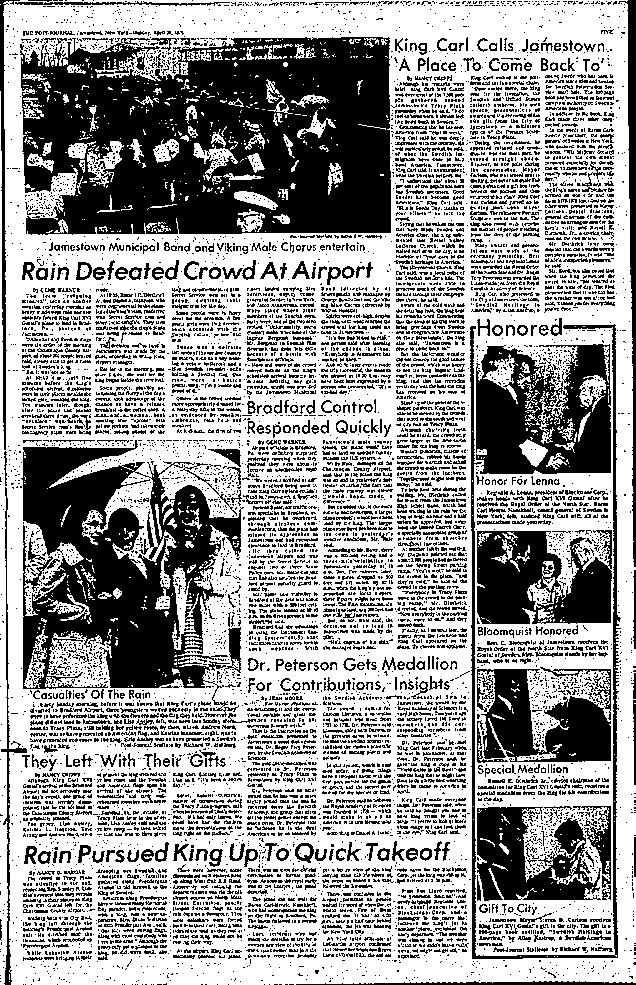
the United States. The final stop of his 27-day United States Bicentennial tour, he was welcomed to our community by thousands. The Post Journal covered this event from when the preparations began for the king a year prior to his visit, to after his departure from Jamestown. The excitement and anticipation of this visit by the community exuded from the pages of the April 1976 editions. Along with articles detailing excitement and details of preparations, ads from numerous businesses – big and small- reflected the community’s buzz and eagerness.
When the great day came, The Post Journal covered every minute of his stay – from his diverted arrival to his trip to Hessel Valley Lutheran Church in Chandler’s Valley, PA, his motorcade on the route to Jamestown, and of course the events and travels once he arrived here. The front page of the Monday April 26th, 1976 headline read, “Thousands Welcome King Carl.” The article tells in detail how “crowds of people stood in the rain for hours waiting to see the young monarch.” It also included a detailed description of his entire visit in the area, and numerous interviews and first-hand accounts of the event.
2026 – reflecting, remembering, and commemorating the amazing history of our community, and celebrating many from it that have impacted our region, the country, and often the world. Steadfast to the original promises of reliability and truth of Adolphus Fletcher, publisher of The Jamestown Journal, stated 200 years ago, The Post Journal continues to guide its community through daily news, into future days, while never forgetting the past 200-year journey of growth and change. Where We Were and What We’ve Shared continued from page 26
Jamestown’s Newspaper History
Since 1826, Jamestown has had at least one newspaper produced in town. In June 1826, the Jamestown Journal was first published by Adolphus Fletcher. He continued until 1846 when his son, John W. Fletcher, became the proprietor for two years. After that it was in the hands of a number of partners, had a few name changes, went from a weekly to a twice weekly, to a daily and a weekly and other combinations of issues, and merged in 1941 with the Morning Post to become the Jamestown Post-Journal now The Post-Journal. For the complete history, see Helen Ebersole’s book, “An Impressive Record,” available for sale at the Fenton History Center’s gift shop.
During the first four decades of the Jamestown Journal, Jamestown saw a number of newspapers come and go. The first newspaper in the county, The Chautauqua Gazette, was published in Fredonia beginning in 1817. A second newspaper in Jamestown was The Chautauqua Republican, started in 1828 by Morgan Bates. It continued under other leadership until 1833 when it passed to S. S. C. Hamilton and moved to Mayville where it was named The Republican Banner but was discontinued after a few months. As a result of the Liberty Party (an abolition political party) starting in the late 1840s, The Liberty Star began publication in Jamestown by Harvey A. Smith in 1847 and supported the abolition cause. In 1849, it passed to Adolphus Fletcher and the name was changed to The Northern Citizen and soon became The Chautauqua Democrat, which continued until the 1890s.
Through the years, there have been many other newspapers in the county, some of which were located in Jamestown. Many were short lived or changed names as ownership changed. The newspaper information for Chautauqua County and all the others counties up to 1860 is found in the Gazetteer of the State of New York, by J. H. French, published in 1860. After that that it is harder to find what newspapers were published where and what happened to each.
After the Civil War, Jamestown saw a number of newspapers come and go. There was the Jamestown Call, and the Jamestown Daily All and the All, just to confuse things. We had the Jamestown Sun in the 1880s along with the Jamestown Sun and Standard and then in the 1950s, we had the Jamestown Sun again. There were a number of others.
In the Special Collection at the Fenton History Center’s Research Center, we have a number of these newspapers represented by a few issues of many of the different ones. Unfortunately, we do not have entire runs of any of them. Through the Library of Congress an effort was made a number of years ago to identify who had what papers in their collections and a bibliography was assembled. Because in the old days news traveled by newspaper, it is possible to find newspapers in collections far from the point of origin.
News was copied from one newspaper to another. Often, especially with death notices, there was included a line such as “Connecticut papers please copy.” That way, that death or other news that would be of interest to people somewhere in Connecticut would reach a newspaper or other places there. Because of the poor quality of paper used for newspapers after the Civil War, preservation and storage and later, accessibility of newspapers became difficult. Thankfully some were kept and were eventually microfilmed as that technology advanced. Today many microfilms as well as actual newspapers are being digitized and many are available on the Internet some on free sites and some on paid subscription sites.
The item in the collection at the Fenton History Center that spurred this article was the front page of the Jamestown Morning Star, published on Sept. 10, 1962. This was Volume 1, No. 1 of the new newspaper in Jamestown. Earlier that year the Jamestown Sun ceased publication after more than a decade of being the morning newspaper in Jamestown. The Jamestown Morning Star survived about two years as an independent newspaper.
‘Nellie’ Carlson Helped Get Newspaper Delivered
As The Post-Journal celebrates 200 years of serving Jamestown and Chautauqua County, it is fitting to remember the people who quietly helped carry it through the decades.
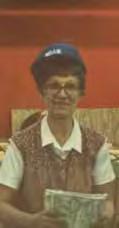
Natalie S. “Nellie” Carlson would have turned 100 years old this year — the same year the newspaper she faithfully served marks its bicentennial. The connection feels especially meaningful.
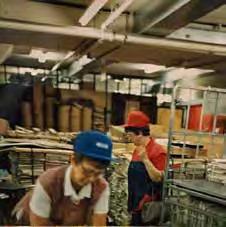
Born on Christmas Day in 1926 in Falconer, Nellie worked in the mailroom at The Post-Journal for more than 30 years. In an era long before digital delivery, the mailroom was essential to getting the news into the hands of readers across the community. Her work may not have appeared in print, but it was vital to the paper’s daily mission.
A lifelong area resident, Nellie was also a former communicant of St. James Catholic Church, enjoyed her Wednesday night ladies card club, and loved reading with a cup of coffee close by. She passed away in 2017 at the age of 90.
Her legacy continues through her daughter, Fran Carlson, a lifelong Jamestown resident and beloved school teacher who has impacted generations of local students.
Her great-niece, Melissa Paterniti, still carries vivid memories
of visiting family members who worked at the newspaper.
“I always remember going to see my Aunt Nellie and my Aunt Teresa when they worked at the Journal,” Paterniti said. “They wore sleeveless button-up smocks with front pockets, and I always thought they were so cool. I thought it was neat that I had three family members who worked at the Journal — that’s what we always called it. I can still picture the big red truck parked in the back and remember the smell of the ink.”
As The Post-Journal marks two centuries of local journalism, it is worth remembering that institutions endure because of dedicated individuals like Nellie — steady, loyal, and proud to serve their community.
Those memories of smocks, ink, and the red truck behind the building are small snapshots of a much larger story — the everyday people whose quiet work helped deliver the news to generations across Jamestown and Chautauqua County.
Two hundred years of news, and one remarkable life that helped deliver it.
A Lifetime Behind the Pages: Terry Warner Put in Nearly Five Decades
By Melissa Paterniti
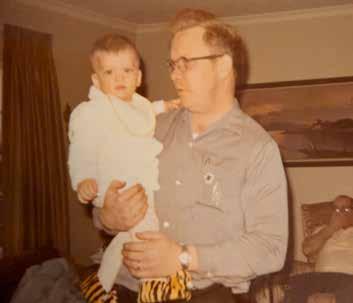
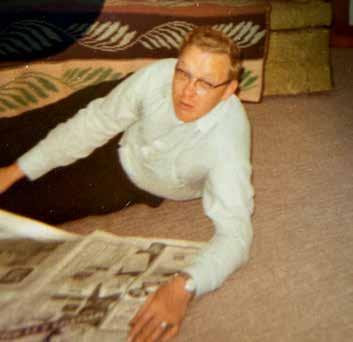
As The Post-Journal celebrates 200 years of serving Jamestown and Chautauqua County, I can’t help but think about my Uncle Terry Warner and the many years he dedicated to the paper.
Terry J. Warner was a lifelong Jamestown resident who graduated from Jamestown High School in 1955. Not long after, he began what would become a remarkable 49-year career at The Post-Journal working in the composing room.
In those days, putting together a newspaper was a hands-on craft. The composing room was where stories were carefully prepared before they ever reached the press. For nearly five decades, my uncle was part of that process, helping make sure the paper reached readers every day.
He eventually retired after 49 years of service — nearly half a century spent helping produce the newspaper that has been such an important part of this community.
Some of my favorite memories of my uncle involve visiting him at the Post-Journal. I can still hear the presses running and smell the ink in the building. Another memory I cherish is going to my aunt and uncle’s house, where there was always paper to color on. The leftover ends of the large paper rolls from the press would become our scratch paper.
My uncle Terry passed away in 2016 at the age of 78. He was a devoted husband to my Aunt Betty and a proud father and grandfather.
As the Post-Journal celebrates this incredible 200-year milestone, it’s important to remember the people behind the scenes who helped make the paper possible. My uncle Terry was one of those people, and his 49 years at the Post-Journal are something our family will always be proud of.
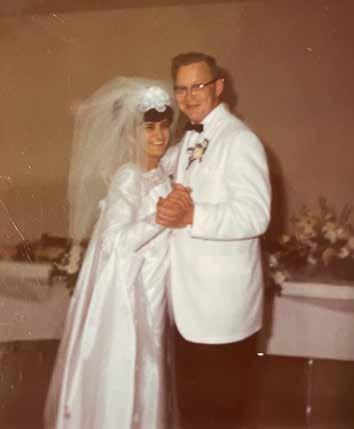
Terry Warner reading The Post-Journal in his home.
Terry Warner holding his son Timothy who passed away at 10 years old from Leukemia. Warner and his wife, Betty.
Riggs Was a Writer With the Right Touch
By Scott Kindberg skindberg@post-journal.com
It’s early March 1980 and I’m driving my parents’ station wagon, accompanied by my 12-year-old brother, Gary, and our friend, Chip Johnson, on a road trip to Erie Community College in Hamburg. The weather is horrible and driving is a challenge, but there is no way we are going to miss the Section VI high school championship basketball game, pitting Jamestown against Lackawanna.
Not a chance.
So what if I spin out three times on Route 20 on the way?
Although there is no damage to the car or to its occupants in any of my mishaps, I wisely surrender the driving to Chip. He gets us to ECC safely and on time, and the three of us wedge our way into the gym where a standing-room-only crowd greets us. As the game plays out, I notice a guy on the baseline, wearing a golf hat and snapping photos of the action on the court.
It’s Post-Journal sports editor Jim Riggs.
Jim doesn’t know me at all, but I sure as heck know him. He’s the guy who just returned from covering the Winter Olympic Games in Lake Placid. He’s the guy who witnessed the United States hockey team knock off the Soviet Union in the semifinals in arguably the biggest upset in sports history and then hold off Finland for the gold medal. Jim is also the guy who covers Nick Creola’s high-flying men’s basketball team at Jamestown Community College where I am a freshman and now he is snapping photos at one of the most important games in Jamestown High School history.
As I sit in the bleachers and watch the Red Raiders run up and down the court, I realize that the biggest assist of the night isn’t a Tyrone Beaman-to-Mark Prechtl pass for a layup. That honor goes to the guy wearing the floppy golf hat with the Canon camera hanging from his neck.
Without him even knowing it, Jim Riggs makes my career choice crystal clear.
Jim Riggs, 65, died on Saturday morning at Roswell Park Cancer Institute in Buffalo after a courageous battle with plasma cell leukemia. Just typing those words seems incomprehensible to me. Because for more than three decades, he was not only my boss, but he was also my friend and mentor, a man who influenced my career choice AND sold me on the path to get there – Point Park College (now University) in Pittsburgh. In other words, he was the point man for two of my most important life decisions, but he never cared if he got the credit. And, really, that was Jim.
In a profession in which your work is on display seven days a week, 365 days a year, he was a quiet, private man. If you gave Jim a good book, a good pizza, time with his elaborate model train layout, a 6 a.m. tee time or a Pittsburgh Penguins, Pittsburgh Pirates or Tennessee Titans game on TV, you might as well have presented him with a million dollars. Generous to a fault, it wasn’t unusual for him to send a card or
P-J file
leave a small gift on the sports desk, just because. He also was blessed with remarkable patience, at least when he and I played golf together at Chautauqua Golf Club where he was a member for more than half a century.
While Jim was the owner of a single-digit handicap and several career holes-in-one, I, in contrast, was a mediocre golfer, at best. Yet, he kept inviting me to join him until I finally “retired” from the game for good around 1990. For those who know Jim and his passion for “the gentleman’s game,” you also know that he liked to play uninterrupted. That’s why he was on the first tee at CGC five days a week just as the sun was coming up. Being there that early, of course, meant that he didn’t have to wait between shots. I guess that’s another reason why he considered me a good playing partner, because I didn’t waste time either. In fact, on one particular morning on the Lake Course, Jim and I completed our round in 2 hours, 8 minutes. And we walked.
I still consider that my greatest “accomplishment” on the links.
continued on page 33
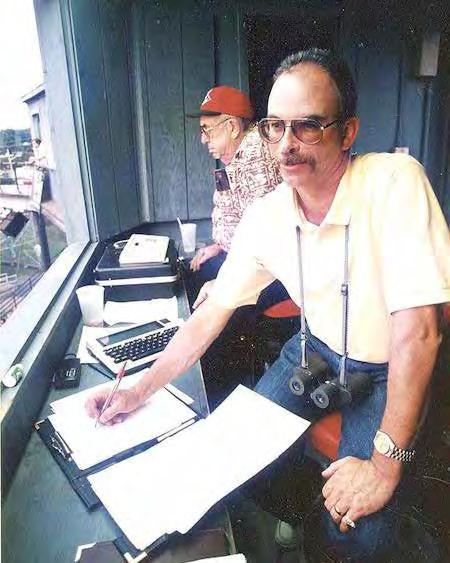
Jim Riggs watches the action from the press box at Diethrick Park, a perch that he called a second home for nearly 40 years.
photo.
Riggs Was A Writer With The Right Touch
continued from page 32
I visited The Post-Journal’s library yesterday and pulled out an envelope. In it were a handful of articles that either Jim authored or were written about him over the years. One of them was from September 2001. The occasion was his induction into the Jamestown Community College Athletic Hall of Fame. He and George Bataitis were the charter members. Both men were worthy of such recognition.
Jim followed closely the Jayhawks athletic program until his retirement in December 2014, a span of nearly 40 years. I dare say no junior college in the country received better coverage than what Jim provided the Jayhawks.
“When I started, all there was men’s basketball,” he told me that day. “Women’s basketball had just started. There wasn’t any soccer, there was no volleyball and there was no softball. Now it’s a huge program. It’s nice to be involved with it.”
I chuckled when I read “involved with it,” which may qualify as one of the biggest understatements ever recorded. Pressed further, Jim acknowledged that “it’s nice to know your work is appreciated,” but quickly added that he was surprised to be among the first two inductees into the school’s hall of fame.
“George is a natural because, without George, sports isn’t here,” he said of Bataitis, known affectionately as the “father” of JCC athletics. “A writer (being inducted) is sort of strange, but it’s a big honor.”
But Jim’s impact wasn’t felt only at JCC.
Across campus from the Physical Education Complex is Diethrick Park where Jim spent his summer nights for 35 years covering Jamestown’s entry in the New York-Pennsylvania League. Not only did he cover the team for The Post-Journal,
but he also served as the official scorer, a labor of love that is preserved for posterity in thousands of articles carefully filed away in our sports department.
Another file cabinet stores all the articles he wrote in his more than three decades covering the Jamestown High School football team, including state championships in 1994, 1995 and 2000. And, of course, another drawer contains his weekly “All In A Day’s Sports” columns, which have been a Saturday staple since 1975.
It was with curiosity then that I began to flip through the decades-old columns on Saturday. One, dated Oct. 6, 1978, caught my eye. It was the story of Lorne McIntyre, who was a 13-year-old quarterback in the Jamestown Midget Football League that fall.
Under the headline that read, “Midget Football’s Adult Player,” the article chronicled Lorne’s own battle with leukemia that threatened to end his gridiron career almost before it began. But thanks to his treatments, his determination and the care of his coaching staff, particularly head coach Dan Drake, Lorne became one of the league’s best signal-callers.
Wrote Jim: “Just watching Lorne play gives the entire team a lift. When a player gets down on himself or tired, he can look at Lorne and think, ‘If he can do it, I can do it.’”
Ironically, in the last two years, I’ve often thought the same thing about Jim. If he could remain upbeat despite all the physical challenges he faced, then I certainly could do the same.
The column earned Jim a New York State Associated Press Association writing award, one of several he received during his years at The Post-Journal. Now, he’s receiving his ultimate reward for a life well lived in a place where the first tee is clear and his drives are straight and true.
Rest in peace, my friend.
Frank Hyde Retires As Sports Editor
Editor’s note: This is from Nov. 27, 1979.
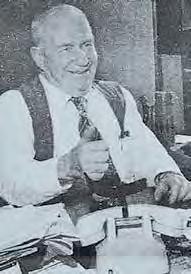
Frank Hyde, veteran sports editor of the Post-Journal, will retire effective Saturday, completing nearly 36 years at the helm of one of the Southern Tier’s largest and oldest daily sports departments.
Hyde, who will be 73 years old December 16, assumed the sports editorship March 1, 1945, after having worked as assistant sports editor of the Salt Lake City (Utah) Tribune for 18 months. He was sports editor of the Billings (Montana) Gazette for six years prior to his work at the Tribune.
“Frank Hyde has become so closely identified with the Post-Journal over the years that when most people think of the newspaper, they inevitably think of Frank,” said Editor Don Meyer in announcing Hyde’s retirement. “He has become an institution in his own right.”
Although Hyde will retire as sports editor, he has agreed to continue to write his popular personal column “Frankly Speaking” and will also contribute sports feature stories from time to time, Meyer noted.
“Frank is one of the top sports editors in our business,” Meyer said, “and we are delighted that he has agreed to continue to share his writing talents with our readers on a limited basis.”
Post-Journal publisher Earl S. Champlin praised Hyde’s dedication to his job, observing that “during my 25 years in the newspaper field, I have never met an employee who has shown more dedication to his job than Frank Hyde has. The Post-Journal and the Jamestown area have been very fortunate to have had a sports writer of his caliber.”
Champlin, on behalf of the Post-Journal management, also wished “Frank and his wife Evelyn a long and happy retirement.”
Hyde’s first contact with the newspaper industry was in a non-writing capacity, as copy boy for a summer with the Chicago Tribune at 15 years of age.
Later he served as a news stringer for the Yankton (S.D.) Press and Dakotan covering the Jack Dempsey-Tommy Gibbons heavyweight title fight at Shelby, Montana. He was described by one wire service reporter as the youngest newsman ever to cover a heavyweight title fight.
Before moving onto the Billings Gazette, Hyde worked in reporting and non-reporting capacities for newspapers in
Portland, Ore., and Minneapolis, Minn.
Hyde has not simply served as an observer of sports, but at one time was an active participant.
After gaining experience in high school and AAU wrestling competition, Hyde tried his hand at professional wrestling. But that pursuit was cut short after he suffered a serious hip injury. He was also involved in promoting both boxing and wrestling cards.
Frank Hyde
During his years with the Post-Journal, Hyde served as statistician for the Pennsylvania-Ontario-New York (PONY) League, now the NY-P. He served without pay and during that period published the league’s first series of record books.
He also covered the Jamestown Falcons in spring training for a decade at various Florida sites.
He is an honorary Gold Card member of the National Association of Baseball League Writers with a lifetime pass. He is a lifetime honorary member of the Gerry Fire Department, sponsor of the Gerry Rodeo; the Jamestown YMCA; Chautauqua Lake Yacht Club; and the International Association of Approved Basketball Officials, an honor bestowed on him in 1967 by Local Board 39, IAABO.
Hyde has served for 20 years on the prestigious Heisman Award Committee of New York. The Heisman, the most coveted award for collegiate football players, is awarded annually to the recipient voted by the writer-members as the nation’s leading college football player.
In 1969 Hyde was awarded the Sport Magazine Service Award. President Frederick A. Klein of McFadden-Bartell Corp., publishers of Sport Magazine, flew to Jamestown to make the presentation at one of the Temple Hesed Abraham Men’s Club sports dinners.
In 1975, Jamestown businessmen and sports personalities staged a testimonial dinner in Hyde’s honor at the Hotel Jamestown. And just two weeks ago, Hyde was honored by fellow P-J employees at a banquet at the Holiday Inn.
Hyde is married to the former Evelyn Young of Newport, Arkansas whom he met in Little Rock, Ark. They were married at Glendive, Montana in 1935 and have three children.
The eldest child, Pat Loy, is village finance director at Chagrin Falls, Ohio and was recently elected vice-president of the Municipal Finance Association of Ohio. Son, David, is studying for his doctorate in school administration at the University of Maryland. The youngest son, Tom, a graduate of Kent State University is residing in New Zealand. All were graduates of Southwestern Central School and have blessed the Hydes with six grandchildren.
SATURDAY, SEPT. 12TH & SUNDAY, SEPT 13TH
FEATURING 150 JURIED CRAFTSMEN
Inspired Folk Art • Traditional American Crafts
Handmade Collectibles • Fine Art • Delicious Foods
Live Music • Children’s Activities • Demonstrations
For additional information, please visit www.wildwindfestival.com, email: info@wildwindfestival.com, or call (802) 689-0609
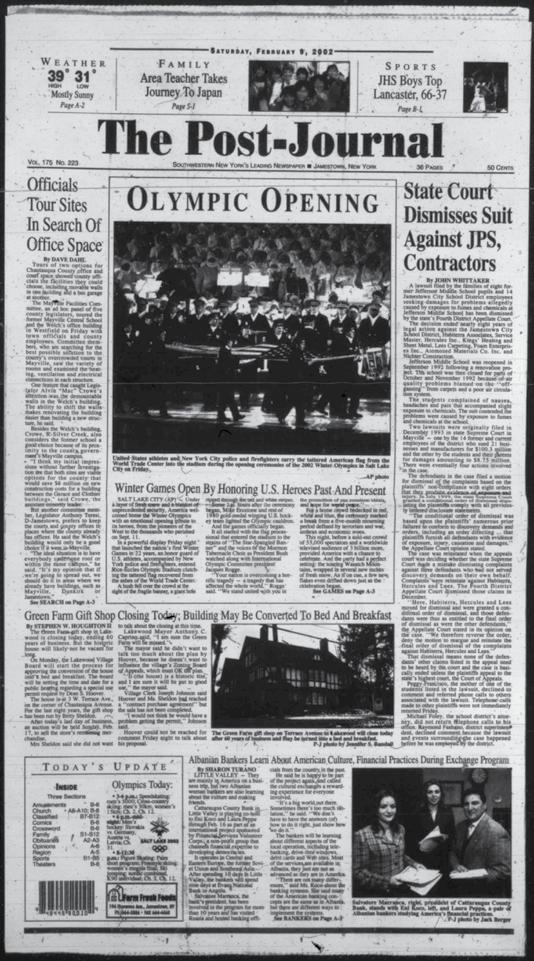
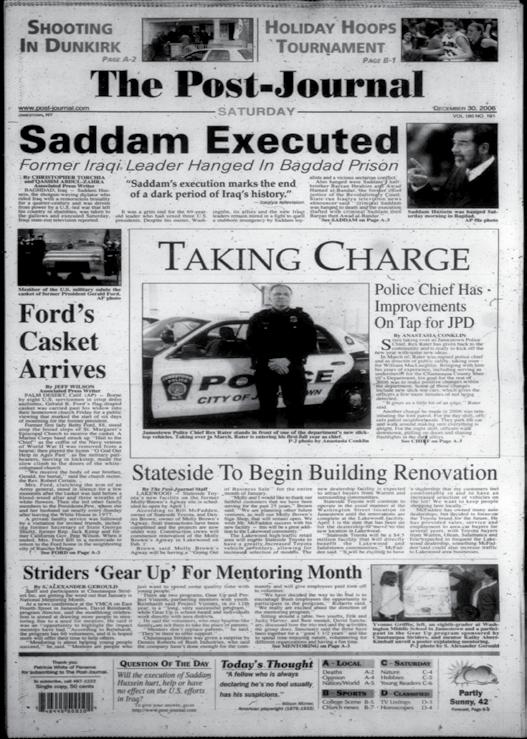
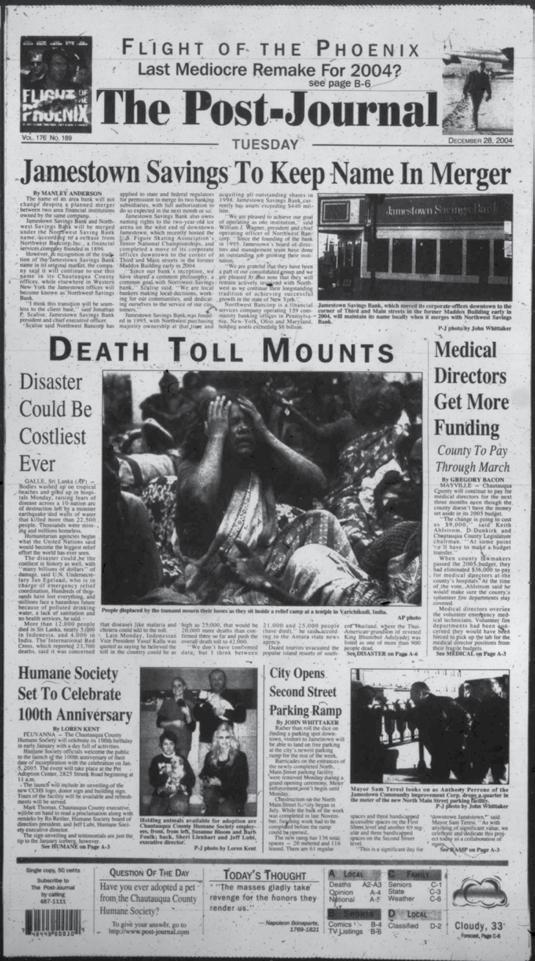
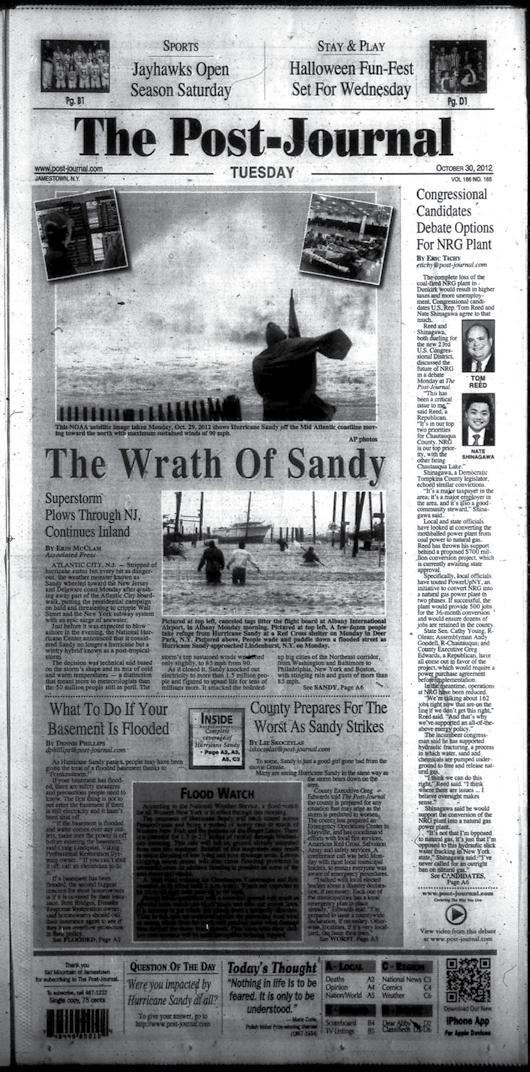
The Post-Journal Through the Years
The Post-Journal Through the Years
The Post-Journal Through the Years
The Post-Journal Through the Years
The Post-Journal Through the Years
Celebrating 200 Years Together
Jamestown Regional
August 21 & 22, 2026
9 AM - 9:30 PM
Mayville Lakeside Park, Mayville, New York
Performers Include:
• TUATHA DEA
• EMERALD ISLE
• STEP N TIME
• WATER HORSE
• THE FIDDLE SESSION
• GATHERING OF THE CLANS
• PIPE BANDS
• SCOTTISH HEAVY ATHLETES
• CELTIC & CRAFT VENDORS
• CELTIC MUSIC
• ALL KINDS OF GREAT FOOD
• BEER & WINE GARDEN
• SCOTTISH & IRISH DANCERS
• CELTIC & CRAFT VENDORS
• OLD FASHION FIDDLE SESSION
• KIDS AREA W/ CLAN HUNT
Saturday, July 25th, 2026
Maplehurst Country Club Golf Course 1509 Big Tree Rd., Lakewood, NY
Teams can be: Men’s
• Women’s • Mixed $340 per Four Person Team Registration includes: Greens Fees. Cart, Beer & Hot Dogs on Course “Coffee & Donuts at 8AM registration time” “Banquet to follow at Maplehurst Country Club”
Mulligans, Best Poker Hand, Skins, More! Sign in time will begin at 8:00 AM / Tee off time will be Shotgun Start 9:00 AM Sharp. Skins / Mulligans / 50/50 and other goodies will be available at the sign in table. We are looking for Tee & Green Sponsors starting at $100 for each that you sponsor !! Company’s, Business or Individuals can be sponsors, so hurry there are only so many spots available!!