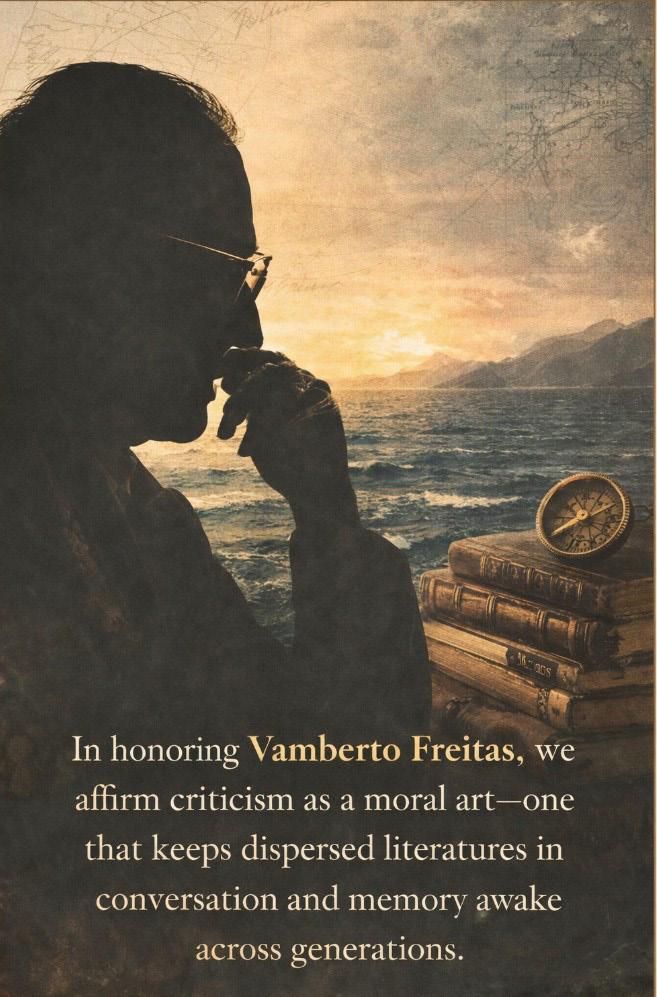
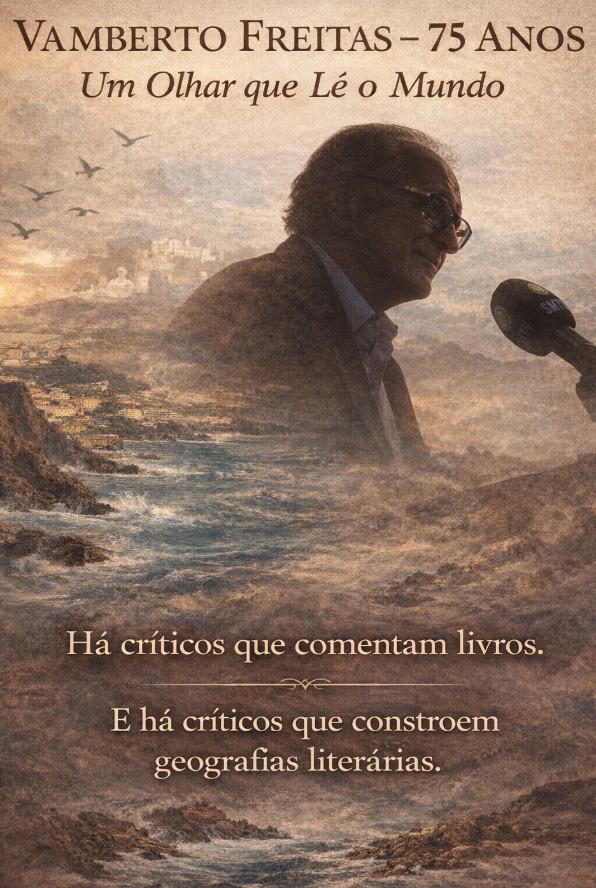
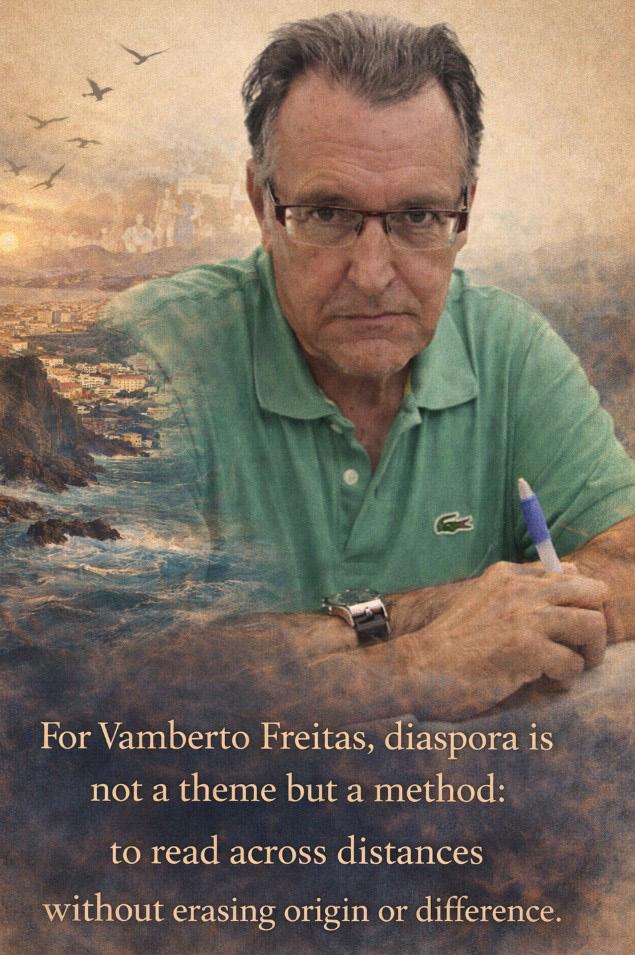
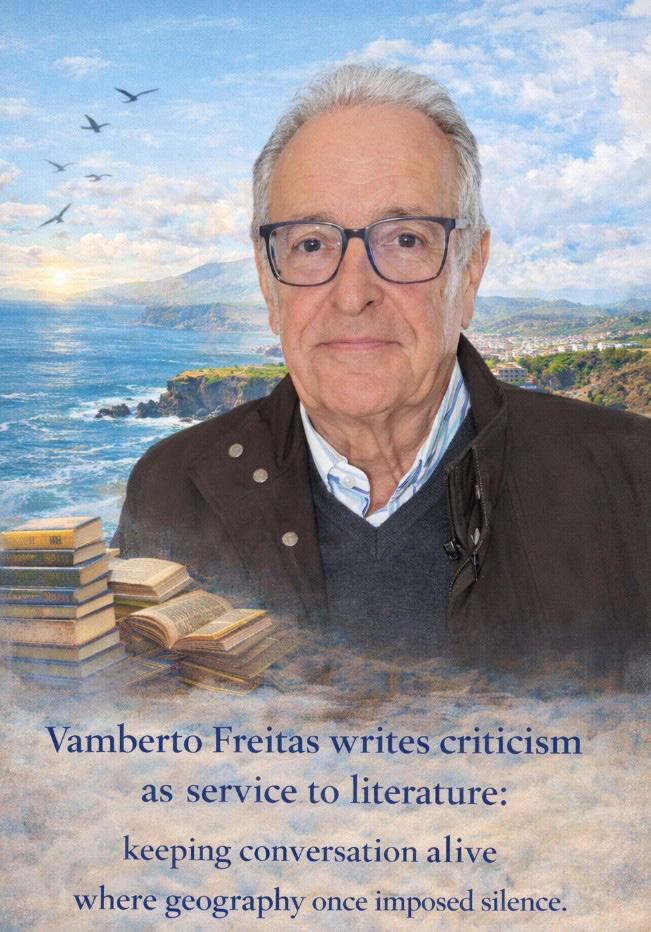
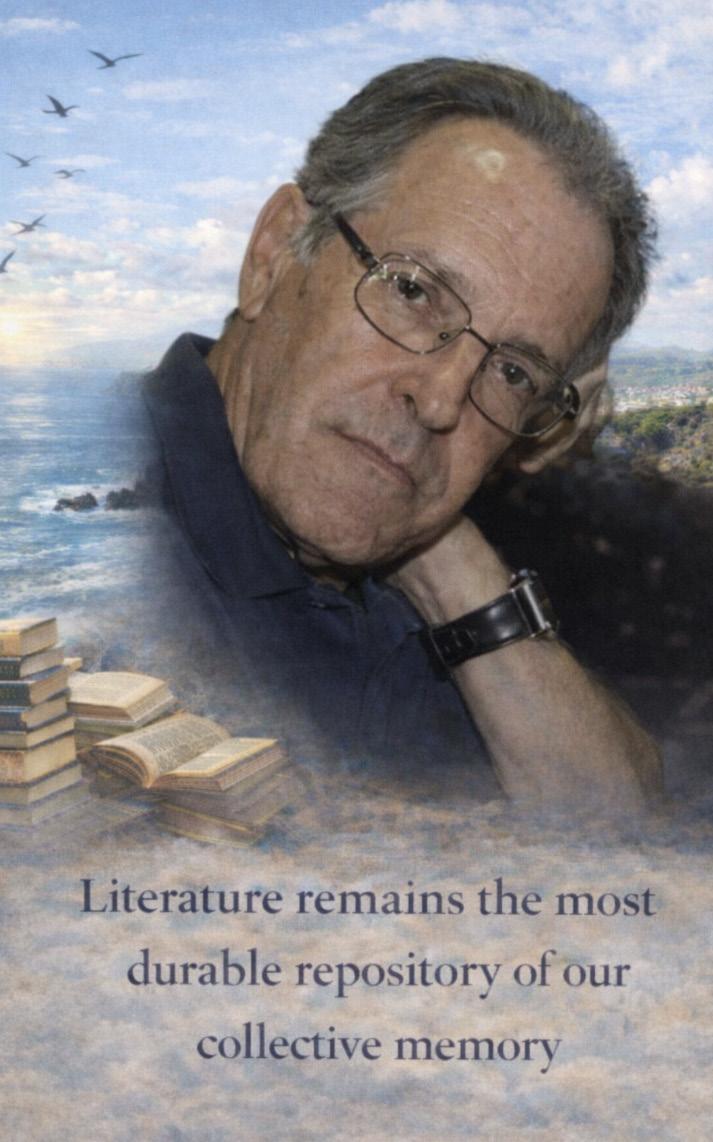
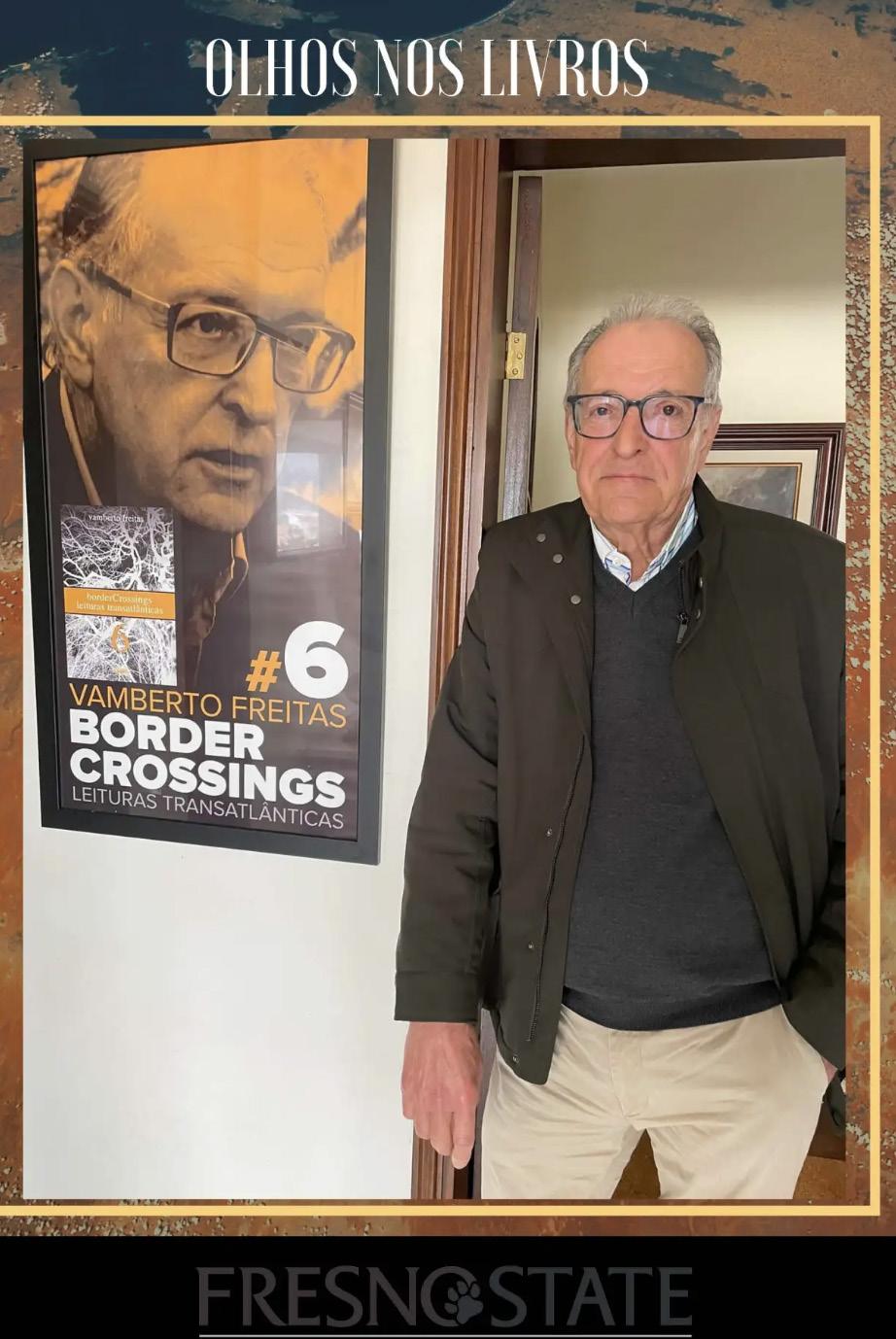
This issue of Filamentos – arts and letters offers only a fragment—deliberately modest, necessarily incomplete—of what has already been written about Vamberto Freitas, a man who has spent a lifetime writing about others, writing about books, writing about the moral and imaginative labor we call literature. What follows are essays of tribute, reflection, and close attention, alongside an interview that allows Freitas’s own voice to surface—not as proclamation, but as measured dialogue, lucid and humane
Across these pages, readers will encounter different angles on the same figure: the critic as bridge-builder, the essayist as ethical listener, the reader as cultural custodian. Together, the texts sketch a composite portrait of a life devoted not to self-display, but to sustained reading—of works, of contexts, of histories shaped by migration, insularity, and memory. They remind us that criticism, at its best, is not judgment from above but companionship across time and geography
This publication is part of a larger undertaking. Throughout the entire month of February, Filamentos – arts and letters, an initiative of Bruma Publications at the Portuguese Beyond Borders Institute (PBBI), California State University, Fresno, is dedicating its daily presence to revisiting the long work of Vamberto Freitas. Day by day, we return to the paths he opened, the voices he amplified, and the crossings— Atlantic, linguistic, ethical—that define
his critical legacy. It is our way of marking a moment: of pausing, collectively, to say Happy Birthday to Vamberto Freitas on the occasion of his seventy-fifth year
Traditionally bilingual, Filamentos appears here entirely in English. This choice is intentional. It reflects a desire to reach readers across the diaspora and beyond—those who may know Freitas’s reputation but have not yet encountered his work directly. This issue is an invitation: to read him, to follow his method of attentive listening, to understand how criticism can still matter as a civic and cultural act.
The essays gathered here explore Freitas as critic, mediator, and intellectual conscience; they situate his work within Azorean culture, Luso-American writing, and broader transatlantic traditions. The interview with poet Millicent Borges Accardi offers a complementary register: reflective, dialogic, grounded in lived experience, and attentive to the future of diasporic literature. Together, they form a small constellation—an introduction rather than a summation
If this issue succeeds, it will not close a chapter but open one. Vamberto Freitas’s work resists finality; it belongs to the ongoing conversation of literature itself. These pages are offered in that spirit: as a gesture of gratitude, a moment of celebration, and a quiet affirmation that reading—done with rigor, generosity, and ethical care—remains one of the most durable ways of being in the world
Abraços Diniz
Vamberto Freitas: A Full-Length Portrait
Marcolino Candeias sketches a full portrait of Vamberto Henriques Ávila Freitas in the Enciclopédia Açoriana, revealing the high intellectual caliber of both the man and the writer. Born in Fontinhas, on the island of Terceira, on February 27, 1951, Freitas began his secondary education at the then Liceu Nacional de Angra do Heroísmo. Soon thereafter, he emigrated with his family to the United States, settling in California. He studied at California State University, Fullerton, where he earned a bachelor’s degree in Latin American Studies, followed by graduate studies in American Literature and Comparative Literature at the same institution.
APortuguese—Azorean—citizen naturalized as an American, Freitas early on developed an ease of movement across what might be called a triple worldview, a vantage point that would decisively shape his intellectual trajectory
He first distinguished himself through the quality of his journalistic work, publishing in Portuguese-language newspapers in the United States. During this period, he was appointed California correspondent for Diário de Notícias(Lisbon), a position he held from 1979 until 1991, when he decided to return permanently to the Azores, settling in Ponta Delgada.Back in the Azores, while continuing to collaborate with the literary supplement of Diário de Notícias, he also worked briefly with RTP-Açores and joined the University of the Azores as a Lecturer in English, a position he held from 1991 until 2020. He was later appointed as the representative
Opinion Council of RDP (Portuguese Public Radio), a role he fulfilled for approximately three years.
With his entry into the University of the Azores faculty, Vamberto Freitas entered a decisive period of affirmation as a literary critic. A scholar and admirer of the American critic Edmund Wilson— whose influence on U.S. literary criticism in the 1920s and 1930s was profound— Freitas’s critical interests center on New World fiction, Portuguese emigrant literature, and, most notably, Azorean literature and what is often termed North American “ethnic literature,” with particular emphasis on the generation of Luso-descendant writers that emerged in the late twentieth century
In 1995, he founded SAC –Suplemento Açoriano de Cultura, the literary supplement of Correio dos Açores(Ponta Delgada), which he coordinated until its closure in 2001. In 2003, he founded SAAL –Suplemento Açoriano de Artes e Letras, published as an independent insert of the magazine Saber/Açores(Ponta Delgada). His work in this field brought new energy and a renewed sense of purpose to literary supplements—particularly in the Azores—securing him a prominent place in the contemporary landscape of literary criticism, especially within cultural contexts rooted in Azorean identity.
Over the years, Freitas has participated in congresses and colloquia in Portugal, the United States, Canada, and Brazil. He has contributed to the Cultura supplement of Diário Catarinense and to the magazine Cartaz: Cultura e Arte, both published in Florianópolis, Santa Catarina, as well as to the Jornal de Letras in Rio de Janeiro.
He serves on the Advisory Board of Gávea-Brown: A Bilingual Journal of Portuguese-American Letters and Studies, on the Editorial Committee of the Boletim do Núcleo Cultural da Horta, and on the Interdisciplinary Journal of Portuguese Diaspora Studies. He has also contributed to the journals Vérticeand LER, and occasionally to JL(Lisbon).
Freitas has published numerous critical studies and essays on North American and Azorean literatures, as well as several translations—most notably of the poetry of Frank X. Gaspar. He currently maintains the weekly literary criticism column BorderCrossings in the daily Açoriano Oriental (Ponta Delgada) and the column Nas Duas Margensin the weekly Portuguese Times(New Bedford). He also collaborates regularly with the literary page Maré Cheia of the Portuguese
Tribune / Tribuna Portuguesa (Modesto, California). Together with Álamo Oliveira, he coordinates the literary and cultural supplement Açoriano Oriental –Artes & Letras. For a period, he also published literary criticism and essays in the Lisbon newspaper i.
Among the distinctions he has received are the Insígnia Autonómica de Reconhecimento from the Legislative Assembly of the Autonomous Region of the Azores (May 2015); the Certificate of Special Congressional Recognition(2017), awarded by the United States Congress in recognition of outstanding and invaluable service to the community; the Certificate of Recognition / 2017 Most Valuable Portuguese American Awards, granted by the Tulare County Board of Supervisors; and the Literary Award –Through Literary Analyses to the PortugueseAmerican World, awarded by SOPAS_ MVPA (2017).
Today, Vamberto Freitas is widely regarded as the most productive and incisive critic of contemporary Azorean and Luso-American literature, without overlooking the numerous high-quality reviews he has written on authors from mainland Portugal.
His extensive and valuable critical work has been published in book form, including:
Jornal da Emigração. A L(USA)lândia Reinventada(1990);
Pátria ao Longe. Jornal da Emigração II(1992);
O Imaginário dos Escritores Açorianos(1992);
Para Cada Amanhã. Jornal de Emigrante(1993);
América: Entre a Realidade e a Ficção(1994);
Entre a Palavra e o Chão. Geografias do Afecto e da Memória(1995);
Mar Cavado. Da Literatura Açoriana e Outras Narrativas(1998);
A Ilha em Frente. Textos do Cerco e da Fuga(1999);
O Homem que Era Feito de Rede(2002), a translation of Katherine Vaz’s short story Man Who Was Made of Netting;Jornalismo e Cidadania: Dos Açores à Califórnia(2002)
Particular note should be made of the sevenvolume compilation of BorderCrossings critical essays, published in 2012, 2014, 2016, 2017, 2019, 2021, and 2023. To publish, every two years, a critical body of work of this scope and consistency is a singular achievement in Portuguese literary criticism.
On BorderCrossings: Transatlantic Readings III
by Vamberto Freitas
TERESA MARTINS MARQUES
I would like to begin by thanking Vamberto Freitas for inviting me to the Azores to present this book—an invitation I accepted with great pleasure, having long been familiar with the quality of his work. I also wish to thank Livraria Solmar for its warm welcome, and to congratulate its owners, Maria Helena and José Carlos Frias, on the silver anniversary of a bookshop that has become a cultural reference point in the Azores. It was in this very bookshop that, in 2000, I first presented a public reading of a short story included in João de Melo’s Entre Pássaro e Anjo. I refer to the story “Postumografia de Pedro-o-Homem,” which only last year I had occasion to present at aconference at the prestigious Sorbonne Nouvelle, given the continuing relevance of its theme.
That invitation in 2000 came from the great lady to whom this book is dedicated. That is why the dedication immediately struck me: “For Adelaide, the memory of having been.”Knowing that Adelaide suffers from memory loss, Vamberto offers her what she no longer possesses: the memory of being a great companion in many situations, all significant. The memory of a profound complicity that will not be erased, because it is enough for one of them to remember for it to exist and endure.
Upon finishing this book, I was confirmed in my conviction that we are dealing with a work of the highest level, signed
by someone whose cultural range within the Western canon is remarkably broad, with particular depth in the AngloSaxon and Azorean traditions. Vamberto Freitas is today a highly respected and recognized name in essay writing and literary criticism, not only in the Azores but also among Luso-American and LusoBrazilian communities. On the mainland, his name began to circulate in the late 1970s through his work as a correspondent and contributor, from California, to the literary supplement of Diário de Notícias Today he is recognized by leading Portuguese intellectuals—amongthem Eugénio Lisboa, Lídia Jorge, Teolinda Gersão, José Carlos de Vasconcelos, and Ernesto Rodrigues—along with many others who, though living on the mainland, have Azorean roots.
Since 1990, Vamberto’s published work has grown to thirteen volumes, in addition to his activity as a translator—of fiction by Katherine Vaz (2002) and poetry by Frank Gaspar (2006)—as well as a substantial body of critical and essayistic studies on North American and Azorean literature, published in Portugal, the United States, and Brazil. This includes journals and newspapers whose literary pages he himself edited, a cultural service of great merit. Notable among these are the Suplemento Açoriano de Cultura(SAC) of Correio dos Açores, which he coordinated from 1995 to 2000, andthe Suplemento Atlântico de Artes e Letras(SAAL) of Saber Açores, from 2003 to 2006—work I followed closely as a collaborator. His current weekly literary criticism column BorderCrossings in Açoriano
Oriental(Ponta Delgada), and Nas Duas Margens in the Portuguese Timesof New Bedford, are a continuation of that intense literary labor, recognized in 2015 with the very just award of the Autonomous Insignia of Recognition by the Legislative Assembly and the Regional Government of the Azores.
Anyone wishing to gain a detailed understanding of this critic’s thinking should read, with great profit, the interview that closes this volume, conducted by Millicent Borges Accardi. Vamberto Freitas is, in truth, a rare case in our literary landscape, owing to a cultural agility and eclecticism that allow him to reconcile elements seldom brought together in Portuguese essay writing: the capacity for close reading derived from his American training and his familiarity with the New Criticism, combined with the legacy of Edmund Wilson—who famously disliked the New Critics. From this singular synthesis emerges a critical method that examines texts with a magnifying glass when close attention is required, yet never neglects the wider view: the historical, geographical, sociological, and psychological contexts that frame authors and works.
Vamberto’s literary criticism, far more illuminating than judgmental, awakens curiosity and empathy in the reader, inspiring the desire to read the works under discussion. That, indeed, is what criticism and textual analysis ought to do. Vamberto reveals himself not only as critic, essayist, and cultural historian, but also as a writer of ideas—a rare phenomenon, as Einstein once remarked to Paul Valéry. José Rodrigues Miguéis recounts in O Espelho Poliédrico that Valéry asked Einstein whether he always carried a notebook to jot down ideas. Einstein replied, playfully: Ideas? Having
ideas is a rare thing!Miguéis concludes: “The formula of Relativity fits in the head of a match and can set the world on fire.” Ideas are indeed rarely confused with opinions, which are frequently nothing more than echoes of others’ views. Vamberto’s writing is clear, coherent, and intelligent.
Few today among us are familiar with the work of Edmund Wilson, the great American modernist critic active from the 1920s to the 1970s, of whom Vamberto is undoubtedly the foremost specialist in Portugal, having studied him since the 1970s. This book includes remarkable pages drawn from an extensive, unpublished essay by Vamberto on Wilson’s work. Of particular interest is the discussion of Wilson’s protest between 1946 and 1955, when he refused to pay taxes as a stand against military spending, launching one of the largest anti-tax campaigns in America. Vamberto notes that it was ironically—and fittingly— during this period that President Kennedy awarded Wilson the Presidential Medal of Freedom. The IRS attempted to block the honor, but Kennedy replied that it recognized Wilson’s contribution to the nation’s literature and culture, not to “good citizenship.” Though averse to interviews, Wilson remains one of the most extensively biographed critics and essayists of the twentieth century in the United States.
Vamberto takes Wilson as a model not only for his intellectual restlessness and skepticism toward canonical thought, but also for his exploration of disparate cultures—Canada and Haiti among them— which Wilson saw as offering alternative creative faces of the Western tradition he had so thoroughly internalized, while also challenging the cultural and political hegemony imposed on oppressed and
marginalized peoples. In this search for overlooked cultures, Wilson ranged from the ancient Essenes to contemporary Francophone Canada, passing through Native American communities across the continent, Jewish history, and Caribbean societies. Long before universities recognized him, Wilson was already reading and appreciating Aimé Césaire of Martinique, whom he read en route to Haiti in 1949 while preparing a series of reports that would later form part of Red, Black, Blond and Olive.
In portraying Wilson, Vamberto looks into a mirror of exemplariness, rescuing him—both symbolically and concretely— from the margins to which he has largely been relegated by Portuguese critics, with rare exceptions such as Eugénio Lisboa and David Mourão-Ferreira, the latter having first introduced Wilson to Lisboa. Vamberto invokes Gore Vidal’s words on Wilson and The Cold War and the Income Tax: A Protest: “Edmund Wilson is our most distinguished man of letters... To lose such a man is a sign that our society is entering a zone of shadow which, once crossed, means the end of everything our founders hoped this country would be.”
To understand the communicative vessels between Wilson’s campaign and Vamberto’s own civic interventions—such as his public opposition to the Passos Coelho and Paulo Portas governments— it is worth remembering that all critical and essayistic writing is imbued with a worldview. Vamberto learned early that “great literature is always a portrait not only of an individual and his circumstances—as Ortega y Gasset wrote—but of an entire society or community.”
the author makes clear in the introduction: this third BorderCrossings follows the same enduring thematic lines—literature and society; how art reflects daily life; how writers respond to periods of historical transition affecting both individuals and communities; lives transfigured and mirrored in prose, poetry, and essays that either invite identification or challenge us to understand other ways of being. For Vamberto, literature has always been a profoundly identitarian act through which we seethe other—and are thus compelled to reflect on who we are. Yethe clarifies: this is literature we are dealing with. Literature is not sociology; behind the “facts” lie narratives that penetrate deeply into reinvented beings and characters who step from reality onto a stage where laughter and tears—the human condition—are dramatized.
This attention to civilizational advances and retreats leads Vamberto to address the Islamic question through a reading of Michel Houellebecq’s controversial Submission, engaging fully with the political, cultural, and ethnic reflections that darken our present, and considering Houellebecq “one of the few contemporary European writers with the courage to introduce into literature the most pressing questions shaping a Europe that no longer knows its role in the world—or how to maintain internal peace or relaunch economic justice for all its citizens.” His reflections on Europe extend to Vasco Graça Moura’s European Cultural Identity(2014).
The relationship between literature and society is the guiding thread of this book, as
The volume also includes incisive studies of writers without direct ties to the Azores: Eugénio Lisboa’s Acta Est FabulaIV; Lídia Jorge’s The Memorable Ones; Teolinda Gersão’s Passagens; Paulo Castilho’s The Portuguese Dream; Paulo José Miranda’s The Machine of the
World; Dulce Cardoso’s The Return; and many others. Brazilian writers discussed include Rubem Fonseca, Chico Buarque, Daniel Galera, Paulo Scott, and Fernanda Torres. Readers interested in American and Luso-American culture will find sharp re-readings of Alfred Lewis, Chomsky, Harold Bloom, Charles Reis Felix, Michael Cunningham, Harper Lee, Sinclair Lewis, Jonathan Franzen, and a delightful portrait of Hemingway through the eyes of four of his wives, via Naomi Wood.
Finally—and crucially—the book pays homage to Azorean authors: Onésimo Teotónio Almeida; João de Melo; Manuel Alegre; Álamo Oliveira; Artur Veríssimo; João Pedro Porto; Emanuel Félix; and many others. Vamberto’s analysis of Emanuel Félix’s Complete Works(Volumes I–III) underscores the ethical responsibility involved in assembling and presenting a life’s work—a principle that applies equally to Vamberto Freitas himself.
For this reason, I thank him for the invaluable literary and civic mission to which he has devoted himself, and I hope these exemplary works will reach the wide readership they deserve, for their astonishing breadth of content, analysis, and synthesis—an art of knowing how to see, how to write, how to think.
PRO MEMORIA
Vamberto Freitas: Transatlantic Readings
At sixty-three—already reached or on the verge of it—holding a degree in Latin American Studies from California State University, Fullerton(1974), and with a substantial body of work dispersed across newspapers, journals, and books, Vamberto Freitas—currently living in Ponta Delgada (though originally from Terceira)—is one of our most vigorous, learned, and clarifying (I would even say: inspiring) literary essayists. A profound connoisseur of American literature and its cultural milieu, Vamberto Freitas has, from very early on (he emigrated to the United States at thirteen), nourished himself on the sharp ozone one breathes in the canonical texts of that great nation’s major novelists, poets, dramatists, and essayists— great, rich, diverse, and contradictory.
He commands a style that is lucid and magnificently assertive—and assertiveness does no harm when it is well informed and better thought through. The author of BorderCrossings clarifies, illuminates, inspires, and seduces all at once: his essayistic prose has an unflinching clarity, the natural property of someone who not only is unafraid of light, but willingly summons it—for reasons that are also ethical. Karl Popper, referring to the limpid, steely style of Bertrand Russell, remarked: It is just not a question of clarity; it is a question of professional ethics.Only cheats and the insecure fear clarity in discourse. Albert Camusobserved that those who write clearly have readers; those who write obscurely have commentators. Vamberto
Freitas’s essays and reviews—packed with rich information and energized reflection—deserve, certainly, to have readers, and also a few commentators, though of the clean and decent variety. Organized into four major thematic blocks—(I) Literature and Azorean Identity; (II) Diaspora and Literature; (III) American Imaginaries; and (IV) Brazil, Near and Far—Vamberto, in the lineage of great American critics and essayists who resisted the dubious siren-song of academic studies, and above all in the lineage of that giant of American criticism and essay-writing, Edmund Wilson, of whom he is a remarkable specialist— Vamberto, I say, illuminates this vast territory of interests through a prospector’s style: vigorous, assertive, and entirely free of that pretentious, gongoristic glossary—often flirting with the comic—that fascinates, more than anyone, the novices who hop about in the thickets of the Academy.
Peter Ackroyd, the notable English novelist, biographer, essayist, and critic, published in March 1976 a ferocious essay later collected in The Collection(2001), titled “The Slow Death of Academic Literary Criticism.” In that luminous and healthily murderous piece, the author of The Last Testament of Oscar Wildeconfronts, with eloquence, the brand of essayismthat emerges from academic forests. From the outset he opens heavy, accurate fire: Nothing original has come from them [academic critics] in ten years of activity. I have yet to read a contemporary academic critic who can write with more intelligence,. or read with more care, than a good
Eugénio Lisboa
reviewer...And I have yet to encounter one who is not a devoted slave to whatever ideological fashion, at that moment, holds the academies captive. It seems to me that it is precisely against this empire of ideological fashions that great critics— such as Wilson or Dwight MacDonald, admired, studied, and cited by Vamberto— take aim, armed with enormous culture and the formidable force of stylistic clarity. And it is this very clarity that becomes, immediately, a comforting guarantee of integrity.
Arthur Schopenhauer—a philosopher and, it should be said, a great writer who fed and steadied me in moments of some disturbance—observed that style is the physiognomy of the mind, and a safer guide to character than the face itself.
Theessayistic style Vamberto cultivates, with uncommon force and flair, becomes for us, as we read these transatlantic pages—where he probes literary, cultural, and ethical values across shifting latitudes and longitudes—a reliable assurance that we may surrender ourselves, without suspicion, to his un-dusty, clarifying discourse, full of light and pleasure (the pleasure of the text). For if the content of discourse matters, its form matters no less. Or, as the great and invaluable Robert Frostonce noted, the whole joke lies in the way one says something. The joke, yes; but it is far more than that: the manner of saying reveals the caliber of the character who speaks. It is this nakedness of writing, this clean frontalness—without ambiguities—that characterizes great critics, those who do not fear lobbies or taboos, wherever they may come from. It is no accident that Vamberto Freitas takes as a model the great Edmund Wilson (of Marxist whom he says, among many references: never wounded his independence),of the canonical American critic of that same
that period is Edmund Wilson, who died in 1972, but began writing in the 1920s and continued until his death, and was one of the first American men of letters to introduce European modernists to his country’s broad public with Axel’s Castle. In his later years he waged a noisy war against university criticism, and to this day remains persona non grata in some academies; yet his posthumous books continue to be (re)published, and he remains one of the most biographed, cited, and studied American writers.
It is within this small but great family of honnêtes hommesthat this Azorean— whom I am proud to call my friend— takes his place: a man of the islands, yet a universal traveler, and a disciple, in the noblest sense, of those luminous spirits who have given literary criticism its highest distinctions. David Lodge, the notable English novelist and literary critic (as well as literary theorist), who emerged from the avenues of academia, wrote a review—“Rabbit Reviewer”—dedicated to a collection of essays (mostly reviews) by John Updike, and there he inventoried the essential qualities of the systematic reviewer: the essential attributes for this kind of critic, beyond intelligence and a liberal education, are an alert eye for the illuminating quotation and a prose style that is eloquent and easy. Easy, of course, in that formidable sense Eça de Queirósgave it when, in The City and the Mountains, he has the Infante D. Miguel lift Jacinto from the ground with an easy strength—easy because it is immensely powerful. I believe these essential attributes, among others, are indisputably part of Vamberto Freitas’s professional equipment.
Originally published in Jornal de Letras(Lisbon), in the October 29–November 11, 2014 edition.
VAMBERTO FREITAS
BorderCrossings: Transatlantic Readings
Carlos Bess
Let us begin with the obvious: Vamberto Freitas is a rare case. Why? Because he has made literature his métier. Becausehe writes about the books he loves and remains alert to what is new. Because he does so at a time when much is published but little seems to be read—a fact suggested both by shrinking print runs and by the kinds of books that dominate the market. Because he is a recognized specialist in contemporary English-language literature produced by Luso-and Azorean-descended writers in North America, and at the same time a discerning reader of what Azorean identity itself continues to produce. For all these reasons—rooted in literature, but also in his generous way of being and of reading, this introduction seeks first and foremost to underscore what brings us together today: the publication and presentation of yet another volume, the fourth of BorderCrossings: Transatlantic Readings.
In this volume, the author gathers an extensive new collection of literary and cultural essays, most of them originally published in the homonymous column he maintains in Açoriano Oriental, as well as in other newspapers. These essays consistently reveal the complex operations that literature and reading demand of us as readers, combining aesthetic specificity with ethical concerns, and engaging a constellation of questions and anxieties inseparable from the time and space we inhabit. This time and space, it should be noted, are not confined to the immediate present, for literature has long prepared
us to include within these dimensions’ imagination, difference, alterity—the Other. It is precisely here, I believe, that one of the high points of BorderCrossings resides, a fact clearly demonstrated by its four sections: “Islands of the Diaspora, Diaspora in the Islands,” “Of Our Time,” “Other American Imaginaries,” and “Coda.
Vamberto Freitas has long been an exegete of these concerns, and he could easily adopt as his own the words Eduardo Lourenço once wrote: “the problem of Portuguese culture is not censorship imposed from outside or by political power, but the censorship we impose on one another.” As readers of Vamberto well know, he moves beyond insularity, opens borders, amplifies what is ours, and reads the present through the books he discusses. In doing so, he discovers affinities or underscores differences; he laughs or bristles; he confronts unease or universal questions. He shows us that to write in the Azores, or from the Azores, is as expansive as writing from anywhere else. He reminds us that what is ours belongs to the world, and what belongs to the world is also ours.
To read in this way is to be receptive to the new; it is to recognize the winding paths of seduction and the labyrinths of manipulation, for literature is also forged between these poles. To read as Vamberto reads is to receive and recognize voices and echoes of other voices—and to do so with method, rigor, and passion. For today, as yesterday, he continues to share with us the authors and works he discovers, tireless in the arduous labor of
promoting writers, creating readers, and expanding the reach of Azorean authors.
Each volume of BorderCrossingsis not only a journey through the world of the Portuguese language, but also through the Anglo-Saxon universe. It is a journey whose logbook records, alongside the inflections of time, the vicissitudes of isolation, the longing for escape, the adventures and anecdotes of the inbetween, the return to origins, the return home. Each volume constitutes a narrative whose point of departure is literature itself—literature in Portuguese or English that reflects, represents, and reinvents our lived experience, especially in thearchipelago, but also in the United States, Canada, Brazil, and other geographies and latitudes.
Vamberto is thus an eclectic author, both in terms of genres and in his choice of authors, generations, and languages. He practices what can rightly be calleda genuine public service: reflecting weekly on a book, to the pleasure of many. That he continues to do so in our own time— when books no longer occupy the public space or enjoy the financial standing they once did—is a source of collective joy. If Vamberto is afforded generous space in an era when books are often reduced in the media to footnotes or to something resembling tweets, it is because of the value recognized by his peers and his readers.
Allow me a brief aside. When media outlets reduced the space devoted to literature and the essay, many quietly— or loudly—rejoiced. But when it becomes widely known that political and financial elites across the world are reading the classics, reading great authors and essayists, philosophers and historians, Greek and Latin poets, do not be surprised
by the reversal. Those who now indulge in mediocrity will discreetly vanish, only to reappear at the front lines of those proclaiming the need to read more—and to read better. Then we will be able to say, even more loudly: we have Vamberto. Through him, we discover works and authors. Through him, we grasp how deeply literature provides keys to the human condition. Through him, we learn that “only those who do not know are ignorant.
Sometimes it takes someone stating truths this simple for us to understand that in books, as in all things, there are basic rules: if business is conducted with numbers, it is also conducted with minorities— because without minorities, only banality remains. Minorities revitalize, add, and openhorizons. And every community of readers, however small, does more for life than hordes of the ignorant. Blessed be Vamberto, who shares his reading impressions and attentive analyses with multiple communities of readers.
Many of us collect his texts and are grateful for the opportunity to have them gathered in book form. We can keep clippings from Açoriano Oriental, but it is not the same. The book enables consultation and rereading. In BorderCrossings, we learn who the Luso-descended authors are, which works address Azorean-American themes, and which national or regional authors have published works of note. We also become acquainted with the author’s affinities. An author who can begin an essay by saying: “I would like to begin by saying this: Luís Filipe Borges represents for me the best of the Azorean generation that follows immediately after mine, almost all born in the 1950s.”
That is to say, a reader as attentive to what is new in Azorean literature as to
those authors who have already attained canonical status—and there are many. To list them here would deprive those holding the book of that pleasure. Suffice it to say that each author and each book reviewed is analyzed without preconceived models or academic presuppositions, as if Vamberto recognizes from the outset that each book is unique in its difference, and therefore each reading is also unique and distinct. There is no fixed menu—only a sustained pleasure: the pleasure of accompanying the book through its winding paths and situating authors intheir proper places. A pleasure with something anarchic, Dionysian about it, to borrow a term dear to a Madeiran poet who passed away two years ago. It is the pleasure of critical reading, or of reflection born from the questions each specific text raises—a way for Vamberto to evoke his masters in this tradition of reading, whether Edmund Wilson, Michael Holland, William Koon, or even Harold Bloom.
No less significant is the fact that Vamberto Freitas, like Pliny the Elder (Gaius Plinius Secundus), fulfills the maxim nulla dies sine linea—not a day without reading or writing at least one line. Indeed, for great readers and great writers alike, writing is akin to life itself. It is the great battle waged against the world and its finite nature.
As rightly noted at the end of this volume of BorderCrossings, Vamberto Freitas has been honored by the United States Congress and by the Tulare County Board of Supervisors for his work on behalf of literature and for promoting authors from both continents, American and European. He is therefore to be congratulated twice over: for the awards, and for yet another compelling volume of readings.
I would like to close by offering my heartfelt thanks for his insistence that I share this moment with him and with all those present—the joy of standing before a vast and wise community of readers, to whom I extend my sincere gratitude.
Vamberto Freitas: A View of Azorean Culture in the Age of Deterritorialization
Pilar Damião de Medeiros
Abstract
This paper seeks to explore the social and cultural contributions of Vamberto Freitas as an Azorean intellectual who, oscillating between two homelands—the United States and the Azores—has played an indispensable role in the recognition of Azorean culture and literature. The ambiguous feeling that moves between nostalgia, absence, and the loss of roots, on the one hand, and new territories of experience, freedom, and hope, on the other, has shaped not only Vamberto Freitas’s life experience and body of workbut has essentially made him a cosmopolitan intellectual, capable of interpreting the multidimensionality of cultural repertoires, codes, and values that emerge within public sphere(s) in the age of deterritorialization (Appadurai, 2001).
In this sense, this exploratory study seeks to highlight the role of Vamberto Freitas in both the continuity and the re-creation of Azorean identity and culture within a new global society, deeply marked by new cultural labyrinths (Benhabib, 2002).
This exploratory study seeks to highlight the contribution of Vamberto Freitas as an Azorean intellectual who, between two homelands—the United States and the Azores (born in the Azores, raised and educated in the U.S., and later returning to his homeland)—has played
an indispensable role in the debate surrounding the recognition of culture, and particularly of Azorean literature. His personal narrative is clearly marked by a fusion of horizons (Gadamer, 1975: 289–290). That is, by a convergence of multiple intercultural references born of his lived experience within the vast ethnic mosaic of North American society.
Yet it was precisely through experiencing this richness of contemporary cultural diversity that the essayist underscored the role of Azorean literature and studies as an anchor of Azorean identity itself, within a society whose cultural, social, and political complexity tends to intensify through the process of deterritorialization (Appadurai, 2004). The globalization of nations, notes V. Freitas (1992: 211), is “[...] the consolidation of multiple bonds of interdependence between lands and peoples, provoking everywhere a human movement—not in the opposite direction, but rather as a kind of corrective action, an essential balancing act: the valuing, without apology, of small communities, a reencounter with local roots [...]”
Early contact in California with a multicultural society, where multiple symbolic universes, cultural codes, and ways of lifecoexisted, afforded V. Freitas a high degree of identity-based and cultural self-reflexivity. As Édouard Glissant (1995: 43) affirms, “[i]n the TotalityWorld, I transform myself by exchanging with the other, remaining myself, without denying myself, without dissolving myself —and it takes an entire poetics to conceive
these impossibilities .” It was within this poetic and dialogical relationship with the “Other” that the literary critic developed a vast hermeneutic-cultural repertoire. Such plurality of Verstehensrollen(“roles of understanding”) contributed not only to a deeper apprehension and understanding of the heterogeneity of cultural manifestations but also fostered respect for “the otherness of the Other” (Benhabib, 2002)—that is, for the idiosyncratic particularities of “other worlds” and “other voices” situated within the public sphere.
It is worth noting that the emergence of a markedly multicultural society resulted, on the one hand, from the growing trend toward globalization and, on the other, from the political claims of minority cultural groups. Indeed, it was from the 1970s onward that multiculturalism— with its increased attention to the values and needs of ethnic communities—gained centrality in North American politics and, later, in Europe.Yet at the heart of the public and political debate on multiculturalism lie several questions, namely,how to reconcile excessive identitybased particularisms with universal democratic values such as equal dignity.
According to Charles Taylor ([1992] 1993: 60–61), it is necessary to reconcile two forms of politics of recognition: (i) the politics of universalism or equal dignity, and (ii) the politics of difference. As Taylor argues, with the transition from honor to dignity emerged a politics of universalism that emphasizes the equal dignity of all citizens, the substance of which lies in the equalization of rights and entitlements. What must be avoided at all costs is the existence of “first-class” and “second-class” citizens. By contrast, the second transformation—the development of the modern concept of identity—
gave rise to the politics of difference.
Expanding on this debate, Alain Touraine ([2005] 2007: 150) underscores the need to link cultural rights to universal political rightsin order to avoid the risk that cultural rights become anti-democratic, authoritarian, or even totalitarian instruments. Anthony Giddens (2002: 8) likewise argues that the process of recognizing minority groups and cultures cannot be led by “guardians of tradition,” but rather by cosmopolitan actors capable of viewing human cultures as constant creations and re-creations—as negotiations of imaginary borders between “us” and the “Other(s).” In other words, actors open to questioning not only their own cultural assumptions butalso to maintaining an ongoing, unfinished dialogue with “different others,” or even with “distant others.”
Indeed, the political recognition of minority voices in the public sphere had immediate repercussions in the academic sphere, which had until then been dominated by absolute canons. The institutional legitimation of ethnic studies in North American academia emerged at a moment when minority intellectuals began to challenge the academy’s elitist and hermetic character. As V. Freitas (2012: 187) observes:
“Ethnic writing,” whose themes insisted on multiple and transnational calls, began to impose itself upon the country’s literary and academic establishment. This was the new cosmopolitanism, counterposed to the notion of the supposed intellectual enclosed within a claustrophobic redoubt, suffering a manufactured existentialism and then launching into the world some of the most illegible and irrelevant works imaginable.
With the eruption of new social movements in the 1960s and 1970s, many activists rebelled against the false objectivity and
epistemic neutrality of academic and Western knowledge. Minority groups, formerly relegated to marginality and discrimination within the dominant paradigm, forcefully challenged the colonization of the Western gaze. Itwas, however, with Edward Said’s seminal Orientalism(1978) that the hegemony of Western discourse—and its longstanding, biased appropriation of other worldviews—began to be fundamentally questioned.
This deconstruction of mainstream discourse, and the consequent opening of academia to the perspective of the non-Christian, non-European, nonwhite “Other,” generated epistemological fertility in the United States. The emergence of innovative disciplines such as gender studies, postcolonial studies, subaltern studies, African American studies, gay studies, Aboriginal studies, among others, resulted from both the materialization of identity politics within academia and the deconstruction of the assumptions of solid modernity (Bauman, 2000).
As Stuart Hall (2003: 123) writes, what matters are significant ruptures— moments when old currents of thought are broken, old constellations displaced, and new and old elements regrouped around a new range of premises and themes. Changes in a problematic situation significantly transform the nature of the questions posed, the ways they are posed, and how they may be adequately answered. Such shifts in perspective reflect not only the results of intellectual labor itself but also how historical developments and transformationsare appropriated in thought, providing thought not with guarantees of “correctness” but with its fundamental orientations and conditions of existence.
Within this context—where minority voices gradually gained space in academia—it is not surprising that the recognition of Azorean culture and literature first took hold in the United States. With the prestigious impulse of Onésimo Teotónio Almeida, Azorean studies achieved academic and institutional legitimacy in 1978 at Brown University. From that moment onward, and borrowing Hegelian terminology, Azorean cultural issues moved from an an sich(in-itself) condition to a für sich(foritself) stance, gaining space and voice within the broader movement of cultural consciousness (Glissant, 1995).
According to Onésimo T. Almeida (2011: 10), an institutionalization of Azorean culture also occurred within official discourse and the university: the reality of insular cultural identity and its literary and artistic expression ceased to be contested and began to be regularly affirmed and defended.
Within this intellectual milieu— characterized by high cultural capital—the critical voice of Vamberto Freitas emerged in the post–April 25 period, both in the Azores and on the U.S. West Coast. His irreverence and indignation toward a stale regime that, even within the diaspora, exuded censorship, intolerance, and remnants of Salazarist moralism among community leaders, placed his sense of cultural belonging on a knife-edge.
rom the distant Pacific, V. Freitas (1999) perceived that his homeland—what Natália Correia would call his mátria— was experiencing a moment of political liberation. The homeland that had once been merely theoretical became alive again: people, places, andbooks persistently nourished his roots, bringing with them both the joy of rebirth and
the pain and perplexity of rediscovered belonging.
Yet rather than retreating into the, Freitas adopted a cosmopolitan stance—being “from here as from everywhere.” He thus embodies an Azorean-diasporic intellectual who holds within himself globalization and roots, diaspora and belonging, cultural fusion and multiple identity affiliations. For him, globalization is not external to lived existence but deeply interior, influencing the intimate and personal dimensions of life (Giddens, 2000).
As a result, Freitas emphasizes the recreation of identity through a dialogical relationship with oneself and others, asserting that one cannot be of the world without first belonging to one’s own home, nor can one know others without first knowing oneself from within (Freitas, 2012: 226).
In sum, Vamberto Freitas stands amongthe most distinguished Azorean intellectuals of the twentieth and twenty-first centuries. His contribution to affirmingAzorean cultural studies as ethnic studies has earned him a prominent role both in the Azores and throughout the diaspora. In response to the cultural perplexities and labyrinths of global society, Freitas proposes an open hermeneutic circle— one that is at once critical and cumulative, and that continually renews and reinvents the Azorean cultural imagination.
References
Adorno, T. W. (1966). Negative Dialektik Frankfurt am Main: Suhrkamp. Almeida, Onésimo Teotónio. (2011). Açores, Açorianos, Açorianidade: Um espaço cultural. Angra do Heroísmo: Instituto Açoriano de Cultura
Appadurai, Arjun. (2004). Dimensões culturais da globalização: A modernidade sem peias. Lisboa: Teorema.
Bauman, Zygmunt. (1987). Legislators and Interpreters. Cambridge: Polity Press.
Gadamer, Hans-Georg. (1975). Wahrheit und Methode. Tübingen: Mohr.
Giddens, Anthony. ([1999] 2000). O mundo na era da globalização. Lisboa: Presença.
Glissant, Édouard. (1995). Introduction à une poétique du divers. Montreal: Presses de l’Université de Montréal. Hall, Stuart. (2003). Da diáspora: Identidades e mediações culturais. Belo Horizonte: UFMG.
Said, Edward W. (1978). Orientalism. London: Routledge & Kegan Paul.
Sena, Jorge de. (n.d.). Rever Portugal: Textos políticos e afins. Lisboa: Babel.
Taylor, Charles. ([1992] 1993). El multiculturalismo y “la política del reconocimiento”. Mexico City: Fondo de Cultura Económica.
Vamberto of All Saints
José Soares
There is a deeply unfortunate habit of recognizing or honoring figures in our societies only after they have ceased to exist among us. Tributes, by their very nature, are acts through which we—as a society—acknowledge the contribution someone has made to the community to which we belong.
I decided to break with that habit—or perhaps to do what should, in fact, be the habit—and speak about one of the most prominent figures in our highest literary art.
For a long time now, Vamberto Freitas has stood out as one of the finest literary critics writing in the Portuguese language. And where the Azores are concerned, Vamberto Freitas may well be the very best among the best in literary criticism.
Beyond his impeccable bilingualism in English and Portuguese, Vamberto Freitas has brought to the attention of readers an immense list of Lusophone and international authors who would otherwise have remained tucked away in the recesses of collective ignorance. Foreign authors, too, whom Vamberto Freitas has introduced to us—writers whose roots are firmly planted in these islands through their ancestors. And what does this man from Terceira, born in Fontinhas, shipped off to California and now rooted in São Miguel, have to say?
“I do not share the idea that printed newspapers are going to disappear, just as no other medium of communication has disappeared in the evolutionary process
of our global societies. A newspaper is part of the identity of its city, and Ponta Delgada has three major daily papers—let us not forget the also historic Correio dos Açores and Diário dos Açores—which give it voice, body, and soul. I have written for some mainland newspapers and magazines, but I never considered them more important than this one, not for a single minute. The readers of Açoriano Oriental are just as intelligent and critical as those of any large or small city. It is from these pages that I have reached the world, that I have tried to honor our cultural traditions and, more than that, to bring those who are far away ever closer, making them part of us—whether they are Azorean readers or not. Its long and dignified history, I believe, ensures that the future will not allow it to fall into the socio-political and cultural labyrinth into which the global village is turning every day. Writing in itspages has become a duty, as literary as it is civic. As long as those responsible believe that this and other presences add value to its pages, I will never stop contributing to one of the most effective voices of Azorean public life.”
This is the Vamberto Freitas I am speaking of. Whether they are Nobel Prize winners or beginners just learning how to scribble, Vamberto Freitas welcomes them all—and reads them, reads them to exhaustion.
And then comes his profound narrative: an elegant yet eloquent analysis of the work read. Its strength lies in its absolute transparency, in a decorous yet forceful honesty—delicate but illuminating—through which the reader is captivated and held by the frankness and literary integrity of this distinguished islander who lives in, and understands, the world through the narratives of his endless reading.
They say that “knowledge takes up no space.”Well, I say this:
Knowledge takes the place of ignorance.
And this Vamberto—critic of the Natálias, the Nemésios, and the Onésimos,someone whom Antero would have chosen as a friend—is obese with Knowledge. So heavy with it that he provokes envy in his stepmother, Ignorance.
From the author’s regular column Fish from My Own Backyard in several Azoreean Newspapers.
Thank You, Vamberto Freitas
The establishment of a literary canon is a sensitive and often contentious matter, one that continually agitates cultural— especially academic—circles, giving rise to heated debates and, not infrequently, to impassioned disagreements and emotional rifts among committed partisans. A canon is neither a neutral gesture nor a purely aesthetic one. Rather, it emerges from a cumulative process in which time, criticism, institutions, and the endurance of works converge, along with—no less importantly—the resilience of their authors. A canon takes shape when certain texts cease to be merely books and begin to function as symbolic reference points: works that organize the reading of a tradition, withstand the erosion of time, and are repeatedly revisited, debated, taught, and reissued. This process inevitably involves choices and exclusions, revealing relations of cultural power and struggles for legitimacy, especially when dealing with peripheral or regional literatures, as is particularly the case with that mist-shaped thing we call Azorean Literature.
n the Azorean literary affair, the central question today is no longer one of existence—long-standing, diverse, and substantial—but of recognition: recognition as a specific literary body, endowed with historical coherence, thematic density, and symbolic autonomy. This specificity is built through generational continuity; through the
inscription of insularity—or Azoreanness, if you will—as an existential condition rather than a mere setting or decorative feature; through distinctive rhythmic and discursive markers; and through a critical consciousness of Azorean identity that rejects both folklorism and self-indulgence. A literature fully asserts itself when it is capable of thinking itself— of interrogating its founding myths and its position in relation to the cultural center, and, in the particular case of an Atlantic, insular literature, in relation to a double periphery: Lusitanian and European, but also AngloSaxon and American.
It iswithin this context—marked by a geostrategic dichotomy of language and literature—that the role of Professor Vamberto Freitas has become decisive in recent years in defining the bearings by which Azorean literature affirms itself and claims autonomy from the centralizing poles that shape its existence. More than an academic or an isolated essayist, his intervention has been that of a persistent mediator among works, authors, readers, and institutions. Through sustained, demanding, and publicly visible literary criticism, Vamberto Freitas has contributed to legitimatingAzorean literature as a field of aesthetic reflection rather than a mere regional variant of Portuguese literature. His work has helped consolidate authors, foster dialogue across generationsand across the Atlantic, establish criteria forreading, and inscribe Azorean literature within national and international critical debate.
By practicing criticism that is regular, informed, and unapologetically situated, Vamberto Freitas did more than
Pedro Arruda
comment on books: he helped construct a narrative of tradition, an essential condition for any canon. In a space marked by geographic dispersion and historical cultural marginalization, this critical persistence proved fundamental in transforming literary production into symbolic heritage. Thus, the contemporary recognition of Azorean Literature as a fully legitimate genre owes a great deal to this long-term labor, in which criticism functions not as ornament but as a genuinely founding act.
On a personal note, Professor Vamberto Freitas was always more than an attentive reader and a cultivated, informed, and supremely dignified critic: he was, above all, a friend who, through his constant encouragement, enabled my affirmation not only as a columnist but as anauthor. For all these reasons, on this symbolic date, I offer him my deepest and most heartfelt thanks.
Vamberto Freitas: The Critical Voice Linking the Azores to the Literary World
Manuel Leal
Today, the name Vamberto Freitas is unavoidable in the landscape of Portuguese literature, yet his relevance extends far beyond academic or university circles. In BorderCrossings –Transatlantic Readings, a series of essays now in its seventh volume (Letras Lavadas, 2025), Freitas appears as more than a critic: he emerges as a genuine cultural mediator between the European Lusophone world and the Luso-American diaspora.
His writing—accessible yet intellectually demanding—builds bridges between experiences and traditions that many would consider distant. With a life divided between the Azores and the United States, anchored in familial affections, Freitas transforms this border condition into an experiential advantage, offering readings that help us understand identities in motion and forms of multiple belonging.
A critic and keen observer, Freitas does not limit himself to the analysis of books. He penetrates silences, stylistic choices, and implicit intentions, revealing latent meanings that escape superficial reading. Like a painter working with light and shadow, he reads between the lines with sensitivity and rigor, exploring the literary psychology of the authors he examines.
There is in Freitas’s style an echo of Norman Holland, a central figure in what came to be known in the United States as “psychocriticism,” an approach that
brings together reception theory and Freudian thought. Holland argued that the aesthetic experience of a literary work involves a dynamic process of projection and identification on the part of the reader. In this context, beyond idiomatic particularities, the unconscious shapes interpretation. The text functions as a form of shared cognition between author and reader.
At the most recent Lisbon Book Fair, Professor Ernesto Rodriguesof the University of Lisbon acknowledged Freitas as “the most important Portuguese literary critic since João Gaspar Simões”—a statement that confirms an appreciation long expressed, if not always publicly, by recognized figures in both diasporic and national literature, such as Onésimo Almeida and Diniz Borges, among others. Yet Freitas’s work speaks to all the Azores, in the way it articulates a sense of place, the lived experience of emigration, and fidelity to a multicultural heritage to which it belongs.
Educated in the United States at California State University, Fullerton, Freitas returned to the archipelago to teach at the newly founded University of the Azores, where he contributed decisively to the consolidation of the humanities.
At the same time, he maintained an active presence in the media, with regular columns in Açoriano Oriental. In that prominent Azorean public voice—one that resonates beyond the archipelago— he treats literature as a space of shared reflection, never as an academic curiosity or a hermetic object.
Freitas demonstrates a clear awareness of the tensions between tradition and modernity, insularity and openness, belonging and uprootedness. Although he does not state it explicitly, this critical experience between two cultural worlds resonates throughout his writing.
Onésimo Almeida’s well-known phrase— “I am American in the United States and Portuguese in Portugal,” spoken of himself—serves here as an interpretive key for understanding the kind of critical consciousness that also informs Vamberto Freitas’s work. He reads the world with knowledge and conviction from the margins and through crossings.
In BorderCrossings –Transatlantic Readings, the author continues this practice of deep reading, moving across the cultural landscapesof Azorean literature, Luso-American writing, and the diaspora more broadly. In contrast to what James Wood has criticized as “hysterical realism”—a tendency in contemporary fiction to accumulate banal detail without depth—Freitas maintains his focus on the symbolic and psychological dimensions of narrative, using language that is both clear and elegant.
His critical thought does not retreat into an ivory tower. On the contrary, Freitas invites the common reader—curious and reflective—to share in his literary journey. His writing communicates with ease, without sacrificing complexity, and without becoming entangled in jargon or obscure ideological postures. His criticism is at once an act of reading, an attentive listening, and an intellectual sharing. One reads not to dominate the text, but to accompany it, to welcome it in its interstices and silences. One listens not only to what is said, but to what resonates in what remains unsaid—in hesitations, metaphors, detours. And one shares not a
closed body of knowledge, but a thought in motion, capable of being affected by the other.
In this triple movement, the critical act reveals itself as an ethical experience: a way of being with the text, with the author, and with the community that draws nourishment from it. More than interpretation, it is a matter of dialogue, of building bridges between times, cultures, and languages. It is within this weave that criticism affirms its place as a space of care and attentive listening.
For Freitas, reflection on literatureis also a way of thinking about contemporary Azorean culture and its place in the world. In his essays, one recognizes the experience of someone who lives between territories, yet refuses the uprootedness of those who embrace cultural diversity while renouncing the dual identity that defines them. In this sense, his work constitutes a lasting intervention in the critical thought of the Azores and of the Lusophone world.
More than interpreting, Vamberto Freitas radiates ideas that stimulate debate and expand horizons. By fusing literature, psychology, and identity, his criticism becomes a form of living dialogue—a bridge toward the future, and a mirror that allows us, as readers, to see more clearly the complexity of who we are, reflected in the psychoanalytic projection of the unconscious within the writer’s stylistic signature.
Between Frontiers and Mirrors: Criticism as the Homeland of Conscience
Diniz Borges
Under the invisible arch of language, where time pauses,and the soul listens to itself, rises true literature —not as ornament, but as revelation. It is there that the word abandons the lightness of artifice and becomes a matter of conscience: the flame that both illuminates and wounds, the clarity in which the human being discovers himself. Reading is an act of pilgrimage: whoever reads crosses inner seas and, at the end of the crossing, returns transformed. In that territory where thought becomes emotion and emotion refines itself into discernment, resides the literary criticism of Vamberto Freitas. His writing, made of lucidity and tenderness, is a gesture of fidelity that resists the erosion of time and restores the dignity of the word.
As heir to the moral and aesthetic tradition of Edmund Wilson, VambertoFreitas embodies the role of interpreter of civilization: the reader who questions the world through books, the essayist who reads the century in the light of conscience. If Wilson was the chronicler of modernity and its wounds, Vamberto Freitas is the guardian of its last clarities —a man who writes from the edge of the Atlantic, where criticism becomes liturgy and the essay a craft of hope against collapse.In his seven volumes of BorderCrossings, Vamberto Freitas constructs a body of work that is at once a memorial and a prophetic work. His pages are not mere essays about books: they are cartographies of consciousness, crossed by voices, seas, and memories. For him, criticism is the place where literature meets its destiny —not as ornament, but as
moral necessity. His insular voice, with its universal timbre, makes the Atlantic echo as a metaphor for the human condition: the space between what we are and what we might yet become. “Literature is the mirror in which man sees and questions himself,” he writes, adding, “it is the invisible map of our humanity in transit.”
Among the great voices of the twentieth century, Edmund Wilson remains the figure closest to Vamberto Freitas —not through stylistic resemblance alone, but through ethical and intellectualkinship. Both believe that literary criticism is a moral diagnostic instrument of societies, and that the critic is, above all, a historian of sensibility. Wilson, in Axel’s Castle,To the Finland Station, and The Wound and the Bow, reinvented the role ofthe essayist: he made criticism a way of interpreting civilization, a field of tension between aesthetics and ethics, between the imaginary and the real.
In the same way, Vamberto Freitas, in his BorderCrossings, rejects neutrality and technicism: every text of his is a statement —literary, civic, and human. Both share a humanistic and total vision of culture. For Wilson, “there is no art without history, nor history without imagination”; for Vamberto Freitas, “there is no reading without responsibility.”In both, literature is a moral mirror of societies and an antidote to nihilism. Wilson believed the essayist should be a “man of the world,” not a “priest of the text”; Vamberto writes from that same place — the reader who thinks with his whole life, not with the jargon of the moment or the academy. His prose —limpid, elegant, incisive —is a
direct heir of Wilson’s moral style: balance between reason and emotion, between analysis and witness. His criticism, like Wilson’s, has body, voice, and blood. Both write with the conviction that culture is an act of resistance against oblivion.Wilson looked at literature as a mirror of modern history; Vamberto Freitas sees in it the spiritual extension of our own Atlantic crossing. The former saw, in the Russian Revolution, the drama of utopia; the latter sees, in diaspora and insularity, the drama of belonging. Yet both are moved by the same faith: that literary thought is the last form of lucidity in a world that trivializes everything. Following Wilson’s legacy, Vamberto Freitas renews the idea that the critic must be a total reader —not only of the work, but of the world itself.
His criticism also inherits a lineage that unites Lionel Trilling, George Steiner, Harold Bloom, Gore Vidal, Susan Sontag, and Octavio Paz —all defenders of literature as a form of moral knowledge. Like Trilling, Vamberto conceives literature as a field of conflict between values and human contradictions. Like Vidal, he makes the essay a form of combat against mediocrity, censorship, and forgetfulness. But where Vidal is corrosive, Vamberto Freitas is elegiac: he prefers the meditative tone to sarcasm, elegance to scandal. Yet both share the same conviction: literature is the most honest mirror of history, and the critic its custodian. Like Steiner, Vamberto believes culture is a continual translation of experience into language, and that every reading is an attempt to restore the acred. With Sontag, there is an intimate parallel: both believe criticism is a form of spiritual sensuality—the encounter between intelligence and feeling, between thought and compassion. As she said, “criticism is the exercise of attention”; in Vamberto Freitas, it is also the exercise
of empathy. Like Bloom, he defends the canon not as authority, but as living memory. And like Paz, he sees in poetry —and in all art —the extension of inner freedom.What makes him singular is the way he inserts the Azores into that global tradition. He shows, masterfully, that insularity is not a limit, but a lens —a way ofseeing the world both from within and from without. His criticism is transatlantic and therefore profoundly human: in it, each author is an island, and each reading, a voyage.
The seven volumes of BorderCrossings form a vast intellectual project —a “critical autobiography” in Wilson’s sense: the record of a consciousness through the readings that shaped it. The first volume opens with an inaugural gesture: thinking of literature as a mirror of identity. From the Azorean writers, Vamberto Freitas draws a moral geography of writing. The critic becomes a cartographer of the Atlantic soul. In the second and third volumes, his reflection expands to the diaspora, crossing authors from Portugal, the United States, and Canada. He writes about emigrant literature with the tenderness of one who knows that distance is also a form of belonging. In these volumes, there is an ethics of reunion: reading as return, writing as salvation.
The fourth volume is the most cosmopolitan. Criticism becomes political and civilizational —a meditation on the place of literature in the globalized world. Wilson would have recognized in this book the same impulse that led him to To the Finland Station: the desire to understand the destiny of culture through its most restless voices. The fifth and sixth volumes are more intimate and philosophical. Between the memory of loss and the reflection on time,
Vamberto Freitas turns the essay into an elegy. Criticism becomes here a way of surviving —a form of fidelity to beauty. “To give public life to the best of what is published among us,” he writes, “is the most just gesture of which I am capable.”The seventh volume, from 2023, is his point of synthesis and maturity. In it, he returns to the origin: to the Azores, to his literary childhood, to the Atlantic as mirror and wound. The prose, refined to its essence, is an act of clarity. “To look inward without ceasing to look outward” — the motto of a life lived between margins. The work of Vamberto Freitas possesses, beyond its literary value, pedagogical and civilizational dimensions. He writes to form readers —not the docile consumers of culture, but the restless beings who read to understand themselves and the world.
In BorderCrossings, the critic is a traveler. Each review is a port, each reflection, a crossing. And, as in the old ship logs, his readings are also testimonies of an era —the time when the Atlantic once again became a bridge, not a border. His style is clear yet cultivated, direct yet elegiac —combining the transparency of one who wishes to communicate with the gravity of one who knows that words can still save. It is a prose that echoes the moral poise of Wilson and the introspection of Bloom but always anchored in insular tenderness: love of land and of the book, of memory and of freedom.
There is also, in Vamberto Freitas, an intellectual courage that brings him close to Edmund Wilson and distinguishes him from academic essayism. He rejects the cult of authority, institutional conformity, and university hermeticism. His criticism is alive, combative, sometimes unsettling —because it springs from moral conviction rather than ideological belonging. Like
Wilson, he writes with independence and passion. He is not a theoretician of the desk, but a reader of flesh and bone —one who believes that literary thought must respond to the anxieties of its time. In BorderCrossings, he discusses, provokes, praises, and denounces. His prose is clear, forceful, elegant, at times wounded, but always guided by an ideal of truth and never acquiescing to the powers that be. This irreverence is also a form of generosity: the critic who dares to disagree is the one who loves most deeply what he criticizes. And like Wilson, he understands that the true writer —critic or poet —is the one who still feels moved by the power of words.
The relationship between Vamberto Freitas and Edmund Wilson, already discussed here, is more profound than stylistic coincidence; it is a spiritual continuity. Both wrote at the thresholds of crises —Wilson between wars and revolutions; Vamberto Freitas, between exiles and amnesia. Both faced the decline of culture as one lights up a lantern in the fog. Both turned the essay into a genre of combat and redemption. Wilson believed that “criticism is the literary form that best expresses modern consciousness”; Freitas confirms this belief in the twentyfirst century.
The first analyzes the collapse of ideologies; the second observes the emptiness of language and belonging. Both share the same conviction: literature is the last territory of freedom. In an age of post-truth and exacerbated markets, Vamberto Freitas’s criticism is the contemporary echo of Wilson’s lucidity —a call to the reader’s responsibility, to the integrity of the spirit, and to beauty as an act of resistance.
here is also something maritime and
mystical in Vamberto Freitas’s prose.
His essays sound like logbooks of a navigator who has read the world and returns with the memory of words intact. TheBorderCrossings are not merely books of criticism: they are books of faith —in art, in culture, in language as a form of communion. In a century of haste and noise, he reminds us, as Edmund Wilson once did, that to think with beauty is the last gesture of nobility left to humanity. That to read is to save, and to write, to resist.
Vamberto Freitas’s criticism is, at heart, a kind of secular prayer. He believes that reading is a form of healing and that dialogue across cultures and languages is humanity’s last hope. In a time that has become shallow and saturated, he restores to the word its original weight — not that of dogma, but of revelation. And if hisBorderCrossingsare “transatlantic readings,” it is because his thought is a bridge of light between continents, a lighthouse in the fog of contemporary haste. His criticism is an act of faith in the transformative power of art, a testimony that there are still those who read to understand and those who write to liberate.
As long as minds are willing to cross the margins with such lucidity, literature —and with it, hope —will continue to breathe.
An Interview with Vamberto Freitas
Millicent Borges Accardi (2016)
Since the 1970’s, Vamberto Freitas has published the most significant reviews and literary criticism available on PortugueseAmerican literature. A recognized expert on the literary landscape of the Portuguese Diaspora in the US and Canada, Freitas is a writer, essayist and literary critic from the Azores. His critical works include studies and essays on American literature, Portuguese-American literature and criticism, and profiles of Azorean and Azorean-American writers. An eminent translator of Portuguese-American writers like Frank X. Gaspar into Portuguese, Freitas is a life-long champion of the written word. His publishing credits have included coordinating the Azorean Culture Supplement (SAC) and directing the Atlantic Supplement of Arts and Letters (SAAL). He is a member of the Advisory Board for the peer-reviewed Gávea-Brown: A Bilingual Journal of Portuguese American Letters and Studies at Brown University, Rhode Island.
Born in Fontinhas, Terceira Island, Portugal, Freitas immigrated to California with his family as a child, and graduated from California State University, Fullerton, in 1974, with a degree in Latin American Studies. He returned to Portugal as an adult, and now resides in Ponta Delgada, in the Azores. A lecturer at the University of the Azores, Freitas was a regular contributor to the literary supplement of the Lisbon newspaper Diário de Notícias, and still publishes periodically in Jornal de Letras (JL) in
Lisbon, and in other national and regional journals.
We conducted this interview in English, over a period of many months via email from 2013-2014
Your critical book borderCrossings, (2012) what impact do you anticipate or hope it will have on Portuguese-American literature in the US? North America? Globally?
Probably not much, I’m sorry to say. Never mind “globally.” On the other hand, we now have cultural and literary niches everywhere, due to global and instant communications. Any text published in an Azorean island can be transmitted to a fair number of interested readers everywhere, as most writers have experienced by now. Portuguese-American literature is just now reaching a maturity –quantity and, I dare say, high quality –in search of a reading public, most probably still limited to a few interested academics and other writers within the lusophone world. But I know for a fact that some of these Portuguese-American writers are already well known as far as Brazil, the novelist Katherine Vaz and the poet/ novelist Frank X. Gaspar at the forefront.
The interest in modern Azorean literature will naturally lead to an interest in Portuguese-American writing. After all, Portuguese-American literary works will inevitably become part of two national
canons: American and Portuguese. The question of identity in the twenty-first century, in a globalized and increasingly standardized world, is more important to a greater number of people in all modern societies, and especially in multiethnic and multicultural societies, which is practically the whole Western world. As for my book, or books, including Imaginários Luso-Americanos e Açorianos: do outro lado do espelho (Azorean and Portuguese-Americans and Imagination: the other side of the mirror), I’m still waiting to see what results or impact they’ve had among a reduced Portuguese-American public.
BorderCrossings: leituras transatlânticas received quite a few notices, and was generously reviewed by Expresso, the leading Lisbon weekly. I’ve also read with much pleasure (and sense of a “mission” on its way to being completed sometime in the future) the long interview that Michael Colson did with the poet Carlo Matos, especially when Carlo says that my last two books of critical essays place me “on the front lines of our movement. He brings some cohesion to what is, at the moment, nothing more than a wild bunch of hungry and exciting young writers. He has written two books which are mustreads for anyone interested in what is going on right now in PortugueseAmerican literature.” (Portuguese American Journal, 2013). Let me just add this: Carlo’s words are so gratifying for me that they alone justify my having writtenthose two books
You are working on the second volume of borderCrossings. What writers will be included?
and Anthony Barcellos. I’m also about to read for the first time the poet Nancy Vieira Couto, and will very probably include her in a future BorderCrossings.
What do you think are the next steps in promoting PortugueseAmerican Literature in the US?
I believe these steps are presently being taken. Great work is being done at the university level: anthologies such as Luso-American Literature: Writings of Portuguese-Speaking Authors in North America (selected and edited by Robert Henry Moser and Antonio Luciano de Andrade Tosta) and the recently released The Gávea-Brown Book of Portuguese American Poetry (Gavea-Brown University Press 2012), beginning with Emma Lazarus’ words in a plaque of the Statue of Liberty, and bringing this steady poetical current from the nineteenth century up to your own generation. And then there is the journal Gávea-Brown: A Bilingual Journal of Portuguese American Letters and Studies (Brown University Press, 2013) of the Department of Portuguese and Brazilian Studies that since the early 80’s has been faithfully publishing the best of Portuguese-American writing, thus introducing this literature to many other universities, libraries, and academic and literary colleagues everywhere.
As far as Portuguese-American writers are concerned, these among others: Sam Pereira, Frank X. Gaspar, Carlo Matos, Julian Silva, Darrell Kastin, Alfred Lewis,
Here in Portugal we are also doing our part in the popular press and in other publications, with most major Portuguese universities now fairly aware of the existence of Portuguese-American writers and their works. Frank X. Gaspar and Katherine Vaz have participated for many years now in colloquiums and other conferences in Portugal dealing with Diaspora literatures and other
narratives. In October of 2008, the University of Lisbon organized a major conference titled precisely “Narrating the Portuguese Diaspora: International Conference on Storytelling”.
The same institution, together with the New University of Lisbon/Universidade Nova de Lisboa, will again organize in July of this year (2013), through their respective Faculty of Letters and Faculty of the Humanities and Social Sciences, another great event under the title “Neither Here Nor There Yet Both: International Conference on the Luso-American Experience”. The yearly Disquiet Dzanc Books Literary Program in Lisbon always includes PortugueseAmerican writers as active participants. These are huge contributions to both the dissemination and legitimization of Portuguese-American Literature.
As for the US, only the writers themselves and their friends in the press together with a great range of other cultural and literary publications can push for a wider reading public. It takes time, but it will happen. As our young people increasingly enroll in higher education, they will also become aware that they are not alone in their quest or reaffirmation of their dual identities, literature remaining the most serious and lasting repository of ancestral memory and creativity.
What do you think are important motifs in Portuguese literature?
The notion of “literature and society” has always been a strong thematic pull in our literature, particularly from the socalled first Portuguese literary modernist movement with Fernando Pessoa and Co. The question of bringing and integrating a centuries-old society into the higher European mode has been an intellectual
obsession, with the individual artists and thinkers at the center of the storm. Until very recently, Portugal has been a very homogeneous society, ethnically, religiously and culturally. The question of identity, or of redefining it, has had a rather pointed place in our best literature. It’s been also an epic and antiepic literature, either the aggrandizement of our long and troubled history, or once again the anti-epic condition after the fall of the empire, an obsessive and masochist turning inward, “the voyage in”, as Edward Said would say.
Obviously, the question of Europe has influenced some of our contemporary writers, but this has only begun to color our best fiction and poetry in our days.
The existential pain of being alive in this corner of southern Europe and the simultaneous impulse to move into the Atlantic, now as emigrants and not as discovers and colonialists, is what marks a great part of our best writings, along with a period from the thirties until the seventies when neo-realism, or the protest novel, as was once called in America, reigned supreme, the leftist influence similar to what happened with American literature during the economic troubles in the thirties.
Azorean literature, an integral part of the national canon —even if some continentals don’t knowit yet —has had to redefine and reaffirm our regional or island identity, or identities, for there has always been cultural and even linguistic diversity among the nine islands. Obviously, this also includes our first generation of immigrant writers, especially in the United States. Portuguese-Americans are now searching for or establishing a hybrid cultural identity, as they recognize their dual or even multiple cultural heritages as Americans and as descendants of
Azorean immigrants, with many of you still having active families and/or distant but recognized relatives within the archipelago itself. The “loyalty”, if you will, towards this fast receding cultural past is an evident development among most Portuguese-American writers. I firmly believe they are rescuing and redefining their own being, and choosing or constructing their own place within the great American human mosaic.
This is why, perhaps, American literature was, throughout twentieth century, and continues to be, one of the most vital and consequential literatures in the world. Its fantastic diversity is what feeds its greatness. No other country in the world, not a single one, can make this claim for its literary arts. The number of American writers who deserve the Nobel Prize every year would be embarrassing for the rest of us, and would cause a new type of rage among others.
Why do you think P and PA literature has not taken off and become popular in North America like, say for example, Cuban literature?
It’s an old story, Millicent. I’ll give you an example from a few years back. The American translator Gregory Rabassa (who translated One Hundred Years of Solitude, the great translation of Gabriel Garcia Marquez’ novel Cien anos de Soledad, and of many other Latin American and Brazilian writers as well as some Portuguese novels and creative works in different genres), after having translated João de Melo’s O Meu Mundo Não É Deste Reino/My World Is Not Of This Kingdom, submitted it to a major publishing house in New York, and the answer came back a few days later: great novel, but nobody knows
anything about the Portuguese, and even less about the Azoreans! I think out of politeness they also may have wanted to say: and nobody cares about them. Rabassa had to wait until 2003, when anex-student of his who was in charge (as editor, I think) of Aliform Publishing, in Minneapolis, took and published João de Melo’s novel. In the last few years we’ve seen a small change of attitude due to Fernando Pessoa’s inevitability and José Samarago’stranslated novels, especially after he received the Nobel Prize in 1998, and also with much help from such influential critics as Harold Bloom, as far as American readers are concerned.
Cuba, on the other hand, is right next door. And its political history in our time made it popular among left leaning critics and publishers, the Cuban dissidents also being supported by the other side. Cuban writers also profited from the Latin literary boom in the 60’s, started by such authors as Carlos Fuentes, Mario Vargas Llosa and Gabriel Garcia Marquez. It seems that for Americans there are only three European countries of any import, both politically and culturally: Great Britain, Germany and France. The rest is mere “periphery”, in every sense of the word.
It isn’t easy to cure such long standing and entrenched ignorance, nor to say anything about the chauvinism with which AngloAmericans have always looked at southern Europe. Never mind that we’re the cradle of much that is good and virtuous in Western culture: democracy, philosophy and the arts in general (the Greeks), architecture and law (the Romans), and, yes, even the Mediterranean food is an ancient art of goodness and taste. Portugal not only “discovered” or reached most lands that had remained unknown to mostEuropeans until the caravels left the Tagus.
River for triumph and tragedy, but began what is called today “globalization,” and on the way “pushed” our part of the world into modernity, both in science and knowledge gained from experience and pure invention. Do read the recent Utopias Em Dói Menor: Conversas Transalânticas com Onésimo (Utopias in Transatlantic Conversations with Onésimo), a summing up of some of these issues by the Brown University Professor Onésimo Teotónio Almeida.
I might be wrong here, but PortugueseAmerican writers will have to deal with these same issues and resistance within contemporary American culture. You’ll have to be accepted and appreciated one by one, and through literary works that will stand first as great aesthetic performances. Content, theme and referential geographies will then impose themselves on other serious readers of literature. Not every writer in America has the privilege of saying: I also come from a literary tradition of a small nation that, among a few other great writers, produced Fernando Pessoa and José Saramago.
There is The Interdisciplinary Journal of Portuguese Diaspora Studies which focuses on the Portuguese-American Diaspora. What other literary journals in the US do you read?
The Paris Review, including all the interviews that were collected in the series Writers at Work, now just called The Paris Review Interviews, The New York Review of Books, The New Yorker, The Partisan Review, until their last issue in, I believe, 2003, Kenyon Review and The Southern Review.
Review every week for a review of a great novel or a poetry book, or even any book of interest, such a literary biography or autobiography, and then Onésimo T. Almeida brings me piles of it that hesaves every Sunday, knowing that I’ll want to feel and smell the paper!
I used to read the British Granta (I have a few issues here in my bookshelf), especially when they did an issue on American or Diaspora literature with writers from their ex-colonies.
What books would you use if you were teaching a Survey of Portuguese-American literature in the US?
I check out The New York Times Book
We now have, fortunately, plenty from which to choose. I would definitely useLuso-American Literature: Writings by Portuguese-Speaking Authors in North America (Moser and Andrade Tosta), Portuguese American Literature, a collection of essays by Reinaldo Francisco Silva, and of course The Gávea-Brown Book of Portuguese American Poetry (Clemente e Monteiro). What a great contribution the work of these academics has made to our cultural and literary canons in the Diaspora, and here in Portugal. Most examples of our best prose and poems are contained within these two anthologies. I would choose some poems and prose represented in these works, and then extended passages from such works as Through a Portugee Gate, the autobiography of Charles Reis Felix, and passages from Never Backward: The Autobiography of Lawrence Oliver (San Diego, California), written in the 70’s and giving us a whole vision of Azorean immigrants in the fishing industries. For the reading of whole novels I would probably assign Saudade by Katherine
Vaz, Leaving Pico by Frank X. Gaspar, and Land of Milk and Money by Anthony Barcellos. I would also use prose, poems and even dramatic writings from a first generation of writers, particularly from those belonging to my own generation, those who introduced a kind of late literary modernism and postmodernism into immigrant writings in the Portuguese language, beginning in the 70’s up to today.
ife has been dedicated to taking care of my wife Adelaide, limiting almost totally my movements, even within the islands. I seldom participate in literary or cultural events, but then I spent a whole lifetime travelling from one conference to another. I have sort of sublimated my present condition — plenty of time to read at home, reflect upon what I read, and then do as much writing as I wish or need to do.
Can you describe a typical day?
Early in the morning to the university, late in the afternoon home again. In between classes, I try to get done anything related to the infernal (as Jorge de Sena used to say) bureaucratic exigencies now made from every teacher in the Western world, leading, of course, to nothing most of the time. Any free minute I have, I read and/ or do some writing. This is really a daily routine. I write everyday, even if it is just a single line or a paragraph that will then let me “rethink” about it later until it is completed. For the past two years I have only worked on my weekly columns for the Açoriano Oriental (Ponta Delgada) and Portuguese Times (New Bedford). ome of these pieces being also published occasionally in the literary page Maré Cheia edited by Diniz Borges in the Portuguese Tribune/Tribuna Portuguesa (Modesto, CA, newspaper), or even for one or another publication in Lisbon. These are short essays I then compile into borderCrossings: leituras transatlânticas, shaping them into what becomes –or I hope they become –my own narrative as a literary and cultural history here and in the Diaspora, including Brazilian literary works pertaining to our historical presence there.
During the last ten years, my personal
You spent most of your youth in Orange County, California: what compelled you to return to Portugal, to live?
Love. I fell in love with the woman who would become my wife when I met her at a literary conference, here in São Miguel, in 1990. But then I was professionally readyto return to Portugal, either the continent or the Azores. I had been teaching for fourteen years at a high school in southern California, but also writing regularly for Diário de Notícias, the Lisbon leading daily until the mid-nineties, and also for Azorean and Portugueselanguage weeklies in our immigrant communities. I found myself returning frequently, visiting Lisbon and my native Terceira Island.
Everything fell into place when I met Adelaide and we decide to marry. She was my perfect companion for many years, until she got stricken with the disease that is now slowly destroying her. She was an Associate Professor of American Literature at the University of the Azores, and also an essayist, poet and novelist. Adelaide finished her novel Sorriso Por Dentro Da Noite (now being translated into English in the US) shortly after she was diagnosed with Alzheimer’s. Our whole life together had
language and literature as the basis for our work, pleasure and passion.
What do you miss about California?
Space! I miss getting on my car and driving at high speed in the early morning hours through the serpentine (out of LA) and then the flat, mythical California 99 up to Tulare, in the San Joaquin Valley, where most of my family lives. I miss the best bookstores in Orange County or in the LA area, including Westwood where I used to hang out on some Saturday nights, going to film premiers or to a bookstore with huge tables of hard cover remainders. I miss walking through the beautiful campus of my alma mater, California State University, at Fullerton, and sit in the quad in the California spring and summer reading a magazine or simply watching people go by, books under their arms, laughter in their hearts.
Portuguese society is in an extreme depressed state, and we hardly see a way out of this economic and financial mess. The only thought or ray of hope that keeps us going with our lives and professional responsibilities is remembering that Portugal is almost nine hundred years old, and we always survive a maddening State governed by incompetent, corrupt and shamelessly greedy politicians. And I miss the huge cholesterol-filled American breakfast I used to eat by stopping midway on 99, after descending the LA mountains, and right before Bakersfield.
How often do you return to the US?
Do you have family here?
I used to go back every year when Adelaide could still travel, either to visit the family in the San Joaquin Valley and in the LA area, or to participate in literary events on both coasts. Now it’s
been more than five years since my last visit. The more I know and experience “Europe” the more America becomes dear to me. I compare the period we’re living through, politically speaking, with the 30’s: America elected a real socialdemocrat, Franklin D. Roosevelt, and “Europe” elected Hitler, and permitted and then “accepted” the traitorous Vichy regime in France, opposed only by a handful of courageous French in the Resistance; today the US elected Barak Hussein Obama, another great American social-democrat, and “Europe” elected that charming lady by the name of Angela Merkel (greatly admired by rightwing Republicans), and my country is occupied” by a foreign financial and political power called, without any shame or remorse, “The Troika”.
Please don’t ask me why I write “Europe” in quotation marks. I’m not the only one who does. I now dream of having my country back, and a passport that simply states: República Portuguesa/ Portuguese Republic. Obviously, it’s not going to happen. Germany wants and demands a new empire, which makes me miss America, especially California, even more; too late at my age and present family circumstances.
What are your pet peeves as far as things you do not like in writing. Techniques or gimmicks writers use that irritate you? Or maybe genres you personally dislike?
No idiotic proverbs in my writing, ever. I dislike and avoid writers who are always asking what I’m working on, just as measure of their own “greatness”, or trying their insecure ideas on you, pretendinghumbleness but actually getting free information out of you. I refuse to listen to a writer telling me about
“constructing” a situation or character in their work in progress. I no longer get past any second page of deliberately obscure prose. No, I have never and will never read Finnegan’s Wake, and will die just as knowledgeable and happy about literature in general..
I don’t like reading drama, but I adore a seeing a great play. Opera, for me, is the silliest and most ingenuous genre in the arts, all that supposed love, betrayal, abandonment, blood, sweat, tears and murder —in Italian or German, mostly. Poupa-me.
What are you reading? What’s on your bedside table?
On my bedside table, just a Chinese alarm clock that often fails to go off. My desk here keeps on getting piled up, as with most compulsive readers and writers. At the moment I have to read books that will fit into the thematic line of my borderCrossings: Páginas sobre Açorianidade, by António M. B. Machado Pires; Late Rapturous (poems), by Frank X. Gaspar; The Gávea-Brown Book of Portuguese American Poetry, selected by Alice R. Clemente and George Monteiro; The Face in the Water (poems), by Nancy Vieira Couto; Al-Andalus Rediscovered: Iberia’s New Muslims, by Marvine Howe; American Dreamers: How The Left Changed a Nation, by Michael Kazin; Mazagran: Recordações & outras fantasias, by J. Rentes de Carvalho; Os Malaquias, by Andréa Del Fuego (a Brazilian writer who received the José Saramago Literary Prize in 2011); Exílio, by Marcela Tagliaferri (also Brazilian, and little known in Portugal); Joseph Anton: A Memoir, by Salman Rushdie; the fourth volume of The Paris Review Interviews, a reprint of writers at work from the 50’s to 2008.
Across the board, there is a lack of exports from Portugal to the US. Portugal has GREAT wines, foods, music and yet most are unknown in the United States. Other small countries seem to have their cultural exports more widely adopted and enjoyed. Why do you think Portugal has been ignored? Hidden?
I believe I have given some tentative answers to some of your previous questions. We have never been part of the American imaginary, or imagination. Their loss, obviously. But you have to remember that we figure in the imagination of some American intellectuals and academics at a higher level. When most American writers think of us, from Mark Twain to John Steinbeck, for example, we’d rather be forgotten: all their prejudices and Anglo-American chauvinism come forth. Again, ignorance is, unfortunately, a universal vice or a widespread condition.
For example, in Innocents Abroad, Twain writes in a passage about visiting the Azores: “The community is eminently Portuguese —that is to say, it is slow, poor, shiftless, sleepy, and lazy.” Even when Barak Obama, in a speech about a year ago, wanted to score some points with the American public, he cried out that “We’re not Portugal.” Well, no, we existed centuries before the United States became a super power, before America, as an organized country, was even “imagined”, and we “connected the world” (as CNN International likes do brag for themselves) way before the pilgrims arrived at Plymouth, and we also demonstrated to the rest of Europe that they would not fall off the water if they sailed in a straight course,and “we”
wrote one of the greatest epic poems in European literature (The Lusiads by Luís Vaz de Camões) at least two centuries before those thirteen British colonies organized themselves into a federal state, and we brought spices from the Far East that the English are still trying to figure how to use in their bland “cuisine.”.
Yes, we’re just a small country of a little over ten million people, and presently going through some rough waters. But we’re used to them, we’re survivors. We’ve been around for along time, and will continue to be around for a long time, European Union —or no European Union.
Can you give us a short quote from something you have written?
From a critical piece (1980) published in The Portuguese Tribune on a book of greatpoetical prose, Plural Transitivo, by Urbino de San-Payo, an immigrant from northern Portugal, who lived with his wife for many years in Beverly Hills while in the service of some movie barons: “A América tornou-se-lhe, como talvez para a maioria de nós, numa espécie de ‘bela indesejada’, um fruto proibitivo e logo saboroso demais para largar. Parte dele (de nós) morreu cá; parte dele (de nós) nasceu cá. É de toda essa ambiguidade que nascem as presentes crónicas. Está agora a pagar, com paciência e estilopróprio, a sua pena”.
Translation: “America became for him, maybe for most of us, a kind of ‘Undesired Beauty,’ a forbidden fruit, thus too tasty to let go. Part of him (of us) died here; part of him (of us) was born there. It is out of this ambiguity that these chronicles are born. He is now paying, in patience and in his own style, his sentence”
What frustrates you with your writing?
Writing has always been a pleasure for me. What frustrates me? The new graphics in most Portuguese periodicals: it’s as if now the text illustrates the pictures, rather than the other way around. Space! Write just a few words, they demand, even if to discuss with readers a great and complex novel, or any other book! Therefore, I feel privileged in writing for Açoriano Oriental, The Portuguese Times and Tribuna Portuguesa —all the space I need within rational limits. I could publish more often in Lisbon, but book reviews or essays are relegated to whatever corner is left from “cultural” news, and favored “personalities” in the arts. I look at The New York Review of Books with much pleasure –here’s a real literary and cultural journal.
Is there something you are trying to accomplish but haven’t yet?
Write a literary biography of my Azorean generation, both here and in the United States. Write a book on some currents in the criticism and essays of Edmund Wilson.
Do you think there is such as thing as Portuguese-American or Portuguese-Canadian literature (as a separate canon?). Like, for example, Italian-American literature? If so, what are the “markers” of Portuguese-North American writing?
Yes, I do, but limited to the United States. Portuguese-Canadians are still lagging behind in their writings in which Portuguese ancestral roots would be present. However, we have
two great Portuguese-Canadian writers that I am aware of, and I have written on their novels: My Darling Dead Ones (translated into Portuguese as Meus Queridos Mortos) and Bteween the Stilness and the Grove, by Erika Vasconcelos, and Barnacle Love (translated as Terra Nova), by Anthony De Sa. There is an Angolan-born writer, Paulo da Costa, residing in British Columbia, who has a very good book of interrelated short stories, The Scent of a Lie. But a “canon” they do not make, yet
I do believe, however, that there is now a substantial canon of Portuguese-American literature. One cannot use numbers of books to define a “canon,” but from the 90’s up to today our literary production (of books written by Portuguese-Americans) in the US has been developing at a great pace (thanks also to your generation) and with undeniable quality. Of course, this is always a subjective judgment –as all judgments are —on any critic’s part.
There is now a whole literary corpus which distinguishes itselffor having a clear thematic unifying line: the Portuguese experience of being either a son or daughter, or even of a generation further removed from its roots, of immigrants from all parts of Portugal, the Continent or the islands, in America. In addition, all of these writers (some mentioned here, many others not), whether in prose, poetry or in any other form, make multiple artistic callings on their ancestral histories and memories. As for Portuguese-American writing being a separate canon, yes and no.
Americans, Southern Literature, etc. Yet, they, or at least most of them, all fit into the national canon of American literature, as is shown, for example, in The Heath Anthology of American Literature, in which even an IndianAmerican and award-wining writer, Bharati Mukherjee (who is a friend of Katherine Vaz, let’s appreciate these connections for they are very important) is present. There is no other country in the world that can boast such artistic diversity and richness. PortugueseAmerican literature has to promote itself to the point where future and “open”, well-informed, national anthologies will include some of our writers. We’ve been much distanced from these cultural objectives, but I firmly believe we’ll get there, despite some of the historical attitudes we’ll have to overcome, mentioned before in our conversation.
Who are your favorite Portuguese writers? Can you share a significant line or passage and explain its importance?
Eça de Queirós, Fernando Pessoa, Jorge de Sena, José Rodrigues Miguéis, Eugénio Lisboa, Onésimo T. Almeida, Urbano Bettencourt,João de Melo, Eduardo Lourenço, Almeida Faria, and many other literary modernists, including a good number of Azorean, Brazilian and, of course, PortugueseAmerican writers. Camões is a founding father, and one loves him as such, as well as Fernão Mendes Pinto, the first great anti-imperialist European writer. Wish he’d be around for us in these darkened times.
Most American literature, from its very beginnings, is richly “divided” into a great human or ethnic mosaic: AngloAmericans, Irish-Americans, AfroAmericans, Hispanic-Americans, Jewish-
Jorge de Sena, from his great poem “In Crete, With the Minotaur”, in a translation by George Monteiro (In Crete, With the Minotaur and Other Poems):
I shall collect nationalities like shirts that are shed –
One wears them and one throws them away –with all the respect
Due clothes one has worn and which have given good wear.
I am my own homeland.
The homelandI write about is the language into which by chance of generationsI was born.
This is, for me, part of the greatest emigrant/immigrant poem ever written in the Portuguese language. It encapsulates all the themes, all the anxieties suffered, I believe, by all those who, willingly or unwillingly, become strangers in a strange land, when flags and national anthems say very little to their hearts. It is a ferociously antinationalist poem, yet patriotic in the best sense of the word: adherence to a language, solidarity with all who become the others anywhere, and yet survive with courage and dignity.
If I asked you at age 12 what you wanted to be when you grew up, what would you have said?
Underwater archeologist, after having read a book by Jacques Cousteau, whose title I don’t remember, about his underwater explorations of ancient civilizations in the Adriatic Sea. There was just a little problem with my early ambition: I’m terrified of the ocean, and never learned how to swim! I believe I’ve always been a continental posing as an islander.
Three great professors at California State University, Fullerton: Nancy T. Baden (Portuguese and Brazilian literatures), Michael Holland (American and European literatures), and William Koon (American, particularly Southern, literature). They taught me the essential theorical or hermeneutical approaches to any text, but also gave me the firm idea that great literature is always a portrait not only of an individual and his circumstances –as Ortega y Gasset wrote –but also of a whole society or community. All the rest is wasteful narcissistic gesture that may be fun but inconsequential at all levels
Who has been your biggest influence? Or mentor?
Then there was my epiphanic discovery of Edmund Wilson in the early 70’s. Again, literature, societyand history are the fundamental references of all great prose and poetry. He showed me that clear and concise writing can only come from deep involvement with a text, from an almost intuitive understanding of subtexts and historical undercurrents in any narrative. He seldom wrote on books he didn’t like, rather ignored or dismissed them in private letters, as he did with his friend/ nemesis Vladimir Nabokov about Lolita, even though he helped to get it published in America. He was also a master of, let’s say, critical creative writing, using and elevating the good works of others while creating his own narratives on American literature and culture. On the other hand, Wilson was the first great, canonical critic of the twentieth century to dedicate himself tominority cultures and ethnic literatures: Red, Black, Blond and Olive: Studies of Four Civilizations (1956), Apologies to the Iroquois (1960), and even Canadian literature, almost totally ignored in the US when he published O Canada: An American’s Notes on Canadian Culture (1963). We may even include here The Scrolls from the Dead
Sea (1959). More than from anybody else, I drew from him the certainty that those “isolated” literatures not only have to be given their due, but that we must: these literatures are the aesthetic and permanent records of other cultures and their existence and contributions to the building of societies, to the sharing of their humanity with all others. He did this after explaining to the American readers the early literary modernism, coming first from Europe (Axel’s Castle: A Study in the Imaginative Literatures of 18701930 (1930), and cultivated in America, with New York as the center or heart for invention and literary daring.MBA —What draws you to literature?VF –All of the above.MBA —Is there a tune or music that has affected you?VF –“The World Over”, by Frank Sinatra, and recently “Saudade,” by Mariza, from her fantastic album Terra. “Adagios” by Albinoni and “The Four Seasons” by Vivaldi always affect my state of mind, help me remember that sadness and happiness are most natural feelings or sentiments shared by all humanity, as dark winter is followed by spring and summer.
What draws you to literature?
All of the above.
Is there a tune or music that has affected you?
The World Over”, by Frank Sinatra, and recently “Saudade,” by Mariza, from her fantastic album Terra. “Adagios” by Albinoni and “The Four Seasons” by Vivaldi always affect my state of mind, help me remember that sadness and happiness are most natural feelings or sentiments shared by all humanity, as dark winter is followed by spring and summer.
The critic and writer George Monteiro at Brown University states, “It is time for an anthology of Portuguese-American poetry. If it cannot be called The Oxford Book of Portuguese American Verse, we propose to call it, with little or no levity, The GáveaBrown Book of Portuguese American Verse.” What impact do you think this anthology will have?
I have it here in front of me, to read word by word, line by line, including every biographical note of the twenty four poets gathered in its pages. It is one of the greatest and timely contributions to Portuguese-American literature, encompassing various generations, from Emma Lazarus in the nineteenth century to the present. You won’t say it, but I will: your poetry opens the anthology. Congratulations on being so prominently present in such a book.
I also want to take this opportunity to state the following: No one among us has done even a fraction of the work in bringing Portuguese-American literature to the forefront as Professor, essayist and poet George Monteiro. Fortunately, since The Gávea-Brown Book of Portuguese American Poetry was also organized and selected by Alice R. Clemente, his own poetry has been justly included in these pages. His poems in The Coffee Exchange (1982) and in Double Weaver’s Knot (1988) are now part of the canon we’ve been discussing along this conversation.
I can think ofno more important and, once again, timely book for all of us –it is now a permanent book of academic reference, pure pleasure as text, setter of standards among future
poets. I also appreciate the criteria in putting it together, and I’ll quote from the introduction: “Early on, we determined that our selection of poetry by PortugueseAmericans would be governed by aesthetic rather cultural criteria... While it will include poems on Portuguese-American themes, the major criterion for inclusion is that the poems themselves –regardless of subject matter or theme –be work of the highest aesthetic quality.
And so it should be. No hiding here behind fabricated identity excuses. Yet, it is also, and rightly so, questions of identity that come forth in these marvelous and competent poems. All literature is memory and identity, confirmation or an exercise in the search for them. Not a single institution either in the US or in Portugal has done as much since the 70’s to promote Portuguese-American writers –and, no,I’m not forgetting anybody or any other institution. George Monteiro and Onésimo T. Almeida started it all, and now with the active collaboration of Professor Alice R. Clemente, secretaries and others, continue to do their work with GáveaBrown: a Bilingual Journal of Portuguese American Letters and Studies, founded in 1980. Gávea-Brown continues to be the flag publication for Portuguese-American writing —essays, book reviews, fiction, poetry, and any document pertinent to our studies or curiosity in this field.
With the contributions of Tagus Press at UMass, Dartmouth, in publishing or republishing books by PortugueseAmericanauthors of all generations, we are now probably in a much better cultural and literary position than many other ethnic or minority writers.
What do you think writers can do to enhance communication between North America and Portugal?
Continue to do the things you’re now doing: publishing, going to readings and conferences, coming to Portugal every chance you get, participate, when invited, in writing and discussion programs, such as the summer gathering of Disquiet, in Lisbon. We here in Portugal should organize more literary events for that very purpose throughout the academic year, and of course invite as many Portuguese-American writers as financial support permits. Unfortunately, you know all too well of our current national situation, financial and economic meltdown with no end in sight, despite government propaganda to the contrary.
Why do you think so few Portuguese writers’ work is translated into English?
Only a very few foreign writers sell well in the US. Without generous institutional financial support nothing can be done about it. Most of our writers, some of the best in contemporary European literature, would quickly end up in the remainder tables. But again, this is also true of many of the best and serious American writers. Our personal collection here in our house, with hundreds of American hard cover books of fiction, poetry and essays of all types and subjects was practically all bought from those tables when Adelaide and I made frequent trips to America.
Why do you think the immigrant experience can be bitter sweet?
The greatest spiritual and cultural hurt happens when you leave family, friends, anguage, and all native references built and cultivated over many generations to restart life in a foreign and distant land. Eventually, the immigrant readjusts and assimilates a new way of being and living, even reinventing his language, creating new families through marriages and births of sons, daughters, and the following generations.
Nevertheless, an immigrant will forever be a divided soul, permanently longing for what has been lost: longing for his/ her homeland, and in periodical visits, if they happen, longing for the new county and the acquired costums. But the Portuguese people have made movement from one continent to another a historical way of being in the world, accept for our traditional elite, always steady, rapacious and unjust. Exactly what we are living at this moment. Just in the last few years, over two hundred thousand of our people have emigrated in search of a better life. Not too long ago one of our sickening politicians actually declared in a public event in Brazil that our well-educated and no so well-educated young people should leave what he cynically called the “comfort zone”, that is, their families, friends, language and all the native references I’ve mentioned, while he, no doubt, excusing himself from such ventures, and continuing to suck out of the public treasury.
Which comes first? The character or the plot?
Brazilian novelist, and oneof the best writers of the Portuguese language who rightly combines politics and delinquent crime in all his novels and short stories. In 2003, he received the most prestigious literary prize in the Portuguese-speaking world, Prémio Camões.
Do you consider yourself a realist or a romantic?
Character, of course. Plot is really out of fashion, unless you’re reading a political or a crime thriller. I myself am a great fan of Raymond Chandler (The Long Goodbye and The Lady In The Lake), and of Rubem Fonseca (A Grande Arte and Agosto),
Perhaps a romantic realist? This is what keeps me, and I think most Portuguese, going. We believe in ourselves despite a country that has been searching for its rightful place in the world since the loss of the empire. We bite our lips and dry our tears, but keep going. Anywhere in the world! A few days ago a television program discussed and showed young and older Portuguese people in other countries in Europe, and far away (Australia and Hong Kong, for example). They talked about missing family and friends, but then would smile and say they were alright, and being successful in their various professions or occupations. This is our people, a great people, or no less greater than those of any other nationality orcountry.Diaspora Writers Honor Vamberto FreitasThe Colóquio Cagarro, a community of writers from the Azorean diaspora formed two years ago within the Portuguese Beyond Borders Institute(PBBI)at California State University, Fresno, has named its first-ever honorary member—a lifetime distinction awarded for exceptional service to Azorean literature, both within and beyond the archipelago.
diaspora writers honor Vamberto Freitas
The Colóquio Cagarro, a community of writers from the Azorean diaspora formed two years ago within the Portuguese Beyond Borders Institute(PBBI)at California State University, Fresno, has named its first-ever honorary member—a lifetime distinction awarded for exceptional service to Azorean literature, both within and beyond the archipelago.
Approved unanimously, the inaugural honorary membership of this community of writers with ties to the Azores inNorth America was bestowed upon literary critic Vamberto Freitas.
Presented by Diniz Borgesat the Praça do Emigrantein the city of Ribeira Grande— on the occasion of the unveiling of the PBBI–Fresno State plaque—the certificate cites Vamberto Freitas’s singular work in bringing the Azores closer to its diaspora through literary creativity.
According to the coordinator of ColóquioCagarro, from his earliest writings in California to his three-decade career in the Azores, Vamberto Freitas has introduced the islands to a multitude of writers and poets with Azorean roots who, despite being separated by geography and time, remain deeply connected to the land of their ancestors. “I would say that more than 95 percent of the creative voices of Azorean descent in North America that are known in the Azores were introduced to the archipelago through Vamberto Freitas’s writing,” added Diniz Borges.
Carlo Matos, a Luso-descendant poet with roots on São Miguel, said, “Few have done as much for Azorean-American writers.”
Lara Gularte, a fourth-generation Azorean-American poet, noted, “He has done so much to draw attention to literary creativity in the diaspora. He should be the king of Colóquio Cagarro! If it weren’t for him, I myself wouldn’t be part of this colloquium.” Sam Pereiraadded, “I’m very happy. Vamberto is a remarkable man.”
It is worth recalling that Vamberto Freitas emigrated to California, where he completed his academic studies and played a prominent role in Portuguese-language media, both in radio and journalism, serving as an active contributor to several newspapers and as a correspondent for Diário de Notíciasin the American West. Born on Terceira Island, Freitas emigrated to the United States in his youth, pursued university studies, and taught there. He returned to the Azores in 1991 and later taught at the University of the Azores.
Operating within the PBBI at California State University, Fresno, Colóquio Cagarro organizes literary events in digital formats, participates in and co-produces the literary magazine Filamentos, and has plans for multiple publications with Bruma Publicationsand Letras Lavadasin Ponta Delgada.