COVERING THE PORT AREA OF GHENT, TERNEUZEN AND VLISSINGEN
North Sea Port and Promotion Council North Sea Port will be in attendance at various events and trade shows. Below you’ll fnd a snapshot of the upcoming events that might be of interest to you.
The paradox of our time
The Promotion Council North Sea Port aims, among other things, to foster connections through its events, gathering and sharing knowledge in order to better navigate uncertainties. Today, this seems more necessary than ever for businesses in ports.
Ports are the lifeblood of a city, region, and country. Where goods dock on ships, interests also converge in various forms and quantities. And where these interests clash, tensions arise that extend far beyond the quay.
In times of geopolitical unrest, the port transforms from a logistical hub into a strategic focal point. Sanctions, trade conficts, stricter laws and regulations, and military threats suddenly take tangible form: a ship denied permission to unload, a cargo stuck in bureaucratic fog, a fag raising suspicion before the ropes are even tied, quays and locks being closed off. Globalisation, once celebrated as an unstoppable force opening up the world, visibly stumbles here. The port worker may notice it frst –not in grand declarations, but in small shifts: different routes, new cargo, stricter controls, unknown destinations.
What makes current tensions so complex is that they do not only play out at the level of nations and multinationals. They seep down into the regional economy, employment, and even the identity of a city. Meanwhile, governments attempt to gain control over a system built precisely on speed and openness. More oversight, stricter rules, strategic investments – these are attempts to regain control in a world that is increasingly VUCA: Volatile, Uncertain, Complex, and Ambiguous. However, control is a relative concept in a port where thousands of tons of goods pass through daily, often faster than policy can keep up.
A port is grand, but also vulnerable. It thrives on connection, yet is threatened by division. Perhaps
this is the paradox of our time: the more connected we are, the more visible the fault lines and contradictions become. And nowhere are these fault lines more concrete than where water meets land, where the world literally arrives.
The port never falls silent, and those who listen closely hear the echo of a world in turbulent motion. As a port community, it is important that we continue to seek connections – both literal and fgurative – in these dynamic and uncertain times, and the Promotion Council is happy to contribute by using its events to foster these connections and fnd ways to reduce uncertainty.
With kind regards,
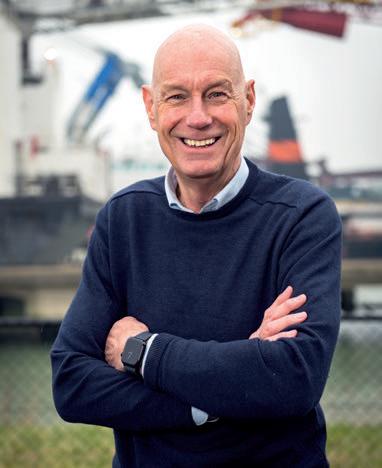
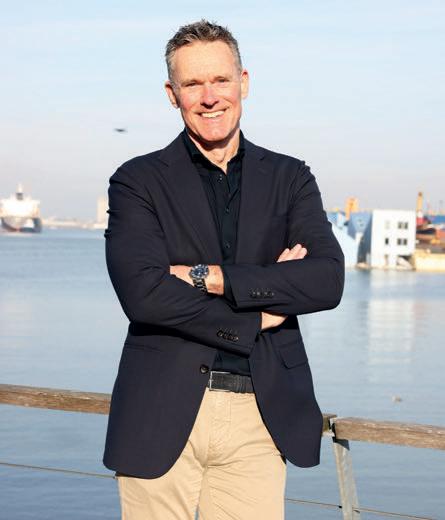
John Dane Chairman Promotion Council North Sea Port
A new EU Port Strategy to boost competitiveness, investment and sustainable growth
A double interview
On 4 March 2026, the European Commission offcially published its long-awaited EU Ports Strategy (COM(2026) 112 fnal). The broad strategy – built around fve pillars covering competitiveness, energy transition, security, fnance and social cohesion – positions European ports as critical infrastructure and important catalysts of competitiveness in a fast-changing geopolitical world.
PortNews spoke with Dr. Louise De Tremerie, responsible for EU Affairs at North Sea Port, and Isabelle Ryckbost, secretary general of the European Sea Ports Organisation (ESPO), to hear their assessments and what it means for ports, especially a cross-border industrial port such as North Sea Port.
The EU Ports Strategy has fnally been offcially published. Is it what the port sector was hoping for?
Isabelle Ryckbost (IR): “We welcome the EU Ports Strategy. It supports the focus on competitiveness, decarbonisation and energy transition and resilience. It is based on a good understanding of what ports are, what they can do, what they cannot do, what they face, and what is needed. The document shows that the policy is there and the focus should be on
implementing this. Ports have their hands full with navigating through the geopolitical volatility the world is going through. Strengthening the competitiveness of ports, giving ports the fexibility to adapt to sudden changes and shocks, and support them in their public tasks are the best way to build resilience. The Commission seems to understand that many of the new roles ports are taking up are public service roles which do not always come with a secure or rapid return on investment but are instrumental in realising Europe’s ambitions and making Europe more sustainable and more resilient.”
Louise De Tremerie (LDT): “North Sea Port can echo ESPO’s take and welcomes the EU Port Strategy as an important step in supporting Europe’s ports and accelerating the transitions ahead. The fnal text represents a balanced framework and refects the diversity across European ports. It recognises ports not just as logistics operators, but as pivotal centres of added value, energy hubs, industrial clusters and critical infrastructure. The dual recognition – as competitive logistics and industrial hubs and as well as public service providers (ref. resiliency, strategic autonomy & military mobility) – is something we had been advocating for and it is now clearly embedded in the text. There is still work to be done and much emphasis will now be on the different initiatives that are listed in the strategy and will be part of the legislative processes in the years to come. So, plenty to keep us busy in the EU affairs bubble!”
One of the key debates in the lead-up to publication concerned the investment framework for ports and how European policy can best support stable long-term industrial investment. What was at stake, and how does the fnal text address this?
LDT: “What was at stake is something that matters deeply to any port with a strong industrial footprint: the certainty and stability that investors need to commit to long-term, capitalintensive projects. Industrial actors investing in a port are not making short-term bets. They are making decisions that have a 20, 30, sometimes 40-year horizon. Think about it this way: if you are going to invest tens or even hundreds of millions of
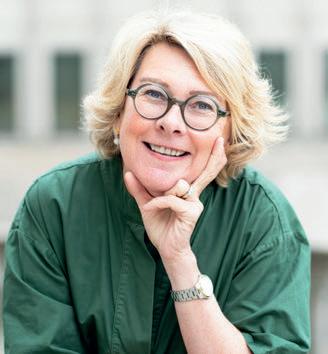
Isabelle Ryckbost, secretary general of the European Sea Ports Organisation (ESPO).
euros in building a factory, upgrading a terminal, or installing cutting-edge industrial infrastructure in a port, you need to know that the legal and contractual framework underpinning your presence there is stable, predictable and long enough to allow you to recover that investment. Nobody builds a beautiful house, fully renovates it and future-proofs it with the latest technologies, only to fnd out after a few years that they may have to move out, and defnitely not an industrial player wanting to invest in a factory.
“Shortening contract durations or introducing excessive uncertainty around renewal would not make ports more dynamic. It can even result in driving investments away, precisely at a moment when Europe needs to attract more of it.
The European Commission understood this and has come up with a balanced strategy that acknowledges that concessions and land lease agreements play an important role in attracting capital and structuring long-term investments. North Sea Port advocated loudly on this point, also to the Belgian and Dutch governments ahead of Council discussions, working closely together with Port of Antwerp-Bruges and the other Dutch ports: Port of Rotterdam, Port of Moerdijk, Port of Amsterdam and Groningen Seaports (‘BOZ ports’). The strategy is balanced and explicitly acknowledges the role that robust contractual frameworks play in attracting capital and structuring long-term investments. The legislative process is now on full speed and we will be watching closely how this evolves in the European Parliament and in the Council in the coming months. Early signs from the Council are looking positive.”
Discussion on foreign investments in EU ports has also been prominently featured. As a TEN-T core port straddling Belgium and the Netherlands, what is North Sea Port’s position?
LDT: “Our position is clear: if the goal is to protect strategic infrastructure from foreign infuence or control that may pose security risks, the existing EU screening instruments such as the FDI (Foreign Direct Investment) regulation is the better vehicle. We have consistently argued – to ESPO, to our national administrations and in our engagement with the Commission and EU policymakers – that the response to economic security concerns in ports should go through the Foreign Investment Screening Regulation, not through a revision of the Concessions Directive. That distinction is fundamental, use the instruments that are already there. The strategy as published does focus on FDI for the key TEN-T core ports, and a revised FDI regulation – the Foreign Investment Screening Regulation – has recently reached a frst formal political agreement between the Council and Parliament. We support this direction. What we want to ensure, now and during the legislative process, is that any port-specifc rules that emerge on top of the horizontal FDI instrument are proportionate, workable, and do not create an administrative machinery that becomes an obstacle to legitimate investment. There must also be strong safeguards around how commercially sensitive data is collected and shared in any mapping or monitoring framework.”
Any additions coming from ESPO, is this echoed across European ports?
IR: “Since COVID-19, followed by the subsequent crises, the strategic and critical role of ports has been coming more and more to the forefront. In that perspective, we understand the fear of policy makers in the current geopolitical turbulence vis-à-vis foreign infuence in strategic infrastructure. We also
understand that we are operating in a new context, the ‘new normal’. Everyone must take this new reality into account, and make sure that the public interest and strategic roles that a port has to play can be safeguarded and are not hindered intentionally by foreign infuence. But one has to fnd the right balance between open trade and an open investment policy – and the advantages of that – and the need to protect your strategic assets.
“As Louise is saying there is a solid instrument for this, with the recently reviewed Foreign Direct Investment regulation, which is the right tool to assess foreign investments in critical infrastructure, such as ports, and the potential risks linked to them. This new framework must now be implemented correctly, and member states must foresee the necessary means for that. For us it is important that the screening is done in a smooth way and that it brings clarity in the short term – better a quick ‘no’ than creating a lot of uncertainty for the investor and for the relevant port authority. So our message is, let’s work with that and do not create extra layers, which will only lead to deterring the majority of good investors we need and want to attract in Europe. It would also be wrong to ask port managers to assess geopolitical risks, this is beyond their competence and would also create conficts of interest. We must not forget that if we talk about ‘foreign infuence in ports’, we are not talking about the level of the port authority. Overall, and certainly in Belgium and the Netherlands, ports are public infrastructures, the investors get a right to use the land for a certain period. So, the ‘keys’ of the ports remain in public – and European – hands.”
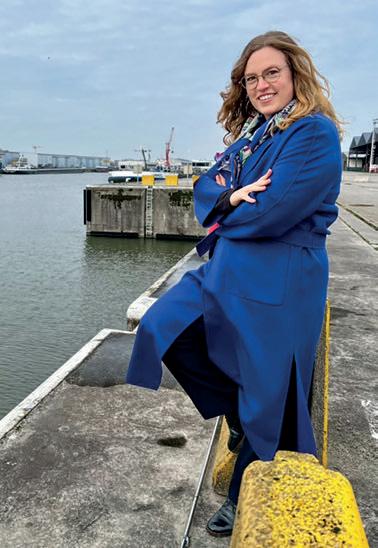
Dr. Louise De Tremerie, responsible for EU Affairs at North Sea Port.
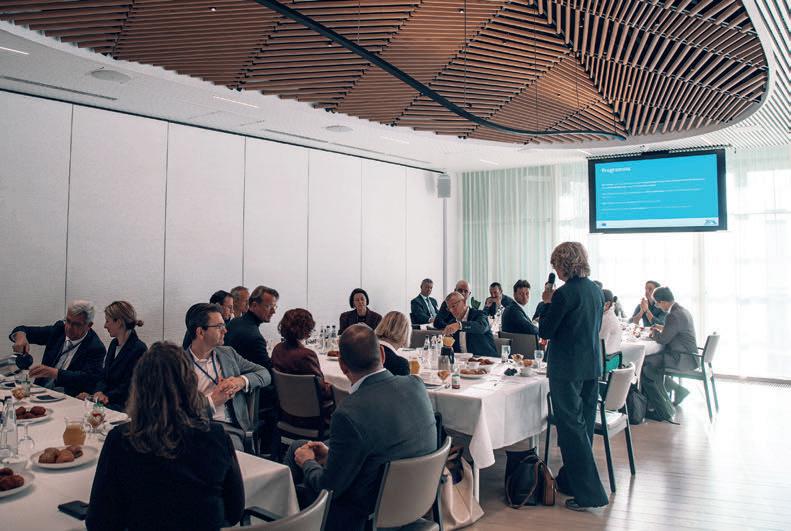
On 14 April 2026, North Sea Port co-organised a breakfast table in the European Parliament on the EU Ports Strategy, alongside VLEVA, the Port of Antwerp-Bruges and Port of Rotterdam. What were the key messages from that event?
LDT: “The breakfast table was a very concrete example of how ports can engage constructively with parliamentarians at an early stage in the legislative process. The event brought together Members of the European Parliament (Flemish & Dutch) to go into dialogue with the top three major industrial European ports in this region: Port of Rotterdam, Port of Antwerp-Bruges and North Sea port. The European Ports Strategy served as the overarching framework, under which we took a deep dive into three specifc pillars: resiliency and military mobility, investment and competitiveness and lastly, the transition towards climate neutrality. Thank you again to Isabelle for moderating this valuable dialogue between the ports and Members of the European Parliament. For us, it was of importance to signal to the European policymakers that you need to move beyond silos and look across national borders. Whether it is industrial, energy, military or sustainability, it makes sense to look at the entire industrial-logistical BE/NL/DE regional ecosystem. The dialogue also reaffrmed how much we share in common with Port of Antwerp-Bruges and Port of Rotterdam on these fles – a coordinated North Sea ports voice is an asset in Brussels.
“For North Sea Port, our key contribution by our COO Peter Van Parys focused on resiliency and military mobility which has been given a prominent place in our recent strategic plan Impact 2030. It was clear that this topic was of high political interests as the members of parliament engaged actively and asked multiple questions: cooperation with defence sector, digital and
cyber resiliency, protocols, drones, security checks personnel, ... North Sea Port stressed the point that ports are increasingly called upon to serve not only commercial logistics chains, but also defence and military logistics purposes – and that this dual-use reality needs to be refected in both infrastructure investment decisions, the regulatory framework and funding. North Sea Port is situated in a strategic location for military mobility within Europe and NATO and has experience as being a host nation port on the Dutch side. Cooperation between the different actors, defence, NATO, private players and the ports, is key.”
IR: “I must say that it was a very fruitful event with a nice exchange of views between the member of the European Parliament and the representatives of the ports of AntwerpBruges, Rotterdam and North Sea Port. Ports are complex and are getting even more complex nowadays since they combine very different roles ranging from the logistic role to roles in the feld of energy, industry, military preparedness and resilience. In that sense we are involved in a very wide range of policy issues and we must engage with a wider range of politicians.
“As Louise mentions, Peter, the COO of North Sea Ports, very clearly explained how the port is taking the new geopolitical context into account, what the role of the port managing body is in that respect and how this all functions in reality. The Port of Antwerp-Bruges put the fnger on the competitiveness challenge of the industrial port clusters as we know them in Flanders and the Netherlands, the importance of keeping these industries in Europe, in particular the chemical sector (basic chemistry) which can provide the raw materials for many
The breakfast table in the European Parliament on the EU Ports Strategy, was co-organised by North Sea Port, VLEVA, the Port of Antwerp-Bruges and Port of Rotterdam.
I must say that it was a very fruitful event with a nice exchange of views between the member of the European Parliament and the representatives of the ports of Antwerp-Bruges, Rotterdam and North Sea Port | ISABELLE RYCKBOST
innovative products and energies. Rotterdam, from its side, pointed out how they focus on becoming less dependent on the fossil energies, the important role of pipelines in that respect and how these can connect the different ports present.
We noticed a big interest of the participating members of parliament for the ports and that is good news.”
LDT: “Indeed, very good news to have such engagement and genuine interest from the policy makers!”
The strategy puts signifcant emphasis on funding – including the Connecting Europe Facility and references to the 2026 Refow Call. Why is it so important? ESPO says that 80 billion is needed?
IR: “Yes, indeed, in 2024 we commissioned a study on the investment needs of Europe’s ports based on an extensive survey among our members. On that basis the study concluded that ports in Europe have investment needs for the period 2024-2034 of 80 billion euros. It is important to know that this study was done before the whole discussion on military mobility and preparedness started and that those investments are not yet taken into account.
“So indeed, if we want ports to take up the tasks and roles that are expected of them to help Europe to become net-zero, more competitive and resilient – tasks that they are taking seriously –they must be supported. Many of these additional tasks require investments that do not always have this direct and clear return on investment for the investing port authority but are instrumental for Europe’s economy and society. So, we hope that the European governments understand that ports are not only transport players but are enablers of all important sectors of the economy. The war in Ukraine has shown very clearly that when ports cannot work, the economy and society stop.”
LDT: “I can only agree with Isabelle’s response. Funding is essential. Concretely, for North Sea Port, we have a European subsidies expert in-house and we are closely following the 2026 CEF Refow Call, which is highly likely to include onshore power supply as a prioritised investment area. That is directly relevant to our decarbonisation roadmap and ongoing development plans with our actors. The announcement that the Commission will develop a specifc roadmap for small and medium-sized ports is also notable, and we are watching how that develops.”
What are the main areas of the strategy that need to be monitored as it moves through the legislative process in Parliament and Council?
IR: “As said overall we are quite happy with the strategy since it puts the fnger on the right issues, without trying to reinvent the wheel. We however see quite a lot of reporting and mapping obligations for the member states in it, as well as guidelines to be developed to further explain the legislation. Here we have to pay attention that this is not leading to needless administrative burden or to adding a level of complexity to already agreed legislation.
But we also note that there is a willingness to discuss the way forward and we of course welcome that.”
A fnal word: why do people in the sector need to care about this new EU Ports Strategy, what does it concretely mean?
LDT: “You can consider the EU Port Strategy as an outline or script on what we can expect in the coming years on port policy. It is a statement of intent, but with clear reference to proposals, initiatives and revisions – so: an important one. The strategy signals that the European Union takes its ports seriously as strategic partners. The recognition that ports are at the crossroads of trade, energy, defence, industry, and sustainability is a signifcant step. For North Sea Port, this matters enormously as we combine these different roles in our region. We want to see a Europe that invests in its ports, removes regulatory bottlenecks, supports the energy transition, bolsters its industrial competitiveness and ensures that ports remain secure and resilient. The strategy sets the policy direction. Now we need to make sure the legislative process that follows and the initiatives that will follow delivers on that promise.”
IR: “As Louise explains it sets out priorities for further work. In ESPO we however hope that this Strategy helps policy makers in understanding the strategic role and importance of ports, hence the importance of supporting and enabling the ports. We hope it is not interpreted as a plea for adding more rules and requirements. Ports want a policy that supports them not one that comes instead of the market or one that restrains ports in their agility to navigate through the geopolitical and geoeconomic turbulence.”
I. NORTHSEAPORT.COM
I. ESPO.BE
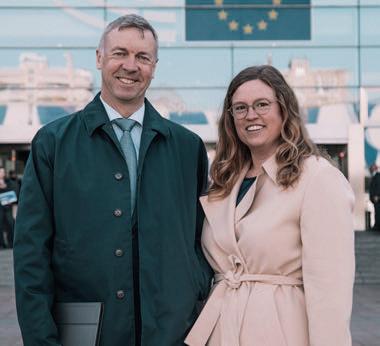
On 14 April, at the breakfast table in the European Parliament on the EU Ports Strategy, Louise De Tremerie was accompanied by Peter Van Parys, COO of North Sea Port.
A real specialist
As an outsider, you may not realise it, but in a maritime and industrial environment, cleaning and waste collection is a true speciality that cannot be performed by just any company. Real specialists are needed for this, and Vertom Cleaning is one such specialist.
“Vertom Cleaning is a leading company providing services in the feld of maritime and industrial cleaning,” explains Joost Verschuur, commercial manager at the company. “From our location in Spijkenisse, we are mainly active in the area roughly between Amsterdam and Rotterdam, and from Vlissigen, we operate in Zeeland as well as in the Belgian seaports of Antwerp-Bruges and Ostend. For some time now, we have even been working as far as Calais, France.”
Activities
The activities of Vertom Cleaning can be roughly divided into the following areas:
Industrial cleaning
This includes cleaning installations, sewers, crawl spaces, and tanks in the petrochemical industry, as well as installations and tanks at tank terminals. Besides this, Vertom Cleaning serves
companies in other sectors, such as the metal processing and food industries. Vertom Cleaning and its staff are fully certifed meeting all safety rules related to industrial cleaning.
Maritime cleaning
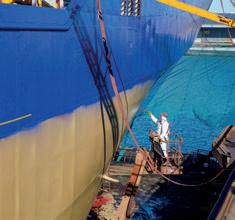
This involves cleaning tanks and engine rooms on seagoing and inland vessels. The tanks include not only cargo tanks for transporting various liquid bulk goods, but also all other tanks on board, such as those for fuel and ballast. Vertom Cleaning also handles the disposal of water used to clean ship holds, which becomes contaminated in the process.
Waste management
Vertom also manages the complete handling of waste streams. The company holds extensive environmental permits, allowing it to collect, store, and transport various types of waste from its Spijkenisse facility. This relieves customers of the need
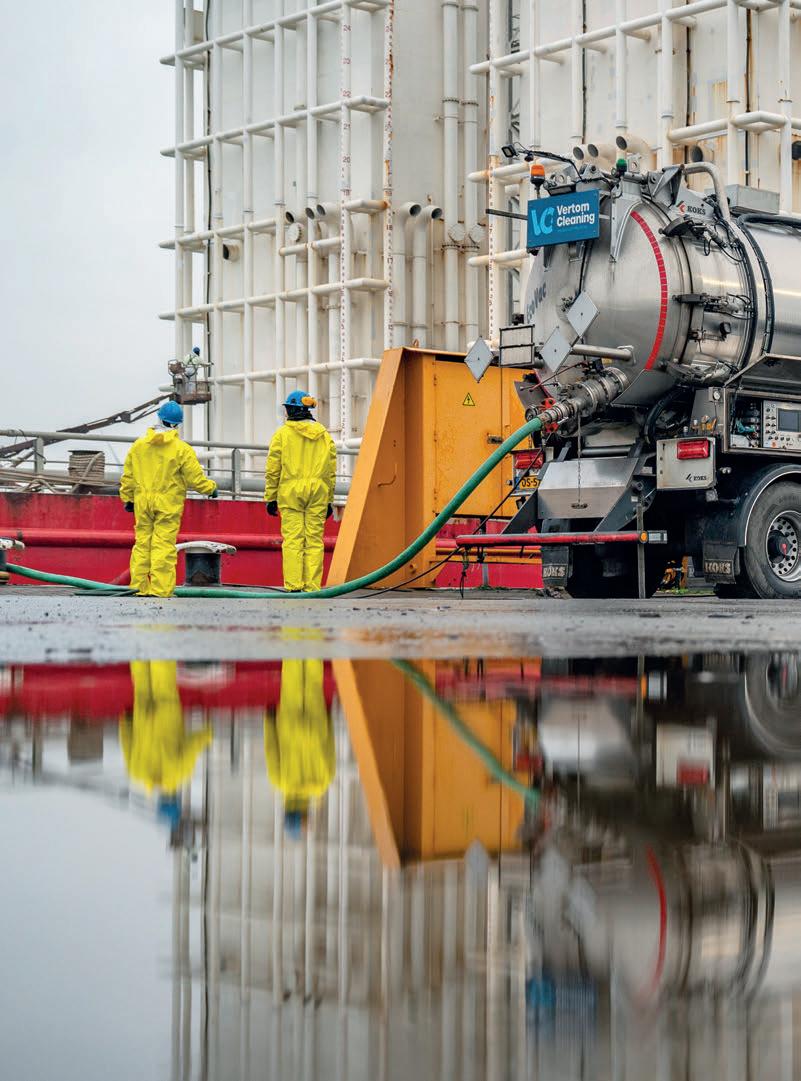
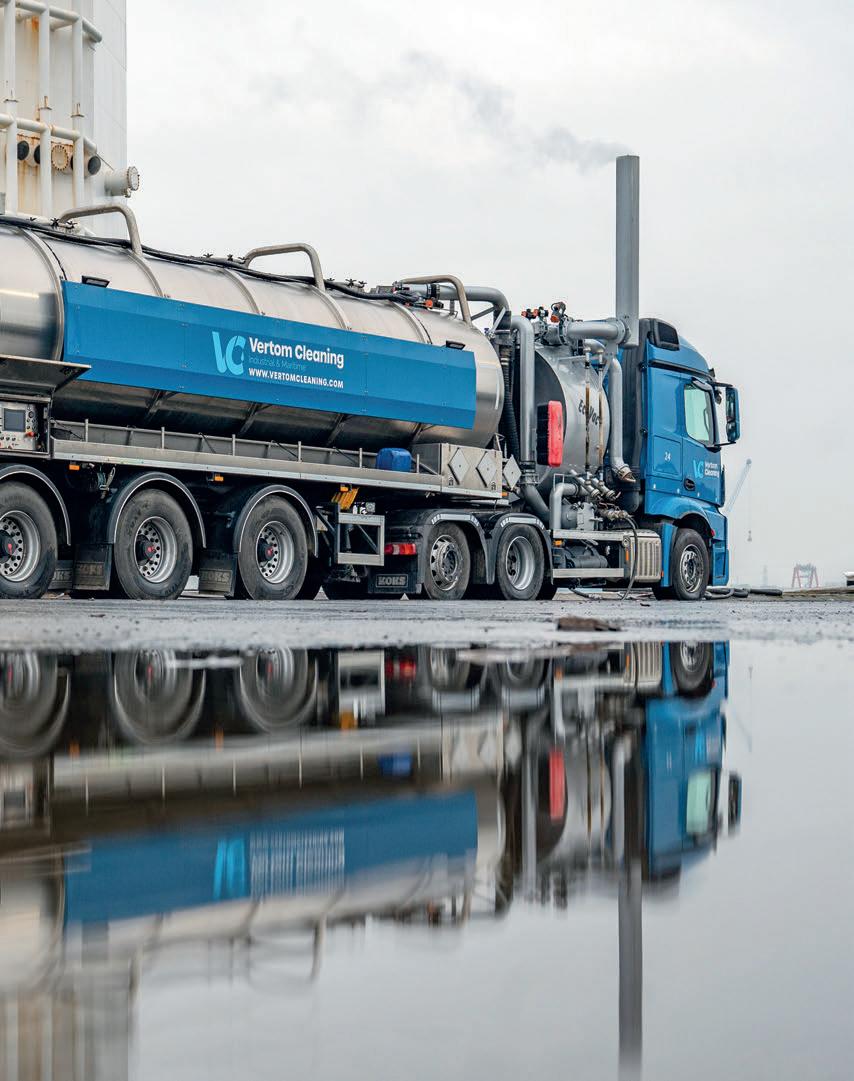
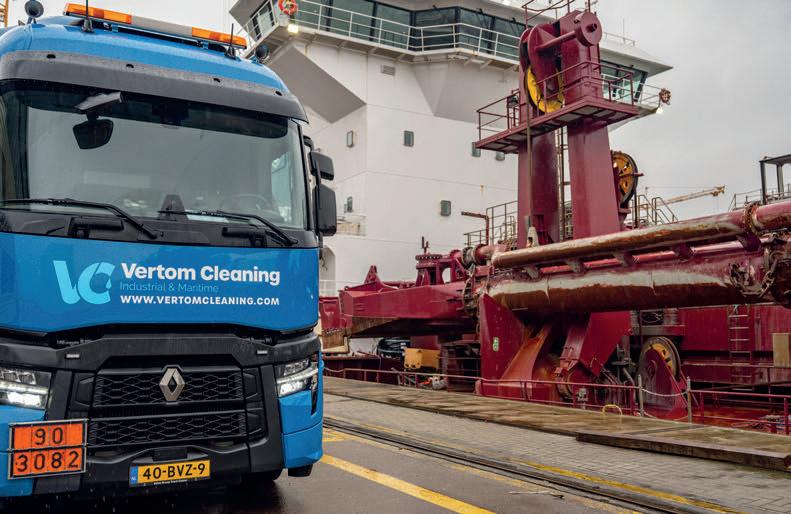
Vertom Cleaning has its own modern vehicles and equipment, such as vacuum trucks, dry material trucks, and high-pressure units.
to involve an external waste processor. In this role, Vertom Cleaning also operates as a port reception facility for ships calling at the ports of North Sea Port.
Oil spill response
For oil spill response at sea, Vertom Cleaning offers a wide range of products and services. The company also plays an active role in advising during emergencies and incidents on the water. Additionally, it provides training to companies at risk of oil pollution. “Our activities are quite diverse, as shown above,” says Joost Verschuur. “Naturally, we have our own modern vehicles and equipment for this, such as vacuum trucks, dry material trucks, and high-pressure units. We also regularly use the services of our sister company Marifex, for example, for the use of pumps and fenders.”
Strong relationships
Joost Verschuur continues: “Over the years, the company has steadily expanded its activities. This was not a conscious choice, but a natural result of the strong relationships with our customers. As a result, we have continuously expanded our services and geographical reach. We have built a strong bond with both our industrial and maritime customers. This ensures that we are top of mind when they need services at a different location or project. We have built a good reputation, which also opens doors with other parties.”
Flanders branch
“Of course, ships call at various ports, and cleaning cannot wait until they return to the area. This has also allowed us to geographically expand our activities. Currently, due to this expansion, we have our own business unit Belgium, focused on the Belgian seaports. At the moment, this unit still operates from Vlissingen, but in the next few years a branch will be opened in Flanders. We are also cautiously looking further along the French coast toward Le Havre, simply because we know there is plenty of work to be done in our feld and that within the Hamburg-Le Havre range, there are only a limited number of parties that can offer services comparable to ours.”
Focus on maritime shipping
Although Vertom Cleaning increasingly serves inland shipping companies, its maritime cleaning activities focus primarily on seagoing vessels. “We are increasingly asked to also handle cleaning on inland vessels,” explains Joost Verschuur. “As the rules on ship cleaning become stricter and cleaning more complex, inland shipping companies more often choose to outsource the work to specialists. However, our primary focus
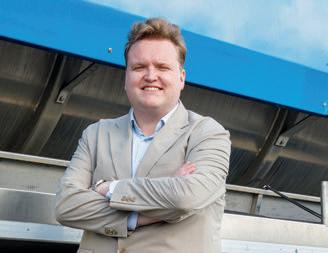
Joost Verschuur, commercial manager at Vertom Cleaning.
Although Vertom Cleaning increasingly serves inland shipping companies, its maritime cleaning activities focus primarily on seagoing vessels.
Image courtesy of Vertom Cleaning.
For oil spill response at sea, Vertom Cleaning offers a wide range of products and services.
remains on seagoing vessels. Of course, we handle the cleaning and waste management of ships owned by or managed by our sister company Vertom Shipping. We also receive many orders through (local) shipping agents both from within our own organisation and beyond.”
Challenge
According to Joost Verschuur, one of the challenges of the work lies in legislation and regulations. “The rules are generally clear, as there are international regulations for the maritime world and also international, mainly EU-imposed, regulations for industry. However, local regulations often apply in industry as well. This naturally requires us to maintain up-to-date knowledge, and it is good to see that our team consistently succeeds in this.”
No regrets
Before joining Vertom Cleaning, Joost Verschuur worked at S.T.T. He has no regrets about his move. “I have been doing this work for about 2.5 years now, with great pleasure. I enjoy the variety in my work. Of course, my work at S.T.T. was already very varied – no two days were the same – but now, the combination of industry and the maritime sector makes the work even more fascinating. The fact that things in the maritime world are always under time pressure, while in industry, matters
can often be planned and prepared much further in advance, means that approaches often differ.”
Out-of-the-box solutions
“What also appeals to me in this work is that we always collaborate closely with our customers. We think along with them to fnd solutions that best ft their needs. We do not automatically choose the easiest path, but also look for out-of-the-box solutions to deliver the best for the customer. This, combined with great fexibility and collaboration with other companies within the Vertom group, truly sets us apart in the market. The growth we achieve in this way is a wonderful process to be part of and contribute to,” Joost Verschuur concludes.
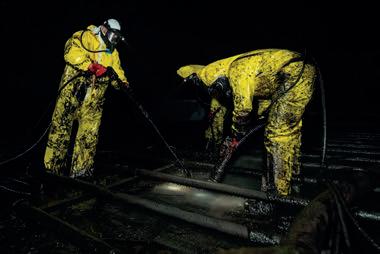
Vertom Cleaning and its staff are fully certifed meeting all safety rules related to industrial cleaning.
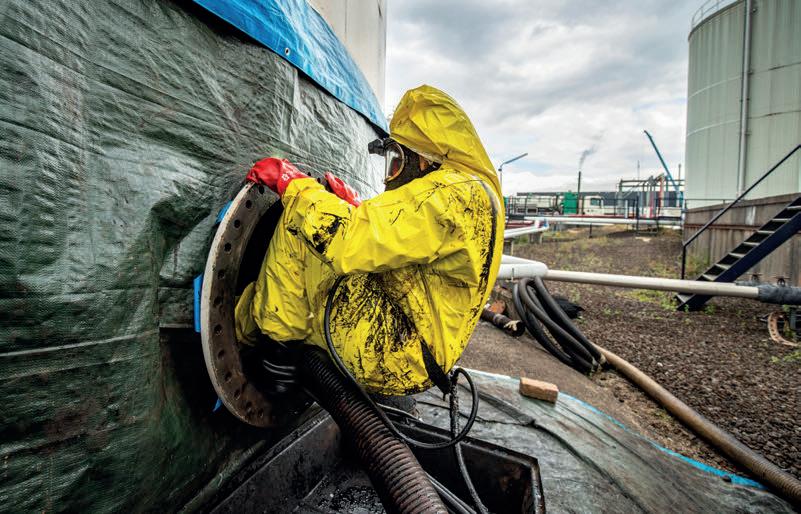
Industrial cleaning includes cleaning installations, sewers, crawl spaces, and tanks in the petrochemical industry, as well as installations and tanks at tank terminals.
Image courtesy of Vertom Cleaning.
Image courtesy of Vertom Cleaning.
Steady navigation
Agrominne is an inland shipping company specialising in reliable and effcient bulk transport across Europe’s waterways. With a strong focus on professional logistics coordination and dependable service, the company connects producers, traders, and ports through fexible inland navigation solutions.
All images courtesy of Agrominne.
At the same time, Agrominne is committed to greening inland navigation and to building sustainable partnerships with clients, shippers, and other partners. Through this combination of trust, professionalism, and sustainability, the company contributes to a stronger and more future-proof inland shipping sector.
“The company was founded in 1902 in Bruges under the name Minnepoort, as a small family business that established its own chartering offce,” says Bruno Vanlooy, general manager of Agrominne. “Over the years, Agrominne moved to Ghent, where it was acquired by Dutch Maaskade Groep in 2010. The acquisition allowed Agrominne to diversify, and since then, the company has grown steadily into what we are today: a comprehensive chartering agency for inland waterway transport. While in the past Agrominne was a very local player, serving mainly Flanders and Northern France, we have now expanded into a chartering agency covering the entire Western European waterway network. The waterways we navigate – our operating area, so to speak – are primarily located in the Netherlands, Belgium, France, and Germany, and we sail up the Danube as far as Hungary.”
“We have also signifcantly expanded the variety of goods we transport,” adds Rebecca Beaussart, chartering manager of Agrominne. “We used to mainly focus on grains and animal feed; now, we handle a wide range of goods, from breakbulk to bulk cargo, including a substantial amount of agribulk and fertilisers, covering both raw materials and fnished products. Essentially, we transport anything that can ft on a ship, except for containers.”
“The link with Maaskade also creates synergies with Maaskade Bevrachters,” Bruno Vanlooy notes, “which specialises in liquids. We have a client, for example, producing linseed oil. Agrominne manages the bulk transport of the small seeds, and Maaskade Bevrachters then transports the fnished oil. We intend to further explore and grow these collaboration opportunities; however, the two daughter companies operate quite differently. Maaskade mainly uses its own tankers, through joint ventures and wholly owned assets, which is still quite rare in dry cargo. We use a feet of what we call ‘in-house skippers’. These are independent skippers who primarily sail for us, sometimes even exclusively. As Agrominne expands, more skippers are reaching out to join our feet. Currently, around 100 vessels sail regularly for us, with about ten sailing exclusively for us on a continuous basis. The goal, of course, is for that list to grow a bit longer.”
Strong partnerships
“It’s a very diverse feet, too,” Rebecca Beaussart says. “We work with French skippers, Belgians, Dutch, and an increasing number of German skippers who fnd their way to our agency as well. They all enjoy working for us because we are committed to our skippers. Everyone in our offce understands what life on board is like. We have people with over 20 years of inland shipping experience, individuals from skipper families, and some who have sailed themselves. We also endeavour to respect the human aspect behind shipping. These are families living on board, often with children who attend boarding school. We try to take these people’s private lives into account. And that is what the skippers appreciate too. There is a personal connection.”
Agrominne is a Green Award Incentive Provider that actively encourages and supports its skippers in investing in greening and achieving Green Award certifcation.
Agrominne transports a wide range of goods for its customers, from breakbulk to bulk cargo, including substantial volumes of agribulk and fertilisers.
“We also try to ease the pressure on these skippers by paying attention to return loads,” Bruno Vanlooy adds. “If possible, we keep the returns in-house, but we also maintain good relations with other agencies so that we can collaborate to complete the chain for our skippers. For example, we might have a load from A to B, they from B to C, and we from C back to A. We have heavily invested in those contacts in recent years, and it is currently working very well. These collaborations are important because, ultimately, all freight forwarding agencies face similar challenges. By working together, we can support each other and our ships. That’s a bit of a trademark for our offce. We don’t beat around the bush; we tackle things head-on, in a practical and pragmatic manner. We pick up the phone and resolve issues. The skippers are aware of this – they know what to expect from us. The same applies to our clients. We don’t make promises we can’t keep. I believe this is appreciated on both sides. That we’re straightforward, dependable, and value clear communication and personal contact, even though we work a lot with international contacts. We meet our clients at trade fairs, stay in touch, and endeavour to keep our fnger on the pulse of what’s happening with them. We are very engaged in the market.”
“Working closely with our customers has become more important than ever, given the current geopolitical situation,” Rebecca Beaussart states. “It’s become a real challenge to get everything sorted. In the past, we could predict much more accurately which periods would be quiet or busy for certain products. Now those certainties are gone; the situation is highly volatile, and the only thing we can do is adapt as much as possible and remain fexible. Not only that, but inland shipping itself is rapidly evolving as well.”
A changing sector
Bruno Vanlooy explains: “The demand for freight for small tonnages – cargoes of 500t or less – has decreased, but the number of small ships suitable for these tonnages is disappearing even more rapidly. For instance, the widening of the Canal du Nord to create Canal Seine-Nord Europe implies that much larger vessels will be able to make that voyage, which will, of course, increase the demand for larger tonnages in that direction. As a result, the type of vessel currently able to sail the Canal du Nord is being phased out even faster. Forty small barges will be taken out of service soon. That’s a substantial number. And that’s a challenge for us, because even though the Canal du Nord is being widened, we’re still receiving requests for those small shipments, including for other locations. It’s becoming increasingly diffcult to fnd vessels for them. However, the process cannot be halted; smaller vessels are being phased out. Standard vessels are now up to 3,000t, with even larger inland vessels up to 4,000t. And the cargoes will follow suit eventually. We still handle these smaller shipments, but not as frequently. About 80% of the cargoes we currently charter are between 1,200t and 3,000t.”
A wealth of knowledge
“Inland shipping has indeed changed signifcantly in recent years,” Rebecca Beaussart agrees. “I’m pleased that Agrominne is an agency that continues to learn and evolve every single day. We are also a rapidly expanding frm. We currently handle 2 million tonnes annually, averaging 45 shipments per week, and the fgures keep rising. We have therefore recently expanded our workforce with experienced individuals who can genuinely add value. This development opens up further opportunities for growth and provides us with the fexibility to address specifc
Agrominne’s feet is diverse, with over 100 vessels that regularly sail for them, including about 10 that operate exclusively for Agrominne, and this number is growing quickly.
challenges. We are fortunate to possess a wealth of knowledge within the team regarding life on board as well as the different waterways. Each person has their own specialised area: the French side, the Rhine, the Netherlands and Belgium, the Danube... We complement each other exceptionally well. This is crucial because, as a charterer, a comprehensive understanding of the waterways you operate on is essential. Every river and canal presents its own challenges: a low bridge here, the accessibility of a particular quay there, the draught... It is vital to be aware of these challenges and to manage them effectively.”
“That’s why it’s so important that we have people in the offce who have also sailed,” Bruno Vanlooy notes. “It’s not just for the skippers’ sake; our charterers understand the situation at hand, know what must be considered on certain rivers or in particular regions, and where the hazards lie on a specifc river. It is also why strong partnerships are vital. Some rivers nearly run dry at low water and food two weeks later. It can be highly unpredictable. In more remote regions, we need trusted partners to monitor and assess the situation on the ground.”
Green shipping
“Furthermore, Rebecca Beaussart adds, “we are also focusing on the Green Deal and all aspects related to greening inland shipping. This is no easy task, as we are dealing with a relatively ageing feet on our waterways, and the necessary investments are often costly. However, we are doing our utmost to support our skippers in this endeavour in every way we can. As Green Award Incentive Providers, our goal is not only to encourage skippers to invest in greening, but also to collaborate with them to explore all options available. To achieve Green Award certifcation, there is an extensive checklist of requirements a vessel must meet, such as a Stage V-engine – an engine that complies with the strictest European emission standards (Regulation 2016/1628) for non-road mobile machinery, introduced to signifcantly reduce emissions – solar panels, the ability to operate independently of shore power for 24 hours, and more. Agrominne has committed to supporting its skippers and is actually funding part of their certifcation process. Thanks to the Green Award, they also receive discounts on port charges, helping them recover some of the costs of their investments made.”
“Chartering a green ship is also advantageous for our customers,” says Bruno Vanlooy, “as this also reduces the carbon footprint of their supply chain. We’ve invested heavily in our IT system for CO2 reporting. And as a next step, we plan to monitor our ships to effectively measure exhaust emissions using a measurement system at the exhaust to determine what is actually being emitted, comparing actual measurements to theoretical calculations. There is also a need for greater awareness of alternative fuels such as HVO (Hydrotreated Vegetable Oil) – a sustainable, fossil-free fuel made from waste streams like cooking oil that produces up to 90% less CO2 than regular diesel. Even though part of our feet has already switched, not everyone has. Partly, that’s because there might be technical diffculties, for instance, if the central heating system in the living quarters is also connected to the diesel tank. One of our greater long-term ambitions is to acquire our frst fully owned vessel and establish it as the fagship of our sustainability initiatives. Investing in our own vessels, or participating in their acquisition to support young skippers in establishing their businesses, is a logical next step to remain economically viable and ensure the future of effcient, reliable and innovative inland shipping.” I. AGRO-MINNE.BE
About 80% of chartered cargoes are between 1,200t and 3,000t. Although demand for smaller loads of 300t–500t remains, there is a noticeable shift toward larger shipments, with some reaching up to 4,000t.
Rebecca Beaussart, chartering manager of Agrominne, and Bruno Vanlooy, general manager of Agrominne.
In the dock
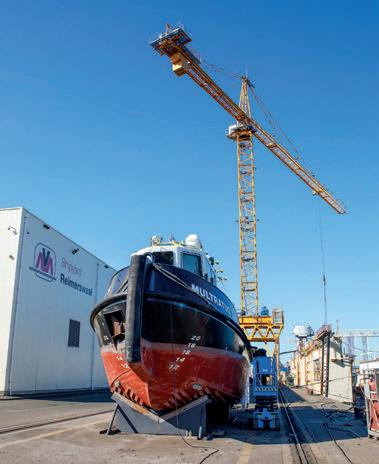
Shipyard Reimerswaal looks to the future with addition of historic drydock
It’s almost two years since PortNews spoke to Shipyard Reimerswaal director Rudi Pieters. Back then, he told us the story of the company, starting in the mid-1980s, including its growth over the years and eventual move to North Sea Port.
The new dock will provide Shipyard Reimerswaal with more fexibility.
Here, in the Vlissingen-Oost part of our port, Shipyard Reimerswaal developed a new site in the heart of the action. The new location offered the company a signifcant increase in berth and draught capacity, as well as open access to the sea. The site covers some 2.1ha and enjoys exclusive access to 450 by 109m of water.
Since 2017, from this location, Shipyard Reimerswaal has offered its clients in diverse maritime sectors a comprehensive scope of repair, maintenance, reft and conversion services.
Over the years, this positioning has enabled the yard to build strong relationships with returning clients, who value both the accessibility of the site and the breadth of services on offer.
Being located within North Sea Port has also ensured that vessels can enter and leave the yard with minimal delay, an increasingly important factor in modern shipping operations where time in dock must be carefully managed.
Next generation
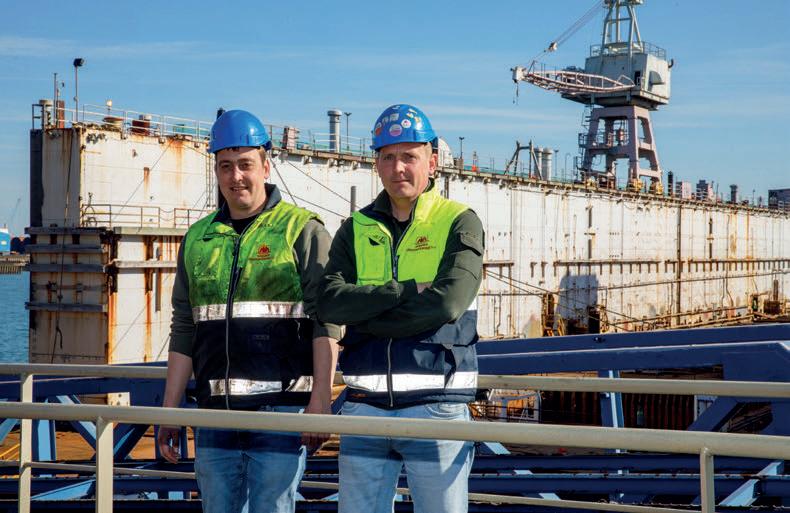
In this edition, the next generation of the Pieters family, brothers Robbert Pieters and Rick Pieters, talk about the latest developments at the shipyard – including the acquisition of a new, signifcantly sized foating drydock.
Robbert Pieters didn’t begin his career at Shipyard Reimerswaal; he spent the frst six years of his working at another shipyard.
“I always felt that I would come and join the family business at some point,” he says. Since he came on board at Shipyard Reimerswaal twelve years ago, Robbert Pieters has experienced a wide range of activities.
“I started on the workshop foor, then went to work in the dock for a while. After that, I did two years as a project manager. Two years ago, I began work in my current role of operations manager. It’s been an interesting learning curve that has allowed me to take part in the entire process, from end-to-end.”
Rick Pieters commenced work at Shipyard Reimerswaal immediately upon completion of his education. “I’ve been here for around ten years now,” he explains. “I started as a project engineer and, after gaining experience in the role, took up the position of project coordinator.”
Increasing fexibility
Since it frst opened the gates of its North Sea Port location, Shipyard Reimerswaal has operated a single drydock, 120m long with an inner width of 22m and lifting capacity of 6,000t. From the outset of its operation in North Sea Port, Shipyards Reimerswaal had the plan to expand with a second drydock, and already had the necessary permits in place to do so. Now, as the view from the company’s offces makes abundantly clear, that moment has arrived.
“She’s 168m long,” Robbert Pieters explains, indicating the impressive sight of the recently arrived dock. “The outside width is 38m, and the inner width between dock walls is 28m. She has a lifting capacity of 18,000t and can host vessels with a draught of 9m on 2m keel blocks.”
Long history
The new dock, then, represents a considerable increase in capacity for Shipyard Reimerswaal. Before it arrived in Vlissingen, the dock had experienced a long and interesting history, having been constructed around 80 years ago by the United States Navy.
“She’s an old lady,” Rick Pieters says, “but she’s been well looked after in her life.”
The US Navy used to take the dock along with them on operations all over the world. Crewed by a 120-strong team, the dock was able to undertake emergency repairs to vessels to ensure mission optimal uptime and mission resilience. Later, it passed into the ownership of BAE Systems, from which Shipyard Reimerswaal purchased it in December 2023. Two years later, in December 2025, the yard took delivery. Having prepared the dock for transport, Shipyard Reimerswaal arranged for the dock to be towed from BAE Systems’ location in Jacksonville, Florida, to Freeport in the Bahamas.
Across the ocean
Here, the dock was loaded aboard Boskalis’ renowned semisubmersible heavy transport vessel, the Mighty Servant 3. Loading the dock required the 181.23m by 40m vessel to ballast down.
With this accomplished, the dock could be manoeuvred over the vessel’s considerable 5,600m2 deck before de-ballasting
Robbert Pieters (left) and Rick Pieters in front of the new dock.
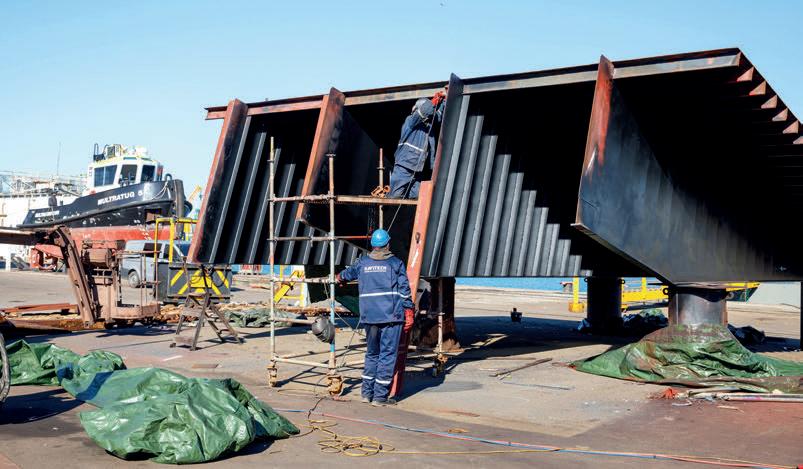
The yard has also built an extenstion to provide vehicular access to the dock.
and securing of the dock could be carried out in preparation for the ocean crossing.
A new life begins
“The dock arrived here in North Sea Port on 1 March. Since then, we have been readying her for her new life,” states Robbert Pieters.
This, he explains, includes carrying out some steel repairs.
“We’ve also constructed an extension to the dock,” he continues. “We have built a new platform, which allows us to access the dock with cherry pickers, fork-lifts and trucks to transport components and equipment to projects.
“Additionally, we are installing a new crane on the SB wing wall. And, of course, when all this is done, she will need to be repainted.”
In parallel with these works, the yard is also ensuring that all systems meet current operational and safety standards, allowing the dock to integrate seamlessly into existing workfows once it becomes fully operational.
Added capacity
The extra dock will provide the yard with much-needed additional capacity.
“At the present time, the original dock is booked up until midsummer. It’s a fortunate position to be in, but it does mean we have to say no to our clients sometimes, and that’s something we want to avoid,” Rick Pieters says.
“With two docks, we will be more fexible, being able to support our clients more and to take on projects for larger vessels.”
First project
The dock is, the brothers explain, an ideal size to host larger vessels of a similar type to those they currently handle. These
include large dredgers, offshore support vessels, pontoons and fshing trawlers.
The yard is already getting plenty of enquiries about the new dock, Rick Pieters says, and has, in fact, already scheduled its frst project.
“We have a 120m hake trawler scheduled to arrive on 18 May for an intermediate survey,” Robbert Pieters states.
Tight deadline
It sounds like a tight deadline, but the brothers have full confdence that they will have everything ready in time for the vessel’s arrival. “We might not be completely fnished with the dock refurbishment,” Robbert Pieters continues, “but we will certainly be ready to welcome a vessel.”
So, with this latest chapter in the story of Shipyard Reimerswaal drawing close to a successful conclusion, what’s next for the yard?
The optimal size
“For a while, nothing,” says Rick Pieters. “This has been a considerable investment and we want to complete the refurbishment properly, and allow some time for it to provide a return.”
Echoing Rudi Pieters when he spoke with PortNews in 2024, he continues, “Besides, we are not looking to grow too large. We want to stay at the optimal size that will enable us to offer our clients the fexible, proactive yard they are looking for.
“If they need a crane, or a fork-lift, we don’t want them to have to wait half a day; we want to provide them with what they’re looking for within the hour. If they call us on a Friday afternoon due to an emergency, we want to start work on Saturday morning.”
I. SHIPYARDREIMERSWAAL.COM/NL
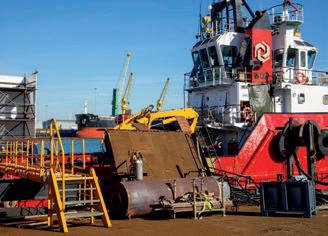
While the new dock is being prepared, work goes on at the yard.
When fabric becomes infrastructure
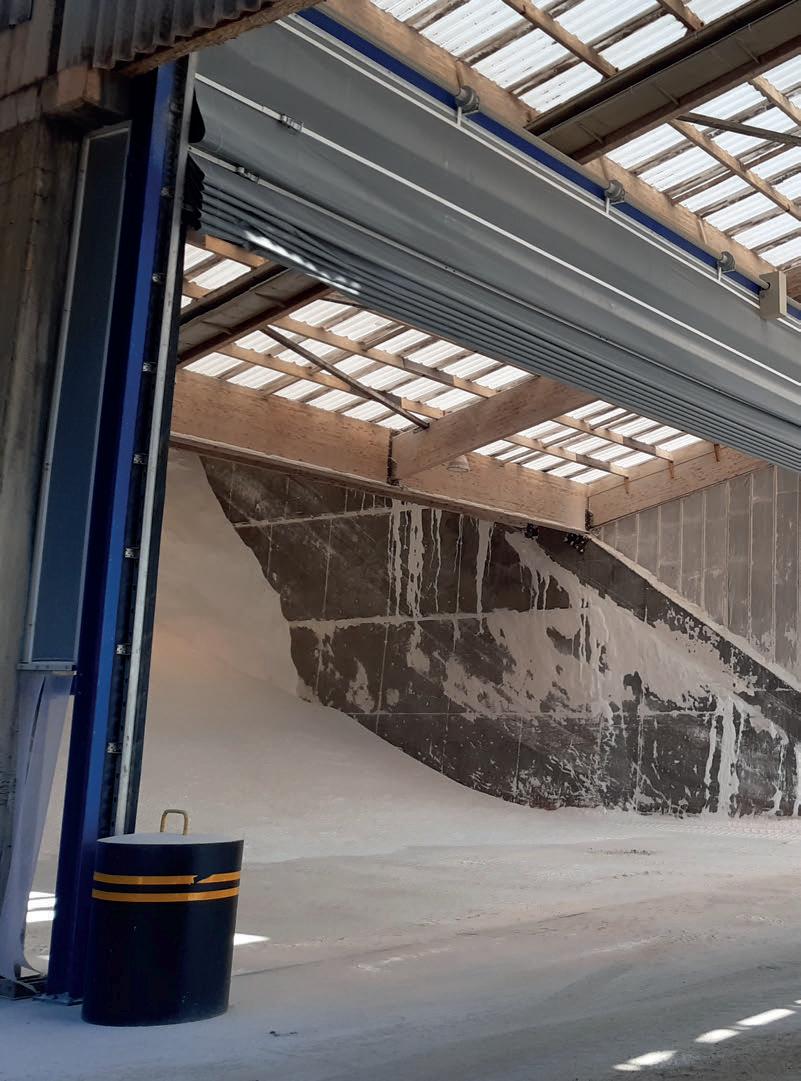
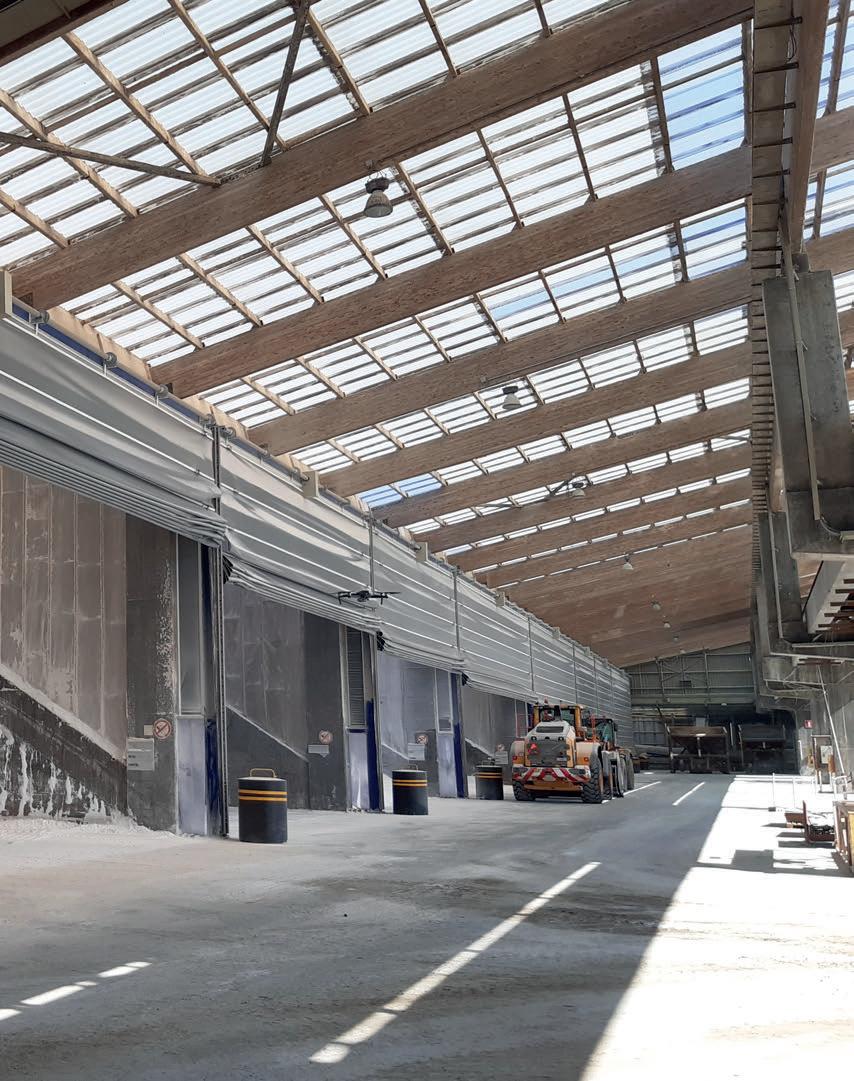
The installation of mammoth doors in fertiliser storage ensures that large openings are securely and effectively sealed, providing protection against wind, dust and rain.
At frst glance, a screen might seem like a simple product. But in the hands of specialists like Dexcon-Vervaeke, it becomes a sophisticated engineering solution. The company has over 30 years of experience in creating systems that integrate technical textiles with structural design to regulate wind, dust, rain, and light in challenging environments –ranging from recycling facilities to logistics warehouses and petrochemical sites. The solutions it provides are custom-designed and engineered to meet specifc industrial conditions.
Gert Janssen, sales director at Dexcon.
“Technical textiles are a highly interesting niche,” says Gert Janssen, sales director at Dexcon. “People usually have no idea of the extraordinary properties and possibilities our screens have to offer. We offer solutions designed for demanding environments, primarily in industrial and logistical settings, ranging from gates and warehouse separators to architectural facades that provide UV protection and light control, and from awnings to noise barriers. The fabric we use is high-quality technical material with a built-in UV-protective coating as well as other components that safeguard the fabric and ensure its longevity. This makes our screens ideal for the most demanding industrial environments, where they protect sites and structures against rain, wind, dust, and even birds.”
Dexcon-Vervaeke
“Dexcon is our sales organisation, operating in the market and managing project coordination, while Vervaeke is the manufacturing plant producing all our products,” he clarifes. “The company was established over thirty years ago. Over the years, the company has experienced steady growth. Moreover, we have observed a change in mindset among our customers over the last six years, with more companies adopting a preventive approach and addressing issues such as dust control more proactively. We can offer them integrated solutions that include shielding machinery and creating dust-free zones, while also working on energy effciency. We manufacture and install our own products and export to more than 25 countries, occasionally working on projects outside Europe or in more distant locations such as Japan or Kazakhstan. A large portion of our clients operate in sectors such as logistics, recycling, production, and the petrochemical industry. Our raw materials are sourced within Europe, and we process them in our two production halls: one dedicated to technical textiles and the other to our aluminium tensioning profles and steel frames.”
Custom-designed
“By combining fabric with aluminium profles, we achieve a consistent tension which would not be possible with traditional
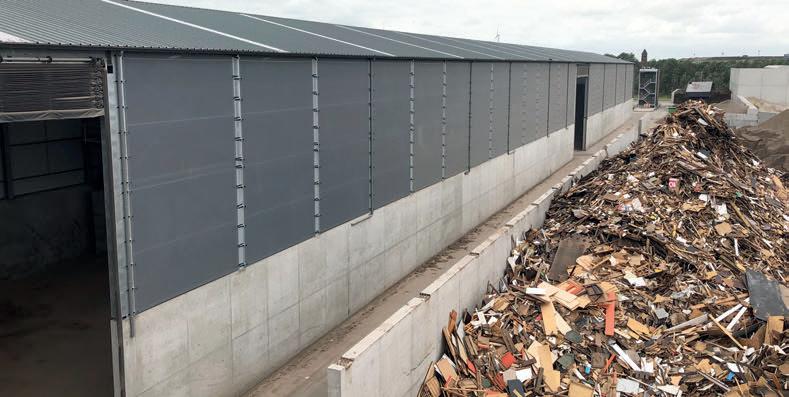
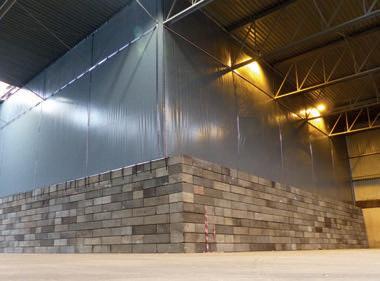
ring-structured banners,” Gert Janssen states. “By utilising various aluminium tensioning profles, a uniform and permanent tension is created in the fabric. This constant tension prevents the wind from moving the material, which is vital for the project’s durability and lifespan. Moreover, the uniform tension ensures an even appearance, as demonstrated in applications from car parks to partition walls in production and logistics. In fact, our screens are also commonly used for technical fabric partitions in warehouses, as they can be stretched vertically between two columns. In bulk logistics environments, the fabric is typically installed from top to bottom and connected to concrete block walls. This solution helps prevent dust from spreading throughout the site and reduces the risk of contamination between two partitions. In many industrial environments, certain areas are exposed to strong air currents that create drafts and generate dust. Our dust and wind screens provide an effective solution to control these conditions. At the same time, our partition walls allow spaces to be easily adapted to changing operational needs, without requiring major structural modifcations. Furthermore, everything is customised for each project; nothing is off-the-shelf.
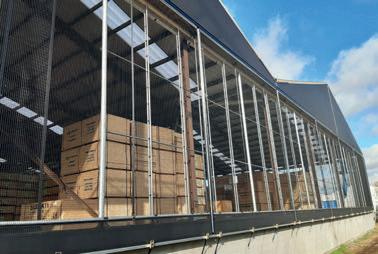
Technical textiles offer a uniform or architectural exterior while providing transparency from inside, supporting an optimal indoor climate with suffcient light, air, and ventilation.
Dust screens create a sheltered, well-ventilated area that allows airfow while blocking dust.
“All of our installations involve detailed engineering tailored to each customer’s site, taking into account factors such as location, required fabric properties, and wind loads on the structures. If needed, reinforcements are added to ensure durability and strength. Other options include upward defections for our dust barriers to trap dust effectively, and sprinklers or mist lines can also be installed at the top to improve dust collection. Our aim is always to address dust issues at their source, whilst considering the specifc needs of each site. For example, soil recycling and recycling industries favour open structures and sheds. For these companies, we typically install dust screens and partition walls that allow light and air to pass through, supporting natural ventilation inside the hall while effectively capturing and containing dust in accordance with environmental permit requirements.”
Mammoth doors and removable sides
“Another solution we offer to industrial sites is our mammoth door,” Gert Janssen continues. “These are ideal for warehouses and logistics operations. They can be up to 16m high and 18m wide, and can include a wind-permeable option. This feature ensures proper ventilation while blocking external infuences as much as possible. Goods stay dry and ready for production, while the logistics fow remains uninterrupted and energy costs are reduced. Furthermore, we can combine various textiles, from completely closed to ventilation strips at the top, for example, to create the perfect solution tailored to the location.
“Removable sides made of technical fabric are also very popular in these settings, as the building’s openness can be adjusted at any time to suit weather conditions or specifc activities. This ensures a well-ventilated environment and improved working conditions. Additionally, since the building remains open, no costly fre-safety investments are needed, depending on local legislation, of course. In this regard, it is worth noting that our fabrics are fre-retardant. This is important because we are often involved in environmental permits or fre safety dossiers and documentation. We support our customers throughout their permit application process by providing helpful advice, information, and visual materials that can be included in their submissions for better understanding. As I mentioned before, many people are unfamiliar with the possibilities and solutions of our screens – they are often not aware of their existence or the benefts they can provide.”
Combining functionality and architectural design
“The solutions we offer are comprehensive,” Gert Janssen explains, “meaning we can simultaneously address both noise and dust, for instance. Depending on the specifc issues, we select the appropriate openness factor to achieve the desired outcome. We always begin by visiting the site to assess and discuss the situation, and we provide tailored advice from the start of the project. Based on this assessment, we develop a customised solution for each case.
“The fabrics are available in various colours, allowing us to consider the look and feel as well. In fact, we also design architectural textile façades. These offer a uniform exterior while providing transparency from inside. We are seeing a shift in this area: while large windows were once popular for letting in light, there is now a growing trend towards technical textiles that support an optimal indoor climate with suffcient light, air, and ventilation, all while emphasising sustainability, as these facades are not only durable but also serve as a UV shield. The
material’s fexibility allows us to create attractive designs that are both functional and eye-catching. We can experiment with 2D and 3D forms or incorporate undulations. Moreover, these fabrics share the same qualities and properties as our other screens, such as dust protection if required, although for facades, the focus is typically more on transparency and UV protection.”
Energy optimisation and sustainability
“Another growing market for us is energy optimisation,” says Gert Janssen. “Around air coolers, for example, we install wind defectors that disrupt the airfow, resulting in greater air intake for the coolers’ mechanisms. Of course, our screens are already a sustainable product. Not only is everything manufactured in-house at Vervaeke, but the technical textiles are also notable for their durability. Our product is high-quality, UV-protected, and designed to withstand wind, which prevents deterioration over time. This makes it a genuinely sustainable, long-lasting choice. Additionally, the fabrics are recyclable, and naturally, our factory operates as effciently as possible, utilising solar panels and other sustainable methods. In short, our engineered textile systems are effectively meeting the demands of today’s industrial infrastructure through their effciency, adaptability, and sustainability.”
I. DEXCON.BE
A partition wall made of technical textile enables effcient zone separation and prevents contamination between different bulk materials.
Adjustable side panels offer fexible open and closed confgurations, ensuring that stored goods remain protected from the elements whilst maintaining ventilation.
Granting access
Secure Logistics increases port effciency with safe rapid entry solutions
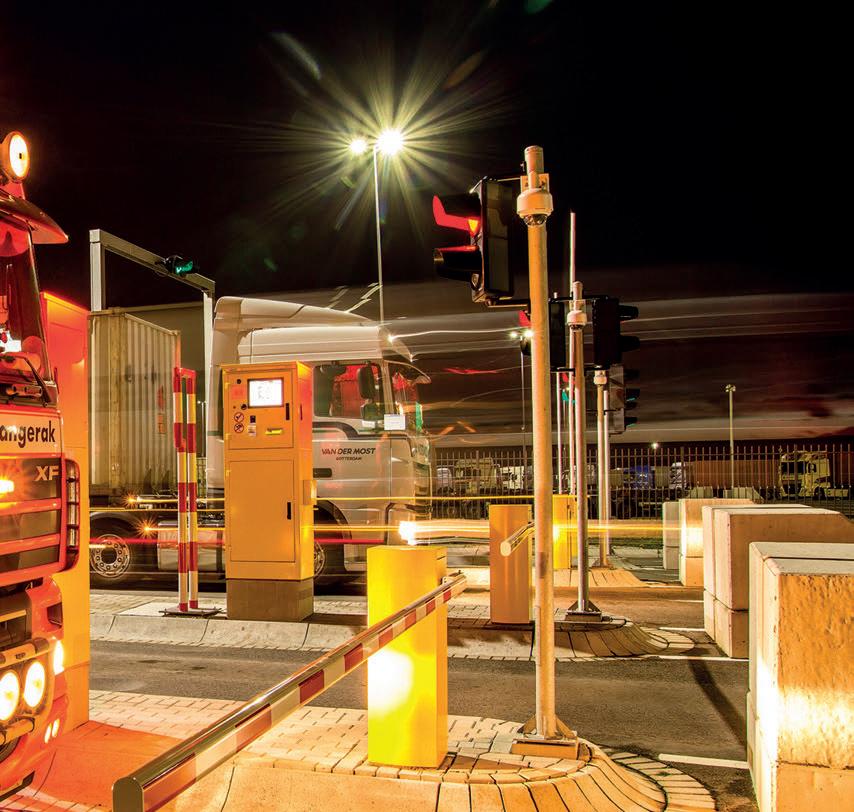
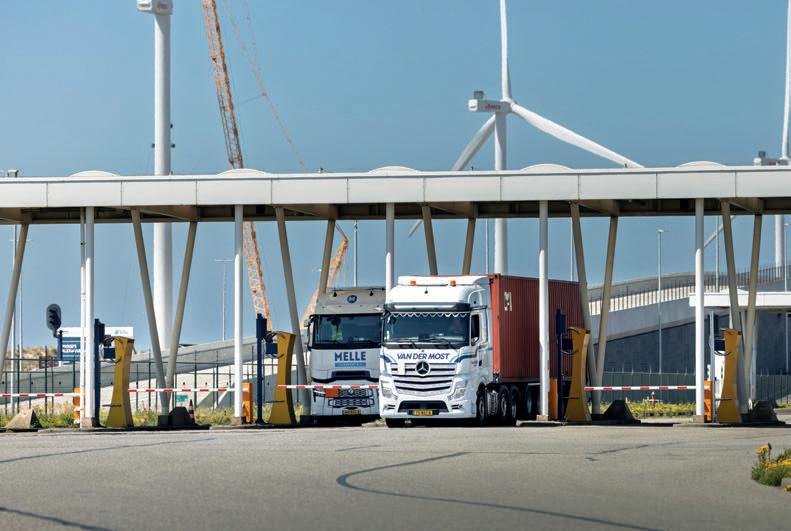
The Secure Logistics story begins in 1998. At the time, the Port of Rotterdam handled a traffc fow of approximately 1.5 million trucks per year, with around 67,000 people active on site without clear registration or structured security. From that situation, a practical question arose from major container terminals: how do you maintain high throughput at the gate without compromising on security?
Frank de Krou, head of commercial affairs at Secure Logistics, explains, “At the time, the entry process was taking a long time. The driver would have to park up, get out of the cab, go to a security cabin, potentially join a long queue, then show a range of ID and freight papers before being allowed in.”
With 16,000 to 17,000 movements per day, it was clear that manual checks were not scalable. If every driver has to exit the vehicle, the process comes to a standstill. That is why Secure Logistics developed a system that automates the entire access process. Both identity and access
All images courtesy of Secure Logistics.
are verifed, allowing drivers to remain in the cabin without having to leave their truck.
Big win
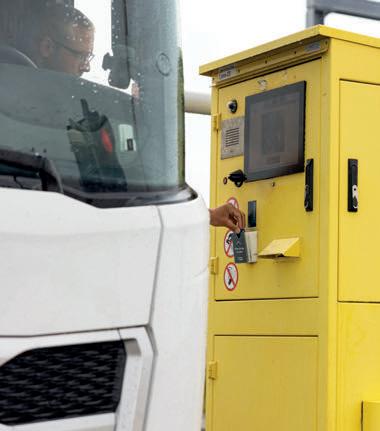
The core of the solution lay in identifying and screening companies and individuals in advance, an approach that led to the development of the XS-ID platform – of which the CargoCard is the most well-known application. With this, drivers, carriers and other visitors are verifed in advance of their arrival at the gate –not only once, but continuously.
Frank explains: “As a result, drivers arriving at the terminal no longer had to show their papers, everything was covered with the CargoCard. It was a major win; in an instant, the gate process had gone from 30-45 minutes to less than ten seconds.”
Additionally, locations can always demonstrate who is on site and when. For terminals, this is essential to comply with ISPS regulations. For drivers, the value lies in simplicity and ease of use: one single identity that can be used across multiple locations.
Expansion
Fast forward a few years to 2016, and the CargoCard had made quite a name for itself in the port and was in use at a number of deep sea and inland terminals. Other operators wanted a piece of the action.
Frank de Krou explains: “We had a lot of contractors approaching us. They could see that it was an interesting product, but the problem was, it was designed exclusively for
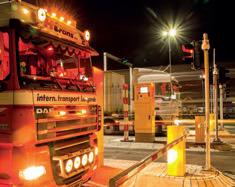
With the CargoCard, the gate entry process is reduced to a matter of seconds.
drivers. They were saying, ‘we have a similar challenge. Can you do something for us?’
He describes what that looks like in practice: “You can picture the scene. When contractors arrive on location, typically they arrive in groups – of sometimes more than 100 people – all trying to get verifed access at the same time. You want to make sure 100% that a person entering is who they say they are. Plus, you want to be certain that they are qualifed to perform whatever work they are doing. This can be simply to ensure that someone has been through a safety instruction on a previous visit, or it can be to check that they have the relevant certifcation to perform, for example, welding work. This costs contractors a lot of money; they are only paid for the hands-on tool time – the time they are working, and not for the time they are waiting at the gate.”
Passports please
This led Secure Logistics to develop the Digital Safety Passport. Like the CargoCard, the Digital Safety Passport replaces traditional gate checks with optional biometrics for increased effciency and security. The combination of identity and qualifcation data is of vital importance in ensuring a safe environment, says Frank de Krou. At the same time, increasing demands from laws and regulations, combined with the variety of roles on site, required additional solutions. These developments ensure that each target group is granted access based on role and authorisations, without causing delays in the operation. To ensure an optimal level of security, a number of checks take place before the pass is issued, Frank de Krou explains: “We check that the business is registered, and is located where
Secure Logistics’ solutions aim to make access both more effcient and safe.
Frank de Krou, head of commercial affairs at Secure Logistics.
it purports to be, and we require verifcation of the identity of the authorised person or company. After that, we require the verifcation of the identity of the personnel for whom the pass is requested. After this check, the applicant is issued a unique XSID, a trusted identity number, which appears on the cards and can be used to log in to different digital platforms.”
New horizons
Where the initial applications focused on ISPS regulated terminals in seaports, the scope of work has since expanded signifcantly. Secure Logistics is now active at around 85 locations in the Netherlands, Belgium and Germany, including (inland) terminals, chemical plants and production sites.
Inland or smaller terminals and warehouses face similar challenges in terms of security and access control, but often within different operational conditions. Not every terminal works with large volumes of fxed drivers. At some locations, the fow consists of a limited number of external visitors per week or even per month.
This distinction led to a new development: OneTime XS, a solution for occasional access. This innovation is a direct response to market demand. For some locations, the existing model proved less suitable, for example due to the required level of security or the associated costs. At the same time, the need remains to ensure that someone is truly who they claim to be.
By scanning the QR code at the entrance or counter, the system confrms that a valid identity has been verifed at that moment. The code can also include a reference or order number, allowing the system to link the visitor directly to the correct load. This reduces manual checks, increases effciency and provides certainty for the load owner.
“It remains very safe and also supports ISPS and AEO compliance,” says Frank de Krou. “The QR code is more secure than a pin code, which can be shared. Additionally, the codes are refreshed every 60 seconds to prevent multiple use.”
Self-service
In addition to access control, the need to digitalise related processes is also increasing. This includes safety instructions and mandatory assessments, which at many locations are still carried out on paper.
“This is time consuming, prone to errors and makes it diffcult to maintain oversight or scale effectively. Once someone has completed a safety assessment at a location, it does not need to be repeated each time. This saves time and avoids unnecessary administrative tasks,” Frank de Krou says.
Secure Logistics supports this process through self-service kiosks, enabling assessments to be completed on site in a simple and controlled way. The certifcate is then directly added to the card, ensuring the gate process remains fully automated while confrming that the person is properly certifed.
Extensive port network
Across North Sea Port and the surrounding region, a growing number of companies are already benefting from Secure Logistics’ 23 years of experience, including locations in Vlissingen, Terneuzen and Rilland. This strong presence within the port area is further enhanced by an extensive partner network.
Frank de Krou explains: ‘’We work closely with a wide range of software partners, including providers of terminal operating systems (TOS), gate operating systems (GOS) and warehouse management systems (WMS). This allows us to integrate
seamlessly into existing operations. With a straightforward implementation, companies within North Sea Port can connect to a complete ecosystem that makes access management not only secure and effcient for the location, but also simple and user-friendly for drivers and visitors.”
An additional advantage for companies in North Sea Port is the ability to read the Alfapass, a port pass used in the Port of Antwerp-Bruges, directly at the gate. Frank de Krou explains: “Our solution supports reading both our own passes and the Alfapass at the gate, eliminating the need for a separate system to grant drivers access across different ports.”
Improvements at the gate and beyond
“A lot of port-based companies take ineffciency at the gate for granted. It’s been like this for years, and that’s just the way it is. But there is a better way. What we aim to do is take the hassle out of the gate process, giving a boost to effciency, reducing unnecessary expense, and increasing safety and security at the same time, all in full compliance with GDPR, and ISPS laws and regulations,” Frank de Krou states.
Underlying all these developments is a broader challenge: criminal infltration within the logistics chain. While big seaports have become increasingly well secured in recent years, criminal activity is shifting to the smaller ports and the hinterland. Risks such as fraudulent carriers, identity misuse and unauthorised access are increasing. This calls for an approach in which identity and access control are not treated separately, but are structurally integrated across the entire chain.
“This is exactly where Secure Logistics adds value,” Frank de Krou emphasises. “We strongly believe in working together to achieve this. By securing identity at the front end and digitalising processes, control is established over who gains access, where and when. Security is no longer an afterthought, but a natural and integral part of the entire chain.’’
Security is no longer an afterthought, but an integral part of the chain.
At the base of the circular society
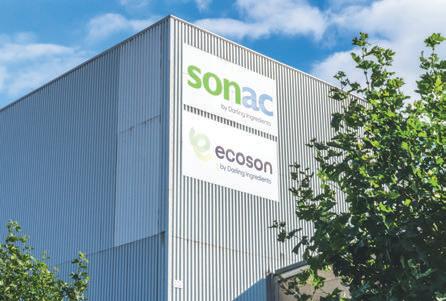
Sonac is a leading global producer of high-quality, sustainable animal proteins and fats. Positioned at the crossroads of agriculture, food production, and waste management, the company focuses on transforming animal by-products into high-grade ingredients for pet food, aquafeed, organic fertilisers and biofuels.
All images courtesy of Sonac.
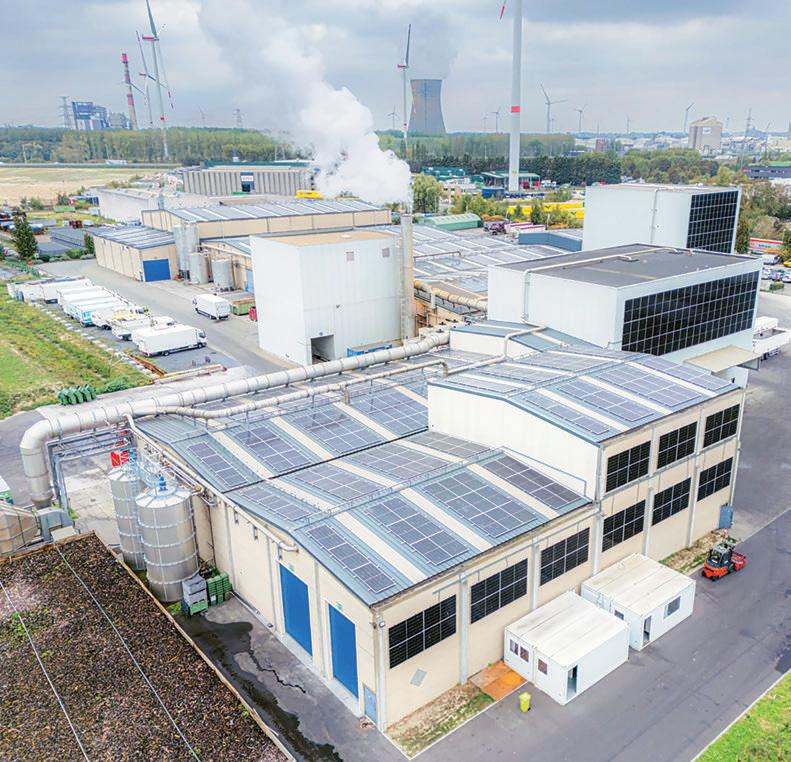
Sonac Gent transforms animal byproducts into high-grade ingredients for pet food, aquafeed, organic fertilisers and biofuels.
From a sustainability perspective, the company’s activities exemplify a shift towards resource effciency, in which materials once considered waste are collected, processed, and reintroduced into supply chains, aligning with circular-economy principles.
Darling Ingredients
In 2014, Sonac became part of Darling Ingredients, an American company operating globally in transforming organic by-product streams into new products for human food, animal feed, pet food, biofuels, pharmaceuticals, and a wide range of technical and industrial applications. Headquartered in Texas, the company now comprises seventeen brands, employs 16,000 people, and runs over 260 facilities worldwide, all sharing a common goal: converting residual streams into valuable raw materials.
“Darling Ingredients’ operations in Belgium consist of four activities across various subsidiaries, each with its own sites,” says Sebastian Feyten, managing director of ERS Belux (Rendac, Sonac, Ecoson). “At Sonac, we process animal by-products and residues derived from animals ft for human consumption, for instance, animal by-products from slaughterhouses. At our site in North Sea Port, we combine this with another activity under the Ecoson brand. Ecoson collects organic waste streams predominantly from the food industry, restaurants, and catering services. This food waste is unpacked from plastic and metal, then transformed into an organic soup that serves as feedstock for our biodigesters, which produce biogas and organic fertilisers.
“Another subsidiary, also located in Ghent, is Rousselot. Rousselot specialises in gelatine and collagen hydrolysates. They also process animal by-products, particularly pork rinds, but use these to produce gelatine for human consumption and health products – an entirely different market from that of Sonac.
“And fnally, of course, there is Rendac. Rendac specialises in collecting fallen stock from farms or private individuals, as well as high-risk material from slaughterhouses. It is precisely because of this work that Rendac is a household name; after all, every livestock farmer has had dealings with Rendac at some point. That is why many people refer to our Sonac site in North Sea Port as ‘Rendac’, but this is a persistent misunderstanding we would like to clarify. Although both companies focus on waste stream recovery as their main activity, the products they handle, their production processes and various end markets are very different indeed.
“Sonac’s products are made from animal by-products and residues from animals suitable for human consumption, and are used, amongst other things, in pet food,” he clarifes. “Rendac, on the other hand, provides a sanitary service. Rendac processes fallen stock, which may have been diseased. These products must not enter the food or feed chain and have a completely different destination. After processing, the animal fat becomes a feedstock for biofuel, and the protein meal becomes a biomass energy source for the cement industry. Rendac therefore operates at a completely separate site to Sonac, Ecoson or Rousselot; there is no crossover – nor can there be any.”
Sonac Gent
Sebastian Feyten continues, “As previously mentioned, we at Sonac handle animal by-products from animals suitable for
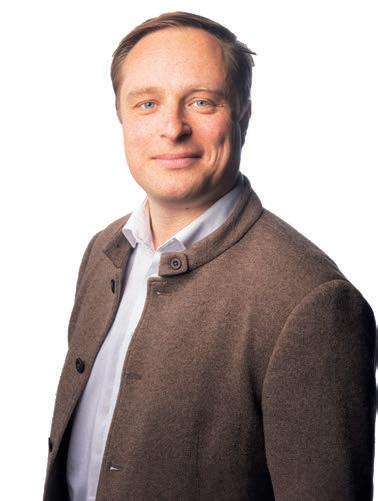
Sebastian Feyten, managing director of ERS Belux (Rendac, Sonac, Ecoson).
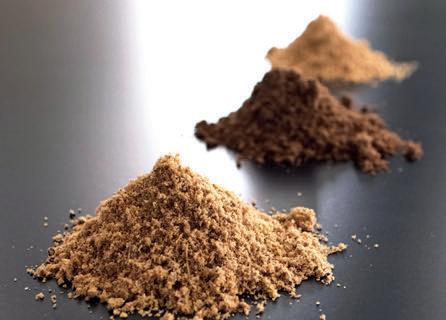
Sonac’s protein powders are mainly used in the pet food industry, as a meat source for dog and cat kibble, as feed for aquaculture, or in organic fertilisers as a source of nitrogen and other minerals.
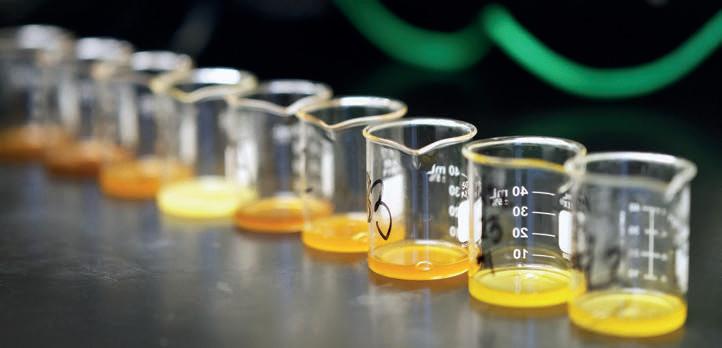
human consumption. At our North Sea Port facility, this mainly includes slaughterhouse by-products from pigs and cattle, as well as trimmings from butcher waste and meat processing plants. To clarify, when an animal is slaughtered, about 50% of the product is meat, while the remaining 50% consists of by-products such as blood, bones, and also offal that is not consumed. At our plant, we then process these by-products by evaporating the water and separating the fats from the proteins.
“The protein is converted into a kind of protein powder –essentially a meal – and the fat is purifed, yielding pure animal fat. The protein powders are mainly used in the pet food industry as a meat source for dog and cat kibble or as feed for aquaculture. In addition, this animal meal is used in organic fertilisers, as it provides nitrogen and other minerals. Fats, then, are primarily used as raw materials for producing sustainable fuels, including biodiesel and SAF (sustainable aviation fuel). Additionally, they are used in surfactants derived from animal proteins, like soaps, or in various oleochemical applications.
“We have around three Sonac sites in Belgium, each with its own specialisation, Sebastian Feyten says. “Our site in Denderleeuw, for instance, handles only chicken by-products. Since chicken has different uses and results in different end products, we do not operate on lines where pork and beef are also processed. These sites and lines are kept entirely
separate for various reasons and regulations. To give you an example: in Olen, we have a factory dedicated solely to chicken products, including specifcally the processing of chicken blood for aquaculture. For fsh feed, it’s crucial that there is no contamination with pork or beef, for regulatory reasons, but also for the cultured fsh to obtain halal certifcation.”
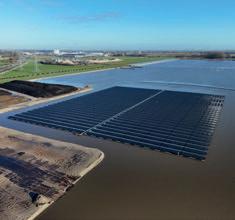
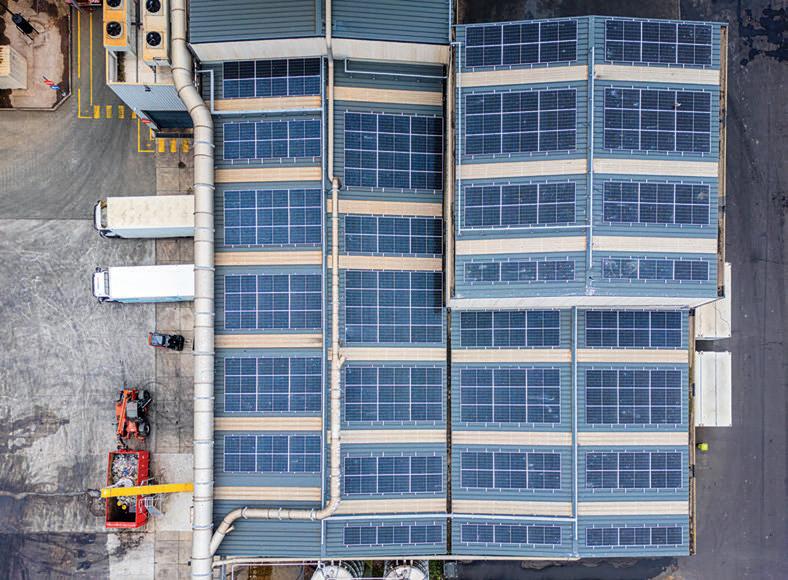
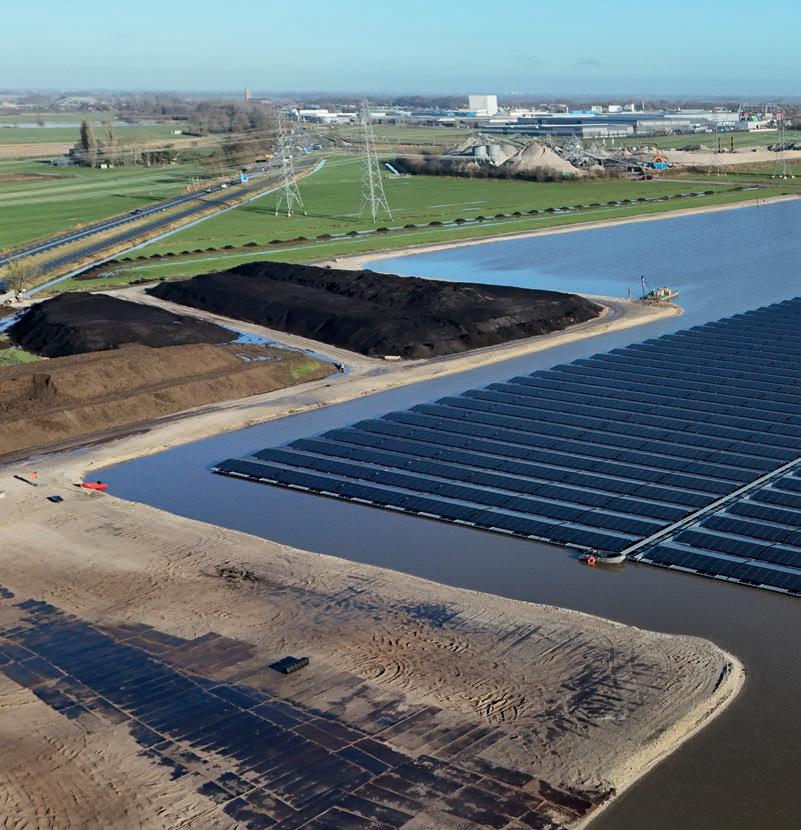
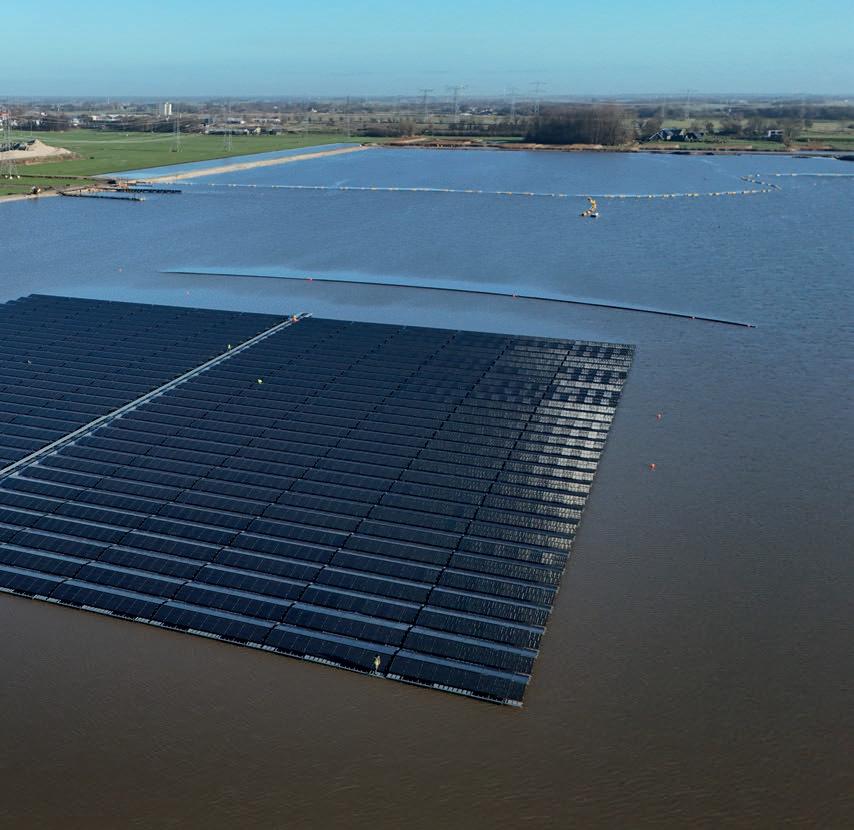
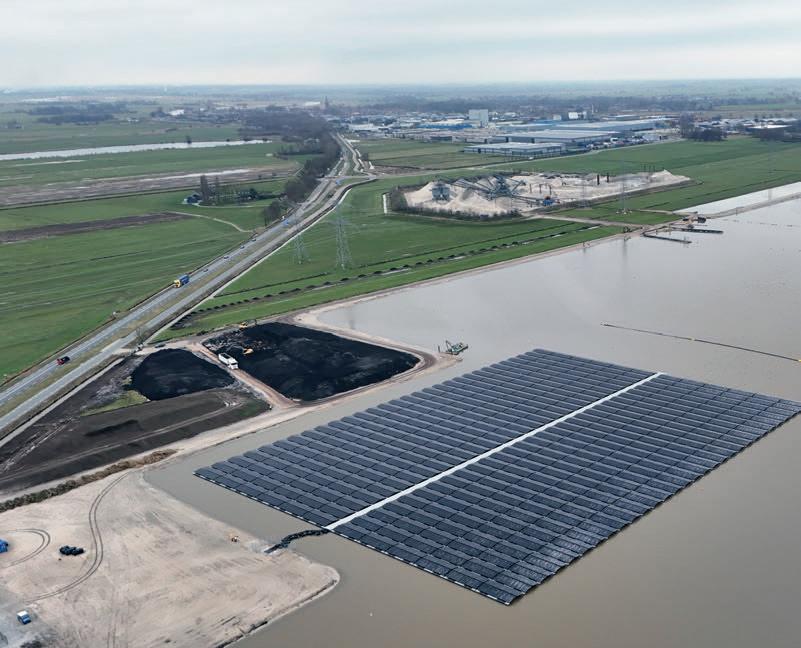
Darling Ingredients consistently invests in its facilities to optimise its production processes and reduce energy and water usage, as exemplifed by Sonac’s solar panel park in North Sea Port.
Darling Ingredients’ North Sea Port facility is also home to Ecoson Recycling, which collects organic waste streams from the food and catering industry and transforms them into green energy.
Ecoson Gent
“The second activity we run at our site in North Sea Part is called Ecoson Recycling,” Sebastian Feyten continues. “With Ecoson, we collect organic waste streams from the food and catering industry. Specifcally, we provide a logistic service to restaurants, commercial kitchens, and supermarkets through a system of exchangeable waste bins that allow them to collect and separate all their organic waste, including expired products. We then collect these bins and transport them to our site in Ghent, where they are emptied and cleaned. The cleaned bins are returned to our customers. The waste itself is unpacked – if necessary – using specialised machinery and transformed into an organic soup, which is then processed into biogas, which is converted into green electricity. Any packaging is shredded, cleaned, and processed separately. This system improves waste separation and maximises the value of the waste. If all of this kitchen waste were to end up in residual waste, it would be incinerated, increasing the carbon footprint of all these institutions. We ensure it can be processed differently instead. In fact, this principle underpins everything we do, whether as Sonac, Ecoson, or Darling Ingredients worldwide.”
Sustainiblity
“The common thread within Darling Ingredients is transforming low-value organic waste streams back into high-value components, so that waste is no longer waste, but regains value within society,” Sebastian Feyten explains. “Sustainability is therefore at the heart of our product. We are not greenwashers; we are green right from the start. This philosophy is refected throughout our entire corporate culture. We are not content with circularity as our core business; we also innovate and constantly seek new applications to create even more value from waste streams. Darling Ingredients also continues to invest in its facilities to optimise the production processes themselves, as well as the energy and water consumption of those processes. For example, we have installed a very large solar panel park at Sonac in Ghent.
”All of this not only ensures our operations are sustainable but also helps reduce the carbon footprint of our customers’ fnal products. Our customers require accurate data for their reporting systems and CO2-labels, especially in the biofuels
and pet food industries. We are fully equipped to calculate the carbon footprint of each of our products, from the collection of organic waste to the delivery of the fnal product. And we prioritise minimising this footprint at every stage of the supply chain.”
A global impact through a local operation
“The fnished products we manufacture at North Sea Port are shipped all over the world, from local destinations within Europe to the Mediterranean region or the Far East,” says Sebastian Feyten. “This is usually done by road transport or sea containers, either in bulk or in big bags. In contrast, our raw material sourcing is highly localised, due to the nature of the product we handle. The raw material must still be fresh to ensure the quality of the fnal product. Furthermore, slaughterhouse by-products must be processed within 24 hours. That is why Sonac Gent’s collection area is not much larger than Belgium. And it is also the reason we operate various such facilities worldwide: as Sonac, we currently operate around 60 locations across the US, South America, Europe, and Asia.
“This contrast between global export and local collection means we work with various trusted partners for our transport and logistics operations,” he states. “We are not a traditional port company, but we are proud to be part of the industrial cluster at North Sea Port. Our presence in the port is not only benefcial from a logistics point of view, but we also beneft from the commodities there that enable industries to thrive and sustain industrial activity. We, in turn, are fully committed to doing things with respect for the local community, properly and thoroughly, and we actively invest in this goal. Our dedication to the environment, odour control, and related issues is strong, aiming to reduce our impact on surrounding communities –another vital aspect of sustainability. In this context, we notice a growing shift in mindset among prospective employees, especially young people, who value our positive impact on the environment and a circular economy. This appreciation motivates them to join us, fostering engagement and a positive dynamic within the company.”
After purifcation, the pure animal fat is primarily used as feedstock for sustainable fuels, including biodiesel and SAF (sustainable aviation fuel), as well as in surfactants derived from animal proteins.
Euro-Mit Staal expands to meet demand
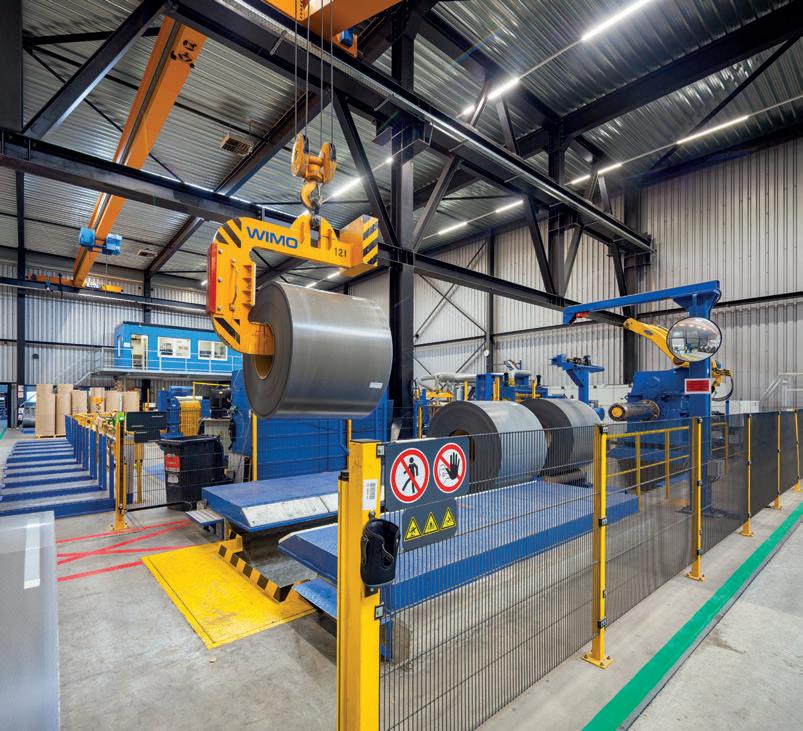
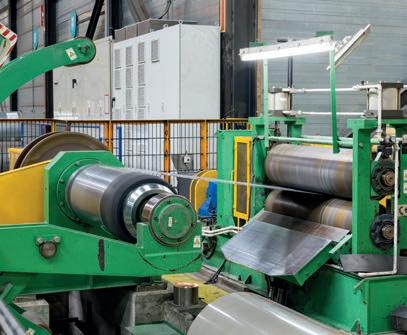
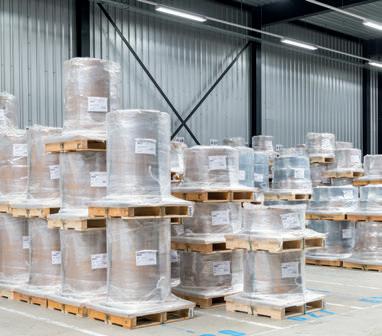
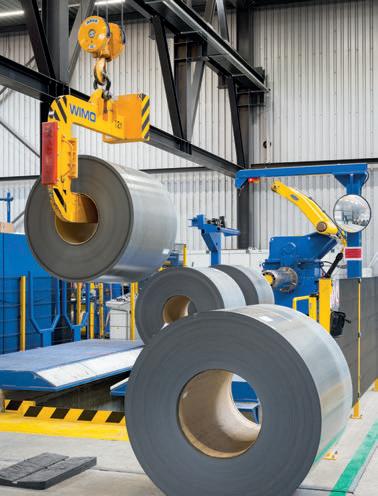
Increasing electrifcation, and the resultant pressure on the grid, are likely to lead to signifcantly increased demand for transformers in the coming years. For Ritthem-based Euro-Mit Staal, a supplier of Grain-Oriented Electrical Steel (GOES), this is an opportunity that has already resulted in recent expansion.
The company, part of Japanese trading house Mitsui & Co., will mark its 35th anniversary this year. Before it commenced operations, custom coils of GOES had to be shipped from Asia. This meant a long wait for Europe-based electrical transformer manufacturers.
For companies such as Hitachi, Siemens, General Electric, SGB-SMIT, and Schneider, the situation was not ideal. The specially coated, ultra-thin (0.18mm – 0.60mm) steel is at the heart of their production, where it serves as the primary medium for carrying magnetic fux.
Close to the heart of Europe
This led Mitsui, in 1991, to open a European location that could slit the steel and transport it to regional clients for just-in-time delivery. The corporation selected North Sea Port for a number of reasons, explains Euro-Mit Staal general manager Marco van Lomwel.
“For one thing, the port offers direct deep sea access. With this, large carriers can bring the steel in from Asia, unloading it at Verbrugge Terminals. Additionally, the port is in a central location that allows us to supply our customers located around Europe, for instance in Sweden, Germany, Poland, France, Spain, Switzerland and Italy.”
Today, the company continues to receive the highest quality of steel from Asia, primarily from Japan, as master coils. On arrival in Europe, the steel is processed by one of Euro-Mit Staal’s slitting machines.
The function of the company’s slitting machines is to cut the master coils – either latitudinally, longitudinally, or both – into narrower coils matching the precise dimensions required for the optimal operation of the transformer.
Continual growth
Since it opened its doors, the Euro-Mit Staal facility has experienced continual growth, Marco van Lomwel says.
“We started out back then with two slitting machines – one large, and one small. In 2000, production had increased to such an extent that we added a second large machine.”
Euro-Mit Staal is preparing itself for continued high demand in the coming years.
Euro-Mit Staal general manager Marco van Lomwel.
In 2011, the company expanded once more, extending its buildings and installing a third large slitting line. In 2015, this was followed by a second small line.
Increasing electrifcation
Now, with various industries looking to electrifcation as a route to achieving emissions goals, the need for electricity is growing. This has resulted in increased attempts to provide electricity by alternative means.
The Netherlands, for example, has seen a considerable increase in the number of solar installations over the past few years. Like many businesses in the country, Euro-Mit Staal has hired out the rooftops of its buildings for the installation of 3,200 solar panels.
The national grid, however, has been unable to keep pace. The result has been a bottleneck that threatens to delay climate targets.
“We have suffcient electricity,” Marco van Lomwel states. “But we need more infrastructure. On the one hand, there is the growing demand that must be met. On the other, we also need to transfer electricity that has been generated by the solar panels back to the grid.”
Rising demand
This, he explains, means a need for new transformers –considerably more, in fact.
“I saw one estimate that suggested that in the Netherlands alone, solving the challenge of grid congestion will require in the region of 2,000 new transformers every year for the next 50 years.”
And with that increase in transformers, it follows, will be increased demand for GOES. This, Marco van Lomwel
The availability of personnel locally was among the reasons that Mitsui selected this location in North Sea Port in the frst place.
continues, is already being seen at Euro-Mit Staal.
“Since 2024, we’ve been hearing from customers that they are increasing their capacity and that they will need us to be ready.”
Opportunities for the local labour market
Euro-Mit Staal has responded to this in two ways, he says.
“On the one hand, we have increased our personnel 50% –from 60 to 90 – and increased our shifts from two a day to three a day.”
Euro-Mit Staal’s investment, then, has been good news for the local labour market. “The availability of personnel locally was among the reasons that Mitsui selected this location in North Sea Port in the frst place. The labour market has changed considerably in the intervening years, but we still manage to attract people to the company.”
In its recruitment, Euro-Mit Staal is looking for a specifc sort of person, explains Marco van Lomwel.
“What we do, you cannot learn at school. But if someone is interested, has a positive mindset and a technical affnity, we’re happy to train them. It takes around three to six months to become competent at operating our machines.”
Investing in innovation
The second step Euro-Mit Staal has taken is an investment in a new, large slitting machine that it is currently in the process
The new machine will enable to company to increase production considerably.
The installation of the new machine has been a complex, technical challenge.
Euro-Mit Staal has been continually growing since it commenced operations.
Euro-Mit Staal has been continually growing since it commenced operations.
of installing. Once this comes online, the company will revert to its usual pattern of two shifts per day. The new employees will remain in position, however, to operate the new machine.
The new machine, Marco van Lomwel explains, will allow Euro-Mit Staal to considerably increase its production. The increased production is not down to the capacity of the new machine alone, but also results from innovation – something not frequently seen in a conservative industry such as electrical transformer production.
“In many ways the construction of transformers is an oldfashioned business that has not changed in hundreds of years. The slitting of the steel has certainly not changed much at all. The material has become thinner over time, but the technique has remained the same.”
Defect detection
An important part of that technique, he states, is to recognise defects as they occur.
“The key to our production is precision. The knives of the machines must be set precisely. The primary function of the steel is to maximise effciency, power density and performance of the transformer, and if you get a burr, or waviness, or a camber, that’s going to result in losses of magnetic permeability, causing the transformer to operate sub-optimally.
On Euro-Mit Staal’s existing machines, spotting these defects is the responsibility of the machine’s operators. For the human eye to be able to detect an issue, however, the machines must run at certain speeds. Now, the company has come up with a solution that it hopes will enable it to increase speed signifcantly.
“Together with the new machine, we have invested in a custom-
Building on a strong foundation
The foundation for the new slitting machine has been installed by neighbouring company Cordeel Nederland. This project was a particularly challenging one, as Adri de Rijke, commercial manager at the construction company, explains.
“The project required the realisation of a very complex foundation, with the execution taking place in a fully operational production environment. There were several noteworthy elements to the work.
“For one thing, we were required to excavate a 10-metre pit in which to install a precast base. This is below the level of the water table, so the base needed to be installed by a diver.”
With the base in position, an underwater concrete foor could be poured into the pit. After hardening, the pit could be pumped dry. The challenges did not end there, however.
“A further factor was that installation was taking place in a completed hall,” Adri de Rijke continues. “With the roof in place there was limited height available. As a result, piling work had to be carried out using segmented piles.
“Additionally, the foundation construction required a very high degree of precision; the machine had to be positioned exactly.”
In the initial phases of the project, the original design was developed in two dimensions by the architect and structural engineer. After being appointed main contractor, Cordeel Nederland developed the foundation using 3D models. This approach contributed to accurate work preparation, risk control and effcient execution.
“We have a long-standing relationship with Euro-Mit Staal, having constructed the foundation for their second and third slitting lines, as well as the warehouse extension in 2011. We are very pleased we have been able to deliver this project on their behalf, and have with this project continued our relationship with EMS,” concludes Adri de Rijke.
I. CORDEEL.NL
made defect detector. This is able to detect a quality issue in the steel quicker than the human eye. Because of this, the machine can operate faster.”
Extra capacity
“Our current machines cover up to 200m per minute, while the new machine, with the defect detector, will cover almost 400m per minute, thereby increasing our production considerably.
Last year, we produced 38,000MT of steel. With the new machine, we will be able to produce as much as 60,000MT per year – an increase of almost 60%.”
And, with demand growing as it is, he says, the company expects to reach those levels in 2028 or 2029.
At the time of writing, the machine, which has been produced by Fimi Group in Italy, is on location at Euro-Mit Staal’s premises and the company is busy overseeing its installation.
Sustainable power generation
Meanwhile, Euro-Mit Staal has been making its own preparations for the new machine’s operation.
“We have also invested in a battery, as well as 410 solar panels to provide our own sustainably generated electricity for the new machine.”
Euro-Mit Staal anticipates the new machine becoming operational in June this year.
The machine, and additional defect detector, will provide the precision required.
Full circle
In recent years, there have been a lot of developments at the Nature Group. Four years ago, the well-established company in the Vlissingen-Oost section of North Sea Port became part of the group.
With this, it was all set to play its part in the end-to-end collection, cleaning and recycling of maritime and industrial waste – in a safe and environmentally friendly manner. More recently, Nature Group has achieved ISCC (International Sustainability and Carbon Certifcation) status for oily waste collection and recycling, demonstrating its credentials in circularity.
In the beginning
It all began with Martens Cleaning. The company has been around for a considerable time, explains Serge Hendrickx who is general Manager for the Martens Cleaning facility in Vlissingen.
“We have an employee working here today, who’s been with us for 50 years – as you can imagine, he has a lot of knowledge – and when he started here, the business was already established.”
All hands on deck
Back when Martens Cleaning frst started, its focus was on cleaning ships in North Sea Port at the Schelde Port yard – now Damen Shiprepair Vlissingen. It started out as a small-scale operation.
“I always say we began ‘with a shovel and a bucket’,”
Serge Hendrickx says with a smile. Martens Cleaning, though, was destined for growth.
“After a while, more people were hired, and they purchased trucks and additional equipment. With this, they were able to clean ships faster – and better.”
Waste collection
A few years down the line, he continues, with rising environmental awareness and adoption of regulations such as the International Convention for the Prevention of Pollution from Ships (MARPOL), the collection of ship waste became a topic in the port. With this, Martens Cleaning’s scope began to grow.
“We started to collect all kinds of waste from vessels –
Martens Cleaning has been in active in North Sea Port for more than 50 years.
everything from barges to seagoing ships. You can compare it to a city. Every type of waste you would fnd in a city you fnd in a vessel, but on a smaller scale.”
With the onset of waste collection, Martens Cleaning began to develop in a new direction, explains Serge Hendrickx.
“When we started collecting waste, we had the idea of processing it in an environmentally friendly way as well.”
Scaling up
And so began the development of the company’s waste processing activities, which has led to its core business today –the processing of oily mixtures – and to signifcant growth over the years.
“When I came on board nineteen years ago, I was employee number 26. There are 65 of us today. And if you include our colleagues at other locations of the Nature Group, we are part of a team of more than 100 people. . The consistent growth that we have enjoyed over the years is the result of the efforts and commitment of our hardworking team.”
Additionally, becoming part of the Nature Group has been very advantageous for the company, Serge Hendrickx states.
“When I joined the company, we were already growing and investing. One of the most important things for us over the last eighteen years is having North Sea Port as the most stable provider in our local business. Almost all the waste in the port comes to us.
“The challenge over the period, however, is that we were only collecting in Vlissingen and Terneuzen. Meanwhile, we had considerably more processing capacity available.”
End-to-end
Now, however, as part of the Nature Group, the company is able to add to its collection, collaborating with other teams in the group. Nature Group has a feet of 25 vessels operating in the whole of the Netherlands and Belgium in sea and inland ports and is the largest company of its kind in Europe.
The North Sea Port location, furthermore, is in a unique position, being the only processing terminal within the group, and the headquarters for its cleaning operations.
“With being part of Nature Group, we’ve been able to bring the entire chain in-house, not only the collection, but the processing, too. As a result, we never stop. We’re now processing 24/7, 365 days a year.”
Most of the waste collected within the Nature Group originates from the maritime industry – including that collected within North Sea Port and through the company’s ongoing ship and industrial cleaning activities, though small volumes are brought in from outside the industry. Wherever the waste originates, the company has a robust procedure in place to ensure that it meets its criteria and can be safely processed and reused. Front-runners in circularity
After all, it’s not only about the volume; the quality is also of vital importance. In recent years, this has continued to improve. Step back a few years, and the company was producing waste oil. Now, though, it has attained so-called end-of-waste (EOW) status, which means that the oil it processes can be returned to the refnery for reprocessing and reuse.
“With EOW status, we have a completely circular process. The oil goes back to where it came from and the entire process is undertaken in the most environmentally friendly way possible,” states Serge Hendrickx.
This has resulted in the company’s recent award of ISCC status. This globally recognised and voluntary certifcation system ensures sustainability, transparency and a reduction of
greenhouse gas emissions across the supply chain.
For example, the heat required to process the oily mixture is sourced not from hundreds of thousands of m3 of gas, but recovered from waste heat at the Zeeland Refnery. This results in a signifcant reduction in CO2 emissions.
The process employed by the company is totally circular.
The new tanks represent a signifcant investment, but they will help to serve our customers at any time at any place.
Demonstrating the process
To explain Nature Group’s recycling process of waste oil, Serge Hendrickx gestures to a wooden stand, upon which are displayed fve glass bottles, containing an oily mixture at various stages of the process.
“This is the stuff we collect,” he says, taking up the frst bottle, which contains a dark, thick substance. “It’s like an emulsion. When you try to move it, nothing happens. Most of the mixture at this stage, 75% of it, is water, but it’s thick with flth.”
Moving on to the second bottle, he continues, “We give it a few days and it separates, the free water moving to the bottom, while the oil settles on top. The water can then be pumped to the water treatment centre.”
Reaching for the third bottle, he says. “What remains is still an emulsion. This we send to the oil treatment installation. Here, it is heated using the recovered heat from the refnery, then we add some chemicals and place it in a centrifuge.”
This, he says, is an oversimplifcation of a process that features
more than twenty steps, but it serves to give an idea of what is involved. He picks up the fourth bottle.
“After that, we have a very clean oil. As you can see, it is now completely smooth and ready to go back to the refnery for the next cycle.”
Indicating the ffth and fnal bottle, he goes on, “And this is the water after it has been treated. It’s clear and is now ready to go via the pipeline to Evides, who will perform the fnal polish before returning the water safely to nature.”
Increasing optimisation
The story doesn’t end here, however. The group’s growing volumes and processing effciency in North Sea Port ensure there is further room for Nature Group to develop.
“With the integration of companies in Nature Group gaining traction, the Nature Group can clearly see the case for further investment – in bigger tanks, processes, innovations. We’re not standing still; we intend to have an even better process in the future and cater for more waste streams.
“In fact, we’ve already started on our third optimisation process – Optimalisation 3.0. With this, we are going to add two new big storage tanks, each with a 3,000m3 capacity, with those tanks we have the possibility to receive waste partiess that we cannot reach at this moment.”
He concludes, “The new tanks represent a signifcant investment, but they will help to serve our customers at any time at any place. On occasion, there are large batches of waste to handle and, in the past, there have been times when we didn’t have the capacity., With the new tanks we, as Nature Group, will be able to look towards the future with increased fexibility and stability.”
I. NGRP.COM/NL
Serge Hendrickx, general manager of Nature Group’s Marten’s Cleaning facility.
As part of the Nature Group, the company now collects suffcient waste to operate around the clock.
Unintentional growth
Sometimes, unexpected opportunities arise, and seizing them can turn out well for your business. A prime example is the growth experienced by M. van Zanten Transport & Overslag over the years.
M. van Zanten was founded in 1925 and currently has two main activities: trading in sand and gravel, and transport and transshipment. The company is now led by the fourth generation, Machiel van Zanten. According to him, growth was never the company’s primary goal, but it has since become a leading service provider in transshipment and transport.
100 years ago
Machiel van Zanten shares the company’s story: “Over a hundred years ago, my great-grandfather, Krijn van Zanten, founded our business. Initially, he worked as an inland skipper, transporting sand and gravel between Germany and the Netherlands. At some point, he decided to sell his ship and start trading sand and gravel from a base in Den Bommel. When customers asked if he could deliver the sand and gravel to them, he started using trucks, initially just regionally around Den Bommel. Our focus with sand and gravel has always been on supplying raw materials for infrastructure projects – think of dike reinforcements, road construction, and related structures like viaducts. We also supply sand and gravel for onshore wind turbine construction, such as for foundation support. In 2006, we moved the company to Middelharnis because our lease
in Den Bommel was terminated. Since then, we’ve moved twice more in this town due to our growth. In Den Bommel, my father rented a transshipment crane for the unloading of sand barges, which he eventually purchased when the owner retired. Suddenly, we were also a transshipment company, as we started renting out the crane to third parties.”
Successor
“I’ve been working in the company for about twenty years now. When I was around sixteen, I didn’t want to go to school anymore; I wanted to work. There was no job for me at our company, so I started a work-study programme with a contractor active in infrastructure. I worked there for some years and rose to the position of work preparer. My younger brother was on a similar path regarding school and started working for my father as a crane operator on the crane we had purchased. One day, however, he was diagnosed with bone cancer, which changed his and my parents’ lives
All images courtesy of M. van Zanten Transport & Overslag.
M. van Zanten’s cranes are also a familiar sight in the ports of North Sea Port.
We now have twenty-fve mobile transshipment cranes for rent, used for handling sand, gravel, grain, fertiliser, animal feed, and cellulose.
overnight. Of course, the business became less important to them, and I decided to quit my job and join the company. Sadly, my brother passed away at the age of eighteen, so our plan to take over the business together didn’t work out, and in the end I became the sole successor.”
Rapid growth
Since Machiel van Zanten joined the company, many things have progressed rapidly and unintentionally. “We had taken over the transshipment crane, which of course needed to be paid off. I had to go out and fnd new work with contractors, cooperatives, and sand traders. This went so well that we ended up with more work than our crane could handle. The solution was to collaborate with a transshipment company in Breskens. History repeated itself when the owner of that company announced in 2012 that he wanted to retire and offered us the chance to take over his business. Suddenly, we had a new location in Zeeland with a large network extending into Belgium. This acquisition further accelerated our growth. We now have twenty-fve mobile transshipment cranes for rent, used for handling sand, gravel, grain, fertiliser, animal feed, and cellulose. In 2018, we put our frst hybrid-powered crane into operation, twice as large as any we had used before. We
M. van Zanten is led by the fourth generation, Machiel van Zanten.
Currently, sand and gravel trading accounts for 25% of M. van Zanten’s activities.
also have a large feet of trucks, including dump trucks and low loaders, to transport our products and our own cranes and machines. The growth of our company is also refected in our staff numbers. Twenty years ago, we could count our employees on one hand, but now we have ffty, plus about twenty self-employed contractors who regularly work for us.”
North Sea Port
From a regional player, M. van Zanten has grown into a company with activities in the ports of Rotterdam, Moerdijk, and Antwerp-Bruges. Its cranes are also a familiar sight in the ports of North Sea Port. Chance played a role here as well. “Work in the sand and gravel trade is often project-based,” says Machiel van Zanten, “which creates a lot of uncertainty. You never know exactly how much work you’ll have. Transshipment work offered a solution, as it usually involves long-term contracts. In 2018 we were working for a contractor on a project for the Sloeweg, the ringway around Vlissingen-Oost. Through connections we heared about a terminal operator’s tender for the rental of cranes for the transshipment of bulk cargo. We entered this tender and won the contract. One thing led to another, and now we also handle their breakbulk goods and currently we are taking care of the transshipment of breakbulk and bulk cargo for several terminal operators at North Sea Port.”
Differences
Today, sand and gravel trading accounts for only 25% of M. van Zanten’s activities. “Looking at the developments of recent years,” explains Machiel van Zanten, “you could say that the transshipment work has really taken off. The beautiful thing is that, while our activities are totally different, they complement
each other well. While transshipment often involves multi-year contracts and sand and gravel trading is about short-term projects, there’s also a big difference in that port operations run 24 hours a day and ships don’t want to wait. So, within the security of long-term contracts, there’s the daily hustle of making sure the cranes are in the right place at the right time. Not only does the transshipment work continue 24 hours a day, but the transport of mobile transshipment cranes often takes place at night. We also see massive scaling up in transshipment, and regulations, especially regarding safety, are becoming stricter and more extensive. This is particularly relevant for terminal access. I understand that safe working and a safe, crime-free port are important, but now we sometimes need two days of administrative preparation for one day of stevedoring work, which can’t be the intention.”
Family feel
Last year, M. van Zanten celebrated its 100th anniversary, and if Machiel van Zanten has his way, the company will continue as it always has. “I’ve put my own spin on the business, and somehow it’s worked out well. Growth wasn’t our goal, and I think where we are now as a company is just fne. Don’t ever ask me where I see this company in ten years, because I don’t make that kind of prediction. Despite our growth, we’re still a real family business, and I want to maintain that family feeling within the organisation and in our approach to customers. For us, every customer, big or small, is equally important, and we don’t really know how to say ‘no’. That’s always been the case, and as far as we’re concerned, it will always stay that way.”
I. MVZANTEN.NL
M. Van Zanten is taking care of the transshipment of breakbulk and bulk cargo for several terminal operators.
Off the grid
In its bid to stimulate sustainability, Solinoor is promoting the development of local renewable energy generation and consumption.
Solinoor is a company with a clear goal in mind – helping its customers to meet their energy and sustainability goals, regardless of their location or industry. The company specialises in the development and construction of innovative energy solutions, building towards a future where renewable energy is accessible and affordable.
An exit from the corporate world
Upon completion of his studies in International Business Management, Solinoor co-founder and managing director Vahid Kharidar built a career working for large corporate businesses, including time at both Ericsson and Philips. During this ten-year period, he witnessed frst-hand how the
rising cost of energy was having an adverse effect on both people and planet. And then his family arrived, a turning point that made him think about what he wanted to achieve in his life.
“I decided to leave the corporate world. I wanted to do something positive to help provide access to green energy. I wanted to do something with a different vision.”
A different vision
For almost four years he served as managing director for the Dutch market for Perpetum Energy, a Belgian-based company, founded in 2007, that designs, fnances, builds, and operates integrated, on-site renewable energy systems for industrial and commercial customers. Then, in 2021, he founded Solinoor.
All images courtesy of Solinoor.
He explains the thinking behind the company, “We have reached a point in the energy transition where there is a lot of renewable energy being generated, and more projects in development all the time. It sounds like a positive development, and it is, but the situation is not without its own challenges.”
Pressure on the grid
The problem is, Vahid Kharidar explains, that in almost all cases, the renewable energy generated is sent directly to the grid. Here, in theory, everyone has access to it. “The current infrastructure, however, was not designed for this sudden infux of green energy.”
The result is what has become a familiar story – and nowhere more so than in the Netherlands – grid congestion. This is creating a bottleneck that, far from promoting the move to sustainable energy consumption, actually puts it in jeopardy, delaying projects, pushing up prices and threatening economic growth.
The thinking behind Solinoor's model is to provide local, off the grid, energy solutions.
Solinoor’s solutions are applicable to both land and water.
Local energy supply
Solinoor aims to provide an answer to this conundrum, explains Vahid Kharidar.
“What we want to do is localise access to renewable energy, bringing it to local customers, without recourse to the regional or national grid.”
The company goes about this by creating solar photovoltaic (PV) systems. This includes uniting it with energy consumers, often from different industries, providing them with an integrated and resilient management system.
Non-taxing solutions
The benefts of Solinoor’s approach can be considerable, Vahid Kharidar states.
“Having a local energy source not only offers increased reliability of supply, and stable pricing, it can also lower costs. For one thing, there is no cost for grid connection and transport. Additionally, there is no tax to be paid for the energy.”
This is because taxation on energy is designed to be levied at the point of sale.
“This represents a signifcant advantage of local energy generation and consumption. It’s diffcult to quantify because prices fuctuate and taxation differs depending on the location, but in some cases you can save up to 50%.”
Three pillars
Solinoor’s approach, Vahid Kharidar explains, rests on three pillars, the frst of which is consultancy.
“This includes conducting a feasibility study. Before we begin, we want to make sure that a project is viable,” he says.
The process is nothing if not in-depth. It involves consideration of the client’s assets, local environmental and policy characteristics, energy storage potential and the presence of a business case.
A solution that fts the client
“Often, when there is a project,” he continues, “the approach is to build as big as possible. That’s not the route we take. Our approach is to fnd out what the consumption is locally and develop a project according to that. We create a solution that fts the client.”
Once the viability and the specifcations of a project have been established, the next step is to develop the project, including the design, the establishment of a process and permitting.
“We try to unburden our clients as much as possible, leaving them free to run their business while we take care of the entire process. That means that we take care of arranging the necessary permits. We have a team of fve in-house specialists who handle all discussions with the authorities. And, once that’s all taken care of, we build it.”
“Paul Hospers leads the development team. He has extensive experience in both business and government environments, getting projects form idea to the start of construction. This helps to design smooth development processes leading to fexible permits within a reasonable timeframe.”
Safety and quality
When it comes to the construction, Vahid Kharidar says, Solinoor has a very keen focus on health, safety, environment and quality (HSEQ) – after all, the aim is to promote sustainability.
“We established a HSEQ programme that includes comprehensive risk assessments and continuous improvement. Our robust approach to HSEQ is demonstrated by our independently verifed VCA (safety, health and environmental checklist for contractors) certifcation, as well as our ISO 9001 accreditation.”
Power in the port
Currently, Solinoor is developing projects with a total energy production of 190MW at locations throughout the Netherlands. While these are taking place in support of businesses in all sectors of industry, there is a clear case to be made for portbased projects, Vahid Kharidar says.
“We install solar panelling on land, roofs, carports, and on water. Perhaps in no other location is this total mix so well represented as in a port.”
Sun Float Power
A recent project that Solinoor has been involved in serves as a good demonstration case. Solinoor is a partner in the Sun Float Power consortium for the Slufter project in the Maasvlakte area of the Port of Rotterdam.
“We have been awarded a tender for the development, realisation and management of a 95MW foating solar park on the Slufter – a 250ha depot for contaminated dredge material, located in the southwestern part of the Maasvlakte.”
“By generating solar energy at this location, it means we are enabling use of precious, scarce space twice. The sustainably generated electricity can then be used by surrounding port companies, without placing more pressure on the grid.”
After the project development and construction have been completed, the solar park is expected to be operational in 2027/2028.
Stimulating sustainability
Given all the associated benefts, Vahid Kharidar is of the opinion that there should be wider encouragement for local projects.
“There are government subsidies available for renewable projects, but they are currently only applied to projects that supply energy directly to the grid. We believe this only further compounds the problem. It encourages businesses to participate in projects that add pressure to current infrastructure. In our view, the answer lies in stimulating projects that relieve the pressure on the grid while, at the same time, providing wider access to cleaner energy.” I. SOLINOOR.COM
Vahid Kharidar, co-founder and managing director at Solinoor.
With locally generated electricity, pressure on the grid is reduced.
A recognised and professional partner
Paul Fermont, owner of Faasse & Fermont.
The North Sea Port area is continuously developing. Existing companies are expanding and new businesses are establishing themselves. They are happy to be advised by a recognised and reliable partner in this process.
Since its establishment in 1990, Faasse & Fermont has grown into one of the leading players in the Zeeland real estate market. The company is also a trusted advisor in the Dutch part of North Sea Port. PortNews speaks with owner Paul Fermont to learn more about this company.
Steady growth
“Faasse & Fermont has been active in the Zeeland market since 1990,” Paul Fermont begins. “Initially, the company was called Faasse & Faasse, named after the two brothers who founded it. In 1994, after completing my studies at HZ University of Applied Sciences in Vlissingen, I started working for the company. In 2002, I became a co-shareholder, and now I am the sole owner. Although there is no longer an active Faasse in the company, I still have a business connection with a Faasse, as I co-founded the platform fnancieringsmatch.nl with one of the sons. In addition to this platform, we also own vastgoedleads.nl.”
Since its founding, the company has experienced steady growth, despite the global credit crisis. “We have always distinguished ourselves with our services, which, despite having to lay off several employees in 2010, has led to a healthy company with around 33 employees today. Although we started as a broker focused on the housing market, we have gradually shifted our focus to commercial real estate. I estimate that
about 60% of our work is now in that market. We are not only active in Zeeland; for the commercial real estate market, we also have an offce in Bergen op Zoom under the name Helmig & Fermont, from which we mainly serve West-Brabant and Tholen. Our services now extend as far as Moerdijk and the Zuid-Holland islands.”
Versatile
In addition to brokerage – mediating the purchase, sale, rental, or leasing of existing real estate – Faasse & Fermont is also involved in mortgage advice, valuation, mediation for new construction projects, and advising companies and organisations on various real estate-related matters. “We have grown into a versatile company with diverse activities. This includes fnding construction sites for new builds and advising on new construction, as well as the renovation and conversion of existing buildings.”
RICS degree
Paul Fermont continues: “In Zeeland, we distinguish ourselves, among other things, by being the frst company to achieve the RICS degree. RICS stands for the Royal Institution of Chartered Surveyors, a global professional body that accredits professionals in land, real estate, and construction. With
The offce of Faasse & Fermont in Goes. Since its founding, the company has experienced steady growth.
Image courtesy of Faasse & Fermont.
this accreditation, we demonstrate that we meet the highest standards of professionalism and integrity. This accreditation also ensures that we are recognised by major international brokers and appraisers, and are often engaged as a regional partner when they are looking for a suitable location for a client in the region. A good example is the arrival of Panattoni in Sas van Gent. On the former site of a glass factory, the company is currently building nearly 50,000m² of multifunctional logistics real estate. Due to our extensive regional network and knowledge of the Zeeland market, we, as the regional partner of CBRE, will handle the leasing. CBRE is one of the world’s largest real estate and investment advisors, and it is a great honour that they have asked us to collaborate on this project.”
Regular clients
“In the Vlissingen part of North Sea Port, we have a number of regular clients for whom we work,” explains Paul Fermont. “This involves performing valuations of land and real estate, mediating purchases and sales, and providing consultancy. In this role, we
act for example as a discussion partner on behalf of the client with municipalities and advise on matters such as demolition and redevelopment. While I would not call us notaries or lawyers, we do have the necessary knowledge and experience to provide advice in these areas. What is special about North Sea Port is that two NRVT appraisers Commercial Real Estate – Large-scale (NRVT registered valuer specialisation) is required for almost all locations. NRVT stands for the Dutch Register of Real Estate Appraisers. As an independent quality register and supervisor, NRVT safeguards, guarantees, and promotes the reliability and quality of real estate appraisals. Registered appraisers are bound by the NRVT’s codes of conduct and professional rules, which are strictly enforced. This ensures reliable and realistic real estate appraisals. Our offce is the only one in Zeeland with two NRVT appraisers Commercial Real Estate – Large-scale (NRVT registered valuer specialisation), which gives us a unique position when it comes to real estate and land in the port area.”
More professional appraisals
According to Paul Fermont, real estate appraisals have become increasingly professional over the years. “In the past, before 2008, an appraisal report consisted of about four A4 pages. Now, these reports have grown to around 40 pages, indicating that appraisals must be much more accurate and comprehensive. Due to stricter controls on appraisers and the requirements set by banks, the number of one-man businesses in our sector has declined signifcantly, which I do not necessarily see as an advantage, as it puts a lot of pressure on the market. Today, we save a lot of time in appraisals by using AI for standard time-consuming tasks. AI is developing so rapidly that it can do more and more in our feld. In the housing market, appraisals have become quite a generic mass product. This is not yet the case in the commercial market, as each commercial property is essentially unique. Nevertheless, there is still a lot of standard data entry that can be done perfectly by AI.
For the commercial real estate market, the company also has an offce in Bergen op Zoom under the name Helmig & Fermont.
In the Vlissingen part of North Sea Port, Faasse & Fermont has a number of regular for performing valuations of land and real estate, mediating purchases and sales, and providing consultancy.
Image courtesy of Faasse & Fermont.
As a company, we invest heavily in this because we truly believe it helps us do our work better and more effciently.”
Gatekeeper
There are also signifcant developments in the brokerage sector. Faasse & Fermont for example, has been appointed as a socalled gatekeeper. Paul Fermont explains: “As a gatekeeper role under the Anti-Money Laundering and Anti-Terrorist Financing Act (Wwft), our task is to critically assess parties that want to buy or rent properties. For example, what is the origin of the money used to fnance this? This prevents large amounts of criminal money from being laundered, and in this way, we also play a role in combating undermining. In brokerage, it is no longer just about a client’s turnover, but increasingly about ethical aspects. I must say that this can sometimes be quite annoying for regular clients, with whom you have a longstanding relationship, because the strict and critical assessment can sometimes make it seem as if you do not fully trust them. And also, it sometimes means that we have to say no to parties that want to buy real estate.”
“Another development in brokerage is that land prices have risen sharply in recent years due to increasing scarcity of both greenfeld and brownfeld sites. Additionally, nitrogen emissions and grid congestion are increasingly playing a limiting role, especially since the government often changes its rules. Anticipating these changes makes brokerage complicated. There is also growing attention for ESG (Environmental, Social, and Governance). For example, if North Sea Port wants to issue a site and launches a tender, not only fnancial aspects but also these three elements must be taken into account. We always try to advise our clients well on this, which requires us to be well-informed in this area as well.”
Putting Zeeland on the map
Paul Fermont concludes: “A lot is happening in our industry, and as a company, we must anticipate these changes. Fortunately, we manage this well with our team and have built a good reputation over the years. I am very proud of that. Speaking of pride, we are a true Zeeland company and perhaps inclined to be modest, and this does not only apply to us. Zeeland, as a province, has a lot to offer for living and working – just think of North Sea Port. Organisations like North Sea Port and Impuls Zeeland, with whom we regularly collaborate, could certainly showcase the possibilities our province has to offer more often, so that Zeeland is more prominently put on the map. Of course, we are happy to contribute to this from our role.”
I. FAASSE-FERMONT.NL
Join Promotion Council North Sea Port
Promotion Council North Sea Port offers the parties concerned with the port area a platform to meet, do business and exchange information. It is a business networking organisation that wants to bring everyone involved in North Sea Port together and facilitate stronger connections.
Companies and institutions that have a direct or indirect interest in the enhancing North Sea Port’s position, can become members.
Interested in subscribing as a member? Please call or mail us via T +31 (0)118 491 320 | E info@pc-nsp.com
A healthy company with around 33 employees today.
North Sea Port: Ghent
North Sea Port: Ghent
Zeekanaal Ghent - Terneuzen: The depth of water in the canal is 13.5 m and there are no currents or tides. Inside the port there are five large docks and three
smaller docks, offering a total quay length of
Zeekanaal Ghent - Terneuzen: The depth of water in the canal is 13.5 m and there are no currents or tides. Inside the port there are fve large docks and three smaller docks, offering a total quay length of 31 kilometres for vessels up to 92,000 DWT. 22 kilometers with a depth of water of at least 12.5 metres. All the docks have direct access to the canal.
31 kilometres for vessels up to 92,000 DWT. 22 kilometers with a depth of water of at least 12.5 metres. All the docks have direct access to the canal.
Zelzate •
• Kluizendok: Is a brand-new dock. Has a total quay length of 4,300 metres with a depth of water of 13.5 metres and a width of 350 metres.
• Kluizendok: Is a brand-new dock. Has a total quay length of 4,300 metres with a depth of water of 13.5 metres and a width of 350 metres.
• Rodenhuizedok: Quay on the southern side is 790 metres long with 13.5 metres of depth. Width of 270 metres.
• Rodenhuizedok: Quay on the southern side is 790 metres long with 13.5 metres of depth. Width of 270 metres.
• Mercatordok: Quay is 1,800 metres long with 13.5 metres of depth. Width of 250 metres.
• Mercatordok: Quay is 1,800 metres long with 13.5 metres of depth. Width of 250 metres.
• Alphonse Sifferdok: Quay is 4,800 metres long, with 12.5 – 13.5 metres depth. Width of 300 metres.
• Alphonse Sifferdok: Quay is 4,800 metres long, with 12.5 – 13.5 metres depth. Width of 300 metres.
• Grootdok, Noorddok, Middendok and Zuiddok:
• Grootdok, Noorddok, Middendok and Zuiddok:
Total quay length of 6,855 metres. 6,575 metres with 13 metres depth of water, and 280 metres with 8.5 metres depth of water.
Total quay length of 6,855 metres. 6,575 metres with 13 metres depth of water, and 280 metres with 8.5 metres depth of water.
Width: Grootdok: 150 metres
Width: Grootdok: 150 metres
Noorddok: 200 metres
Noorddok: 200 metres
Middendok: 250 metres
Middendok: 250 metres
Zuiddok: 220 metres
Zuiddok: 220 metres
Ghent •
Zuiddok
Middendok
Alphonse Sifferdok
Mercatordok
Rodenhuizedok
Noorddok
Grootdok
Kluizendok
Zeekanaal Ghent - Terneuzen
• Terneuzen Western Scheldt
• Hoek
North Sea Port: Terneuzen
North Sea Port: Terneuzen
Ghent-Terneuzen channel (Kanaalzone)
Ghent-Terneuzen channel (Kanaalzone)
• Noorderkanaalhaven: North quay: 170 metres; South quay: 192 metres.
• Noorderkanaalhaven: North quay: 170 metres; South quay: 192 metres.
• Zuiderkanaalhaven: North quay: 225 metres; South quay: 230 metres.
• Massagoedhaven: 978 metres.
• Zuiderkanaalhaven: North quay: 225 metres; South quay: 230 metres.
• Massagoedhaven: 978 metres.
• Zevenaarhaven: North quay: 421 metres and 555 metres; South quay: 259 metres.
• Zevenaarhaven: North quay: 421 metres and 555 metres; South quay: 259 metres.
• Axelse Vlaktehaven: 290 metres.
• Axelse Vlaktehaven: 290 metres.
• Autrichehaven: 850 metres.
• Autrichehaven: 850 metres.
Braakmanhaven
Braakmanhaven
Braakmanhaven is part of North Sea Port, located directly on Western ScheIdt with no locks. Four berths for seagoing vesseIs and three berths for inland vessels.
Braakmanhaven is part of North Sea Port, located directly on Western ScheIdt with no locks. Four berths for seagoing vesseIs and three berths for inland vessels.
• Westdorpe
• Scheldt Jetty: 0ne berth for vessels up to 22,500 dwt or 200 metres LOA.
• Dow’s Scheldt Jetty: One berth for vessels up to 22,500 dwt or 200 metres LOA.
• Oceandock: North and south berths.
• Dow’s Oceandock: North and south berths.
• Zeeland Container Terminal: 185 metres.
• Zeeland Container Terminal: 185 metres.
• 0iltanking Jetties: Jetty 0tter 1 and Jetty 0tter 2.
• EVOS Terneuzen.
• Braakman: Docks A, B and C.
• Dow’s Braakman: Docks A, B and C.
Sluiskil •
Zelzate
Sas van Gent •
Autrichehaven
Zijkanaal C
Zijkanaal E
Zijkanaal H
Zijkanaal B
Zijkanaal D
Massagoedhaven
Zijkanaal A
Braakmanhaven
Zevenaarhaven
Zijkanaal G
Zijkanaal F
• Middelburg
Middelburg
• Nieuw- en Sint Joosland
• Oost-Souburg
Vlissingen
• Vlissingen
• Ritthem
• Ritthem
W
• Nieuw- en Sint Joosland • Borssele Lewedorp
Lewedorp • • Nieuwdorp
Nieuwdorp
’s-Heerenhoek
•
• Borssele
Vlissingen
North Sea Port: Vlissingen
Vlissingen port area
North Sea Port: Vlissingen
• Sloehaven: Suitable for alI kinds of transshipment including LPG and chemical bulk 920 metres of quay. Cobelfret RoRo jetties: Four berths.
• Sloehaven: Suitable for alI kinds of transshipment including LPG and chemical bulk 920 metres of quay.
• Sloehaven: Suitable for alI kinds of transshipment including LPG and chemical bulk 920 metres of quay. Cobelfret RoRo jetties: Four berths.
• Bijleveldhaven: 1,980 metres of quay. North bank is 300 metres long.
• Sloehaven: Suitable for alI kinds of transshipment including LPG and chemical bulk 920 metres of quay. Cobelfret RoRo jetties: Four berths.
• Bijleveldhaven: 1,980 metres of quay. North bank is 300 metres long. Can accommodate largest reefer vessels.
• Bijleveldhaven: 1,980 metres of quay. North bank is 300 metres long.
• Bijleveldhaven: 1,980 metres of quay. North bank is 300 metres long.
• Westhofhaven: 475 metres of quay. Can accommodate largest reefer vessels. East side jetty for discharging peat and general cargo quay.
• Westhofhaven: 475 metres of quay. Can accommodate largest reefer vessels. East side jetty for discharging peat and general cargo quay.
• Westhofhaven: 475 metres of quay. Can accommodate large offshore vessels.
• Kaloothaven: 1,130 metres of quay.
• Westhofhaven: 475 metres of quay. Can accommodate largest reefer vessels. East side jetty for discharging peat and general cargo quay.
• Kaloothaven: 1,130 metres of quay. Two jetties on south bank, one for inland barges.
• Kaloothaven: 1,130 metres of quay. Two jetties on south bank, one for inland barges.
• Scaldiahaven: Over 1,700 metres of quay. South side used by Verbrugge for handling and storage of cellulose and metals. Transverse quay is 250 metres long.
• Scaldiahaven: Over 1,700 metres of quay. South side used by Verbrugge for handling and storage of cellulose and metals. Transverse quay is 250 metres long.
• Scaldiahaven: Over 1,700 metres of quay. South side used by Verbrugge for handling and storage of cellulose and metals. Transverse quay is 250 metres long.
• Kaloothaven: 1,130 metres of quay. Two jetties on south bank, one for inland barges.
• Van Citterskanaal/haven: Six jetties for inland vessels and coasters. 0n south bank, 275 metres. 0n north bank, 200 metres. Heerema quay: 230 metres and 220 metres.
• Van Citterskanaal/haven: Six jetties for inland vessels and coasters. 0n south bank, 275 metres. 0n north bank, 200 metres. Heerema quay: 230 metres and 220 metres.
• Van Citterskanaal/haven: Six jetties for inland vessels and coasters. 0n south bank, 275 metres. 0n north bank, 200 metres. Heerema quay: 230 metres and 220 metres.
• Scaldiahaven: Over 1,700 metres of quay. South side used handling and storage of cellulose and metals. Transverse quay is 250 metres long.
• Quarleshaven: Extension of Sloehaven to NNE, 315 metres of quay. Set of two mooring buoys on east bank with a span of 320 metres. Zalco quay: East bank, length of 150 metres. Vopak Terminal VIissingen: Four LPG jetties.
• Quarleshaven: Extension of Sloehaven to NNE, 315 metres of quay. Set of two mooring buoys on east bank with a span of 320 metres. Zalco quay: East bank, length of 150 metres. Vopak Terminal VIissingen: Four LPG jetties.
• Quarleshaven: Extension of Sloehaven to NNE, 315 metres of quay. Set of two mooring buoys on east bank with a span of 320 metres. Zalco quay: East bank, length of 150 metres. Vopak Terminal VIissingen: Four LPG jetties.
• Van Citterskanaal/haven: Six jetties for inland vessels and coasters. 0n south bank, 275 metres. 0n north bank, 200 metres. Quay: 230 metres and 220 metres.
• Zeeland Refinery Pier: Located on Western Scheldt. Accommodates tankers up to 100,000 dwt with maximum LOA of 280 metres.
• Quarleshaven: Extension of Sloehaven to NNE, 315 metres of quay. Set of two mooring buoys on east bank with a span of 320 metres.
• Zeeland Refinery Pier: Located on Western Scheldt. Accommodates tankers up to 100,000 dwt with maximum LOA of 280 metres.
• Zeeland Refnery Pier: Located on Western Scheldt. Accommodates tankers up to 100,000 dwt with maximum LOA of 280 metres.
• Buitenhaven: Located outside lock system with direct access to sea, 300 metres of quay. Northern basin has area for coasters and Iighters. Vesta also operates an oil jetty for tankers.
• Zeeland Refinery Pier: Located on Westernscheldt River. Accommodates tankers up to 100,000 dwt with maximum LOA of 280 metres.
• Buitenhaven: Located outside lock system with direct access to sea, 300 metres of quay. Northern basin has area for coasters and Iighters. Vesta also operates an oil jetty for tankers.
• Buitenhaven: Located outside lock system with direct access to sea, 300 metres of quay. Northern basin has area for coasters and Iighters. Vesta also operates an oil jetty for tankers.
• Buitenhaven: Located outside lock system with direct access to sea, 300 metres of quay. Northern basin has area for coasters and Iighters. Vesta also operates an oil jetty for tankers.
Sloehaven
Buitenhaven
Quarleshaven
Bijleveldhaven
Westhofhaven
Van Cittershaven
Van Citterskanaal
Scaldiahaven
Zeeland Refinery Pier
Sloehaven
Buitenhaven
Quarleshaven
Bijleveldhaven
Westhofhaven
Scaldiahaven
Zeeland Refinery Pier
Van Citterskanaal
Kaloothaven
The Promotion Council North Sea Port is pleased to welcome new members. Founded in 1993, the Promotion Council North Sea Port represents members and promote the North Sea Port area. Together they offer a complete range of the best possible port facilities and all the logistics solutions you need. See pages 60-64 for a complete list of members.
GADOT BELGIUM
meet | connec t | promot e
Members of Promotion Council North Sea Port
5G Multimodal
www.5gmultimodal.com
A.C. Rijnberg transportservice B.V. www.rijnberg.com
aaf www.aaf.nl
Aannemingsmaatschappij Van Gelder B.V. www.vangelder.com
ABN AMRO www.abnamro.nl
AC Timber Trading www.actimbertrading.com
Access World Terminals B.V. www.accessworld.com
Actemium www.actemium.nl
Adriaanse & van der Weel Advocaten www.avdw.nl
Aerssens & Partners www.aenpmakelaars.nl
Aertssen Lifting N.V. www.aertssen.be
Agro Minne www.agro-minne.be
AmSpec PMI B.V. www.polarismarineinspections.nl
ASD Group / Vervaeke www.industrial.vervaeke.be
AXXAZ www.axxaz.nl
Best Hall Benelux www.besthall.com
BMD Advies www.bmdzuid.nl
Boels Rental B.V. www.boels.com
Bolckmans N.V. www.bolckmans.be
Boluda Towage Europe www.boluda.eu
Bouwgroep Peters B.V. www.bouwgroep-peters.nl
BOW Terminal www.bowterminal.nl
Brandwacht Huren België www.brandwachthuren.be
Brandwacht Huren Nederland www.brandwachthuren.nl
Cemminerals N.V. www.cemminerals.be
Clarksons Port Services BV www.clarksons.com
CLdN www.cldn.com
COMCAM International www.comcamenergy.com
Competence Development Center www.bbeu-cdc.org
Control Union Belgium N.V. www.petersoncontrolunion.com
Cordeel Nederland B.V. www.cordeel.nl
C.T.O.B. Transport & Logistics www.ctob-logistics.com
Customs Support Terneuzen www.customssupport.com
Damen Naval www.damen.com
Damen Shiprepair Vlissingen www.damen.com
Danser Group www.danser.nl
DB Cargo Belgium B.V. www.dbgargo.com
DB Cargo Nederland N.V. www.nldb.cargo.com
De Baerdemaecker N.V. www.stukwerkers.com
De Jong Shipping www.dejongshipping.com
De Ruyter Training & Consultancy www.drtc.nl
De Zeeuwse Alliantie Notarissen www.dezeeuwsealliantie.nl
Zéfranco Communicatieservice Frans www.zefranco.com
ZR Company www.zrcompany.nl
ZTZ Logistics B.V. www.ztzlogistics.com
COLOPHON
About PortNews
Covering the port area of North Sea Port, PortNews is the offcial publication of the Promotion Council North Sea Port and port authority North Sea Port.
Circulation and subscriptions
Distributed to a wide international audience, the high quality quarterly magazine promotes the activities of companies active in the ports to key customers, business partners, stakeholders, as well as at major international trade events. PortNews is available in hard copy as well as a digital version. Each issue has approximately 10,000 readers.
Editorial Committee
The content of PortNews is the responsibility of the Editorial Committee. Contact: • John Dane, Chairman, Promotion Council North Sea Port
• Michael Moreau, Communication Manager, North Sea Port
• Charles van den Oosterkamp, Director, OMC Services BV
Special thanks to everyone who kindly contributed their time and expertise to put together this issue of PortNews. Find out more about contributing to future issues of PortNews by contacting Charles van den Oosterkamp, info@omc-services.com, tel. +31 (0)6 10 979 655.
Free subscription or additional copies?
Would you like a free subscription to PortNews, or would you like to receive additional copies of PortNews free of charge for promoting the port and your organisation to your business relations? Please contact the publisher at info@pc-nsp.com or contacteer@northseaport.com.
P.O. Box 132
4530 AC Terneuzen, The Netherlands T +31 (0)115 647 400
John Kennedylaan 32, Harbour 3000A, 9042 Ghent, Belgium T +32 (0)9 251 0550 E contact@northseaport.com I www.northseaport.com
Follow us on:
IMPRINT
Copyright 2026. All rights reserved. The contents of this magazine may not be reproduced in whole or in part without the express written consent of the publisher(s). PortNews is a production of OMC Services BV on behalf of the Promotion Council North Sea Port and North Sea Port. The opinions expressed in PortNews are not necessarily those of the Editorial Committee or the publishers. While every effort has been made to ensure the accuracy of information in PortNews, no liability can be accepted for any errors or omissions.
meet | connec t | promot e
P.O. Box 5130
4380 KC Vlissingen, The Netherlands T +31 (0)118 491 320 E info@pc-nsp.com I www.pc-nsp.com
Follow us on:
PRODUCTION
OMC SERVICES BV
Management
Charles van den Oosterkamp
Contributing editors
Arno Dirkzwager
Ben Littler
Tamara De Maesschalck
Contributing photographers
Foto-atelier De Rammelaere BV
Limit Fotografe
Mark Neelemans Fotografe
Contact E info@omc-services.com T +31 (0)6 10 979 655