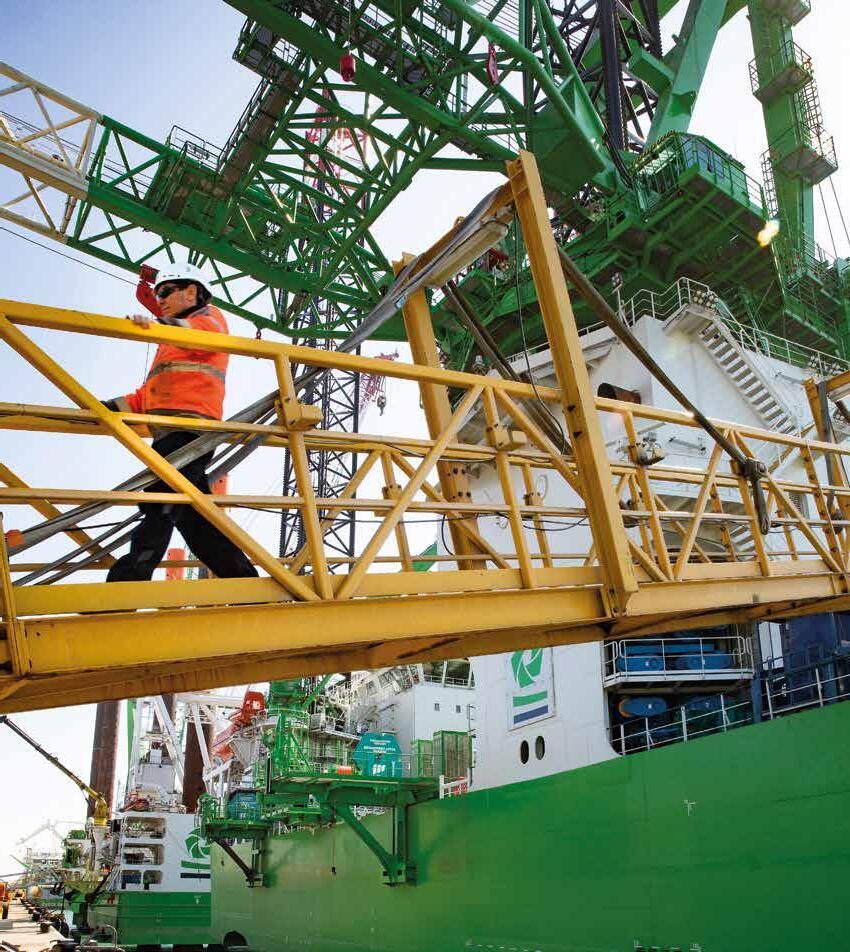
COVERING THE PORT AREA OF GHENT, TERNEUZEN AND VLISSINGEN
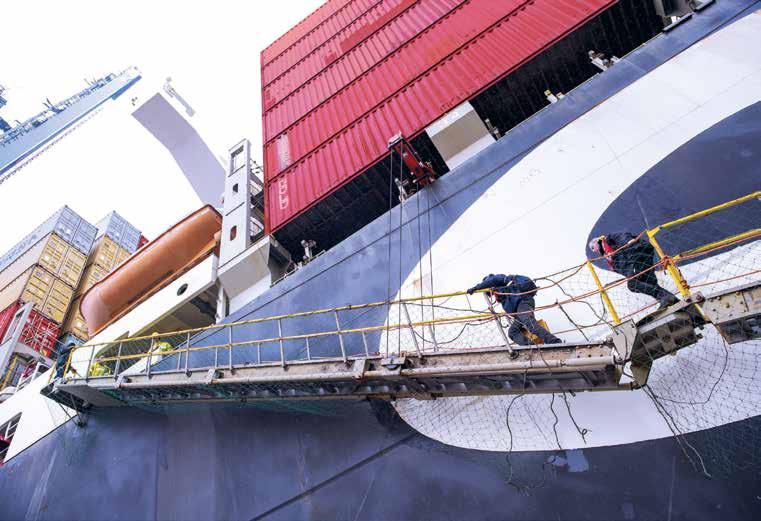
Our pilots navigate the world’s largest ships safely and efficiently through the Western Scheldt
North Sea Port and Promotion Council North Sea Port will be in attendance at various events and trade shows. Below you’ll fnd a snapshot of the upcoming events that might be of interest to you.
Let’s accelerate investments together
North Sea Port is not only a logistics hub in Western Europe, but also a powerful engine for regional and international growth.
In 2025, our companies handled 67 million t of goods via maritime shipping. With a slight increase compared to 2024, we once again underscore our resilience and ambition.
In times of uncertainty, dry and liquid bulk goods form the backbone of our maritime transshipment and a buffer that makes us resilient. We see the UK, Canada, and the US as our most important trading partners, but our vision extends further.
Today’s success is no guarantee for tomorrow; it requires collaboration, vision, and courage. To maintain and strengthen our position as a leading European port, investments in infrastructure and innovation are crucial. That is why I make a warm appeal: let’s accelerate together. Businesses – keep investing, dare to innovate, and realise the plans that are ready to be implemented. Governments – make the decisions needed to expand infrastructure and ensure a stable, robust permitting policy.
In this way, we create a port where economic growth goes hand in hand with society and the environment. Safety – physical, digital, and in terms of subversion and defence – is not a side condition, but a foundation. A future-proof port demands decisive action against crime and cyber threats, as well as strengthened military and cross-border cooperation in Europe.
As North Sea Port, we seize opportunities on European transport corridors, connect chains, and anchor employment and prosperity. Together, we are
growing purposefully toward a climate-neutral and safe port that not only attracts investments but also brings them to full fruition.
Our ambition is crystal clear: as North Sea Port, we want to make a difference. Now is the moment to further combine our strengths and realise this ambition together.
Kind regards,
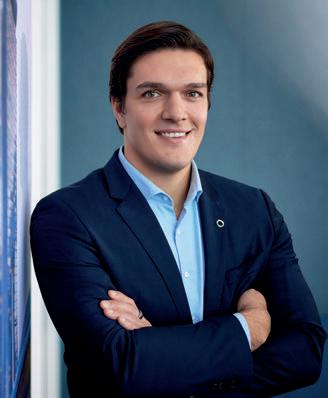
Cas König CEO North Sea Port
Shoulder to shoulder for the future of European chemistry
North Sea Port is home to a signifcant and substantial chemical industrial and logistics cluster. To secure the future of this cluster, the port authority – together with Smart Delta Resources (SDR) and the Province of Zeeland – recently joined the Critical Chemicals Alliance, a new initiative established by the European Commission.
PortNews speaks with Karen Polfiet, project leader for circular economy and sustainability at North Sea Port, and Rob de Ruiter, circular program manager at SDR. “The European industry, especially the chemical sector, is facing major challenges,” Karen Polfiet begins. “Within Europe, we have hardly any access to the raw materials necessary for our own production. Energy is expensive, regulations are complex, and our competitive position has weakened compared to the US and China – partly because we have committed to producing more sustainably. Additionally, the current uncertain geopolitical situation shows how dangerous it is to be overly dependent on other regions. Self-production,
resilience, and autonomy are essential. In short, it is crucial to fnd solutions that strengthen the European industry, making it both competitive and a leader in low-carbon production.”
Essential chemicals
A notable initiative addressing these challenges is the recently established Critical Chemicals Alliance (CCA). Rob de Ruiter explains, “While Europe depends on many different raw materials, the CCA focuses specifcally on critical chemicals – those essential to European industry and for which we want to reduce our dependence on other regions. The idea for this alliance
North Sea Port is a key region for the supply
initially came from France, which was the frst to advocate for more domestic chemical production. The challenge is that determining which chemicals are truly critical is somewhat subjective; what is important to one may not be to another.”
Karen Polfiet adds, “To overcome this subjectivity, the European Commission took the step to create the CCA. Its task is to identify exactly which chemicals are critical and where in Europe they should be produced.” Rob de Ruiter continues, “Given the importance of the chemical sector to our region, with major players in chemical production and logistics facing the aforementioned challenges, SDR and North Sea Port decided to jointly apply for the CCA. We already collaborate closely on sustainability, so it was logical to join forces for this initiative as well. It’s encouraging to see the Province of Zeeland also join as a stakeholder.”
Urgency is clear
“It’s positive to see that, unlike many European initiatives, this one has come together quickly and is already up and running,” says Karen Polfiet. “It shows how urgent the problems are considered to be. The evidence is clear: in recent years, around 20 chemical plants in Europe have closed, and companies are withdrawing from new investments. This must be stopped. The frst steps were taken in 2025, and on 13 January of this year, the frst general assembly was held at Chemelot in Geleen. During this meeting, four working groups were announced, and alliance members could indicate which groups they wished to join. Each group was expected to have about ffteen to 20 participants, but this number was far exceeded. It was decided that everyone is welcome, but an additional registration process will be introduced for those who want to join the socalled sub-drafting groups, where methods, targets, and KPIs will be established.”
Four working groups
The alliance’s working groups are briefy described below.
Working group 1: Critical molecules and critical sites
This group will develop criteria to determine which chemicals and sites are critical, identify those chemicals and sites, and make recommendations on how to support them.
Working group 2: Trade
This group will monitor and address potential trade barriers for the European chemical industry and make recommendations for accelerating the defence of the European market and for partnerships to import renewable raw materials.
Working group 3: Modernisation and investments
This group focuses on measures to modernise the existing European chemical industry and maintain a strong competitive position, with an emphasis on cracking processes and ammonia production – both highly relevant to our region.
To secure the future of the chemical industrial and logistics cluster, the port authority – together with Smart Delta Resources (SDR) and the Province of Zeeland – recently joined the Critical Chemicals Alliance, a new initiative established by the European Commission.
North Sea Port is home to a signifcant and substantial chemical industrial and logistics cluster.
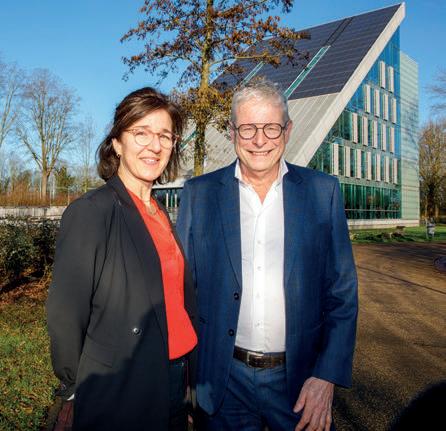
Karen Polfiet, project leader for cicular economy and sustainability at North Sea Port (l), and Rob de Ruiter, circular program manager at SDR (r).
Working group 4: Lead markets
This group will identify potential private and public markets for low-carbon and sustainable carbon-containing products and explore opportunities for creating demand for these products.
“Of course, it is important for us that the chemicals critical to our region are recognised as such and that our region is designated as critical,” says Karen Polfiet. “For us, it was logical to join Working group 1 in addition to Working group 3. Beyond our own interests, we believe we can make a real contribution to these groups based on the expertise available in our region.”
Rob de Ruiter adds, “As the representative of Zeeland, I will participate in both working groups, drawing on the knowledge and experience of SDR members and other partners in North Sea Port. I am merely the intermediary who will advocate for our interests.”
“The choice to focus on these two specifc working groups does not mean we will have no infuence on the other two,”
Karen Polfiet clarifes. “The Netherlands has been appointed chair of the Lead markets working group, and CEFIC (the European Chemical Industry Council) chairs the Trade working group. Through SDR and its members, we have good contacts, so we can also contribute to the other two working groups.”
Example for other sectors
Karen Polfiet continues, “The CCA is not only an important initiative for the chemical industry but also serves as an example for other threatened sectors in Europe. It’s great to be part of this. The alliance forces parties to collaborate across national borders, just as we do daily at North Sea Port. It also pushes countries to look beyond their own interests and consider whether these still align with Europe’s. With our experience as a
cross-border port in international cooperation, we will certainly add value.” Rob de Ruiter emphasises, “The advantage for a region designated as critical is that it can expect support from Europe. It is important to determine how the Netherlands and Belgium will position themselves and how the various regions in both countries will do so. It is clear that North Sea Port and SDR members want to play a major role, given our large cracking capacity – the largest in the Netherlands – our position in nuclear energy, and our hub function in electrifcation and energy supply. We are a key region for the supply of basic raw materials needed for various products. There is often a lot of attention for innovation in product-focused industries, but it is sometimes forgotten that these industries cannot exist without the basic industry – without raw materials, there are no end products. That is why it is important that these basic raw materials are produced in Europe, as this also supports other industries in Europe.”
Five to twelve
The urgency of the CCA is refected in its timeline. “We can expect the frst results from the working groups as early as April. These will be presented in June, after which concrete action can be taken. Progress is being made rapidly, and for good reason – right now, it is fve to twelve for the future of the chemical industry in Europe,” says Rob de Ruiter. Karen Polfiet agrees: “For a sustainable future, we must all work shoulder to shoulder within Europe. As participants in the CCA, we hope to play a relevant role in securing the future position of companies in and around our port.” I. NORTHSEAPORT.COM I. SMARTDELTARESOURCES.COM
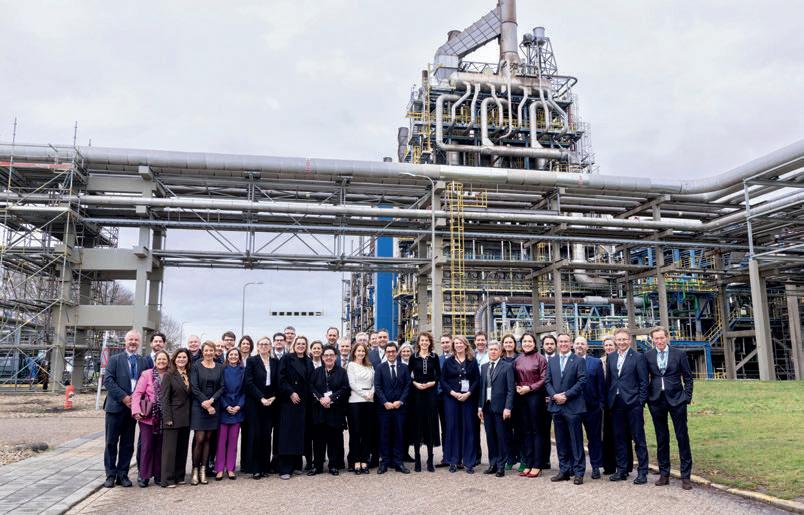
On 13 January of this year, the CCA’s frst general assembly CCA was held at Chemelot in Geleen.
Image courtesy of NPVI.
Experts in the chemical value chain
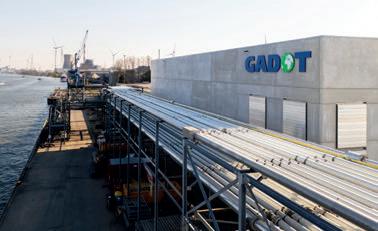
Gadot Belgium is a vibrant chemical company based in Ghent. More than just a tank storage terminal, it provides value-added services such as blending, flling, and custom chemical processing of liquid chemicals, along with logistics solutions for clients and partners in North Sea Port.
Gadot Group
Gadot Belgium is part of the Gadot Group, a multinational active in chemical distribution, logistics, and infrastructure. Founded in the 1950s, the company grew by embracing diversity, combining acquisitions with infrastructure development, and adopting an overall entrepreneurial approach to international trade, says Wim De Windt, CEO of Gadot Europe and managing director of Gadot Belgium. “In addition to traditional chemical logistics, the group has invested in recycling technologies, plastic waste processing, and renewable material production through strategic acquisitions such as a biorefnery. Additionally, Gadot owns a stake in a privatised port terminal in Haifa, strengthening its role in infrastructure and multimodal product fow capabilities.
“Gadot Belgium was acquired in 2010; at that time, it was mainly a logistics and production hub, established in the 1960s by Chevron (formerly Texaco). When Chevron sold the site, it changed ownership several times before being acquired by the Gadot Group. Today, the group’s presence in Europe includes chemical warehouses in Frankfurt and Mannheim, supply chain projects in Düsseldorf, a chemical tank terminal at North Sea Port, and a shipping company in the Netherlands operating under the name Chemship. Chemship is a Rotterdam-based shipping frm with a feet of ffteen tankers that transports speciality and commodity chemicals between Europe, the US, and Israel. The group’s global turnover is approximately USD 600 million, with about 700 employees worldwide. Gadot Belgium currently employs around 140 people, as well as contractors for specialised tasks and project support. This alone shows how much we’ve grown over the past years. Ten years ago, we employed around 60 people in North Sea Port. Since 2019, we’ve steadily grown our EBITDA at a rate of >20% CAGR by diversifying our core operations and developing new complementary activities. In this timespan, a package of 15 million growth investments was deployed in our location in Ghent.”
Contract manufacturing
Recently, the company made signifcant investments to expand its processing capabilities and strengthen its position as a chemical distributor, all while advancing sustainability efforts and addressing the rising demand for biofuels. By embracing diversity, the company has positioned itself well for further growth across Europe and abroad.
“Gadot Belgium’s core activity today is the production of chemical additives, semi-fnished products and end products for several major players in the industry,” Wim De Windt explains. “Roughly, we can divide our production activities into three categories: fuel additives, additives for lubricants, and fnished lubricants. Fuel additives are used for traditional fuels like diesel and petrol, as well as for new-generation fuels such as biofuels, SAF, and low-sulphur fuels. Each fuel needs specifc additives,
All images courtesy of Gadot Belgium.
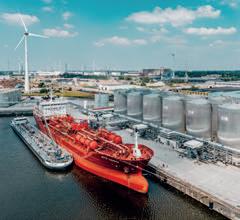
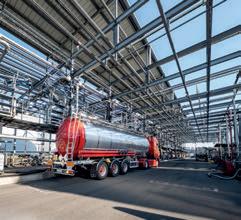
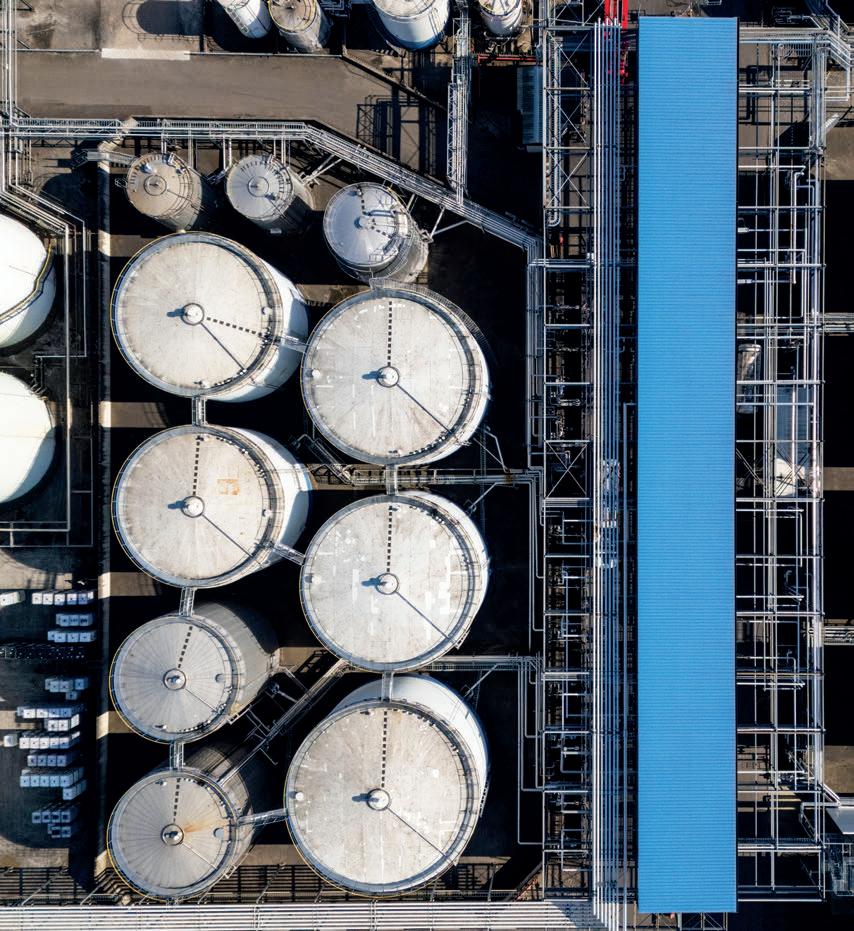
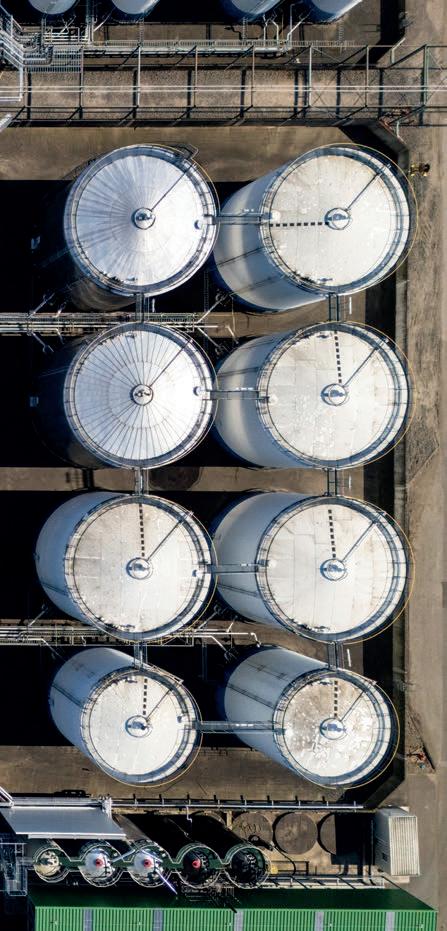
At its multimodal tank storage terminal, Gadot Belgium stores and handles a range of chemical products, with a steadily increasing contribution from renewable and circular solutions, including green recycled base oils (rrBO) and biofuels.
e.g. to prevent deposits and oxidation, improve stability and engine compatibility. Fuel additives are a highly specialised business, in which we act as a contract manufacturer for large multinationals, helping them free up capacity, ramp up innovative compositions or outsource production. This is one of our faster-growing markets, because new generations of renewable fuels require specifc components, and thus specialised expertise. Additionally, handling these additives requires us to be a SEVESO-certifed company, which means we are subject to various safety and quality regulations. In fact, safety and security are among our core values, much in alignment with North Sea Port’s vision. As a port facility, we are also subject to ISPS (International Ship and Port Facility Security Code).”
He continues: “A second production type is lubricant additive packages, performance-enhancing chemicals that provide protection, stability, cleanliness and other functional properties required to meet lubricant performance standards. Some of these chemicals, including Viscosity-Index Improvers, are produced on-site. For this product line, we also act as contract manufacturers for large companies, adhering to strict quality standards and rigorous quality assurance, safety, and process management to meet their high expectations. The third, somewhat related type of production is fnished lubricants, where we add our additives to base oil to produce specifc blends for our customers and ship them in their branded packaging. Recently, we’ve invested in a new, fully automated flling line for small packs such as one-litre bottles. We now produce 30 million litres annually for small packs, equivalent, then, to 30 million bottles. Naturally, we’ve also had to build a warehouse to accommodate those extra volumes. And that’s just one of the investments of the last fve years.
Another business area in which we’ve signifcantly grown is our distribution and export activities.”
Growing in distribution
“Our activities as a distributor currently include sales and distribution for the local Benelux market, as well as for West Africa, where we supply essential process chemicals for clients involved in oil, gas and mining activities,” says Wim De Windt. “For the local market, we supply customers with a variety of process chemicals for industries such as steel, metals, paper, food, beverages, home care, industrial cleaning, and chemical
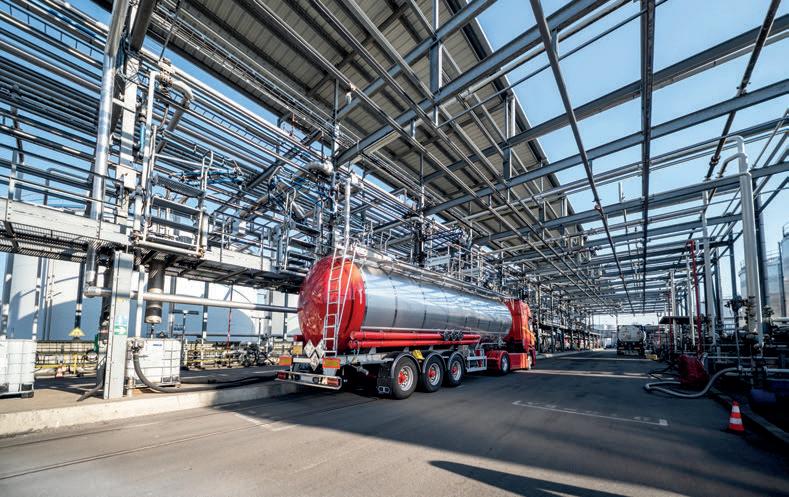
As a distributor, Gadot Belgium supplies local customers across a variety of industries with a wide range of speciality and process chemicals.
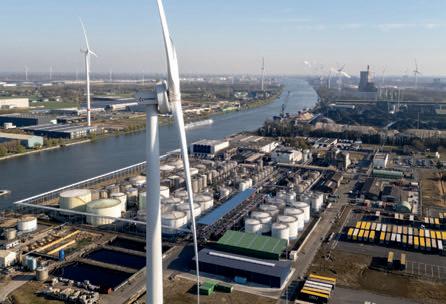
An on-site wind turbine and a partnership with the nearby Bio Energy Base biomass plant provide Gadot Belgium with renewable energy, already resulting in a 55% reduction in CO2 emissions on the way to 100% renewable energy.
manufacturing, all of which require specifc chemicals for their processes. These activities represent a signifcant growth path for us. In Europe, we began from scratch fve years ago, looking to diversify in response to the changing global market. To support this fast-growing business, we have expanded our tank storage and flling capacity, the latter to accommodate products destined for West African countries, which often require repackaging. Upon arrival, these products are sent directly to our flling lines, where they are properly conditioned and repacked before being shipped on major logistics routes to West Africa.”
“A third important business unit at Gadot Belgium is the multimodal tank storage terminal. This activity enables strong synergies with both distribution and manufacturing. We store and handle a range of chemical products, with a steadily increasing contribution from renewable and circular solutions, including green recycled base oils (rrBO) and biofuels.”
“Combining all those activities, production, value-added services and distribution can be complex, but that’s what makes us unique, and it makes working at Gadot interesting,” Wim De Windt states. “There’s never a boring day, with all our diverse activities like production, logistics, terminal operations and tank storage. Moreover, we invest in training and maintain an open company culture: Gadot Belgium operates like an SME within a larger multinational organisation. We say, we absorb your complexity, and that has offered us unique growth opportunities. And we are not done expanding. For instance, we also have plans to expand our tank farm to support our growing terminal operations. We also want to implement a new rail connection to make even better use of North Sea Port’s multimodal facilities. In distribution, we see opportunities for import-driven developments. We are exploring developing export solutions to South America as well, building on the expertise we acquired by developing West Africa over the last couple of years.”
Sustainability
“Expanding our multimodal solution is also important when it comes to sustainability,” Wim De Windt adds. “Sustainability is, of course, very important to the Gadot Group, which has set out several sustainability goals towards 2050. Chemship, for instance, has taken various initiatives to drastically reduce its fuel consumption. As for Gadot Belgium, 80% of the energy we use is renewable, resulting in a 55% reduction in CO2 emissions compared to 2020. To accomplish this, we have an on-site wind turbine and are looking to add solar panels on the new warehouses. Furthermore, we have an agreement with the nearby Bio Energy Base biomass power plant, which supplies us with green steam to heat our installations. Also, we are currently exploring ways to further reduce emissions while scaling up to 100% renewable energy. Of course, part of our sustainable story is also our local network, the good relationships we have with our neighbours.”
Local partnerships
“Besides investing in our own facilities, we also prioritise good relationships and collaboration with partner companies,” Wim De Windt explains. “Firstly, we have two on-site laboratories operated by SGS on our premises. SGS conducts its quality analysis activities on our location, both for Gadot and for other companies in the area. This has the added advantage that we can offer our customers independent quality assessments by a certifed laboratory for the products we handle on their behalf.
“Another example is our agreement with DFDS. Our liquid bulk terminal handles about 70 trucks per day and 250 ships per year. But what we lack today is isotainer storage. As this is a request from our customers, we have agreed with DFDS to develop a small storage area for about 100 isotainers on our premises, as a frst step. They are always looking for extra space, whereas we do not have the proper equipment like stackers and dock cranes to handle isotainers. Together, we can manage storage and logistics, including handling from water or rail. It’s a win-win, much like our collaboration with our neighbour PVG Liquids. As a flling and distribution centre, they are mostly involved with fuels and homecare products. Through our terminal, we handle their raw materials, receive the ships, clear customs, and transport the products via a pipeline to their flling plant. It’s a nice example of complementary collaboration. Gadot Belgium aims to build a collaborative environment in North Sea Port that always explores ways we can support one another. My philosophy emphasises openness – by not closing ourselves off, we strengthen our collective capacity.”
I. GADOT.BE
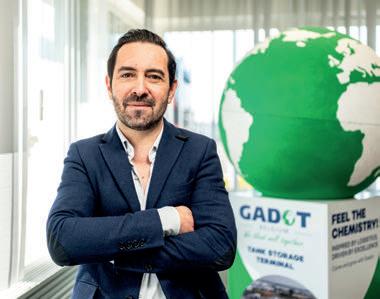
Wim De Windt, CEO of Gadot Europe and managing director of Gadot Belgium.
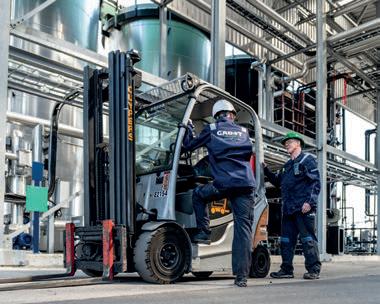
The new warehouse and fully automated flling line for small packs, such as one-litre bottles, are just one of the many signifcant investments Gadot Belgium has made in the last few years.
A hub for sustainable steel
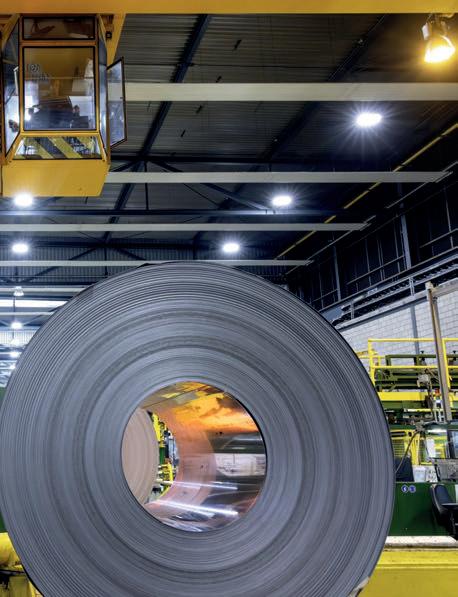
In North Sea Port near the village of Westdorpe lies one of Europe’s key stainless-steel processing hubs. Operated by global stainless steel specialist Outokumpu, the Westdorpe site plays an essential role in supplying high-quality, sustainable steel to industries across the continent.
Although Outokumpu is today the global leader in sustainable stainless steel, with locations across Europe and the Americas, the Finnish company originally began as Outokumpu Copper Mill in 1914, following the discovery of copper in 1910 on a hill called Outokumpu, which means “strange hill” in Finnish. Over the decades, the company expanded its activities to other metals, but it wasn’t until the 1990s that it truly focused on stainless steel. Around the same time, the decision was made to invest in a location near Terneuzen in North Sea Port as a strategic entrance into the Central European markets, as Dr Max Menzel, vice president operations of Outokumpu Stainless, explains.
“The Westdorpe facility has always held a special place in Outokumpu’s value chain,” he says. “When Outokumpu decided to invest in Westdorpe
in 1991, Our operations were mainly in Finland, while the biggest markets for stainless steel were in Central Europe. Therefore, Outokumpu built a logistics hub near Terneuzen to secure a mainland entrance to Central Europe, where the majority of stainless steel is consumed. Even today, our biggest markets are in Germany and Italy. Given the distance from Finland to these countries, the investment made perfect sense, and the Westdorpe facility has indeed grown into a strategic logistics hub for the whole Outokumpu supply chain in Europe today. We have a direct vessel connection between Finland and North Sea Port, where we receive three to four vessels per week, loaded with stainless steel coils manufactured in Finland.”
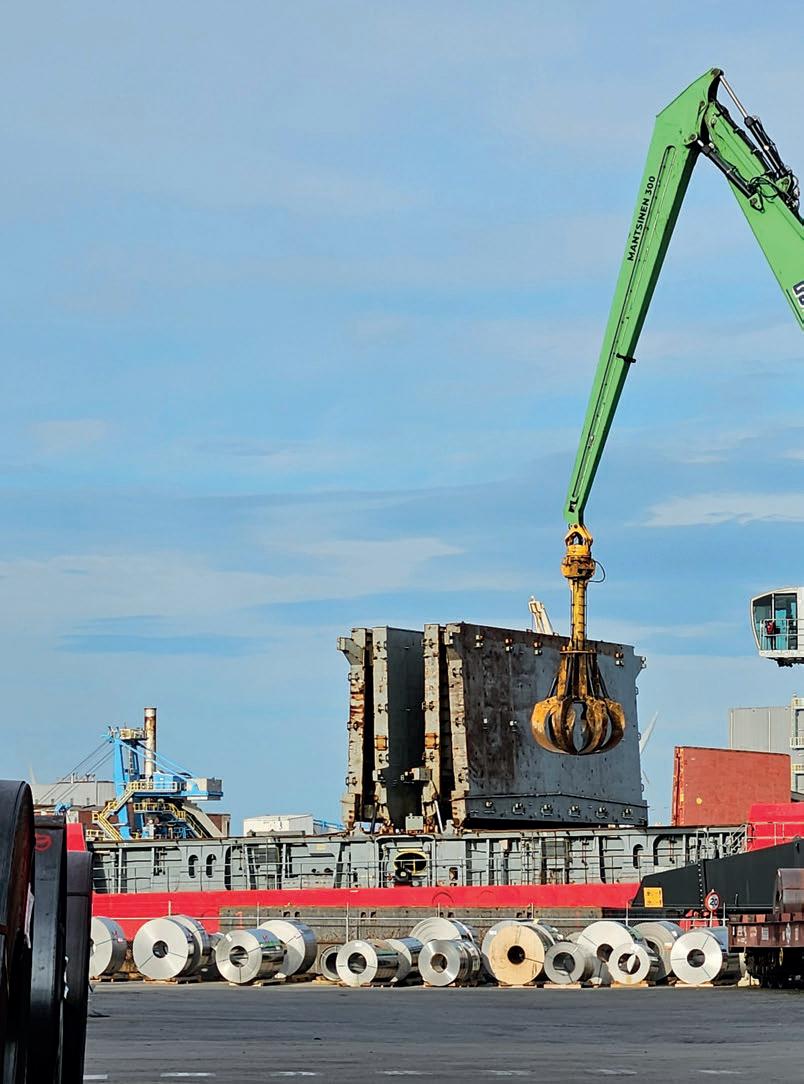
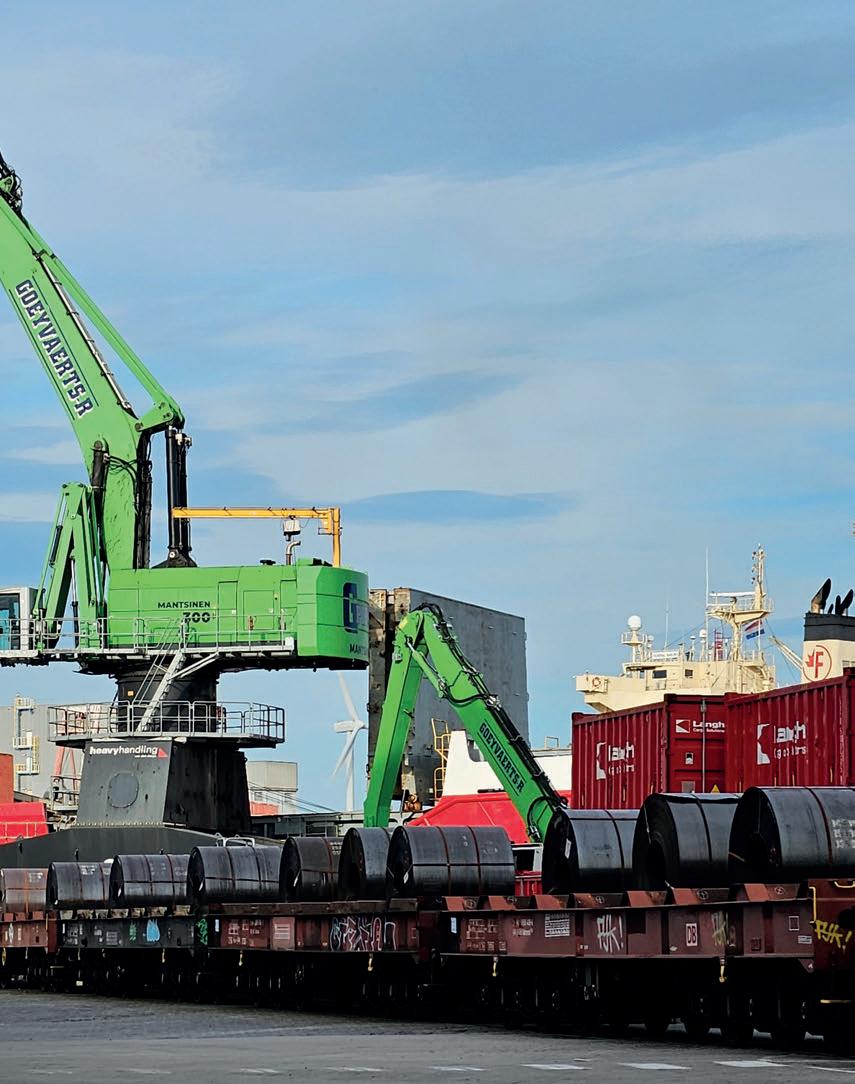
Outokumpu's Westdorpe facility is a strategic logistics hub for the whole Outokumpu supply chain in Europe today.
A multimodal logistics hub
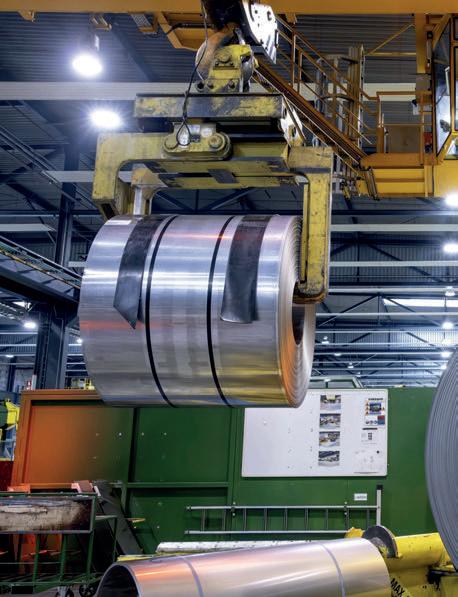
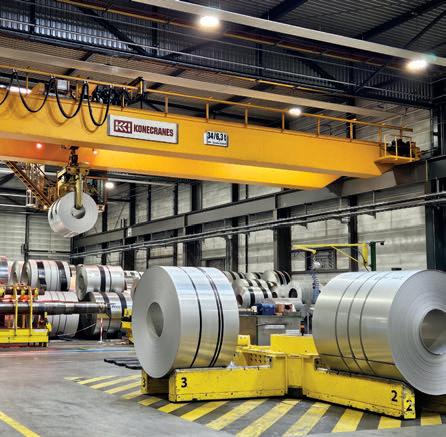
“The stainless steel coils from Finland are further processed here at North Sea Port,” Max Menzel says. “The steel is cut and fnished to meet customers’ requirements before continuing its journey across Europe. That’s one major export fow that goes through the Westdorpe facility. The other is the supply of our distribution centres in Europe. We are a strategic supplier to Outokumpu’s locations in France, Germany, Italy and Poland, among others, that distribute the volumes that arrive through Westdorpe. In the reverse direction, we collect a large amount of scrap at the Westdorpe facility to serve as raw material for our mill in Tornio, Finland. Our operations are built on circularity, with at least 95% recycled material in our stainless steel production. With an annual output of approximately 2 million t of stainless steel, we handle and purchase more than 1.5 million t of steel scrap. At the Westdorpe facility, vessels bringing coils from Finland are received and then reloaded with scrap to supply our mill in Finland. It’s circularity at its best, further enhanced by our strategic location within North Sea Port, which provides a wide range of multimodal logistics solutions.
“Outokumpu Westdorpe not only benefts from water access but also boasts strong rail and logistics links,” he states. “Our facility acts as
a strategic hub for our core operations in Finland, our German plants, and our customers and service centres throughout Europe. Logistically, we are perfectly positioned to support Outokumpu’s value chain. We actively utilise multimodal transportation solutions, with vessels arriving from Finland carrying volumes for processing and export across Europe. Our German mills are supplied by train, while customers are served by trucks and, for larger volumes, barges. Scrap collected for our Finnish mill arrives by truck and barge, then is shipped to Finland. Overall, these arrangements are always optimised to use the best possible solutions.”
Global leader in sustainable steel
Beyond logistics and processing, the Westdorpe site refects Outokumpu’s broader commitment to sustainability. “Stainless steel has the beneft that it is indefnitely recyclable and durable,” says Max Menzel, “and because of its corrosion resistance, it has a very long lifespan. As one of the biggest players in stainless steel globally, our vision has always been to create a world that lasts forever, because that is what stainless steel can provide. As such, sustainability is part of our DNA, and we are proud to say that we have the highest recycling content in the industry, which is a key element in a low-carbon industrial future. But Outokumpu’s green ambitions extend far beyond the material’s circularity. For example, we’ve been commercialising
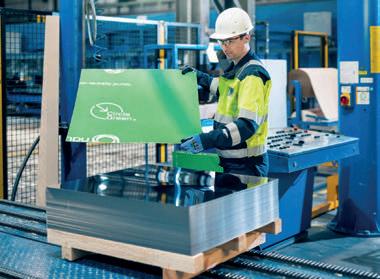
low-carbon stainless steel products for years, with our pioneering towards-zero stainless steel, Circle Green. Circle Green’s emission intensity is up to 93% lower than the global industry average. Furthermore, we are constantly improving our manufacturing methods as well.”
He explains: “Today, metal production is highly CO2-intensive and costly to decarbonise. We’re currently investing in a facility in the Americas as we’re developing proprietary technology for metals production, starting with enriched ferrochrome and chromium metal. We’re confdent this will further help us reduce carbon emissions. It is just one of our strategies to advance sustainable material manufacturing and push the limits of what’s possible. Even though we have the most sustainable stainless steel production in the world today, with the lowest CO2 footprint, we aim to go even further.
“We are also converting our energy and processes to lowcarbon sources, including green electricity, low-carbon fuels, or even green fuels. Our process control is highly effective because steel manufacturing requires careful management of how and where processes are applied. We have optimised our processes such that, within a certain part of our portfolio, we can now reduce our CO2 footprint below 1t per t of stainless steel, which is very low compared to the industry average of around 7t. This provides us with a clear advantage over our more CO2-intensive competitors, and we are confdent that this will continue to gain importance for our customers in the coming years. After all, our circular, near-zero stainless steel enables our customers to lower their carbon footprint equally. Considering the wide variety of applications our stainless steel has, this is an important element in a greener economy. Incidentally, the same applies to our ferrochrome products. The carbon footprint of our ferrochrome is 67% lower than the industry average. The ferrochrome from our mine in Finland, the only chrome mine in the EU, is mainly used in our own stainless steel production. Chromium gives stainless steel its corrosionresistant properties. However, we also sell a range of chrome products, enabling our customers to beneft from low-carbon ferrochrome as well.”
Dr Max Menzel, vice president operations of Outokumpu Stainless.
Stainless steel is used everywhere, from cookware to the inside of your washing machine, from exhaust systems to battery systems, from wind turbines to the production, storage, and transportation of hydrogen.
Outokumpu's vision has always been to create a world that lasts forever, because that is what stainless steel can provide. It is indefnitely recyclable and durable, and because of its corrosion resistance, it has a very long lifespan.
The industries we supply are incredibly diverse. From home appliances to automotive, from the chemical industry to green energy.
Green applications
“The industries we supply are incredibly diverse,” Max Menzel explains. “From home appliances to automotive, from the chemical industry to green energy. Stainless steel is used everywhere, from cookware to the inside of your washing machine or dishwasher. In the automotive industry, stainless steel is mainly used for exhaust systems, though we are seeing a shift, as it is now also used in some battery systems for electric vehicles. In fact, the renewable energy sector is a major growth area for Outokumpu. Not only is stainless steel used in the production of wind turbines, but it is also a great material for the production, storage, and transportation of hydrogen. In production, hydrogen is essentially produced using electrolysers, for which stainless steel is commonly used. We’re actively involved in some projects here, making this a promising growth area. Once hydrogen is produced, stainless steel is used to store it in tanks and pipelines, especially because hydrogen must be cooled to extremely low temperatures to become a liquid. Storage conditions reach approximately -273°C, a very
like
harsh environment where stainless steel’s properties prove particularly advantageous.”
Natural gateway
“Given these market developments and North Sea Port’s position as a hub for renewable energy, Outokumpu’s facility in the harbour will gain even greater importance in the years ahead,” Max Menzel concludes. “Additionally, as part of our strategic plan to address today’s market challenges, we are optimising our production footprint in Europe and aim to also move some production from Germany to Finland, where we beneft from lower energy costs. As more production shifts upstream in our value chain, the importance of our location in Westdorpe also increases. Furthermore, as the largest producer of stainless steel in Europe, we believe the EU’s carbon border adjustment mechanism (CBAM) and new tariffs on imported steel could positively impact the European market, thereby further strengthening our business in the coming months and years. Looking back, however, the output of Outokumpu Westdorpe has already increased in recent years, even amid industry challenges. Even without the bright indicators for the future, this, in itself, is a very strong indicator of our location’s resilience. Westdorpe is and will remain an essential part of Outokumpu’s European supply chain.” I. OUTOKUMPU.COM
Outokumpu’s pioneering towards-zero stainless steel, Circle Green’s emission intensity is up to 93% lower than the global industry average.
Slides
these show just one of a wide range of possible applications for Outokumpu’s sustainable Circle Green steel.
Connecting North Sea Port to Europe: the De Jong Shipping story
After more than a century, De Jong Shipping is going strong, providing its clients with a comprehensive service from end to end.
Maassluis-based De Jong Shipping boasts a long and interesting history. The company dates its offcial history – in various forms and under changing names – back to 1923. This was the year in which Willem de Jong purchased the 90 t motor vessel De Hoop for 13,000 guilders.
Beginnings
The company’s origin story, however, goes even further back than this, beginning in 1902, in Krimpen aan den IJssel, when Piet de Jong Senior purchased his frst sailing ship to transport coal. Over the years, the company has endured, surviving economic turbulence, extreme weather events and two world wars. Today, the company continues, employing around 100 personnel working on board its vessels and in its offce, and transporting in the region of 9 million t of cargo each year.
Growing commercial focus
While the business has changed over the years, evolving up until the present day, the company remains a family business, still in
All images courtesy of De Jong Shipping.
the capable hands of its founding family, the de Jongs.
Recently, De Jong Shipping has set about increasing its commercial presence – with a focus on the Southern Netherlands and Belgium, including in North Sea Port. To support it in these aims, De Jong Shipping has recruited two business development managers, one of whom is no stranger to North Sea Port.
In the heart of North Sea Port
Bram Peters spent fourteen years in various commercial functions at Ovet in Vlissingen and Terneuzen, and fve years as Managing Director of testing, inspection and certifcation specialist Control Union in Ghent. He also served for a number
of years as a board member on the North Sea Port Promotion Council.
“I even live in the heart of the port, in Sas van Gent,” he says.
Prior to his recent appointment, Bram Peters was already familiar with De Jong Shipping.
“We frst connected some years ago when I was working at Ovet, for a large project taking place in the Port of Antwerp.”
New horizons
When he was offered the role at De Jong Shipping, he was, he explains, attracted by the opportunity to experience something new.
“In my previous roles, I’ve worked on the terminal side of things,
De Jong Shipping is still going strong after more than a century.
and on the inspection side. With this function, I’m experiencing barging and coasters. It gives me new insights, but, while it is something new, it’s still connected to my network.”
Tapping into the network
It is this network that Bram Peters is tapping into as he sets about raising the profle of De Jong Shipping in North Sea Port and beyond.
“Up to now, the company has largely relied on the quality of its services and its reputation for growth. This has been very effective – much of our work comes from word of mouth, which is a sure sign that we are doing something right. Now, however, we are looking to diversify further and to increase our presence. That’s where my commercial background comes in; my job is to tell people who De Jong Shipping are, and what we are capable of.”
Wasting no time, this is precisely what he does now, detailing the way the company operates today.
Where inland barging and sea freight come together
“De Jong Shipping is a relatively new name for the organisation,” he begins. “It’s an umbrella name covering the operation of our two companies that bring together inland barging and short sea shipping.”
“Rederij de Jong is the inland part of the business – the sector in which we frst began over a century ago. Today, this side of the business covers two main activities – push barges and inland shipping.”
Rederij de Jong, Bram Peters continues, operates a signifcantly sized feet, consisting of 180 push barges, ranging from 1,700 - 5,300t with and without hatches – ideal for diverse cargo types – as well as eighteen push boats.
Stress-free and cost-effcient
On the inland shipping side of things, Rederij de Jong charters anywhere between 25 and 50 inland barges each week –including those from its own feet. The company is able to cover the entire process from loading to unloading, offering its clients a stress-free and cost-effcient one-stop shop.
Rederij de Jong covers a broad geographical area. The inland vessels it charters cover the bulk of European waterways, consisting of the Rhine, Main and Danube rivers and the canal network in France.
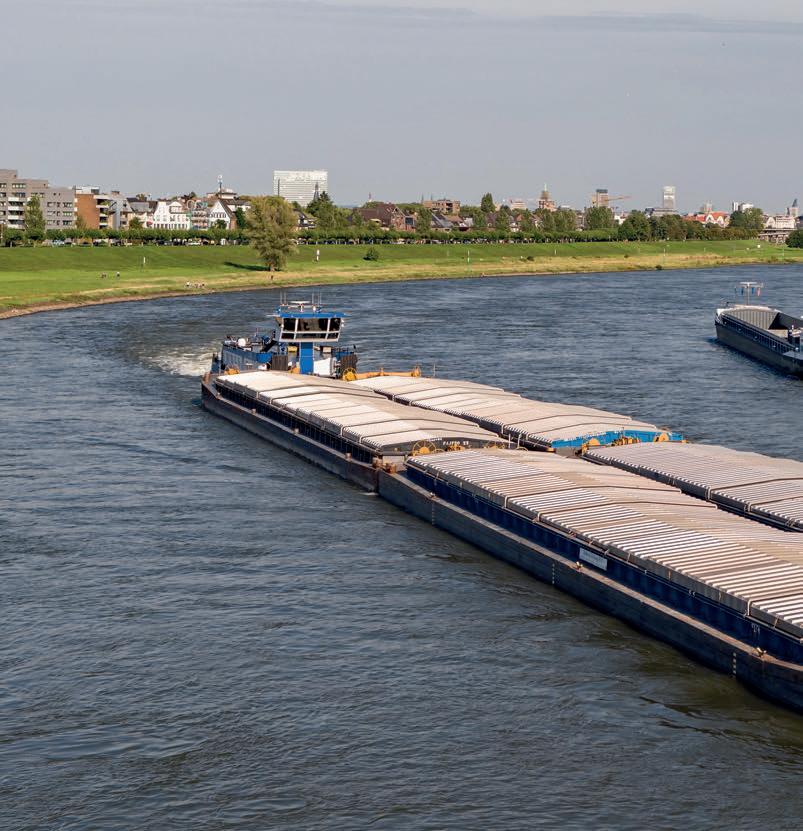
Its push barge operations typically take place along the lower Rhine, as far inland as Dusseldorf and Cologne in Germany. Essentially, Rederij de Jong connects sea ports with terminals and loading and unloading locations along rivers and canals. For many years, this formed the core of De Jong Shipping’s offer to the market.
Going to sea
That changed in 2019, however, with the beginning of subsidiary C-Shipping & Logistics.
The company has brought together all elements to create an end-to-end service.
Bram Peters, business development manager at De Jong Shipping.
“Inland shipping is a consolidating market where scale and continuity are becoming increasingly important. Especially now that investment pressure is increasing and the number of private entrepreneurs is declining, we believe in investing against the tide.”
“On the seagoing shipping side of things, we have three main activities. There is chartering, as well as the operation of our own feet of eight coaster vessels, ranging from 1,400t to 3,500t, as well as agency services, covering everything from berth requests to transhipment coordination to bunkering,” states Bram Peters.
“Within this area of our operations, our focus is Europe-wide,” he goes on. “We do, however, handle a lot of shipments to and from Scandinavia, the United Kingdom, the Republic of Ireland, Spain and Portugal.”
Cargo diversifcation
When it comes to cargo, De Jong Shipping handles a wide range of different materials – including dry bulk, breakbulk and project cargoes.
“We’ve historically been very strong in agricultural shipments. We also do a lot of biomass – particularly wood pellets for power stations. This could be challenging in the future, however, as subsidisation for pellets is coming to an end. It’s not clear yet if this will be renewed, or what alternatives power stations will choose. In any case, to prepare for situations like this, we have diversifed the types of cargo we transport in recent years.
“As well as the pellets, dry bulk cargo we handle includes coal and other minerals. For breakbulk we handle coils, wire rods, that type of thing. Project cargoes, amongst other things, include wind turbine parts which we transport to sea ports ready for installation at offshore wind farms in the North Sea.”
A client-oriented future
De Jong Shipping plans to continue to increase its offering to the market, Bram Peters continues.
“We want to remain relevant. Our focus is very much on being customer-oriented, by listening to the client and offering them a broad range of fexible services. While everything we do will always remain connected to our roots and core operations in
Investing against the tide
Fifth generation of the de Jong family and De Jong Shipping operational director Pelger de Jong agrees with Bram Peters on the importance of a comprehensive, fexible offering to the market, saying, “Inland shipping is a consolidating market where scale and continuity are becoming increasingly important. Especially now that investment pressure is increasing and the number of private entrepreneurs is declining, we believe in investing against the tide.
“Our strength lies in the combination of inland shipping, push barges, and seagoing shipping, which allows us to meet customer needs in the right way. In a consolidating market, it’s all about scale, making choices, and the ability to truly unburden customers.”
barging, we are investigating ways we can diversify around that.”
He offers an example of the sort of service the company hopes to increasingly provide in the future – and is, indeed, already offering.
“To give just one example, we recently handled a shipment from the UK where we provided our coaster services and agency services, the terminal on the European side, covering customs clearance and inspection. After that, we are able to provide our inland shipping services for further transport into the hinterland. Since we are able to offer all services now – both at sea and inland – we are well placed to offer our customers access to the entire chain in a single location.”
I. DEJONGSHIPPING.COM
De Jong believe in offering a solution that truly unburdens the client.
European specialists in sustainable timber
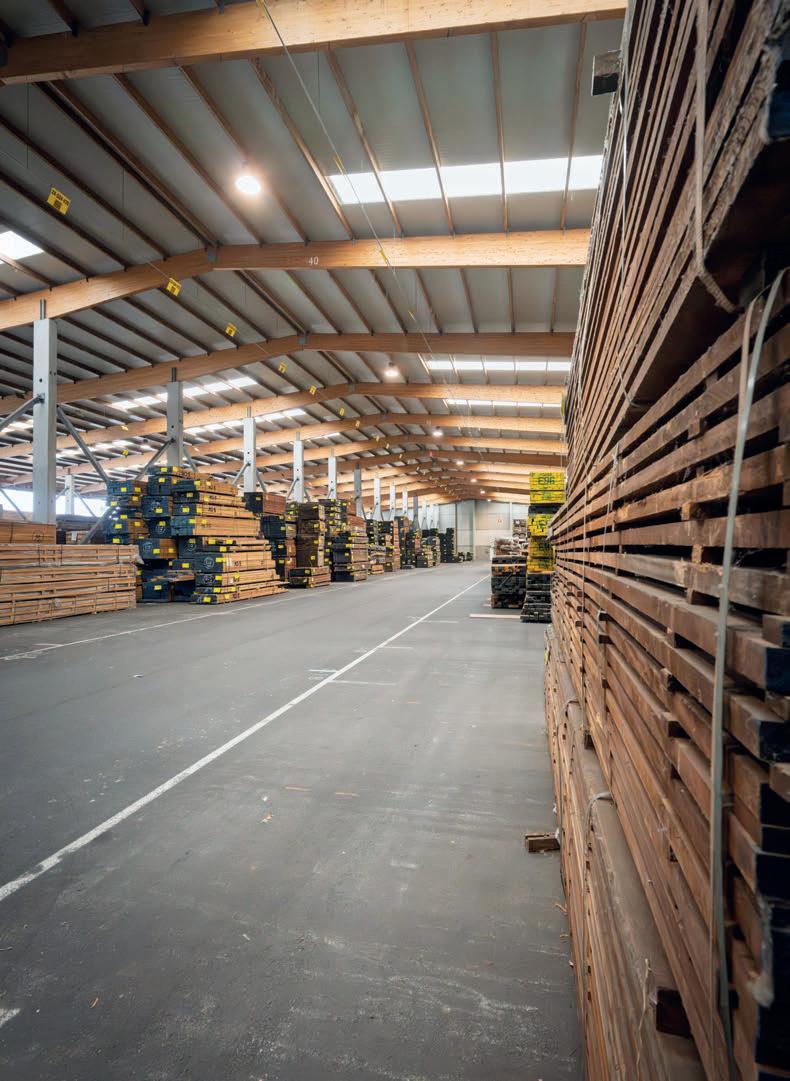
AC Timber Trading in Ghent has a long-standing presence in the Belgian and European timber market. As part of the van Steenberge Invest group, it combines decades of expertise in timber importing and distribution with a proactive approach to logistics and customer service. The company specialises in the wholesale supply of quality timber to professional merchants, emphasising reliability, strong international sourcing relationships, and responsible wood procurement.
Van Steenberge Invest group
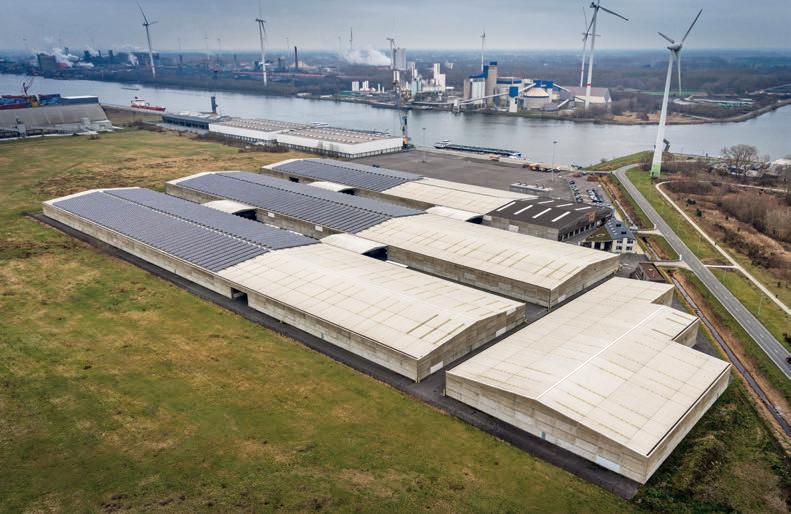
“Hout – Bois van Steenberge was founded in 1903 by Joseph van Steenberge, who took over a timber business in the centre of Zottegem,” says Benoît Clarysse, managing director of van Steenberge Invest. “At the time, it was a typical business where residents received their wood by horse and cart. This family business grew over the next decades into a leading specialist in timber, wood processing, and wood panels. But when my wife and I took over Hout-Bois van Steenberge in Zottegem from my father-in-law, Marc van Steenberge, in 2020, we quickly realised that it would be better to consolidate the sector. With the ambition to further develop this family business into an international company, we started exploring the possibilities. Quickly, van Hoorebeke Timber came into view. They had been active in North Sea Port since 1740, initially as a brewery, then, as of 1800, as a timber importer. Those are roots to be proud of, to exist continuously for so long. Another advantage of acquiring van Hoorebeke Timber is its excellent location here in North Sea Port, offering both logistical and multimodal advantages, as well as ample space at our disposal. In Zottegem, we had no more space to expand, but here we have a total area of 12ha, of which only 6ha are currently covered by warehouses. This provides us with interesting possibilities and opportunities for the future.
“In conclusion,” he continues, “we contacted the van Hoorebeke family, and on 23 March 2023, we completed the acquisition, after just recently acquiring the French Bois Plus company in January 2023. They had a depot in Dunkirk, which
we closed and moved to Ghent to centralise our logistics. We also acquired the transport company Martens Logistics, which already worked for van Hoorebeke Timber, and we acquired a majority stake in Altripan in October 2024. Altripan mainly imports wood panels, and is therefore complementary to our other business units. Together, we now have several complementary divisions in the European timber and panel industry under the umbrella of van Steenberge Invest.”
Timber and wood panels
“As a group, you could say that our core activity is the import and distribution of high-quality timber and wood panels,” Benoît Clarysse explains. “Our wood comes from around the globe; Canada, South America, Africa, Southeast Asia, Scandinavia and many other European countries. We take special care in selecting high-quality, sustainable wood, FSC- and PEFCcertifed, of course, that is suitable for timber and wood panels. We are not specialised in tropical hardwood, but we do supply it. To give you an idea, tropical hardwood currently accounts for only 1% of the group’s turnover.
“When we focus on distribution, our divisions each have a well-defned product fow and customer base. Hout-Bois van Steenberge primarily supplies large contractors with wood for construction and big industry. We specialise in the processing and direct deliveries of wood to construction sites and serve major industrial clients across Belgium and Europe. Altripan specialises in plywood and other wood-based panels, supplying wholesalers and retailers throughout Europe and
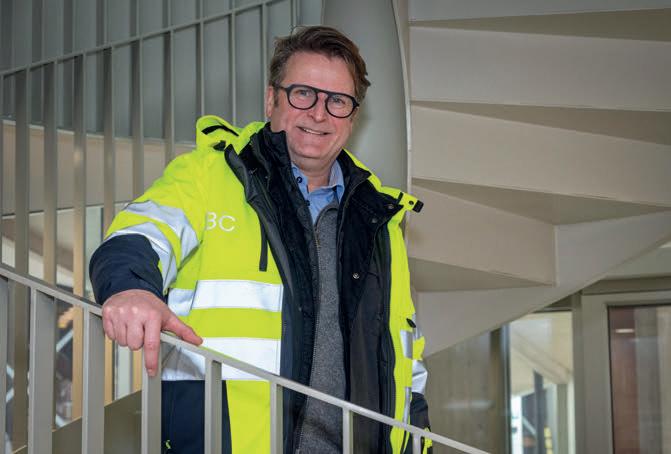
Benoît Clarysse, managing director of van Steenberge Invest.
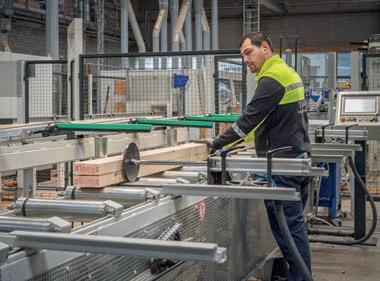
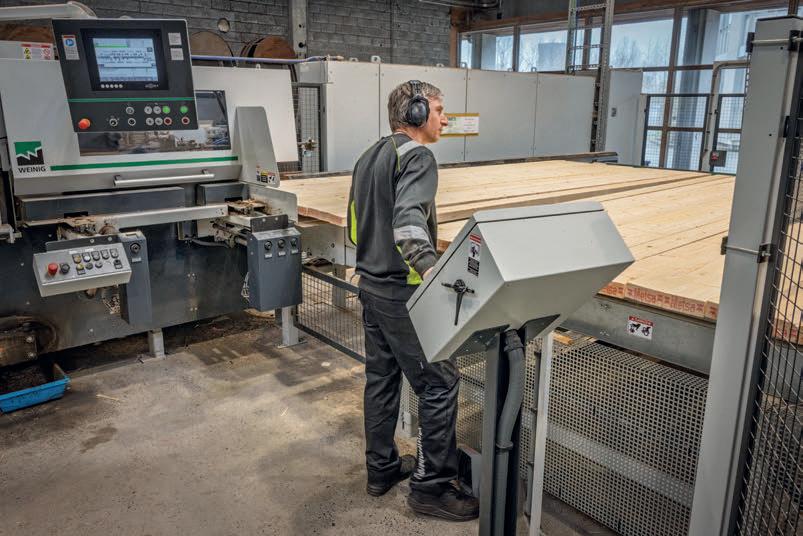
the UK. And lastly, of course, AC Timber Trading, our rebrand of van Hoorebeke Timber, not only specialises in timber for professional wood and construction materials dealers, but also focuses on processing. In North Sea Port, we also have a production section, where we operate three planing machines. We custom-cut the wood or cut it in various ways to make all sorts of pegs, beams, planks and panels, offering maximum fexibility and customisation for our customers. On top of this, AC Timber Trading is also a timber terminal.”
Challenging logistics
“Logistically speaking, we are still recovering from major changes in the global market of the last few years,” Benoît Clarysse states. “One of these is, of course, due to the Ukraine war, since van Hoorebeke Timber imported a large part of its turnover from Russia. When import stopped, about 60% of revenue vanished overnight. Then, more recently, supply from China has almost entirely stopped because Europe is implementing measures similar to the US’s, including signifcant import tariffs. The import tariff on wood-based panels from China is nearly 87%, which is substantial. We are therefore shifting our sourcing strategies yet again, starting almost from scratch in some places. This also implies importing from countries that have no fxed sea routes yet or are not yet equipped to handle breakbulk shipping. Luckily, we have extensive expertise within our team, with professionals who have over 20 to 25 years of experience, so we know what needs to be done and where to go. We are making great efforts to return to normal operations and have ships dock here again. Being located at the port is indeed a signifcant advantage that we plan to leverage fully, including for container shipments. The diversity of countries of origin often makes for
One of our priorities as international wood and panels distributors is to be ambassadors of sustainable wood and panels as an ecological and sustainable construction method.
complex logistical arrangements for our import containers, but we are nevertheless working hard to route them also through North Sea Port, in collaboration with nearby companies, which would simplify processes and reduce road transport needs. We hope to have containers arriving through North Sea Port within the next few months. Our outbound logistics is, luckily, much simpler, and also multimodal, since nearly all of our deliveries to the UK are done by ship.”
Ambassadors of sustainable wood and wooden panels
“One of our priorities as international wood and panels distributors is to be ambassadors of sustainable wood and panels as an ecological and sustainable construction method,” Benoît Clarysse says. “There is still a very persistent misconception that wood is not very environmentally friendly. That is not the case, if handled responsibly, of course. Logging activities receive a lot of attention, also rightly so from legislators. But logging and deforestation are not the same thing. Plots need to be replanted, for instance. In fact, when the European Deforestation Regulation (EUDR) is implemented in the near future, every log, plank, and beam will have to be traceable, by geolocation, back to the very plot
AC Timber Trading’s roots in North Sea Port date back to 1740.
where it was logged, to ensure the wood does not contribute to deforestation. However, some organisations, in their fght against illegal logging, tend to photograph plots immediately after logging, which naturally shows barren ground. They should instead return fve or ten years later, to see if proper new planting has occurred or not, as trees take time to grow – fve to twenty years, or even a hundred for hardwoods. But they don’t return, which adds to the misconception. However, we at van Steenberge Invest strongly believe in an ecological lifestyle, and we know that wood is much more environmentally-friendly as a construction material than bricks and cement. We are proud to adhere to the FSC and PEFC certifcates, of course, but there’s more. Wood is a natural product, growing on its own, producing a loggable tree within 20 to 25 years. Compare that to the energy and emissions required to produce bricks and cement. Moreover, wood can be reused or recycled, for instance, in fbreboard. Wood is also extremely sturdy and durable. People often underestimate this, but just look at Ghent City Hall, for instance. There are beams there that are hundreds of years old.
“Obviously,” he adds, “We also pay attention to lowering the CO2 footprint of our activities to process and distribute this wood. We continue to develop new techniques and materials essential to sustainable construction. The roofs of AC Timber Trading and Hout – Bois Van Steenberge are covered with solar panels – a major investment, but worth it to be able to supply ourselves with renewable energy. Our mission is to be an international ambassador for sustainable wood and to pave the way for sustainable building. People who share this
passion are, of course, welcome to apply. Already the largest importer of timber and wood panels in Belgium, we are an international company in full expansion. At the same time, we remain a family-owned business with a family-like atmosphere, with professionalism, innovation and sustainability as our core values.”
I. ACTIMBERTRADING.COM
AC Timber Trading specialises in the import, processing and distribution of timber and wood panels for professional wood and construction materials dealers.
Expanding with battery storage
Heylen Warehouses and Borghese Logistics expand North Sea Port footprint with lithium-ion battery storage of all classes
Since 2021, Heylen Warehouses has had a presence in North Sea Port with its facility in Ghent. The company is now planning to expand its footprint with a new, high-quality site in Vlissingen-Oost, which is being developed in partnership with Borghese Logistics.
Heylen Warehouses is a long-term logistics and industrial real estate developer and investor, and part of the Heylen Group, based in Herentals, Belgium. Founded by entrepreneur Wim Heylen, who started his first business at the age of eighteen in the 1990s, the group has grown into an organization comprising over 40 companies and approximately 4,000 employees.
On the move
Heylen Warehouses started with its first development in 2001.
“Since then, we have developed 2,600,000m2 of assets,” says one of the business development managers for Belgium, Jarno Vandermeren. We currently have 1,800,000m2 assets under management and have an additional 119,000m2 under construction.
The company’s warehouses are located across Belgium, the Netherlands, France and Spain. Heylen Warehouses currently employs 40 people.
“These positions cover a wide range of functions, from commercial and legal roles to design, engineering and architecture,” says Jarno Vandermeren. “This broad in-house expertise makes us a truly knowledge-driven organisation, enabling us to anticipate and effectively respond to the increasing complexity of the logistics and industrial real estate development landscape.”
Future-proofing with flexibility
“In line with our founders’ entrepreneurial vision, everything we do is focused on the long term,” explains his colleague, Nick Oude Aarninkhof, business development manager for the Netherlands. “At Heylen Warehouses, we apply the second-life principle to all our real estate projects. This means we design and develop warehouses that not only meet the needs of today’s tenants, but are also flexible enough to adapt to the requirements of tomorrow. We don’t build solely for the first tenant – we anticipate the needs of the second and future occupiers as well. By doing so, we ensure that each warehouse can enjoy multiple ‘lives’ throughout its lifecycle.”
“It makes sense,” adds Jordy Grundel, head of business development, “because we are building for our own portfolio. As long-term owners and operators, it is in both our interest and that of our clients to ensure these properties are constructed to the highest standards, using high-quality materials with minimal maintenance requirements. Functionality, sustainability and future-proofing are central to everything we build.”
To ensure this, he explains, flexibility is key.
“There are numerous ways in which we ensure a second life through flexibility. We design buildings with generous clear heights and high floor load capacities, allowing them to
All images courtesy of Heylen Warehouses.
Heylen Waterhouses has long had a presence in North Sea Port.
accommodate a wide range of applications – from narrow or wide aisle racking to multi-level picking towers as well as automation and robotics solutions. The scalable unit layout gives companies room to grow within the campus locations. In addition, we actively select locations with broad zoning plans, providing our clients with extensive storage possibilities and ensuring our buildings remain adaptable for many years to come.”
Campus model
“A prime example of our philosophy, is our Ghent location in North Sea Port,” states Jarno Vandermeren. “Here, we work with diverse clients, storing a very wide range of different products. This is a campus location, with 150,000m2 storage available in numerous, connectable units.”
“The units we develop typically range from 8,000 to 12,000m2
This allows tenants to start with a single unit and expand gradually as their operations grow. We also frequently see tenants collaborating, particularly in Ghent. In such cases, units can be positioned adjacent to one another and, where required, physically connected to create a larger, integrated space.”
Jordy Grundel, head of business development at Heylen Warehouses.
Nick Oude Aarninkhof, business development manager NL at Heylen Warehouses.
For a considerable period, the Ghent location has been fully occupied. Recently, however, some vacancy has become available, creating a new opportunity to lease five units totalling approximately 56,000m2. Each unit offers a clear height of 13.7m, in this highly strategic location.
Towards the future
Currently, Heylen Warehouses and Borghese Logistics are developing their second location in North Sea Port, in Vlissingen-Oost.
“The new location will consist of two industrial campuses – one with a footprint of 52,000m2 and another of 100,000m2 on a total surface area of approximately 280,000m2,” states Nick Oude Aarninkhof.
“Our aim is to construct the building according to BREEAM excellent standards,” he explains.
BREEAM stands for Building Research Establishment Environmental Assessment method. It aims to provide a sustainable built environment covering energy, health & wellbeing, innovation, land use, materials, management, pollution, transport, waste and water.
Energy storage potential
The zoning plan allows for the broad storage capabilities that Heylen Warehouses aims to offer its clients, including the option to store hazardous goods. A particular focus for the company at its new site in Vlissingen, realised together with Borghese Logistics, is the storage of lithium-ion batteries. Heylen is currently preparing the first building – a 52,000m2 facility – for the storage of all classes of lithium-ion batteries: A, B, and C. These classes are distinguished based on battery
Borghese Logistics: Driving the Dutch market strategy
Borghese Logistics is a developer of high-quality logistics real estate, focused on solutions tailored to end-user requirements and long-term site value. Recent projects include Europark Laar (Germany), Bakker Barendrecht (Ridderkerk), M&G (Assen) and Lighthouse (Dordrecht). With a pipeline of over 200,000m2 across the Netherlands and Germany, Borghese Logistics is involved throughout the development process.
While Heylen Warehouses contributes international scale and the strength of a knowledge-driven organisation, Borghese Logistics firmly anchors the Vlissingen development in the Dutch market. As one of the Netherlands’ leading logistics real estate developers, Borghese has built a strong track record in identifying strategic locations at an early stage and transforming them into high-performance, future-proof logistics environments.
In Vlissingen-Oost, Borghese is – together with Heylen Warehouses – architect of the commercial strategy. From land acquisition and permitting to product positioning and tenant engagement, both companies ensure the campus aligns precisely with current and future demand in the Dutch logistics corridors. Borghese’s experience in complex logistics environments – including food-grade facilities, GDP-compliant buildings and high-security operations – strengthens the project’s ability to facilitate specialised storage such as lithium-ion batteries and ADR goods.
By combining Heylen’s knowledge-driven organisation and international portfolio strength with Borghese’s market-driven development expertise, the Vlissingen campus is positioned as more than a logistics park; it is a strategic gateway for companies active in energy storage, advanced manufacturing and European distribution.
Jarno Vandermeren, business development manager BE at Heylen Warehouses.
The new location in North Sea Port will feature ready to use and custom storage facilities.
A particular focus for the company at its new site in Vlissingen is the storage of lithium-ion batteries.
size, energy content and associated risk. This building will allow the facility to accommodate the full spectrum of lithium-ion products, from the smallest cells to large automotive battery packs, while applying the appropriate safety measures for each class. Importantly, the building is being developed on a speculative basis, meaning construction is proceeding ahead of securing tenants to meet anticipated market demand. Heylen and Borghese are working closely with the local fire service and specialist advisors to ensure full compliance with all safety requirements. All necessary preparations will be completed so that, upon delivery of the building, companies storing lithium-ion products can immediately commence operations.
“The building is scheduled for completion around May or June 2027, and we are already seeing strong interest from potential tenants,” says Jordy Grundel.
Interest in the market
“Given the energy transition that is taking place, there is a growing focus on electrification and energy storage, and we see that in the enquiries we receive about the new location. It certainly helps that we are constructing the new location speculatively – this will help our clients to get to market much faster.”
“This, once again, is a benefit of flexibility,” he continues.
“By building a warehouse that can handle a broad range of products we are able to begin construction before we have an agreement in place. The versatility of the building means we are very likely to be able to secure a contract once it is ready.”
Covering all bases
The other building with a foot print of approximately 100.000m2 that will be constructed on the Vlissingen site will consist of nine units in total.
“The permit is in place, so we will be able to move quickly on this, too,” Jordy Grundel continues. “This building will be fully customisable. This way, we are able to cover all bases in one location, with direct availability of storage and built-to-suit units for those who need something special.”
Ideally situated
The new development represents a considerable investment, but, as Jordy Grundel explains, Heylen Warehouses is very confident in the location they have selected in North Sea Port.
“This is the ideal location. There is a lot of growth in the region for one thing. Additionally, there is multimodal access with excellent connections by road, rail and water. And, very importantly, the zoning plan here offers us the flexibility that is such a crucial part of our operating philosophy. We are very happy to be investing in this location in North Sea Port.”
I. HEYLENWAREHOUSES.COM
I. BORGHESELOGISTICS.NL
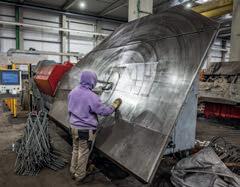
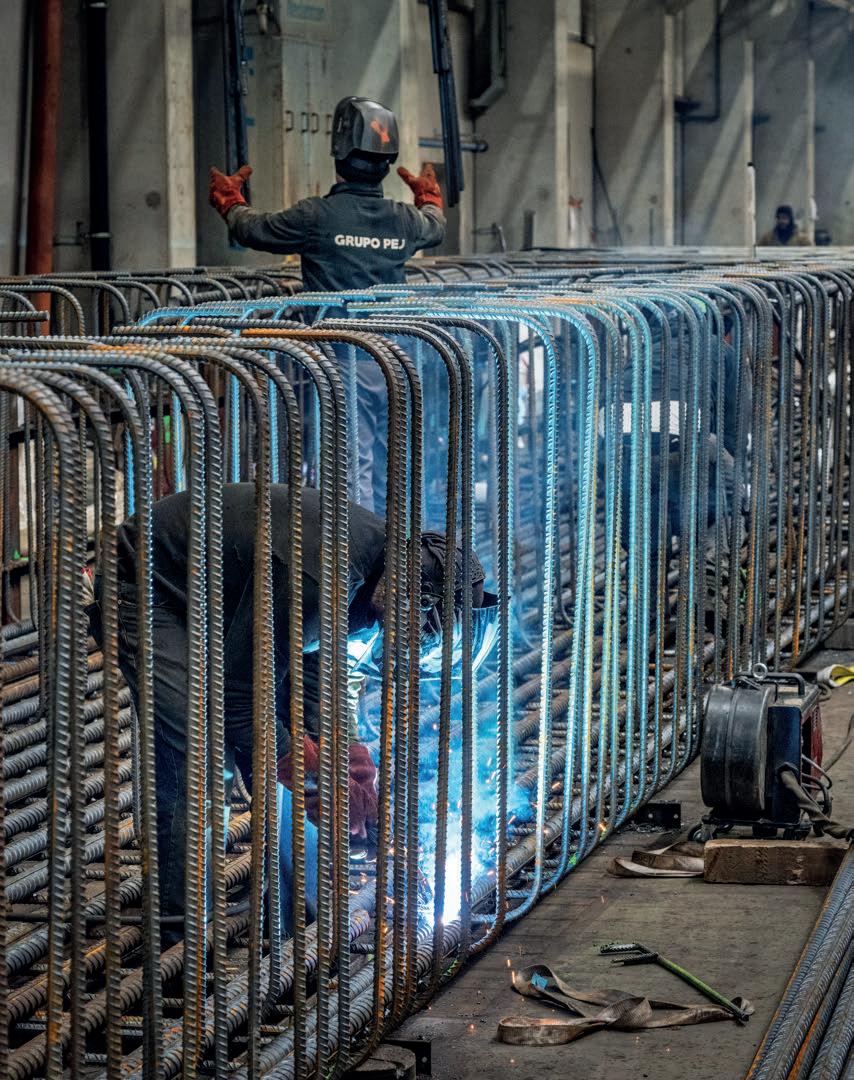
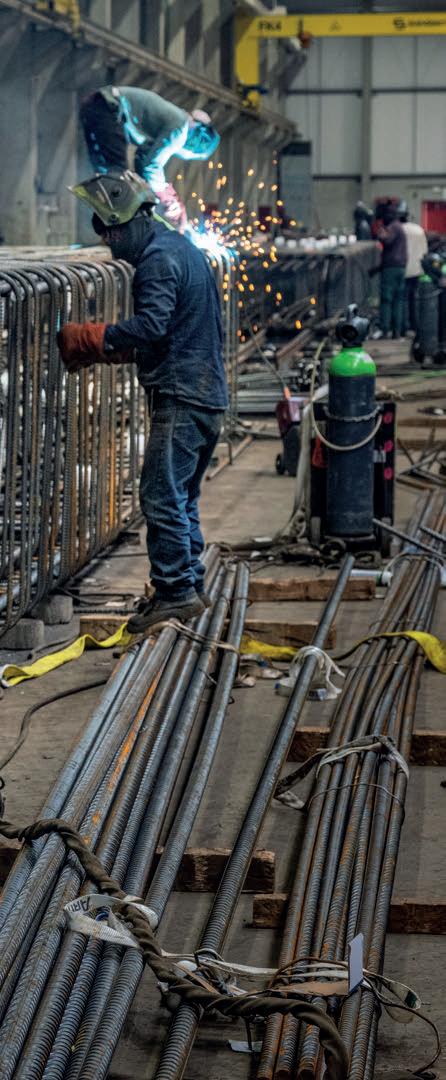
Armasteel’s prefab production hall has been specially designed and equipped to produce large 40t diaphragm walls used in tunnel or quay construction.
Built to withstand
Since relocating to North Sea Port in 2023, Armasteel has evolved from a regional reinforcement specialist into a leading trader and processor of steel for major construction and infrastructure projects. Within North Sea Port, the company benefts from maritime access and extensive commercial networks across Belgium and neighbouring markets.
In addition to cutting and bending reinforcement steel, Armasteel plays a crucial role in sourcing, trading, and distributing high-quality steel products tailored to specifc project requirements. Its integrated logistics and certifed production methods enable it to connect the global steel supply with local construction needs. This strategy positions Armasteel not only as a manufacturer but also as a reliable trading partner within the regional building economy.
A new hub in North Sea Port
Armasteel, originally a subsidiary of steel producer ArcelorMittal, experienced exponential growth since becoming an independent company in 2013, says Vincent Luyten, operations director of Armasteel. “So much so,” he says, “that our original location in Waver was bursting at the seams. With no room to expand and having already stored a large portion of our material in a third-party warehouse in Willebroek, the decision was made to look for a new location. From the beginning, it was clear that our new site needed to be accessible by water to facilitate our imports. Ultimately, we chose this strategic spot in North Sea Port, at the Kluizendok in Ghent, where we built a brand-new production complex. We did transfer some machinery from Waver when we moved here in 2023, but at least half of our equipment is also new, which enabled us to create a nearly automated production process for our reinforcement steel that remains one of our three main activities today.”
Made to order
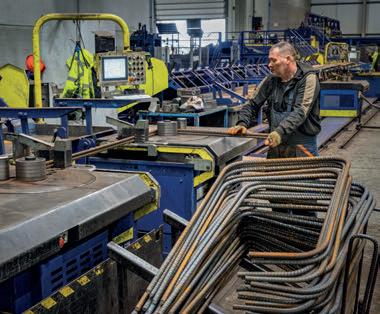
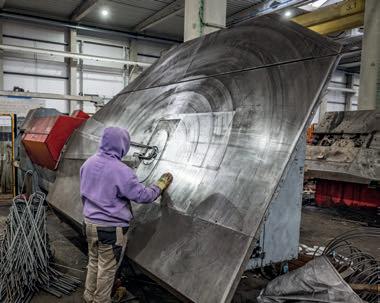
“Armasteel was originally founded in 1971 as a bending centre,” Vincent Luyten explains. “In the world of reinforcement steel, a bending centre is where the steel bars used to reinforce concrete are cut and bent. Today, we remain the largest bending centre in Belgium, and we have been the market leader in concrete reinforcement for roads and roundabouts for many years. We cut and bend steel for large contractors’ construction sites and deliver it directly to the job. This is entirely made to
order: tailored to the customer’s specifcations. As mentioned, our production process is almost fully automated; operators need only supervise it. The only exception is bending, which is performed manually by an employee operating the bending machine. For straight bars, the process is fully automated. The customer supplies us with an order containing all the required specifcations. This information is then entered into our IT system and software package, which sends it to our automatic cutting machine. The machine cuts the bars to size and labels them, after which they are automatically transported to the loading areas, where they are loaded onto delivery trucks using gantry cranes.
“Today, our sales market for reinforcement steel as a bending centre is mainly concentrated in Belgium. That’s not unusual in the bending business, as transport costs for the steel are so high that a bending centre really needs to be able to deliver within a radius of 250km to be proftable. Furthermore, each country requires specifc certifcation, for instance, BENOR for Belgium or KOMO for the Netherlands, which we have both, of course. A particular advantage of our new location in North Sea Port is that we can signifcantly expand our activities towards the Netherlands, which was logistically much more diffcult from Waver.”
Diaphragm wall engineering
“We have also built a large prefab hall here for our second core business: diaphragm walls,” Vincent Luyten continues. “A diaphragm wall, or deep wall, is essentially a very large basket made of woven steel that is cut, bent, and welded. They are primarily used in excavation work, such as tunnel or quay construction. The steel structures are hoisted vertically into a ground shaft and flled with concrete, creating a reinforced concrete wall. This supports the soil on one side while allowing safe excavation on the tunnel side, ultimately forming a permanent wall that allows a tunnel to be constructed. You can imagine that these tunnel engineering baskets are quite large. To give you an idea, the longest deep wall we have ever made was 45m long, in one piece. But that was exceptional. Today, we try to limit the baskets to a standard length of 26.5m, which still requires special transport to the construction site, but without additional escort vehicles on the road. However, the baskets we produce still weigh up to 40t each, so we needed a much larger production hall and storage location to continue growing in this business and handle large projects such as the Oosterweel works we are involved in today. In Waver, we had a total surface area of 2ha, and in North Sea Port, we have 5.7ha. Additionally, we now operate seven production stations, up
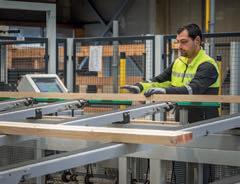
Armasteel’s activities as a bending centre are entirely made to order, cutting and bending steel for large contractors’ construction sites and delivering it directly to the job.
from just one at Waver, enabling us to undertake much larger projects. Currently, we produce around 24 baskets per week, which is substantial, but our production hall has been specially designed and equipped for these large 40t diaphragm walls. We have four gantry cranes installed that can work together, each capable of carrying 10t, and about 50 contract welders are working on these projects. And that’s not even our biggest area of growth since our relocation to North Sea Port.”
Growing in trading
“A third major business branch of Armasteel is our trading activity,” Vincent Luyten explains, “where we purchase large volumes of steel products in trade lengths from Turkey or Algeria and then resell them to smaller bending centres that don’t import them themselves. We used to import through our third-party warehouse in Willebroek, where, incidentally, the canal depth was much shallower than here in North Sea Port. There, we could import ships up to 6,000t; today, with our own site in North Sea Port, we can purchase shipments of 20,000t or more. These larger volumes offer signifcantly better pricing and give us a strong competitive edge. Over the past two years, in partnership with Stukwerkers, we have greatly optimised these operations, already doubling our discharge times.
Additionally, all of this positively impacts our ecological footprint. Nowadays, large shipments arrive via Stukwerkers, who unload the ship and immediately bring the steel here for storage. In the past, shipments arrived at Willebroek, where they also had to be stored, meaning we constantly had three trucks driving back and forth to transfer steel between Waver and Willebroek. Thanks to our move to North Sea Port, we have eliminated about ten truck journeys each day from traffc.”
Sustainable business practices
“Although this is a major ecological improvement, we naturally continue to seek sustainable solutions,” Vincent Luyten adds. “That is why we have covered the roofs of our three production halls with solar panels that supply about 45% of our energy needs. Armasteel’s mission is to be CO2 neutral by 2030. To achieve this, we plan to install a wind turbine on our site in partnership with Luminus. This will signifcantly reduce our carbon footprint, as most of the energy needed for our production process is electrical. Furthermore, we undertake initiatives to compensate for the ecological footprint of our trading activities. More specifcally, Armasteel plants trees for every km travelled during steel transportation. This accounts for emissions from all transport involved in moving steel from point A to point B. Trees are planted in Uganda, Thailand, and Peru to help combat climate change, support biodiversity, and strengthen local communities. Furthermore, we support the well-being and independence of communities in Uganda, Thailand, and Peru through infrastructure development, training, education, and job creation for sustainable incomes. And these are not empty promises: our partnership with Forestmatic ensures trees are planted for every km travelled from the source to the construction site. In fact, every tree we planted is traceable on our Forestmatic profle. At Armasteel, we believe in an ecological approach to entrepreneurship, where growth goes side by side with sustainability.”
I. ARMASTEEL.BE
Armasteel moved to the Kluizendok in 2023, where they built a brand-new production complex, including a brand-new production hall for diaphragm walls.
Vincent Luyten, operations director of Armasteel.
The eyes and ears of the customer
The name Peterson will certainly ring a bell for many people in our industry, as this Rotterdam-based family business has been providing its services since 1920.
Since its foundation, the company’s growth, the core principle has remained unchanged: providing customers with reliable, independent insight so they can operate with confdence. What makes this company so special? Time for a conversation. Dennis Maas has been working at Peterson Netherlands
since 2022 and, since early 2025, as inspections manager.
As a true Rotterdammer, he feels at home with the company.
“Although we are a company with offces around the world and over 6,500 employees, the Rotterdam motto ‘No words, just action’ still truly fts us. I am really proud of this. Despite
Truly unique is that Peterson can also manage the transshipment from seagoing vessels to coastal and inland vessels.
our internationalisation and growth in activities and as an organisation, we are still a real family business with values that come with it, such as people frst, customer focus, and longterm thinking.”
Grain factor
Dennis Maas continues: “What began in Rotterdam with the inspection of grain cargoes has developed into a broad range of services supporting customers in over eighty countries. In addition to controlling and inspecting shipments, we also carry out inspections during storage. Besides inspections, we also handle certifcation and can analyse and assess cargo samples in our own laboratory. What makes us truly unique is that we can also manage the transshipment from seagoing vessels to coastal and inland vessels, and we even have our own inland shipping department with our own vessels and shares in vessels that sail exclusively for us. Finally, if desired, we are also active in pesticides control. In this way, our grain customers –usually traders – can rely on us throughout the entire logistics process, and we have everything in-house to carry this out in a good, reliable, and fast manner.”
Independent
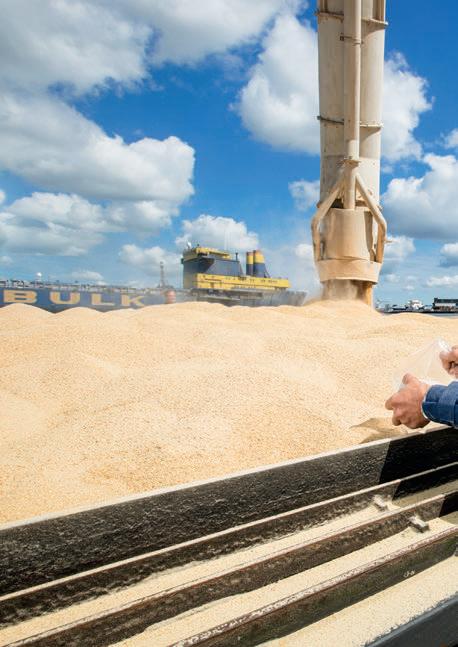
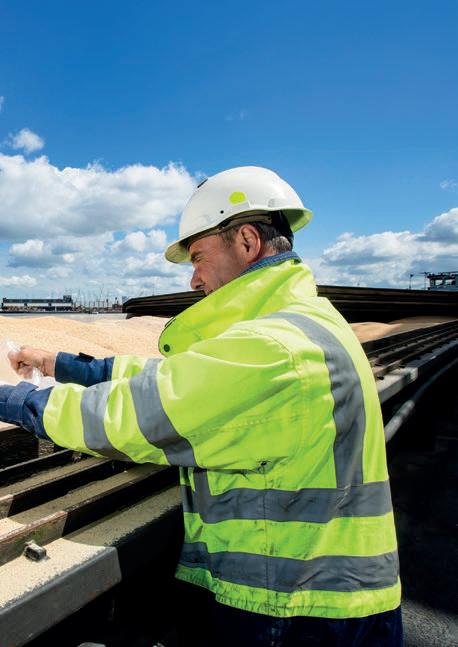
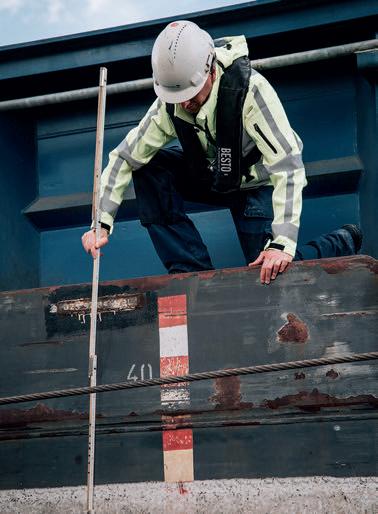
Dennis Maas gives an example: “Suppose a seagoing vessel arrives with grain. We frst take a sample of this grain for analysis in our laboratory. We then organise the unloading of the sea vessel into inland vessels, barges, or shortsea vessels. We take care of the complete discharge planning to ensure that unloading is done quickly and carefully, minimising waiting times. These are things that our chartering department, led by Berend Lensen, keeps a sharp eye on. Precisely because we have everything in our own hands, customers know that we are not pressured by anything. All controls and inspections we perform must be accurate. Customers must be able to rely on that.” Where required, Peterson also conducts inspections at the fnal destination and provides remote monitoring of stored bulk goods through sensor technology. By tracking factors such as temperature, customers maintain continuous visibility of cargo conditions during storage. In practice, this means fewer surprises, reduced risk of deterioration and a stronger position in the event of contractual discussions. Acting as the eyes and ears of the customer throughout the entire logistics process is not a slogan but an operational responsibility. Independence is fundamental to this role. Peterson operates
autonomously and retains a signifcant portion of its capabilities in-house, including inspection personnel, laboratory facilities, planning expertise and logistical coordination. This structure ensures that judgments and reports are not infuenced by external commercial interests. Controls must be accurate, consistent and transparent. Customers rely on these fndings to make operational and fnancial decisions, and that trust is built on integrity rather than marketing claims.”
Other sectors
“All in all,” says Rinus de Bruijn, who has been working at Peterson as sales manager since early last year, “we carry out about 5,500 inland shipments per year, which amounts to approximately 5.5 million t of cargo.” Although grain remains an important part, Peterson has also expanded into other commodities over the years. Rinus de Bruijn continues: “In short, you could say that we divide our activities into three segments. First, the aforementioned control, inspection and certifcation of grain. In addition, we are now also active in the inspection and control of other dry bulk goods, such as raw materials for energy supply. In this context, it is good to know that all power plants in the Netherlands are our customers. We are also active in the control and inspection of fertilisers. Furthermore, we are active in industry, where we perform
Rinus de Bruijn, sales manager (l), and Dennis Maas, inspections manager (r) at Peterson.
technical inspections such as measuring weld thicknesses. Initially, we focused on offshore project cargo, but we are increasingly serving other industries as well.”
In each of these activities, the objective is consistent: to reduce operational risk, safeguard quality and support continuity of supply. Whether measuring weld thickness in industrial installations or supervising the handling of bulk commodities, the focus remains on precision, safety and reliability.
Digitalisation and innovation play a role in all these developments, but always with a clear purpose. Data-driven monitoring, improved reporting systems and remote sensing technologies are implemented to enhance reliability and predictability. Innovation is valuable only insofar as it strengthens operational control and reduces risk within the chain.
Sustainability follows the same principle: by planning effciently, reducing waiting times and preventing loss or damage, practical improvements are achieved that beneft both customers and the broader supply chain.
North Sea Port
According to Rinus de Bruijn, Peterson’s international presence is complemented by its connection to Control Union. “As operations expanded beyond the Netherlands, international activities were conducted under the Control Union name, while
Peterson Nederland continues to operate domestically. Within North Sea Port, for example, Peterson Nederland is active in Vlissingen and Terneuzen, while Control Union Belgium operates in Ghent. The cooperation between these teams is pragmatic and seamless. For customers, this means consistent standards, coordinated execution and a single, dependable approach across borders.”
Profling
Despite its international reach, the company maintains its Rotterdam character: practical, direct and focused on execution. “We remain a down-to-earth Rotterdam company,” explains Dennis Maas, “and we still, so to speak, have our feet frmly on the ground. A well-known saying here is: ‘We are here for the customers, not for the newspapers’. Nevertheless, we now believe that we can profle ourselves a bit more actively. That is why Rinus started working with us last year. He is someone with a long track record in the maritime sector and a large network.” Rinus de Bruijn adds, “As a family business, Peterson prioritises long-term relationships over short-term gains. Investment in people, systems and quality is considered essential to continuity. The objective is not rapid expansion for its own sake, but steady development aligned with customer needs and market realities. As one of the leading players in the market, we want to further expand our market and in our view, we can afford to set aside our modesty a little more often to tell how, in our unique way, we can also act as reliable eyes and ears for new parties.”
When a seagoing vessel arrives with grain, Peterson frst takes a sample of this grain for analysis in its laboratory.
Peterson is active in the inspection and control of other dry bulk goods, such as raw materials for energy supply.
Leader in sustainability
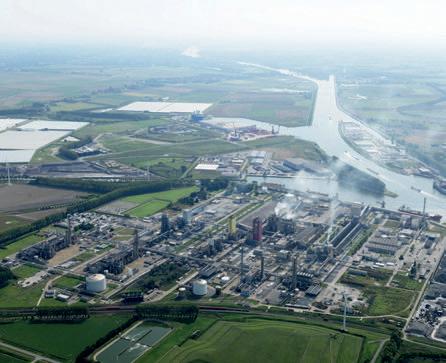
As Europe’s largest fertiliser producer, Yara Sluiskil (Yara) has taken major steps over the years to make its production processes as sustainable as possible. The latest achievement is a unique carbon capture and storage (CCS) project that, starting this year, will lead to an annual reduction of up to 800,000t of CO2.
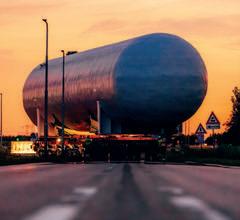
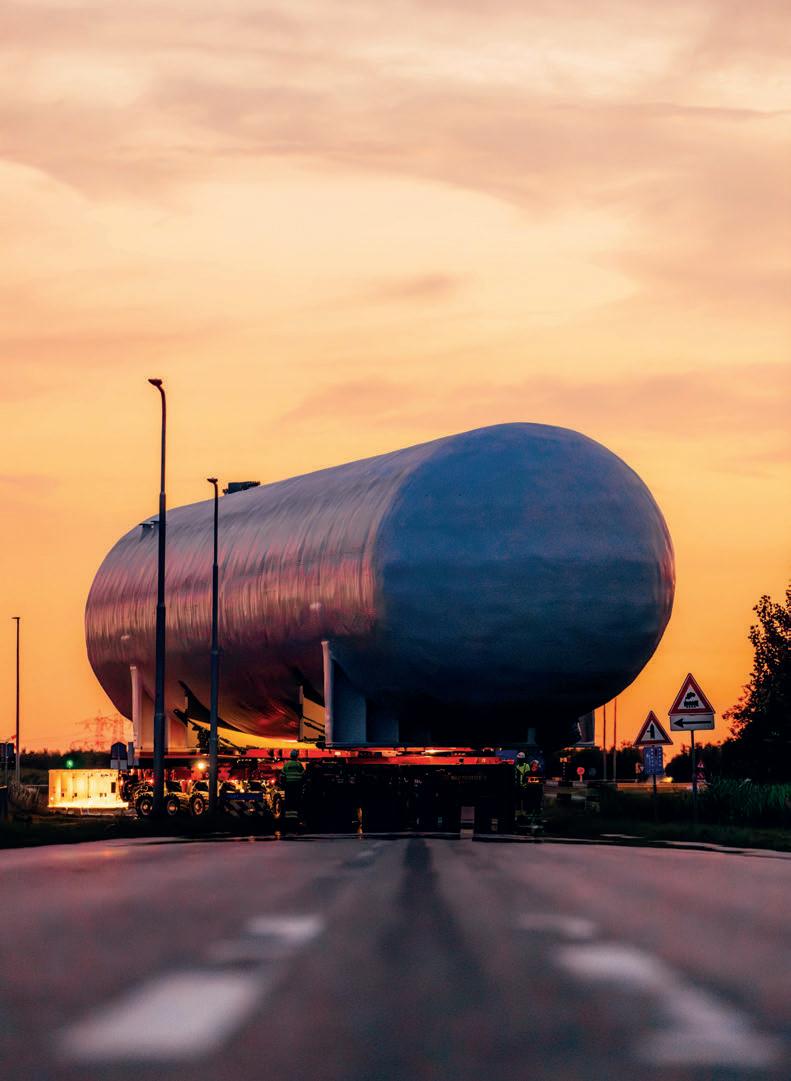
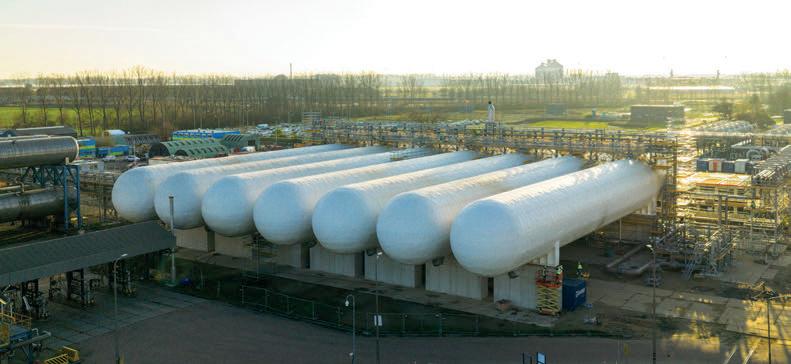
On 20 and 21 June of last year, the last three storage tanks were transported by road to Yara’s site.
Image courtesy of North Sea Port.
Before handing the foor to Luc Cattoir, plant manager of Yara Sluiskil, a brief explanation of CCS. In this process, CO2 is captured, liquefed, and then stored in porous rock formations, so called aquifers, for example beneath the North Sea. This prevents the CO2 from entering the atmosphere and harming the environment.
Yara man
Luc Cattoir updates us on Yara’s CCS project in relation to the many efforts the company has already made to reduce the CO2 emissions. With nearly forty years of service, Luc Cattoir is a true ‘Yara man’. After graduating from HOGent, he started in 1986 as maintenance manager and has since held various positions. Since 2023, he has been plant manager of the Norwegian company’s site in Sluiskil, making him the leader of Europe’s largest fertiliser producer. “I have been working here in Sluiskil for many years and have witnessed numerous developments: the automation and digitalisation of processes, new construction and expansions, and many turnarounds for maintenance. Next year, the largest maintenance shutdown ever is planned, which we are already fully preparing for.”
Down-to-earth
Luc Cattoir continues: “What makes me particularly proud as a Yara man is that over the years, we have always stayed true to ourselves. We have always been a down-to-earth company. Of course, there is a certain hierarchy, but within a very open and fat organisation. This has allowed us to respond fexibly to changing circumstances. I am also proud that our parent company in Norway has always believed in us and continued to invest in our facilities. This has enabled us to make signifcant efforts in recent years to make our production processes more
sustainable, culminating in the unique CCS project, in which the company closely collaborates with Norway’s Northern Lights.” Northern Lights is a special joint project by Equinor, Shell, and TotalEnergies, supported by the Norwegian government and the EU, for the transport and storage of CO2. Due to its scale, it can be called the world’s largest CCS project. “Yara is one of the frst parties to commit to supplying CO2 to the Northern Lights project, and our site is its frst foreign supplier,” explains Luc Cattoir.
Reducing emissions
He continues, “For us, this project can be seen as a provisional highlight of our efforts to reduce CO2 emissions as much as possible. In 1990, the period that I started at Yara Sluiskil, we emitted about 5.2 million t greenhouses gases in Sluiskil, expressed in CO2 equivalents because part of these emissions were N2O (laughing gas) emissions. Today, these greenhouse gas emissions are about 1.8 million t and I foresee less than 1 million t by the time I retire. In the same period, we realised a production increase of about 60%. The CO2 emissions result mainly from the production of hydrogen and ammonia which are produced in the same plant. This specifc large CO2 fow is pure CO2 produced by the cracking of natural gas and water molecules. Over the years, we have already achieved a lot in reducing emissions by using this pure CO2. First, we use CO2 as a raw material for urea, the world’s largest fertiliser volume. Urea also forms the basis of AdBlue, that removes the reactive nitrogen oxide compounds from exhaust gases of diesel engines. With AdBlue we remove about 700,000t of NOx emissions from the air in Europe, which is about 2.5 times the total Dutch NOx emissions. Additionally, we have been supplying CO2 to the food industry for years, for example for
Industrial-scale climate action with Carbon Capture and Storage (CCS)
Europe’s largest ammonia and fertilizer plant now leads the region’s biggest industrial emissions cut.
HOW CCS WORKS
CO2 as byproduct of ammonia production
Yara’s ammonia production relies on hydrogen generated via steam methane reforming (SMR), a process that emits high-purity CO2
CO2 capture CO2 is captured at the ammonia plants using MDEA absorption technology.
Yara’s CCS-project is a true mega project.
Liquefaction
Captured CO2 is compressed and liquefed for safe transport. Yara expanded its liquefaction capacity to handle 800kt/yr.
Temporary storage at the plant
The liquid CO2 will be temporary stored in the storage tanks on site in Sluiskil. There are 7 storage tanks with a total capacity of 15,000 tons.
Loading onto ships
Twice per week, a ship of Northern Lights arrives in Sluiskil and liquid CO2 is loaded from the storage tanks into the ship.
CCS is a strategic investment in Europe’s industrial future Scalable, cost-effcient and compatible with existing hard-to-abate industries, particularly ammonia and fertilizer production.
Transport & permanent storage
The ship delivers CO2 to Øygarden, Norway, for intermediate storage. Subsequently the CO2 is injected into a deep geological reservoir, which has been verifed and approved by the Norwegian authorities.
soft drinks, and our CO2 is used to produce dry ice for the medical sector. Moreover, we supply some of our CO2 to nearby greenhouses on the Axelse Vlakte, where growers use it to stimulate plant growth.”
WESP
Another option Luc Cattoir mentions for reducing emissions is making the production process more sustainable. “We continuously work on optimising our production and reducing our ecological footprint. Recently, we announced an investment in two new WESP installations for two of our nitrate granulation plants. The frst will be operational this year, and the second in 2027. WESP stands for Wet Electrostatic Precipitator. These installations use an additional scrubbing liquid in combination with an electrostatic feld to remove the last traces of ammonia and nitrate-containing dust from the plume generated by the nitrate plants. Because of this, the visible plume will also disappear so that the neighbours will see that we’re working on emission reduction. The new installations will reduce emissions by up to 60t of ammonia and 160t of nitrate-containing dust per year.”
Hydrogen
Yara is also active in the development of hydrogen. “Hydrogen is needed for fertiliser production,” says Luc Cattoir. “Currently, we use natural gas to produce this hydrogen, which is called grey hydrogen. The frst step is to belong to the most effcient plants in the world, the so called European benchmark. And yes, the Yara Sluiskil site belongs to this benchmark! By implementing CCS, we will make the next step to blue hydrogen. This is fossil-based, but a large part of the CO2 is captured and permanently stored, as I explained. We are now working on solutions to replace grey hydrogen with clean, ‘green’ hydrogen. In parallel with the blue hydrogen, we work on smaller scale on this. Green hydrogen can be obtained for biogas were we can valorise the methane as well as the CO2. Biogas fts also in the circular economy to use rest products again as feedstock and keep them in the food supply chain. Another option for green hydrogen is production via electrolysis. This is not new for Yara, because when I started in the company we were operating a 160MW electrolyser in Glomfjord (Norway) and also today, Yara is running a 24MW electrolyser in our plant in Porsgrunn. However, the development of green hydrogen takes time and a market demand has to be develop. Moreover, electrolysis produces only hydrogen and oxygen. We lack the important carbon atom, which comes from methane. Last but not least, the intake of only hydrogen will deteriorate our energy effciency as site. Together, these are reasons we are using CCS for the coming years. At the same time were exploring the next steps after CCS. Overall, our efforts have ensured that, despite signifcantly increasing our production capacity, we have reduced our CO2 emissions by about 65% and will reach almost 90% before 2030.”
Megaproject
CCS sounds simple in principle, but the quantities of CO2 involved and its transport make this a true megaproject, with hundreds of millions of euros invested. “For the CCS project, we frst expanded our liquefaction capacity. We already liquefy CO2 for transport to our customers, but this was far from suffcient for the CCS project. Therefore, we built a new plant, which is currently the world’s largest CO2 liquefaction plant. We also had to increase our storage capacity for liquid CO2. For this, a total of seven tanks were built and installed on our site. On 20 and
Luc Cattoir, plant manager of Yara Sluiskil.
Seven tanks storage tanks, each 58m long, 8m diameter and weighing over 400t, were built and installed.
We continuously work on optimising our production and reducing our ecological footprint.
21 June of last year, the last three storage tanks, each 58m long, 8m diameter and weighing over 400t each, were transported by road to Yara’s site. For this exceptional transport, SPMTs (selfpropelled modular transporters) were used: platform vehicles with numerous wheels, specially designed to move extremely heavy and oversized loads. The storage tanks were produced in Belgium by Geldof and each transported in three parts by barge to Mammoet’s site nearby our premises, where they were welded, isolated and prepared for fnal delivery. A fne example of regional cooperation within our port”, says Luc Cattoir.
Wind energy
“Together, the seven tanks provide 15,000t of storage capacity of liquid pressurised CO2. We will probably not need all the capacity of the CCS plant and storage ourselves, so we are looking for local partners who also want to use it. In collaboration with partners we have the opportunity to build a real regional CCS hub. I would like to highlight the role of North Sea Port, as their support in this is very important to us”, emphasises Luc Cattoir. He continues, “Our capture and storage capacity will soon be enough to fll two ships with liquid CO2 every week. These ships – four have been built by Northern Lights specifcally for the transport of liquid CO2 – are special because they are equipped with a rotor that, in addition to the main LNG propulsion, partially powers them using wind energy. The total loss of CO2 by transport will be about 1 to 1.5%, which makes this modality very effcient and fexible. The frst ship, the Northern Pathfnder, made a festive visit to Sluiskil during her maiden voyage. Shore power has been installed especially for the reception of the ships, so the use of diesel generators is no longer necessary. This is sustainable, preventing nitrogen, dust and noise emissions and is therefore pleasant for local residents in Sluiskil. The CO2 then travels about 800 km to Øygarden (nearby Bergen) in Norway,
where it is temporarily stored in Northern Lights’ collecting tanks. From there, the CO2 is transported via a 110km pipeline to an injection point, where it is ultimately stored in porous stone 2.6km beneath the North Sea bed. A thick layer of shale above ensures that the harmful substance remains safely and permanently stored.”
Relevant player
The entire project is now almost mechanically fnished. “At the moment, the fnal touches are being made, electricity, operation systems, protocols etc. are installed and commissioned. Employees get training for operating the plant and loading facilities. The tanks are already commissioned, and in March, a ship will come to Sluiskil to test the loading installations. A pipeline of 1.4km will bring the liquid CO2 from the plant to the loading point at the quay side. We hope to be fully operational by June of this year. This means we are actually on schedule, which is a great achievement for the 250 people involved in this project. With our low carbon fertilisers, we play a major role in reducing emissions in the global food supply. This project fts perfect in our mission: ‘Responsibly feed the world and protect the planet’. In that respect, we are truly a relevant player as a vital company. We realised early on that to remain relevant for strengthening European strategic autonomy, we also had to work on producing more sustainably, and we are doing well. We are on track to drastically reduce our CO2 and nitrogen emissions toward zero. We are already among the top 10% most effcient plants in Europe, and soon our carbon footprint will be even smaller. The fertiliser we then sell will deserve the ‘low carbon’ label – something we can be proud of as a company and as a region,” concludes Luc Cattoir.
I. YARA.NL
Yara Sluiskil. Europe’s largest fertiliser plant and one of the world’s most effcient plants.
The frst ship, the Northern Pathfnder, made a festive visit to Sluiskil during her maiden voyage.
Shaping the world of tomorrow
While Jan De Nul is still predominantly known for its dredging and offshore operations, the organisation has transformed signifcantly over the years, evolving into an all-round World Builder. Jan De Nul focuses on projects that prepare the world for some of the greatest challenges of our era, including rising sea levels, soil contamination, and the transition to renewable energy sources. Within North Sea Port lies one of Jan De Nul’s strategic hubs that advances the mission of its business unit Planet Redevelopment.
World Builders
“Jan De Nul is active today in three main areas,” says Alexander Van Heuverswyn, business developer Planet Redevelopment at Jan De Nul. “Those are water, land, and energy. Water encompasses, of course, our dredging and maritime infrastructure works. Land encompasses infrastructure projects, such as the reconstruction of the Zaventem ring road. It also includes civil engineering, buildings – such as the new prison in Antwerp, which we are both fnancing and will maintain – and soil, groundwater, and sediment remediation and redevelopment. The third is the energy division, responsible mainly for installing offshore wind turbines and preparing their underwater foundations. This also involves connecting the turbines with underwater electrical cables, interconnectors, that link the wind farm to land and to the wider international grid.
“By combining these three operational areas, we can address complex sites holistically – from underground demolition and soil cleanup to redevelopment and building new infrastructure, setting the stage for new uses. This integration also allows us to act as a comprehensive partner for intricate infrastructure and environmental challenges. Global issues such as climate change, soil contamination, and rising sea levels jeopardise our quality of life. Jan De Nul is dedicated to improving it, creating solutions for the numerous challenges we face as a society.”
Circularity and soil remediation
“Our North Sea Port site in Hulsdonk (Ghent) comes into focus when we zoom in on our land division,” Alexander Van Heuverswyn continues. “Our activities on land focus mainly on civil engineering, infrastructure, and construction. Remediation, carried out by our business unit Planet Redevelopment (formerly Envisan), is an integrated and strategic part of our land-based expertise. Within Planet Redevelopment, Hulsdonk is one of several Jan De Nul soil remediation centres in Belgium and abroad. These centres were initially created to support our diverse operational areas. In water, we dredge contaminated sediments; on land, we excavate polluted soil for civil infrastructure. If not on site, these sediments, soil, and water are treated in our remediation centres, with the aim of maximising valorisation and thereby reducing the use of primary raw materials and landfll. In essence, we promote circularity by treating contaminated soil as a valuable raw material rather than waste. Over the years, our Planet Redevelopment department has grown, serving external clients as well as other Jan De Nul divisions.”
Research and development
“However, our site in North Sea Port is much more than just a soil remediation centre,” Alexander Van Heuverswyn states. “What really sets Hulsdonk apart is that the centre also serves as an innovation hub, where Planet Redevelopment is developing new methods to remove hard-to-tackle pollutants, such as PFAS, more effectively and sustainably, both at our valorisation centres and on-site. Since we perform as much remediation on-site as in our centres, we focus on developing techniques that make both these processes as effcient as possible. We develop and implement biological and physical-chemical treatment methods, as well as in-situ and ex-situ remediation techniques, for soil, groundwater, and sediment, always tailored to the specifc site context.
“In addition, innovations from our R&D department enable us to redevelop contaminated sites in their entirety. For example, we will
Soil and sediments brought to Jan De Nul’s valorisation centre in North Sea Port are analysed, treated and reused as raw material elsewhere, supporting sustainable circularity.
redevelop the Houtdok in North Sea Port into a beautiful site to work and live. The redevelopment of contaminated sites is often a complex project, and the expertise of our Planet Redevelopment team makes all the difference. We invest heavily in R&D and focus on the more diffcult pollutants as part of our key mission to shape a better future. Take PFAS, for instance. We are researching and developing techniques to treat PFAS in soil, groundwater and sediments more effectively and effciently. Our in-house developed foam fractionation unit, developed to remove PFAS from water, is one example.”
Smart remediation techniques
He explains: “Today, activated carbon is used to remove PFAS from water by adsorbing the compounds, after which the saturated carbon is either incinerated or regenerated. Since
activated carbon is expensive and a consumable, we have developed a method to concentrate PFAS, thereby reducing the volume requiring treatment and minimising the amount of activated carbon used. This results in lower costs and a more sustainable remediation. The method, called foam fractionation, employs foam and was developed in Hulsdonk. This technology can be applied at the Hulsdonk valorisation centre, in our mobile water treatment systems, or directly at industrial sites, where groundwater contaminated with PFAS can be treated effciently. Thanks to its compact and modular design, this unit can be deployed on any site, and can be integrated into our mobile treatment plants.
“Another example is soil fushing,” Alexander Van Heuverswyn continues, “where PFAS are literally washed out from the soil. Since not all sites can be fully excavated, we tested both in-situ and ex-situ soil fushing in Hulsdonk. The water used in fushing is subsequently purifed using our foam fractionation method. This demonstrates how all our innovative techniques are integrated into a comprehensive approach.
“Of course,” he adds, “this can only be done with a specifc type of soil, depending on its composition. If we are dealing with loam or clay soil, fushing becomes much more diffcult because these soils are highly impermeable to water. That’s why our R&D Team at Hulsdonk is also developing a method to immobilise PFAS in soil. Since PFAS spreads through water and quickly contaminates soil via groundwater, we tested different binding agents that prevent further spread by fxing PFAS in the soil. This solution is now being tested at a pilot scale with industrial partners, whilst conducting tests at Planet Redevelopment, including simulations, to determine the product’s longevity. We see a bright future for this approach because it eliminates the need for excavation.”
Alexander Van Heuverswyn, business developer Planet Redevelopment at Jan De Nul.
Jan De Nul’s North Sea Port site is a true living lab, where advanced and innovative techniques are developed and tested at an industrial scale before being deployed globally as a full-scale solution.
Sharing knowledge
“Some of our R&D projects are also closely linked with KIS vzw (Kenniscentrum Innovatieve Saneringstechnieken), Flanders’ Knowledge Centre for Innovative Remediation Solutions,” says Alexander Van Heuverswyn. “KIS vzw is a network comprising remediation companies, soil remediation experts, technology providers, universities, research institutions, and government agencies. Its goal is to promote the development of innovative remediation and purifcation techniques for problematic substances in water, soil, and air. Founded in 2023 with Jan De Nul as a founding member, KIS vzw aims to position Flanders as a hub of knowledge and innovation in high-level remediation techniques, with the ambition to deploy this technology internationally. Our North Sea Port site plays a key role in this, as it is where our most advanced and innovative techniques are developed. We also use this location to conduct tests and pilot projects on an industrial scale before deploying full-scale solutions across Flanders, the Netherlands, and globally. It truly is a living lab.”
Living lab at North Sea Port
“Jan De Nul’s valorisation centre in Hulsdonk has been active since 2004. However, Jan De Nul has had a long history with North Sea Port prior to this. One of Jan De Nul’s frst major dredging projects was the broadening and deepening of the Ghent-Terneuzen canal in 1954. Now, its site in Hulsdonk, Ghent, has grown into a strategic link between remediation, circularity and redevelopment – both for Jan De Nul and for the industrial operators in North Sea Port.”
He explains: “As a valorisation centre, we capitalise on the port’s strategic location, multimodal facilities, and water connections. Most soil or sediments brought in are transported by ship. After analysing the soil type, contamination, and concentrations, it is stored for suitable treatment, which may include physico-chemical washing, biological treatment, or lagooning for sediments. Post-treatment, the soil is reused as raw material elsewhere. This highlights an essential function
of our on-site R&D department: minimising landfll waste and maximising valorisation and recycling. Our goal is sustainable global circularity. We have an on-site wind turbine and solar panels supplying green energy. We also perform on-site testing of electrical equipment and electric cranes. This approach is part of the Hulsdonk living lab, where successful methods are scaled up at our other sites and for our customers.
“After all, our customers also greatly beneft from our living lab. For example, they can send us samples for analysis. We then work with them to evaluate all possible remediation options based on the contamination and soil type, and choose the most suitable, customised solution. Moreover, the techniques we develop and deploy can be used across all their sites. For industries in and around North Sea Port, this results in less transportation, lower costs, a smaller ecological footprint, and faster, more tailored solutions developed in an operational context rather than in laboratory conditions.”
Building a better tomorrow
“In conclusion,” Alexander Van Heuverswyn notes, “for Jan De Nul, the Hulsdonk site in North Sea Port is not only a soil and sediment valorisation centre, but also an innovation hub where we team up with our customers to develop the remediation techniques of tomorrow that can be used for contaminated sites throughout Flanders and beyond. And on top of this, it’s a great place to work. Jan De Nul remains a family business, now in its sixth generation. Like many frms, we sometimes struggle to fll vacancies due to labour shortages, but I can confdently say we’re a fantastic employer. Recently, we received the Sport Company Award 2025 for our exceptional dedication to employees’ physical health and for organising diverse on-site sports activities. We offer exciting career opportunities for those interested in local or international work. So, join us to contribute to our mission of building a better tomorrow.”
I. JANDENUL.COM
I. JOBS.JANDENUL.COM
Jan De Nul’s Planet Redevelopment department develops and implements biological and physical-chemical treatment methods, as well as in-situ and ex-situ remediation techniques, for soil, groundwater, and sediment, always tailored to the specifc site context.
Your partner for heavy-duty projects
The Aertssen Group transformed from a local Belgian family business into a globally recognised leader in infrastructure, lifting, project logistics and renewable energy. Starting as a small earthworks company, it expanded alongside major port developments, developing expertise in marine construction and civil infrastructure. Supported by a strong heavy-lifting division, internal logistics, and specialised transport, Aertssen provides integrated solutions that seamlessly combine infrastructure, lifting, and project logistics.
The stones of the family farm
Aertssen Group began its port operations in 1964 with earthworks. Over time, the company expanded, offering transport services mainly for special loads, along with crane services and related activities. Today, the company operates internationally across civil engineering, heavy lifting, transport and logistics, often integrating these sectors into tailored projects and solutions. However, it all started with a farm in a now long-vanished hamlet, says Yves Aertssen, CEO of Aertssen Group.
“My grandparents had a farm in Oorderen, a small village in Antwerp’s port area,” he says. “As the port of Antwerp expanded northwards, Oorderen was slated for removal, similar to what is happening today in Doel. My grandfather Marcel Aertssen, along with my parents and uncles, carefully
dismantled the farm stone by stone, transporting them to Stabroek, just outside of the port area, where our headquarters now stands. Using these original stones, they built a new facility there. From that point on, Marcel Aertssen shifted from farming to contributing to the port’s development, purchasing a dump truck and an excavator, and gradually growing the business with more machinery. Transporting these large machines required special transportation, including heavy cranes, so the company’s activities expanded once again. Over time, even more additional activities were added, fueling the group’s growth. Today, for instance, Aertssen Group is also active in sustainability initiatives, the remediation of industrial heritage sites, demolition projects, and the development of brownfeld sites with historical contamination into new residential or commercial spaces. However, all these activities remain closely
All images courtesy of Aertssen Group.
Aertssen Lifting is active on both sides of the border in North Sea Port, both in rental and in taking on large infrastructure and marine engineering projects, such as these offshore activities in Vlissingen.
tied to our core expertise. The common thread throughout our operations is our emphasis on large-scale, heavy projects –whether it’s heavy lifting, infrastructure, exceptional transport, or logistics – delivering specialised and integrated solutions to our clients.”
Infrastructure and heavy lifting
“Our product portfolio is quite diverse indeed, but can generally be categorised into four main business units: Infrastructure, Lifting, Transport & Logistics, and a smaller Trading segment for used machinery,” Yves Aertssen explains. “Infrastructure activities account for around half of our total group revenue. We started in this sector with earthmoving and have since expanded into marine engineering, demolition, road construction, remediation, and recycling. Recently, we’ve also
made strategic acquisitions to broaden our expertise and offer clients a more comprehensive service. For example, we’ve acquired a foundation company and a dewatering frm, enabling us to deliver fully integrated infrastructure solutions, such as construction pits, where multiple disciplines converge.
“Approximately one quarter of our turnover is generated from crane rental and complex lifting operations,” he continues. “Our activities range from daily to hourly rentals to long-term projects. We carry out highly specialised lifting operations in sectors such as chemicals, petrochemicals, and data centres, where we also focus on manipulating and precisely installing heavy objects. Our lifting operations are carried out by Aertssen Lifting, the business unit that was established following the acquisition of Kranen Michielsen and its merger with Aertssen
Yves Aertssen, CEO of Aertssen Group.
The common thread throughout Aertssen Group’s operations is its emphasis on large-scale, heavy projects – whether it’s heavy lifting, infrastructure, exceptional transport, or logistics – delivering specialised and integrated solutions to its clients.
Kranen. Aertssen Lifting is also a name that better refects the scope of our activities, as we are, after all, more than just a crane rental company. We conduct complex lifting and transportation operations using telescopic and crawler cranes, jack-up and skidding systems, and SPMT transport equipment, without losing sight of our customers who only require smaller or specialised cranes for precise manipulation tasks. Aertssen Lifting was founded to be closer to our clients in three main activities: frstly, crane rental; secondly, industrial services, where we operate on industrial sites with fxed contracts and teams for factory maintenance; and fnally, projects, such as in data centres, bridge engineering, and building offshore wind turbines, including marshalling activities on the quaysides.
“From our location in North Sea Port, we already serve companies on both sides of the border with our heavy-lifting activities, but we aim to explore further opportunities in the North Sea Port area,” Yves Aertssen adds. “ Not only for large infrastructure or maritime engineering projects, but also for the expansion of our activities in the transport and logistics business unit.”
Transport and logistics
“Transport and logistics is a rapidly expanding sector,” Yves Aertssen states. “This unit now makes up about 15% of the group’s revenue. Our transport company specialises in exceptional transport and the movement of heavy, indivisible loads, such as wind turbine components, large infrastructure components, and process equipment for manufacturing plants. We also manage the transportation of construction machinery, for which we developed a new logistics model: we collect machine parts from various global locations, perform
Much more than just a crane rental company, Aertssen Lifting conducts complex lifting and transportation operations, using telescopic and crawler cranes, jack-up and skidding systems, and SPMT transport equipment.
fnal assembly at our logistics hub, and then distribute the fnished machines to end users. In 2020, we established a new equipment processing centre in Verrebroek for our transport and logistics division, conveniently located along the E34 to serve North Sea Port and the Port of Antwerp-Bruges. Also, since mid-2024, our transport and logistics department has been active in Savannah, Georgia, in the US. This initiative was launched at the request of our customers and is performing
Nowadays, we increasingly focus on projects that further support the transition to renewable energy.
very well. We are now operating at full capacity and exploring additional expansion possibilities in the US.”
Big projects in the Middle East
“Our biggest international projects take place in the Middle East,” Yves Aertssen continues, “where we’ve been active since 2006, both with our infrastructure division and crane rental services. These projects resulted from a combination of factors. First, a signifcant amount of equipment became available after Aertssen Infra completed its frst major contract: the Deurganck Dock in the Port of Antwerp. Second, large-scale dredging and land reclamation projects were launched in the Middle East, where our expertise in dry earthworks proved highly valuable. We helped shape the landscape and built protective structures on the islands once the terrain above sea level was established.
“Our frst project in the Middle East was Hamad Port, which was built on reclaimed land in 2006. The area was largely undeveloped with mainly low-rise buildings, where extensive infrastructure works later took place, including roads, tunnels, and bridges. Over the past few years, we have been very active in this area, combining our infrastructure and heavy-lifting expertise.”
Focus on renewable energy
“Nowadays, we increasingly focus on projects that further support the transition to renewable energy,” Yves Aertssen says. “A major project in the North Sea Port area is Terranova, where we have transformed a gypsum waste site in Zelzate into the second-largest solar park in the Benelux. This site now supplies green electricity to 4,000 households. Additionally, we will soon start the construction of a wind turbine there. We are also assessing the feasibility of hydrogen applications in industry or, potentially, for powering our own machinery.
“We strongly emphasise the circular use of materials across all our endeavours, both in our infrastructure works and industrial operations, seeking ways to utilise materials in a sustainable and reusable manner. For example, we focus on water recovery instead of relying on mains water. And within our dewatering company, we focus on circular water management and actively seek methods to minimise water extraction and maximise reinjecting water into the ground wherever possible, rather than discharging it into the sewer system.”
Pioneering in sustainability
“When it comes to sustainability, we aim to take on a pioneering role by developing and bringing sustainable business models to market,” Yves Aertssen states. “We have already tested electric vehicles in nearly every department. Several cases, such as freight transport within port areas, show that electric machinery can be cost-effective. At our logistics site, two electric trucks are currently in operation, supporting port activities. Additionally, a fully electric crane is operational at a customer’s site. As technology improves, deploying electric lifting equipment becomes more practical and benefcial for our customers, particularly in reducing their carbon footprint. Electric trucks
excel in daily container transport along fxed routes. However, exceptional road freight remains a challenge, but we are ambitious and continue to invest, as illustrated by our latest asset: a new electric Mercedes-Benz eActross 600 truck.
“We have developed a roadmap extending to 2030, and ultimately to 2050, with the aim of becoming completely carbon neutral by then. This is essentially an investment in the future. As a family-owned business, we can look beyond short-term results and make long-term decisions, even across generations. For example, twenty years ago, we already invested in shifting towards inland shipping for the transport of construction materials and bulk goods. This perfectly fts within our sustainable vision of moving traffc from roads to waterways wherever possible.
“Furthermore, we believe it is important not only to treat our planet sustainably but also to treat our people sustainably. We consider proper employee training essential for their development. We are growing as a company, and we want our employees to grow alongside it. That is also an important aspect of sustainable business. We are currently recruiting many new employees. We employ around 2,400 employees worldwide, but there are approximately 100 vacancies across our divisions. So we warmly welcome anyone who wants to contribute to our mission. Many people choose Aertssen Group for our sustainable mission and strong family-like character. Aertssen Group is still 100% owned by our family, now in the second and third generations, and we want to project this outwardly as well, because that family feeling is deeply embedded in our organisation. People feel connected, even in an international context.”
I. AERTSSEN.BE
I. JOBS.AERTSSEN.BE
Aertssen Group aims to take on a pioneering role in sustainable business models and continues to invest in new sustainable technologies, as illustrated by its latest asset: this new electric Mercedes-Benz eActross 600 truck.
Actemium – the power behind adaptability
Actemium Goes has been supporting industry for years. Now, in a dynamic market, the company is helping companies to navigate the energy transition.
Actemium operates business units around the Netherlands, providing a wide range of services covering the lifecycle of industrial processes. Active in 40 countries, the company employs in the region of 25,000 specialists.
Stone’s throw from the port
Its business unit in Goes, with its 60-strong team, is focused on providing support to the numerous heavy industrial companies located within a 100km circumference of its offce in Goes, just a stone’s throw from North Sea Port.
The main felds in which the unit works are electrical & instrumentation, workshop panel building, commissioning and, increasingly onshore power supply. Business unit general manager Mark Cosijn introduces the operation explaining, “Actemium Goes aims to be a reliable and active partner for our clients. Our mission is to be the best in the region. We believe that what distinguishes us is our customer-centric, proactive attitude, as well as the overall quality we take pride in delivering.”
The business unit prides itself on its entrepreneurial mindset, something, he continues, that is of great importance at the current time.
“The market is changing a lot right now, especially in heavy industry. There are a lot of challenges facing business. Strong, cheaper competition in China, for example, as well as political uncertainties, especially those surrounding the energy transition.”
Survival of the adaptable
“In times such as these, it’s very important that we are able to think differently, stay focused, stay determined, and continue to surround ourselves with good people – this is how we stay resilient. As Charles Darwin said, ‘It’s not the strongest that survives, but the most intelligent and the most adaptable’. That’s where we place our focus – adaptability. The changes in the market require an organisation that is able to alter its course, sometimes rapidly, in order to continue to provide business what it needs.”
An example of the organisation’s adaptability in action is its growing involvement in onshore power supply. ‘Cold ironing’ as it is frequently referred to in the maritime sectors, allows berthed vessels to access the electrical grid. With this, they are no longer dependent on their generators when in port. Powering the transition
The benefts of this are many and varied. It reduces dependence on the engines, lowering maintenance
requirements and extending life. Noise is reduced, too, which can make working in, or living near a port more pleasant.
The primary advantage, however, is the considerable reduction in emissions on shore power supply offers – almost 100% in many cases.
Track record
Actemium – and the Vinci Group to which it belongs – has already gained signifcant experience in onshore power supply projects.
“Onshore power supply is a good ft for us. It requires engineering, electrical works, and panel building. These are things that are all part of our existing services.
“Plus, as a group, we’ve been involved in 30 projects all over Europe already. With that, our network has developed a lot of knowledge that we are able to tap into.
Besides this, we’ve had direct experience in a number of projects ourselves, including for clients in North Sea Port.
“Of course, as with anything new, there is a learning curve, but the experience we have had so far has given us a chance to optimise our offering; something that the market can really take advantage of.”
Actemium has developed its own strategic approach to onshore power supply, Mark Cosijn states.
Swimming with the tide
“We have established three ‘swimming lanes’ as we call them. The frst of these is to offer a standard solution.”
There are a number of benefts to this, he explains. These include the rapid delivery of a proven, and cost-effective product. At the same time, however, the company realises the need for fexibility.
“It’s the same as when you go to, for example, a telephone shop. You might say you want an Apple iPhone, but then you still want to choose a specifc model. With the 30 projects we have behind us already, we are able to invite our clients to
Actemium Goes business unit general manager Mark Cosijn.
choose an off-the-shelf solution that best fts their needs.”
The second ‘lane’, he continues, features two phases. “The frst of these in engineering. Then, once the customer has approved of the design, we can start construction.”
The third ‘lane’, he says, is the offering of a comprehensive solution – engineering, procurement, and construction (EPC).
Potential in the port
Actemium sees a lot of potential for onshore power supply in the years ahead.
“It’s certainly a market that is growing in relevance,” Mark Cosijn says. “Ports and maritime operators are looking for ways to fulfl their requirements under new regulations.”
An example is the FuelEU Maritime regulations that will require container and passenger vessels above 5000 GT to use shore power from 2030 when berthed.
“This is likely to be pushed back a little,” allows Mark Cosijn, “but it is only a matter of time before it becomes compulsory.
“We see a lot of potential – and certainly here in North Sea Port
where there is a lot of industry and a lot of quaysides. We really believe the area can beneft from onshore power supply, and from our approach to it.”
Working together towards sustainability
As well as beneftting business and the environment, there is another area to which onshore power supply is presenting opportunity – the labour market.
“Today, we see that a lot of people looking to work for companies that are active in the energy transition. People want to be part of a team that is working towards a sustainable goal.”
This, Mark Cosijn states, is an area of great importance to Actemium. “Being an attractive employer is crucial to us. We don’t only want to do the perfect job. We want to do it with the right people. We work very hard to create a culture like this –and to provide our employees with the opportunity to develop their career.”
The company, he says, seeks a balance of experienced and new talent. It is able to offer the right candidate a range of
All images courtesy of Actemium.
In times of transition, Actemium believes that adaptability is key.
In times such as these, it’s very important that we are able to think differently, stay focused, stay determined, and continue to surround ourselves with good people – this is how we stay resilient.
options for the direction of their career.
“As well as a lot of development options, we also have a lot of disciplines. So, regardless of whether you want to be an engineer, a technician, a panel builder or a supervisor, it’s all possible.”
Career success stories
The main thing that the company is looking for, Mark Cosijn continues, is a person who is the right match with the Actemium culture.
“We even have a number of success stories with people who have previously been working in different sectors. If they show the right attitude, they are welcome here and we will provide them with the training and education they need to get ahead.
“We believe skills only account for about 20% of what makes the right person. What’s more important is that they share our entrepreneurial mindset. We are looking for people who share our values including autonomy, ownership, guts and determination. Also, the team spirit is very important – there is no ‘I’ at Actemium, only ‘we’.”
Pleasure in the work
A further important element is the ability to have fun, he says.
“That’s one of the keys to our success. We enjoy the work we do and we also do a lot of social activities together. This includes charity work, but also sports tournaments, BBQs and regular team get-togethers.”
Mark Cosijn is himself a good example of the Actemium work culture, he explains.
“I started at this company 22 years ago as a technician. I’ve now been the general manager of our business unit for nine years. I can personally confrm that there is a lot of opportunity for development here – and a lot of autonomy, too.
“Our parent company provides the direction we should move in, but the vision and the strategic plan comes from below. We are a very ‘bottom-up’ organisation and that makes it very nice to work here. The freedom and the entrepreneurial spirit in the team creates a lot of enthusiasm, and that’s the reason I am still sitting here after all these years.”
I. ACTEMIUM.NL
The company surrounds itself with good people.
Every project is custom-made, which is why HomeFlex’s approach is very fexible.
A place to call home
Over the coming years, several large-scale construction projects are planned within the port area of North Sea Port. This will require thousands of additional workers who need to be housed for longer periods. This puts extra pressure on the already tight housing market in the region. HomeFlex offers a solution.
HomeFlex is an independent provider of living space. The company develops, rents out, and manages accommodation for labour migrants. PortNews speaks with the company’s director, Willem Weggeman, about this.
Great variety
“In 2008, we started buying and renting homes, which we then managed ourselves for renting to companies looking for accommodation for their foreign employees,” explains Willem Weggeman. “Initially, this mainly involved labour migrants working in horticulture and agriculture, but over the years, our market has expanded to other sectors. We soon moved on to building our own residential complexes, making us less dependent on the existing, ever-shrinking housing supply. This way, we have realised a wide variety of projects to date. Every project is custom-made, which is why our approach is
very fexible. For example, our frst new-build project in 2017 in Katwijk, involved about 64 people, while a project constructed in the glasshouse region Westland, consists of living spaces for 400 people.”
Tight housing market
Since 2017, several new construction projects have been realised in various locations across the Netherlands. Willem Weggeman continues: “Currently, we are in intensive discussions with municipalities about some 20 new locations to be built. We sometimes encounter resistance in these talks, because ultimately, suitable space must be found and made available – space that is scarce and can be used for many other purposes. What we emphasise in these discussions is that we actually relieve municipalities of the various problems that can arise from housing foreign workers in residential
All images courtesy of HomeFlex.
neighbourhoods. Often, too many people are placed in one house, which can lead to unliveable conditions and nuisance in the area. Valuable living space is also taken up, which could otherwise be rented or sold to people looking for a home. This is something you really want to avoid in the current tight housing market. Municipalities must balance various interests, and it is good to see that the advantages of our projects are increasingly being recognised.”
Unique
“What makes us unique is that we operate 100% independently and are therefore not bound by the wishes or requirements of employment agencies regarding the homes in which they want to house their people. When it comes to housing labour migrants, you often see undesirable conditions with too many people in a space with limited or even poor sanitary and hygiene facilities. We want to stay far away from that. Another distinguishing feature is that, in addition to being a project developer, we also manage our own complexes. As project developers, we guarantee high-quality housing. All residents have their own sleeping space with full privacy. Shared spaces, such as sanitary facilities, living rooms, and kitchens, only need to be shared with a limited number of people. At the moment, we are also developing studios where you can live completely independently. The advantage of our concept compared to hotel accommodation, which also often happens, is of course that you can cook your own meals and are not dependent on what the hotel has to offer.”
Pleasant place
Willem Weggeman continues, “As mentioned, in addition to being a project developer, we also manage the projects we have built. All our complexes have security and a concierge, and we have our own technical service available 24/7 to resolve any issues. Every three weeks, the homes are inspected by us so we can respond quickly when necessary. This inspection is partly due to our SNF certifcation. SNF is a certifcate that stands for, among other things, privacy and space for residents, good sanitary facilities and hygiene, daylight and heating, fre safety, and information provision. All this ensures that our homes are a pleasant place to stay. At the moment, each resident has 17m² of personal space, which is well above the standard of 15m², but a new project on Goeree-Overfakkee already offers 20m² of privacy. More space is pleasant for the residents themselves, but it is also pleasant for the manager, because it simply causes less trouble when people are not living on top of each other. In this way, we ensure that people feel at home. Municipalities also receive few to no complaints from local residents regarding our projects. And that is exactly what we want: satisfed residents, satisfed neighbours, and satisfed authorities.”
Large projects
Many foreign workers are also employed in the port area of North Sea Port. In addition to permanent staff, these are often people who are temporarily, but often for longer periods, deployed on a project basis, for example during major maintenance shutdowns of factories and new construction or renovation projects at shipyards. In the coming years, many new industrial and logistical construction projects are also planned. Hundreds, if not thousands, of additional people will be put to work for these projects, requiring long-term accommodation. “Many of the temporary foreign employees working in the port live in hotels in Zeeland or are scattered in
Shared spaces, such as sanitary facilities, living rooms, and kitchens, only need to be shared with a limited number of people.
Each resident has their own sleeping space with full privacy.
The SNF certifcation ensures that HomeFlex’s homes are a pleasant and safe place to stay.
Another distinguishing feature is that, in addition to being a project developer, we also manage our own complexes.
residential neighbourhoods,” explains Willem Weggeman. “This is not ideal for the people themselves, but it also puts extra pressure on the already strained housing market. It also results in daily streams of vans transporting people back and forth between their living and work places and by providing housing closer to the port area, you take a lot of traffc off the road. Incidentally, we always agree with municipalities that the people staying in our homes actually work in the region. This is only fair and reduces commuting traffc.”
A governmental task
At the moment, HomeFlex is in talks with various Zeeland municipalities to launch their special housing concept there as well. “We are currently in good contact with the municipality of Terneuzen, and they are quite enthusiastic about our concept. The idea is to start with a small-scale project in Sluiskil. We are also talking to Vlissingen and the province, among others. Within North Sea Port, we also see plenty of opportunities across the border.” Over the years, HomeFlex has learned that things do not happen by themselves. “As early as 2012,” explains Willem Weggeman, “a national declaration was agreed upon that governments, employers, and employee organisations would work on more and better housing for labour migrants. There was already a major shortage of suitable housing at the time, and despite this agreement, the shortage
director of HomeFlex.
has only grown. In my opinion, it is the task of the government, both national and regional, to act as a catalyst, for example by simplifying and speeding up procedures and we continue to emphasise this in our discussions with them. In any case, our concept helps municipalities relieve some of the pressure on the housing market. At the same time, we offer temporary foreign workers, whom companies – especially in Zeeland – cannot do without, liveable and pleasant accommodation. And I think that is something everyone should be enthusiastic about”, concludes Willem Weggeman.
I. HOMEFLEX.NL
Willem Weggeman,
Since 2017, several new construction projects have been realised in various locations across the Netherlands.
North Sea Port: Ghent
North Sea Port: Ghent
Zeekanaal Ghent - Terneuzen: The depth of water in the canal is 13.5 m and there are no currents or tides. Inside the port there are fve large docks and three smaller docks, offering a total quay length of 31 kilometres for vessels up to 92,000 DWT. 22 kilometers with a depth of water of at least 12.5 metres. All the docks have direct access to the canal.
Zeekanaal Ghent - Terneuzen: The depth of water in the canal is 13.5 m and there are no currents or tides. Inside the port there are five large docks and three
smaller docks, offering a total quay length of
31 kilometres for vessels up to 92,000 DWT. 22 kilometers with a depth of water of at least 12.5 metres. All the docks have direct access to the canal.
• Kluizendok: Is a brand-new dock. Has a total quay length of 4,300 metres with a depth of water of 13.5 metres and a width of 350 metres.
• Kluizendok: Is a brand-new dock. Has a total quay length of 4,300 metres with a depth of water of 13.5 metres and a width of 350 metres.
• Rodenhuizedok: Quay on the southern side is 790 metres long with 13.5 metres of depth. Width of 270 metres.
• Rodenhuizedok: Quay on the southern side is 790 metres long with 13.5 metres of depth. Width of 270 metres.
• Mercatordok: Quay is 1,800 metres long with 13.5 metres of depth. Width of 250 metres.
• Mercatordok: Quay is 1,800 metres long with 13.5 metres of depth. Width of 250 metres.
• Alphonse Sifferdok: Quay is 4,800 metres long, with 12.5 – 13.5 metres depth. Width of 300 metres.
• Alphonse Sifferdok: Quay is 4,800 metres long, with 12.5 – 13.5 metres depth. Width of 300 metres.
• Grootdok, Noorddok, Middendok and Zuiddok:
• Grootdok, Noorddok, Middendok and Zuiddok:
Total quay length of 6,855 metres. 6,575 metres with 13 metres depth of water, and 280 metres with 8.5 metres depth of water.
Total quay length of 6,855 metres. 6,575 metres with 13 metres depth of water, and 280 metres with 8.5 metres depth of water.
Width: Grootdok: 150 metres
Width: Grootdok: 150 metres
Noorddok: 200 metres
Noorddok: 200 metres
Middendok: 250 metres
Middendok: 250 metres
Zuiddok: 220 metres
Zuiddok: 220 metres
Zelzate • Ghent •
Zuiddok
Middendok
Alphonse Sifferdok
Mercatordok
Rodenhuizedok
Noorddok
Grootdok
Kluizendok
Zeekanaal Ghent - Terneuzen
• Terneuzen Western Scheldt
• Hoek
North Sea Port: Terneuzen
North Sea Port: Terneuzen
Ghent-Terneuzen channel (Kanaalzone)
Ghent-Terneuzen channel (Kanaalzone)
• Noorderkanaalhaven: North quay: 170 metres; South quay: 192 metres.
• Noorderkanaalhaven: North quay: 170 metres; South quay: 192 metres.
• Zuiderkanaalhaven: North quay: 225 metres; South quay: 230 metres.
• Massagoedhaven: 978 metres.
• Zuiderkanaalhaven: North quay: 225 metres; South quay: 230 metres.
• Massagoedhaven: 978 metres.
• Zevenaarhaven: North quay: 421 metres and 555 metres; South quay: 259 metres.
• Zevenaarhaven: North quay: 421 metres and 555 metres; South quay: 259 metres.
• Axelse Vlaktehaven: 290 metres.
• Axelse Vlaktehaven: 290 metres.
• Autrichehaven: 850 metres.
• Autrichehaven: 850 metres.
Braakmanhaven
Braakmanhaven
Braakmanhaven is part of North Sea Port, located directly on Western ScheIdt with no locks. Four berths for seagoing vesseIs and three berths for inland vessels.
Braakmanhaven is part of North Sea Port, located directly on Western ScheIdt with no locks. Four berths for seagoing vesseIs and three berths for inland vessels.
• Scheldt Jetty: 0ne berth for vessels up to 22,500 dwt or 200 metres LOA.
• Dow’s Scheldt Jetty: One berth for vessels up to 22,500 dwt or 200 metres LOA.
• Oceandock: North and south berths.
• Dow’s Oceandock: North and south berths.
• Zeeland Container Terminal: 185 metres.
• Zeeland Container Terminal: 185 metres.
• 0iltanking Jetties: Jetty 0tter 1 and Jetty 0tter 2.
• EVOS Terneuzen.
• Braakman: Docks A, B and C.
• Dow’s Braakman: Docks A, B and C.
• Westdorpe
Sluiskil •
Zelzate • Philippine •
Sas van Gent
Autrichehaven
Zijkanaal C
Zijkanaal E
Zijkanaal H
Zijkanaal B
Zijkanaal D
Massagoedhaven
Zijkanaal A
Braakmanhaven Zevenaarhaven
Zijkanaal G
Zijkanaal F
• Middelburg
Middelburg
Lewedorp •
Lewedorp •
• Nieuw- en Sint Joosland
• Nieuw- en Sint Joosland
• Oost-Souburg
• Oost-Souburg
• Vlissingen
• Vlissingen
• Ritthem
• Ritthem
W es t ers c he lde
W es ers c
• Nieuwdorp
• Nieuwdorp
’s-Heerenhoek
’s-Heerenhoek
•
• Borssele
• Borssele
Vlissingen port area
Vlissingen
North Sea Port: Vlissingen
North Sea Port: Vlissingen
• Terneuzen
• Sloehaven: Suitable for alI kinds of transshipment including LPG and chemical bulk 920 metres of quay.
• Sloehaven: Suitable for alI kinds of transshipment including LPG and chemical bulk 920 metres of quay. Cobelfret RoRo jetties: Four berths.
• Sloehaven: Suitable for alI kinds of transshipment including LPG and chemical bulk 920 metres of quay. Cobelfret RoRo jetties: Four berths.
• Bijleveldhaven: 1,980 metres of quay. North bank is 300 metres long.
• Sloehaven: Suitable for alI kinds of transshipment including LPG and chemical bulk 920 metres of quay. Cobelfret RoRo jetties: Four berths.
• Bijleveldhaven: 1,980 metres of quay. North bank is 300 metres long. Can accommodate largest reefer vessels.
• Bijleveldhaven: 1,980 metres of quay. North bank is 300 metres long.
• Bijleveldhaven: 1,980 metres of quay. North bank is 300 metres long.
• Westhofhaven: 475 metres of quay. Can accommodate largest reefer vessels. East side jetty for discharging peat and general cargo quay.
• Westhofhaven: 475 metres of quay. Can accommodate largest reefer vessels. East side jetty for discharging peat and general cargo quay.
• Westhofhaven: 475 metres of quay. Can accommodate large offshore vessels.
• Kaloothaven: 1,130 metres of quay.
• Westhofhaven: 475 metres of quay. Can accommodate largest reefer vessels. East side jetty for discharging peat and general cargo quay.
• Kaloothaven: 1,130 metres of quay. Two jetties on south bank, one for inland barges.
• Kaloothaven: 1,130 metres of quay. Two jetties on south bank, one for inland barges.
• Scaldiahaven: Over 1,700 metres of quay. South side used by Verbrugge for handling and storage of cellulose and metals. Transverse quay is 250 metres long.
• Scaldiahaven: Over 1,700 metres of quay. South side used by Verbrugge for handling and storage of cellulose and metals. Transverse quay is 250 metres long.
• Kaloothaven: 1,130 metres of quay. Two jetties on south bank, one for inland barges.
• Scaldiahaven: Over 1,700 metres of quay. South side used by Verbrugge for handling and storage of cellulose and metals. Transverse quay is 250 metres long.
• Van Citterskanaal/haven: Six jetties for inland vessels and coasters. 0n south bank, 275 metres. 0n north bank, 200 metres. Heerema quay: 230 metres and 220 metres.
• Van Citterskanaal/haven: Six jetties for inland vessels and coasters. 0n south bank, 275 metres. 0n north bank, 200 metres. Heerema quay: 230 metres and 220 metres.
• Van Citterskanaal/haven: Six jetties for inland vessels and coasters. 0n south bank, 275 metres. 0n north bank, 200 metres. Heerema quay: 230 metres and 220 metres.
• Scaldiahaven: Over 1,700 metres of quay. South side used handling and storage of cellulose and metals. Transverse quay is 250 metres long.
• Quarleshaven: Extension of Sloehaven to NNE, 315 metres of quay. Set of two mooring buoys on east bank with a span of 320 metres. Zalco quay: East bank, length of 150 metres. Vopak Terminal VIissingen: Four LPG jetties.
• Quarleshaven: Extension of Sloehaven to NNE, 315 metres of quay. Set of two mooring buoys on east bank with a span of 320 metres. Zalco quay: East bank, length of 150 metres. Vopak Terminal VIissingen: Four LPG jetties.
• Quarleshaven: Extension of Sloehaven to NNE, 315 metres of quay. Set of two mooring buoys on east bank with a span of 320 metres. Zalco quay: East bank, length of 150 metres. Vopak Terminal VIissingen: Four LPG jetties.
• Van Citterskanaal/haven: Six jetties for inland vessels and coasters. 0n south bank, 275 metres. 0n north bank, 200 metres. Quay: 230 metres and 220 metres.
• Zeeland Refinery Pier: Located on Western Scheldt. Accommodates tankers up to 100,000 dwt with maximum LOA of 280 metres.
• Zeeland Refinery Pier: Located on Western Scheldt. Accommodates tankers up to 100,000 dwt with maximum LOA of 280 metres.
• Zeeland Refnery Pier: Located on Western Scheldt. Accommodates tankers up to 100,000 dwt with maximum LOA of 280 metres.
• Quarleshaven: Extension of Sloehaven to NNE, 315 metres of quay. Set of two mooring buoys on east bank with a span of 320 metres.
• Buitenhaven: Located outside lock system with direct access to sea, 300 metres of quay. Northern basin has area for coasters and Iighters. Vesta also operates an oil jetty for tankers.
• Zeeland Refinery Pier: Located on Westernscheldt River. Accommodates tankers up to 100,000 dwt with maximum LOA of 280 metres.
• Buitenhaven: Located outside lock system with direct access to sea, 300 metres of quay. Northern basin has area for coasters and Iighters. Vesta also operates an oil jetty for tankers.
• Buitenhaven: Located outside lock system with direct access to sea, 300 metres of quay. Northern basin has area for coasters and Iighters. Vesta also operates an oil jetty for tankers.
• Buitenhaven: Located outside lock system with direct access to sea, 300 metres of quay. Northern basin has area for coasters and Iighters. Vesta also operates an oil jetty for tankers.
Sloehaven
Buitenhaven
Quarleshaven
Bijleveldhaven
Westhofhaven
Van Cittershaven
Van Citterskanaal
Scaldiahaven
Zeeland Refinery Pier
Sloehaven
Buitenhaven
Quarleshaven
Bijleveldhaven
Westhofhaven
Van Cittershaven
Scaldiahaven
Zeeland Refinery Pier
Van Citterskanaal
Kaloothaven
The Promotion Council North Sea Port is pleased to welcome new members. Founded in 1993, the Promotion Council North Sea Port represents members and promote the North Sea Port area. Together they offer a complete range of the best possible port facilities and all the logistics solutions you need. See pages 60-64 for a complete list of members.
meet | connec t | promot e
Members of Promotion Council North Sea Port
5G Multimodal
www.5gmultimodal.com
A.C. Rijnberg transportservice B.V. www.rijnberg.com
aaf www.aaf.nl
Aannemingsmaatschappij Van Gelder B.V. www.vangelder.com
ABN AMRO www.abnamro.nl
AC Timber Trading www.actimbertrading.com
Access World Terminals B.V. www.accessworld.com
Actemium www.actemium.nl
Adriaanse & van der Weel Advocaten www.avdw.nl
Aerssens & Partners www.aenpmakelaars.nl
Aertssen Lifting N.V. www.aertssen.be
Agro Minne www.agro-minne.be
AmSpec PMI B.V. www.polarismarineinspections.nl
ASD Group / Vervaeke www.industrial.vervaeke.be
AXXAZ www.axxaz.nl
Best Hall Benelux www.besthall.com
BMD Advies www.bmdzuid.nl
Boels Rental B.V. www.boels.com
Bolckmans N.V. www.bolckmans.be
Boluda Towage Europe www.boluda.eu
Bouwgroep Peters B.V. www.bouwgroep-peters.nl
BOW Terminal www.bowterminal.nl
Brandwacht Huren België www.brandwachthuren.be
Brandwacht Huren Nederland www.brandwachthuren.nl
Cemminerals N.V. www.cemminerals.be
Clarksons Port Services BV www.clarksons.com
CLdN www.cldn.com
COMCAM International www.comcamenergy.com
Competence Development Center www.bbeu-cdc.org
Control Union Belgium N.V. www.petersoncontrolunion.com
Cordeel Nederland B.V. www.cordeel.nl
C.T.O.B. Transport & Logistics www.ctob-logistics.com
Customs Support Terneuzen www.customssupport.com
Damen Naval www.damen.com
Damen Shiprepair Vlissingen www.damen.com
Danser Group www.danser.nl
DB Cargo Belgium B.V. www.dbgargo.com
DB Cargo Nederland N.V. www.nldb.cargo.com
De Baerdemaecker N.V. www.stukwerkers.com
De Jong Shipping www.dejongshipping.com
De Ruyter Training & Consultancy www.drtc.nl
De Zeeuwse Alliantie Notarissen www.dezeeuwsealliantie.nl
Zéfranco Communicatieservice Frans www.zefranco.com
ZR Company www.zrcompany.nl
ZTZ Logistics B.V. www.ztzlogistics.com
COLOPHON
About PortNews
Covering the port area of North Sea Port, PortNews is the offcial publication of the Promotion Council North Sea Port and port authority North Sea Port.
Circulation and subscriptions
Distributed to a wide international audience, the high quality quarterly magazine promotes the activities of companies active in the ports to key customers, business partners, stakeholders, as well as at major international trade events. PortNews is available in hard copy as well as a digital version. Each issue has approximately 10,000 readers.
Editorial Committee
The content of PortNews is the responsibility of the Editorial Committee. Contact: • John Dane, Chairman, Promotion Council North Sea Port
• Michael Moreau, Communication Manager, North Sea Port
• Charles van den Oosterkamp, Director, OMC Services BV
Special thanks to everyone who kindly contributed their time and expertise to put together this issue of PortNews. Find out more about contributing to future issues of PortNews by contacting Charles van den Oosterkamp, info@omc-services.com, tel. +31 (0)6 10 979 655.
Free subscription or additional copies?
Would you like a free subscription to PortNews, or would you like to receive additional copies of PortNews free of charge for promoting the port and your organisation to your business relations? Please contact the publisher at info@pc-nsp.com or contacteer@northseaport.com.
P.O. Box 132
4530 AC Terneuzen, The Netherlands T +31 (0)115 647 400
John Kennedylaan 32, Harbour 3000A, 9042 Ghent, Belgium T +32 (0)9 251 0550 E contacteer@northseaport.com I www.northseaport.com
Follow us on:
IMPRINT
Copyright 2026. All rights reserved. The contents of this magazine may not be reproduced in whole or in part without the express written consent of the publisher(s). PortNews is a production of OMC Services BV on behalf of the Promotion Council North Sea Port and North Sea Port. The opinions expressed in PortNews are not necessarily those of the Editorial Committee or the publishers. While every effort has been made to ensure the accuracy of information in PortNews, no liability can be accepted for any errors or omissions.
meet | connec t | promot e
P.O. Box 5130
4380 KC Vlissingen, The Netherlands T +31 (0)118 491 320 E info@pc-nsp.com I www.pc-nsp.com