![]()


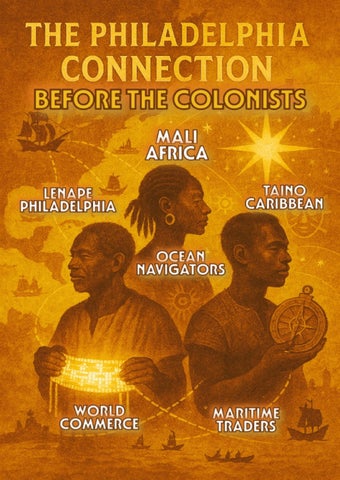
Philadelphia wasn’t just a colonial city — it was the diplomatic capital of three interconnected civilizations:
1. Lenape (Lenni-Lenape) — the diplomats and treaty keepers
2. Taíno — the Caribbean maritime traders
3. Malian navigators — the African sailors who crossed the Atlantic long before Columbus
In this tri continental alliance, the Lenape were the neutral diplomats, the interpreters, the archivists, the ones who carried the WAMPUM belts that encoded agreements between the nations of the World.
Philadelphia’s Wampum was the protocol that held the alliance together.
Philadephia (Lenapehoking) was the Center of International Trade
The Atlantic ocean was originally called the Ethiopen Ocean
The term Oceanus Aethiopicus appears on European maps from antiquity through the 18th century.
It referred to the entire South Atlantic, especially the waters touching:
• West Africa
• The Caribbean
• Brazil
It literally meant “The Ocean of the Black World.” Not metaphorically — explicitly. Colonizers hated it.
Ancient Greeks and Romans used “Aethiopia” to describe all lands south of Egypt, inhabited by dark skinned peoples they regarded with respect, not contempt.
So when early cartographers labeled the Atlantic as the Ethiopian Ocean, they were acknowledging:
• Africa’s maritime presence
• Africa’s geographic centrality
• Africa’s navigators


One-Way Highway West:
The Canary Current Concept Line:
“The Canary Island route could only get Africans to the New World.” This is true in both world history and in Philadelphia’s story.
The Canary Current flows southwest from Morocco and Senegal. It pushes vessels straight toward the Caribbean and Brazil. It is the same current that carries Saharan dust to the Amazon every year.
It is the same current Columbus used — because it was already known. In the pre-Colonial world, Malian navigators mastered this current centuries earlier.
But here’s the key: The Canary Current is a one-way ticket. It can get you to the Americas — but not back home.

And here’s the twist:
The
To return to Africa, a ship must:
• Sail north along the American coast
• Enter the Gulf Stream
• Ride it northeast toward the North Atlantic
• Catch the Easterlies (prevailing winds)
• Arrive back at the Canary Islands
• This is the only natural return route.
The Gulf Stream does not touch the Caribbean directly. You must enter it from the mid-Atlantic coast — the region of the Lenape People of Phildelphia, formerly Susquehanna, PA.
More than just a Trading Post This is how Philadelphia became The Commerce Center Of The Entire Western Hemisphere.

This is not just a concept... it’s a fact and — it’s elegant.
Philadelphia sits at the exact latitude where the Gulf Stream bends east.This means:
Malian ships arriving in the Caribbean (via the Canary Current) Could sail north along Taíno and Arawak trade routes
Reach Lenapehoking and from there, enter the Gulf Stream Which would carry them home to Africa
This made Philadelphia: “The Secret Route Home.”
A hidden,Indigenous-controlled maritime chokepoint. A diplomatic capital.
A place where: Taíno navigators, Arawak traders, Lenape river pilots, Malian mariners…all intersect.
Philadelphia was more than just a Trading Post or a B Wall Street. Philadelphia was the economic capitol of the western world. The Colonists had to change the name of an entire ocean to hold Philadelphia down... they failed. Philly is back.


Taíno & Arawak Navigators
Control the Caribbean Sea
Maintain canoe highways from Puerto Rico to Cuba to Florida Guide Malian ships northward after landfall
Lenape Navigators (Lenapehoking)
Control the Delaware River and mid-Atlantic coast
Know the seasonal shifts of the Gulf Stream
Provide the only safe entry point into the return current Malian Navigators
Master the westbound Canary Current
Bring metallurgy, textiles, astronomy, and diplomacy
Depend on Indigenous knowledge to return home
This creates a tri-continental alliance built on:
Ocean currents
Trade winds
Shared navigation
Mutual respect
And it positions Philadelphia as: The Atlantic’s first global port city — centuries before Europe.

How Taíno Maritime Genius Rescued Columbus—and Was Erased
Columbus described the Taíno as “naked as the day they were born,” yet also admitted their boats were faster than any European vessel. He noted they looked “like Ethiopians,” linking them to African ancestry and maritime skill.
After wrecking the Santa María, Columbus relied on Taíno shipbuilders to salvage two vessels and return to the Canary Islands.

Taíno canoes could carry 50–100 traders, navigating from Florida to Philadelphia. Their vessels were carved from massive ceiba trees, guided by celestial maps, wind patterns, and Saharan dust plumes. These boats were faster, more agile, and more durable than anything Columbus had ever seen.
Taíno navigators predicted Canary Island water routes and traced Saharan wind patterns like modern, hi-tech meteorologists. They used constellations, ocean currents, and migratory birds to guide trade routes across the hemisphere.
After the Santa María wrecked, Columbus was stranded. Taíno shipbuilders helped him reconstruct two vessels and navigate back to Europe, via a route Eurpeans had not known, yet the TAINO People’s name and contributions were omitted (ERASED) from history.

Wampum belts were not decorative objects. They were information systems.
They functioned as:
1. Memory technology — recording lineage, treaties, and historical events.
2. Diplomatic technology — carried by trained Lenape diplomats who could “read” and “speak” the belts.
3. Treaty technology — each belt served as a constitution, a contract, a binding agreement.
4. Status technology — not wealth, but responsibility and relationship.
Wampum was decentralized, verified by community consensus, and impossible to forge without collective agreement. In every meaningful way, WAMPUM was a living blockchain.
Europeans saw beads. The Lenape saw a network.

When Europeans arrived, they interpreted everything through the lens of their own economic systems. They saw:
• beads → currency
• trade → markets
• belts → primitive accounting
But Wampum was not a commodity. It was a protocol. This misunderstanding matters today because the same thing happens with crypto.
People who only understand: speculation, price charts, mining rigs, exchanges…miss the deeper purpose of digital networks.
Wampum was not a speculative coin. Wampum was not a hype token. Wampum was not trying to imitate a coin or dollar.
Wampum was a Blockchain technology, Just like today’s UNI PI.


UNI PI is built on the same principles that made Wampum powerful. The parallels are structural, not metaphorical.
1. Wampum = Proof of Relationship
UNI PI = Proof of Participation**
Wampum recorded who met, what was agreed, and what responsibilities each party carried.
UNI PI records who contributes, who participates, and who strengthens the network.
Both systems reward engagement, not extraction.
2. Wampum = Decentralized Memory
UNI PI = Decentralized Ledger
Wampum belts were distributed, verified by community, and tamper resistant.
UNI PI uses distributed verification, community validation, and transparent records.
Both systems rely on collective truth, not centralized authority.
3. Wampum = Diplomatic Network
UNI PI = Diaspora Network**
Wampum connected Lenape villages, Taíno ports, and Malian navigators.
UNI PI connects African Americans, South Africans, Caribbean communities, and global Diaspora entrepreneurs.
Both networks turn relationships into power.
4. Wampum = Cultural Technology
UNI PI = Digital Cultural Technology**
Wampum encoded identity, memory, and responsibility.
UNI PI encodes participation, contribution, and shared ownership. Both systems are cultural before they are financial.

The global Black Diaspora has always been connected—through trade, culture, migration, and shared struggle. But the economic infrastructure to support that connection has always been fragmented or controlled by outside forces.
UNI PI changes that.
It creates:
• a mobile first economic network
• a participation based token
• a community owned ledger
• a cross border bridge between African Americans and South Africans
• a digital economy rooted in cultural memory
UNI PI is not a new idea. It is an old idea made digital. It is Wampum for the 21st century.
The Marketing Message That Ties It All Together Wampum was the first Indigenous financial network.
UNI PI is the next evolution — a digital Wampum for the global Black Diaspora.
Where Wampum used quahog shells, ceremony, and memory, UNI PI uses mobile participation, digital identity, and Diaspora economics. Both systems turn trust into value and community into power.
This is not crypto for crypto’s sake.
This is cultural technology.
This is legacy technology.
This is the rebirth of a network that predates Wall Street, predates the dollar, predates colonial borders.
UNI PI is the return of a system that Indigenous and African civilizations already mastered.

Philadelphia: The First Diplomatic Capital of the Atlantic World
Long before the United States existed, Philadelphia— Lenapehoking—was a diplomatic center. The Lenape were known as the Original People, but also as the Peacemakers. They were the neutral diplomats who maintained relationships between world nations.
In the tri continental alliance of:
• Lenape (Lenni-Lenape) — the treaty keepers, commerce
• Taíno — the Caribbean maritime traders
• Malian navigators — the African sailors who crossed the Atlantic before Columbus …the Lenape served as the archivists, interpreters, and custodians of agreements. Their tool for managing this network was Wampum.