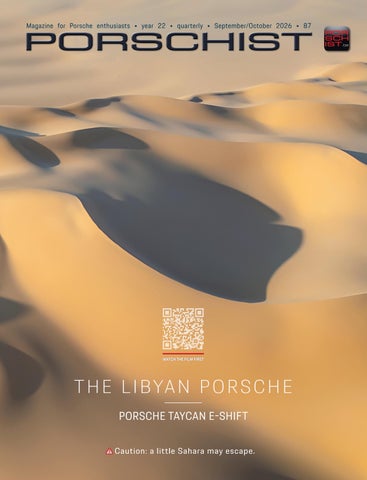
Magazine for Porsche enthusiasts • year 22 • quarterly • September/October 2026 • 87
WATCH THE FILM FIRST
T H E L I BYA N P O R S C H E PORSCHE TAYCAN E-SHIFT Caution: a little Sahara may escape.
TRAVEL
Sand, Oil and Divided Power: The Libya of Today.
Text: Kathleen Van Bremdt - Photos: Sven Hoyaux - Drone: Graatje Weber
For many people, Libya still carries predominantly negative associations: military conflict, Gaddafi-era chaos and danger. But a little research reveals a very different side of the country — one of ancient caravan cities, endless deserts, rugged mountain ranges and beautiful coastlines. When, through a local travel agent, we were put in touch with a Porsche enthusiast from Tripoli and received an enthusiastic email from him saying, “Welcome to Libya!”, we decided to take the plunge. We put together an exciting itinerary and set off into the unknown with a healthy dose of curiosity.
5
TRAVEL Libya is surprisingly close: nestled between Tunisia and Egypt and bordering the Mediterranean Sea. With an area of around 1.76 million km², it is one of Africa’s largest countries. Since 90% of its territory is desert, its roughly 7.5 million inhabitants live mainly along the coast, around cities such as Tripoli, Benghazi and Misrata. Thanks to Africa’s largest proven oil reserves, Libya is theoretically a wealthy country. In reality, however, very little of that wealth reaches the population. Years of conflict and corruption have weakened the economy and prevented a fair distribution of oil revenues. That economic reality is inextricably linked to the political developments of recent years. Since the fall of Muammar Gaddafi in 2011 and the civil wars that followed, Libya has struggled with political instability. The country remains divided between two rival power centres: the internationally recognised government in Tripoli and a competing administration in Benghazi. National elections have been repeatedly postponed, while armed militias continue to wield considerable influence. The country has been under a red travel advisory for years. That does not mean, however, that travelling in Libya is impossible, although caution and vigilance are certainly essential.
6
At the same time, there are some cautious signs of progress. This year, for example, a national budget was approved for the first time in more than a decade. The government is also trying to regain greater control over the administration and economy through reforms and institutional reshuffles. Although the road towards a stable future remains a long one, these developments offer some tentative hope for greater stability and recovery.
The red dashed line shows our route in Libya.
Gaddafi, the eccentric dictator who ruled the country from 1969 to 2011, left an indelible mark on Libya.
Big Brother is watching On arrival at Tripoli airport, we encounter the Kafkaesque Libyan bureaucratic maze for the first time. We have an e-visa and are therefore officially registered. Yet our details are recorded all over again by three different authorities. Completely inefficient, but nobody seems to care. It immediately becomes clear that Libya is a country divided between different power blocs. It takes two hours to complete all the formalities. During that time, we meet Ali, the guide who will accompany us for the next two weeks. He is a sprightly man in his seventies, speaks perfect English and we immediately hit it off. Abdul is also waiting for us. He works for the tourist police. In Libya, foreigners cannot travel around the country without official supervision. Abdul is responsible for all our travel documents and visas. He will make sure that we stick to the pre-approved itinerary and liaise with the local authorities. We are being watched, that much is clear. At the same time, Abdul is also responsible for our safety, although we take that particular aspect with a large pinch of salt, given that he is unarmed.
Tripoli has a long history dating back to antiquity, when the Phoenicians founded the city in the 7th century BC. Tripoli through the ages Tripoli is the capital and largest city of Libya. Its long history stretches back to antiquity, when the Phoenicians founded the city in the 7th century BC. Over the centuries, it came under the influence of the Greeks, Romans, Byzantines and Ottomans, in that order. From 1911 to 1943, Tripoli was under Italian rule as a result of the Scramble for Africa between the European powers. Under Benito Mussolini, Libya was even promoted as Italy’s ‘Fourth Shore’, and tens of thousands of Italian settlers moved to Tripoli and its surrounding areas. As a result, quite a lot of Italian architecture can still be found in the city. During the Second World War, Italian rule collapsed and Tripoli and western Libya came under British military administration, which lasted until Libya gained independence in 1951.
7
TRAVEL
A Porsche in a City Steeped in History We meet Sohail Taher Shawesh, the Porsche enthusiast we had been in touch with before our departure. He surprises us with his stunning 996 Turbo, one of Porsche’s most iconic models. With this eye-catching car, we head into the city in search of Tripoli’s most emblematic landmarks.Our first stop is the Red Castle, overlooking the harbour. The fortress dates back to Byzantine times and was used by successive rulers to defend the city. Today, the complex houses a modern, well-organised museum dedicated to 5,000 years of Libyan history and culture. In a country like Libya, you need to take the time to delve into the past if you want to understand the present. Remarkably, the museum makes no mention whatsoever of the Gaddafi era; it is as though the man never existed. And yet the eccentric dictator, who ruled the country from 1969 to 2011, left an indelible mark on Libya. The Italian colonial period is also completely ignored. Quite odd, really.
With a stunning Porsche 996 Turbo as the centre of attention, we make our way around Tripoli’s most iconic landmarks.
8
Between Decay and Renewal In front of the castle lies the vast Martyrs’ Square. “When Gaddafi gave his final speech here in 2011, the square was packed with people,” Ali tells us. Not far away stands the impressive Arch of Marcus Aurelius, one of the few remaining traces of Tripoli’s Roman past. We wander through the Old City, with its narrow alleyways, colourful souks, historic mosques and mausoleums. Every place we visit proves to be a dream setting for photographs, with the Porsche 996 Turbo stealing the show.
Today, Tripoli is a city of stark contrasts. Two very different worlds coexist in its streets. On the one hand, there are the many bomb-damaged and unfinished buildings — scars left by the 2011 war and the conflicts that followed — giving the city a bleak and neglected feel. On the other, modern buildings with smart, well-kept shops are beginning to appear, signalling cautious economic recovery and fresh investment. Tripoli is therefore a city that is both run-down and evolving at the same time. Another major concern is the fragile security situation. Several armed militias remain active, meaning violence could flare up again at any moment. We can sense the underlying tension ourselves. For people living in Tripoli — and, more broadly, across Libya — daily life is a constant balancing act between normality and uncertainty.
Today, Tripoli is a city of contrasts, where the scars of war stand alongside signs of recovery and modernisation. 9
TRAVEL
Waed: A Young Woman with Ambitious Dreams In Tripoli’s Old City, we meet Waed, a young woman who spontaneously approaches us. She is passionate about photography and asks whether we might have a few tips for her. We are just about to step into a cosy coffee shop, so we invite her to join us. She enthusiastically accepts. For us, it is the perfect opportunity to learn more about the position of women in Libyan society. Waed admits that life as a woman in Libya is not easy. She dreams of travelling, pursuing a career and shaping her life independently, but once she is married, she fears those dreams may no longer be attainable. In effect, she faces a choice between having a family and maintaining her personal freedom — a dilemma that says much about the challenges confronting Libyan women. Yet Waed remains hopeful. She hopes that women will have more opportunities in the future and that their choices will be less constrained by social expectations. We are curious to know whether she is an exception in her outlook. “I’m a bit of an outsider, I suppose,” she admits. “Luckily, my parents accept me for who I am.” We say goodbye, thank Waed for her openness and wish her all the best.
10
Waed hopes that women will have more opportunities in the future and face fewer restrictions imposed by social expectations.
WATCHES & JE WEL L ERY SINCE 1904
NIEUWE LOCATIE LEYSSTR AAT 1, 2000 ANTWERPEN - 03/213 50 80 SCHUTTERSHOFSTR AAT 30, 2000 ANTWERPEN - 03/226 41 44
WWW.SL AETS.EU
TRAVEL
Historic Berber Granaries We leave Tripoli and head northwest. Outside the city, the buildings soon give way to a vast, yellow emptiness. Sand stretches as far as the eye can see. This is the homeland of the Berbers, who call themselves Amazigh or Imazighen. Today, we visit two remarkable structures: Qasr al-Haj and Qasr Nalut. Both are fortified granaries where the Berber population stored for many centuries grain, olive oil, flour and other valuable goods, protecting them from looting. Wealthy families also kept gold and silver there. The complexes were not only available to the inhabitants of the surrounding villages, but also to travellers and pilgrims. Those who returned to collect their goods after some time would leave a small portion behind as payment. In a way, the qasrs functioned as a kind of primitive bank.
12
Although both qasrs served the same purpose, they look strikingly different. Qasr al-Haj, built around the 12th century, immediately stands out for its unique circular shape. Seen from above, the structure resembles a giant wheel, with more than a hundred storage chambers arranged over two levels around an open courtyard. Qasr Nalut looks completely different. The sand-coloured complex is built into a hillside and seems almost to have grown out of the rocky landscape. Its roughly four hundred storage chambers, spread across several levels and linked by narrow stairways and passageways, form a labyrinth reminiscent of a beehive. Both qasrs are magnificent examples of ingenious Berber architecture.
Qasr al-Haj and Qasr Nalut served for centuries as fortified storehouses for the Berber population.
13
The striking wheel-like shape of Qasr al-Haj.
14
Inside, Qasr Nalut looks like a gigantic beehive.
15
16
The ingenious oasis town of Ghadames seen from the air.
TRAVEL
Ghadames: A Masterpiece of Desert Architecture In the far west of Libya lies Ghadames, a fertile oasis in the desert surrounding a natural water source discovered by the Berbers thousands of years ago. From the seventh century onwards, the oasis town took on its present form, with its characteristic whitewashed mud-brick houses. To cope with the extreme heat, its inhabitants created an ingenious urban environment with architecture perfectly adapted to the desert climate. One of the oldest settlements in the Sahara, this ‘Pearl of the Desert’ served for centuries as an important trading post and resting place for caravans. Today, the historic centre remains remarkably well preserved. The families who once lived here only moved to a nearby modern town in the 1970s, where they had access to greater comfort and modern amenities.
With its whitewashed mud-brick houses, Ghadames was ingeniously designed to withstand the heat of the desert.
Old Ghadames is enclosed by a semicircular city wall with several gates that were once closed every evening at sunset. The layout of the town is as ingenious as it is functional. Some 1,500 houses are grouped around seven main streets. Each street leads to a small square that served as a meeting place for residents. Narrow, covered alleyways connect the main streets, while the houses are linked to one another by passages across their rooftops. This created what was essentially a second level of streets. The men moved through the streets below, while the women used the routes across the rooftops. We wander through the impressive labyrinth. Fortunately, we have a guide; without one, we would be hopelessly lost. The fact that Ghadames lies in a fertile area becomes obvious at the edge of the town, where gardens filled with date palms, orange and pomegranate trees provide a lush splash of greenery.
17
TRAVEL Although all the houses now stand empty, one has been specially preserved in its original condition, offering visitors a glimpse into the past. We count four floors. The living and sleeping quarters are downstairs, while the kitchen is located on the top floor. The central living area is colourful and inviting, decorated with carpets and cushions. Numerous small copper plates hang on the walls, reflecting the light. On the rooftops, each terrace has one wall that is higher than the others, allowing it to catch the wind and funnel it into the house. This natural ventilation system, combined with the carefully designed architecture, is ingenious. Inside, it is no less than fourteen degrees cooler than outside. The former inhabitants still have a strong connection to their centuries-old medina. They regularly return for celebrations and family gatherings, or simply to escape the heat during the summer months. We can completely understand their love for this ancient town, because it has an irresistible charm.
18
19
TRAVEL
20
Sunset in the Dunes After a siesta at the hotel, we head out to the towering desert dunes just beyond the city. Algeria and Tunisia are only a short distance away, and Ali points out where the borders of both countries run. We race up the dunes in off-road vehicles, climbing, dipping down, climbing again, then dropping a little lower, until we are almost at the highest dune. From there, it is just a short climb to the top. We settle into the soft sand and wait for the spectacle of the setting sun. Slowly, the orange fireball sinks below the horizon, until all that remains is a gentle golden glow lingering over the desert.
21
TRAVEL
Unexpected Guests at a Libyan Wedding When we return to the hotel, our car is overtaken by a long procession of honking vehicles. It turns out to be a wedding. Before we have even had time to take in what is happening, we are invited to join the celebrations. The party is already in full swing. The groom is dressed in all his finery and is warmly congratulated by everyone around him. Strikingly, we see only men. In keeping with Islamic tradition, the bride and the women are celebrating elsewhere. Music blasts from the loudspeakers, and it is clear that Libyans love to dance. Everyone seems to have their own style and throws themselves into it wholeheartedly. Within minutes, we no longer feel like outsiders, but simply like guests who are genuinely welcome. A wonderful illustration of Libyan hospitality.
An unexpected invitation to a wedding offers a glimpse of the warm hospitality of the Libyan people.
22
CALLA a jewellery icon
CALLA a jewellery icon
S C H A F F R AT H 1 9 2 3 .CO M
TRAVEL
24 Impressive remains of a Roman amphitheater in Sabratha.
Sabratha, Centuries of History on the Mediterranean Libya is renowned for its magnificent ancient Roman ruins along the coast, many of which are now UNESCO World Heritage sites. Sabratha is one of them. The city’s history dates back to around 500 BC. Its first inhabitants were the Phoenicians, who developed Sabratha into an important seaport and trading centre. The Romans later took over that role. Like Tripoli, Sabratha grew into a prosperous city over the centuries. In the 14th century, however, it was struck by a devastating earthquake. Fortunately, not everything was destroyed. The undisputed highlight is the impressive Roman theatre, with a monumental stage measuring no less than 43 metres across. It is estimated that around 5,000 spectators could be seated here. There are also the remains of bathhouses and temples, as well as a spectacular amphitheatre that once accommodated some 10,000 spectators, who came to watch gladiatorial contests and other spectacles. Their cheers seem to be embedded in the very stones.
25 The triumphal arch of Septimius Severus in Leptis Magna.
Under Emperor Septimius Severus (AD 147–211), Leptis Magna could easily rival great cities such as Carthage and Alexandria. Leptis Magna: An Emperor’s Masterpiece Even more impressive than Sabratha is Leptis Magna, the birthplace of Emperor Septimius Severus (AD 147–211). Thanks to his efforts, the city grew into one of the most important and beautiful centres of the Roman Empire. He rightly bestowed upon it the honorary title Magna — ‘the great’. Under his rule, Leptis Magna could easily rival major cities such as Carthage and Alexandria. Our guide has brought along reconstruction drawings showing what the city looked like during its heyday. It must have been a spectacular sight. Remarkably, much of that splendour has survived to this day. The Arch of Septimius Severus, an imposing four-sided triumphal arch richly decorated with reliefs, marks the main entrance to the vast archaeological site. The enormous bathhouses are still clearly recognisable, and even the public toilets are largely intact. We learn that musicians used to perform there to drown out less pleasant sounds. We admire exquisite mosaics and intricate marblework in a rich array of colours, patterns and geometric designs. Almost two thousand years later, they still bear witness to the city’s exceptional craftsmanship and prosperity. As we wander among the monumental ruins, we find ourselves wondering how builders, using the technology available to them at the time, managed to create such extraordinary structures. Leptis Magna leaves a profound impression and is without doubt one of the most spectacular archae ological sites in the world.
TRAVEL
Car Trouble and Checkpoint Anarchy Today’s itinerary involves a long journey: around 700 kilometres south, taking us deep into the Sahara. The car is not what we were promised: no air conditioning, uncomfortable seats and too little luggage space. On top of that, it runs on diesel, which is not only unusual for a passenger car in Libya but also highly inconvenient, as there are few petrol stations where diesel is available. Our driver therefore carries two jerry cans of fuel, which he uses to top up the tank twice along the way. Fairly unorthodox, but at least we can keep moving. That is, until things go wrong after just an hour and a half. The car is leaking oil. The driver starts tinkering with the engine and appears to take almost the entire thing apart. After securing ‘something’ inside the engine with a piece of wire he has found by the roadside, we think to ourselves, this is not going to end well. Yet he signals that we can continue. And, remarkably, the car makes it through the rest of the journey without a hitch.
26
What does cause us problems are the numerous checkpoints where we are invariably pulled over. Everywhere we go, Abdul has to produce documents proving that we are authorised to be in the region at that particular time. We had been told beforehand that we would need offi-
One of the many checkpoints.
cial permits for every location. At the time, that sounded excessive and even somewhat implausible. Now we realise just how crucial those papers are. We are monitored by three different authorities: the army, the militias and the police. Sometimes all three are present, sometimes only one. There is, however, a clear hierarchy: the army is at the top, followed by the militias. The police have the least authority. At one checkpoint, things get heated. According to the militia group, our number plate does not match their records. For an hour and a half, the two sides argue back and forth. Just when we think we will have to turn around and head back to Tripoli, we are suddenly waved through. Why? Your guess is as good as ours. It is a telling example of how arbitrarily these militias exercise their power. They can obstruct you without warning, and there is nothing you can do about it. The fact that they are always present in groups, with Kalashnikovs slung casually over their shoulders, makes us distinctly uneasy.
A B R E AT H O F F R E S H A I R
A hotel in the dunes A place to relax H O T E L . R E S TA U R A N T . S PA & W E L L N E S S . B A R B R A S S E R I E C A D Z A N D . T H E N E T H E R L A N D S . + 3 1 1 1 7 3 9 2 0 4 0 . W W W. B L A N K E TO P. C O M
TRAVEL
Suleman
Ali
Abdol
A Rough Night, a Golden Morning
28
It is already evening when we reach Brak, a small village marking the gateway to the Sahara. Here we meet the desert team that will guide us for the next six days. The team consists of five people, all Tuareg from the region, recognisable by their distinctive turbans. There are three drivers, including Suleman, the team leader, as well as a cook and a kitchen assistant. We transfer to rugged 4x4 pickups whose cargo beds are packed to the brim with tents, mattresses, blankets, cooking equipment and provisions. The Libyan desert is an unspoilt wilderness. There are no hotels here. Wild camping is the only option. From now on, luxury takes a back seat to natural beauty and adventure. Our first night is challenging from the outset. Around midnight, a fierce sandstorm blows up. Because it was warm, we had left the
We invariably pitch our tents in the most beautiful spots.
tent partly open, relying only on the mesh panel. We regret that decision almost immediately as sand lashes relentlessly into the tent and we are practically sandblasted. With great difficulty, we manage to zip the outer canvas shut. The wind tears at the tent, and we can only hope it will hold. The next morning, we crawl out of our tent bleary-eyed. But the moment we see where we have spent the night, we are wide awake. What a setting! Towering sand dunes rise all around us as far as the eye can see.
TRAVEL
Face to Face with Giants of Sand This is Idehan Ubari, or the Ubari Sand Sea, and the landscape is simply breathtaking. After breakfast, we drive for hours through an endless desert, zigzagging between and over towering sand dunes. The highest ones reach as much as 200 metres. We have seen plenty of dunes before, but never on this scale. This is the Sahara as you would normally see it only from an aeroplane window. Suleman and the other drivers display exceptional skill behind the wheel. Their driving has a lot in common with sailing. They steer the pick-ups diagonally up and down the dunes with remarkable precision, constantly adjusting their course as they climb and descend. How Suleman finds his way across this endless sea of sand, with barely a landmark in sight, is a mystery. He seems to have been born with an internal compass. At one point, we get stuck and find ourselves balanced precariously on the crest of a dune. Suleman grabs a shovel and the rest of the team rushes to help. After some serious digging, we manage to free the vehicle. An exciting interlude that proves just how important the other two vehicles are. Out here, having a backup is essential.
Surreal Lakes 30
The Ubari Sand Sea is one of the most spectacular desert landscapes in the world.
And then, seemingly out of nowhere, they appear: lakes that look like mirages, their turquoise-green waters sparkling in the desert sun, fringed by palm trees and reeds. You would be forgiven for doubting your own eyes. But they are real. The Ubari Lakes form a chain of sixteen small, permanent lakes. They lie hidden in basins shaped by tectonic activity and erosion. These natural reservoirs collect the scarce rainwater and groundwater from the surrounding region. It is only from the air, captured by our drone, that the intricate patterns and countless shades of blue and green in the water truly reveal themselves. A natural masterpiece painted by algae.
For a moment, we are stuck on the crest of a dune.
Photographed from the air, the surreal beauty of the Ubari lakes truly comes into its own.
32
TRAVEL
The Otherworldly Landscape of Meghidit The landscape changes. Contrary to popular belief, the Sahara is not made up entirely of sand and dunes; they account for barely a quarter of its surface. The rest of this vast desert, covering nine million square kilometres across no fewer than eleven countries, consists of immense gravel plains, rocky deserts, stone plateaus and barren mountain ranges. The Sahara has many faces. Here in Meghidit, bizarre, dark-grey rock formations rise from the sand like natural sculptures, stretching as far as the eye can see. Local people call this extraordinary place the City of Ghosts. As we wander through it, every turn reveals another breathtaking panorama. Fascinated by the sheer beauty around us, we keep walking until we suddenly realise that we are completely disoriented. Fortunately, our footprints in the soft sand show us the way back. We realise that if you get lost here, there is little chance of finding your way out. Over thousands of years, the interplay of rock, sand and wind has sculpted Meghidit into a natural wonder. In this surreal setting, the kitchen team sets up our lunch. We cannot imagine a more beautiful place to eat.
In Meghidit, bizarre, dark-grey rock formations rise from the sand like natural sculptures.
33
TRAVEL
The Hidden Treasures of Tadrart Akakus From Meghidit, we travel deep into the Tadrart Akakus Mountains. Here, in this remote corner of the world, traces of a distant past remain remarkably tangible. In secluded caves and beneath sheltered rock faces, the secrets of vanished peoples have survived for more than twelve thousand years. Ancient rock paintings and petroglyphs tell the story of a time when the Sahara was not a desert, but a fertile, green savannah where humans and animals could thrive. Images of gazelles, elephants, giraffes and hunting nomads provide irrefutable evidence of this lost paradise.
34
The impressive Afzgar Arch in the Tadrart Akakus massif.
Alongside its archaeological treasures, the Akakus Mountains are renowned for their extraordinary beauty. The massif is made of sandstone, a relatively soft material that has been patiently moulded by wind and erosion into remarkable shapes. One of the best known is Adad, the ‘Thumb Rock’, in which we can indeed make out a gigantic raised thumb. Elsewhere, centuries of erosion have carved immense natural arches. The spectacular Afzgar Arch, a gigantic arch rising some 60 metres high, is the most impressive geological formation in the region. High in the mountains, we set up camp for our final night in the Libyan Sahara. From our campsite, we look out across a spectacular, seemingly endless valley. It takes little imagination to picture a scene from Jurassic Park or Avatar here; the landscape is perfectly suited to either film. As the sun slips behind the distant mountain ridges, we become acutely aware of the absolute silence. No rustling wind, no whispering trees, no birdsong… nothing but silence and profound tranquillity. It is an almost sacred experience.
In the Tadrart Akakus Mountains, ancient rock paintings tell the story of a vanished world.
35
TRAVEL
One Last Look at Libya Travelling through Libya today is like balancing on the crest of a sand dune: thrilling as it is unpredictable. Libya is a country of extremes, mysteries and contrasts. It is the unease of armed checkpoints versus the serene silence of the desert. It is the restraint of a traditional society versus boundless hospitality. It is the chaos of a capital in need of rebuilding versus the otherworldly beauty of nature. Modern-day Libya is a country of many faces, caught between a turbulent past and an uncertain future. We leave with sand in our clothes, but above all with a wealth of unforget table impressions and experiences. ♦
Travelling through Libya today is like balancing on the crest of a dune: as thrilling as it is unpredictable.
36
Phenomenal panoramas in the Tadrart Akakus Mountains.
With thanks to: - Turkish Airlines - Ali Alboishi, our fantastic guide Tel: +218 91-323 3135 E-mail: najwaali2018@gmail.com
Scan the QR code and watch the video accompanying this article.
WHERE BUSINESS MEETS BENEFITS Business travel meets benefits. Those who sign up for the special program with Turkish Airlines Corporate Club membership enjoy exclusive advantages and privileges. Join now without any fee or commitment and don't miss out on the opportunities.
ADVANTAGES
PRIORITIES
Special Discounts
Fast – Track
Flexibility
Priority Check-In
Free Standard Seat Selection
Priority Boarding
Extra Baggage Allowance
Personal Touchpoint
Corporate Help Desk Miles&Smiles Elite Corporate Card Lounge Access
Scan the QR code, apply now!
For further information corporateclub@thy.com
INTERVIEW
Sohail Taher Shawesh,
the Man Who Saves Porsches.
40 Sohail Taher Shawesh
From a toy Porsche in a cereal box to a striking 996 Turbo in the heart of Tripoli. The story of Sohail Taher Shawesh, a man for whom every car has a story, a challenge and a piece of history.
All our travel features begin long before we arrive at our destination. Our trip to Libya was no different. Months before departure, we were already working on obtaining the necessary visas, permits and security clearances, while also searching for a local Porsche owner. That was no easy task in Libya. Until, one day, an email arrived from Tripoli. The sender: Sohail Taher Shawesh. His message read: "In a country where one's energy is often consumed by the daily struggles of life, I have chosen never to lose sight of my childhood passions. I consider it a blessing to be able to share those passions with others. I own several Porsches, each with its own story and character, and I am delighted to take part in your reportage. You are most welcome and I will do my best to make this a memorable experience." A month and a half later, we meet the man at the Radisson Blu Hotel in Tripoli. Before the coffee has even reached the table, the conversation has already turned to engines, restorations, auctions, racing history and childhood memories. Some people own cars; Sohail lives for them.
"I want to understand cars inside and out." Sohail Taher Shawesh
A Passion That Started Early Sohail was born in London, where his father was studying medicine. The family lived in England for many years before eventually returning to Libya. Sohail’s father was not only a doctor but also a passionate car enthusiast. For years, his pride and joy was a BMW powered by a six-cylinder engine. As a child, Sohail didn’t understand what a six-cylinder engine was, but he could sense how much the car meant to his father. Family movie nights also left a lasting impression. While Bullitt played on television, his father explained why Steve McQueen’s Mustang was so special. Even then, the foundations were being laid for Sohail’s lifelong passion for cars. His great love for Porsche began in the most unexpected of ways: with a cereal box. Inside were three toy cars: a Ferrari, a Jaguar and a Porsche 964. His brother chose the Ferrari, his sister the Jaguar, and Sohail got the Porsche. "I normally destroyed all my toys, but I treasured that Porsche," Sohail recalls. Ever since he saw a Porsche 944 as a teenager, his love for the marque has been unshakeable.
41
INTERVIEW
42
From Student to Self-Proclaimed Restorer
The Porsche That Brought It All Together
Like his father, Sohail initially studied medicine, but his attention was increasingly drawn to cars. While his fellow students were studying anatomy, he devoured car magazines. A visit to the garage with his father’s Mercedes S-Class proved to be a turning point. Much to his annoyance, he discovered that some of the parts had been secured with wood screws. He simply couldn’t accept that. Right there and then, he decided that he would never be dependent on others. He immersed himself in automotive mechanics and set out to understand cars inside and out.
Today, Sohail owns several Porsches, but the undisputed star of the collection is his Porsche 996 Turbo. The story behind the car is particularly special. He discovered it by chance on an American auction website. Without knowing the owner or having any reliable information about the Porsche, he decided to bid based solely on a handful of photographs. After an hour, only two bidders remained: Sohail and a collector from Ukraine. The bids kept climbing. Eventually, Sohail won.
His thirst for knowledge gave him an impressive level of technical expertise. At the same time, more and more cars found their way into his garage: BMWs, Jaguars, Mercedes-Benzes and, of course, Porsches. Often, they were cars that others had given up on, because where most people saw problems, Sohail saw challenges. He would drive hundreds of kilometres across Libya without hesitation if someone tipped him off about an interesting car. He calls it "saving automotive history".
"If I can’t spend two hours a day among my cars, something is missing." Sohail Taher Shawesh
When the Porsche arrives in Libya several months later, it turns out that there is still plenty of work to be done. For many buyers, that would have been a disappointment. For Sohail, that was when the fun really began. He spent months working on the car. Parts came in from Europe and the United States, mechanical problems were sorted, the transmission was rebuilt and the interior was refurbished. Step by step, the Porsche was brought back to life. The striking Gulf livery completes the transformation. Our feature coincides with one of the car’s first drives following the restoration. Wherever the Porsche appears, heads turn. Smartphones come out, motorists slow down and children excitedly point at the brightly coloured 996 Turbo. Sohail smiles and savours the moment. When we ask him why he agreed to take part in our feature, his answer is immediate: "I didn’t have to think about it. You probably only get an opportunity like this once. I couldn’t let it pass."
More Than a Hobby During the day, Sohail represents an Italian humanitarian organization. After office hours, he heads to his garage and gets to work. "If I can’t spend two hours a day among my cars, something is missing." His ultimate dream? To one day drive one of his Porsches to Italy. And if there is room for one more model in his collection, it will be a 993 Turbo S. When the last photographs have been taken and evening falls over Tripoli, Sohail walks around his 996 Turbo admiringly for what must be the umpteenth time. He checks a detail, studies the reflection in the bodywork and smiles with satisfaction. For some people, a car is simply a means of getting from A to B. For Sohail, it is a passion that began with a toy car in a cereal box and, more than thirty years later, burns as brightly as ever. ♦
INTERVIEW
Ali Alboishi,
the Man Who Opened Libya to Us.
44
For two weeks during our journey through Libya, we were accompanied by Ali Alboishi, a fit man in his seventies who showed us the many faces of his country with unmistakable enthusiasm. From the medina of Tripoli and the Roman ruins of Leptis Magna to the endless sands of the Sahara, he seemed to know the right people everywhere. Closed doors opened, permits appeared just in time, and he even managed to arrange a photoshoot with a Porsche on Tripoli’s iconic Martyrs’ Square. As the journey unfolded, we discovered the remarkable life story of the man who had made so much of it possible.
Ali Alboishi
A native of Tripoli, Ali originally trained as a communications engineer, specialising in microwave and satellite communications. In the 1970s, the Libyan government sent him to Japan for further training. There, he not only learned Japanese but also met his future wife. Alongside his professional career, Ali built an impressive career in the world of judo. He attained 6th Dan, a master rank awarded only to a select number of judoka. Holders of the iconic red-and-white belt are recognised not only for their profound technical expertise but also for their outstanding contribution to the sport of judo. Ali went on to become a respected international referee, representing Libya at numerous international championships. Thanks to his language skills, he was also regularly called upon to act as a liaison for foreign delegations.
"Whether someone is a president or an ordinary citizen, everyone is equal during training." Ali Alboishi
From Judo to Gaddafi’s Inner Circle That combination of sport, discipline and language skills eventually brought him into the orbit of one of Africa’s most controversial leaders: Muammar Gaddafi. In the late 1980s, Ali and a select group of instructors were asked to teach martial arts techniques to the Libyan leader’s bodyguards. According to Ali, Gaddafi wanted his security forces to be better prepared for potential attacks without relying exclusively on firearms. For several months, Ali trained both male and female members of the security detail. "For me, Gaddafi was not a leader, but a student," he recalls. "Whether someone is a president or an ordinary citizen, everyone is equal during training." He shows us an old photograph of himself standing alongside Colonel Gaddafi at Bab al-Azizia, the Libyan leader’s famous residential compound in Tripoli. The picture was taken during the 23rd African Judo Championships, held in Tripoli in October 2001. Ali was there as an international referee. He still keeps his original accreditation badge as a memento. According to Ali, all the participating delegations, coaches, officials and athletes were invited to Bab al-Azizia for an official reception hosted by Gaddafi. During the gathering, the Libyan leader personally addressed those present. Afterwards, the visitors were given a tour of the parts of Gaddafi’s residence that had deliberately been left in ruins following the American air strikes of 1986. Twenty-five years on, Ali looks back on that period with a touch of nostalgia, but he prefers to steer clear of political discussions. Instead, he is keen to emphasise the hospitality of his country and its enormous tourism potential, which he believes remains largely undiscovered. "Libya has everything," he says. "Roman cities, deserts, oases, history and friendly people. I hope more and more visitors will come and discover it for themselves."
45 Ali Alboishi on the right side of Gaddafi.
he took charge of situations and stood up to security forces when they became difficult — something few others would have dared to do. He had an uncanny ability to read people and always found the right tone: sometimes soothing, usually friendly and, when necessary, uncompromising. The result was that he invariably got what he wanted.Without him by our side, we could never have travelled across Libya in the way we did: adventurous, carefree and filled with wonderful, unique moments we would otherwise never have experienced. Thank you, Ali. Not only for being our guide, but for showing us your Libya. ♦
An Indispensable Travel Companion We certainly share that hope, and we hope Ali will be their guide. Because he was so much more to us than a tour guide. He was our anchor, our rock, our interpreter and more than once our guardian angel. "I’m only satisfied when you are satisfied," he would say, and he always went to extraordinary lengths to make that happen. Warm and approachable, he also knew how to set boundaries and naturally commanded respect. With his innate authority,
Ali was more than just our guide. He was our anchor, our rock and more than once our guardian angel.
www.porschist.be