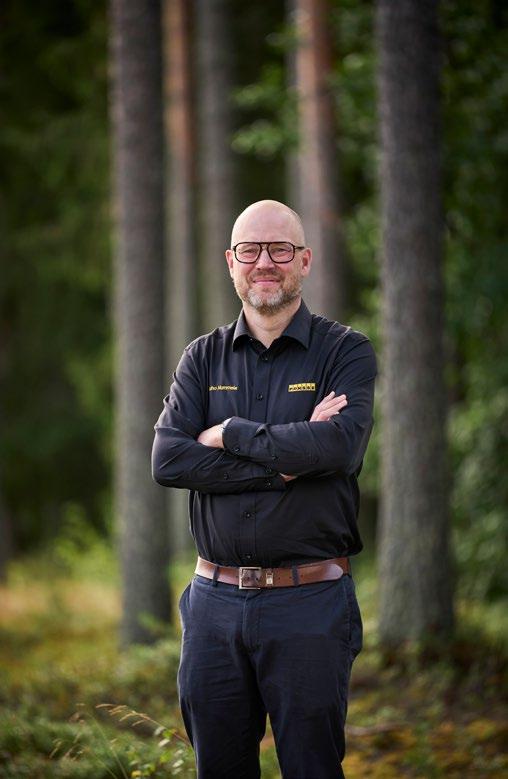
PRESIDENT AND CEO JUHO NUMMELA:
In the early part of the year, the forest machine market showed signs of picking up. Market developments continued to be overshadowed by geopolitical uncertainty and trade policy tensions, yet forest machine sales developed strongly during the first quarter. The order flow slightly exceeded the good level of the comparison period, with orders received totalling EUR 193.3 million. At the end of the period, the company’s order books stood at EUR 167.9 (187.7) million.
Sales of Ponsse’s new forest machines developed favourably during the review period, particularly in Sweden, but also in Central Europe and Latin America. The Finnish market, on the other hand, was challenging due to the tight market situation in the forest industry, the exceptionally early spring and the thawing period. In North America, sales developed better than expected given the circumstances, and the Canadian market also showed signs of picking up. However, uncertainty remained significant and caused delays in customers’ investment decisions.
The first quarter was operationally challenging. Due to the weak order books early in the year, the factory operated below capacity for the first nine weeks of the year, which was reflected in the invoicing of new machines. The company’s net sales decreased by around 10% from the previous year and amounted to EUR 166.8 (185.4) million in the review period. Invoicing of both new and used machines was lower than in the comparison period, while net sales from maintenance services remained at the previous year’s level. The net sales of Ponsse’s technology company Epec increased significantly during the review period.
Profitability remained low as a result of the lower net sales. Cost discipline was successfully maintained, and the operating cost structure did not increase during the review period. Relative profitability was 0.9% (7.1).
The cash flow for the review period was EUR 7.7 (15.9) million. The challenging market situation continued to be reflected in used machine sales, and the current sales level was not yet sufficient to reduce inventory levels. The company’s solvency remained very strong, and Ponsse’s equity ratio developed favourably.
The situation in Brazil developed positively. The challenging Full Service agreement will end considerably earlier than expected,
during the second quarter. Ponsse has performed its contractual obligations responsibly throughout the contract period, and the termination of the contract is being carried out in agreement with the customer. The provisions made in connection with the agreement proved to be sufficient.
The strong order flow early in the year increased the company’s order books, and the factory moved to two shifts and a five -day working week after 9 March 2026. The factory’s capacity utilisation is currently at a normal level. Sales have developed exceptionally well given the circumstances, and the overall momentum across the organisation is clearly strong.
We have been serving harvesting professionals since 1970. Last year, we celebrated Ponsse’s 55th anniversary at numerous different events around the world, and this year we are delighted to mark milestone anniversaries in Britain (30 years) and Denmark (20 years). During the current year, we will meet customers widely at international trade fairs and forestry events, where we will also present new solutions and product features. These interactions bring us close to our local customers and allow us to hear their views and feedback, supporting our continued development and manufacture of the world’s best forest machines.
NET SALES
Consolidated net sales for the period under review amounted to EUR 166.8 (185.4) million, which is 10.1 per cent less than in the comparison period. International business operations accounted for 72.6 (75.2) per cent of net sales.
Net sales by segment 1-3/2026
Nordics and Baltics 48%
Central and Southern Europe 28%
North America 13%
South America 8%
Asia, Australia and Africa 3%
PROFIT PERFORMANCE
The operating profit amounted to EUR 1.5 (13.2) million. The operating profit equalled 0.9 (7.1) per cent of net sales for the period under review. The Brazilian Full Service contract had no impact on profit in the period under review. There is a provision of EUR 5.5 million on the Group's balance sheet for a loss-making contract. In the comparison period the operating profit included, taking into account the change in provision, an expense of EUR 2.6 million related to the Brazilian Full Service contract. The contract is fixed-term and will expire during the year 2026.
Consolidated return on capital employed (ROCE) stood at 3.7 (15.7) per cent.
Net sales by segment 1-3/2025
Nordics and Baltics 47%
Central and Southern Europe 23%
North America 13%
South America 16%
Asia, Australia and Africa 1%
Staff costs for the period under review totalled EUR 31.4 (29.7) million. Other operating expenses stood at EUR 20.6 (21.8) million. The cost impact of the provision of the loss-making Full Service contract of the Brazilian subsidiary is included in other operating expenses. The net total of financial income and expenses amounted to EUR 1.4 (1.8) million. Exchange rate gains and losses due to currency rate fluctuations were recognised under financial items, having a net impact of EUR 1.9 (2.2) million. During the period under review, EUR 0.2 million of revaluation profits on interest rate swaps were recognised in the result.
Result for the period under review totalled EUR 2.5 (14.4) million. Diluted and undiluted earnings per share (EPS) came to EUR 0.09 (0.51).
STATEMENT OF FINANCIAL POSITION AND FINANCING ACTIVITIES
At the end of the period under review, the total consolidated statements of financial position amounted to EUR 548.9 (561.2) million. Inventories stood at EUR 244.2 (222.8) million. Trade receivables totalled EUR 58.8 (51.4) million, while cash and cash equivalents stood at EUR 50.8 (78.0) million. The payment arrangements for the EUR 3 million receivable arising from the sale of the share capital of Ponsse’s Russian subsidiary, OOO Ponsse, are still being clarified in cooperation with the authorities and financial institutions. This item is presented as a current receivable.
Group shareholders’ equity stood at EUR 340.8 (338.4) million and parent company shareholders’ equity (FAS) at EUR 306.9 (304.6) million. The amount of interest-bearing liabilities was EUR 69.4 (71.2) million. The company has ensured its
liquidity by credit facility limits and commercial paper programs. Group's loans from financial institutions are non-collateral bank loans without financial covenants. Consolidated net liabilities totalled EUR 18.6 (-6.7) million, and the debt-equity ratio (net gearing) was 5.5 (-2.0) per cent. The equity ratio stood at 62.4 (60.7) per cent at the end of the period under review.
Cash flow from operating activities amounted to EUR 7.7 (15.9) million. Cash flow from investment activities came to EUR -4.8 (-4.9) million.
ORDER INTAKE AND ORDER BOOKS
Order intake for the period under review totalled EUR 193.3 (184.5) million, while period-end order books were valued at EUR 167.9 (187.7) million.
DISTRIBUTION NETWORK
With focus on sales and maintenance, the organisation is divided into five market areas: Nordic countries and the Baltics; Central and Southern Europe; South America; North America; and Asia, Australia and Africa.
R&D AND CAPITAL EXPENDITURE
Group’s R&D expenses during the period under review totalled EUR 6.0 (6.2) million, of which EUR 1.2 (1.7) million was capitalised.
Investments during the period under review totalled EUR 5.1 (4.9) million. In addition to capitalised R&D expenses, they consisted of investments in buildings and ordinary investments in machinery and equipment.
PERSONNEL
The Group had an average staff of 2,014 (2,035) during the period under review and employed 1,973 (2,035) people at the end of the period.
SHARE-BASED INCENTIVE PLANS
On February 16, 2026, the Board of Directors of Ponsse Plc decided, and the company announced, that new PerformanceBased Matching Share Plans will be established for the Group’s CEO and key personnel for the period 2026–2030. The plans
are a continuation of the Performance-Based Matching Share Plans 2023–2027.
The CEO Performance-Based Share Ownership Plan
In the CEO plan the following performance periods concluded in previous years are valid: 2024-2026 and 2025-2027. The cost impact of these plans during the period under review was EUR 0.1 million.
The new CEO Performance-Based Matching Share Plan 2026–2030 includes three (3) performance periods, covering the financial years 2026–2028, 2027–2029 and 2028–2030. It is possible to earn a matching reward and performance-based matching reward under the plan. The performance-based rewards under the performance period 2026–2028 are based on the development of Group’s EBIT, Group’s Working Capital and Scope 3 CO2 emissions. The achievement of the targets set for the performance criteria will determine the final proportion of the maximum reward that will be paid as performance-based matching reward to the CEO. The performance-based matching rewards will be paid after the end of each performance period, for the 2026–2028 performance period by the end of May 2029.
The gross rewards to be paid under the performance period 2026–2028 amount to an approximate maximum total of 50,000 Ponsse Plc shares.
Key Employee Performance-Based Matching Share Plan
In the key employee plan the following performance periods concluded in previous years are valid: 2024-2026 and 20252027. During the period under review, the costs related to the 2023-2025, 2024-2026 and 2025-2027 performance periods of the share-based incentive plans amounted to a total of EUR 0.1 million.
The Performance-Based Matching Share Plan 2026–2030 includes three (3) performance periods, covering the financial years 2026–2028, 2027–2029 and 2028–2030. It is possible to earn a matching reward and performance-based matching reward under the plan.
The performance-based rewards under the performance period 2026–2028 are based on the development of Group’s EBIT, Group’s Working Capital and Scope 3 CO2 emissions. The achievement of the targets set for the performance criteria will determine the final proportion of the maximum reward that will be paid as performance-based matching reward to participants. The performance-based matching rewards will be paid after the end of each performance period, for the 2026–2028 performance period by the end of May 2029.
The target group of the plan consists of approximately 120 persons, including the members of the Management Team but excluding the President and CEO. The net rewards to be paid under the performance period 2026–2028 amount to an approximate maximum total of 78,000 Ponsse Plc shares calculated at the current share price. In addition, the company will pay taxes and social security contributions arising from the reward to the participants in connection with the reward payment. The final number of shares will depend on the number of shares acquired by the participants and the achievement of the targets set for the performance criteria. As a rule, no reward will be paid if the participant’s employment or director contract terminates before the reward payment.
SHARE PERFORMANCE
The company’s registered share capital consists of 28,000,000 shares. The trading volume of Ponsse Plc shares for 1 January – 31 March 2026 totalled 221,822, accounting for 0.79 per cent of the total number of shares. Share turnover amounted to EUR 5.5 million, with the period’s lowest and highest share prices amounting to EUR 21.00 and EUR 27.40, respectively.
At the end of the period, shares closed at EUR 22.40, and market capitalisation totalled EUR 627.2 million.
At the end of the period under review, the company held 5,366 treasury shares.
ANNUAL GENERAL MEETING 2026
Ponsse Plc's Annual General Meeting was held on 8 April 2026. A separate release was issued on 8 April 2026 regarding the resolutions at the AGM. The Annual General Meeting approved the consolidated financial statements and the company’s financial statements for the financial year 1 January – 31 December 2025 and discharged the members of the Board of Directors and CEO from liability. The Annual General Meeting decided that a dividend of EUR 0.55 per share will be paid for the financial year of 1 January – 31 December 2025. The Annual General Meeting decided that a maximum of EUR 100 profit bonus per person per working month is to be paid for the financial year 2025 to the personnel employed by the Group. The Annual General Meeting approved the remuneration report for the company’s governing bodies for financial year 2025.
The Annual General Meeting confirmed that the Board of Directors consists of eight (8) members. The Annual General Meeting re-elected Jarmo Vidgren, Mammu Kaario, Terhi Koipijärvi, Matti Kylävainio, Ilpo Marjamaa, Juha Vanhainen and Juha Vidgren, and elected Sanna Otava as new member for the term starting at the end of the Annual General Meeting on 8 April 2026 and ending at the end of the Annual General Meeting following the election. In its constitutive meeting convening right after the Annual General Meeting, the Board of Directors decided to elect Jarmo Vidgren as Chair of the Board and Mammu Kaario as the Vice Chair of the Board. The Annual General Meeting resolved on an annual compensation of EUR 48,000 for the Chair of the Board of Directors, EUR 45,000 for the Vice Chair, and EUR 38,000 for the other members of the Board of Directors. Travel expenses will be reimbursed in accordance with the company’s travel policy.
The Annual General Meeting elected PricewaterhouseCoopers Oy, an Audit Firm and an Authorized Sustainability Audit Firm, as the company's auditor and sustainability reporting assurance provider. PricewaterhouseCoopers Oy has announced that Markku Katajisto, APA, ASA, will act as the company's principal auditor and principal authorised sustainability auditor. The remuneration to the auditor and the sustainability reporting assurance provider will be paid according to the reasonable invoice approved by the company.
The Annual General Meeting resolved to authorise the Board of Directors to decide on the repurchase of a maximum of 250,000 company’s own shares in one or more tranches, corresponding to approximately 0.89 % of the company’s total shares and votes. The authorization is valid until the closing of the next Annual General Meeting, however, no longer than until 30 June 2027.
The Annual General Meeting resolved to authorise the Board of Directors to decide on the issuance of shares as well as the issuance of options and other special rights entitling to shares referred to in Chapter 10, Section 1 of the Finnish Companies Act. The number of shares to be issued based on the authorization may in total amount to a maximum of 250,000 shares (including shares issued based on options or special rights), corresponding to approximately 0.89 % of all the shares in the company. The authorization is valid until the closing of the next Annual General Meeting, however, no longer than until 30 June 2027.
SUSTAINABILITY
Ponsse has determined key sustainability targets for its business operations. Their implementation is promoted through annual function-specific targets and measures as part of the company’s strategy process. Ponsse works to improve its people’s well-being, create innovative sustainable solutions that respect nature, develop its operations without burdening nature, and be a reliable partner that values community.
During the first quarter, Ponsse published a sustainability report included in the Board of Directors’ report, prepared in accordance with the Accounting Act, the European Sustainability Reporting Standards (ESRS) and the Corporate Sustainability Reporting Directive (CSRD). The sustainability report has been verified in accordance with the ISAE 3000 assurance assignment standard.
A climate -related target was added early in the year to the remuneration of the governing, management and supervisory bodies and key personnel, following the decision of Ponsse Plc’s Board of Directors to establish new performance -based matching share plans for the Group’s President and CEO and key employees. The performance -based rewards for the 2026–2028 performance period are linked to the development of the Group’s operating profit, working capital and Scope 3 greenhouse gas emissions.
During the first quarter, Ponsse carried out a combined climate and nature risk assessment. The assessment was based, where applicable, on the TCFD and TNFD frameworks, and was carried out using a scenario-based approach, evaluating climateand nature-related risks across three alternative pathways.
In addition, stakeholder interviews and sustainability surveys were conducted for employees, contractual service partners and dealers to support the double materiality assessment. The results are used in defining the sustainability strategy and the related measures. The aim is to ensure that the double materiality assessment and the resulting sustainability report take stakeholder views into account and support the identification of material impacts, risks and opportunities.
In its product offering, Ponsse became the first forest machine manufacturer to introduce the Opti Felling Assist feature, which ensures controlled tree felling. This function assists the operator, improving the precision of felling sawing and occupational safety and reducing equipment wear. The solution is based on Ponsse’s Active Crane boom management system.
RISK MANAGEMENT
Our risk management is based on the company’s values and strategic and financial goals. The purpose of risk management is to support the company’s strategic objectives and to secure its financial development and the continuity of its business. Ponsse’s management conducts an annual risk assessment that includes the sustainability risks and opportunities impacting the company’s business. Within them, aspects related to climate change, biodiversity, and resource efficiency together with digitalisation and technological development are emphasised.
The purpose of risk management is to identify, assess, and monitor business-related risks that may impact the realisation of the company’s strategic and financial objectives or the continuity of business. This information is used to decide what measures will be required to prevent risks and respond to current risks.
Risk management is part of the company’s daily business and has been incorporated into its management system. Risk management is directed by the risk management policy approved by the Board of Directors.
A risk is any event that may prevent the company from achieving its objectives or threatens the continuity of business. A risk may also be a positive event, in which case the risk is treated as an opportunity. Each risk is assessed on the basis of its impact and probability. The company’s risk management methods include the avoidance, mitigation, and transfer of risk. Risks may also be managed by controlling and minimising their impacts.
SHORT-TERM RISK MANAGEMENT
The most significant short - term risks in Ponsse’s operating environment are related to uncertainty in the global economy and geopolitical situation, changes in trade policy, and the subdued pace of economic growth in key markets. Rising geopolitical tensions, tariffs and other trade restrictions may affect export markets, investment decisions and the functioning of supply chains.
Ponsse’s business operations focus on the cut - to-length (CTL) method, for which demand is linked to the cyclical development of the forest industry and wood raw material markets. Weakening economic conditions, the availability of financing and fluctuations in interest rates may affect customers’ willingness to invest, particularly in certain market areas. The company manages market
risk through its broad geographical presence, strong customer base, and investments in services and digitalisation, which support customers even in weaker market conditions.
International trade policy and changes in tax and customs legislation may affect Ponsse’s supply chains and cost structure. These risks are managed by strengthening supply chain resilience, increasing local sourcing, using alternative suppliers, and enhancing the flexibility of production and logistics.
Investments in digital services, automation and new technologies, in line with the strategy, also involve implementation and cybersecurity risks. The increase in cyber threats and regulatory requirements, such the Cyber Resilience Act, may increase risks related to information security and system reliability through growing resource needs. Ponsse is systematically developing its cybersecurity and progressing towards an operating model aligned with the ISO 27001 standard, to ensure business continuity and the reliability of digital services.
The company’s strong financial position and liquidity support risk management in an uncertain market environment. Ponsse actively monitors financial, interest rate and currency risks and, if necessary, uses financial instruments to manage risks. In addition, the parent company monitors the risks related to trade receivables and long-term service agreements as part of normal financial control.
LEGAL MATTERS
A number of legal proceedings and claims related to product liability are pending against Ponsse in Canada and France. In Brazil, a settlement process is under way with the tax authorities concerning the tax treatment of intra- group trade payables written down in previous years. Ponsse received a favourable first -instance decision in the matter, which the tax authorities have appealed, and have submitted a related claim. A liability of EUR 5.2 million has been recognised in connection with the case. According to the assessment of the company’s management, the outcome of these legal processes and claims is not expected to have a material impact on Ponsse’s financial position, taking into account the entries made, the insurance cover and the arguments presented.
OUTLOOK FOR THE FUTURE
The company’s euro-denominated operating profit in 2026 is estimated to be on par with the operating profit in 2025 (EUR 41.6 million).
Economic uncertainty persists and is affecting the demand for both forest industry end products and forest machines. Trade tensions, the geopolitical situation and fluctuations in the
financial markets create a challenging operating environment, underscoring the importance of cost discipline and carefully considered investment levels.
Ponsse invests in customer relationships and high-quality service, and is continuing to improve the efficiency of its operations in accordance with the new operating model. Investments are selectively targeted at product development, digital services and the strengthening of the sales and maintenance network. The Vieremä factory is being expanded with an extension to the welding shop, and productivity is being improved by automating welding and internal logistics. Cost developments are monitored closely, and the company responds rapidly to changes in market conditions when necessary.
The ramp-down of the operations under the Full Service agreement in Brazil is progressing as planned, and the obligations related to the agreement will end during the second quarter.
EVENTS AFTER THE PERIOD
There are no other known events after the end of the reporting period that would require either adjustments to the information presented for the period under review or disclosure of additional information.