Read online at www.pololifestyles.com On Instagram & Facebook @pololifestyles
A proud partner of Issuu, U.S. Polo Assn., USPA, Global Polo, The Impression and Mixam
GRAND CHAMPIONS
USPA North American Cup
USPA National 20-Goal
Legends of Polo
International Cup
LA PALMERAIE MOROCCO
The Autumn Cup
NATIONAL POLO CENTER
Joe Barry Memorial
Ylvisaker Cup
The Gauntlet of Polo
PATAGONES POLO CLUB
Inglehart Cup
Outback Cup
EL DORADO POLO CLUB
Bronze Trophy
Rossmore Cup
PORT MAYACA POLO CLUB
Butler Handicap
Stephen Orthwein Memorial
SCOREBOARDS & COCKTAILS
POLO LIFESTYLES EDITORS & CONTRIBUTORS
Dana
The scientifically unproven peptide craze, page 78
FW26 collections favor embellishments, page 140
Perfect powder in Japan's Hakuba Valley, page 70
Fifteen laptops on the cutting edge of A.I. and more, page 98
MY INSTAGRAM FEED IS NON-STOP PEPTIDE POSTS, REELS AND VIDEOS. MY ENTIRE KNOWLEDGE OF PEPTIDES IS BASED ON THE INGREDIENTS OF MY FAVORITE SKINCARE PRODUCTS, SO I WASN’T SURE THE ALGORITHM WAS ALGORITHMING, BUT, CURIOUS, I WATCHED A FEW REELS.
One very aesthetically inclined trainer was injecting himself with a “self-tanning peptide” over the course of two weeks. His progress videos showed him rather rapidly turning the color of a tired carrot (you know, the kind you find forgotten in the back of the refrigerator when you’re cleaning out the drawers) over 14 days. He seemed incredibly pleased with his “natural tan,” but I didn’t order the injectable from his link in bio. I’ll stick to my infrequent spray tans and my natural sun-kissed look.
There are, apparently, peptides for everything from hair regrowth to weight loss and melanin-boosters. As of press time, the American Food and Drug Administration still does not recognize any of them as approved or regulated. Only time will tell if they enter the official drug marketplace anytime soon.
Click and comment on our choices... Tag @pololifestyles . We will share noteworthy comments with you next month.
@polofromtheair
@oscardelarenta
@chopard
PHOTOS COURTESY OF GLOBAL POLO
THE USPA GOLD CUP
The championship match of the USPA Gold Cup, the second leg of The Gauntlet of Polo, between Pilot and La Dolfina Tamera, expected to be played on Sunday March 29, at the National Polo Center (NPC), set in Wellington, Fla., was cancelled due to heavy rains. The USPA Gold Cup, that preceeds the much-anticipated US Open Polo Championship, sees 10 teams up to 22 goals partake. Teams are split in two leagues.
It’s worth to remember that Pilot and La Dolfina Tamera reached the final after their wins in semifinals over The Dutta Corp and La Dolfina Scone, respectively.
A new date will be set for the decisive match of the USPA Gold Cup by the United States Polo Association when weather conditions improve.
THE USPA GOLD CUP
PHOTOS COURTESY OF GLOBAL POLO
THE USPA GOLD CUP
PHOTOS COURTESY OF GLOBAL POLO
THE USPA GOLD CUP
PHOTOS COURTESY OF GLOBAL POLO
THE USPA GOLD CUP
PHOTOS
NATIONAL AMATEUR CUP
EL
DORADO POLO CLUB
PHOTOS
NATIONAL AMATEUR CUP EL DORADO POLO CLUB
PHOTOS
PHOTOS COURTESY GETTY IMAGES
After the rainfall, there was no better way to welcome the sunshine than with a special AHPC Exhibition Match held this Sunday at Al Habtoor Polo Club. The match provided an important platform for our low-goal players to refine their skills, build confidence, and progress toward improving their handicaps. With professional players riding alongside
them, each game becomes a valuable learning experience — offering insight from some of the very best in the sport.
The main event saw spectators enjoy an exciting clash between Habtoor Polo Team and Dubai Wolves by Thera – PBS. The opening chukkers began at a slower pace, as players adjusted to the condi-
tions following the past few days of rain. However, as the match progressed, so did the intensity. After a closely contested start, with both teams level in the first two chukkers, Habtoor Polo Team demonstrated strong teamwork to gain momentum, extend their lead, and ultimately secure the win.
LUXURY TRAVEL IS GOING OVERBOARD FOR SUPERYACHTS
HIGH-END HOSPITALITY BRANDS — LIKE AMAN, FOUR SEASONS, THE RITZCARLTON AND ORIENT EXPRESS — ARE BETTING THAT TRAVELERS WHO HATE TRADITIONAL CRUISES WILL HAPPILY CLIMB ABOARD THEIR SMALLER, SLEEKER AND MUCH MORE EXCLUSIVE VESSELS.
For travelers drawn to the romance and ease of a voyage at sea but allergic to the thought of a giant cruise ship, there’s now a more rarefied option.
The newest frontier in luxury travel is smaller, sleeker and far more curated: intimate superyachts built for guests who want top-tier hospitality on the open water without the spectacle, crowds or all-you-can-eat excess of traditional cruising.
Hospitality heavyweights like Orient Express, The Ritz-Carlton, Aman and Four Seasons are taking their brand of high-end service to the high seas, betting that affluent travelers would rather board a boutique yacht than a floating megacity.
“Hotel lovers who swore off cruising are being converted by their favorite brands taking to the seas, promising a true hotel experience on the water without the annoyance of the repack,” says Mandy
McKaskle,
founder of luxury travel
advisory Creosote Journeys & Co.
The Ritz-Carlton Yacht Collection helped set the tone with the 2022 debut of Evrima. Designed for fewer than 300 guests, the sleek vessel features an infinity pool and staterooms that feel more like polished floating residences than standard ship cabins, with Frette linens, double-vanity marble bathrooms and walk-in showers roomy enough to suggest nobody had to compromise. There are no hulking buffets or elbow-throwing brunch lines either; meals are seated, elegant and made to order, from Maine lobster pasta to seared foie gras and sashimi salads.
Next up are new launches from Four Seasons, Orient Express and Aman, arriving later this year and into 2027. The pitch is straightforward: serious design, white-glove service and itineraries tailored to slip into private anchorages in some of the world’s most coveted corners, from hidden Mediterranean coves to the icy reaches of Antarctica, where stars including Nicole Kidman, Michael Douglas and Catherine Zeta-Jones have reportedly ventured in recent years.
SATORI YACHT
“Perhaps most compelling isn’t the 600-thread-count linens or the Michelin-caliber kitchens. It’s what’s been left out,” says McKaskle.
“No Broadway show. No themed deck party. Itineraries as short as two
AQUA LARES
nights. Ships with barely 100 cabins that can access coves and fishing villages no megaship can touch. There is nothing cruise-like about them.”
Alongside other elite operators like Ponant and Aqua Expeditions, not to mention private yachts hosting fewer than 15 guests — the bar for truly topshelf nautical escapes is rising fast.
Here, a look at some of the most exclusive players around the globe.
THE RITZ-CARLTON YACHT COLLECTION
The Ritz-Carlton Yacht Collection elevates sea travel with three posh superyachts: Evrima (298 guests), Ilma (448 guests) and newest vessel Luminara (452 guests), each enhanced with Ritz-Carlton service. Itineraries include Alaska, the Mediterranean, Croatia’s secluded harbors and Asia-Pacific. Indulge in
Fabio Trabocchi and Michael Mina’s culinary creations on Ilma, unwind at The Ritz-Carlton Spa, and soak up live music, movie nights under the stars, cooking demos and wine tastings.
FOUR SEASONS YACHTS
Launched in March 2026, Four Seasons Yachts’ inaugural vessel, Four Seasons I, debuts with Mediterranean sailings through the Greek Islands, the French Riviera and Croatia. Hosting just 222 guests across 95 expansive suites, the yacht focuses on quieter ports and private anchorages inaccessible to larger ships, creating a more tailored itinerary. Onboard highlights include 11 distinctive dining venues, a rotating Chef-inResidence program and the Kids for All Seasons club. Caribbean voyages follow this fall and winter, with additional yachts forthcoming.
ORIENT EXPRESS SAILING YACHTS
Bringing its legendary opulence from rails to the sea, Orient Express is debuting the Corinthian, the world’s largest sailing yacht, this June, with a sister ship, Olympian, on track for spring 2027. Expect just 54 suites, multiple restaurants and bars with a culinary program by 17-Michelin-starred chef Yannick Alléno, a Guerlain Spa, and immersive destinations across the Mediterranean and Caribbean. Offshore experiences include a tour of Pierre Cardin’s holiday home and a candlelight concert in Les Saintes in the Guadeloupe archipelago.
AMAN AT SEA
Charting a course in spring 2027, Amangati promises to be a haven of minimalist calm. Designed by Sinot Yacht Architecture & Design, the vessel
will feature 47 suites with soaring ceilings and private terraces merging the indoors with the horizon. Onboard, four dining venues will serve Mediterranean flavors and Japanese teppanyaki. There will also be an Aman Spa, ocean-view treatment rooms and a 16meter pool with direct water access from Selora Marina & Lounge. Itineraries will explore the French Riviera, Croatia’s Dalmatian Coast and the shores of Sicily.
AQUA EXPEDITIONS
Specializing in lavish smallship voyages to some of the planet’s most pristine and remote waters, Aqua Expeditions’ newest vessel, Aqua Lares, is a 77meter expedition superyacht designed for adventurous travelers who crave a high dose of
comfort with their outdoor escapades. Hosting 30 guests in 15 cabins, the ship offers exploration via small boats, kayaks, paddleboards, snorkeling gear and bikes. Voyages span the Seychelles, Zanzibar, Tanzania and the Arctic fjords of Svalbard, featuring wildlife encounters and guided excursions.
PONANT
Venture to the ends of the Earth aboard Ponant’s polar icebreaker Le Commandant Charcot. The luxury vessel accommodates up to 245 guests in 123 staterooms and suites, many with private balconies. Guests can enjoy French cuisine designed by Alain Ducasse and explore Antarctica’s dramatic ice fields with Zodiac-boat outings.
SATORI YACHT
From the team behind Tuscany’s celebrity-frequented Borgo Santo Pietro boutique hotel and estate, Satori is a 41.5meter luxury sailing yacht for up to 10 guests across five cabins. There’s a private spa suite with steam room and Mediterranean fare prepared by one of the esteemed chefs employed by founders Claus and Jeanette Thottrup. Charters typically run for one week (shorter or longer trips may be possible) along the coasts of Italy, France, Greece, Turkey and Croatia.
CAPASECCA YACHT
Another bespoke yachting experience, Capasecca — featuring four cabins
FOUR SEASONS
that sleep up to eight guests — sails the Amalfi Coast, Capri, Ischia and Procida, backed by a family with generations of seafaring heritage. Daily, overnight or tailormade multi-day cruises are guided by multilingual crews with customizable itineraries across quaint seaside villages and secret inlets.
A&K X CRYSTAL CRUISES
Luxury travel pioneer Abercrombie & Kent teams up with Crystal Cruises for a boutique cruise-within-a cruise, launching August 2026 for just 50 guests in select suites aboard Crystal Serenity (which holds 740). A&K curates the entire
sojourn with a two-night hotel stay prior to boarding, their own expedition expertise (one specialist per 18 guests), private shore excursions and VIP access including at Vatican City. Nobu’s Umi Uma and Beefbar are dining highlights, and initial itineraries sail Italy, Greece, the Balkans and Croatia.
SATORI YACHT
PERFECT POWDER IN JAPAN'S HAKUBA VALLEY
HAKUBA VALLEY
PERFECT POWDER. LUXURY ACCOMMODATIONS. LIVELY RESTAURANTS. AN EXPERIENCE DESIGNED WITH A JET-SET, SNOW-FIEND IN MIND. WE COULD BE TALKING ABOUT ASPEN, VAIL, MEGÈVE, CORTINA D’AMPEZZO OR WHISTLER; BUT WE’RE TALKING ABOUT HAKUBA VALLEY IN – YOU MIGHT HAVE GUESSED IT – JAPAN.
From December to May each year, skierswho-know flock to the mountainous village in the Nagano Prefecture that hosted part of the 1998 Winter Olympics. Since it’s on the same island as Tokyo, it’s a simple drive or ride from the international airport to Hakuba Valley, where the snowpack measures between 36-42 feet each year. Japan’s railways and bus systems are efficient and spotless, but private cars and transportation companies are also available for a more elevated arrival and departure to and from the slopes. The best snow conditions fall
from January to February, after the wilder and busier holiday season and just before spring sleepily arrives in the Valley.
The massive scale of the Hakuba Valley – 10 sprawling snow resorts across two villages and a city with choices galore for apres-ski, fine dining and accommodations – means there’s something for everyone’s individual taste. Shuttles run frequently between snow resorts and the picturesque, charming villages. Nighttime transportation operates into the evening hours for those looking for a more lively experience after dark in the Happo area or Echoland.
The resorts in Hakuba Valley stretching south to north are: Jigatake Snow Resort, Kashimayari Ski Resort Family Park, White Resort HAKUBA SANOSAKA, ABLE Hakuba Goryu, Hakuba 47 Winter Sports Park, Hakuba Happo-One Snow Resort, Hakuba Iwatake Snow Field, Tsugaike Mountain Resort, Hakuba Norikura Onsen Snow Resort and, finally, Hakuba Cortina Snow Resort.
Each has its own reputation or something it’s known for — Happo-One is famed for its steep terrain and Olympic histo-
ry, while Tsugaike caters to skiers of all levels, with wide, gentle runs. Hakuba Cortina is renowned for its off-piste skiing and incredibly high snowfall.
LODGING IN HAKUBA VALLEY
A myriad of lodging – from efficient to luxurious – abounds in the Hakuba Valley and we certainly lean toward comfort and class when traveling.
One hotel is a stand-out among all the others for its oversize suites, on-site amenities and world-class dining. Hotel La Vigne, with views of the northern Alps, has a three-bedroom, 2.5 bath suite we just can’t get over. Finished in luxurious minimalism and Japanese bathroom particularities that put Western bathroom concepts to shame, Hotel La Vigne delivers rest and repose in every sense of the words. The La Vigne Suite is nearly 150 square meters or over 1,550 square feet, perfect for a family or group of friends. You won’t want to get out of the bathtub with its breathtaking views of the snowy mountain peaks.
HOTEL LA VIGNE
3020-1116 Hokujo, Hakuba Village
HAKUBA VALLEY
HAKUBA VALLEY
EXCLUSIVE DINING EXPERIENCES
The hardest-to-get table in the Hakuba Valley is the 10-seat bar at Sushi Sakai, where renowned Ginza sushi master, Chef Sakai, wows his guests in an intimate, front-row-view setting of an artist at work. Select from two exquisite omakase menus, each thoughtfully curated to showcase the freshest ingredients of the season.
SUSHI SAKAI
Inside the Happo by HHG
The Sky Lounge, located on the fourth floor of the Ski Jump Tower, offers a unique tasting experience in the heart of the Hakuba Valley. Imbibe on premium sake, craft cocktails and local six-dish courses while admiring stunning nighttime views of the illuminated village below. With elegant interiors and an intimate atmosphere, the Sky Lounge provides the perfect setting to relax, unwind and savor the flavors of the Hakuba Valley in style.
SKY LOUNGE @HAKUBA JUMP
3609 Hokujo, Hakuba Village
Legendary powder, lively villages and elevated dining experiences define the magic of a winter getaway to the Hakuba Valley, whether for a weekend or the entirety of the snow season. Make Hakuba Valley part of your winter tradition.
MORE INFO
To learn more about Hakuba Valley, visit hakubavalley.com/en/.
SKY LOUNGE @HAKUBA JUMP
RESHAPING HEALTH PEPTIDE TREND THE UNPROVEN
The trend of unproven peptides is spreading through influencers
MORE AMERICANS ARE INJECTING THEMSELVES WITH UNAPPROVED CHEMICALS THAT ARE PITCHED AS WAYS TO BUILD MUSCLE, REJUVENATE SKIN AND EXTEND LIFE, THE LATEST EXAMPLE OF THE NATION’S FASCINATION WITH ALTERNATIVE THERAPIES AND WELLNESS HACKS.
Behind the trend is the surging popularity of GLP-1 weight loss medications, a class of so-called peptides approved to help users quickly shed pounds. But the peptides being promoted by influencers, celebrities and wellness gurus are different: Many have never been approved for human use and much of their purported evidence comes from studies in rats and other animals. Several peptides, such as BPC-157 and TB-500, are banned by international sports authorities as doping substances.
“None of them are proven,” said Dr. Eric Topol, a research methods expert and director of Scripps Research Translational Institute. “None of them have gone through what would be considered adequate clinical trials, but nonetheless many people are taking these. It’s actually quite extraordinary.”
For years, the Food and Drug Administration has been trying to crack down on the space, sending warning letters to clinics that promote the products and adding more than two dozen pep-
tides to a list of ingredients that should not be made by specialty pharmacies that often custom mix the formulations. That approach may be coming to an end.
PEPTIDES ARE NOW PART OF THE ‘CIRCUS’ OF UNPROVEN WELLNESS PRODUCTS
Peptides are essentially the building blocks of more complex proteins. Inside the human body, peptides trigger hormones needed for growth, metabolism and healing. The FDA has approved a number of peptides as medications, including insulin for diabetics who don’t naturally produce it and human growth hormone for children with developmen-
tal disorders caused by low levels of the hormone.
But many other peptides promoted online have never been approved, making them technically illegal to market as drugs. Under current FDA guidance these peptides also are ineligible for compounding — the process in which pharmacies mix made-to-order medications for patients.
That hasn’t stopped celebrities and influencers from touting them. Joe Rogan, for example, has repeatedly praised BPC157, a peptide derived from acids found in the gut. “I had tendonitis in my elbow, I started using BPC-157 and it was gone
in two weeks,” Rogan told his podcast audience last year.
He is among the celebrity clients listed on the website of Ways 2 Well, a Texasbased company that offers peptides, stem cells, vitamin infusions and other alternative treatments. It’s all part of “the circus of unproven, expensive and possibly dangerous” offerings promoted by wellness and longevity clinics, said Topol, who has written about the industry.
For $99, Ways 2 Well offers a “peptide consult” with a physician, after which the company ships the peptide vials along with a “full kit with dosing, instructions and syringes,” according to its website.
Company founder Brigham Buhler is a former pharmaceutical sales rep. He did not respond to requests for comment.
PEPTIDES ARE OFTEN PITCHED AS A ‘NATURAL’ ALTERNATIVE TO MODERN MEDICINE
Andrea Steinbrenner, a consulting executive, said she became intrigued by peptides after hearing about their benefits for “longevity, repair, anti-aging and energy,” from an acquaintance who runs a clinic outside of San Diego.
Steinbrenner and her husband now receive monthly infusions at the clinic, in addition to daily supplements. “I think peptides are popular right now because we are the aging generation and we are looking for alternatives to modern day
medicine,” she said. “I absolutely believe in modern day, western medicine— it’s necessary. But there’s a lot of other things in the universe that the earth supplies.”
Peptide proponents often suggest their products are safe because they are based on substances found in the body. “Unlike synthetic pharmaceuticals, peptides are naturally recognized by your body,” Brecka told his more than 2 million Instagram followers in February.
Critics point out that the peptides for sale are often imperfect synthetics and are taken at doses much higher than any peptides in the body, raising the risk of allergic reactions and other harms. Brecka sells more than a half-dozen peptides, including ipamorelin and
CJC-1295 — both of which the FDA has flagged for serious safety risks.
Like other peptides sold on Brecka’s website, the ipamorelin vials carry the labeling: “research use only.”
RESEARCH CLAIMS ARE OFTEN A PLOY TO DODGE REGULATORS
The “research use” language is pervasive across the peptide space, even in forums where users trade tips for buying, dosing and “stacking” different drug combinations. One Facebook group instructs members what to avoid: “instead of ‘taking’ you are ‘researching’.” Lawyers who work in the field say the language is an attempt to skirt FDA regulations. The agency does not oversee chemicals that aren’t intended for human use.
It’s often unclear whether such peptides are being produced in the U.S. by pharmacies and mislabeled for research, or whether they are being purchased from chemical manufacturers, many located in China and not subject to FDA drug quality standards.
“Research-grade peptides are going to have junk in them,” said Paul Knoepfler, a cellular biologist at the University of California Davis. “They’re going to have chemicals used in the purification process and fragments of peptides that you don’t want.”
FDA HAS WORKED TO RESTRICT PEPTIDES FOR YEARS
During the COVID-19 pandemic, the FDA issued over a half-dozen warning
letters to businesses promoting peptides with “immune-boosting powers.” Then in 2023, the agency added nearly 20 peptides to a list of substances that should not be compounded due to safety risks. Pharmacies violating the measure risk fines, legal action or potential loss of their state licenses.
That triggered pushback from wellness entrepreneurs and compounding pharmacies, including lawsuits. One coalition, Save Peptides, warned its followers: “Our basic human rights to access alternative medical care using regenerative peptides is being stripped away by the FDA.”
A lawsuit brought by a large compounding pharmacy alleged that regulators had skipped legally required steps when
adding peptides to FDA’s list of highrisk substances. The litigation forced the agency to backtrack, and the FDA late last year agreed to convene two public meetings of outside advisers to review several peptides flagged for safety risks. In each case, the experts agreed with the FDA, voting that the substances were too risky to be compounded.
SOME IN THE INDUSTRY DISAGREE.
“Physicians should have every available arrow in the quiver to treat illness and, because of the FDA’s inaction, they don’t,” said Lee Rosebush, who helped bring the lawsuit against FDA and represents a group of large compounding pharmacies.
THE GUIDE TO DRINKING
CHAMPAGNE
IN PARIS (SOMETHING FOR EVERYONE)
THERE ARE MORE RESTAURANTS AND BARS IN PARIS THAN YOU CAN POKE A BAGUETTE AT. TAKE YOUR PICK FROM THE CACHE OF HOLE-IN-THE WALL EATERIES TO CHANDELIER DRIPPING HIGH-END BARS, AND YOU WILL NEARLY ALWAYS FIND CHAMPAGNE ON OFFER – FOR BREAKFAST, LUNCH OR DINNER – OR JUST BECAUSE.
But if you’re a champagne lover, you won’t want just any old bar. Surprisingly, Paris offers relatively narrow diversity when it comes to champagne, though it’s getting better. Since the pandemic, things
have changed. More and more venues are providing an impressive fusion of maisons and growers, sometimes curated by terroir, and not just style.
There is new energy in Paris, and you feel it everywhere. At the annual Les Printemps des Champagnes grower trade tasting extravaganza in Champagne, the event is overrun by sommeliers and restaurant owners from Paris looking for something new or alternative for thirsty champagne customers. It says a lot about the diversity of champagne coming to the world’s most visited city.
Under the guise of research, I have experienced some of the city’s best options for champagne. These are my top recommendations. Keep them earmarked for your next trip to Paris.
FUN AND INTELLECTUAL: BUBBLE BLISS BAR
3 Rue de Bourbon le Château, 75006
Bubble Bliss is unashamedly the intellectual’s choice for good champagne and good times with no pretense. The bar is tucked away in the backstreets of SaintGermain-des-Près and attracts an astute audience that is part Parisian and part tourist.
From the moment you walk in you’ll be greeted with the same kind of enthusiasm as a host uncorking a cherished bottle to share with friends. The staff are super-friendly, accessible with their knowledge and bilingual; so, you won’t need to brush up on your French (or champagne knowledge) to feel welcome.
LE DOKHAN'S
You’ll come for the 300+ champagnes by the bottle and a rotating selection of 10 champagnes for the glass, but you’ll stay for the elegant small plates of delicious food and friendly conversation from staff.
Owner, Marina Nest, was inspired to create an experience with a unique atmosphere for sharing, fun and ‘good vibes’.
Time your visit right and you’ll have the opportunity to experience one of many regular ‘meet the maker’ events featuring leading identities from Champagne.
“One of the most popular formats amongst locals and international champagne lovers is the Soirée Vigneron. It is a champagne dinner whereby the winegrower works together with our chef, Damien Duccas, and chef sommelier, Clement Cabaret, to develop the
perfect pairing for the cuvées. Only 12 sits around our main bar and the winegrower will share stories. The atmosphere is authentic and fun.”
Bubble Bliss is a home away from home for those seeking champagne indulgence with a comfortable atmosphere.
CLASSICAL : LE PETIT SOMMELIER
49 Avenue du Maine, 75014
Located in Montparnasse, Le Petit Sommelier has quietly built a reputation as one of Paris’s most wine-savvy bistros, and its champagne list is a highlight. Owner Pierre Vila Palleja curates a cellar that balances prestige and discovery, offering both the Grandes Marques and a thoughtful selection of grower-producers. The list’s depth in vintages is particularly impressive, allowing guests to
explore champagne beyond its youthful sparkle and into the realm of maturity. Accessibility is also a priority: rotating pours by the glass invites casual enjoyment, while pairing menus showcase how champagne elevates classic French bistro fare. With monthly winemaker dinners and a convivial atmosphere, Le Petit Sommelier transforms champagne from luxury into everyday experience.
ROMANTIC: LE DOKHAN’S CHAMPAGNE BAR
117 rue Lauriston, 75116
Tucked away from the tourist thoroughfare of Paris is a little-known boutique hotel called Le Dokhan’s in the mostly residential 16th Arrondissement. It is home to Paris’ first dedicated champagne bar, nestled to the side of its small lobby.
LES AMBASSADEURS
Paired-back Parisian chic interiors, with some reference to the decadence of the 19th Century, succeed at keeping the vibe low-key and intimate.
Navigate the wine list’s regional flair which conveniently orders producers by growing area and - along the wayspy some rare beauties. Expect to see the likes of Jacques Lassaigne, Olivier Horiot and Ulysse Collin interspersed with Taittinger, Philipponnat, Gosset and many others.
OFF THE BEATEN TRACK: DILETTANTES PARIS
22 rue de Savoie, 75006
Follow the labyrinth of cobblestone roads along the bohemian back-streets of Paris’ Saint-Germain-des-Prés and you will discover the hidden delights of Dilettantes. Venture inside, descend the stairs into its deep, cool cellars and you will find an extensive collection of grower champagne from some of the region’s best – but lesser known – vignerons.
Browse the portfolio of 24 producers that have been selected for their notion of ‘agriculture, season and place’. Among them, take your pick from Didier-Ducos, Eric Rodez, Eric Taillet, La Borderie, A. Margaine, Claude Cazals or J.Lassalle.
You don’t need to brush-up on your French either. Staff are bilingual and there are handy technical reference cards for each champagne in English.
A CASUAL AFFAIR: CANARD ET CHAMPAGNE
57 Passage des Panoramas, 75002
In the 2nd Arrondissement, take the long and narrow passageway just off Boulevard Montmartre, bustling with every kind of restaurant imaginable, until you reach one of Paris’ best-kept secrets for champagne lovers. At Canard et Champagne you will find duck and champagne, it’s as simple as that. Free range duck confit, duck sous vide and duck foie gras - with simple side dishes - can be enjoyed with more than 60 different kinds of champagne, primarily from growers and smaller maisons, at reasonable prices.
Order champagne with food, or simply enjoy on its own, the staff are friendly and efficient with good English.
HIGH END, FIVE-STAR EXCELLENCE: LES AMBASSADEURS
10 Place de la Concorde, 75008
Paris is even more enchanting when experienced through the eyes of five-star excellence. Les Ambassadeurs at Hôtel de Crillon on Place de la Concorde is a destination unto itself, overlooking one of the world’s most beautiful squares. You’ll be lured by attentive staff, luxe but cozy atmosphere and the soloist at the piano. Then be swayed by the impressive champagne list of maisons and artisans.
It’s unusual to see a solid offering of grower champagnes by a leading international hotel. But here, you’ll see the likes of Egly-Ouriet, Frédèric Savart and Jacques Selosse on alternating pages of Louis Roederer, Perrier-Jouët, BillecartSalmon and Pol Roger. Pair with a canapé menu of petite lobster rolls or caviar and blinis for the ultimate night out in Paris.
TRADITIONAL : LES CAVES LEGRAND
1 rue de la Banque, 75002
Push open the doors and discover a genuine Parisienne institution with a history dating back to 1880 in the 2nd Arrondissement. You cannot pigeonhole Les Caves Legrand because it’s a little bit of everything – a cellar, a restaurant, a delicatessen, a bar – but above all, it’s a place that you go to for wine that has been carefully sourced for its story, sense of place and pleasure.
Located inside the beautiful Galerie Vivienne, select your champagne from the cellar or wine list at the bar. Choose from a diversity of producers, in bottle and magnum format, from star growers Chartogne-Taillet, Emmanuel Brochet, and Benoît Marguet to icons like Jacquesson and Pierre Peters, as well as maisons like Bollinger, Laurent-Perrier, Veuve Clicquot and Louis Roederer, among many others.
MODERN FRENCH: RESTAURANT CONTRASTE
18 rue d’Anjou, 75008
Boasting one Michelin star, Restaurant Contraste is more of a restaurant than a bar and hangs its hat on ‘making elite gastronomy accessible’.
What sets them apart is their special relationship with Anselme Selosse, the originator of the ‘Contraste’ champagne (now known as Aÿ ‘La Côte Faron’), who had a hand in developing their wine list to provide ‘old and unique’ wines, including some not available publicly.
Choose from several champagnes by the glass or from 40 different bottles; Jacques Selosse, Tarlant, Egly-Ouriet, Jacquesson, La Rogerie, JM Sélèque, Frédèric Savart, Cédric Bouchard, Charles Heidsieck, Billecart-Salmon, Louis Roederer and Dom Pérignon.
Staff are young and passionate, with a wonderful sense of service, and excellent English.
LEGRANDE FILLES & FILS
DILETTANTES PARIS
MODERN FRENCH: PARCELLES
13 rue Chapon 75003 Paris
Book well in advance to secure your seat at one of the most sought-after restaurants in town. Located in the heart of the Marais, Parcelles has earned a reputation for its modern and incredibly delicious take on French cuisine.
On a warm night you’ll be charmed by the wood paneling, exposed stonework and ambient lighting behind green partitioned doors. From the extensive wine list you’ll choose from a solid selection of grower champagne at affordable prices.
Surrounded by all of this charm and deliciousness, you’ll want to stay all
night. Make sure you do, there’s plenty of options to keep your glass full.
PARCELLES
OHOW HIGH COULD CRUDE OIL PRICES GO UP?
IL PRICES COULD SURGE WELL BEYOND CURRENT LEVELS AS THE IRAN WAR UNFOLDS, ANALYSTS POLLED BY REUTERS SAID, AS THE EFFECTIVE CLOSURE OF THE STRAIT OF HORMUZ AND ATTACKS ON MIDDLE EASTERN PRODUCTION FACILITIES CUT DEEPLY INTO GLOBAL SUPPLIES, WITH NO CLEAR PICTURE ON WHEN FLOWS WILL RESUME.
Brent futures have surged by more than 50% since the war began, and briefly topped $119 a barrel last week, after Iran attacked energy targets across the Middle East and threatened vessels attempting to sail through the Strait, a conduit for around a fifth of global oil and gas supplies.
Prices are expected to remain high under different scenarios posed by Reuters, according to the poll of 13 analysts, potentially climbing to $200 a barrel if Iranian export facilities are damaged.
Elevated energy prices are rippling across the global economy. Oil and gas-importing countries in Asia and Europe are taking the biggest hit and would be hit the hardest if oil prices sustained a breach above $150 a barrel, analysts said.
“As long as transit through the Strait of Hormuz is affected, all Asian countries will feel the pinch but in somewhat different ways. North Asian countries will risk power rationing while South and Southeast Asian countries will risk consumer and industrial fuel rationing,” said DBS Bank analyst Suvro Sarkar.
Assuming current supply disruptions are sustained, analysts estimate Brent prices between $100 and $190, with an average forecast of $134.62.
The war had shrunk global oil supplies by around 11 million barrels per day as of March 23, according to International Energy Agency Executive Director Fatih Birol.
While the White House extended a deadline for Iran to reopen the Strait of Hormuz, he has also been weighing whether to use ground forces to seize
Kharg Island, a hub for around 90% of Iran’s oil exports.
An escalation in the conflict that damages export facilities at Kharg Island would lift prices above $120, with some analysts forecasting levels as high as $200. The average forecast for this scenario was $153.85.
If the U.S. and Israel were to declare an end to the war soon, but Iran’s threats to shipping operations through the Strait of Hormuz persist, analysts see prices anywhere between $50 and $150, reflecting the uncertainty over how long or severe disruptions to oil flows through the Strait would be in the aftermath of the war.
While all industries would feel the impact f higher energy costs, power-intensive sectors as well as agriculture and downstream chemicals-dependent industries would be especially hard hit.
“Rising transport costs affect consumer goods but also capital goods. Supply chain problems and rising costs affect in particular the chemical and agriculture sector,” said Thomas Wybierek, analyst at NORD/LB.
LAURA HOWES/SPECIAL TO POLO LIFESTYLES
LAPTOPS ON THE CUTTING EDGE TECH
CHROMEBOOK PLUS 14
HUNDREDS OF LAPTOPS COME OUT EVERY YEAR, BUT TRUST ME, YOU DON’T WANT TO BUY MOST OF THOSE. BUY ONE OF THESE INSTEAD.
I’ve been reviewing laptops for well over a decade, sometimes testing over 30 devices per year. As you can probably guess, they aren’t all winners, and many should be avoided—no matter how cheap the discount is. Good news—it’s my job to recommend laptops that fit your budget and won’t make you regret your purchase six months later. So, don’t fall for the marketing, fake sales, or knockoff brands on Amazon. These are my favorite laptops that I’ve tested myself and would highly recommend you buy.
For more guidance, also see my recommendations in specific categories, such as Best MacBooks, Best Gaming Laptops, Best Chromebooks, Best
Budget Laptops, Best Windows Laptops, and Best 2-in-1 Laptops.
THE LAPTOPS I RECOMMEND MOST
When friends or family ask what laptop to buy, I always start with the MacBook Air. This little laptop is far more powerful than most people realize. With the update to the M5, its GPU is now as powerful as the M3 Pro MacBook Pro, speeding up everything from games to video renders. That’s not at all what the MacBook Air is designed for, but the performance is there when you want to dabble. It’s what makes it feel like a do-it-all machine, all contained in a fanless chassis that’s still one of the thinnest laptops you can buy. Oh, and did I mention it’ll last well over a full work day away from the wall and perform as well on battery as when plugged in? In almost every aspect, it’s the gold standard.
You might be dissuaded from the MacBook Air for the attractive price of
the new MacBook Neo. But if you work in front of a computer for eight hours a day, the performance, extra memory, super-fast storage speed, and Thunderbolt ports make the MacBook Air the right option. Unlike with the Neo, you’ll never have to stop and wonder if you’ve got the right computer for the job. (If you don’t already know that you need a MacBook Pro for your work, you probably don’t.)
I know not everyone wants a Mac. Not everyone wants to submit to the walled garden of Apple, or maybe there are specific applications you rely on that require Windows. Windows has a really solid alternative to the MacBook Air: the Surface Laptop 13.8 (also known as the 7th Edition). It’s almost as good as the MacBook Air in many ways, and it even surpasses it in others. The MacBook Air might be slightly thinner, but the Surface Laptop comes with an additional USB-A port. There are lots of little tradeoffs like that. My favorite aspect of the Surface Laptop 13.8 is the screen, though. This is
easily the superior screen compared to the MacBook Air, offering a touchscreen, a 120-Hz refresh rate, and a taller 3:2 aspect ratio. Like the MacBook Air, there’s a 15-inch version as well that’s otherwise identical.
My one caveat with this current version of the Surface Laptop is that it came out in mid-2024, and we’ve been waiting for the update to the Qualcomm Snapdragon X2 chips with improved performance. These are rolling out on other laptops, but Microsoft has yet to announce a refreshed Surface Laptop. My best guess would be an announcement around the Microsoft Build developer conference in early June, but we’ll have to wait and see.
Lastly, I’ll point you in the direction of the Asus Zenbook S 16. I’ve always appreciated this laptop for its stunning design. That all-white aesthetic, oversized trackpad, and those thin bezels make it stand out. There’s also the fact that it’s only 0.48 inches thick, which is very close to as thin as the MacBook Air. My only problem with this laptop has been that the pricing refused to drop throughout much of last year. It was hard to justify at over $1,500, regardless of how polished it felt. These days, the price is hovering around or under $1,000, making it much easier to swallow. What you get is an absolutely stacked laptop,
with more memory and twice the storage as the MacBook Air. The OLED display is also gorgeous. It’s high-resolution at 2880 x 1800 and has a 120-Hz refresh rate. It doesn’t get much more high-end than that.
POWERFUL LAPTOPS FOR THOSE WHO NEED IT
The M5 Max MacBook Pro is the real deal. Not only is it immensely powerful, it’s also surprisingly portable and gets fantastic battery life. Those three things don’t seem physically possible, but the 16-inch M5 Max MacBook Pro pulls it off. That’s been true of the “Max” chips for years, but with the M5 generation, it’s never been more impressive. Not only does this year’s M5 Max greatly expand the capabilities of the GPU again, it also significantly bumps up this laptop’s on-device AI processing with a more efficient Neural Engine, AI accelerators in each of the 40 GPU cores, and faster memory bandwidth. It’s one of the most powerful AI laptops you can buy, which is only going to appeal to a fraction of the demographic. The MacBook Pro is not for everyone. It’s for professional creatives and engineers that run heavy, taxing applications all day.
There are a number of Windows alternatives to the MacBook Pro, such as the Asus ProArt P16 and Lenovo Yoga
Pro 9i. And while these are both powerful, they both use hot-and-heavy discrete graphics cards that significantly reduce the battery life to achieve that level of performance. That’s why the Dell XPS 14 takes a different approach, ditching the discrete GPU for Intel’s new X9 chip (also known as B390). The results are seriously impressive, replicating the performance of an RTX 4050 without the downsides of using a discrete GPU. More than that, as a laptop, the Dell XPS 14 has a level of polish really only seen on MacBooks—and I might even say it surpasses it in some areas.
OTHER GOOD LAPTOPS I’VE TESTED
If you stick with one of the laptops above, you will be very happy with your purchase. They’re all laptops I’ve come back to repeatedly over the past year or two. However, there might be an individual feature you’re looking for—or maybe you really are trying to hit a certain price point that isn’t represented above. Below, I’ve included some of the other laptops I’ve recently tested and enjoyed at some level. They each have at least one issue that give me hesitation, but for the right person (and discount), they could be worthwhile options.
Framework Laptop 13 for $899: This unique laptop is fully repairable
and accessible, including the CPU and motherboard. There’s nothing else like it out there. The Framework Laptop 16 gets you better performance, while the Framework Laptop 12 is the budget option.
MacBook Pro M5 for $1,499: It’s not a significant step up from the MacBook Air in terms of performance, and it’s quite a bit thicker. The Mini-LED screen and extra ports are what you’re paying for.
Asus Zenbook A14 for $999: This laptop’s calling card is the portability, as it’s a half-pound lighter than the MacBook Air, without making compromises in build quality.
Lenovo Yoga 9i for $1,550: This high-end 2-in-1 laptop is one of the most premium-feeling Windows laptops you can buy, but it’s priced too high to be competitive.
Acer Nitro V 16 for $780: This gaming laptop is one of the cheapest you can buy, and it’s a solid option as a starter. But the 130-watt power supply is underpowered, meaning you don’t get the full performance out of the GPU while gaming.
Asus Vivobook 14 for $650: While it has great battery life, the HP OmniBook 5 14 and Dell 14 Plus both offer better displays and specs for a similar-priced budget laptop.
Lenovo Legion 7i for $1,739: This allwhite, high-end gaming laptop is one of my favorites aesthetically, and it performs just as well. But you pay extra for all those bells and whistles.
Asus CX14 Chromebook for $139: A sub-$200 Chromebook is never going to be compromise-free, but if your budget really is this low, this is as good as you’ll find.
Alienware 16X Aurora for $1,653: Another great gaming laptop, this one with the typical Alienware flair. It has a higher-resolution display, but if price is your concern, the Lenovo LOQ 15 is still the way to go.
MACBOOK AIR M5
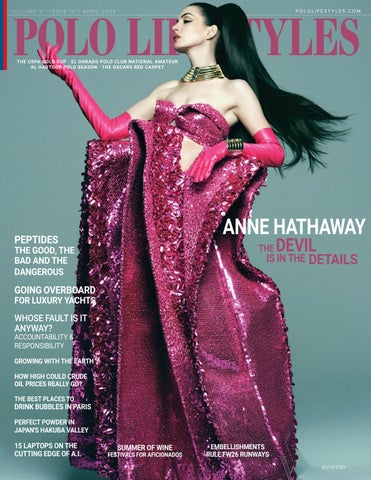
THE DEVIL WEARS PRADA BUT ANNE HATHAWAY
WEARS WHATEVER SHE WANTS, WHEN SHE WANTS
ANNE HATHAWAY IS TALKING ABOUT WORK-LIFE BALANCE, A CONCEPT THAT ACTRESSES WERE ASKED ABOUT FOR DECADES AND THEIR MALE COUNTERPARTS NEVER WERE.
It may have reached its apex (or nadir, depending on how you look at it) in 2013, when Sheryl Sandberg told every woman to lean in, that they could “have it all”, which mostly meant having a family and a full-throttle career and no time to feel adequate at any of it. For a while, everyone seemed to agree that this was a good thing. In other words, it’s a very millennial notion for a very millennial film star to be contemplating, having just reprised her most millennial role, as plucky Andy Sachs, in the highly anticipated The Devil Wears Prada 2.
It has been 20 years since Hathaway starred in the original The Devil Wears Prada as a recent graduate with serious journalistic aspirations who takes a job at the fictional fashion magazine Runway as an assistant to the imperial editor-in-chief Miranda Priestly (played meme-ably by Meryl Streep), despite her disdain for something so frivolous as fashion. The movie made her the patron saint of earnest millennial ambition, and Hathaway returns to Andy Sachs at a time when both she and the culture have outgrown the fantasy of having it all.
Hathaway is now 43. She and her husband, the producer Adam Shulman, have been married for 13 years and have two young boys, ages six and 10. She has made about 50 films, some of them giant and blockbuster-y, some of them critically revered, and some of them – as she herself put it recently –
“weird” or that “no one saw”, such as 2017’s Colossal. One of them, 2012’s Les Misérables, earned her an Oscar for Best Supporting Actress for her performance as Fantine. She tells me about having made a “conscious shift” in recent years to stop living her life as a “stressed person”, which coincided with her decision to stop drinking.
“Before, there was this focus that was really uncompromising and uninterrupted,” Hathaway says. “And I just can’t tell you anymore what life is like without kids, but kids interrupt you all the time.” Balance, she explains, is too fragile a concept. “My friends and I talk about it a lot, and we actually feel very defeated by the concept of balance,” she says. “If the weight shifts in one direction, you then have to bounce it up on the other side, and we find that it winds us up as opposed to making us steady.” Harmony, Hathaway theorises, is more forgiving.
“We’re like, ‘We seek to harmonize our life.’”
The world of magazines that serves as a backdrop for the first The Devil Wears Prada is slick and glamorous; the editor-in-chief has multiple assistants, and all of them are somehow dripping in Chanel and, naturally, Prada. This sequel is set in the current media landscape – one that I know from my lived experience is starkly different from what it was in 2006. Andy Sachs has returned to Runway as the magazine’s features editor (the role that usually oversees cover stories like this one).
“The characters are obviously 20 years along in their careers and at very different places, and the world of media is in a very different place,” says the film’s director David Frankel. “Andy has had a career in journalism that mirrors a lot of people’s experiences in journalism these days.” If that’s true, then Andy has survived lots of rounds of layoffs. And if The Devil Wears
Prada was a bildungsroman with a makeover scene so aspirational that it inspired legions to work in fashion, the sequel, Frankel says, “is a movie about a woman in her 40s … [that’s] about how you make peace with the world as you find it, not the world that you wish existed”.
The other thing that is different about The Devil Wears Prada 2 is that it was made, as Hathaway puts it, “in view.” The first movie was such an unknown quantity that fashion brands were initially hesitant to get on board and lend clothes.
This time, the cast attended actual fashion shows during Milan Fashion Week. That was a first for Meryl Streep, who says she was “struck by how not only beautiful and young—everyone seems young to me –but alarmingly thin the models were… I thought that all had been addressed years ago. Annie [Hathaway] clocked it too,” Streep adds, “and she made a beeline to the producers about it, securing promises that the models in the show that we were
putting together for our film would not be so skeletal! She’s a stand-up girl.”
Filming was a spectacle. “Even though we were aware of the impact of the first film two decades ago, I think none of us were prepared for the ambush of both goodwill and avid attention that engulfed us,” says Streep. “We needed police barriers and crowd control. Buses of fans turned up, and paparazzi swarmed and in one case kept jumping in front of the camera and the shot and got in a kerfuffle with crew! Annie kept her cool, but I was unnerved.”
During one scene, Hathaway took a spill down some steps after a heel snapped. “I was aware that I was falling, I was aware that I was being photographed, and I was also aware that, like, so many people on the crew, their hearts had just jumped up into their throat, so I needed to get up quickly to make sure they knew I was OK,” she recalls. She jumped up immediately after, with her arms outstretched like a gymnast finishing a routine, to let everyone know she was okay. But privately, she told Frankel, “Oh no. I’m news.”
Hathaway has been that kind of famous – where a stumble, literal or not, makes headlines – for most of her life. She tells me about having a conversation with an actor she reveres who told her, “We’ve watched you grow up.” “I’d never thought about it like that,” Hathaway says. “It’s funny to have met people when you were a teenager and grown in plain sight.”
In many ways, Hathaway is a perfect millennial avatar. Her mother was an actor who performed in regional theater productions, and she knew early on that she wanted to follow in her footsteps. She grew up the middle child and only girl of three children in Millburn, New Jersey, close enough to New York that she could take the train into the city to go on auditions for commercials. “I would go to school, and then I would get out at 2.22pm and I would sprint to the train station,” she recalls. Hathaway began doing that her freshman year in high school, while she was also performing with her town’s
local theatre, Paper Mill Playhouse. At age 16, she landed a part on a family TV drama called Get Real and moved to LA. The following year, she booked the role of Princess Mia Thermopolis in The Princess Diaries, the other duckling-toswan story that, along with that of Andy Sachs, became a canonic cultural touchstone for a generation.
“I feel like I was, like, everybody’s babysitter,” Hathaway says of the loyal fans who watched her in those early projects. “And I was a child when I made The Princess Diaries. I was still a 22-year-old mess of a human when I made The Devil Wears Prada. And so, we’ve grown up together, and I’m so happy for them and how their lives are unfolding. Like, this
crazy thing where people just graduate from high school and they just send me their graduation announcements. People send me their wedding invitations. It’s so very sweet. And I feel bad, because I can never do anything with them, because I’m not Taylor Swift–level organized. Maybe someday.”
FASHION & STYLE
FALL WINTER RUNWAYS: LOUIS VUITTON, VALENTINO & GABRIELA HEARST
LOUIS VUITTON FW26
FOR LOUIS VUITTON’S FALL/WINTER
2026 WOMEN’S COLLECTION, NICOLAS GHESQUIÈRE TURNS TO THE ULTIMATE DESIGNER: NATURE. TITLED SUPER NATURE, THE COLLECTION IMAGINES CLOTHING SHAPED BY LANDSCAPES—MOUNTAINS, FORESTS, AND PLAINS—WHERE INSTINCT, PROTECTION, AND MOVEMENT INFORM A NEW LANGUAGE OF SILHOUETTE.
Elements like wind, rain, and sun appear to sculpt the garments, creating exaggerated volumes and organic details that echo traditional dress while projecting a futuristic sensibility. The result feels like a new folklore for the digital age, where heritage and technology coexist.
Flora and fauna leave their mark across the collection: reworked animalier patterns woven into canvas and denim, leather flowers that function as decoration and armor, and tactile surfaces inspired by the natural world. Ghesquière calls it hyper-craft—a fusion of artisanal savoir-faire with innovation, from 3D-printed details to buttons resembling minerals and heels shaped like antlers.
Accessories reconnect the house with its travel heritage. The iconic Noé bag returns in its original 1932 proportions and colors, reaffirming Louis Vuitton’s enduring spirit of exploration.
VALENTINO FW26
VALENTINO IS ENTERING A NEW ERA—AND DOING SO IN ITS HOMETOWN. FOLLOWING THE PASSING OF FOUNDER VALENTINO GARAVANI EARLIER THIS YEAR, THE HOUSE RETURNED TO ROME FOR ITS FALL/WINTER 2026 SHOW, STAGED INSIDE THE STORIED HALLS OF PALAZZO BARBERINI.
It marked another step in Creative Director Alessandro Michele’s ongoing evolution of the brand since his arrival post-Gucci—a tenure already defined by his signature romantic maximalism and deep love of '70s references.
For Valentino's fall/winter 2026 show, Michele leaned into the house’s flair for drama with sculptural silhouettes, saturated color, and styling moments that felt both nostalgic and entirely new. But among the collection’s many standout details, one accessory quietly stole the
spotlight: the cummerbund. Re-imagined as a bold satin waistband layered over chiffon blouses and minidresses, the traditionally formal piece suddenly felt playful, feminine, and undeniably cool. If Michele has anything to say about it, the cummerbund will be fashion’s most unexpected It accessory of the season.
GABRIELA HEARST FW26
EMBELLISHMENTS RULE FW26
EMBELLISHMENT RETURNED THIS SEASON WITH NEW PURPOSE. RATHER THAN READING AS PURE GLAMOUR, DECORATION OFTEN FELT LIKE A WAY OF GIVING CLOTHES TEXTURE, EMOTION, AND VISUAL WEIGHT.
In a moment when stripped-back minimalism can risk feeling too severe,
designers turned to beading, sequins, embroidery, brocade, and appliqué to restore a sense of richness. The result was a femininity that felt less pristine than in past cycles – more layered, more personal, and at times intentionally a little undone.
Across the season, labels approached the idea from distinct angles. Erdem brought a romantic, heirloom-like sensibility, where embellishment felt tied to memory and narrative. Miu Miu made it feel offbeat and knowingly eclectic, while Dior
used decoration to heighten elegance and craft without losing softness. At Chanel, embellishment reinforced the house’s fantasy and polish, Prada gave ornament a more intellectual and disrupted edge, and Givenchy sharpened the idea with a cooler sensuality. Chloé, meanwhile, offered a lighter, more instinctive take, where surface detail felt bohemian rather than overly formal. Together, they made a strong case for embellishment not as excess, but as a way of making fashion feel tactile, expressive, and desirably alive again.
MONARCH VISIONARY
SENSUALLY COMPLETE
“The day science begins to study non-physical phenomena, it will make more progress in one decade than in all the previous centuries of its existence.” -
“You are not a drop in the ocean. You are the entire ocean in a drop.”
- Rumi
HE KUMBH MELAFESTIVAL OF THE SACRED PITCHER - IS THE WORLD’S LARGEST, MOST PROFOUND SPIRITUAL CONGREGATION, ANCHORED IN VEDIC MYTHOLOGY, ASTROLOGY, AND COSMOLOGY. IT IS A 12-YEAR CYCLICAL PILGRIMAGE, BASED ON JUPITER’S SOLAR REVOLUTION, WHERE MILLIONS GATHER TO BATHE IN SACRED RIVERS AT FOUR SPECIFIC LOCATIONS, BELIEVING THE WATER TRANSFORMS INTO THE SACRED AMRITNECTAR OF IMMORTALITY.
In 2025, as Jupiter entered Aquarius, at the confluence of the Ganga, Yamuna, and the hidden Saraswati rivers in Prayagraj, 660 million devotees submitted to the celestially activated waters to dissolve that which pollutes the absolute truth – our deep sense of interconnectedness.
The Kumbh Mela is inscribed by UNESCO as “the largest peaceful congregation of pilgrims on Earth,” where millions gather to bathe in sacred rivers seeking purification and liberation from the cycle of birth and death. Yet its true magnitude is beyond numerical - it is neurological, emotional, and subtle.
Each pilgrim arrives as a system: layered with memory, conditioned through repetition, shaped by unseen patterns embedded within the nervous system. Immersion becomes a moment of dissolution - a reorganization of identity at the level of sensation, perception, and subtle awareness - an initiation at a magnitude of which science is only beginning to articulate:
• A system-wide recalibration.
• Cold immersion modulates vagal tone, reduces inflammatory signaling, and shifts autonomic balance and neurochemical balance. But beneath these mechanisms lies a deeper intelligence:
• Water reorganizes coherence.
The act is simple. The consequence is profound. What dissolves in that moment is not identity - but egoic distortion. What emerges is not something acquired - but an ancient awakening.
THE CHURNING OF THE INNER OCEAN
“The wound is the place where the Light enters you.” - Rumi
The first truth the ocean offers is not sweetness. It is pressure. The ancient myth of Samudra Manthana reveals a universal truth: evolution requires friction. In the ancient telling, the devas (gods) and asuras (demons) come to the rim of the cosmic milk-sea and agree to do what destiny requires: churn the world until it gives up what it has hidden and preserved.
Nikola Tesla
Before the nectar came all the poison. In the Samudra Manthana, the gods and anti-gods churned the cosmic ocean for Amrit, the nectar of immortality. However, the first emergence is not immortality - it is halahala, the venom that threatened to dissolve the worlds. Then Lord Shiva materializes to receive it, held it in his throat, and became Nilakantha, the blue-throated one. That myth remains one of the most refined teachings on purification ever given: true purity is not fragility. It is the capacity to meet poison without becoming it.
Within the human system, this friction is biochemical, neurological, and experiential. It is the tension between stress and adaptation, damage and repair, chaos and order.
Today our poisons often arrive in quieter forms: inflammatory excess, metabolic fatigue, sleep deprivation, cognitive overload, traumatic memory loops, environmental burden, and the subtle exhaustion of a nervous system that has forgotten how to rest.
This is where an unexpected mod-
ern blue molecule enters the frame: Methylene Blue. A scientifically real compound whose role in oxygen handling, mitochondrial function, memory, and brain resilience creates an arresting echo of Shiva’s old lesson: what is toxic may, under the right conditions, be transmuted into function.
The emergence of poison is a mere consequence in the natural purification and evolution of consciousness. What matters is the system’s capacity to process it.
THE BLUE THRESHOLD: SHIVA AND THE SCIENCE OF TRANSMUTATION
“What you seek is seeking you.” - Rumi
When Lord Shiva becomes Nilakanthathe blue-throated one - he demonstrates the highest intelligence of all living systems:
• The ability to hold and transform toxicity without collapse.
• This is not myth alone. It is mirrored precisely in cellular biology.
Within the mitochondria, the body
constantly manages reactive oxygen species - byproducts of energy production that, if unchecked, become damaging. Health is not the absence of these byproducts - but the efficiency with which they are processed.
Here, the relevance of Methylene Blue becomes profound. Functioning as a redox mediator, methylene blue enhances mitochondrial respiration, allowing cells to maintain energy production while reducing oxidative stress. It supports the body’s innate capacity to convert metabolic “poison” into usable intelligent energy.
In this sense, it is not a foreign intervention. It is a biochemical ally for transformation.
THE INVISIBLE RIVER: SARASWATI AND GLYMPHATIC INTELLIGENCE
“The quieter you become, the more you can hear.” - Ram Dass
The unseen river Saraswati flows beneath perception. Saraswati names the unseen current beneath language,
beneath thought, beneath identity itself. She represents wisdom, memory, subtle intelligence, and refined perception. And in that sense, she is not only a sacred river. She is a map of the human condition. The most important currents in our lives are rarely visible from the surface - just as the glymphatic system flows beneath cognition.
Emerging neuroscience has demonstrated that the glymphatic system governs the clearance of metabolic waste from the brain through cerebrospinal fluid dynamics. It is most active in states of deep rest - when the organism is not striving, but surrendering.
During deep restoration, the body enters a more truthful relationship with itself. Surface identity softens. The compulsions of the day loosen. The brain shifts into slower, more ordered wave patterns. Neurovascular rhythms change. Cerebrospinal fluid dynamics support the removal of metabolic residue. What has accumulated begins, quietly, to move.
This is the hidden principle: Clarity is not created. It is revealed when obstruction is removed.
Methylene Blue supports this revelation by enhancing the energy available to neural support cells, improving the efficiency of waste clearance processes, and reducing oxidative congestion.
It does not force awakening. It restores the conditions under which awakening becomes possible.
THE BRAIN AS A TEMPLE OF FILTRATION
“The kingdom of God is within you.”Jesus Christ
The brain is not only an organ of thought. It is an organ of curation. It depends upon barriers, channels, rhythms, tides, and selective permeability. The blood-brain barrier does not merely separate blood from tissue; it protects the atmosphere in which thought can
remain coherent. The neurovascular network is not merely plumbing; it is the architecture of availability. The endocrine system does not simply produce hormones; it times the tides of attention, repair, desire, calm, and signal integration.
The spiritual imagination has long understood that charged sacred waters and subtle plasma energies flow invisibly through the human being. Modern science, in its own language, is beginning to catch up - not by proving mysticism, but by revealing just how dependent consciousness is on invisible forms of cleansing and flow.
This is why the Age of Aquarius is not an escape from reality. It is an invitation to embody the fullest sense of truth, through slow and deep embodiment. The clearer the channel, the cleaner the signal. The cleaner the signal, the more faithfully purpose can descend.
Methylene Blue enhances:
• ATP production
• Cerebral blood flow
• Neurotransmitter balance
• Signal efficiency across neural networks
The result is not stimulation - but refinement. A quieter system. A clearer signal. A more accurate experience of reality.
THE AGE OF AQUARIUS: THE RISE OF INNER MASTERY
“We are spiritual beings having a human experience.” - Pierre Teilhard de Chardin
The Age of Aquarius signals a shift from external authority to internal alignment. This is not abstraction - it is biology evolving toward coherence.
As brainwave patterns synchronize and neural networks integrate, individuals and groups begin to experience:
• Heightened awareness
• Increased intuition
• Greater emotional regulation
• Enhanced creative cognition
These states are not granted. They are enabled by system clarity and orchestrated harmonies.
THE MONARCH VISIONARY: THE FOUR-FOLD PATH
“Until you make the unconscious conscious, it will direct your life.” - Carl Jung
Transformation unfolds in stages:
I. Initiation: Churning the Waters
Initiation begins when the poison is seen clearly. The individual recognizes that burden has accumulated in the body and field: inflammatory residue, poor sleep, metabolic fatigue, emotional fixation, cognitive static, traumatic reflex, environmental stress, and the subtle exhaustion of living too long in overdrive. This is the stage of honesty. One does not yet become luminous. One simply stops pretending the waters are already clear.
Biologically, Initiation asks: What is burdening the filters? Are sleep and restoration compromised? Is the nervous system living in false emergency? Are oxygen delivery, metabolic resilience, and barrier integrity under strain?
In this stage, methylene blue can be contemplated not as salvation, but as a precise possible ally in the work of lifting fog, supporting mitochondrial steadiness, and creating better conditions for signal clarity under professional guidance.
Zenity Blue supports Initiation by helping clear metabolic fog and support cellular energy, offering the nervous system a steadier foundation from which to begin the work of purification, discernment, and honest self-revelation.
II. Crystallization: The Hidden River Clears
Crystallization begins when signal starts separating from noise. The hidden
Saraswati current returns. Attention steadies. Memory becomes less burdened. The organism is no longer only surviving the turbulence; it is developing coherence. In this stage, Methylene Blue aligns most directly with the human cognitive findings: support for memory retrieval, modulation of attention-related activation, and a more ordered energetic atmosphere.
Crystallization is not ecstatic fantasy. It is the first dependable experience of inner order. The temple becomes transparent enough to hold light without distortion.
Zenity Blue supports Crystallization by nourishing focus, cognitive clarity, and energetic coherence, helping the hidden river of perception flow with greater precision as signal begins to separate from noise.
III. Actualization: Expanding Awareness
Actualization is embodiment. It is not enough to glimpse safety. The body must learn to keep it. This is where methylene blue’s fear-extinction literature becomes especially resonant. After successful therapeutic work, the biology may better retain what has been
learned. The new pattern begins to hold. The organism stops rehearsing the old emergency as its primary ritual.
In Monarch Visionary terms, this is not the erasure of painful memory. It is the consecration of a new relationship to memory. The nervous system becomes less available to old tyranny and more available to present coherence.
Zenity Blue supports Actualization by serving as a disciplined ally for mental steadiness and integration, supporting the brain’s capacity to hold clearer patterns of thought, attention, and embodied learning.
IV. Ascension: Fully Integrated Radiant Alchemy
In Monarch Visionary language, Ascension is what becomes possible when the filters are no longer overwhelmed. The river clears. The temple brightens. Consciousness radiates instead of merely defending.
Scientifically, this is better biological conditions for coherence. A fully interconnected, well-resourced instrument that has steadier energy, less distortion, more clarity, and more ordered internal conditions through which awareness may be carried with grace.
Zenity Blue supports Ascension by refining the biological conditions for steadier presence and cleaner transmission, supporting a more coherent human instrument through which higher awareness may be embodied with greater awareness.
ZENITY BLUE: PRECISION, PURITY, AND THE MODERN ELIXIR
“In an age saturated with excess, refinement becomes the highest form of luxury.”
Zenity Biolabs approaches Methylene Blue not as a trend - but as a discipline. Zenity Blue is formulated with a singular intention: to support the body’s inherent intelligence with clarity, purity, and precision.
In its clearest medical role, Methylene Blue remains acquired methemoglobinemia, where it helps restore more normal oxygen handling. But outside that approved use, Methylene Blue is being studied or clinically discussed for a much broader constellation of benefits. These include:
• Cognitive clarity, attention, and memory
• Mitochondrial and cellular energy support
• Trauma learning and memory reconsolidation
• Neuroprotection and barrier resilience
• Pain-control, tissue support, and skin-aging related research
• Antimicrobial and photodynamic uses
• Mood, fatigue, and broader integrative uses
SLOW & DEEP REMAINS THE HIGHEST LUXURY
“Nature does not hurry, yet everything is accomplished.” - Lao Tzu
At Kumbh, millions enter the river because they know something modern culture often forgets: the body must sometimes participate in surrender before the soul can trust release.
In the myth of amrit, poison appears before nectar because transformation is not naive. It must earned.
In the Age of Aquarius, humanity is being asked to become more responsible with what it carries - more elegant in what it circulates, more truthful in what it transmits, more refined in the subtle channels through which higher purpose descends.
In methylene blue, modern medicine has encountered a molecule whose story - bounded, compelling, and richly symbolic - belongs uncannily to this threshold.
Blue is not merely a color. It is an ethic of precision.
It is the discipline of holding intensity without dispersing it. It is the refusal to confuse force with clarity.
It is the recovery of the hidden river beneath the noise.
It is the possibility that the human tem-
ple, properly tended, may once again become lucid enough to carry light beautifully.
Slow and deep living remains the highest luxury:
• What is slow can be metabolized.
• What is deep can be trusted.
• What is sensually complete does not glitter from emptiness; it radiates with coherence.
The nectar is churned through the sweetness of our realized existence.
As a special gift, use coupon code MonarchVisionary for 5% off all Zenity purchases at www.zenitybiolabs.com
Visit www.MonarchVisionary.com to receive regular updates through our newsletter.
This article is for educational and lifestyle purposes and is not medical advice. Dietary supplements are not intended to diagnose, treat, cure, or prevent disease. Use only as directed on the label; consult a qualified clinician if pregnant/nursing, taking medications, or managing a medical condition.
Ultra-Exclusive Silicon Valley Estate known as Villa de Verano
SET ON MORE THAN 12 SECLUDED ACRES, VILLA DE VERANO IS AN ULTRA-EXCLUSIVE HILLSBOROUGH ESTATE INSPIRED BY THE ELEGANCE OF LAKE COMO.
The gated compound offers exceptional privacy, symmetry and scale, with a tree-lined drive leading to a grand motor court and the main residence, guest quarters and sports pavilion.
The 12,404-square-foot main residence spans three levels serviced by an elevator and overlooks the elegant pool, reflection pond and sweeping views of San Francisco Bay.
The 4,612-square-foot guest house and sports pavilion complement the estate. Interior amenities include a fitness center, theater, game room, spa, and a 2,100-gallon saltwater aquarium. Many furnishings and artworks were commissioned for Villa de Verano, creating a unified and distinctive aesthetic throughout the property.
The grounds include a 150 capacity amphitheater, event lawn, Asian garden with koi pond, swimming pool, reflection
pond, open air pavilion, rose garden, redwood grove and English spiral mound.
The Sports Pavilion includes a two-story sports lounge with an elevated viewing platform overlooking a sunken championship tennis court, pickleball court, volleyball court, badminton court, bocce ball court, horseshoe court, shuffleboard court and putting green.
The estate also features an executive length golf course. Following its completion, Villa de Verano received the CLCA annual Grand Sweepstakes Award for best residential estate completed in the state of California.
MANSION OF THE MONTH
$23,000,000 USD
BEDROOMS 6 | BATHROOMS 6 FULL AND 2 PARTIAL | INTERIOR
Located in the gated Gros Ventre North subdivision, in the heart of Jackson, Wyoming, is this newly constructed architectural masterpiece. Boasting exquisite craftsmanship and attention to detail, this home offers an unparalleled living experience amidst the breathtaking backdrop of the Teton Range.
At the heart of the main level is the expansive Great Room adorned with vaulted ceilings and exposed steel beams. Gather around the floor-to-ceiling stone fireplace or express your culinary creativity in the chef’s kitchen, outfitted with top-of-theline appliances, tailor-made finishes, and a butler’s pantry.
Floor-to-ceiling windows and telescoping doors flood this room with natural light and provide seamless access to the expansive deck, complete with a covered outdoor dining area, a built-in grill, and an outdoor fireplace, perfect for entertaining against the backdrop of Wyoming’s natural splendor.
Step into opulence as you enter the spacious Primary Suite. Featuring his and her walk-in closets and a spa-like bathroom complete with a double vanity, double showers, a freestanding bathtub, and an outdoor shower, this retreat boasts privacy and comfort.
Relax and unwind on the private deck, offering a sweeping panorama of the Teton Range, or enjoy the warmth and comfort of the double-sided fireplace perfectly situated in front of a built-in reading nook. There is a private office located between the Primary Suite and the Great Room, designed for productivity and inspiration. With a private covered deck offering sweeping views of the surrounding mountains, this office becomes a private retreat within the expansive home.
Adjacent to the office is the mudroom, a transitional space crafted with custom millwork and thoughtful design elements. Here, gear, jackets, and shoes find a styl-
ish home, keeping the main living area pristine and clutter-free. Adjacent to the mudroom, is the upstairs laundry room and an additional coat closet to meet all your storage and cleaning needs. At the center of the home where the main level and lower level meet is a causeway flanked by expansive two-story windows which saturate the home with natural light while providing endless views of the surrounding wilderness.
Located on the lower level is the entertainment and media room. Unwind in the sprawling Media Room, equipped
with a full-sized wet bar featuring a wine fridge, ice machine, and dishwasher. Built-in shelves offer ample space for entertainment, books, and art. Indulge in recreation and relaxation within the gym and sauna, with seamless outdoor access to the meticulously landscaped backyard and built-in hot tub, creating an oasis of luxury and relaxation.
Additionally, attached to the Media Room is a spare Flex Room with an en-suite bathroom that is perfect for supplementary accommodations for guests. The south wing of the lower level is the dedicated
guest wing, with four en-suite bedrooms, each offering incredible wilderness and mountain views.
The garage is a haven for recreation enthusiasts, with expansive storage solutions ensuring that every vehicle, tool, recreational equipment, or seasonal gear finds its designated place. This six car garage bay designed to provide maximum utility and with over 1,500 square feet this space can easily house all of your standard and recreational vehicles.
BLENDED WITH NATURE IN THE HEART OF SAGAPONACK
A STORYBOOK ESTATE IN THE HEART OF SAGAPONACK
Set on three enchanting acres in Sagaponack, “Whimsy Farm” is a one-ofa-kind estate blending Hamptons farmhouse charm with French countryside elegance and Palm Beach flair. From the
original barn-turned-great room to the lush, sculpture-filled grounds, saltwater pool, dual kitchens and separate guest quarters, every detail invites relaxation, celebration and timeless style.
PROPERTY DETAILS
790 Sagg Road, Sagaponack, New York
5 Bedrooms | 6 Bathrooms
$6,995,000
Listed by Douglas Elliman Adam Hofer adam.hofer@elliman.com 631.236.8659
In Search of Solace Summer Wine Festivals
NOT-TO-MISS SUMMER WINE FESTIVALS ACROSS THE UNITED STATES SUMMER OF WINE
WILLIAM SMITH @willismith_2000 COPY EDITOR & CONTRIBUTOR
ONE OF THE ABSOLUTE BEST WAYS TO LEARN ABOUT WINE IS TO “DIVE IN” AND WINE FESTIVALS, ESPECIALLY WHEN THEY HAVE A FOCUS ON EDUCATIONAL SEMINARS, ARE A TERRIFIC WAY TO DIVE IN. BUT EVEN IF YOU’RE JUST A WINE LOVER WHO LIKES TO TASTE AND SAMPLE AND ENJOY, THEN WINE FESTIVALS EQUALLY RISE TO THE OCCASION.
There are thousands of wine-focused festivals - both big and small - each year and in every corner of the world. This month, we take look at some incredible summer wine festivals in the United States that bring together top wine producers from around the world into one place for a few days of unadulterated, vinous-infused bliss.
I also encourage readers to research local wine festivals in your own city, state, or region. You will find some. For my part, I’ve chosen a handful of worldclass festivals that should make their way onto your schedule this summer. As always, Salud!
SONOMA COUNTY VINTNERS POUR + EXPLORE SERIES
One of the best ways to find events and opportunities for exploring wine regions is by researching the various
WILLIAM SMITH /WINE CONTRIBUTOR
types of membership associations that represent regions. In some cases, they are trade associations, guilds of growers, or some other permutation that coalesces the power and promise of those in the industry in any particular locale. Additionally, supporting these organizations and their work bolsters the entire ecosystem of those involved in wine in their geography.
Being a fan of Sonoma County and its many producers, Sonoma County Vintners is an incredible organization that represents and champions Sonoma County and their 150 winery members.
This year, and in collaboration with local Somm extraordinaire Christopher Sawyer, the organization has launched the Pour + Explore Wine Tasting series: 10 different events that take you to different Sonoma County properties and treat attendees to a true introduction
to the bounty and diversity of the area’s wines:
• Thirty different producers pouring their Pinot Noir at Bricoleur Vineyards
• Chardonnay and other whites at Kendall-Jackson
• Ram’s Gate showcasing their luxurious property and Joe Nielsen’s incredible bottlings
• Other events are dedicated to Zinfandel (too under-appreciated!), Rhone Varietals, subregions in the Valley like Petaluma Gap, and sparkling wines at Gloria Ferrer.
You can even avoid the hustle and bustle of the bigger airports and take advantage of flights – many direct from larger west coast cities – into Charles M. Schulz Sonoma County Airport by Alaska, American and Southwest airlines.
Events run monthly through December 2026. More information and ticket purchases can be found at sonomawine. com/pour-explore
HEALDSBURG WINE & FOOD EXPERIENCE
Because Sonoma County continues to emerge from the long shadow of its neighboring valley and as a true world-renowned wine region in its own right, we are including a second wine festival in Sonoma on our list: the Healdsburg Wine & Food Experience.
Thursday’s Welcome Celebration kicks off at celebrity chef Charlie Palmer’s new culinary-driven hotel, Appellation Healdsburg. Through the rest of the weekend, there are winery luncheons, various seminars, an outdoor concert, and incredible wine dinners to choose from. The Grand Tasting on Saturday afternoon will feature over 150 incredible wines, beers, spirits and ample bites from top chefs and restaurants in Sonoma County and beyond. I love that Healdsburg locals get a discounted rate to the Grand Tasting. And if you’ve paced yourself accordingly, there is a Big Bottle Party that same evening with large format bottles, caviar stations and live music.
Those seeking the ultimate experience can purchase the Platinum VIP Weekend Package which ensures you won’t miss the best of the festival’s events with lots of VIP perks like a personal hospitality concierge, priority hotel booking, early access to the Grand Tasting and complimentary shuttle service to and from all events.
The event runs from May 14 to 17, 2026, and tickets are currently on sale. Head to healdsburgwineandfood.com for further details.
FOOD & WINE CLASSIC IN ASPEN
Polo Lifestyles readers know well that world-class polo can be found in the dreamy, luxe outpost of Aspen. And of course there is skiing. But it is also home to one of the most storied food and wine festivals in the U.S., the Food & Wine Classic in Aspen. Held since 1983, the event only garners more accolades and attention year after year.
One of two festivals with the full backing of Food & Wine magazine – the other being the Food & Wine Classic in Charleston, S.C., – the event draws top
In Search of Solace Summer Wine Festivals
talent in both the culinary and beverage worlds. Chefs Tyler Florence, Maneet Chauhan, Bobby Flay and many others will be conducting seminars and demonstrations this year. Nearly a dozen wine seminars are available covering everything from leading women winemakers from Italy to the rising interest in Chenin Blanc, from “ultra-luxury” sake to the amazingly entertaining Wanda Mann leading a seminar on high altitude, mountain wines.
The Grand Tasting sessions are available both before and after the scheduled seminars, with each session offering a new lineup of bites and beverage offerings. The winery attendees are opaque on the event Web site, but fear not, top producers are always in attendance. Local hotels play host to various scheduled events, including the St. Regis Aspen Resort. Luxe accommodations are also right downtown at the wonderfully historic Hotel Jerome, which is part of the Auberge group.
The festival runs June 19 to 26, 2026, and tickets are currently on sale (and going fast) at classic.foodandwine.com
Consistently ranked among the top wine festivals in the U.S., the Santa Fe Wine & Chile Fiesta is actually the best wine festival in the world. Truly. Okay… owning up that I am a wee bit biased as I not only live in Santa Fe, N.M., but I also serve on the Fiesta’s Board of Directors. However, there are nearly 5,000 people who love this annual event – celebrating its 35th year in 2026 – and descend on downtown Santa Fe each September to enjoy a week of festivities that celebrate and center wine, while also elevating Santa Fe’s unique history, culture, and stellar culinary scene.
The nearly week-long Fiesta includes golf outings, sunset train tours, a wine luncheon at Georgia O’Keefe’s Ghost Ranch and a slew of amazing culinary demonstrations. There are also fun and educational seminars led by top U.S. wine talent, including this year, a seminar to recognize the 50th anniversary of the Judgement of Paris. The city’s culinary scene is hot, with over two dozen winery dinners and luncheons.
The Fiesta really comes alive with the events at Fort Marcy Park in downtown. Chile Friday kicks things off with a celebration of New Mexican cuisine, craft beers and ciders, and tequila. Saturday’s Grant Tasting brings together 80 wineries and the city’s best restaurants to create a truly unforgettable afternoon. Lest you think Sunday, the last day of the Fiesta, is an afterthought, you’d be wrong. In fact, it includes my favorite event, Rosé All Day, at the posh Auberge Bishop’s Lodge.
Individual events can sellout and the city’s hotels also reach capacity, so be certain to buy tickets and make reservations early. Most of the Fiesta’s events are held downtown in walking distance to many of Santa Fe’s celebrated hotels, including the former Harvey House hotel, La Fonda, where history envelops visitors and – by September - the property’s lobby and bar will have emerged from a thoughtful makeover.
The Fiesta runs from September 23 to 27, 2026. More information is available at santafewineandchile.org and tickets go on sale on June 17th.
SANTA FE WINE & CHILE FIESTA
MONARCH VISIONARY HEAL
YOURSELF AND HEAL THE WORLD
SPIRITUALITY FAITH
QUESTIONS GROWTH · FOCUS
GROWING WITH THE EARTH
“If the doors of perception were cleansed, everything would appear to man as it is, infinite.” - William Blak
“When we protect the youngest members of the human family, we build a better world.” - António Guterres
THERE ARE MOMENTS IN HISTORY WHEN THE FUTURE DOES NOT ARRIVE AS A MACHINE, A MARKET, OR A MANIFESTO. IT ARRIVES AS A CHILD.
Not merely as a biological beginning, but as a living threshold - a soft, watchful, radiant presence through which a civilization quietly reveals what it believes about life itself. Whether it chooses tenderness or force. Whether it values wonder or utility. Whether it remembers that the soul of tomorrow is formed in the atmosphere of today.
This is why UNICEF’s 2026 report Growing with Rights carries such gravity. Beneath its careful language of evolving capacities, developmental context, protection, participation, and emancipation lies a truth so simple that it feels almost sacred: children do not grow in abstraction. They grow in fields of relationship. In love or in fear. In belonging or in fracture. In the felt sense that the world is willing to receive them - or in the opposite lesson, that they must harden themselves to survive it.
This insight is as much spiritual as it is policy-driven. A child is not a future unit of production. A child is a field of becoming. And whatever enters that field - safety, violence, reverence, neglect, beauty, chaos, continuity - enters the architecture of the nervous system, the imagination, the heart, and the future self.
From a Monarch Visionary perspective, this is where all true leadership begins: not with conquest, but with guardianship. Not with personal power severed from consequence, but with the recognition that the next generation is the living altar of the world to come. If children are raised in dignity, the future
has a nervous system capable of trust. If they are raised in fracture, the future inherits a bloodstream of fear.
So the child stands at the beginning of this article not as ornament, but as oracle.
Not because childhood is sentimental. Because childhood is foundational. Because the child is where policy, spirit, biology, and destiny first meet.
THE POWER OF THE MYTH
“Science polishes the gift of seeing, Indigenous traditions work with gifts of listening and language.” - Robin Wall Kimmerer
Myth endures because it speaks in the language of wholeness.
Long before institutions found terms like participation, psychosocial development, intergenerational dignity, or future generations, humanity carried its deepest truths in symbol. It spoke through the rainbow, the sacred child, the luminous one, the world healer, the returned memory, the promised people, the bridge between Earth and heaven. Myth has always been one of the oldest technologies of remembrance.
RENEWAL COMMUNITY SUPPORT EXPLORATION · ENERGY
That is why the modern fascination with rainbow children, rainbow warriors, star-born generations, and luminous beings has such staying power. Even when some of the language is historically mixed, culturally simplified, or spiritually modernized, the deeper intuition remains potent: humanity senses that it is being asked to become more relational, more compassionate, more ecologically sane, more spiritually coherent, and more worthy of its children.
And yet reverence must be accompanied by honesty. Not every rainbow prophecy circulated today can be cleanly traced to one original Indigenous source. Some have been reworked, softened, merged, or mythologized in contemporary spiritual culture. But this does not diminish the underlying power of the symbol.
It asks us to handle it with greater maturity.
Because the rainbow is not powerful merely as folklore. It is powerful as pattern.
It names a movement from fragmentation into harmony.
From the monochrome of fear into the full spectrum of living awareness. From severance into kinship. From domination into reverence. From private survival into collective awakening.
UNESCO’s recognition of “knowledge and practices concerning nature and the universe” gives an extraordinary institutional mirror to this truth. It affirms that many of humanity’s deepest
ways of knowing are carried not only in formal education or scientific method, but in oral tradition, ritual, worldview, spirituality, attachment to place, memory, ecological wisdom, and cosmology. What myth preserves, policy is now beginning to protect.
In Monarch Visionary language, myth is not an escape from reality. It is reality remembered before the world has language precise enough to defend it.
APOCALYPSE AS THE LIFTING OF THE VEIL
“The most beautiful thing we can experience is the mysterious. It is the source of all true art and science.” - Albert Einstein
In its deepest sense, apocalypse is not
MONARCH VISIONARY HEAL
YOURSELF AND HEAL THE
WORLD
SPIRITUALITY FAITH
catastrophe. It is unveiling.
It is the lifting of the veil from perception. The falling away of false narratives. The exposure of what fear, propaganda, greed, and spiritual numbness have concealed for generations. It is the moment when a civilization begins to see what has always been true: that life is relational, that the child is sacred, that land is not dead matter, that the future is already forming in the present, and that consciousness itself is shaped by what it consents to perceive.
This is why the apocalypse of our era may not look only like collapse. It may look like recognition.
Recognition that exploitation cannot produce peace.
Recognition that fractured childhood becomes fractured governance.
Recognition that false economies built on despair, addiction, and severance can no longer sustain the human spirit.
Recognition that the “demons” of
QUESTIONS GROWTH · FOCUS
humanity - fear, greed, blame, dis-empowerment, guilt, domination, numbness - are not merely private afflictions, but collective conditions reproduced through broken systems.
In this sense, prophecy and policy are no longer strangers. What myth preserved as warning, global governance is beginning to articulate in civic language. The veil lifts when institutions can no longer pretend that child wellbeing, cultural continuity, ecological stewardship, mental health, and intergenerational responsibility are separate concerns. The apocalypse begins when the architecture of separation is exposed as illusion.
THE POWER OF THE SENSES
“We are not human beings having a spiritual experience; we are spiritual beings having a human experience.” - Pierre Teilhard de Chardin
The senses are not passive windows. They are living thresholds.
Modern neuroscience increasingly supports what contemplative traditions have long implied: perception is not simply the reception of an external world. It is an active, dynamic shaping of reality through attention, expectation, memory, and embodied state. The brain does not merely record what is there. It anticipates, filters, weighs, selects, and magnifies. What we sense is inseparable from how we are organized, and our senses dynamically affect reality.
This makes the senses more mysterious and more powerful than modern life usually allows. Our attention magnetizes experience. Our fears narrow what can be perceived. Our emotional history colors the world before thought has even named it. A nervous system shaped by threat will notice threat more readily. A nervous system shaped by safety, rhythm, reverence, and love can perceive nuance, subtlety, beauty, and relation with greater ease.
From a spiritual perspective, this is why
the awakening of the senses matters so much. Awakening does not begin only in the intellect. It begins in the restoration of perception. To see more clearly. To hear more truly. To feel more deeply. To recover sensitivity from saturation, and wonder from numbness.
In Monarch Visionary language, the senses are not mere biological instruments. They are magnetic gateways through which the human being enters communion with divinity. When coarsened by fear, they become servants of survival alone. When purified, they become pathways of revelation.
SENSORY PURIFICATION AND THE RETURN OF WONDER
“Purification of the senses is the foundation of spiritual life.” - Swami Sivananda
How, then, are the senses purified?
Across traditions, the answer has been remarkably consistent: by calming the body, disciplining attention, simplifying input, refining feeling, and restoring
reverence. Breathwork, meditation, chant, prayer, fasting, silence, pilgrimage, ritual, and contemplative beauty all work, in different ways, to re-tune the nervous system.
Modern language gives this process another vocabulary. Slower breathing, greater vagal tone, calmer stress circuitry, more coherent heart rhythms, heightened interoceptive awareness, and less defensive self-reference all support a perceptual field that is less distorted by alarm. When the organism is less flooded, the world can come back into focus.
That is why silence can make the world brighter.
Why prayer can make perception more tender.
Why grief, when it is held rather than suppressed, can deepen sight rather than diminish it.
Why ritual can feel as though it is not adding something artificial, but removing interference.
In lay terms, the world brightens when the noise is turned down.
This is not merely poetic. It is developmental. It is physiological. It is spiritual. It is also profoundly relevant to children. A child whose senses are protected from chronic assault, whose attention is not shattered by constant overstimulation, and whose emotional life is met with attunement rather than dismissal is far more likely to retain the innate capacities modern adults spend decades trying to recover: awe, subtlety, imagination, trust, and moral sensitivity.
The child does not need to be made luminous. The child needs conditions that do not extinguish luminosity and the training to source the power and wisdom to evolve and transform the Earth.
THE RAINBOW BODY AND THE ARCHITECTURE OF LIGHT
“The goal of the mystic is not simply a transient ecstasy; it is a permanent state of being in which the person’s nature is transformed.” - Encyclopaedia Britannica
MONARCH VISIONARY HEAL
YOURSELF AND HEAL THE
WORLD
SPIRITUALITY FAITH
Across sacred traditions, humanity has returned again and again to one great image: that consciousness, properly purified, does not become smaller. It becomes radiant.
In Tibetan Buddhism, the Rainbow Body stands as one of the most luminous examples of this aspiration. Within the Vajrayāna and Dzogchen streams, the realized being is said not merely to think differently, but to undergo an extraordinary refinement of awareness in which fixation, fear, and karmic density are dissolved into a more subtle, unified, luminous expression of being. Whether approached devotionally, philosophically, or anthropologically, the Rainbow Body represents a profound declaration: that human consciousness may be capable of becoming transparent to light.
This does not mean that modern science has proven such attainment in literal material terms. It has not. But the power of the doctrine lies not only in its outer
QUESTIONS GROWTH · FOCUS
claims. It lies in the inner architecture it reveals.
The Rainbow Body suggests that the senses, thoughts, energies, and identity of a human being are not meant to remain fragmented. They are meant to be refined. Clarified. Reunified. Purified of distortion until awareness itself becomes a kind of radiant magnetism - lucid, compassionate, integrated, and free.
This is where bodhicitta becomes essential. In Mahāyāna Buddhism, bodhicitta is the awakened heart-mind: the vow to attain awakening for the liberation of all beings. Without bodhicitta, radiance becomes spiritual vanity. With bodhicitta, light becomes service. Illumination becomes responsibility. Wisdom becomes love in motion.
This is why the Rainbow Body matters so deeply to the wider conversation of prophecy. It teaches that the highest human development is not spectacle.
It is compassionate coherence. It is the purification of awareness until self and world are no longer held in opposition, and consciousness becomes capable of carrying life rather than defending against it.
Christian mysticism preserves a related arc through purification, illumination, union, and return. Tantric traditions preserve it through the subtle body, through kundalini, through self-illumination, through the transmutation of life force into divine realization. Different traditions, different languages - yet the same great intuition returns: the perfected human is luminous, compassionate, and in right relationship with reality.
From a Monarch Visionary perspective, this is the hidden thread beneath the rainbow myth. The rainbow child is not merely a charismatic future generation. The rainbow child is the image of the human being transfigured into higher dimensional awareness.
THE HEART AS PORTAL TO THE FUTURE
“The heart knows things that the mind cannot understand.” - C.G. Jung
Across science and spirit, the heart plays a unique role in shaping perception and future vision.
Physiologically, a coherent heart is not a sentimental idea but a real condition of regulation. When heart rhythms are more ordered and vagal tone is stronger, the body is better able to process emotion, attention, and social engagement without collapsing into reactivity. Symbolically, the heart has always been treated as a chamber of deeper knowing. A place where life is sensed before it is explained.
This is why so many traditions locate prophecy in the heart rather than the intellect alone. The heart is where time softens. It is where the future can be felt not merely as forecast, but as moral consequence. It is where possibility becomes intimate.
Love, wonder, grief, reverence, devotion - these do not simply change what we think. They change the quality of time itself. Moments can dilate. Presence can widen. The “now” can become large enough to contain both memory and future at once.
In spiritual language, the heart is a portal.
In scientific language, one might say that interoception, autonomic regulation, and emotional coherence profoundly influence cognition, attention, and future-oriented appraisal.
In Monarch Visionary language, both are true enough to stand beside one another.
The future unfolds first in the felt life of the present. A culture without heart loses its future long before it loses its markets. A civilization that restores the heart restores its capacity to imagine, protect, and steward what has not yet been born.
BELONGING AS BIOLOGY, SPIRIT, AND SOCIAL DESTINY
“Children today are living in a world that is increasingly hostile to their rights.” -
Catherine Russell
Modern neuroscience, for all its instruments and precision, is discovering something the elders already knew: the world enters the body.
Trauma is not only remembered as story. It is carried as pattern.
Belonging is not only emotional. It is biological.
Safety is not merely comforting. It is organizing.
The child who grows in a field of tenderness, voice, rhythm, and continuity develops very differently from the child who grows in a field of chronic stress, instability, humiliation, or emotional exile. The nervous system learns the world before the intellect explains it. The body forms expectations of life before philosophy arrives.
This is why UNICEF’s insistence on meaningful participation, respect for evolving capacities, and supportive environments is so important. It is not merely an ethical appeal. It is developmental realism.
When global child-rights frameworks say children must be heard, protected, and treated as real participants in social life, they are describing conditions un-
der which the organism can learn trust rather than alarm, coherence rather than fragmentation, and identity rather than chronic defense.
From a spiritual perspective, we might say that the inner child learns whether the world is worthy of love.
From a scientific perspective, we might say that the developing brain, endocrine system, and stress architecture are being shaped by lived conditions. Both point toward the same conclusion.
Belonging is not a luxury.
Belonging is one of the basic conditions of human flowering.
And that is precisely why the rainbow myth matters here. The rainbow child is not merely a symbolic being adorned with mystical beauty. The rainbow child is the human being whose sensitivity has not been crushed, whose perception has not been numbed, whose relational intelligence has not been trained out of existence.
A civilization that honors such children is not indulging fantasy.
It is protecting its own highest evolutionary potential.
EARTH AS TEACHER, CULTURE AS MEMORY
“The Earth is the root and the source of our culture.” - Rigoberta Menchú Tum
There is perhaps no sentence more beautiful - or more necessary - for this century.
The Earth is not the background of the human story.
The Earth is one of its oldest authors.
UNESCO now says that biodiversity is the “living fabric” of the planet, and
that restoring the relationship between humans and nature is essential to the future of life. WHO affirms that Indigenous health is inseparable from land, community, spirituality, biodiversity, and “the interconnectedness of all that exists.” These are not mystical slogans. They are formal acknowledgments from global institutions that the human being cannot remain healthy in a broken relationship with the living world.
But sacred traditions have always known this more intimately. For many Indigenous communities, land is not property before it is presence. It is ancestor, teacher, law, archive, and living kin. It holds memory. It transmits order. It initiates children into belonging. It reminds adults of scale.
This is why growing with rights must also mean growing with Earth. A child who is given culture without place is given only half an inheritance. A child who is given information without reverence is educated but not oriented.
A child who is raised without living relationship to land may become technically capable and spiritually homeless.
From a Monarch Visionary view, Earth is not only habitat. It is spiritual pedagogy. It teaches the senses how to harmonize. It teaches the nervous system what rhythm feels like. It teaches perception to widen beyond self-reference. It teaches the human being that beauty, reciprocity, and limit are not restrictions but forms of wisdom.
This is where cosmic consciousness stewardship becomes practical. It means we do not speak of consciousness as though it floats above ecology. We understand that awareness matures through relationship with body, place, ancestry, and the moral demands of the living world.
AYAHUASCA AND THE NEUROCHEMISTRY OF REMEMBRANCE
“The future is defined by how we care for the next generation.” - António Guterres
Ayahuasca and other Indigenous medicines have become powerful symbols in the modern imagination because they appear to offer what many people feel they have lost: continuity.
Continuity with feeling. Continuity with memory. Continuity with the Earth. Continuity with awe.
Continuity with one’s own deeper life.
The strongest current science remains measured, but meaningful. Controlled clinical research suggests that ayahuasca can reduce depressive symptoms in some adults, even rapidly, and neuro-imaging studies suggest that it modulates self-referential networks such as the default mode network. Broader psychedelic research points toward neuroplasticity-related effects, emotional flexibility, and heightened empathy, prosociality, and connectedness.
That scientific picture does not certify every mystical interpretation. But it does help explain why these medicines can feel so spiritually consequential.
If trauma narrows consciousness into defensive repetition, and if alienation freezes identity into constriction, then a medicine that helps loosen those forms may be experienced not merely as symptom relief, but as return.
This is why so many people describe psychedelic healing in terms of remembrance. Not because the medicine literally proves their cosmology. But because it may restore access to parts of themselves they had been estranged from: grief, tenderness, humility, wonder, ethical feeling, reverence, and the sense of being held within something larger than private survival.
From a Monarch Visionary perspective, this is where neurochemistry and mysticism cease to be adversaries. Neurochemistry explains something of the pathway. Mysticism explains something of the meaning. Ceremony protects the ethical container. Indigenous lineages preserve the relational worldview in which healing does not become
extraction.
And that is the real point: these medicines do not belong only to the chemistry of the brain. They belong to worlds of relationship. Worlds in which healing, ecology, song, discipline, ancestry, and reciprocity are still woven together.
SENSITIVE CHILDREN, HIDDEN GIFTS, AND THE FUTURE OF LEADERSHIP
“Meaningful participation is grounded in mutual respect, shared power, and a re-imagining of intergenerational relationships.” - UNICEF Innocenti
Many spiritual traditions have long recognized that some children are unusually sensitive: more empathic, more perceptive, more porous to atmosphere, more awake to suffering, beauty, meaning, and the subtle tone of environments. In contemporary spiritual language, such children may be called rainbow children, star children, indigos, visionaries, sensitives, or mediums.
While mainstream science and educational systems lack these categories in their metaphysical form, they do increasingly recognize meaningful differences in sensory processing sensitivity, empathic responsiveness, and susceptibility to environmental influence.
That matters. Because what spiritual traditions often describe as giftedness may, in some cases, overlap with children whose nervous systems process more deeply, feel more intensely, perceive more subtly, and respond more powerfully to both care and harm. These children may be more prone to overwhelm, but they may also carry extraordinary capacities for empathy, moral perception, creative insight, peace-making, and systems-level awareness.
A smaller body of exploratory research on anomalous experiences suggests that when children describe unusual intuitions, perceptions, or spiritually charged experiences, adult responses matter greatly. Dismissal can wound. Humility and discernment can protect.
The goal is not to romanticize every unusual report, but to create cultures capable of meeting sensitivity with wisdom rather than ridicule.
This is where UNICEF’s framework becomes quietly revolutionary. When children are treated as real participants in civic and cultural life, their insights are no longer dismissed as immature noise. Their perceptions can begin to inform the design of the future.
Imagine what global policymaking could learn from children who are deeply empathic.
Imagine what climate governance could learn from those who feel ecological grief not as abstraction, but as intimate truth. Imagine what peace-building could learn from children whose nervous systems still recognize the cost of disconnection. Imagine what social design could become if sensitivity were cultivated into leadership rather than medicated out of visibility.
From a Monarch Visionary perspective, the prophesied generation may not be defined by spectacle or supernatural identity. It may be defined by the revaluation of qualities that modern systems have underappreciated: empathy, intuition, perception, relational intelligence, moral imagination, and the ability to feel life deeply enough to protect it.
These children are not peripheral to the future.
They may be among its most necessary architects. These children will teach us who we can be, as we show them the way.
FROM PROPHECY TO POLICY, FROM VISION TO GOVERNANCE
“Acknowledging … the interconnectedness of past, present and future.” - Declaration on Future Generations
The world’s major institutions are not becoming mystical in the simplistic sense. Nonetheless, they are increasingly being pushed toward the same structural truths that sacred traditions have long preserved.
UNICEF is saying that children require dignity, voice, protection, and environments aligned with their evolving capacities. UNESCO is saying that biodiversity is the living fabric of the future, and that human relationships with nature must be transformed. WHO is saying that health is inseparable from land, community, spirituality, and interdependence. The UN is saying that future generations must be considered in present governance. The best neuroscience is saying that healing is possible, that the nervous system remains plastic, and that relationship matters all the way down. The psychedelic sciences are saying that even hardened patterns of selfhood may loosen under the right conditions.
This is not coincidence. It is convergence. What prophecy once held in image - sacred child, luminous being, rainbow bridge, Earth guardian, awakened servant of life - is increasingly being translated into governance, neurobiology, ecological law, and public ethics.
From a Monarch Visionary standpoint, this is the true unfolding of the Rainbow Body prophecy in collective civilization. Not because parliaments now speak like mystics, but because institutions are beginning to reflect - however imperfectly - the relational structure of reality itself.
The future is molding an evolved Monarch Visionary archetype of leadership: one who is scientifically literate, spiritually grounded, emotionally mature, ecologically reverent, and devoted to service. In other words:
One who carries bodhicitta in public life. One whose empowerment is not domination, but stewardship. One whose radiance is not image, but integrity. One whose sensitivity has ripened into responsibility.
AN INVITATION TO THE AMAZON
“We have to take care of her so that our children and grandchildren may continue to benefit from her.” - Rigoberta Menchú Tum
For Monarch Visionary initiates, the
highest invitation of this moment is not toward trend, but toward threshold.
Amazonian Guardians of the Light presents itself as an immersive retreat in the Ecuadorian Amazon with Waorani and Secoya elders, where ceremony, ecology, sensory awakening, cultural preservation, and optional research are invited into one field. Whether one arrives as scientist, philanthropist, policymaker, healer, seeker or artist, the deeper invitation is the same:
To enter a world where knowledge has not yet been fully severed from reciprocity. To learn where healing still remembers the forest. To listen where land, ceremony, medicine, and spirit are not treated as unrelated categories. To ask whether the future of human wellbeing may depend on recovering some of the relationships modernity sacrificed in the name of progress.
For the scientist, this is an invitation to study healing without reducing it to chemistry alone.
For the policymaker, it is an invitation to recognize that child dignity, Indigenous sovereignty, biodiversity, and mental health are not separate portfolios, but interwoven realities.
For the luminary, it is an invitation to let wonder mature into duty.
For the wider culture, it is an invitation to remember that the healing of the child, the healing of the Earth, the awakening of the senses, and the refinement of consciousness may all belong to one great work.
To grow with rights is also to grow with Earth. To steward consciousness is also to steward culture, forest, future, and body. And to become spiritually empowered, in the deepest Monarch Visionary sense, is to become a human being - and a civilization - refined enough to carry more light without abandoning the world that needs healing most.
Visit Amazonian Guardians of the Light at www.GuardiansoftheLight.com Visit www.MonarchVisionary.com to sign up for our newsletter.
THOUGHTS MATTER
"THE
MENTAL BREAK-DOWN" PODCAST IS NOW ON ALL STREAMING PLATFORMS
COACH JOEY VELEZ MENTAL WELLNESS CONTRIBUTOR
@velezmentalperformance
AT
A LOCAL
HIGH SCHOOL
BASKETBALL GAME, THE GAME CAME DOWN TO THE WIRE. PLAYER A, THE STAR OF THE TEAM, IS STANDING ON THE PERIMETER, SURVEYING THE DEFENSE, BALL IN HIS HANDS. PLAYER A COULD EASILY TAKE THE SHOT, BUT INSTEAD, PASSES TO PLAYER B WHO’S WIDE OPEN IN THE CORNER. PLAYER B TAKE A SHOT, BUT MISSES.
It would be easy for Player A to say, “Why didn’t he make that shot? He is terrible!” which may be an accurate assessment of skills, but instead, he chooses to ask himself, “How could I have set him up better?” and the insight that followed included, “I could have invited him to weekend shootarounds more often so he would feel more comfortable with that shot”.
When something goes wrong, what is your first instinct - is it to fix it or is it to find someone to blame? As a species, I believe we are quick to blame someone else for the things that happen in our lives. Or even when the impact on our lives is marginal, we still find ways to place blame onto other people. While this may help deal with the consequences in the long-term, the short-term suf-
fers. Looking within can provide many benefits that can either lead towards growth, or strengthen our relationship with other individuals.
WHAT IS ACCOUNTABILITY?
Accountability can be defined as the obligation to own the outcomes of your actions. This differs from responsibility because, with responsibility, you focus more on the process and the actions, whereas with accountability, you focus more on the results and the consequences. People who lack accountability typically do so to protect their ego, selfworth and reputation from the fear of shame, guilt, or negative consequences. While the logic checks out, as nobody wants to look like a fool or let others down, accountability can provide a positive impact in a variety of ways.
One, accountability fosters trust. When people begin to place blame on other people as a result of specific actions, resentment develops. It makes it more challenging to reach out to or communicate with that individual in the future, due to an expectation that they are going to be on the receiving end of some type of backlash. Taking accountability shows that achieving the desired consequences is a team effort.
Two, accountability can boost productivity. Often, results are out of our control, but focusing on the actions of others will not lead to the desired outcome as much as if I were to change my own actions. You cannot control others or the results, but you can control your actions, and by doing so can lead it to increased work ethic to achieve the desired outcomes.
Lastly, accountability enhances performance through ownership of actions. Being able to identify, accept, and learn from mistakes, can help foster continuous improvement, and the only way to do this is by taking accountability for your actions.
Holding yourself accountable is not easy and can oftentimes be uncomfortable. Even in times where we do take accountability, in a group setting, others may not follow suit, which can make the situation even more uncomfortable and even damage the team environment and working relationship. The key is to lead by actions. Just because others lack accountability, does not mean that you have to. Doing so in times of adversity can be the spark that others need to start taking accountability.
HOW TO INCREASE ACCOUNTABILITY
The first way to increase accountability is by asking yourself the simple question of “How did I contribute to the situation?” This can be beneficial for two reasons, with the first reason being that it shows others that you are willing to put in the work to achieve the desired results, even though you may have done your job. This shows others that everybody is equal and that the team succeeds when everyone succeeds, not just one person. This can also be beneficial because of how it may impact the emotions of someone who had a more direct impact on the results. Being the main contributor as to why the team did not achieve success can be a lonely feeling. Taking accountability in these moments, can help others feel more safe and more
MOLD YOUR MIND
motivated to improve upon their skillset.
Another way is by providing and receiving regular feedback. Regular feedback sessions offer a consistent and constructive format to address performance gaps before they become a major issue. Accountability would likely increase since the amount of effort required to change tactics and achieved desired outcomes would be far less than if you waited before it was too late. This gives individuals a clear and more concise picture of how their actions need to change. What regular feedback also allows is for individuals to own their mistakes. Encouraging a culture where you discuss what went well and what did not go well,
no matter the result, can make it a more comfortable process to acknowledge the things that went wrong and how to fix them.
Finally, a great way is to increase accountability is to develop a strong support system. When it comes to setting goals, having an accountability partner can increase the probability of achieving goals by 30 percent. Sometimes we do not want to do the hard things. Sometimes we do not want to wake up at 5 am and run three miles. Having that accountability partner can be the voice of reason, or source of motivation, to get you to do what you need to do to achieve your goals. Life is not meant to
be a solo journey, so having those people beside you can help you fight through adversity and see tasks through to the end.
FINAL THOUGHTS
Accountability is not about punishment, it is about power. The moment someone takes accountability for an outcome, good or bad, they gain the ability to change what happens next. It is never one person’s fault. It is more likely that there were a variety of factors that led to the undesirable outcome. Be the one to take accountability and show up for others so that yourself and your team can maximize their potential.