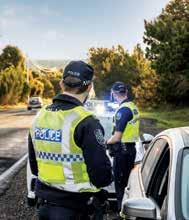
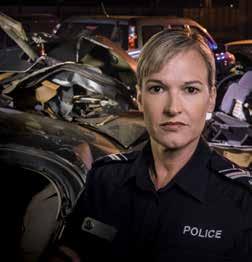
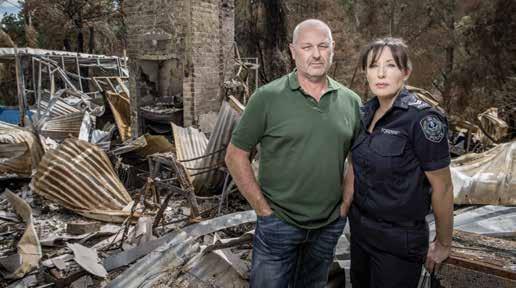
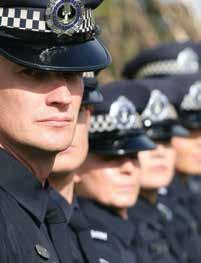
“The players were only allowed to train in small groups.”
The Crows’ own detective
Frozen take-away meals $10 each
Butter Chicken & rice
Chef’s Vegetable Curry & rice
Chicken Stroganoff & rice
Tuna Mornay & rice
Chef’s Macaroni Cheese
Spaghetti Bolognese with parmesan
Lamb Lasagne with parmesan
Vegetable Lasagne
Garlic Mashed Potato $5
Please remember to adhere to social distancing rules between dining groups. Hand sanitizer is available for use by all patrons. Take-away menu: Monday – Friday 11am – 2pm
POLICE CLUB
Monday – Friday 11am – 2pm
Friday dinner 5:30pm – 8:30pm
PRECINCT CAFÉ
Monday – Friday 7am – 2pm
27 Carrington Street, Adelaide (08) 8212 2924
Fisherman's Basket with crumbed fish, crumbed calamari & crumbed prawns $22 Chicken or beef schnitzel with chips and your choice of sauce (gravy, dianne, pepper or mushroom) $19
famous beer battered chips served with gravy or garlic aioli Small $4 Large $7
Real stories from our police member community...
"Whenever you used to hear of someone with asbestos disease (mesothelioma), you’d think it must be an old miner. But not these days.”
Police Health member Kathleen Drage, 58
Content warning: Kathleen’s account of her ongoing mesothelioma cancer treatment might be upsetting for some readers.
“For every fibre you see of asbestos, there are thousands you don’t see. They are that miniscule. I won’t even walk down a street if there is a building site with signage indicating asbestos. Part of my 19-hour surgery was picking tiny fibres out of my bowel.
“It is just so dangerous.
“A house down the road burned down recently, which was asbestos. Who has to turn up? Police and emergency services.
“When the backpackers decide to camp in the old asbestos mine at Wittenoom, who has to drag them out? Police.
“I climbed on the roof of a house my husband’s family were renovating, to fix the TV aerial. When I came down, I was covered in asbestos dust...
“The latency period for mesothelioma is around 30-45 years, but mine was only 15.
“I was diagnosed in February 2015. They picked it up through a random pap smear.
The oncologist said only 8% of cancer is picked up from pap smears, and they think this is the only time ever in the world they’ve picked up abdominal mesothelioma from a pap smear. So, I’m rather glad I had that pap smear.
“At one point I remember seeing a quote for what one treatment would have cost me if I was selffunded and thinking: ‘No one can afford this.’ So, I’m extremely grateful to be a Police Health member.”
“Since joining Police Health 12 years ago Kathleen has received more than $81k in benefits.”
“It was recommended that I undergo a full hysterectomy. While I was under, the doctor noticed the cancer had spread. They inserted a port and I had four rounds of chemotherapy – two through the port in my stomach and two intravenously.
“By then I’d done my research, so I asked the oncologist about this major surgery called the Sugarbaker technique, where they remove everything they can possibly remove.
“I lost my spleen, appendix, greater and lesser omentum, half my large bowel, part of my small bowel, and my gallbladder. I’d already lost my ovaries and cervix during the hysterectomy, otherwise they’d have come out too.
“They basically opened me up from my breastbone right down to my pelvic bone. The surgery took 19 hours.
“I was in the ICU for two days, high care for three days, and then on the ward for around three weeks. After I initially got out, I was readmitted due to dehydration. Then I had the stoma reversal, which became infected, so it was back to hospital again.
“Soon enough my oncologist told me the cancer was growing again. The only thing they could offer me was palliative care –but I wasn’t accepting that.
“I asked to be put on any trials going. Luckily there was one being conducted through our local hospital which I went on for about 18 months. The cancer shrunk quite a bit and stayed stable throughout the trial, but now it’s starting to grow again. Luckily a new trial’s been announced.
“Police Health have helped in every way they could throughout my treatment. At one point I remember seeing a quote for what one treatment would have cost me if I was self-funded and thinking: ‘No one can afford this.’ So, I’m extremely grateful to be a Police Health member.
“Police Health have just been fantastic, and not just with my mesothelioma journey. I went to get my glasses the other day and I told the girl I was getting back more than I thought I should. She put it through and said: ‘Oh, my, you’re getting double back!’ Even my physiotherapist was surprised at how much I get back, saying: ‘None of my other patients get it so cheap!’
“I’m very happy with the fund, it’s definitely worth the investment.”
EDITOR
A police career of 40-plus years, much of it spent in undercover work, is bound to leave a copper with countless dramatic memories It certainly has for Detective Senior Sergeant 1C John Schulz (ret), as we found out in an interview with him last month.
The difference with his story is that much of his personal life has been just as dramatic as his professional life. For us, he revealed plenty about both.
And then there’s another extraordinary turn his life has taken in the last two years In 2019, he took on the role of integrity and security officer for the Adelaide Football Club It keeps him extremely busy, but there’s a particular player or two with whom he enjoys a good laugh
All the serious topics came up at the Police Association annual conference this month: COVID-19, stab- and bullet-proof vests, assaults on police, mentalhealth taskings…
Premier Steven Marshall and Opposition leader Peter Malinauskas attended the meeting, and both had messages for the assembled delegates
Dr Rod Pearce explains the different types of arthritis, the stats on how many of us suffer from it, and what treatments might work best
Police Association president Mark Carroll explains how the DPM has adversely affected police coverage of Hindley St.
And, in Jobs you never forget, Brevet Sergeant Brendan Gottschutzke recalls an encounter with Sir Donald Bradman.
Brett Williams
brettwilliams@pj asn au
Publisher: Police Association of South Australia Level 2, 27 Carrington St, Adelaide SA 5000 T (08) 8212 3055 F (08) 8212 2002 www.pasa.asn.au Editor: Brett Williams (08) 8212 3055 Design: Sam Kleidon 0417 839 300 Advertising: Police Association of South Australia (08) 8212 3055 Printing: Finsbury Green (08) 8234 8000
The Police Journal is published by the Police Association of South Australia, 27 Carrington St, Adelaide, SA 5000, (ABN 73 802 822 770). Contents of the Police Journal are subject to copyright. Reproduction in whole or in part without written permission of the Police Association of South Australia is prohibited. Opinions expressed are not necessarily those of the editor. The Police Association accepts no responsibility for statements made by advertisers. Editorial contributions should be sent to the editor (brettwilliams@pj.asn.au).
COVER: Detective Senior Sergeant 1C John Schulz (ret) outside Adelaide Football Club headquarters at West Lakes.
12 The Crows’ own detective
After an extraordinary career in policing, Detective Senior Sergeant 1C John Schulz (ret) is looking out for the integrity of the Adelaide footy club
20 Police Association annual conference
Premier Steven Marshall commented on the two-year police response to COVID-19 while Opposition leader Peter Malinauskas backed blood tests for bite offenders. October 2021 12 20 47
Photography by Steve McCawley.
Julian
Snowden
Chris Walkley
Michael Kent Treasurer
COMMITTEE
Bernadette Zimmermann Secretary
Daryl Mundy Vice-President
Leonie Schulz
Trevor Milne
Police
P: (08) 8212 3055 (all hours)
E: pasa@pasa.asn.au
Membership enquiries: (08) 8112 7988
Brett Williams Editor Nicholas Damiani
PRESIDENT
Mark Carroll Andrew Heffernan Member Liaison Officer
INDUSTRIAL
Steven Whetton Assistant Secretary Nadia Goslino Grievance Officer
Samanda Brain
Anne Hehner Jan Welsby
Sarah Stephens
Shelley Furbow Reception
Caitlin Brown Executive Assistant
Bronwyn Hunter Manager
Darren Mead
POLICE A S S OCIATION OFSOUTH AUSTRALIA
Police Association of South Australia
REPRESENTATIVES
Superannuation
Police Dependants Fund
Mark Carroll and Michael Kent
Bernadette Zimmermann
Leave Bank Andrew Heffernan
Country housing Andrew Heffernan
Commissioner’s Office Health Safety & Welfare Advisory Committee Steven Whetton
Legacy Julian Snowden
Sexual Orientation, Gender Identity & Intersex members
DELEGATES & WORKPLACE REPRESENTATIVES
Metro North Branch
Gawler
Andrew Wearn
Golden Grove Darren Quirk
Henley Beach Sean Hobbs
Holden Hill
Matthew McCarthy
Northern Prosecution Tim Pfeiffer
Parks Matthew Sampson
Salisbury
Country North Branch
Ceduna
Coober Pedy
Stuart Smith
Anthony Taylor
Glenn Batty
Kadina Gavin Moore
Nuriootpa Andrew Dredge
Peterborough
Port Augusta
Port Lincoln
Port Pirie
Nathan Paskett
Peter Hore
Mark Heading
Gavin Mildrum
Whyalla Paul Velthuizen
Crime Command Branch
Adelaide Alex Grimaldi
Forensic Services
Kristin Enman
Fraud Sam Agostino
Intelligence Support
Stephen Foenander
Major Crime Alex McLean
Port Adelaide Scott Mitchell
South Coast Scott Milich
Metro South Branch
Adelaide James Cochrane
Hindley Street
Netley
Dick Hern
Paul Clark
Nadia Goslino and Andrew Heffernan
Metro South Branch continued
Norwood
Phillip Buttfield
South Coast Andrew Bradley
Southern Prosecution Sallie McArdell
Southern Traffic Joshua O’Dwyer
Sturt David Handberg
Country South Branch
Adelaide Hills Joe McDonald
Berri
John Gardner
Millicent Nicholas Patterson
Mount Gambier
Robert Martin
Murray Bridge Stephen Angove
Naracoorte
Renmark
Michael Hutchinson
James Bentley
Operations Support Branch
Dog Ops
Academy
Band
Comcen
Comcen
Bryan Whitehorn (chair)
Melanie Smith
Russelll Nash
Ian Mitchell
Vilija Sabeckis
Human Resources Eugene Wasilenia
Mounted Ops Sonia Wellings
STAR Andrew Suter
State Tac/Op Mandrake Duncan Gerrie
Traffic David Kuchenmeister
Officers Branch Les Buckley
Women’s Branch
ATSI Branch
Kayt Howe (chair) (no delegates)
Brendan White (chair) (no delegates)
PRESIDENT
Mark Carroll
Big trouble in the CBD
The ongoing failure of the SAPOL district policing model to provide a permanent police presence in Hindley St continues to cause major issues
SAPOL has indicated that it will provide this presence when its new CBD foot-patrol plan is developed
In the meantime, however, both police and the public are placed at greater risk
Members have described a recent situation in which all available patrols were required to deal with a single critical incident in the city — leaving no other police to respond to any other calls in the entire CBD.
Before the introduction of the district policing model, the CBD had 12 two-person patrols
Now, there is a maximum of four patrols for the entire CBD and surrounding area
Members have shared concerns about insufficient numbers of officers to prevent outright violence The current setup clearly does not provide a safe environment for police or the public
I have urged SAPOL to review this issue immediately It must, as a matter of urgency, address the failure of the DPM as it relates to the CBD, and ensure the city is fully prepared to emerge from COVID-19 restrictions.
Anything less would put South Australians at risk
It must, as a matter of urgency, address the failure of the DPM as it relates to the CBD, and ensure the city is fully prepared to emerge from COVID-19 restrictions.
Eyre Western CIB
There are, sadly, similar issues on the Eyre Peninsula
A general lack of numbers in Ceduna CIB and Family Violence Investigation Section is the major source of the issues.
In fact, SAPOL is requiring CIB members to be on call more frequently than seven days in 14, which is a direct contravention of the enterprise agreement
This on-call requirement has resulted in Whyalla or Port Lincoln CIB covering Ceduna’s leave absences
Some of these investigations are significant major indictable files, such as child sex offences, sexual assault and aggravated robbery
The flow-on effects are real, too. General-duties patrol members in the area suffer, as CIB members are unable to assist them with investigations and searches.
Members from other locations hundreds of kilometres away — Port Lincoln and Whyalla — are often called on to address shortages in the area
It is another area in which SAPOL must act, and quickly, to avoid the matter progressing beyond the current stage two of the industrial grievance and dispute avoidance procedure
ICAC reforms
The Police Association strongly supported the new ICAC bill which MLC Frank Pangallo (SA-Best) recently introduced into the Legislative Council
It is one of the most important pieces of legislation for police since the changes to the police discipline system
The reforms stipulate that the ICAC would only investigate corruption, not misconduct or maladministration
A host of other changes proposed in the legislation would strengthen public integrity institutions and align the ICAC more appropriately with its intended role and functions
Ultimately, individuals summonsed to the ICAC over matters arising from their employment are at a disadvantage The ICAC has significant public resources on which to draw, and a public servant is not likely to be able to fund his or her own legal representation.
The association has long had an interest in the proper functioning of the ICAC given that it has a significant impact on police
For more than eight years we have received feedback from our members and our legal advisors, and we have assisted our members who have been subject to investigation That has included welfare support
We believe unequivocally that reform is necessary.
We have made detailed submissions at every inquiry into public integrity structures in SA . We also recently made a detailed submission to Premier Steven Marshall on why we believe the reforms put forward in the bill are critical
The bill unanimously passed both houses of parliament
Mandatory vaccinations
SAPOL has recently issued a direction to members indicating that it will be mandating COVID-19 vaccinations. Current feedback indicates this direction will impact on a significant number of members who do not wish to have the vaccination
The Police Association is on record as stating that it does not support the imposition of mandatory vaccination on its members
We strongly believe in the right of each member to make his or her own decision. We do, however, understand the need for members who voluntarily undertake specific COVID-related duties to receive vaccinations
We have a duty, and a responsibility, to explore whatever options those members have within the existing legal frameworks.
Of course, the association encourages its members to make their personal health decisions with the fullest possible knowledge and understanding of the relevant medical facts and implications
To this end, we recently held an online information and discussion session for members who were still undecided about having the vaccination. The session featured a panel of medical experts and doctors, with members encouraged to ask them a wide range of questions
In light of the recent SAPOL direction, the association has also called a meeting of delegates to discuss which options — legal or otherwise — will be available for members who do not wish to be vaccinated.
Clearly, some members hold strong views on either side of the mandatory vaccination argument.
Regardless of each member’s personal view, we have been presented with a situation in which potentially hundreds of members are facing a forced leave arrangement or, possibly, termination
We have a duty, and a responsibility, to explore whatever options those members have within the existing legal frameworks
The delegates meeting will be held in early November. We will keep members informed of any updates or developments on this issue.
If you have a specific enquiry about this issue, please email pasa@pasa.asn.au.
The Crows’ own detective
It is hard to determine which of his two lives has been more intriguing, the personal or the professional. And now in another life, Detective Senior Sergeant 1C John Schulz (ret) is plying his skills for the Adelaide Crows.
By Brett Williams
Around 50 cops stood and applauded John Schulz when he walked into the Mount Gambier police social club back in 1995 It was a rare form of peer acknowledgment and a first for the then undercover operative. But he had, after all, just ensnared a drug dealer with a $16,000 buy of 225 grams of amphetamine.
Schulz had kept up his drug-buyer façade for two months and, at one point, faced the closest call of his police career
It happened in a Mount Gambier pub where he and his informer were waiting to meet up with the dealer Another man, drinking in a corner of the bar, had fixed his gaze firmly on the waiting pair Schulz noticed him staring and asked his informer: “What’s the go with this bloke?”
The informer confessed that he knew the starer, whose arm he had broken during some jail time he had spent with him. That, of course, had Schulz concerned but the staring man eventually left the pub, and it seemed a case of disaster avoided
A little while later, however, he came back –with a handful of his mates They surrounded Schulz and the informer at the bar, and each had a schooner glass in his hand
Then, from one of the intimidators, came a question to unnerve Schulz even further: “Glass or blade?” He knew that meant an imminent attack on him and the informer with either the schooner glasses or knives.
Still, today, he remembers thinking: “I’m f--ked! I’m in real strife this time ” And that seemed a perfect summary of his predicament, until the 198cm barman swung into action He jumped the bar and, as Schulz describes it, “pissed them (the aggressors) off”
With the risk of a stabbing eliminated, Schulz got his meeting with the dealer who turned up at the pub late The eventual drug buy went down in a local warehouse and the job ended with the arrest of the dealer. He wound up convicted and jailed.
The operation gave Schulz a “real taste” for covert policing, but not his first taste. That came after he had completed the detective
training course and was back in uniform working Hindley St
He had gathered up all his files and set out on the walk from Bank St police station to the old Angas St headquarters That was the home base of Adelaide CIB, which he was to join within the next day or two.
But on the walk, in plain clothes, he wound up approached by a bloke who asked: “Hey, man, do want to buy some green?”
Seizing on the opportunity, Schulz agreed to come back and buy an ounce for around $300 Meanwhile, he went to consult the Drug Squad, where he got the okay to make the buy
“So, I went down and did it,” he says “And I’d actually had police files in my arms as he was asking me whether I wanted to buy this green.
“That was my first taste of it (covert policing), and it sort of sparked my interest ”
Indeed, Schulz would come to relish undercover jobs, like the investigation he and his Drug Squad colleagues undertook into Domenic Perre in 1995-96.
It all started after police had discovered two offenders cooking meth in a clan lab in the Adelaide Hills And out of that discovery came an informer who knew NCA bombing suspect Perre
That informer, along with two undercover officers from interstate, were to help Schulz and colleagues Pat McManus and Doug May get evidence of meth production against Perre and his accomplices.
“We got a UC (undercover) and controller from Victoria and another UC from New South Wales,” Schulz explains “The UC from Victoria had actually been taught how to cook meth
“We were supplying the chemicals and he (Perre) was supplying the money and the (Angle Vale) premises and some of the other equipment.”
“He and Perre negotiated and eventually came up with the conspiracy to build a meth lab So, the lab was all set up
“We were supplying the chemicals and he (Perre) was supplying the money and the (Angle Vale) premises and some of the other equipment
“The cook went ahead, and we did the raids early one morning and locked up everybody with two UCs.
“That was a great job. To get Perre on-site at a clan lab that he financed was quite a significant thing He did a fair stretch for that ”
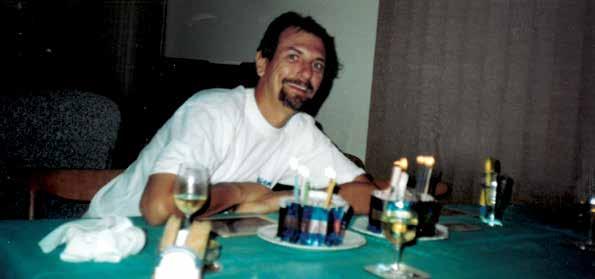
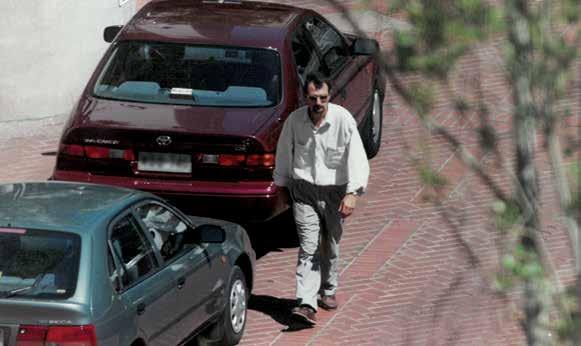
1. Schulz on an undercover operation in 1998.
2. During his undercover days in 1998.
3. About to undertake a drug buy at the Hyatt Hotel in 2001.
or a bloke who, in his youth, had never had a burning desire to be a cop, Schulz was acquiring a lot of job satisfaction It was perhaps compensation for a lot of bad luck in his childhood and later personal life
After his parents split up when he was just seven, his father never again sought contact with him
“He was a pretty abusive father, both to my mother and to me,” Schulz recalls. “I can remember being petrified when he came home, as to whether I’d get a belting or not. And I think he was probably an alcoholic ”
Schulz and his younger brother went to live with their maternal grandfather in Kimba while their mother remained in Adelaide to study nursing
She had completed her training and worked as a nurse years earlier But in those days, the 1960s, former nurses had to undertake the three-year live-in course all over again.
“When I was over in Kimba, I really struggled with it,” Schulz says. “One, he (my father) had left, and two, my mother was gone a fair bit of the time ”
During holidays was when mother and her sons got to spend time together But after a couple of years had passed, and she had re-established herself, the three got to resume life as a family back in Adelaide
“I look back now,” Schulz says, “and think how remarkable she was, and I probably didn’t realize it at the time ” Schulz had attended Kimba Area school before returning to Adelaide, where he continued his education at Highgate Primary and Unley High schools
When the time came to think about job prospects, he spoke with his then stepfather who raised the idea of a police career Then 16, Schulz had never considered law enforcement but knew a family friend who, at the time, was undertaking his academy training
Word from the young man’s family was that he was “having a great time”
“And, so, I applied and got in,” Schulz says “It was a really quick decision I started on February 5, 1976, and I’d just turned 17 two weeks earlier
“For probably the first three months I really didn’t want to be there, but then, it just swept me up. ”
The only other job the young Schulz might have scored was with the Reserve Bank He got an interview but ended up overlooked, which he came to see as a blessing
Of course, few young recruits ever got through their training without an element of misadventure Schulz had his moment while “skylarking” in a dormitory block
He had jumped up to touch a light globe, but it smashed and some of its pieces wound up in his eye. It was a serious injury, but Schulz recovered and continued his training with Course 56
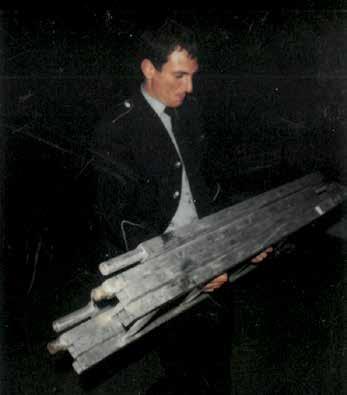
4. About to search a roof for a break-in.
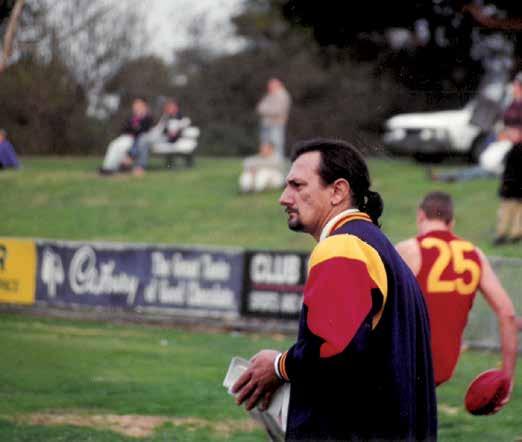
5. As team manager for SA amateur footy side against Victoria.
“And, at one stage, I thought I was going to lose my leg. I thought: ‘What am I going to do with my police career?’ ”
Another memorable moment, while still a recruit, came at the funeral of his paternal grandmother There, at the ceremony, was his remarried father, whom he had neither seen nor spoken to since his parents had split.
“He didn’t speak to me,” Schulz recalls. “I just found it unusual He bought me a beer but didn’t come and talk to me
“The last I knew he was up at Mount Isa I’ve got no idea whether he’s dead or alive I’ve just sort of wiped him Bit annoyed ”
Once through his recruit training, after two years and nine months plus three months as a reserve cadet, Schulz graduated in December 1978. Region B was his first post, where he worked as a patrol officer.
“In those days, we had the whole area out to Athelstone and down south to Darlington,” he says “With the Traffic
guys, there’d be 200 people on parade every morning. It was quite remarkable, and I had a lot of fun. ”
But the fun ended abruptly after Schulz went down in a motorcycle accident and broke his lower leg To repair the damage, doctors inserted a plate which enabled Schulz to get back to work, but on crutches and in the non-operational role of Region B collator
Around 12 months later, with the plate removed, he got back on the road and had no problem with his leg – for a while.
Long involved in local football, he fell over while coaching teenaged players in the parklands and rebroke his lower leg With the “bone sticking out” it was clearly a shocking break
It led to a couple of rounds of surgery, a battle with gangrene, and bone-growth stimulation treatment, which lasted for 15 months
“And, at one stage,” Schulz says, “I thought I was going to lose my leg I thought: ‘What am I going to do with my police career?’
“So, I made a decision to go teaching down at the academy. I was there for a bit over two years, until my leg got fully healed ”
As he had undergone hospital treatment for that second break, Schulz met his then future wife, a nurse who hailed from Tasmania She had come from a family of 16 children, among whom she was a middle child
Her parents had produced 14 children but, after they divorced, her mother remarried and had two more And the man who had become her mother’s second husband had nine children from his first marriage
Ultimately, the couple ended up with an extended family of 25 children.
“So, I’d go down to Tasmania and there was still about nine or 10 kids living at home,” Schulz remembers. “I just couldn’t get over it It was like living in an army barracks ”
Still, Schulz married into the family at the age of 29
Naturally, when his future parentsin-law came to Adelaide for the wedding, they met his mother and stepfather, who had retired to Normanville The visitors found the seaside town so enchanting that they eventually bought a block of land there.
But that led to bad news for Schulz one evening when he arrived home from work His parents-in-law were going to come to Adelaide to build on their block
No problem with that Until his wife told him that her parents, along with a heap of the children, would “live with us” as the construction took place
Schulz exclaimed: “No they’re not!” But, after he arrived home from work one other evening, he found a caravan parked in his driveway. The family had lobbed.
With the disagreement unresolved, Schulz moved out of the family home. He returned but he and his wife separated and ultimately divorced
“There were other issues (besides her family moving in),” Schulz says, “but that was the straw that broke the camel’s back ”
When Schulz and his wife separated, she was pregnant He only learned of the birth of his child when he got a phone call from his mother-in-law.
“I was working afternoon shift at Adelaide CIB when she rang,” he says. “She said: ‘You've had a daughter,’ and the phone went ‘clunk’. And that was it
“We knocked on the door and the (husband answers and) says: ‘Oh, I’ve killed my wife.’ ”
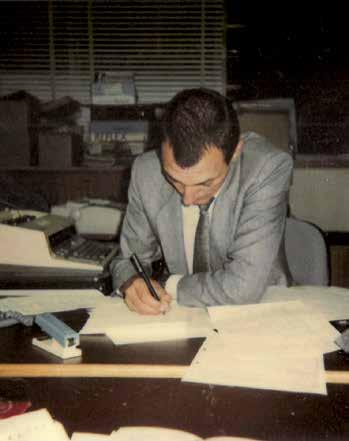
6. Preparing court files at Adelaide CIB in 1990.
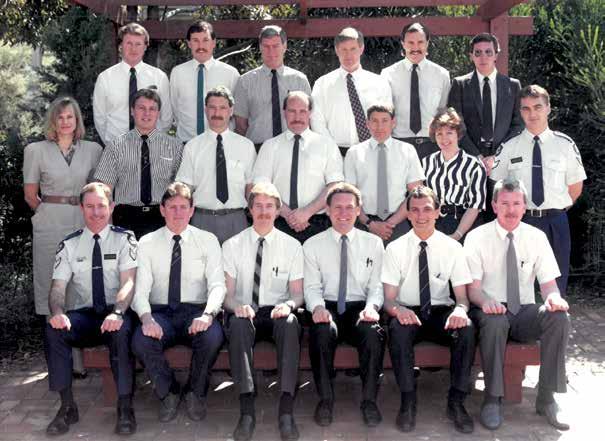
7. On the CIB designation course in 1991 (front row second from right).
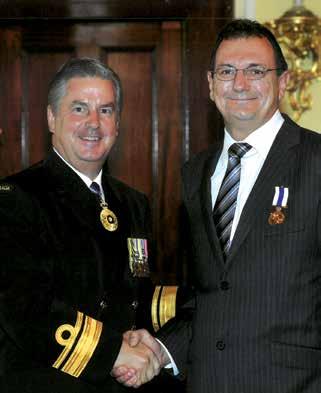
8. Receiving the APM from Governor Kevin Scarce in 2009 for his commitment to the investigation of organized crime throughout Australia.
“My ex-wife then married her stepbrother and moved to Sydney. So, before my daughter was two, she’d moved to the eastern seaboard, so I’ve had a long-distance relationship with her ”
Schulz found the dynamics of that relationship tough at the outset He only got time with his daughter twice a year, during school holidays And the sight of his two-year-old walking toward him across the Adelaide Airport tarmac, escorted by a flight attendant, broke his heart.
It was rare, however, for Schulz to get overly emotional in his work . His greater interest was always in dealing with offenders rather than victims
Nonetheless, the plight of some victims did move him In one case in the city around 1982, the driver in a car-crash wound up trapped in his seat Schulz was the on-scene cop he reached out to, and whose hand he grabbed and held as he lay dying
The incident had “a bit of an effect” on the then patrol officer, who was only around 23 years old. Another job had some effect on him, too. It was a death message he had to give a young wife and mother
Her husband had died in a motorbike crash on Norton Summit Road.
“You just couldn’t do anything for this woman,” he says. “And I don’t think we were very good in those days at following up on how people were (coping) ”
Before he left Adelaide CIB for the Drug Squad, Schulz undertook one of his most memorable jobs with now Major Crime boss Des “Doc” Bray
In 1993, a young woman had gone to visit her older married sister and not returned home to her parents. They tried calling their elder daughter but got no answer and so eventually called the police. Schulz and Bray drove out to the older sister’s Holden Hill home after themselves getting no answer on the phone The most they expected was a case of abduction
Says Schulz: “We knocked on the door and the (husband answers and) says: ‘Oh, I’ve killed my wife ’
“He’d raped the sister in front of his wife and left her (the younger sister) tied up in the shed out the back . He then killed his wife and buried her in the backyard in a very shallow grave.
“He made full and frank admissions Still don’t know why he did it ”
“We ended up locking up 18 people Australiawide and they got a total of 180 years in head sentences over 20 years.”
Later came the work Schulz relished in specialist areas like the Drug Squad, which he joined in 1994. He had undertaken the relevant two-week course, with its one session on undercover work
New members to the squad were to have six months’ experience before they attempted any drug buys
“Undercover work just enthralled me,” Schulz says, “and I didn’t last the full six months before I started doing it.
“For my first undercover drug buy I bought from a bloke we used to call The Businessman. He would walk around with a briefcase with all these drugs in it ”
After his start, buying heroin from The Businessman, Schulz continued with undercover work until 2002, when he transferred to Port Adelaide CIB He calculates that, before then, he had applied for detective-sergeant positions 23 times – and now he had one
“So, I went down to the Port and loved it,” he says. “I hadn’t been in mainstream CIB in eight years and things had changed a lot in that time
“I had a really good young team, and I was amazed at the level of investigation these kids were doing. It was so much higher than what I’d done as a young detective ”
In 2006, as OC of the Viking Joint Task Force, Schulz got to work on Operation Confound The objective of the operation was to bring down a syndicate of international drug traffickers importing heroin into Australia
On the case, in partnership with the Australian Crime Commission, was Customs, the Australian Federal Police, and cops from SA, WA, NSW and Victoria.
The investigators knew that Vietnamese-born Australian drug couriers were bringing the heroin in from Vietnam Their challenge was to identify them, among hundreds of other travellers, and establish how they were concealing the heroin
The initial thought was that the couriers were sewing the drugs into their clothes. But, as the investigation went on, it looked like they were sewing them into their suitcases.
As the investigators drew toward a big win, they determined that a courier was flying into Perth, so Schulz and his colleagues flew over there, too
“Two of the organized crime syndicate had driven to Perth so we knew it was on,” he says “We thought we knew who the courier was, a woman, and we got seven kilos in her two suitcases
“I remember conducting a briefing in the Sydney office of the ACC . I had about 400 coppers ready to go the next morning, so the pressure was on
“We ended up locking up 18 people Australia-wide and they got a total of 180 years in head sentences over 20 years
“The main crook had gone to Melbourne, but we got him extradited ”
So, there was Schulz, a detective from Adelaide in Sydney with an offender extradited from Melbourne for an offence that occurred in Perth. Explaining that to the Sydney City Watch House sergeant was a tough exercise
n mid-2019, as Schulz drew close to retirement, he applied for and scored the job of integrity and security officer for the Adelaide Football Club And his appointment made sense He was a highly experienced detective, had 40-odd years’ involvement in amateur footy, and had long supported the Crows
But it was a time of upheaval Controversy had beset the club after its 2017 grand final loss to Richmond and the Dunstall-Pavlich post-season review was soon to take place.
Schulz, in his new role, was to manage compliance audits, which included player contracts, the club salary cap, and all AFL rules
But he would also spend time with the players as he did last year during segregated training sessions forced on them because of COVID-19
“I was doing something like an operation order every day for training,” he says “That’s because there were so many rules and regulations the AFL had in place.
“The players were only allowed to train in small groups. I had them going to the gym at different times, and on the oval at different times It was really difficult, and then we spent two weeks up on the Gold Coast in a hub ”
Schulz accompanies the players on occasions like mad Monday He also talks to them about criminal associations and drug use, and the scope for reputational damage to themselves, the club and the entire footy industry
After an incident occurs – as it did on a plane last May when players wore masks incorrectly – Schulz investigates it and prepares a report for the AFC board
Even enquiries into the controversial 2018 Gold Coast training camp, which happened before his appointment, have demanded his input
“I had to send SafeWork SA those training plans that I do,” he says, “and copies of the presentations I’ve given the players about criminal associations and drugs That’s all finalized now. ”
Among those Schulz reports to is the club deputy chair, Police Association member and SAPOL assistant commissioner Linda Fellows
It is a kind of reversal of roles given that, during his time at the police academy 30-odd years ago, he had taught Fellows as a cadet. And, later, the two worked together at the Drug Task Force
But it is the players who interest Schulz the most He speaks of them as “good young people” whose lives are not “all beer and skittles”
“Everyone thinks about the big money they get,” he says “But, of the kids who come into the system, I think about 50 per cent of them are gone within five years.
“Starting wages are less than a probationary constable on shift work, and they’ve got this window of opportunity of maybe 10 years ”
“It’s really interesting to see these kids develop from 18-year-olds You’re starting to see it with players like Jordan Butts, Ned McHenry and Harry Schoenberg
“It’s also sad when you see some that don’t make it What are they going to do?”
But Schulz enjoys plenty of laughs, too, particularly with players like 29-year-old midfielder Paul Seedsman. He describes him as an “absolute card” and a lover of TV cop shows
“So, he’ll be watching a cop show at 11 o’clock at night,” Schulz explains, “and he’ll ring me and say: ‘Schulzy, do you know about this one?’ ”
Just as some older players move from multi- to single-year contracts, so too has Schulz at age 62 He had always expected to work to the age of 65, so he might yet remain in the role for three more years
After he does retire from paid work, he intends to stay involved with his local footy club and travel around the northern half of Australia. The only regret with which he retired from policing last month was that he never served in the country.
And he figures that, had he pursued and attained commissioned rank, he would never have had the all the good times he enjoyed
Of his days in undercover work, he still says: “I loved it ” PJ
After taking part in the interview for this story, John Schulz visited Queensland where he discovered that his father had died in 2019. And, having found out some years ago that he has a half-sister, he discovered on his visit to Queensland that he has a second, younger half-sister.
Schulz at Adelaide Football Club headquarters.
Police Association Members’ Buying Guide Facebook Group
The Police Association has created a new Facebook group to advise you more effectively and efficiently of savings and special offers for you and your family. This is a closed group for members only.
By joining the group, you will be the first to know about seasonal and exclusive specials, specifically designed to save you money.
Police Association Annual
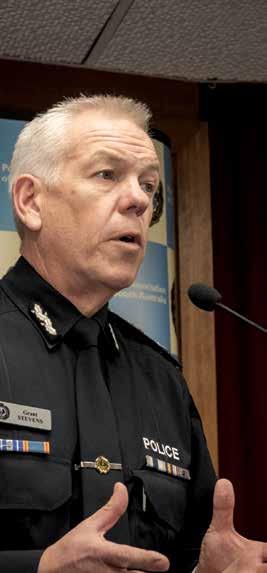
Left to right: Police Association president Mark Carroll, Premier Steven Marshall, Opposition leader Peter Malinauskas and Police Commissioner Grant Stevens.
Annual Conference
Staffing issues still overwhelming cops
The COVID burden on police certainly came up at the Police Association annual conference. But so too did the high demand for cops to respond to mental-health incidents. Premier Steven Marshall and Opposition leader Peter Malinauskas joined association delegates and had their say.
By Nicholas Damiani
Staffing issues across many areas of SAPOL continue to pose issues for members, according to Police Association president Mark Carroll
Mr Carroll, in his address to association delegates and the media, said the events of the last 18 months continue to have an “overwhelming” impact on police officers
”It’s regrettable that COVID-19 is still the major news topic of the day,” he said
“Many members have spent extended periods away from their families, ended in up quarantine, had leave cancelled, put their own life commitments on hold, and suffered both physically and psychologically.
“At times, more police were on duty in medi-hotels than in some police districts
“Our position has been that some COVID duties are simply not roles for sworn police officers ”
Mr Carroll said the association had outlined several practical solutions to SAPOL and the government over the last 20 months of the pandemic
“These include increased recruitment, and the recruitment of recently retired or resigned officers, incentive payments and the recruitment of protective security officers,” he said.
“The PSOs were an obvious solution. ”
He acknowledged that the government and Commissioner Grant Stevens ultimately responded and implemented some of the solutions but said the association would have preferred to see the outcome sooner
Mr Carroll explained that staffing issues all across SAPOL — some unrelated to COVID duties — were causing a serious strain on members and affecting the delivery of services to the community
“We have spoken to the commissioner about areas such as Southern District Response, the district policing teams, Riverland CIB, Hindley St patrols and the broader Eastern District,” he said.
“A long-running industrial dispute about staffing issues on Kangaroo Island also remains in progress ”
Police Association Annual Conference
“It is a lot to ask men and women to protect the public from dangerous criminals, at the same time they do the jobs of social workers, psychologists and psychiatrists.”
Police duties unlike any other
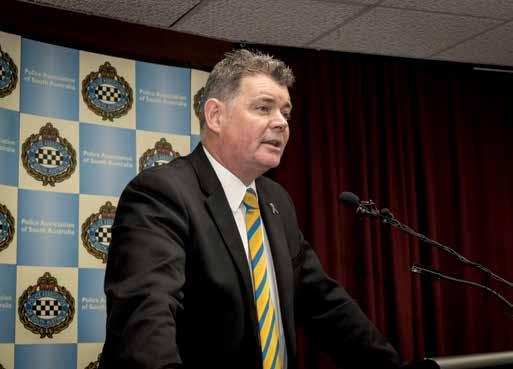
SA police officers have led the nation when it comes to community support and positive feedback during the COVID-19 pandemic, according to Premier Steven Marshall.
Mr Marshall told delegates this year’s nationwide report on government services revealed Police Association members had been the pacesetters for the entire nation
“(You) are the highest-ranking police in the nation for community satisfaction and community perception of professionalism,” he said
The premier said that, although nobody could have predicted the events of the last two years, SA cops had calmly risen to every challenge thrown at them.
“More than 350 police members on average, each day, have dedicated themselves (to COVID duties),” he said
“The duties these members have performed have been unlike any other policing duty
“I’m quite certain that no police members, as they were undertaking their training as cadets, would have envisaged their duties as members to include guarding our borders, processing crossborder applications and ensuring compliance with pandemic restrictions ”
Premier Marshall said the relationship between the Police Association and the state government was as strong as ever
“PASA has delivered strong outcomes over the last three-anda-half years,” he acknowledged.
“We have worked through COVID issues. In total, we’ve provided more than $100 million in additional funding and resources to support SAPOL’s response to the pandemic
“This includes accelerating the recruitment of an additional 72 cadets and 168 protective security officers ”
The premier also highlighted the current rollout of custom-made stab- and bullet-proof vests, and the new assaults-on-police legislation, as two more examples of the association’s strong collaborative approach with government.
“(This legislation) has seen the strongest penalties this state has ever had in place for assaults against police and emergencyservices workers,” he said
“They send a clear message to those who think they can get away with committing violent acts against some of the most respected members of our community ”
The premier said the vests had already been rolled out to 2,600 officers.
Mental-health incidents demand too much of police
SA must urgently invest in its “broken” health system or face ongoing issues with police resources, according to state Opposition leader Peter Malinauskas
Mr Malinauskas told delegates the percentage of police resources used to respond to mental-health episodes was too high.
“Being a police officer is more difficult today than it has ever been before, and I’m not just talking about COVID,” he said.
“It is a lot to ask men and women to protect the public from dangerous criminals, at the same time they do the jobs of social workers, psychologists and psychiatrists
“Cutting crime means preventing crime, but none of it is achievable without the right level of resources ”
Mr Malinauskas also announced he was backing the Police Association call to compel people to undergo a blood test if they spit on — or bite — police officers and other emergency-services workers
He said the general number of assaults against police officers was still a major concern, with over 660 people charged with assaulting police since the beginning of the pandemic.
The former SDA secretary also praised the conference delegates for their strong union representation
“Being a delegate is a thankless task,” he said
“Your day job is to be in harm’s way but, as a delegate, you take on additional responsibilities to look after your fellow workers, sometimes putting you in harm’s way of your superior officer
“That takes a degree of courage and sacrifice ”
Mr Malinauskas promised funding for stab-proof vests — over and above the commitment already made by the Marshall government
The government is currently rolling out 2,900 vests, but the Opposition leader has promised a further 1,500 if he is elected premier, ensuring more members will be protected.
The commitment, supported by the Police Association, is worth an extra $4 5 million
DPM 2 still to be trialled
The second phase of the SAPOL district policing model has not been properly trialled owing to COVID-19 staffing issues, according to Commissioner Grant Stevens
The commissioner told conference delegates the model is still yet to be tested under normal working conditions
“We launched DPM two in late March 2020,” he said. “DPM two has not be trialled — that’s the reality.
“My hope is that we’re able to push as many people out of COVID-19 duties back into the districts as soon as possible, so that we can commence the model as it’s supposed to look
“We believe it’s a sound model, but it has to be tested If we need to make changes, we will make changes ”
Commissioner Stevens said the COVID burden was likely to be lifted in 2022, at which point he was hopeful the newly acquired protective security officers would transition into substantive ongoing roles
He also said the current regional review was uncovering issues that require “the ongoing attention of a part of the executive”.
“We’re already under pressure (even) in the outer metro area,” he said. “The Barossa and Hills Fleurieu areas, are seeing phenomenal growth. ”
The commissioner also told delegates he was optimistic about the rollout of SAPOL’s new Mobile Workforce Transformation programme
“This means we’re rolling out (smart devices) to every employee, with full access to systems, and for personal use,” he said
“It’s not just about saving 30 minutes of a patrol officer’s time every day
“What the programme really means to me is putting information into the hands of every SA police employee, so you have direct access wherever you are, whatever you’re doing. ”
Members can expect the rollout of devices to gather momentum within the next 12 months, Commissioner Stevens said
He also discussed the direction which requires all SAPOL employees to provide notification of their COVID-19 vaccination status by October 24, but stressed the jabs were not mandatory
“It’s essential for us to have an appreciation of how many are not vaccinated and potentially where they are,” he said
“We haven’t made a determination about mandatory vaccinations
“(But) one of the factors that would influence our thinking is just how many of the workforce are not vaccinated.
“The absence of that information will probably cause an alternative decision that we might not ordinarily make if we had all of the information at our disposal ”
Award for highlighting shortfall in DPM
Eastern District Response sergeant Tim Tollenaar has won the 2021 Police Association Step Up Award for workplace safety. Sgt Tollenaar submitted a hazard and incident report on January 17, 2021
The report highlighted the district policing model’s impact on response and team structure within the Eastern District, including issues such as:
• Response staffing before and after the implementation of the DPM
• The area of responsibility extended from Hindley St to suburban areas.
• Hindley St foot patrols not being part of the DPM structure. (A lack of operational presence had resulted in increases in victimreported crime and decreases in the policing of licenced venues )
• District policing teams were unable to address occurrences or had insufficient staff to respond to taskings
• Workload intensification
• The current policing model was unsafe for response members and the community in general. Sgt Tollenaar continued to represent the workplace and provide information to the association about
his district policing model concerns, particularly in respect of:
• Staffing and rostering at Eastern District.
• Enterprise bargaining.
• The lack of workplace consultative committee meetings and OHSW meetings
• Police station design
The association then wrote to Commissioner Grant Stevens on January 25, 2021, highlighting its concerns about the ongoing failure to facilitate a permanent police presence in Hindley St and surrounding areas.
President Mark Carroll also fronted the media to address the public about the association’s concerns surrounding member and community safety
On February 3, 2021, Commissioner Stevens wrote to the association highlighting that he had requested the assistant commissioner, Metropolitan Operations Service, to provide a permanent foot patrol in the area Association assistant secretary Steve Whetton told delegates that “Sergeant Tollenaar’s actions demonstrated exceptional professionalism and reflect the association Strategic Plan 2017-2022 ”
Sergeant Tim Tollenaar receives the Step Up Award from Police Association president Mark Carroll.
Police Association Annual Conference
Influential delegate an award-winner
Detective Brevet Sergeant Scott Milich won the Police Association Biennial Delegate of the Year Award. Assistant Secretary Steve Whetton told delegates there had been many examples of Detective Brevet Sergeant Milich’s influence as a delegate, including:
• Seeking and explaining award conditions to his and other workgroups
• Assisting members with administrative grievance processes
• Roster-change compliance with the award
• COVID implications and changes conducted in the workplace.
• Commissioner of Public Employment guidelines.
• Explaining the historical aspects of current conditions of employment
• Explaining the enterprise bargaining process and new clauses.
• Equipment concerns and WorkCover considerations.
• Meeting with association staff while on programmed leave
• Superannuation contributions
• Assisting with the provision of hazard and incident reports
• Arranging statements from members to enable industrial action
• Attendance at Crime Command Branch meetings
Assistant Secretary Whetton told delegates the actions Detective Brevet Sergeant Milich undertook were “overwhelming evidence of the advocacy and assistance he has provided in his role as a workplace delegate”
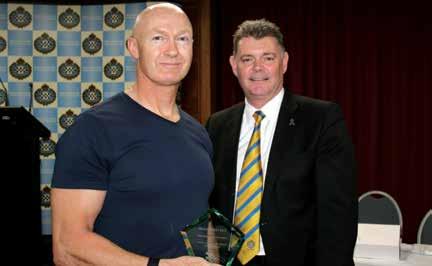
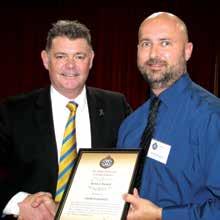
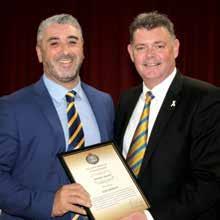
Police Association president Mark Carroll presents service awards to:
1. Senior Constable 1C Andrew Bradley (five years)
2. Detective Brevet Sergeant Alex Grimaldi (five years)
3. Superintendent Les Buckley (five years)
4. Police Association vice-president Daryl Mundy (10 years)
5. Police Association committee member Chris Walkley (10 years)
Service awards
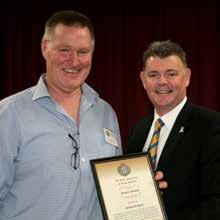
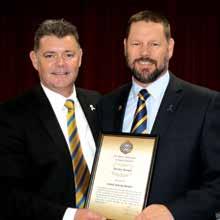
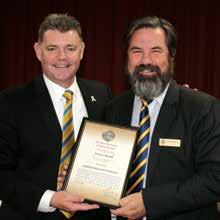
Police Association service awards for five years continuous service went to Senior Constable 1C Andrew Bradley (Metro South Branch), Detective Brevet Sergeant Alex Grimaldi (Crime Command Branch) and Superintendent Les Buckley (Officers Branch)
For 10 years’ service, awards went to Police Association vice-president Daryl Mundy and committee member Chris Walkley PJ
Morning break, day 1
11.
12.
13.
6. Leonie Schulz, Samanda Brain, Vilija Sabeckis, Sam Agostino and Ian Mitchell
7. Kerry Rouse and Mel Smith
8. Stephen Foenander and Les Buckley
9. Darren Quirk, Matthew McCarthy and Matt Sampson
10. Police Association assistant secretary Steve Whetton and Gavin Mildrum
Josh O’Dwyer and Nathan Paskett
Duncan Gerrie and Bryan Whitehorn
Opposition leader Peter Malinauskas and Police Association treasurer Michael Kent
Commissioner Grant Stevens and Premier Steven Marshall
Paul Velthuizen and Dick Hern
INDUSTRIAL I
Travel allowances
Private motor vehicle travel claims continually frustrate regional members
The Police Association knows of a case in which a country member submitted a claim for “private” motor vehicle travel he/she undertook to attend, and return from, the Magistrates Court in two metropolitan districts
According to SAPOL general orders (Rates – employee claims and reimbursements) a private vehicle used on transfer – for permanent, temporary or relieving duties – attracts, for motor cars or station wagons, 32 cents per kilometre.
A private vehicle used (with prior approval) for “official purposes” attracts 100 cents per kilometre
The general order does not define official purposes
In line with SA Police requirements, the member sought approval to travel by air and the supply of taxi vouchers to attend the respective courts in his/ her official capacity as a police witness.
General orders (Travel ) stipulate that members should, in the first instance, contact their administration managers in respect of air travel According to the guidelines, “an employee who is travelling is required to select the lowest airfare that is compatible with their business needs”
The order further stipulates that an employee should only hire vehicles/ taxis, when necessary, in connection with specific SAPOL duties, and must make sure that only the legal fare is charged.
The association understands that the flights for the member were not approved and a request for a police vehicle followed
When travel options are confirmed in writing to be unavailable and you choose to use your private vehicle for official purposes, you are thoroughly entitled to claim the appropriate reimbursement.
Steve Whetton Assistant Secretary Police Association
The subsequent instruction to the member was to travel in his/her private vehicle, and an application for that purpose received approval
General orders (Private Vehicles) stipulate that:
“Employees must not use their private vehicle on duty without permission from their District/LSA/branch manager
“Employees will not be required to use their private vehicle for official purposes when they do not want to. Employees wanting to withdraw their acceptance to use their private vehicle on official business must notify their District/LSA/branch manager. ”
The member, who had no other options, used his/her private vehicle to travel to Adelaide to attend the courts and give evidence as a police witness
Then, in line with general orders (Rates), the member submitted a request for reimbursement for 1,402 kilometres at the then-rate of 98 cents per kilometre
SAPOL rejected the claim and gave its approval only for 31 cents per kilometre for travel. It also ordered the claim be “capped” at $300.
The association wrote to SAPOL to seek payment of the appropriate remuneration rate of 98 cents per kilometre
The SAPOL response was that the relevant industrial instruments were the applicable general order and determination 3 2 for the Commissioner for Public Sector Employment (CPSE)
The CPSE determination stipulates that:
“When public or Government transport is available, that transport is to be the first preference. However, where the employer is satisfied that there are grounds for the use of a private
vehicle, reimbursement will be limited to the cost of travel by public transport. ”
The determination provides the basis for “capping” reimbursement rates at the cost of a bus fare when an employee uses his or her private vehicle for official purposes
This is clearly and grossly unjust A member drives his or her private vehicle for eight or more hours to Adelaide for official police business and returns to his or her country location for reimbursement equal to a bus fare.
The association sought industrial advice on the application of determinations of the CPSE pursuant to section 16(1)(b) of the Public Sector Act 2009 and regulation 9 of the Public Sector regulations 2010
The determinations of CPSE apply only to employment to which part 7 of the Public Sector Act applies – which is not employment under the Police Act
The member had a clear entitlement to reimbursement at 98 cents per kilometre.
SAPOL has subsequently agreed to the payment at that rate.
If you are required to travel for official purposes, communicate with your manager as soon as possible and retain all e-mail and other written communication covering your request for airfare and/or the use of a police vehicle
If you are directed to use your own vehicle, express your position on that to management in writing
When travel options are confirmed in writing to be unavailable and you choose to use your private vehicle for official purposes, you are thoroughly entitled to claim the appropriate reimbursement
Dr Rod Pearce
When the joints age and wear out… arthritis
Arthritis is usually split into two main types One occurs when some diseases, such as rheumatoid arthritis or psoriatic arthritis, actively destroy the joints These are usually known as erosive forms of arthritis because the disease process erodes the joints and bones.
Gout is an erosive arthritis caused by the urate crystals damaging the joint . With these diseases comes active inflammation. Joints might be hot and tender
The other type of arthritis is more common and not always caused by inflammation but more so wear and tear associated with age It is commonly known as degenerative arthritis or osteoarthritis
Despite one in six of us having this type of arthritis, there is not any real agreement about exactly what it is, other than something wrong with our joints.
In medical terms, it is thought of as primarily a degenerative disorder with inflammatory components arising from the biochemical breakdown of articular (hyaline) cartilage in the synovial joints
As the joint wears down with age and activity it triggers irritation and inflammation and includes not only the joint but also the cartilage, the lining of the joint (synovium) and the surrounding bone
Symptoms of arthritis include deep, achy joint pain – made worse by extensive use – with reduced range of motion and crepitus (grinding noise). Joints typically have increased stiffness after rest
As the joint wears down with age and activity it triggers irritation and inflammation and includes not only the joint but also the cartilage, the lining of the joint (synovium) and the surrounding bone.
Arthritis of the hand usually involves the last joints of the fingers, the base of the thumb and sometimes disfigurement of the hand with lumps and bony protuberances
There are thought to be many reasons the joints are painful
The presumption is that the pain arises from a combination of mechanisms . Sometimes the bones form spikes which push against the ligaments (osteophytes). Rubbing of bone on bone might cause vascular congestion of subchondral (under the cartilage) bone, leading to increased “bruising” or internal pressure
The lining of the joint (synovium) might swell and become inflamed and cause irritation to the nerves in the joint The muscles that cross the joint might become fatigued The joint itself might become scarred and contract. Fluid might cause swelling. The cartilage might tear or the tissue around the joint might become injured through overuse. Psychological factors Sometimes crepitus (a rough or crunchy sensation) might alter the way you walk Other times it is just the chronic nature of the problem that can become depressing
The goals of osteoarthritis treatment include pain alleviation and improvement of functional status It is also important to do no harm with medicines, as the condition is chronic, and to handle the pain and stiffness but not always inflammation.
Sometimes heat packs and other times cold packs are useful. Exercising is important to help the muscles protect
the joint. Think of the joints like opening a door. If you thrust the door open it can hit the wall and make a hole. If you slam it shut the whole frame can shudder So too a joint
Over-exercising can stir up pain but if the muscles control the movement there is less disruption of the joint
To reduce the stress on the joint you need to reduce the weight on it
That’s why muscle training, such as strengthening the quadriceps for the knees, becomes important.
The issue of whole-body weight loss is about more than just helping joints like the knee and ankle. It appears that the weight reduction decreases the risk of active inflammation in all joints
So, less shoulder pain if you lose weight, but also less knee pain because there is less for the joint to carry
If drugs are needed, the first suggested are those other than nonsteroidal anti-inflammatory drugs (NSAIDs) This is partly because there is not always inflammation, but also because of the long-term side effects on blood pressure, the heart and kidneys, and the creation of stomach ulcers.
Continued page 44
MMOTORING
Jim Barnett
Kia Stonic
DESIGN AND FUNCTION
The new Kia Stonic urban SUV offers a trendy, youthful alternative in the compact SUV market. Based on Rio’s hatch platform, it is available in three trim levels: S, Sport and GT-Line, with drive-away pricing from $23,490
S and Sport share a 1 4-litre fourcylinder petrol engine with either sixspeed manual or automatic transmission
A smaller three-cylinder 1 0-litre turbo petrol engine, with seven-speed dual-clutch transmission, powers the GT-Line While producing the same power, this engine offers substantially more torque, uses less fuel and produces lower emissions.
GT-Line’s specific features include front LED lighting, a sporty grille, trendy roof rails and 17-inch alloys shod with low-profile tyres It also has the options
Pricing S manual $23,490 (six-speed auto adds $1,000), GT-Line $30,490 (both drive away pricing)
Power train S and Sport have 1 4-litre four-cylinder petrol (74kW/133Nm) with six-speed manual or auto transmissions GT-Line has 1 0-litre turbo three-cylinder petrol (74kW/172Nm) with seven-speed dual clutch transmission
Fuel economy GT-Line 5 4 litres/100km, S and Sport 6 0 litres/100km (manual) –6 7 litres/100km (auto)
Safety Five Star (ANCAP), six airbags, AEB with pedestrian and cyclist recognition, lane-keeping and lane-following assistance, driver-attention monitor, rear camera and rear parking sensors .
Warranty Seven-year unlimited-kilometre warranty with seven-year capped-price servicing .
of two-tone paint with black roof or a sunroof with standard paint colours
GT-Line seats are trimmed in a black cloth, imitation leather combination with contrasting stitching An eight-inch colour touchscreen features with sat nav (10-year map update), DAB+ radio, Bluetooth, Android Auto and Apple CarPlay.
Up front are big bottle holders in the doors, a small-lidded console bin, 12-volt and USB sockets and, in the back, another USB charger
The rear 60/40 seat is just roomy enough for adults but it lacks a centre armrest Generous cargo space varies between 352 and 1,155 litres with both rear seats folded A space-saver spare wheel hides under the floor
DRIVING
GT-Line comes with push-button entry and start, and the driver scores a comfortable, supportive seat with ample manual height and leg adjustments
The thick leather-bound flat-bottom steering wheel offers reach and rake adjustment Visibility is good, and there’s a 4 2-inch TFT screen providing trip computer information and digital speedo
GT-Line’s small 1 0-litre turbo engine is smoother than expected and freerevving by nature. It can be lacklustre off the line but, once revs build (generally over 2,000rpm), it performs better than its modest (74kW) output suggests
The seven-speed dual-clutch transmission makes the most of available power, delivering slick changes and keeping the engine on the boil While moving the gear selector to the right engages manual mode, this car could really benefit from paddle shifters
Three selectable drive modes (Eco, Normal and Sport) affect the steering, throttle and transmission settings.
Ride comfort is firm but not uncomfortable with its suspension tune biased toward agility in corners and Australian road conditions
More torque, less fuel
Model Hyundai Palisade seven- or eight-seat large SUV
The new Hyundai Palisade might just suit you – if you need a big familyfriendly SUV with up to eight seats
Palisade and two other model variants (Elite and Highlander) offer petrol FWD or turbo-diesel AWD drivetrains . All models feature an eight-speed automatic transmission with paddle shifters.
This SUV is big and bold but some might baulk at its imposing chrome grille
Inside, the spacious environment is superbly crafted and family-friendly Palisade features three rows of comfortable seats trimmed in perforated or Nappa leather (model dependent) There’s wireless phone charging, 16 cup holders, seven USB ports and air conditioning to each row.
While Elite and Highlander have the option of two captains’ seats in the centre row the standard layout is a three-seat 60/40 configuration
Hyundai Palisade AWD a steal
Third row can accommodate adults as long as second-row seats are moved forward
Cargo space is versatile and generous Available floor space measures between 540mm long by 1,360mm wide (all seats in use) and up to 2,150mm long with rows two and three folded
All Palisade models feature a full suite of advanced safety and driverassistance technologies along with a new rear-passenger detection system to prevent children or pets being trapped inside a locked car.
DRIVING
Highlander provides a superbly appointed interior with seats trimmed in luxurious Nappa leather A commanding driving position provides excellent visibility
Gear selection is via buttons on the console and an electric park brake frees up console space The result is a tall console with two large bins and an enormous tray underneath.
The instrument cluster features a seven-inch LCD screen delivering varied information flanked by
smart analogue gauges with a head-up display projected onto the windscreen
Central is a 10 25-inch colour touchscreen featuring DAB+ radio, satellite navigation and reversing camera With split-screen functionality, it is also programmable for different drivers
While the 3 8-litre V6 engine is superbly smooth and powerful (217kW), the 2 . 2-litre diesel AWD option is a steal at $4,000. This is seriously one of the quietest and smoothest diesels around. With its additional torque, the diesel delivers power effortlessly It is far more frugal at the fuel pump and the AWD system offers snow, mud and sand drive modes for difficult conditions
Drivers have multiple camera views available, including blind-spot video down either side when indicating They can use the vehicle’s audio system to speak with rear passengers without the need to raise their voices.
Paul Modra Executive Manager Member Value and Distribution Police Credit Union
Buy now, pay later – through the nose
Buy-now-pay-later (BNPL) options are at the fingertips of most Australian shoppers They provide the perfect instant gratification of buying something now with the “convenience” of paying it off later
But there are some serious potential pitfalls to consider, with the Australian Securities and Investments Commission (ASIC) finding that 20 per cent of BNPL users go without everyday living essentials to meet repayments and another 15 per cent have been forced to take out additional loans to make ends meet.
A staggering $9bn of BNPL payments were processed in Australia during the 2019-20 financial year, with one in every five Australians regularly using these services A growing number of merchants now offer BNPL as a payment option to increase their online and in-store transactions
How does BNPL work?
A BNPL service lets you buy goods up to limits of around $2,000 by paying part of the purchase price at the time and the rest in instalments from a linked debit or credit card Get what you want right now, and the merchant gets paid upfront by the BNPL provider
If you manage to pay your instalments on time, there is normally no interest or fees to worry about
Merchants are charged a service fee for BNPL payments and, while they receive the full amount of the purchase price upfront minus the associated fee, BNPL running costs are significantly higher than other payment options such as credit cards and PayPal
Most BNPL providers impose nosurcharge rules that prevent the cost of fees being passed to the consumer, but there are calls to change this in the future and that might increase the cost of goods to the consumer in the future
What are the downfalls of BNPL?
Difficulty in tracking your spending
According to ASIC, more than half of BNPL users are spending more than they otherwise would, with one in six with overdrawn accounts, delayed bill payments, or borrowed money because of overcommitment through BNPL platforms
Be careful of the effect of BNPL on your credit score and late payments
While older Australians had largely shunned the BNPL boom, they’re now one of the growing groups of consumers Younger people and low-income earners are very familiar with BNPL schemes, using it to shop online, and buy clothing and big household items.
This payment option has brought about a jump in the number of people struggling to pay debts and, with six out of 10 BNPL users aged under 34, there is growing concern that regular late payments could affect their future credit rating and shatter their dreams of future home ownership
BNPL schemes are unregulated
It means people are not carefully assessed on whether they can afford the repayments, taking into account regular living expenses. This can lead to financial heartbreak when something goes wrong, like losing your job, getting your hours cut or an unexpected large bill.
It means people are not carefully assessed on whether they can afford the repayments, taking into account regular living expenses This can lead to financial heartbreak when something goes wrong, like losing your job, getting your hours cut or an unexpected large bill
What you should consider with BNPL
As with any spending decision, consider whether you can afford something and really need it, as you are only delaying the need to repay a purchase If you rely on BNPL payment options, consider the type of account access card linked to your BNPL account to avoid paying extra interest on purchases Limit yourself to only one BNPL account to track your spending
Could a credit card work better for you?
Although BNPL options are widely available at many merchants, they cannot be used to pay bills and all daily transactions, unlike credit cards Credit card interest-free periods could be used as part of a cash-flow strategy combined with offset or redraw accounts For example, depositing your salary in your offset or redraw accounts during interest-free periods means you do not use these funds for your daily spending You can then benefit by having your money lowering (offsetting) the interest payable on your mortgage, until you require the funds for your credit card payment.
BNPL accounts might seem easy to use but people forget they’re entering legally binding contracts that are not regulated like normal credit applications done through a financial institution such as a bank or credit union Continued
Free Legal Service for Police Association Members, Their Families & Retired Members.
Leading Adelaide law firm, Tindall Gask Bentley is the preferred legal service provider of the Police Association, offering 30 minutes of free initial advice and a 10% fee discount.
DISCIPLINARY & ADMINISTRATIVE LAW
• ICAC
• Coroner's Court
• Criminal Law
INJURY COMPENSATION
• Motor accident injury compensation
• Workers compensation
• Police Complaints
• Equity & diversity
• Public liability
• Superannuation claims (TPD)
FAMILY & DIVORCE
Matrimonial, De Facto & Same Sex Relationships
• Children’s Issues
• Child Support matters
BUSINESS & PROPERTY
• General business advice
• Real estate & property advice
• Property Settlements
• “Pre Nuptial” style Agreements
• Business transactions
• Commercial disputes & dispute resolution
To arrange a preliminary in-person or phone appointment contact PASA on (08) 8212 3055
Mohammed Noor shot and killed Justine Ruszczyk on July 15, 2017 He was charged with second-degree intentional murder, third-degree depraved-mind murder and seconddegree manslaughter
A jury sitting in Minnesota acquitted Noor of second-degree intentional murder but convicted him of thirddegree depraved-mind murder and second-degree manslaughter.
Noor appealed his conviction of third-degree depraved-mind murder to the Supreme Court of Minnesota The court allowed his appeal, quashed that conviction, and remanded him back to the trial court to be resentenced for the second-degree manslaughter charge only
The court made clear that the issue in the appeal was not whether Noor was criminally responsible for the death of Justine Ruszczyk – he was – as he did not appeal his conviction for second-degree manslaughter The question before the court was a technical point of law about the elements of third-degree depravedmind murder, and whether in law Noor could be guilty of that offence
The law of murder in Minnesota is unusual compared to Australian and English law In some respects, it is also a little unusual in American law While the US law is a cousin of Australian law – both Australian and American law descending from the English common law – over the centuries US law could accurately be described as a third cousin twice removed
It was the elements –or ingredients – of what constitutes third-degree depraved-mind murder that were the subject of the Supreme Court’s decision and Noor’s appeal.
In Australia, there is one offence of homicide: murder and manslaughter are really two different species of the one offence Murder requires proof of an intention to kill or to do grievous bodily harm or of being reckless as to those results If the act that causes a death is not accompanied by an intention to do, or recklessness as to, either of those results there is usually no murder. Manslaughter meanwhile is a catchall applicable when a person does an act that causes the death of a person but there is either no intent or recklessness as to the result, or there is some part justification or excuse for the unlawful killing
It might apply where a person does an act that causes a death, with intent or recklessness, but the act was done in self-defence and the force that was used was excessive so not completely justified. We call that voluntary manslaughter because the act is done with a state of mind that considers the result. But manslaughter might also apply where a person does an unlawful and dangerous act like stabbing a person, without an intent or recklessness as to the result, but that act kills the deceased Or it can apply where someone does an act that kills the deceased, without intent or recklessness, but the act is so negligent that it is criminal, and the person should be criminally responsible for the death. We call that involuntary manslaughter.
For historical reasons, manslaughter is always available to a jury as an alternative verdict to murder as a
merciful verdict That was because, at common law, murder was the first offence to which mandatory sentencing was applied: the judge had no choice but to impose the death penalty. So, the common law created a work-around for juries who felt sorry for the accused and allowed them to convict of manslaughter instead which was not punishable by death
In most states in Australia, you won’t find the ingredients for murder and manslaughter in the statute books They are pure common law offences That (and for other historical reasons) means in Australia there is no such thing as “aggravated” murder or manslaughter
A drug dealer causing the death of a police officer, or a domestic violence perpetrator causing a death of a victim during a DV incident is, in our law, treated the same as when a drug dealer causes the death of another one
In America it is quite different
American criminal law is code-based, which means you find it in the statutes By and large, the criminal law is statebased and the law varies wildly depending on which state you’re in It’s hard to make generalizations for that reason
In about 1794, in Pennsylvania, murder was first graded into subcategories – first and second degrees. That was for the same reason as the common law in England and Australia allowed juries to convict of manslaughter instead of murder: firstdegree murder carried the death penalty, second-degree murder didn’t Eventually all the American states followed suit
First-degree murder is murder where there is an intention to kill, and there is some feature of the murder that is particularly serious and an element of premeditation or pre-planning.
The Devil’s Advocate
Steve Cavanagh Hachette Australia, $32 99
A deadly prosecutor
They call him the King of Death Row. Randal Korn has sent more men to their deaths than any district attorney in the history of the United States
A twisted ritualistic killing
When a young woman, Skylar Edwards, is found murdered in Buckstown, Alabama, a corrupt sheriff arrests the last person to see her alive, Andy Dubois. It doesn’t seem to matter to anyone that Dubois is innocent.
A small town boiling with rage
Everyone in Buckstown believes Dubois is guilty He has no hope of a fair trial. And the local defence attorney assigned to represent him has disappeared.
A former con artist
Hot shot New York lawyer Eddie Flynn travels south to fight fire with fire He plans to destroy the prosecutor’s case, find the real killer and save Dubois from the electric chair
But the murders are just beginning Is Eddie Flynn next?
Win a book or in-season movie pass!
For your chance to win one of the books or an in-season pass to one of these films (courtesy of Wallis Cinemas) featured in this issue, send your name, location, phone number and despatch code, along with the book and/or film of your choice to giveaways@pj.asn.au
When You Are Mine
Michael Robotham Hachette Australia, $32 99
Philomena McCarthy has defied the odds and become a promising young officer with the Metropolitan Police despite being the daughter of a notorious London gangster.
Called to the scene of a domestic assault one day, she rescues a blood-covered young woman, Tempe Brown, the mistress of a decorated detective The incident is hushed up, but Phil has unwittingly made a dangerous enemy with powerful friends
Determined to protect each other, the two women strike up a tentative friendship.
Tempe is thoughtful and sweet and makes herself indispensable to Phil, but sinister things keep happening and something isn’t quite right about the stories Tempe tells
When a journalist, with links to Phil’s father and to the detective, is found floating in the Thames, Phil doesn’t know where to turn, who to blame or who she can trust.
The Platoon Commander
John O’Halloran Hachette Australia, $34 99
John O’Halloran was a country boy from Tamworth, NSW, and was called up for national service not long after the start of the Vietnam War.
Before You Knew My Name
Jacqueline Bublitz Allen & Unwin, $29 99
Eighteen-year-old Alice Lee arrives in New York looking for a fresh start with $600 in her pocket and a stolen camera in tow Just one month later, she’s the city’s latest Jane Doe, an unidentified murder victim splashed across the news
Ruby Jones arrives in the city with a grand plan to reset her life away from Melbourne but quickly finds herself lonelier than ever That is until she discovers Alice’s body by the Hudson River on a morning run
Alice, the novel’s narrator watching from above, is sure that Ruby is the key to solving the mystery of her life – and death.
Ruby, traumatized by finding Alice and the lack of answers available as to who she was and why she died, is unable to let Alice go Ruby becomes determined to give her the ending she deserves
As a tough, determined 21-year-old, he guided 6 RAR’s B Company 5 Platoon through some of the biggest conflicts of the war, including Operation Hobart and the Battle of Long Tan
But he faced his hardest military challenge at Operation Bribie, leading a fixed bayonet charge against a deadly Viet Cong jungle stronghold
The Platoon Commander is a firsthand account of the realities and brutalities of war O’Halloran’s sense of humour kept him going through the years afterwards. His indomitable spirit inspired the men of 5 Platoon to fight against the odds to achieve the mission
O’Halloran has never told his own remarkable story Until now
1979
Val McDermid Sphere, $32 99
The first in a new series of novels introducing Allie Burns, set at pivotal moments of the past four decades.
1979 It is the winter of discontent and ambitious young journalist Allie Burns is on the hunt for the story that will change her career
The only woman working for the Glasgow news desk, she needs a groundbreaking scoop for the boy’s club to take her seriously.
Soon Burns and fellow journalist Danny Sullivan are exposing the criminal underbelly of respectable Scotland
They risk making powerful enemies – and Burns won’t stop there. After all, she is a woman in a man’s world, and nobody can be trusted.
The Nameless Ones
John Connolly Hachette Australia, $32 .99
Private Investigator Charlie Parker returns in this heart-pounding thriller, with Angel and Louis taking centre stage, following from events in A Book of Bones, from the bestselling author of the acclaimed Charles Parker novels
In Amsterdam, four people are butchered in a canal house, their remains arranged around the crucified form of their patriarch, De Jaager: fixer, go-between, and confidant of the assassin named Louis.
The men responsible for the murders are Serbian war criminals They believe they can escape retribution by retreating to their homeland
They are wrong.
For Louis has come to Europe to hunt them down, five killers to be found and punished before they can vanish into the east
There is only one problem The sixth
Ron’s Gone Wrong
October 28
Barney is a socially awkward middleschooler and Ron is his new walking, talking, digitally connected device, which is supposed to be his “Best Friend out of the Box”
Ron’s malfunctions, set against the backdrop of the social media age, launch them into an action-packed journey in which boy and robot come to terms with the wonderful messiness of true friendship.
An aspiring fashion designer is mysteriously able to enter the 1960s, where she encounters a dazzling wannabe singer
However, the glamour is not all it appears to be, and the dreams of the past start to crack and splinter into something far darker
Cast: Anya Taylor-Joy (Sandy), Thomasin McKenzie (Eloise), Matt Smith (Jack), Diana Rigg (Miss Collins), Terence Stamp (Jack)
Eternals
November 4
Marvel Studios’ Eternals features an exciting new team of superheroes in the Marvel Cinematic Universe, ancient aliens who have been living on Earth in secret for thousands of years
Following the events of Avengers: Endgame, an unexpected tragedy forces them out of the shadows to reunite to battle mankind’s most ancient enemy, the Deviants
Globe-trotting spy James Bond has left active service and is enjoying a tranquil life in Jamaica. His peace is short-lived, however, when his old friend Felix Leiter from the CIA turns up asking for help.
The mission, to rescue a kidnapped scientist, turns out to be far more treacherous than expected, leading Bond onto the trail of a mysterious villain armed with dangerous new technology
Cast: Daniel Craig (James Bond), Ana de Armas (Paloma), Rami Malek (Lyutsifer Safin), Christoph Waltz (Ernst Stavro Blofeld), Naomie Harris (Eve Moneypenny), Ralph Fiennes (M)
L The Last Shift
For the full version of The Last Shift, go to PASAweb at www.pasa.asn.au
Mick Abbott
John Adamczyk
Verlaine Bell
Tom (Antonius) Bosman
Andrew Fortington
Chris Jackson
Wayne Overmeyer
Stephen Ryan
John Schulz
Glen “Gus” Sickerdick
Paul van der Ploeg
Peter Wickham
Sergeant Chris Jackson
Telecommunications Interception Section
43 years’ service Last Day: 25 08 21
Comments…
“I thank current and past executive teams, current and past association employees and current and past workplace representatives for everything that has been achieved and continues to be achieved.
“I have always been grateful for the association’s efforts in securing improvement in pay and workplace conditions
“I joined SAPOL, along with other Course 66 recruits, on June 15, 1978, as a soon-to-be 17-yearold graduating over two years later, on September 11, 1980.
“I have fond memories of the ’80s and ’90s having served at Adelaide, Stirling, Nuriootpa, Kangaroo Island (Kingscote), Unley, Surveillance Section, Vice and Gaming Task Force, Southern Command Response and Adelaide Investigations
“Since September 9, 1999, I have been attached to the Telecommunications Interception Section, where I hope I have been more help than hindrance.
“I have met many remarkable people during my service and thank them for their guidance and friendships. I leave with no regrets and a lot to be grateful for ”
Senior Constable 1C
Verlaine Bell
Aldinga Police Station
35 years’ service Last Day: 02 08 21
Comments…
“I particularly thank Mark Carroll for his dedication to the association and its members and for always being there to protect and fight for members’ rights, working conditions, wages and entitlements and for his personal support when I have needed it Just his length of service alone speaks for itself
“I thank all other past and present committee and reps for the great work they do in caring for and representing members, including me Keep up the great job you are all doing
“I have my regrets which are few but mostly I have great memories of the many interesting and exciting things I have experienced and some fabulous people I have had the pleasure to work with.
“My advice to everyone is always to have a plan B, and even a plan C, just in case things don’t work out how you would like them to due to injury, stress or other personal circumstances
“I retire on August 2, 2021, which is also my birthday A gift to myself
“Aldinga has been a fabulous place to work with some good people and I have really enjoyed the last few years and my time with the Neighbourhood Policing Team at Christies Beach with Russell Stone as my sergeant and the team of guys.
“I have been volunteering as an SA Ambulance officer and with St John SA
for the past two years and will continue to do this both as a volunteer at Goolwa station and a casual at other stations around the state when needed.
“I am now fortunate enough, thanks to the training I have had with SAAS, to have gained a 0 5 FTE position with the Royal Flying Doctor Service working out of Andamooka, Maree and Marla
“You might still see me around from time to time at SAPOL jobs
“I encourage you to support the association and its endeavours as it will always be there for you when you need it. ”
Senior Constable 1C
Mick
Abbott
Police Media Section
44 years’ service Last Day: 11 08 21
Comments…
“While my rank didn’t reach any dizzy heights, I would like to think I have made a passionate and reliable contribution to SAPOL operations, especially through my many years in the Media Section.
“I thank the current association committee and all those people who have served in it over the many years of my service – policing and the association have certainly evolved since 1977 when I started
“I also thank all those people I worked with during my 40-plus years in uniform, especially the past and present members of the Police Media Section, the most underrated and unrecognized section in SAPOL
“Started in SAPOL as a teenager who had just turned 17, leaving as a 61-year-old soon-to-be grandfather. I have a lifetime of memories and friendships I will always treasure ”
Detective Superintendent
Stephen Ryan
Health, Safety & Welfare Admin
43 years’ service Last Day: 15 01 21
Comments…
“In 1978, I joined SAPOL via adult Course 126 and completed a six-month recruit programme.
“By the early 1990s, about 80 per cent of my course colleagues had moved to alternative careers. I didn’t take the hint, primarily because I enjoyed the sense of identity and camaraderie provided by policing Valued friendships from Course 126 remain to this day
“I depart SAPOL with the satisfaction of knowing that I maximized my policing experiences by working as a patrol officer, research officer, detective, negotiator, trainer, supervisor, and manager.
“As a young detective, I attended court in France, interviewed dubious witnesses in Monaco, and conducted multiple investigations in England, Switzerland and Thailand
“Completion of the FBI National Academy course and Hong Kong Police exchange programme were career highlights I returned to Hong Kong to study Triad organized crime and Shenyang, China, to lecture periodically at the National Police University of China.
“For about six years, I worked with national law enforcement agencies via the former National Crime Authority and Australian Crime Commission
“I am particularly grateful for the staff at the former Ethical and Professional Standards Branch and their ability to continually perform challenging and often unappreciated investigations Over a two-year period, as officer-in-charge Internal Investigations, I worked with Doug Barr, a dedicated, intelligent and honest police manager and friend.
“My years as a local service area commander in country and metropolitan locations and Crime Service manager were challenging and rewarding I have fond memories of stints at Coober Pedy and the APY Lands
“For more than a decade I delivered a police management subject at Adelaide TAFE, and I depart knowing that probably 25 per cent of SAPOL’s current supervisory ranks completed my subject.
“I thank the association for its ongoing pursuit of better conditions and employee well-being. ”
Brevet Sergeant Paul van der Ploeg
Barossa Crime Scene
35 years’ service Last Day: 21 07 21
Comments…
“I thank the association for its service to members and the resulting improved conditions and wages.
“I wish all members, other staff employed within SAPOL, and Police Association staff all the very best for the future ” Continued…
Stephen Ryan at the FBI Academy in Virginia, USA.
THE LAST SHIFT
Senior Sergeant
Andrew Fortington
State Intelligence
35 years’ service Last Day: 16.07. 21
Comments…
“During my 35-year career in SAPOL I have had the good fortune to have been able to share a wide range of experiences with so many good people
“It is those shared experiences that will remain with me, so thank you to everyone who played a part in creating all these great memories
“I also wish everyone good luck with their own careers and sincerely hope that you get as much satisfaction and enjoyment from them as I have from mine. ”
Detective Chief Inspector
Wayne Overmeyer
Professional Conduct Section
44 years’ service Last Day: 16 07 21
Comments…
“I am grateful for the opportunities this career has given me and the friendships I have made along the way.
“As a 16-year-old from Willunga, I was lucky enough to be accepted into SAPOL and so the ride began. From patrols to CIB and various squads as well as metropolitan and country spots. I have loved it all.
“My wife and I are very thankful for the many kind words and well wishes received
“I thank the association for its work in gaining our standard of pay and conditions and its continued efforts to support individuals in need ”
Brevet Sergeant Peter Wickham
COMCEN
44 years’ service Last Day: 29.07. 21
Comments…
“I leave after 44 years with plenty of friendships and fond memories and, most importantly, no regrets
“It was good in the police
“I thank the association’s past and present members for all their achievements The association has come a long way in my short time from what it was back when I joined I can now sit back and enjoy some of the benefits. ”
Inspector Glen “Gus” Sickerdick
Hills Fleurieu Local Service Area
41 years’ service Last Day: 30 07 21
Comments…
“I have had a great and rewarding career with many experiences along the way.
“During my journey, which has covered two tours (so to speak), starting originally from January 4, 1971, I can proudly say I have worked with and alongside some great people through my career, while also seeing and being inspired by great leadership
“Everyone I have been involved with has contributed to what I call extremely fond memories All have contributed to my enjoyable career and to what I have been able to achieve along my journey.
“I am extremely proud of the work all our members have done and continue to do on a daily basis, especially through these current trying times.
“To everyone with whom I have been associated, I thank you for your friendship, camaraderie and support ”
Senior Constable 1C John Adamczyk
Eastern District
46 years’ service Last Day: 22 09 21
Comments…
“Time has caught up with me. Unfortunately, the last 18 years on the long-term injury list.
“To all those who gave me guidance throughout my career I thank you To those who I have been able to educate and assist, I thank you To those who helped me through some awful times with my injury, I thank you
“I wish those remaining in the job all the best in their future endeavours. ”
Detective Senior Sergeant 1C John Schulz APM
Human Source Management
45 years’ service Last Day: 29 09 21
Comments…
“My thanks to the association for its efforts over the years in attaining the pay and conditions I have enjoyed during my almost 46 years with SAPOL .
“I also thank all those I worked with during that time, and I struggle to work out how it all happened so quickly February 1976 seems like yesterday
“I have no regrets and have enjoyed all my postings Region B patrols, teaching at the academy, Adelaide CIB, Drug Task Force, Port Adelaide CIB, Viking Joint Task Force, Coverts and Human Source Management – I have been
done differently.
privileged to work with and enjoy the company of so many dedicated and relentless investigators.
“Undercover policing was my passion, and I loved every minute of it.
“I am currently enjoying a new challenge with the Adelaide Football Club, which has reinforced my belief that the achievements and abilities of people within of our organization are quite remarkable ”
Senior Constable Tom (Antonius) Bosman
Murray Bridge Police Station 16 years’ service Last Day: 13.08. 21
Comments…
“I am taking on a new role outside of the public service for the last few years of my working life as a church pastor
“I have many enjoyable memories of my time in SAPOL and wish my colleagues past and present all the best ”
CEO Brett Schatto, former SA police officer and Police Association member (11 years).
H
HEALTH
From page 29
For hands, the suggestion is to try things like topical capsaicin and topical NSAIDs, such as heat rub or anti-inflammatory applications.
For knee osteoarthritis, the rheumatologist conditionally recommends using paracetamol, topical and oral NSAIDs, other pain killers such as tramadol and, in more severe cases, intra-articular corticosteroid injections
The same can be tried on the hips but, in the end, the only thing that might work is a joint replacement
If surgery is needed, some joints do well with replacements but, sometimes, fusing the joints becomes an option.
Results are excellent insofar as hip replacements . Ankle replacements, however, tend to be unstable because the muscles around the joint are vulnerable to stretching, so a fusion is more common
Replacing joints in the hands and fingers sometimes becomes a cosmetic operation rather than leaving a functional joint, or it reduces pain rather than improving function
Arthritis is more common as we age Certain diseases can predispose the joints to more injuries and trauma and injury through activity, like some sports, increases the risk of developing arthritis Some people seem to be genetically predisposed
It is important to understand how to manage your arthritis and not spend money on treatments that don’t work and medication which can be more dangerous than the original problem
BANKING B
From page 33
Just remember to pay off your credit card spending once your credit card payment is due to avoid extra interest.
Most credit cards can be monitored with Online Banking or Banking App options with all your purchases in one area Having different BNPL schemes makes it especially difficult to track your spending
Credit cards are heavily regulated, and applications are assessed with your living expenses and affordability considered Limits are set according to your affordability level and are helpful for budgeting but can be lowered later to reduce temptation.
Responsible credit card holders who consistently make repayments on time could help to build their credit score. This could assist you in applying for more serious credit in future, such as a mortgage No matter how responsible you are with BNPL, these schemes will not increase your credit ratings
Credit Cards are accepted globally across thousands of established retailers, making them a good option once international travel becomes a possibility
Interested in saving rather than spending?
Police Credit Union has safe access options to easily track both your spending and your savings with Online Banking and the Banking App You could also save thousands with Police Credit Union’s low-rate home loans with options such as free redraw or 100 per cent offset accounts, as well as an optional Extralite Credit Card with up to 44 days interest free
These products allow members to maximize their cash flow and lower their interest payments . Plus, Police Credit Union’s home loans and credit cards have $0 monthly fees and annual fees which can save you even more. Check out Police Credit Union’s great range of award-winning banking and loan options at www.policecu.com.au. Platinum members have access to personal banking with dedicated relationship managers who can review your accounts and help you switch your loan to a feature-packed home loan with Police Credit Union Contact our Platinum relationship managers, Glenn and Ryan, via email at platinum@policecu.com.au or call 1 300 131 844.
Police Credit Union Ltd (PCU) ABN 30 087 651 205 AFSL/Australian Credit Licence 238991. Terms, conditions, fees, charges, lending and membership criteria apply. Full details upon request. Extralite credit card is provided by PCU. Interest free days depend on when you make your purchase, when your statement is issued and whether or not you are carrying forward a balance on your account from the previous statement period. There are no interest free days for cash advance, Bank@Post withdrawals or balance transfers. All information correct as at 01/10/2021 and subject to change. PCU reserves the right to withdraw or amend product features at any time. No further discounts apply. The information provided herein does not take into account your personal needs, objective and financial circumstances. Please consider your circumstances before deciding if the product is right for you.
Lost Wolf Wine
Tanunda, South Australia
lostwolfwine.com
Lost Wolf Grenache
The Barossa Grenache from Greenock has a vibrant garnet colour. And almost confusing are all the identifiable flavours in the nose: pomegranate, star anise, ginger, fennel seeds but also some floral touches such as rose petals, dried violets, and home-made Turkish Delight. Quite atypical for a Grenache
The body is medium and well balanced and Wolf, the winemaker, is right about hints of fresh bacon bones
This 100% Grenache matured for 20 months in very old French oak which provided it with structure and tension. Available on Bottli.com.au for $34. Enjoy it until about 2026.
Lost Wolf Reserve Shiraz
One of Bottli’s favourite wines of the moment displays a dense and dark ruby red colour. It is made with disciplined use of varied oak – new/old, French/American – for 20 months, assisting with silky satin tannins. It is truly a rich, elegant Shiraz with a dash of cabernet (7%)
The nose is inviting and suggests dark, wild meats with Mediterranean herbs such as rosemary and lavender but also black olives
There’s the bright, tense palate with flavours of bacon and cured meats and a finish-off with lingering hints of mocha. Fantastic to drink now and a wise investment to hold on to until 2035 Available on Bottli com au for $95
Lost Wolf Shiraz
The more affordable version of the Reserve Shiraz is almost as good with a fruitier vibe American oak provided some vanilla bean touch to the nose There are also mocha aromas composed with a twist of caramel
A photometry analysis revealed a high level of astringency giving this wine its unique character of dark, dense, and moody. Also noticeable are sweet red to dark fruits and lingering white pepper.
Treated the same way as the Reserve in French and American oak, the tannins are silky Ready to enjoy now and regularly until 2029 Available on Bottli com au for $34
From page 35
So, in America, killing a police officer intentionally, or a DV perpetrator intentionally killing a victim in a DV incident, would be first-degree intentional murder.
First-degree intentional murder would be similar to murder in SA if murder was intentional (and not reckless) and accompanied by circumstances of aggravation set out in s5AA of the Criminal Law Consolidation Act, but also if the murder was pre-planned
Second-degree murder would be closer to what we in Australia understand as murder: one drug dealer intentionally killing another one would usually be second-degree intentional murder, provided there was no element of pre-planning.
Depending on the state you’re in, the offence is generally also graded by intention or recklessness, and the type of intention or recklessness held in the mind of the accused Manslaughter is also usually graded, by whether it is voluntary or involuntary and what state of mind is held or how criminal liability arises
Noor was charged with second-degree intentional murder – that he did an act that caused the death of Ms Ruszczyk and intended to kill her in doing so, but that there was no element of pre-planning. Of that offence he was acquitted.
Here’s where it gets more complicated
Three states only, of which Minnesota was one, created a further subcategory of murder: third-degree depraved-mind murder There are still only three states that recognize this form of murder
Noor was charged with this offence and was convicted
The state’s case at Noor’s trial was that he deliberately shot the deceased: the person he shot was the person he meant to kill. Accordingly, the Supreme Court found that Noor could not have a “depraved mind” because the act was directed towards a particular person.
It was the elements – or ingredients – of what constitutes third-degree depraved-mind murder that were the subject of the Supreme Court’s decision and Noor’s appeal.
Third-degree depraved-mind murder does not require preplanning or an intention to kill a particular person It does not require that the person shot was the person who was meant to be killed
In Minnesota, third-degree murder occurs when a person, without intent to kill a particular person, causes the death of another by perpetrating an act eminently dangerous to others that evinces a depraved mind, without regard for human life. This is basically what, in our law, would be something in between unlawful and dangerousact manslaughter or manslaughter by criminal negligence
In Noor’s case, the Minnesota Supreme Court held that a “depraved mind” cannot be established when a defendant’s conduct is directed with particularity toward the person who is killed: that is, toward a particular person.
So, in our stabbing without intention to kill example, in Australian law this could either be an unlawful and dangerous-act manslaughter and the prosecution would have to show that the accused intentionally stabbed the deceased, but that he or she did so without an intention to kill or do grievous bodily harm and was not reckless as to either of those results
Or it could be manslaughter by criminal negligence and the prosecution wouldn’t need to prove an intention to stab a particular person even if that intention was present. In Minnesota it could never be third-degree depravedmind murder because the stabbing was directed towards a particular person
To use an example put forward by Noor’s lawyers, third-degree depravedmind murder “is like shooting into a crowd” or “like driving a car, speeding down the road with a blindfold on”
The state’s case at Noor’s trial was that he deliberately shot the deceased: the person he shot was the person he meant to kill. Accordingly, the Supreme Court found that Noor could not have a “depraved mind” because the act was directed towards a particular person. It followed that Noor could not lawfully have been found guilty of third-degree depraved-mind murder
In Australia, because our common law is more flexible, the conviction could be upheld on the basis that it was just a different kind of manslaughter: not manslaughter by an unlawful and dangerous act directed to a particular person, but criminal negligence.
In Minnesota, as in America generally, the prescriptive nature of the statutory law meant that Noor had to be acquitted of the offence
As Noor was sentenced for the thirddegree murder only, the Supreme Court remitted him back to the trial court to be sentenced for the second-degree manslaughter offence
Graduation: Course
Police Academy August 18, 2021
1. Kirsty Kingshott, Daniel Willis, Dan Stratton, Sarah Hall and Kristina Fletcher
2. Gillian Kennedy, Ehlana Mackay, Steven Button and Will O’Neill
3. Esteban Anderson, Cory Riccio, Alex Cooper, Lachlan Barry and Sam Bryan
4. Ehlana Mackay, Rachel Head, Sagan North and Andrew Hollands
5. Graduates march toward the parade ground
6. Graduates line up on the parade ground
7. Commissioner Grant Stevens inspects the course
8. Will O’Neill receives the Academic award trophy from Police Association committee member Trevor Milne
9. The traditional toss of the caps after dismissal
10.
11.
1. Alex Miller and Jessica Teoh
2. Amethyst Horne and Martin Stephens
3. Shayne Harris and Chelsea Harris
4. Courtney Mitchell and Jake Sandell
5. Cole Davy, Emily Boundey and Bailey Corbin
6. Raphael Liddle and Lucy Gallo
7. Tracy Clark and Stephen Bedford
8. Sherri Middleton, Shannon Smoker and Emily Fenwick
9. Mathew Staskevicius and Shannon Clifton
Lydia and Jarred Schenscher
Rhys Scott and Katherine Tilker 12. Jessie McCallum and Jack Wilhelm
Graduation: Course 46/2020
Police Academy
August 18, 2021
1. Rhys Scott, Chris Sawyer, Alex Miller and Jess Teoh
2. Chelsea Harris
3. Lucy Gallo, Emily Boundey, Courtney Mitchell, Shannon Clifton and Eryn Caruso
4. Supporting courses ready to march onto the parade ground
5. Graduates line up on the parade ground
6. Commissioner Grant Stevens inspects the course
7. Graduates in their ranks as the parade concludes
8. Graduates march off the parade ground
9. Academic award winner Emily Fenwick with Police Association president Mark Carroll
10. Sarah Hartley embraces a coursemate
11. Simon and Bailey Corbin
12. Alex Miller embraces a coursemate
Graduation: Course 47/2020
Police Academy September 15, 2021
1. Nikhili Smith
2. Michael Doyle
3. Emma Hewitt-Hunt
4. Graduates ready for inspection on the parade ground
5. Graduates line up on the parade ground
6. Commissioner Grant Stevens inspects the course
7. Jacob Trudgian delivers a speech on behalf of the course
8. Steph Morton congratulates a coursemate
9. Tyla Thorpe, Danielle Tuffin and Tayler McKenzie
10. Tayler McKenzie congratulates a coursemate
11. Tyla Thorpe and Michael Doyle congratulate each other
12. Andrew Heffernan and Tayler McKenzie
Jobs you never forget
We’ve all attended fatal motor vehicle accidents. One accident still remains with me to this day. When working at Ceduna police station in 1992, I was on a night shift with an amazing police aide, Jenny Scott . Just after midnight we received a call advising us of a serious head-on motor vehicle accident west of Ceduna on the Eyre Highway Once we attended the scene, I realized the male driver was in fact a friend of mine He was the only person in his vehicle which had collided head-on with a semi-trailer While at the scene, I was able to talk to him and provide comfort in the circumstances He passed away due to significant injuries . I never go into detail about it other than to say I’ll always wonder if he heard me comforting him just prior to passing .
As a young probationer in 1989, I had the pleasure to operate the Government House guard room. It was mid-afternoon and I was in the office watching traffic go by when there was a knock at the door. A well-dressed elderly man appeared and said: “G’day, my boy, can you help me? I locked my keys in the car ” I opened the door and there stood the great Sir Donald Bradman His ageing Mercedes Benz was parked within the gardens of Government House He and Lady Bradman had attended lunch with the governor I took the opportunity to find an old coat hanger and accompany him to the car I gained entry but took some paint off the door. Sir Donald was elated and I was the beneficiary of a halfhour conversation with him.
BREVET SERGEANT BRENDAN GOTTSCHUTZKE (South Coast Prosecution)
I conducted a trial many years ago which involved a father and son. The matter related to an assault (child chastisement). The prosecution case did not rely on the victim’s version of events . For various reasons the victim was excluded from providing evidence at trial This clearly diminished the prosecution’s attitude toward proceeding to trial However, the trial proceeded Having presented facts that were provided by other witnesses and tendered in evidence, the charge was proved, and a conviction imposed This was subsequently appealed by counsel but upheld . This is now case law and referred to by other prosecutors . I’ve recently spoken to the mother of the victim and her appreciation toward police remains strong .
“I opened the door and there stood the great Sir Donald Bradman.”