

TO THE STREET FOR JUSTICE






FEATURE Contents
10 To the street for justice
The continuing refusal of the Weatherill government to restore compensation entitlements for injured police led to a rare, historic march of cops on Parliament House.


REGULARS
19 Gruelling ultramarathon “blissful”
Brevet Sergeant Jo Kruk took on yet another punishing, hours-long overseas race and now explains why she loved it.
COVER: Police and their supporters assembled in protest at the front of Parliament House as part of the Protect our Cops campaign
Photography by Steve McCawley

Brett Williams Editor (08) 8212 3055

Dr Rod Pearce Health Writer
Publisher: Police Association of South Australia (08) 8212 3055
Advertising: Police Association of South Australia (08) 8212 3055

Jim Barnett Motoring Reviewer
Design: Sam Kleidon 0417 839 300
Printing: Finsbury Green (08) 8234 8000
The Police Journal is published by the Police Association of South Australia, 27 Carrington St, Adelaide, SA 5000, (ABN 73 802 822 770). Contents of the Police Journal are subject to copyright. Reproduction in whole or in part without written permission of the Police Association of South Australia is prohibited. Opinions expressed are not necessarily those of the editor. The Police Association accepts no responsibility for statements made by advertisers. Editorial contributions should be sent to the editor ( brettwilliams@pj.asn.au).

Police Association of South Australia
POLICE AS S OCIATION OFSOUTH AUSTRALIA
CONTACT DETAILS
Level 2, 27 Carrington St, Adelaide SA 5000 P: (08) 8212 3055 (all hours) F: (08) 8212 2002
Membership enquiries: (08) 8112 7988
COMMITTEE
Allan Cannon VICE-PRESIDENT

DELEGATES
Trevor Milne DEPUTY PRESIDENT
Mark Carroll PRESIDENT 0417 876 732
METRO NORTH BRANCH
Port Adelaide Kim Williams (chair)
Elizabeth Glenn Pink
Henley Beach Matthew Kluzek
Holden Hill Nigel Savage
Gawler David Savage
Golden Grove Simon Nappa
Parks Kylie Slater
Salisbury Mardi Ludgate
Northern Prosecution Tim Pfeiffer
COUNTRY NORTH BRANCH
Port Lincoln .................... Lloyd Parker (chair)
Ceduna ............................ David Bourne
Julian Snowden
Tom Scheffler SECRETARY 0417 817 075
Coober Pedy Jeff Page
Kadina Ric Schild
Nuriootpa ........................ Michael Casey
Peterborough .................. Nathan Paskett
Port Augusta Peter Hore
Port Pirie Gavin Mildrum
Whyalla Michael Ball
CRIME COMMAND BRANCH
Fraud ............................... Jamie Dolan (chair)
Elizabeth Ben Horley
Major Crime Alex McLean
DOCIB Dwayne Illies
Forensic Services ........... Adam Gates
Holden Hill ....................... Narelle Smith
Intelligence Support Kevin Hunt
Port Adelaide Rebecca Burns
South Coast ................... Jason Tank
Sturt ................................. Brad Scott
METRO SOUTH BRANCH
Sturt ................................ Michael Quinton (chair)
Adelaide Melissa Eason
Adelaide Daniel Wray
Netley Toby Shaw
Norwood Ralph Rogerson
South Coast Peter Clifton
South Coast Russell Stone
Southern Traffic .............. Peter Tellam
Southern Prosecution .... Andrew Heffernan
Mitch Manning
Samantha Strange
Chris Walkley
Daryl Mundy
David Reynolds

STAFF

COUNTRY SOUTH BRANCH
INDUSTRIAL
Assistant
Secretary
Bernadette
Zimmermann
Grievance Officer
Matthew Karger
Grievance Officer
Nadia Goslino
FINANCE
Wendy Kellett
Mount Gambier ............. Andy McClean (chair)
Adelaide Hills Joe McDonald
Berri John Gardner
Millicent Nick Patterson
Murray Bridge Kym Cocks
Naracoorte Grant Baker
Renmark Dan Schatto
OPERATIONS SUPPORT BRANCH
Dog Ops ......................... Bryan Whitehorn (chair)
Police Academy .............. Francis Toner
Police Band ..................... Neil Conaghty
ACB Trevor Rea
Comcen Brenton Kirk
EXECUTIVE SECRETARIES
Anne Hehner, Jan Welsby, Sarah Stephens
Firearms Brett Carpenter
HR Peter Stephen
HR Kayt Howe
Mounted Ops Melanie Whittemore
STAR Ops
Wayne Spencer
Traffic .............................. David Kuchenmeister
Transit Michael Tomney
WOMENS BRANCH
Kayt Howe (chair) (no delegates)
ATSI BRANCH
Shane Bloomfield (chair) (no delegates)
OFFICERS BRANCH
Alex Zimmermann
POLICE
JOURNAL
Editor
Brett Williams
MEDIA AND COMMUNICATIONS
Nicholas Damiani
RECEPTION
Shelley Furbow
REPRESENTATIVES
COHSWAC ........................ Bernadette Zimmermann
Housing Bernadette Zimmermann
Leave Bank Bernadette Zimmermann
Legacy ................................. Allan Cannon
Police Dependants Fund Tom Scheffler
Superannuation Bernadette Zimmermann
Tom Scheffler
Michael Kent
Jim Tappin
PRESIDENT
Mark Carroll

The truth of the return-to-work debate
WHAT
kind of a state government abandons its own police officers? Here, in South Australia, the Weatherill government probably doesn’t want you to reflect on that.
Its return-to-work legislation penalizes injured cops in the most merciless way possible – by stripping them of compensation after they put their lives on the line protecting the community.
Premier Jay Weatherill said the Police Association had campaigned only “faintly” on this issue.
A quick fact-check shows otherwise.
The association first officially lobbied the government in September 2014, when I wrote to Deputy Premier John Rau to explain that this draft legislation (as it was then) could leave injured police financially destitute.
We’ve lobbied virtually non-stop ever since, including at our 2014 annual conference. Back then, I made a very public statement to delegates, a media throng, Mr Weatherill and the Opposition leader about the issues surrounding the Return to Work Act
It seems everyone heard me except the premier. Or perhaps his hearing was selective.
His government ignored the association on this issue for more than a year, before we finally launched the Protect our Cops campaign.
The premier said recently that, if the association “want to hand out a few elbows, they can expect some back”.
That was the sort of political grandstanding you’d expect from a government coming to terms with how unpopular the community finds this legislation.
Mr Rau, when commenting on our campaign, said that the association “is not the ordinary men and women of the police force”.
In fact, the opposite of Mr Rau’s comments is the reality.
Wrong again!
NSW police are specifically exempted from widespread workers compensation reforms and, in WA, police are covered under the (WA) Police Act rather than the (WA) Workers Compensation and Injury Management Act.
In SA in 2012, the state government passed a specific regulation to ensure that a “special income protection benefit’’ would be payable to any SA police officer incapacitated in the line of duty.
It is a truth Mr Weatherill and Mr Rau don’t want police officers –or, indeed, the community they serve – to grasp.
The association not only represents the rankand-file police officer, it represents 99.3% of the entire force.
But Mr Rau wasn’t finished.
He told the SA people that the other emergencyservices unions were far more interested in having a “mature” discussion, and that the association was far more interested in “being on TV”. Wrong!
When we launched our campaign on November 6, some emergency-services unions – perhaps spurred on by their members’ reaction to our campaign – spoke publically of their concerns about the legislation. Some even refused to rule out industrial action.
Are these the unions to which Mr Rau refers?
Mr Weatherill also said: “There’s no rational basis on which we could carve out a separate (compensation) system for police.
“None of that exists in any other state anywhere in the Commonwealth.
“The idea of creating a separate set of rules for police compared with other workers has no precedent across the nation.”
Examples of different sets of rules for police lie in the Southern State Superannuation Act, the Police Disciplinary Tribunal and some interstate commissions against corruption, such as the former OPI in Victoria.
And, after the 2010 shooting of two police officers in the northern suburbs, the parliament passed legislation designed specifically – and only – for police.
In the Criminal Law Consolidation Act now is the offence of shooting at a police officer.
Mr Weatherill also told the media that “we expect their expenses (those of injured officers Brett Gibbons, Alison Coad and Brian Edwards) will be met in the future”.
However, if those officers are not deemed seriously injured workers under the Return to Work Act they will have no entitlement to wage maintenance after two years.
Mr Rau let the cat out of the bag when, on November 19, he told the ABC’s breakfast programme that Brett Gibbons was covered “as things stand now”.
That’s precisely the point.
Brett is the “beneficiary” of an “interim assessment”. In real terms, he’s been granted a stay of execution.
Not only does his post-assessment status remain unknown, but the SAPOL Injury Management Section has told him such an assessment probably won’t put him in the legislation’s 30 per cent impairment category.
In fact, that section told Brett – an officer who was shot in the face – that he’d be lucky to make 20 per cent.
And I wonder how many more times Mr Rau is going to claim in media interviews that he’s not across the circumstances of the Alison Coad case.
I suspect he knows very well the details of Alison’s incurable disease –oral herpes she contracted in the line of duty. She will suffer it for the rest of her life.
As the legislation stands, it will from 2018 force Alison and her family into extreme financial hardship. That’s when she’ll have to start finding the money for the medication she needs for relief from her debilitating condition.
Today, that cost is more than $400 a month.
These stories illustrate the ugly truth of the return-to-work legislation. It is a truth Mr Weatherill and Mr Rau don’t want police officers – or, indeed, the community they serve – to grasp.
And these courageous officers aren’t the only examples of cops adversely affected by the return-to-work legislation. There are many more.
Though the amendment bill passed the Upper House of parliament on November 18 – with the support of the state Opposition, Family First, the Greens, independent John Darley and Kelly Vincent (Dignity for Disability Party) – this campaign is far from over.
The government has made it crystal clear it will not support this bill.
And we’ve made it crystal clear that we will not give up on injured police. Ever.
TO THE STREET FOR JUSTICE



By Brett Williams
STREET JUSTICE
Police had to parade their anger on the street and take their demand for compensation justice right up to the steps of power. Only the government stood – and still stands – against their cause.
THE MARCH
Angry rank-and-file police officers sent the Weatherill government the strongest possible message when they marched on Parliament House in their hundreds last month. They wanted – and still want – the restoration of workers’ compensation entitlements lost to them under the new Return to Work Act on July 1.
Led by Police Association president Mark Carroll, police had come from as far as Ceduna in the west and Mt Gambier in the south-east.
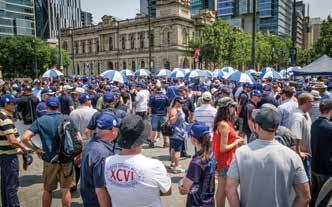
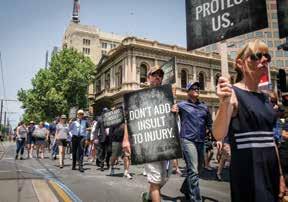
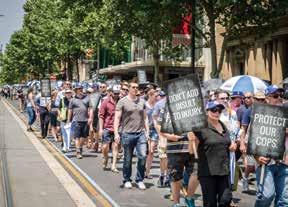
Out of uniform, and almost all of them off duty, they strode with unmistakable purpose toward North Terrace wearing blue Police Association caps and holding up protest placards.
Among them were senior constables Brett Gibbons and Alison Coad and Senior Constable First Class Brian Edwards, the three public faces of the Protect our Cops campaign. Their horrific injury stories had touched the community deeply.


“I’m very inspired by it … it shows that police and their families and the broader community support and respect a fair go for police.”
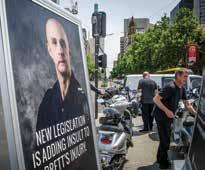
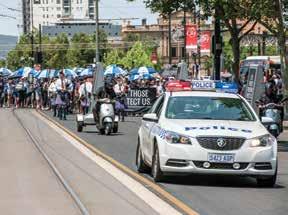
Motor scooters towed billboards with images of each of the three officers in uniform and lines of text about the new legislation adding insult to their injuries.
Enthusiastic members of the public showed their support for the marchers, and the broader campaign, with cheers from the sidelines.
A vote on amendments to the Police Act was to take place in the Legislative Council later that afternoon. Family First MLC Robert Brokenshire had tabled the Police (Return to Work) Amendment Bill in the Upper House in October.
His bill set out to amend the Police Act so as to restore the compensation benefits stripped away from police by the Return to Work Act
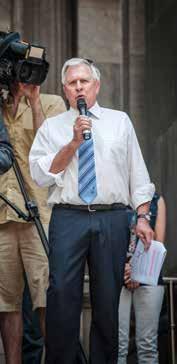
Top: police and supporters gathered in Victoria Square; above: one of the campaign billboards in Victoria Square; above right and right: Police Association president Mark Carroll and secretary Tom Scheffler address the gathering in Victoria Square; far right and above far right: marchers on King William St head for Parliament House Facing page – right: Police Association committee members lead the march carrying the main banner; top right: a police officer makes his message clear with a Protect our Cops placard; far right: scooters with billboards at the head of the march behind a patrol car

The key injustices in the act – which Mr Brokenshire has called “draconian, detrimental and unfair legislation” – are strict new cut-off dates on compensation payments.
A two-year cap now applies to income maintenance and a three-year cap to medical expenses.
Only a determination that an injured police officer has a 30 per cent “whole-person impairment” will get him or her coverage of income and medical expenses beyond those caps.
The Return to Work Act defines a person so injured as a “seriously injured worker”.
If the Upper House vote on the Brokenshire bill were to prove favourable it would be the first part of an easy solution to the police compensation dilemma.
So the key message of the determined police officers to the government was to vote the amendments up in the Lower House as well.
And only if the government had become “so arrogant” and “so out of touch with the

community” could it have failed to get that message.
That was how Robert Brokenshire saw it as he marched shoulder-to-shoulder with police officers and their supporters in searing midday heat, from Victoria Square to Parliament House.
Having tabled his amendments bill in the Upper House, he was an eager participant in the historic protest march.
And the march was the first one the Police Association had organized, and its members participated in, since 1991.
“I’m very inspired by it,” Mr Brokenshire told the Police Journal, as he marched close to the front of the mass of police. “Given the weather conditions, it shows that police and their families and the broader community support and respect a fair go for police.
“They have to put their lives on the line every time they go out on a shift. And people want and expect the government to protect them properly.
“In my 15 years as a parliamentarian, this is
the most important issue that needs to be fixed. It’s been demonstrated now, since this draconian legislation became law, 44 police officers will be put on a potential scrapheap. That’s just an injustice that we cannot accept.”
Family First MLC Dennis Hood and Liberal Party whip and police spokesman John Gardner also marched with the police.
Mr Gardner described the turnout of around 2,000 police and their supporters as “incredible” and “indicative” of the strong backing for the Police Association action.
“I’m confident that this is a common-sense campaign,” he said, as he too marched near the front of the throng. “The community is on board and the Liberal Party is fully lock-stepped in (with the police).
“We obviously needed to look at the detail of the (return-to-work) legislation and we’ll continue to do that. But the principle that we need to support our police officers is straightforward and sensible.”





THE RALLY
The marchers eventually turned the corner from King William St into North Terrace and assembled before the steps of Parliament House.
There, with no sign of Premier Jay Weatherill or his deputy, John Rau, Liberal Party deputy leader Vickie Chapman delivered the first rousing address.
“Clearly, the government take the view that you have to go and make an appointment with your arm shot off and beg for mercy…” she said.
“Now that is not acceptable, and we will continue this fight and … make sure that you … are not placed in that disgracefully shameful position...”
Greens MLC Tammy Franks, who also backed the Protect our Cops campaign, proclaimed her endorsement of the protest.
“This is … just the sort of turnout we should see when workers’ entitlements, that are so vital, are stripped away,” she said.
“We (the Greens) will stand up for the police… You don’t go to work to come home with an injury that cripples you for life. You go to work to make a living, not to lose your living. All power to you.”
Next to condemn the injustice done to police was Robert Brokenshire, whom the clearly grateful crowd welcomed with cheers and applause. He insisted that the Weatherill government had made a serious mistake with its return-to-work legislation.
“We must right this wrong,” he vowed. “The least that we can do as a community is to ensure that you are properly protected. You need proper protection and you had that removed on the 30th of June.
“I say: ‘Premier and deputy premier … you’ve ripped the guts out of their protection.’ ”
Mr Brokenshire concluded with a reference to a bizarre comment Premier Weathrill had made about his support for police withdrawing their labour.
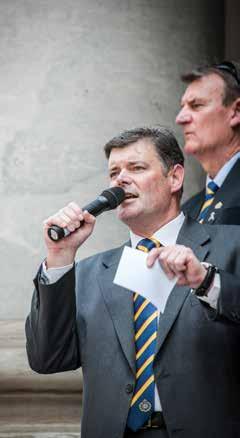
Facing page – top: marchers gathered outside Parliament House; far left: Liberal Party deputy leader Vickie Chapman addresses the crowd; far lower left: Greens MLC
Tammy Franks flanked by Mark Carroll and Tom Scheffler; centre: Family First MLC
Robert Brokenshire addresses the marchers; left: police and supporters listen to the speeches; lower left: Mark Carroll makes the final address
Right: Mark Carroll stresses a point during his speech
“Police, even though you don’t seem to know (premier), are not allowed to strike,” he said. “But I tell you what they are allowed to do: they’re allowed to fight for justice. And that fight for justice is just beginning.”
Mark Carroll, a veteran of industrial battles with government but undertaking his most serious since his 2008 election as president, made the final, telling points of the rally.
He called the injustice of the Return to Work Act the most serious issue currently
serving police would ever face in their careers.
“Society assumes that police will pursue their critical role fearlessly and prioritize the well-being of others above their own,” he asserted. “And that is what we do. And, in return, the government has seen fit to cap our entitlements.
“We are shot at. We are stabbed. We are murdered. We expect protection from our parliament, from the government of the day. We expect to go to work and not to have to worry about financial ruin.”
“We are shot at. We are stabbed. We are murdered. We expect protection from … the government of the day. We expect to go to work and not to have to worry about financial ruin.”
Mr Carroll explained that the Return to Work Act had enabled SAPOL to make an $8.9 million reduction in its workers compensation liabilities. He labelled that “a cost shift from the employer onto the employee”.

Left: Injured police officers Brett Gibbons, Brian Edwards and Alison Coad stand with Mark Carroll as he speaks on their behalf; right: Brian, Brett and Alison look out over the crowd during a speech; lower right: Mark Carroll, too, looks out over the police and supporters
THE INJURED
Injured officers Brett Gibbons, Alison Coad and Brian Edwards continued to show their commitment to the campaign after the march. All three stood resolutely with their union president, Mark Carroll, and other speakers throughout the rally on the steps of Parliament House.
Senior Constable Coad contracted incurable oral herpes after an offender spat in her mouth in Whitmore Square in 2003. Under the Return to Work Act, she will have to cover her own medical expenses from 2018.
That cost is currently $400 per month for medication alone.
Emotional as she came to the end of the march, Snr Const Coad described the turnout of police as “absolutely wonderful”.
“I’m so overwhelmed by the sheer numbers that have just come out here to support this amendment to the Police Act,” she said as she choked back tears.
“It’s more than I expected. I’m so thankful for the officers who have made their way from the country or have got up after a night shift to come and support us.”
Senior Constable Gibbons suffered a shotgun blast to his face after he and his then-partner responded to the Hectorville triple murder in 2011.
He underwent surgery after the shooting and has had four more operations in the past three years.
SAPOL has afforded him an interim determination as a seriously injured worker. But, if he falls short of the 30 per cent whole-person impairment, after he undergoes an assessment, he too will be left to cover his own medical expenses.
With the potential for many more operations in the future, he is likely to face exorbitant costs.
And the SAPOL Injury Management Section has assured him he will be “lucky to reach 20 per cent impairment”.
The march, as part of the Protect our Cops campaign, gave Snr Const Gibbons great hope. “It’s fantastic to see such a massive public display of support for the police and for our safety,” he said.
“I can’t believe the outpouring of support, and not just from police but also members of the public and family members. It’s impossible not to be moved by it.
“I hope common sense will prevail and that police will be protected as they deserve to be.”


Senior Constable First Class Edwards suffered burnt lungs after he inhaled leaking anhydrous ammonia at Gumeracha early this year.
Like his two colleagues, he will have to cover his own medical expenses if he fails to meet the 30 per cent impairment threshold.
“I’m still suffering pains in the chest,” he said. “That continues; and who knows what’s going to happen to me in the future.
“And people like Brett and Alison put their lives on the line. They deserve to be looked after. It’s just a basic right to be looked after.”
SC1C Edwards had not expected the deep emotion he sensed among his colleagues and supporters whom he marched with to Parliament House.
“I was humbled,” he said. “Mark Carroll said some nice words about us three. You don’t look to be put out there on a pedestal, but this was an issue really worth pushing.
“And I think Alison and Brett felt the same way. We weren’t out there for ourselves, we were there for everyone.”
“… suffering injured police officers came to the union asking us to fight for compensation justice, and we’ve taken up that fight for them.”
THE TRAVELLER
By Nicholas Damiani
Many country police officers showed their dedication to the campaign by the long journeys they made to Adelaide to take part in the march.
Busy senior constable first class and newly elected Police Association delegate David Bourne made the time to travel over from Ceduna.
“We need to know that, if we’re injured protecting the community, we’ll be protected against financial ruin by the government,” he said.
“Our work is inherently dangerous. We deal with unpredictable people in unpredictable circumstances.”
SC1C Bourne asserted that the impact of the return-to-work legislation would be greater on country police officers because of unique challenges in their work.
“For country members, the call of 801 (police in trouble) might not result in help for a substantial amount of time,” he explained.
“It’s not because our mates aren't trying to get there but because they simply have that far to travel.
“For example, as a highway patrol officer in parts of my patrol area, my nearest backup is from across the border in WA.
“The return-to-work legislation has far-reaching consequences, many of which have not even been discovered.”
So the sight of such strong public support for the march on Parliament House and campaign came as a delight to SC1C Bourne.
“It was fantastic to see,” he said. “It was a turnout greater than any rally I’m aware of in many years.”
THE MISINFORMATION
Misinformation and spite abounded at a media conference Deputy Premier John Rau held after the rally. He claimed that the Police Association was “not the ordinary men and women who serve in the police force”.
But Mr Rau would have known that those ordinary men and women actually direct and manage the association: as a lawyer, he used to perform work for the organization.
So he would also have known that every association delegate and committee member is a full-time police officer, while seconded officers manage the union.
And the association enjoys a participation rate of 99.3 per cent.
Compensation for Brett Gibbons was another issue on which Mr Rau misled the media, as he had previously. He insisted that the severely injured officer faces no prospect of disadvantage under the Return to Work Act
Association president Mark Carroll exposed the inaccuracy of that and other Rau claims in a media release the next day.
“The interim determination of 30 per cent impairment SAPOL has afforded Brett Gibbons is simply a stay of execution,” he said. “It’s completely irrelevant to his post-assessment status.
“The SAPOL Injury Management Section has told him he will not reach that threshold, and that will leave him to cover his own medical expenses.
“The clock is ticking on Brett Gibbons, despite Mr Rau’s claims to the contrary.
Mr Carroll also addressed the Rau accusation that the Police Association had gone about “whipping up members of the police force” and playing to the cameras.
“On the contrary, suffering injured police officers came to the union asking us to fight for compensation justice, and we’ve taken up that fight for them,” he said.
“If Mr Rau had any genuine desire to support injured police, he’d cease his misleading commentary and support the fair and just amendments to the Police Act.”



Top:
THE MEETING
Before the Police Association staged the November 18 march on Parliament House, it sought the endorsement of its members through their delegates.
To that end, the union a week earlier convened a special meeting of delegates from workplaces across the state for discussion and a vote on the action.
For around two hours, association president Mark Carroll restated the implications of the Return to Work Act
He also detailed not only the aims of the march and rally but also alternative action in the event of a Weatherill government refusal to support the Brokenshire bill.
One motion put to the delegates sought their authorization for the march and rally. Another motion, on the alternative action, was to lobby the government for extra funding and resources for changes to work practices so as to minimize workplace risks.
The delegates voted in favour of the motions unanimously.
THE HISTORY
The Police Association first voiced its strong opposition to the return-to-work legislation more than a year ago, well before it became law. One arena in which that occurred was the association annual conference of 2014.
Premier Weatherill and other parliamentarians attended the conference, where Mr Carroll condemned the injustice of the Return to Work Bill.
“I said the proposed legislation was neither fair nor reasonable for police who had to put themselves in harm’s way to protect the community,” he recalls.
“I also said that, were the bill to become law, it would overwhelmingly disadvantage police and possibly lead to hesitant responses to critical incidents.
“And my final point was that the association had no intention of sitting idly by without challenging these unjust laws.”
The Police Association continued to agitate by lobbying parliamentarians, and through correspondence with the government, media releases and statements in a range of public arenas.
In the Police Journal – sent directly to parliamentarians and available to the public –Mr Carroll wrote a 900-word article in which he again condemned the return-to-work legislation.
Under the title Return-to-work legislation set to exacerbate police suffering (June 2015), he highlighted the Gibbons and Coad cases.
Mr Carroll and Police Association secretary Tom Scheffler even met Deputy Premier John Rau in person in mid-October to detail the union’s opposition to the legislation.
But, despite this strong, continuous voice of opposition, Premier Weatherill last month told journalists that the association had “agitated very faintly”.
“I also said that … it would overwhelmingly disadvantage police and possibly lead to hesitant responses to critical incidents.”
And John Rau, in his post-rally media conference, said the association was welcome to engage in a “mature conversation” with him about “the real issues”. He did not inform journalists that precisely such a conversation had taken place a month earlier. PJ
Police Association delegates vote up the motion for the march and rally; above: Mark Carroll addresses the delegates before the vote; left: journalists question Mr Carroll about the result of the meeting
GRUELLING ULTRAMARATHON “BLISSFUL”


By Brett Williams
BREVET
Sergeant Jo Kruk has conquered mountain slopes, river crossings and punishing terrain – all in oppressive tropical heat – to excel in yet another overseas ultramarathon.
This time, the Elizabeth prosecutor took on the 100km TMBT (The Most Beautiful Thing) 2015 in the jungles of Malaysian Borneo in late August.
And, in just under 17 hours, she crossed the finish line in fifth place, ahead of 278 other runners and just one hour and 43 minutes behind the winner.
Kruk, 28, also set a course record as the first woman across the line, more than three-and-a-half hours ahead of the next female runner, who finished in 20th place.
And Kruk emerged from her record-breaking finish feeling “pretty good” and with surprisingly few injuries.
“That was despite the time on my feet, tough terrain and challenging weather conditions,” she says.
“I had minor niggles in the hip and quads, as well as scrapes and scratches from the sharp vegetation, and my ‘mandatory’ falls.
“I think I tripped up no less than four times, including some pretty decent face plants.
“And I had blisters as a result of the ever-changing weather conditions, from 40-degree heat and intense humidity to torrential downpours.
“There were also river crossings which resulted in soaked feet and lots of rubbing on shoes, general soreness and a bit of a sciatica issue.”
Promoted as an extreme outdoor trail race for experienced marathon runners, the TMBT 2015 was the fifth year of the event.
It took place around the western side, base, southern face, and south-eastern side of Mount Kinabalu in the state of Sabah.
In the tropical environment, runners had to endure not only the searing heat but also temperatures as low as 14 degrees overnight and during heavy rain. And, apart from its waist-deep rivers, the race involved 6,000 metres of elevation.
Runners had to carry their own supplies of food, water and clothing. Kruk carried a stash of nut butter, cheese, nuts and a small amount of meat, which she had to throw away after it went off in the heat.
She also ran out of fresh water and took the risk of drinking from a stream. “Although I had no issues with that at the time, I think I may have felt the aftereffects a few days later,” she says.
Kruk, who ran for six of her 17 hours after dark, never stopped for a recovery break or pain relief. The only stops she made were brief and at checkpoints to collect supplies and change her socks.
And, to Kruk, the whole experience was “blissful”.
“I love the adventure of being out on the trail,” she says. “You’re never going to experience the real rugged, cultural reality of an area without traversing through untainted trails and natural communities.”
Kruk had prepared for the race as she had for other ultramarathons – chiefly workouts on cardio machines in the gym for three-and-a-half hours every weekday. On weekends those sessions were as long as six hours.
And, away from the machines, Kruk – a former boxer and tae kwon do champion – undertook three 25km runs per week.
Her success in Borneo follows outstanding results she has achieved in other world-renowned ultramarathons, such as the gruelling Namib Desert Challenge in 2012.
Staged in Namibia, it involves five marathons over five consecutive days. Kruk was the first of 10 women over the finish line in 17 hours and 53 minutes.
And, in 2013, she competed in the Northburn 100 Ultra Mountain Run in New Zealand where she finished in 12th place. Kruk had completed the 160kms in 30 hours and 47 minutes and beaten all but two other female runners.
Back in Adelaide, after the TMBT 2015, Kruk ran in the Heysen 105 Ultramarathon in October and was again the first female runner across the line and fifth overall.
Her plan now is to compete in Duncan’s Run Hundred, a 100km ultramarathon in Gippsland, Victoria this month. PJ
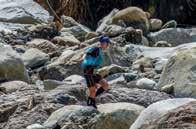
Top: Jo Kruk runs over a bridge during the ultramarathon; centre: running through a rock crossing; above: at the finish line which she crossed in fifth place








LETTERS TO THE EDITOR CAN BE SENT BY: Regular mail Police Journal, PO Box 6032, Halifax St, Adelaide SA 5000
Email editor@pasa.asn.au Fax (08) 8212 2002
Internal dispatch Police Journal 168
Passion for rallying and White Ribbon
The return running of the closed-road Classic Adelaide Rally took place in conjunction with the second Adelaide Motorsports Festival in October.
I took part in the premier classic vehicle tarmac rally, co-piloting in a very rare (only 200 made) 1986 Ford RS200. This car has its roots in the World Rally Championship of the mid-1980s.
This was the first outing for the car after spending the last few years in a Tasmanian museum so a few mechanical areas were exposed as requiring improvement. There were bound to be some areas in need of fine-tuning.
The car showed great potential, collecting four equal fastest times on the stages and one second fastest time in a field of around 50 cars in the premier class. However, it was retired early on the second day with a slipping clutch.
I have had a 10-year working relationship with the vehicle’s owner, Tony Quinn. Together we have won several national and overseas Targa events, including Targa Tasmania twice and Targa New Zealand five times.
Mental health at risk in policing
Policing exposes its members to real possibilities of developing physical and psychological injuries.
The high propensity for police to develop injury – particularly post-traumatic stress disorder and related mental-health injuries – is well known, widely accepted, and supported by substantial evidence-based research from across the world.
My passion for motorsport is only rivalled by my commitment to the White Ribbon campaign.
Straight after retiring the car, I returned to Victoria Park – the site of the Motorsports Festival – to assist the White Ribbon ambassadors in promoting the White Ribbon message to my fellow motorsports enthusiasts and competitors.
A stunning black Mercedes Benz GLA with a giant white ribbon was used for the display and drew the crowd to hear the important message.
The Ford RS200 rally car was on display, too, with its White Ribbon sticker, which most of the 200-plus entrants in the Motorsport Festival and rally were proud to carry.
I was pleased to raise over $2,000 to support local White Ribbon initiatives.
Naomi Tillett Constable Sturt LSA
Creating an environment that protects members against mentalhealth injuries greatly benefits SAPOL by ensuring a productive, motivated and retained workforce. So what will it take for SAPOL to become responsible for the numbers affected by work-related mentalhealth injuries and the propensity to develop such injuries, and acknowledge the ongoing effect of these injuries for many members?
Surely SAPOL could demonstrate its genuine commitment and support to members’ mental health and welfare by supporting the restoration of workers’ compensation rights through the proposed Police Act amendment?
Detective Gaye Kittel Sturt Family
Violence Investigation Section
Cops, Crooks, Courts…
Your bi-monthly production of the Police Journal is excellent. Congratulations.
I also know a bit about the publishing world with 10 novellas over a period of 10 years.
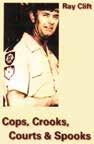
My last novel-size non-fiction is Cops, Crooks, Courts and Spooks, which is a collection of anecdotes and some bios on people I worked with. Some sadly are dead.
I did all the customary duties like courses, seminars, brushing up on the grammar and joining a writers group, which are essential before venturing into that tough world.
Apart from the first books, I have been published in several anthologies of poetry and prose.
If members wish to access any of my books I have a Facebook page.
Ray Clift
Senior Sergeant (ret) rayannclift@bigpond.com
Was Deputy Premier John Rau wrong to say the Police
Association “is not the ordinary men and women who serve in the police force”?


Sergeant Kevin Dollard
Strategy, Policy and Programs Section
Shortly after SAPOL members marched on Parliament House for amendments to the Return to Work Act, Deputy Premier John Rau said: “As far as I’m concerned (the union) is not the ordinary men and women who serve in the police force. They are an organization that has chosen to engage in a particular type of campaign.” How wrong he was.
The Police Association is made up of members of the South Australia police force. It is police working to improve the lives, benefits and conditions of other police, in this case by seeking amendments to the return-to-work legislation which has eroded member entitlements.
The association has “chosen” to engage in this campaign because it recognizes the injustice of the current legislation and the impact it is having or, indeed, could have on its members.
More than 99 per cent of (sworn) police officers are members of the association. It is an elected, delegated voice in pursuit of better outcomes for its members, and it speaks for all 4,726 of us.
Senior Constable 1C Russell Disher
Eastern Adelaide LSA
Attorney General John Rau was manifestly wrong in his statement and belief.
This shows a minister and a Labor government completely out of touch with the “men and women of the police force”.
The Police Association was the first police union in Australia. In its 104 years it has, every day, fought to protect its members’ rights and conditions.
Fletcher and Hand (2004), in a paper about what is a successful union, wrote that it is: “… in pursuit of social objectives such as health care and adverse effects of corporate behaviour.”
The Protect our Cops campaign is a perfect example of a successful union fulfilling its core objective to its members.
The national average of union membership is 17 per cent (Australian Bureau of Statistics, 2014).
Police Association membership is more than 99 per cent and is not just the committee and representatives. It is the very people that Rau has insulted: “the ordinary men and women of the police force”.
Detective Acting Sergeant Annette Martin
Sturt Family Violence Investigation Section
Deputy Premier Rau could not have been more wrong. The association executive and committee consist of the very people Mr Rau was talking about.
Membership of the Police Association of South Australia is not compulsory, yet more than 99 per cent of SAPOL’s sworn officers choose to be members. The association committee is elected by those members.
The association committee consists of sworn members. Workplace delegates also play a key role in ensuring the interests of the membership are represented.
The association always has, and always will, promote the interests of its members. It affords the opportunity for discussion and the provision of action in respect of redress, grievance settlement and complaint resolution, and recourse in matters affecting the entire membership.
I have had the opportunity to work with several of the committee members and executive over the past 28 years and I am proud of the work they are doing.
The association is our collective voice and we are grateful for them.
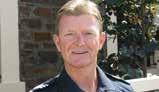
From top: Sergeant Kevin Dollard, Senior Constable 1C Russell Disher and Detective Acting Sergeant Annette Martin.
Serving and transferred or retired members of Prosecution are staging an inaugural lunch and reunion in celebration of history and ongoing service.
The lunch reunion will take place at 12.30pm on Friday 19 February, 2016 at the Police Club.
More than 530 former and current police prosecutors are invited to attend – seating will be limited.
PROS E CUTION PROSECUTOR’S
Please purchase your tickets in advance Cost: $27.00 (choose from two dishes with drinks available from the bar)
Book online at www.trybooking.com/170691 or phone the Police Club for further information 8212 2924
Bookings close Friday 12 February (unless sold out beforehand)

INDUSTRIAL
Nick Damiani
Parliamentary committee hears of psych impact on cops
POLICE
Association president Mark Carroll addressed the Parliamentary Committee on Occupational Safety, Rehabilitation and Compensation in late October.
He provided the committee – which focuses on mental health and suicide prevention in the workplace
– with pertinent statistics on police and mental health:
• One quarter of all police deaths in SA are attributable to suicide (eight of SAPOL’s 33 recorded fatalities of the past 11 years were suicides).
• In the five-year period to June 2014, 247 workers’ compensation claims – almost 50 a year – were accepted by SAPOL as psychological injuries.
• By 2013-14, psychological injury claims accounted for around 20 per cent of SAPOL’s annual claims numbers.
• Costs for psychological injuries amounted to $2.3 million in 2013-14.
• In terms of years of service, 37 per cent of claimants lodged their compensation claims for psychological injury between six and 15 years after commencing employment with SAPOL.
• The most common cases reported were harassment, bullying, discrimination, racism, victimization (as one category); accumulation and/or build-up of stressful circumstances; and exposure and/or continual exposure to a traumatic incident. Among steps the association has taken to educate its members and their families about the impact on the police-officer family member involved in a traumatic, life-threatening incident are:
• Publishing FamilySupportforPoliceOfficers. This booklet is designed to help families understand the workers’ compensation system and the recovery process in respect of police injured in the workplace.
It also outlines some practical strategies aimed at assisting families to maintain their well-being as the recovery takes place.
• Commissioning a lecture series by Dr Kevin Gilmartin, PhD, a 20-year US law enforcement veteran and behavioural scientist. His highly regarded book Emotional Survival for Law Enforcement – A Guide for Officers and Their Families is a definitive text about the effects of police work. He conducted two lectures at the Adelaide Convention Centre as well as training to line supervisors at the police academy when he came to Adelaide in March and November 2014. SAPOL jointly funded his second visit, while Police Health, Police Credit Union and the Police Association supplied copies of his text to more than 1,000 attendees.
• Liaising with beyondblue, which is developing a first responders’ programme to produce a goodpractice framework for emergency-service organizations. The framework aims to provide practical, useful information about the range of programmes and practices required for effective support of first responders and to create mentally healthy workforces.
• Assisting Flinders University PhD candidate Andrew Patterson in his research dealing with resilience among police in Australia. The Patterson research will explore mechanisms police officers use to normalize their experiences to preserve the delicate professional balance between coping (or psychic numbing) and being responsive to victims and survivors in their every-day work environment.
Mr Carroll told the parliamentary committee that engaging with the families of police officers was crucial.
“Police work often spills over into family life,” he said. “Family members can be the sounding board
for the police officer when he or she talks about difficulties at work.
“They can also serve as a critical support base for the injured officer.
“We must engage with families to help them understand the impact that policing has on their loved one, and to prevent alienation from the family unit.
“Comprehensive training and education programmes are key.
“It will lead to an organizational culture that places the prevention of psychological injuries on the same basis as physical injuries.”
PSYCHOMETRIC ASSESSMENTS
SAPOL has scrapped its proposal to psychometrically assess officers of police as part of selection or promotion processes.
The Police Association wrote to SAPOL in August, requesting more detail on the proposal and questioning its benefits.
SAPOL advised the association in October that “whilst it was initially considered this type of assessment would add value to the merit based assessment process, the outcomes to date did not provide additional benefits to the actual selection process.”
Psychometric tests were originally developed in the early part of the 20th century for use in educational psychology.
Go to PASAweb (pasa.asn.au) to:
• View the association’s letter to SAPOL about psychometric assessments and SAPOL’s response.
• Download Family Support for Police Officers (an updated version of the booklet will soon be available owing to the new return-to-work legislation).

HEALTH

Dr Rod Pearce
Shark bite and the infection risk
The danger stems from the bacteria-filled diet and environment of the feared creature
SCIENTISTS
don’t believe that sharks attack humans to eat them. The belief is that these monstrous creatures bite into our flesh out of curiosity about what kind of animal we are.
Shark jaws contain multiple rows of sharp, serrated, triangular teeth, which are continuously replaced as they shed. This accounts for the classic crescent shape of the shark bite.
Wound infections are a serious concern because sharks eat other animals so the bacteria in their mouths reflect the bacteria of the local fish and swimming environment.
It is best to treat all suspected shark bites as carrying a high risk of infection. If one antibiotic does not work, seek early advice because treatment is empirical.
Having survived an attack long enough to reach medical care, and after receiving antibiotics, continued survival and recovery are possible.
A series of parallel cuts caused by the shark raking its teeth on the swimmer or surfer seems to be a way the shark bumps or tastes. But, again, managing the infection risks becomes the key to survival.
For the extreme injuries, management depends on the damage done by a toothto-tooth biting force which, in the extreme, might be as much as 18 tons per square inch.
Fortunately, most bites are not deep, and puncture wounds do occur without causing blood vessel or nerve injury.
First aid includes putting pressure directly on the wound, using gauze, a towel, or any other available cloth.
… management depends on the damage done by a tooth-to-tooth biting force which, in the extreme, might be as much as 18 tons per square inch.
An avulsion is when a chunk of flesh is entirely removed from the body, and this can be the most severe, life-threatening injury. Broken bones might also result from a bite.

If the wound is an avulsion, you might have to put pressure on exposed muscle or fat tissue to save the bite victim’s life. If the bleeding doesn’t stop, do not remove the cloth but rather add more.
In the excitement of the moment, as pressure is applied to stop bleeding or horrific injuries, you still need to protect yourself. This is imperative.
Avoid danger – don’t get bitten yourself. And don’t expose yourself to blood-borne diseases of the victim.
Begin by assisting the victim out of the water. Apply direct pressure to any bleeding sites as quickly as possible.
A barrier such as a cloth or gauze pads may be helpful, and gloves should absolutely be worn whenever possible for protection against bloodborne disease.
Elevate the bleeding limb above the heart and press down on pressure points to slow the bleeding further. Pressure points reside in parts of the body where blood vessels are near the surface.
You will need to pick a pressure point between the wound and the heart. The most common areas for these are on the arm between the elbow and the shoulder, at the groin along the bikini line, and behind the knee.
Continued page 35

MOTORING
Jim Barnett
Redesigned from bumper to bumper
And it’s clearly the best Camry yet –at a value-for-money price
THE newest Toyota Camry hits the mark with completely new styling, sharper pricing and a new sports variant.
DESIGN
Except for its roof, Camry has undergone a bumper-to-bumper redesign. And it looks extra athletic with a more aggressive grille and new alloys on all models.
Inside is a new dash layout with upgraded instruments and new multi-function display. A smaller steering wheel, with audio and phone function buttons, features across the range.
Seating is roomy and comfortable. The rear seats feature 60-40 split-fold functionality for storage of longer items. The huge boot comes with a spare wheel under its floor.
Atara SX, a stand-alone sports model, was conceived and engineered in Australia to be the most agile Camry yet. Making it complete are:
• Eighteen-inch black alloys.
• Wide low-profile rubber.
• A black mesh grille.
• Boot-lip spoiler.
• Dual exhausts.
VALUE FOR MONEY
With up to $5,000 slashed off equivalent superseded models, entry Altise now has an asking price of $26,490, just $90 more than a 1997 Camry CSi. And it’s a far better car with loads more equipment.
The new sporty Atara SX is $31,990, while the three well-equipped Hybrid models start at $30,490.
Top-of-the-range Atara SL is available in petrol ($37,440) or Hybrid ($40,440).

Suspension is firm but the ride is generally good and the cabin remains quiet.
SAFETY
All models score a five-star safety rating and feature:
• Seven airbags.
• Traction and stability control systems.
• LED daytime running lights.
• Reversing camera.
• Pre-load differential, which improves stability and enhances steering feel.
Top-spec Atara SL models come with more advanced safety features such as:
• Pre-collision alert with the ability to apply the brakes.
• Blind-spot monitoring.
• Lane-departure warning.
• Auto high beam.
• Radar cruise control.
STATS
Petrol models feature a 2.5-litre DOHC fourcylinder petrol engine, which produces 133kW of power and 231Nm of torque. The addition of dual exhausts on all Atara models squeezes an extra 2kW and 4Nm.
The standard transmission is a six-speed automatic with manual mode. Atara models gain paddle shifters. Claimed fuel economy is 7.8 litres/100km with CO2 emissions of 183g/km.
The three Hybrid variants feature a 2.5-litre Atkinson-cycle four-cylinder petrol engine combined with a 650-volt electric motor and generator. Combined output is an impressive 151kW.
Hybrid models use an all-gear CVT transmission; and Hybrid combined fuel economy is 5.2 litres/100km, with CO2 emissions of 121 g/km.
ON THE ROAD
The Atara SX feels more powerful than its engine output figures suggest. The transmission offers smooth, quick changes and the paddle shifters add to its sporty feel.
On bends, SX remains agile and compliant. Its quicker steering ratios are evident. Suspension is firm but the ride is generally good and the cabin remains quiet.
VERDICT
This is clearly the best Camry yet and represents better value for money.

When the sports bits come together
It’s close to the price of an SS Redline but highly specified
the centre of the dash displays sat-nav, reversing camera, and audio and other functions.
Drivers can select between Standard, Sport and VXR drive modes. These alter throttle response, gearshift mapping, power-steering assistance and the torque transfer between front and rear axles.
VALUE FOR MONEY
THE third Holden instalment from Germany this year is the new Insignia VXR.
DESIGN
A mid-sized four-door sports sedan, Insignia VXR features a turbocharged V6 petrol engine driving all four wheels through a six-speed automatic transmission with paddle shifters.
The car features big 20-inch alloy wheels shod with low-profile (255/35) Pirelli tyres. Big cross-drilled front rotors are fitted with four-piston Brembo callipers with smaller solid discs at the rear. A boot-lid lip spoiler and dual exhaust outlets also feature.
Driver and front passenger each score an electrically adjustable heated Recaro sports seat. The 60-40 rear seat offers sufficient head and leg room for two adults. The boot is roomy but contains no spare wheel, just a tyre inflation kit.
Insignia’s gauge layout features an analogue tachometer and fuel and temp gauges. Between these is an eight-inch configurable driver information centre, which offers electronic voltmeter, oil temperature and speedometer.
Drivers can toggle between digital speed, tyre pressure, trip computer, phone info, G-meter, lap timer and satellite navigation readouts. A second eight-inch colour touchscreen in

The $51,990 price tag, plus dealer delivery and on-road costs, sounds a bit steep. It’s close to the price of a Commodore SS Redline V8. But Insignia VXR is well engineered and highly specified. Standard items include:
• Leather trim.
• Satellite navigation.
• Dual-zone climate control.
• Front and rear parking sensors.
• Trip computer.
• Seven-speaker audio with digital radio.
• Smart entry.
• Push-button start.
SAFETY
Insignia comes with an array of safety equipment, including:
• Reversing camera.
• Six airbags.
• Auto wipers and lights.
• LED daytime running lights.
• Blind-spot monitoring.
• Lane-departure warning.
• Adaptive cruise control with speed limiter.
• Forward collision and rear traffic alert systems.
• Emergency brake assist.
• ISOFIX child seat anchorage system.
STATS
Insignia’s 2.8-litre turbocharged V6 engine puts out 239kW of power and 435Nm of torque. But the car is heavy, a tad over 1,800kg and, as a result, can be thirsty. Holden claims fuel economy of 11.3 litres/100km.
ON THE ROAD
A smooth and relatively quiet car around town, except for the exhaust burble at idle. On twisty bitumen, all the sports bits come together to make for a quick, agile performer. In VXR mode it’s exhilarating.
VERDICT
Although not a V8 killer, Insignia VXR is a superbly fitted-out driver’s car which can set the pulse racing. Fuel efficiency and the requirement for 98RON unleaded are possible drawbacks.



HOLDEN PARTNER PROGRAM



Our GM Partner Program gives valued Police Association members access to special off ers and discounts on a wide range of Holden vehicles. It’s a great way to find a new Holden that suits your budget and your lifestyle.
For more information, simply call the GM Fleet Customer Service Centre on 1300 559 696 or email us at gmfleetenquiries@gm.com. Vehicles and colours shown are correct at time of print.



Please purchase your tickets in advance www.trybooking.com/137381 or speak to Police Club staff for further information Bookings close Friday 26 February (unless sold out beforehand) (No BYO food or drink) BACK DUE TO POPULAR DEMAND! Defending Champions PCU and runner-up team TGB throw down the gauntlet!
Police Club Quiz Night
FRIDAY 4 MARCH, 6pm for a 6:30pm start – 10pm $22.00 per person
Ten rounds of all your favourites, plus • Silent Auction • Lucky Squares • Wine Lucky Dip • Raffle

Entry includes a complimentary snack plate (choice of Asian basket, seafood platter, party favourites or cheese platter) and drink on arrival (choice of beer, wine or soft drink). Additional refreshments available on the night.
Table of ten bookings include a complimentary bottle of Puppeteer wine

Rise in rates for the Big 4 banks
Paul Modra Executive Manager – Member Value and Distribution, Police Credit Union
And, of course, none of those banks has apportioned blame for the increase to itself
NOBODY
likes rate rises, so why are the Big 4 banks asking their customers to pay more?
With the low interest rate environment, you wouldn’t have expected a rate hike anytime soon. However, this hasn’t stopped the Big 4 banks.
As of November 3, 2015, the Reserve Bank of Australia elected to keep the official cash rate unchanged at a record low 2.0 per cent. This was the sixth straight month that the Reserve Bank left the cash rate untouched.
Reserve Bank of Australia governor Glenn Stevens says the decision to keep the cash rate untouched was because “low interest rates are acting to support borrowing and spending.”
Mr Stevens also suggested that any future move in the cash rate would more than likely be down.
However, despite the current low and steady environment, the Big 4 banks – Commonwealth Bank, National Australia Bank, ANZ and Westpac –have decided to ignore the trend.
Australian homeowners are now expected to face higher mortgage repayments owing to the banks hiking up their interest rates for home and investment loans.
Each bank has increased its standard variable home loan rates by between 0.15 per cent and 0.20 per cent.
The banks have blamed the decision to increase rates on the tighter lending regulations and increased scrutiny placed on them by the Australian Prudential Regulation Authority (APRA) over the past few months.
APRA has directed and enforced the banks to hold more capital so as to prevent possible losses and to secure their businesses.
However, that’s not the only reason for the rate hike. Banks like to put the interest of the shareholders first, instead of the customer.
All of the profit banks make goes directly to the shareholders whereas, at a credit union, all of the profit is poured right back into the business to benefit members.
Over the last year, the Big 4 banks made a combined $30 billion profit1. And, now, with the increase in rates, it is projected the shareholders will make even more.
Now is the time to make a smart decision and switch to a financial institution that cares about you instead of dollar figures.
People are constantly looking for better deals and no longer scared to vote with their feet and find the best rates.
If you switch to Police Credit Union you could save thousands!^
Based on a comparison rate of 4.88 per cent over 25 years, if you took out a $150,000 Better Fixed Home Loan, you’d save over $17,000 ^ in interest compared to the average standard variable comparison rate from a major bank.
Imagine what you can buy with that kind of saving! A new car, boat or dream holiday? The possibilities are endless.
We not only care about providing competitive interest rates, but we also care about our member satisfaction.
The Customer Owned Banking Association commissioned a poll earlier last month, which found 61 per cent of customer-owned banking customers, credit union members for example, were “very satisfied” with their banking experience, compared to only 28 per cent of the Big 4 bank customers.
At Police Credit Union we currently have a member satisfaction rating of 93.2 per cent. Ready to make the move but have a distaste for filling in forms? Don’t worry, we get you. It can be a big move, but that doesn’t mean it has to be stressful. If you come to us, you won’t even have to talk to your bank. We can do all the work for you. Visit a branch or give us a call on 1 300 131 844 today about how we can help deliver you a Better Banking experience.
Police Credit Union ABN 30 087 651 205 AFSL/ Australian Credit Licence 238991. Terms, conditions, fees, charges and lending criteria apply. Full details available on application. Minimum loan amount is $150,000. New money only. Comparison rate of 4.88% is current as at 26/11/2015 subject to change and based on a secure $150,000 loan over 25 years. At the end of the 3 year fixed period, rate reverts to the Discount Variable rate of 5.09% P.A. current as at 26/11/15, subject to change. Comparison rate is based on a secured $150,000 loan over 25 years and valid for applications made in South Australia. Maximum LVR 80%. WARNING: This comparison rate is true only for the examples given and may not include all fees and charges. Different terms, fees or other loan amounts might result in a different comparison rate. ^Savings based on a comparison between the Big 4 bank’s Standard Variable home loan rates and Police Credit Union Ltd Better Fixed Home Loan rate. This offer may be varied or amended by Police Credit Union. 1 Sourced from News.com.au 29/10/2015.


Free Legal Service for Police Association Members, Their Families & Retired Members.
Leading Adelaide law firm, Tindall Gask Bentley is the preferred legal service provider of the Police Association, offering 30 minutes of free initial advice and a 10% fee discount
To arrange a preliminary in-person or phone appointment contact PASA on (08) 8212 3055.


Have you or a family member been injured in a car accident?
Tindall Gask Bentley acts in more motor vehicle accident claims that any other law firm in SA. Gary Allison & Richard Yates can provide free preliminary legal advice on your entitlements to compensation. They can also help with Workers Compensation, public liability & medical negligence claims.
Family Law
Matrimonial, De Facto & Same Sex Relationships
• Children’s Issues
• Child Support matters
• Property Settlements
• “Pre Nuptial” style Agreements
Appointments with Wendy Barry (Accredited Family Law Specialist) & Dina Paspaliaris.
Commercial Law
• General business advice
• Real estate & property advice
• Business transactions
• Commercial disputes & dispute resolution
Appointments with Giles Kahl & Michael Arras.
Wills & Estates
• Wills & Testamentary Trusts
• Enduring Powers of Attorney
• Advance Care Directive
• Advice to executors of deceased estates
• Obtaining Grants of Probate
• Estate disputes
Appointments with Michael Arras & Rosemary Caruso.


Blended families: inheritance claims for stepchildren
Fiona Fagan Wills and estates lawyer, Tindall Gask Bentley Lawyers
Whose assets go where in a stepfamily can be far more complex than some might expect
Acommon problem with blended families is the tracing of the inheritance from a parent to a step-parent.
The natural reaction of will-makers is to leave everything to their spouses and, then, if their spouses don’t survive them, to their children equally.
Unfortunately, if you are part of a blended family, the division of your estate is not as simple.
Gifting your whole estate to a step-parent gives the stepchildren no security in respect to their inheritance. Those children can never expect to receive their parent’s inheritance through the step-parent.
Even if the couple made identical wills, there is nothing stopping the surviving spouse amending his or her will later.
More often than not, surviving spouses will amend their wills as their circumstances change. They might lose touch with their previous spouses’ children, remarry or move overseas.
to make a claim on your stepmother or stepfather’s estate (there are only very limited circumstances in which a stepchild can make a claim on his or her step-parent’s estate in South Australia).
Jointly owned property with any third party will automatically go to the surviving party upon death and will not form part of an estate if the ownership structure is as joint tenants. So it could be that there is no estate on which to make a claim.
If you die without a valid will, the law determines how your assets will be distributed. This can result in your assets being paid to relatives you have little or no contact with.
THE IMPORTANCE OF A WILL
Gifting your whole estate to a step-parent gives the stepchildren no security in respect to their inheritance.
Failure to recognize this in will-drafting could result in the children of the deceased spouse making a claim because they were not, and will not be, adequately provided for.
There are a number of options available to blended families which could accommodate both the spouse and the children, including a right of residence or life interest in the matrimonial home which would allow the surviving spouse to live in the property until his or her passing and, then, the property is transferred to the children.
You are not related to your step-parent. Once your parent has passed away you have no right
Your inheritance from your parent will likely flow onto your step-parent’s children and, in this event, you cannot make a claim or do anything to recover your parent’s inheritance.
In order to avoid such claims being made on your estate you should seek advice from a lawyer specializing in wills and estates to ensure that your will is drafted effectively.
Conversely, if you are a child of a blended family where the spouse has been left everything, it is important for you to ensure your claim is made immediately after your parent’s passing if a claim can be made.
A family provision claim must be made within six months from the date of the grant of the probate or letters of administration. The court may grant an extension of time depending on the reasons for the delay and other factors.
Tindall Gask Bentley Lawyers can assist will-makers to understand their obligation to their children and their current spouses and assist claimants to make claims on their parents’ estates.
A will allows you to appoint a person of your choice to be the executor of your estate. Your executor is then in charge of administering your estate in accordance with the terms of your will. Having a will also allows you to nominate a guardian to care for your children.
If you die without a valid will, the law determines how your assets will be distributed. This can result in your assets being paid to relatives you have little or no contact with. It can also cause considerable expense and unnecessary delays in finalizing your estate.
Keeping your will up to date can avoid future problems. Your will should be reviewed every three years or when your life circumstances change.
For example, when you get married or divorced, when there is a change in your family situation –such as having a child or the death of a family member – or when there are changes to your financial situation.
Tindall Gask Bentley Lawyers provides free initial advice through a legal advisory service to Police Association members and their families, and retired members. To make an appointment, members should contact the association (8212 3055).

A Game for all the Family
Author Sophie Hannah
Publisher Hachette Australia
RRP $29.99
Justine thought she knew who she was, until an anonymous caller seemed to know better.
After escaping London and a career that nearly destroyed her, Justine plans to spend her days doing as little as possible in her beautiful home in Devon.
But, soon after the move, her daughter, Ellen, starts to withdraw after her new best friend, George, is unfairly expelled from school.
Justine begs the head teacher to reconsider, only to be told that nobody’s been expelled – there is, and was, no George.
Then the anonymous calls start: a stranger, making threats that suggest she and Justine share a traumatic past and a guilty secret –yet Justine doesn’t recognize her voice.
When the caller starts to talk about three graves – two big and one small, to fit a child – Justine fears for her family’s safety.
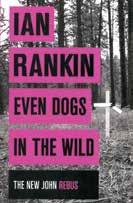
Even Dogs in the Wild
Author Ian Rankin
Publisher Hachette Australia
RRP $32.99
Detective Inspector Siobhan Clarke is investigating the death of a senior lawyer during a robbery. But the case becomes more complex when a note is discovered, indicating that this might have been no random attack.
Local gangster Big Ger Cafferty receives an identical message, and Clarke decides that the recently retired John Rebus might be able to help. He’s the only man Cafferty will open up to.
But a notorious family has arrived in Edinburgh, too, tailed by a team of undercover detectives. There’s something they want, and they’ll stop at nothing to get it.
DI Malcolm Fox’s job is to provide the undercover squad with local expertise, but he’s soon drawn in too deep as the two cases look like colliding.
Meanwhile, an anonymous killer stalks the night-time streets, focussed on revenge.
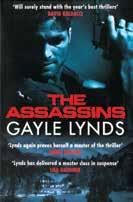
The Assassins
Author Gayle Lynds
Publisher Corvus
RRP $24.99
Six top international assassins are locked in a battle to the death. Only one will be left standing.
Recently retired from US military intelligence, Judd Ryder is walking home one evening when he sees a man wearing his clothes step out of his house. Moments later, the man is killed in a hit-and-run. Was the stranger the intended victim, or was it Ryder himself?
Searching the man, Ryder finds a phone with only one number dialled – to CIA trainee Eva Blake, Ryder’s former girlfriend.
What Ryder and Blake don’t know is that they’ve unwittingly been trapped in a battle to the death against six professional assassins and only one will be left standing.
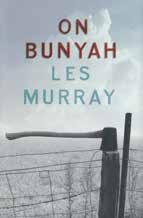
On Bunyah
Author Les Murray
Publisher Black Inc
RRP $32.99
On Bunyah tells the story of rural Australia in verse and photographs. From blood and fence posts to broad beans and milk lorries, Les Murray evokes the life and landscape of his part of the country.
“Bunyah has been my refuge and home place all my life. This book concentrates on the smallest habitats of community, the scattered village and the lone house, where space makes the isolated dwelling into an illusory distant city ruled by its family and their laws.”
HEALTH
Dr Rod Pearce
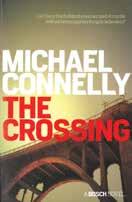
The Crossing
Author Michael Connelly
Publisher Allen & Unwin RRP $32.99
The Crossing is Michael Connelly’s 20th novel featuring legendary LAPD detective Harry Bosch. When the story opens, Bosch has retired from the LAPD but his half-brother, defence attorney Mickey Haller, needs his help.
The murder rap against his client seems ironclad but Mickey is sure it’s a setup. Though it goes against all his instincts, Bosch takes on the case.
With the secret help of his former LAPD partner, Lucia Soto, Bosch turns the investigation inside the police department. But, as he gets closer to discovering the truth, Bosch makes himself a target.
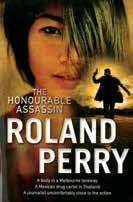
The Honourable Assassin
Author Roland Perry
Publisher Allen & Unwin RRP $29.99
The execution of a Mexican drug cartel hit man in a Carlton laneway draws Vic Cavalier to Thailand and back to a past he’d rather forget.
His newspaper editor is hell-bent on showing him the door, his footy team lost its last game, and his drinking habit is winning the war with his better angels.
And then there’s the man with the bullet in his head and links to a Mexican drug cartel lying in a Carlton laneway.
When his editor wants the story, Cavalier finds himself in Bangkok uncomfortably close to the action and under the watchful eye of a local cop.
In the steamy violent world of Thai elite power plays and the chaos of a coup, Cavalier’s motivation becomes clear – this same cartel is implicated in the disappearance and possible murder of his daughter.
WIN A BOOK! For your chance to win one of these books, send your name, location, phone number and despatch code, along with the book of your choice to giveaways@pj.asn.au
From page 27
Almost all bleeding will stop with sustained direct pressure and immobilization. Some wounds, however, particularly those involving amputation or damage to large blood vessels, might bleed uncontrollably.
In these cases, consider a tourniquet and apply it tight enough to stop the bleeding but, if it is too tight, the limb could die from lack of circulation.
A tourniquet must be well-padded to reduce the risk of severe local tissue injury. Apply it between the heart and the injury as close to the bleeding site as possible.
Tighten it only until bleeding is controlled. Loosen tourniquets for a moment every 10 to 15 minutes to assess whether they are still necessary. Retighten the device if the bleeding is brisk.
If bleeding has ceased to the point at which it can be controlled by direct pressure, remove the tourniquet and apply that pressure. Keep the tourniquet handy in case you need to reapply it.
The first step is always to control the bleeding but, if you have done that, and the victim is breathing and free of a broken spine, you can begin treating for shock.
Beyond puncture wounds, shark jaws can crush bones. If this is the case, do not try to straighten a deformed limb. Pad the injury to keep it from moving and put ice on the padding to keep the swelling down.
Never put ice or an ice pack directly onto the skin. Remove ice for 20 minutes after applying it for 20 minutes to give the skin a break.
If internal organs or tissues are protruding through an injury, do not attempt to push them back inside the body unless it is absolutely necessary for transport.
All wounds to the chest should be covered with a dressing. Wounds that appear to be bubbling or “sucking” should be covered with a dressing, taped and sealed on three sides.
The fourth, non-taped side serves as a flutter valve which allows air to escape from the chest. Without this valve, air pressure might develop in the space surrounding the lung and prevent lung expansion.
DVDs

The Man from U.N.C.L.E
SRP $39.95 1 disc
Set against the backdrop of the early 1960s, at the height of the Cold War, The Man from U.N.C.L.E. centres on CIA agent Solo and KGB agent Kuryakin.
Forced to put aside longstanding hostilities, the two take on a joint mission to stop a mysterious international criminal organization, which is bent on destabilizing the fragile balance of power through the proliferation of nuclear weapons and technology.
The duo’s only lead is the daughter of a vanished German scientist, who is the key to infiltrating the criminal organization, and they must race against time to find him and prevent a worldwide catastrophe.



Survivor
SRP $29.95 1 disc
A State Department employee newly posted to the American embassy in London is charged with reviewing passport and visa applications.
After her entire team is killed in a bomb blast, she instantly finds herself in the line of fire: targeted for death, framed for crimes she didn’t commit, discredited and on the run.
She must now fight to clear her name and prevent a catastrophic terrorist attack planned for New Year’s Eve in Times Square.
Southpaw
SRP $39.95 1 disc
Southpaw tells the riveting story of Billy “The Great” Hope, reigning light heavyweight boxing champion of the world.
Billy Hope seemingly has it all with an impressive career, a beautiful and loving wife (Rachel McAdams), an adorable daughter (Oona Laurence) and a lavish lifestyle.
When tragedy strikes and his lifelong manager and friend (Curtis “50 Cent” Jackson) leaves him behind, Hope hits rock bottom and turns to an unlikely saviour at a rundown local gym: Tick Willis (Forest Whitaker), a retired fighter and trainer to the city’s toughest amateur boxers.
With his future riding on Tick’s guidance and tenacity, Billy enters the hardest battle of his life as he struggles with redemption and to win back the trust of those he loves.
Vacation
SRP $39.95 1 disc
The next generation of Griswolds is at it again. Vacation, starring Ed Helms and Christina Applegate, takes the family on the road for another ill-fated adventure.
Following in his father’s footsteps and hoping for some much-needed family bonding, a grown-up Rusty Griswold (Helms) surprises his wife, Debbie (Applegate), and their two sons with a cross-country trip back to America’s favourite family fun park, Walley World.
WIN A DVD! For your chance to win one of these DVDs, send your name, location, phone number and despatch code, along with your choice of DVD, to giveaways@pj.asn.au
CINEMA




Good Kill
SRP $29.95 1 disc
In the shadowy world of drone warfare, combat unfolds like a video game – only with real lives at stake.
After six tours of duty, air force pilot Tom Egan (Ethan Hawke) yearns to get back into the cockpit of a real plane, but he now fights the Taliban from an air-conditioned box in the Las Vegas desert.
When he and his crew start taking orders directly from the CIA, and the stakes are raised, Egan’s nerves – and his relationship with his wife (January Jones) – begin to unravel.
Revealed is the psychological toll drone pilots endure as they are forced to witness the aftermath of their fight against insurgents.
Star Wars: The Force Awakens
Season commences December 17
Director JJ Abrams brings to the screen the long-awaited Star Wars seventh episode, continuing George Lucas’s blockbuster space opera.
Set 30 years after the Battle of Endor and the events portrayed in Return of the Jedi, the new film features John Boyega, Daisy Ridley, Adam Driver, Oscar Isaac, Andy Serkis, Lupita Nyong’o, Domhnall Gleeson and Max von Sydow.
They will join the original stars of the saga: Harrison Ford, Carrie Fisher, Mark Hamill, Anthony Daniels, Peter Mayhew and Kenny Baker.
Room
Season commences January 28
Spirited five-year-old Jack (Jacob Tremblay) and his loving mother, Ma (Brie Larson), escape from the enclosed, windowless surroundings which is all Jack has known his entire life.
They are now free of their captor, Old Nick (Sean Bridgers).
And, after they escape, Jack makes a thrilling discovery: the outside world.
Room – a Canadian-Irish dramathriller directed by Lenny Abrahamson – premiered at the Telluride Film Festival in Colorado in September and has won critical acclaim.
Also in September, it won the People’s Choice Award at the Toronto International Film Festival.
Room is based on the best-selling novel by Emma Donoghue. Its other cast members include Joan Allen and William H Macy.
The Revenant
Season commences January 7
Inspired by true events, The Revenant captures one man’s epic adventure of survival and the extraordinary power of the human spirit.
In an expedition of the uncharted American wilderness, legendary explorer Hugh Glass (Leonardo DiCaprio) is brutally attacked by a bear and left for dead by members of his own hunting team.
In a quest to survive, Glass endures unimaginable grief as well as the betrayal of his confidant, John Fitzgerald (Tom Hardy).
Guided by sheer will and the love of his family, Glass must navigate a vicious winter in a relentless pursuit to live and find redemption.
The Revenant is directed and co-written by renowned filmmaker and Academy Award winner Alejandro G. Iñárritu ( Birdman, Babel).
WIN A MOVIE PASS! For your chance to win an in-season double pass to one of these films, send your name, location, phone number and despatch code, along with your choice of film, to giveaways@pj.asn.au
JUDGE
OUR STAR RATING SYSTEM designed with one thing in mind: balanced guide on wines to our readers. procedures in an activity that criticisms of wine shows and approach our tastings.

MEMBER EVENTS
JANUARY 2016
PERTH - 15 January 2016
Best of the West
Perth Hyatt Regency Hotel
PERTH - 18 January 2016
Wines of South Africa
Perth Hyatt Regency Hotel
The judges
We take care in selecting our judges. But remember: judges are human and their own preference will influence their scores. We use judges with complementary backgrounds and a three-person panel for each flight will include winemakers with technical expertise and often a marketing/retail expert who knows consumer tastes. Often one or more of the judges are masters of wine with vast international experience, and most judges have experience at major australian wine shows. We are also aware of expertise. If we are judging a region, for example, we will have a winemaker judge from that region because that person knows the local style. We balance that with a judge from outside the region and generally someone with broad and mature experience.

Accordingly, Winestate uses the star rating level of accuracy that simply does not exist. their choice to advertise if they wish. The judges’ decisions are final and these are published according to the judges’ scores, whether advertising is taken or not.
Police Wine Club members
(Winestate subscribers) are entitled to a ticket to each event upon request.
Go to www.pasa.asn.au for details or call the Police Association (8212 3055) to join.


APRIL 2016
ADELAIDE - 8 April 2016
Cabernet & Bordeaux Blends Tasting
National Wine Centre - 6pm – 8.30pm (Tickets available early 2016)
ITALY - 10 April 2016
Best of South Australia vs Italy
Veronafiere, Verona - Italy

MAY 2016
ADELAIDE - 27 May 2016
Mainfreight International World’s Greatest Shiraz Challenge XI

National Wine Centre, Adelaide - 6pm – 8.30pm (Tickets available early 2016)
JUNE 2016
ADELAIDE - 30 June 2016
NASAA Organic Wine of the Year Tasting & Awards
National Wine Centre, Adelaide - 6pm – 8.30pm (Tickets available March 2016)
JULY 2016
SYDNEY - 9 July 2016

Luigi Bormioli 'Winestate Wine of the Year 2015' Tasting Trenton International, St Peters - 5.30pm – 8.30pm (Tickets available April, 2016)
SEPTEMBER 2016
ADELAIDE - 2 September 2016
Winestate 'Wine of the Year 2016' Subscribers Tasting National Wine Centre Adelaide - 6pm – 8.30pm (Free tickets available for subscribers in June 2016)

JOIN US TODAY!
By becoming a Winestate Member you will receive one complimentary ticket to all of our events listed above!





Grampians Estate
Great Western, Victoria grampiansestate.com.au
2013 Garden Gully Vineyard
Barrel Block Shiraz
Screw cap 15.4% alc $50
A complex nose with some great oak and elegant fruit aromas which echo on the beautiful ripe rich chocolatey palate. This is the complete package. Five stars and contender for Winestate’s Wine of the Year.
A single vineyard Shiraz from the Barrel Block on the St Ethel’s vineyard at Great Western. This particular vineyard is one of the oldest in Victoria. It was planted by the Salinger family in 1878 with some of the original vines still in production.
The Salinger family operated the vineyard until 1945 when it was purchased by Seppelt.
The well-known sparkling Seppelt wine Salinger comes from the association between the family, Seppelt, and Seppelt’s predecessor, Hans Irvine Wines.
The Salingers sold fruit to the wineries for more than 50 years and a Singer married a winemaker up on the hill.
• A James Halliday five red star winery. GourmetWineMagazine: Best Small Cellar Door and Cellar Door with Best Food in the Grampians.
Grampians Estate 2014 Grampians GST
Screw cap 13.0% alc $28 A fresh, estery fruit bouquet and a stylish palate that’s complex, long and well-balanced. A great wine to serve at lunch.
The 2014 Grampians GST is a blend of Grenache (60%), Shiraz (30%) and Tempranillo (10%).
The Grenache and Tempranillo were sourced from the Arrawatta Vineyard just outside Great Western and the Shiraz from Grampians Estate vineyards.
The wine, aged in old oak, has a lovely savoury palate and has been very popular at cellar door. With a name like Grampians GST, one could say it has 10 per cent more flavour.
• A James Halliday five red star winery. GourmetWineMagazine: Best Small Cellar Door and Cellar Door with Best Food in the Grampians.
• Trophy: 2015 Western Victoria Wine Challenge.
2013 Rutherford Sparkling Shiraz
Crown seal
14.0% alc $35
The recently released 2013 Rutherford Sparkling Shiraz is an elegant and fulfilling wine that consumes the mouth with good fruit and effervescence.
The palate is spicy and rich with good fruit flavour and some varietal spice on the nose. This méthode traditionnelle sparkling has balance, length and style.
The 2013 Rutherford Sparkling Shiraz follows previous vintages having collected 15 trophies, including the 2006 vintage which was Winestate Magazine’s Sparkling of the Year for Australia and New Zealand.
The Grampians region is synonymous with sparkling Shiraz. It was Hans Irvine in Great Western who pioneered Sparkling Burgundy in the 1890s.
When Seppelt purchased Irvine Wines in 1918, it continued to produce and promote the truly Australian style throughout the good and bad times within the industry.
Today, sparkling Shiraz enjoys huge popularity, especially those from its regional birthplace where the magnificent quality of the local Shiraz ensures only the best sparkling Shiraz is made.
• A James Halliday five red star winery. Gourmet Wine Magazine: Best Small Cellar Door and Cellar Door with Best Food in the Grampians.
• Blue Gold medal and Top 100 – Sydney International Wine Competition.











Name:
Address:
Mobile:
Email:
Free delivery to Police Club until March 2016
$10 per bottle - available in cases of six
Quantity required: Total Cost:
Credit Card details (diners or American express not applicable) Visa MasterCard
Card No: / / / Exp: / CCV:
Name on card:
Signature:
Email order form to: lynda@vine2you.com.au
Enquiries to Gavin Cook on 0409 625 642
Orders for collection from the Police Club, 27 Carrington St Adelaide
Delivery to alternative metropolitan only address – $15
Delivery to Country areas by negotiation Liquor licence number 50306731 & ABN 83 604 467 941 Visit www.policeclub.com.au for more information

Free WiFi | Private function rooms available | Free entry into weekly meat tray OPENING HOURS Mon – Wed 10am till 3.30pm | Thurs 10am till 5pm | Friday 10am till late HAPPY HOUR 4.30pm till 6.30pm every Friday
The Last Shift
GREG COMLEY (1)
STEPHEN FERRIS (2)
DESMOND FRICK (3)
KELLI HERSEY
GEOFF MARKWICK (4)
SENIOR CONSTABLE
1C KELLI HERSEY
Commercial & Electronic Crime Branch
15 years’ service
Last Day: 4.11.15
Comments…
“Thank you for the support of not only me but all SAPOL and association members over the years.”


SENIOR CONSTABLE GREG COMLEY
Sturt Traffic
39 years’ service
Last Day: 09.11.15
Comments…
“I thank all the staff at Sturt LSA and special thanks to all the traffic people I have worked with over the years at Sturt Traffic. I thank them for their comradeship.
“I have many great memories, most of them good.”
Sergeant Geoff Markwick
Call Centre
40 years’ service
Last Day: 07.10.15
Comments…
“I have had some interesting times working in the metro area, Peterborough, 17 years at Comcen and the last 13 years at the call centre.
“I shall truly miss the friendly staff at the Call Centre. The ASOs do a magnificent job for the amount of work they do.
“I will not miss the shift work.”
Markwick as a radio dispatcher in VKA2 at Oakbank Races in the late 1990s

SENIOR CONSTABLE 1C STEPHEN FERRIS
Mt Barker Crime Prevention Section
39 years’ service
Last Day: 12.11.15
Comments…
“I thank the Police Association for the support it gives to all members.
“I wish the association all the best with its continued efforts to support our police officers.”

Detective Brevet Sergeant Desmond Frick
Commercial & Electronic Crime Branch
38 years’ service
Last Day: 14.10.15
Comments…
“I thank the association for its support over the years in obtaining better work conditions and excellent pay rises for all members.
“Since joining SAPOL in 1977, the benefits obtained by the association over the years have truly been amazing. This will enable me to retire and live comfortably.
“I have worked in a number of areas in SAPOL. I would like to think I made a difference.
“I thank my work colleagues at Confiscation Section and Welfare Branch for their support, particularly when our family was going through interesting times.
“One thing about SAPOL: when things are tough for a member or his family, other members stand up and make it easier to cope with adversity.”
Above left: with a cannabis crop in a shipping container at Golden Grove in 1995; above: Frick (second row, fourth from right) with his course on graduation day in 1977; far left: in Canberra with the Commonwealth Police in 1976; left: a portrait taken after graduation in 1977
Ferris with John Gooley on a bike at Unley police station in the 1980s
Fenwick Function Centre








1. Andrew and Fiona Crowe
2. Sean and Vanessa Mayo
3. Scott Osborne and Christina Inaldo
4.
5. Jessica and Jared Cardno
6. Kieran Ashenden and Sarah Henderson
7. Sarah Gavini and Michael Chaplin
8. Laena and Joshua Hern
9. Jared and Jessica Evans
10. Paul and Paula Hammond
11. Aaron Dart, Alex Belletti, Louis Burden and Georgia Papini
Craig Gehlig, Maisie Nankivell, Lewis Nankivell and Sonia Gehlig
Graduation: Course 2/2014
Wednesday, October 28, 2015
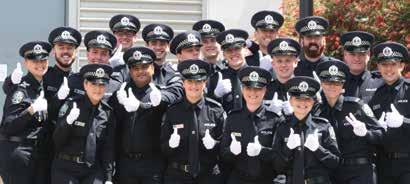

1. Graduates give the thumbs-up before the parade 2.
a speech on behalf of the graduates
6. The toss of the caps after dismissal
Paula Hammond 3. Lewis Nankivell 4. Caitlin Bennett 5. Sean Mayo delivers
7. Joe and Sarah Gavini
8. Joshua and Laena Hern with son Emaneul
9. Police Association president Mark Carroll with Academic Award winner Paula Hammond
Graduates march off the parade ground
POLICE ASSOCIATION OF SOUTH AUSTRALIA
GOING OVERSEAS? YOUR COVERAGE MAY BE AFFECTED
The group life insurance cover provided by the Police Association covers members 24 hours a day, seven days a week, regardless of the cause of death while members remain in Australia.
The insurer may specify certain geographical exclusions and restrictions on the coverage due to increased risk.
If members travel to areas of the world considered to be at increased risk, an increased insurance premium may apply or coverage may cease entirely.
Members who intend to go overseas for six months or longer, or who are travelling to or via a war zone are advised to contact the association beforehand to confirm whether or not coverage will be affected.
GOT SOMETHING TO SAY?
Got a comment about a story you’ve read? Do you have strong views on a police issue?
Is there someone you want to acknowledge? Know of an upcoming social or sports event? Whatever the subject, put it in a letter to the editor.
Regular mail Police Journal, PO Box 6032, Halifax St, Adelaide SA 5000
Email editor@pasa.asn.au
Fax (08) 8212 2002
Internal dispatch Police Journal 168
WORKING PART-TIME?
Are you currently working part-time? Are you commencing or ceasing part-time work?
If your hours change, it is important that you advise the Police Association. Your subscriptions may be affected. Please phone (08) 8112 7988 or e-mail membership@pasa.asn.au to advise of a change in hours.
CHANGE OF ADDRESS
The Police Association of South Australia needs your change- of-address details.
If you have moved, in either the recent or distant past, please let the association know your new address. Its office does not receive notification of changed addresses by any other means. The association will need your new address, full name, ID number, telephone numbers (home, work and/or mobile). Members can e-mail these details to the association on pasa@pasa.asn.au or send them by letter through dispatch (168).
GROUP LIFE INSURANCE BENEFICIARY NOMINATION FORMS
Owing to a Supreme Court decision, the Police Association no longer uses the GLI beneficiary forms. Existing forms held at the association have been destroyed. Now, in the case of the death of a member, the GLI benefit (currently $300,000) will be paid to his or her estate.
Accordingly, the association’s strong advice is that you ensure that your estate is well-administered. This is best achieved by having a valid will.
Tindall Gask Bentley Lawyers provides a free legal advice service to Police Association members and their families, and retired members. To make an appointment to receive free preliminary legal advice covering all areas of law, particularly families and wills, members should contact the Police Association (08 8212 3055).
Police Club High Tea and fashion parade







1. Models in Intimo swimwear
2. Models in Perri Cutten outfits
3. Amelia Mulcahy, Lee Scamell and Julie Douglas
4. Kath House and Jane McLaughlin
5. Sophie McVann, Julie Abraham and Jane Virgo
6. Jackie Freeman, Megan Edwards and Sarah Bachman
7. Model in Intimo lingerie
KERSTIN “KAZ”
WOJCIECHOWSKI
Detective Brevet Sergeant Special Crime Investigation Branch
Playback

STORY Uncovering the children’s horror ISSUE August 2011 POSITION Front cover AWARDS Single Article of the Year (Publishers Australia Excellence Awards)
Best Feature in Print (SA Press Club Awards)
THEN
She was an investigator with the Neglect Task Force when it broke open the House of Horrors case which, in 2008, shocked the entire nation. It involved the physical abuse of 21 children, five of whom had suffered starvation, beatings and, ultimately, torture.
“They were dirty and had bruises and contusions all over them, and they were just so skinny,” she told the Police Journal. “You could see every bone in their bodies. But the worst thing was their faces. They were dead inside.”

Uncovering the children’s horror
Of her post-shift reaction, Brett Williams wrote: “At home, Wojciechowski got into her shower and stayed under it for around an hour. The putridity of the Parafield Gardens house had seeped into her skin and clothes.”
NOW
“After the story came out, most people were just horrified that something like that could happen in this day and age. People were quite horrified as to the magnitude of the abuse. Anybody who knew me and knew that I did the job made comment on how horrific it was. I was still getting comments for quite a few months afterwards.
“I told the Police Journal my story because I thought if I got it out there it might help make a difference. One night I had a phone call from a sergeant friend of mine who said: ‘Can you speak to one of my investigators. We’ve got a mini House of Horrors.’ So I spoke to the investigator, and that still happens today.
“After doing the House of Horrors case I spent five-and-a-half years in child abuse with Elizabeth Family Violence. I stayed in it because I think it’s a very valuable area. Children are our future; and the abuse and neglect that’s out there is massive. And somebody needs to give children a voice.
“Now, seven years later, I still get images of the kids we found in a sofa bed. In the story I said they looked like something from the Holocaust and that the image of that would always stay with me. A job I’m working on or something on TV might spark it but I try to put it out of my head.
“There was a case of aggravated endangering life involving a little boy in Gilles Plains in 2013. Holden Hill CIB charged his parents and asked Danny Smalbil and me to consult with them. We discussed what they had, what they’d done and all the bases they needed to cover, which they did. It certainly brought back memories of the House of Horrors.
“Now, at Special Crime, the work is not wholly focussed on children but there is certainly a side of it which is to do with child exploitation. We do a lot of work with children and child protection, and a lot of those jobs fall my way. I enjoy being an investigator, and I’ve always had the passion to work on child-abuse matters.”
To read the story Uncovering the children’s horror, go to PASAweb at pasa.asn.au
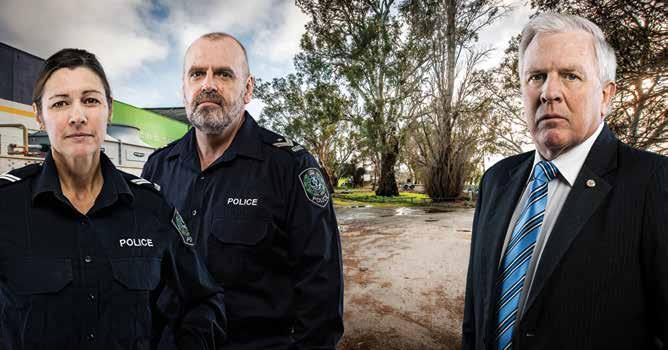




Police Journal
Winner of six international awards in the last two years
Gold for Best Single Issue (Tabbie Awards, USA, 2015)
Gold for Best Focus/Profile Article (Tabbie Awards, USA, 2015)
Gold for Front page (International Creative Media Awards, Germany, 2014)
Silver for Best Single Issue (Tabbie Awards, USA, 2014)
Silver for Cover and Cover Story (International Creative Media Awards, Germany, 2014)
Bronze for Opening Page or Spread (Tabbie Awards, USA, 2014)




The Members Buying Guide
Another exclusive money-saver the Police Association delivers its members. Save on homewares, groceries, wine, clothes, cars, restaurants, dry cleaning, photography, paint, accountancy services and more. Log onto PASAweb to find it.