
Carpathia

A mystical land in the heart of Europe. A mysterious mountain massif, hiding natural wonders and the rich diversity of nature. A place where, among peaceful valleys and shady forests, the East meets the West. Multiculturalism, authenticity, reverence towards nature, and a sense of grandeur these are the pillars of CARPATHIA, the flagship project of Euroregion Karpacki (Carpathian Euroregion the oldest and largest cross-border structure in the Carpathian Mountains). An innovative initiative to better integrate and enhance the tourist economies of this unique international region, CARPATHIA is home to territorial and thematic sub-brands, including UNESCO, CITIES, ACTIVE and CULTURE, that invite engagement from people across the globe. The mission of CARPATHIA is universal, but also intensely personal. The slogan, ‘Listen to yourself,’ proposes the opportunity for a spiritual transformation through contact with Carpathian spaces. The Low Beskids, Bardejov, Bukovina and Saris are just some of the key places where the CARPATHIA project interacts with the strong authenticity, richness and vibrancy of its inhabitants and landscapes. Together with the Carpathian Convention and partners from the Carpathian countries, we are creating a destination of global relevance. CARPATHIA the international mark of Carpathian quality calls explorers, tourists and investors to discover this inspiring region. See you here soon…
The CARPATHIA Team
Association of the Carpathian Euroregion 2 Kilińskiego Sq, 35-005 Rzeszów www.karpacki.pl

Funded by the National Freedom Institute – Centre for Civil Society Development within Civil Society Organisations Development Programme 2018–2030


Introducing Podkarpackie
Ethnic Cultures & UNESCO Sites

Located in the Carpathian Mountains, in the southeastern corner of Poland, Podkarpackie (Subcarpathia) is a region of great natural beauty and a unique melting pot of cultures, offering visitors scenic landscapes, outdoor activities, cultural treasures and colourful folk traditions. For centuries Slavic ethnic groups like the Lemkos, Boykos, Pogorzans, Dolinians and others thrived in this historical borderland, contributing to the region’s rich multicultural tapestry. Although distinct in their craftsmanship, cuisine, music, dress and other customs, these groups all suffered a similar 20thcentury fate that has greatly diminished their presence today.
Following 123 years under Austro-Hungarian rule, Podkarpackie found itself at a geopolitical crossroads in the wake of World War I, as Polish, Slovakian, Ukrainian and even Lemko national movements all vied for territory and sovereignty. Initially secured inside the Second Polish Republic, Podkarpackie found itself on two international borders when neighbouring territory became part of Soviet Ukraine after WWII. In 1947, Polish and Soviet authorities used alleged support for the Ukrainian Insurgent Army (a paramilitary group fighting for a free Ukraine) as justification for the expulsion of hundreds of thousands of people from both sides of the border, including the forced relocation of entire ethnic populations from Podkarpackie to the formerly-German territories now in western Poland.
Known as ‘Operation Vistula,’ the controversial campaign succeeded in ending hostilities, but also resulted in accusations of ethnic cleansing.
Despite this, today there are many places in Podkarpackie where these ethnic cultures have been preserved, and this In Your Pocket map one of four thematic Podkarpackie Region Maps - points you towards the most accessible and important sites, including six on the prestigious UNESCO list. Visit iyp.me/podkarpackie for more information about the area, and happy travels.
UNESCO World Heritage Sites
When it comes to Polish entries on the prestigious UNESCO World Heritage List, religious buildings loom large, particularly ancient wooden churches and tserkvas (Orthodox churches), which can be found throughout southeastern Poland and western Ukraine. Places of worship account for all six of the UNESCO sites found in Podkarpackie, though the actual number of stunning wooden churches throughout the region is over 100.
In addition to being beautiful, Podkarpackie’s wooden churches are inextricably linked to the Lemko and Boyko ethnic minorities, who inhabited this area for centuries, and whose descendents still do today. Here they gathered, prayed and also sought shelter from their adversaries. Sadly, many members of these communities were forcibly relocated after World War II, but their spirit and culture lived on, and many found ways to return to their homeland in the following decades. As it happens, the UNESCO list is not the only to laud Podkarpackie’s churches. You’ll find many more on the Wooden Architecture Route Szlak Architektury Drewnianej a tourist trail connecting hundreds of sites across Poland and Ukraine. These sites make easy diversions and are essential for any visitor interested in the rich heritage of the area.

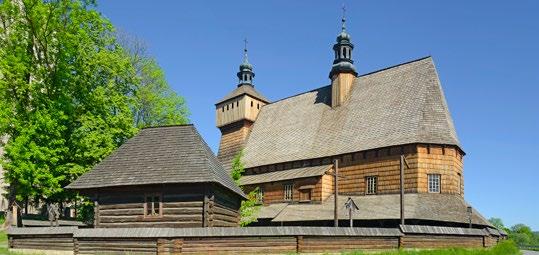
Haczów Parish Church of the Assumption of the Blessed Virgin Mary
Recognised as a UNESCO World Heritage site in 2003, this is the oldest and largest wooden Gothic church in Europe. First built in the 1450s or '60s, the wooden structure has stone foundations retaining the original truss-plank-bracket system and some structural elements still show medieval carpenters’ assembly markings; see if you can spot them. Excited scholars made a beeline for Haczów in 1955 when 15th-century wall paintings were uncovered here. The nave and chancel walls are stunningly decorated with figural and ornamental polychrome paintings dating from 1494 probably the oldest in Europe. Originally, Gothic paintings were also visible on the ceiling, but only fragments remain today. Inside visitors will also see many original church furnishings, including a late Gothic sculpture of the Holy Mother and Child, a 16th-century stone baptismal font, a 17th-century altar, and a copy of a Gothic Pietà from 1400 (the original of which is in the brick church next door). Guided tours are available if booked in advance.
Outside, in the square next to the church, lies a small wooden granary that is worth a look, and while you're there, make sure you see the 'silent memorial' barn mural by Arkadiusz Andrejkow only 100m away at Haczów 601; additional murals can also be seen nearby at Haczów 540 and Haczów 443.


© Archiwum parafialne Blizne (RAVA Studio Rafał Czepiński)
Blizne tel. (+48) 782 458 050, www.blizne.przemyska.pl
Blizne
Parish Church of All Saints & Surrounds
A fine example of regional wooden architecture from the late 15th century, this Roman Catholic Church, its rich interiors and surrounding buildings were added to the UNESCO List in 2003. The church featured a Gothic altarpiece from the early 1500s of which only a venerated figure of Madonna today survives; known as Our Lady of Blizne, the figure was actually being stored in the church attic until a local woman had a vision telling her to retrieve it from the parish priest and create a small shrine in the hollow of a linden tree. There the Madonna racked up miracles until the tree burned down and the figure was eventually returned to the church in the 1970s, where it can now be seen by visitors. The church boasts ample ornamental and figurative wall paintings from the 1500s, including a particularly well-preserved series showing the Passion of Christ, and the illusion of having a coffered ceiling. Guided tours are available if arranged in advance.
Originally the church in Blizne was surrounded by defensive walls, and in 1674 successfully repelled a Tatar invasion, as a nearby shrine upon St. Michael's Hill commemorates. Several other wooden buildings immediately outside the church form a small ethnographic park, including the vicar's house which predates 1699 and today holds the parish museum, the organist's house from 1866, and a 19th century granary.
© Adelina Krupski Turzańsk tel. (+48) 500 071 205
Turzańsk Greek Catholic Church of St. Michael the Archangel
Seamlessly integrated into the surrounding landscape of mountains and forests stands the charming Church of St. Michael the Archangel in Turzańsk. Added to the UNESCO list in 2013, its unique history and changing religious associations are directly entwined with the history of the Lemko people in the Beskids-Bieszczady mountains, who built it as a Greek Catholic church from 1801-1803. The architecture is typical of Lemko houses of worship, featuring a tripartite, elongated plan, and five spherical helmets crowning the main parts of the church. Inside, Lemko iconography is very evident in the polychromes by Josyf Bukowczyk, which depict Christ visiting a Lemko family, a Lemko sowing grain and other scenes. There is also a mountain landscape painted over the iconostasis.
Following the mass deportations of Lemkos after World War II, the church stayed in use, adopted by a Roman Catholic parish. When Lemkos returned to Turzańsk in 1963, they reclaimed the church and took up Eastern Orthodoxy in order to pray in their own language. Thanks to this small community, the church is still an active Lemko place of worship today.
Outside the church you'll find a three-storey wooden belltower from 1817 the tallest free-standing belfry in the Polish Carpathians, and a small cemetery a short distance away.
Pogórze Przemyskie Landscape Park Słonne Mountains Landscape Park Cisna-Wetlina Landscape Park San Valley Landscape Park Bieszczady National Park Jaśliska Landscape Park Czarnorzeki-Strzyżów Landscape Park Janów Forests Landscape Park South Roztocze Landscape Park Puszcza Solska Landscape Park
SLOVAKIA Lubelskie
Świetokrzyskie Małopolska Podkarpackie Podkarpackie Podkarpackie Podkarpackie Wisła Wisła Wisła San San San San San San A4 A4 A4 A4 LVIV KRAKÓW LUBLIN Paszczyna Przybówka Latoszyn Pysznica Trzcinica Jagiełła Grzęska Bażanówka Palikówka Korczyna Stubno Chotyniec Dzikowiec Laszki Polańczyk Solina Czarna Cierpisz Poręby Dymarskie Sokolniki Żupawa Wilcza Wola Przewrotne Niwiska Lutcza Kosowy Czermin Podgrodzie Wola Baranowska Wylewa Jasionów Iskrzynia Kąty Łęki Strzyżowskie Lubzina Krzątka Ruda Różaniecka Bojanów Handzlówka Kliszów Prusiek Trzęsówka Dąbie Łężany Torki Majdan Sieniawski Stobierna Basznia Dolna Radruż Stępina Rakszawa Humniska Wiśniowa Chorzelów Глиниці Gorzyce Tryńcza Trześń Cewków Grodzisko Dolne Tyrawa Wołoska Grębów Zaczernie Sarzyna Nowe Sioło Lisie Jamy Cmolas Wiśniowa Krzeszów Trzciana Urzejowice Krzemienica Żurawica Alfredówka Będziemyśl Kolbuszowa Górna Pakoszówka Czarna Górna Przychojec Podleszany Kłyżów Góra Motyczna Harasiuki Werynia Nowosielce Tuczempy Tarnawa Dolna Turbia Шегині Domatków Tuszów Narodowy Ocieka Wola Rusinowska Nagoszyn Kamionka-Kolonia Majdan Królewski Widełka Skrzyszów Zaleszany Wzdów Rogi Odrzykoń Trzebownisko Wola Zarczycka Jelna Wielkie Oczy Iwierzyce Trzciana Tarnowiec Wola Mała Miejsce Piastowe Medynia Głogowska Brzóza Królewska Kielanówka Stasiówka Jaszczew Nockowa Bratkowice Brzóza Stadnicka Grabownica Starzeńska Świerzowa Polska Młodów Klęczany Węgierka Żarnowa Jadachy Zmiennica Pustynia Czaszyn Szówsko Albigowa Rudna Wielka Pilchów Stary Dzików Wiązownica Żołynia Kozodrza Widacz Raniżów Ostrowy Tuszowskie Strażów Wola Mielecka Głowienka Posada Jaśliska Maleniska Wrzawy Pisarowce Iwonicz Nowy Żmigród Gać Wólka Niedźwiedzka Brzyska Wola Tuszyma Zręcin Nosówka Łętownia Mrowla Święcany Jarocin Jeżowe Cholewiana Góra Wróblik Szlachecki Świlcza Łukawiec Bircza Giedlarowa Niebieszczany Budy Łańcuckie Dąbrówki Węglówka Trześń Kuryłówka Rzędzianowice Posada Górna Medyka Frysztak Wólka Pełkińska Markowa Turze Pole Straszęcin Brzezówka Orzechówka Dębów Besko Zgłobień Jasionka Sadkowa Góra Nowosielec Trzeboś Adamówka Borowa Padew Narodowa Rzepedź Sandomierz Tomaszów Lubelski Koprzywnica Gorlice Zwierzyniec Frampol Краковець Krasnobród Szczucin Судова Вишня Oleśnica Staszów Рудки Pacanów Janów Lubelski Рава-Руська Klimontów Goraj Opatów Sabinov Giraltovce Мостиська Tarnogród Połaniec Добромиль Modliborzyce Svidník Biecz Stropkov Tyszowce Lubycza Królewska Medzilaborce Немирів Ryglice Bardejov Iwaniska Хирів Яворів Tuchów Biłgoraj Szczebrzeszyn Józefów Osiek Tarnów Zamość Narol Jasło Cieszanów Pilzno Sanok Nowa Dęba Sędziszów Małopolski Dynów Rymanów Radymno Rudnik nad Sanem Łańcut Nowa Sarzyna Sieniawa Leżajsk Radomyśl Wielki Brzozów Przecław Strzyżów Stalowa Wola Kolbuszowa Jarosław Ustrzyki Dolne Lubaczów Przeworsk Dukla Zaklików Głogów Małopolski Dębica Baranów Sandomierski Zagórz Nisko Ulanów Iwonicz-Zdrój Kańczuga Tyczyn Brzostek Błażowa Kołaczyce Boguchwała Pruchnik Sokołów Małopolski Lesko Jedlicze Mielec Dubiecko Ropczyce Нижанковичі Oleszyce Krosno Tarnobrzeg Przemyśl Rzeszów М-10 М-11 S19 S19 S19 @28 28 @ ?28 28 @77 @28 28 @ ?94 94 @ ?94 94 @77 @ ?77 77 @19 @ ?19 19 @19 @ ?19 19 @94 94 @9 9 @ ?94 94 @ ? @ ? @ ?94 94 @73 73 @28 28 @ ?28 28 @28 28 @ ?84 84 @28 28 @77 77 @ ?77 77 © OpenStreetMap contributors. Available under the Open Database License. Podkarpackie cm 4,9 km Scale 1:490 000 10 km 9 2 11 10 12 5 7 6 14 8 1 4 3 13 7 12 13 2 3 11 5 8 6 10 1 9 4 2
UKRAINE UKRAINE
Lubelskie
Publisher: IYP City Guides Sp. z o.o. Sp.k., ul. Karmelicka 46/51, 31-128 Kraków tel. +48 606 749 676, poland@inyourpocket.com, iyp.com.pl Cover photo: ‘Cichy Memoriał’ mural ©Arkadiusz Andrejkow All content copyright IYP City Guides Sp. z o.o Sp.k and its partners, and may not be reproduced without written consent. The brand name In Your Pocket is used under license from UAB In Your Pocket (Bernardinu 9-4, Vilnius, Lithuania tel. (+370-5) 212 29 76). UNESCO Sites Lemko Sites Boyko Sites Pogorzan Sites Dolinian Sites Regional Tastes 1
© Pecold stock.adobe.com Interior of the Church in Blizne, ©Rafał Czepiński Haczów 365 tel. (+48) 534 557 009, www.haczow.pl 3
Podkarpackie Region Map Ethnic Cultures & UNESCO Sites
Smolnik Greek Catholic Church of St. Michael the Archangel
Formerly Eastern Orthodox, today the church in Smolnik is Roman Catholic and known as the Church of the Assumption of the Blessed Virgin Mary. It was built in 1791 on the site of several previous churches, the first presumably dating back to 1530, which were destroyed by fire, flooding or Tatar invaders.
One of only four such buildings surviving today, the church comprises an archaic style of construction used by the Boyko ethnic group.
Unfortunately, in 1951 the local Boyko community was forcibly relocated, their houses dismantled and the abandoned tserkva used as hay storage.
The church dome and walls were whitewashed at this time, sadly destroying the original wall paintings. Many furnishings were also lost, though some are preserved in the Łańcut Icon Repository.
Although many of the interiors were compromised, faithful restoration works were undertaken here in 1969-73 using only traditional, manual methods, meaning no mechanical tools. Upon completion, religious functions returned to the building, this time under Roman Catholicism.
The tserkva was renovated again in 2004-05 and added to the UNESCO list in 2013. Next to the tserkva, amidst mature trees, lies a cemetery. Guided tours are available in Polish but booking ahead is recommended.
The Lemkos
Forging their unique identity and culture over many centuries, the Lemkos Łemkowie) are a Carpathian subethnic group who probably settled in the areas of southeastern Poland around the 16th century, busying themselves with animal husbandry, farming, woodworking and masonry. Podkarpackie was inhabited by Lemkos for over four centuries before these communities were forcibly removed from their lands after World War II. Despite this, traces of their vibrant heritage and cultural influence can still be seen and felt across the region, particularly at their surviving homesteads and places of worship. The Museum of Lemko Culture in Zyndranowa is an ideal place to see their dwellings and imagine how these communties lived before the wars.
Lemko identity is rooted in their religion (predominantly Eastern Orthodox), unique language (variably described as its own Slavic language, or a dialect blurring Ukrainian, Slovakian and Polish) and cultural traditions, which are slowly being revived throughout Podkarpackie, but also Upper Silesia - the region of Poland with the next-highest Lemko population (a result of postwar resettlements). The Lemko language is increasingly taught in Polish schools, and the number of people declaring Lemko nationality is on the rise; some estimates put the number of ethnic Lemkos in Poland today as high as 60,000. People of Lemko descent who have achieved international renown include jazz pianist Bill Evans, comic book artist and Spider-Man co-creator Steve Ditko, and pop artist Andy Warhol (birth name Andrew Warhola).
The Boykos
The Boykos Bojkowie are a Ruthenian ethnographic group, descended from East Slavic tribes, who lived across a wide area of the Carpathian Mountains from Wysoki Dział in the Bieszczady Mountains (in the west) to the Łomnica Valley in Gorgany, Ukraine (in the east) for 500 years. That included a significant community in Podkarpackie until the forced resettlements carried out by the government during 'Operation Vistula' in 1947. Boykos share the same religious affiliation as the Lemkos (mostly the Ukrainian Greek Catholic or Orthodox Church) and in Podkarpackie you can visit some of their distinctive wooden churches, such as the ones in Rosolin and Grąziowa (near Ustrzyki Dolne). Boykos also speak a dialect of the Rusyn language, but one distinct from their Lemko neighbours. Their dress, folk architecture and customs also differ from the Lemkos, and their population numbers today are also much more diminutive by comparison (not reaching 500 people in any country). The Ukrainian poet, writer and statesman Ivan Franko is likely history's most well-known Boyko descendent.

A hardy people who once lead herds of livestock through mountain pastures filled with wildflowers, today Boyko culture is being rediscovered. Traces of old huts, churches, cemeteries and other evidence of settlements - some of it taken over by nature long ago can be found in some of Podkarpackie's most rugged and romantic territory. For a more in-depth view of Boyko history and culture, a visit to the Boyko Culture Museum in Myczków is highly recommended.
The Pogorzans
The Pogorzans (Pogórzanie) also known as Polish Uplanders, are an ethnic group of Poles living in the Beskid Ranges of Podkarpackie and Małopolska. Their unique community developed due to a cultural mix of Polish and German settlers, the former arriving in the 10th-13th centuries and the latter, smaller group brought in during the 14th century to curb the influx of the neighbouring Ruthenians, who also had an influence on the Pogorzans. In contrast to other ethnic groups of the region, the Pogorzans speak a dialect of the Polish language and practice Roman Catholicism. Historical wooden churches associated with the Pogorzans can be seen in Sękowa (Małopolska), Binarowa (Małopolska) and Haczów (pin 2)all three are inscribed on the UNESCO list. Due historical differences in construction methods, interior design, dress and economy, Pogorzans are divided typically into two groups Western and Eastern - with the conventional border between them being the Jasiołka and Wisłoka rivers. Traditionally the Pogorzans have been weavers and farmers, raising livestock and crops like flax, rye, wheat, oats and barley, but they were also instrumental in the development of the oil industry in the 19th century. In 1854, the world's first oil mine was established in Bóbrka, near Krosno, and Pogorzan territory became the cradle of the early oil industry, vastly altering their lifestyle, economic and living standards, and also causing the disappearance of many folk traditions. With the decline of the local oil industry, many Pogorzans today work in the agrotourism and hospitality sectors.
The Dolinians
One of the lesser-known ethnic groups from Podkarpackie are the Dolinians (Dolinianie). Researchers explain that this could be due to the proximity of their settlements to larger cities, resulting in their urbanisation by 1939. Another factor is that many historical records and cultural artefacts of their communities were lost during and after World War II. Thanks to the determination of ethnographers, however, a clearer picture of this enigmatic group has emerged in recent years.
The Dolinians were descendants of the 14th and 15th century Poles, Germans and Ruthenians who settled in the fertile San River valley. The intermingling of these three societies over generations led to a unique new fusion of cultural traditions, rituals and beliefs. Their faith was linked to the Roman and Greek Catholic churches, and they spoke a regional Polish dialect.

The name 'Dolinianie' indicates that they were valley-dwellers, with their villages primarily located along rivers. As a result they excelled at cultivating cereal crops, potatoes and turnips in the rich soil. Their cuisine has always been rich in vegetables which they sold at urban markets. They also raised cows, pigs, horses, chickens etc. for their own domestic use. Unique rituals of the Dolinians involved baptisms where the child was dressed in the feathers of the eiderdown from the mother’s wedding night, and brides going from door to door of those villagers who were not invited to the wedding ceremony to ask for their blessing and forgiveness!
Proziaki (Sodabreads)
These flat soda bread rolls are a local delicacy. For the most authentic and theatrical experience check out Manufaktura Domowa Piekarnia Spiżarnia on the Przemyśl Market Square and see how it was done back in the day.

Try it here:
Manufaktura Domowa Piekarnia Spizarnia Rynek 6, Przemyśl Proziakownia Rynek 22, Sanok
Fuczki (Sauerkraut Pancakes)
Like potato pancakes but with pickled cabbage added to the dough, this savoury dish tastes much better than it sounds. There are a lot of variations, but seek out the ones with garlic sauce.

Try it here:
Restauracja Dominikańska Plac Dominikański 3, Przemyśl Stodoła Bistro Glinne 64
Gołąbki Przemyskie (Cabbage Rolls)

A variation on the Polish staple of seasoned meat and rice wrapped in a steamed cabbage leaf, in Podkarpackie the meat/rice filling is replaced with mashed potatoes, making this a winner for vegetarians.
Try it here:
Cuda Wianki Rynek 5, Przemyśl Karczma w Młynie ul. Fabryczna 12, Ustrzyki Dolne
Hreczanyki (Meatballs)

Podkarpackie-style meatballs of minced pork mixed with buckwheat, these little round morsels are best enjoyed when they come slathered in creamy dill sauce.
Try it here:
6
Chotyniec
Chotyniec Greek Catholic Church of the Nativity of the Most Holy Mother of God
One of the oldest and finest examples of wooden religious architecture in Poland, the tserkva in Chotyniec was first built around 1600. After the deportation of the local population in the 1940s, it was briefly used as a Roman Catholic church before being abandoned and falling into disrepair. After the Greek Catholic Church regained the right to function, the tserkva was eventually returned to the faithful in 1990 and is one of the few in use today. In 2013 it was added to the UNESCO list.
A rare example of a tserkva with a gallery running along the perimeter of its interior chapel, the church also features a unique external gallery above the skirt roof of the old chapel. There are two entrances, one on the south side, and another on the western side via a vestibule which was added later and disrupts the overall harmony of the original design.
The interiors have mostly been preserved and include a fascinating polychrome from 1735 of the Last Judgement - complete with winged demons which covers almost the entire southern wall of the nave. The iconostasis from the 1600s has been renovated and includes prominent icons of the Holy Mother and St. Nicholas. Though the original belfry was destroyed, a 17th century example from the village of Torki was moved here. The perfect time to get a church tour is after Sunday Mass (11:00-12:00).
Zyndranowa 1 tel. (+48) 13 4330712, www.zyndranowa.org
Museum of Lemko Culture in Zyndranowa
Founded in 1968, this open-air ethnographic museum collects and showcases Lemko homesteads from the late 1800s. Here you can view traditional clothes and everyday objects, agricultural tools and old furniture pertaining to Lemko heritage and culture. One room has a display of religious artefacts, including parts of cast iron crucifixes, liturgical garments and replicas of icons. There are also exhibits connected with the WWII Battle of the Dukla Pass that took place near here: military uniforms, helmets, weapons and shrapnel shells.

The original founder of this museum was Teodor (Fedor) Gocz, who in the 1950s with his great-grandfather, Teodor Kukieła, undertook efforts to protect the heritage of the Lemkos who had been expelled from Zyndranowa after the war. Although he avoided deportation as part of 'Operation Vistula', he was repressed for his noble activities. The museum is the result of his efforts to salvage fragments of Lemko culture from these brutal times. Currently, the museum is run by the Society for the Development of Lemko Culture Museum in Zyndranowa, and its activities, after Teodor Gocz's death in 2018, are managed by his son, Bogdan. For the past 30 years the museum has hosted the Festival of Lemko Traditions at the Borderland of Cultures called 'Od Rusal do Jana'. The museum can be reached along the green trail leading from Barwinek towards Stasiana and the Hermitage of Jan of Dukla.
Myczków 46 tel. (+48) 13 463 15 69, www.muzeumbojkow.pl ul. Rybickiego 3, Sanok tel. (+48) 13 463 16 72, www.skansen.mblsanok.pl
Museum of Boyko Culture in Myczków
This unique museum gives a fine overview of the history, lives and customs of the Boykos (Bojkowie) ethnic highlanders who lived across this region for five centuries before their expulsion in 1947. It was created on the initiative of local history teacher Stanisław Drozd, who began privately collecting paraphernalia related to Boyko culture (the culture of his ancestors) in the 1970s, in order to preserve the fading memories and legacy of these people.
Among the museum's extensive displays are old agricultural tools, household items, handicrafts, furniture, dishes, traditional fabrics, clothing made of linen or hemp canvas, as well as festive garments skilfully decorated with cross-stitch embroidery. There are also liturgical vessels from the former Orthodox churches, as well as crosses and fragments of iconostasis. Priceless documents, photographs, messages and manuscripts are plentiful.
In the basement of the museum is a gallery of works by local artisans, and there's also a little café where you can sip traditional Boyko coffee in fine surroundings. The museum is located on the green trail and is well worth an afternoon for anyone interested in the history and heritage of the Bieszczady Mountains. For an additional fee, a guide can be organised; group tours can be arranged if you call in advance.
Museum of Folk Architecture in Sanok

Sanok's open-air ethnographic museum (skansen) is the largest such folk park in Poland and the second-largest in Europe at 38 hectares. Over 150 wooden structures dating from the 17th to 20th century have been collected here, preserving important heritage sites and cultural treasures that may otherwise have been lost. They include everything from rustic residential dwellings, sacred buildings, barns, roadside shrines, schools, taverns, fire stations, mills, even beehives, and most recently a replica of a 18th-century wooden synagogue from Połaniec.
Established in 1958, the park was first opened in 1966 and has grown ever since. Close attention is paid to the layout of the objects, which are divided into ethnographic sectors, creating the effect of passing through separate Lemko, Boyko, Pogorzan and Dolinian villages, as well as a Galician marketplace. As such, it's an incredible place to visit for anyone interested in any of Podkarpackie's ethnic cultures, or Polish folk traditions from bygone days. Visitors are able to stroll freely around the vast area of the museum and even enter many of the structures, which are filled with further artefacts and period furnishings. Extensive exhibits of folk attire and religious iconography can also be seen here, and they also organise workshops and special events like antique markets; there's even a traditional bakery where you can get a bite to eat. Guided tours can also be pre-arranged in various languages.
ul. Klasztorna 32,
Monastery of Discalced Carmelites in Zagórz

The Monastery of the Discalced Carmelites and its complex in Zagórz comprise an area of 1.75 hectares. The remnants of this late Baroque church and monastery, dating from the 1700s, are a rare example of a Polish fortified monastery. The evocative complex was built during the times of the former Polish-Lithuanian Commonwealth to defend the area against the marauding Swedes, and covers an area of 1.75 hectares. Instead, it became the site of the last battle of the Bar Confederation and was destroyed by the Russian Army during the siege.
Although essentially a ruin today, its location atop Mariemont Hill affords great views of the Osława River valley below, and some wonderful photo opportunities for fans of crumbled grandeur. Interestingly, Karol Wojtyła
- soon to be Pope John Paul II - visited the ruins while tramping about in the Bieszczady hills in 1957; this event is commemorated with a plaque. In recent years, the Way of the Cross has been organised amidst the ruins during Lent. The ruins are also the backdrop to the popular novel, Pan Samochodzik & the Zagórz Monastery
In the adjacent Foresterium Culture Centre, you can check out the ruins through virtual reality glasses while getting a multimedia rundown of the site's history. Entrance to the ruins is 5zł. Foresterium tours are 20zł and begin every 30mins. Call ahead for foreign language guides.

8
Restauracja Dominikańska Plac Dominikański 3, Przemyśl Karczma w Młynie ul. Fabryczna 12, Ustrzyki Dolne
Pstrąg (Trout)
Straight from Podkarpackie's numerous freshwater reservoirs, whether baked, grilled, smoked or pan-fried, trout is typically served whole and filled with herb butter. Sublime.

Try it here:
7
Karczma Solina Solina 38A
Wędzarnia Smażalnia Pstrąga 'Regionalny Przysmak' ul. Zdrojowa, Polańczyk
Bałabuch (Savoury Pastry)

A bałabuch (sometimes 'bałabuszek') is a buttery, onion seed-encrusted roll filled with potatoes, cabbage (our prefered choice) or buckwheat groats. Accompanied by a dollop of sour cream and a mug of barszcz (beetroot soup), it doesn't get much better when it comes to a light, savoury meal.
Try it here:
Cuda Wianki Rynek 5, Przemyśl
Regional Products
Podkarpackie has a bountiful array of locallyproduced goods and products - from honey, jams and small batch alcohols to ceramics and natural cosmetics that make lovely gifts or mementoes. As you travel the region, try to support small local businesses any time you can.


9
6
Radruż 13 tel. (+48) 606 357 108, www.muzeumkresow.eu
Radruż Orthodox Church of St. Paraskeva
One of the oldest wooden Eastern Orthodox churches in Poland, the sublime 16th-century tserkva in Radruż is steeped in myth and history.


While primarily a place of worship, it also provided a defensive function and is surrounded by a stone wall from 1825. According to legend, traces of Tatar axe blows can still be seen on the door.
Strikingly, in the nave and the chancel, the original figural and ornamental polychrome decorations have survived. Figural paintings can be seen arranged in three tall horizontal rows separated with ornamental friezes.
They depict various prophets, Biblical scenes and Church fathers, as well as a Mandylion supported by two angels. Original altars from the tserkva's rebuilding in the 1700s have also been preserved.
Located just metres from the Ukrainian border, the local population of the area was forcefully expelled after World War II and the site was not used for many years thereafter. Between 1963-1965 the building was completely restored, and during the conservation eight ‘shilling’ coins of King John Casimir from 1665 were found. In 2013, the church was entered onto the UNESCO World Heritage List, and the interiors can be visited on guided tours (Polish-only, arrange in advance for English). The complex includes a wooden belltower, two stone outbuildings and two historic cemeteries.
Komańcza 180 www.andrejkow.pl
'Lemko girls from Komańcza' mural

The sad forlorn faces of Arkadiusz Andrejkow's haunting mural 'The Lemko girls from Komańcza' will stay with the viewer for some time. Based off of archival photographs of the families that once populated this region, this is one of over 100 such murals the artist has done around Podkarpackie in honour of the area's 'disappeared.'
The project began in 2017 when Andrejkow born in Sanok in 1985 and a graduate of the Faculty of Art at the University in Rzeszów - received a scholarship from the Minister of Culture and National Heritage for the implementation of the ‘Silent Memorial’ (Cichy Memoriał) project Known locally as 'deskale,' Andrejkow's murals are most often found on old barns and applied directly onto the wood in gray and brown tones, blending hauntingly into the environment. While exploring the region it is almost impossible to not encounter these evocative works of art, in fact you may find them inescapable.
This particular work (shown above), is one of two such murals in Komańcza and is based off of a photograph by Roman Reinfuss from the 1930s. A map of all of Andrejkow's art installations around Podkarpackie can be found on his website, where you can also order a copy of the 'Cichy Memoriał' album - filled with beautiful photographs of over 100 murals and support the artist directly.
Farmhouse 'Bieszczadzka Koza'
Organic goat cheese and lots of it! This family-owned enterprise is run by Aleksandra and Miłosz who, like so many other romantics, left it all behind elsewhere and moved to Bieszczady to be closer to nature and a simpler, more traditional way of life. Buying a farm, they first thought they would be focused on crop-growing, but a change in subsidy laws led to their decision to raise and breed animals. Today the herd consists of over 200 female goats of Alpine and Carpathian breeds. Goats graze 'almost in the wild,' walking in the surrounding meadows and, yes, 'goats grazing on the meadows give superb milk.' Who'd have thought?
Milking takes place every day, producing approx. 200 litres of milk. For the production of cheese, only 'live,' unpasteurised milk is used. The only technological addition is lactic acid, and local natural herbs (wild garlic, lavender, hot peppers, pepper, fenugreek) are added to flavour various products. You simply have to try some, and you can by dropping by their farm store. Among the great variety of products you'll find jars of goat cheese balls in rich olive oil with wild garlic, sliced cheese cubes with herbs and hot peppers, jams and preserves and more. It's all delicious and worth weighing down the boot of your vehicle with. The farm is reached by a road which ends at the church in Smolnik, making this a great stop after you've seen the UNESCO-listed village church (pin 4). Beware! Goats crossing!
Krosno is the largest glass and glass fibre production centre in Europe, with a tradition of glass-blowing going back over five centuries. Modern production began in the interwar period, and attractive salaries at the new Krosno glassworks brought in specialists from all over Poland, including the Lower Silesia region, where the production of glass had been prolific since the Middle Ages. They, in turn passed on their knowledge to local apprentices, creating future generations of highlyskilled glass workers. Soon Krosno glass was winning international awards on its way to the worldwide renown which it retains today.
This modern, interactive facility was opened in 2012 and presents the history and achievements of Krosno's glassmaking tradition via exhibits, demonstrations, workshops, galleries and (of course) a large shop full of extraordinary and beautiful objects you can take home. The 2-hour tour begins in the glass workshop where you can not only observe the process of glassblowing, but have a turn at the pipe yourself. Next are the decoration workshops where artists explain how to design and make stained glass, and you can try your own hand at engraving on glass. Hundreds of glass items made in the region are also on display and temporary exhibition spaces present the work of some of the best international artists in the field, as well as other thematic exhibits. Certainly one of the best attractions in the area.
Uherce Mineralne 137 tel. (+48) 570 770 135, www. ginacezawody.pl
Bieszczady School of Crafts
This early 20th-century schoolhouse is today a place where visitors can learn about the old trades and craft traditions of the region, and try their own skills at some disappearing arts and techniques. Basically an interactive, hands-on museum, start in the attic once the teacher's apartment, now a modern audiovisual classroom that transports viewers back in time with a presentation about the ways of working by hand in days gone by. Then participate in one of several workshops where you can learn how to use a pottery wheel and make your own ceramics, write a letter in prewar style using a calligraphy pen and inkpot, or make traditional proziaki a regional sodabread from scratch and bake it in a rural oven. Best of all, everything you create goes home with you (if you don't eat it first). With over 400m2, each workshop takes place in a separate part of the building, set up in the style of an early-20th century office, pottery, schoolhouse and bakery, and furnished with period relics. The building also boasts a large and intricate mural on the outside, don't miss it. Lastly, you can also pick out some lovely hand-made ceramic souvenirs from their gift shop - most of which have been created lovingly onsite.
Check online to see their schedule and make reservations; 1hr workshops 40zł/person, 2hrs 60zł/person. Contact them in advance to arrange workshops in English.
Manufaktura Nalewek ul. Czajkowskiego 55, Krosno Bieszczadzkie Smaki Smolnik 9

Ursa Maior Brewery
This small, locally-owned and operated brewery in Bieszczady is surely one of the coolest places in the region and worth dropping in for a visit to their bar and shop. Priding themselves on their commitment to the environment and local community, they offer not only great beers, but also regional snacks and a range of local products. Tours of the brewing process can also be arranged (prebooking required).
11
Uherce Mineralne 122A

Wineries & Enotourism

Thanks to a warming climate and improving conditions for grape cultivation, winemaking has begun to flourish across Podkarpackie and much of southern Poland. What's more, many small local wineries in the region offer tours and tastings in English.

Widokowa Winery Kombornia 802B
Stecki Family Winery Węgierka 99A

5 7 8 9 11 13 14 12 10
Glass Heritage Centre Krosno
© Bohdan Tchórz
© Museum of Lemko Culture
© Adelina Krupski
© Arkadiusz Andrejkow
© Museum of Boyko Culture © sitriel stock.adobe.com
© Adelina Krupski
© Glass Heritage Centre Krosno
Lemko folk motif Traditional Boyko folk attire. © Museum of Boyko Culture 19th-century Pogorzan roadside shrine. © Museum of Folk Architecture Dolinianie shrine, 1924. © Museum of Folk Architecture
© Bieszczadzka Koza
tel. (+48) 505 003 609
Zagórz www.klasztorzagorz.pl
ul. Blich 2, Krosno tel. (+48) 13 44 400 31, www.miastoszkla.pl
Smolnik 25, tel. (+48) 509 507 357, www.etno.visitcarpathia.com/ gospodarstwo-bieszczadzka-koza
© Bohdan Tchórz
4
tel. (+48)
© Wacław Zygarowicz
Smolnik
13 461 03 40
1 5
12
5
3
3 2 6 13
4
10