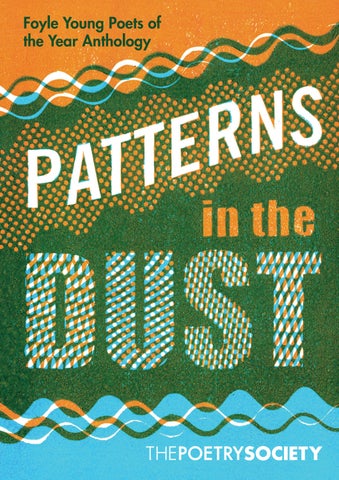
Foyle Young Poets of the Year Anthology
‘Winning this award feels surreal. I never expected my poem to reach beyond my notebook, so this recognition means the world.’
– Nikki (Nakshatra) Kothapalli, top 15 winner, Foyle Young Poets of the Year Award 2025
Foyle Young Poets of the Year Anthology
The Poetry Society 22 Betterton Street London WC2H 9BX poetrysociety.org.uk
Cover: James Brown, jamesbrown.info
ISBN: 978 1 911046 64 6
© The Poetry Society and authors, 2026
The title of this anthology, Patterns in the Dust, is taken from Anna Rechel’s commended poem ‘Instrument of Heaven’.
This anthology is available in a range of accessible formats.
Please don’t hesitate to contact us at fyp@poetrysociety.org.uk
Introduction
‘These are poets who are not just developing their art early but – as with poets of any age and place – seeing clearly and writing truly. Under their gaze, a complex world is made brutally simple, and simple truths shatter into complexity. I can’t wait to see how these brilliant writers continue to transform our world.’
– Will Harris, Judge of the Foyle Young Poets of the Year Award 2025
The Foyle Young Poets of the Year Award has been finding, celebrating and supporting the very best young poets from around the world since 1998. Founded and run by The Poetry Society, the award has been supported by the Foyle Foundation since 2001 and is firmly established as the key competition for young poets aged 11 to 17.
In 2025, we received a record-shattering 28,000 poems from over 10,900 poets from 135 countries. 15 top poets and 85 commended poets were selected by judges Colette Bryce and Will Harris; together, these 100 winners showcase some of the most exciting young voices today. Reflecting on the judging experience, Will said: ‘It was a joy to read through thousands of poems of wonder, mourning, rage, silliness, longing, invention, and humour, and pick out a hundred poems which, in combining some (or all) of those qualities, stayed with us.’ Colette commented: ‘The boxes loomed like Easter Island statues on my kitchen table. I put my ear to the cardboard and imagined the murmur of hundreds of voices talking within. This isn’t as fanciful a notion as it seems: our silent reading of a poem on the page involves an inner speaking of its voice – a magical connection between writer and reader that makes poetry such an intimate art form. I’m encouraged for the future of our ancient and ever-changing art, and amazed by the confidence, humour, invention, curiosity, and sheer intelligence on display. It’s an honour to bring a selection of these poems to a wider audience and I commend everyone who entrusted us with their writing.’
This anthology contains the top 15 winning poems and celebrates the names of the 85 commended poets. A sister anthology, collecting the commended poems, is freely available to read online (alongside a wide selection of anthologies from previous years of the competition and accompanying teaching resources). All of the poems were written by poets aged 11 to 17. Both anthologies demonstrate a breathtaking array of talent that promises to inspire poetry lovers everywhere.
The poems in this anthology are wide-ranging in their concern about the faultlines of the world we live in. They write with emotional acuity and wry humour about topics that range from the loss of a friend to the looming possibilities of war. They regard the changing self through mythmaking and turn a surreal gaze on life and art alike. The moon is a recurring motif, as are questions of language and its complexities. They do not shy away from naming violences – in the school, in the street and the wider world.
You might find some of the poems difficult to read. We have added content warnings to three poems, signposted at the top of the pages in question and on the Contents page. We recommend younger readers ask a trusted adult to look at the poems before reading them alone. We have versions of our commended anthology available for younger and older readers online.
The title of this anthology, Patterns in the Dust, is taken from commended poet Anna Rechel’s poem ‘Instrument of Heaven’ (available online). Here, an old cello case transforms into a Pandora’s box under the speaker’s curious gaze. The poem extends an invitation to step into the unknown, much like all the poems in this anthology. We hope these poems inspire more young people to write, to share their work and enter the competition.
Foyle Young Poets of the Year 2025
Top 15 Winners
Eleni Barrett · Rebecca Cai · Kai Campagnac · Amira Cheung Simhani · Asha
Chib-Lewis · Nathan Graham · Aanya Jain · Jannath · Hayden Kennedy ·
Nikki (Nakshatra) Kothapalli · Silas Mitchell · Zahra Noorul Sahr Hasan ·
Ellanya Sivasubramaniam · Nhuomachim Umo-Chinda · Bea Unwin
Commended Poets
Tawhida Aalifa · Avy Abdulrazzaq · William Aishman · Zara Amjad · Zaara
Arif · Zonaira Arora · Florence Ashton · Vivienne Bach Stewart · Abigail
Bailey · Amelia Balliu · Eleesa Banjoko · Khadija Bashir · Juno Blake ·
Eleanor Bowden · Chloe Cam · Clara Capgras · Juliet Capgras · Saskia
Carter · Jennifer Choi · Alice Coombs · Eden Craig · Florence Datta · Kaviya
Dhir · Andrea Domingo · Georgina Fry · Eve G · Yashita Ghate · Emma
Gillbanks · Bonnie Gillow · Ria Goodwin · Georgina Griggs · Georgina
Hudson · Brooke Hurry · Amna Husain · Maisie Jane Mair · Nikola
Jastrzebska · Amy Jia · Gabrielle Jiarui Dai · Mia Johnson · Elizabeth Kane
· Monisha Kerai · Gabe Kirkham Joseph · Alaw Lawrie · Amelia Lawson ·
Max LeMaitre · Julia Liu · Sophia Liu · Zihan Liu · Evie Lockwood · Vania
Madan · Phoebe McGhee · Ellen McPetrie · Isobel Millington · Aaliyah
Muili · Iasmine Nic a’ Ghobhainn · Chidu Hillary Okoroigwe · Imogen
Oscroft · Felix Ospino Archer · Evie Parker Hornsby · Ronnie Parsons · Taylor Pickthorn · Anwita D. Pillai · Aadit Rana · Anabelle Rayner · Anna
Rechel · Nerys Schmetterling · Adelaide Sendlenski · Aine Shafiq · Mahek
Shah · Uma Shukla · Youngjae Sim · Chiara Stuttard · Khoi Tran · Ena
Umpleby · Sharuni Vasa · Neena Vincent · Ernest Wakeford · Katie Walker
· Maleeya Watts · Niamh Whelan · Zak Wilson · Katoog van Woestyn ·
Senoli Yunaya Jayasekara · Allison Zhang · Yu Ziyao
Ellanya Sivasubramaniam
The Girls Who Grow Antlers
In late August, three girls in school sprout antlers. Not metaphor. Bone.
First, a bud like a bruise above the brow.
Then branching – silent, slow, like trees deciding where to reach. By September, they wear them like crowns no one asked for.
We pretend not to notice how they duck through doorways, how their sweaters fray where the velvet snags. The teachers hold meetings. The nurse takes photos ‘for records.’ One girl stops coming.
Another tries to saw hers off with a bread knife. Leaves Maths early, blood blooming through her fringe like another kind of signal.
One lets them grow wild. Loops fairy lights through the tips in winter. Laughs when they call her stag.
No one speaks of how it started. Or if it hurts. But in the toilets, we check our foreheads like clocks, press our fingers to skin for the start of something sharp.
Bea Unwin
Conversations in Bread-Breaking
Know that something is changing. Know that your body is less likely than ever to rip in the wind, fragile as tissue, and above all that is a good thing. Know that all of your haircuts and braids down your back taught you the art of loss like a dance. The oil hisses and winks at you from the pan – an eye for an eye, the slack gaze of a mackerel’s head scaled rough between your leatherskin thumbs. Now, in this sharing of teeth, you may split yourself from your sorrow. The bread fits on your tongue like a stormcloud, swelling. You are moth-winged & pigeon-toed: a hungry thing, sharply inelegant. You have taught yourself how to wait. And now you crave it, don’t you? The mouth-feel. Go on. Eat up, the whole lot.
Eleni Barrett th glsh lngwij
& still it don’t sit right –like old chairs or verbs that bend. gnashlish.
forked tongue, soft schn of schnapps,
flat a of class,
slipped l of yolk.
i learnt it in pieces: chalkdust, throatspill,
psalm, sitcom, vowelbone, keyboard.
it slurs.
no case, no crown, no lace on endings.
a streettalk queen, pockets tongues like coins from dead empires.
∀nd wé spêll in ghostsknightlightwrightwrong,
g-r-i-e-f, where the i sounds like silence. somewhere between ache & echo it makes a sentence: “belovèd” (pronounced without breathing).
it means: i try.
it means: you left.
you hear me? not yet. but listen –
there’s a word in its mouth
& it’s almost
mine.
Asha Chib-Lewis
On surrealism
He spent every day fishing wearing suit and tie, he cast the line from the edge of a skyscraper. The sunset shouted the sky into a modern renaissance painting but he did not know he was at the centre. He forgot to bait the line, drew it up, attached a prayer his mother taught him, forgot the words, threw down the line. He hummed a tune. He was wearing odd socks, paired rainbow stripes with polka dots, one of his shoes grew bigger and bigger and fell off into the abyss. That was Imperial Leather. His watch melted onto his wrist; He sighed, a moth spluttered into the dusk. He drew up the line. He had caught a bicycle. He captured and crushed the moth. He rode the bicycle to work.
This is an exam Analyse this poem – you have 45 minutes. Your time starts now.
Nhuomachim Umo-Chinda
A Semiotic Deconstruction of Blue in Static Form
‘It’s a wave,’ she says. I nod. ‘A wave,’ she says, ‘that is crashing down.’ It might be a wave, so I nod. ‘What,’ I ask, ‘is it crashing down on?’ ‘An island,’ she says. She nods; I nod; we both nod. ‘Where,’ I ask, ‘is the island then?’ ‘Not in the painting,’ she says. ‘Not in the painting,’ I say. She nods; I nod; we both nod.
The woman leaves. A man joins me. ‘It’s the sky,’ he says. I nod. ‘The sky,’ he says, ‘when there are no clouds.’ It might be the sky, so I nod. ‘Is it British sky,’ I ask, ‘if the weather is this nice?’ ‘It’s Dubai,’ he says. He nods; I nod; we both nod. ‘Where,’ I ask, ‘is the sun then?’ ‘Not in the painting,’ he says. ‘Not in the painting,’ I say. He nods; I nod; we both nod.
The man leaves. A dog joins me. ‘Woof,’ it says. I nod. ‘Woof,’ it says, ‘bark bark woof woof rawr.’ It might be a woof, so I nod. ‘Why,’ I ask, ‘is the woof a thing and not a sound?’ ‘Bark rawr,’ it says. It nods; I nod; we both nod. ‘Where,’ I ask, ‘is the dog that is making the woof then?’ ‘Woof woof,’ it says. ‘Not in the painting,’ I say. It nods; I nod; we both nod.
The man comes to pick up his dog. The woman comes to pick up her husband. They nod; I nod; we both nod. ‘What,’ they ask. ‘do you think it is?’ ‘It’s blue,’ I say. They nod. ‘That’s it,’ I say. I think they thought that might be it, because they nodded. ‘Do you like the painting?’ they asked. ‘No,’ I say, ‘I can’t see the point in it.’ ‘Where,’ they ask, ‘is the point then?’ ‘Not in the painting,’ I say. ‘Not in the painting,’ they say. They nod; I nod; we all nod.
Amira Cheung Simhani
Why the sky never closed behind her
the last time
she touched my hair
the wind folded itself
into a prayer
and left through the latch
the house blinked once
with the lights on
I watch the rain write her name
then slept
gripping the chalk in my pudgy hands
on the porch bricks
her voice grows cotton-soft
in the attic insulation
I press my ear
to the bathwater’s surface to hear what the silence
has learned to say
in the pantry,
a pear caves in on itself
without rotting
the air here holds her scent like a bruise pressed through silk
I fold her old scarf
pull its threads
just to see what shape is right at night
the shadows paw the blue wallpaper blue she is more echo than absence more vapour than leaving and still the moon won’t stop asking if I remember
Aanya Jain What Won’t Save Us
Nessie is a species of worm.
She has feathery antennae, and no measurable worth to humans.
I saw her once, under a flat stone by the Tay, where moss bled rust and the air smelled like wet pennies.
She curled around a twig in not-quite-summer. Sorry. I mean late. I’ve lost track of the seasons.
Gravel clung to her skin, slick as strained words.
She moved like someone trying not to be seen –like the last of her species.
So a stranger – maybe me, maybe someone lonelier –tossed her in a loch.
Told tourists she was ancient. Told children she was vast.
Because Nessie is rare. And a human won’t save what won’t save them.
So the stranger searched, from river source to sea, for a trait to market: bioluminescence, medicinal slime, symbolic meaning, anything.
Now she lives somewhere between a bedtime story and a spreadsheet –
And we humans keep telling stories just to earn her the right to exist.
Hayden Kennedy They say peace came
they say peace came, but i’ve seen the murals –how the dead still watch us, waiting for the living to rise and finish what they started. and the women in my family carry Ireland in their hips –sturdy, stubborn, made for marching, made for mourning. i wasn’t there when Collins fell, but i’ve walked streets that still argue over his name. they teach us the Treaty like a clean break –but nothing in this land ever snaps clean. and de Valera’s shadow stretches long across that break –his silence fills the spaces where peace should have spoken. i’m from Derry –where sunday still bleeds into every quiet word. it hasn’t washed out from cracks in concrete –lingering, metallic, unfinished. i’ve seen borders that don’t appear on maps –in wary eyes, in flags hung like warnings,
caught between the Union Jack’s grip and the Tricolour’s flame. they call me too young to dream of one Ireland. i do not want violence –but i want the island whole, not just a promise –but my birthright.
Rebecca Cai
Tip before your lesson: vibrato covers off-tune notes
While I am a child, I imagine that I can build anything from my body. I play violin seven days a week so the edges of my fingers are tough and square. I clip the skin down into little dead pieces that pile high to the ceiling. Once I have enough I knead the skin into a dough to make a new finger or a toe. Ma keeps brushing me into the trash, and she shortens me, the body that I try for. She licks her lips while I play. My fingers swell until they are almost bursting. I pop. She is there to suck the tomato out of me, my sour bits. She takes and packs my violin when I am done. Then I am clipping again & she is sweeping. She unzips my case & untucks the metronome pendulum & sets it on 160 bpm, so I am playing, playing, playing, playing until I have enough skin to make myself some new feet, some new knees, new hands, new ears that can’t hear the beat-beat-beat-beat of what she asks for & what I cannot give.
Nikki (Nakshatra) Kothapalli
Lockdown Lotto
For Columbine, Sandy Hook, Uvalde, and many others.
Content warning: graphic imagery
Welcome to Lockdown Lotto, America’s favorite game show, where the children compete for survival, and the grand prize is walking out whole. The set is Room 212: desks overturned like beetles, a flag slouched in the corner and twenty-three contestants told to stay quiet as the host strolls in with a grin and something heavier than a microphone.
Mason, age eight, hides in a supply closet. He knows the difference now, drills don’t make the teacher cry like this. Ava, age ten, counts footsteps in the hallway, calls it multiplication. Jamal clutches his backpack like a body shield, Lily types “I love you” with shaking thumbs and no punctuation.
The wheel spins clack clack clack to decide where we’ll hear the bang bang bang.
Behind Door Number One: a shoe still warm.
Behind Door Number Two: a spelling test soaked red. Behind Door Number Three: a silence so thick it drips from the ceiling tiles.
Commercial break. Footage of stuffed animals taped to fences, a governor’s Thoughts and Prayers arriving late, dressed in empty suits. Back to the game. Rules unchanged: stay low, don’t breathe,
hope the host forgets your name. Hope isn’t worth points. If a shooter enters and the country watches but nothing shifts, did the episode even air?
The bell rings. A janitor mops around what’s left. The chalkboard still says “Welcome.” Somewhere, a child keeps whispering the lockdown mantra like a hymn.
And the crowd – if there ever was one –waits for the next show, pretending the ending isn’t always the same.
Zahra Noorul Sahr Hasan
Remembrance Day
The chaplain talks of the men who died in World War I, Of those who fell in Iraq, stepped on an IED Or caught the bad end of an enemy gun. Those too young, killed by the Taliban in Afghanistan. 1914, 2001.
Englishmen who died for their country, And the colonies for the Commonwealth –as if the Commonwealth is some club that we all signed up for – and Everyone for God, to eradicate any enemy of good. Men who died for freedom, for peace. For family. For belief. For their homeland. For England, in Flanders Fields.
But in the chapel, staring at the stained glass, at that blonde, white Mary, I only think:
We die too.
We die every day.
And when he reads out those names Of the boys who fell from this school, This place where we stand, Well, it is sad, but it only takes ten minutes.
How long would it take for him to read the names of all the children who have died in Gaza?
He could never stop, because they just keep dying.
Silas Mitchell
I’m Going to Meet Kurt Cobain
My friend’s got plans on the 20th
Content warning: allusion to suicide
He said maybe April 5th cause he wants to see the Minecraft movie
I asked him to watch it with me but he said nah
You can tell me about it when we next see each other
He’s got plans on the 20th so he can’t come to the barbecue the week after
He’s got plans on the 20th so he can’t come to the sleepover in the Easter holidays
He’s got plans on the 20th so we can’t have a party at his
How often do you get to grieve in advance
In English class we all agreed Romeo and Juliet was stupid
It’s not sad when you know what’ll happen
Irony is more comedic than dramatic
I’m living the prologue
I’m in the audience screaming
I’m wondering how best to applaud the ending
I’m rehearsing my lines
Tragedies aren’t always plot twists
What’s worse than knowing the unavoidable
What’s worse than grieving the preventable
What’s worse than grieving in advance
Don’t spoil the ending
But tell me if my favourite character lives happy ever after
I’m watching a play I’ve already seen
I’m annotating a suicide note for English lit
I’m wondering if suffering makes for good lyrics
But I’d have to write it on piano cause bass guitar is his
We’re living the prologue but I won’t listen to the chorus
He’s been listening to Radiohead alone these days
Shake the yoke of inauspicious stars
Setting up our hang outs for the summer knowing it’s not going to work
He’s got plans that day
He’s got plans on the 20th
Jannath
LITTLE RED RIDING
(lullabies sung to a half-bellied moon)
– ya ruhi, im glad you have no eyes, ahead the boys dance, with rotting chunks of swelling flesh, held together by jutting bones, like the unwashed silver spoons, left to rust behind the cracks in the kitchen counter, blindness is a blessing
– ya ruhi, im glad you have no head, upstairs the jugular vein of your sister, decorates the ceiling in rugged patchwork, a crimson keffiyeh, ignorance is bliss
– ya ruhi, im glad you have no tummy, next door the old man sits, bloated like a beached whale, hollowed out with hunger, burrowing into his bones and cracking them apart, emptiness is compassion
Content warning: graphic imagery
– ya ruhi, im glad you have no legs, behind us the children sprint, eating up the now concrete hills, so deep in rubble the whole city has been washed colourblind,
desperate, clawing and yet still, they drop like flies, one-by-one, stillness is mercy – ya ruhi, when did you become nothing? taking my fragile hope with you, red kite in the sky, resisting the west winds like prophecy, as if it was written in your birthright, that you would not be limited by fools.
Nathan Graham Ed Davey-Coded
For the most part, they all lived happily ever after; Dodgy Dave lost the Dodgy, now he’s just Dave, Joris got his new blue passport, Lizzy wrestled her lettuce into submission, and our short king was ‘Flushed Away’ to his very own battle royale. Cotton-Eye Joe conquered his mortal enemy: the stairs. The red, blue and orange baby lost the war on aliens, because ZipzapzopX12version13’s father is still stuck up on Mars. Nobody complains too loudly. Thanks to Nigel’s army of Deanos, the milkshake industry was widely reformed and demilitarised separately, the sausage industry rejoiced at the return of their hostages. Oh, but you might have missed all of that, all those politically-ever-afters, if you were deprived growing up, working in McDonald’s with no Sky TV.
Kai Campagnac
I Hope War Doesn’t Start Today
Not for noble reasons. Not for peace or flags.
Just because I want to walk past Thomas Waghorn with a cone on his head and not think too hard about it.
Some things are funnier in silence.
Let the missiles wait. Let the sirens stall.
I’ve got petty things to do.
I want to buy crisps for the train then miss the train on purpose.
Pass people who hate me feel their gaze burn holes in my coat. Means I still take up space.
I want to loiter in London like it’s mine, lean on Thames railings thinking something that sounds profound but isn’t.
Probably about pigeons or French films.
There’s a kid in Chatham who draws swastikas on bus seats still says ‘thank you’ to the driver.
A man in Gillingham who laughs alone sometimes fights the air –I think he’s on to something.
I want to see “LONLEY” spelled wrong on the wall near Iceland.
Watch a seagull drag half a pizza into the road and win.
Yesterday a man on the Jubilee line cried so quietly you had to be really bored to notice. I noticed.
There’s a fox behind the bins near my house looks like he’s been through something. He’s earned the right to keep living like this.
I hope war doesn’t start today, I’ve found two £1 coins in my blazer pocket –I’ve planned a trip to the shop.
England can burn down tomorrow, today my pocket holds exact change.
The Poetry Society
The Poetry Society is the UK’s leading poetry organisation. For over 100 years, we’ve been a lively and passionate source of energy and ideas, opening up poetry to an ever-growing community of people. We run acclaimed international poetry competitions and publish The Poetry Review. With innovative education and commissioning programmes, and a packed calendar of events, The Poetry Society champions poetry for all ages. The Foyle Young Poets Award is at the core of our extensive education programme and it plays an influential role in shaping contemporary British poetry. In 2025, achievements of former winners include: Isabelle Baafi’s debut collection Chaotic Good won the Jerwood Prize for Best First Collection; Sarah Howe’s Foretokens was shortlisted for the T.S. Eliot Prize; Mukahang Limbu won the Borough Press’ non-fiction prize for his forthcoming memoir Egg-Fried Rice; Charlie Jolley won the Young Northern Writers’ Award; Olive Franklin won the Poetry London Pamphlet Prize. poetrysociety.org.uk
The Foyle Foundation
The Foyle Foundation was established in 2000 as an independent grantmaking trust to distribute grants to UK-based charities (primarily arts and learning) and schools. The Foundation’s long planned spend down and closure took place in December 2025, by when it had distributed over £180M, including a number of legacy projects with long-term benefit. The Foyle Foundation has invested in the Foyle Young Poets of the Year Award since 2001, one of its longest partnerships, during which time it has grown to become one of the premier literary awards in the country. The Foyle Foundation awarded a legacy grant to The Poetry Society to support the continued delivery of the Award over the next ten years.
In 2025, the award benefited from additional support from a legacy from poet and educator Sue Dymoke.
About the Foyle Young Poets of the Year Award
Established in 1998, the Foyle Young Poets of the Year Award is The Poetry Society’s flagship education programme. In 2025, we received over 28,000 poems from over 10,900 poets from 135 countries. The competition’s scale and global reach shows what a huge achievement it is to be selected a winner. Every year, 100 winners are chosen by esteemed poets who are passionate about discovering new voices. Winners receive a range of brilliant prizes, including a selection of poetry books donated by our generous supporters, and talent development support, such as mentoring, performance and publication opportunities, throughout their careers.
Alongside the competition, the award supports poetry in schools. Free teaching resources, including the winners’ anthologies, are distributed to schools worldwide, and The Poetry Society arranges poet-led workshops in culturally underserved areas of the UK. Each year, we celebrate ‘Teacher Trailblazers’: individuals who have shown outstanding commitment to poetry in the classroom. In 2026, we are delighted to work with Karen Goodwin from Millais School, Horsham, and the English Department at Highfields School, Wolverhampton to share their enthusiasm for poetry with the wider teaching community.
The award has kick-started the careers of many well-known poets. Former winners regularly go on to publish full poetry collections and are often recognised in significant national competitions for adults. We are confident that the most recent winners will reach similarly dizzying heights, and we look forward to discovering yet more fantastic young poets in years to come. If you’re a young writer, enter the Foyle Young Poets of the Year Award 2026 and you could follow in the footsteps of some of the most successful poets writing today.
Further Opportunities for Young Poets
Young Poets Network is The Poetry Society’s free online platform for young poets worldwide up to the age of 25. It’s for everyone interested in poets and poetry – whether you’ve just started out, or you’re a seasoned reader and writer. You’ll find features, challenges and competitions to inspire your own writing, as well as new writing from young poets, and advice and guidance from the rising and established stars of the poetry scene. Young Poets Network also offers a list of competitions, magazines and writing groups which particularly welcome young writers.
In the past year, our writing challenges have invited young poets to write poems in couplets, engage with eco-poetry, write about colour, and create poetry that breaks rules. We partnered with Modern Poetry in Translation to dive into the archives and with Jane Austen’s House to explore satire in poetry. We’ve also published features about performing poetry, getting your work out there, and being part of a writing collective. Young Poets Network also partnered with the T.S. Eliot Foundation to run the Young Critics Scheme, offering ten emerging poetry reviewers the chance to develop new skills around reviewing and share their thoughts on the T.S. Eliot Prize shortlist.
For updates about poets, poetry, competitions, events and more, follow Young Poets Network on Bluesky and TikTok (@youngpoetsnet), and follow The Poetry Society on Instagram and Threads (@thepoetrysociety) or on Bluesky (@poetrysociety.org.uk).
Join the Young Poets Network mailing list to be part of this vibrant community of poets and continue your poetry journey. Sign up by visiting ypn.poetrysociety.org.uk
Further Opportunities for Schools
Download free poetry teaching resources, lesson plans and activities on our resources site, Poetryclass. Covering all ages and exploring many themes and forms of poetry, each resource has been created by our team of expert poeteducators and teachers. resources.poetrysociety.org.uk
Book a poet to visit your school through our Poets in Schools service. Poets can deliver one-off workshops, long-term residencies, INSET sessions for staff, and poet-led assemblies. Online and in-person options available. poetrysociety.org.uk/education
School Membership connects your school with all that poetry has to offer. School members receive books, resources, posters, our quarterly publications, Poetry News and The Poetry Review (secondary only), as well as discounted access to our Poets in Schools service. poetrysociety.org.uk/membership
Cloud Chamber is an online CPD network for poets and teachers delivering poetry in the classroom to come together and discuss ideas, experiences and best practice. Meeting regularly on Zoom, each session considers a different theme. You’ll hear from expert speakers and have access to accompanying resources. It is free to attend and is open to anyone with an interest in poetry in the classroom. Find out more at bit.ly/CloudChamberPoetry
For monthly updates, sign up to our schools e-bulletin by emailing educationadmin@poetrysociety.org.uk
You can also follow The Poetry Society on Bluesky (@poetrysociety.org.uk), and on Facebook, Instagram and Threads (@thepoetrysociety).
Acknowledgements
The Poetry Society is deeply grateful for the generous funding from the Foyle Foundation, which has established the Foyle Young Poets of the Year Award as one of the world’s most prestigious writing competitions for young people. We are also indebted to Sue Dymoke, whose legacy gift has allowed us to build on our work with teachers. Our thanks go to Arts Council England for its continued support.
Thank you to 2025’s judges, Colette Bryce and Will Harris, for their time, passion and support for the competition and The Poetry Society. Thanks also to the dedicated team of poets who helped the judging process: Tom Bailey, Aliyah Begum, Helen Bowell, Godelieve de Bree, Ella Duffy, Olive Franklin, Keith Jarrett, Mukahang Limbu, Rachel Long, Eira Murphy, Maureen Onwunali, Em Power and Joshua Seigal.
Thanks to The British Library for providing a venue for this year’s awards ceremony. We thank Bad Betty, Bloodaxe, Candlestick Press, Carcanet, the Emma Press, Forward Arts Foundation, ignitionpress, Poems on the Underground, Tall-Lighthouse and Tilted Axis Press for providing winners’ prizes. Thanks to Arvon for hosting the Foyle Young Poets’ residency.
Our thanks go to Marcus Stanton Communications for raising awareness of the award, and to James Brown for designing the Foyle Young Poets anthology artwork. Thank you to our network of educators and poets across the UK for helping us to inspire so many young writers.
Finally, we applaud the enthusiasm and dedication of the young people and teachers who make the Foyle Young Poets of the Year Award the great success it is today. foyleyoungpoets.org
Now YOU can be part of the Foyle Young Poets of the Year Award
Aged 11–17? Enter the competition by 31 July 2026
Judges: John McAuliffe and Rachel Long
Enter your poems – change your life! The Foyle Young Poets of the Year Award 2026 is open to any writer aged 11 to 17 (inclusive) until the closing date of 31 July 2026. The competition is completely free to enter and poems can be on any theme or subject.
Prizes include poetry books, mentoring and the chance to develop your talent through publication, performances and writing opportunities. If you are selected as a winner, you will join a vibrant community of young poets. The award has shaped the careers of many well-known poets writing today.
How to enter: please read the updated competition rules, published in full at foyleyoungpoets.org. You can send us your poems online through our website, or by post. UK entrants can submit up to three poems, and international entrants can submit one poem each. If you are aged 11–12 you will need permission from a parent or guardian to enter. For more information, visit the rules section at foyleyoungpoets.org
School entries: teachers can enter class sets of poems by post or online using our simple submission form. Every school that enters 25 students or more will receive a £50 discount on our Poets in Schools service.
UK schools can request a FREE set of anthologies, bookmarks and resources for their class. Email your name, address and request to fyp@ poetrysociety.org.uk. All the anthologies are also available online for anyone to access at bit.ly/YoungPoetsAnthologies
Find out more and enter online for free at foyleyoungpoets.org. Remember, you must be aged 11 to 17 on the closing date of 31 July 2026. Good luck – we can’t wait to read your poems!
‘I’m encouraged for the future of our ancient and ever-changing art, and amazed by the confidence, humour, invention, curiosity and sheer intelligence on display. It’s an honour to bring a selection of these poems to a wider audience.’
Colette Bryce Judge of the Foyle Young Poets of the Year Award 2025