Friday, May 12, 2017 [1]
PAID ADVERTISEMENT
A College for the Community
G HI
HLI
NE COLL
EG
Ce l eb r a t i ng
E
EST. 1961
55 Years and Counting
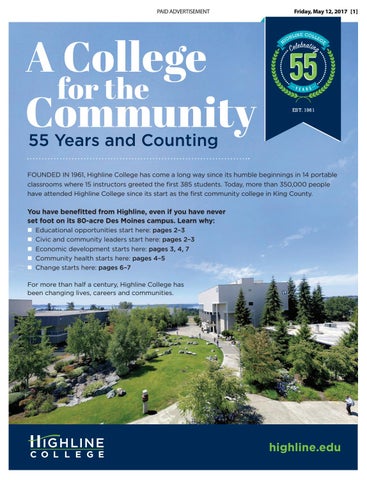
FOUNDED IN 1961, Highline College has come a long way since its humble beginnings in 14 portable classrooms where 15 instructors greeted the first 385 students. Today, more than 350,000 people have attended Highline College since its start as the first community college in King County.
You have benefitted from Highline, even if you have never set foot on its 80-acre Des Moines campus. Learn why:
Educational opportunities start here: pages 2–3 Civic and community leaders start here: pages 2–3 Economic development starts here: pages 3, 4, 7 Community health starts here: pages 4–5 Change starts here: pages 6–7
For more than half a century, Highline College has been changing lives, careers and communities.
highline.edu
[2] Friday, May 12, 2017
PAID ADVERTISEMENT
A New College, a New Campus
and a Lot to Learn
Left: Dr. Melvin “Pat” Allan. Top: Students stand in long lines to register for fall quarter classes, the first on the new campus, October 1964. Right: Dr. Melvin “Pat” Allan, the first permanent president of Highline College, carries a table from a moving truck during the 1964 move from the college’s temporary home at Glacier High School to the college’s permanent campus on South 240th Street, a 100-block trip to the south.
DR. MELVIN “PAT” ALLAN was interviewed in January 2002 as part of the college’s 40th anniversary celebration. As Highline’s first permanent president, he played a pivotal role during the college’s early years. Allan joined Highline in July 1962 and served until 1971. (The college had a temporary president during its first school year, 1961–62.) Below is part of that interview. For more, visit highline.edu/55th.
used the high school’s facilities [such as the gymnasium, cafeteria and auditorium] after the classes were over and the high school students had gone home. We had lab classes, like chemistry, physics. Very limited program at that time. During the day there were probably about 400 students; the evening classes were smaller, probably 250 or so. That first year there were about 15 to 20 faculty and staff.
A: Everyone wanted to teach at community colleges. There were a lot of people applying for jobs. One of the compliments I received in my life, of the two [Allan laughs], was at a function not too many years ago where they invited all of the retired presidents, and one of the fellows said, “I don’t know what Pat Allan did, but he sure had a good bunch of people working for him.” And I did have some wonderful, competent people in counseling, teaching, and everything else.
describe that day?
Q: You oversaw the college’s Q: Was it difficult to get instructors move from Glacier High School to join the new college? to its present location. Can you
Q: What was it like being temporarily housed at Glacier
High School until the permanent campus was built?
A: The situation at Glacier was interesting because we had portable classrooms and
A: We had a big parade right down the middle of Des Moines. At a certain time of the day, someone blew a whistle and everyone got packed into cars and we had trucks and everything. And we went through town with horns blowing, a celebration. Of course, most of the furniture and stuff had been moved already.
hall of the Student Center and the place was full of students at 2:00 in the morning. They were there with sleeping bags, dinner, thermos bottles. They came there the day before to get in line to register.
Q: Why do you believe there were so many students willing to wait overnight to register?
A: I have one word to describe it: eager. They were eager to get their education. That was probably the only problem we had on the campus the first couple of years, the fact that we simply didn’t have the faculty or the staff or the equipment or the programs to satisfy the enormous need that was there.
Q: What is one of your earliest memories of Highline? A: Very vivid in my mind were the first few registrations we had on the new campus because there was so much publicity and so many people and it was a brand new community college, the first one in 20 years or so. I remember going up there one evening with the Dean of Students and standing in the
SEATTLE MAYOR NORM RICE sits with Highline President Shirley Gordon before the 1990 commencement ceremony where he would receive the college’s first Distinguished Alumnus Award. Rice attended Highline during the 1968–69 academic year. Dr. Gordon was one of Highline’s founders and served as president from 1976 to 1990. When she became president, she was not only the college’s first female president, but also the only female president of a publicly funded college in the state.
PAID ADVERTISEMENT
Of Highline’s 35 buildings,
25
are original, dating back to the original campus construction in the 1960s.
During 2014 –15, Highline and its students added
Friday, May 12, 2017 [3] FUTURE PLANNING
$631.5 >350,000 million students have attended Highline since it was founded in 1961 as the first community college in King County.
in income to the King County economy, which is equivalent to supporting 8,675 jobs, according to a study by Economic Modeling Specialists International (“Analysis of the Return on Investment and Economic Impact of Education,” Dec. 2016).
PARTNERSHIP PUTS HIGHER ED IN FEDERAL WAY’S
FUTURE
Federal Way residents may one day be able to attend higher education classes in their community, thanks to a partnership between local government and educational institutions. Officials from the City of Federal Way, Federal Way Public Schools, University of Washington Tacoma and Highline College came to an agreement to work collaboratively to enhance access to higher education opportunities for those living in Federal Way. Signed in
HIGHLINE COLLEGE: Why Here? Why Then? Founded in 1961, Highline College was the first public two-year college in King County. Why was it established in south King County rather than elsewhere? And why then? Highline history instructor Tim McMannon, Ph.D., explains why in one of his three vignettes exploring Highline’s rich history. Read it at highline.edu/55th.
early January 2017, the memorandum of understanding calls for the partners to explore ways to offer classes in the city. Just over 20 percent of Highline’s students reside in Federal Way, the most of any city in the college’s service area.
Athlete, Advocate and More SEEKING A DIVERSE COMMUNITY and a chance to continue playing basketball, second-year student Anna Cook found her way to Highline from Anacortes. “I chose Highline College for a number of reasons,” Cook said. “I received a basketball scholarship. I also really liked the location of the school, close to Seattle and a city vibe. Not to mention the diversity amongst the students, which I am very fond of.” Soon, Cook will transfer to a university to earn her bachelor’s degree in American Indian studies, followed by law school, where she plans to focus on civil rights and/or tribal law.
Anna Cook Cook’s future includes a career as an attorney focusing on civil rights and/or tribal law.
“Highline College has greatly impacted my future. Here, I learned a lot about myself and how getting involved isn’t as hard as it looks. I was able to start a club, play collegiate basketball, work with the Unified Sports program, and become a student ambassador,” she said.
[4] Friday, May 12, 2017
40%
1964:
New Campus Gets Nursing AFTER MOVING to its permanent
and the Burien Manor Nursing
campus on South 240th Street in
Home will be used for this
1964, Highline College introduced
purpose.”
a new two-year program to train
of public baccalaureate graduates in Washington start at a community or technical college.
Hands-on clinical experience
registered nurses. Only 25 students
remains an integral part of a
were chosen from the 200 or so
student’s experience. Highline’s
applicants, demonstrating high
partnerships with numerous
demand for such a program in
hospitals, medical facilities and
south King County.
community-based settings give
The Thunder-Word, Highline’s
Friday, May 12, 2017 [5]
PAID ADVERTISEMENT
FOR EVERY $1 INVESTED
students the opportunity to
student newspaper, reported on
develop knowledge and skills.
the new Nursing program in its
While the uniforms have
October 1964 issue. “Some of
changed since the early days,
the students will be off campus
the demand for the program
in medical buildings for nursing
has remained consistently high,
experience this quarter. Burien
creating a competitive entry
Hospital, West Seattle Hospital,
program and top caliber
Riverton Heights Nursing Home
graduates year after year.
at Highline during 2014–15, society gained $9.80 in added taxes and public sector savings, according to a study by Economic Modeling Specialists International (“Analysis of the Return on Investment and Economic Impact of Education,” Dec. 2016).
Top: Thunder-Word newspaper, October 1964 Bottom: Mary Townsend, Highline nursing student, staffs the Northwest Kidney Center mobile unit during the college’s first Health Care Fair, May 5, 1971. Eighteen agencies were expected to participate in the daylong event, according to an article in the April 23, 1971, edition of the Thunder-Word (“Health Care Fair Planning Extensive Program May 5”). A campus committee planned the event.
FUTURE PLANNING
MORE ROOM FOR MORE STUDENTS
in HIGH-DEMAND CAREERS
STUDENTS SEEKING HEALTH CARE CAREERS will soon learn in the state-of-the-art Health and Life Sciences building. Currently a 3-story concrete masonry structure, Building 26 will undergo a major renovation, creating an integrated, flexible learning environment needed to meet the growing demand for health care professionals. Construction is expected to begin in the fall of 2017 and be completed approximately 18 months later. Highline’s health and wellness-related programs are scattered across campus. Unifying them will allow students of various disciplines to interact in a real-world environment. And it will create more room for more students. Waiting lists are common for high-demand programs, such as Nursing.
Breathing Easier for
Back in the 1960s, this respiratory care equipment was considered high tech. Highline’s Respiratory Care program has run continuously since it admitted its first class in 1967.
50 Years A HIGHLINE PROGRAM that began 50 years ago this year counts among its alumni one who has been a consistent advocate for the respiratory care field. Carl Hinkson earned the 2013 Distinguished Alumni award for his substantial contributions and success in the respiratory care profession. Hinkson graduated from Highline’s Respiratory Care program in 1996 and went on to earn his bachelor’s and master’s degrees. In addition to directing the Pulmonary Service Line at Providence Health & Services, Hinkson is an author, national speaker, volunteer and lecturer. “My time at Highline College was very important to my development as a professional,” said Hinkson. “I credit much of my later successes to my time at Highline.”
NURSING and
Respiratory therapists work with doctors and health care staff in medical facilities to find the best treatment for patients with breathing or other cardiopulmonary disorders. Highline’s program is one of the oldest professional-technical programs offered on campus and has long held special endorsement from the Commission on Accreditation for Respiratory Care. It began in 1967, but curriculum and training has changed with technology and needs of the medical field.
5 Years + 5 Clinical Sites = 1 New Career
First Student of Color in First Nursing Class
Sandra Cravens in August 1965 at a clinical site where she gained experience as a Nursing student at Highline College. Uniforms have changed substantially since those days, while the emphasis on clinical practice remains an important part of a student’s education.
SANDRA CRAVENS was among the first 25 students, and the only student of color, in the college’s new Nursing program in 1964. Fifty years after graduating, she was named the college’s 2016 Distinguished Alumna for her outstanding contributions to the community and country. Now Sandra Cravens Robinson, the Highline alumna has accomplished much since leaving campus: 50 years in nursing, 20 years in the military and several academic degrees. “Highline marks the launching point for my nursing career,” she said. A woman of profound faith, Robinson feels called to serve others. She went on to earn
Today’s graduates develop patient care plans, implement Carl patient protocols and Hinkson are asked to consult about various aspects of disease management and prevention. After earning an applied associate degree in the field, students can now earn an applied bachelor’s degree at Highline, yet another evolution in the program since its inception 50 years ago. Learn more about Hinkson at highline.edu/55th.
RESPIRATORY
CARE
are two of Highline’s oldest programs. To meet the demand for advanced education and training, the college now offers applied bachelor’s degrees in four fields — including Respiratory Care — giving students the option of earning a four-year degree close to home.
IT’S BEEN A LONG JOURNEY for student Laura Garcia, 41,
Sandra Cravens 1965 2016
who started at Highline in 2012. The single mother of three knew she wanted to be a respiratory therapist, but didn’t want to sacrifice too much time with her children. Highline’s flexible Respiratory Care program allowed her to take education at her own pace. She also discovered another reason the program will benefit her future. “Highline has great working
bachelor’s and master’s degrees in nursing and a master’s in theology, and is now pursuing a doctorate in psychology. She served as Dean of the Army’s sole psychiatric program, retiring as Lieutenant Colonel. She currently is in private practice and serves as an evangelist missionary. Learn more about this remarkable woman at highline.edu/55th.
relationships with some of the largest hospitals in the area. I have done clinical rotations at five different sites,” said Garcia. “It’s a competitive job market and by putting me in these sites as an intern, they have given me a leg up in the hiring process. I gained experience and was able to start networking while I was still in school. I feel prepared to graduate and join the workforce.” Garcia, who will graduate in June 2017, said, “Our future is promising.”
Laura Garcia As a mother, Laura Garcia is used to caring for her three children. As a Highline student, she is training to care for others as a respiratory therapist.
[6] Friday, May 12, 2017
PAID ADVERTISEMENT
The Changing Face of Highline
STUDENTS OF COLOR
HIGHLINE COLLEGE OPENED its doors in 1961 to 385 students. By the time the college’s permanent campus was ready in fall of 1964, nearly 3,200 were enrolled either part time or full time, and 1,000 qualified applicants had been refused admission due to limited space on campus, according to an article by Dr. Tim McMannon, “Our Award-Winning Campus (Buildings!).” Buildings were added to campus, making room for more students. Enrollment would continue to grow year after year, reflecting the growth in the south King County population and the demand for higher education in the region. In its early years, Highline was home to a homogenous student body. White faces filled the photos in the student newspaper and yearbook. In the 1990s, the diversity on campus would begin its upward climb. One factor was housing in the area was
relatively inexpensive, making it a draw for the region’s newer residents, many immigrants and young families. As the diversity of the area’s population increased, so did the diversity of Highline’s student body. By 1998, the college had 34 percent students of color, up from 25 percent in 1993. That trend would continue (see graphic below). Today, Highline is proud of its status as the most diverse higher education institution in the state. With over 70 percent students of color and people representing more than 120 cultures and ethnicities, Highline’s nearly 17,000 students are a microcosm of the world. Highline prepares students to live and work in a multicultural world and global economy. The college’s globally focused environment for higher education provides a natural fit for its diverse community and an important reflection of its core values.
Student Diversity 45%
66%
70+%
BUILDING BOOM STILL UNDER CONSTRUCTION when Highline’s permanent campus opened in the fall of 1964, the Lecture Hall — today’s Building 7, fondly known as the Turtle Building for its resemblance to the reptile’s shell — was part of the first wave of the college’s building boom to keep up with the growing demand for education. Read more in “Our Award-Winning Campus (Buildings!)” at highline.edu/55th.
Approximately
800
students from around the world come to Highline to study each year.
52%
34% 25%
1993
1998
2003
2006
2010
2016
1968: Protest Comes to Highline THE 1960s WAS a time of unrest in the United States, with students speaking out and protesting on college campuses across the country. Highline College was no different. Read Dr. Tim McMannon’s account of how students used civil disobedience to bring about change in the 1960s at highline.edu/55th.
PAID ADVERTISEMENT
Friday, May 12, 2017 [B7]
FUTURE PLANNING
For Students Far From Home, a New Home Is on the Way IN THE NOT-TOO-DISTANT FUTURE, a weed-filled vacant lot adjacent to the northeast corner of Highline College will be transformed into a place to call home for international students studying on the campus. A two-building, mixed-use project, Highline Place will be developed in two phases. The first building will include ground-floor retail and four floors of housing for up to 160 international students. Construction of the first phase is expected to get under way in 2017, with a projected completion in 2018. The project is owned and being developed by Eastern Link Capital Management Group.
Currently, Highline College does not offer any student housing. International students have various living arrangements, including apartments, short-term housing and homestay opportunities with local families. The need for dedicated student housing has been apparent for some time. Each quarter, Highline serves more than 520 students from 25 countries, with demand continuing to grow. Students from other countries not only contribute to the ethnic and cultural diversity of the campus, but also contribute positively to
the local economy. The organization NAFSA: Association of International Educators estimated that Highline’s international students contributed approximately $16.9 million to the local economy during the 2014–15 academic year through tuition costs and living expenses. The project is thought of as the first part of transit-oriented development for the future Sound Transit light rail station that will be located on the east side of Pacific Highway South (Highway 99) by 2024, if federal funding is not eliminated.
Learning From Others
Aminata Drammeh On her future to-do list? A career in finance and world travel to explore other cultures.
MEET A
GL BAL
HEALTH
HERO
ORIGINALLY FROM Gambia, but growing up in Seattle, Highline College alumna Aminata Drammeh has always had a passion for learning about new cultures. “I had the opportunity to learn from many different people and to meet people who have similar backgrounds to mine,” Drammeh said of her time spent at Highline. “Learning different aspects of people and their identity being celebrated at Highline is what I liked most.” Not only did Drammeh find the diversity she was seeking, but she also discovered her career path at Highline. “Highline College helped me realize the career and educational path I wanted to pursue,” she said. “I had the time and opportunities to learn from various programs and classes that helped me become more confident in my choice.” Drammeh is now studying at Seattle University pursing her bachelor’s degree in business with an emphasis in finance and management.
EZRA TESHOME emigrated from Ethiopia in 1971 and enrolled at Highline shortly after coming to the United States. In 1973 he graduated from Highline and went on to Seattle University, where he earned his bachelor’s degree in political science and pre-law. Through the service organization Rotary International, Teshome has led more than 20 trips to Ethiopia, where volunteer teams help immunize children against polio. His dedication to the polio eradication effort led Time magazine to honor him in 2005 as one of nine global health heroes at the Time Global Health
Summit, which pulls together public health experts and policy setters to address the world’s critical health issues. Other humanitarian projects include arranging delivery of ambulances to his home country, providing low-cost housing for the poor and establishing micro-credit programs to help families become self-sufficient. In 2006, Teshome earned Highline’s Distinguished Alumnus Award for his outstanding humanitarian efforts. Learn more about this remarkable alumnus at highline.edu/55th.
Ezra Teshome
[8] Friday, May 12, 2017
PAID ADVERTISEMENT
Education for All
by Dr. T.M. Sell
T.M. Sell, Ph.D., is a 1978 graduate of Highline College where, in 2002, he was named winner of the Distinguished Alumnus Award. He is the author of two books about politics and is head of the journalism department and professor of political economy at Highline. A COUPLE OF years ago, I was at a summer advising workshop. We do that a lot at Highline — try to find ways to be better teachers for our students. We were asked, as part of the workshop, to think about what barriers we faced in going to college. I thought briefly and could reach only one conclusion: None. I knew I was going to college from the time I was 5 years old. My father, on his way to becoming a college professor, was going to college, and I knew that was what I was going to do. And I knew that was what I could do and would do. It was what was expected. I never had a moment of doubt that I belonged or that I could succeed. My first day of college was one of the best days of my life. The professor got up in my very first
class and started talking, and I thought, “Thank God. We’re actually going to learn something.” And, in fact, going to Renton High School had prepared me well for college. The teachers were encouraged to teach, to do whatever it was that they did best. The classes were not stratified into “smart kids” and “other kids.” For the most part, we were all lumped together. The smart kids helped the other kids along, and we all learned something in the process. When I started at Highline in January of 1976 (because, as my father, by then a Highline professor, said, “No son of mine is going to Green River”), tuition was around $100 a quarter. In current dollars, that’s about $350. Students could get part-time jobs, pay for their tuition and books and graduate with
four-year degrees without any debt. But the lack of barriers I encountered is not what students face today. Unlike the solid middle class of my youth, when students on free and reduced-price lunches were extremely rare, a frightening number of scholars today come from families so poor that much of what they get to eat comes from those lunches and breakfasts. Their parents aren’t lazy; they’re just not paid a living wage despite working multiple jobs. Tuition today is over $1,200 a quarter at Highline. It’s gone up nearly four times the rate of inflation, in large part because, during every state budget crisis, the Legislature treats higher education like an ATM. And they continue to cut state need grants, which provide financial help to the poorest of the poor.
K–12 teachers still work very hard, but they are burdened by having to teach students how to pass the standardized tests mandated by what I like to call “No Rich White Child Left Behind.” If not, they lose the roughly 7 percent of their budgets that comes from federal funding. (That ought to tell you how tight your typical school district budget really is.) Students hate the tests. They tell me that every quarter when I ask them about the experience. None of them reports learning anything of consequence from taking the tests. Meanwhile, classes are increasingly segregated by students’ perceived abilities. This doesn’t seem to be doing anyone any favors. ... (Read the rest of Dr. Sell’s article at highline.edu/55th.)
Thank you Highline College Foundation Sponsors
Alaska Airlines, BYN Mellon, CHI Franciscan Health, Edward Jones, Jimmy John’s Kent/Auburn, Holland America Line, Red Canoe Credit Union, Salty’s at Redondo, Sound Credit Union, Therapeutic Health Services, and Yoshida Group.
Thank you generous sponsors! You have supported students to reach their educational goals and dreams, through scholarships, emergency funds and special projects.
Highline College Foundation Board of Directors: President Mike Slater, Vice President Mark Rasmussen, Secretary Ana-Maria Popp, Treasurer Courtney Jinjika; Directors Dan Altmayer, Debra Baker, Sheri Keller, Susan Landgraf, John Powers, Virg Staiger, Jeff Wagnitz, and Michelle Coffman-Whitney.
funds4highline.org