[12]
Friday, May 20, 2016
WWW.ISSAQUAHREPORTER.COM
PROUD MEDIA SPONSOR
OverlakeObGyn_SGK05169.83x2_D1.3_PrintReady.pdf
1
5/13/16
12:41 PM
Championing Women’s Health for more than 35 years!
M
Y
Y
Overlake Medical Pavilion 1231 116th Avenue NE, Suite 950 Eastside Professional Center 1800 116th Avenue, N.E. ph: 425-454-3366 | overlakeobgyn.com
1610896
Y
WWW.ISSAQUAHREPORTER.COM
Friday, May 20, 2016
2nd Ave
Race for the Cure Schedule Paws for the Cure Walk June 5, 2016 6:00 am
Registration and timing chip booth open. Coffee provided by Dillanos 6:30 am to 11:30 am Top Fundraisers’ & Survivors’ Tents, Snacks, Water, Coffee, Sponsors & Main Stage Entertainment by Restless Vocals 8:00 am Survivor Parade 8:15 am Kids’ Race 8:30 am Women’s Only 5K Run 8:45 am Coed 5K Run 9:00 am One Mile Walk 9:15 am Coed 5K Walk 9:35 am Paws for the Cure Walk
Mercer
SEATTLE CENTER FINISH
5th Ave
Your dog can come along for the fun when you register for the Paws for the Cure 5K walk! A Race bib and pink bandana are included with your dog’s $25 registration fee, which must be purchased as part of an adult walker registration. Only one dog is permitted per adult walker registration.
START
Why We Race • One in eight women in the U.S. will be diagnosed with breast cancer in her lifetime. • Because every minute, somewhere in the world, someone dies from breast cancer. • Because breast cancer knows no boundaries - be it age, gender, socio-economic status or geographic location.
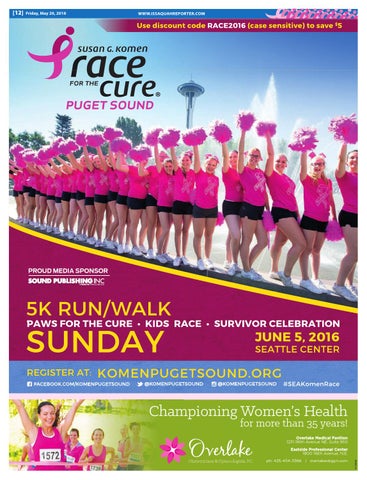
Join us on Sunday, June 5 as we come together to celebrate breast cancer survivors while raising critical funds for the fight against breast cancer. Funds raised through Race support local breast health screening, education and outreach programs, and global research to find a cure.
Commemorative Race T-Shirts Are Available For The First 5,000 Registered Participants.
Form or Join a Team Multiply your impact, multiply your fun! Participating in the Susan G. Komen Puget Sound Race for the Cure® with a team increases the fun, the laughter and maybe even the tears you share on Race day. Consider forming a team in honor or in memory of someone you know impacted or touched by breast cancer. Together you make an even greater impact than you could alone. There is no extra cost to form or join a team.
All participants receive a Race bib, and those who identify as survivors during registration receive a pink survivor t-shirt and bib. Timing chips are supplied to those who register for a running event. REGISTER ONLINE: KOMENPUGETSOUND.ORG •
@KOMENPUGETSOUND
Denny START: 2nd & Mercer E/B Mercer to 5th Ave. S/B 5th Ave. to Cedar W/B Cedar to 4th Ave. S/B 4th to Seneca (East side of street) N/B 4th to Denny (West side of street) W/B Denny (W/B lanes) N/B 2nd Ave to Seattle Center FINISH: 2nd & Harrison (Int’l Fountain)
ar d Ce
Make a donation
e Av 4th
Register
When you participate and fundraise for Race, we fight these statistics together. In 1980, the 5-year relative survival rate for women diagnosed with early stage breast cancer (cancer confined to the breast) was about 74 percent. Today, that number is 99 percent! Komen has played a critical role in every major advance in the fight against breast cancer - transforming how the world talks about and treats this disease. With your support, we can reach our vision of a world without breast cancer.
[13]
Even if you can’t walk or run, you can lend your support to the breast cancer fight by making a general donation or giving to a participant or team. Visit www.komenpugetsound to find out how.
Fundraise for the cure
neca
Se Fundraising for Race is easy! When you register, you’ll receive your own fundraising web site which can be personalized. Use it to encourage everyone you know to visit your site where they can see what you are doing in the fight against breast cancer and make a donation on your behalf. The Race web site has a full list of resources you can use to help you achieve your fundraising goals.
/KOMENPUGETSOUND
@KOMENPUGETSOUND #SEAKomenRace
Breast Cancer Screenings Save Lives Finding breast cancer early, when it’s easiest to treat, can save lives. Research estimates that regular screenings with mammography have resulted in 30 percent fewer deaths from breast cancer. However, mammography is not perfect. It can sometimes miss tumors or identify tumors that are not cancerous, particularly in women with dense breasts or who are at high risk for developing breast cancer. Komen is committed to finding better, more sensitive
methods for detecting and identifying breast cancer earlier. Through the years, Komen has invested nearly $33 million in more than 115 research grants and 50 clinical trials focused on early detection. Examples include the development of new imaging technologies that are more effective – and more comfortable – than mammography. Komen-funded researchers are also looking into new, more precise ways to screen for breast cancer, such as identifying genetic risk factors through a simple blood test.
[14]
Friday, May 20, 2016
WWW.ISSAQUAHREPORTER.COM
Celebrating Survivors of Breast Cancer
Komen Puget Sound Upcoming Community Events
If you know Race for the Cure, you’re aware it’s our biggest, pinkest annual fundraiser for local programs of Susan G. Komen Puget Sound. Through proceeds from Race, we fund breast cancer research, further our work to ensure underserved women and men have access to breast cancer screening programs, and help patients get what they need to live and thrive as cancer survivors. Celebrating the strength and courage of breast cancer survivors is one of best things we do on Race day. So much so, we’ve decided to begin the day with a Survivor Parade. Everyone gathered to participate in the race or walk will get to experience the energizing and inspiring sight of scores of cancer survivors grooving with the Seahawks’ Blue Thunder drumline.
Survivor Celebration September 10, 2016
Join us at the 2016 Breast Cancer Survivor Celebration aboard a Holland America Line cruise ship. Enjoy a gourmet lunch with stunning views of Puget Sound and the Seattle city skyline, meet other breast cancer survivors and be inspired by special guest speakers. Registration begins in August.
Sound like fun? It will be. That’s Race for the Cure on Sunday, June 5 at Seattle Center. Check out our website and fundraising app and be sure to sign up to walk or run, and register your friends, co-workers and family. Got kids? Got dogs? We’re prepared to show them a good time, as well. Our gratitude goes out to Seattle Cancer Care Alliance, whose sponsorship made possible this newspaper supplement, and to all the companies and dedicated teams who come together to make Race such a great experience every year. Don’t miss this chance to honor and support breast cancer survivors while raising critical funds to battle the disease locally. The lives and well-being of our loved ones and all the women in our communities are at stake. Yours in the fight,
David Richart Executive Director Susan G. Komen Puget Sound
Susan G. Komen 3-Day® September 16-18, 2016 Greater Seattle Area
The Susan G. Komen 3-Day is a 60-mile walk for women and men who want to make a personal difference in the fight to end breast cancer.
Lunch for the Cure®
October 5, 2016 Hotel Murano Bicentennial Pavilion, Tacoma Lunch for the Cure® brings together our region’s business and community leaders to raise funds for breast health outreach and education in Western Washington and for breast cancer research globally. Learn more about these and other events at www.komenpugetsound.org.
KOMEN PUGET SOUND IMPACTS COMMUNITIES IN NEED
Founded in 1982, Susan G. Komen is widely known for its role in sparking the breast cancer conversation nationally and for its leadership in breast cancer research, with investments of more than $800 million over the past 35 years. But did you know its local affiliate, Komen Puget Sound, has also granted more than $30 million locally since 1994 to organizations and agencies that provide breast health and breast cancer services that serve thousands of low-income women in Western Washington? Every four years, in partnership with government agencies, non-government organizations and other partnership groups, Komen completes in-depth research, data analysis and planning to determine where breast health needs in the region are greatest. This community needs assessment guides how Komen allocates funding among the groups it supports, focusing finances in the communities that need it most. After the completion of its grants review process in early 2016, Komen Puget Sound announced it will award nearly $795,000 in grants to eight local organizations and agencies. These groups will provide vital services to 8,000 underserved women in Komen’s 16-county
Western Washington service area and respond to specific community needs. For instance, black women are 30 percent more likely to die from breast cancer – and are more likely to be diagnosed at a later stage of the disease. Grantee Northwest Leadership Foundation will provide early breast cancer outreach, education, screening and referral to appropriate services for 360 African-American women in Tacoma-Pierce County through its Outreach Demonstration Project (ODP). Other awardees will fund breast cancer screening and culturally-appropriate patient treatment and support programs. “The data we collected in our needs assessment has taught us a lot about the role Komen can play in meeting community needs regarding women’s health, specifically within the breast cancer space,” said Robyn Sneeringer, director of programs for Komen Puget Sound. “With new advances in science, changes to our health system, and progress in key communities, we have to be thinking about our changing landscape -- redefining disparities, tackling stigma, empowering communities, navigating our health system, moving towards survivorship, and so much more.” To learn more about Komen Puget Sound’s community grants for 2016-2017, visit http://bit.ly/ KPSCommunityGrants.
Make Healthy Lifestyle Choices You can do things that are good for your health that may lower your risk of getting breast cancer. 1. Maintain a healthy weight. 2. Add exercise to your routine. Physical activity not only burns energy (calories), but may help lower your risk of breast cancer (this benefit is seen most clearly in women after menopause.) Exercise fights obesity and may lower estrogen levels.
3. Limit alcohol intake. 4. Limit menopausal hormones. Talk to a doctor about the risks and benefits 5. Breastfeed, if you can. Breastfeeding protects against breast cancer, especially in premenopausal women. 6. Let there be no smoke. If you don’t smoke, don’t start. 7. Emotionally health. Keep a positive attitude.
WWW.ISSAQUAHREPORTER.COM
income countries such as sub Saharan Africa and Q & A with middle income countries in Latin America, but also in Dr. Ben Anderson, underserved communities in the United States. KPS: What about the bigger picture? Who’s Komen Scholar partnering through BHGI to make that
Founded in 1992 by local volunteers dedicated to ending breast cancer, Komen Puget Sound funds community programs and screenings – and groundbreaking science to fight breast cancer. Dr. Ben Anderson of the Seattle Cancer Care Alliance and Fred Hutchinson Cancer Research Center is a Komen Scholar, funded for his research to address breast cancer disparities around the globe.
global impact against breast cancer? Dr. Anderson: Our collaborators have come from more than 50 countries around the world. We held a series of global summits that brought together experts from high and low income settings, and we analyzed specific questions, such as what do we need to put into place, what does the evidence support? There are certain patterns in regard to breast cancer that are very similar throughout the world. It really doesn’t look very different in Africa versus our own urban and rural communities.
KPS: Dr. Anderson, what were the origins of your Komen-funded research? KPS: How do you merge this Dr. Anderson: Back in 2002, I became interested groundbreaking work in global health with in how one could address breast cancer in low and middle income countries, and Komen was one of your role as a breast cancer doctor at two initial sponsors that allowed us to hold our very first breast cancer global summit. That has evolved SCCA? into the Breast Health Global Initiative, or BHGI. Our stratified guidelines have really changed our way of Dr. Anderson:Yes, I’m a practicing clinician at thinking about breast cancer in the context of limited resources.
KPS: Tell us more about those breast health stratified guidelines? Dr. Anderson: In the 1990s, if we asked what
could be done about breast cancer in lower income countries, people would say, well in those countries they can’t do what we do with screening mammography. And it would stop there. My colleagues and I said, wait, some of the measures we take against breast cancer are very affordable and doable. So we began to explore how to put together functional healthcare systems that involve early detection and effective treatments, even when dealing with obstacles and limited resources. ‘Stratified guidelines’ mean there are certain tools that we use, in order of priority. There are essential elements, such as breast surgery to remove a tumor, and having the ability to make a diagnosis. A tiered strategy is the basis through which we do this work. Groups like the World Health Organization are now following the work that we did on this fundamental framework through BHGI. However, this approach can apply not just in low
Seattle Cancer Care Alliance and director of its Breast Health Clinic. When I started doing global health work, I would say, well, what would we do in Seattle? How would we handle this problem? It’s being able to go back and forth from the clinic, where I care for patients, to these environments with limited resources and issues that I rarely see but they commonly see. And figuring out how we can problem solve. So it’s very functional, very practical.
KPS: Can you describe someone you’d hope your work in global health would benefit? Dr. Anderson: I have a vision – perhaps I’ll have a painting done someday – of a woman in a very distant place, and I don’t know her, and she won’t have heard of me. But something we’ve done in breast health has improved her quality of life. That’s what I want - for BHGI to benefit those who won’t ever know anything about it; they’ll just benefit.
More on Dr. Anderson’s Komen funded grant and the full slate of Komen funded research at http://bit.ly/ KomenGrants2015. For more information about Seattle Cancer Care Alliance, visit www.seattlecca.org.
Register at:
KOMENPUGETSOUND.ORG
Friday, May 20, 2016
[15]
MOViN’s Brooke Fox Gears Up For Her 11th Race For The Cure: Here’s Why I was 25 when I signed up for my first Race for the Cure. I had very simple reasons: I had never run a 5K, it sounded fun and the cause was a great motivator. I didn’t put much more thought into that initial event. Then Race day happened….and everything changed. Cresting that first hill, I saw it. That mass of pink. That mass of people. That mass of hope and courage and bravery. It’s hard to describe how it feels to realize you are part of something much bigger than yourself, but that day I did. I was surrounded by warriors. A great uprising of people who were all in the same battle, fighting to find a cure. I hate to sound dramatic but as anyone who has participated in the Race knows, it is. I’ve experienced that moment every year since and so many more. From watching teammates who are single moms with full time jobs spend countless hours raising money, to witnessing families tape “in memory of” signs on each other’s backs, to the joyous tears shed for the survivors as they celebrate the battle they won while dancing their way to the front of the stage, the Race has given so much more to me than I could ever give to it. Coming up on my 11th Race for the Cure and the ninth captaining our “Save the Boobs” team, this was supposed to be a blurb about “why” I got involved all those years back. But I would like to use it as my opportunity to say “thank you” instead. To my teammates, the volunteers, the sisters, the mothers, the daughters, the sons, the husbands, the fathers and all the warriors, thank you. I can’t wait to see you at the start line again! Brooke Fox of MOViN 92.5’s “Brooke and Jubal in the Morning” lives in Seattle with her husband and baby girl, both of whom accompany her to Komen Puget Sound events.
[16]
Friday, May 20, 2016
WWW.ISSAQUAHREPORTER.COM
Survivor reclaims her body through fitness BY ALLISON DEANGELIS adeangelis@bellevuereporter.com
B If Someone You Love has Breast Cancer Breast cancer can cause many emotions. Your loved one may have many feelings, including fear, anger, sadness or frustration. This is normal. Sometimes it’s hard to know what to say or do. It is important to understand what they may be thinking and feeling. Here are some suggestions on how you can help. Providing informational support: • Find out all you can about breast cancer and treatment choices • Learn about common breast cancer terms • Make a list of questions to ask the doctor (see examples below) • Share what you learn with your loved one Providing emotional support: • Just listen • Let them express their feelings • Give them a hug Providing practical support: • Cook or clean • Drive them to the doctor • Bring them a hot meal • Do laundry • Send them a note If facing end of life: • Attend grief counseling • Work with your family, friends and doctor • Provide spiritual and emotional support • Be a good listener • Talk with a hospice nurse Questions to ask the doctor: • What side effects should we expect from treatment? How can we prevent or treat these side effects? What problems should we report to you? How soon will the side effects begin? • Where can we find a breast cancer support group? Can partners or children attend? • What should I do if I am feeling overwhelmed or depressed?
eing diagnosed with breast cancer was a surreal experience for Brenda Frost. Having just been laid off at work, she went in for a routine check-up, not expecting to be diagnosed with Ductal carcinoma in situ (DCIS), or abnormal cells inside of the milk ducts. After more scans, an MRI and a biopsy on Christmas Eve, doctors found two 2-centimeter lumps in her breast tissue. Frost’s condition was upgraded to stage 2, meaning that it had spread and was possibly in her lymph nodes. “It was totally surreal,” the Bellevue resident said. “I had no family history of breast cancer. I’m a statistic — one of the one in eight women who will develop breast cancer in their lifetimes. Now, I’m not the kind of ‘why me?’ person, but you start secondguessing everything. But they still don’t really know what causes breast cancer, so it could be anything.” Frost didn’t have any lumps or visible signs of breast cancer, and was diagnosed at stage zero or the earliest stage of cancer. DCIS is such an early stage of cancer that it’s generally only diagnosed by a routine mammogram, according to the Mayo Clinic. In the end, Frost’s unemployment was a happy accident, because it gave her the time to go for the mammogram she had been postponing for seven years. Two weeks after starting a new job, Frost began her 18-month round of chemotherapy. Because she didn’t want to be known as “the woman with breast cancer” in her new workplace, she hid her treatment from her coworkers, receiving her treatments toward the end of the week so the side effects would affect her less at work. Feeling like she had the flu every Saturday — then like she had been hit by a truck on
Allison DeAngelis/staff photo
Breast cancer survivor Brenda Frost said fitness helped her to reclaim her body and power during a time when she felt a loss of control. Sunday before returning to work on Monday — became her new normal. Around the same time she started chemotherapy, Frost discovered Team Survivor Northwest. The organization’s mission is to provide a broad range of fitness and health education programs to enable cancer
“You feel a loss of control, like your body has betrayed you when you’re diagnosed,” she said. “I felt like I had to prove something to myself. I had to reclaim my body, my mind, some power over what was happening to me.” That’s not to say it was easy. The stress of her new job and her chemotherapy treatments took a toll on Frost. Some weekends, she said, she could barely get around the loop that she and her daughter would walk. By her last chemotherapy appointment, she was so drained, she could barely get out of her chair. Frost had also never been one to exercise much. She started off running at night so people wouldn’t see her. But knowing that there were other women around her who were going through or had gone through the same thing gave her encouragement. Near daily walks to prepare her for a 5K or half-marathon also gave her
“I felt like I had to prove something to myself.”
- Brenda Frost survivors or women at any stage of treatment or recovery to take an active role in their physical and emotional healing. Frost happened to join at the same time as another woman who was just diagnosed, and felt a familial bond to the various women. It was exactly what Frost felt like she needed.
the opportunity to talk about her cancer with her daughter, then 15. Soon, Frost became addicted to activity, she said. Her work with Team Survivor, Komen Puget Sound and Ford’s Warriors in Pink helped her deal with treatment, the early menopause it threw her into and with her eventual mastectomy and breast reconstruction surgeries. More than six years after her diagnosis, Frost is in remission and still active, biking and running around Bellevue and spending quality time with her daughter for Mother’s Day. While the threat of cancer reoccurrence lingers, it hasn’t stopped her from moving forward. “Yeah, we don’t know what causes it or if it will come back. You could have the BRCA gene (a mutation linked to a greatly increased risk of breast cancer) and never get cancer,” Frost said. “Why not move towards life? Even people who don’t have cancer go through these kinds of struggles. You just do what you do to keep living and being.”
Around the World <<<< • Worldwide, breast cancer is the most frequently diagnosed cancer and the leading cause of cancer death in women, with ore than 1.7 million new cases recorded in 2012. • Every 60 Seconds, somewhere in the world, someone dies from breast cancer. • At the current rate, 13 million breast cancer deaths around the world will occur in the next 25 years.
WWW.ISSAQUAHREPORTER.COM
Pictured with Ali: Elisabeth Tomere, Physical Therapist; Bente Dalby, Oncology RN; Dr. Janice Kim, Radiation Oncologist.
Our collaboration keeps Ali running at top speed. Fred Hutch · Seattle Children’s · UW Medicine At Seattle Cancer Care Alliance, we treat cancer care differently. It’s care that harnesses the powerful science and devoted collaboration of Fred Hutch, Seattle Children’s and UW Medicine to give patients the best chance of getting better. For Ali, she had access to groundbreaking clinical trials to overcome her aggressive form of breast cancer. It’s one-of-a-kind care that moves patients, like Ali, past boundaries and toward hope. Learn more about Ali’s story at SeattleCCA.org.
Friday, May 20, 2016
[17]