Whidby Record L angley Centennial edition 1913 - 2013
d goo A ‌ 100 years
Trailblazers: A legacy of strong women, pg. 6 When Hollywood came knocking, pg. 17 Looking ahead: The future is in good hands, pg. 23 Published as a supplement to The South Whidbey Record
g in n in beg
Happy Birthday, Langley. May Your Second Century Be Every Bit As Good As Your First.
Langley – a place with character(s) Now and Then L angley has abundant natural beauty, but its strongest attribute is its natural charm. It is full of character and filled with plenty of characters. That has been the secret ingredient for the past 100 years. And in its Centennial year, Langley is in a very good place. “Over the years we had ups and downs, but at this particular moment it feels like we’re having the light on our wings,” said Josh Houser, who is Langley’s longest-serving merchant in downtown. A young immigrant – too young at the time to lay claim to the land legally – is the founding father of Langley. Jacob Anthes left his hometown of Gross Gerau, Germany at the age of 14 and crossed the Atlantic Ocean in hopes of finding adventure. Anthes found his way to Seattle where a businessman hired him to live on a wild tract of homestead land on Whidbey Island so that the businessman could ratify the homestead rights to the land. While there Anthes explored all of South Whidbey on foot and decided on the Langley area for his home. He was too young to file his own homestead, so in 1881 he purchased 120 acres from John G. Phinney for $100. When he turned 21 in 1886, he filed a homestead on 160 acres. In the 100 plus years since then, there hasn’t been a shortage of other men and women with big ideas and a deep love for the land. And those characters have shaped Anthes’ little town into the bustling, artistic city it is today. One can’t help but wonder what Langley's founding father would think if he would step off the boat at the Langley marina in 2013. Our residents - now and then - came from all walks of life, but the passion for this place binds us together. Best-selling crime writer Elizabeth George calls Langley home. The city has inspired her so much that her latest work, a youth series, is set in Langley. Her story mirrors many. George and her husband drove into Langley on a rainy day in April 2002, after they had dropped in on a friend in Coupeville. She recommended that they stop by Langley on their way to the ferry. “I remember getting out of the car in the rain and looking around and saying to my husband, ‘I bet this is what Laguna Beach was like at the turn of the last century.’ “We were completely charmed by the place. We'd been traveling to Washington for the two preceding years, looking for a place to live when Tom retired from fire fighting. After two more visits to Langley, we knew we'd found that place," George recalled. “This is a little village that keeps reinventing itself. We're only sorry we weren't able to move up here to enjoy it sooner,” she said. Mayor Fred McCarthy, who took office during the Centennial year, said it is a good time to be the mayor. “The City of Langley feels to many like a rocket poised on the launching pad for take off and a great economic adventure,” he said. “We have weathered the storms of times passed and now a sense of optimism and excitement characterizes our shared vision of the future.” One hundred years IS a good beginning.
Michaela Marx Wheatley is the Langley Main Street Association manager and a journalist, who grew up in Germany only 15 minutes west of Gross Gerau, where founding father Jacob Anthes was born. Langley Centennial
Shuttle 1914/2013
Shakespeare outdoors 1916/2012
Shopping 1900s/ 2013 Whidby Record
3
Who was Mr. Langley? Langley’s namesake, James Weston Langley, was born in Erie County, Penn., Jan. 17, 1836. At age 15, his family moved to Illinois. In 1857, he began reading law under the instruction of Hon. John M. Palmer, ex-governor of Illinois, and was admitted to the bar in January 1859. On the advice from a friend named Abraham Lincoln, he moved to Champaign and began practicing law. He married Jeanette Josephine Young on June James Langley 4, 1861 and their only daughter, Mary Celeste, was born a year later. A month later, he enlisted in the Union army. He and a friend formed a regiment of about 900 men, the 125 Illinois Volunteer Infantry, of which James was elected Lieutenant Colonel. Langley came home with a great hatred of war. He never stopped regretting that his country had suffered a civil war. He gave away the gold mounted sword presented by his regiment. He said he never wanted to touch a sword or gun again. In May 1890, Judge Langley and his wife took the train to Seattle to be near their daughter and her husband. The judge set up a law practice near Pioneer Square. He served as Superior Court Judge of King County, and signed Jacob Anthes’ naturalization papers in 1896. When Anthes was looking for financial backing to develop a town, he made a pitch to the judge, and with other investors formed the Langley Land and Improvement Company. Anthes had initially wanted to call the town “Bingen” after a town near his home in Germany, but decided to name the town Langley to get the judge's attention. According to the judge’s grandson, if Anthes had known that the judge preferred to be called by his middle name, the town might have been named “Weston.” Bob Waterman
•
Langley Centennial Magazine A Langley Main Street Association project in partnership with the South Whidbey Record Editor/Design: Michaela Marx Wheatley Reporting: Bob Waterman, Sue Frause, Francis Wood, Patricia Duff, Sandey Brandon, Michaela Marx Wheatley, Mully Mullally. Production MANAGER: Michelle Wolfensparger Ad Design: Rebecca Collins Marketing Representative: Kimberlly Winjum Copyright 2013 Sound Publishing, Inc. All rights reserved.
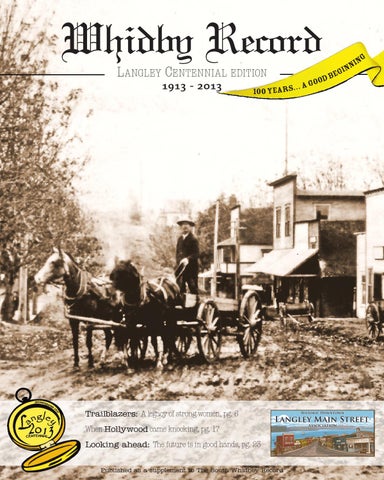
ON THE COVER
Photo courtesy of South Whidbey Historical Society
Jacob Brehm on wagon, Gus Brehm and son Vincent on side boardwalk (not shown) circa 1914. 4
Whidby Record
Langley Centennial
Langley declares independence
B
y 1912, Langley had weathered the economic slump of the 1890's and had grown into a respectable little community. It now boasted three hotels, several general stores, two churches, schools, a telephone company, livery stable, blacksmith shop, barber, and pool hall. Homes and small farms dotted the area and a marina with warehouses and other buildings provided access to the mainland via the ships of the “mosquito fleet.” A primitive road to the county seat at Coupeville had been completed in 1902, but for Langley to continue to grow, new roads and bridges were required to connect Langley with other communities and farms appearing on the South end of Whidbey Island. A number of Langley’s leading citizens felt they were not receiving their fair share of the taxes they sent to Coupeville for road
...OK, it just incorporated construction and maintenance, so in December 1912, a petition to incorporate the town of Langley signed by 37 men and 28 women was published in the Langley Islander newspaper and submitted to the Island County Board of Commissioners. The area of the town encompassed the land originally owned by the Langley Land and Improvement Company when the town was platted in 1891. According to the petition, 314 people lived within these boundaries in 1912. Despite opposition from those who felt incorporation would mean their taxes would rise, an election was held on Jan. 28, 1913 and Langley was incorporated as a fourth class town by a margin of seven votes; 64 for and 57 against.
A slate of town officials was also elected with Frank E. Furman as mayor and Henry English, William A. McGinnis, Isaac Bainter, Angus McLeod and Edward Howard as councilmen. James Curtis Langley, nephew of the town’s namesake, was elected treasurer. The county commissioners verified the election results on Feb. 2, 1913, making Langley the second incorporated town on Whidbey Island. Coupeville was incorporated in 1910 and Oak Harbor in 1915. Langley remains the only incorporated city on South Whidbey today. An interesting feature of the election was the participation of women. The state legislature had granted women the right to vote in 1910, and this was the first election in which women in
Langley exercised that right. Seven women ran for office, each receiving one vote. Most were wives of the men who were elected. It is not recorded whether they voted for themselves, voted for each other, or their husbands voted for them. Six years later, in 1919, three women were elected for vacant positions on the town council, and one, Helen Coe, was elected to the position of mayor. When the two sitting male councilmen resigned in 1920, their positions were filled by women making Langley the second town in the United States to have an all-woman town administration. Bob Waterman is Langley Main Street Association's resident history buff and the co-author of "Langley" – now in bookstores.
Happy 100th Birthday Langley from the Langley Main Street Association
Board Members Fran Able Jeff Arango
An extraordinary collection of plus size clothing
Open Daily 11-5
Christina Drake Fred Lundahl
208 First St., Langley • 221-7056
Callahan McVay Rene Neff Mark Riomondo Sandy Wainwright Bob Waterman
The COTTAGE 210 1st St. ~ LANGLEY 360-221-4747
Janet Ploof Langley Centennial
Whidby Record
5
A legacy of strong women
All-woman admin paved way for Langley’s future I
n the early 1920s, a group of women took it upon themselves to whip Langley into shape. The town needed it. In the process the six women served as trailblazers for those who came after them and paved the way for the community Langley is today. Langley’s famous all-woman council, which was the second of its kind in the nation, was elected in December 1919. Helen Coe became mayor and with an all-female council immediately set to work "cleaning up the town." By 1920, the town administration included Grace English, Emma Monson, Clara Brown, Lillian Wylie and Maggie McLeod. The sextet and the women who succeeded a couple of them governed Langley between 1920-22, the only period before or since that the town was run entirely by women. “The history of capable women getting things done in Langley has deep roots,” said Helen Price Johnson, Island County commissioner and first woman elected to the position. “The stories from the 1920s tell us that the women of that time saw a need to make Langley a better place, and when they got the vote, they got elected and then got organized to address the needs of the community. “That is still happening around here today. Busy women get
Photo courtesy Karen Pauley
Langley's all-woman administration of 1920: (front) Grace English, Helen Coe, Emma Monson. Back row: Clara Brown, Lilian Wylie and Margaret "Maggie" McCleod.
things done,” Price Johnson said. The women took office shortly before the ratification of the 19th amendment to the United States Constitution, which granted women the right to vote. Rene Neff, who is Langley’s only councilwoman in 2013, said she is proud to carry the torch.
“I feel like the precedent was set long ago for women to serve this community by the amazing all-women council in 1920,” she said. “The all-woman council were truly trailblazers and had to contend with much skepticism. Today I feel totally free to express my opinions and believe as a woman I bring an important perspective to the
In 1962, Good Cheer began feeding families on South Whidbey. Thank you for being of Good Cheer for over 50 Years! Tommie Double 6
Whidby Record
www.goodcheer.org
city council. Through the eight years of service the men I have worked with have always been respectful and I have felt like their equal.” The women who took the helm in December 1919 were not so lucky. The men in town were not amused. Continued on Page 7
THE CLYDE THEATRE movies South Whidbey-style Since 1937 217 First Street, Langley 221-5525 www.theclyde.net Langley Centennial
Not only did the women govern Langley during the tumultuous early prohibition years, but they also battled grumpy neighbors and husbands, as they were determined to clean up the town. In 1919, animals roamed the streets, roads turned into mud pits when it rained, sidewalks were in disrepair and piles of garbage were everywhere. If the physical make-up of Langley was troubling, the moral disposition was even more worrisome. Drinking, gambling and other questionable behavior ran rampant in Langley. Billiard and card parlors on First Street did a booming business, and gambling and partying went on around the clock. Coe helped form the Ladies’ Civic Improvement Club in 1916, and the other councilwomen were members. They also belonged to the local chapter of the Woman’s Christian Temperance Union. The women set about trying to deal with the town’s morals. They enforced ordinances prohibiting dancing from 6 a.m. to midnight on Sundays, and closed all pubs and parlors and other amusements by 2 a.m. on weekdays and 1 a.m. on Saturdays. Enforcement wasn’t easy. The women burned through an impressive number of town marshals. The council was turned once again into a boys club by 1928. But the women had left their imprint on Langley forever. Price Johnson, a trailblazer in her own right as she became the first female county commis-
sioner in 2008, said the council women were the first in a long line of powerful women running the city. Price Johnson, who is the granddaughter of Mayor Vincent Jones, grew up in Langley where her mother ran Jones’ Department Store that she eventually took over. “During my time as a retailer in Langley many of the businesses were owned and operated by women: Virginia LaRue and her two daughters’ retail shops, Jackie Shafer’s law office, Josh Hauser at Moonraker, and the then-mayor Dolores Cobb ran the Skipper's Inn restaurant on Second Street,” she said. People like Grethe Cammermeyer and Nancy Nordhoff exercise their influence way beyond Langley’s city limits and women in leading business and government positions are commonplace these days. Women in public service are met with much less opposition thanks to those who came before them, Neff said. While happy with her male counterparts, she said she wouldn’t mind more female perspectives on the council. “We have come a long way, but of course there is always farther to go,” Neff said. “Any other women out there ready/able/willing to serve Langley on the city council are totally encouraged to step up and join me.” Michaela Marx Wheatley
Meet the councilwomen • Helen Coe, trained as a teacher, came to Langley in 1896. She resigned in 1922 to push for a public library. • Maggie McLeod was appointed in 1920, and took over as mayor when Coe resigned. She was mayor in 1922 when the town purchased its first fire engine. • Grace English came to Langley with her family around 1903. Her husband Henry became Langley’s second mayor in 1915. • Lilian Wylie came to Langley in 1913 with her husband and three children. She had no formal medical training, she was credited with saving lives during the 1918-19 influenza epidemic. • Emma Monson came to Langley around 1903. Her husband, Leander, committed suicide in 1908, and her eldest son, Ernest, died from an accidental gunshot wound in 1910. She served for a year before resigning, and was replaced by Mary Kohlwes, who was replaced by Ethyl Manley. • Clara Brown was appointed in 1920 to replace a male member who had resigned, and she served until 1922.
Happy Birthday, Langley! Puget Sound Energy salutes Langley's 100th Anniversary
Happy Birthday Langley on your
100 birthday! th
5531 Freeland Ave. Freeland 360/331-6006
223 Second St. Langley 360/221-8898
PSE Customers Gary and Beth Smith, Owners of Mukilteo Coffee Roasters - Langley
PSE South Whidbey Community Office 1794 Main Street, Freeland, WA 98249 360-331-3060
Whidbey Island's local energy provider since 1925
Stay connected to PSE PSE.COM/ISLANDCOUNTY
www.WindermereWhidbey.com Windermere Real Estate/South Whidbey
Langley Centennial
Whidby Record
7
Helen Coe – a visionary ahead of her time
How Langley got a
T
hink, for a moment, about the last time you visited Langley’s library. Conveniently located at the corner of Second Street and Cascade Avenue with glorious views out over Saratoga Passage, it is a rich resource in the center of our community. For this we can thank the library’s founder, Helen Burwell Coe. Have you ever noticed the portrait of Helen on the wall behind the librarian’s desk? Born in 1858 in Winnebago, Minnesota, Helen came from a wellto-do family, was educated at the State Normal School of Oswego, New York, and taught school before moving to Langley in 1896 at the age of 40. She purchased 10 acres to the west of town and settled into a small cabin. An educated and refined person, Helen taught Sunday school, wrote a small children’s book titled Nature Tales and staged theater events. Later, Mabel Anthes, daughter of the town’s founder, recalled visiting Helen Coe when Mabel was about seven years old. “Once or twice a month during 1896-8 the three Anthes children were invited to little tea parties which Miss Helen B. Coe and Miss Lillian D. Kelsey gave, both of whom had taught kindergarten before coming to Langley to live, and it was in their home that we learned to make little fans and sailboats of colored paper. Their home was a most interesting place with furniture made by themselves from odd-shaped pieces of driftwood which they had collected.” Over the years Helen enlarged her
library
cabin into an elegant house with fine furnishings and created extensive flower and vegetable gardens. She hosted friends and family from far and wide. Most notable of those guests was her niece Margaret Camfferman and Margaret’s husband Peter. In 1915 they moved to Helen’s property and shortly after established an artists colony, which they called Brackenwood. One of Helen’s most notable contributions to Langley’s history was as the town’s first female mayor. In 1919 the town voted in an all-women’s council and elected Helen mayor. That group worked to improve and gentrify the town, regulating saloons and gamling halls, rounding up free-ranging farm animals and trying to improve the streets. Yet Helen’s greatest dream was yet to materialize. Having always loved books and children, she dreamed of establishing a public library. The Ladies Civic Improvement Club had raised part of the needed funds. Helen stepped forward, bought the land and contributed $500 of her own money. In 1922 Helen quit the town council to focus on building the library. Work soon began and it opened a year later. Helen lived in Langley until her death in 1940, continuing to support the arts, children’s education and sharing her love of reading. Helen Coe was one of Langley’s extraordinary founding mothers. Her legacy remains alive in the town’s commitment to art, theater, culture and education. Frances Wood is a columnist for the South Whidbey Record and co-author of "Langley."
Photo courtesy of Maureen Duryee
Helen Coe in 1922.
Congratulations Langley on your 100th birthday! Moonraker is proud to be a part of this community since 1972
moon ra ker books
209 First Street, Langley • 221-6962
8
Whidby Record
Langley Centennial
“Hello, Central?” 105 years of visionary phone service When Alexander Graham Bell spoke, “Mr. Watson, come here, I want you” into his experimental liquid transmitter, a communication revolution had begun. Over a hundred years ago, a telephone company was formed in Langley that would grow into the unique, independent telecommunications company that is today Whidbey Telecom. As far back as 1893 Langley had a telephone system “of sorts,” according to Lorna Cherry's book “Langley, Village by the Sea.” “Jacob Anthes had it installed to connect his store on First Street with the dock, which he operated.” Later he installed a line to Bayview and on up to Coupeville. Whidbey Telephone company was organized in 1907 and incorporated in April 1908. In 1921, the managers salary went up to $135 per month. That year, the company had 185 subscribers. In 1929 the board voted to “fit up the rooms” in the back of the telephone office for the night operator who would answer emergency calls. A charge of $0.25 cents was to be made, this charge to go to the operator “for her trouble.” The operator would be allowed free rent and light, water and fuel. In 1953, David C. Henny purchased controlling shares of the company and became the manager at 23 years of age. In 1961, the newly finished Bayview headquarters opened. Whidbey Telecome became the first telephone company in the nation to bury 100 percent of its lines. In 1972, the state-ofthe-art Pentaconta A-1 Crossbar switch was installed, providing push-button “touch-tone” dialing, and eliminating most party lines by establishing residence lines. In 1994 Whidbey Telephone Company launched Internet services, and was the first telephone company West of the Rocky Mountains to offer this emerging technology to its customers. By the year 2000, Whidbey Telephone had started offering DSL service, being the first 10 percent of high-speed Internet deployments in the nation. Continuing the tradition of being leading edge, Whidbey Telecom launched cloud computing in 2002, along with security and alarms and computer repair. And this year –WhidbeyTV. “We are deeply grateful for our community,” said George Henny, co-CEO. “Our foundation is rooted in service, communications, sustainability, local involvement and investment.” The voice of “Hello, Central” continues today even through its technological metamorphosis. Chris Michalopoulos, Whidbey Telecom Langley Centennial
Happy 100 Birthday Langley th
Nichols Brothers Boat Builders has been building boats on beautiful Whidbey Island since 1964
Nichols Brothers Boat Builders 5400 South Cameron Rd., Freeland Whidby Record
9
Langley Clock & Gallery Timeless Treasures
Two Unique Shops featuring collections of vintage and new clocks, and professional repairs, along with hand-crafted twig furniture, fine collectibles, cards, flags, & local art. Down the Lane at 220 2nd St. in Langley Open by chance or appointment 360-221-3422
1913
2013
CHAMBER OF COMMERCE LANGLEY: CELEBRATING 100 YEARS
July 6-7: Choochokam Arts Festival August 15-18: Whidney Island Fair October 5: Langley Harvest Festival November 30: Lighting of Langley December 7: Holiday Parade December 21: Holiday Giveaway
www.visitlangley.com
10 Whidby Record
What the Camffermans started:
How Langley became a town devoted to
T
he first settlers of Whidbey Island built themselves a little haven in Langley, and called it their “Village by the Sea.” Enchanted by the spell of the island’s magnetic beauty, it didn’t take long for artists to find their own place within the forests and in the towns of the island. Even in the rugged days of the early 1900s, when the area was mainly a frontier for farming families, Langley managed to attract its share of fine artists and actually became home to a forward-thinking artists’ colony. Margaret and Peter Camfferman were progressive painters who moved to Saratoga Road in Langley in 1915, where they established the Camfferman Art Colony at their home, which they called “Brackenwood.”
Treasure in the basement
Margaret Gove Camfferman was the niece of Helen Coe, the first female mayor of Langley in 1919. A number of Margaret’s stilllife paintings surprisingly re-surfaced after having been stored in the recesses of city hall. That’s when some Langley folks did a bit of historical digging, which led them to David Martin of Martin-Zambito Gallery in Seattle, a gallery devoted to Pacific Northwest art history, particularly the work of early 20th century American artists. Martin said that the Camfferman Art Colony was active through the 1930s and 1940s under the direction of its founders, who dedicated their lives to painting and teaching. The Camffermans
ART were some of the earliest modernist painters in the Northwest and were part of Seattle’s Group of Twelve. “The whole movement of modern art is reflected in the Camffermans’ work and it’s in high contrast to where they were living,” Martin said. Whidbey Island was not the center of the art world, but they chose the place not only because Margaret’s aunt lived there, but because it inspired them to make art. One could call the Camffermans “the first couple” of the Langley art scene, and the ones who started something that, to this day, has continued to be inherent in the personality of the village by the sea. Needless to say, Langley continued its love affair with art.
Glass artists find home
In the 1960s and 1970s artists and counterculture folks discovered South Whidbey, and moved there to live the dream of a utopian lifestyle among the island's natural assets. That was also the beginning of the period when South Whidbey began to get its reputation for being the “Little Murano” of the Northwest, named for the island in Italy that is famous for its long, fine tradition of glass blowing. South Continued on Page 11
Happy 100th Birthday Langley!
Happy Birthday Langley!
We’re here to provide compassionate and quality care for your pets
Whidbey Island Yoga
Jean Dieden DVM 114 Second St., Langley • 331-8090 www.animalhospitalbythesea.com
360-969-2401 whidbeyislandyoga.com
Amanda Murphy
Langley Centennial
Story art From Page 10
Whidbey is home to some of the most prominent glass artists in the United States, who often join in the annual Glass Invitational held in downtown Langley’s Museo Gallery in July and August.
Galleries pay tribute to artists
Other art galleries in Langley include the Brackenwood Gallery, which honors the Camffermans with its name; the cooperative Whidbey Art Gallery; the brand new Arlon Rosenoff Fine Art Gallery; Whidbey Island Gem Gallery; Studio 106; and Callahan’s Firehouse, where folks can blow their own glass. There are also galleries that are located outside of downtown Langley in the towns both north and south on the island. One could go on and on about where to find art on
Whidbey Island. Follow the Whidbey Art Trail or visit the online Whidbey Life Magazine www.whidbeylifemagazine.org, which lists many of the island’s artists in its directory.
A legacy of fine art lives on
Of course, this article has only touched on the fine artists of the island. There are also a good number of writers, poets, dancers, musicians and culinary artists who work and reside on the island. In fact, it’s probably safe to say that no other town in America with a population of about 1,000, is home to four theater venues as is Langley, including OutCast Productions at the fairgrounds, and Whidbey Children’s Theater, Island Shakespeare Festival and Whidbey Island Center for the Arts Theater Series, all in downtown Langley. And Whidbey Island Dance Theatre trains young dancers at its Langley studio.
The center for the arts, WICA, is also a venue that hosts the gamut of artists from literary to comic to musical, and holds major events as well, such as the internationally renowned DjangoFest Northwest, a fiveday Gypsy Jazz festival held there every September. Langley is also home to Choochokam Arts, a festival now in its 38th year that blends two days of art, music, food, a half-marathon and a famous Saturday night street dance in the streets of Langley in July. The almost 40 years of Choochokam, in fact, are a testament to that artistic spirit planted by the Camffermans in Langley all those years ago. Patricia Duff is the editor of Whidbey Life Magazine, the author of the Duff ‘n Stuff blog and a freelance writer.
Peter and Margaret Cafferman, Helen Coe, Mabel Anthes, Cora Anthes and Katchen Anthes on a Whidbey beach. The pair laid seed of artistic wealth on the island. Photo courtesy of Bob Waterman and SW Historical Society
WHIDBEY ISLAND CENTER FOR THE ARTS
SEPTEMBER 18-22, 2013
theatre music dance literature visual arts
Our 2013-14 Season is exciting! Visit wicaonline.com for a schedule of events.
(360) 221-8262 (800) 638-7631 WICAONLINE.COM
565 Camano Ave, Langley, WA 98260
Langley Centennial
Brackenwood Gallery www.brackenwoodgallery.com brackenwoodgallery@whidbey.com 302 First Street, Langley 360-221-2978
Whidby Record
11
'Village by the Sea' celebrates
100 years in style Photo by Sharen Heath
Seventeen members of the Hunziker family showed up to Langley Life 18901980 at WICA in January to hear the story of Langley from grandpa himself.
Photo by Bob Waterman
Celebrating those who came before us. The suffragettes marched May 11, 2013. Here depicted during the rehearsal at the fairgrounds.
Photo by Janet Ploof Langley Main Street Association photo
The Langley Shuttle, also known as the Happy Mobile or Gary the Golf Cart, arrived in Langley in 2013. Driven by volunteers, it shuttles vistors and locals through town. In May 2013, it was recognized by the Washington Main Street organization with the "Excellence on Main" award for Community Partnerships, as it is a great example of how the Port of South Whidbey, the City of Langley, Langley Main Street Association, merchants and the community as a whole came together to make it happen.
Photo by Janet Ploof
Photo by David Welton
Ava showing off her sea float that she found at the Sea Float Scramble Jan. 5, 2013.
Shevaun Wright dances at the Welcome the Whales Parade in April.
12
Whidby Record
Photo by Jill Hein
This spyhopping whale popped up to say "Happy Birthday, Langley." Langley Centennial
Langley Centennial
A city with character(s). Historic cutouts, along with Anne and Bob Waterman, Bob Thurmond and Rene Neff decorated the town all year.
LMSA photo
Photo by Sharon Lundahl
Ringing in the Centennial. New Year's party in the streets.
The Mystic Sea offered whale-watching tours in spring 2013, bringing many visitors to Langley. Whidby Record
13
'Village by the Sea' celebrates
100 years in style Photo by Sharen Heath
Seventeen members of the Hunziker family showed up to Langley Life 18901980 at WICA in January to hear the story of Langley from grandpa himself.
Photo by Bob Waterman
Celebrating those who came before us. The suffragettes marched May 11, 2013. Here depicted during the rehearsal at the fairgrounds.
Photo by Janet Ploof Langley Main Street Association photo
The Langley Shuttle, also known as the Happy Mobile or Gary the Golf Cart, arrived in Langley in 2013. Driven by volunteers, it shuttles vistors and locals through town. In May 2013, it was recognized by the Washington Main Street organization with the "Excellence on Main" award for Community Partnerships, as it is a great example of how the Port of South Whidbey, the City of Langley, Langley Main Street Association, merchants and the community as a whole came together to make it happen.
Photo by Janet Ploof
Photo by David Welton
Ava showing off her sea float that she found at the Sea Float Scramble Jan. 5, 2013.
Shevaun Wright dances at the Welcome the Whales Parade in April.
12
Whidby Record
Photo by Jill Hein
This spyhopping whale popped up to say "Happy Birthday, Langley." Langley Centennial
Langley Centennial
A city with character(s). Historic cutouts, along with Anne and Bob Waterman, Bob Thurmond and Rene Neff decorated the town all year.
LMSA photo
Photo by Sharon Lundahl
Ringing in the Centennial. New Year's party in the streets.
The Mystic Sea offered whale-watching tours in spring 2013, bringing many visitors to Langley. Whidby Record
13
For the times they are a changin'
Disaffectedarrivesyouth to grow up in Langley I
n the early 1970’s there were about 200 “disaffected youth” that migrated to South Whidbey Island. I was one of them. Many of us had spent summers here as children; many came from Oregon and California, and some from the east coast and midwest. We all have interesting stories about how we found ourselves on the island, what we believed in and what we wanted to do here. Most of us never thought we would live here “forever” – but many of us are still here today.
Long hair and big ideas
It was a time of economic depression. With unemployment at 9 percent many children of the local farmers and loggers had gone to the city to look for work. The townspeople were suspicious of us. We had long hair, appeared unkempt, and often were barefoot. Our reputation as the Youth of the '60s engendered a “fear of the unknown” among many of the old timers. But as time went on and people got to know us, many of us became their surrogate children. A common thread was a belief that there might be a better way to live. Being “downwardly mobile,” not looking for high-paying jobs, we were looking to create new lives based upon our connection to the earth and our counter cultural idealism.
Cooking up community
The Soup Coop restaurant was going to be the start of this better way: a warm place for
good coffee, soup, bagels and treats. It was formed by a team of folks who knew that nonprofit organizations could receive grants and tax-deductible donations. The hope was that this restaurant would generate enough income to provide the start up funds for the social services the community so badly needed. This great vision attracted all of us in one way or another. We were young, creative and energetic. We had skills and we were hard workers. We had the heart for making something new happen, and we loved to have fun. We didn’t always get along with one another, but we were committed to our ideals. It was a rainy St. Patrick’s Day night when the Soup Coop opened. The room was candlelit, with music and coffee and the air wafting with the aroma of smoke that is now legal. There was an acoustical guitar playing something familiar. Who was that stranger playing that guitar? Could it be? How did he get here? It was one of those memorable moments when folks realized that Joe McDonald, of Country Joe and the Fish, had been playing music that night.
Babies in the vault
The Coop was the place for a young mother to work. Working at the Soup Coop, which was located in an old bank building, you could keep your baby in the vault. It was a perfect place for childcare, and you could nurse your infant while working.
May 2013 celebrating 40 years practicing dentistry in Langley Frank Ploof, DDS
221 Anthes Ave., Langley | 360-221-5616 14
Whidby Record
Photo courtesy of Mully Mullally
Mully and daughter Cere in 1967
In the first years of the Soup Coop energy the Soup Box Derby began. It is now an annual event in Langley every September. Children of Continued on Page 15
Congrats Langley on your 100th Birthday! I’ve been proudly serving South Whidbey since 1976
Sandra Menashe
D
DALTON R E A L T Y
I N C.
sandram@daltonrealtyinc.com 360-579-4950 office • 360-929-2368 cell
Langley Centennial
Story Mully From Page 14
Below: Michele LaRue and a fellow thespian in the 1970s. Left: The Soup Coop menu.
all ages love it. We had our own community building for awhile. The Willson family purchased what is now Museo, next to the Clyde Theater. In the front there was Brian’s Bagels, the Daily Bread Bakery and the Red Star Music Company. In the back was a job bank and a food co-operative, run under the auspices of the South Whidbey Consumer’s Co-op, the nonprofit that had initiated the Soup Coop.
Photo courtesy of Bob Waterman and SW Historical Society
Laying seed for today
During the decade of the '70’s we continued to create more businesses, artistic endeavors and services: Wellspring Health Clinic, with start up money from the Whidbey Island Quilt raffle, Sue Ellen’s boot shop, Chochookam, and Fools performing arts production were some of the outpourings of our vision and creativity. We have had our long lasting impact on the fabric of Langley as each new “generation” of immigrants to Whidbey Island does. Mully Mullally arrived in Langley in 1972. She is the founder of the South Whidbey Children’s Center and has impacted countless young lives with other projects.
Nonprofit Coffeehouse Meet friends in a cozy homelike environment and enjoy a delicious breakfast or lunch along with locally roasted coffee.
Coffee, Books, and Conversation The South Whidbey Commons is the hearth around which our community gathers. A nonprofit organization, it brings together people of all ages, provides barista and food service training, and serves as a venue for all kinds of events and activities.
Events and Activities Attend free concerts, lectures, game nights, and other events that help bring South Whidbey Islanders together.
Coffeehouse Training Program
Opportunities for Involvement
Get training that can help you attain a job, complete school, and become careerand college-ready. Or volunteer, and mentor young trainees.
Join the many community members who help weave together the fabric of community by volunteering at the Commons.
Bookstore Browse more than 2,000 quality used books, as well as new books by more than 50 Whidbey authors.
Langley Centennial
© 2012 LucyBPhotography.com
124 Second St. Langley, WA 98260 360.221.2414 SouthWhidbeyCommons.org
Whidby Record
15
Langley,
Langley, Oklahoma - Pop. 821 - Located in Mayes County, 54 miles from Tulsa. Langley, South Carolina - Pop. 1,447 Located in historic Horse Creek Valley. Langley, Virginia - Unincorporated (part of McLean, VA) - CIA Headquarters.
Langley!
During my years at the South Whidbey Record as a columnist (1988-2003), I had the idea that my hometown of Langley needed to have a sister city. But unlike the Seattle Sister City program, which has 21 sister cities from Bergen, Norway to Haiphong, Vietnam, Langley’s sister cities would all be named Langley. I even went as far to mention it to the mayor at the time, but it fell on deaf ears. With Langley celebrating its Centennial this year, it’s the perfect time to revive my idea. The Langley sister cities concept came to me during my trips to British Columbia via the U.S.-Canadian Border at Blaine. The Canada Border Services Agency officer would always ask where I was from, and I’d reply “Langley, Washington.” That often caused an arched eyebrow, since there’s also a Langley, BC. I’d explain that my Langley was on Whidbey Island and I’d be waved on through. I first visited Langley, BC in the ‘80s as a member of the Whidbey Island Chorale. Our singing group was on a bus tour in British Columbia, and one of our performances was in the “other” Langley. Located 40 minutes east of Vancouver in the agricultural Fraser Valley, Langley is actually two different municipalities: the City of
England
Georgia Gerber's Boy and Dog sculpture is one of Langley's most iconic sights. Langley (population 130,000) that includes the downtown core, and the surrounding Township of Langley. Nearby is Fort Langley, the Birthplace of British Columbia and a National Historic Site of Canada. It’s the actual spot where the Hudson’s Bay Company established a small trading post in the mid-19th century. I decided to extend my search beyond our namesake across the border, and came up with 18 other Langleys in the United States, England and France. Let the sisterhood begin!
United States Langley, Arkansas - Pop. 206 - Gateway to Ouachita National Forest. Langley, Illinois - Unincorporated Located east of Sheffield and north of Buda.
�elebrating
�angley’s �entennial
Langley, Cheshire Langley, Derbyshire Langley, Essex Langley, Hampshire Langley, Hertfordshire Langley, Kent Langley, Northumberland Langley, Oxfordshire Langley, Greater Manchester (Middleton) Langley, Berkshire (Langley Marish) Langley, Shropshire Langley, West Sussex
France Langley, Vosges - Located in the Lorraine region of France and 185 miles northeast of Paris, this community of 186 people on the Moselle River was renamed Langley in 1458 (the hamlet dates from 1247). The residents are called Langleyens, their town hall is in a centuries-old farmhouse and although there is no church -- there are more than a dozen bakeries in the immediate area. Sue Frause is a travel writer, world traveler, blogger and long-time Langley resident.
Happy “100” th Langley!!
We’re glad our office is back in Langley! Please give me a call for all your Real Estate needs… Dana Bieber
121 Second Street, Langley 877-316-7276 16 Whidby Record
Serving the Island since 1996 360.239.0328 danab@windermere.com
www.WindermereWhidbey.com Windermere Real Estate/South Whidbey
Langley Centennial
When Holly wood came knocking
White out on First
E
very hundred years or so, somebody comes up with an idea that turns Langley up side down, or in the case of the city’s brush with Hollywood fame – white. In 1985, a movie called “Dixie Lanes” was filmed in Langley, and the facades in the downtown core were all painted white. Moonraker owner Josh Hauser, said when the production company ran out of money, it left town without painting back a lot of places. “It didn’t bother me particularly,” she said. “They painted my building and painted it back when they were supposed to. The guy who was in charge of the crew made a special effort to make sure my building got repainted. I have to say, I got preferential treatment.” Many others weren’t as lucky. “Everybody lost money on it. They went bankrupt, and the whole town lost money,” recalled Loudon Fraser in an interview with Bob Waterman. It was all a big mess, but undoubtedly the most excitement that had hit Langley in quite some time. Hauser remembered some of the fun that happened on her doorstep. “There was an extra standing out in front of my place during the big wind storm holding a shape that was supposed to be a baby. She was rocking it and talking to it. Finally, she opened the door and said, ‘God, this kid needs a diaper change!’” The movie was set in the 1940s. The Clyde Theatre was turned in the bowling lanes. Many people from the community were extras. The production company had vintage cars in the middle of First Street and a big fan. “They put a car up on the big tree at the corner of Second Street and Park Avenue with a crane,” Fraser said. “They said ‘action’
Photo courtesy of Bob waterman
Hollywood at work as viewed from Anthes Avenue. The film crew painted all of First Street white, but unfortunately the film was a big flop. Yet, it was the biggest excitement that had hit Langley in a while.
and every body came running out of the Dog House and everywhere, and the fan blew leaves and stuff; it looked like a hurricane.” The movie was cinematically and financially a flop as the production company ran out of money along the way. Critics panned the film with comments like “there were so many things wrong with Dixie Lanes that I really don't know where to begin.” Delores Cobb was mayor and thought it would be a good idea for the town. The movie featured Karen Black and a number of lesser-known actors. Hindsight is 20/20, as we know today
that the script was poorly written, the plot was minimal, and the production company went broke and left without fulfilling its contracted obligations. While a flop for the town, at least one Langley resident garnered some fame. “They had a dog leash law in Langley. Our dog was always in trouble for walking around without his leash. While they were filming the movie, the dog walks right into the scene and they left the dog in the movie,” Fraser said. Written by Michaela Marx Wheatley, based on previous interview conducted by Bob Waterman.
Extraordinary Hand-Crafted Pinot Noir from the Heart of Puget Sound
Langley Centennial Visit us at:
5881 Maxwelton Rd, Langley, WA 98260
Whidby Record
17
A Century at a glance Clearing the way 1890 - The town was platted by Jacob Anthes in 1890 and named for Judge James Weston Langley, a partner in the Langley Land and Improvement Company. 1891 - A post office was established with Anthes as postmaster. The town supplied the outlying farmers with mail and dry goods, and was the terminus of the steamer Camano, which sailed to Everett and Seattle. 1894 - A storm severely damaged the dock. A new wharf was built at the present location in 1902 and steamers and tugboats began to return.
Turn of the Century 1902 - The Improvement Company deeded land back to Anthes and he
began building roads connecting to Clinton and other areas of South Whidbey. 1906 - Langley's first telephone system was installed with as many as 15 residences per phone line. 1908 - The Olympic Club was built which later became the Dog House.
Langley incorporates Feb. 26, 1913 – Langley incorporates and selects town officials.
1919 - Lights were installed on First Street. They were powered by a gasoline motor. December 1919 Langley elects female mayor and three councilwomen. In 1920, it becomes the second municipality in the nation to elect an allwoman council shortly after Congress passed and the President signed the 19th amendment giving women the right to vote.
The roaring 20s 1920 - Since 1920, the Island County Fair has been held on the south end of Whidbey Island, mostly in Langley. 1921 – The Whidby (the e was added later) Record was first published.
1923- The Fair Association was incorporated in 1923, one of the first to do so in the state. The first parcel of fairgrounds property, a five-acre chicken ranch, was acquired in 1934 for $300. 1928 – Langley now owns its own water system. 1929 - The power system was upgraded so that residents could use electricity on Monday and Tuesday mornings to do their laundry. The power system was sold to Puget Sound Power and Light in 1931, but the telephone system remains locally and independently owned to this day. December 1929 - The car ferry service to Langley ends.
30s bring change 1936 - Whidbey Telephone Company brings 24-hour service to South Whidbey Feb. 27, 1936 – Superintendent O.C. Eidal closes Langley schools for two weeks due to a measles outbreak. 1937 - The Clyde Theatre opens in Langley with the film, "You Can't Have Everything." Bought by Blake Willeford in 1972, the Clyde continues to show films, host musical acts, and provide a home stage for meetings. June 1939 – Langley sinks a new well on the former Skidmore proper-
ty to assure city resident have enough water. 1939 – Jacob Anthes dies in Everett.
The war touches home May 9, 1940 - Census officials show Langley’s population to be at 311. Sep. 19,1940 Langley Grade School is torn down to make way for a new “up-to-date” brick building. Oct. 31, 1940 - Dog House bartender John McLoed is the first South Whidbey man drafted into service in World War II. Dec. 16, 1948 - The Masons finish construction on their new temple on Second Street. It became City Hall in 1992. April 28, 1949 Island businesses start advertising South Whidbey as a tourism destination.
50s start with tradegy Sept. 21, 1950 – A Navy bomber crashes in Saratoga Passage near Langley. Seven crewmen die in the crash. Jan. 25, 1951 - The South Whidbey School District opens its new gymnasium. July 10, 1952 - Two men rob Langley State Bank, making off with more than $5,000. The men are arrested five hours later. Oak Harbor real estate agent Jane Powell is arrested as the suspected mastermind behind the robbery.
Town father Jacob Anthes glazes into the distance. Ever wonder what he would think if he could look over the past 100 years of Langley's history? Photo courtesy of Bob Waterman and SW Historical Society
18 Whidby Record
Langley Centennial
Winds of change Feb. 11, 1960 - Fortythree candidates are nominated to run for election for five open city council seats in Langley. 1961- The Port of Langley was established. Dec. 6, 1962 - Langley builds a new fire hall. December 1962 Langley’s new sewage treatment plant is completed.
Langley becomes a 'city' 1970 - Langley’s population was 525. 1975 - The town annexed property and was reclassified as a Noncharter Code City, retaining its mayorcouncil form of government. Langley became a city 62 years after first incorporating. Notice of this status change was filed with the office of the Secretary of State (Elections Division) on January 27, 1975. 1975 - Choochokam established. A Hopi word, Choochokam roughly translates as "a Gathering of Stars," inspired early organizers to showcase a diverse group of local artists and to create a festival in Langley.
New additions 1981 - Martha Murphy founded the Whidbey Children’s Theater. 1982 - Langley High School becomes Langley Middle School. The high schoolers now attend school at the new building
on Maxwelton Road. May 16, 1983 - Charles Hatley shot and killed two people in front of the Dog House. May 1984 - Gene and Tamar Felton buy Star Store, later expand, a longterm success story. The landmark building that straddles First and Second Streets in Langley came to life in 1919 when Joe Primavera first opened the Star Store for business. 1989 - Pam and Paul Schell built the Inn at Langley on First Street. The project drew criticism but has since grown in one of the most awarded resorts in the Pacific Northwest, and Langleyites have grown to appreciate its architecture and spirit. 1989 – Linda Anderson heads up the Langley Village project on Second Street. 1996 - WICA opened its doors in May 1996, culminating a 10-year grassroots effort to build a community performing arts center on rural South Whidbey.
A new millenium 2001 - Inspired by a festival in France, the first
Beautiful Clothing! We have been listed in Best Places Northwest!
Langley on Whidbey, it’s magic.
315 First St., Langley 360.221.8202 • Open Every Day Langley Centennial
DjangoFest in the United States opened in October, 2001 featuring Pearl Django and the Robin Nolan Trio. 2006 – A 96-member comprehensive plan review group tackles updating the city’s comprehensive plan which aims to guide planning and growth for the next 20 years. 2006 - Pete Jacobs, who was the driving spirit behind the Dog House, died in 2006, and the tavern began to go downhill. It closed in spring 2009. June 2006 - Jenn and Sieb Juriaans open the Prima Bistro. 2007/2008 - The City of Langley and the Island County Fair Association battle over a piece of land to build a road across the fairgrounds. The 20-months dispute is solved in July 2008. 2008 – Langleyite Kirk Francis wins an Academy Award for his sound work on the Bourne Ultimatum. Januar y 1, 2009 – Langley transfers marina ownership to the Port of South Whidbey. May 2010 - Langley’s historic Dog House Tavern was sold just above the minimum bid of $590,000 in an auction on the steps of the Island County courthouse. Charlie and Janice Kleiner of Issaquah submitted the winning bid. 2011 – The Langley Main Street Association is founded.
2013 – Langley celebrates 100 years.
prima bistro Happy 100th Birthday Langley! 201 ½ First Street • Langley • 221-4060
www.primabistro.com
Music for the Eyes
Happy Birthday Langley! 314 FIRST STREET, LANGLEY
www.musicfortheeyes.com
Happy Birthday Langley!
Herzlichen Glückwunsch zum Geburtstag お誕生日おめでとうございます feliz cumpleaños (360)321-2101 • 5023 Langley Road, Langley • www.nwlanguageacademy.com Whidby Record
19
Langley Icons The Dog House
The Langley landmark, a fixture in the city since 1908, was the Olympic Club in its early years. It housed a general store on its first floor, a gymnasium on the lower floor, and a stage and auditorium on its upper story. The club featured boxing, billiards and wrestling events, drawing spectators from the mainland, where wrestling was largely banned. Soon after 1908, various owners began operating a general store on the building's first floor; the most durable of these was known as the Langley Mercantile and General Store, run by Walter Hunziker beginning 1912. After Prohibition, the store space was opened as a bar and quickly became a community watering hole. The Dog House is owned by Janice and Charlie Kleiner of Issaquah who bought the Dog House in 2010. It was owned by the Jacobs family. Pete Jacobs, who was the driving spirit behind the Dog House, died in 2006, and the tavern began to struggle. It closed in spring 2009. It’s the only building in Langley on the National Register of Historic Places.
The Olympic Club
Langley United Methodist Church
Langley’s oldest religious establishment, Langley United Methodist Church, began as the aspiration of 14 worshipers in 1899. They erected a long building known as the Friends Meeting House at First and Anthes Streets that was used as an elementary school during the week and for church services on Sunday. In 1901 the congregation petitioned the Methodist Conference in Olympia for inclusion. Seven years later a circuit-rowing preacher, Rev. A. J. McNemee (“Brother Mac”), arrived to help the church find a new home after the First Street building burned. He purchased a lot from local blacksmith Anton “Blackie” Anderson at the corner of Anthes and Third streets and asked people to donate materials and labor. Brother Mac must have been persuasive, because within six months the church was completed at a total cost of $1,800. It was dedicated on Sept. 13, 1909. In 1939 they dug out a basement to house a kitchen, fellowship hall and Sunday School rooms. John McLeod remembers a stream running under the church that had to be diverted. It wasn’t until 1982 that parishioner Paul Crowder crafted the leaded glass windows for the sanctuary’s north façade. In recent years, UMC has become a greening, reconciling congregation.
United Methodist Church
Langley Middle School
Langley’s Middle School library began as the South End’s sole high school – a WPA effort to ease the impact of the Great Depression. Ground breaking took place in January 1935, and the two-story brick-clad structure was completed in the spring of 1936. Since 1883 when the first school district was established, islanders struggled with the distance and challenging terrain children had to travel to reach their classrooms. Most early schools were simple, one-room structures that accommodated 5-10 elementary-age students. Typically they were active for only three to four months during the late spring and early summer. Student numbers swelled during the 1920s and 30s. By 1935, nearly all South End students were attending classes in Langley. An edition of the Whidby Record in 1939 reports that a staff of seven taught high school students. An athletic field, playgrounds and tennis court augmented the carefully kept gymnasium and were home to championship teams. From the 1950s through the 1980s, the campus expanded swiftly. Officials increased the classroom building’s capacity, added the Spencer Building for shop and home economics and constructed a separate auditorium. Since 1982, high school students attend high school on Maxwelton Road, middle school students remain at the Langley campus.
Langley Middle School
The Clyde
The Clyde Theatre is such a Langley institution that most people on South Whidbey feel it belongs to them. Many don’t know, however, that Norman and Hazel Clyde built it in 1937. Norman busied himself constructing many of Langley’s first buildings, including the theatre and the adjacent Clyde Motors. "You Can’t Have Everything" starring a young heartthrob named Don Ameche was the premier showing at The Clyde on Sept. 16, 1937. Barbara Mathews remembers going to the movies every Saturday night in the 1950s with her soonto-be husband, then dancing the night away at Bayview Hall. Norman and Hazel operated the theatre through the 1960s, although it was closed intermittently due to “bad behavior.” In 1972 Blake Willeford, returning from a Peace Corps stint in India, allowed his aunt, Margaret Kish, to persuade him that his future involved owning a movie house. It was home for Island Theatre, FOOLS, and Whidbey Children’s Theater for many years. In 1978 Blake married his Sunday ticket seller, Lynn Murray. Those stars spilling down the front of the building were added in 1987 as part of the 50th anniversary festivities. In 2012 The Clyde celebrated its 75th anniversary and the 40th year of Blake’s ownership. 20
Whidby Record
The Clyde
By Linda Beeman, former chair SW Historical Society Langley Centennial
The Fair -
Putting on the county's biggest party for 101 years
A
year before Langley incorporated in 1913, the Island County Fair Association was formed as a private stock company by a consortium of farmers and businessmen, and the fair bounced from the north to the middle to the south end of the island for the next two decades. It was held at the Langley marina from 1917-1920. In 1923, Fair Association members refined the structure and reincorporated as a Washington state nonprofit organization. In 1934, when Albert Melsen advanced $300 to purchase an old chicken ranch on the outskirts of Langley, he and his fellow visionaries planned to construct a large pole barn to house the annual Fair exhibits. With funding from the Works Progress Administration during President Franklin D. Roosevelt’s term in office, the WPA Pole Building was completed in 1937. For 76 years, the Pole Building anchored the fairgrounds and welcomed visitors to Langley. It was the Fair’s first exhibit hall, when nothing but raw land surrounded it. It housed school children before Langley High School and the elementary school were built. It served as a community center for gatherings of all kinds. In the years since its construction, the Pole Building has undergone changes in use, structural additions and some cosmetic repairs. However, its character remained sufficiently unscathed that it was added to the Washington State Department of Archaeology and Historic Preservation’s Heritage Barn registry last year as an irreplaceable historic and cultural resource. But 76 years of use have taken their toll, and this antiquated icon is currently undergoing a facelift to assure its continuation into the 21st century. In its ongoing role as stewards of the fairgrounds property and structures, Island County Fair Association received a $50,000 grant from the Washington State Department of Agriculture to upgrade the kitchen infrastructure, with $35,000 in matching funds from Island County’s real estate excise tax
Photo courtesy Island County Fair Association
Bathing beauties during the fair parade funds and $15,000 from the Fair Association. That process, which commenced mid-April, will result in a renovated skeleton to support today’s appliances. Fair Association members are campaigning to raise the additional $75,000 needed for appliances, cabinetry and dining room improvements before the Fair starts Aug.15, so fairgoers may continue to enjoy the breakfasts traditionally served there. After all, what’s the Fair without Pastor Matt’s pecan rolls? They’re just one example of the threads that tie our community together at fair time, when friends catch up with friends, families reunite on the Midway and the parade marches on. Albert Melsen and his cronies built the fairgrounds with a passion and a purpose that has infused Island County Fair Association volunteers throughout the intervening years. The Melsen name may have passed into the historic record, but love of the Fair has been handed down from generation to generation. Just ask his grandson Abe Luhn, great-granddaughter Kim Berto or great-great-grandaughter Amy Lehman. It’s all about family.
Happy 100th Birthday Langley www.gemkow.net 360-321-6414 Lic# gemkocl005cq
Cong ratulations
Langley on your 100th birthday!
Sandey Brandon is the long-time fair administrator
Langley United Methodist Church Third and Anthes, Langley
Sunday Worship 9:30 a.m. (with Sunday School and Nursery) Followed by Adult Study Forum and Fellowship Time
See what Langley did to Neil in just 35 years?
A Greening & Reconciling Congregation
Rev. Mary Boyd, Pastor 360-221-4233
http://langleyumc.org • lumc@whidbey.com
Langley Centennial
Hwy 525 • Bayview • 321-4120 Cocktails Open 7 days • 6:30AM to 8PM Available
Whidby Record
21
Taking care of each other
Good Cheer and the remarkable legacy of Langley service organizations
L
angley has a remarkable number of nonprofits taking care of the community. Some may joke that Lynn Willeford has started most of them including Hearts & Hammers and Friends of Friends Medical fund (and countless more). However, the oldest Langley nonprofit still in existence today is Good Cheer. It’s been half a century since a group of friends from St. Augustine’s Episcopal Church got together to spread some holiday “good cheer” to their less fortunate neighbors. A pair of socks, a toy for the kids and a few food items for their families was what this group shared during its inaugural season of 1962. Little did they know that their idea would morph into a self-sustaining, model food bank that provides nourishment for an average of 864 families each month. “People were helping each other back then,” recalled Richard Clyde, who spent most of his life in Langley running a garage and became a board member in the late 1980s. “People helped each other because there wasn’t anybody else around.” Recognizing the need, the group formalized its efforts by forming the South Whidbey Good Cheer Inc. in 1963. The organization was led by three strong women: President Marian Howe, who had a talent for starting charitable organizations; vice president Ida deArmand; and treasurer Hanna Tommy Double, who ran the Langley thrift store for 25 years and remained honorary board president for the remainder of her life. In 1964, the group held its first fund drive. They made a record-setting $61.60. In 1965, after two seasons of spreading Christmas joy, the founders submitted an application to become a nonprofit 501(c)(3) — the first of its kind on South Whidbey. At that point, the organization was funded mainly through proceeds from the thrift store that also opened in 1965 in the old post office next to the Dog House.
Happy 100
years old, Langley “The Inn at Langley wouldn’t be here if this weren’t such a charming village by the sea.” ~Paul & Pam Schell 400 1st St., Langley 360.221.3033 www.innatlangley.com
22
Whidby Record
Double, a retired social worker, ran the thrift store opening it on Friday afternoons. The store brought in some funds, but it also served as a help closet for families in need. There wasn’t a food bank yet. But Double would hand out food vouchers. Min Dexter, who became a volunteer in 1978 after retiring from the Star Store, said that the crew at the Star Store sometimes reported that the vouchers weren’t used for nutritional food but for candy and soda pop. Double did not like to hear that, so she started walking clients down to the store. “You better believe, people started buying good food then,” Dexter said. Dexter reflected on how much Double would have loved Good Cheer today. “She would have loved the garden, the fresh vegetables,” she said about the garden project that was started in 2009 and provides food bank clients with seasonal fresh foods. Good Cheer moved into its best-known location on Anthes Street in Langley in 1969. With the move to a larger location, an in-house food bank was established to handle the increased need and slowly, throughout the 1970s, Good Cheer shifted its focus to feeding people. Howe and Double led Good Cheer for many years. Double was the face of the Langley Thrift Store until nearly 1980, when she reluctantly retired. Joy McClellan was the executive director from 1981-1996 and she meant business. When she started out, the thrift store made $50 a day on a good day, donations came in slowly, yet the need was great, she recalled. “First I was the only paid employee. Then I finally got an assistant,” she said. “Then we talked our board into not renting out the space that Porter Insurance had held and expanded instead. Next, we talked them into building a walk-in freezer. It just kept growing so fast. Upstairs was added in 1992.” They needed to grow in the early 1980s, she said. Continuing Boeing layoffs affected the
H A P P Y B I R T H D A Y
L A N G L E Y
community and the population was growing. “There were certain things you couldn’t get. We didn’t always have everything. We traded with stores when we needed fresh milk or when somebody had a baby and we needed baby food. Then we’d call around,” McClellan said. The thrift store also wasn’t bringing in much, said long-time volunteer Marilyn Thomas. “We never made any more than $20 a day. If we did, it felt like we did something big,” she said. Richard Clyde, who became a board member after his late wife Juanita — an avid Good Cheer volunteer — passed away, said the organization grew with the community. “I saw the need for Good Cheer,” Clyde said. At the time he joined the board, it was a community quickly changing, he said — more focused on tourism and specialty stores and less of the neighbor-helping-neighbors community he had known in earlier years. “It felt like people helped each other less.” Clyde also said while many merchants and residents supported Good Cheer, some were critical as the thrift store sold at low prices and the food bank gave away food. “Some looked down on it. They didn’t have sense to see that people would come back later when they got back to work and spend their dollars in town,” Clyde said. Looking at the accomplishments of recent years, including moving the food bank to the Bayview site, Clyde said it’s the determination of staff and volunteers that keep the organization thriving. “Our community is so blessed that 50 years ago the founders of the local food bank named it ‘Good Cheer,’” said executive director Kathy McLaughlin McCabe said. “The name itself implies optimism, hopefulness, and joyfulness. With the same spirit in which Good Cheer was first created that same spirit continues to thrive and has led us to where we are today.”
Michaela Marx Wheatley
Serving Southeast Asian Cuisine
Happy Birthday Langley! -The Saephans
Mon - Thurs 11am-3pm • Dine-In or Carry-Out 25171 SR 525 #1 Greenbank (360) 221-1314 www.whidbeyrice.com Vegetarian & Gluten Free Options Available
Langley Centennial
Looking ahead
The future is in good hands
M
y daughter Ava learned to crawl on the old wooden floors of South Whidbey Record newsroom at the Bayview Cash Store building. She used to play with discarded proof pages of the newspaper and it looked like the baby was proofing the pages. Since then I have worn many hats in the community, but lately Ava has found herself once more hanging out at the newsroom as the Record and Langley Main Street are neighbors. Reporter Ben gave her a reporter’s notebook, and publisher Kim gave her a pink pen and she has been following me around town, taking notes in her kindergarteners writing, randomly interviewing people, and recording the winners of the Soup Box Derby. Looking at the future editor of the South Whidbey Record, I can’t help but wonder what the future will hold for the Village by the Sea. Will the Independent Republic of Whidbey secede from the mainland and make Langley its capital? Will we still argue about parking for our flying cars? Will Langley be a sprawling city of 10,000? Here are a few predictions by those who hold the future in their hands...
Happy 100 Birthday OPEN 10AM - 5PM (360) 221-1242 Langley! www.callahansfirehouse.com 179 Second Street Langley, WA
Naomi Atwood, 6 (future nurse), with sister Reed. "I hope we have flying carpets and lots of trees to climb on – like the big one behind our house." Annie Saltee, 11 (future Django musician) & Carli Newman, 12 (future mayor of Langley)
Carli: "I mostly hope it stays the same. I hope the buildings stay the same, but we should have lots of solar panels and recycled stuff." Annie: "We should be moe Earth conscious. We need more electric cars for the charging station."
Branson Bloom, 7
(future spaceman) "There will definitely not be any spaceships. I do hope the pizzeria is still here. I really Michaela Marx Wheatley is the like their slices." proud mama of Ava, Emilia & Isla.
Happy 100th Birthday,
Langley!
OAK HARBOR (360) 279-1229
380 SE Midway Boulevard
FREELAND (360) 331-1415
5570 Harbor Ave., Suite B
www.islandfamilyhearing.com Langley Centennial
th
Happy 100th Birthday
Langley!
Please support the below community minded businesses
Cafe Langley Eagle’s Nest Inn Sweet Mona’s Spyderman Excavating LLC Jean Steinbrecher Architects & Mira Plans Joe’s Island Music
Happy 100th Birthday Langley
228 Wharf St Langley, WA (360) 221-1120 Whidby Record
23