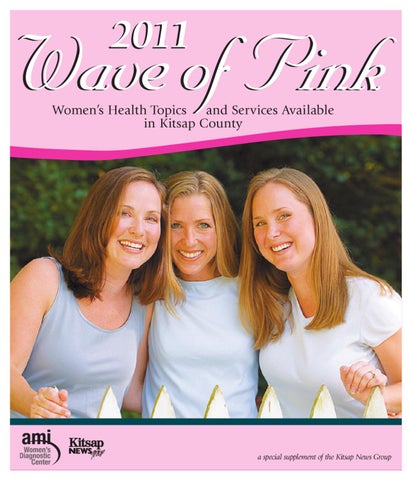
2011
Wave of Pink Women’s Health Topics and Services Available in Kitsap County
a special supplement of the Kitsap News Group
PAGE 2
WAVE OF PINK
SEPTEMBER 9, 2011
HOPE at every turn
Comprehensive cancer care close to home. %RDUG FHUWLÀHG SK\VLFLDQV ,QGLYLGXDOL]HG WUHDWPHQW SODQV &DQFHU UHJLVWU\ SURJUDPV *HQHWLF VFUHHQLQJ FRXQVHOLQJ &OLQLFDO WULDOV
5HIHUUDO ,QIRUPDWLRQ :(// KDUULVRQPHGLFDO RUJ/RQFRORJ\
5DGLDWLRQ RQFRORJ\ 'LDJQRVWLF LPDJLQJ 3URJUHVVLYH VXUJHU\ RSWLRQV ,QSDWLHQW FDUH 5HKDELOLWDWLRQ VHUYLFHV
6SHFLDOL]HG RQFRORJ\ QXUVHV 3DWLHQW QDYLJDWRU 3DOOLDWLYH FDUH &RPSOHPHQWDU\ WKHUDSLHV 6XSSRUW VHUYLFHV
September 9, 2011
WAVE OF PINK Page 3
Wave of Pink 2011
Women’s Health Issues and Services available in Kitsap Count y This 3rd annual publication - WAVE of PINK - is full of vital women’s health information plus services available in Kitsap County by local providers. The past two issues dealt with breast cancer prevention and services, and covered this important topic well. This year we have added topics to include women’s sleep issues, women and heart disease, necessary adult immunizations, hormone replacement or not, importance of exercise, image-guided breast biopsies and several more. Many women have put this annual publication in their “health file” for future reference. PUBLISHER: Sean McDonald COORDINATOR: Wayne Nelson PRODUCTION: Bryon Kempf COVER DESIGN: Bruce Pritchard GUEST COORDINATOR: Susan Phillips, Advanced Medical Imaging
Thank you to the following whose expertise contributed to this publication: Ellen Arthur, RN, Kitsap County Health District
Victor Leen, MD, Advanced Medical Imaging Berit Madsen, MD, Peninsula Breast Center
Gillian Esser, MD
Eva Nicholas, MD, Kitsap Cardiology Consultants
Brad Frandsen, MD, Sound Health Care Center
Scott Richards, PT, Kitsap Physical Therapy Bremerton
Jenifer Henderson, MD, The Doctors Clinic, Cavalon Aesthetics
Kristi van Niel, OT, Harrison Medical Center.
Margaret Krieg, MD, Kitsap Pulmonary and Sleep Medicine
Copyright 2011 ©Sound Publishing Inc.
Differences in heart disease in women versus men BY Eva Nicholas, MD
H
Kitsap Cardiology Consultants
eart disease is far and away the number one killer of women and men, accounting for more than one third of all deaths. Despite this, studies have shown that only 20 percent of women consider heart disease to be their own greatest health risk! One in 2.6 women will die of coronary heart disease while one in 4.6 women will die from all cancers put together. Women’s risk of heart disease is actually equal to that of men over a lifespan, but men have increased risk than women at an earlier age. By the age of 65, however, women have equal risk and overall have more events in later life. It is not known why women have less risk than their male counterparts in their younger years. Some research suggests that women may be protected by the effects of estrogen prior to menopause; however, research has not shown that estrogen supplementation decreases the risk of cardiac events. Women who have a family history of heart disease may present at earlier ages. In fact, a family history (father or brother with heart disease before 55
Eva Nicholas, MD or a sister or mother with heart disease before 65) of heart disease increases a woman’s risk for heart disease 3 fold. The mechanisms of heart disease may be different for women than they are for men. Some data suggest women have more dysfunction of the small blood vessels in the heart as opposed to the large arteries on the outer surface of the heart. This condition, called microvascular dysfunction, can be difficult to diagnose because of lack of findings in diagnostic studies such as
a coronary angiogram. This condition higher in women and may aid in assessmay be a precursor or indicator for ing cardiac risk in women. Hormonal future large vessel disease. syndromes, such as polycystic ovary, When women do present with heart are linked with type 2 diabetes melattacks, they do not do as well as men. litus and higher risk of ischemic heart There is a higher mortality rate for disease. women with epicardial coronary disMultiple challenges exist in our treatease (blockage of the ment of heart disease larger arteries on the surin women today. Our face of the heart). More knowledge is evolvwomen die before even When women do ing with regard to the arriving to the hospital, present with heart differences in ischemic 52% versus 42% women attacks, they do not heart disease in men and versus men respectively. women including the do as well as men. After revascularization, unique role that nontramore women have anothditional risk factors play er heart attack, compliin ischemic heart disease cations of the heart attack, and have in women. Even as our knowledge cardiac arrest. increases, however, traditional risk facThere are some differences in the tors are on the rise in terms of obesity, cardiac risk profile in women and men. diabetes, and hypertension. Potential Women typically have higher choles- new techniques involving the identiterol levels when they reach their 50s fication of inflammatory or hormonal when compared to men. Women and markers may aid in risk assessment men both suffer from high rates of and the more aggressive treatment of diabetes and obesity but women with microvascular disease. New techniques diabetes have a higher mortality when aside, greater attention to the known compared to men. Diabetic men have and enormously significant risk factors had recent trends for improvement in such as obesity, diabetes, hypertension, cardiac risk, and diabetic women have and smoking and increased education not. Other nontraditional risk factors on the true dangers of heart disease also seem to play a more important to women can have an immediate and role in women. Inflammatory markers positive impact on the lives of patients. such as CRP (C-reactive protein) are
Page 4
WAVE OF PINK
September 9, 2011
Vitamin D and calcium for women mg or less is absorbed at one time. On a side note, it is also interesting to know that chewables, liquids, gels or capsules are the best absorbed. This goes for all vitamins.
By Gillian Esser, MD
H
ow much Vitamin D and Calcium does a female need through her lifetime? Vitamin D and Calcium are both needed for optimal health. Calcium is required for vascular contraction and vasodilation, muscle function, nerve transmission and most importantly bone health. Vitamin D helps to support our bones, immune system, helps to reduce the risk of cancer and helps to improve our moods. Calcium can be found in multiple foods that we eat i.e., dairy and leafy greens like broccoli, kale and cabbage. But Vitamin D is our sunshine vitamin, not much Vitamin D can be obtained via foods. As we know, sunshine is not abundant in Washington State, especially during the winter months, so supplementation is essential. Thus, how much do we need of these vitamins? The recommended dietary allowances (RDA’s) for Calcium developed by the Food and Nutrition Board at the Institute of Medicine of the National Academies are as follows: • females between the age of 14 – 18 need 1300 mg/d – if pregnant/breast
Concerning Vitamin D, the goal is to maintain a Vitamin D level of 50 ng/ml, so, it is important to obtain a Vitamin D blood test from your physician. We need to take enough Vitamin D to maintain this level and sometimes that means
Gillian Esser, MD feeding still 1300 mg/d • between the ages of 19 – 50 need 1000 mg/d – if pregnant/breast feeding still just 1000 mg/d • over the age of 50, females need 1200 mg/d. It is important to remember that since most foods contain calcium, most women only need to take one extra calcium supplement per day of 500 mg, as only 500
“Our clients come to us because we have over 30 years of experience in providing exceptional care and services at an affordable price within the comfort and privacy of their own home.�
Kitsap County’s experienced choice for exceptional in-home care at an affordable price. &YDFMMFOU &NQMPZNFOU PQQPSUVOJUJFT .BLF B EJòFSFODF JO ZPVS MJGF CZ NBLJOH B EJòFSFODF GPS TPNFPOF FMTF
t 1FSTPOBM )ZHFJOF t 5PJMFUJOH t &BUJOH BOE .FBM QSFQBSBUJPO t "NCVMBUJPO 5SBOTGFST t %SFTTJOH t #BUIJOH
t .FEJDBUJPO "TTJTUBODF t -JHIU )PVTFLFFQJOH t &TTFOUJBM 4IPQQJOH BOE 1FSTPOBM &SSBOET t 5SBOTQPSUBUJPO UP .FEJDBM "QQPJOUNFOUT
t UPMM GSFF
0MEJOH 3E #SFNFSUPO t LIDT!LJUTBQIPNFDBSF DPN
taking 10,000 iu’s a day. Vitamin D is best absorbed when taken with Omega 3’s. Most over-the-counter Vitamin D is Vitamin D3 which is the active form of Vitamin D. Prescription Vitamin D is D2. Both are recommended for supplementation. If one is very forgetful with taking their vitamins, the prescription supplement is quite easy to remember because you only need to take it once or twice a week.
Vaccine preventable diseases have no age limit By Ellen Arthur, RN, PHN, Nurse Epidemiologist Kitsap County Health District
Vaccine preventable diseases have no age limit- you can get these diseases at any time in your life. People who are not immunized put themselves and others at risk of getting the diseases vaccines prevent. Vaccines are the safest way to get your body’s immune system working to fight disease. Vaccines are tested before they are licensed to make sure they are safe and to see how well they protect people against disease. Vaccines are also monitored for side effects after they are licensed. Vaccines are not 100% risk-free. Some people may have mild side effects, like Ellen Arthur, RN, PHN a fever or soreness where the shot was healthcare provider to find out about given. Severe reactions are rare. The the recommended vaccines; Chicken benefits of preventing disease are great- Pox (Varicella),Hepatitis A, Hepatitis er than the risk of a severe reaction to B, Human Papillomavirus (HPV), a vaccine. Influenza (flu), Measles Mumps and Some diseases are more common in Rubella (MMR), Meningococcal, adults and may cause life threatening Pneumococcal, Tetanus, Diphtheria health problems. Some and Pertussis (Td/Tdap), adults were never immuand Shingles (Herpes nized as children. Zoster). Some diseases are Some diseases, like More immunization measles, spread very eas- more common in information for chilily. It only takes a small adults and may cause dren and adults is availnumber of unprotected life threatening able by calling Kitsap people to cause a disease County Health District health problems. outbreak. at 360-337-5235 and askSome adults were Many health plans ing for a member of the cover recommended never immunized as Immunization Team. Or immunizations. Check children. you can access informawith your insurance plan tion on the web at www. or healthcare provider. kitsapcountyhealth.com, Kitsap County Health or www.cdc.gov, or www.wa.doh.gov. District and many pharmacies and Before our bodies are subjected to medical providers’ offices have vac- the diseases we cannot control, let’s get cines for adults. immunized and give it our best effort Your age, health conditions, job, to prevent the diseases we do have some and lifestyle determine which immu- control over. nizations you need. Talk with your
September 9, 2011
WAVE OF PINK Page 5
What to expect with your first mammogram by Victor Leen, MD, Radiologist
L
Advanced Medical Imaging
pretation. At Advanced Medical Imaging the patient is provided with a private dressing area with lockers to change into a gown. The technologist will perform a brief history and check the breasts for any surface abnormalities such as moles.
ike so many things in life, it is easy to put off getting that first mammogram. Remember this though The mammogram itself breast cancer is the most requires compression of common type of cancer the breast to obtain good in women and is second images. Typically, the only to lung cancer as more the compression, the leading cause of the better the image. The cancer-related deaths in mammography technolowomen. Furthermore, gists have learned from unlike with many many years of experience, other forms of cancer, how to balance comfort early screening for with diagnostic quality. breast cancer has been Compression can make proven to save lives. the mammogram uncomIn the year 2011, for fortable but it should not the average person, be downright painful. there is little doubt that Feedback to the technolomammography is the gist can help best way ensure this. to pick up The whole early breast For many, the process cancer. hardest part takes about W h e n about getting a 20 minutes. to get that mammogram is For many, first mamthe hardest waiting for the mogram has part about become a results. In the getting a bit of a con- perfect world every mammot r o v e r s i a l woman would get gram is subject. In results immediately waiting for the US, the the results. after the test. general conIn the persensus is the fect world first mammogram should every woman would get be at age 40 followed by a results immediately after repeat mammogram each the test. This is impractiyear for women with no cal for two reasons. One, particular risk factors. the mammogram is post Women with risk factors processed and analyzed often start screening earby a computer. This prolier. cess often takes too long Your first mammogram to make it worthwhile will not require much for the patient to wait, preparation. It is best to considering that most avoid deodorant, pow- mammograms are norders, and body gels on the mal. Two, at Advanced day of the test, as these Medical Imaging we percan interfere with inter- form about 80 screening
mammograms per day as well as numerous diagnostic workups, breast ultrasounds, breast MRIs, and image-guided breast biopsies. The large volume enable us to excel at women’s imaging but also makes it impractical for the doctor to try to quickly rush to read the many screening mammograms and meet with patients before they leave. We believe that rushing to read the mammogram before the patient leaves could introduce errors into the diagnostic process and potentially cause
Employment Opportunities... at your Fingertips! Visit www.nw-ads.com or see today’s Classified Section
more harm than good. Typically the results are mailed to the patient within one to two days. It is more common after a first mammogram to be called back for additional views than on subsequent mammograms. On your first mammogram, it is impossible to know if anything is changing and the Radiologist must
carefully scrutinize anything that might be an abnormality, despite the fact that the finding might have been there for many years. Many abnormalities are not worrisome as long as they are not changing, and you need a couple mammograms to compare to see if there are any changes. Like so many things
in life, the first time is the hardest. After the first mammogram most women realize that the small amount of discomfort required for mammography is more than offset by the substantial benefits. There is no doubt that annual mammography significantly decreases a women’s chance of dying from breast cancer.
Page 6
WAVE OF PINK
Image-guided breast biopsies By Victor Leen, MD, Radiologist,
I
Advanced Medical Imaging
n the past, whenever a potential breast cancer was suspected, the usual procedure was to surgically remove the area of concern. In this past decade, advances in imaging technology have made imageguided needle biopsy the procedure of choice when tissue sampling is felt to be appropriate. An image-guided needle biopsy entails sampling the questionable area with a biopsy needle, rather than surgically removing a large area of tissue. Major advantages over surgery are that it is faster, minimally invasive, has a quick recovery, uses only local anesthetic, potentially less expensive, causes less scarring and there is no disfigurement of the breast. There are three imaging modalities used to guide the needle biopsy: ultrasound biopsy, stereotactic biopsy, and MR-guided biopsy. Typically ultrasoundguided biopsy is performed if the lesion is well seen on ultrasound. The procedure is done as an outpatient, in as little time as 15-30 minutes. The skin on the breast is sterilized and local anesthesia is used for
pain control. Oral sedation can be administered if the patient is anxious. A tiny incision is made through which a biopsy needle is introduced. Ultrasound is used to guide the needle to the area of concern and typically 5-10 tissue samples are taken in the area of concern. A small metal clip may be left at the site of biopsy to mark the site in case the biopsy comes back positive for breast cancer. Ultrasound is the preferred method when possible because the patient can lie on her back and no uncomfortable compression of the breast is required. Some lesions like small microcalcifications cannot be seen on ultrasound. In these cases mammographic equipment is used to guide the biopsy. With mammogramguided stereotactic biopsy the patient lies on a table on her stomach with her breast in compression. Typically this takes a bit longer than an ultrasound-guided biopsy and there is extended compression of the breast. The vacuum-assisted biopsy needle will be guided to the precise location and an average of six tissue samples are taken using a hollow needle. There will be slight pressure but no significant pain. Sterile strips and a band-aid will be applied to the skin.
Victor Leen, MD In rare cases a lesion might not be well visualized on either ultrasound or mammogram and the third option is to perform an MR-guided biopsy. MR-guided biopsies are reserved for lesions that can not be biopsied by ultrasound or stereotactically. MR biopsies are more expensive, harder to perform, and take a bit longer. Guided by MR images, the radiologist places a needle into the area of concern and withdraws a
September 9, 2011
small, cylindrical-shaped sample. There is usually only one insertion of the needle, and tissue is extracted in a 360-degree pattern. This biopsy is fast, accurate and minimally invasive. There is little discomfort. In the majority of cases, an imageguided needle biopsy is the procedure of choice. A recent study in Florida found that 30% of breast biopsies performed from 2003 – 2008 were surgical. The rate should be 10% or less according to medical guidelines. The figures in the rest of the country are likely to be similar to Florida’s, researchers say, which would translate to more than 300,000 women a year having unnecessary surgery, at a cost of hundreds of millions of dollars. Many of these women do not even have cancer: about 80% of breast biopsies are benign. There are still many times that a surgical biopsy is preferred. One advantage of surgery is that the whole lesion is usually taken out, whereas image-guided biopsy only samples the lesion, leaving some of it behind in the breast. Anytime an imageguided biopsy discovers breast cancer, the patient will require surgery to make sure all of the cancer is removed. Though a second procedure is required, the information obtained from the image-guided biopsy is very helpful in the surgical planning.
Top 10 Women’s Health Issues Leading Causes of Death Among Females
1 Heart disease 27.2% of deaths 2 Cancer 22.0% of deaths 3 Stroke 7.5% of deaths 4 Chronic lower respiratory diseases 5.2% of deaths 5 Alzheimer’s disease 3.9% of deaths 6 Unintentional injuries 3.3% of deaths
7 Diabetes 3.1% of deaths 8 Influenza and pneumonia 2.7% of deaths 9 Kidney disease 1.8% of deaths 10 Septicemia 1.5% of deaths
thinkpink think
September 9, 2011
WAVE OF PINK Page 7
The key to mammograms screening is that it be done routinely Once is not enough. Don’t delay. Schedule your mammogram today!
LIVE STRONG! HOPE ROCKS!
From the girls at
r 'SPOU 4USFFU r %PXOUPXO 1PVMTCP
:063 )063 1)"3."$:
Keep Your Family Healthy!
Get Fit & Fight at
t 'MV 4IPUT /PX "WBJMBCMF t 1SFTDSJQUJPOT /PX "WBJMBCMF JO B %BZ 4VQQMZ
Silverdale
.PTU *OTVSBODFT "DDFQUFE
$PSOFS PG #VDLMJO )JMM 3PBE 4JMWFSEBMF 8BZ
1IBSNBDZ
TO ALL THE WOMEN WARRIORS.. FROM ALL THE WOMEN AT BLUE HERON
LIVE STRONG THINK PINK!
BLUE HERON JEWELRY CO. 'SPOU 4USFFU t %PXOUPXO 1PVMTCP t XXX CMVFIFSPOKFXFMSZ DPN
10516 Silverdale Way NW Suite 110-B, Silverdale
360-308-9700
Acupuncture & Chinese Herbs t 8PNFO T )FBMUI $BSF t 1BJO *OKVSZ t "MMFSHZ $MFBSJOH
)BSCPS )FBMJOH $FOUFS
Nancy Knode, Licensed Acupuncturist, National Board Certified Located in the Old Kingston Hotel on the waterfront in Downtown Kingston
t XXX IBSCPSIFBMJOHDFOUFS DPN
Go to: MaryKayFoundation.org
To All The Strong Women I Know... Keep on Keepin’ On!
These stories are from mothers, sisters, aunts & best friends. “All� with a drive to achieve a better life, look their best and give back!
Jan Zufelt, REMBA
Find Inspiring Stories! Julie Jennings
Independent Sr. Sales Director jrjennings@marykay.com www.marykay.com/jennings • (360) 271-7890
Kingston - John L. Scott’s #1 Real Estate Specialist
,JOHTUPO t XXX KPIOMTDPUU DPN KBO[ t KBO[!KPIOMTDPUU DPN
Page 8
WAVE OF PINK
September 9, 2011
Sleep affects women’s quality of life By Margaret Krieg, MD
H
Kitsap Pulmonary and Sleep Medicine
ow well a woman sleeps has an effect on her quality of life. Sleep is important for renewing our mental and physical health each day, yet 100 million Americans regularly fail to get a good night’s sleep.
Research has shown that women’s sleep changes over time. In general, we sleep most soundly as a young adult. Sleep problems in young adulthood may arise in relation to menstruation, pregnancy and motherhood. Women with busy lifestyles often cut back on sleep and ignore signs of fatigue. This can lead to daytime sleepiness, poor concentration and other daytime problems. As we age, physical and hormonal changes affect our quality of sleep. Older women get less deep sleep and are more likely to wake up at night. Sleep may also be disturbed when women feel stress, depression, fear or other emotions.
ficulties staying awake or staying with a regular sleep/wake cycle, sleepwalking, bedwetting, nightmares and other problems that interfere with sleep. All can lead to a lowered quality of life and reduced personal health. They endanger public safety and some disorders can be life threatening.
• Go to bed and get up at the same time each day.
Getting enough sleep is important to everyone’s life. Women who take care of home, work and family need to know that getting enough sleep can improve concentration, job performance, social interaction, relationships, and overall well being. When a sleep problem results in disruption in one of these areas, it may be time to consult with a healthcare professional. Successful management of common problems such as sleep apnea, snoring, restless leg syndrome and insomnia can lead to an improved quality of life.
• Get up early in the morning and maintain structured daily activity.
Some sleep problems are temporary and resolve on their own. For better sleep at all times, women should follow these guidelines
There are over 80 disorders of sleep. Theses disorders can lead to problems falling asleep and staying asleep, dif-
“Art for the Cure” A Night Out for Women – with a Great Cause!
L
isa Stirrett, Glass Art Studio and the Women’s Diagnostic Centers of Advanced Medical Imaging are teaming up to offer a fun and informative night out for women in October, which is Breast Cancer Awareness Month. The event is scheduled for Thursday, October 27th from 5:00 – 8:00 pm at the new glass art studio of Lisa Stirrett on Silverdale Way. A variety of “women themed activities” will be on site – including lots of shopping, 123 Fit Exercise, yoga demonstrations, seated massages, refreshments and lots of art. Art for a Cure is a fundraiser for the Susan G Komen Foundation, Puget Sound Chapter. Proceeds raised from the many great raffle items will be donated for breast cancer research. Lisa will be highlighting some of her new glass projects as well as offering demonstrations. She is
creating a new “Pink Line of Glass Art” especially for this breast cancer event. She will also be displaying some of these pink glass pieces at Advanced Medical Imaging Silverdale in October for Breast Cancer Awareness Month on the “AMI Art Wall”.
Advanced Medical Imaging/ Women’s Diagnostic Center will have handouts and a display on the latest technology they offer in breast cancer detection, including 3D Mammography (Tomosynthesis) and 3D Elastrography Breast Ultrasound. Both of these technologies will be available in October. They will also be offering complimentary DEXA heel bone density scans. Mark it on your calendars and plan to attend this fun and worthwhile event for women. For more information, call 360-337-6530.
Lisa Stirrett
• Keep a comfortable, safe environment in your bedroom • Go to bed only when sleepy. Use relaxing sleep rituals such as warm bath or light snack.
• Stay away from fatty, spicy foods that are likely to cause indigestion. • Avoid staying in bed late in the morning to make up lost sleep
• Exercise regularly, but avoid 4-6 hours before bedtime. • Don’t have caffeine within 6 hours of bedtime • Don’t drink alcohol, especially when sleepy. • When possible, avoid daytime napping. • Avoid sleeping pills, or use with caution. Do not use for more than 3 weeks. Talk to your healthcare provider if this advice does not get rid of your excessive daytime sleepiness The worst thing in the world is to try to sleep and not to.” -F. Scott Fitzgerald
September 9, 2011
WAVE OF PINK Page 9
F R E E H E A LT H TA L K
Protect your loved one from falling. You’re invited to a free seminar on fall prevention.
Fall Prevention A panel discussion for you and your loved ones Featuring: Matthew Bushley, MD Speaking on vision and balance Ka Ning Jellison, Pharm.D. Emily Strovink, Pharm.D. Speaking on medications and vertigo Tim Pazier, PT Speaking on balance through exercise Carmen Helle-Doud, Franciscan Lifeline Speaking on home safety Thursday, September 22, 6 – 7:30 p.m. St. Anthony Hospital Smalling Family Education Center 11567 Canterwood Blvd. N.W., Gig Harbor Seating is limited. Register today! Call 1 (888) 825-3227 or visit www.FHShealth.org/ StAnthonyHealthTalks
If you love and care for someone who is struggling with stability or vertigo, we invite you to attend our panel discussion at St. Anthony Hospital to learn specific ways to reduce the risk of falling. Our team of professionals can teach you simple ways to improve balance. From corrective lenses to exercise to medications, we can help you find solutions so you can enjoy the fall season without a fall in your future.
Reserve your space today! Call 1 (888) 825-3227 or visit www.FHShealth.org/StAnthonyHealthTalks FOR ADVANCED MEDICINE AND TRUSTED CARE, CHOOSE ST. ANTHONY HOSPITAL.
-RE )LOH QDPH )+6B6$+ B)3)3B [ SGI $G &RGH )3)3B 3XEOLFDWLRQ 0XOWLSOH 7ULP Âľ [ Âľ ,QVHUWLRQ 'DWH PXOWLSOH
Page 10
WAVE OF PINK
Healthy exercise for the 21st century By Scott Richards PT, SCS, ATC
F
Kitsap Physical Therapy Bremerton
For decades it has been obvious that exercise has multiple significant benefits to overall health. Along with other components, exercise is an important part of maintaining a healthy lifestyle. This can be particularly true when combating unexpected medical conditions. In every case it is important that individuals consult their physicians to determine if they are healthy enough for an exercise program. Over the past many years there have been a number of new types of exercise that have become popular in our society. One of these is Yoga, which originated hundreds of years ago in India, but whose instruction has just recently become a highly sought after skill in the medical scene. Yoga focuses on controlled move-
ments and has shown significant benefits in both flexibility and strength. Postural stability benefits are also gained through yoga. However not all benefits of Yoga are musculoskeletal. Blood pressure and stress level improvements are also very common, and with the meditative background of the exercise that is entirely expected. Another newer but very popular exercise program is Pilates. While less than a century old the number of people participating in Pilates programs is increasing worldwide. It is similar to Yoga in its benefits and does a good job of focusing on core stabilization as well. One big difference is that some Pilates exercises require the use of specific kinds of equipment while Yoga is largely done independent of equipment. For more information on these specific kinds of exercise contact a local fitness facility as most now are offering instructed classes. For those that like to incorporate technology into their exercise regime there is now
the Nintendo Wii. The Wii was introduced a few years ago and instantly “Wii Fit� became hugely popular. This is a video game of sorts but focuses on improving fitness through instruction on games for balance, flexibility and cardiovascular conditioning. In fact, there are both Pilates and Yoga games available for the Wii. We actually utilize the Wii Fit program with our patients here in the clinic and have had very positive responses to it! One downside is that there is a higher up front cost involved with the Wii, but it can be done at any time in the home and is very user friendly. There are some however, that feel these new types of exercise are not for them. In that case just go with plain old walking. Yes walking can be the start of a great exercise program, or can be a full program by itself. Whatever it is that you decide to do, incorporate a little bit of exercise into your daily life and just watch how much benefit you get from it.
September 9, 2011
Scott Richards PT, SCS, ATC of Kitsap Physical Therapy Bremerton
Because
We’re as close as your own backyard
KPS Health Plans has offered quality health plans to residents of Kitsap County for more than 63 years. Our extensive provider network ensures that you will receive care through your choice of doctors, without a referral. In fact, the network includes more than 47,000 providers in the state of Washington alone. When shopping for a health plan, think close to home. Think KPS.
We cover: Individuals and Families Seniors Associations Federal Employees
www.kpshealthplans.com | (360) 377-5576 | (800) 552-7114
September 9, 2011
WAVE OF PINK Page 11
Centralized care simplifies treatment New Peninsula Breast Center centralizes state-of-the-art care for Peninsula patients Berit Madsen, MD
L
Peninsula Breast Center
ike many breast cancer patients, when Mary Potts first received her diagnosis, she was scared. But Potts, who has been in a wheelchair for 25 years with Fredericks Ataxia, a degenerative muscle disease, was worried about more than cancer. “I was actually more afraid of going to the doctor because it is hard and sometimes painful to lift me in and out of my wheelchair,� she said. “Because I was afraid, I avoided getting
The New Standard For Local Navy News
Breast Center and decided to give it a try. The center’s multidisciplinary style of cancer care treatment means that patients, like Potts, can see a mammogram for 15 years.� multiple providers in one visit, After she was diagnosed, including surgeons, radiation Potts was woroncologists, ried she would medical oncologet bounced gists, imaging from one spe- “When I came in, they specialists and cialist to anoth- put me totally at ease, p a t h o l o g i s t s . er. Each new It felt good to know I And the center’s appointment c o o r d i n a t o r, have a place close to represented an Denise Bundow, home that could meet emotional, physARNP is there ical as well as a all of my needs in one to help patients t ra nspor tat ion visit.� like Potts every challenge. What – Mary Potts, step of the way. Potts needed was “When I came breast cancer patient a place where in, they put me she could get all totally at ease,� of her care under one roof. Potts said of her first visit. Potts heard about Peninsula “It felt good to know I have a
NAVY NEWS Kitsap
www.kitsapnavynews.com
Berit Madsen, MD place close to home that could meet all of my needs in one visit.� Multidisciplinary care is convenient for patients but also ensures that each case is carefully reviewed from several viewpoints and areas of expertise. This team approach is becoming more common in medical centers in big cities,
but is still hard to find in rural areas where specialists are likely to be scattered in clinics throughout the community. Until recently, many Peninsula breast cancer patients would travel to Seattle and Tacoma to receive multidisciplinary care. “We use a holistic approach by getting all the specialists together in one room to make a care plan together, so that all of the patient’s doctors are on the same page,� added Bundow. Dr. Berit Madsen along with Denise Bundow ARNP, co-founders of the Peninsula Breast Center, have many years of experience with multidisciplinary care in Seattle, which they brought with them to establish the breast center in Poulsbo. “We believe patients deserve the best possible care, no matter which side of the water they live on,� Madsen says. “We’re proud to be able to provide coordinated care right here on the Peninsula.�
Page 12
WAVE OF PINK
OGY L O N ECH BER T D 3 ST N OCTO E T A L THE ILABLE I AVA
September 9, 2011
Comprehensive Breast Diagnostic Center
SILVERDALE
1780 NW Myhre Rd., #1220
POULSBO
22180 Olympic College Way, #101
PORT ORCHARD
450 South Kitsap Blvd., #110
AMI is proud to offer the most comprehensive diagnostic breast imaging services to women in Kitsap, Jefferson and Mason counties. Our Women’s Diagnostic Center in Silverdale can evaluate breast abnormalities and concerns in a timely manner and one of our radiologists is on site for evaluation and consultation every day. All female technologists perform the following exams in a private, women-only setting:
t % .BNNPHSBQIZ 5PNPTZOUIFTJT
t 4IFBS 8BWF % &MBTUSPHSBQIZ #SFBTU 6MUSBTPVOE t %JHJUBM .BNNPHSBQIZ t #SFBTU .3* t 4UFSFPUBDUJD $PSF #JPQTZ t 6MUSBTPVOE HVJEFE #JPQTZ t .3* HVJEFE #JPQTZ All breast modalities are American College of Radiology accredited. For patient convenience, digital mammography and DEXA bone density scans are also offered at our Port Orchard and Poulsbo Women’s Diagnostic Centers. Walk-in appointments for mammograms are available in Silverdale and Poulsbo. Regular mammograms are the best protection against breast cancer, starting at age 40 and continuing for as long as a woman is in good health. Get screened today.
Accredited by the American College of Radiology in CT, MRI, Ultrasound and Mammography
Subscribe to our quarterly Especially for Women e-newsletter at contact@amiradiology.com.
SEPTEMBER 9, 2011
WAVE OF PINK
PAGE 13
The pros and cons of hormone replacement therapy hormone therapy can slow bone loss that occurs after menopause, which can decrease the risk of fractures.
BY BRAD FRANDSEN, MD
I
SOUND HEALTH CARE CENTER
n the past hormone replacement medications were standard treatment for post-menopausal women, especially for those who experienced hot flashes and other menopause symptoms. These medications contain female hormones and doctors prescribed them in an effort to replace the hormones that the body does not make after menopause. Hormone replacement therapy was also thought to prevent osteoporosis and heart disease. In 2002 feelings regarding hormone therapy changed because of a large clinical trial that showed that the treatment caused more health risks than benefits for many postmenopausal women. As a result, doctors became more hesitant to prescribe medications that might cause such health risks – posing a dilemma for menopausal women. The general consensus currently is to take the lowest dose of hormone for the shortest length of time possible after onset of menopausal symptoms. The decision regarding treatment should follow a discussion between the women and her physician of the possible risks and benefits of treatment. What are the benefits of hormone therapy? Estrogen and progesterone together are
• Colorectal cancer. Studies show that hormone therapy can decrease the risk of colorectal cancer. • Heart disease. Some data suggest that estrogen can diminish risk of heart disease when taken early in the postmenopausal years. A randomized, clinical trial is now underway and will eventually provide doctors with more information about estrogen use and heart disease. What are the risks of hormone therapy?
Brad Frandsen, MD typically taken by women who choose standard hormone therapy during natural (nonsurgical) menopause. Estrogen alone is used in women who have undergone a hysterectomy. Hormone therapy can help ease vaginal symptoms of menopause, such as dryness, itching, burning and discomfort with intercourse. Although long-term hormone therapy is no longer regularly recommended, women who take estrogen for short-term reprieve of menopausal symptoms may gain some protection against the following conditions: • Osteoporosis. Studies show that
In the largest clinical trial to date, the combination estrogen-progestin (Prempro) increased the risk of specific serious conditions. The study followed 10,000 women over one year and found that the women taking estrogen plus progestin compared to placebo - experienced: • Seven more cases of heart disease • Eight more cases of breast cancer • Eight more cases of stroke • Eighteen more cases of blood clots • An increase in abnormal mammograms, particularly false positives The study did not find any increased risk of breast cancer or heart disease among women taking estrogen without progestin.
Women’s waterworks BY KRISTINE VAN NIEL
Y
HARRISON MEDICAL CENTER
ou know the feeling…when you sneeze, you cross your legs to reduce the amount of urine you leak. Or you drop what you are doing to run to the bathroom, unfastening your pants along the way, since you know you won’t have time to get that done once you reach the bathroom. Both of these are very common problems, and 70% of those people with this experience are women. There are different types of urinary incontinence. The most common two types are stress incontinence which occurs when you
leak with coughing, sneezing, laughing, yelling, lifting, etc. This is more common prior to menopause. After menopause, the most common type of urinary incontinence is urge incontinence which is when you don’t quite make it to the bathroom in time. This amount can vary between a few drops that escape before you are seated on the toilet, to almost the entire bladder emptying. There are several causes of urinary incontinence, and there are many approaches to treat it as well. Two of the better known approaches include surgery and medication. (You’ve seen the ads…”Gotta go! Gotta go!”) There is a third approach that works for many women (and men), but that is not as well known, and that includes rehabilitation.
Find out what’s happening
Kristine Van Niel There are exercises, beyond the infamous
in communities around the county in “Kitsap Week” inserted into the Central Kitsap Reporter, Bremerton Patriot, North Kitsap Herald, Port Orchard Independent and Bainbridge Island Review
Over one year, however, 10,000 women taking estrogen by itself might experience: • Twelve more cases of stroke • Six more cases of blood clots in the legs • An increase in mammography abnormalities (Doctors are concerned about the effect of hormone therapy on mammograms because the study suggests that women on hormone therapy might need mammograms and/ or additional testing more often.) Who should consider hormone therapy? Despite the risks, estrogen is still the gold standard to treat menopausal symptoms. The overall risk to an individual woman taking hormone therapy is quite low — possibly low enough to be acceptable, depending on the symptoms experienced. The benefits of short-term hormone therapy may outweigh the risks if you: • Experience moderate to severe hot flashes or other menopausal symptoms • Have lost bone mass and either aren’t able to tolerate other treatments or aren’t benefitting from other treatments The best way to conclude if hormone therapy is right for you is to discuss your individual symptoms and health risks with your doctor. Together, you will be able to decide what the best treatment options are for you.
Kegel exercises, that can be done to strengthen a person’s pelvic floor muscles and core muscles that help support the pelvic floor. These exercises are easy to perform and, for most people, produce great results. It is important to note that not every problem can be solved with exercises, and to realize that even if surgery is needed, healing may occur more quickly if the muscles are strong going in to surgery. There are even some studies that indicate that surgical repairs last longer if the pelvic floor muscles have been strengthened. At Harrison Medical Center, the Rehabilitation Department has therapists to assist people with urinary and fecal incontinence as well as chronic constipation and pelvic pain. The therapy includes very simple exercises to be done at home. For many people, this is an effective method of addressing a frustrating or embarrassing problem, and it is usually covered by your medical insurance.
Page 14
An Autumn Luncheon to Celebrate Women Susan Phillips
E
Angie Harrison Memorial Guild
xciting plans are underway for An Autumn Luncheon to Celebrate Women. This women’s event is scheduled for Friday, September 30th at the Kitsap Conference Center in Bremerton. The luncheon is coordinated by Harrison Medical Center Foundation’s newest guild – the Angie Harrison Memorial Guild, and proceeds will benefit Harrison’s Intensive Care Unit. Beautiful fall centerpieces, live and silent auctions, raffle for soughtafter items, a delicious lunch and dessert selections plus an inspiring and entertaining speaker are a part of this fun afternoon event for women.
Guests are sure to enjoy the event program from the founder of Seattle’s Total Experience Gospel Choir, Patrinell “Pat” Wright. This wonderful woman – full of great life experiences – will share her love of life as she “celebrates women and all they can and have accomplished”. She will close along with several members of her choir in a beautiful gospel tune and she is sure to bring lots of enthusiasm and joy to this room full of women! Mistress of Ceremonies for the event is Berit Madsen, MD, co-founder of Peninsula Cancer Center. She was voted “Top Radiation Oncology Doctor” in Seattle for many years, and has now opened a radiation oncology practice in Poulsbo. She was also instrumental in starting the Peninsula Breast Center, which has tremendous value to women
WAVE OF PINK
September 9, 2011
recently diagnosed with breast cancer. Financial sponsorship has been secured from several generous donors. Advanced Medical Imaging/Women’s Diagnostic Center is the title sponsor for the event. This medical imaging practice of nine radiologists has four imaging centers in Bremerton, Silverdale, Port Orchard and Poulsbo and a staff of 65 employees. AMI is an established medical practice with over 33 years in Kitsap County, and has been a generous contributor and community involved business for many years. Presenting sponsor is Dr. Lois Bresaw/Olympic Gynecology and Women’s Care in Poulsbo. Dr. Bresaw has been a loyal, long term sponsor to the hospital foundation and her continued support to this women’s luncheon is very appreciated. Dr. Bresaw, who has been in practice for over 18 years, has dedicated her practice to focus on gynecology and women’s health issues. Clark Nuber Accounting, Wells Fargo and Puget Sound Energy have also agreed to sponsorship, which is greatly appreciated. Media sponsorship has been secured by the Kitsap News Group who will publicize this event in several venues.
Many exciting auction items have been procured and will make excellent gifts for the holidays for the highest bidder, including a Christmas shopping trip for 35 women on the Hale’s Alehouse double-decker bus, including refreshment to and from. Experiences, trips, $400 shopping spree and lots of gifts and services are also included.
A fun raffle and memento gifts for everyone in attendance are also planned. Tickets are $50 per person and can be purchased beginning August 1st by calling the Harrison Medical Center Foundation at 360-744-6760. This event is sure to sell-out as there is lots of interest.
LUNCHEON NET PROCEEDS TO SUPPORT INTENSIVE CARE UNIT (ICU) Friday, September 30, 2011 11:30 am Kitsap Conference Center
at Bremerton Harborside, 100 Washington "WFOVF t #SFNFSUPO 8BTIJOHUPO
Great Silent Auction and Spectacular Live Items Fun RaffleBeautiful Fall Centerpieces Inspiring, Entertaining Program Delicious Luncheon and Desserts
Generously Supported by:
Presenting Sponsor
Tickets: $50 per Guest For more exciting details, check the Foundation website: www.harrisonfoundation.org Invitations to follow. Reservations accepted beginning August 1st. Online reservations accepted at: www.harrisonfoundation.org with VISA, MC, American Express or Discover payment. For more information about hosting a table of eight, please call (206) 842-5112
Title Sponsor
Reservations accepted August 1st ~ 360-744-6760
Media Sponsor
Coordinated by Harrison’s Newest Guild ~ Angie Harrison Memorial Guild
September 9, 2011
Guide to timeless beauty
WAVE OF PINK Page 15
Puget Sound’s Premier Center for Facial Rejuvenation
jenifer henderson, MD
I
the doctor’s clinic / cavalon aesthetics
t is always fun for me to look at a person’s face and try to determine what about that person’s face makes them look youthful and attractive versus aged, unhealthy or “operated on”. Most of the changes seen in the face as we age are the result of loss of support and fullness in combination with hereditary factors, smoking history, and sun exposure.
Facial surgery has really evolved over the past fifteen or so years. Gone are the days of the overly tight face, the “wind tunnel appearance”. When rejuvenating a face, we now strive for a soft, natural appearance this is achieved using modern surgical techniques. The “skinonly removal” type of facelift is a thing of the past. The skin provides no structural support so this type of lift only lasts one to two years and, because so much tension is placed on the skin, it gives an overly-tight appearance that is unacceptable to most people. Newer facelift techniques involve a two layer approach, called a “deep plane” or SMAS facelift. The facial skin is lifted, but an additional second layer, deep to the skin, is also lifted. This second layer, the SMAS layer, is a fibrous - fatty layer that attaches to the lower facial muscles. Tension is diverted to this deeper layer during the lifting process and results in a more natural look with a much longer duration. With this technique and proper incision placement, once the healing process is complete, there will be little, if any, tell-tale signs that surgery has been performed. A newer procedure that has really enhanced my face lifting results is fat injection. Fat injections, or “lipostructure”, add volume to the face on a more permanent basis.
Jenifer Henderson, MD We “borrow” fat from areas of excess – saddle bags, love handles, inner knees; process it, and actually re-inject it into the face to fill it out. If you look at little child’s face, it is a full face. As we age, we lose volume in the face. Deep valleys in the face, volume loss, and sagging skin create the appearance of aging or poor health. By removing excess skin, tightening facial muscles and re-volumizing the face we can recreate the appearance of youth. Typical areas for fat injections are the cheeks, temples, nasal folds, jaw line and even in the hollows underneath the lower eyelids. It never ceases to amaze me to see how adding back facial volume makes one look so much younger. I frequently recommend fat injections in combination with deep plane face lifts; it takes what would normally be a good surgical outcome and just makes it better. Interestingly current scientific research has demonstrated that harvested fat cells actually also contain an abundance of stem cells and various growth factors. Stem cells and growth factors show promising results for mending sun damaged
and aged skin by improving skin texture, elasticity and color. Stem cells are the new buzz in facial rejuvenation and I look forward to exciting new procedures combining them in the rejuvenation process. When properly planned and executed, modern face lifting procedures can provide long lasting, natural results. Ancillary procedures such as fat injections, eyelid surgery, skin resurfacing, chin augmentation, rhinoplasty and forehead lifts all combine to improve the final outcome. My practice is unique in that we only operate and perform services only on the face. We therefore are uniquely qualified to tailor each procedure to achieve an outcome that is harmonious with age and appearance. It is my firm opinion that no surgeon performing full cosmetic surgery can be an expert at every procedure and that is why I chose to specialize in plastic and reconstructive surgery isolated to the face and neck. Attention to detail, beautiful, yet natural, surgical outcomes with a female prospective are what I am all about.
Dr. Jenifer Henderson World-Renowned, Board-Certified Facial Plastic Surgeon Cavalon Aesthetics 2011 NW Myhre Silverdale, WA (360) 830-1755 www.CavalonAesthetics.com “Only Trust Your Face to a Facial Plastic Surgeon”
Page 16
WAVE OF PINK
September 9, 2011
3-D Mammo comes to the NW PAID ADVERTISEMENT
W
SPECIAL ANNOUNCEMENT
by lung cancer. Statistics indicate that one hen it comes to cutting edge in eight women will develop breast cancer medical technology, most PDJLQJ //& WKLV PRQWK KDV DQQRXQFHG ,Q+HDOWK ,PDJLQJ //& $QQRXQFHV sometime in her lifetime. The stage at patients travel to Seattle. But DWHV WR RIIHU ' 'LJLWDO 0DPPRJUDSK\ )LUVW 6LWH LQ WKH :HVWHUQ 8QLWHG 6WDWHV WR RIIHU which breast cancer is detected influences a these days, some women are traveling across HHQLQJ DQG GHWHFWLRQ ZKLOH UHGXFLQJ woman’s chance of survival. When detected WKH FXUUHQW FKDUJH LV HTXDO WR D VWDQGDUG the water to Poulsbo for the latest in breast ' 0DPPRJUDSK\ DOVR NQRZQ DV 7RPRV\QWKHVLV early, less extensive treatment is needed and cancer detection. That’s right, Poulsbo. Our the five-year survival rate is 97 percent. local clinic, InHealth Imaging, became The clinic also offers a full-spectrum one of the first in the nation to provide the of breast imaging services, including; new technology called 3-D mammography Breast MRI, diagnostic ultrasound and or tomosynthesis. The new equipment Dr. Manfred Henne, MD-PhD, MS ultrasound-guided core biopsies. 3-D was approved by the FDA in March and mammograms Though very few mammograms advocates worldwide have praised its H are covered by benefits. One woman even traveled from the lead to biopsies, women who are asked UDWHV Phillipines to visit the local clinic. insurance and to undergo the procedure can often UHGXFLQJ Detecting breast cancer is no easy cost the same experience great discomfort. The new as standard equipment provides a more comfortable task for radiologists, especially for early digital cancers. In traditional 2-D mammography, upright position and a continuous flow P 3-D mammo facility and technologist there is considerable guesswork in detecting with lidocane, a numbing agent, reducing mammography. JKW suspicious areas, since normal breast tissues discomfort and bruising. Many patients InHealth Imaging also participates in OHVLRQ can overlap and create ‘phantom’ images therefore experience a completely pain-free various programs for low-income patients, FKHVW ZDOO so that they can receive the treatment they that appear like lesions. For many women, recovery. WLF WDEOH need. For more information visit their By offering women the latest this leads to unnecessary and costly biopsies. website: www.inhealthimaging.com or call technology in mammography, InHealth The new technology eliminates the //& their office at (360) 598-3141. â—† Imaging hopes to increase the number of guesswork by taking a series of low6XVSLFLRXV /HVLRQ women who will be routinely screened. dose images and constructing ,Q WKH VFUHHQLQJ ' PDPPRJUDP OHIW LPDJH WKHUH LV D SRVVLEOH OHVLRQ LQ WKH FHQWUDO EUHDVW XDOO\ Breast cancer is the second leading cause of them into a 3-D image EXW LWV PDUJLQV DUH GLIĂ€FXOW WR DVVHVV 8VLQJ WRPRV\QWKHVLV WKLV FDQ EH FOHDUO\ VHHQ WR EH D cancer death among women, exceeded only VSLFXODWHG PDVV DQG DOPRVW FHUWDLQO\ D PDOLJQDQF\ of the breast. The ability to look around these overlapping structures, eliminates ‘phantoms’ giving the radiologist a greater * / ) & " - 5 ) As editorially featured on ability to detect smaller KING 5 News Healthlink lesions or rule our cancer UHFWRU RI 'HYHORSPHQW [ with greater confidence. ER :DVKLQJWRQ Celebrating Breast Cancer Dr. Henne was moved to become >˜vĂ€i`ĂŠ i˜˜i]ĂŠ
Z LQKHDOWKLPDJLQJ FRP one of the first to adopt the 3-D technology Awareness! 15. 2! . *ÂœĂ•Â?ĂƒLÂœĂŠ >ÂˆÂ˜ĂŠ “>}ˆ˜}ĂŠ iÂ˜ĂŒiĂ€\ĂŠÂĂŽĂˆĂ¤ÂŽĂŠx™n‡Î£{ÂŁ 1* //& because of his intimate history with cancer: -ˆÂ?Ă›iĂ€`>Â?iĂŠ ˆ}ÂˆĂŒ>Â?ĂŠ8‡À>ÞÊ"vwVi\ĂŠÂĂŽĂˆĂ¤ÂŽĂŠĂŽĂ¤Ă‡Â‡Ă‡Ă¤nÇ
>ˆ˜LĂ€Âˆ`}iĂŠ ĂƒÂ?>˜`ĂŠ ˆ}ÂˆĂŒ>Â?ĂŠ8‡À>ÞÊ"vwVi\ĂŠÂĂ“Ă¤ĂˆÂŽĂŠ{x£‡{ÓÓä “We want the best tools to detect these 50% off mammos* +)43!0 -!,, ĂŽ ĂŠ " , * 9]ĂŠ , ]ĂŠ /]ĂŠ " ĂŠ - /" /,9ĂŠÂ 8 ÂŽ]ĂŠ / ĂŠ8‡, 9]ĂŠ1 /, -"1
]ĂŠ 1 ,ĂŠ ]ĂŠ 1","- "*9]ĂŠ* ĂŠ / " *Cash-pay only, schedule now through October 31, 2011 for cancers early, because that saves patient’s exams before September 30, 2012. lives.â€? InHealth Imaging is also the only *>ĂŒÂˆiÂ˜ĂŒĂŠĂšĂšĂšĂšĂšĂšĂšĂšĂšĂšĂšĂšĂšĂšĂšĂšĂšĂšĂšĂšĂšĂšĂšĂšĂšĂšĂšĂšĂšĂšĂšĂšĂš ĂŠ ÂˆĂ€ĂŒÂ…`>ĂŒiÚÚÚÚÚÚÚÚÚÚÚÚÚ clinic in the region to provide a new kind 3-D Mammography CT
ÂŤÂŤÂœÂˆÂ˜ĂŒÂ“iÂ˜ĂŒ\ĂŠ /ˆ“iĂŠ ÚÚÚÚÚÚÚÚÚÚÚÚÚÚÚÚÚÚ of stereotactic breast biopsy. “This is aĂŠ >ÞÚÚÚÚÚÚÚÚÚÚÚÚÚÚÚÚÚÚÊ ˜ i>Â?ĂŒÂ…ĂŠ “>}ˆ˜}ÊÉÊ*ÂœĂ•Â?ĂƒLÂœĂŠ >ÂˆÂ˜ĂŠ “>}ˆ˜}ĂŠ iÂ˜ĂŒiĂ€ AďŹ rma™ Thyroid Analysis MRI High Field 1.5T ÂœĂ€ĂŒÂ…ĂŠ ÂˆĂŒĂƒ>ÂŤĂŠ i`ˆV>Â?ĂŠ iÂ˜ĂŒiĂ€ significant advancement in patient comfort, â€? Digital Ultrasound Nuclear Medicine ÓäÇääÊ œ˜`ĂŠ,`°]ĂŠ Â?`}°Ê ]ĂŠ*ÂœĂ•Â?ĂƒLÂœ]ĂŠ7 ʙnÎÇä Ă?>“Ê,i¾ÕiĂƒĂŒi`ÊÚÚÚÚÚÚÚÚÚÚÚÚÚÚÚÚÚÚÚÚÚÚÚÚÚÚÚÚÚÚÚÚÚÚÚÚÚÚÚÚÚÚÚÚÚÚÚ ˜ i>Â?ĂŒÂ…ĂŠ “>}ˆ he says, “because it greatly decreases pain Bone Densitometry Pain Injections (360) 598-3141 during the procedure.â€? Â?ˆ˜ˆV>Â?ĂŠ ˜vÂœĂ€Â“>ĂŒÂˆÂœÂ˜Ă‰*Ă€ÂˆÂœĂ€ĂŠ-ĂŒĂ•`ˆiĂƒĂŠĂšĂšĂšĂšĂšĂšĂšĂšĂšĂšĂšĂšĂšĂšĂšĂšĂšĂšĂšĂšĂšĂšĂšĂšĂšĂšĂšĂšĂšĂšĂšĂšĂš Digital X-Ray Fluoroscopy w w w. i n h e a l t h i m a g i n g . c o m
09:; $0;, 05 ;/, ',:;,95 &50;,+ $;(;,: ;6 6--,9 (446.9(7/@ (3:6 256>5 (: %646:@5;/,:0:
;/, ',:;,95 &50;,+ $;(;,: ;6 6--,9 .9(7/@ (3:6 256>5 (: %646:@5;/,:0:
â—?
â—?
â—?
â—?
â—?
â—?
â—?
â—?
â—?
â—?
3)
#,%!2 #2%%+ 2$
* . " ( * / (
,i¾ÕiĂƒĂŒi`ĂŠLÞÊ ÚÚÚÚÚÚÚÚÚÚÚÚÚÚÚÚÚÚÚÚÚÚÚÚÚÚÚÚÚÚÚ ° °ÊÊ °"°ÊÊ ° °ÊÊ* ĂŠĂŠ *ĂŠ
/. !6% 3
7).3,/7 7!9 7
ÚÚÚÚÚÚÚÚÚÚÚÚÚÚÚÚÚÚÚÚÚÚÚÚÚÚÚÚÚÚÚÚÚÚÚÚÚÚÚÚÚÚÚÚÚÚÚÚÚÚÚÚÚÚÚÚÚÚÚÚ
"*5. %
˜ i>Â?ĂŒÂ…ĂŠ “>}ˆ >ˆ˜LĂ€Âˆ`}iĂŠ ĂƒÂ?>