







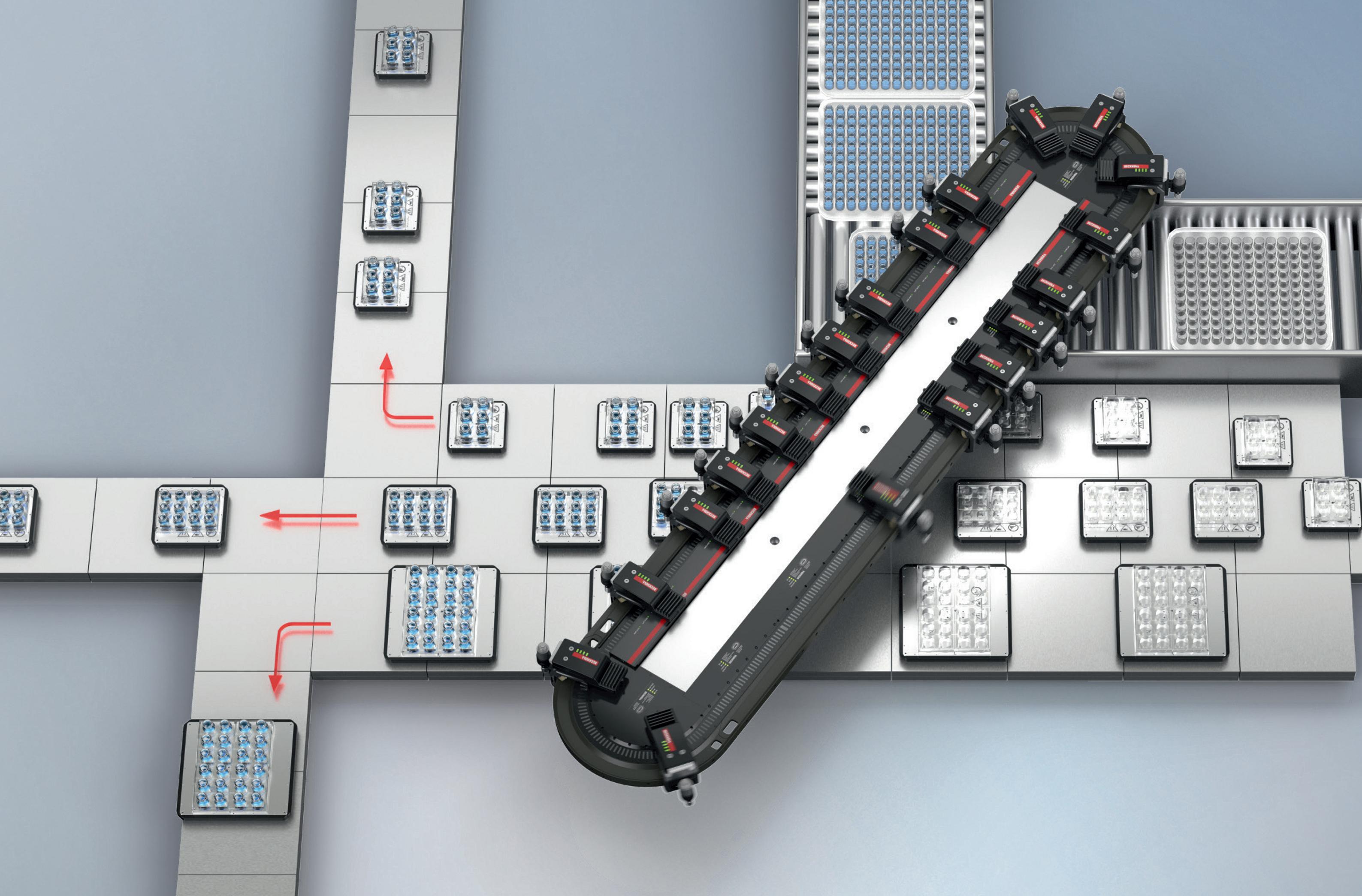
What if your packaging line could float, adapt, and think? This isn’t just motion control, it’s a revolution in machine design.
XPlanar: A fleet of maglev movers in multiple sizes float and fly with total freedom and enable hygienic, contact-free product handling in any direction at up to 3 meters per second. XTS with NCT: Independently controlled, wireless movers can synchronize with XPlanar and operate powered end effectors like grippers, sensors, and pneumatics much like a robot.
Together, XPlanar and XTS create a choreography of intelligent product transport, ideal for: adaptive format handling multi-product packaging inline inspection and rejection real-time process feedback total elimination of mechanical handoffs
This is the revolution in packaging machinery: Modular. Scalable. Software-defined. Only from Beckhoff.










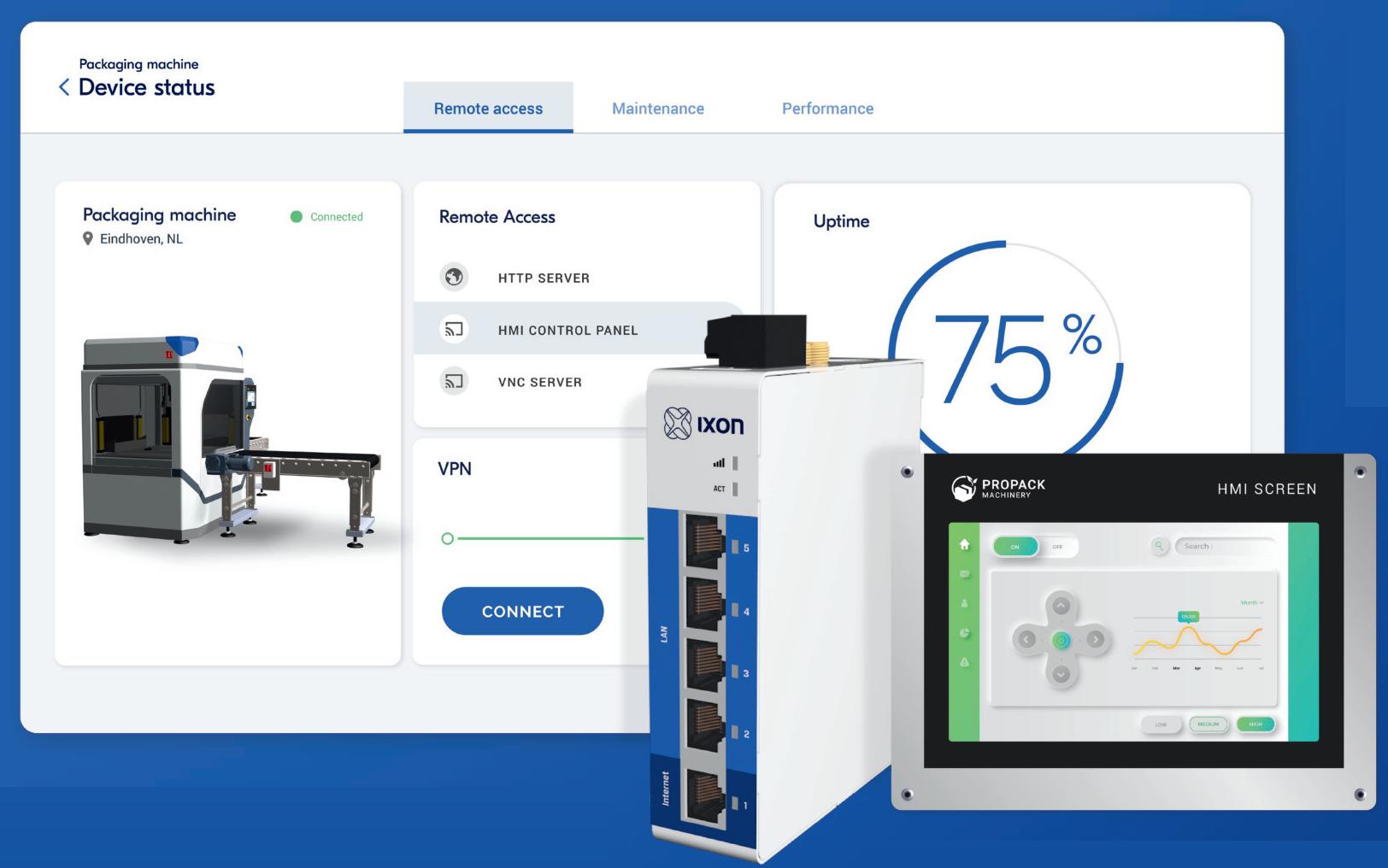
Out-bound only VPN, ISO 27001 & IEC 62443 certified
Unlimited users & devices, no license fees
No VPN data or concurrent access limits
Plug & play with your PLCs & IT stack
CONNECT
BUSINESS INTELLIGENCE
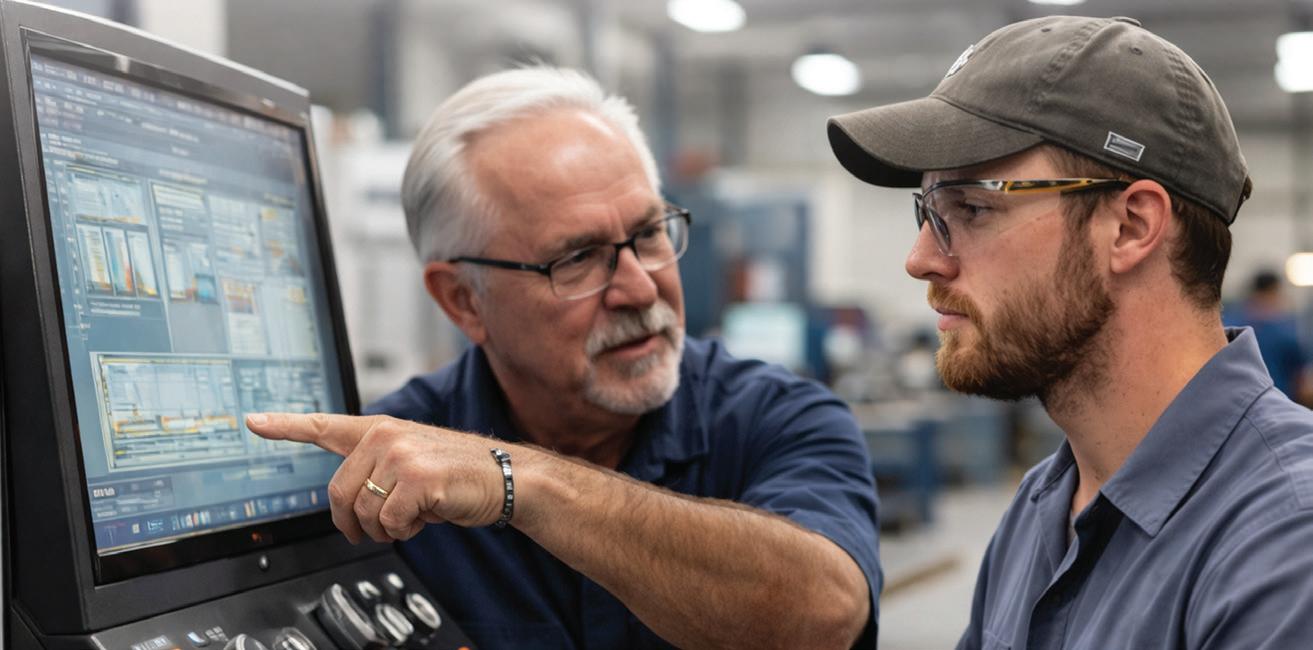
8 Engineering Best Practices
Fighting back against teams that are stretched thin.
SALES FOCUS
10 AI Meeting Tools
Turn sales calls into competitive intelligence.
MARKETING INSIGHTS

Five
The second-generation
Survey


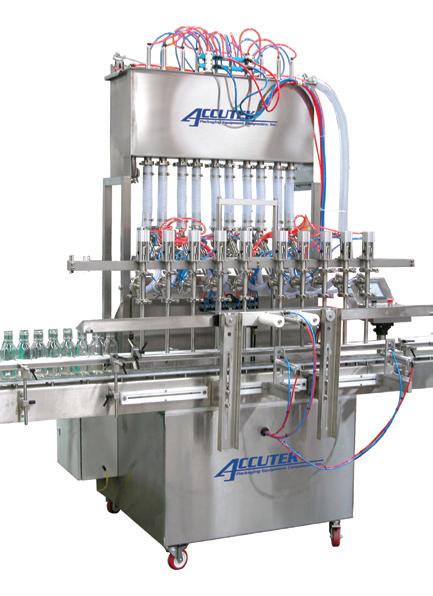
14 The Modern Machinery Buyer
Prioritizing the early research phase.
INDUSTRY
16 PACK EXPO East
Three high-energy days of AI, sustainability, networking, and education.
ASSOCIATION
42 PMMI Member Roundup Mike Rowe headlines the Executive Leadership Conference.
EXHIBITOR’S
46 Embracing Technology
AI-powered trade show strategies.




PERSPECTIVES
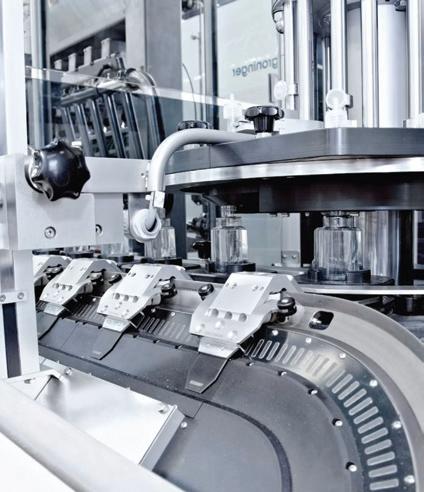
48 Digital Twins
Seven questions CPGs are asking OEMs.
WOMEN’S LEADERSHIP
50 PPWLN Learning Circle
Establish connections vs. collecting contacts.
WORKFORCE
52 Tipping Point for AI

The shi from adoption to advantage.





84
Machine Technology
Check out the latest product innovations.
88 The Edge You Can’t Automate Trust is still built face-to-face.

The official publication of PMMI OEMMAGAZINE.ORG
Sean Riley Editor-in-Chief sriley@pmmimediagroup.com | 571 266 4419
Tracey Labovitz Editorial Operations Coordinator
Kim Overstreet Director of Content
Norman Smith Art Director
David Bacho Creative Director
Reggie Lawrence Vice President, Sales rlawrence@pmmimediagroup.com
Courtney Nichols Director, Client Success & Development cnichols@pmmimediagroup.com
Lara Krieger Senior Manager, Print Operations lkrieger@pmmimediagroup.com
Janet Fabiano Financial Services Manager jfabiano@pmmimediagroup.com
PMMI Media Group
500 W Madison, Suite 1000, Chicago, IL 60661 www.pmmimediagroup.com
David Newcorn President
Elizabeth Kachoris Vice President, Digital
Jen Krepelka Senior Director, Digital Media
Amber Miller Director of Marketing
Joan Jacinto Director, Ad Tech and Search
PMMI, The Association for Packaging and Processing Technologies
12930 Worldgate Dr., Suite 200, Herndon VA, 20170 Phone: 571 612 3200 | Fax: 703 243 8556 www.pmmi.org
Jim Pittas President and CEO
Joe Angel Executive VP, Industry Outreach, PMMI
Glen Long Senior VP
Tracy Stout VP, Marketing and Communications
Laura Thompson VP, Trade Shows
Andrew Dougherty VP, Member Services
SUBSCRIPTIONS
To subscribe to OEM visit: oemgo.to/9999
To change or modify a subscription, please contact circulation@pmmimediagroup.com
OEM EDITORIAL ADVISORY BOARD
Greg Berguig President, PAC Machinery
Jacob Cox VP of Electrical and Controls, Fallas Automation
Rick Fox III Vice President, Fox IV Technology
Jordan Hamrick President, Hamrick Packaging Systems
Paul Irvine Executive Chairman & Owner, Plexpack
Zack Lynch Founder, Next Tech Automation
Stacy Johnson VP Business Development, Hoosier Feeder Company
Tom Sosnoski Director of Advanced Development, JLS Automation
Alex Vargo VP of Manufacturing, LAKO
Colin Warnes Director Sales Engineering & Project Management, ADCO Manufacturing


By Sean Riley, Editor-in-Chief
Anyone who has read one of my opening columns knows I’ve been at this for a while and often use this space to reflect on the changes I’ve seen during my nearly quarter-century in the world of packaging and processing. One shift that has really resonated with me is the growth of conglomerates, often composed of businesses that were once smaller, familyoperated companies.
There was a time when PACK EXPO show floors were filled with individual corporations that are now part of sleek, one-stop shops offering completely integrated operations under one umbrella.
I’m not pointing out this shift as good or bad. Mainly because I can easily argue how both sides can be beneficial to the customer depending on individual wants and needs.
And I don’t believe our cover story, Legacy Is Earned, Not Inherited (p. 18), takes a side either. Instead, it offers a deep and passionate reflection from five multi-generational companies on the changes they’ve made to remain viable in today’s market.
For those on the family-run side of the table who hope to stay in the game, I believe this story offers meaningful insight into how they can succeed into the next generation.
It was a fun story to write, and I was humbled as each participant thanked OEM and PMMI for providing a platform to share their story.
People in this industry truly love this industry — and it’s fair to say it has served us all well.
As always, I hope you enjoy this issue of OEM. If you have feedback—positive or negative—please reach out at sriley@pmmimediagroup.com. ■













DEBRIS TOLERANT
Systems designed to perform in abrasive and demanding environments.
INDUSTRIES
Food processing, medical, aerospace, packaging, and more.

MODULAR RTUS
Heavy-duty 7th and 8th axis RTUs for complex systems.

CUSTOMIZATION
End-to-end automation designs from concept to production.
Bishop-Wisecarver® delivers production-ready automation—from design and fabrication to integration, commissioning, and lifecycle support— engineered to reduce risk and perform for decades.
Trusted for 75 years in demanding industrial environments, our solutions are easy to specify and supported by experts to keep projects on track.
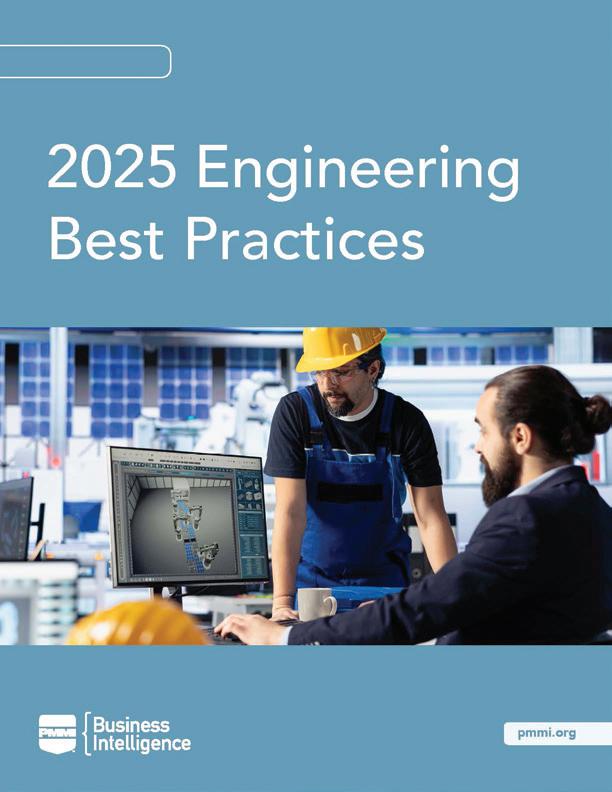
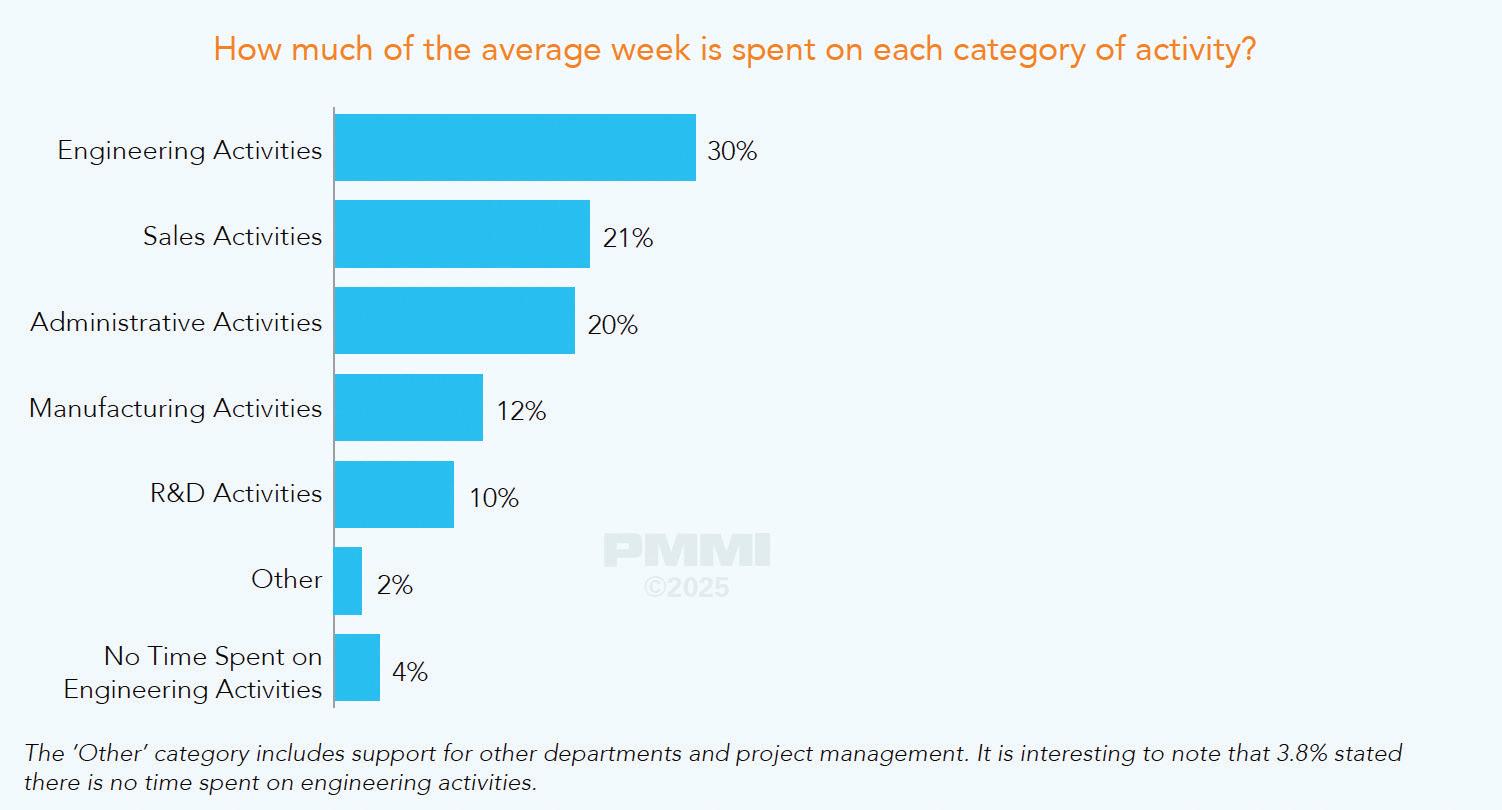
With engineers spending just 30% of their week on true engineering work, PMMI’s new research charts a path for OEMs to reclaim e ciency and protect critical expertise.
By Sean Riley, Editor-in-Chief
It’s no secret that, over the past few years, engineering teams have found themselves stretched in new ways, with no relief in sight. PMMI Business Intelligence’s 2025 Engineering Best Practices report highlights the strategies forward-looking OEMs are using to stay competitive during an era of workforce shortages, and uneven digital adoption.
Drawing on data from 72 manufacturers, plus in-depth interviews, the report captures a picture of engineering teams whose roles are expanding beyond pure design. Engineers today are expected to juggle technical work alongside sales support, documentation, customer-facing tasks, and leadership responsibilities. In fact, only about 30% of an engineer’s weekly hours are spent on engineering activities, according to those surveyed, a signal that many companies are overextending technical talent.

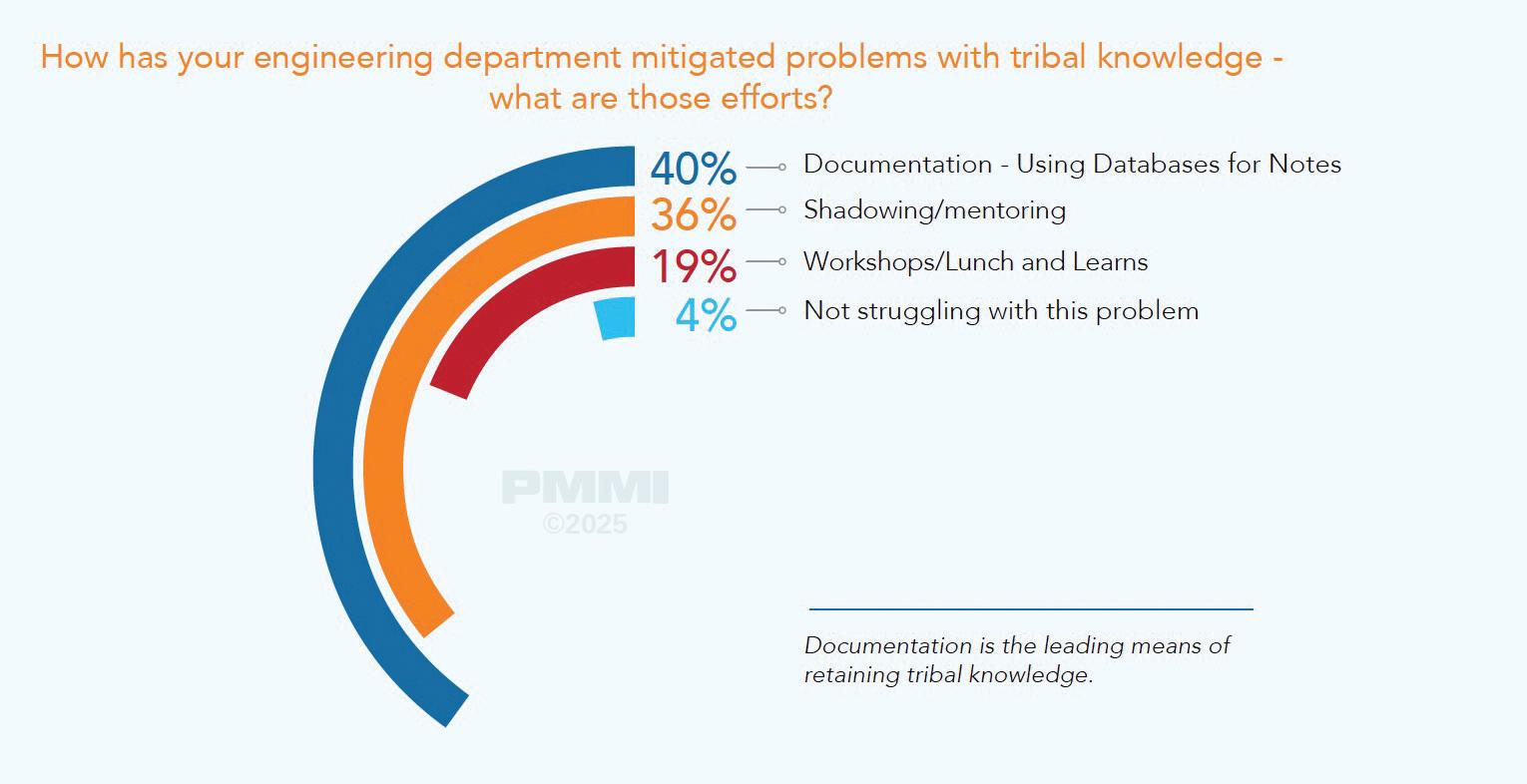
At the same time, an aging workforce puts critical institutional knowledge at risk as decades of expertise is walking out the door at an escalating rate. Forty percent of companies rely on databases to capture tribal knowledge, yet interviews underscore that documentation is often inconsistent or outdated. Leaders cite upcoming retirements as one of their most urgent challenges.
Digital transformation is another mixed bag. While large OEMs are beginning to adopt tools like digital twins, AI-assisted design, and ERP–CAD integration, smaller manufacturers still rely heavily on spreadsheets and manual processes. One respondent summed up the struggle: “All this information needs to marry back together, and trying to find the software to handle it can be a challenge.”
Despite these pressures, the report shows momentum toward systematizing knowledge, developing talent pipelines, and prioritizing efficiency. The following six takeaways offer OEMs a roadmap for making engineering teams resilient and future-ready:
and future-ready:
1. Codify tribal knowledge
The report’s knowledge-transfer section makes the threat clear: Retirements are accelerating, and much of the expertise still resides in engineers’ heads. Companies that succeed must treat knowledge as a managed asset. Best practices include:
∙ Creating digital knowledge bases with searchable articles, photos, and videos—one company’s “KBA” system is highlighted as a model.
∙ Using structured mentoring, job shadowing, and cross-training.
∙ Standardizing resources, including SOPs, CAD templates, and troubleshooting guides.
2. Increase the percentage of time engineers spend on engineering
Engineers in many companies lose hours each week to administrative tasks, data entry, or sales activities. The report notes that “getting the most engineering out of the engineers” boosts both productivity and retention. Ways to achieve this:
∙ Offload administrative tasks to support staff.
∙ Improve internal processes and digital tools to reduce duplicate work.
∙ Clarify roles to prevent engineers from being pulled into non-technical duties.
3. Build a retention strategy, beyond pay
While 96% of companies say they offer competitive

salaries, the most effective retention strategies combine culture, development, and recognition. Top tactics include:
∙ Investing in company culture, from social events to flexible work options.
∙ Creating formal career paths so employees can see long-term growth.
∙ Recognizing contributions—some OEMs credit engineers on machine nameplates.
4. Modernize training
Training new engineers is overwhelmingly hands-on: 97% use shopfloor training, and 91% use mentoring. But the most advanced teams blend hands-on work with digital resources. Effective programs include:
∙ Structured mentoring timelines.
∙ Digital training materials (videos, SOPs, knowledge databases).
∙ Funding continuing education —63% of companies reimburse tuition.
5. Adopt technology through a phased, strategic roadmap
While many companies still rely heavily on Excel, larger OEMs are implementing ERP/PDM systems, digital twins, and AI-assisted design. The report recommends:
∙ Stabilizing processes before introducing advanced tools.
∙ Building an integration roadmap rather than buying software ad hoc.
∙ Involving engineers directly in technology selection and implementation.
∙ Using simulation and digital twins for scalability and error reduction.
6. Outsource selectively, but capture the knowledge
Thirty-seven percent of OEMs outsource engineering tasks such as controls programming or documentation. But the most successful companies treat outsourcing as a targeted, temporary boost. Best practices include:
The report notes that “getting the most engineering out of the engineers” boosts both productivity and retention.
∙ Use outsourcing for niche expertise or overflow, not core competencies.
∙ Require structured documentation from external engineers.
∙ Integrate outsourced learnings into internal systems and standards.
The report reveals, above all, departments that invest in both people and processes will thrive. The companies that are codifying knowledge, prioritizing training, reducing non-engineering workload, and planning digital transformation strategically are building stronger, more future-ready engineering departments. OEMs that follow these best practices aren’t just keeping up; they’re positioning engineering as a strategic driver of long-term competitiveness. ■

Maximize your sales potential with AI meeting tools to turn every customer conversation into a strategic asset that drives business and competitive advantage.
By Ma hew Neuberger, President, Neuberger & Company, Inc.


The packaging machinery market grew just 2.2% in 2025, the slowest rate since the pandemic, as tariff uncertainty and $1.4 billion in additional import costs froze capital equipment decisions. According to PMMI’s Q2 2025 How’s Business report, quoting activity remained steady, but conversions stalled as buyers delayed commitments amid what respondents described as “tariffdriven cost dynamics.”
If you’re competing in this environment, every sales conversation matters more than ever. Yet most OEMs are sitting on one of their most underutilized competitive assets: the institutional knowledge captured in those conversations.
When your technical sales engineer explains why servo-driven changeovers solve throughput problems, that’s institutional knowledge. When your service rep overcomes total cost of ownership objections, that’s your competitive playbook. When your top seller navigates a seven-person buying committee to close a $2.3 million line, that’s your blueprint.
“ Shouldn’t your AI be learning from your best conversations?”
As I shared at PMMI’s Annual Meeting, procurement teams are now using AI to:
∙ Generate RFQs in minutes
∙ Screen eight vendors down to two before human conversations begin
∙ Identify exactly where each bidder is strong, and where they’re bluffing
When capital budgets are frozen, and every purchase requires CFO approval, buyers are using AI to de-risk decisions faster than ever.
So why are some OEMs still winning deals? They’re training their teams and their AI on what actually works in their own sales calls.
Most companies let that knowledge walk out the door. Elite OEMs capture it, analyze it, and scale it.
After recommending this approach to dozens of PMMI members, the results have been remarkably consistent.
High-performing OEMs are using AI meeting intelligence platforms, such as Fathom, to turn sales conversations into actionable intelligence. These platforms deliver three measurable outcomes:
1. Preserve what wins
After successful closes, teams review meeting recordings to identify:
∙ Which technical points resonated
∙ How ROI was articulated during budget freezes
∙ What objection-handling actually worked
That insight becomes training material, not theoretical role-plays, but real conversations that closed six- and seven-figure deals in a difficult market. When reps replicate success, similar opportunities move through the pipeline faster.
2. Improve what’s not working
Lost deals are just as valuable. Recordings show exactly where conversations went sideways:



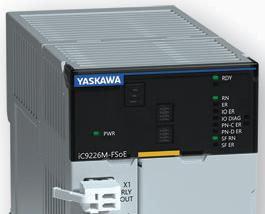



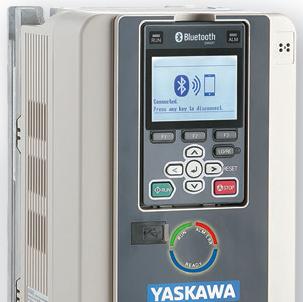


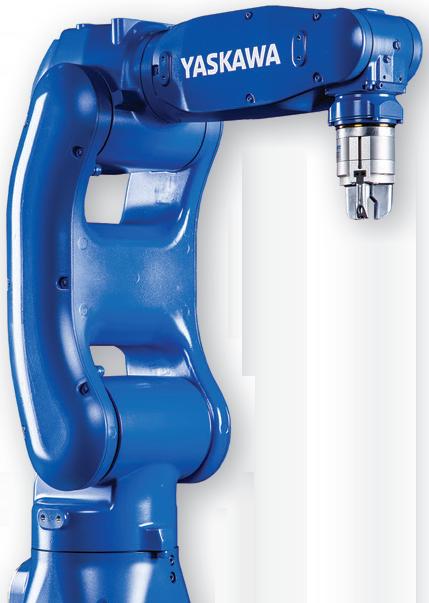





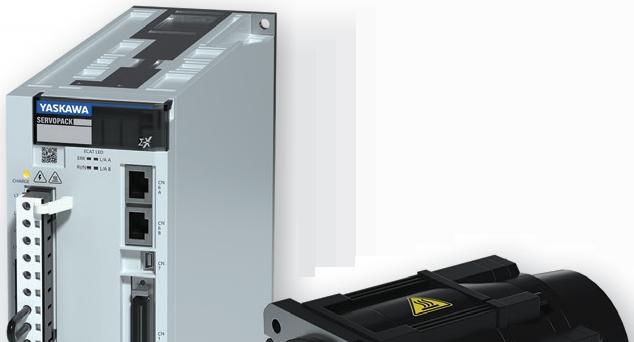





The quality of Yaskawa products is second to none, but Yaskawa Quality goes beyond that. It’s the total experience of purchasing Yaskawa products and working with people.
















∙ A missed technical requirement
∙ An unaddressed budget concern
∙ A sustainability benefit that was never clearly articulated
∙ For OEMs with 6–12 month sales cycles and multiple stakeholders, improving a single discovery call can save an entire pipeline.
PMMI’s 2025 State of the Industry confirms that hiring and retention remain “key concerns.” You cannot afford to lose institutional knowledge when top technical sellers retire or move on.
With AI meeting platforms, new hires can search phrases like “sustainability objections” or “pharmaceutical compliance questions” and hear exactly how veterans handled them even after they’re gone.
While there are a variety of AI sales intelligence tools, for teams trained in Sandler methodology through PMMI’s sales and tradeshow programs, Fathom offers a free Sandler integration that scores sales calls on execution:
∙ Did you build rapport?
∙ Uncover pain?
∙ Qualify budget and timeline?
∙ Secure next-step commitments?
In packaging machinery sales, where technical complexity often derails methodology, this keeps teams disciplined without slowing them down.
In practice, no. Most AI meeting intelligence platforms request participant permission before recording; it’s built into the process. The value to the customer is immediate: summarized meeting notes and action items delivered right after the call, saving time and reducing miscommunication.
Most platforms also include a pause feature. If something needs to be discussed off the record, simply say, “Let me pause the recording for a moment so we can speak more candidly.”
In the rare case where a client has a policy against recording—roughly 1% of situations in my research— don’t use it. Take detailed notes instead.
The bigger risk isn’t offending clients. It’s losing the institutional knowledge that could help you win the next deal.
“ Buyers are using AI to de-risk decisions faster than ever.”


Companies winning in 2026 aren’t just selling better equipment. They’re building systems where every customer conversation makes the entire sales organization smarter.
While competitors rely on individual talent—and lose knowledge when people leave—elite OEMs and components, materials, services, and integration providers create institutional intelligence that compounds over time.
With market growth hovering near 2.2%, every deal counts. Your buyer’s AI is already analyzing your proposals. Shouldn’t your AI be learning from your best conversations?
Start with your best Set up Fathom (or an equivalent free platform) on your next five customer calls. After successful closes, review what worked and make those recordings your onboarding material—not generic training, but real conversations that closed deals in today’s market.
Build your objection library When tariff concerns, budget freezes, or sustainability questions arise, capture the responses. Over 90 days, you’ll build a searchable database of real answers to 2026’s real objections.
Diagnose pipeline stalls When opportunities go dark, pull up the last call. Often, the issue is obvious: a budget concern you thought you addressed, a stakeholder you missed, or a timeline you misread. ■

















































































ENSURE PERFORMANCE & RELIABILITY


















From repeated brand exposure to AI-assisted research and equipment-in-action video, the early research phase has become the decisive ba leground in capital equipment sales.
By Amber Miller, Director of Marketing, PMMI Media Group


If you read my column in the Fall 2025 issue, you may recall we explored Part 1 of PMMI Media Group’s 2025 Buying Cycle Study. That research focused on what triggers machinery investment and how buyers evaluate suppliers. Now, with results from Part 2 in hand, one overarching takeaway connects both studies:
The sale starts long before a member of your team meets with the buyer.
Part 2, based on 248 verified end users with purchasing authority, confirms that today’s machinery buyers are forming opinions, building shortlists, and validating suppliers well before direct engagement with OEM sales teams. When paired with insights from Part 1, a larger pattern emerges: Buyers are more self-directed, more risk-aware, and more digitally driven than ever.
Credibility through repetition
One of the strongest findings in Part 2 is the importance of repeated brand exposure. More than 86% of


buyers say it’s important to see a supplier’s solution multiple times before viewing them as credible. A single interaction is rarely enough to establish trust.
Part 1 reinforced this behavior. Buyers rely on a mix of trade shows, peer recommendations, vendor websites, search engines, and industry media during early research. No single channel dominates; rather, credibility is built through coordinated visibility across multiple touchpoints.
For OEMs, credibility is no longer earned in a booth or during a first meeting. It is earned through sustained presence: industry media exposure, strong search discoverability, consistent digital messaging, and strategic event participation.
Visibility builds credibility.
Visualization builds confidence.
If visibility creates awareness, seeing equipment in action drives qualification.
Part 2 revealed that 66% of buyers say video of machinery in operation is very important in the initial research phase, and another 26% say it is moderately important. That means more than 90% of buyers expect to evaluate equipment visually before they decide to reach out.
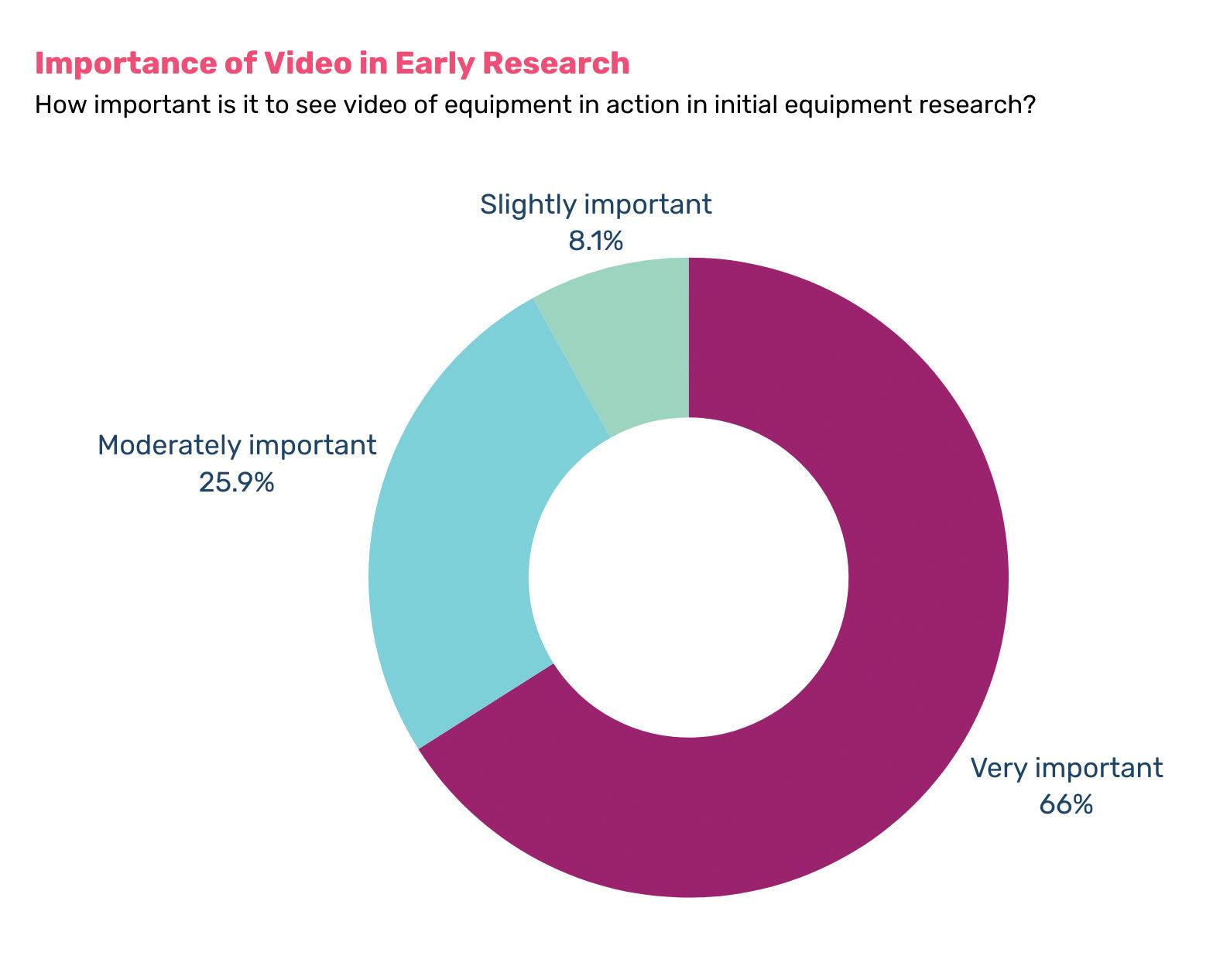

Video helps buyers determine whether a machine can solve their challenge and allows them to share that content internally with other stakeholders. In many cases, an entire buying team may decide to pursue — or not pursue — a supplier based on video content alone.
Part 1 supports this shift. When asked how vendors can improve the buying experience, buyers emphasized clearer demonstrations, better access to information, and easier evaluation tools. Equipment-in-action video addresses all three.
Video is no longer a marketing accessory. It is a primary qualification tool that can shorten sales cycles and improve inbound lead quality.

Part 2 also reveals an acronym that’s becoming part of our everyday language: AI.
Over 50% of buyers surveyed report using AI tools to summarize technical specs, find and compare equipment options, or uncover additional insights they wouldn’t have found on their own.


Although 26% say AI hasn’t impacted them yet, it’s clear buyers are increasingly using AI as a time-saving filter before engaging sales.
This aligns with Part 1 findings showing that buyers are heavily engaged in independent research through digital channels before contacting suppliers.
If your specifications, FAQs, and application descriptions are poorly structured or buried behind gated forms, they are less likely to surface accurately in AI-assisted searches. If you want to have a better chance of being discovered in AI responses, be sure your content is clearly organized, accurate, and written in natural language.
As AI has changed how buyers research, purchasing processes and behaviors have also changed. When asked how purchasing processes have evolved over the past three to five years over 38% of respondents said they now have greater scrutiny of supply chain risk, while 32% said they’ve increased reliance on online research, and 27% are analyzing ROI/payback windows more than before.
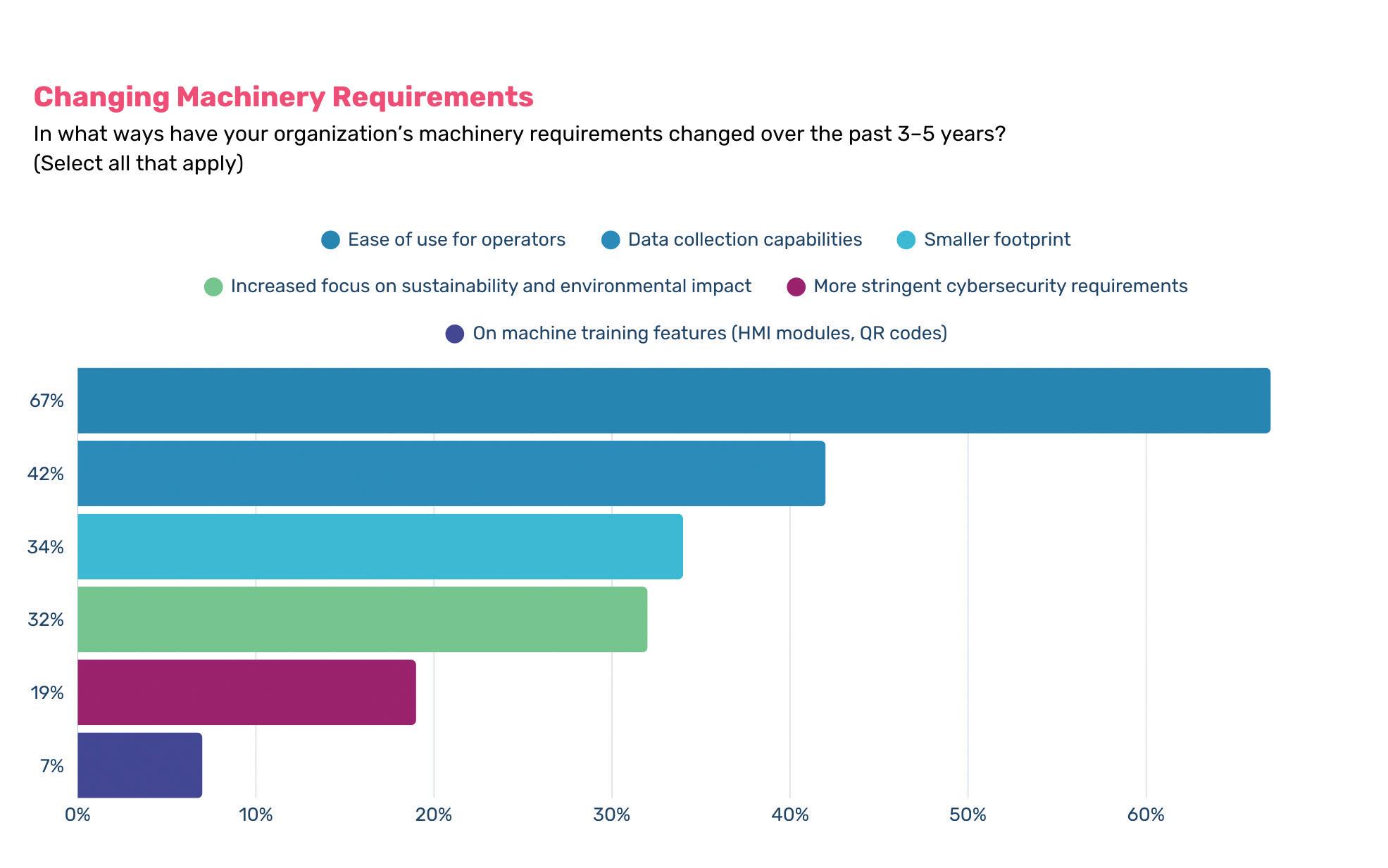
Speaking of building a business case for other stakeholders, we asked, “In what ways have your organization’s machinery requirements changed over the past 3-5 years?
Ease of use leading the list is no surprise, and we’ve seen labor challenges and workforce turnover remain persistent operational pressures.
In fact, our Part 1 study showed that efficiency improvements, performance limitations, and new capability needs are primary drivers of equipment investment. When combined with workforce constraints, usability becomes central to value. Modern buyers aren’t only concerned with the efficiency of the machine, but now need to evaluate ease of use, integration with existing technologies, training and support, and ROI.
Let’s bring it all together. What does this all mean?

Marketing is no longer support for sales. It is a primary driver of capital equipment influence.
Buyers are beginning their research independently and need to see a brand and/or solution through multi-channel repetition to build trust. By the time a salesperson is contacted, buyers are often well into their evaluation process.
OEMs that coordinate their presence across industry media, events, digital platforms, and educational content will enter those conversations with more informed, more confident prospects.
The modern packaging and processing machinery buyer is not just comparing machines. They are evaluating risk, usability, integration, financial justification, and supplier credibility before the first meeting.
Part 2 of PMMI Media Group’s 2025 Buying Cycle Study showed that the early research phase is now the competitive battleground. And as our Part 1 study confirms, the suppliers who educate, demonstrate value clearly, and reduce friction throughout the process will rise to the top.
So, if you take anything from our 2025 Buying Cycle Study, take these three bullets:
∙ Be visible early, often, and everywhere.
∙ Show, don’t just tell. Video, video, video.
∙ Help buyers justify decisions internally by showing value and transparency. It’s more than price and throughput.
Do that, and you won’t just be another name on a crowded supplier list, you’ll become the benchmark buyers measure others against. ■
PMMI Media Group is here to help your brand get the exposure it deserves, to an audience of engaged buyers looking for your solution. We’d love to partner and enhance your marketing strategy, deliver quality leads, and help you meet your 2026 goals.

Marking its 10th anniversary, the Philadelphia-based event offered three high-energy days of automation, AI, sustainability solutions, and education, underscoring strong capital investment and forward-looking momentum across the industry.
By Sean Riley, Editor-in-Chief INDUSTRY NEWS
Now entering its second decade, PACK EXPO East returned to Philadelphia with a show floor packed with working machinery, live demos, and active buyers, drawing more than 7,300 attendees and 2,700 exhibitor personnel to the Pennsylvania Convention Center Feb. 17-19.
“The energy throughout the show was exceptional,” says Jim Pittas, president and CEO of show producer PMMI. “The level of engagement this year underscores the strength of our industry and the demand for innovative, automation-driven solutions.”
Across the show floor, exhibitors emphasized not just traffic volume but traffic quality. Attendees came prepared, many bringing active applications, sample parts, and clearly defined challenges.
“This is my second time at PACK EXPO East, and it’s incredible to see how much the show has grown, from the number of exhibitors to the amount of equipment running live on the floor,” says Suzanne Bakiewicz, senior business development representative, SourceAmerica. “As an exhibitor, the experience has been wonderful. We’ve connected with many high-value prospects who may not have known about us before, and we’ve generated strong leads.”
For many exhibitors, having decision-makers on site made the difference.
“PACK EXPO East delivered exactly what we were hoping for,” said Travis Nelson, sales engineer, ParityFactory, an Advantive Company. “The foot traffic was strong throughout the show, and more importantly, the right buyers were here. We met our lead goals, which speaks to the quality of attendees.”
Lisa Khoury, president, POBCO, Inc., agreed: “We’ve had great foot traffic. The conversations have been spot-on. We’re talking to the right people. They’re bringing their problems, and we’re
looking forward to providing them with a solution.”
Solutions addressing labor challenges, improving efficiency, and enabling longterm scalability dominated the exhibit hall. Packaging and processing professionals experienced firsthand how AI, robotics, and flexible automation platforms can reduce downtime and drive measurable gains.
For first-time attendees, the experience proved eye-opening.
“It’s my first time at PACK EXPO East, and I was blown away by the machine demonstrations, especially in robotics,” said Abdiel Sanchez, assistant distiller, Trippy Goat Distillery. “I came in assuming these solutions would be far outside the budget for a smallbatch facility, but after speaking with the representatives, it’s clear there are options for everyone.”
Education sessions drew packed crowds, with sustainability, regulatory readiness, and digital transformation topping the agenda.
New show features added further depth. The Containers and Materials Pavilion spotlighted paperboard, glass, metal, flexible, and resealable packaging innovations, and the SMB FastTrack Program connected small and medium-sized manufacturers with exhibitors offering flexible financing and valueadded.
“The engagement we witnessed at PACK EXPO East confirms that the industry is actively investing in new technology such as automation, digitalization, and smarter manufacturing strategies,” said Laura Thompson, vice president, trade shows, PMMI. “Our goal is to create an environment where innovation is accessible, conversations turn into partnerships, and ideas translate into real operational progress.” ■

By Sean Riley, Editor-in-Chief
Acommon thread in manufacturing is the story of the family business that grew into a successful enterprise through hard work and generations of commitment. Packaging and processing are no exception, as owner-operated OEMs have long formed the backbone of the industry. Yet despite their prevalence, sustaining independently owned OEMs remains difficult. Data shared at a recent PMMI Executive Leadership Conference by succession expert Richard Bryan shows that only about 30% of family businesses reach a second generation, 12% survive to a third, and fewer than 3% reach a fourth.
Against those odds, a group of OEM leaders is proving that generational continuity is still possible when succession is treated as an ongoing discipline rather than a single event. Conversations with leaders at PAC Machinery, Hamrick Packaging Systems, Polypack, All-Fill, and Spee-Dee reveal a consistent theme: Successful transitions blend earned credibility, deliberate leadership development, and early governance, long before a handoff is required.
Their lessons form a practical playbook for familyowned OEMs preparing the next generation.
For next-generation leaders, legitimacy is far from automatic. In fact, many say being “the owner’s kid” raises the bar rather than lowers it.
“ You’re running a sizable company and still tightening bolts in a booth at PACK EXPO.”
Ryan Edginton, third-generation president and CEO of All-Fill, lived that principle from Day 1. His first role was not strategic; it was operational. Working in the stockroom at $26,000 a year, Edginton learned that respect is earned through shared effort, not inherited authority.
“You don’t slide into a corner office,” he says. “You earn it by doing the same work everyone else does.”
Jordan Hamrick, second-generation president of Hamrick Packaging Systems, remembers sensing skepticism early on. Entering a company where employees had worked alongside his grandfather and great uncle, he understood credibility would come only through consistency, long hours, and results.
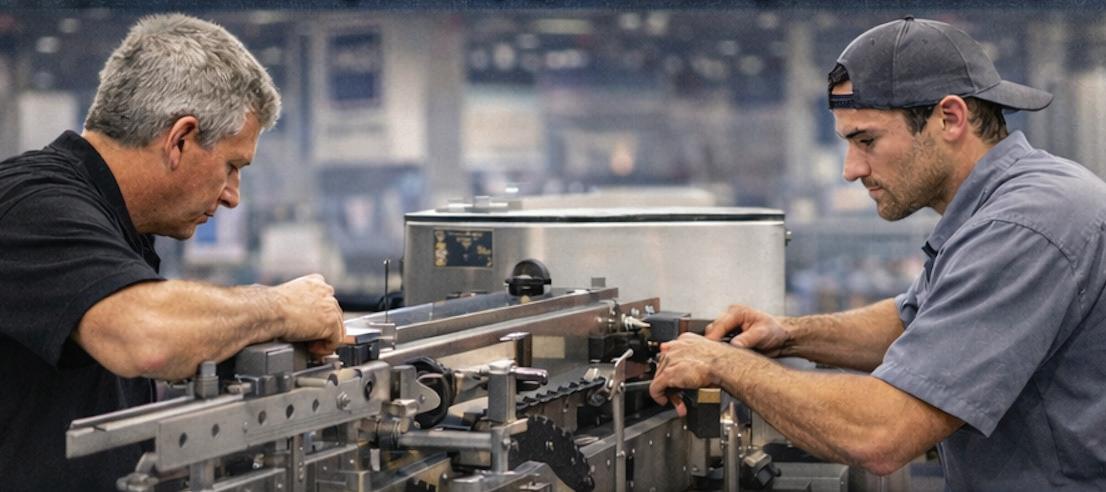
“People saw me as the boss’ son,” he says. “So I put my head down and worked for 15 years.”
At PAC Machinery, second-generation president Greg Berguig reinforces that credibility doesn’t stop once leadership is earned—it must be maintained. Even while running a $20–40 million business, Berguig remains visible on the show floor, setting up booths, and working alongside his team.
“You’re running a sizable company and still tightening bolts in a booth at PACK EXPO,” he says. “And right across the aisle, Kyle and Ryan Edginton from All-Fill were doing the exact same thing.”
Dave Navin, second-generation president and CEO of Spee-Dee, learned early how delicate family dynamics can be inside a business.
“People used to try to work me to get information on my dad,” Navin recalls. “My dad pulled me aside and said, ‘That’s part of learning. Send them to me directly.’”
Takeaway: In family OEMs, credibility is built on humility, visibility, and shared effort, not lineage.
Leave before you lead.
One of the strongest points of consensus across all five leaders is that outside experience matters. Leaving the friendly confines of the family business provides a perspective that no internal rotation alone can match.
Emmanuel Cerf, second-generation president and CEO of Polypack, is unequivocal on this point. If the next generation needs persuasion to join the business, he argues, succession is already compromised. Cerf believes working outside the family firm forces young leaders to confront different management styles and expectations, equipping them to return with ideas that challenge legacy thinking rather than reinforce it.
“If you have to convince them to do it, it will never work,” Cerf says. “They need to want it, and working elsewhere helps them decide.”
Berguig’s experience reinforces the point while adding nuance. He didn’t graduate with a predetermined plan to take over PAC Machinery. Instead, outside work and evolving opportunity gradually pulled him in.
“That organic entry made the commitment real,” Berguig says, “not assumed.”
Edginton agrees but adds that credibility also can be earned internally, if next-generation leaders are willing to start at the bottom and accept criticism from non-family supervisors. Whether inside or outside the business, the common denominator is humility and accountability.
Navin took the idea even further. He left Spee-Dee for 15 years, built and scaled a healthcare information systems company to 500 remote employees, and only
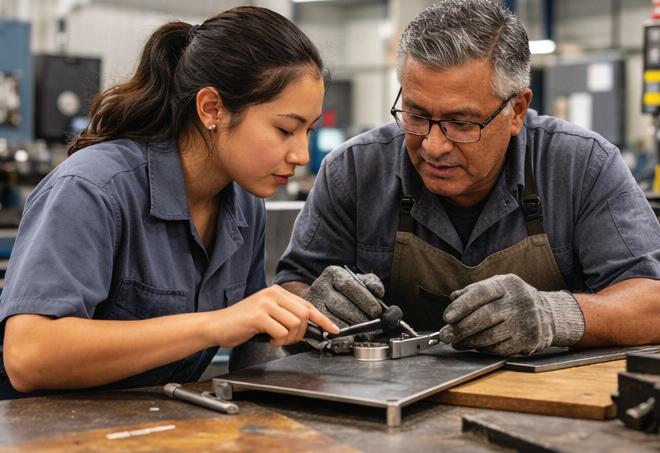
• Earn credibility early: Start at the bottom, stay visible, and work alongside your team.
• Gain perspective outside the family business: External experience builds independence, confidence, and credibility.
• Choose the business, don’t inherit it by default: Genuine interest matters more than obligation.
• Modernize with respect for the foundation: Bring solutions, not disruption, and pair new ideas with execution.
• Design roles and governance intentionally: Define responsibilities by strengths, introduce structure early, and elevate non-family leaders when needed.
• Protect and reinforce culture: Formalize core values, enforce them consistently, and keep family conflict out of the workplace.
• Plan succession long before it’s needed: Capture tribal knowledge, develop bench strength, and communicate early.
returned when the timing and interest aligned.
“We’ve told our kids they should work somewhere else for five years before joining the family business,” Navin says.
Bryan emphasizes that building bench strength before leadership transitions is critical and that outside experience remains one of the most reliable ways to do so without entitlement.
Takeaway: Outside experience builds independence, perspective, and credibility while preventing entitlement.
Modernize without erasing the foundation. Communication sits at the heart of any successful

Only about 30% of family businesses reach a second generation, 12% survive to a third, and fewer than 3% reach a fourth.
“ I stopped bringing problems. I started bringing plans.”
transition, but working with relatives often introduces unspoken bias. How successors communicate with the prior generation frequently determines whether change becomes collaborative or contentious.
“I stopped bringing problems,” Berguig recalls of working alongside his father. “I started bringing plans.”
Hamrick describes a similar balance.
“He’s been through things I haven’t,” Hamrick says of his father. “[The company] combines that experience with my fresh perspective and has found a new path to success.”
Generational tension around modernization is unavoidable but often productive. Hamrick admits that modernization at Hamrick Packaging often lagged vision, not because of disagreement, but because legacy systems and risk tolerance take time to evolve.
“Some ideas took a decade,” he says. “But the patience to get them right preserved trust while still moving the company forward.”
At PAC Machinery, Berguig describes modernization not as disruption, but translation. Whether upgrading IT systems, CRM platforms, or workflows, progress accelerated when evolution was framed as continuity rather than correction.
Navin adds a crucial nuance: Modernization isn’t only technological.
“It’s not about being stuck in a role just because of your last name,” he says. “You have to do something you enjoy and then put the right people around you.”
At Spee-Dee, that meant restructuring leadership roles and elevating a non-family COO to oversee day-to-day operations.
Bryan’s succession frameworks consistently emphasize defining roles and decision rights early, before modernization efforts test relationships.
Takeaway: Modernization includes organizational design, not just machines or software.
All five presidents accept that consolidation and private equity aren’t going away. But as consolidation accelerates, they believe family-owned OEMs in-

creasingly differentiate themselves through culture.
“Give people consistency,” says Edginton. “Give them a great place to work.”
Berguig adds that culture erodes fastest when family conflict becomes public. He emphasizes handling disagreement privately and presenting a united front to employees, noting that professionalism, not bloodlines, sustains trust.
For Cerf, culture is inseparable from independence. He argues that family-owned OEMs retain the freedom to make customer-first decisions that large corporate groups simply cannot justify. Whether it’s reinvesting time, absorbing short-term cost, or adapting machines on the fly, Cerf believes these choices reinforce pride, not just profitability, across generations. “If we were owned tomorrow,” he notes, “the [next generation] wouldn’t feel the same ownership or pride. It wouldn’t be theirs anymore.”
At Spee-Dee, Navin believes culture only scales when supported by structure. The company formalized core values, built an outside board, and clarified ownership roles to reduce friction as it grew.
“We hire and fire based on [core values],” Navin says. “If people don’t believe what we believe, they shouldn’t be here.”
Bryan warns that culture is often the first casualty of poorly planned transitions, and once lost, it cannot be repurchased through capital or scale.
Takeaway: Culture must be explicit, enforced, and protected, especially during change.
From PAC Machinery to Spee-Dee, these leaders demonstrate that family-owned OEMs don’t survive by resisting change—but by managing it intentionally.
Hamrick’s first succession was reactive, driven by loss and urgency rather than design. Navin’s was deliberate, structured, and supported by governance. Both agree on one point: Waiting too long makes succession harder than it needs to be.
“You need to plan, communicate, and identify key people early,” Hamrick says. Navin adds that documented tribal knowledge and financial planning often determine whether a business survives transition or loses control to circumstance.
In modern manufacturing, legacy is not automatically handed down. It is re-earned, generation after generation, through humility and deliberate leadership. ■
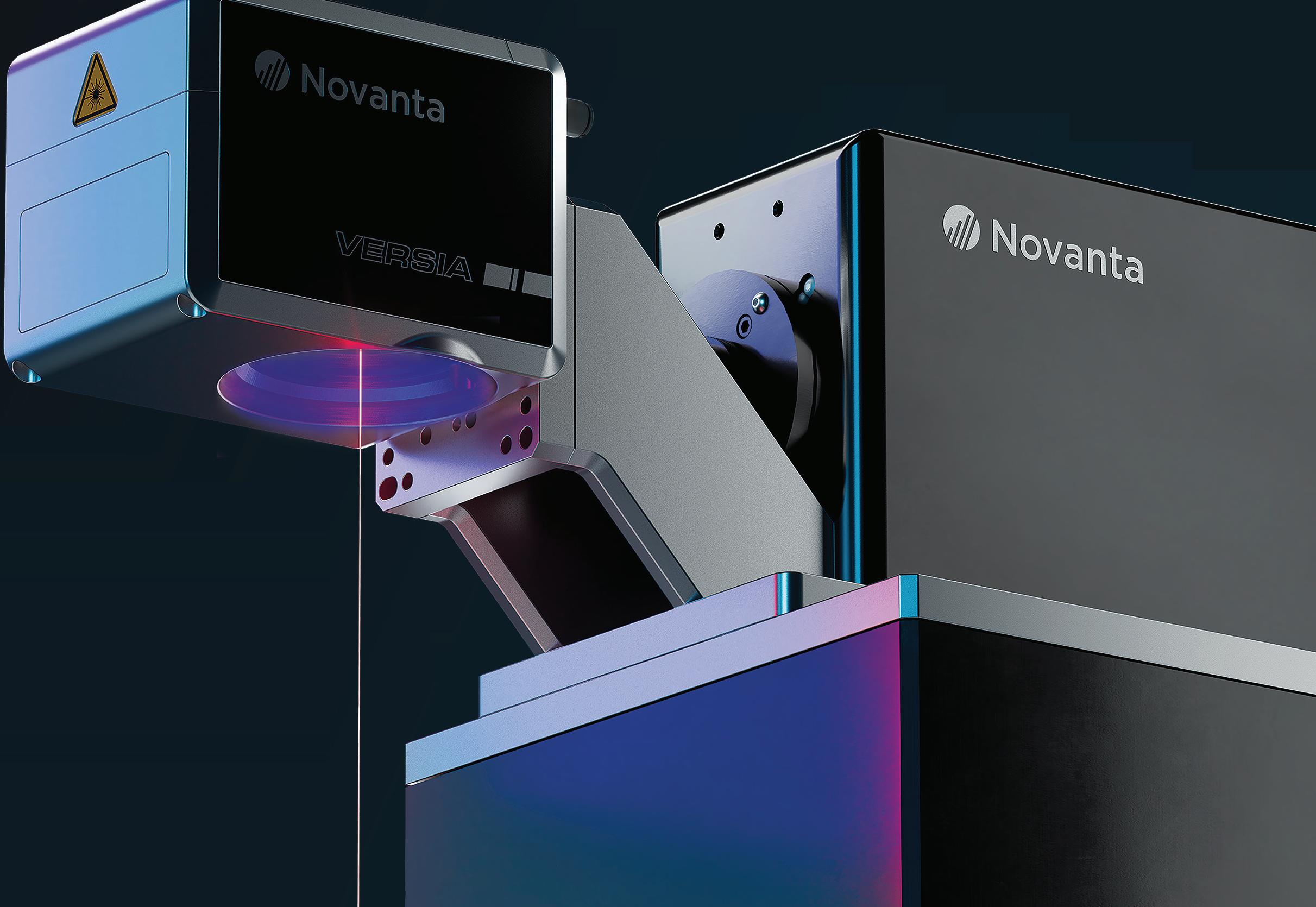
Configurable CO2 laser Integrator Packages enable OEMs to choose the best combination of laser power, wavelength, and working distance to fit specific application and machine needs.
Factory pre-aligned CO2 laser sub-system include laser source, scan head, controller, software, and mounting hardware ordered as a single part number with harmonized shipping.
Discover


The second-generation OEM prebuilds “ready-to-customize” bottling equipment, then adapts them to spec, reducing build variability while improving throughput and consistency.
By Sean Riley, Editor-in-Chief
For more than three decades, Accutek Packaging Equipment has proven that a family-owned company can innovate aggressively and distribute globally while still operating with the nimble decisionmaking of a startup.
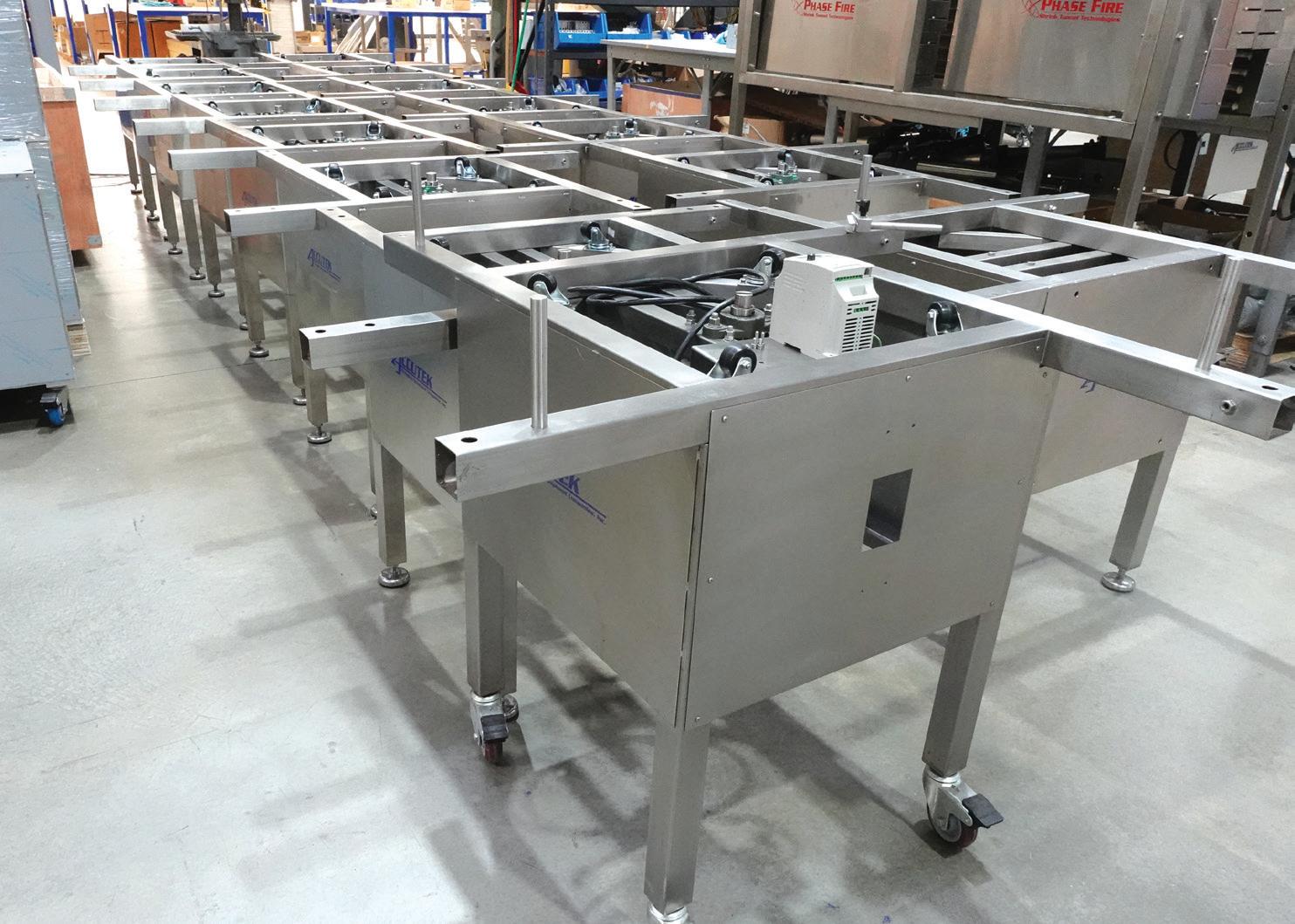
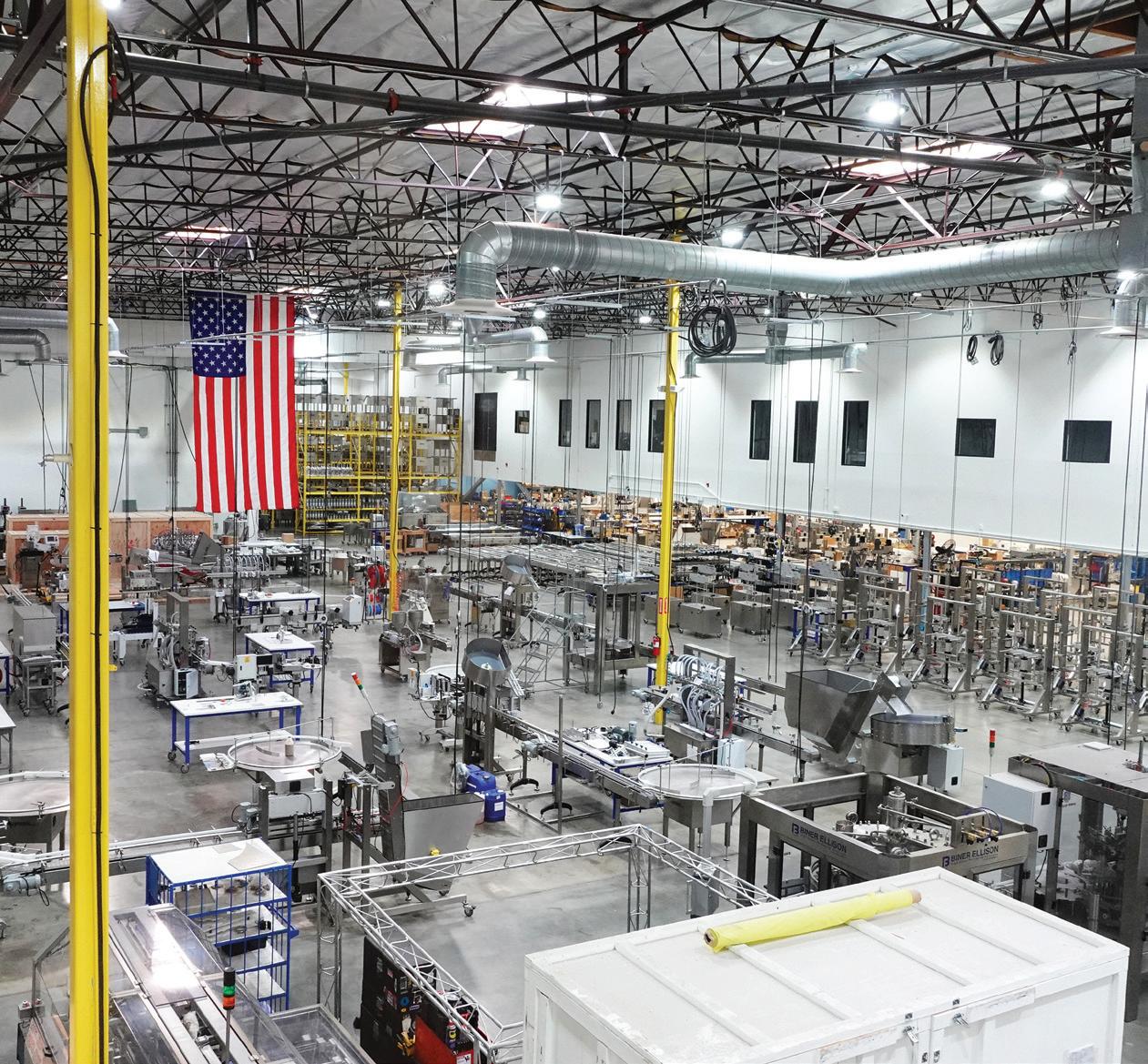
Founded in 1989 by Edward Chocholek and his sons, the Vista, Calif.-based OEM set out to do things differently even from its earliest days. At a time when many custom machine builders crafted equipment one unit at a time, Accutek pursued a hybrid strategy grounded in standardization. That strategy, referred to as its “80% core machine build,” has become one of its strongest competitive advantages. Today, most Accutek machines are built to about 80% completion in advance and stocked as ready-to-customize “cores,” enabling faster lead times, higher repeatability, tighter quality control, and far greater scalability.
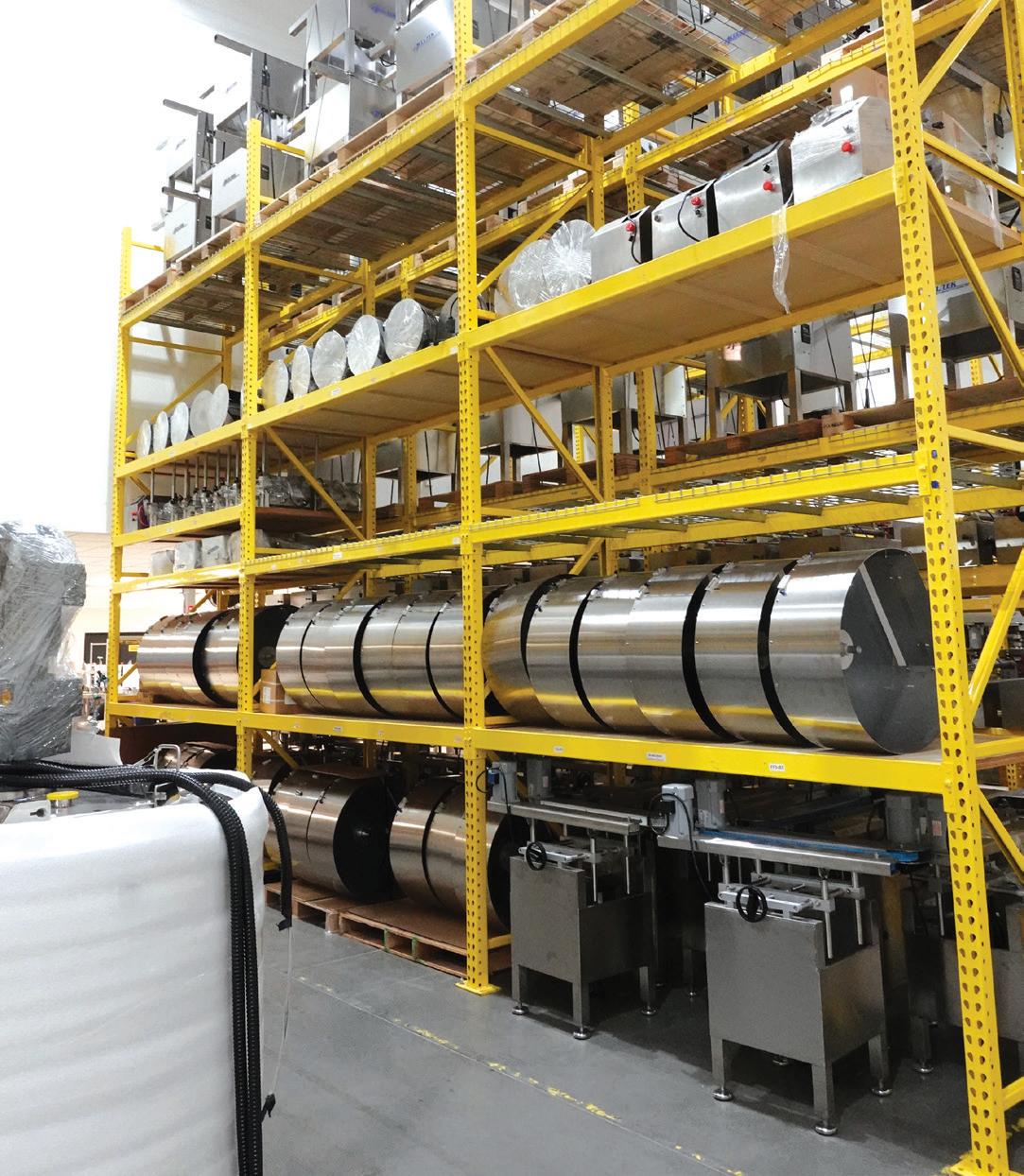
“We realized that if we standardized frame sizes, subassemblies, and core structures, we could build 10 or 20 frames at a time instead of making every machine from scratch,” says Drake Chocholek, CIO and Vice President. “It improves speed, quality, and consistency. If you walk through our facility today, you’ll see rows of nearly complete fillers, cappers, and labelers ready for customer-specific adaptation.”
Accutek now stocks millions of dollars in inventory—raw materials, precision components, and prebuilt subassemblies—allowing the company to deliver custom-configured lines at speed. This approach proved invaluable during the COVID-19 pandemic, when demand for hand sanitizer filling lines surged, and component availability tightened.
One of Accutek’s most distinctive strengths is its ability to support customers at every stage of their growth. Many businesses begin with Accutek’s benchtop fillers, cappers, or labelers, originally designed for small businesses, labs, and startups. As production needs increase, customers can seamlessly transition to inline automatic equipment and, when volumes surge, to high-speed rotary systems.
According to Drake Chocholek, few competitors offer this full technology spectrum under one roof.
“We started as a benchtop equipment manufacturer, and we still manufacture those systems today,” Drake Chocholek says. “But unlike most benchtop competitors, we also make fully automatic inline machinery and rotary equipment. With Accutek, customers can start small and grow with us—without ever switching manufacturers.”
This ability to scale with customers has resulted in exceptionally high return-
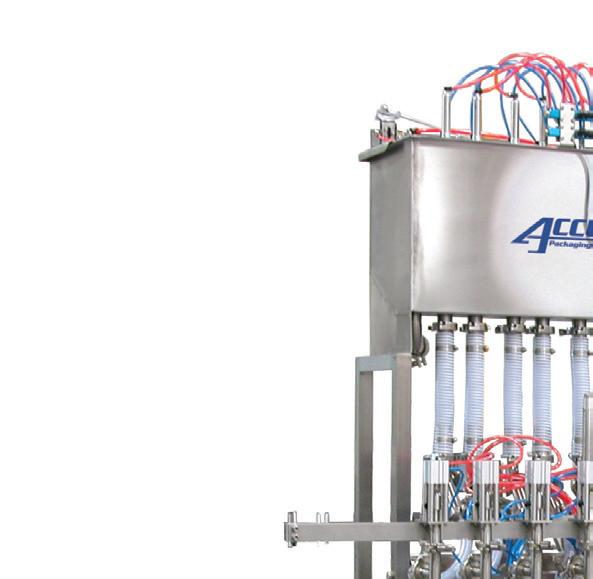
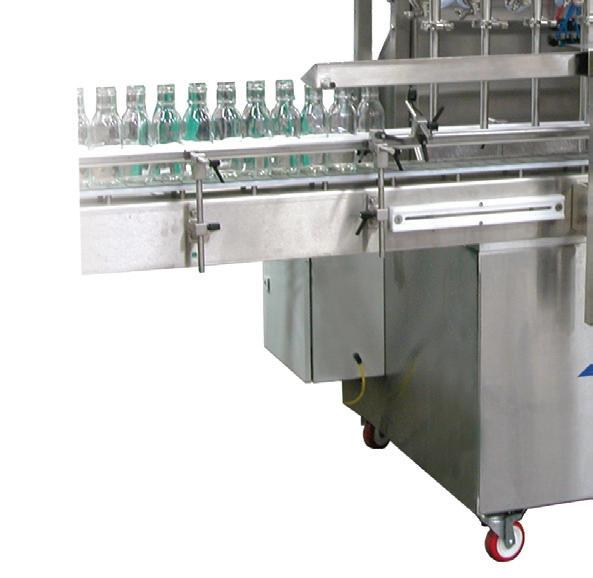
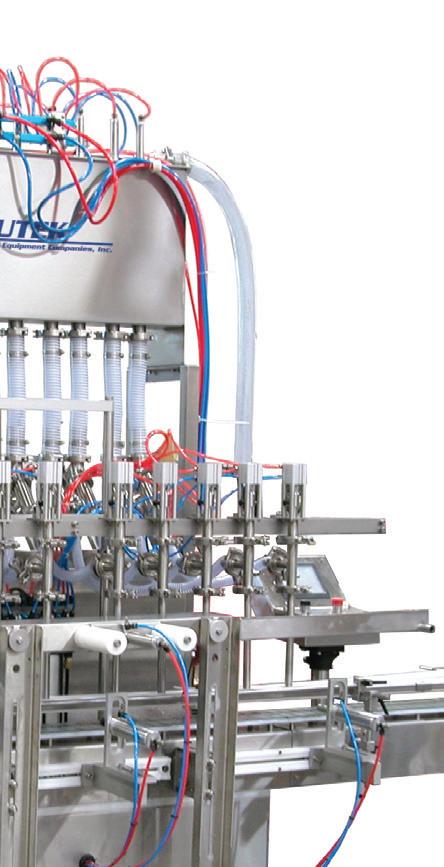
Accutek scaled with its customers, growing from a benchtop manufacturer to fully automatic inline machinery, like the AVF series.
“ We want to be ready for what the market demands, before it demands it.”
business rates, not just for parts and service but for upgraded equipment as organizations expand.
Beyond fillers, cappers, and labelers, Accutek provides an entire ecosystem of supporting equipment: bottle unscramblers, washers, rinsers, conveyors, inspection/rejection systems, induction sealers, tamper-evident sleevers, turntables, hoppers, tanks, mixers, transfer pumps, valves, and more.
“In terms of the full packaging line—from container handling to filling, capping, labeling, coding, and support systems—I’m not aware of any competitor that covers all of these categories as comprehensively as we do,” says Drake Chocholek.
This broad catalog enables Accutek to serve industries ranging from food, beverage, and cosmetics to pharmaceuticals, nutraceuticals, and household chemicals.
Because Accutek manufactures such a wide range of equipment, its team often integrates multiple complete bottling and packaging lines simultaneously. This includes system layout, inter-machine communication, line testing, and full Factory Acceptance Tests (FATs) conducted with customer-provided products whenever possible.
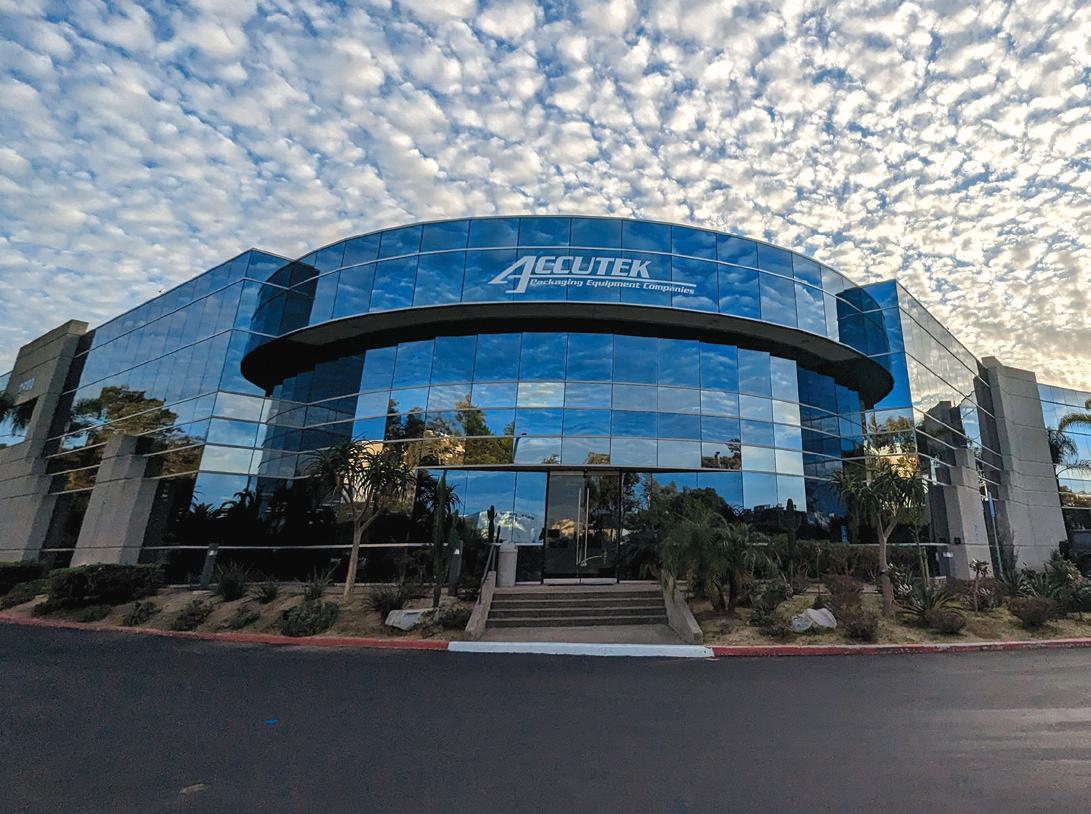
When established: Founded in 1989; Incorporated in 1994
Range of products: Bo ling Equipment–all of the equipment needed to move, clean, fill, cap, and label containers.
Executive team: Edward Chocholek (CEO-President), Darren Chocholek (CFO-Vice President), Drew Chocholek (COO-Vice President), Drake Chocholek (CIO-Vice President), Kenneth Ngo (Operations Manager), Jim Heim (Sales Director), Ellie Hosseinpour (Marketing Director)
Headquarters/manufacturing location(s): Vista, CA (HQ); Irving, TX; Fort Myers, FL
Number of employees: 100
Number of field service personnel: 10
Facility square footage: Vista, CA, is around 130,000 square feet. Texas and Florida are around 40,000 square feet each.
Geographic sales and support areas: We sell and support bo ling equipment/packaging machinery globally
Company websites: accutekpackaging.com, accutekoutlet.com, binerellison.com, kisspkg.com, labele e.com, phasefire.com
Annual revenues: 15 to 20 million
After FAT approval, Accutek’s field service technicians provide installation, operator training, and ongoing support. Their multilingual team helps support customers across North America and internationally.
Accutek’s focus on innovation traces back to founder Edward Chocholek, who spent years in electronics before turning to mechanical and automation design. Drake Chocholek says that spirit never left the business.
“My dad was always tinkering, always redesigning something to make it simpler or more reliable.




Courtesy: Accutek
That mindset shaped the company,” he says. “And my brother Drew—our COO—carries that same engineering philosophy forward.”
As the company expanded into Texas and Florida, the Chocholeks kept a family presence at each location to maintain culture and ensure continuity across sales, service, and manufacturing operations. Today, Accutek’s 100 employees operate in a collaborative, innovation-driven environment where cross-training, hands-on problem solving, and customer focus are central values.
Accutek’s trajectory reflects a combination of family continuity, long-term thinking, and a willingness to redesign how custom equipment is built. The company’s push toward standardized cores—paired with specialized customization—has enabled high throughput without sacrificing flexibility.
“Our goal is always to stay ahead of customer needs,” Drake Chocholek says. “We want to be ready for what the market demands—before it demands it.”
Accutek stocks millions of dollars in inventory to deliver custom-configured lines at speed.
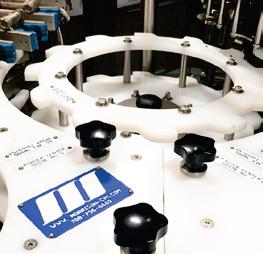
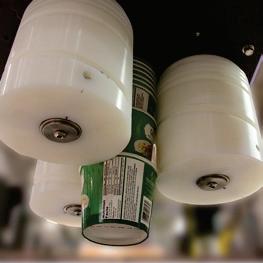
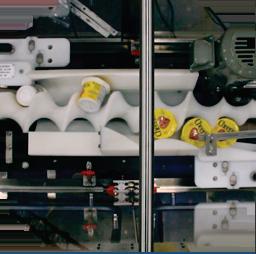
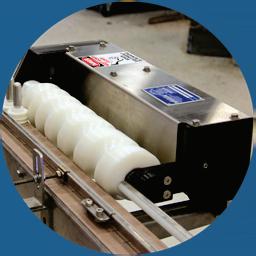
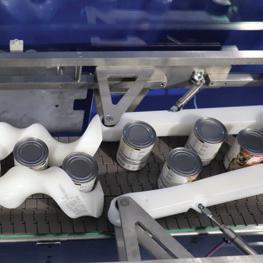
SYSTEMS DESIGNED TO POSITION CONTAINERS BEFORE, WITHIN, OR AFTER YOUR EQUIPMENT.
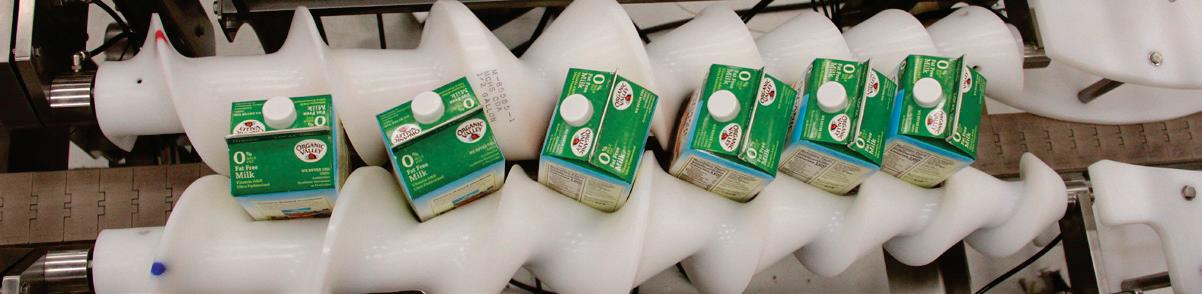









“ We realized that if we standardized frame sizes, subassemblies, and cores structures, we could build 10 to 20 frames at a time.”
As CIO, Drake Chocholek is increasingly focused on the role artificial intelligence may play in the future of packaging machinery—from inquiry automation to guided troubleshooting and predictive maintenance.
But he remains cautious.
“There’s an enormous opportunity in private, onpremises AI,” he says. “But putting sensitive engineering data into public cloud tools is a risk. Our longterm goal is to build secure AI tools that truly serve our customers without compromising proprietary designs.”
Accutek’s story offers a compelling blueprint for how family leadership, engineering rigor, and strategic standardization can elevate a packaging OEM into a global competitor built for the next generation. ■
According to Packaging World’s Annual Outlook Report survey, companies are turning to automation to solve labor constraints and throughput demands while simultaneously grappling with higher costs and internal alignment challenges.
By Sean Riley, Editor-in-Chief
At
first glance, the 2026 results of our Packaging World reader survey of CPGs on automation and robotics mirror those of its 2025 predecessor. A closer look at the numbers confirms the trends established last year, with incremental
Cautious But Decisive Climb
Automation adoption (2025 vs 2026)
65% Automation adoption
or steady increases or decreases where applicable. Motivations intensified around reducing labor cost and addressing labor scarcity, while cost has become an even bigger hurdle, and deployment has shifted decisively to end-of-line and secondary packaging.
69% Automation adoption
In 2026, 69% of surveyed companies say they will add automation, cobots, or robotics to packaging operations, compared with 65% in 2025. The rise is incremental rather than explosive, but it is notable for reflecting a confidence trend: even as budgets feel the pressure, more CPGs view automation as the prudent hedge against an unreliable labor market and persistent input cost inflation. That perspective closely echoes last year's narrative, which found that workforce constraints and costs simultaneously drove adoption and restraint—a paradox that persists into 2026.
“ Automation adoption will increase. Even if the labor market and inflation improve, companies don’t want to be caught in another pinch as they were
during the pandemic. As projects can be justified to boards, they will continue making cases for lower operating cost equipment over expensive labor.
”
— Ryan Simmons, Site Director, Second Nature Brands
The strongest reasons in favor of adding automation strengthened year over year. In 2026, reducing labor cost/ good ROI jumped to 71% (from 61% in 2025), di culty finding labor climbed to 44% (from 33%), and adding speed/ throughput rose to 40% (from 34%). Interest in accuracy/repeatability and safety/ergonomics also ticked up, rounding out a profile that blends financial, operational, and risk controls. This spike in cost-centric motivations aligns with broader evidence that companies are pairing automation with AI/ vision to protect margins and meet volume targets amid tight labor. The 2025 workforce driver stressed how labor realities were the primary catalyst; 2026 data reveals that firms are now quantifying ROI more aggressively to win internal buy-in.
“ Automation is a huge di erentiator for reducing the end cost to consumers… in a time of increasing costs, anything that can be done to reduce costs and consumer prices is a must.” — Cody Loewen, Packaging Engineer, Hill’s Pet Nutrition
The barriers to automation and robotics implementation grew more pronounced in 2026. The cost of automation/weak ROI case surged to 73% (from 50% in 2025), limited floor space/ footprint to 49% (from 35%), and ability to find skilled technicians to 35% (from 31%). Concerns about the complexity of programming and the inflexibility of equipment remain material, even as cobots and so ware reduce integration friction.
As in 2025, 2026 robotics deployment priorities skew heavily toward end-of-line (61%) and secondary packaging (59%), up from 39% and 33%, respectively, in 2025. Primary packaging also gains to 37% (from 25%), while fulfillment/warehouse interest sits at 16% (vs. 6% in 2025). The pa ern is unmistakable: firms are automating labor-intensive, ergonomically challenging, and high ROI tasks first. End-of-line and secondary packaging are also typically less disruptive to integrate, with mature cobot stacks, vision, and safety speeding deployment.
A case could also be made that, for larger CPGs, primary packaging would be the first area automated and could have already happened in years past.
“ Plant operators and engineering teams are the biggest allies, but we’ve seen our executive team coming around recently as well.”
— Laura Schwind, Associate Product Manager – Plates & Bowls, Ho master
For and Against Adoption
Not surprisingly, Plant Operations (63%) and Engineering (49%) remain the top allies for pushing towards automation and robotics investment, with growing support from the C-suite (22%). The actual operators on the floor are aware of the benefits of the technology and serve as its biggest champion, and executive teams are “coming around,” especially when ROI is well documented. Conversely, Procurement (37%) and the C-suite (39%) figure prominently as hurdles in separate results sets—consistent with 2025 narratives about ROI proof points and capital approval being critical. Procurement skepticism underscores the need for phased pilots, clear downtime plans, and total cost of ownership models that bridge the gap between engineering enthusiasm and capital discipline. ■
By Steve Sterling, Contributing Editor
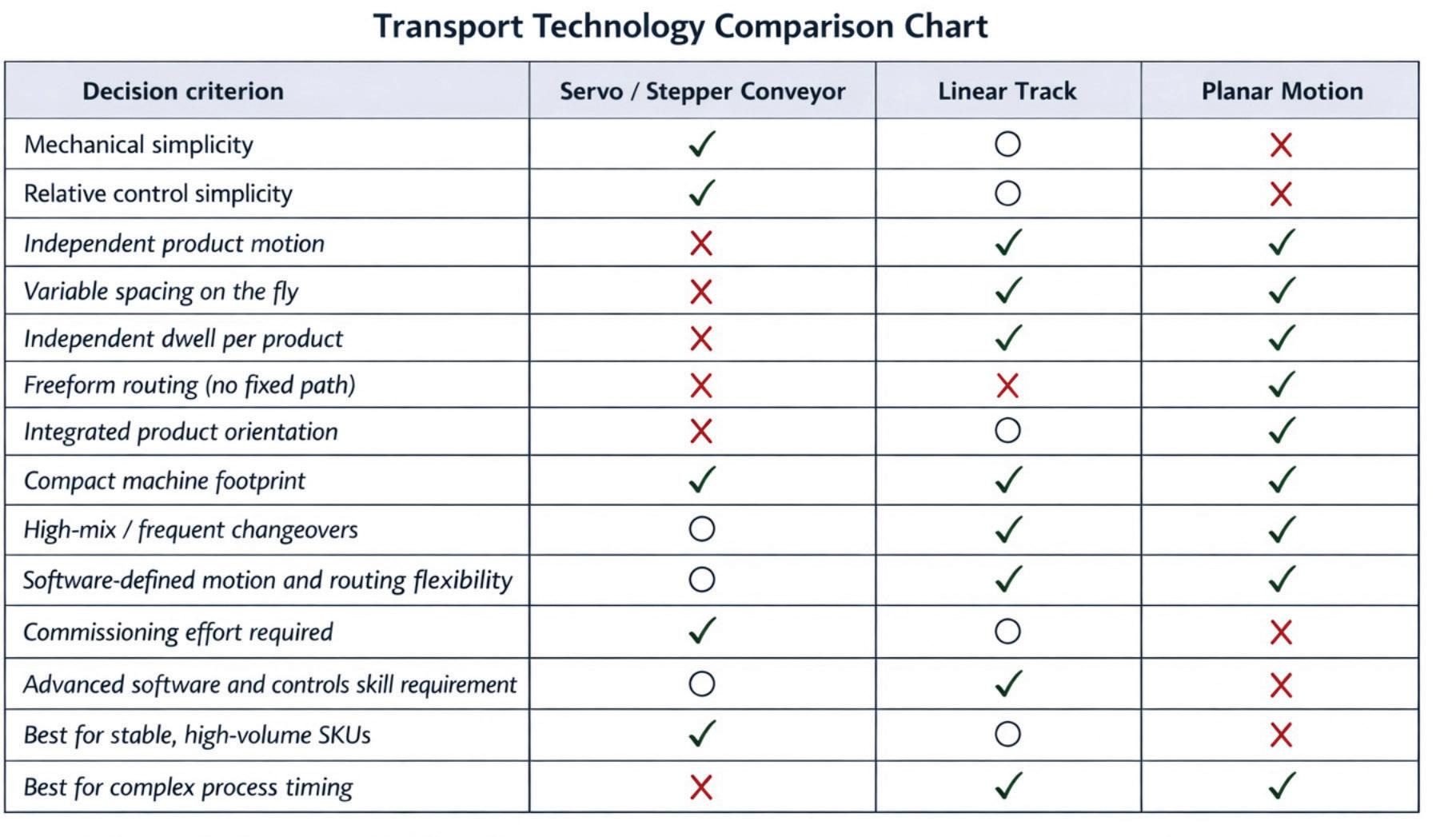
For decades, transport inside packaging machines followed a predictable path. Products moved along mechanically fixed conveyors, indexed by cams, chains, belts, or screws. As servo and stepper technology matured, those conveyors became more precise and programmable, but the underlying architecture remained unchanged. Products still advanced along a fixed path, driven as a group rather than individually.
Linear track and planar motion emerged in response to design pressures that stepper- and servodriven conveyors could no longer cleanly absorb. Understanding those pressures, and how each architecture addresses them, provides a practical basis for deciding when linear track or planar motion is the right foundation for a new machine design.
A linear motor track system replaces continuous belts or chains with independently driven carriers moving along a guided track. Motion is generated through electromagnetic interaction between a stationary stator embedded in the track and coils mounted to each carrier.

B&R’s modular ACOPOS 6D uses magnetic levitation to bring flexibility and compactness to today’s planar machines.

Courtesy: B&R
By precisely controlling these magnetic fields, each carrier can be propelled, positioned, and synchronized independently. This electromagnetic drive element, often referred to as a forcer, allows products to accelerate, decelerate, dwell, or sequence differently while sharing the same physical route.
In packaging applications, typical systems operate at speeds of several meters per second, support high acceleration profiles, and deliver repeatable positioning accuracy of hundredths of a millimeter.
Tracks are often implemented as closed loops for continuous flow, but the architecture can also support straight sections, curves, and junctions. These configurations allow carriers to merge, divert, or bypass process stations when the application justifies added design and control complexity.
Compared to stepper- and servo-controlled conveyors, linear track systems enable:
∙ Product spacing changes on the fly
∙ Independent dwell at process stations
∙ Sequencing through different process timings
∙ Higher throughput without adding parallel lanes
Linear track systems introduce additional complexity compared to mechanically linked transport. Independent carriers require more advanced motion control, tighter coordination between mechanics and software, and more sophisticated safety and diagnostic strategies. As a result, a greater share of design effort shifts to the software layer compared with stepper- or servo-driven conveyors.
During commissioning, this flexibility can extend setup time. Motion profiles, spacing logic, and dwell behavior must be validated at the carrier level rather than tuned globally. Software changes still require careful verification to prevent unintended interactions between carriers, stations, and junctions.

From a maintenance perspective, linear track systems reduce some traditional wear points but introduce new considerations. Carriers, guideways, and electromagnetic components must be monitored for alignment, contamination, and thermal effects. Troubleshooting also becomes more softwaredriven, requiring maintenance teams to work with motion diagnostics and control logic alongside mechanical systems.
Despite the added complexity, linear track systems address packaging trends that mechanically linked transport cannot. Independent carrier control enables smaller, more flexible machine layouts that adapt more readily to changing product and process requirements. Used deliberately, linear track systems provides OEMs with a powerful way to solve motion and layout challenges without mechanical duplication or compromise.
While terminology varies by supplier, linear motor track systems share a common set of functional elements:
∙ Track and stator – the fixed guideway and stationary electromagnetic drive structure
∙ Carriers (movers) – independently driven elements that transport products
∙ Forcer – the electromagnetic interface between stator and carrier
∙ Position feedback – integrated sensing for precise carrier control
∙ Motion controller and drives – hardware and software coordinating carrier movement
∙ Mechanical interfaces – fixtures or tooling mounted to carriers
∙ Safety and diagnostics – safety-rated motion functions and system monitoring
A tissue packaging machine builder adopted independent cart technology to break throughput limits imposed by mechanically linked transport. While individual process stations were capable of higher speeds, conventional conveyors forced all products to move in a shared cycle, constraining output and reducing overall equipment effectiveness.
Using Rockwell Automation’s iTRAK intelligent track system, the OEM decoupled product motion from the fixed conveyor cycle. Slower dispensing operations no longer dictated line speed. Independently controlled carts enabled variable dwell times and dynamic product spacing, improving line balance and sustaining higher throughput without increasing machine footprint.
A planar motion system replaces fixed transport paths with a controllable electromagnetic surface. Motion is generated through interaction between an array of stationary motor tiles and electromagnetic elements embedded in each mover, allowing movers (pucks) to levitate and move freely across the surface without mechanical rails or tracks.
By precisely controlling these magnetic fields, each mover can be positioned, translated, and rotated independently. Products can accelerate, decelerate, dwell, reorient, or change direction while sharing the same motion surface, without being constrained to a predefined route. Movers can operate in coordinated groups to support larger or heavier products, then transition back to independent motion as process requirements change. Some systems also support controlled changes in levitation height, which can be advantageous in filling or handling applications.
In packaging applications, planar systems support rapid multi-axis motion with high acceleration capability and repeatable positioning accuracy within hundredths of a millimeter, while enabling controlled rotation as part of the transport process.
Planar systems are built from modular motor tiles that define the usable motion area. The surface can be expanded, reshaped, or reconfigured through tile
layout and software changes, allowing products to move, merge, queue, or bypass process stations anywhere within the defined area when the application justifies the added system complexity.
Compared to stepper- and servo-controlled conveyors, planar motion enables:
∙ Compact machine designs that collapse transport and process space
∙ Freeform routing without fixed paths
∙ Integrated product orientation during transport
∙ Rapid layout reconfiguration through software changes
Planar motion systems introduce additional complexity beyond both conveyors and linear track. The control architecture is heavily software-driven, requiring precise coordination of multi-axis motion, levitation control, and collision avoidance across the entire motion surface. As a result, system design places greater emphasis on controls engineering, simulation, and safety integration.
During commissioning, planar systems require careful validation of motion envelopes, routing logic, and orientation behavior at the individual mover level. While layout changes are largely software-based, each change must be verified to ensure stable levitation,
repeatable positioning, and predictable interaction among movers operating in close proximity.
From a maintenance perspective, planar systems reduce mechanical wear associated with rails, belts, and chains but introduce new considerations. Motor tiles, movers, and cooling systems must be monitored for contamination, thermal loading, and electromagnetic performance. Troubleshooting is primarily software-centric, requiring maintenance teams to rely on diagnostics, system logs, and motion visualization tools alongside traditional mechanical inspection.
Despite the added complexity, planar motion systems address packaging challenges that path-based transport cannot. By eliminating fixed routes, planar motion enables machine architectures that are more compact, more adaptable, and better suited to high product variability without mechanical rework. Planar motion gives OEMs a distinct tool for solving transport, orientation, and layout problems that would otherwise require significant mechanical compromise or parallel equipment.
As with linear track systems, terminology varies by supplier, but planar motion systems share a common set of core terms engineers will encounter:
∙ Motor tiles – modular electromagnetic units that form the motion surface

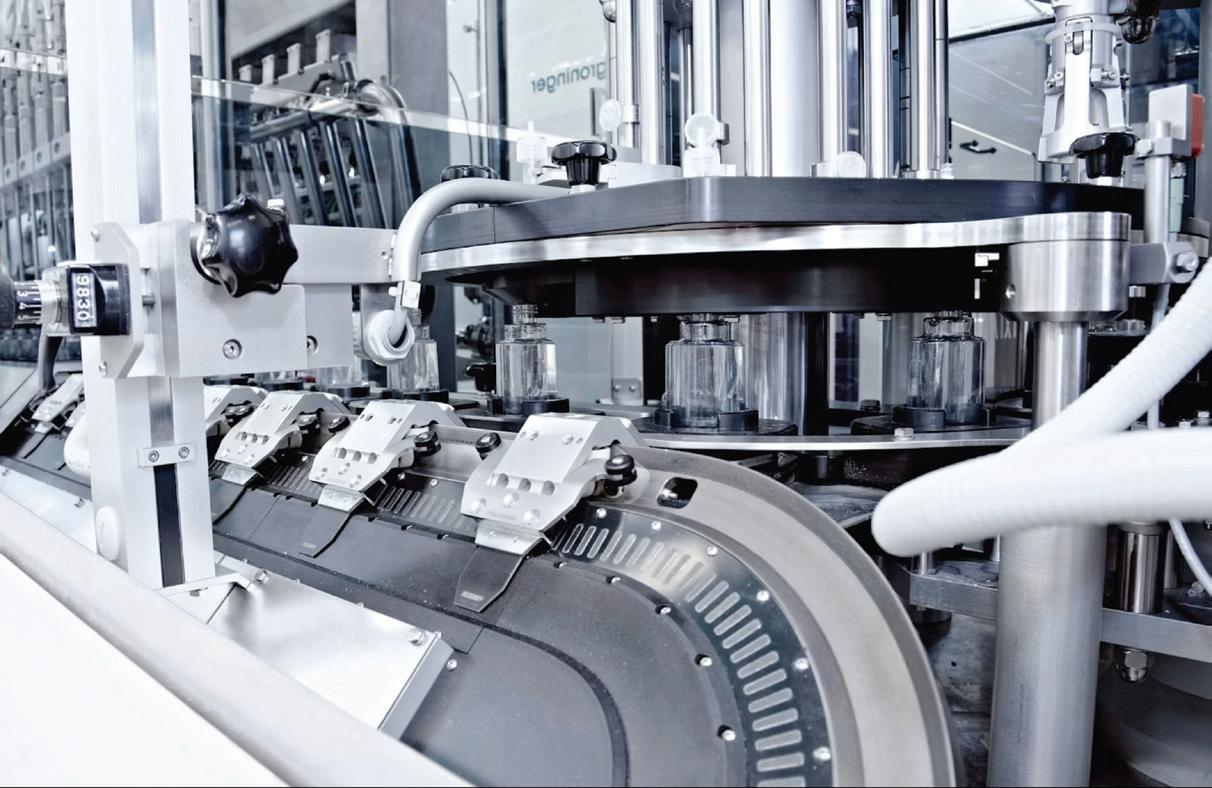
The oval-shaped linear track of the Beckhoff XTS is tilted by 45 degrees relative to the plane on which pucks deliver bottles to a capping station.
∙ Tile array – the assembled field of tiles defining the usable motion area
∙ Planar stator field – the combined electromagnetic surface generated by the tile array
∙ Movers (pucks) – levitating elements that carry tooling or fixtures
∙ Levitation gap – the controlled air gap between movers and the tile surface
∙ X-Y-Theta control – independent control of planar position and rotation
A German packaging OEM applied planar motion to address growing demands for flexible secondary packaging, where products must be sorted, mixed, and oriented before case packing. Conventional conveyor-based transport limited the ability to handle varied product combinations without adding mechanical complexity or multiple transfer steps.
By integrating a planar motor system into its CORAS packaging machine, SOMIC Packaging enabled products to move independently across a two-dimensional surface. This allowed dynamic sorting, grouping, and orientation within a compact footprint, simplifying machine layout while supporting gentle handling and rapid reconfiguration for different packaging formats. ■

APPLICATION BRIEF
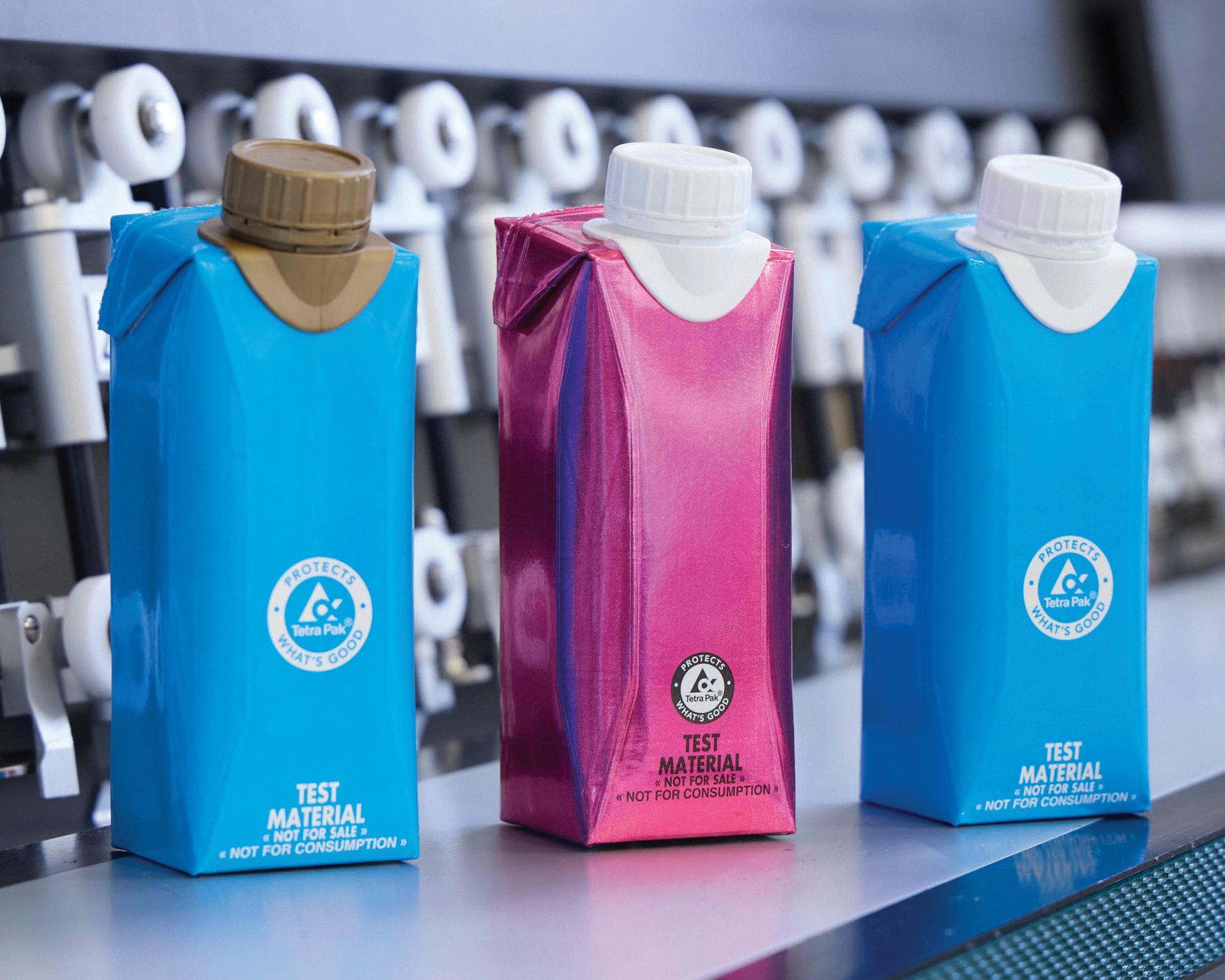
A new cap applicator from Tetra Pak uses the Beckhoff XTS linear servo transport system to deliver 25,000 precisely sealed cartons per hour, nearly tripling output over conventional portion-package cappers that run at 9,000/hour.
By Matt Reynolds, Chief Editor, Packaging World
At its Modena, Italy, development center, Tetra Pak engineers recently designed a next-generation capping machine that applies plastic caps to beverage cartons at what they say is unprecedented speed and precision. The new Tetra Pak Cap Applicator 40 Speed Hyper uses a linear servo transport system, the XTS from Beckhoff, that precisely synchronizes over 120 motion axes, doubling system reliability and enabling quick changeovers across packaging formats. The system has been so successful that Tetra Pak’s pilot end-user customer, impressed by its reliability, performance, and flexibility, has described it as a “magic machine.”
“When it comes to new developments, we believe it is always very important to listen to our customers carefully,” says Gianmarco Di Eusebio, product owner
at Tetra Pak. “In this case, a more flexible machine with reduced space requirements and a higher system output was needed. Current solutions for portion packages run at 9,000 units per hour–so achieving the required 25,000 would have meant installing three machines, each with a feeding system and so on, and finding the space to go along with that.”
He adds that the requirements placed on the new machine were demanding, both because of the high processing rate and the complex 3D geometry of the cap.
To meet these goals, Tetra Pak’s engineering team says that it selected Beckhoff PC-based control to provide the necessary computing power and flexibility.
“Our customers are increasingly demanding systems with a high degree of digitalization and connectivity,” adds Paolo Scarabelli, director of innovation, analytics & line solutions at Tetra Pak. “The PC-based control technology from Beckhoff forms the ideal basis for this. XTS also makes it easy to replace work that used to be mechanical with software functions, representing an additional step towards a digitalized machine. With the Tetra Pak Cap Applicator 40 Speed Hyper, for example, we were able to shift the boundary between digital and mechanical machine components in favor of digitalization. In our specific case, this means that we have full digital control of more machine functions and can operate the system more reliably.”
This higher level of digitalization improves data transparency and allows faster product changeovers. Fabio Bassissi, technology specialist at Tetra Pak, says: “The XTS movers can be controlled as individual servo axes, allowing new product formats to be introduced very quickly and easily, leveraging software flexibility. In addition, we can compensate for any mechanical tolerances very effectively in conjunction with the vision system for adhesive monitoring.”

If the vision system detects adhesive deviation, the software automatically switches cam plates for the coupled mover pairs during operation, restoring the precise path.
“We also use asset health monitoring to check the state of our equipment,” Bassissi adds. “All of this is crucial to quality assurance and, as such, to the success of the product. Ultimately, beverage containers can only be sent to end customers if they are reliably sealed and completely leak-tight.”
The Tetra Pak Cap Applicator 40 Speed Hyper’s motion architecture presents a real challenge: more than 120 real axes and 10 virtual master axes. Two parallel, 4.5-m linear tracks each carry 55 movers, and roughly 10 rotary servo axes manage packaging transfer and hot melt application.
Because of the cap’s 3D shape, X, Y, and Z motions must synchronize with the movers’ trajectories. Each pair of movers is mechanically linked but operates across two parallel transport systems.
“It does not matter whether the movers are on one system arranged in a row or on two different systems,” says Stefano Flore, director of packaging lines and embedded automation at Tetra Pak. “The control software takes advantage of this–it always moves the movers in complete synchronization with each other.”
Flore notes that the linear transport system offers exceptional flexibility thanks to its modular design.
“The ability to change the track length and the number of movers means that hardly any work is involved in creating machine variants with a higher or lower product throughput,” he says. “It is also very easy to change over to different packaging formats to accommodate other fill quantities and pack tops or caps with different shapes, for example.”
New configurations are handled in software by adjusting mover spacing and motion parameters.
“After the caps have been picked up by the corresponding brackets on the movers, up to six synchronized movers form a batch to apply the adhesive profile,” Flore continues. “For this purpose, the cap bracket moves on the X-axis and Y-axis by means of a mechanical coupling with the associated mover of the parallel system. At this point, the system compensates for any tolerances. The cap is then applied to the carton packaging with precision and monitored by means of image processing. The system also assists with error-free gluing by maintaining the correct contact pressure using a precisely defined level of transverse force.”
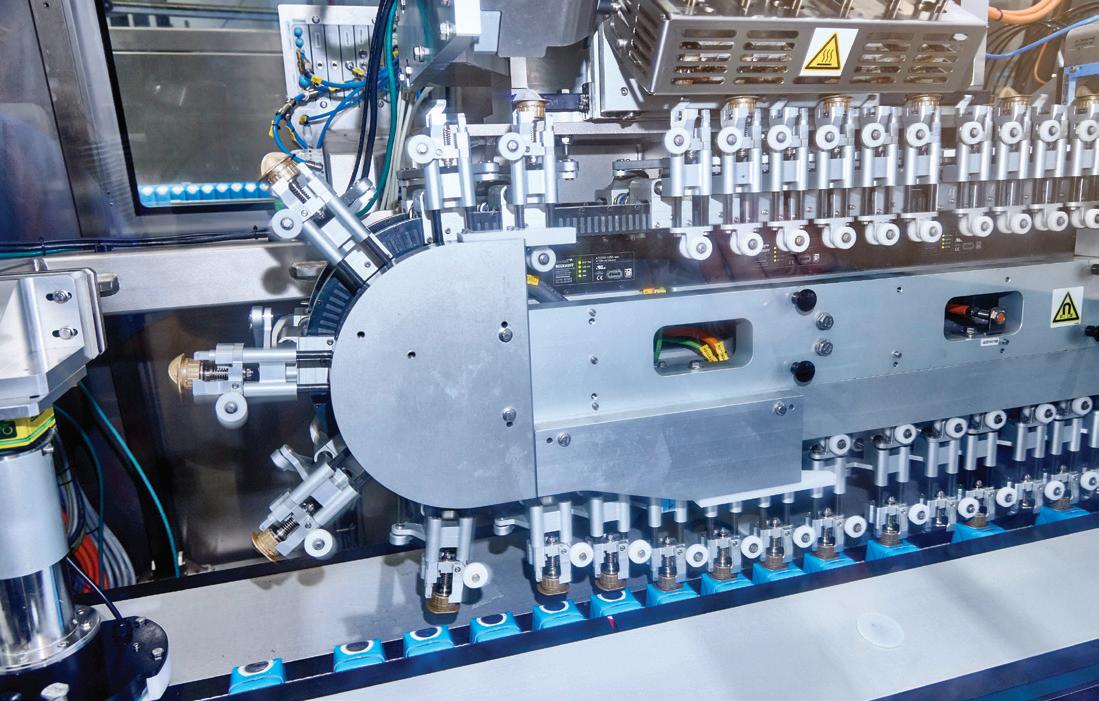
Adhesive is applied to the plastic caps in the upper XTS area, and the plastic caps are then glued to the cartons with high precision in the lower area–in a process that’s almost invisible to the naked eye at full speed.
Adhesive is applied to the plastic caps in the upper XTS area, and the plastic caps are then glued to the cartons with high precision in the lower area—in a process that’s almost invisible to the naked eye at full speed.
The contact pressure that Flore mentions results from the coordinated interaction of the two coupled gantry movers. The high degree of digital control also allows data from the motion system to feed directly into diagnostics. Deviations from parameters can be quickly localized or even prevented.

“The mean time between failures (MTBF) has more than doubled with this system,” Di Eusebio says.
Control platform and drives
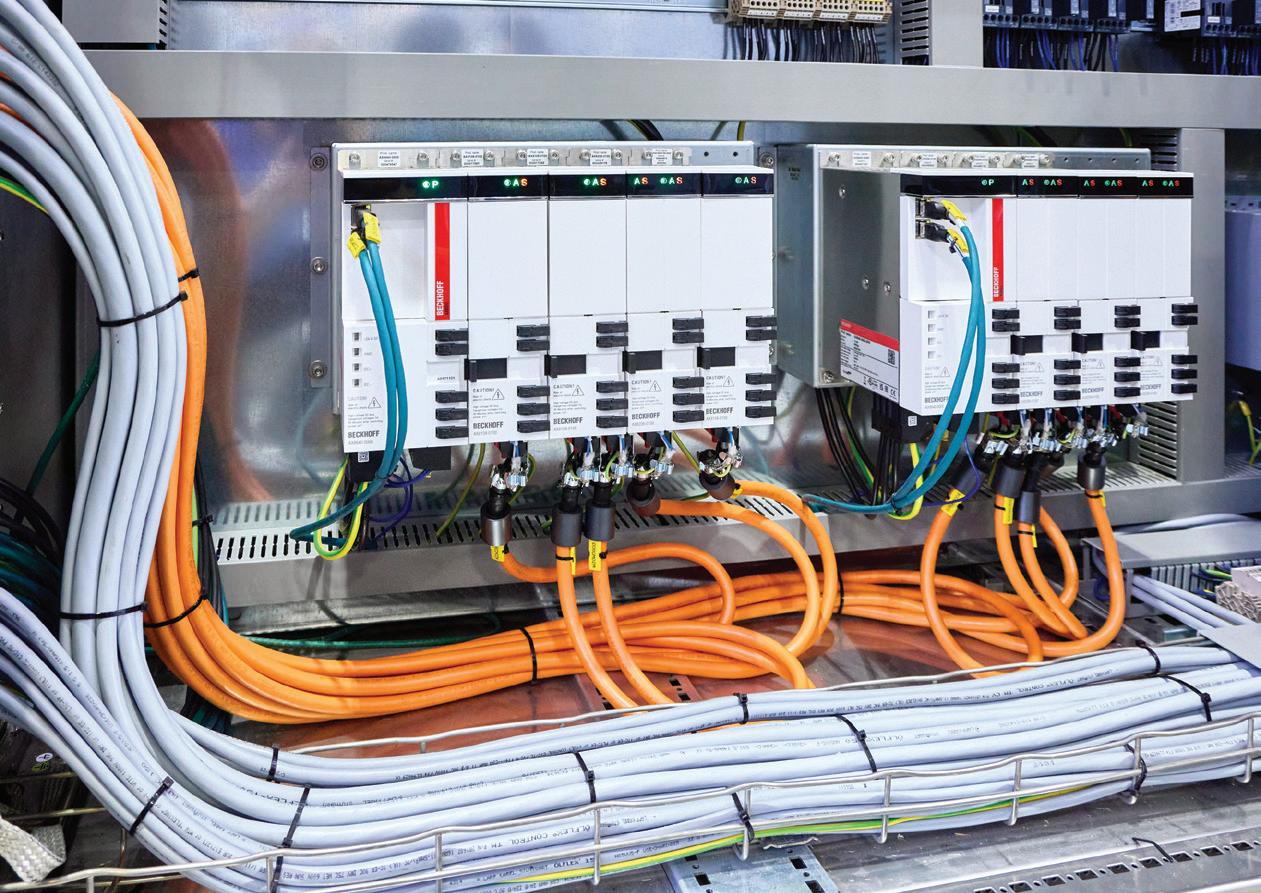
Tetra Pak also chose to use control technology from Beckhoff because all system-related components are available from a single source, which the company says guarantees seamless, efficient integration. At the heart of the machine control system are two C6032 ultra-compact Industrial PCs that handle the HMI applications, the two XTS systems, and motion control via TwinCAT NC PTP and TwinCAT PLC. In addition, a wide range of functions can be combined in a single control unit, including machine simulation. The selected PC-based hardware platform also offers plenty of potential to add new functionality in the future.
“TwinCAT exploits the full potential of PC-based control. This ranges from a wide variety of programming languages, including object-oriented languages to integration in Microsoft Visual Studio and compre -


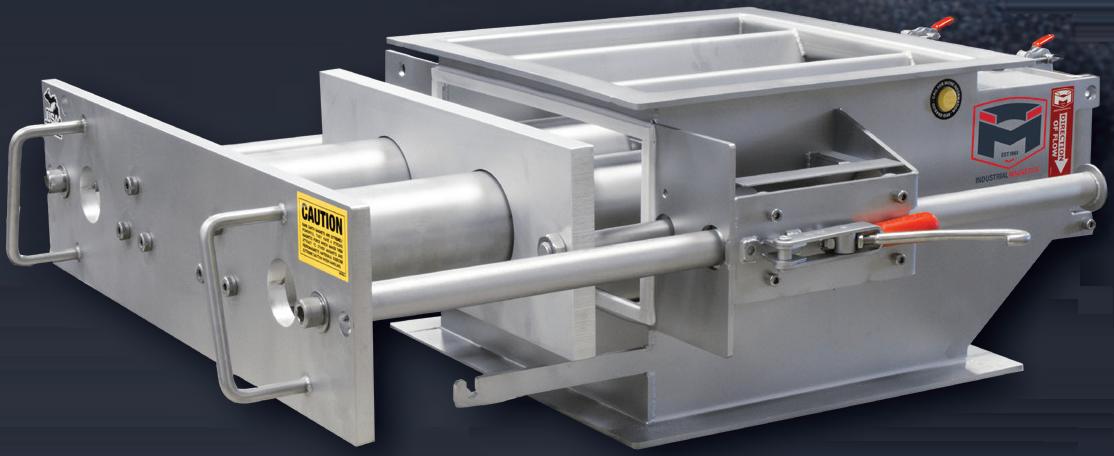
Industrial Magnetics Large-Tube Housings is a powerful magnetic separator that incorporates 3 inch diameter rare earth tubes into our proven Drawer-in-Housing configuration for optimum ferrous metal separation for difficult flowing products.
Key Industries: Food & Grain, Plastics, Petrochem, Aggriculture, Aggregates, Recycling, & Pharmaceuticals




hensive network configuration options, to excellent multi-core processor support,” Scarabelli says. “In addition, the software is well structured, and its open nature makes it possible to not only use the extensive function libraries but also seamlessly integrate your own libraries to create machine-specific condition monitoring. We also make extensive use of TwinCAT Scope for development-related analyses. Overall, TwinCAT gives us the best possible support, including when it comes to achieving our goal of standardized software development.”
Flore adds that the openness of the platform plays a key role.
“The platform is backed by powerful and open EtherCAT communication, which seamlessly integrates the I/O system, functional safety, and drive technology. The Beckhoff AX8000 servo drives offer clear advantages due to the very high dynamics and precise control of the motion sequences. In addition, the modular design is extremely compact and flexible, allowing the simple addition of more axes if required. This is supported by the wide range of AM8000 servomotors and its fine scaling in terms of motor type, power, winding type, and other aspects.”
Davide Borghi, manager of advanced analytics for equipment at Tetra Pak, adds that the whole exercise of launching new equipment on a new software and components platform relies on good service and support.
“Support is particularly important when changing the machine concept. For the Tetra Pak Cap Applicator 40 Speed Hyper, this came into play right from the point when feasibility testing was performed and was especially useful for configuring the system and its huge range of functions. Support was provided flawlessly in all cases–on-site in Italy and from experts in Germany–and right up to each of the different management levels involved.”
Looking ahead, Tetra Pak expects to build on this success.
“We believe that No Cable Technology (NCT) is a promising further development,” says Flore. “And we are already testing the possibilities that XPlanar can bring to a number of applications. We also see attractive advantages of the MX-System for control cabinet-free automation and of TwinCAT Runtime for Linux. So there is a great deal of potential to surprise our end users–like the pilot customer in this case–by giving them another ‘magic machine.’” ■
By Sean Riley, Editor-in-Chief
PMMI MEMBERS are invited to join an exclusive group of senior leaders shaping the future of the packaging and processing industry at PMMI’s Executive Leadership Conference (ELC), April 12–15, 2026, at The Ritz-Carlton, Amelia Island, Florida.
Explicitly designed for C-suite executives and top decisionmakers, the ELC offers a rare opportunity to step away from day-to-day demands and engage in high-level dialogue with peers facing the same strategic challenges — and opportunities — as you.


1. Gain perspective from others at your level
Engage in candid conversations and share best practices with more than 150 C-suite industry leaders. These peer-to-peer discussions offer practical insights and fresh perspectives that you won’t find in a traditional conference setting.
2. Get economic and leadership insights you can act on
Hear from respected thought leaders, including Lauren Saidel-Baker of ITR Economics, and other exceptional speakers who will help you anticipate trends, navigate uncertainty, and make confident decisions.
3. Expand a high-value executive network — intentionally
Build meaningful relationships through 15+ curated networking experiences designed to foster genuine connections among senior leaders. Many attendees cite these relationships as the most valuable takeaway of the conference.
View the full conference schedule at pmmi.org/elc.
Featured Speaker: Mike Rowe, CEO mikeroweWORKS Foundation and Creator & Host, Dirty Jobs
Mike Rowe brings his unfiltered perspective on the skilled trades, technical recruitment, and the widening skills gap — issues every executive is confronting as the workforce ages, and competition for talent intensifies.
Three reasons your peers are registering now:
PMMI’s 2025 Guide to Global Markets provides a clear look at where demand for packaging and processing machinery is growing. This report can help you identify emerging markets, understand export dynamics, and plan international growth



strategies with confidence. Whether you’re evaluating new territories or fine-tuning your approach, this guide offers the practical information needed to make smart, strategic moves in 2026 and beyond.
Download report at pmmi.org/report/2025-guideto-global-markets
Learn proven strategies to attract the right prospects, engage with confidence, and turn booth conversations into lasting sales opportunities.
• Field Service Essentials Workshop: June 9-10, Cleveland



OpX Work Product Release: Data Management Standardization
Focused on data prioritization and effective presentation to drive efficiency faster, these guidelines filter overwhelming production data into actionable information. Aligning OEM and CPG perspectives ensures the right data reaches the right people at the right time to accelerate decisions and cut wasted effort.
Download at pmmiopx.org/work-products
Equip your field service team with the skills they need to improve customer satisfaction and represent your brand at the highest level.
• Certified Trainer Workshop; June 11-12, Cleveland
Learn the techniques and presentation skills to train individuals across all skill levels.
Three workshops. Three chances to level up your people—and your performance. Learn more and register now at pmmiu.org.



OpX Work Product Release: Operator Training Standardization
Operator Training Standardization challenges traditional training models by focusing on transitioning capable individuals into highly qualified operators using modern, outside-the-box methods. Read how embracing fresh perspectives and adaptable learning formats close generational gaps, accelerate competency, and prepare operators for today’s complex, tech-driven environments.
Download at pmmiopx.org/work-products
SHARPEN your skills and drive real results in 2026 with PMMI’s lineup of high-impact workshops. These hands-on sessions deliver practical tools you can use immediately.
• Successful Trade Show Selling; April 1-2, Chicago
THE CONSORTIUM for Waste Circularity (CWC) and PMMI, The Association for Packaging and Processing Technologies, announce their sponsorship of a University of Florida-led research initiative to develop a standardized Life Cycle Assessment (LCA) framework for evaluating the environmental performance of Regenerative Robust Gasification (RRG) at landfills and incinerators.
The two-year research and development effort is led by Dr. Bruce Welt, professor of Packaging Engineering, and Dr. Ziynet Boz, assistant professor of Circular Foods and Packaging Systems at the University of Florida. The research is focused on creating a rigorous, ISO-aligned, site-specific LCA template. Once completed, the framework will enable municipalities and landfill operators to quantify greenhouse gas emissions, material recovery, and circular product outputs using a consistent, science-based methodology.
By providing a standardized approach to environmental impact assessment, the LCA template will support data-driven infrastructure planning, permitting, and policy decisions, while improving transparency and comparability across landfill-based and incineration waste management strategies.
“This Life Cycle Assessment framework provides the scientific foundation needed to assess Regenerative
Robust Gasification at scale,” says Mike Ferrari, president of CWC. “This structured template enables municipal projects to easily apply LCA methods using local data.”
“Standardization is essential to making meaningful progress on circularity,” says Jim Pittas, president and CEO of PMMI. “This ISO-aligned Life Cycle Assessment framework will help communities evaluate Regenerative Robust Gasification using consistent, science-based metrics—supporting more informed infrastructure planning, permitting, and policy decisions.”
The project will incorporate primary data from RRG trials alongside authoritative public datasets and peer-reviewed literature, in accordance with ISO 14040 and ISO 14044 standards, allowing results to reflect site-specific and regional conditions.
Through this sponsorship, CWC and PMMI aim to support credible, academically led research that helps local governments and waste authorities better understand and evaluate the environmental implications of landfill-based waste management options. This should lead to breakthroughs, closing the recycling gap through the creation of true waste circularity.

u IN TODAY’S high-stakes cybersecurity environment, it’s tempting to focus on new technologies such as AI-driven threat detection, zero-trust architectures, and cloud-native security stacks. But for most companies, impactful cyber investment centers on the fundamentals: strong passwords, proper user behavior, and routine security awareness training.
That’s the message our cybersecurity consultant partner 501CISO (via ClearTone Consulting) delivers in two excellent guides: Critical Password Protocols: Your Digital Security Posture and Phishing Testing & Training Best Practices . These are the kinds of resources that all PMMI members can implement quickly and easily for high impact.
Why the basics still matter
• According to incident data, credential compromise remains one of the top root causes of breaches.
• Sophisticated attacks often start with an unpatched system, reused credentials, or a phishing click.
• Investing in large-scale tools without good fundamentals is like installing a high-end alarm system but leaving the doors unlocked.
What 501CISO recommends
• Use unique, strong passwords for each account.
• Conduct regular phishing simulations and training to help your team recognize real-world lures.
• Make employee awareness training part of your cyber hygiene standard — not a “one-and-done” event, but regular reinforcement.
• Track your progress: You can’t simply say, “We trained our staff” — you should seek continuous improvement using measurable metrics (click rate, repeat offenders, behavioral improvements).
How PMMI members can act now
1. Download the two guides from 501CISO and circulate them among leadership and IT/security teams.
2. Map your current security controls: Do you have MFA enforced? Are passwords reused? Are you running phishing simulations?
3. Prioritize and invest: If you don’t yet have a password manager rolled out organization-wide, that might be a quick and painless first step. If your employees have never done a phishing simulation, schedule one this quarter.
4. Build a culture of cyber hygiene: Mechanisms help, but behaviors matter most.
5. Use the guides as the foundation for your next security budget discussion.
Why this matters for the packaging & processing supply chain
• Your machinery, control systems, supplier networks, and customer data are part of complex value chains. A breach doesn’t just hit IT; it can impact production, delivery, reputation, and compliance.
• Foundational security reduces your attack surface and limits the “easy wins” for attackers. That allows your higher-level defenses (cloud, AI, network segmentation) to work from a stronger base.
As the industry integrates smart machines, IIoT, remote monitoring, and cloud analytics, the human layer remains the weakest link. Fixing that is high impact.
IN 2025, the PMMI Foundation, the charitable arm of PMMI, The Association for Packaging and Processing Technologies, expanded its reach through scholarships, Skills Fund matching grants, student travel assistance, and industry-sponsored events, introducing thousands of young people to careers in packaging, processing, automation, and manufacturing.
and partners whose support makes these opportunities possible.”
The PMMI Foundation continued to elevate realworld career exploration through national events and competitions, bringing packaging and processing into the lives of students across multiple touchpoints.
points.

The Foundation supported over 70 programs in North America through the PMMI U Skills Fund for the Future Workforce, resulting in over $600,000 in matching funds and a total investment of $1.2 million across the industry to strengthen packaging education and training. These programs benefited more than 17,000 students, creating meaningful engagement opportunities and fueling long-term talent development for the industry.





This impact was made possible in part through the support of Schneider Electric, the PMMI Foundation’s Visionary Benefactor. As a champion of workforce development, Schneider Electric’s support helps expand access to education, hands-on experiences, and career pathways for students pursuing futures in packaging, processing, and manufacturing.
“Every one of these initiatives is about opening doors, helping students discover the career paths available in packaging and processing, and giving them real-world access to our industry,” says Kate Torrence, director, workforce development, PMMI.
“We’re proud of the momentum we’ve built and deeply grateful to the partners and sponsors who make this work possible.”
In 2025, the PMMI Foundation awarded more than $168,000 in academic scholarships to students pursuing degrees in packaging, processing, engineering, automation, and related fields at colleges and universities across North America. The scholarships recognize outstanding emerging leaders and help develop the next generation of innovators for the industry.
“These students represent the heart of the future for packaging and processing,” says Jim Pittas, president & CEO of PMMI. “Their dedication, curiosity, and drive will help our industry thrive for years to come. We extend our sincere thanks to our sponsors





In 2025, the Foundation helped make PACK EXPO accessible to students by supporting more than 1,000 student attendees across PACK EXPO Southeast and PACK EXPO Las Vegas, providing over $75,000 in funding to help student groups travel to the shows and explore packaging innovation firsthand.
“ This work is about much more than programs; it’s about the future of our industry.”
The Foundation also continued its investment in summer workforce development experiences through 23 co-branded summer camps, impacting more than 500 students in North America and providing $50,000 in support to fuel hands-on manufacturing exploration.
That same year, the PMMI Foundation supported major national initiatives aimed at connecting students with technical skills, leadership development, and industry inspiration.
At the SkillsUSA National Leadership and Skills Conference held in June, the Foundation engaged with more than 19,000 students from across the country, featuring the Packaging Pavilion to highlight packaging careers and bring industry visibility to the next generation of skilled professionals.
The Foundation also continued its support of FIRST programs, sponsoring 36 FIRST Robotics (FRC) teams and 10 FIRST Tech Challenge (FTC) teams to attend the FIRST Championships, reinforcing its commitment to STEM, automation, and the engineering pathways that connect directly to packaging and processing careers.
“The progress we’ve made this year reflects the strength of our partners and the urgency of our mission,” says Pittas. “This work is about much more than programs—it’s about the future of our industry. We’re proud to be helping students find their place in packaging and processing, and we’re committed to expanding this impact even further in the year ahead.” ■
Discover how exhibitors can leverage AI to strengthen connections, improve e ciency, and turn booth tra c into measurable results.
By Peggy Lotfi, Exhibitor Operations Coordinator , PMMI
Artificial Intelligence (AI) is quickly becoming one of the most powerful tools shaping the future of trade show planning and execution. Companies around the world are embracing AI not only as a trend but also as a strategic advantage for innovation. Understanding how your company, as an Exhibitor, can adopt AI platforms and technology effectively into trade show programs is key to functional growth.
Recent data from UFI’s Global Exhibition Barometer report shows 63% of companies indicate that they currently use standard AI tools in at least some of their business functions. Additionally, Deloitte predicts 25% of companies that use generative AI will launch Autonomous generative AI agent (agentic AI)

pilots this year, growing to 50% in 2027. The rapid adoption and deployment of these systems signal a growing trend that affects every sector, including trade shows.
The question for exhibitors is no longer if AI belongs on the show floor, but how it can be used to build stronger connections, generate qualified leads, and drive measurable sales outcomes.
The trade show floor is built on real-time interaction, and AI is helping exhibitors personalize those moments like never before. AI-powered engagement tools have the power to recognize repeat visitors, identify key decision-makers, and create more intuitive experiences through voice-activated commands.
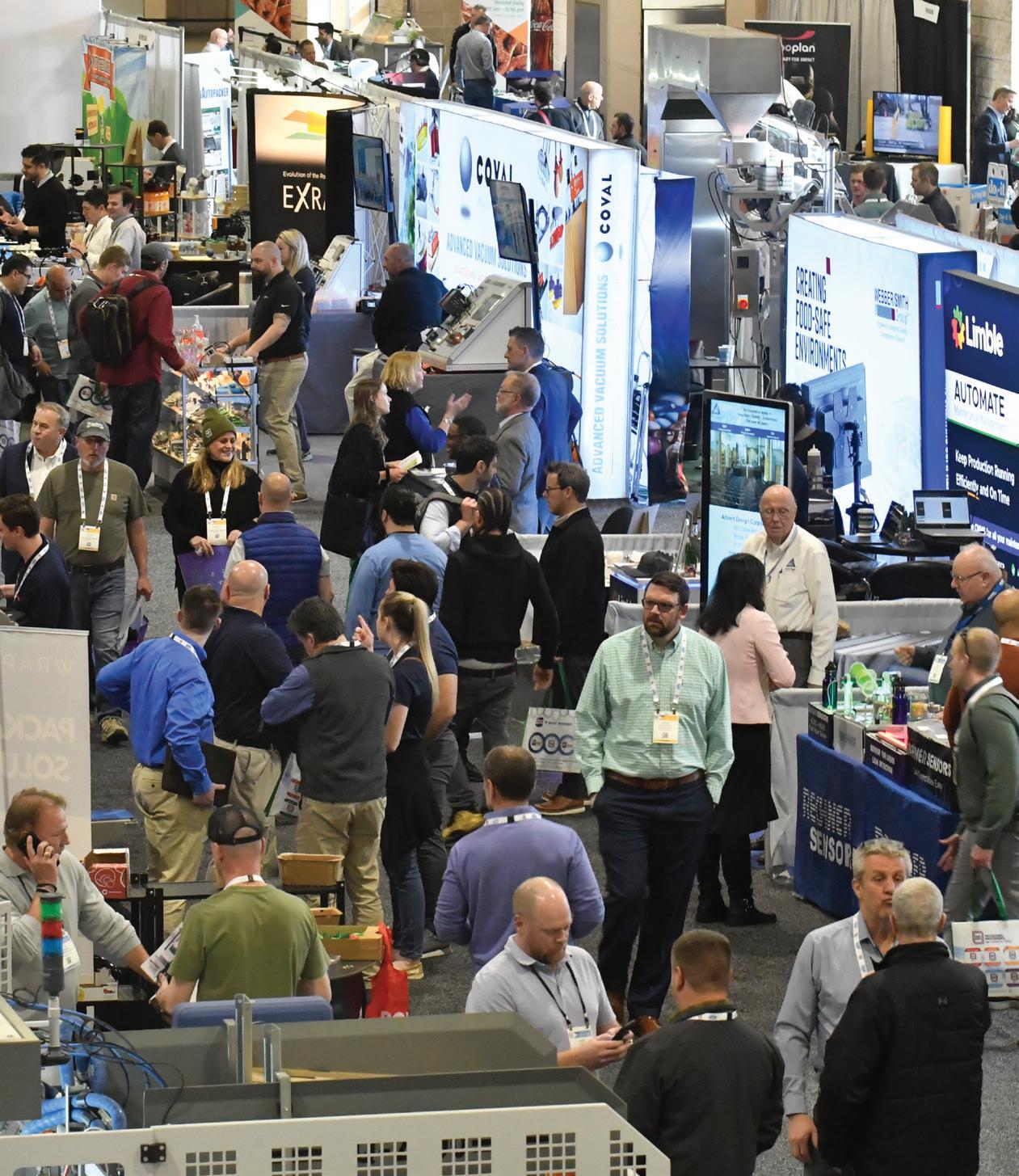


How can you incorporate AI into your trade show plans?
∙ Custom chatbots that provide natural language customer support
∙ AI tools that schedule meetings with booth staff
∙ Real-time conversation translation through smart devices
∙ AI-powered software that automatically captures notes from sales conversations
“ ...sales teams focus on building relationships while AI handles the repetitivetasks...”


AI is also reshaping how exhibitors manage leads beyond the booth. New tools like Sales Accelerator— debuting at PACK EXPO International 2026—use AIdriven analytics to identify and connect with attendees. With this state-of-the-art tool, exhibitors can:
∙ Access key insights on attendee interests and needs
∙ Generate detailed lead reports
∙ Rank and prioritize high-value online leads
∙ Develop personalized emails tailored to a contact’s needs and preferences
∙ Identify similar connections within a target company
This automation allows sales teams to focus on building relationships while AI handles the repetitive tasks behind the scenes.
As exhibitors adopt AI tools and agents, it is important to use them thoughtfully and responsibly. AI should enhance booth engagement and efficiency, but it works best when paired with human oversight and clear guidelines. Exhibitors should avoid uploading confidential customer data into public platforms, ensure AI-generated responses align with brand mes-
saging, and be transparent when technology is being used to support interactions. By keeping a human in the loop and focusing on approved, accurate information, exhibitors can use AI confidently while maintaining trust and professionalism on the show floor.
PMMI and PACK EXPO recently unveiled two new AIpowered tools to enhance the Exhibitor Search experience for attendees and provide more targeted results:
Users enter their product to receive AI-powered, step-by-step packaging or processing recommendations and explore exhibitors offering solutions for each stage.
Enter the type of packaging you are looking for or upload an image of your package to receive AI-powered category recommendations.
Exhibitors at PACK EXPO trade shows should ensure their online listings are complete and their product categories are up to date to be featured in search results.
AI has significant potential to change the way exhibitors work, especially by eliminating mundane tasks and enhancing meaningful engagement. Companies that embrace AI on the show floor may gain a powerful edge in attracting attention, nurturing leads, and driving results.
If you’re exhibiting this year, will AI be a part of your strategy? ■
Wipotec Technology‘s new MMS 2 is an ideal weigh cell for production lines in a variety of settings, including quality control scenerios for vial and syringe filling. The MMS2 offers IP65 protection for safe guarding of components against dust, foreign materials, water, and other environmental factors.
With more brands writing digital twin requirements into RFQs, Rockwell Automation revealed seven questions OEMs need to be ready to answer from their customers before the first design review.
By Matt Reynolds, Chief Editor, Packaging World PERSPECTIVES
As more brand owners begin including digital twin requirements in their RFQs, Rockwell says OEM engagement is becoming one of the most important success factors. At Rockwell’s Automation Fair, Dwayne Negron, digital twin capability manager at Kalypso, a Rockwell business, noted that more end users are “bringing in digital twin requirements on first pass to their contracts,” which means machine builders are increasingly expected to support them.
For CPG engineering teams preparing for new equipment purchases or line upgrades, here are the questions Rockwell recommends asking OEMs early:
1. What CAD assets can you provide, and in what format?
Digital twins depend heavily on simplified or fulldetail CAD models. CPGs should understand whether their OEM can provide the required geometry and how the OEM handles IP protection.
“OEMs are protective of their CAD data … There’s a lot of IP tied to that,” he said.
2. Can you provide virtualized PLC logic for emulation?
Rockwell emphasized that digital twins work best when the OEM shares real controls code, not placeholder logic. Ask whether the OEM supports program
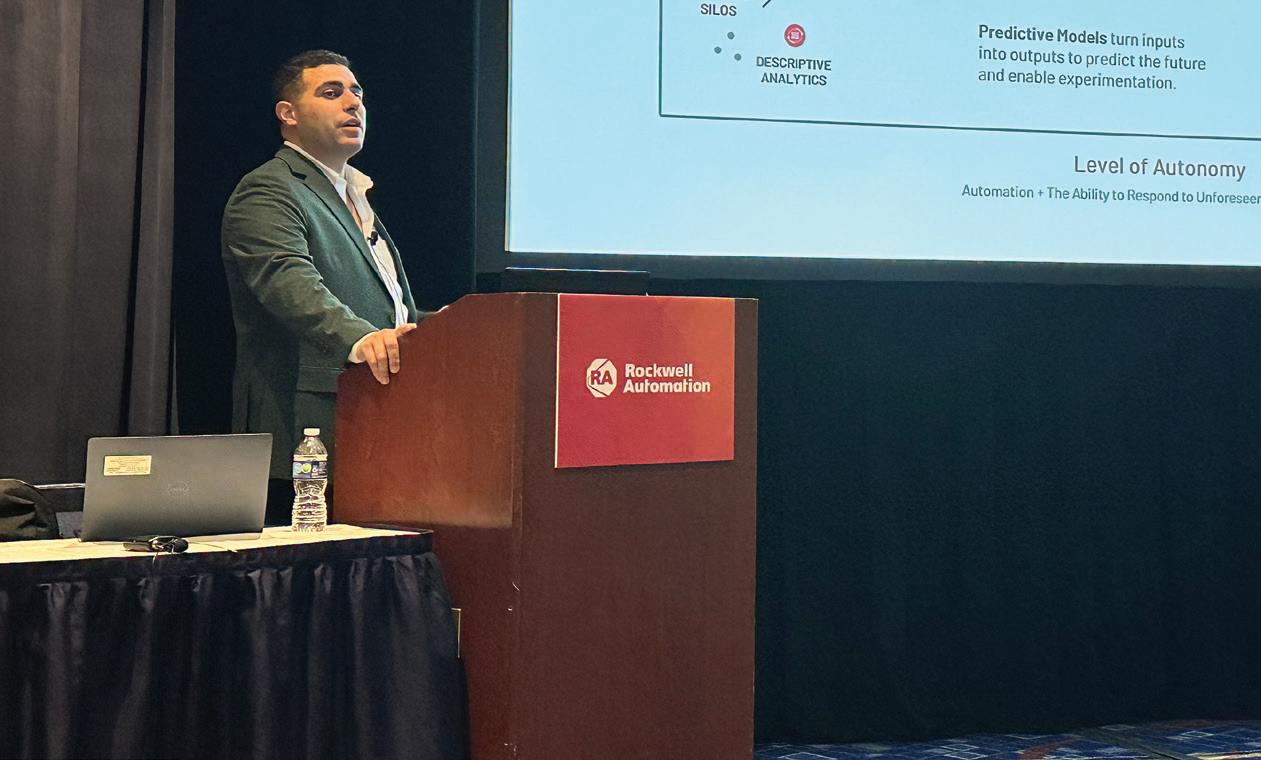
encryption or controlled-access environments for collaboration.
“OEMs are [also] protective of their … PLC/software programs. We produce the digital twin and encrypt [the PLC program],” Negron said.
3. Are your machines already part of a digital twin library or reference model?
Rockwell is building partnerships with OEMs to pre-build digital twins of specific assets. If your equipment is already modeled, your commissioning and troubleshooting twins could come online faster.
“Rockwell is going into many different partnerships with OEMs to produce digital twins of their specific equipment,” he said.
4. How will updates be managed post-installation? How will future equipment changes–like controls updates, mechanical revisions, and tag additions–be communicated so the twin stays accurate?
Controls revisions, firmware changes, and mechanical updates all affect the accuracy of a digital twin. Ask whether your OEM has a change-management pathway that keeps virtual and physical machines aligned.
“Models are built for design or commissioning and then they’re ‘shelved.’ To use the model, users are then required to bring the digital twin back in sync with its physical twin,” Negron said.
5. What support do you offer during virtual FAT or commissioning?

Dwayne Negron, digital twin capability manager at Kalypso, a Rockwell business, noted that more end users are “bringing in digital twin requirements on first pass to their contracts. Courtesy: Packaging World
Digital twins allow FATs, I/O checks, safety logic validation, and sequencing tests to start weeks or months earlier. OEM participation in virtual FAT can significantly reduce startup risk.
Courtesy: Rockwell Automation
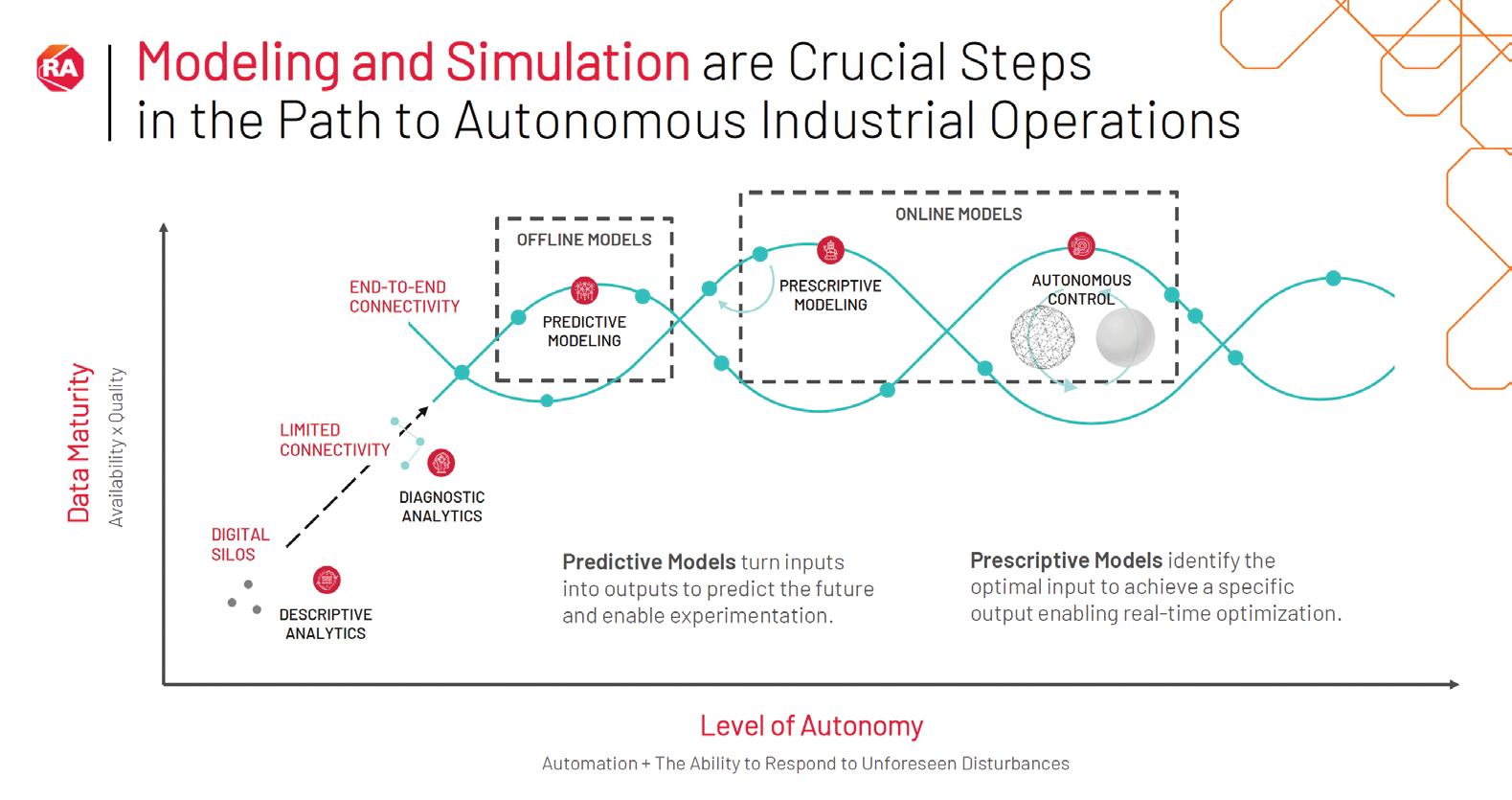


“We’re able to take that controls testing time … and get that process started much earlier in the equipment’s lifespan,” he said.
6. How does the OEM protect its IP while enabling your modeling needs?
Negron acknowledged OEM concerns directly, and for good reason, OEMs have to be careful of their own IP. Ask what encryption methods, access controls, or middle-ground collaboration tools the OEM uses to
safely support you.

Rockwell positions modeling and simulation as foundational steps on the journey to autonomous industrial operations, moving manufacturers from descriptive and diagnostic analytics toward predictive modeling, prescriptive modeling, and ultimately autonomous control as data maturity and connectivity increase.
“We … receive that information… produce the digital twin and encrypt. We then go to the intermediate environment … [and] protect that information the same way [OEMs] normally would,” Negron said.
Together, these questions help ensure that CPGs and OEMs approach digital twins as a strategic component of modern packaging equipment design, delivery, and lifecycle management, and not as an afterthought. ■

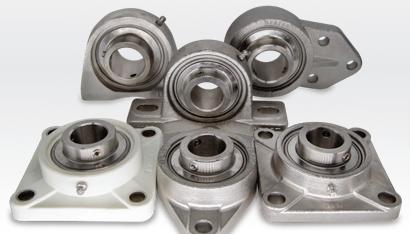



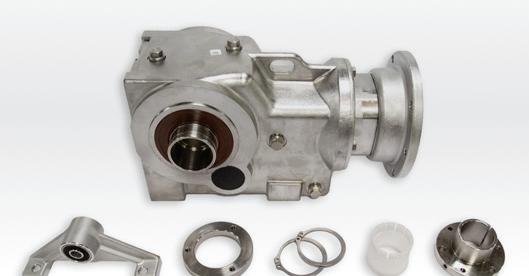

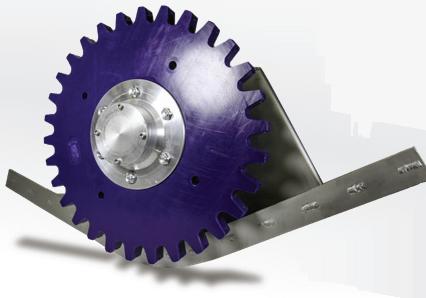







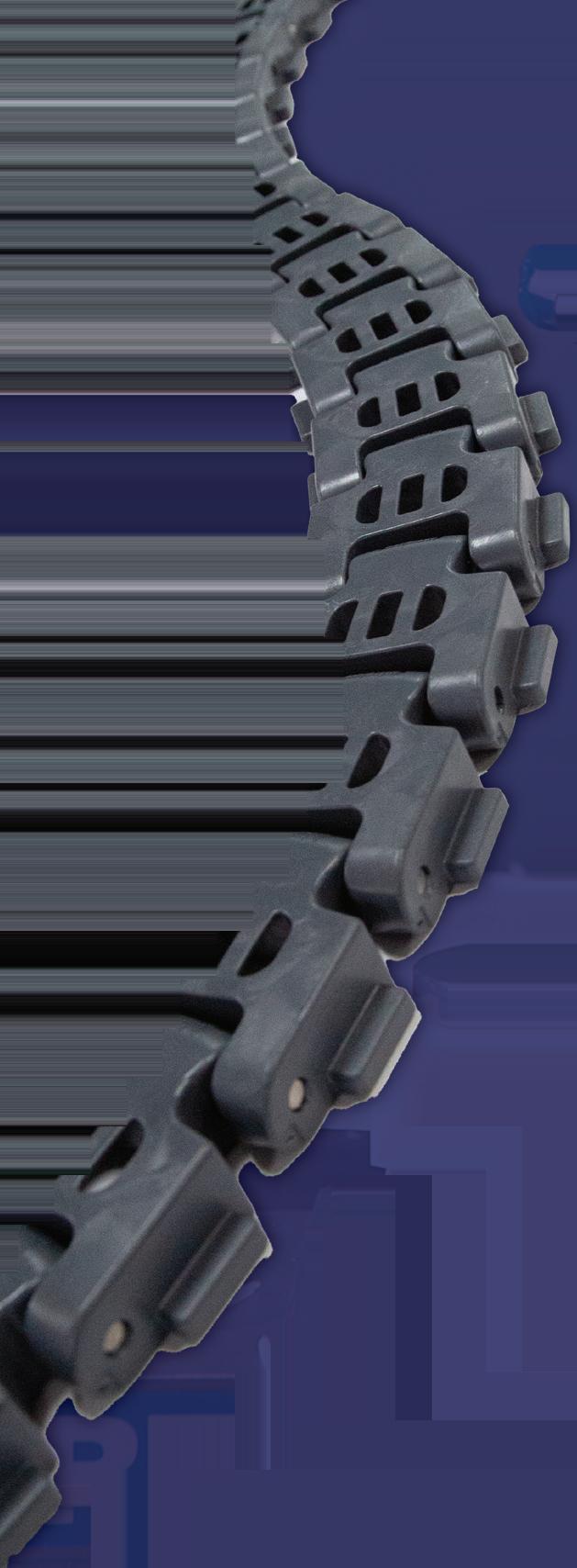
A Q&A on building professional relationships that last beyond the initial first meeting.
By Amber Miller, Director of Marketing, PMMI Media Group

At every industry event, professionals exchange business cards, connect on LinkedIn, and promise to “stay in touch.” Yet too often, those conversations fade once everyone returns to full inboxes and packed schedules. During a recent PPWLN Learning Circle focused on connection, I spoke with organizational psychologist and author Alison Fragale and packaging industry executive Lisa Hurtz of Felins, Inc., about how to build relationships that extend beyond the show floor.
Below is an edited Q&A from that conversation.
OEM: How important is it to stay connected after an event?
Alison Fragale: It’s important—but not every interaction needs to turn into a long-term relationship. You attend events because meeting people is valuable. The real question is: Who should you prioritize?
Not every conversation carries the same weight. It’s OK to enjoy a discussion and leave it there. Focus on the people who align with your goals or who you genuinely want to know better.
The bigger challenge is logistics. Most people don’t fail to follow up because they lack interest, they fail because life gets in the way. You come back to a full inbox and urgent deadlines. Suddenly, the event feels like it happened months ago.
The solution is to make the connection easy. Build simple follow-up habits so staying in touch doesn’t feel overwhelming.
Lisa Hurtz: I approach networking differently. I don’t walk into events thinking, “Who can I do business with?” I look for friends and companions in the industry.
The packaging world is small. Genuine friendships— built without an agenda—naturally create opportunity over time. When you focus on real connection instead
of transactions, follow-up becomes natural.
OEM: How do you shift from transactional networking to genuine connection?
Fragale: I always ask myself: “How can I help this person? What’s their story? What do they care about?”
Help doesn’t have to be tied to your job. If someone mentions getting a new puppy and you recently went through that, you can share a recommendation. If you connect over parenting, fitness, or travel, that still adds value.
Even a small value counts. When someone walks away thinking, “That was helpful,” you’ve made an impression.
Especially for introverts, this mindset is powerful. If you’re going to be at the event anyway, focus on being helpful in small, efficient ways.
Hurtz: When you remove the sales pitch, people relax. If someone leads with their product or service, it feels transactional. But when someone shows personality and curiosity, it builds trust.
Those social connections are what make people happy to hear from you later.
OEM: How do you know if someone wants to stay connected?
Fragale: It’s OK to ask. “Would it be alright if I connect with you on LinkedIn?” That establishes permission for follow-up.


“ Infl uence doesn’t start with a pitch. It starts with connection.”
—Lisa Hurtz

Beyond that, the key is your approach. If your follow-up is service-oriented and shares an article, resource, or other relevant content, you’re unlikely to annoy anyone. They don’t even need to respond.
Problems arise when people ask for too much, too soon. If your early interactions consist only of requests, it can feel one-sided.
There’s a concept I’ve heard: “No asks for one year.” While that may not always be realistic, the principle is sound: Invest in the relationship before making demands on it.
Hurtz: Exactly. When you’ve built a social relationship—not just a business one—follow-up feels welcome. Without an agenda, most people are open to staying connected.
OEM: Why does likability matter so much professionally?
Fragale: The science is clear: Liking is one of the strongest drivers of influence.
Imagine two colleagues make the same request. You’re more likely to say yes to the one you like, even if the request is inconvenient. It’s not the request that determines your response; it’s the relationship.
Being likable doesn’t mean being fake. It means being interested, curious, and human. Show up with something other than an ask. Be someone people enjoy interacting with.
That foundation makes collaboration easier later.
OEM: What creates likability?
Fragale: Similarity. When we perceive that someone is like us, we trust them more.
It can be something simple—shared industry challenges, navigating tariffs, balancing work and family, even riding Peloton. That shared moment creates connection.
People think small talk is superficial, but it’s powerful. When someone feels, “You get me,” it builds trust that carries into professional interactions.
Hurtz: Empathy matters too. Right now, many packaging companies are dealing with tariffs, labor challenges, and market uncertainty. If you genuinely acknowledge what someone is going through and listen, it quickly builds a connection.
People want to feel understood.
OEM: What are practical ways to maintain connection after an event?


“
Depth ma ers more than breadth. A handful of strong relationships is far more valuable than a stack of business cards.
” —Alison Fragale
Fragale: Keep it simple:
∙ Send a LinkedIn note referencing your conversation.
∙ Share a relevant article or resource.
∙ Follow up within 48 hours while the interaction is fresh.
You don’t need elaborate emails. A short message like, “Great talking about sustainability goals, here’s the study I mentioned,” is enough.
Light, occasional touchpoints are powerful. When you see something tied to your shared conversation— an industry update, podcast, or event—send it with a quick “Thought of you.”
It keeps the relationship warm without overwhelming either person.
Hurtz: And in an industry like packaging, relationships often resurface unexpectedly, through referrals, new roles, or collaborative opportunities. When the connection is genuine, it never feels forced.
OEM: What’s the biggest networking mistake professionals make?
Fragale: Treating networking as contact collection instead of relationship building.
Depth matters more than breadth. A handful of strong, well-maintained relationships is far more valuable than a stack of business cards.
Focus on service first. Make follow-up easy. And prioritize genuine connection over quick wins.
OEM: Final advice for OEM readers?
Hurtz: Don’t go looking for sales. Go looking for people.
Fragale: And remember—long-term influence doesn’t start with a pitch. It starts with connection.
In an industry defined by long sales cycles, complex buying committees, and repeat business, relationships are not optional—they’re strategic.
Stop collecting contacts. Start connecting. ■

Artificial intelligence is no longer a future capability in packaging equipment, according to PMMI’s latest white paper, and five rapid advancements are accelerating the shift from adoption to advantage.
By Sean Riley, Editor-in-Chief
When AI officially moved from a sci-fi lover’s dream to a real-world reality, PMMI quickly researched the new advancements and produced the 2024 white paper, The AI Advantage in Equipment: Boosting Performance and Bridging Skills Gap. Less than two years later, interviews with OEMs, CPGs, AI vendors, and integrators for a follow-up white paper, Building an AI Advantage in Packaging Equipment, reveal a stark shift: AI is no longer about proving concepts. It’s about solving operational, workforce, and compliance challenges at scale.
Five areas in particular stand out for making the most significant strides.
1. Turning tribal knowledge into digital assets
The biggest leap since 2024 has been in AI-powered knowledge transfer. Two years ago, companies discussed the idea; many are actively deploying it in 2026. AI is being used to capture undocumented “tribal knowledge” from experienced operators and technicians. Generative AI systems can quickly record manuals, service logs, work orders, and even voice notes, then deliver context-aware guidance directly to operators on the line.
2. Predictive maintenance
While not new, predictive maintenance is much more intelligent and trusted by OEMs and their customers.
AI models have moved beyond simple thresholdbased alerts to continuously learning systems trained on real machine data. New developments, including explainable AI, richer sensor integration, and the move toward prescriptive maintenance, are enabling systems not only to predict failures but also recommend specific corrective actions and optimal intervention windows.
Advances in deep learning have increased defect detection rates to over 99%, while greatly decreasing
false rejects. AI vision systems now can detect subtle irregularities that traditional sensors miss and adapt to new SKUs without extensive reprogramming. When combined with robotics, vision systems facilitate flexible picking, inspection, and quality assurance in fast-paced environments.
4. Automating the administrative burden
Environmental, social, and governance have collectively created an administrative bottleneck for packaging companies. AI systems are now being deployed to aggregate data, auto-complete compliance questionnaires, and ensure consistent, audit-ready responses across customers and regions to meet sustainability reporting, material disclosures, and evolving global regulations.
Administrative tasks offer smaller or hesitant companies “low-hanging fruit” for AI adoption. It delivers fast ROI with limited operational risk.
After years of cybersecurity and IT concerns, data transparency is slowly catching on in packaging and processing.
New AI architectures allow secure, locally controlled data collection with selective data sharing, easing security fears while unlocking value. AI-driven data platforms can automatically classify, organize, and contextualize information across operations, turning raw data into actionable insight.
This matters because every other AI application depends on it. Predictive maintenance, compliance automation, and knowledge transfer all perform better when data is structured and accessible.
The takeaway for OEMs is straightforward: Customers are no longer asking if AI belongs in their operations; they’re asking how fast it can be deployed, how well it integrates, and who is accountable when it’s running. ■
The following section, Partner Leaders, features profiles of leading packaging and processing automation suppliers that stand to deliver value to you, the OEM. These companies specialize in bringing you the innovative products and services that you need, such as controls, components, integration, and more. Plus, you’ll find a companion Partner Leaders box prominently featured on the homepage of OEM (scan the QR code above or go to www.oemmagazine.org), with a drop-down menu of the participating companies listed by product category.
AMCI’s products are designed for superior performance, offering specialty I/O solutions that expand functionality and introduce capabilities like position sensing, motion control, stamping press automation, and packaging control. Whether linear or rotary, our PLC-based interface products provide user-friendly operation and set new industry standards.
AMCI also offers a full range of heavy-duty rotary shaft sensors for demanding applications. Our resolver transducers include single-turn, multi-turn, and redundant versions for precise absolute position sensing in harsh environments. Additionally, our stepper and servo motion control products feature optional network connectivity or seamless integration into existing systems, enhancing performance and reliability.
Warranty/Guarantee: AMCI guarantees our products to be free from defects in materials and workmanship for 18 months from the shipment date. We will repair or replace any defective product within this period, free of charge.
Service, Support & Spare Parts: Our commitment doesn’t end with a sale. AMCI is trusted across industries, and our 24/7 Technical Support team ensures maximum performance for every customer. Our resource library is available at no cost on our website.
Training: AMCI’s Sales Department offers virtual and in-person training to help customers and distributors maximize product use. We provide demo products at cost and promotional materials for better understanding. Our customer service team is dedicated to helping you find the best solutions for your application.
AMCI is committed to delivering high-quality automation solutions with a focus on customer satisfaction. Our goal is to provide seamless, reliable solutions for your industrial automation needs.

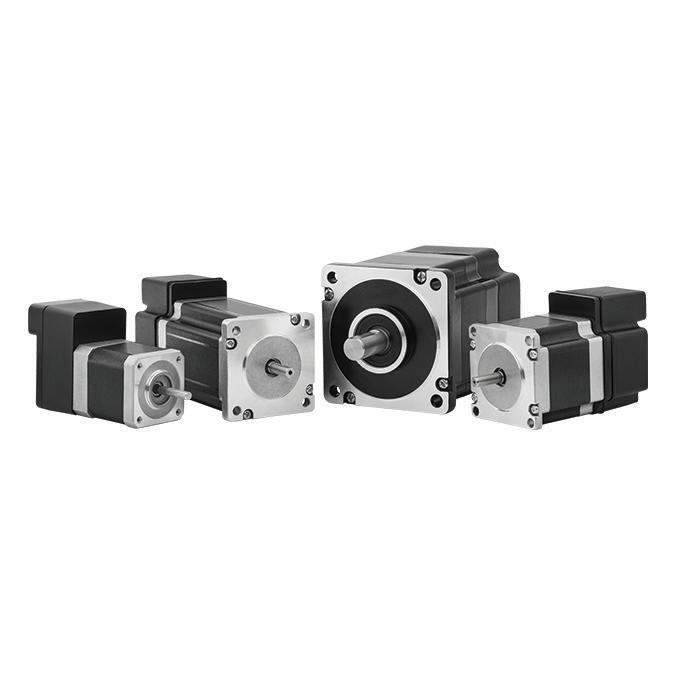
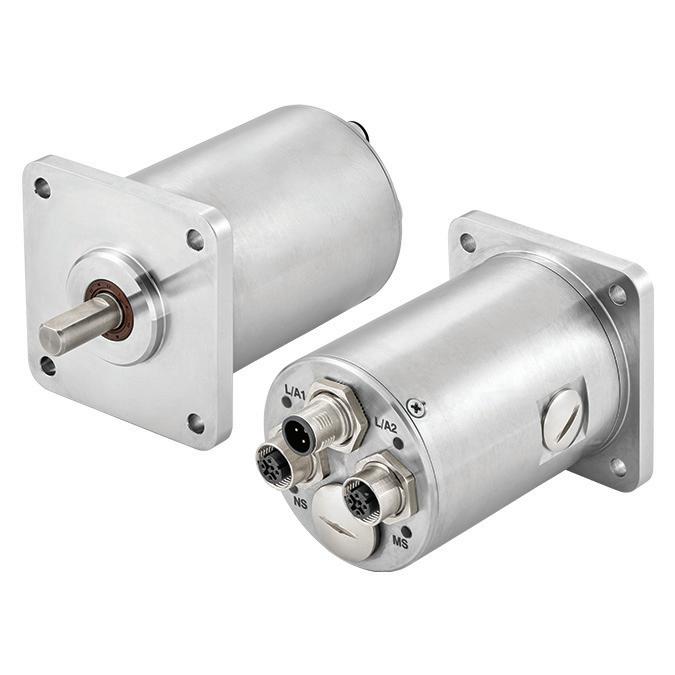
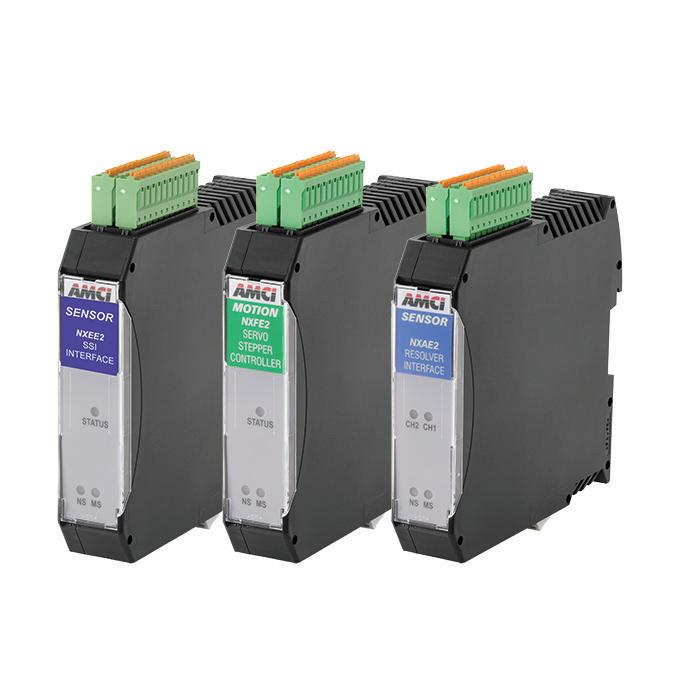
Ashworth Bros., Inc. delivers innovative conveyor solutions, offering both metal and plastic belting options tailored to specific product and system requirements. With 80 years of industry leadership, Ashworth holds more conveyor belt patents than any other manufacturer in the food processing, can making, and material handling sectors.
The PosiDrive Spiral® System—the original direct drive—features a unique drive design engineered to handle heavier loads while reducing jam ups and streamlining packaging processes. It provides a cost effective way to reduce downtime and improve efficiency in both new and existing spiral applications.
SpiralSurf plastic belts, available in 1 inch and 2 inch pitch with plastic or steel rods, can be customized for cooling, proofing, and freezing applications. Proven to operate for more than 100,000 cycles, the SpiralSurf 100 supports tight transfers and small products, while the SpiralSurf 200 is ideal for heavier or larger items.
Ashworth Factory Service
Ashworth Factory Service provides comprehensive engineering support, including system refurbishment, troubleshooting, and belt installation— available 24/7, year round.
Companies worldwide rely on Ashworth for high quality products, responsive service, and innovative solutions that improve productivity. As a global industry partner, Ashworth helps optimize the performance of food processing conveyor systems critical to operational success.

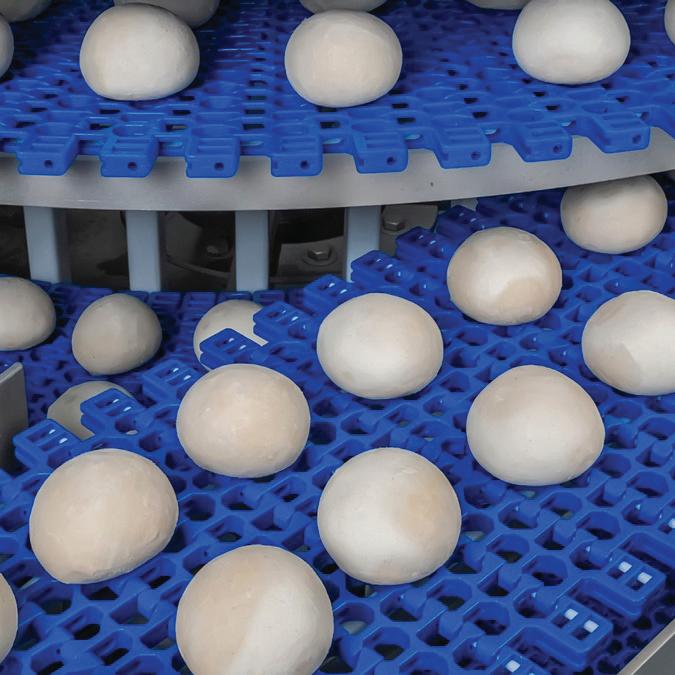

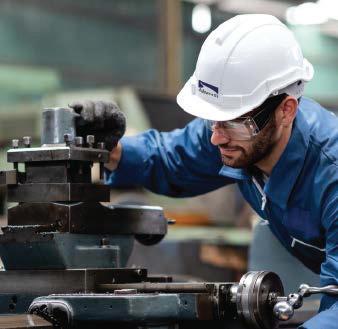
At Beckhoff, automation is our calling. We empower engineers to succeed as industry leaders across all aspects of packaging and processing. We help you differentiate by harnessing new technologies, embracing open standards and solving the world’s most complex problems.
Founded and led by engineers, we organically create advanced controls, communication, IoT and motion technologies that become unique tools for your one-of-a-kind challenges in an age of digital transformation. As a global partner with U.S. headquarters in Minneapolis, we remain committed to sustainability, inclusivity, and support for the people behind the automation.
So whether you’re harvesting data from V/F/F/S machines with integrated cloud connectivity, saving valuable plant floor space with cabinet-free control systems, optimizing traceability in pharma applications, or ensuring food safety in protein processing with integrated vision tech – you can reach new heights for your business, industry, and humankind.
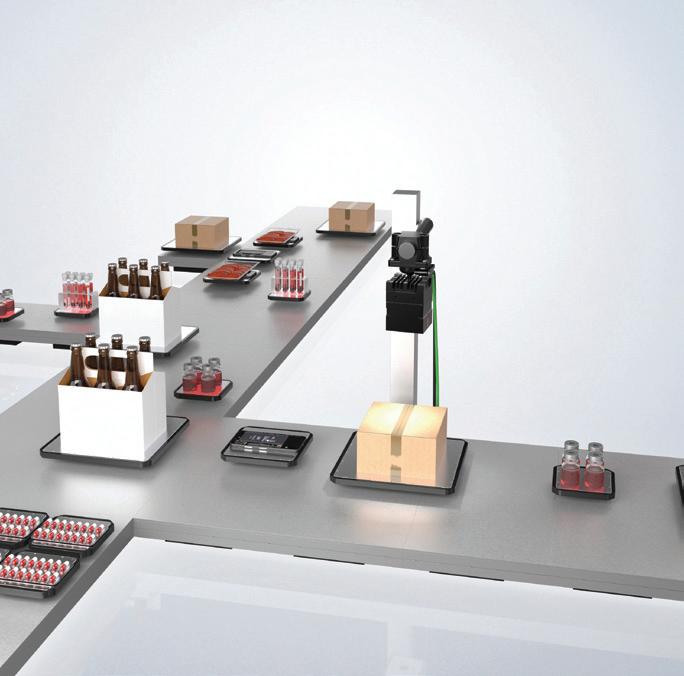
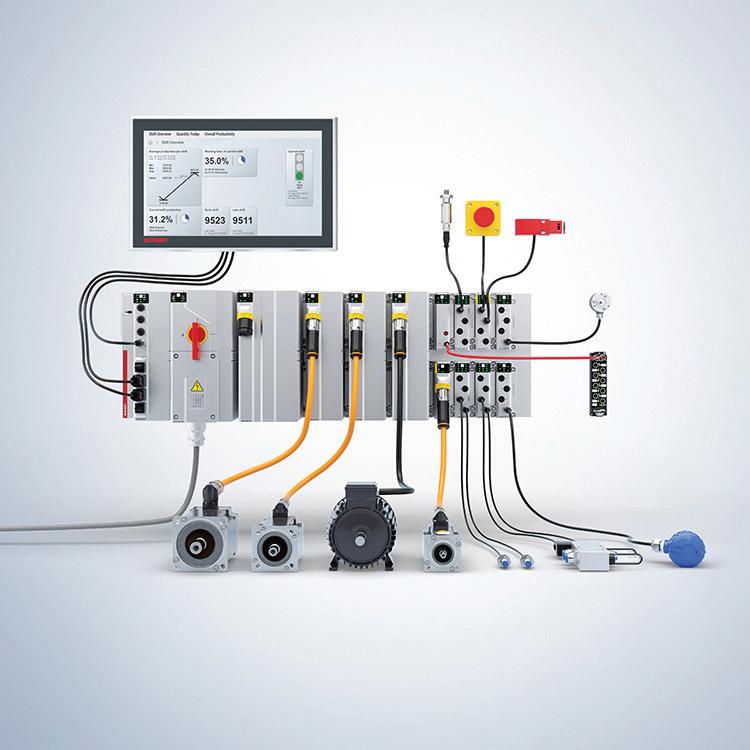

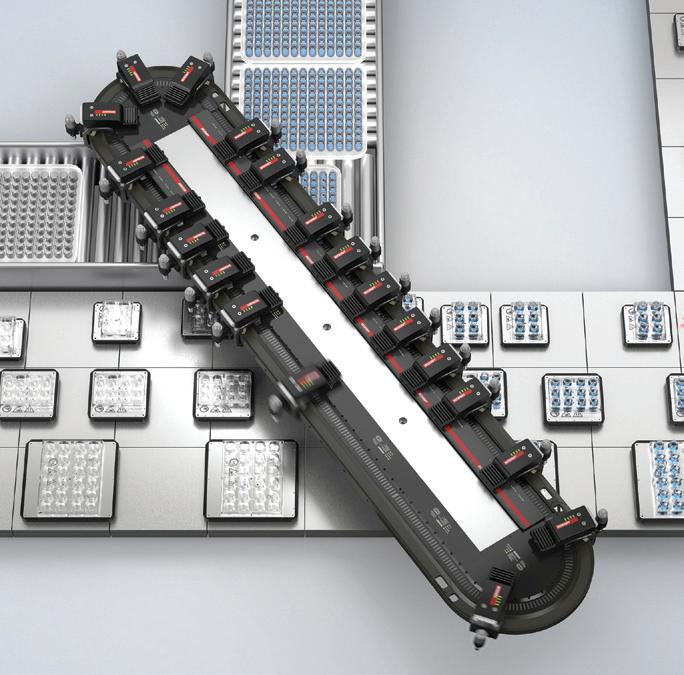
Powered by 75 years of relentless problem-solving and steadfast reliability, Bishop-Wisecarver® delivers innovative motion solutions around the world that thrive in harsh and extreme conditions. Our product lineup includes linear and rotary motion solutions, custom complex assemblies, and mechatronic systems that lead the manufacturing industry. In addition to standard offerings, our engineers specialize in custom-engineered solutions—adapting, configuring, and designing systems to meet unique application requirements.
Our leadership is rooted in an integrated, systems-level engineering approach. We combine mechanical design, materials expertise, fabrication capabilities, and motion technology with a focus on reliability and long-term performance. Through Wisecarver Automation, our dedicated automation division, multidisciplinary teams collaborate across mechanical, electrical, controls, and application software disciplines to deliver fully engineered, turnkey automation systems. This approach enables early risk mitigation, streamlined integration, and solutions that scale reliably from prototype through long-term production.
Equally important is how we partner with our customers. Through our Signature Experience™, we emphasize early collaboration, clear communication, and hands-on engineering support throughout the project lifecycle. Our engineers work as an extension of the customer’s team—aligning design intent, system performance, and serviceability from concept through deployment.
By combining integrated engineering expertise, turnkey system delivery, and a commitment to long-term reliability, Bishop-Wisecarver® sets the standard for leadership in motion and automation—delivering solutions engineered to perform where others fall short.

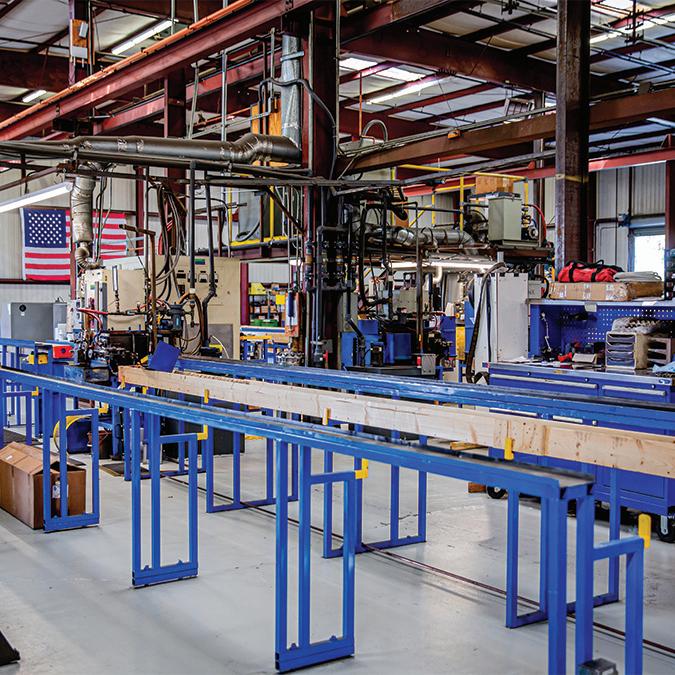
Dalton Electric is a mechanical engineering firm specializing in custom thermal systems for packaging machinery. We partner with OEMs and end users to engineer heating systems that support stable processes and predictable performance in demanding production environments. Unlike catalog component suppliers, Dalton approaches heating as a system-level engineering discipline. We analyze how heat is generated, transferred, controlled, and maintained within a machine, supporting both new equipment development and the optimization of existing machinery. This approach helps OEMs deliver equipment that performs consistently at production scale and supports high-cycle operation.
Packaging processes demand tight temperature control, repeatability, and durability under continuous duty. Dalton’s systems are applied across sealing, forming, thermoforming, laminating, and other heat-critical packaging operations to support uniform heat transfer and stable process control.
Watt-Flex cartridge heaters are engineered for conductive heat transfer and long service life in continuous-duty packaging applications. The splitsheath design expands during operation to maintain consistent contact, supporting uniform temperature profiles in sealing bars, platens, and other heater-dense components where consistency and serviceability are essential.
Most Dalton solutions are custom-configured to the application. We collaborate with packaging OEMs throughout development and equipment refinement to design thermal systems that integrate cleanly into machinery and align with control strategies. By considering the complete thermal system including heat transfer, integration, and serviceability we help OEMs reduce scale-up risk and deliver equipment that meets expected operational outcomes.

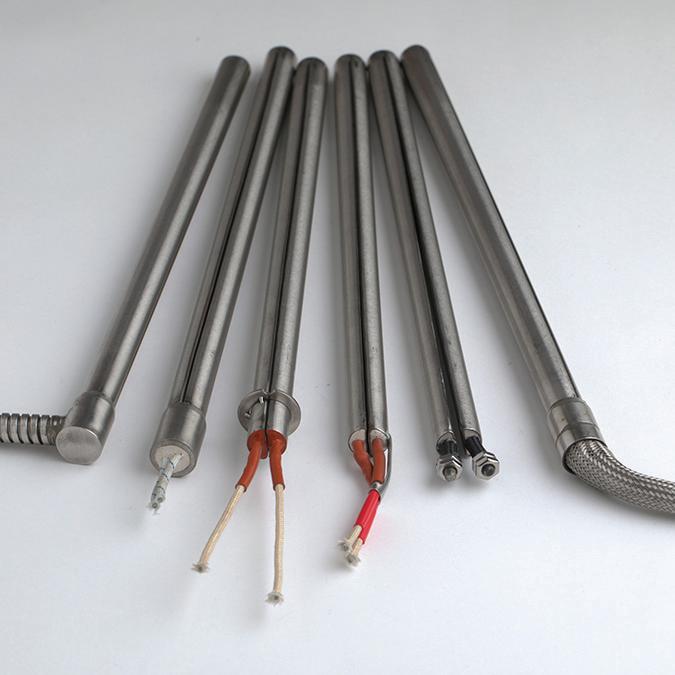
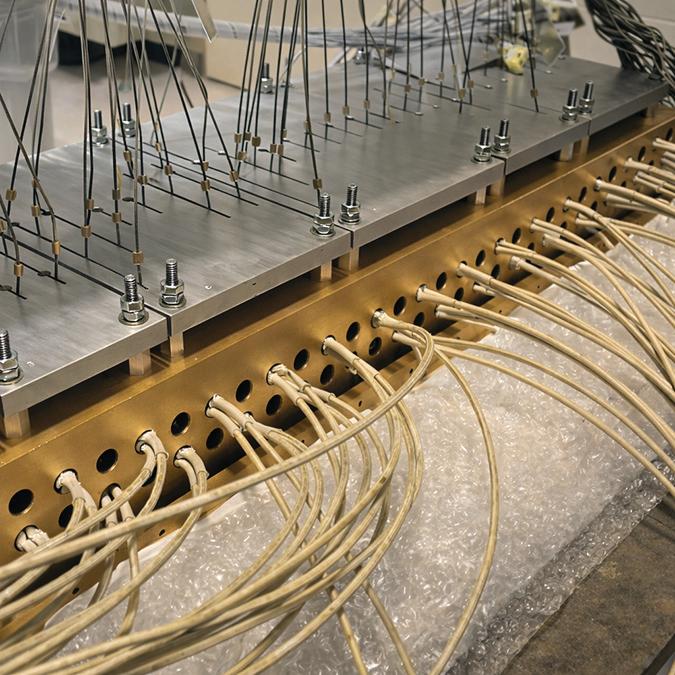
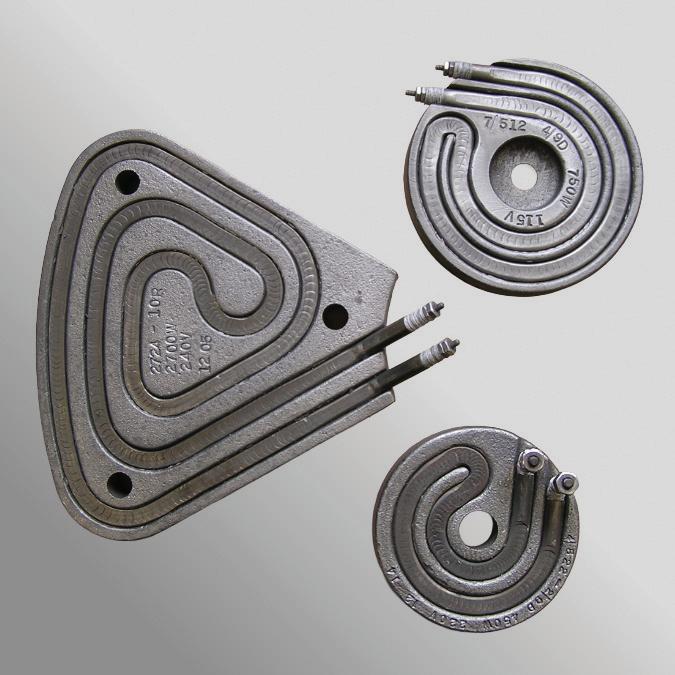
At Dorner, our unwavering commitment is to revolutionize Conveyor Automation by delivering cutting-edge solutions with unparalleled support. This dedication, coupled with a storied history of proven excellence, has firmly established the Dorner brand as a recognized leader in product handling for over 55 years. Our comprehensive range of customizable sanitary, industrial, pallet, and flexible chain automation solutions position Dorner as the go-to provider for conveyor applications.
Dorner’s conveyors are meticulously crafted to facilitate the seamless movement of products to precise locations at the right time and in the exact position required for the subsequent phase of the production line. Boasting industry-best product transfers and in-house belting capabilities, Dorner stands at the forefront of precision conveyance, facilitating the integration of conveyors with robots, personnel, and equipment with remarkable accuracy.
For more custom projects, Dorner’s Engineered Solutions Group (ESG) is transforming product handling with innovative solutions that are custom designed to solve customers’ unique needs. This full service team can provide systems for applications such as accumulation, indexing, positioning, product flow and much more.
Additional Dorner benefits:
• After sales support through services such as installation, maintenance, replacement part audits, and preventative maintenance programs.
• Industry best lead times with conveyors shipping in as few as three business days.
• Online Configurator (D-Tools) allows users to design conveyors and download 3D CAD assemblies for instant validation of fit.
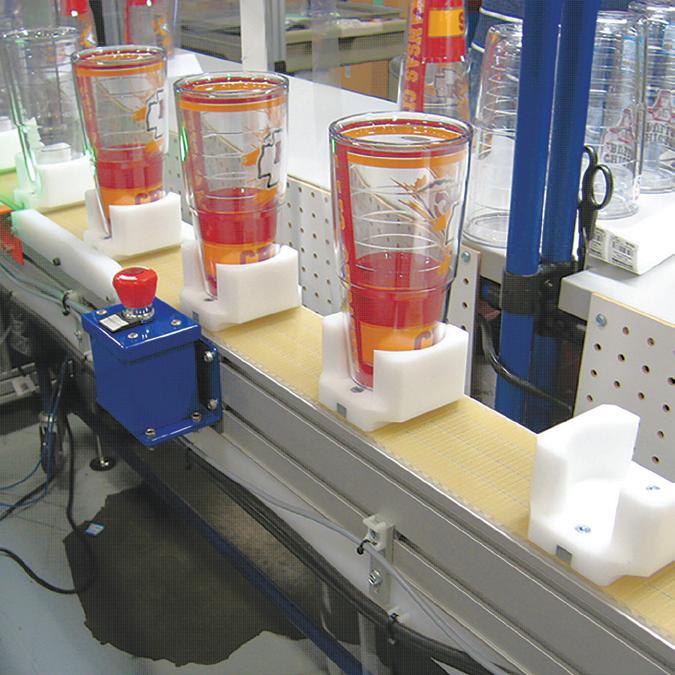
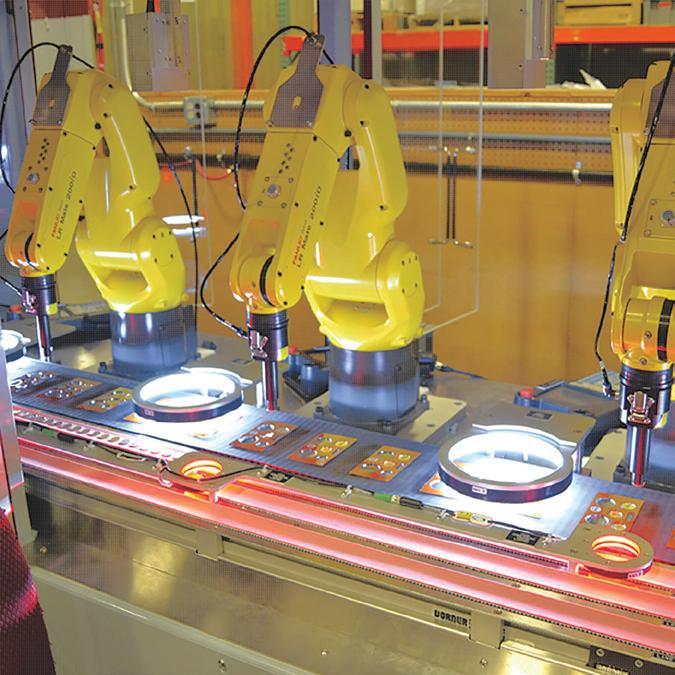
At Elesa, we understand the demands placed on today’s packaging machinery: high cycle rates, frequent changeovers, and the need for precise, repeatable performance. That’s why packaging equipment builders and end users across the globe rely on Elesa’s standard machine components to improve efficiency, reliability, and long-term machine performance. Designed to perform, our components integrate seamlessly into new designs and existing equipment alike.
Founded in 1941, Elesa is the international reference for the design, production, and distribution of the broadest range of standard components in plastic and metal for industrial machinery. With more than 50 industrial design awards and over 300 patented solutions, Elesa combines engineering precision with award-winning industrial design to solve realworld application challenges.
For packaging applications, Elesa offers proven solutions including electronic safety handles such as the M.2000-SWM with an integrated safety switch for access control and machine guarding in automated packaging environments, a comprehensive range of position indicators for accurate positioning and monitoring, and a broad selection of adjustable handles and control elements engineered for ergonomics, durability, and repeatability. These components support faster setup, safer operation, and reduced downtime.
Elesa’s leadership is built on continuous innovation in measurement, ergonomics, and materials, supported by a global network of subsidiaries and technical representatives. In the United States, our team provides direct technical support, application consulting, and on-site assistance for OEMs, system integrators, and maintenance teams. This commitment to seamless service ensures that customers receive not only high-quality components, but also the guidance needed to select the right solution for each packaging application.
Together, Elesa’s engineered components, application expertise, and responsive support make us a trusted supplier for packaging professionals.

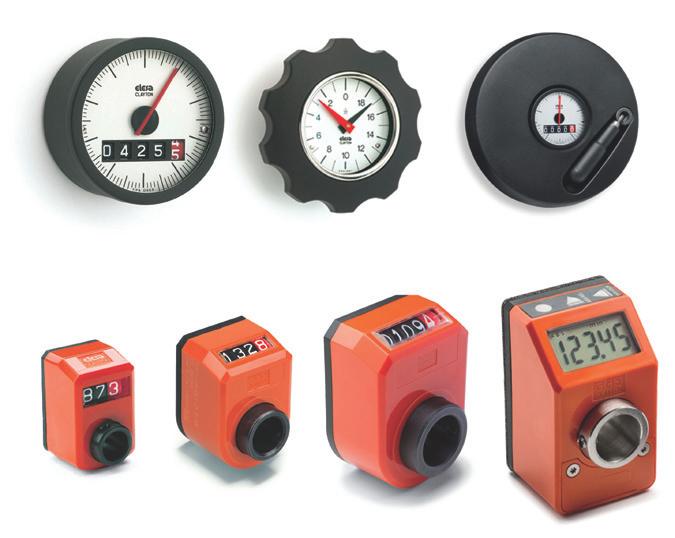
HIWIN Corporation is a global manufacturer of precision motion-control components and integrated automation solutions that support OEM machine builders across the packaging industry. From cartoning and filling to labeling, pick-and-place, and palletizing, HIWIN products deliver the accuracy, rigidity, and reliability required in high-performance packaging systems.
Our linear guideways and ballscrews deliver smooth motion, high load capacity, and long service life, ensuring repeatable positioning and consistent throughput. These components help reduce vibration, improve cycle times, and extend equipment uptime in demanding production environments.
HIWIN single-axis stages integrate guideways and drive systems into compact, ready-to-install modules. These space-saving units simplify machine design, reduce assembly time, and improve overall efficiency in automated handling and packaging operations.
We also offer robotic automation solutions that integrate seamlessly with linear motion platforms to support flexible pick-and-place and end-of-line systems. By combining precision mechanics with application expertise, HIWIN helps packaging OEMs enhance performance while reducing design complexity.
With global manufacturing, engineering support, and a strong focus on quality, HIWIN delivers motion solutions that enable packaging machinery to run faster, operate reliably, and perform consistently in demanding industrial environments.
Industrial Magnetics is a leading force in the magnetics industry, known for its strong emphasis on customized craftsmanship, quality, and performance. Since 1961, IMI has delivered exceptional solutions to meet customer needs, resulting in the widespread adoption of magnetic equipment in manufacturing processes worldwide.
IMI provides magnet options to purify your product from ferrous metal contamination and defend downstream equipment. Gravity-fed magnetic separators like the Drawer-In-Housing contains rows of round 1”, 2” or 3” magnetic tubes assembled into drawers and contained within a housing. Specialty units like The Ox® can handle magnetic separation in difficult processing conditions, such as high or low ambient temperatures, high humidity, bridging, abrasive, corrosive, or galling tendencies. IMI Magnetic Grates separate ferrous tramp metal in bins, chutes, drawers, hoppers, and enclosures. Plate Magnets are the optimal solution for angled chute applications.
IMI offers the best options for liquid line production needs. The Plate Style T-Trap is ideal for carrying viscous or fibrous products through the housing without plugging. The Tube Style T-Trap is optimal for heavy-duty flow systems. Our Multi Tube Style is now offered in our Patent Pending Radius Plate Design, which features double-welding, preventing tube breakage and enhancing durability.
Our Exposed Pole Tube protects pneumatic line system machinery and ensures purity when installed before processing equipment and bulk load outs. The Bullet® Magnet is shaped with a solid stainless steel nose cone diverter. This magnet maintains uniform velocity in line flow, allowing it to be used anywhere in your system.
When it comes to making things better, Industrial Magnetics is a magnetics industry leader.

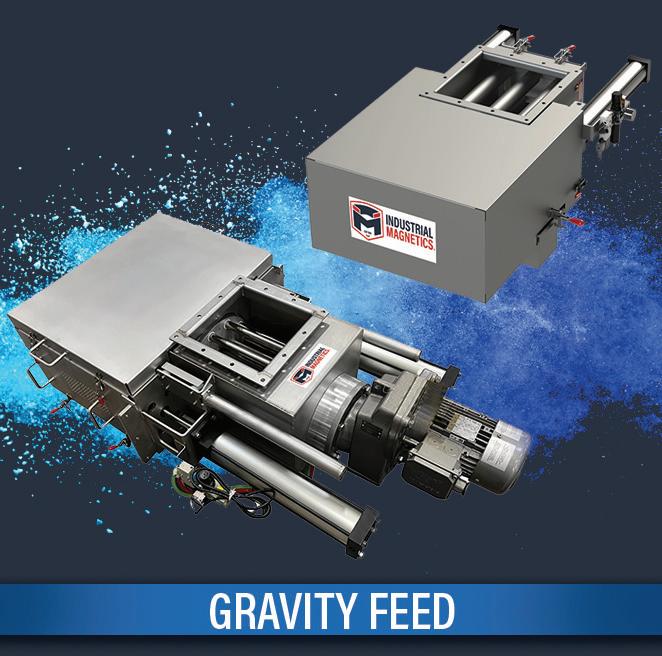
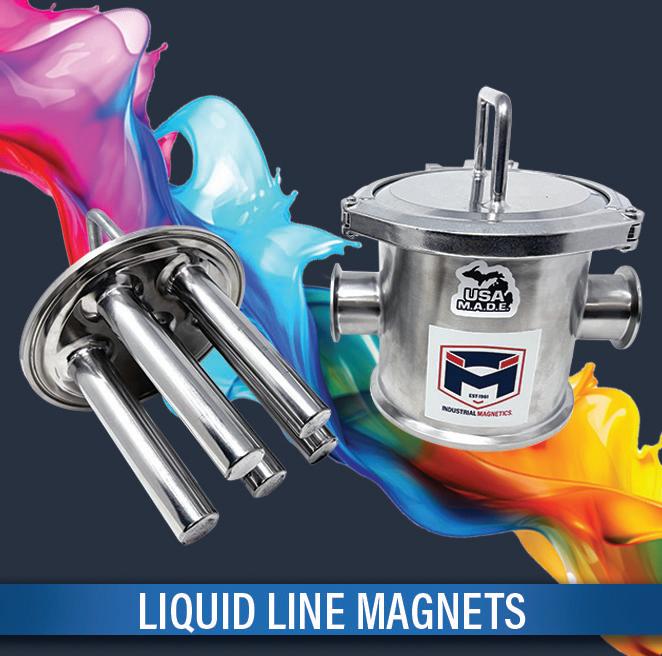
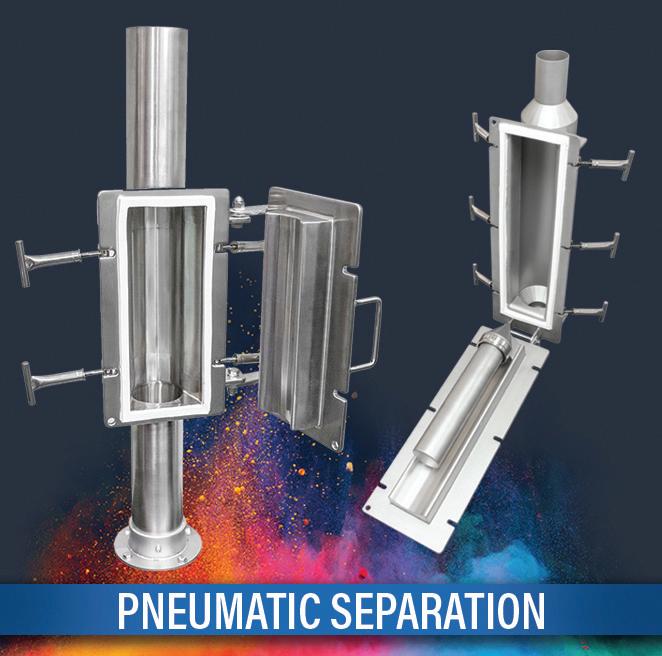
Founded in 2014 by Willem Hofmans, IXON is a global Industrial IoT (IIoT) company dedicated to empowering machine builders and service organizations to work smarter, faster, and more securely. What began as a simple idea to eliminate inefficiencies and lost value in traditional industrial service processes, has grown into a powerful cloud-native platform that connects over 100,000 machines worldwide and supports thousands of customers across industries.
IXON’s mission is rooted in simplicity, user focus, and practical innovation. From its headquarters in the Netherlands, the company has expanded internationally with over 100 employees in multiple countries; yet remains grounded in collaborative problem solving.
At the heart of IXON’s platform are the IXRouter and Secure Edge devices, used as gateways to empower users to remotely access their machines from anywhere. In tandem, IXON’s hardware is also backed by a suite of cloud-based solutions that enable real-time data insights and seamless collaboration between machine builders and their end customers.
Security and compliance are fundamental to IXON’s platform philosophy. Holding multiple internationally recognized certifications (including ISO 27001, ISO 27017, ISO 27701, ISO 9001, IEC 62443-4-1, and IEC 624434-2) and active in industry associations that help shape best practices for secure and reliable industrial connectivity.
IXON’s customer-centric culture and platform flexibility have made it a trusted partner for machine builders and industrial organizations worldwide, helping reduce service costs, unlock machine data value, and support digital transformation journeys across sectors.
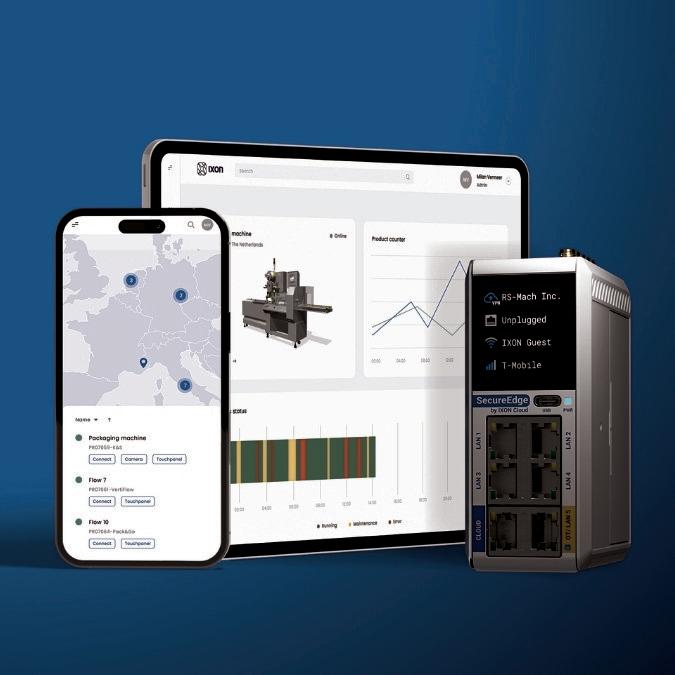
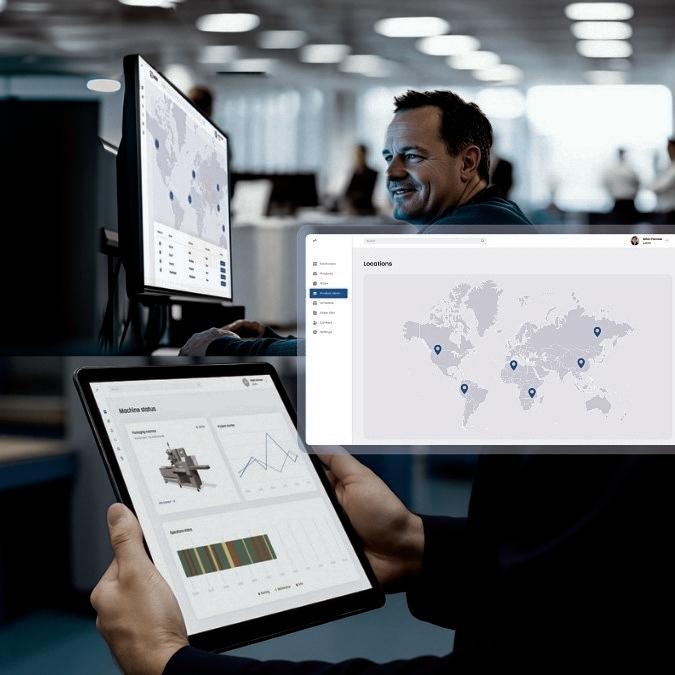

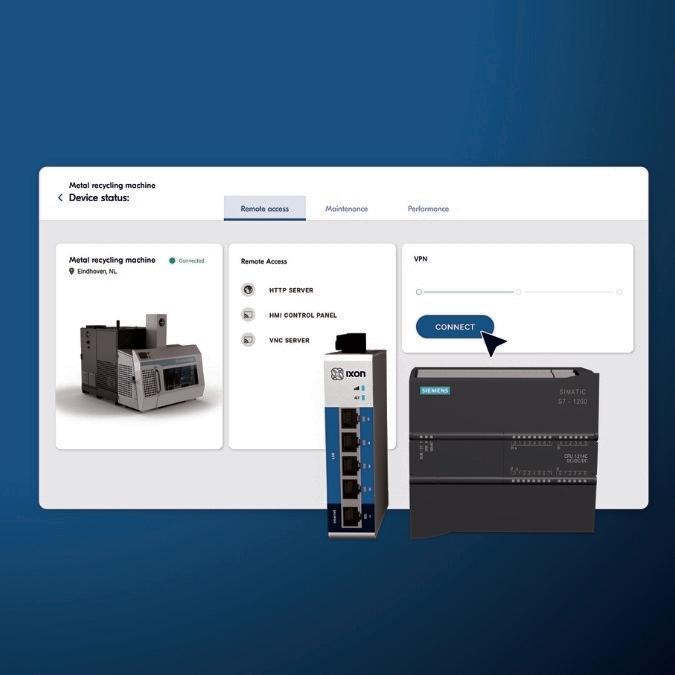
JAX develops high-performance industrial and food-grade lubricants engineered for equipment reliability and efficiency.
A pioneer in food-grade lubrication, JAX has formulated hundreds of NSF-registered H1 and 3H lubricants to combat the rigorous demands of bakeries, meat processing, beverage bottling, and other key food and beverage operations. Beyond food processing, JAX serves a wide range of industrial sectors, including marine, metal forming, and container manufacturing, where specialized lubrication solutions are essential for performance and reliability.
At JAX, technical expertise drives everything we do. Our team of chemists and lubrication engineers provides hands-on support, in-plant training, and real-time problem-solving to keep your equipment running at peak performance. The JAX RPM Innovation Center leads the way in research and development, crafting advanced lubrication solutions and offering in-house used oil analysis to help eliminate downtime and maximize equipment longevity. All JAX lubricants are manufactured in ISO 9001:2015-certified facilities and developed in accordance with ISO 21469:2006 principles for hygienic lubricant design and manufacturing.
Did you know we also provide private label and filling services? OEMs choose to private label a lubricant to expand portfolio offerings and bring more products to their customers. This provides enhanced revenue potential by growing their business through aftermarket sales, and ensures performance and reliability by providing a solution that is formulated specifically for their equipment.
Innovation is at our core. Whether you’re facing a lubrication challenge or looking to optimize performance, JAX delivers tailored solutions built for your needs. Contact us today to discover the right lubricant for your operation.




Innovation in the pursuit of greater line efficiencies has kept Morrison Container Handling Solutions a trusted partner to OEMs for more than 55 years. As the leading manufacturer of automated container handling equipment and largest supplier of timing screws in North America, Morrison works alongside OEMs to help their machines perform better in real-world production environments.
Overall line performance is heavily influenced by how containers behave before, during, and after each machine. That’s where Morrison adds value. By taking ownership of container control, Morrison helps OEMs reduce risk, improve uptime, and deliver smoother startups without requiring redesigns to their core equipment.
Morrison solutions are designed to integrate seamlessly with OEM equipment to increase speed, automate container presentation, stabilize lightweight containers, and improve consistency throughout the line.
OEMs regularly leverage Morrison’s expertise to solve both straightforward and complex container handling challenges. Standard product offerings include timing screws; drive units for metering, feeding, turning, and grouping; change parts; combiners and dividers; down bottle rejects; denesters; can openers; collating, stacking, and multi-packing systems; as well as orienting and inverting solutions. When standard products are not enough, Morrison designs and builds some of the most robust and flexible custom container handling equipment in the industry.
If a customer’s product must be in a specific position, orientation, or pattern for OEM equipment to function effectively, Morrison provides the missing piece.
By helping OEMs solve the container handling portion of the line, Morrison helps you own more of the project and create better outcomes for their customers. For OEMs looking to elevate machine performance and strengthen customer satisfaction, Morrison is the trusted partner for container control.
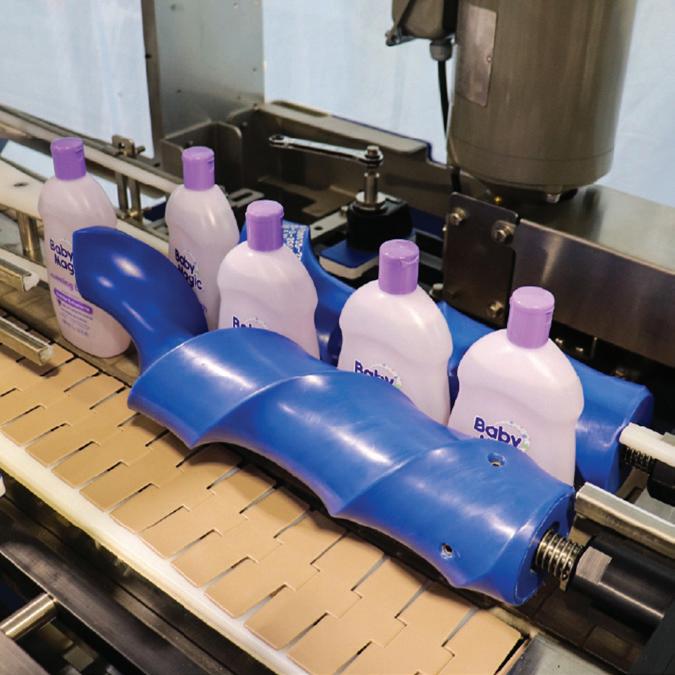
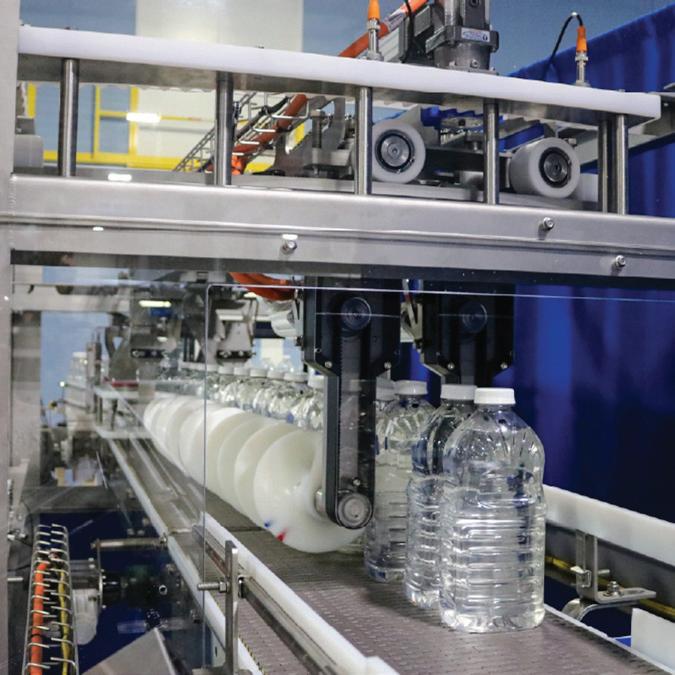
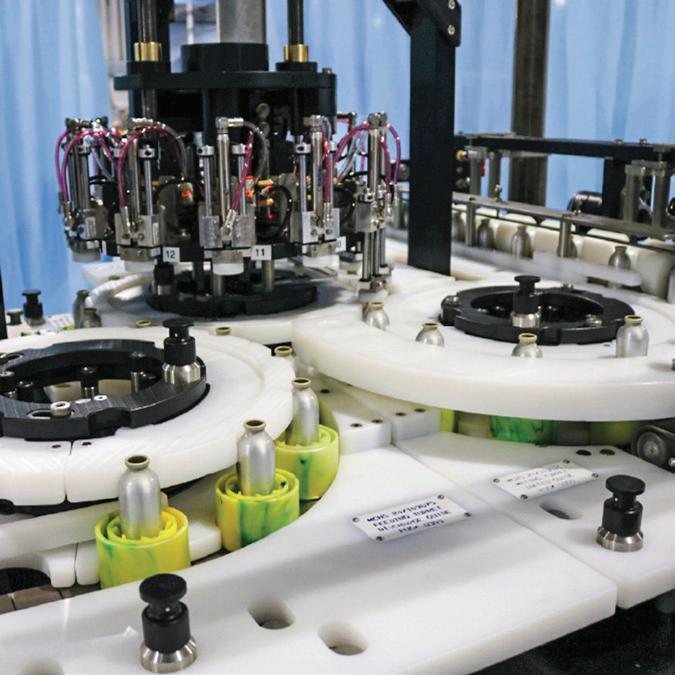
Back in 1870, Lubriplate’s founders set out to make the highest quality, best performing lubricants available. In doing so, they helped pioneer the use of anti-wear additives that significantly increased lubricant performance through the years. Today, that innovative tradition continues with their complete line of ultra high-performance, 100% Synthetic, NSF H1 Registered, Food Grade Lubricants.
Manufactured under strict NSF/ ISO 21469 Certified and ISO 9001 Registered quality control standards, these lubricants are formulated to deliver a number of significant, cost effective advantages, including; extended lube and fluid change intervals, multiple application capability, lubricant inventory consolidation and improved performance. Clean, safe and non-toxic, their use can eliminate lubrication as a critical control point in HACCP programs.
All Lubriplate Lubricants come with Lubriplate’s ESP Extra Services Package at no additional charge. Services include; a complimentary plant lubrication survey by a factory direct representative, color coded lubrication charts and machinery tags, a toll free technical support hotline and email, and follow-up lubricant analysis.
All Lubriplate Lubricants come with Lubriplate’s ESP Extra Services Package at no additional charge. Services include; a complimentary plant lubrication survey by a factory direct representative, color coded lubrication charts and machinery tags, a toll free technical support hotline and email, and follow-up lubricant analysis.
For more information contact: Lubriplate Lubricants Company Newark, NJ 07105 / Toledo, OH 43605 Phone: 800-733-4755
E-Mail: LubeXpert@lubriplate.com www.lubriplate.com



215-721-1900
www.nccas.com
info@nccas.com
From sanitary processing lines to high-speed packaging systems, NCC Automated Systems delivers conveyor solutions built for integration, speed, and profitability.
We supply a full suite of conveyor technologies — including sanitary conveyors for food and pharma applications, non-sanitary conveyors for general industry, spiral systems for compact elevation changes, and GlideLine modular conveyors designed for seamless integration into assembly, processing, and packaging environments.
What sets NCC apart is how our systems support integrator success. Our flexible pre-assembly options reduce on-site labor, compress installation timelines, and eliminate hidden build costs. Whether you require partially pre-assembled modules for rapid setup or fully pre-assembled plug-andplay systems ready to mount, wire, and run, NCC helps your team focus on high-value automation instead of mechanical assembly.
NCC also integrates its Glide-Line conveyors — modular automation solutions that simplify engineering, quoting, and configuration while protecting margin. GL conveyors integrate seamlessly with robotics, PLCs, vision systems, and automated controls, delivering flexible, reliable automation across diverse production environments.
With Glide-Line industrial panel and pallet handling conveyors, SideDrive sanitary spiral conveyors, and a full range of modular configurations, NCC empowers OEMs to optimize material flow, streamline engineering, and deliver high-performance automation solutions
NCC Automated Systems is designed to help integrators, OEMs, and end users succeed — delivering solutions engineered for real-world production demands in packaging, processing, assembly, and measurable profitability.
Contact us at info@nccas.com to request a quote and learn how NCC can support your next project.

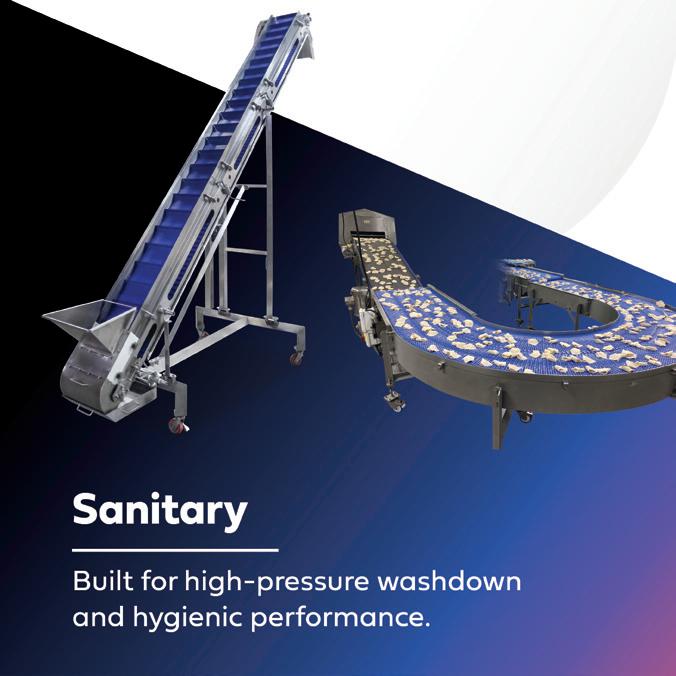
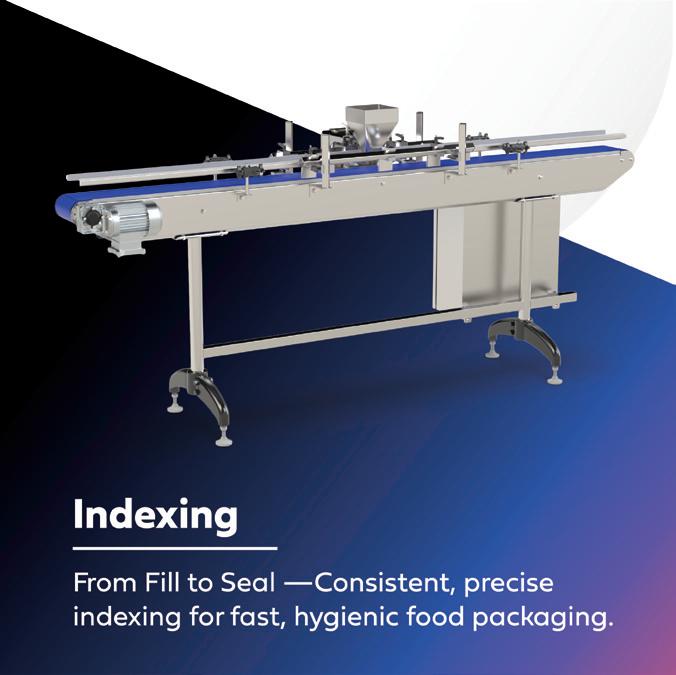
The use of advanced laser technology in manufacturing and production environments continues to revolutionize many industries. From the latest additive manufacturing and micromachining processes, to advanced packaging and material converting, lasers are changing the face of next generation manufacturing beyond recognition. Advance laser processing systems bring unprecedented levels of precision, production efficiency, and mass customization to these applications.
Novanta holds a unique capability in this field, being a manufacturer of both the laser source AND the beam steering technology. This enables us to develop products that are specifically engineered to work in perfect harmony, deep within complex manufacturing environments. During our 50 years of heritage in developing laser-based manufacturing technologies, we’ve built up expertise that is the envy of the industry — from our unique ultra-high performance laser mirror technology and advanced beam steering solutions, all the way to our much-revered high reliability CO2 laser technologies.
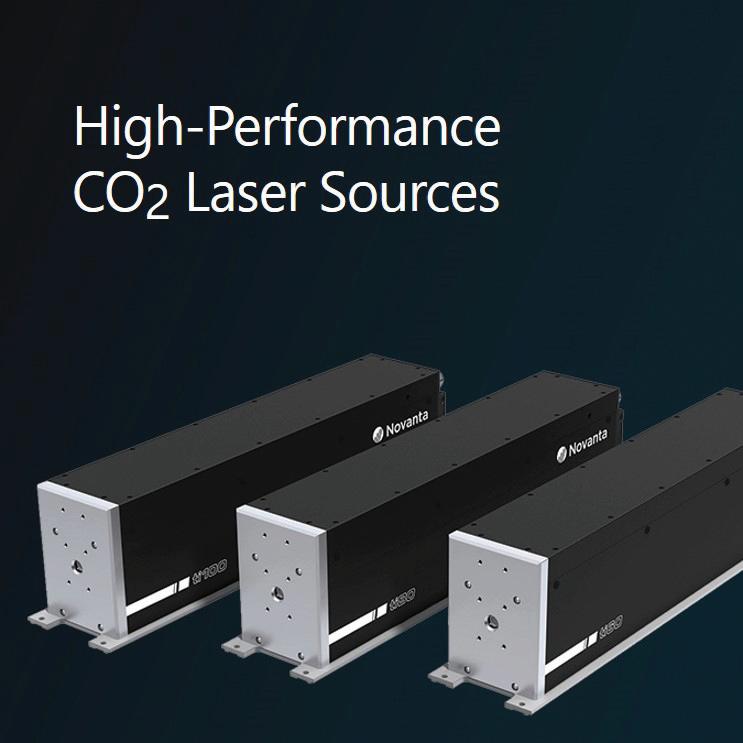
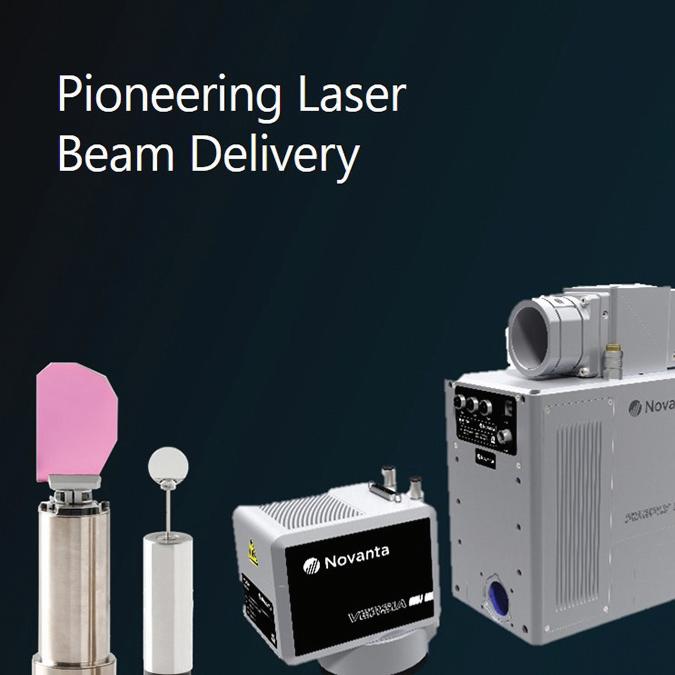

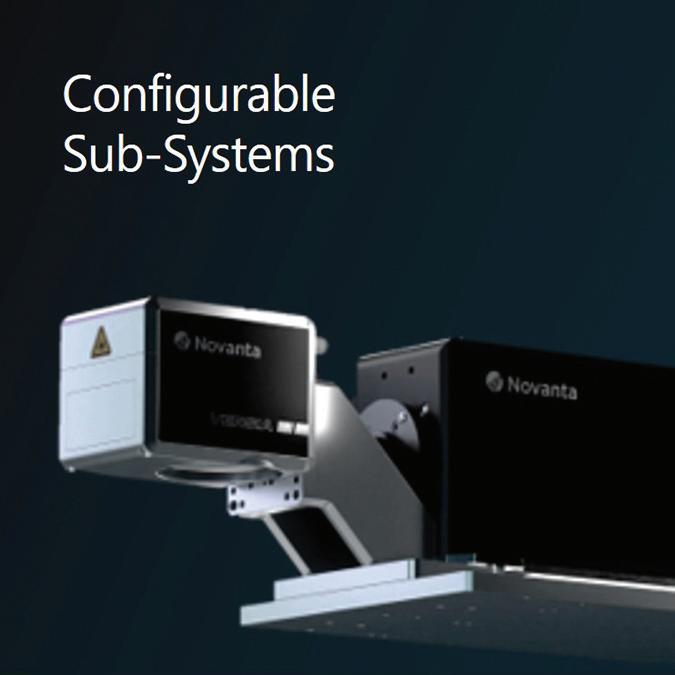
Operating from two strategic locations in Alabama and Arkansas, PartsXpress® is committed to immediate action and dependable service. As industry demands continue to evolve, our focus remains on innovation, responsiveness, and building trusted relationships that help your operation run efficiently, safely, and profitably for years to come. We supply Everything You Need for successful operations, from belting and chain, power transmission, hydraulics and pneumatics to sanitary fittings, electrical components, consumables, bearings, overhead components, Xpress Oil, non-slip stainless surfaces, and custom-machined products.
Whether you need a motor gearbox end drive or a low-profile center drum drive, brands like Sterling Electric and Van der Graaf® enable us to deliver proven power transmission solutions backed by strong warranties, handson product knowledge, and dependable availability. As Sterling Electric’s leading stocking distributor and build center, PartsXpress® helps OEMs and plant teams reduce lead times and control costs without sacrificing reliability, while partnerships with industry leaders such as Intralox, Safari, and Habasit support fully integrated conveyor and system performance across your facility. PartsXpress® offers a YOU-Build-It program, where we equip your team with the training and confidence to reduce inventory costs and minimize downtime. Together, these value-added programs reflect our commitment to delivering not just parts, but practical solutions that strengthen long-term plant performance.
PartsXpress® stands ready to support you with the products, service, and expertise you deserve, delivered with urgency, precision, and a commitment to partnership. Our dedicated teams across poultry, meat, and prepared foods bring more than 250 combined years of industry experience and a tenacious dedication to getting the job done in the demanding food processing and packaging environment. We understand that downtime is not an option, which is why we remain laser-focused on sourcing solutions that strengthen plant performance and protect your bottom-line.
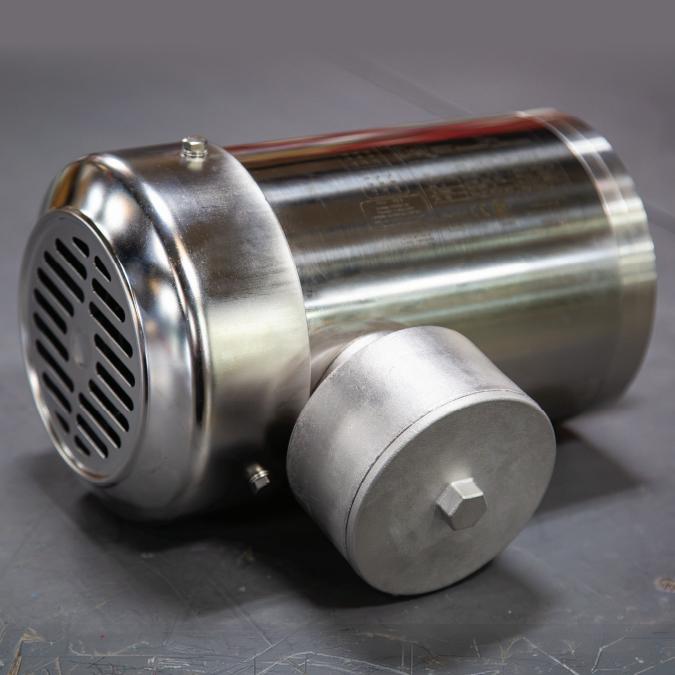
Paxton Products manufactures high efficiency centrifugal air blowers and custom-engineered pneumatic air delivery devices and systems that are used for drying, air rinsing, and blow-off, in order to improve the quality of labeling, tamper branding, date coding, and other packaging processes.
The new Control Panel from Paxton Products offers manufacturers a simplified solution to manage Paxton’s Centrifugal Blowers in a turnkey manner. Designed for easy installation and scalability, Paxton’s Control Panel is ideal for simply controlling your Paxton Blower System while upholding safety standards and ensuring the highest of quality during operation.
Paxton’s Ionizing Rinsing Systems are designed to dissipate the static charges that cause dirt and debris to adhere to surfaces, and then blast the contaminants away using ultra-efficient, blower-driven air. Using a specially designed Air Knife or Nozzle Manifold, Paxton’s Ionizing Systems are available for can or bottle rinsing and eliminate the need for compressed air or water rinsing.
Paxton’s own PX-Series line of high efficiency centrifugal blowers use state-of-the-art impellers and scroll designs to achieve efficiencies as high as 80%, to generate 33% more air flow than a standard centrifugal blower.
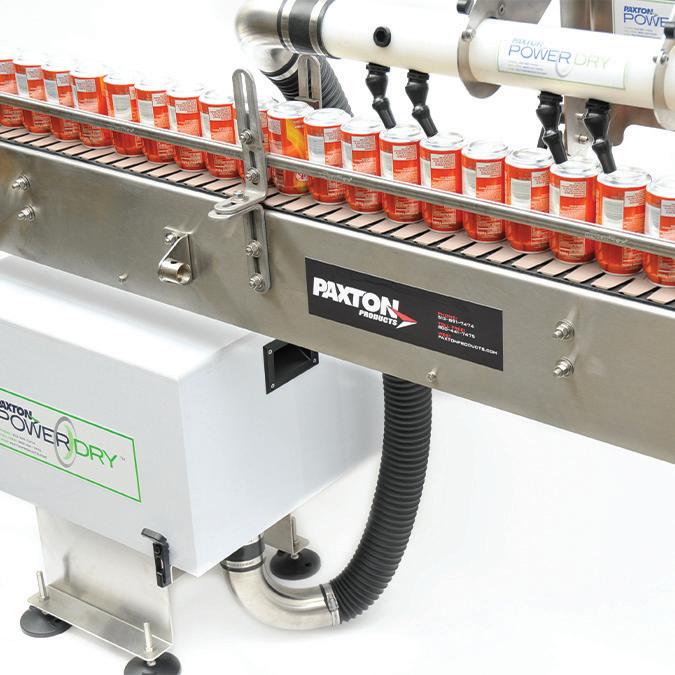
Rechner Sensors is the world leader in industrial capacitive sensor design. Our numerous patented technologies allow our sensors to detect lower dielectric materials, sense further, and ignore a larger buildup of solids and viscous materials than the competition. We strive to be the most reliable sensor that you can depend on for production uptime.
Rechner has four product lines of high temperature proximity and level sensors. These include IAS-series inductive sensors, KS-series capacitive sensors, the extreme-range KXS-series capacitive sensors, and KF-series level probes. All four series operate in temperatures up to 482°F (250°C).
KXS-series systems are exceptional in their extreme sensing distance. Our M30 KXS sensors have a maximum sensing range of 100mm with a hysteresis of only 1-2 mm! This is useful for extremely accurate level control in sticky and viscous liquids (such as hot melt glue), or dusty and high static environments (such as plastic regrind).
KXA-amplifiers can support up to 4 sensors or up to 4 independently adjustable outputs on a single sensor for flexible, multi-point level control installations.
HIGH
KF-series custom-made level probes fit your tank perfectly. We have no minimum order and quick turnaround times. Probe sizes can range from 0.5 inches to 78 inches. You can choose between discrete measurements (1-4 points) or analog level measurement (4-20 mA or 0-10V).
Our sensors are used for level control, position detection, and quality control applications. We carry a wide selection of miniature sensors, sensors for explosive atmospheres, and analog measurement. Contact us for help finding the correct sensor for your application.
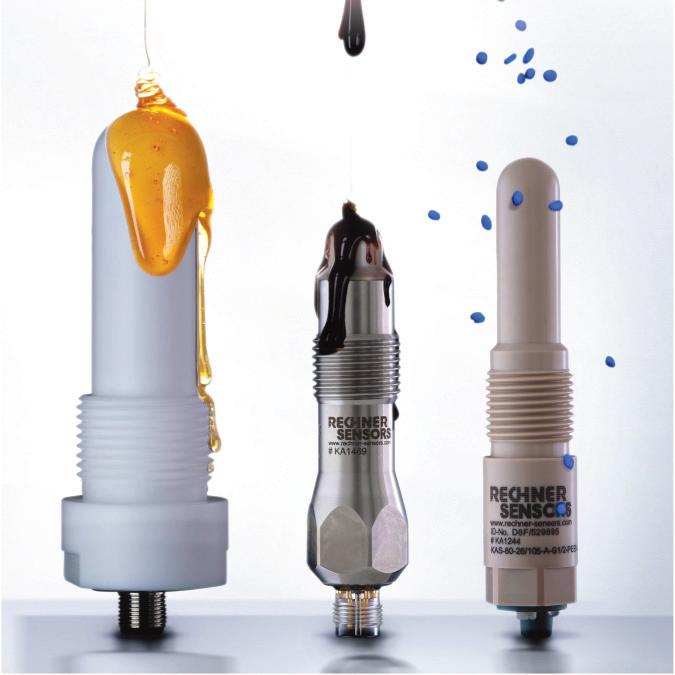
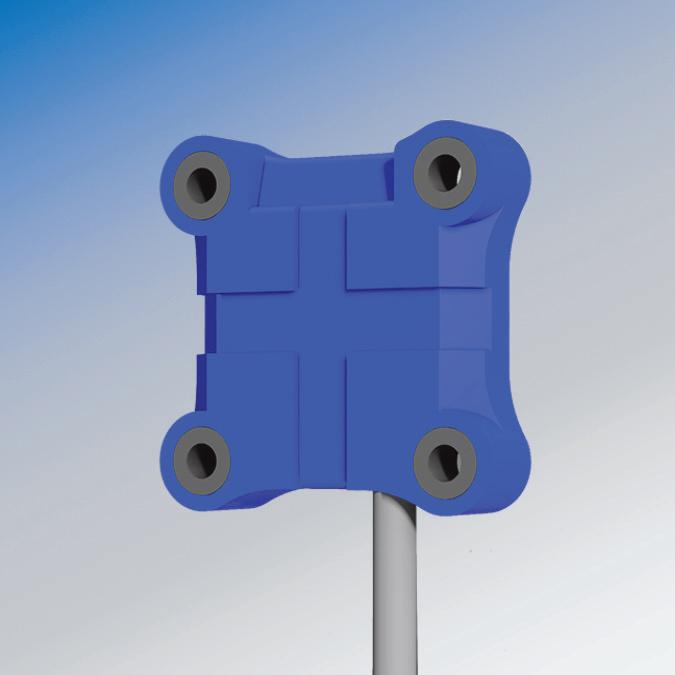
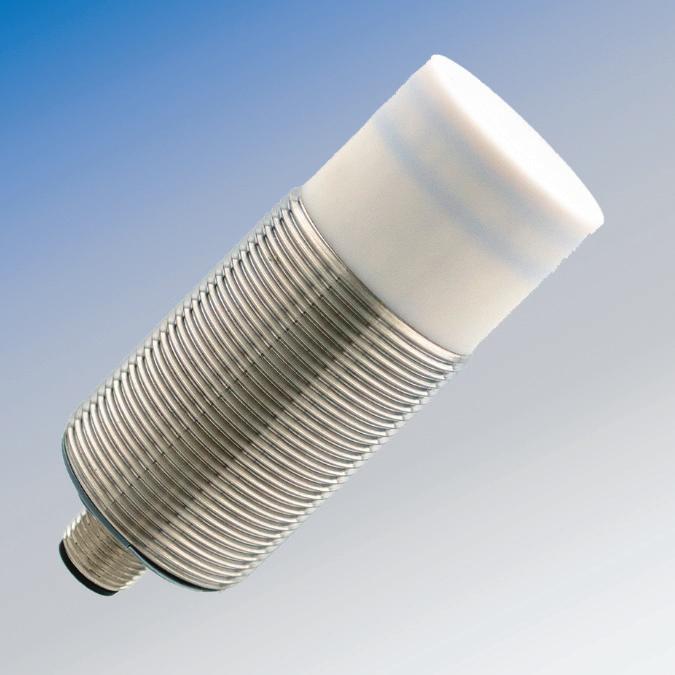
www.seweurodrive.com
For nearly 100 years, SEW-EURODRIVE has been the driving force in machine automation, powering the movement, precision, and reliability behind industries around the world. What began in 1931 as a family-owned engineering company has grown into a global technology leader trusted for its sophisticated German engineering, unmatched product breadth, and a solutions-oriented approach that puts customer needs at the center of everything it does.
SEW-EURODRIVE’s technology portfolio is one of the most comprehensive in the drive and automation industry. It includes a wide range of sizes of high-efficiency right-angle, inline, and parallel shaft gear units and integral gearmotors; an expanded line of stainless-steel gear units and motors for hygienic and corrosive applications; servo gear units for high-precision, dynamic motion, and heavy-duty Industrial Gear (HIG) units engineered for the world’s most demanding environments. The company also offers a full line of decentralized solutions included MOVIGEAR – the all-inone mechatronic drive, motion controllers, and energy-efficient inverter technologies.
The MOVI-C® automation platform reduces complexity and startup time with controls, components and software all designed to work together seamlessly – from a single source. MOVI-C unifies engineering, controls, components, communication, and safety into a single, easily scalable ecosystem. Together, these technologies enable customers to design complete, flexible solutions—from simple conveying lines to fully automated, networked production facilities.
A defining strength of SEW-EURODRIVE is its global presence paired with deep local accessibility. With operations in more than 50 countries, 17 manufacturing plants, and more than 85 Drive Technology Centers, SEW-EURODRIVE delivers world-class support with regional expertise and responsiveness. As the company approaches its 100-year milestone, SEW-EURODRIVE remains focused on shaping the future of motion and automation.

SC Wellford
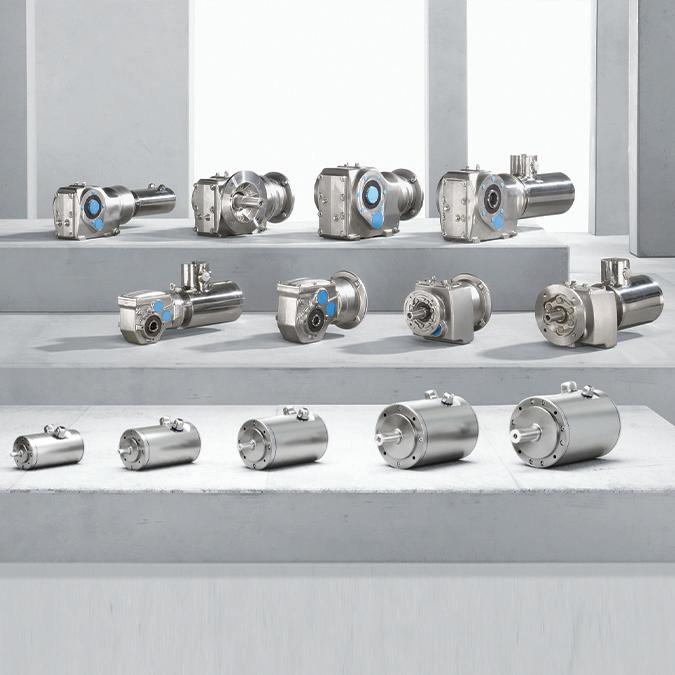
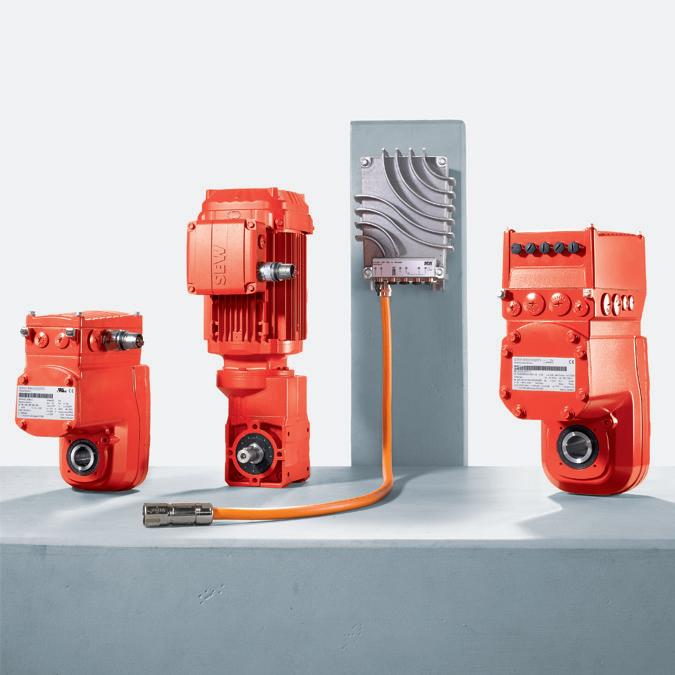

www.sick.com
For more than 80 years, SICK Sensor Intelligence has been defining the future of industrial safety. Founded in 1946 by Dr. Erwin Sick, the company recognized early on the transformative power of applying light, optics, and intelligent electronics to industrial challenges. This vision led to the introduction of the first accident‑prevention light curtain in 1952—an innovation that not only marked SICK’s commercial breakthrough but also helped set global benchmarks for machine safety.
This pioneering mindset sparked a legacy of invention. SICK continued to build on early photoelectric sensing technologies and went on to secure hundreds of patents that advanced the fields of industrial sensing, safety controls, and protective devices. As the inventor of the safety light curtain, SICK became instrumental in establishing worldwide machine‑safety standards and delivering solutions that protected workers across a growing range of industries.
Over the years, that spirit of innovation expanded into sophisticated safety systems engineered for increasingly complex automation environments.
Today’s portfolio—which includes advanced safety light curtains, interlocks, and next‑generation safety laser scanners—reflects decades of engineering progress. Modern breakthroughs like the microScan3 and outdoorScan3 combine rugged design with high‑precision scanning and exceptional reliability, continuing the tradition of redefining what industrial protection can achieve.
Backed by a global presence and deep technical expertise across factory, logistics, and process automation, SICK remains a leader in sensor‑based safety. Its solutions provide the intelligence, durability, and innovation that keep machinery running safely and efficiently—ensuring that wherever industry moves next, SICK is there to safeguard it.
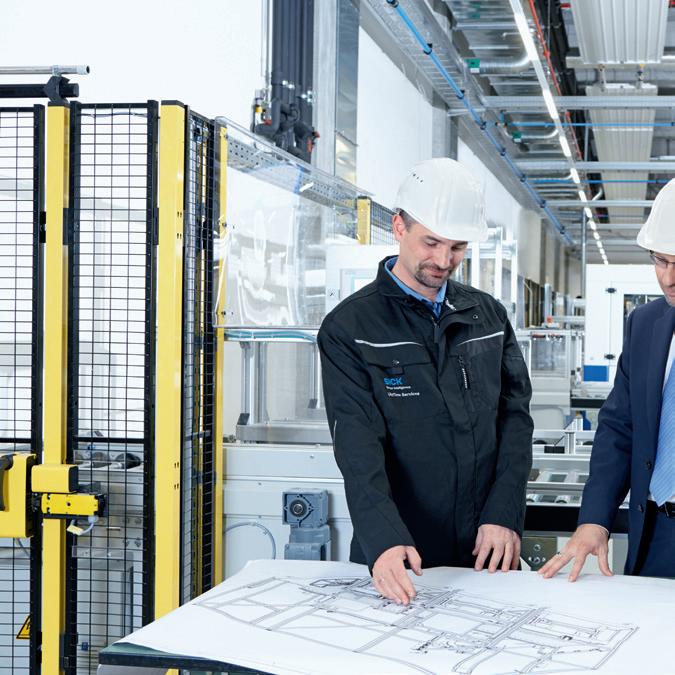
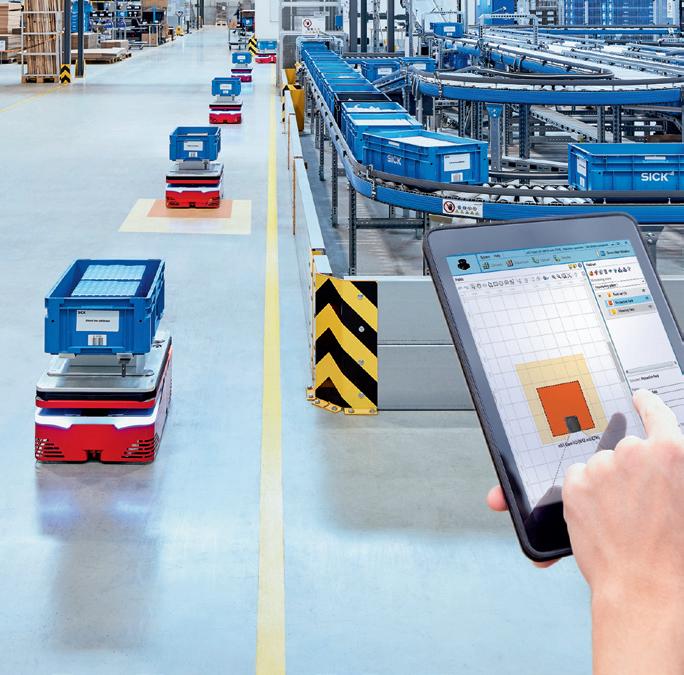
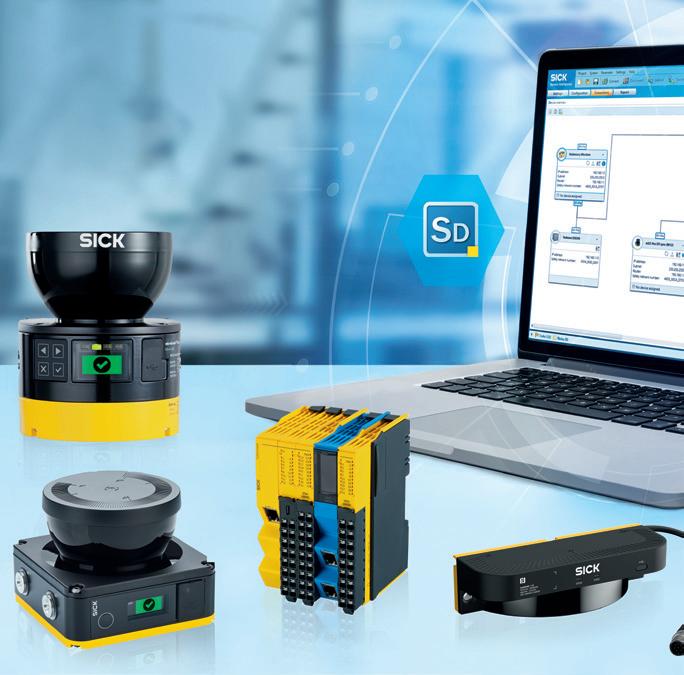
www.slideways.com
Slideways has served the conveying, packaging, and processing industries since its establishment in 1994. With an emphasis on high-quality machined plastic parts, the company has built a reputation as a leading manufacturer where precision and prompt delivery are essential. Our reputation is reflected in our motto: Made Right. Delivered Fast.
Our standard ensures that customers receive quotes for custom parts within one to two days, and finished parts are delivered within two to three weeks. We engineer to perform the 1st time to your exact specifications with quality materials and manufacturing. OEMs rely on this efficiency to maintain their operational schedules and meet project deadlines.
Our core products are essential in a range of industries, including food and beverage, bakery, dairy, poultry, pharmaceutical, distribution, and electronics. We are known in the industry as the conveyor parts specialist. Each solution is designed to increase productivity and reduce operational costs for our clients. We are the experts for determining the best materials for your application by selecting the optimal polymers for long life and ease of maintenance.
Custom and Standard Products and Service Offerings
•Engineering and Design Assistance
•Custom Machined Plastics
•Standard Bolt-On Conveyor Parts
• Operational Excellence
Our high service levels are made possible by a combination of advanced CNC equipment and a well-maintained inventory. Slideways works with a d i v ers e s election o f m achinable p lastics, o ffering m aterials t hat f eature s uperior f riction r eduction, w ear r esistance, c orrosion r esis tan ce, a n d the ability to perform across very high and low temperature ranges. This versatility ensures suitability for most operating and environmental con ditions.

VDG is the world’s leader in the design and manufacturing of drum motors for belt conveyors, with a strong focus on safety, reliability, and longevity. Manufacturing in-house in the USA and Canada for over 40 years, using cutting- edge production technology and automation, and with continuous improvements through research and development, VDG ensures product quality, short lead times, and after-sales service.
The VDG Drum Motor is a one-component conveyor drive. It has all drive components, including the new premium-efficiency (IE4) electric motor, gear reducer, and bearings, enclosed within the drive drum, increasing mechanical and electrical efficiency, optimizing space, and promoting operator safety. With 80,000 hours of service life, VDG Drum Motors reduce maintenance and operational costs and increase productivity.
VDG’s patented IronGrip™ lagging increases the durability and lifespan of the lagging and the conveyor belt. IronGrip™ lagging consists of symmetrically welded steel bars on the outside of the drum with vulcanized rubber lagging inserts between the steel bars. IronGrip™ lagging eliminates uneven belt wear, improves belt tracking, increases belt traction by 40%, and has 5 times longer service life compared to standard lagging.
All-stainless steel SSV Drum Motors feature an IP69K-rated sealing system and withstand washdown pressure up to 3,000 psi. Designed to drive modular conveyor belts, the belt profile is machined either directly onto the drive drum or onto an exchangeable profiled sleeve. This eliminates crevices that can trap food by-products and harbor bacteria, reducing washdown time and water usage by up to 50%. VDG’s New-Generation SSV Sprockets are also available to drive these belts.
The IntelliDrive® Drum Motor features new synchronous permanent magnet motor technology, delivering 40% increased electrical efficiency, a wider range of belt speeds without loss of torque, and an increase in electric motor lifespan compared to a traditional conveyor drive. It enables onsite diagnostics, full motor indexing speed control, and communications with other automated plant equipment.

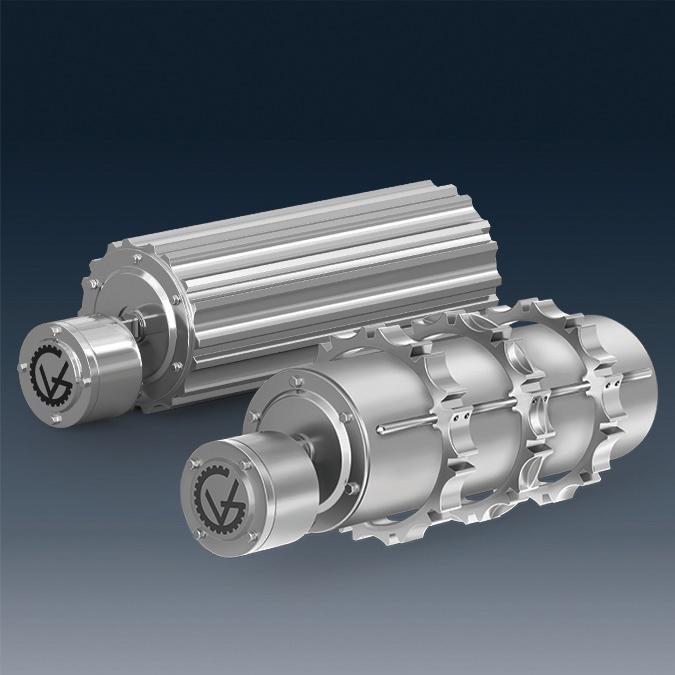
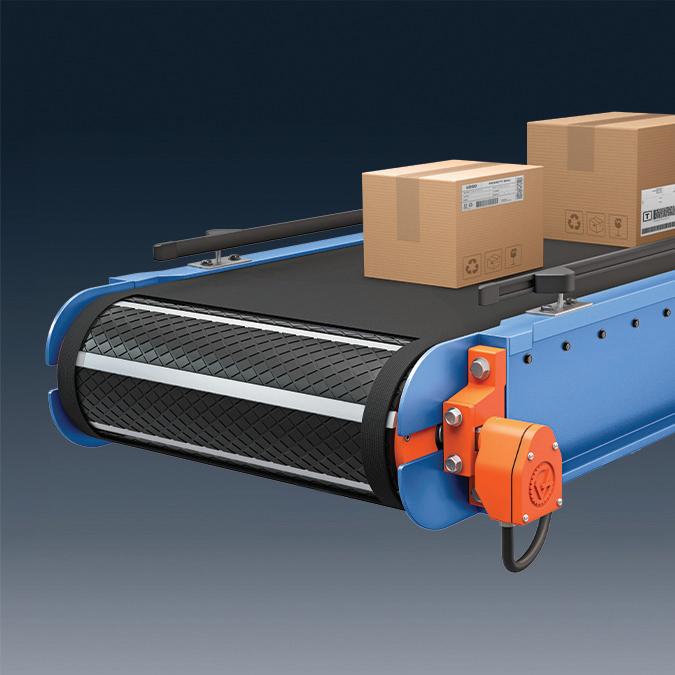
513-272-0131
www.vega.com
For over 70 years, VEGA Americas, Inc. has been a leader in level, pressure, and density measurement solutions. VEGA provides OEMs globally with innovative, high-quality measurement solutions that enhance efficiency, safety, and accuracy in their systems. With a comprehensive product line and innovative technology, we offer industry-leading measurement solutions. Our goal is to provide easy-to-install, reliable, and safe measurement technology. As pioneers in radar level measurement, we introduced the first two-wire radar in 1997 and continue to innovate, with recent releases like VEGAPULS 6X, a versatile sensor designed for any application. Headquartered in Cincinnati, Ohio, VEGA Americas is part of VEGA Grieshaber KG in Germany, a family-owned company employing over 2,700 people globally. We prioritize investing in our community and employees, ensuring success for both our team and our customers.
VEGA manufactures hygienic pressure sensors and point level devices with a brilliant advantage. The VEGABAR pressure sensors and VEGAPOINT level switches use a universal hygienic adapter system, which provides the flexibility to keep installation effort and parts inventory to a minimum. Process fittings can be selected as needed to meet application-specific requirements. The VEGAPULS C 21 wired radar sensor is the ideal sensor for non-contact level measurement in simple applications where a high degree of protection is required.
The VEGAPOINT 21 compact capacitive limit switch and VEGABAR 38 pressure sensor with switching function comes standard with a 360° switching status display, which can easily be seen from any direction. The color of the illuminated ring can be customized with one of 256 different colors, all of which remain clearly visible, even in daylight. At a glance, users can see when the process is running, if the sensor is switching, or if the sensor requires maintenance.
Standard IO-Link protocol is built into every pressure sensor and point level switch, ensuring universal, simple communication. This gives these instruments a standardized communication platform, enabling seamless data transfer and simple system integration.

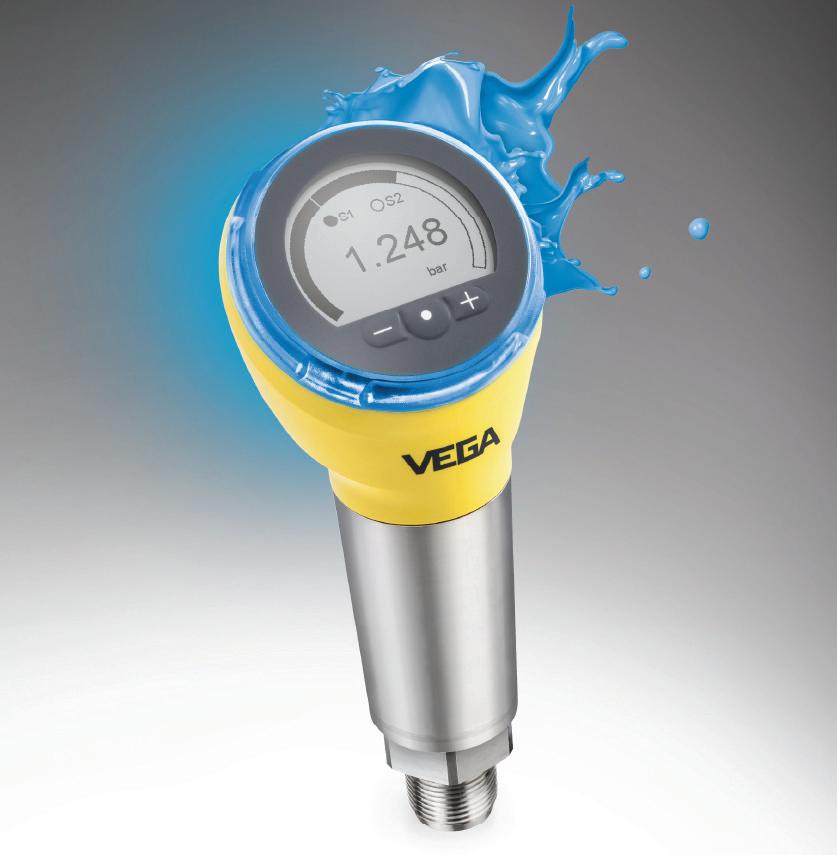
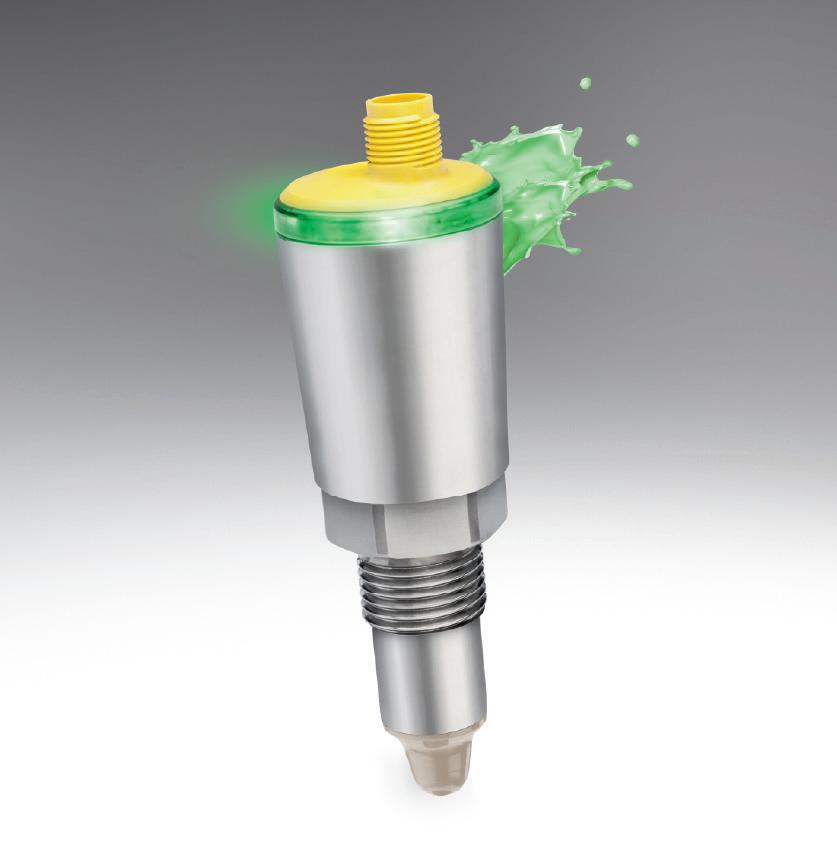
678/344-8300
www.wipotec.com/us
Wipotec North America – weighing technology at its best. Wipotec North America is a subsidiary of the German weighing technology specialist Wipotec GmbH based in Kaiserslautern, Germany. Wipotec is a technology leader in the production of weighing and inspection systems. The company has a worldwide staff of over 1,000 employees, and subsidiaries in Europe, Asia, and the United States.
The core business of Wipotec is the development, production, and integration of ultra-fast precision weigh cells and high-tech weighing systems for high-speed applications.
Wipotec weigh cells are used in a wide range of industrial production processes. Application examples include checkweighing, product filling, dosing, price labeling systems, and integration into packaging machines. Furthermore, highly specific solutions, customized to customer needs, are implemented for the pharmaceutical industry in order to weigh capsules, tablets, syringes, and vials in dry or wet food processing and packaging.
Wipotec weigh cells work according to the principle of Electro Magnetic Force Restoration (EMFR). They are based on the monoblock technology which makes them extremely precise and fast and enables them to render accurate weighing results even at the highest speeds and under the most adverse conditions. Vibrations can be actively compensated within the weigh cell. The product range includes models which can weigh a mere microgram and others which can deal with loads up to 120 kg.
The heart of all Wipotec weigh cells is the monoblock, and it is manufactured in our in-house machining center using state-of-theart CNC milling machines. The in-house development and project engineering departments enable the company to support unique customer requirements. For example, numerous combinations of infeed, outfeed, and weighing conveyors are available for use with our weigh cells to provide complete weighing kits designed to easily integrate into OEM machines.
Certified to DIN EN ISO 9001.
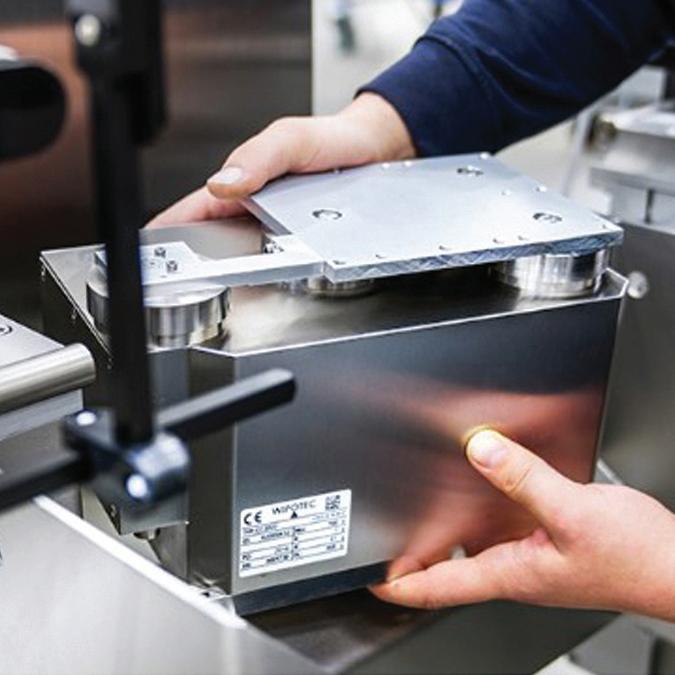
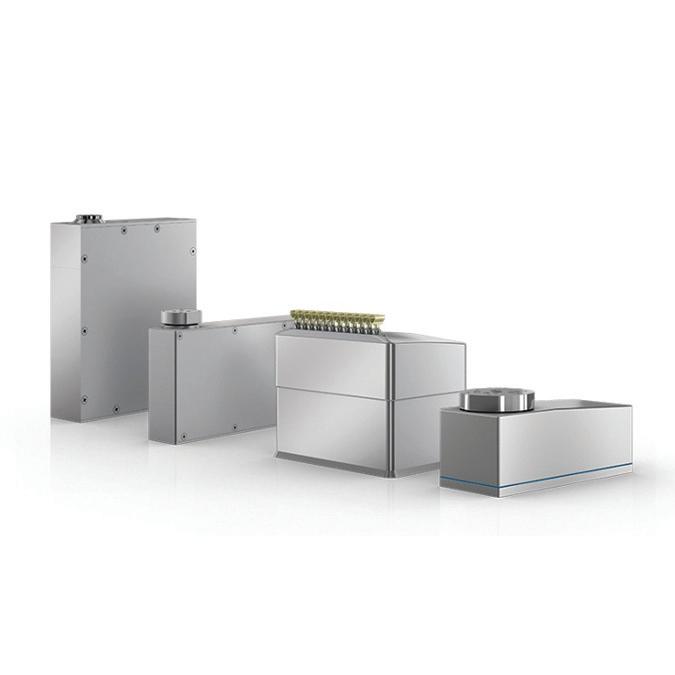
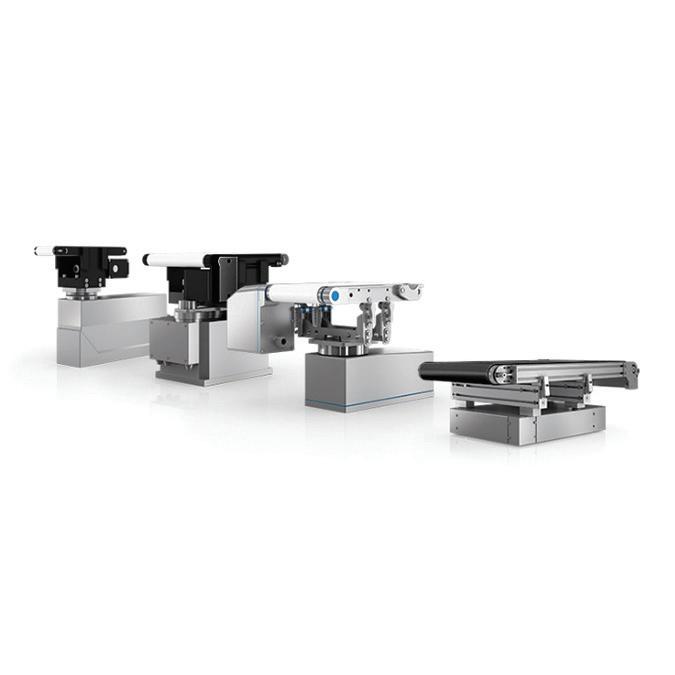
Wire Belt Company is a global leader in manufacturing top-quality stainless steel conveyor belts. With over 100 years of expertise, we design and deliver solutions that meet the highest standards of performance.
Wire Belt Company has a global presence, operating manufacturing plants in the USA, UK, and Germany. This ensures reliable delivery wherever you are.
Our conveyor belts support food processing applications such as:
• Baking
• Coating
• Cooling
• Frying
• Breading
• Dusting
• and more
Customer Service Excellence - When you contact Wire Belt, you’ll speak directly with a knowledgeable representative. Our technical engineers are also available to help optimize your application and select the right conveyor belt.
Comprehensive Solutions - We offer a wide range of conveyor belts tailored to improve process efficiency—from simple designs to specialized solutions.
Global Distribution - Our customer service and worldwide presence ensure seamless distribution to keep your operations running smoothly.
Call us if you need help with an efficient conveyor belt system for your process.
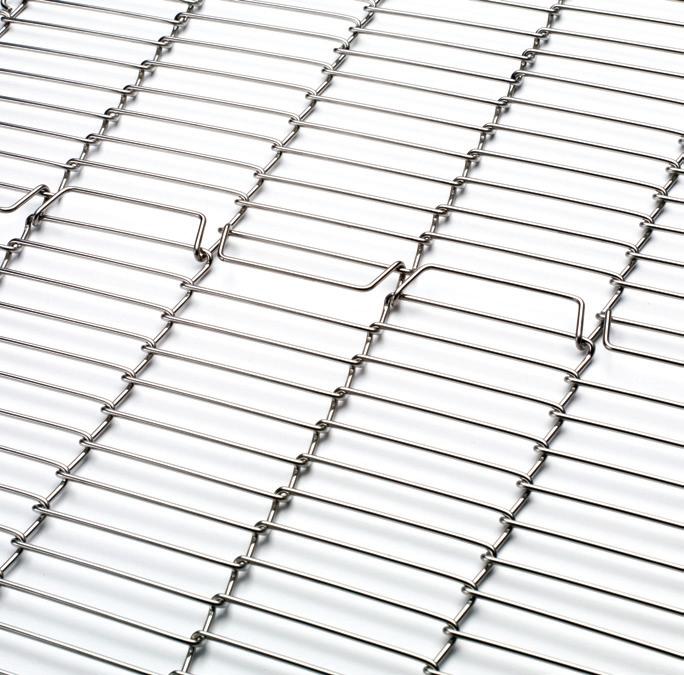
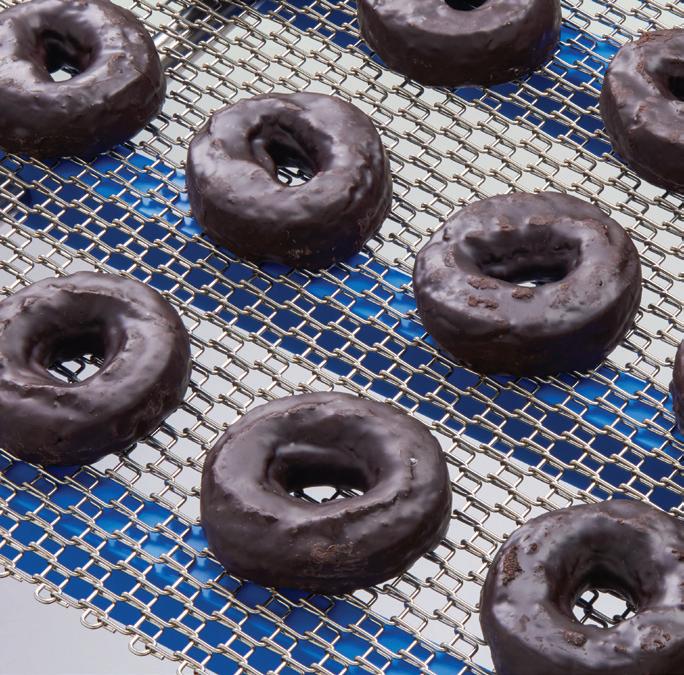


847/887-7457
https://www.yaskawa.com
As a machine builder, you know the daily struggle with limited resources and tight deadlines. You can’t afford to settle for less than the right products and services to solve urgent problems, delivered with reassuring consistency and reliability you can trust.
Yaskawa’s global expertise is unmatched and unquestioned, with 100+ Years of manufacturing excellence, 14,000+ worldwide associates, 30 countries with sales, service, and manufacturing locations, and $4.5 billion in global sales per year. Since 1915, Yaskawa has produced 25 million servo motors, 35 million variable frequency drives, and 600,000 robots.
We continuously work to save you money, time, energy, and headaches because we believe your machine can always run faster, smoother, and more productively.
Motion Control: Yaskawa AC Servo Systems come to a precise position with speed and consistency that is unmatched in the automation industry. Connect our rotary, linear, and direct drive motors (outputs from 3W to 55kW) to an advanced Yaskawa iC9200 machine controller to manage motion, logic, kinematics, safety, security, and more from a single EtherCAT-based controller utilizing our iCube Control™ platform.
AC Drives: Yaskawa offers a variety of low and medium voltage AC drives that support every application in the industrial plant, offering size and performance options from fractional HP to 16,000 HP. Our latest variable frequency drives provide simple motor setup with highly flexible network communications, embedded functional safety, no-power programming, and easy-to-use tools featuring mobile device connectivity with our DriveWizard® mobile app.
Robotics: Our industrial robots increase efficiency, provide consistent quality, and boost productivity to deliver outstanding ROI. Our robotic portfolio ranges from 4 to 15-axis industrial robots with load capacities of 2 to 800 kg to special machines, devices, and turnkey robotic systems.

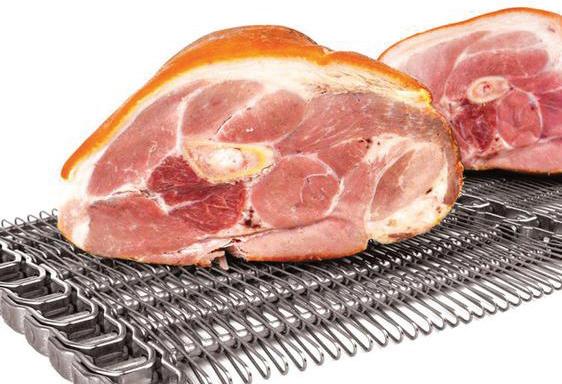
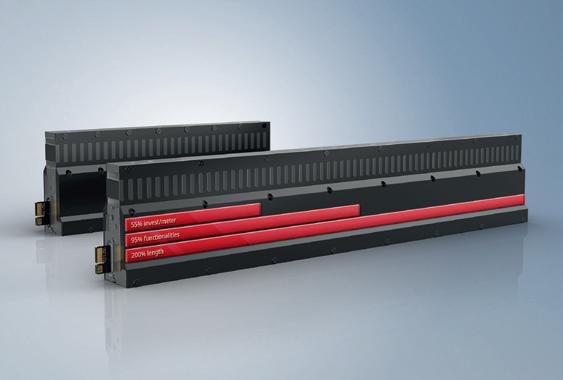
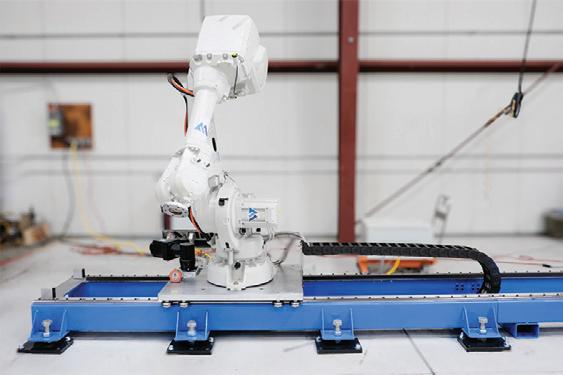
The Small Radius Heavy-Duty Omni-Grid® 360 belt combines high load capacity with tight transfer capability. Welded link construction enhances durability while minimizing stretch, making it ideal for demanding spiral and curve applications in protein and food processing.

The new XTS Ecoline motor module enables more cost-effective integration of intelligent product transport. It offers 95% of the performance of the widely used XTS motor modules at just 55% of the cost for the same length of motor. XTS Ecoline motor modules are fully compatible with existing XTS modules.

Greater robot reach starts with Bishop-Wisecarver RTUs—extremely durable 7th-axis systems built on DualVee® guidance that sheds debris for smooth, consistent motion. Designed for any length, high loads, and harsh environments, they deliver reliable performance with lower total cost of ownership.
From high-speed SCARA systems to articulated automation cells, HIWIN robotics delivers precision, compact footprints, and dependable cycle times for high-throughput packaging lines.

Stay connected to your machines—wherever you are. IXON’s remote access platform delivers a secure and highly effective solution that simplifies maintenance, minimizes downtime, and empowers service teams to operate with greater efficiency. Secure Industrial Remote Access to Your Machines

Enhance revenue potential and grow your business through aftermarket sales. Ensure performance and reliability by providing a solution formulated specifically for your equipment. Private label a quality lubricant for a more comprehensive portfolio

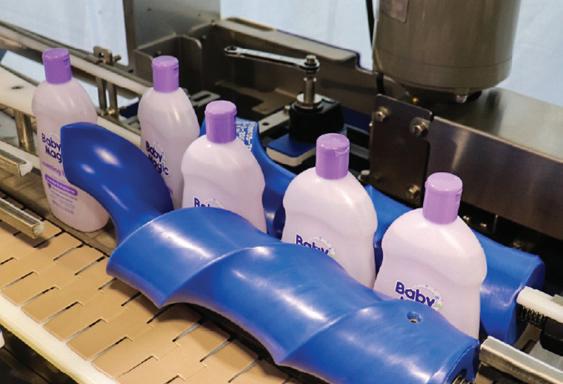
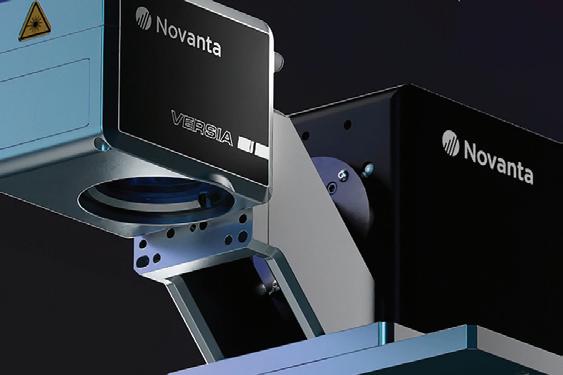
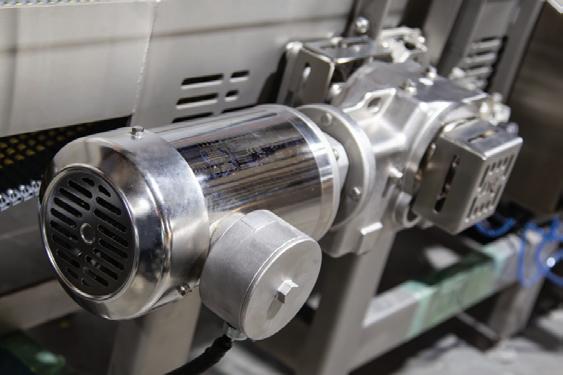
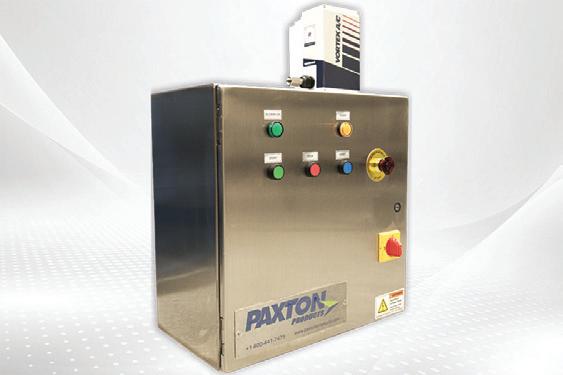
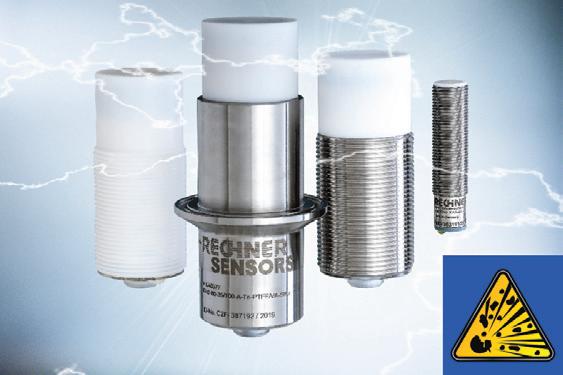
Lubriplate offers a full line of quality lubricants to meet your needs
Lubriplate’s High-Performance NSF H1 Registered Food Grade Lubricants include; High-Performance Synthetic Gear Oils, Air Compressor Fluids, Hydraulic Fluids, Multi-Purpose Greases, High-Temperature Chain Lubricants, Spray Lubricants and Specialty Lubricants.

Precision Container Control Starts Here
Morrison screw drive units give OEMs precise, repeatable container control that improves machine performance. Designed to integrate seamlessly with your packaging equipment, drive units deliver consistent container presentation, helping OEMs deliver more reliable equipment to their customers.

Novanta CO2 Laser Integrator Packages are configurable laser processing sub-systems that let OEMs choose the power level, wavelength, scan head, and working distance. These high performance components are factory configured into a single part number for fast, easy integration.

Powering OEMs With Sterling Electric Motors at Best Prices
PartsXpress® delivers Sterling Electric Motors with the inventory, customer service, and technical support OEMs depend on. From standard configurations to application-specific builds, we have Everything You Need to keep production moving.

Simplified Blower Management with the Paxton Products Control Panel
The new Paxton Products Control Panel can be used with any size Paxton Blower System to effectively and simply manage blowers in a turnkey manner so you can ensure that your drying and blow-off systems are operating at the highest of standards.

Rechner Sensors carries over 150 models of capacitive and inductive sensors that are rated for use in areas with a risk of dust or gas explosion. For use in Class 1, Div 1 or Class 2, Div 1 areas. CSA or ETL listed intrinsically safe sensors and FM approved barriers are marked for use in the USA.


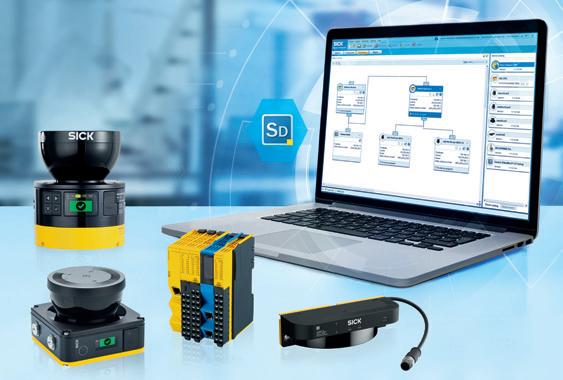
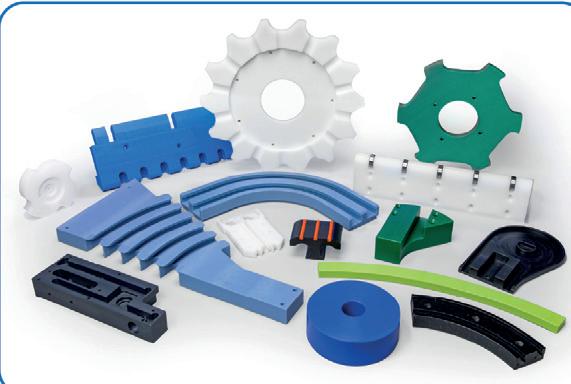
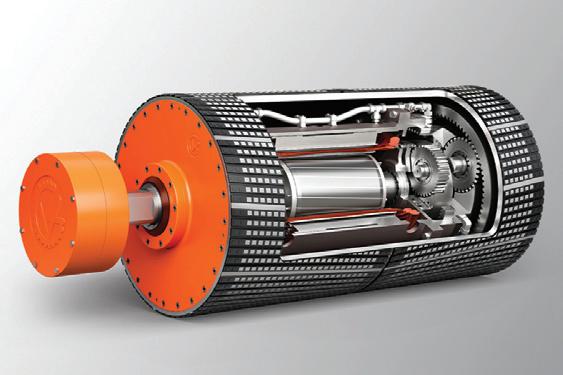
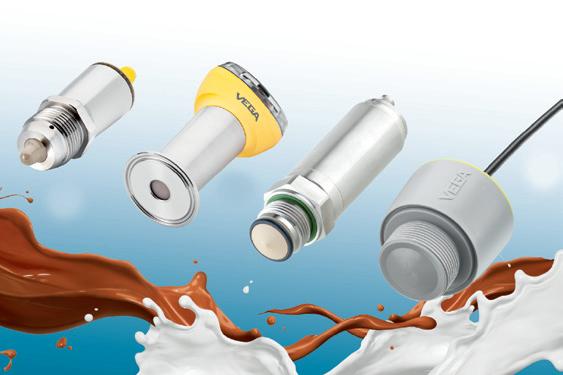
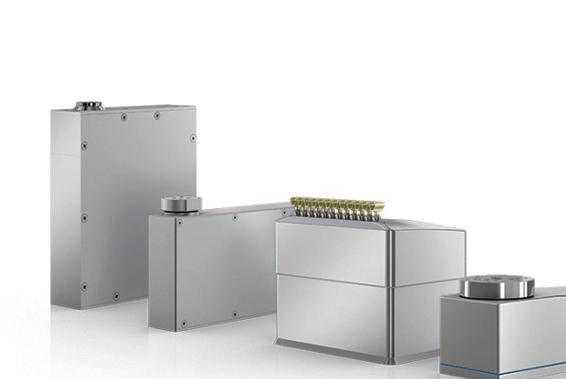
SEW-EURODRIVE’s integral stainless steel gearmotors deliver cooler operation, higher efficiency, and greater design flexibility than traditional worm solutions. With multiple gear types, sizes, and mounting options, you get a hygienic drive solution engineered for performance—without compromise.

The microScan3 delivers rugged, intelligent safety performance with SICK’s innovative safeHDDM® scanning technology, offer ing high‑precision measurement data even in dusty, demanding environments.
OEMS demand custom parts
As the conveyor + machine parts expert, over 65% of what we make is made to your specifications.
Premium VDG Drum Motors
All drive components of the VDG Drum Motor, including the premium-efficiency (IE4) electric motor, are enclosed within the drive drum and designed for 80,000 hours of continuous operation. Available in a wide range of diameter sizes, horsepower, belt speeds to suit various belt conveyor applications.
Standard IO-Link protocol is built into every pressure sensor and point level switch, ensuring universal, simple communication. This gives these instruments a standardized communication platform, enabling seamless data transfer and simple system integration. VEGA provides OEMs globally with innovative measurement solutions.

Wipotec weigh cells are used in all industrial production processes. In addition to integration in checkweighers and filling/ dosing lines, they are also installed in packaging machines of all kinds. Our weigh cells are superior due to maximum accuracy and long-term stability.


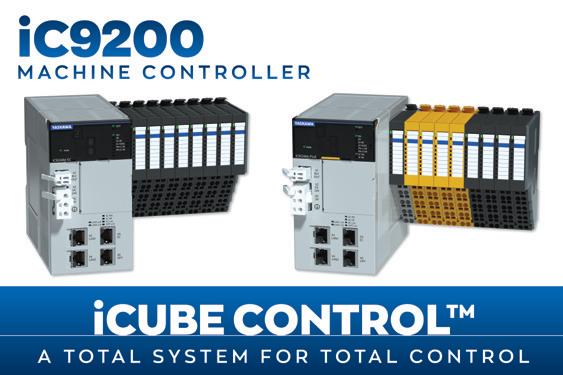
Enhanced Hygienic Conveyors from Wire Belt Company feature wash-through construction and clean-in-place designs that make sanitation simple. Options such as FLEX-TURN®, LADDER-FLEX®, and straight conveyors deliver reliable performance. Learn more at www.wirebelt.com | TEL: 603-644-2500

Yaskawa’s iCube Control™ platform offers open system design, modular system integration, and advanced functional safety. iCube Control is centered around the iC9200 machine controller, a single controller for motion, logic, kinematics, safety, security, and more, ready for any challenge you’ll face.

ABB is accelerating industrial energy efficiency with its expanded range of IE6 Hyper-Efficiency synchronous reluctance (SynRM) motors. This magnet-free technology—now available from 110 to 450 kW in frame sizes 280 and 315, and speeds up to 3600 rpm—brings next-level efficiency and sustainability to even more industrial applications. This move builds on the 2024 milestone when ABB was the world’s first manufacturer to launch a magnet-free IE6 SynRM motor for specialist applications.
“The IEA’s World Energy Outlook 2025 2 reinforces energy efficiency as one of the fastest, and most cost-effective levers for industrial productivity and decarbonization. In line with our Engineered to Outrun philosophy, the IE6 Hyper-Efficiency SynRM motors are designed exactly for this moment,” said Stefan Floeck, President IEC LV Motors, ABB. “Customers can now access world-leading efficiency across a wider power range, often achieving payback in just months while moving closer to their sustainability targets.”
ABB, www.abb.com
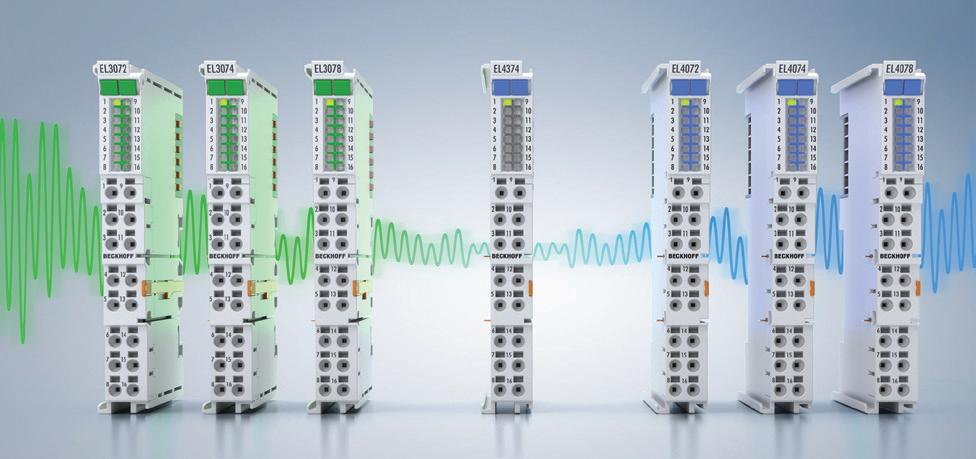
Balluff Inc. launches the 5GigE Vision Cameras, which offer cost-effective and reliable performance for industrial applications. Balluff’s smallest 5GigE cameras (29 x 29 mm face) provide high-speed image acquisition and transmission with the latest technology. The camera family has the lowest power consumption in it’s class, yet consistently delivers crisp images. A low-level heat dissipation option maintains reliability without additional heat sinks, small footprint (40 x 40 mm) and minimal noise.
The 5GigE cameras are ideally integrated in industrial applications with fast image sequences or high data rates. The wide aspect ratios are great for wide conveyor belt inspection, continuous product throughput, larger-distance measurement using laser light sectioning and other applications where several cameras must be arranged in parallel or there is a significant restriction in distance measurement. Balluff caters to customer-specific requirements such as special filters, extended temperature ranges, frozen firmware versions, production under special clean room conditions and high-precision sensor alignment.
The 5GigE camera integration is simple thanks to the compatibility with GigE Vision and GenICam digital interfaces as well as its compact, modular design. The cameras integrate the latest Sony image sensors IMX901 and IMX902, which offer wide aspect ratios of 4:1 and 3:1 respectively. enables both power supply and data transmission via a wired connection, simplifying cabling and space required for installation. A variety of digital input-output configurations makes integration flexible and easy. Balluff, Inc., www.balluff.com


Beckhoff is significantly enhancing the performance of the EtherCAT Terminals with a new generation of analog I/O terminals in compact high-density (HD) housings. With up to eight channels and an impressive 16-bit resolution, the seven terminals cover a wide range of applications and deliver exceptional value.
The new generation of analog terminals includes the EL4374, the first combined Beckhoff analog input/output terminal (10 V / 20 mA or -20/0/+4 to +20 mA) compatible with a conversion rate of 2 ksps per channel. The two inputs and outputs can be individually parameterized for current or voltage operation via TwinCAT software and a CoE interface. With a technical measuring range of ±107% of the nominal range, the terminal supports commissioning with sensor values in the limit range and enables evaluation in accordance with NAMUR NE43. The outputs can provide up to 107% of the nominal value, and the high output power permits a load of up to 750 Ω at 20 mA.
The same features are offered by the EL3072 and EL3074 analog input terminals, which now feature 16-bit resolution (previously 12-bit) as 10 V / 20 mA universal inputs. The EL3072 is equipped with two individually parameterizable inputs, while the EL3074 has four. Another addition is the EL3078, which expands the lineup with eight channels in the same compact HD housing. These improvements - higher resolution and up to eight channels - are also available in the analog output terminals: EL4072, EL4074, and EL4078. Beckhoff, www.beckhoff.com
Migatron Corp. , an expert in innovative sensor technologies, is happy to announce the launch of their latest Intrinsically Safe Ultrasonic Sensor: the RPS-429AA-80P-IS2 . Engineers and OEMs can achieve precise distance measurement and object detection in explosive atmospheres and hazardous areas without worrying about costly downtime using this ultrasonic sensor, which provides advanced accuracy and reliability.
The RPS-429AA-80P-IS2 is ideal for industries such as mining, chemical processing, and oil and gas, being designed specifically to be Intrinsically Safe, which is perfect for engineers and professionals that work in explosive atmospheres/hazardous locations.
Key Features of the RPS-429AA-80P-IS2:
∙ Intrinsically Safe Certifications: The ultrasonic sensor is thoroughly tested and approved to meet global standards, for intrinsic safety in explosive atmospheres and hazardous locations. The RPS-429AA-80P-IS2 is approved for use in Europe (ATEX), Internationally (IECEx), and in North America (C-UL-US).
∙ Precision Measurement: Built for high accuracy in distance and level measurements, this sensor delivers reliable performance, even in challenging industrial environments. The ultrasonic sensor is designed to reduce downtime, lowering the odds of the equipment failing, making it an essential tool that can be relied on for long periods of time.
∙ Robust Industrial Design: The IP66/IP67 rated enclosure protects the RPS-429AA-80P-IS2 from dust, moisture, and washdown exposure in demanding industrial environments such as oil and gas, mining, and chemical processing. With no moving parts and minimal maintenance requirements, the sensor is designed for continuous, long-term operation, reducing downtime, service calls, and overall project risk for engineers and OEMs.
∙ User-Friendly Interface: Features a 4-20mA 2-wire current loop design.
Designed for Intrinsically Safe applications, Migatron Corp.’s sensors ensure that your equipment is not only still operational but exceeds expectations in the most demanding environments. Migatron Corp., www.migatron.com





These encoders are especially suited for applications where position information must be retained after loss of system power. The rugged magnetic technology and high IP rating make these encoders an excellent choice in tough industrial environments.








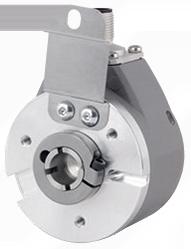
• Single turn/multi-turn absolute encoder
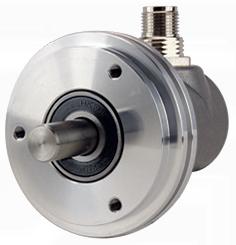

• SSI, CANopen®, and J1939 communication available
• Maintenance-free and environmentally friendly all-magnetic design
• Energy-harvesting magnetic multi-turn technology
• No gears or batteries
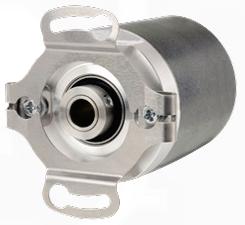
Get real-time feedback, digital changeover, and plug-and-play simplicity with EPC’s Absolute Encoders featuring IO-Link— engineered to maximize uptime and built for Industry 4.0 smart machines and fast production.
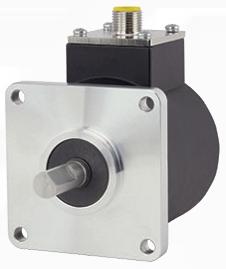
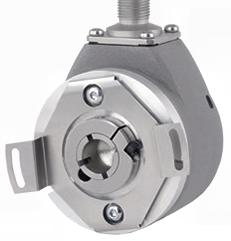
Not sure which motion feedback is right for your application?


EXAIR’s Ion Air Cannon eliminates static electricity and cleans at distances up to 15 feet, with no moving parts. It is ideal for bench-tops, machine mounting, and those “hard to reach” spaces that require a concentrated flow of static eliminating ions. This engineered product has undergone independent laboratory tests to certify it meets the rigorous safety, health and environmental standards of the USA, European Union and Canada that are required to a ain the CE and UL marks. It is also RoHS compliant. New design features include a metal armored high voltage cable to protect against abrasion and cuts, a replaceable emi er point, integrated ground connection and electromagnetic shielding.
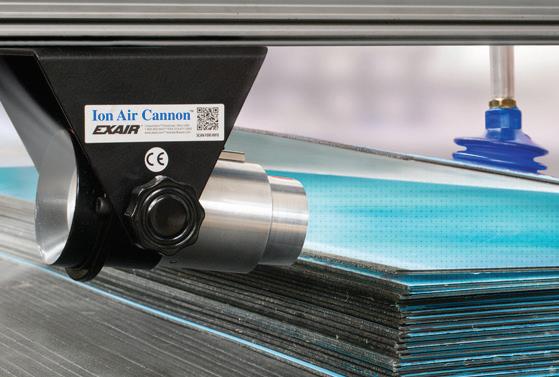

The Ion Air Cannon incorporates EXAIR’s patented Super Air Amplifier that minimizes compressed air use by inducing surrounding airflow at a ratio of 22:1. The unique amplified airflow carries the ions to the target, making it possible for the Ion Air Cannon to eliminate static charges in less than a half second.
EXAIR, www.exair.com
Festo introduces the System Configurator, a free online engineering tool that enables OEMs, system integrators, and distributors to design complete automation systems – including pneumatic and electric motion, remote I/O, and IO-Link devices – in one workflow.
The tool brings sizing, configuration, and commissioning together to help teams work faster and reduce design time. It is ideal for packaging, material handling, assembly, and custom machine builders.
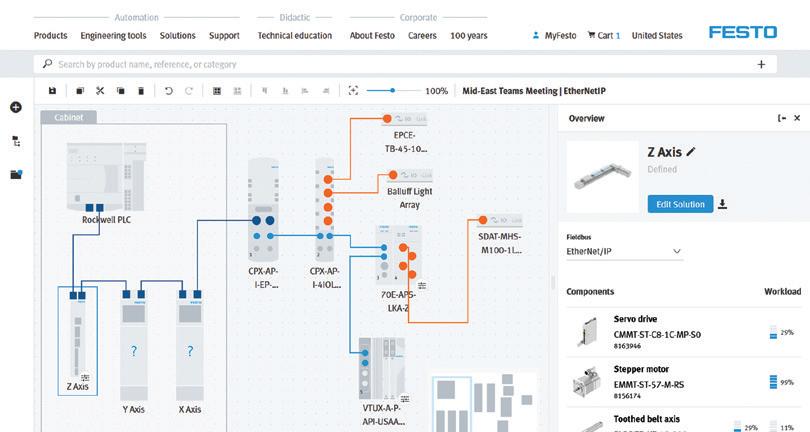

The launch comes as machine builders face increasing pressure to develop systems faster with fewer engineering resources and less tolerance for rework. Today’s automation projects o en combine pneumatic and electric motion, which not only adds complexity but brings together di erent disciplines.
Festo, www.festo.com
Fortress Technology’s roll-out reject device for gravity metal detectors allows the reject valve to slide out on rails for full access during cleaning and maintenance, improving hygiene and reducing changeover time without compromising valve rigidity.
Accessing a Gravity metal detector’s reject device and removing it from service for deep cleans and maintenance can be di cult when the reject mechanism is enclosed.
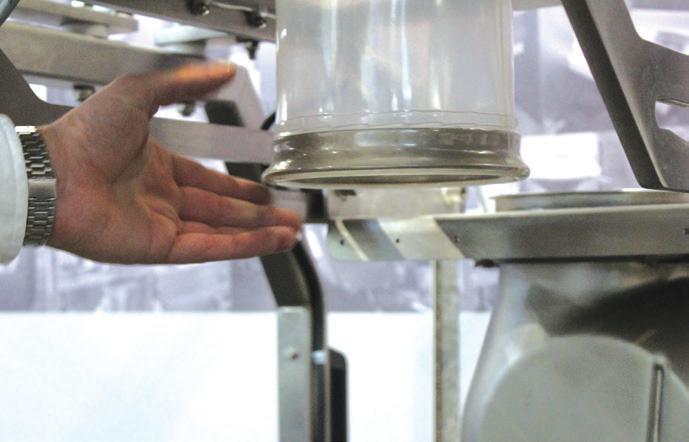

To address some of the most common issues encountered in gravity metal detection, Fortress Technology has designed a roll-out reject device to support faster changeovers and be er hygiene practices. The innovative design allows the reject valve to roll out on rails, providing quick and easy access to the product flow area inside the valve and product tube.
Fortress Technology Inc., www.fortresstechnology.com
AMCI - Advanced Micro Controls Inc. 22, 54 www.amci.com
Ashworth Bros., Inc. 55, 80 www.ashworth.com
Beckhoff Automation LLC IFC, 56, 80 www.beckhoff.com
Bishop-Wisecarver Corporation 7, 57, 80 www.bwc.com
Bodine Electric Company 41 www.bodinedecatur.com
Dalton Electric Heating Co. 58 www.daltonelectric.com
Dorner Mfg. Corp. 6, 59 www.dornerconveyors.com
Elesa 60 www.elesausa.com
Encoder Products Company 85 www.encoder.com
Hiwin Corporation 27, 61, 80 www.hiwin.com
Industrial Magnetics, Inc. 40, 62 www.magnetics.com
Ixon Inc. 1, 63, 80 www.ixon.cloud
JAX INC. 13, 64, 80 www.jax.com
Lubriplate Lubricants Company 3, 66, 81 www.lubriplate.com
Morrison Container Handling Solutions 26, 65, 81 www.morrison-chs.com
NCC Automated Systems 36, 67 www.nccas.com
Novanta 23, 68, 81 www.novantaphotonics.com
PartsXpress, Inc. 49, 69, 81 www.mypartsxpress.com
PAXTON 70, 81, 86 www.paxtonproducts.com
PMMI 21, 35, 37, 83, IBC www.pmmi.org
Rechner Electronics Ind., Inc. 71, 81 www.rechner.com
Seifert Systems 87 www.seifertsystems.com
SEW-EURODRIVE, Inc. 72, OBC, 82 www.seweurodrive.com
SICK, Inc. 31, 73, 82 www.sick.com
Slideways, Inc 4, 74, 82 www.slideways.com
VDG (Van der Graaf) Cover-1, 75, 82 www.vandergraaf.com
VEGA Americas 5, 76, 82 www.vega.com
Wipotec 47, 77, 82 www.wipotec.com
Wire Belt Company of America 17, 78, 83 www.wirebelt.com
Yaskawa America, Inc. 11, 79, 83 www.yaskawa.com
OEM Magazine (ISSN# 2377-293X) is a trademark application of PMMI, The Association for Packaging and Processing Technologies. OEM Magazine is published four times annually by PMMI with its publishing office, PMMI Media Group, located at 500 W. Madison, Suite 1000, Chicago, IL 60661; 312.222.1010. Copyright 2026 by PMMI. All rights reserved. Materials in this publication must not be reproduced in any form without written permission of the publisher. To subscribe or manage your subscription to OEM Magazine, visit oemgo.to/9999. POSTMASTER; Send address changes to OEM Magazine, 500 W. Madison, Suite 1000, Chicago, IL 60661. PRINTED IN USA by Quad. The opinions expressed in articles are those of the authors and not necessarily those of PMMI. Comments, questions and letters to the editor are welcome and can be sent to: support@oemmagazine.org. Mailing List: We make a portion of our mailing list available to reputable firms. If you would prefer that we don’t include your name, please write us at the Chicago, IL address. Volume 9 • Number 1

PMMI members are reminded that the most powerful business accelerator still comes from participation and the trust built one handshake at a time.
By Jim Pi as, President & CEO, PMMI

In manufacturing, particularly in packaging and processing, it’s natural to focus on tangible advantages, new technology, faster automation, and better access to and use of data. These are all critical, and PMMI exists in large part to help our members stay ahead in those areas. But over the years, I’ve become increasingly convinced that the most powerful competitive advantage our members have access to is far more human.
PMMI meetings, the MaX Member Forum, OpX Networking Group, and PACK EXPO trade shows provide meaningful, face-to-face connections. And when our members talk about why they attend these events, one theme keeps coming up: networking. Not as a buzzword, but as a business driver.
When you’ve sat across the table from someone at a PMMI meeting, shared a conversation on the PACK EXPO show floor, or collaborated on a committee, future interactions start from a place of trust. Those relationships don’t just make business easier; they make it better.
I’ve seen competitors become collaborators because of conversations that began at PMMI events. I’ve watched supplier relationships strengthen because people took the time to connect beyond a transactional setting. These outcomes aren’t accidental; they are the result of an environment designed to bring the right people together.
There’s a difference between knowing what’s happening in the industry and understanding how your peers are responding to it. When our members gather, the real value often comes from the moments between agenda items. It’s in the questions asked, the experiences shared, and the challenges openly discussed among peers who understand the realities of the business. Often, members leave realizing that the problems
they’re trying to solve aren’t unique, and that someone else may have already found a solution worth learning from. That kind of insight comes from engagement.
Typically, exhibitor success at PACK EXPO is measured by leads generated and deals closed, and those metrics matter. But they don’t tell the whole story.
The true strength of events like PACK EXPO lies in concentration. Nowhere else can you have so many relevant conversations in such a short time. Customers, suppliers, competitors, and industry experts are all in one place, creating opportunities for connection while walking the floor, during an unexpected introduction, or over a cup of coffee.
This helps craft a more strategic view of the industry. These connections allow companies not just to see where their company fits today, but to understand where the industry is heading.
It also reinforces an important truth: While we compete every day, we also share a responsibility to strengthen the industry as a whole.
Networking is not a one-time benefit. Each event strengthens existing relationships and creates new ones. Over time, that network becomes a resource, one that delivers insight, opportunity, and resilience.
For companies that choose not to engage, that’s the real cost. It’s not just what they miss today, but the relationships they never build for tomorrow.
My final thought is this: If you’re looking for a competitive advantage, don’t underestimate the value of showing up. Attend the meetings. Walk the show floor. Join the conversation.
In packaging and processing, some of the most important progress still begins with a handshake. ■
Jim Pittas is the President & CEO of PMMI. He may be reached at jpittas@pmmi.org or at linkedin.com/in/jimpittas.




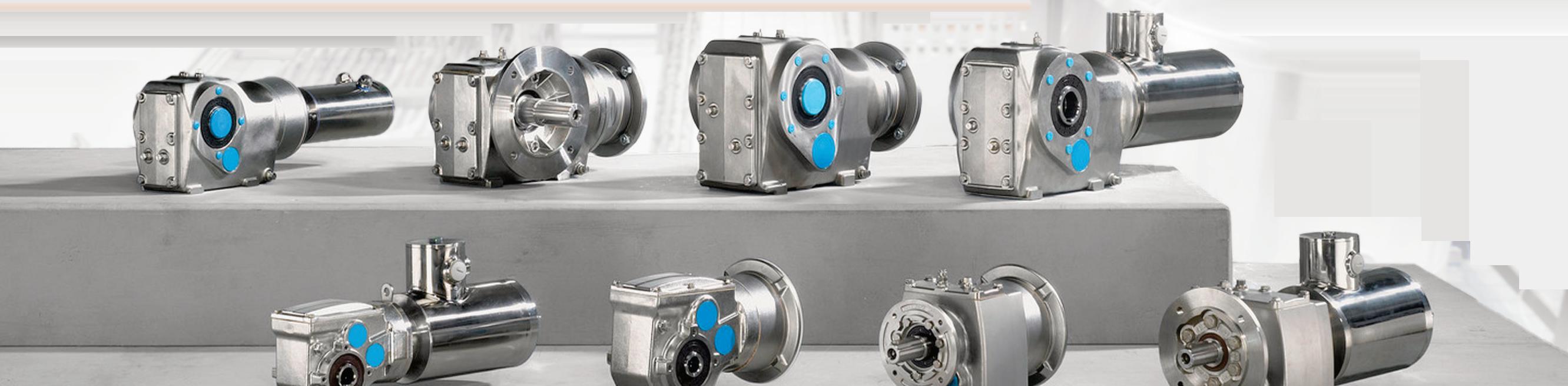

SEW-EURODRIVE’s stainless steel gear units and gearmotors are engineered for applications subject to frequent cleaning and harsh washdown conditions. Helical, helical-bevel, and SPIROPLAN® gearing provides flexibility for torque, speed, efficiency, and installation requirements. Compared to traditional worm gear solutions, these gearing technologies offer higher operating efficiency, reduced heat, extended lubricant life, and longer service intervals.
Units are available as integral stainless steel gearmotors or with stainless steel adapters for IEC, NEMA, and servo motors, providing flexibility for new designs and retrofit applications. Join us at: MODEX - Booth # B-16112 | Cheese Expo - Booth # 314