
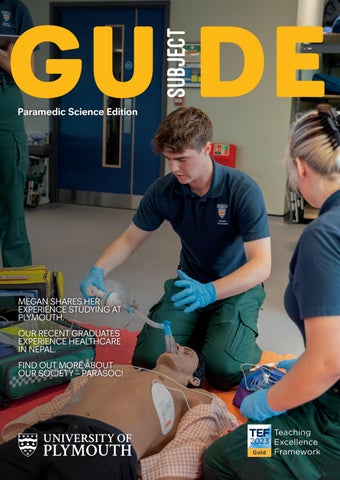
Subject Guide Paramedic Science Edition

Page 1


SUBJECT

Paramedic Science Edition

MEGAN SHARES HER EXPERIENCE STUDYING AT PLYMOUTH.

OUR RECENT GRADUATES EXPERIENCE HEALTHCARE IN NEPAL.

FIND OUT MORE ABOUT OUR SOCIETY – PARASOC!

Gold
Admissions

+44 (0)1752 585858 admissions@plymouth.ac.uk plymouth.ac.uk

Schools & Colleges Outreach Faculty of Health outreach@plymouth.ac.uk

University of Plymouth Drake Circus Plymouth Devon PL4 8AA United Kingdom

Follow us @PlymUniApply

Paramedic Science Edition

SUBJECT

It’s never too early to start thinking about what you would like to do after school or college, of if you are thinking of a career move! At Plymouth, we know that choosing a university and course is a big decision. While you may have an idea of a profession, career or industry that you’re aspiring towards, if you’re unsure of exactly what you want to do or are keen to find out more – this is where our handy subject guide comes in.

Meet some of this issue’s contributors:

BSc

Shares what he has experienced so far on placement. P.20

EXPLORE YOUR FUTURE HOME

When it comes to finding out if university feels right for you, nothing compares to an open day. Talk to current students and quiz lecturers about your course. You can register to attend here: plymouth.ac.uk/open-days

Our virtual tour allows you to experience firsthand what it is like to be on campus and explore the environments and facilities that inspire and shape our learning every day. You can take a virtual tour here: virtual.plymouth.ac.uk

Inside...

FEATURES:

P. 4 10 reasons to study at Plymouth

P.8 Our Paramedic Science degree

Find out what you can expect from each year of the course..

P.12 Where will your degree take you?

Learn more about what careers are available in paramedic science. P.14 What inspired you to become a paramedic?

Discover why current students Jamie and Flora decided to study paramedic science.

P.24 InterCity Place

Take a look at the facilities our paramedic science students can benefit from.

P.36 Hear from our alumnus

Past student Paul shares what he loves about his current role in the South Western Ambulance Service Trust.

Ismael
(Hons) Paramedic Science student
Suzie Boot Lecturer in Paramedic Science Talks us though the exciting clinical skills simulations that you can get involved in. P.26
Matthew BSc (Hons) Paramedic Science student Shares tips on how to settle into university life. P.28

10 REASONS TO STUDY AT PLYMOUTH

Being a paramedic is a highly rewarding and stimulating career. The BSc (Hons) Paramedic Science course at the University of Plymouth offers a forward-looking programme of study, which aims to prepare you for the workplace by developing your decision-making capabilities, clinical knowledge and skills base.

1. EXPERT-LED TEACHING

During your time studying at Plymouth, you will be educated by a dedicated programme team, who between them have a wide variety of experience and backgrounds, including and beyond practising in the traditional paramedic role, working for an NHS ambulance service. Examples of these include

primary and urgent care, hazardous area response teams, research, and education. Each team member is a paramedic and has encountered situations that they wish they had never faced. This level of insight is valuable when supporting you to discuss and learn from these events.

2. FACILITIES

InterCity Place is a dedicated building equipped with learning spaces and resources to train and develop the next generation of nurses, midwives and allied health professions. Paramedic students may learn within the home simulation suite, clinical consultation rooms, an integrated ‘simbulance’ and a range of other environments. During practical teaching, tutors will support you to safely practice using the equipment that would be available to paramedics in real-world situations.

4. CAREER OPPORTUNITIES

As well as working for the ambulance trusts, opportunities extend into a diverse range of settings including health services and private ambulance services, acute hospital and community settings or private businesses such as offshore medics.

Career progression may include areas such as advanced paramedic practice, or to progress within educational, clinical effectiveness, research and managerial roles. Find out more about career opportunities on P.12-13

3. PLACEMENTS

During the course of three years’ study, you’ll undertake clinical practice placements in a variety of settings to provide real-life experience of the profession you are planning to enter. These placements will help prepare you for the workplace by developing decision-making capabilities, communication and clinical knowledge.

Find out more about placements on P.20-23

5. HANDS-ON LEARNING

Simulations and enhanced learning are embedded within clinical skills modules, where you’ll complete “real time” scenarios to explore different areas of paramedic science. Using group and independent work, to encourage problem-based learning allows you to gain confidence and competence in your development. We also have the Peer Assisted Learning Scheme (PALS) where you can learn alongside other students on the course, helping to broaden your knowledge, gain confidence and make friends.

“PALS is a great way to learn collaboratively with the mentors being students from the years above. In this relaxed setting, students are able to interact and develop much-needed study skills and revise their course content. This is especially useful for new students who are just starting out at university and sets them up for success.”

6. INTERPROFESSIONAL LEARNING

You have the opportunity to engage within Interprofessional Learning (IPL). These are shared sessions with other allied healthcare students such as occupational therapists, physiotherapists, optometrists, podiatrists and

dietitians within the school. This gives a good insight into multidisciplinary working across healthcare teams, and ensures a wider knowledge base of other professions and how each works together.

7. TRAINING GRANT

Health students may be eligible to receive an additional £5,000 each year. The NHS Learning Support Fund provides additional funding for for eligible healthcare students to support them while they train and gain professional registration.

8. RESOURCES

Our library is open 24 hours a day, 7 days a week, 365 days a year, enabling you to access a wealth of resources whenever you need them, including online journals, subjectspecific databases, online archives

and of course, books! There’s also specialist support on hand when you need guidance, and our enthusiastic subject librarian is always happy to help.

9. LOCATION

Benefit from a great work–life balance in Britain’s Ocean City. You will be spoilt for choice with the thriving nightlife in walking distance of our city centre location, sandy beaches of Devon and Cornwall, and swathes of Dartmoor’s picturesque countryside and landscapes. Study with us to enjoy a healthy quality of life, surrounded by the ocean and the moors.

10. BECOME A QUALIFIED PARAMEDIC

Our Paramedic Science course is endorsed by the College of Paramedics which will support you to achieve the highest standards of patient care. Those who successfully complete the course are eligible to apply to register with the Health and Care Professions Council (HCPC) as a paramedic.

OUR BSc (Hons)

PARAMEDIC SCIENCE DEGREE

As a paramedic, you are trained to assess and support those with urgent healthcare needs. The paramedic science course prepares you to practise autonomously, often as a first responder working in an ambulance environment.

BS c (H ons) Paramedic Science

Our degree focuses on the contemporary needs of the NHS and preparing graduates to develop the paramedics of tomorrow. The course is designed to enable you to practise safely, confidently and competently in a variety of relevant clinical skills sessions. You will also experience a range of placements in different areas, with support from the academic team and practice educators.

YEAR 1

In your first year, you will gain the knowledge to develop into the paramedic role, such as anatomy and physiology, risk assessment, professional issues and effective communication. You will also learn the theory and skills leading to basic assessment and management of patients.

YEAR 2

In your second year, you will build on the skills learnt in year one, developing your knowledge in relation to the assessment and management of medical and trauma patients. This year addresses the contemporary focus of the need for paramedics to understand mental health emergencies. It also introduces you to the concepts behind evidence-based practice and sees the commencement of your group research projects.

YEAR 3

In your final year, you will continue the group research project, collecting data and reporting on it. Year 3 aims to advance your knowledge about clinical decision making and prepare you for educating future learners in practice.

You will also continue to improve your knowledge of medical conditions and pathophysiology, as well as your scope of practice in relation to clinical skills.

You are eligible to apply for registration with the Health and Care Professions Council (HCPC) on successful completion of the course.

This course is endorsed by the College of Paramedics and the HCPC.

“The course is thoroughly comprehensive with many different aspects of the role covered in detail. The course is also very cohesive with strong bonds formed between students, respective cohorts, and the teaching staff who work tirelessly to provide excellent tuition and support. All this really helps the University of Plymouth to stand out as a place to study paramedicine.”

FIND OUT MORE about the BSc (Hons) Paramedic Science course

FIND THE RIGHT ROUTE FOR YOU VIA OUR FOUNDATION COURSE!

Our integrated foundation course provides the understanding and basis to prepare you for the undergraduate degree in BSc (Hons) Paramedic Science. The course offers students from a variety of backgrounds and skills sets an avenue into a wide variety of degrees that have traditionally been out of reach.

Taught by university lecturers on campus, you are part of the university from day one. If your current qualifications don’t allow you direct entry to degree level, this course is for you.

A foundation pathway allows you to:

Build your confidence, regardless of your educational background.

Grow academically and personally in a university environment.

Develop research, utilise digital resources, essay-writing, academic argument, presentation, independent study and referencing skills.

Be supported via tutors, resources and subject-specific skills training to prepare you for progression onto your chosen degree.

Join a community of like-minded students and make friends for life.

WHERE WILL YOUR DEGREE TAKE YOU?

Since specific career paths may not be obvious, it is important to research and explore the range of opportunities and to consider your personal interests, motivations, values and strengths.

Although the level of demand fluctuates, paramedic science graduates are continuously recruited into the NHS to be paramedics. Paramedics tend to start their careers in generalist roles before gaining specialisms through experience and further study. In time, graduates develop to work in other areas, including HART (the ambulance service’s hazardous area response team), urgent treatment centres, minor injury units, GP surgeries, the military, or working as a forensic paramedic. This degree can also take you into working around the world as an offshore paramedic or within other nations’ ambulance service.

WHAT SKILLS WILL YOU GAIN?

• How to diagnose and treat a wide variety of injuries and illnesses while developing a resilience to high pressure scenarios.

• Exemplary physical and mental stamina for intense situations, allowing you to be calm, confident and reassuring when necessary.

• A preparedness for unknown or unpredictable situations with the ability to understand situations quickly, and make sound and prompt decisions.

• Working alone and as part of a team in a quick, careful and appropriate manner.

• Research and analytical skills with the ability to create, evaluate and assess options, and apply knowledge to a range of situations.

• Effective communication, leadership and interpersonal skills through teamwork and collaborative learning opportunities.

“After graduation I began working full time as a paramedic. Initially, I worked as a relief paramedic (working at multiple stations to fill gaps) before taking a “line” at Torquay ambulance station. The lecturing team at Plymouth are dynamic and innovative, creating an interesting learning environment, and providing a great platform to become a successful paramedic.”

“The University provided a great course with lots of support and allowed me to train with a great ambulance service. Since completing the course, I have walked straight into a well-paid graduate job. I began my employment with SWAST (South Western Ambulance Service NHS Foundation Trust) with a three-week response driving course, followed by an induction week, and then on the road as a paramedic the week following my graduation.”

Paramedic Science graduate Find out

WHAT INSPIRED YOU TO BECOME A PARAMEDIC?

Two of our third year students share why they decided to apply for the BSc (Hons) Paramedic Science course.

JAMIE

I served in the Royal Marines for a little over 15 years. I joined the military at 16, straight from school, and then due to having a young family who did not want me deploying away from home anymore, I took early voluntary release at the age of 31.

My main role within the Royal Marines was working as a boat operator, deploying all over the world, including operational deployments to Afghanistan, Sierra Leone and multiple ‘discreet operations’. Additionally, since leaving the military, I have taken a role as a beach lifeguard within the RNLI alongside my studies.

I have the same classic reasons as everyone else for wanting to become a paramedic. Helping people, working as part of a team, ever-changing work environments, job security, job diversity, good pay...the list goes on. All these things appealed to me because they

were things I enjoyed while working within the Royal Marines. Moving from one uniformed service to another has certainly helped with my transition from military to civilian life. Ultimately, I have always wanted a job that I felt proud to do, that my parents were proud of me doing, and now more recently my partner and children can be proud of me doing, and I definitely feel that becoming a paramedic is something that can achieve that.

Although sometimes challenging, I have really enjoyed my time on this course so far. The lecturing team throughout have been great, they are all so knowledgeable, supportive and approachable. While out on the road the support and learning I have been provided with by members of SWAST ambulance crews has been amazing,

I remember thinking at the start of the course that there was going to be no way I could ever gain the knowledge

needed to be a competent/successful paramedic. However, I remember being told to just work hard, trust the process and it will all fall into place, and it really has! As I start my third and final year, I know I still have so much to learn but I really do feel confident in my abilities now and I honestly really do look forward to going out on my own as a registered healthcare professional this time next year!

FLORA

Before applying for the course, I focused on both my education and gaining practical experience. I studied Biology, Chemistry, and Maths at A Level, as I have always found human anatomy and physiology fascinating.

Even in my final year at Plymouth, I still find myself referring back to my A level notes – they provided me with an excellent foundation of knowledge for this course. Following my A levels, I took a gap year to acquire practical, handson experience by working as a lifeguard. This role was highly rewarding and allowed me to undergo training in basic life support (BLS) and first aid, which further fuelled my enthusiasm and excitement for a future career as a paramedic.

I was initially torn between studying medicine and paramedic science. I always knew that I wanted to choose a rewarding career that could provide me with a sense of purpose. Ultimately, I

chose to become a paramedic because I felt that the career was more personal than medicine. You do not face the same formal, clinical barrier between you and the patient. It is a huge privilege to be invited into people’s homes – their safe spaces – during times of extreme vulnerability, and to be able to support them through what might be the worst day of their lives. This opportunity to make a genuine impact, no matter how small, was what stood out to me and made me want to pursue this career. Furthermore, I preferred the dynamic nature of this career and the huge amount of variety it offers – no two days are the same. As a paramedic, you are not confined to an office or hospital, but instead work as an autonomous clinician out in the community.

I feel that the course is preparing me well for my future career, primarily through its emphasis on practical placements. I believe that hands-on experience is crucial as a student

paramedic, as it allows me to apply theoretical knowledge in real-world situations. While classroom learning is invaluable for building a strong foundation of knowledge, placement is where that understanding, and those skills are solidified.

Furthermore, the breadth of the curriculum covered is hugely beneficial. In addition to core modules on anatomy, physiology, and pathophysiology, the course includes modules on softer skills, such as clinical decision-making. While these can feel less exciting and are easily overlooked by students, these lectures and the discussions that we have in them, have greatly increased my confidence as I approach qualification and ensure that I am well equipped to face more complex jobs.

STORY Megan’s

Current paramedic science student Megan shares what you can expect from the course.

“Overall, I believe the course has equipped me with the knowledge, skills and practical experience needed to step confidently into a paramedic role and provide quality care when it matters most.”

WHY PLYMOUTH?

Firstly, the University has an excellent reputation for its practical approach and strong links within local NHS services, which I believe is essential for hands-on training. The curriculum is well structured, offering a balance between the theoretical knowledge and practical skills, which is crucial to a career in emergency care.

Additionally, I was impressed by the state-of-the-art facilities and simulation equipment that Plymouth offers, allowing students to experience real-life scenarios in a controlled environment. This aligns with my learning style, as I thrive in practical, immersive settings.

Ultimately, my passion for helping others in critical situations, coupled with Plymouth’s strong course, made the ideal choice for me to pursue my career in paramedic science, and I

could not think of a better place to live than by the sea!

HOW HAVE YOU FOUND THE MIX OF THEORY TO PRACTICAL WORK?

I’ve found the balance of theory and practical work in my paramedic science degree to be incredibly beneficial. The theoretical components provide a strong foundation in medical knowledge, anatomy, and emergency protocols, which are essential for understanding the complexities of patient care.

What really stands out though, is how the course seamlessly integrates practical training. The hands-on experiences through lectures, seminars and placements have helped me develop critical thinking and decision-making abilities under pressure, which are vital in the field. Overall, I appreciate how the course prepares us to be well-rounded

paramedics ready for the challenges we’ll face in our careers.

HOW DO YOU FEEL THE COURSE DEVELOPS YOUR CLINICAL SKILLS?

In our first year, we focused a lot on patient assessment, and history taking, focusing on patient care. In our second year, we began gaining more clinical skills like cannulation, IO and needle compression. Finally, in our third year we go into building our leadership skills and integrating all of our skills into practice ready for when we are qualified.

Each year we expand on our clinical skills, which can be through:

• Simulations: where mistakes are encouraged as they promote learning.

• Dissections: to gain further understanding of the body’s anatomy and the effect of our clinical interventions.

• Clinical placements: where we work alongside paramedics to gain exposure to the dynamics of emergency patient care and the challenges faced within this field.

• Clinical skills sessions: where we learn skills such as cannulation, needle decompression and giving intramuscular injections.

YOUR ADVICE FOR APPLICANTS INTERESTED IN STUDYING PARAMEDIC SCIENCE?

My main advice for anyone thinking about studying paramedic science is to stay proactive. This field is all about continuous learning, so being open to new information and experiences will really benefit you.

Get some hands-on experience: If you can, try to volunteer or shadow professionals in healthcare or emergency services. This will give you valuable insights into what the job

entails and help you confirm that it’s the right path for you.

Develop strong communication skills: As a paramedic, you’ll need to communicate effectively with patients, families and other healthcare professionals. Practising these skills now—whether through group work, volunteering, or even part-time jobs— will serve you well.

Be ready for challenges: The course can be demanding, both academically and emotionally. It’s important to build resilience and coping strategies. Stay organised and manage your time effectively, and don’t hesitate to seek support when needed.

Connect with your peers: Forming a support network with fellow students can be incredibly helpful. Share experiences, study together and lean on each other during tough times.

Stay passionate about helping others: Remember why you chose this path. Keeping that passion alive will help you through the challenging moments and remind you of the positive impact you’ll make in people’s lives.

Overall, if you’re dedicated, adaptable, and committed to learning, you’ll find the paramedic science program to be an incredibly rewarding experience.

Find out more about Megan’s student journey with Plymouth

MY PLACEMENTS

THE PLACEMENT EXPERIENCE

Across all three years of the BSc (Hons) Paramedic Science course, you will spend time developing your skills, knowledge, experience and confidence, in various settings. Placements are both rewarding and demanding, being arranged to facilitate the best use of clinical practice time, balanced against the demands of the academic elements of the programme.

PARAMEDIC SCIENCE STUDENT

ISMAEL SHARES WHAT YOU CAN EXPECT FROM PLACEMENT

I’m starting my third year as a Student Paramedic and so far, have completed over 1,000 hours of placement. This has mainly been made up of frontline NHS ambulance services, as well as acute settings such as maternity and surgical theatres.

PLACEMENTS

Placements are a core part of the course, and without a doubt the most enjoyable. We’re required to have over a thousand hours of placement time under our belts by the time we complete the course. Practising on frontline ambulances all over Devon, Cornwall and Somerset forms the bulk of our placement time, where we’re assigned a paramedic mentor whom our shifts are with. My shifts mirrored my mentors exactly, working days and nights as required.

Along with this, the University facilitates a variety of non-ambulance placements. Some are mandatory year by year, such as emergency departments for the first years and paediatrics for the second year. In contrast, there are additional placements where we get a choice, such as surgical theatres and cardiology wards.

SUPPORT

It is pretty normal to feel uncomfortable or overwhelmed especially when starting placement, so it is really reassuring to know that the Uni is always behind us in offering support and guidance throughout, from day one. It’s in the nature of the job to see traumatic injuries and patients in pain, and naturally these experiences can affect students in different ways. Having a solid team of placement educators, personal tutors/lecturers, and wellbeing ambassadors at our disposal, really makes that difference after experiencing something unpleasant.

GAINING CONFIDENCE

I feel more and more confident in myself and my practise every shift. There are good days and bad days, but I am very happy with my progress so far, and can’t wait to see my name on the paramedic register in the future.

I feel placements are a crucial part of the course, they have prepared me well for when I will be by myself on the road. It is the best chance to put the theory into practice; and I have gained so much knowledge and experience in a variety of different corners of healthcare through hospital, ambulance and surgical placements, which hopefully will all come together to allow me to deliver the best healthcare to my patients.

MY PLACEMENTS

AMBULANCE

I started university in September 2022; exactly three and a half months later, I was already sitting in a frontline ambulance, nervously checking equipment with my paramedic educator. Starting out as a first year on the road was pretty daunting. We have covered all sorts of assessment techniques at university, as well as basic life support and received inductions from the local ambulance service, nonetheless, everyone’s first day is daunting. The feeling of excitement, however, can’t be helped, especially when the ambulance computer announced “999 MODE ACTIVATED!” as we set off to our first patient on blue lights.

It’s an understatement to say we go to anything and everything. In one ambulance placement block, I went to a cardiac arrest, countless elderly fallers, a stabbing, a patient who wanted their TV to be turned down, a patient threatening to jump off a building, and many others with mild and serious ailments.

About 10% of calls are labelled Category 1 or ‘life threatening’, such was the case in one of the last jobs of my second year, a cardiac arrest. We had covered advanced life support a few months prior, so I was confident in my cardiac physiology and life support algorithms. Being on placement is the chance to put your knowledge to practice, and it was brilliant to work alongside HEMS (Helicopter Emergency Medical Services) consisting of a doctor and critical care paramedic throughout that arrest.

I had the opportunity to independently manage an airway, analyse cardiac rhythms, use

a defibrillator and administer lifesaving medications. I learnt an immense amount about resuscitation during that job and felt like I made a real difference while working as part of that team. Jobs like those are few and far between, but they are the ones we look forward to the most, the opportunity to help people at their most desperate times of need: that’s what makes being a paramedic the most rewarding and best career.

SURGICAL THEATRES

There are a number of nonambulance placements each year. At the beginning of my second year, I elected to spend a week in surgical theatres. This placement is designed to

allow student paramedics to work with anaesthetics, airway management, prepare patients for surgery and provide insight into non-emergency care. This by far was the most enjoyable time throughout my course so far and I am incredibly glad and privileged to attend a university that can offer such placements.

I observed surgeries ranging from abdominal, orthopaedic, ophthalmic and colorectal operations. I was given the opportunity to manage airways of sedated patients, use multiple airway adjuncts such as OPs, BVMs and iGels, as well as practising cannulation and drawing up anaesthetic drugs like Propofol and Rocuronium.

Find out more about Ismael’s placement experience

Although I had one and a half years of paramedic knowledge under by belt, theatres were a whole new level. Working with anaesthetic doctors, operating department practitioners and surgeons opened my eyes to how interchangeable the skills I’ve learnt at university are, as opposed to the stereotypical high-stress environment of ambulance work. Working in theatres provided a calm and thankfully clean environment to learn and practise in, as well as liaising with many different healthcare professionals. Granted, once the surgeries had started, I wasn’t handed a scalpel and told to remove a gall bladder or anything like that, but I had the chance to strengthen

my communication skills with the patients who were nervous and made them feel comfortable before the surgery.

In addition, anaesthetic doctors explained how the drugs worked, and went through their anaesthetic machines detailing every part of human anatomy they have to take care of, as well as advising me on the airway complications I may encounter when I start practising as a paramedic. The team at the hospital were very inviting and made me feel very comfortable in a new environment, and I was offered the chance to spend half a day in the ICU (intensive care unit) where I learnt a huge amount from critical care doctors and

ICU nurses. It’s a placement that I strongly recommend to anyone on the course.

MATERNITY

My maternity placement consisted of spending a week in Derriford Hospital’s central delivery suite, where I worked alongside midwives and obstetric doctors. I was assigned to a midwife who was my preceptor, and I was made to feel welcome and supported throughout the entire week. Maternity jobs are quite rare to see while on ambulance placements, so this placement itself was very important to consolidate the maternal healthcare we learn in theory.

On day one, I had the opportunity to assist the midwife in delivering two babies and learnt about immediate care for the newborn and mothers, as well as analgesic medications given and the birthing process as a whole. My second shift was the first time I delivered a baby with support and assistance from my preceptor, and it was probably the highlight of my course so far. From the beginning, I was involved in undertaking observations, monitoring foetal activity via interpretating CTGs, supporting the father through reassurance and communication and finally completing assessments of the baby straight after. It was a real full circle moment when the baby was here, and I felt like I had made a real difference. Again, a great placement and I left my final shift feeling much more confident with maternal patients and how to manage them.

INTERCITY PLACE

PARAMEDIC SCIENCE AT INTERCITY PLACE

The facilities at InterCity Place will provide an environment in which to learn both the theoretical and practical skills required to practise as a student paramedic.

You’ll be supported during simulated practice, and work alongside fellow students, with life-like manikins, a simulated ambulance and equipment that you’ll become familiar with in the real-world settings. The simulations imitate practice and develop a deeper understanding of the role. There is also more general space available where you can practise skills and activities relating to paramedicine. This provision will provide an opportunity to learn steadily and learn from errors during simulation, allowing you to build your confidence and prepare for practice.

The paramedic team look forward to supporting you to learn with, and from students from, other allied health professions in this unique facility.

SIMBULANCE

You’ll spend hundreds of hours working in an ambulance environment.

The University’s simulated ambulance is an ideal environment to promote small group learning in such a setting. Equipped with a stretcher, ambulance chairs

and storage cupboards all within easy reach, you can practise just as they would in a real ambulance. To promote authenticity, the simbulance is equipped with cameras and microphones to enable tutors and peers to watch you learn without invading the learning environment.

InterCity Place has a wide range of teaching areas, study places, a cafe and social learning spaces, so there is always somewhere to study, learn, socialise and relax.

“I really value InterCity Place and the facilities that it offers. The lecturing team have worked hard to source a large stock of equipment for us to practise with. Nearly all of the equipment is identical to that used in the local ambulance service. The ability to book out the space and practise skills in our own time is also extremely beneficial to our learning.”

FIND OUT MORE InterCity Place: facilities for allied health professions, nursing and midwifery students. Discover the learning environments that will give you the knowledge, skills and experience to build careers in healthcare.

CLINICAL SKILLS SIMULATIONS The House Party

Suzie Boot – Lecturer in Paramedic Science, with a passion for prehospital trauma care, talks us through the exciting clinical skills simulations that paramedic students get involved in throughout their studies.

We put on a lot of simulated practice activities for our students during their studies. These sessions aim to expose students to different situations and scenarios, having the opportunity to gain experience in the types of things that they are going to have to manage when they are paramedics. These sessions allow students to practise in a safe and controlled environment where they can make mistakes, without the life altering consequences that might result if those mistakes were made once they are qualified.

In these simulations we have anyone from drama students, paediatric nurses, actors and colleagues from the ambulance service involved. We cover them in fake blood and wounds and they will be acting, showing signs of having certain injuries,

The students began entering a simulated “house-partygone-wrong”. They worked in multidisciplinary groups of student nurses, paramedics, and medical students to assess the messy, dark, loud scene, apply Ten Second Triage, manage and extricate their patients.

being in pain and reacting to conversations and actions that the students are making throughout the simulation. All of which really creates a pressured environment and makes the emergency exercise extremely realistic.

WORKING WITH OTHER HEALTH PROFESSIONALS

We try to work with students from all other health courses across the University in the different simulations we arrange. As a paramedic, you can’t go out to treat and manage patients without working with other professions. If you are taking a patient to hospital, you have got nurses, doctors, physiotherapists, occupational therapists and so many other professions that you have to talk to once you get them there. The same goes if you are leaving someone at home,

you need to speak and work with occupational therapists, physiotherapists, podiatrists and more. We couldn’t do our jobs without the other professions, and the more you understand about what other professions do, the more you can understand what a patient needs.

Having students from a range of different health courses work together on scenarios and simulations is a great way

Emergency Department ICU

They then moved over to a scenario in the emergency department where initially they were managing a full emergency department, co-ordinating ongoing care for those patients when a phone call indicated the patients from the house party would be arriving imminently and they needed to make space.

for student to learn about each other’s profession. They can gain more of an insight into what the profession does, and then see how they may approach and work with patients with different needs. This will help students to begin to understand how health professions can work together to support and provide the best care to patients throughout different stages from incident to recovery.

BENEFITS OF CLINICAL SKILLS SIMULATIONS

It is beneficial to expose students to major traumabased scenarios, and add pressure to this training, so they can gain some experience of a stressful atmosphere in a safe and controlled environment. This will hopefully allow them to feel more confident if there was a situation like they need to attend once qualified. The students come out of the

sessions saying it was so stressful, but they enjoyed it and achieved something. It was really nice for us academics to watch. In the simulated house party, the paramedics were in charge and on point, and then when it moved to A&E it was very much the nurses who took over and then at the ICU part, the medical students took over and they did it almost naturally.

The students were then tasked with managing the patients and other critically unwell patients in the ICU setting.

SETTLING INTO UNIVERSITY LIFE

Matthew, Year 2 BSc (Hons) Paramedic Science student

LIVING AND STUDYING IN PLYMOUTH

Plymouth is known as Britain’s Ocean City. The Uni is right in the city centre and around a 15-minute walk to the sea, which is incredible. Not only does Plymouth have the sea, which is great for water sports, but Dartmoor National Park is a short drive away, where I have enjoyed going on some spectacular hikes. Plymouth has so many amazing, affordable accommodation options to choose from which are all a stone’s throw away from the University. The cost-ofliving crisis had made life challenging, but I have found that Plymouth is a very affordable city to live in.

MAKING FRIENDS

I have found it quite easy to make friends at uni. There was a group chat created for our year group before we even met, which was a great way to get to know everyone and become friends. Our course involves a lot of group work making it easy to get to know everyone on the course.

The societies I have been a part of have also been a great way for me to make friends as we share the same interests and meet up regularly. You just have to find the crowd that best suits you and your interests.

SUPPORT

The University offers many support services to help students reach their full potential and excel while studying. The University’s library has such a rich resource of publications and databases

which I have used extensively to find information for my various assignments. The library also has information specialists who are very approachable and informative. I have used them on a number of occasions with the most recent being when I needed assistance with a research module. It was incredibly easy to get in contact with the specialist and book a one-to-one where they shared really helpful information on how to conduct my research.

There is also the Writing Cafe which offers academic support and assistance with academic writing. You can go into the library or book an online session and attend the session from the comfort of your own room.

Another great service the University offers is the medical centre which has linked me to a GP surgery in Plymouth and provides medical advice and support. When I was unwell, I managed to get an appointment in the medical centre on the same day. It is reassuring to know the University has you covered when you are away from home.

SOCIETIES

Societies are a great way to meet people who have the same interests and make new friends. They provide a good break from assignments and help maintain a good work-life balance which I believe is very important during your studies.

I am part of three societies:

ParaSoc allowed me to meet and engage with student paramedics from all three years, enabling me to gain knowledge, support and advice from students who have been through the same thing.

The Christian Union has been a great way for me to grow in my faith while at university and make some awesome Christian friends along the way. The Church Surf, which is run during Freshers’ Week, allowed me to experience all the different churches in Plymouth and helped me settle in the church I currently go to.

The Plymouth Night Patrol involves completing a first responder training course and then volunteering. During this time, you provide medical and welfare support to students and the general public on nights out. This society has taught me many useful skills which I am able to use on placement. It has been a great way for me to ease into the medical field and learn how to build a rapport with patients in a less intense environment.

We visited Nepal to give some of our newly qualified graduates an experience of the healthcare system.

“ Whie studying my masters, I covered a module in global health, this is where I met a doctor who had recently built a hospital in Nepal. Together, we did some research into the community needs in Nepal. With the University, we have maintained a connection with Nepal and have been looking at ways we can connect the university to healthcare work out there.

We recently visited Nepal taking some of our newly qualified graduates, so before they start their career, they could see a healthcare system that is completely different to what we have in the UK. They were able to see how the people of Nepal adapt to the services and resources they have available.

During our time in Nepal, the graduates were able to really experience the healthcare systems here by:

• visiting different hospitals, emergency departments, some very rural areas and a burns specialist

• providing first aid teaching in schools and training to healthcare professionals..

This experience is really beneficial because it opens them up to different cultures, different ways of life and different healthcare systems to what we have in the UK and provide an experience that hopefully they will not forget.

It is really important that we work on the foundations that we have put in place this visit and expand further. I hope we will be able to bring more students and newly qualified graduates over to gain experience working in some of the hospitals, ambulance services and continuing to provide education to the community and health professions while they are here, and looking at more ways we can help influence positive change within the healthcare system.”

“I wanted to come to Nepal because I have done a bit of travelling in Asia before, and I really enjoyed the culture and the people. I thought it would be a great opportunity to come out and give a bit back to the community while

learning more about how they do things in healthcare. I have had an interest in global health and humanitarian work, so hopefully I can use this to kickstart doing something within that field.”

Sarah

“I wanted to come to Nepal because I thought it was a really great way of rounding out my three-year degree, and to bring my University of Plymouth experience to a close. It was a really great opportunity to bring some teaching, mentoring, observations and sharing of ideas to this country and their services.”

Paul

“I have learnt that healthcare in Nepal is very different to the UK. In Nepal they are very adaptive, they do not

have as much technology or resources as we do in the UK. It means they have developed to be very flexible in different environments and use different types of equipment to help them.

My favourite part of the trip was going into the schools and teaching the children first aid and how to use their environment to help their family, friends or people in their communities before taking them to the hospital. It has been really valuable, and the children have really taken on board what we have had to say, and I believe that it generally will improve people’s healthcare in the community, especially the rural communities.”

“This experience has been amazing for both my personal and professional development, I have learnt to adapt in different conditions and how to think on my feet. I can also now see how my equipment is not always the most important thing, and I can use my skills and my knowledge in other ways.”

Becky

WELCOME TO THE UNIVERSITY OF PLYMOUTH

PARAMEDIC SOCIETY

Mark, BSc (Hons) Paramedic Science student – President of ParaSoc.

MY ROLE AS PRESIDENT

My role is to have an overall management of the society. I ensure the society is a place which provides additional support and opportunities for students who may be studying paramedic science at the University of Plymouth. My role has also included having meetings with charity partners such as BASICS Devon and MIND as well as with the Students’ Union and School of Health Professions.

GETTING INVOLVED IN THE SOCIETY

We are actively encouraged to get membership for the Paramedic

Society from the first year of the course, as it provides a great opportunity for students to gain a greater understanding of different specialisms in paramedic science, and there are many different events that take place which really help personal development.

Being part of the society as a member in the first two years, and then as president this year, has given me an opportunity to learn new skills which would not necessarily be taught in lectures. It has been great to all get together from different stages of

the course and share our student experiences to each other.

A GREAT WAY TO MAKE FRIENDS

The society is really great for meeting new people and creating new friends within your cohort and also students on different stages of the course. This year we have organised a winter ball, board game nights and attended the Cider festival at the Students’ Union, which have been great opportunities to get together. We have also organised smaller regular welfare catch ups which are a great way to check in on one another, especially when we are all out on placement.

WHAT WE GET UP TO

The paramedic society has so many different activities which we run each year. We organise simulations with students across different healthcare professions, which are a great opportunity to learn more about how to work effectively with other professions and put our skills to practice.

We have also organised talks where the society have been able to hear insightful stories from:

• A paramedic in the British Army.

• Critical care paramedics in New Zealand and Australia.

• The chief advisor to the prime minister for chemical and biological attacks.

• The first UK Patient Liaison Nurse within an Air Ambulance setting.

WHAT WOULD YOU SAY TO OTHER PARAMEDIC SCIENCE STUDENTS

WHO ARE CONSIDERING JOINING?

DO IT! It’s a great way to meet new people and make lots of new friends who you will likely be seeing on the road on placements, so it creates a fantastic support network.

GRADUATE STORY

PAUL

BS c (H ons ) PARAMEDIC SCIENCE GRADUATE

After a career in the Royal Marines, Paul wanted something more than an office job. Passionate about the idea of working in a fast pace, unpredictable and rewarding job, he applied to study paramedic science at Plymouth. One year on from graduating, Paul gives an insight into his career as a newly qualified paramedic with the South Western Ambulance Service NHS Foundation Trust.

WHAT WAS YOUR CAREER BEFORE AND WHAT INSPIRED YOU TO BECOME A PARAMEDIC?

I spent 23 years in the Royal Marines beginning as a marine and leaving as a major, with many different jobs in between. I had reached a sort of natural jump-off point of my career where, rather than staying in the military, I could retire and retrain in another job.

I am entirely unsuited to desk jobs, and I had enough of that in the last part of my career. My wife is a nurse, and we had some good long chats about what I could do, and the NHS seemed like quite a natural fit in terms of it being a service that has a big public structure, there are various jobs within it, you can move about and there is continuous learning. I am a big fan of chaos and unpredictability and really love working in that sphere.

WHAT HAVE YOU BEEN UP TO SINCE GRADUATION?

Not long after I graduated, I went out to Nepal for a month with the University and did a series of small projects and scoping work. We worked in a newlybuilt hospital and worked shifts with the Nepal ambulance service, we also ran some training and first aid courses to the community, it was all great fun!

After this, I went travelling with my wife for a month to Thailand.

Once I was back in the UK in February, I began my pre-joining training with the South Western Ambulance Service Trust NHS Foundation Trust (SWAST), and I was on the road by March. The first 14 shifts, I worked alongside an experienced

paramedic, and since then I have been working normal shifts doing exactly the same as any other paramedic on the road with a variety of crew mates.

As a newly qualified paramedic, you are also offered recall days. These are educational days where we can get involved in scenario and simulation training under clinical supervision, which is a great way to practise and further develop your skills in a safe environment. You also get the opportunity to discuss any difficult jobs you have been on. These days are such a great opportunity for newly qualified paramedics to have a chat, and realise that you are not on your own and everyone feels the same – it is really nice.

Whie the University and degree prepare you to do the role, it is still a big shift to physically be on an ambulance, making the decision, being able to sign off and administer drugs without that safety net of a practice educator, it is difficult for anybody, and how quickly you adjust to that is a very individual thing.

WHAT DO YOU LOVE ABOUT YOUR CURRENT ROLE?

Even when I have got a 6am start, I am excited to get up and go to work. I love the unpredictability; it has its frustrations, I have had shifts where I did nothing but sit with a patient in a car park outside a hospital waiting to get them in, but then other shifts you can go from job to job to job, and I think that is the joy. I enjoy being challenged on a regular basis, like finding ways to keep people at home and working with the other healthcare professionals.

I work out at Totnes more than anywhere else, but even when you go out to the other stations, you very quickly feel like you belong – which is really nice.

WHAT ARE YOU EXCITED FOR?

At the moment I am concentrating on consolidating all of the work from my degree and the experience I am now gaining into being a good paramedic. I have a lot of experience in leadership and management from my previous work, but medically is where I need to focus, and I will only gain more of that by going and seeing people. I would like to feel completely comfortable from a medical standpoint at every job that I go to.

I am really looking forward to mentoring the next generation of students when they start coming out on placement. Looking back on my experience I was well mentored for three years, and I would like to pay that back because I know how important it is to do right. I love the idea of being almost quizzed on why we are doing things and helping someone else on their paramedic journey going from student to colleague.

HOW DID STUDYING HERE HELP AND PREPARE YOU?

The lecturers always go above and beyond the minimum. Most of them are still practising paramedics, so their knowledge is so valuable, current and relevant, and a lot of their delivery of the course comes with examples from personal experience. This knowledge is so helpful when you go out to work, remembering lecturers mentioning scenarios you are facing and being able to build on that experience.

PIHC

The Plymouth Integrative Health and Social Care Education Centre

Most of you will have had some form of experience with the healthcare system in your lifetime. While our courses at Plymouth are designed and delivered with a single goal in mind – be that to become an adult health nurse or an occupational therapist, for example – your experience will have shown you that healthcare is a collaborative, interprofessional environment.

PIHC, or the Plymouth Integrative Health and Social Care Education Centre, is an initiative within the Faculty of Health that supports interprofessional learning (IPL) across our suite of healthcare courses, so that our students are given opportunities to learn with, from and about each other.

IPL is an effective tool in equipping students with transferrable skills that are valuable for their future careers. We want the next generation of healthcare professionals to step into the workforce as confident practitioners from day one. Drawing on the diversity of courses within the faculty allows us to facilitate this by putting various disciplines together – from Diagnostic Radiography to Dietetics, Dental Surgery to Clinical Physiology, and from Psychology to Child Health Nursing.

PIHC embeds these opportunities for all year 1 students studying our health and social care courses, and continues to develop the initiative throughout your degree. PIHC ultimately allows you to feel supported and valued, and develop cross-collaborative skills in a safe and risk-free environment.

In addition to embedded IPL, PIHC supports further opportunities for students across the faculty to come together such as:

• Schwartz Rounds: a confidential forum for students and staff to talk about the emotional impact of their work and studies

• C4CHEd: an international collaboration promoting compassion in health and social care education

• Tea-Time Teaching: a series of student-led sessions where students present to their peers on a topic of their choice

• ad hoc events, including a simulation day for midwifery and paramedicine students.

“The webinar allowed attendees to have an understanding not only of the processes that they may encounter in their career in medicine, but also the experiences of other professionals involved.”

General Medical Council feedback for Synergy: Oral Cancer with year 1 students

“It was so interesting to hear about healthcare roles outside of medicine and what other members of the MDT do.”

Year 1 Medicine student

“Healthcare systems always require improvement, it’s easier to know how to improve your area if you know how other areas work too.”

Year 1 Nursing (Adult Health) student

“It is great to know how to ensure all of our professions can work effectively together. This benefits the service user and staff.”

Year 1 Nursing (Adult Health) student

Find out more about PIHC

IT’S YOUR FUTURE MAKE IT COUNT

Over 95% of our graduates are in work or further study*

Turn static files into dynamic content formats.

Create a flipbook
Subject Guide Paramedic Science Edition by University of Plymouth - Issuu