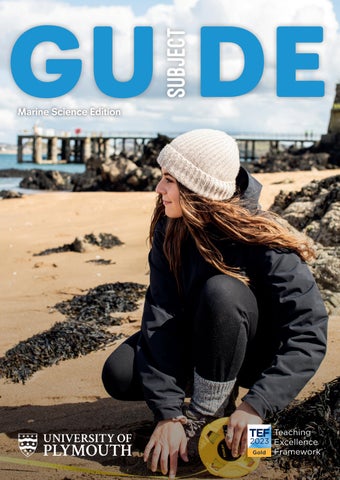
Marine Science Edition

![]()
Marine Science Edition

Admissions
+44 (0)1752 585858 admissions@plymouth.ac.uk plymouth.ac.uk
Schools & Colleges Outreach
Faculty of Science and Engineering sciengoutreach@plymouth.ac.uk
University of Plymouth Drake Circus Plymouth Devon PL4 8AA
United Kingdom
Marine Science

Follow us @PlymUniApply
It’s never too early to start thinking about what you would like to do after school or college, or if you are thinking of a career move! At Plymouth, we know that choosing a university and course is a big decision. While you may have an idea of a profession, career or industry that you’re aspiring towards, if you’re unsure of exactly what you want to do or are keen to find out more – this is where our handy subject guide comes in.
Meet some of this issue’s contributors:


19
When it comes to finding out whether university feels right for you, nothing compares to an open day. Talk to current students and quiz lecturers about your course. You can register to attend here: plymouth.ac.uk/open-days
Our virtual tour allows you to experience firsthand what it is like to be on campus and explore the environments and facilities that inspire and shape our learning every day. You can take a virtual tour here: virtual.plymouth.ac.uk
FEATURES:
P.8 Which degree is right for me?
Learn more about each of our Marine Science courses.

P.14 Discover our facilities. Learn more about what we offer our students.

P.21 What can a placement do for you?
Learn more about placement opportunities.

P.24 Carving a career?
Learn more about the careers available in marine sciences.

1. YOU WANT TO MAKE A DIFFERENCE
Many of the major problems facing human society, such as the impact of climate change and sustainable management of marine resources, relate directly to the oceans. Marine science is at the heart of the action! Our Marine Science undergraduate degrees develop you to become a highly skilled graduate, with knowledge and expertise of complex marine environments, their importance to society, and the need to manage them sustainably.
2. LEARN TO DIVE
We offer the optional opportunity to train as a HSE Professional SCUBA diver (additional costs do apply).
This course will allow you to work, once trained, as a paid professional scientific diver, both in the UK and overseas.
SCAN THE QR CODE TO LEARN MORE


The Marine Station is our unique waterfront teaching and research space specifically designed to support the Marine Science courses. Most of your practical work will be based at this location, where you’ll gain experience using equipment that is utilised throughout research and industry.
SCAN THE QR CODE TO LEARN MORE

You’ll get hands on with practical aspects of the courses, using state-of-the-art oceanographic and surveying instrumentation and resources, an automatic weather station, and specialist software for data analysis and visualisation.


At the core of our Marine Science degrees is the belief that all of our students should have the ability to conduct practical work confidently and independently. The skills you’ll develop to achieve this goal make the difference between educated graduates and employable graduates. Follow other University of Plymouth graduates into careers in hydrographic surveying, marine conservation or consultancy to name just a few.
You’ll be trained to use a variety of technically advanced equipment and techniques, usually aboard our own fleet of vessels operating in Plymouth Sound and beyond. You’ll be out on the water from the start, taking part in group practicals and individual project work to hone your skills.
SCAN THE QR CODE TO LEARN MORE


Whichever pathway you choose, you’ll take part in a residential field trip during your final year; past field trips have included the Bahamas, Maldives and Bali. This presents opportunities to apply your knowledge in different environments, and to consolidate your practical skills. See p. 10 for more details.

Plymouth boasts one of the highest concentrations of marine scientists in Europe. With our seafront location and links with internationally renowned research institutions (including Plymouth Marine Laboratory and the Marine Biological Association of the UK), you’ll join a hub of activity for the study of marine life in the UK’s first National Marine Park.


Throughout your course, you’ll be taught by academics who are engaged in a wide range of research and also have the chance to conduct your honours project with a research active supervisor. You’ll have the opportunity to be part of research projects in the latest advances in marine science.
We provide opportunities for you to study with an overseas partner institution or take part in an overseas work placement or internship. See pages 20–23, including Jennifer’s experience in New Zealand working on the review of its 2050 emissions target. SCAN THE QR CODE TO FIND OUT ABOUT THE OPPORTUNITIES AVAILABLE IN YOUR SUBJECT AREA
BS c (H ons) OCEAN SCIENCE
You’ll develop the practical skills needed to collect and analyse data from the marine environment alongside an advanced understanding of the dynamics that shape the marine ecosystem, and physical environment. Your knowledge will enable you to address challenges that include marine habitat protection, ocean circulation, and the impacts of sea-level rise on coastal erosion.
BS c (H ons) OCEAN SCIENCE AND MARINE CONSERVATION
Focus on society’s relationship with the sea and how we can manage the oceans sustainably, including marine policy and biological conservation.

BS c (H ons) OCEAN EXPLORATION AND SURVEYING
You will explore the underwater and coastal environment, using light and sound to depict the seabed and coastal landforms, uncovering their hidden characteristics, dynamics and mysteries. A focus on practical application provides highly sought after skills in hydrographic surveying, mapping, measurement, visualisation and analysis of the seafloor.
FIND OUT MORE
About our BSc (Hons) Ocean Exploration and Surveying course
BS c (H ons) OCEAN SCIENCES WITH FOUNDATION YEAR
We offer a foundation year degree which qualifies you for entry to any of the three-year ocean science degrees. It is popular with students who have been out of education for some time or have changed their focus, or those seeking to build confidence in their science knowledge.


“Ocean Science and Marine Conservation attracted me because I liked the way it was part of a shared course. This means I get to gain technical skills from a wide range of areas within marine sciences whilst studying the subject I really want to.”
LUCY
BSc (Hons) Ocean Science and Marine Conservation


“The Ocean Science and Marine Conservation course captivated me with its hands-on approach to learning through boat and lab practicals, as well as the field trip.”
LUKE
BSc (Hons) Ocean Science and Marine Conservation
"Ocean Exploration and Surveying interested me because of the practical aspects and hands-on learning. As well as this, having many different optional modules available to me was particularly enticing as I have the ability to choose what I'd like to get out of my degree, such as the scientific diving module in my second year."
HOLLY
BSc (Hons) Ocean Exploration and Surveying
Fieldwork presents opportunities to apply your knowledge to different environments, and to consolidate your practical skills. You will get the opportunity to use industry-standard equipment and perform scientific research techniques. Field trip locations for the different courses (including scientific diving) have included the Bahamas, Maldives, Bali and the Isles of Scilly.*


*Locations are subject to change.


“In my final year, we took a field trip to the Isles of Scilly. I’d been on an industry placement the previous year, so my friends and coursemates had moved on! But when I came back after placement and met my new coursemates, the field trip really did help to break the ice. We learned a huge amount about how to position our equipment using satellites, do bathymetric surveys and use drones to map the shape of the land. (The pub grub was amazing too!)”
Paul, BSc (Hons) Ocean Exploration and Surveying


"Going on the residential field trip was one of the highlights of my undergraduate degree. Learning how to deploy instruments and process data and running up and down the beach... I felt like a real scientist in the field! I wouldn't hesitate to encourage students to go!”
Isabel, BSc (Hons) Ocean Science


“The University gave us the opportunity to go to the Bahamas! It was the highlight of my degree, not simply because we got to see sharks and coral reef but also because we were part of real conservation efforts on real-world issues, which will certainly help grow my career. The field trip also brought us close together as peers. Living together on a research base did wonderful
things for the relationships between students, and also with the staff members attending the trips. Since the fieldwork, I feel so much more confident with approaching members of staff for career advice and academic support, and they are so welcoming.”
Samuel, BSc (Hons) Ocean Science and Marine Conservation


“As part of my course, we went to the Scilly Isles, which is just off the coast of Cornwall. It was such an incredible place to visit, very remote and beautiful. We stayed there for a week, working as a group on a chosen marine science topic to later present to the rest of the class.”
Keira, BSc (Hons) Ocean Science and Marine Conservation

Situated on the shores of Plymouth Sound, the Marine Station offers labs and classrooms and is the base for our research vessels. It is also a centre of excellence for diving, a wet laboratory used for sample examination and analysis, and a seawater aquarium which allows samples to be collected, stored, examined and returned to the sea with minimal disturbance.


“In my first year, going on RV Falcon Spirit for the first time was my first taste of doing 'offshore' work, and being able to get hands on with some of the equipment was a real eye-opener to the sheer breadth of research you can do in the marine environment. Using equipment like the ADCPs and temperature salinity profilers was really cool.”
Paul,
BSc (Hons) Ocean Exploration and Surveying

“I love that we get to use such a variety of instrumentation; it gives me the opportunity to find what practical work I enjoy the most. Being able to go out on the boats is one of the reasons I came here, and it’s always made to be a great learning experience.”
Lucy, BSc (Hons) Ocean Science and Marine Conservation

“My CV looks infinitely more employable thanks to the experience I gained with the facilities at Plymouth. The equipment we learn to use is all in high demand by employers, and the boats we get to use it on are all of the highest standard.”
Samuel, BSc (Hons) Ocean Science and Marine Conservation


We have a fleet of research and diving vessels, plus smaller boats that are used for the collection of seabed and water samples to the acquisition of hydrographic survey and oceanographic datasets.
Pride of place in our fleet goes to RV Falcon Spirit, a 14 metre catamaran that is used extensively for oceanographic and biological sampling as well as hydrographic survey. Other vessels include Wavedancer, a South Cat 11 metre (36 feet) Mk11 catamaran, and three
types of small powerboats namely Polar Cirkel workboats, an Orkney Day-Angler and an Arancia inflatable.


Our instrumentation includes the latest oceanographic and hydrographic survey sensors, including an acoustic doppler current profiler, a multi-beam echo-sounder, a towed undulating conductivitytemperature-depth system, an automatic weather station installed on Mount Batten Tower, and specialist software for data analysis and visualisation.


The University is a very welcoming, friendly and open place. There is lots of support during your course with the many resources available, like the Wellbeing Hub and Careers Service. Plymouth is surrounded by so many fun outdoor activities like Dartmoor National Park and many beautiful beaches in Cornwall! So on top of the fantastic academic life, you are well connected to nature.
If you’re considering studying Marine Science, do it! I have changed so much not just academically but in myself. Before I studied at Plymouth, I felt negative and hopeless towards the issues we face in conservation. I now realise that there are so many incredible people and initiatives focusing on conservation. I feel more hopeful towards the future and I now know that we have the ingredients to fix problems; we just need to work together as a species to put these ingredients together! The course also developed my knowledge on marine science and helped shape me into a professional and confident individual.
Studying a degree within the area of Marine Science allows you to understand how the ocean works and how to solve a variety of marine problems such as climate change. I learnt that the ocean is one, and we are all connected to it, whatever you do and wherever you live. Studying this degree enables you to contribute to the work many organisations are doing towards solving conservation issues.
There are many facilities available to you when studying at Plymouth and you should make use of them! I really enjoyed going out on the research vessels during my course. I wanted to have more experience on the boats, so offered my time to assist with other courses’ work. I helped out with a few final year students’ work by deploying Van Veen grabs for them and collecting data. By doing this, I was able to learn extra skills on top of those I learnt on my own course. I recommend anyone to reach out to their professors to get involved in work outside of your course as it’s really fun and a great way to develop your skill set.

My course provided a range of handson experience from lab work, field trips and group work. The course was very focused on building skills and confidence in using these skills as they hope you will go on to use these in your career. Being able to perform a range of tasks in the lab and in the field is very important for career development, and employers are impressed if students can do these tasks. Building skills in group work in particular is a big part of the course, and this is important as working with people is a huge part of marine science.
During the entirety of my course, the staff at Plymouth were incredibly supportive. They were always an email away or available for us to drop in during school hours. What I really liked about the staff was that they were very approachable and friendly – I wasn’t as intimidated by them as I thought I would be! During dissertations especially, you are very well supported by your advisor. They guide you through the long process of the project and offer advice whenever you need it.

THE OCEAN AND CLIMATE CHANGE

Doing the marine science pathways can give you the right knowledge on how the ocean responds to climate change and biodiversity loss. Much of the lecture content in first and second year puts a lot of emphasis on the global ocean and how physical and chemical processes occur, and how we can monitor them to see how they’re changing.
PLYMOUTH – THE HOME OF MARINE
The University had what a lot of other universities offering marine science degrees didn’t. The University has several research vessels, lots of ocean monitoring equipment, and a building designed for the marine science students. Plymouth is also a great place for anything ocean related; there are a good few spots to go free diving! Plymouth Sound has such a diversity of marine life and habitats that are definitely worth exploring.
CHOOSE WHAT INTERESTS YOU
I would definitely recommend studying marine science at Plymouth. The three different marine science courses really do give you a choice of pathways you
can pursue depending on what interests you, and you can choose to change your pathway in your second year if you like. The lecturers are always passionate about their work and it inspires you to really get stuck in!
EVERYONE HELPS!
The academics have been there every step of the way. You can drop them an email with questions and concerns and they’re so helpful. In my final year, my project advisor agreed to help me with my dissertation despite it being unrelated to his field. The support staff are also brilliant at what they do; the Marine Station technicians were really helpful to me when it came to collecting my dissertation data, and a chat with one of them inspired me to change my degree pathway.
MY CAREER GOALS
I want to go into the offshore surveying and defence industries. The University has an amazing careers service, with staff who can help you write your CV, do mock interviews, and put you in touch with the right people in the industry to find out more.


You may choose to spend a year between year 2 and your final year on a work placement. You’ll be free to seek out the type of company or organisation you’re interested in learning more about, and our Placements team will support you in arranging your visit.
You’ll have an academic supervisor during this time, who may visit or video call with you during your placement year and guide you in developing a project based on your placement work. Placements provide invaluable insight into life after graduation and provide you with a rich professional development opportunity.
For example, our students have engaged in the removal of ghost-fishing debris, along with diving to maintain the National Marine Aquarium enclosures and routine data collection with our colleagues at Plymouth Marine Laboratory, the Marine Biological Association and the Sir Alister Hardy Foundation for Ocean Science.

During my placement year, I completed two five-month internships within governmental organisations in two different countries. For my first placement, I was employed directly by the States of Guernsey. I worked within the Natural Environment Team within the Environment and Infrastructure Committee in a civil servant role. I always knew I wanted to complete my second placement in New Zealand, and I ended up working for the Climate Change Commission as a research analyst.
At the States of Guernsey, my role was many and varied! My primary role was to develop and undertake methodology to map the nearshore marine environment. This initially involved researching the most efficient techniques but progressed to buying and building the survey equipment, carrying out the kayaking surveys (when the weather allowed!), and analysing the GoPro footage to attribute biotope classifications to the different areas
surveyed. I was also involved in the wider workings of the team, which included developing and implementing a monitoring method for marine invasive species and helping other team members with their work.
My placement at the Climate Change Commission was much more desk based but equally facilitative of the work that needed to be achieved. Initially, I created a blue carbon report for the commission which was used to internally increase staff understanding of blue carbon and how it fits into their own work streams. This involved independent research but also meeting with various scientists and policy makers across the country to develop a picture of the current blue carbon research projects happening in New Zealand. Subsequently, I became part of the team working on the commission’s review of New Zealand’s 2050 emissions target, which involved more research and meetings with various people working on emission plans and climate policy.

MY MOST REWARDING ACHIEVEMENT!
Near the end of my placement in New Zealand, I attended the New Zealand Marine Science Society conference on behalf of the Climate Change Commission and participated in discussions on the progress of blue carbon research and what this means for climate monitoring and policy going forward. It was a real full-circle moment for me as I had spent five months working in the world of policy (not one I am used to!) and I was able to communicate my knowledge back to some of the country’s top scientists.
Once I had obtained my placement, my colleagues were very supportive and always ensured I was enjoying my time (which I was!). Government entities are very good at facilitating hybrid working, which came in very handy when the ski season started in New Zealand and I was able to work from ‘home’ in Queenstown despite the office being in Wellington! I was able to work either side of the hours that the ski field was open, give or take a


few meetings! It really allowed me to make the most of being in New Zealand and experience everything I went there to do, whilst also earning money and learning so much from my placement.
ORGANISING YOUR PLACEMENT
I found both of my placement opportunities by identifying places I wanted to work at and emailing them to ask whether they had any capacity for an intern – it worked both times! The placement process at the University is great as you can complete multiple placements within the year and really tailor your time to experiencing as much as possible.
APPLYING MY SKILLS TO MY COURSE
My first task on my first day at the States was to write a knowledge piece on side scan sonar, a piece of equipment that we had used in our module just a few months earlier! I was able to directly apply my knowledge to the first task I was given, which made me (and my managers) much more confident in where I was. Throughout both placements, the researching and

data analysis skills that I developed at university became invaluable.
THE SKILLS I LEARNT?
Too many skills to mention! From improved GIS skills to independent survey design and the ability to work on the edge of policy and science. The practical skills I gained from the placement year are innumerable and have absolutely increased my confidence for my final year and applying for jobs going forward. Perhaps more importantly though, the soft skills of professional teamwork, communication and genuine time management are invaluable and allowed me to develop both professionally and personally throughout the year.


“I did a placement at the Marine Biological Association (MBA) in my third year. Doing the placement was honestly life changing. Being part of a prominent research organisation was a real privilege, and being able to contribute to their body of knowledge was a really valuable experience. I worked as a research assistant and helped maintain the MBA’s long-term plankton dataset in the western channel. Working with the crew on their research vessel helped me to grow my confidence in myself and my abilities. It's also hugely improved my research skills and as a result I have a research project that they want to publish.”
Paul, BSc (Hons) Ocean Exploration and Surveying


Meet Jon Christie, our Careers and Employability Consultant (STEM specialist). Jon has been working in the university careers sector for over 20 years.
HOW DO YOU SUPPORT THE CAREER PROSPECTS OF OUR STUDENTS?
One of the important parts of my job is to make students aware of the breadth of opportunities that are open to them both during and after they graduate.
THIS IS FACILITATED BY:
• course-based lectures on employability in all three years of study
• the opportunity of doing a year-long work placement
• inviting employers and alumni onto campus via careers fairs, employer panels and specific academic activities.
WHAT CAREER SUPPORT SERVICES DOES THE UNIVERSITY OFFER?
The Careers Service offers students one-to-one careers guidance at any point during their studies and continues after graduation so that graduates can continue to benefit from support with the following:
• Job hunting, application writing, CVs, networking and interview skills.

• Attending six on-campus careers fairs, including a specific STEM fair in November, an alumni event in December called Broadening Career Horizons, and the GeoEnvironmental Careers Fair in February.
• A work placement programme using our extensive industry contacts (with many opportunities being paid).
• An industry mentoring scheme that matches you with a specific industry individual who will meet with you on a regular basis to provide valuable insights into a specific sector. University of Plymouth alumni who are now working in key areas are invited to become mentors and use the scheme to give something back and to spot future talent.
• Our myCareer vacancy platform hosts an extensive database of both graduate, placement and part-time opportunities. You can sign up for events such as employer panels, enterprise competitions or mentoring. myCareer also holds a range of highly specialised digital tools such as a CV builder, an interview simulator, online courses and video resources. Access to myCareer is available to our graduates at any time in the future.
HOW DO YOU JUDGE THE JOB PROSPECTS FOR MARINE SCIENCE GRADUATES?
Excellent – currently, demand for all marine science graduates is extremely high in a number of sectors, with demand outstripping supply, but also many of the academic skills learned are transferable across a very broad range of STEM employer sectors. Graduate salaries are also very competitive, and for many students doing work placements, it is highly likely they will be offered a graduate role with the placement host after completing their final year. This is also reflected in the willingness of employers seeking to recruit our students by engaging with our events, recruitment fairs and online vacancies.
A defining feature of our suite of courses is the focus on developing skills that enhance the employability of our students. We actively engage with local companies as well as international professional bodies to facilitate your development of industryaligned knowledge and skills.

INCLUDE:
• Oceanography
• Hydrographic surveying
• Marine conservation
• Climate science
• Research
• Consultancy
• Coastal management
• Coastal engineering
• Marine policy and planning
• Offshore industry
• Hydrocarbon exploration
• Marine renewables
• Marine modelling
• Field survey
• Surveying for construction
• Marine monitoring and management
• Water quality
• Meteorology.


I am now a coastal processes scientist with Plymouth Coastal Observatory. PCO aims to provide a standard, repeatable and cost-effective method of monitoring the coastal environment around South West England. My role includes quality checking a range of coastal and survey data (from topographic data to LiDAR to ecological data), analysing data and producing technical reports, with the aim of helping stakeholders and local authorities make informed decisions.
I also undertake topographic beach surveys. A topographic beach survey is where a surveyor will collect data including height measurements at fixed intervals along predefined profiles across a beach. This then allows us to calculate the crosssectional area of the beach and to identify areas of change. What I love about my career is that there isn’t a typical weekday. One week I can be out surveying beaches, the next quality checking data, followed by researching new innovative ideas.
I can describe my time at Plymouth in three words – social, memorable and opportunities. I met so many people and made lifelong friends and had amazing experiences. I developed and learned new skills, networked, and had my eyes opened to a variety of topics within the umbrella term of oceanography. The exciting aspect of my course was that a typical week was often varied. Sometimes I would be in lectures from 9–6 and at other times I would be out on the boat completing surveys, or down at the Marine Station carrying out lab experiments.
SUPPORT ON THE COURSE
I received excellent support from my lecturers. They were always willing to help and to take time out of their day to make sure I understood the topic whenever I was confused or had a question.

My most memorable module would have to be scientific diving owing to its uniqueness and having the opportunity to dive whilst learning new skills. During this module we developed underwater survey and data collection skills including photography, lift bag use, sediment core sampling and quadrat surveys. As a coastal processes scientist, my degree helped get me where I am now by developing the transferable skills I had gained previously through internships and work and growing my confidence to seek out new opportunities. Communication and networking, independent research and data analysis are the top three skills I have gained from my time at Plymouth.
Away from study, I loved going on adventures with my friends. One fine summer’s day, when a group of us had no lectures scheduled, we walked to Whitsand Bay, following a kind farmer’s directions and a trail map. The memories from this will never be forgotten.
I joined several clubs during my first year, but hockey was my favourite because it got me outside doing physical activity with like-minded people, competing as a team against other clubs. This was often followed by a movie night with friends. I still spend my weekends playing hockey or diving as a volunteer at the aquarium. I am still either doing something on or in the water or walking on the moors or the South West Coast Path – the draw of the sea continues to grow from strength to strength for me.

WORKING ON MARINE CONSERVATION ACTIVITIES IN FIJI


HOW I CHOSE PLYMOUTH FOR MARINE SCIENCES
Reputation alone was enough to make me apply for a place at the University of Plymouth. The worldclass research opportunities, the staff leading their fields, and the facilities that they share with the students all had an enormous pull-factor.
Aside from the academic merits that the University can offer, I decided that Plymouth was a place in which I wanted to build an enjoyable life for the duration of my degree. By choosing this course, I could live in the perfect place to do all the things I love while I studied. I could enjoy some of the best diving in the UK, I could surf, and I could explore the beautiful Dartmoor.
WOULD I RECOMMEND UNDERTAKING MARINE SCIENCES AT THE UNIVERSITY?
Without a doubt. I look fondly back on my time as a student, and I am sincerely grateful for all the opportunities that came my way. The people I met will always be a valuable part of my career network, and if not, they will always be there as firm friends.
What made it the perfect place to study marine science was the location – it kept nurturing my love for the ocean beyond the lectures and the library hours. Devon and Cornwall have the most amazing coastline, and being able to learn about it from the academics who understand it better than anyone was invaluable.
HANDS-ON EXPERIENCE
Hands-on experience was a huge part of the course, and was clearly an effective learning strategy. I highly valued the trust and encouragement to get involved with all of the scientific techniques which the talented staff use as part of their own research projects.
The most valuable hands-on experience provided to me was during my final year research project. I was encouraged to implement hands-on techniques

that I had learned throughout the course into my own research, which has undoubtedly given me the confidence and skills to become a marine scientist.
ACADEMIC SUPPORT
During my degree the staff were always there to help with whatever problem I threw their way. What has amazed me is how they continue to care now that I have graduated and started my own career. A special mention to Professors Mark Davidson and Abigail McQuatters-Gollop, who have both been incredibly supportive in helping me grow my career.
Marine conservation was the focus of my degree, and will now be the focus of my career. Since graduating, I have started to grow a marine monitoring programme in Fiji, which aims to provide evidence for more marine protected areas.
The University is helping me achieve this through the network of people that are looking to collaborate, or offer useful advice, or even pass on information to more relevant people who may be interested in my work. Having contacts associated with the University is an asset as strong as the degree itself.
Writing from my own personal experience, my degree has given me not only skills, but the confidence to apply them, with my knowledge to pursue issues which I care about most. My degree has enabled me to start a career in marine conservation in Fiji, an island nation where climate change poses an immediate danger from sea-level rise, ocean acidification and fishing exploitation. I now lead a project working towards implementing new marine protected areas, which we hope will make a real positive impact to Fijian people, and help save one of the most beautiful marine environments on our planet.


FLOOD AND COASTAL RISK MANAGEMENT GRADUATE TRAINEE
AT THE ENVIRONMENT AGENCY

Studying a Marine Science degree gives you the foundation knowledge and skills for a career in scientific research, enabling you to make a positive impact to help resolve current challenges. For example, the frequency and intensity of storms is increasing with climate change, increasing flood risk to local communities in England. Within my current role as a flood and coastal risk management officer, I support the local councils to develop flood alleviation schemes to mitigate risk from flooding and coastal erosion, therefore better protecting communities and societies' assets.
After graduation, I stayed with the University and completed my masters in MSc Applied Marine Science. Whilst completing my masters, I did an internship with the Coastal Marine Applied Research consultancy (CMAR) within the University, who I then worked part time with over summer whilst finishing my masters. CMAR aims to support coastal, marine and estuarine management by analysing coastal processes and marine physics to understand and predict environmental change. Working with CMAR enabled me to build my work experience in the coastal sector, which supported my job application for my graduate role.

Since completing my masters I have secured a graduate job with the Environment Agency as a flood and coastal management officer. Although starting my graduate role was daunting at first, I am really enjoying working for the Environment Agency. It is rewarding to be able to utilise my subject-specific knowledge and skills gained through my degrees, to make a positive contribution to society by supporting flood and coastal erosion risk management in England, whilst furthering my understanding in an area I am passionate about.
When I decided that completing a masters degree was the right decision for me, I chose to stay at the University, due to the really positive experience of studying for my undergraduate degree. The students and staff are friendly and approachable. The lecturers were always happy to answer any questions, which supported my learning and development. The emphasis on the inclusion of practical elements on my course helped me to gain practical experience, and there were opportunities to gain additional experience in the field through the University’s connections, which I found really useful when applying for jobs in the future.
I really enjoyed my time at the University. There is a wide variety of support available for anyone that needs it. Plymouth is a lovely city. The University is located in the city centre, which has a lively atmosphere and good night life but also has the coast a 20-minute walk from campus, giving a really nice balance between city and countryside. There are loads of societies to get involved with, from sports clubs to course-related societies, allowing you to build your uni family with people who share the same interests as you.
1. Never be afraid to ask questions – if it will help you learn, it's worth asking.
2. Look for development opportunities outside of your degree – there are lots of internships and practical activities to get involved with, which is really good for work experience.
3. Engage in practical work – being involved in practicals is a lot of fun and you will learn more by joining in. Sometimes coursework is based off data collected in practicals, so engaging early will help you to understand the module assessment.
4. Be an active member of your course – everyone has different backgrounds, knowledge and experience. Making connections will help everyone learn more and get the most out of the course.

Over 95% of our graduates are in work or further study* Apply now