
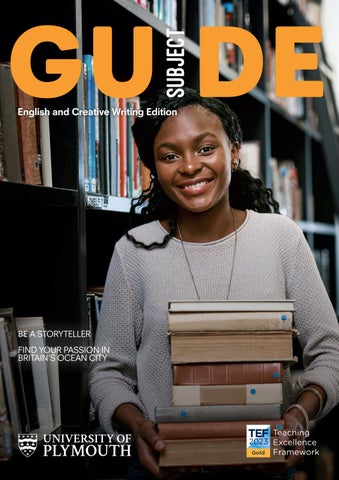
Subject Guide English & Creative Writing Edition

Page 1


English and Creative Writing Edition

BE A STORYTELLER

FIND YOUR PASSION IN BRITAIN’S OCEAN CITY

Gold

Admissions

+44 (0)1752 585858 admissions@plymouth.ac.uk plymouth.ac.uk

School & College Outreach

Faculty of Arts, Humanities and Business foabhoutreach@plymouth.ac.uk

University of Plymouth Drake Circus Plymouth Devon PL4 8AA United Kingdom

Follow us on social media @PlymUniApply

English and Creative Writing Edition

SUBJECT

It’s never too early to start thinking about what you would like to do after school or college, or if you are thinking of a career move! At Plymouth, we know that choosing a university and course is a big decision. While you may have an idea of a profession, career or industry that you’re aspiring towards, if you’re unsure of exactly what you want to do or are keen to find out more – this is where our handy subject guide comes in.

Meet some of this issue’s contributors:

Head of English and Creative Writing

Mandy shares her top 10 reasons why studying at Plymouth is special. P. 4

Amy BA (Hons) English Graduate Amy details her placement experiences at the Oxford University Press. P. 20

Ieuan

BA (Hons) English and Creative Writing

Student Ieuan talks to us about his painting and creative writing and how both art forms can inspire a change in how men talk about their mental health. P. 16

EXPLORE YOUR FUTURE HOME

Visit us at an Open Day

When it comes to finding out if university feels right for you, nothing compares to an open day. Talk to current students and quiz lecturers about your course. You can register to attend here plymouth.ac.uk/open-days

Start exploring –take a virtual tour

Our virtual tour allows you to experience first-hand what it is like to be on campus and explore the environments and facilities that inspire and shape our learning every day.

Inside...

HOT TOPIC:

P. 11 How has the representation of the gothic villain changed throughout literature?

Explore how the archetypal villain and genre have been re-worked for contemporary audiences.

FEATURES:

P. 14 Where will your degree take you?

What skills will you develop and what career options are available?

P. 18 Writing your first essay Charlie provides his top tips to make your academic essays shine.

P. 22 Find the right route for you via a foundation degree!

Grow academically and personally in a university environment.

P. 24 Memory, place and decolonisation

Dr Arun Sood, explores the relationship between the written word, memory and history.

P. 30 Your next steps

Discover the road to higher education

THE GUIDE:

P. 26

Personalise your degree with the School of Society and Culture

Explore how you can gain handson experiences to prepare you for the real world.

Dr Mandy Bloomfield

10 REASONS TO STUDY AT PLYMOUTH

New books to read. A fresh sheet of paper to fill. A blank screen to start writing on. The start of your next journey.

1. LOVE

Our degrees introduce you to new texts and ideas that you will have never encountered before, in addition to books and authors you thought you knew from another angle. Our students spend three years with us, experiencing a wide variety of literature and learning how to express their thoughts on paper in the most effective way possible. You’ll come out with a broad, deep appreciation of literature, and a new sense of your place as a writer against the sweep of literary history.

2. BOOKS

Reading and writing are what we do. We welcome all new students to our department by providing them with free or subsidised core texts. Every single staff member is a practising author, from academic books to award-winning poems, national newspaper columns and fresh new novels. Join our community to develop as a reader, thinker, and writer.

3. SUPPORT

We pride ourselves on our friendly and supportive learning environment run by internationally recognised staff. We are driven by our dedication to student-centred learning. Throughout your time here you have a personal tutor who supports you individually, and every tutor operates an open-door policy, meaning you can see them outside seminars, workshops, and lectures to talk through your work one-to-one.

We also offer writing workshops and other kinds of writing support, so that you have lots of opportunities to improve your work with guidance from

experts. For example, you can make an appointment with our Royal Literary Fund Fellow for one-to-one help with improving your writing. Alternatively, you can drop into The Writing Café, a unique and creative space where you can have a conversation with a member of the Learning Development team, work with one of our trained writing mentors, or take part in one of our many events and activities centred on writing.

Find out more: plymouth.ac.uk/ writing-cafe

4. KNOWLEDGE

Our degrees are powered by our research. We are changing the world around us, from Angela K Smith’s work with parliament on suffragettes to Miriam Darlington’s book of nature writing, Owl Sense, a BBC Radio 4 Book of the Week. This research underpins all our teachings – and when you come to Plymouth, you too will become a researcher in your final-year dissertation. You will spend a year completing a self-generated research project under the guidance and support of an expert lecturer. As a team, we bring the methods of literary studies and critical analysis to wider public debates, such as recent debates about sustainability and the environmental crisis.

“Recently, I have become particularly interested in how ideas of utopia, and the challenge of finding new and better ways for people to live together, interact with the bafflingly varied and global nature of our contemporary environmental crisis.”

Dr David Sergeant – Associate Professor of 20th- and 21st -Century Literature

5. PEOPLE

We are a small and friendly department in a big, diverse school. You can tailor your degree to focus on what fascinates you. By taking different options, you will gain a thorough grounding in your areas of interest

“The course doesn’t just teach you how to write creatively and analyse literature but explores the intricate aspects of language. It explores how language evokes meaning, how it evokes our senses, and how there is poetry within a single syllable. Language is more complex than any of us can imagine.”

Ross, BA (Hons) English and Creative Writing student

– whether it be English related or from a completely different subject such as criminology, history, or sociology. Whatever your passion, you will have the freedom to explore it here. Find out more on page 26.

“I chose to study at Plymouth because I loved the University – it is so friendly and inviting. In addition, the English course has a level of flexibility that I couldn’t find anywhere else. The tutor – student relationship is one of the best things about this course. There is an ‘open door’ policy that the academic staff are great with – there is always someone to talk to!

There is also a wealth of extracurricular events that the English department provides. All year round there are film screenings, shows at art galleries, field trips, as well as opportunities to get involved in writing for student-run publications. The greatest things I will take away with me are confidence and independence. With the encouragement of my tutors, I secured an international placement in Los Angeles which was invaluable for my present career. The University of Plymouth is responsible for that.”

6. BEYOND THE CLASSROOM

An English degree is an enriching experience. It is not just about reading but becoming intimately familiar with history, performance and the mechanics of publishing. We are committed to exploring ways for you to enjoy your subject, in terms of your study, but also socially. We run a range of field trips, including Paris, London, and Stratford-uponAvon, plus we go to see plays at Theatre Royal Plymouth, all of which are free or at an exceptionally low cost. You will deepen and enrich your understanding of literature, its history, and its cultural contexts.

Elanor, BA (Hons) English graduate Senior Editor at Make Believe Ideas UK

7. CULTURE

Our city is a stunning seaside location with a rich cultural life. Our students have the unique opportunity to develop their toolkit surrounded by the famous landscapes that inspired some of the most influential novels of all time: Daniel Defoe’s Robinson Crusoe; Agatha Christie’s house is a stone’s throw away at Dartmouth, while Dartmoor, the setting for The Hound of the Baskervilles, looms behind the city of Plymouth.

Plymouth and adjacent Cornwall are places where writers congregate, and independent presses, publications and writing ventures abound. Make the most of a rich cultural life with the Arts Institute ‘s public arts programme, and the University’s links with local cultural organisations such as The Box and Theatre Royal Plymouth.

9. FACILITIES

Our library is open 24 hours a day, 7 days a week, 365 days a year, enabling you to access a wealth of resources whenever you need them, including online journals, subject-specific databases, online archives and, of course, books! There’s also specialist support on

hand when you need guidance, and our enthusiastic subject librarian is always happy to help. You will also benefit from worldleading digital and printmaking facilities, including our Letterpress Studio, Immersive Media Suite, 3D Printing Lab and Mac Design Studios.

9. STUDY ABROAD

You will have the chance to study in another country and gain a diverse cultural perspective. The most popular destinations for our students are the USA, Sweden, France, Italy, Germany, Spain, and Canada. You can choose to go for one semester or a year. You do not need to decide at the outset of your degree, as your goals and aspirations grow you can explore the possibilities available to you.

Students come to us from other countries as well, adding to the valuable diversity of the student body. Encountering a variety of innovative ideas, knowledge and people is one part of your degree experience.

10. BECOME A PUBLISHED AUTHOR

Gain invaluable experience with INK, our in-house magazine, allowing you to build skills in everything from desktop publishing to editing and magazine journalism. You’ll have the ability to work inter-professionally with English, creative writing, illustration, graphic design and publishing students, mirroring real-world creative teams.

“My degree has been invaluable in helping my career – to work as an editor in publishing, I don’t believe I would have been offered my editorial roles without it.

I worked on INK, the literary magazine for two years, becoming the Managing Editor in my second year. I gained so many valuable skills working on this publication, including InDesign training. INK was a fantastic celebration of all our hard work and talent.”

Hannah, BA (Hons) English graduate Editor at Media Magazines

HOW HAS THE REPRESENTATION OF THE GOTHIC VILLAIN CHANGED THROUGHOUT LITERATURE?

EXPLORE HOW THE ARCHETYPAL VILLAIN AND THE NARRATIVES OF THE GOTHIC GENRE HAVE BEEN REPLAYED AND REWORKED FOR CONTEMPORARY AUDIENCES.

Gothic fiction typically shares environments of fear, a threat of the supernatural and the present being haunted by the past. Named after the architecture of the European Middle Ages, the first work to call itself Gothic was Horace Walpole’s 1764 novel The Castle of Otranto . The Gothic had a huge influence on the 18th and 19th-century imagination and is still one of the most powerful genres in Western culture. From tyrant aristocrat to mad scientist, the Gothic villain has been replayed and reworked for contemporary audiences in many forms.

A GOTHIC ORIGIN STORY

Beginning with the origins of the Gothic novel, Matthew Gregory Lewis’s The Monk (1796) saw issues of gender, foreignness, religious difference and European revolution all come to the boil.

The Monk establishes tropes of Gothic villainy that reflect the apprehension of the times and is about the monk Ambrosio and his metamorphosis from pure to degenerate – a portrayal of character doubling later embodied in Stoker’s iconic Dracula, just over a century later.

The Monk’s Gothic tyrant develops in Mary Shelley’s Frankenstein (1818). An iconic Gothic text, it gifted us the mad scientist and began to blur boundaries of the genre, as the Romantic hero and Gothic villain shift across the famous Doctor and his still more famous ‘creature’.

Gothic villainy shifted again with Charles Dickens’ creation of the misanthrope, Scrooge in A Christmas Carol (1843). Another example of character transformation, this time it focuses on the change of heart and is a study of a human’s rediscovery of their own innocence.

THE RISE AND FALL OF DRACULA

If the 18th century gave us the tyrant aristocratic lord, Mary Shelley gifted us the mad scientist, and Dickens the misanthrope, it was Bram Stoker who breathed new life into the tyrant aristocrat with one of the iconic Gothic villains, Dracula.

Bram Stoker’s Dracula (1897) is a central work in the history of the Gothic, as influential in film and popular culture as it has been in fiction. It channels anxieties about multiple forms of otherness at the end of the nineteenth century and the apex of the British empire.

“I got to explore how and why the genre is just as important today as it was in the eighteenth century. I found it really pleasurable to read some of the eeriest and fantastical texts in English Literature.”
Oliver Portillo, BA (Hons) English

Dracula shares motifs of the Gothic genre: the dark castle setting, the woman in distress and a mysterious and supernatural plot. The count embodies the common Gothic archetype of the evil father and

the dangerous lover, but it is their ‘otherness’ that poses the greatest threat.

Why did the tyrant lord resurface? Dracula represented worn-out European royalty and explored

“The range of theories and interpretations covered was immense, meaning that it was the most interesting module I have done. I would definitely recommend to anyone with an interest in the weird and wonderful!”

Devon,

BA (Hons) English

Freud’s “return of the repressed”. The Count is destroyed, but so too symbolically is modern America, creating instability and leaving Gothic literature with no definite way forward.

GOTHIC VILLAINY CHANGES WITH THE TIMES TO REFLECT THE CONCERNS OF THE TIMES.

The monks, bandits and aristocratic figures of the 18th century, changed to include criminals and scientists in the 19th. Settings shifted from distant times and lands to contemporary domestic settings.

Over to you! How do you think the gothic villain will be portrayed in centuries to come?

HAS THIS SPARKED YOUR INTEREST?

Explore how and why the Gothic genre is just as important today as it was in the 18th century by studying the featured module Gothic Fictions: Villains, Virgins, Vampires on our BA (Hons) English course. Discover how the gothic villain, the supernatural, gloomy castles, abduction, fear, terror and horror – have been replayed and reworked for contemporary audiences through a range of forms, from novels to short stories.

Our star texts:

• Matthew Gregory Lewis, The Monk (1796). One of the few novels studied at Plymouth that can make students so queasy that they need to leave the room.

• Mary Shelley, Frankenstein (1818): a novel born in a ghost story competition held at Byron’s villa on the shores of Lake Geneva, and one of the iconic Gothic texts.

• Arthur Conan Doyle, The Adventure of the Copper Beeches and The Adventure of the Speckled Band (1892): allow us to analyse how fiction’s most famous sleuth reworks many of the tropes and concerns of the genre. We try not to talk too much about Benedict Cumberbatch.

• Bram Stoker, Dracula (1897): another central work in the history of the Gothic, as influential in film and popular culture as it has been in fiction.

WHERE WILL YOUR DEGREE TAKE YOU?

Graduation marks the end point of your undergraduate degree. It is a wonderful occasion for you, your family, your friends, and your tutors. We want to make sure that, while you have been working towards your degree, you have also been preparing for the next phase of your life.

We aim to empower you to follow your passions, to develop lifelong skills in reading, writing and research, to help you realise your potential as a critical and creative communicator, and to prepare you for a variety of career opportunities.

DEVELOPING EMPLOYABILITY

At Plymouth, we have excellent opportunities for developing employability skills and gaining work experience in a range of graduate careers. We work with local arts organisations, festivals, PR firms, schools, and libraries to offer internships and work experience opportunities throughout the undergraduate degree. We run bespoke Careers Days to allow you to meet employers and speak to successful Plymouth English and Creative Writing graduates about their journeys in their chosen careers.

We also offer a range of workshops and one-to-one sessions throughout the year, to give all our students individually tailored advice and ensure that they get the most out of their degrees.

CAREER OPTIONS

• Freelance Writer

• Journalist

• Copywriter

• Teacher

• Paralegal

• Marketing Executive

• Editor

• Librarian

• Author

• PR Manager

• Social Media Manager

• Publisher

• Digital Marketing

WHAT SKILLS WILL YOU DEVELOP?

• Critical thinking and the ability to convey complex theories and concepts

• Problem-solving and flexibility

• Time management through juggling different module assessment requirements

• Written and verbal communication via report writing and presenting

• Teamwork and leadership through group projects

• Planning and project management via independent research tasks

• Independent research through seminar work and assignments

• Constructing a reasoned argument by evaluating texts

• A knowledge of history, culture, and society.

“Since graduating, I have worked in an independent publishing house. I quickly realised that publishing wasn’t quite as glamorous as I had hoped and that what I wanted was to engage with English literature in some way. Although I had been stalwartly against teaching as a career in my younger years, I quickly realised it was an occupation that would not only equip me with new skills but would allow me to work with my subject. The opportunity to work with young people in further education never fails to fill me with pride. I am fortunate to see the journeys they undertake with us and to play a small role in helping them along their way. The real highlight is when I see that ‘lightbulb’ moment in a student, and they become switched on to the subject.” Dee, BA (Hons) English graduate Director of English, Exeter College

“I completed an internship between my second and third year which I had found using the University’s career portal. I firmly believe that the experience and confidence obtained from this have allowed me to secure my current role. Doing an internship enables you to have real life, working examples of not just your experiences and skills but how you’ll add value to the company.” Samantha, BA (Hons) English graduate, Insurance Broker

“The most exciting thing that has happened in my career so far is going to events and inspiring kids to do theatre, join parades, sing, dance – bringing fun for everyone. It’s great to be working in collaboration with groups nationwide in the art world, growing relationships, and building the art community in Torquay.”

Jasmine, BA (Hons) English graduate, Theatre Director

FIND OUT MORE

AN INTERVIEW WITH IEUAN

POEMS, PAINTING AND MEN’S MENTAL HEALTH

BA (Hons) English and Creative Writing student, Ieuan Holt is a writer and watercolour painter based in Plymouth.

As a fan of horror fiction, Ieuan changed careers, switching life at sea working as a qualified Navigational Officer, to pursue a passion for poetry and fiction. With an interest in mental health, particularly from the viewpoint of reassessing masculine values, he has set up the Understanding the Pieces of Ourselves poetry anthology.

Alongside his creative writing, Ieuan has developed a burgeoning reputation for evocative watercolour paintings.

His talent has been recognised by having a piece accepted into the 2022 Royal Academy of Arts Summer Exhibition.

In a wide-ranging conversation, Ieuan talks to us about his painting and creative writing and how both art forms can inspire a sea change in how men talk about their mental health.

Do you recognise any similarities between writing and painting? There are similarities, especially when it comes to poetry and short stories. In both, you are creating a snapshot of a story that, while being limited by word count or size of the paper, contains characters,

emotion, tension, and drama, all in the effort to immerse the reader or observer into the fictitious dream contained within pages or paint.

Like painting, your pursuit of creative writing is also relatively new after leaving the Merchant Navy to pursue becoming a horror writer. When did creative writing become a passion? When I first went to therapy about three years ago, my therapist suggested I should write down my feelings in the form of stories, so that I could process them better. From there, I started to write short stories, which quickly became a passion, and before I

knew it, I was applying for a place at university.

What made you decide to study English and Creative Writing at Plymouth?

Plymouth was my first choice. I had grown up in the city most of my life and wanted to study somewhere I knew and was close to my friends. One of the biggest draws of the course was the study texts and module options in the second and third years. I was especially drawn to the one focused on gothic fiction, which has remained a personal favourite.

You have set up Understanding the Pieces of Ourselves. Why did you launch this anthology?

I launched this project as part of one of my second-year modules. I created an online poetry anthology to provide a platform for anyone who has experienced or is suffering from mental health issues – especially men – to write down their experiences or feelings in the form of poems, in

the hope of encouraging people to use writing to express emotions positively.

Your poem Leviathan speaks about experiencing the negative effects of regressive masculine values. How important is it to continue to encourage people, especially men, that it is okay to talk about their mental health? It is very important because it is normal to feel sad and to have problems and worries. It can still be all too easy to say, ‘I’m fine,’ when you might not be –something which I am still guilty of, but it takes time.

I want to combat regressive masculine ideas such as the saying

‘man up’. Creating an environment where everyone is free to talk about their mental health without being judged is very important.

How can the creative arts help with ‘opening up’?

The creative arts are a brilliant way for people to express feelings they might not be ready to talk about. By encouraging people to partake you are, in some sense, asking them to open up emotionally to themselves and to others, to connect to a side of themselves they might not have yet begun to explore, which is very important to uncover.

Has your audience shared any responses after viewing your paintings?

One common takeaway is that my paintings are almost like short stories and their endings. They are oblique in the way they open a space in which the observer can infer their interpretation and meaning.

It will follow me down, casting shadows that splatter against the submerged sides of my concrete construction, where happiness never learnt to survive. Loam for the indifferences that taught me to man up

And never cry. – Leviathan [extract]

3 Tips I’ve Learned from Writing Essays

From reading, writing to reviewing, BA (Hons) English and Creative Writing student Charlie gives his top tips for writing your first academic essay.

Tip #1: Just write.

Everything that comes into my head, whether I think I’m going to include it or not, I get it down somewhere. If I’m reading a source and find a useful quote, but can’t figure out where to put it, then I just write it down and anything else relevant to that quote I can think of. By the end of your research, you might have four or five pages of quotes and loose paragraphs, but you have all your information in one place. From there, you can open a new document and start piecing everything together. Some people find it better to plan out the whole essay in advance, but I’m quite an erratic thinker and this tip has been invaluable to me over the course of my degree.

Tip #2: Just read.

Some people say that an English degree is just a bunch of reading and writing but putting ‘just’ in front of anything makes it seem simple. Maths is just sums. Architecture is just designing buildings. Yes, English is a whole bunch of reading and writing, but there’s a lot more to it than that. You can’t just read one additional source and expect to get a first. You must read a lot.

After deciding on the question I’m going to delve into, I then read everything I can that is mildly relevant to it. You may end up reading a lot of sources that aren’t quite relevant, but what you are doing is expanding your knowledge in that area which will translate into your writing.

As well as this, most sources reference other sources, meaning that you end up finding

useful texts you otherwise wouldn’t have. I can’t remember who said it, but one of the most useful pieces of advice I’ve read for English is that leaving out information that you do know is perfectly fine, but if you’re leaving out information that you don’t know, then the reader will know, and it’ll create gaps in your writing.

Tip #3: Start early.

The earlier you start, the more you can take in. The more you can read and write, the more you can improve your copy-editing skills. What many people don’t realise about essays is that it’s not just about working to a deadline; it’s about working to a deadline with enough time to review at the end.

We all hate reading back our work, but it’s a necessary evil to fill in holes that you’ve missed, correct grammatical errors, and improve the flow of your writing. Review and review again. If it means reading it ten or 20 times, then so be it. You’ll miss things in your first draft as much as you’ll miss things in your first review.

Secret Bonus Tip #4: Pick an essay question you’re interested in. Sure, one topic might sound smarter than the other, but its important to choose a subject matter you are interested inyou will enjoy writing about it more!

THE PLACEMENT EXPERIENCE

BA (Hons) English graduate Amy undertook a placement opportunity at Oxford University Press alongside her studies.

MAKING CONTACT

I decided to contact Oxford University Press directly through an email address I found on their website. I thought this was a long shot as they don’t advertise work experience positions at their company, but my only thought was that this would be an incredible place to work, so why not give it a shot?

To my utter surprise, I received a reply within a few weeks offering me a five-week placement at my convenience during the summer break. I was ecstatic, to say the least. I had been allowed to work in the medical books department, two weeks with the marketing department and three weeks with the editorial department.

THE EXPERIENCE

It was amazing. The team I worked with made me feel very welcome; they asked what I wanted to get out of this experience and tailored the placement to fit around my goals. I felt comfortable enough to ask questions when I was confused.

While working with the marketing team, I was tasked with creating flyers, show cards and press releases using my knowledge of Adobe InDesign and creating the text myself. I also created social media posts and a quiz about snake bites to advertise their new book on tropical diseases. I drafted ideas for blog posts, and I was given research tasks to find academic contacts to offer review copies of certain texts.

Working in the editorial department meant a new set of challenges and skills to be learnt. I began with compiling art lists for certain reference books, filing legal documents and drafting contracts to contributing authors. I then progressed to reviewing manuscripts, requesting

copyright permissions and formatting manuscripts to be sent to the production department.

The entire team were incredibly helpful and despite throwing me in at the deep end, they guided me through each task, so I would get a real understanding of how the publishing industry works. They each gave me valuable tips to gain more work experience and how to make myself more employable. Although both departments offered very different experiences, they fitted together well and helped to give me a well-rounded experience.

ADVICE FOR STUDENTS

I highly recommend Oxford University Press for publishing work placements. My experience has proved invaluable and has given me insight into the publishing industry which has solidified my choice of wanting to work in this field.

Benefits of undertaking work experience:

• Build several key employability skills

• Put theory of your course into practice

• Get a taste for your chosen career, helping you to make informed decisions

• Expand upon your professional network

• Potentially earn money around studies

• Learn skills you cannot develop on your course.

Find out more

Our dedicated Careers Service provides you with several opportunities to gain work experience either via internships, placement years, part-time work, mentoring and more.

FIND THE RIGHT ROUTE FOR YOU VIA A FOUNDATION DEGREE!

A foundation year forms part of a four-year degree and provides the understanding and basis needed to embark on the full degree. It offers students from a variety of backgrounds and skill sets an avenue into a wide variety of degrees that have traditionally been out of reach.

Whether you are returning to education after a break or if you come with qualifications other than A levels, a foundation pathway enables you to:

“The best

part

of the

course

for me was the confidence it gave me. I wasn’t sure getting into university was something I’d

be able to do. It’s an immense sense of achievement”.

Harry, BA (Hons) English

English and creating writing degrees draw students who want to read, think, discuss, discover, argue, and create. We believe in the power of literature to engage with some of the most pressing issues of our times; our courses encourage a rounded appreciation of culture, history, theatre, film, art, and politics.

Join one of our foundation courses to:

• Discover your inner academic

• Undertake an individual project

• Imagine the past

• Study literature, history and visual cultures

“It had been nearly 10 years since I’d been in education, and I felt very unsure how I’d find the academia believing I wouldn’t be able to manage the requirement. The foundation degree really helped me feel more confident in going back to learning.”

Memory, Place and Decolonisation: DISCOVERING THROUGH WRITING WHAT IT MEANS TO REMEMBER

Learn how Lecturer in English, Dr Arun Sood, explores the relationship between the written word, memory and history

PLYMOUTH, PLACE AND DECOLONISATION

The call for decolonisation is resonating in universities across the globe today, and I’m interested in furthering those conversations at both institutional and civic levels. Critiques of knowledge production and circulation are central to literary studies, and so we — as students, scholars, and creative practitioners— all have a role to play in shaping these conversations.

Plymouth is a particularly interesting and indeed complex place to explore these issues given its open access to the Atlantic led to it being integral to colonial endeavour, which has been documented more widely during the Mayflower 400 commemorations.

In the past, commemorations have tended to be Anglo-centric and

celebrated heroic nationalisms, with little or no serious account of the impact of colonisation on indigenous peoples, which we might easily call a form of cultural amnesia.

EXPLORING OUR COLONIAL ARCHIVES

My current project, Romanticism and West Africa: Griots, Bards & Books investigates the extent to which Romantic discourse shaped ideological assumptions about West Africa and assesses how an examination of postcolonial West African literature can help us to redefine the borders of Romanticism.

I interweave analysis of travel narratives, essays, oral literature, and fiction, to examine the literary and intellectual legacies of Romanticism as established by enforced British colonial

education. For example, I’m looking at the way oral culture is portrayed in Mungo Park’s Travels in the Interior of Africa, but rather than think about it via Plato, or Greco-Roman/‘Western’ ways of thinking about language, I’m engaging with Mande knowledges and indigenous thought which has often been repressed in the Western academy.

If we are to decolonise literary studies, then it’s important to both deconstruct colonial ways of coming to know, as well as offer alternatives.

IMPACTS ON OUR CULTURAL MEMORY OF A PLACE

Memory is often inscribed upon a place and vice versa. Statues, books, anniversaries, relics, buildings and street signs can all function as “institutions of preservation” that uphold collective

memories and indeed ideological national narratives.

Previously, I worked on a project that concentrated on Glasgow’s forgotten links with the transatlantic slave trade and helped to identify how museum buildings, statues, and street signs celebrated and commemorated individuals directly involved in forced labour. These “institutions of preservation” were part of the city’s collective memory and unpacking them helped to address aspects of what we might call the city’s cultural amnesia.

When I arrived in Plymouth, I was naturally sensitive to the plethora of plaques, statues, street names, and buildings that celebrated colonial voyages and problematic figures such as Francis Drake, John Hawkins, and Humphrey Gilbert.

In many ways, the Mayflower 400 year has been one of cultural renewal, and the challenge will be to maintain a legacy that encourages inclusivity, collaborative opportunities, and safe spaces to share work and ideas relating to key issues such as language, knowledge hierarchies, and contested histories.

FINDING YOUR VOICE

The critical skills and knowledge that students acquire by studying English mean that they too can have a role to play in informing dialogue around important issues, from decolonisation to climate change to imagining better future communities for us all. We encourage you to interpret not only the texts you’ll read but also the world around you in more subtle and penetrating ways.

MEET DR ARUN SOOD

Research Expertise

Romantic literature in global contexts, postcolonialism, and memory studies.

Background

Prior to his academic career, he worked as a travel journalist and music critic for Time Out, The Guardian, and Lonely Planet.

Authored works

Robert Burns and the United States of America: Poetry, Print and Memory 1786-1866 (2018), Searching Erskine: On Art, Ancestry, and Place (2022), and his work has often featured on television, radio, in print, and online. His debut ficton novel New Skin For The Old Ceremony (2022), explores the intersections between personal histories and broader colonial processes.

Favourite texts

Ron Butlin’s The Sound of My Voice for its haunting use of secondperson narrative; Janice Galloway’s The Trick Is To Keep Breathing for how beauty and fragility could be captured in prose; and Ralph Ellison’s Invisible Man and Melville’s Moby Dick which sparked an interest in American literature.

Discover more

PERSONALISE YOUR DEGREE WITH THE

SCHOOL OF SOCIETY AND CULTURE

With our innovative new curriculum, you can make your degree your own by choosing from a huge range of optional modules!

The School of Society and Culture offers you access to a reimagined set of courses across the social sciences, law and humanities. With a focus on hands-on learning, we have created an environment that roots your subject in the real world.

For the first time you will now be empowered to personalise your degree, by picking modules from other subject areas that are important to you, in your second and third years. By combining subject areas, you can follow your interests wherever they might take you – to make a real difference in society.

Delivered by world-leading experts actively driving change, these degrees are designed so that you can experience the relevance of your subject in the modern world, addressing some of today’s most pressing social issues.

“There is a lot of freedom in the modules that you can decide to do, the options are amazing and there’s a great range.”
Alys, BA (Hons) History
Photo by Derick McKinney on Unsplash

HOW IT WORKS

CHOOSE YOUR CORE DEGREE

• BA (Hons) Anthropology

• BA (Hons) Art History

• BA (Hons) Creative Writing

• BSc (Hons) Criminology

• BSc (Hons) Criminology and Psychology

• BSc (Hons) Criminology and Sociology

• BA (Hons) English

• BA (Hons) English and Creative Writing

• BA (Hons) History

• BSc (Hons) International Relations

• LLB (Hons) Law

• LLB (Hons) Law and Criminology

• BSc (Hons) Politics

• BSc (Hons) Politics and International Relations

• BSc (Hons) Sociology

AFTER YOU START STUDYING…

1. CHOOSE YOUR SECOND YEAR OPTIONAL MODULES

Stick with modules from within your core degree subject area, or swap in modules from a different school subject area, such as computer programming in Python, environmental law or imagery in online and offline worlds: film, television and video games.

CHOOSE YOUR FINAL YEAR OPTIONAL MODULE

As you approach the final year of your degree, you should be in a good position to choose your final optional module.

ACHIEVE YOUR FINAL DEGREE CERTIFICATE

If you’ve studied three optional modules from the same second subject area, you can choose to add this to your degree certificate – for example, BA (Hons) English with Art History

PERSONALISE YOUR DEGREE

“Our degrees give you experience of using your studies in the real world by getting hands-on in the community and with industry partners throughout your degree, ensuring you graduate with experience that sets you apart. Studying with us also means you have the opportunity to follow your passions and explore what really inspires and motivates you. All the school’s subjects are taught by a dedicated team of academics and practitioners who are actively driving change in their fields and who work with our students as individuals to help them achieve their goals. By focusing on the impact our disciplines can have in the real world – and giving students genuine experience of putting this into practice – we are supporting the next generation of change-makers and showing the value of these critical subjects to society.”

Dr John Matthews Interim Head of the School of Society and Culture

“ I enjoyed the fact that the English course at Plymouth allowed me the freedom to shape my degree according to my individual needs and interests. With the excellent support and guidance of the lecturing staff I was able to pursue my specialisms and strengths and gained a degree of which I can be proud.”

Joanna, BA (Hons) English graduate

The aim is for you to experience real-world problem solving and practical learning, increasing your ability to prepare for the world of work. We have strong partnerships with major South West organisations like The Box and Theatre Royal Plymouth which provide you with invaluable handson learning across English, creative writing and history.

Links with partners such as HM Prison Exeter bring new insights if you’re interested in criminology, with the option to study alongside prisoners; and the award-winning oncampus community Law Clinic will enable you to use your skills to support those most in need in the region.

RESEARCH COURSE OPTIONS

At Plymouth, you can choose from a variety of English courses. The emphasis of your degree depends on your interests. You can opt for mostly literary studies, mostly creative writing, or a more even blend.

Look into the detail of each course you are interested in.

• What tariff points and subject profile do you need?

• Does it include modules you are interested in?

• Will it forge a career in an industry you aspire to?

EXPLORE OUR COURSES

CHOOSE THE RIGHT A LEVELS OR EQUIVALENTS

Some courses require you to have obtained certain entry subjects or grades. Make informed choices when choosing your options.

Don’t worry if you didn’t have an idea when you were deciding, hopefully, you will achieve a strong set of grades across a range of subjects to maximise your options.

GET ORGANISED

Make a pros and cons list and discuss them with your family and friends. Undertake additional research by looking at course webpages, professional body sites or ucas.com for further information.

“The open day helped me make my decision, as the lecturers were kind, approachable, and took a genuine interest in my goals and aspirations. I felt like a person, not just a number lost in the system. Attending the open day classes gave me a taste of Plymouth’s teaching style. The lecturers engaged with my perspective and volleyed my answers back to me, challenging me to take my ideas further. After this open day, I was set on attending Plymouth and applied in the following weeks.”

Ross, BA (Hons) English and Creative Writing student

VISIT AND CONNECT WITH US Find out more about our courses, facilities, and support services at one of our open days held throughout the year!

BOOK YOUR PLACE

IT’S YOUR FUTURE MAKE IT COUNT

Over 95% of our graduates are in work or further study*

Turn static files into dynamic content formats.
Create a flipbook