
Subject Guide Criminology & Policing Edition

Page 1


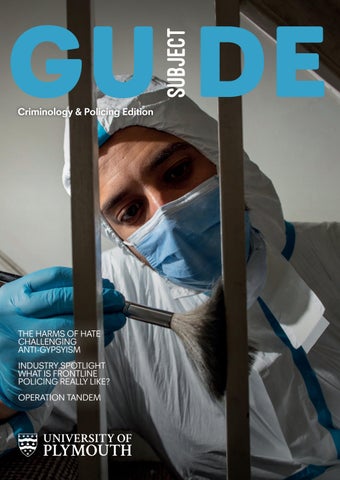
Criminology & Policing Edition

THE HARMS OF HATE CHALLENGING ANTI-GYPSYISM

INDUSTRY SPOTLIGHT WHAT IS FRONTLINE POLICING REALLY LIKE?

OPERATION TANDEM
SUBJECT

Admissions

+44 (0)1752 585858 admissions@plymouth.ac.uk plymouth.ac.uk

Schools & College Outreach

Faculty of Arts, Humanities and Business foabhoutreach@plymouth.ac.uk

University of Plymouth Drake Circus Plymouth Devon PL4 8AA United Kingdom

Follow us on social media @PlymUniApply

Criminology and Policing Edition

SUBJECT

It’s never too early to start thinking about what you would like to do after school or college, or if you are thinking of a career move! At Plymouth, we know that choosing a university and course is a big decision. While you may have an idea of a profession, career or industry that you’re aspiring towards, if you’re unsure of exactly what you want to do or are keen to find out more – this is where our handy subject guide comes in.

Meet some of this issue’s contributors:

Dr Julie Parsons

Associate Head of Criminology

Julie shares her top 10 reasons why studying at Plymouth is special. P. 4.

Natasha

BSc (Hons) Criminology Student

Natasha shares how working within Plymouth’s Cold Case Unit has improved her confidence while helping others. P. 50.

Kayleigh

BSc (Hons) Criminology Graduate

Kayleigh shares how her Criminology degree from Plymouth has launched a rewarding career in offender rehabilitation. P. 34.

EXPLORE YOUR FUTURE HOME

Visit us at an Open Day

When it comes to finding out if university feels right for you, nothing compares to an open day. Talk to current students and quiz lecturers about your course. You can register to attend here plymouth.ac.uk/open-days

Start exploring –take a virtual tour

Our virtual tour allows you to experience first-hand what it is like to be on campus and explore the environments and facilities that inspire and shape our learning every day.

Inside...

HOT TOPIC:

P. 10 The Harms of Hate –Challenging Anti-Gypsyism Professor of Criminology Zoë James shares her expert insights on who is deemed valuable and who is not in society – and what we can do about it.

FEATURES:

P. 20 Industry spotlight – what is frontline policing really like?

Dr Brendan Brookshaw, Lecturer in Professional Policing, gives his insight into the realities of policing. P. 26 Operation Tandem On a busy street, a gruesome discovery is made. Two victims lie dead in a blood-spattered flat. Can you piece together what has happened to solve the crime?P. 44 Find the right route for you via a foundation degree Grow academically and personally in a university environment.

P. 52 The placement experience Criminology student Amber shares how her experiences of volunteering at the charity LandWorks have boosted her CV.

P. 60 Where will your degree take you?

What skills will you develop and what career options are available?

THE GUIDE:

P. 62 Personalise your degree with the School of Society and Culture

Explore how you can gain handson experiences to prepare you for the real world.

10 REASONS TO STUDY AT PLYMOUTH

With emerging issues in criminology and a fragmented criminal justice system, are you ready to start your journey to create a fairer, safer and more inclusive society?

1. DISCOVERY

Our degrees introduce you to new criminology principles you may never have encountered before , in addition to investigative and forensic techniques you thought you knew from another angle.

Our students spend three years with us, discovering how we can learn from the past, consider the present and look to the future to create change. You’ll come out with a broad, deep appreciation of the complexities of crime, and a new sense of your place as an analytical thinker against the sweep of the criminal justice system.

“When watching a crime TV drama, you see the characters rocking up to a crime scene with their hair out and no protocols to stop cross-contamination. You start to really nitpick and spot the inconsistencies. The reality is there is so much more involved and there are so many different levels of what you must do in a certain order.”

Megan, BSc (Hons) Criminology student

2. INNOVATIVE TEACHING

Experience contemporary technologies including virtual reality (VR) and artificial intelligence (AI) to explore forensic techniques. Use state-of-the-art 3D VR crime scenes to augment the live experience of crime investigation. You will play detective to grow your analytical and investigation skills.

We actively encourage you to explore the boundaries of criminological ideas. Experience our pioneering module with HMP Exeter, where you will learn about rehabilitation inside prison walls to understand the effects of crime.

3. CRIME SUITE FACILITY

Learn by doing in scenarios that are based on real-life investigations in our state-of-the-art crime, interview and simulated policing suite.

Benefit from an immersive learning experience to:

• explore crime scenes and harvest forensic material such as blood, fibres and fingerprints from various scenes and lifelike mannequins

• learn police interview techniques and practise these on actors in our bespoke police interview rooms

• use CCTV footage and two-way mirrors to observe and record the investigation

• review footage and evaluate your performance at leisure

• use the latest laser scanning technology to capture the scene virtually and revisit it in the future.

“Working in the Crime Suite allows me to learn practically. We study motives and connect them to the crime and the physical evidence. For example, fingerprints, weapons and CCTV. Learning about criminal justice inspires me to learn more about society and how relevant this field is to our everyday lives.”

Laura, BSc (Hons) Criminology student

4. EXPERT LED TEACHING

Our degrees are powered by our research. We are changing the world around us, from Dr Sian Lewis’ work with the UK parliament and the British Transport Police on sexual harassment in public spaces, to Dr Iain Channing’s research on the history of crime and policing in Britain from the 19th century to the present day. This research underpins all our teachings – and when you come to Plymouth, you too will become a researcher for your finalyear dissertation. You will spend a year completing a self-generated research project under the guidance and support of an expert lecturer. As a team, we bring the methods of research studies and critical analysis to wider public debates, such as workplace violence experienced by frontline workers.

“The Criminology department comprises lecturers and PhD students who aim to incorporate their professional knowledge and personal experience to deliver an array of exciting modules. I feel privileged to be taught by such an experienced team who are knowledgeable in their fields and continue to research to keep the curriculum as current as possible.”

Emma, BSc (Hons) Criminology student

5. FLEXIBILITY

We are a friendly department in a big, diverse school. You can tailor your degree to focus on what fascinates you. By taking different options, you will gain a thorough grounding in your areas of interest – whether it be criminology related or a completely different subject such as history, politics or sociology. Whatever your passion, you will have the freedom to explore it here. Find out more on page 62.

6. BEYOND THE CLASSROOM

Undertaking a Criminology or Policing degree is an enriching experience. It is not just about theory but becoming intimately familiar with the practical elements of the discipline. You can take part in live suspect interviews with actors mimicking real criminal justice situations and present your evidence in a simulated courtroom experience, collaborating with our law students. This experiential learning enables you to deepen and enrich your public speaking, performative and cross-examination techniques. We are committed to exploring ways for you to enjoy your subject, not just in terms of your study but also socially.

Our vibrant CrimSoc student society enables you to meet like-minded people and make lifelong friendships. Find out more on page 56.

7. LOCATION

Study with us and discover a thriving waterfront city at the heart of the stunning South West. The university sits on the idyllic South Devon coastline at the very centre of the city. With excellent national transport links, great shopping and culture, top sporting opportunities, pristine seas and south-coast sunshine, studying here allows you to live the lifestyle that only the South West peninsula can offer. Policing in Devon and Cornwall is as challenging as anywhere in the country, particularly as our region is one of the UK’s top tourist destinations. You will benefit from key insights into rural and urban policing and the challenges that this unique area can bring.

8. SUPPORT

We pride ourselves on our friendly and supportive learning environment run by internationally recognised staff. We are driven by our dedication to student-centred learning. Throughout your time here you will have a personal tutor who supports you, and every tutor operates an open-door policy, meaning you can see them outside seminars, workshops, and lectures to talk through your work on a one-to-one basis. Moreover, our associate lecturers act as study mentors at each stage of your learning. You will benefit from bespoke sessions focusing on study skills, with one-to-one support available on any aspect of your learning.

We also offer writing workshops and other kinds of writing support, so that you have lots of

opportunities to improve your work with guidance from experts. For example, you can drop into the Writing Café, a unique and creative space where you can have a conversation with a member of the Learning Development team, work with one of our trained writing mentors, or take part in one of our many events and activities centred on writing. Learn more about the Writing Café

“I have had a lot of support from lecturers who are all very encouraging and want you to do well, which has made me want to work and do the best that I can.”

Emily, BSc (Hons) Criminology student

9. COLD CASE UNIT

Take advantage of our innovative Cold Case Unit. Our mission is to uncover new evidence which can be used by the police to solve cases while giving students experience and skills –including investigative, analytical and social – to launch them into rewarding careers.

We are a student-led, expert-guided group with international connections and access to facilities and training at both the University of Plymouth and Locate International.

Find out more about the unit and how you can become an investigator on page 48.

10. EMPLOYABILITY

Develop your skills and stand out to employers, whatever your career goals. Our dedicated criminology employability officer provides you with a range of opportunities to build your portfolio of experience with local and national criminal and social justicerelated agencies. Additionally, each year, our students work with the Devon and Cornwall Police to create a real campaign to tackle issues impacting the student community, such as online scams.

THE HARMS OF CHALLENGING

Professor of Criminology Zoë

James shares her expert insights on who is deemed valuable and who is not in society – and what we can do about it.

The struggle for acknowledgement and respect of Gypsies, Travellers and Roma in the UK and Europe has been a constant challenge over centuries and is still present in modern society. Racism underpins the attitudes and actions towards these communities.

Gypsy, Roma and Traveller people belong to minority ethnic groups that have contributed to British society for centuries. Their distinctive way of life and traditions manifest themselves in nomadism, the centrality of their extended family, unique

HATE ANTI-GYPSYISM

languages and entrepreneurial economy. It is reported that there are around 300,000 Travellers in the UK. However, the real population figures may be different as some members of these communities do not participate in the census.

DIVERSITY

Traditionally, Irish Travellers can be traced back to 12th-century Ireland, with migrations to Great Britain in the early 19th century. They have a separate identity, heritage and culture from the community in general.

Romany Gypsies have been in Britain since at least 1515 after migrating from continental Europe during the Roma migration from India. Linguistic analysis of the Romani language proves that Romany Gypsies, like the European Roma, originally came from Northern India, probably around the 12th century. Other groups of Travellers may travel through Britain, many of whom can trace a nomadic heritage back for many generations and who may have married into or outside of more traditional Irish Traveller and Romany Gypsy families. There

were already indigenous nomadic people in Britain when the Romany Gypsies first arrived hundreds of years ago.

There are also Traveller groups which are known as ‘cultural’ rather than ‘ethnic’ Travellers. These include ‘new’ Travellers and Showmen. Show People are a cultural minority that has owned and operated funfairs and circuses for many generations and their identity is connected to their family businesses.

“School said they had a vacancy for our youngest daughter until I said where we lived. I was then told they made a mistake and did not have any vacancies.”
Romany Gypsy

New Travellers are people who are sometimes referred to as ‘New Age Travellers’. They are generally people who have taken to life ‘on the road’ in their lifetime, though some New Traveller families claim to have been on the road for three consecutive generations. The New Traveller culture grew out of the hippie and free-festival movements of the 1960s and 1970s.

HATE AND RACISM

Hate is a strong word. It is used purposely to evoke emotion and represent the feelings subject to its quirks. Having an intense dislike for somebody because they are a Gypsy, Traveller or Roma is a problem we need to explore.

In 2017 and 2018 research studies

found that public perceptions of Gypsies, Travellers and Roma in the UK were hostile. Moreover, in 2014, the Global Attitude Survey found that 50% of UK respondents held negative views towards these groups. These negative views and attitudes have racist roots, which determine and sustain who is valuable in society and who is not.

Race is a predictor of what happens to people when they travel through the criminal justice system. It determines whether an individual is stopped and searched, whether they are arrested, what bail decisions were made, whether they are charged by the police and ultimately if their case was prosecuted by the Crown Prosecution Service.

The Criminal Justice and Public Order Act, passed in 1994, caused a political storm. It famously legislated against raves but also extended power to the police to stop protests. Within the same section of the law that addressed public order problems, it increased police powers to evict Gypsy, Traveller and Roma people from the land. Their ways of living had been criminalised.

POLICING

Travellers, Roma and Gypsies are continually being over-policed, meaning an increased focus and attention on a group that is reasonable and acceptable. It does not make people feel safer as it increases fear and community tensions. Police use various tactics

to disrupt, destabilise and spatially exclude these groups that are both within and beyond the meaning and intent of the law.

HOUSING

Travellers, Roma and Gypsies are among a diverse range of people who live nomadically for a variety of reasons but most commonly because they have been pushed or pulled out of housing and found an opportunity to live relatively safely as part of their wider community.

Post-war legislation and policy closed off the traditional stopping grounds on common land that Gypsies and Travellers have used for centuries. This deteriorated when local authorities did not follow the legislation to provide

“I was told by a policeman that people like us should be put against a wall and shot as there is no place for people like us in society.”
Romany Gypsy

new stopping places for them. Today, many Gypsies and Travellers live in houses though countless would prefer to live on sites. They are punished for stopping and staying in the only places they can find.

“I’m not allowed to live anywhere. I feel looked down on by everyone.”

Irish Traveller

STEREOTYPES

Gypsies and Travellers from diverse communities were pushed into a corner, marginalised, demonised and problematised. A romantic myth was created. Only ‘legitimate’ or ‘real gypsies’ were those who lived in horsedrawn wagons and conformed to stereotypical pre-modern styles of living with the land. However, in real terms, those who did live according to some of those stereotypes were not protected by them.

“My young family and I were abused and shouted at when on the road. We were shot at when we were horse-drawn. That happened quite a few times by farmers and actual pellets rained down. They

“My young family and I were abused and shouted at when on the road. We were shot at when we were horsedrawn. That happened quite a few times by farmers and actual pellets rained down. They would either shoot over you or aim at the wagon where my children were inside.”

New Traveller

would either shoot over you or aim at the wagon where my children were inside.”

New Traveller

EDUCATION, HEALTH AND WELLBEING

The failure to effectively accommodate Gypsies and Travellers, and racism towards them means that Gypsies and Travellers have the worst outcomes of any minority community in the UK. They have notoriously poor access to education or are pushed out of education because of bullying from peers and poor treatment from teachers and school officials.

Likewise in health and welfare, their engagement with, and by support services is highly problematic. The joined-up approach of multiagency working encourages the police and social services to interrogate the lives of Gypsies and Travellers and threaten their family units based on their insecure accommodation. In other words, threatening to remove their children from their care. The fear evidenced by Gypsies and Travellers has led them to be private and protective, often to the point that they hide their identities out of fear of the hateful treatment that they will experience if they state their heritage.

They also have a lower life expectancy, are more susceptible to illness, live in worse conditions, their children are more likely to die, hold the lowest educational attainment levels, and have elevated rates of mental illness and suicide. They appear to be disproportionately represented in the criminal justice system.

HATE STUDIES

Hate studies provide an outlet to bring the terrible circumstances Gypsies and Travellers experience to the forefront. My 2015 research found that 79 people experienced 225 hate incidents and crimes in the last few years. Research completed by the Traveller Movement found

that Gypsies and Travellers had been physically attacked and had their homes and cars burnt or vandalised.

When Gypsies or Travellers talk about their experiences of hate and microaggressions they see the discrimination they experience as part of their everyday life.

This has a direct impact on their lived experience, how they see themselves in their communities and the people they interact with.

“School said they had a vacancy for our youngest daughter until I said where we lived. I was then told they made a mistake and did not have any vacancies.”

Romany Gypsy

“When I deal with any kind of office they reject or turn me down.”

Irish Traveller

“I was told by a policeman that people like us should be put against a wall and shot as there is no place for people like us in society.”

Romany Gypsy

Name calling, bullying, threats, intimidation, sexual intimidation, harassment, discrimination and unwanted photography or filming are experienced by the community. Few report this to the police or organisations, despite the severity of incidents they experience. The failure to report incidents does not only mean that the perpetrators will not be held to account, but it also leaves victims without support, guidance or help. The breakdown of trust between Gypsies, Travellers, Roma and the police also causes other issues that may arise within their communities to not be effectively dealt with.

MISCONCEPTIONS

There is a gap in our ability to explain why Gypsy, Traveller, and Roma communities continue to experience so much hate in a contemporary society that apparently embraces difference and human rights. Hatefulness is integrated into the accepted

norms and values of the world that we live in today, which places individualism, competition, and consumerism at the heart of what it is to be a valuable person.

When we feel insecure, lost, and angry in this new social landscape, instead of questioning how the world works, we scapegoat others whom a racist society has placed beyond us. This manifests in extreme ways, some people turn to hideous ideologies as we have seen with the rise of the far right. However, none of us is immune to the feelings of anxiety that the 21st century has produced. Consumerism does not make us feel better, we are fearful of Gypsies, Travellers, and Roma who seem to want to live in ways that we do not understand, and at the same time, we are jealous of their apparent freedoms.

The outcome of our fears and jealousies are hateful acts, so we accept legislation that destroys the lives of these communities, falling for the lies peddled by the media. We turn a blind eye to anti-Gypsyism, we accuse them of leaving rubbish, being in the wrong place and not paying their taxes. In the meantime, we do not always follow the same rules we demonise Gypsies and Travellers with. We leave our rubbish on the streets and in the countryside, we shop in big out-of-town centres while city centres collapse, and tax avoidance is considered legitimate whether you are a banker or a plumber – if it is cash-in-hand work or a big corporation with offshore accounts. It is easier to scapegoat than to realise that we are all living in a contemporary society that is broken. We need to make change happen.

FINDING SOLUTIONS

We need to reignite our imaginations so that we can find answers to challenge our preconceived ideas or stereotypes. To bring change, we must shift the narrative on a range of issues within legislation,

policing, organisations, and in our own homes and lives.

The former Home Secretary Priti Patel proposed a new piece of legislation in 2021, the Police, Crime Sentencing and Courts Bill which was passed as an Act in 2022. It further enhances measures to evict Gypsies and Travellers from land and prevents them from returning to places they have previously been evicted. It applies to anyone over the age of 18 with as little as one vehicle and maybe ‘likely’ to cause damage, disruption or distress. Such terms are extremely loose as how can it be predicted what a person may be likely to do? When anti-Gypsyism is

so widespread in our society, the presence of Gypsies and Travellers in an area may likely cause alarm.

This legislation does nothing to address the fact that they have nowhere to stop or stay. People suggest that as ‘Travellers’ they should move on, even those that choose to be mobile need somewhere to stop overnight, or for a few days while working in a particular area or while their children are educated. For some, they want to stay in a place for a long period; they just don’t want to live in a house.

Creating legislation that prevents people from stopping is

illogical. What we need are more legitimate places to stop. It would immediately reduce community tensions, the police will not waste their time policing communities unnecessarily, victimised people could begin accessing support services they deserve, and children could attend school and health services. This does not resolve everything, but it is a start of a relationship that could be strengthened.

WHAT CAN YOU DO TO HELP?

We can all make a difference. Next time you hear someone use a racist term against a Gypsy or Traveller, do not simply accept it. Challenge people on social

media, educate your friends and family about what you have learnt, and try not to believe everything you see in the media or on TV – remember these are created for entertainment My Big Fat Gypsy Wedding is no more representative of a community than The Only Way Is Essex, Geordie Shore or Made in Chelsea

More importantly, treat people with kindness and compassion –everyone has a responsibility to stand up against hate, prejudice and negative stereotypes.

DID YOU KNOW?

• Gypsies, Travellers and Roma have been persecuted since the Middle Ages, and subjected to enslavement, expulsion and laws seeking to destroy their culture.

• It is estimated that 25% of the pre-war European Roma population perished at the hands of the Nazis.

• Roma are one of Europe’s oldest ethnic minorities.

• They continually face racial, religious, or political persecution.

• The term Gypsy comes from Egyptian which is what the settled population in the 12th century perceived them to be because of their dark complexion.

• Family, extended family bonds and networks are very important to the Gypsy and Traveller way of life.

• Contrary to frequent media depictions, Traveller communities value cleanliness and tidiness.

• Family anniversaries are usually marked by extended family or community gatherings with strong religious ceremonial content.

• Horses are symbolic and significant in their lives, with horse ownership seen as a last link to their nomadic way of life.

WHICH DEGREE IS RIGHT FOR YOU?

Criminology and policing are related fields, but they have different focuses and prepare students for different careers. Both fields are essential to the criminal justice system and work together to achieve its goals.

BS c (HONS) CRIMINOLOGY

Criminology is the scientific study of crime. A degree in this area is more theoretical and focuses on studying the nature, causes and consequences of crime at a sociological level. It looks at crime from a broader perspective, examining the social, economic, and political factors that contribute to criminal behaviour. It also analyses the criminal justice system and its effectiveness in preventing and reducing crime

STUDY: BSc (Hons) Criminology

BSc (Hons) Criminology and Psychology

BSc (Hons) Criminology and Sociology

KATIE

BSc (Hons) Criminology student

“The University of Plymouth was right for me because of the wide variety of learning and teaching styles. There’s visual learning when you get to watch and are involved in lots of crime scene examinations and group learning. You get to work in a team with other students which is something I didn’t expect coming from sixth form to uni. It’s a complete difference but in a great way since you are not just learning out of a textbook you are engaging with what you’re learning which makes it so interesting.”

BS c (HONS) PROFESSIONAL POLICING

Modern policing is facing new professional challenges and the communities served by the police are increasingly diverse and complex, with different needs and priorities. Policing degrees focus on practical law enforcement aspects including patrol strategies, crime prevention and investigation techniques. It examines the academic theory, behaviours and knowledge needed to become an effective frontline police officer.

STUDY: BSc (Hons) Professional Policing

KARA BSc (Hons) Professional Policing student

“The content we work through within this course is catered specifically to educate us on everything we will need when we graduate and enter the real sector of policing.”

INDUSTRY SPOTLIGHT

what is frontline policing really like?

With over 30 years of active service in Devon and Cornwall Police, Dr Brendan Brookshaw, Lecturer in Professional Policing, gives his insight into the realities of policing.

WHAT MADE YOU WANT TO ENTER THE POLICE FORCE?

I joined the police in 1988 after completing a degree in biochemistry. I simply could not see myself at age 21 working in a lab for the rest of my life, so I had to think about what it was I wanted from a career and there were two things which jumped out at me. The first was a stable income, given the dire national financial situation in the 1980s, and the second was that I wanted to do something which would be a force for good in society. Over the course of my career, my various promotions have therefore been a combination of these two as I have been able to earn a little bit more money and have a lot more influence over a greater area as I progressed through the ranks.

TELL US ABOUT YOUR CAREER AND EXPERIENCE PROGRESSING THROUGH THE RANKS.

I have been very fortunate in being able to have an interesting variety of roles within the police service. I was promoted to Sergeant in 1997, Inspector in 2002, and Chief Inspector in 2004. I also spent five years in total as a Temporary Superintendent and Detective Superintendent. Therefore, over half my career was spent as a senior manager in the police service, allowing me to work at that level across several specialist roles. I was Head of Equality and

Diversity for three years, a Staff Officer for two chief constables, a Geographic Police Commander for East Cornwall and Plymouth, Specialist Operations Chief Inspector with responsibility for firearms, public order, major sporting events, nuclear accidents emergencies and other exciting tasks of that nature. I was the Route Commander for the Olympic torch in 2012 on its first day in the UK helping to make sure it was able to pass through the villages of Cornwall to Plymouth without being attacked or disrupted.

In my last four years, I was the Head of the Professional Standards Department which dealt with public complaints against the police and internal counter-corruption investigations. It was during this time that I attended the national senior investigating officer’s course and became a Detective Chief Inspector and Temporary Detective Superintendent.

WHAT WAS YOUR FAVOURITE POLICING ROLE YOU UNDERTOOK?

The role I most enjoyed, simply because it was exciting, dynamic, and a lot of fun was as critical incident Chief Inspector, call sign Yankee 2. In this role, I had about 500 officers across 35 policing hubs in two counties which

included a dog section, roads policing teams, firearms teams and all response officers. The work was done through 24/7 shifts with plenty of blue light emergency calls and the opportunity to reconnect with the fun, fear and friction of frontline policing.

WHAT HAS BEEN THE MOST REWARDING THING YOU HAVE ACCOMPLISHED TO DATE?

The role in which I think I was able to have the most impact was as head of equality and diversity because I introduced to the force several equality and diversity reference groups, bringing in people from the disabled, BAME, LGBTQ+ and faith communities to assist the police by providing strategic advice and also real-time specialist tactical advice in critical incidents. I also created policies for Traveller encampments and helped every supervisor in the force attain the national standard certification for equality and diversity. This was harder and much less fun than the other role I talked about, but it has left a lasting legacy with the police which I am very proud to have created.

HOW DOES POLICING COMPARE TODAY TO WHEN YOU STARTED?

I strongly believe that policing was very much easier in the 1980s and 1990s than it was when I retired in 2018, and certainly than it is now.

Over the course of those three-and-ahalf decades, the world has changed from a Cold War environment, through increasing neoliberalism of private and public services, to a world where there is an intense focus on individualistic competition. Police have had to respond to this by moving away from their traditional roles, towards traumainformed and victim-focused policing which is much more bespoke and fixated on individual needs.

TELL

US ABOUT YOUR JOURNEY INTO ACADEMIA

Having successfully applied to the Home Office’s national high potential development scheme, I was able to complete my masters in public administration at the University of Plymouth in 2006. This was the real pivot around which my professional life revolved. It established my interest in lifelong learning, public sector ethics and philosophy which significantly improved my outlook on life. In 2016, I started to teach as an associate lecturer at City College Plymouth and the University of Plymouth. I taught ethical decision-making, conflict and cohesion, criminology and a few other subjects. In 2017, I embarked on my PhD and when I retired from the police in 2018 this led to me teaching as an associate lecturer on

a much more frequent basis until I was appointed as the full-time professional policing lecturer in 2021. I completed my PhD in 2023 having designed the new Professional Policing course at the University which is licensed by the College of Policing.

WHAT’S YOUR FAVOURITE THING ABOUT TEACHING AT PLYMOUTH?

There are three things that I enjoy about being a lecturer at Plymouth. The first is working with the students to pass on not only policing theory, but hopefully some of the wisdom of my years of experience. Secondly, I very much enjoy researching policing issues and I’m trying to understand the psychology ethics, and management of police corruption. Lastly, I have amazing colleagues in the policing and criminology teams who are great fun to work with and international leaders in their academic fields. This makes coming to work a real joy; as the saying goes “If you find a job that you love you don’t have to work a day in your life.”

WHAT’S THE BIGGEST PIECE OF ADVICE YOU HAVE FOR PROSPECTIVE STUDENTS WISHING TO ENTER THE POLICE FORCE OR THE COURSE AT PLYMOUTH?

My first piece of advice would be that, of the three-degree routes that you can

take into a career in policing, the licenced Professional Policing degree we offer is the most effective, personally influential and fun. My main mission in developing the Professional Policing course was to focus on the academic and philosophical aspects of policing more than the practical elements which can be taught later. I really want any student considering a career in policing to enter it with their eyes wide open. The police are an amazing group of people and as a career, it can be incredibly rewarding and positive. But, as recent reports have shown, there are dark elements to policing that people should be fully aware of before choosing a career in that field. When I joined, I was quite ignorant of what the police did and completely unaware of the darker side of police cultures and practices.

WHAT ADVICE WOULD YOU GIVE TO STUDENTS ABOUT THE REALITIES OF POLICING?

I cannot think of a more rewarding job than being a police officer or working for the police in another capacity. Hardly a day goes by when you can’t identify something you did which directly improved the life of another human being. The flip side of this is that almost everything you do, even if well-intentioned, has the potential to

create personal and societal harm. To be a police officer you must be morally and physically courageous, physically fit and healthy, mentally resilient, and possess self-control and strong leadership abilities. The public expects the police to put themselves in harm’s way to protect others. Therefore, it is impossible to undertake a full policing career without fairly significant physical, mental and emotional damage. The key thing is to create and develop strategies for coping with the assaults, stress, trauma, and the inevitable moral corruption that comes with continually working with criminals.

WHAT DOES THE FUTURE OF POLICING LOOK LIKE?

Part of my PhD research suggests that one of the historic issues with the police is that it has been overtrained but undereducated which has led to a reliance on doing the same thing in response to increasingly diverse threats and policing challenges. I am convinced that the future of policing lies firmly in preparing police officers and staff for a working environment where they should not be expected to say “Yes Sarge” but rather “Why Sarge?”. By this, I mean the police as individuals need to become much

more highly skilled in critical thinking, problem solving and philosophy. I believe that the recent move towards degree-only entry is the right way forward and that it creates an environment within which innovation and novel thinking are practised and valued rather than doing the same old thing and getting the same old outcomes.

If I can leave you with a quote from philosopher Friedrich Nietzsche (Dawn. Aphorism 297)

“The surest way to corrupt a youth is to instruct them to hold in higher esteem those who think alike than those who think differently.”

Research expertise

Scientific examination of police attitudes towards corrupt or improper practice by police officers. He’s interested in ethical decision-making conflict and cohesion with forces.

Policing career

• 30 years of active service in Devon and Cornwall Police.

• Held the rank of Chief Inspector and Temporary Superintendent for 14 years.

• Four years of Senior Investigating Officer experience as a Detective Chief Inspector and Temporary Detective Superintendent in the field of police misconduct and counter-corruption.

• Ten years of command experience in tactical firearms, nuclear emergencies, public order, major public events and civil emergency matters. Successfully resolved over 200 preplanned and spontaneous firearm incidents and over 150 public events.

• A wealth of experience in chairing multi-agency responses to flooding and severe weather events.

• Professional Standards specialist as part of Her Majesty’s Inspectorate of Constabulary’s Legitimacy Inspection team.

• Former Head of Equality and Diversity and Force Strategic Partnerships developing unique insights into police culture, politics, role and structure of the police in the UK and alongside other agencies.

Discover more

MEET DR BRENDAN BROOKSHAW

SETTLING INTO UNIVERSITY

Settling into university is a strange feeling. BSc (Hons) Criminology student Grace gives her top tips to make the transition easier.

Moving out of home for the first time for most people can be daunting and frightening, especially if you’re unsure what to expect. I remember the feeling of uni move-in day all too well. Feeling panicked and overwhelmed is natural and the variety of teams that support you at Plymouth is truly amazing. One thing to remember is that everyone will be in the same boat as you and feel the same way. Making friends with your flatmates is always key and a good way to help settle the nerves.

For the first several weeks, maybe months – depending on how you are as a person, life will be strange for everyone. Not having parents around to cook the evening meals and tidy up after you is a big difference. Ensuring you’re respectful of your flatmates and leaving a clean environment for everyone goes a long way. Abiding to your contract around kitchen safety is another big thing to keep adhering to throughout the entire academic year. The feeling of wanting to quit and move back home is quite normal as well, but there are always people who you can talk to, to help guide you in the right direction and to give good advice. Having an outsider’s perspective is always a helpful

insight into how things can be adapted or changed to suit your specific needs.

Decorating your room to your tastes was something I found helpful when settling into a new place. Putting up pictures of your hometown, pets and friends helped me feel at home. Sticking up posters of your favourite music artists will help the room to not look so bare! Sprucing the place up to make your own was beneficial for me to get me into the uni mindset.

Bringing too much for your first year is also normal. When you come to move out after your first academic year, you will realise how much stuff you do not use or need. For the second year, you will soon know what to leave at home and what essentials will be needed. Making lists of the necessities for uni and looking on Plymouth’s website for top tips for moving in is beneficial too, so don’t forget to do that. If you know anyone that has been to uni before, ask them for their help too.

Most of all, enjoy yourself, uni goes by way too quickly!

OPERATION TANDEM

On a busy street, a gruesome discovery is made. Two victims lie dead in a blood-spattered flat. Evidence of what led to this horrific crime lies scattered about. Can you piece together what has happened to solve the crime?

“A call was received by control at 15:50 reporting a suspected homicide at 52 Gibbon Street. I attended the scene at 16:15 on 9 March 2020. The initial call was made by Leslie Dawson, a social worker to the deceased who remained at the scene in a distressed state. I made a cursory sweep of the premises to secure the scene and discovered a second body of a young woman in the downstairs bathroom covered in a blanket. Dawson claims to not know the second victim.

I called paramedics immediately after securing the scene, who attended at 16:30. They concluded at 16:50 that there was no recognition of life and both

victims were declared dead. At 17:00 the forensic team arrived at the premises and conducted a thorough forensic sweep of the scene, producing detailed drawings and photographs of the evidence, which was undisturbed during the process.”

First officer on the scene

Senior Investigation Officer 476322

It is your job as the lead detective assigned to this case to establish which items of potential evidence you wish to forensically analyse, and which leads you will follow up to bring justice to the victims and their families.

Victims

Thomas Cooper (22)

• Tom was a vulnerable person who was visited by his case worker Leslie Dawson on a fortnightly basis.

• Dawson has become aware that there was some change in Cooper’s behaviour.

• She assumed the change was drug related, but she had never known him to take drugs or be a big drinker.

Victoria Wood (21)

• Vicky was Tom’s suspected girlfriend, who regularly stayed over at Tom’s flat.

• Her friends also stayed at the flat on occasion, which Tom’s social worker disagreed with.

Initial findings

the time of the crime. The flat was searched and there are no apparent missing items. Parked vehicles in the vicinity were checked for evidence but none was recovered. PCs interviewed the landlord, but no noticeable evidence was identified.

The social worker Dawson’s alibi was checked which revealed she had been with clients and in meetings all day, up until she arrived at 52 Gibbon Street at 15:54.

The mobile phones of both victims were checked for evidence. They had several text messages that are largely written in code and quite illegible. Other call histories to note include those from Saturday afternoon to Monday morning showing there were 24 missed calls from the same number recorded on Vicky’s phone.

CCTV

Neighbour, Frank Howard heard shouting late on Saturday morning. He ignored it as does not have anything to do with Tom Cooper and he thought it was ‘just a domestic’. He did say that he thought Tom did have more people coming to his house than he usually did in the last few weeks though.

Initial enquiries have led to no pedestrians being identified to provide witness evidence. Both victims’ bank accounts have been checked and no transactions have occurred during

CCTV footage captured from the adjacent Charles Cross Car Park on 9 March shows two males entering the flat at 13:02 via the street-access front door. At 13:06 an upstairs window is opened, and movement is detected near the window, but it is firmly shut again. Multiple people continue to walk along the street outside the flat, and at 13:07 a figure runs out of the front door around the corner and out of view.

On further review of the footage, another man is spotted calmly walking out of the flat at 13:07, at the same time the other man is leaving. However, this man walks off in the opposite direction up the road.

All persons remain unidentified at this stage.

Evidence collection and DNA testing

Crime Scene Investigators attending the scene discovered the following.

Front bedroom:

• Ex 3 Knife – DNA confirms the blood on the knife to be Tom Cooper’s. No clear or usable fingerprints are available on the knife.

• Ex 7 Blood on the windowsill - DNA confirmed as Tom Cooper’s. Suspect reference code: OPT090320S1A

• Ex 11 Baseball cap – DNA hair sample recovered from a baseball cap.

• Ex 18 Door handle – Partial print of Tom Cooper recovered on the door handle.

• Ex 19 Spoon and tin foil - Partial print of Tom Cooper recovered. Substance in tin foil confirmed as heroin.

Back bedroom:

• Ex 22 Female clothing on a rail – No DNA found on the female clothing.

• Ex 24 Powder in aluminium foil –Confirmed as heroin.

• Ex 35 Blood on the window and window ledge – Confirmed to be Tom Cooper’s.

• Ex38 Hammer – Fingerprints recovered are consistent with Tom Cooper. Blood and skin cell trace evidence from the face of the hammer is consistent with Vicky Wood.

• Ex 39 Door frame damage – Hammer mark found on the door frame.

Kitchen:

• Ex 48 -Orange pills in polytene bags

– Confirmed as MDMA.

• Ex 49 Knife - DNA confirms blood on the knife to be Tom Cooper’s. Several fingerprints on the knife are consistent with Vicky Wood and Tom Cooper.

• Ex 50 Contents of bin/blood on tissue - DNA confirms blood to be Tom Cooper’s.

• Ex 51 Bloody footprints – DNA confirms blood to be Tom Cooper’s.

Bathroom:

• Ex 27 Cell phone triangulation - Two of the cell phones have been switched off and no record was retrieved. One cell phone had been static in the area since Saturday 7 March at 10.30.

Stairs and entrance:

• Ex 29 Blood on handrail - Confirmed to be Tom Cooper’s.

• Ex 32 Footprints on entry to the house - No identifiable or relevant prints recovered from outside the house.

Dining area:

• Ex 34 Blood on the curtain rail –DNA confirmed as Tom Cooper’s. The fingerprint recovered in blood on the rail was confirmed as Tom Cooper’s.

• Ex 52 Items from bathroom – DNA from toothbrushes reveal that three brushes were each used by Vicky Wood, Tom Cooper. Suspect reference code: OPT090320S1A. DNA on several strands of hair found in the hairbrush is consistent with Vicky Wood and Tom Cooper.

• Ex 53 Blood on curtain covering Vicky’s body – DNA confirms blood to be Tom Cooper’s.

• Ex 55 Blood on the floor - DNA confirms blood to be Tom Cooper’s. The pattern is consistent with a footprint from the shoe by the front door.

• Ex 56 Bathroom door handle – Partial print recovered.

DNA match

Scientists run the evidence through the Home Office’s National DNA Database which was set up in 1995. By 2016 it had accrued 5.86 million profiles. The database is populated by samples recovered from crime scenes and taken from police suspects although data for those not charged or not found guilty are deleted.

A match is identified.

• Suspect Reference Code - OPT090320S1A

• Name – Tony Hancock

• Alias - Bleach

• DOB – 18/02/76

• Height – 5’11”

• Eye colour – Green

• Distinguishable marks – Skin pigmentation, especially across the right torso

• Last known address – 21 Station Road, Birmingham

• Previous convictions:

o 09/05/98 – Possession with intent to supply – 6 months Suspended

Sentence (2 years)

o 14/01/01 – Common assault and breach of the peace – 12 months

Custodial

o 10/02/08 – Possession with intent to supply and assault of a police officer – 3 years Custodial

o 07/12/11 – Actual bodily harm – 4 years Custodial

Post-mortems

A post-mortem examination, also known as an autopsy, is the examination of a body after death. The post-mortem aims to determine the cause of death and provide useful information about how, when and why someone has died. They are usually carried out by pathologists who are specialist doctors.

Thomas Cooper:

Time of death

Estimated Monday 9 March between 12:30 and 13:30.

Toxicology

• Hair tested positive for cocaine and cannabis consumed in the last 1-2 weeks.

• No positive results for illicit substances from the blood test.

• The blood alcohol concentration (BAC) analysis revealed high alcohol content had been consumed.

Injuries

Three slash wounds to left forearms. Possible defence wounds which have already started to heal. Possibly 2-3 days old.

Five slash wounds to right forearms. Possible defence wounds which have already started to heal. Possibly 2-3 days old.

Four stab wounds predominantly on the left side of the back, ranging between 6cm and 10cm in depth. The position of the wound’s penetration is angled slightly towards the spine.

Vicky Wood:

Time of death

Estimated Saturday 7 March between 10:00 and 14:00.

Toxicology

• Positive for alcohol, MDMA, cannabis, heroin and cocaine.

Injuries

Bruising to the head is consistent with a blow from a small blunt object.

There are signs of decomposition and the presence of fly maggots on the facial orifices indicating an earlier time of death.

Post-mortem lividity to the shoulders, back and rear of the thighs and calves (reddening of skin when the blood has settled after death) indicates that the body had not been moved after the death.

Interviews

The process of interviewing suspects of crime has been subject to major changes in recent decades. When interviewing suspects, the investigating officers must comply with laws such as the Police and Criminal Evidence Act 1984. This will include interviewing the suspect under caution, recognising the suspect’s right to legal advice and recording the interview. Also, the police now adopt an investigative interview

Suspect interview – Tony Hancock

14.03.20 Time – 10:28

– Detective Sargeant Brookshaw

During the interview, Tony initially denies any involvement in the murder of Vicky Woods and Tom Cooper. He claims to have never been to Plymouth, where the crime occurred and insists he has never met the victims before. However, as the questioning continues, Tony’s story starts to unravel.

Evidence begins to surface, such as a baseball cap with Tony’s DNA found at the crime scene bottle of alcohol with his fingerprints. CCTV footage also shows Tony and another person the flat where the murders took place. Tony eventually admits that he went to Plymouth with a man named Larry Grayson, who became enraged because Vicky was not returning his calls. Tony confesses that he followed Larry upstairs and witnessed him stabbing Tom with a knife. In fear own life, Tony ran out of the flat and claims to have not seen Larry since. He believes have fled to Spain.

Throughout the interview, Tony attempts to deflect blame onto Larry, claiming he was coerced and forced into the situation. He requests protection in exchange for providing more information. The investigators, however, insist on Tony revealing the full truth before any agreements can be made.

Over to you!

Can you piece together the evidence to form a hypothesis of who killed Tom Cooper and Vicky Wood and why?

Turn over to discover the full story.

Suspect interview – Larry Grayson

Date – 18.03.20 Time – 10:15

Interviewer – Detective Sargeant Chang

Larry stated that he had no idea what he was doing on 9 March. DS Chang showed Larry a picture of the victim Tom and asked if he recognised him. Larry confirmed that he knew Tom from around but didn’t specify where he had seen him before. When asked about the picture of Vicky, Larry recognised her and mentioned that she was called Vicky. DS Chang informed Larry that Vicky was dead. Larry denied any involvement in the deaths of Tom or Vicky and stated that he had no involvement in drugs. Larry expressed his frustration about being stuck in Spain due to illness and denied any violent tendencies or involvement in the murder. DS Chang mentioned a witness statement from Tony Hancock, who claimed that Larry was the person who stabbed Tom. Larry reacted with disbelief and accused Tony of being a snitch. DS Chang presented CCTV footage of Larry and Tony entering a house, and Larry confirmed that it was him and Tony. Larry then proceeded to share his account of what happened inside the house, emphasising that he had not killed anyone. He mentioned finding Vicky’s body and Tony’s aggressive behaviour.

DS Chang asked Larry about his relationship with Tom and Vicky and whether he introduced Tom to drugs. Larry admitted to bringing drugs to Tom’s place but claimed that Tom willingly participated and that everyone takes drugs. He mentioned being shocked by Vicky’s body and denied any romantic relationship with her. Larry described Tony as a selfish person who does whatever he likes and stated that Tony would be the one to fear, not him.

Larry expressed his anger towards Tony for potentially implicating him in the murders and denied having any fear or control over Tony. He mentioned Tony’s temper and recounted an incident where Tony killed a rabbit, expressing his disapproval. Larry concluded by asserting his innocence and stating that he was not involved in the murders.

SO, WHAT HAPPENED AT 52 GIBBON STREET?

This was a cuckooing case where Vicky Wood, Larry Grayson and Tony Hancock were drug dealers that exploited Tom Cooper. Originally using Vicky to get close to him and get his trust, Larry and Tony then started to stay there as well. This was evidenced by the female clothing in the spare bedroom, DNA on the toothbrushes of Vicky and Tony, and Vicky’s hair and skin cells on the bed sheet in the spare bedroom.

They used the property to store and sell drugs. During this time, they had also introduced Tom to cannabis and cocaine, and encouraged heavier drinking. The social worker was aware that there was some change in Tom’s behaviour thinking it may be drug-related but had never known Tom to have ever taken drugs or to be a heavy drinker. Also, Tom admitted to knowing a girl he liked that stayed over and sometimes her friends stayed over too. The social worker warned Tom that he should put a stop to this. The social worker volunteered other bits of information, but this was the key.

The reason this was key, was that it became the catalyst for the dispute

between Tom and Vicky. Tom told Vicky that she could not stay at his flat anymore. This was on Saturday 7 March while Tony and Larry were back in Birmingham. Vicky responded violently to this, threatening Tom with a knife. Tom got angry back and Vicky lashed out cutting Tom’s hands and forearms - identified as defence wounds evidence in the post-mortem.

Vicky was very much the aggressor here. Stumbling back out of the kitchen with bloodied hands, Tom grabbed a hammer from his tool shelf and struck Vicky across the head. The swing with the hammer also caught and damaged the edge of the door frame, but in such a poorly maintained house this could not be substantiated. She died quickly. Tom, alone and afraid, did not know what to do. He put Vicky’s body in the bathroom and covered it with the curtain he tore off the rail in the dining room. He phoned his social worker but there was no answer. He did not want to phone the police because of what he had done but he was also terrified because Vicky’s phone had been ringing constantly; this was later determined as 24 missed calls from the same number, connected to Tony Hancock.

When Tony and Larry returned to check on Vicky as to why she was not answering her phone, Larry discovered her in the bathroom. His fingerprint was found on the bathroom door handle. Tom tried to escape but could not go downstairs as Tony and Larry were there. He went to the bedroom and opened the window which was caught on CCTV and tried to escape. Tony caught up with him and stabbed him in the back. In the struggle, a chair was knocked over and Tony lost his baseball cap which was forensically linked to him through his hair. Tom died there and Tony shut the window getting Tom’s blood on the net curtain in the process. He also left a series of bloody footprints away from the body and his bloodied hands made a series of blood smears down the stairs and on the front door.

Larry did not go upstairs. He stayed downstairs collecting all the drugs in a rush and knocked some of them on the kitchen floor but had put most of them in his bag. Larry rushed out of the house behind Tony but took a different route away from the house in an attempt to remain disassociated from what he suspected might have happened upstairs.

WHAT IS CUCKOOING?

The term ‘cuckooing’ takes its name from cuckoos that take over the nests of other birds to lay their eggs. It is a practice where people take over a person’s home and use the property for some form of exploitation.

Cuckooing is part of a drug dealer’s business model and has become far more prevalent due to COVID. Before the pandemic, although many gangs used cuckooing, others would often use Airbnb, guest houses or hotels to set up and run their ‘businesses’, but because of lockdowns they have been forced to find alternative premises, so they too use vulnerable individuals’ properties.

DIFFERENT TYPES OF CUCKOOING INCLUDE TAKING OVER THE PROPERTY TO:

• take drugs

• manage the ‘workforce’ of drug runners and carry out acts of violence

• initiate sex work or human trafficking

• store weapons

• live there indefinitely

• financially abuse the homeowner/ tenant.

CUCKOOING USUALLY INVOLVES THE CRIMINALS IDENTIFYING VULNERABLE PEOPLE WHO MAY, FOR EXAMPLE:

• use drugs and/or alcohol

• be former addicts

• have connections with other people involved in gangs

• lack a safe/stable home environment

• have a history of being in care

• have prior experiences of neglect, physical and/or sexual abuse

• be vulnerable due to mental or physical health impairments

• be elderly or socially isolated

• have cognitive impairments or learning disabilities

• be experiencing economic deprivation

• be single mothers

• be sex workers.

THE CUCKOOING MAY BEGIN WITH THE CRIMINALS:

• giving gifts or paying bills

• offering friendship

• offering sex

• offering drugs in exchange for use of the person’s home.

The gang then expects “repayment” for the debt and, all too often, the gangs coerce and sometimes threaten the vulnerable person into allowing them to take control of their home, so they can use it for their criminal activities as repayment for the debt.

Women who have entered into relationships with gang members are often subject to coercion, control and domestic abuse to book hotels, hire cars and identify addresses for cuckooing. Once they gain control over the person, whether through drug dependency, debt or as part of their relationship, larger groups will sometimes move in. In several cases, the victims of cuckooing may ultimately find themselves homeless.

HOW DID YOU DO?

DID YOU MANAGE TO COME TO THE SAME CONCLUSION?

KAYLEIGH’S GRADUATION STORY

Graduate Kayleigh shares how her Criminology degree from Plymouth has launched a rewarding career in offender rehabilitation.

TELL US WHAT YOU HAVE BEEN DOING SINCE COMPLETING YOUR STUDIES. I was fortunate to secure a position within Victim Support as an Anti-Social Behaviour Caseworker which I went straight into from university. This was an excellent start to my career in criminal justice and I learnt valuable skills.

I then decided after a year to take my qualification further and train to be a Probation Officer. This consisted of 15 months of work-based learning, and I also completed a Graduate Diploma in Community Justice. I worked in both Magistrates’ and Crown Court, HMP Exeter and the community. The training was hard, but I have developed so many transferable skills and have also increased my academic profile.

Once I had qualified, I then took a sixmonth secondment to the Home Office, working on the Independent Inquiry into Child Sexual Abuse, as a Victim and Survivor Liaison Manager. This involved working directly with survivors of child sexual abuse and gave me managerial experience and project management skills.

I am now back at the National Probation Service. I manage a caseload of medium and high-risk offenders both in custody and in the community. My job is challenging but I love what I do and would encourage anyone with an interest in probation practice to go for it!

WHAT IS THE MOST REWARDING THING YOU HAVE DONE IN YOUR CAREER?

The best times I have had in my career are seeing people succeed. I often start working with people whilst they are at the lowest point in their life and have experienced numerous difficulties. Helping them turn their lives around and go on to lead successful lives without offending is a great feeling and it keeps me going when things get stressful.

WHAT WOULD YOU DO DIFFERENTLY SINCE GRADUATING?

I wouldn’t have done anything differently! I am really glad that I focused on my career and have managed to get the experience I have at such a young age.

WHAT WAS YOUR MAIN REASON FOR CHOOSING TO STUDY YOUR COURSE AT PLYMOUTH?

I knew that Plymouth was very good for the course I wanted to do. They offered a flexible choice of modules, and I felt like I could choose modules I was interested in, and which fitted the career I wanted. I also really liked the idea of doing work-based learning. I was lucky enough to spend time in the psychology department within HMP Channings Wood which was a huge eye-opener into what it was really like to work with offenders. I got a really good feeling about the University on the open day, and for me, it was an easy choice.

HOW DID WE SUPPORT YOU IN YOUR STUDIES?

The most supportive element for me was the Criminology staff. All of my

lecturers were so helpful, and you are allocated a tutor whom you meet with regularly to discuss both personal and educational issues. All of the lecturers were so knowledgeable and had a lot of experience working across different fields such as police, probation, victim work and research. Nothing was ever too much to ask.

HOW DID STUDYING AT PLYMOUTH CHANGE YOUR CAREER ASPIRATIONS AND PLANS?

When I started university I did not know exactly what I wanted to do as a career. I knew I wanted to work with people and help those in need, but my knowledge of the criminal justice system itself was limited. Studying at Plymouth, I developed a deeper understanding of the different career paths I could go down. The knowledge of my lecturers meant they could give

me real advice on what it is like to be a Probation Officer, which helped me make the decision I did.

Whilst at Plymouth, I also took up the opportunity of being President of the Howard League for the Penal Reform Society, which is a national organisation fighting for an improved criminal justice system. This allowed me to get further knowledge and experience, especially with vulnerable groups such as female offenders and young people, which made me even more certain I wanted to work with these groups of individuals when I graduated.

WHAT IS YOUR FAVOURITE MEMORY OF STUDYING FOR YOUR DEGREE AT PLYMOUTH?

My favourite memory has to be attending the Howard League for

Penal Reform National Conference in London. It was an amazing opportunity to network with professionals, and fellow students, and we even met Olympic Gold medal winner Katherine Grainger who was there to support the cause. We heard from great speakers and met individuals who had previously been involved in the criminal justice system but had turned their lives around and were now helping others, which was extremely inspirational.

HOW WELL DID PLYMOUTH PREPARE YOU FOR THE CHALLENGES THAT YOU HAVE FACED, OR WILL FACE, IN YOUR CAREER?

I think Plymouth really focuses on employability and preparing you for the workplace. As well as the academic work, we had regular workshops on how to write a CV, and how to prepare for interviews, and throughout our we

course were encouraged to develop skills in presentation, public speaking and teamwork which prepare you for employment. This gave me the confidence to give presentations and have successful job interviews throughout my career.

WHY WOULD YOU RECOMMEND UNDERTAKING A COURSE WITH THE UNIVERSITY?

I couldn’t think of a better place to have studied for my degree than Plymouth. The University itself is modern, wellequipped and diverse – you meet so many people from all over the country, even the world, and make friends for life. The staff are all so helpful and encouraging and genuinely want to see you succeed.

THE SUSTAINABLE SOCIAL JUSTICE INITIATIVE

Learn how you could play a role in creating a fairer, safer and more inclusive society.

The Sustainable Social Justice Initiative focuses on the combined efforts of our students, academic colleagues and community partners in the pursuit of social justice. Through the initiative, we identify the common aims and priorities that we all share and facilitate collaborative projects that harness the skills and expertise of all involved.

Developed by academics within the University’s Criminology team, the initiative supports all our social

science students including those studying sociology and anthropology.

Get involved to:

• expand your understanding of social justice

• learn to apply your knowledge within collaborative multi-agency partnership settings focused on achieving change

• become a socially conscious and valuable citizen, with the relevant skills and experiences needed to influence and impact changes in

our social systems and structures for the benefit of the most excluded and marginalised

• develop ideas for new research into under-researched or misunderstood areas of social life

• build your professional network, undertake real-world learning, and collaborate with community partners and expert academics to create a fairer, safer and more inclusive society.

• advance your skill set to carve a rewarding career or grow your postgraduate research interests in what matters to you.

Academic colleagues within criminology, policing, sociology and anthropology are engaged in cutting-edge research into the contemporary issues that are central to the development of a sustainable, socially just world for all our communities. Explore research areas such as:

• violence

• inequalities

• social harms

• consumer culture

• the political economy

• drug use and rehabilitation

• community justice

• desistance and offender rehabilitation

• alcohol abuse

• the night-time economy

• victimisation.

FEATURED PROJECT – BIG SIS

We train our students to become ‘Big Sis mentors’ to primary school girls and non-binary children, to support their confidence, resilience and healthy body image during pre-puberty.

We have found that the biggest crisis of confidence occurs between Years 5-7, as the transition from primary school into secondary school is substantial, and highly impacts a child’s life. We aim to provide additional focused support during this adjustment.

• Self-harm, body issues and eating disorders are on the rise.

• Teenagers in the UK have the lowest happiness levels in Europe.

• Violence against girls and women is on the rise in Plymouth.

• The pandemic has impacted mental health.

Our project:

• reduces stress and anxiety for schoolgirls

• helps with key transition phases in development

• enhances cognitive and psychemotor development

• improves learning and performance in school.

We train mentors to support girls with:

• caring for their bodies and minds

• building confidence and relating to others

• working towards goals and aspirations

• finding and developing their voices

• building emotional awareness.

“Discussing periods with strangers was going to be the most embarrassing experience ever. I learned a lot and it was fun in the end.”

Lilly, Year 6 pupil

“Laying these foundations for young girls is so important. I wish I had had such support through the mothering of my two girls.”

Emily, mother

“It has been everything I hoped for and more. It has opened doors professionally and personally. I feel honoured to have been part of such a powerful and important movement.”

Laura, student mentor

“I am just loving every minute of it. I really enjoyed the facilitation experience. It is a really well-designed project, that is easy to run. The change we have seen in the girls from the first session to now has been amazing. They are so much more open and willing to share, it has been heart warming to see.”

Daisy, student mentor

WANT TO MAKE YOUR MARK ON THE WORLD AROUND YOU? Find out more about our other inspiring projects.

A HOME AWAY FROM HOME

BSc (Hons) Criminology student Christina, originally from Germany, explains how she found her place in Plymouth.

For my entire pre-university education, I went to an international school in Germany. It was normal for me to experience friends having to move away to another country. In my mind, it had become normal. So, when I decided to go to university it was quite an easy decision to go to a different country. Due to everything being taught in English at my former school, it wasn’t too hard to adapt to going to an English-speaking university.

MAKING FRIENDS

There was a bit of a culture shock moving to the UK but that is normal. Meeting other students through the University’s International Student Freshers Week really helped me not feel alone as I have no family in the UK and had only been to the UK once before when I was eight.

In my first year, I did not live in student halls. This meant that I had to find other

ways to meet people and make friends. Making friends through my course was challenging because chatting during lectures and seminars about personal interests was difficult when we were busy studying. However, joining societies and sports groups helped me with meeting people and making friends that have the same hobbies and interests as me. I joined three sports societies in my first year and regularly attended international student meetups.

I strongly advise international students to not just attend international student events but to also get involved with other societies. This way you can have the best of both worlds.

EXPLORING THE CITY AND CAMPUS

One thing that I love about the University of Plymouth is the city itself. Plymouth is a total student city. Everything is within

walking distance and there are so many things you can do. The beach is quite close as well as the national park Dartmoor. The city constantly works in collaboration with the University to make the city safer for students.

Another thing I love are the facilities as well as campus life. The library is open 24 hours a day where you can book private rooms to do group work in. The campus has several shops offering everything between pizza and Starbucks. The gym on campus is in good condition and accessible.

There is a Campus Market once a month where international food is offered and regular events are hosted by the Student’s Union which make me feel at home.

Lastly, the faculty is an important part of the University. They are always friendly and willing to help. Any questions and emails about assignments, lectures or seminars are always answered quickly. You can see that the lecturers are interested in what they teach and that the student support faculty is always around when you need help.

ACCESSING SUPPORT

Any wellbeing issues you may face are handled with utmost importance at the University which has made me feel very safe.

Since arriving at the University, the Student Hub has been very helpful in terms of showing me where to ask my specific questions. The staff has always been friendly and never made

me feel like I was being annoying with all my questions. As an international student, the University Medical Centre has been a lifesaver since I don’t have a previous address from the UK, and it was difficult to sign up at my local GP. The University Medical Centre works fast and efficiently; it doesn’t have long waiting times and the staff are always super friendly.

FINDING HER PASSION

One of the main reasons why I choose to study Criminology at the University was what the course offered. One of the modules offers a select number of students the opportunity to complete a module called ‘Inside Knowledge’ where students visit Exeter prison once a week to learn about criminology together. Another interesting module that the

Ready to start your next adventure in a new part of the world? Join our international student community!

“Any wellbeing issues you may face are handled with utmost importance at the University which has made me feel very safe.”

course provides is the forensics module. A part of our assessment for this module was to go through a house where a murder was recreated while playing the role of the investigators. The course provides you with a critical perspective of criminology and overall gives you an insight into the criminal justice system.

The course is quite balanced when it comes to group work and working alone. It offers a good amount of selfstudy time next to regular lectures and seminars. Most modules rely on coursework and group projects to determine your grades. When I was deciding between Plymouth and other universities, I found that Plymouth seemed the most welcoming and interesting.

I attended one of the virtual open days and by the end, I knew I wanted to go to Plymouth because of how friendly everyone was and how interesting the course sounded.

CARVING OUT A CAREER

One of my proudest moments of studying for my degree at Plymouth is being a part of the newly created University Cold Case Unit. Being able to take part in shaping the unit and creating a group that can be continued for many years to come makes me feel very honoured. The teamwork and work ethic displayed by every single person involved in the unit is inspiring.

After graduation, I plan to complete two years of Detective Constable training with the Devon and Cornwall Police. After

a few years of working as a Detective Constable, I aim to start working for Europol or Interpol to be able to continue my international journey. Along the way, I hope to gain more insight into policing in different countries as well as experience different cultures.

I recommend undertaking a course with the University because of its diverse offer of courses. Every course has characteristics that make the course special. Campus life is refreshing because individuals from different subjects all interact with each other.

“Studying at Plymouth is refreshing, interesting, and engaging.”

FIND THE RIGHT ROUTE FOR YOU VIA OUR FOUNDATION COURSE!

A foundation year forms part of a four-year degree and provides the understanding and basis needed to embark on the full degree. It offers students from a variety of backgrounds and skill sets an avenue into a wide variety of degrees that have traditionally been out of reach.

Whether you are returning to education after a break or if you come with qualifications other than A levels, a foundation pathway enables you to:

Build your confidence, regardless of your educational background.

Grow academically and personally in a university environment.

Develop research, utilise digital resources, essay-writing, academic argument, presentation, independent study and referencing skills.

Be supported via tutors, resources, and subject-specific skills training to prepare you for progression onto your chosen degree.

Join a community of like-minded students and make friends for life.

Politics and International Relations degrees draw students who want to make a mark on the world through debate, campaigns and activism. We believe that politics and international relations can make a tangible impact on society, whether you specialise in global diplomacy, environmental policy, human rights advocacy, economic cooperation or conflict resolution.

Join one of our foundation courses to:

• discover your inner academic

• undertake an individual project

• study crime and deviance

• explore human rights and social justice.

BSc (Hons) Criminology with Foundation

STUDENT AWARDS CELEBRATE TEACHING STARS!

Every year students thank their standout academics and peers at the STARR Awards. Our foundation stage leaders have been recognised as outstanding lecturers.

Theresa Waight – Foundation Stage Leader UPSU STARR Awards nomination 2022: Personal Tutoring and Programme Leadership.

“Theresa is an exceptional foundation stage lead. I am studying a foundation year because my grades are not great. Due to this, I felt depressed and wasn’t putting my all in. She supported me and encouraged me that I could do it. She is very patient with us all on my course. She is such an amazing person and I hope she realises that.”

Amy, BSc (Hons) Criminology with Foundation student

“The best part of the course for me was the confidence it gave me. I wasn’t sure getting into university was something I’d be able to do. It’s an immense sense of achievement.”
Harry, BSc (Hons) Criminology with with Foundation student

Everyday Offending in Plymouth

Join Professor of Crime History Kim Stevenson to delve beneath the surface of Plymouth’s offending heritage.

As a maritime city Plymouth has a unique heritage. Until 1914, when there was a need to combine resources to respond to the threat of the Great War, it was not one but Three Towns.

Plymouth and East Stonehouse were the oldest, with Devonport, formerly known as Plymouth Dock, evolving in the early 18th century to serve the expanding naval defence base. By 1850 each of the Three Towns had their own separate police force and Magistrates’ Court with an adjacent police station. Plymouth was not an Assize town, so the management of crime was essentially focused on the Magistrates’ Courts and local policing initiatives.

BLURRED BOUNDARIES

As the Three Towns grew during the 19th century, the boundaries between them became opaquer which presented challenges for the three separate police jurisdictions. It became increasingly

difficult to establish where one town ended and the other began – something that is very apparent in the local newspaper coverage of crime events.

This problematic overlap was very noticeable on Union Street, world famous among sailors for its number of pubs and its associated drunken disorder. By the 1880s there were 350 public houses across the Three Towns as well as numerous beer houses and off licences, in fact, 1 for every 232 persons in Plymouth. While men could socialise on licenced premises away from the pressures of family life, public houses also attracted sex workers, habitual drunkards and other ‘ne’er do wells’. Drunken behaviour often escalated into brawls and fights causing problems for the local community and concern about the morality of such individuals.

Union Street linked all Three Towns, policed by the Plymouth Borough Police

at its eastern end, partly under the supervision of the Devon County Police Stonehouse Division in the middle, and the Devonport Borough Police patrolling its western end.

NEW OFFICERS

Police officers across the Three Towns were largely recruited from the working classes. The previous occupation of many recruits was labourers, with others having previously worked as bakers, carpenters and gardeners. For many of them, joining the Borough Police was seen as an avenue for social progression, while some revealed dissatisfaction with their previous working conditions.

OFFICER CONDUCT

For the chief constables of the Plymouth and Devonport forces, a particular challenge was to monitor the performance and conduct of their officers. Effectively regulating police conduct is an issue which has persisted

throughout the history of the police to the present day. In the late 19th and early 20th century, typical behaviours which were punished to varying degrees included drinking or being intoxicated on duty, falling asleep and using improper language.

The conduct books of Plymouth and Devonport police forces reveal that drinking affected a significant number of officers. The Plymouth conduct book, covering a sample of 154 police officers appointed between 1874 and 1915 shows that 52 received a formal punishment for poor conduct, typically ‘drunk and unfit for duty’ or ‘drinking intoxicating liquor whilst on duty’, and 32 had been reprimanded at least once.

Despite the promise and expectation of social progression by joining the police, in 1872 officers in Plymouth and Devonport discovered that opportunities in other police forces were more financially rewarding. In May of that year, it was reported that two-thirds of the Plymouth force had resigned to join other forces, and it was forecast that the town would be policed by just 20

officers by the end of that month. Many had also resigned from the Devonport force as their negotiations for what they considered ‘fair wages’ were not addressed. Other police forces, particularly the Metropolitan Police Force, were able to capitalise on the local unrest by appointing fully trained and drilled officers from Plymouth and Devonport.

(Western Daily Press, 22 May 1872)

THE ‘YOUNGEST’ CHIEF CONSTABLE EVER

A noteworthy landmark in the history of the Plymouth Borough Police was the appointment of Joseph Sowerby as Chief Constable in 1893. Sowerby was just 29 years old when he was appointed. The emphasis under Sowerby’s predecessor, Superintendent Wreford, was on prosecuting low-level behaviour such as bad language and drunkenness to prevent more serious violence and crime from developing and escalating.

Newspaper editorials made it plain that this aspect of law-breaking was considered the most detrimental to the peace and stability of the urban area of the Three Towns. When Sowerby

took up his post he had a clear agenda for the Borough Police, which built on those concerns and was endorsed by the willingness of ratepayers to provide the funds for police prosecutions, ones which prioritised tackling drunkenness, prostitution and gambling. Arguably his style of monitoring criminal and civil disorder in Plymouth can be regarded as an early example of zero-tolerance policing.

HOW HAVE TIMES CHANGED… OR NOT?

1912: Devonport population 81,078. Devonport Borough Police: Head Constable, 5 Inspectors (inc. Chief Clerk), 10 Sergeants, 76 Constables, 45 Special Constables.

2017: Devonport population c.17,000. Devonport is now part of the Plymouth Command Unit. Devonport Policing team: 1 Inspector, 1 Sergeant, 1 Constable and 5 PCSOs.

CONTINUE THE STORY AT

A PERSON IS REPORTED MISSING EVERY 90 SECONDS IN THE UK*

The impact of missing people on family members and friends can be profound and devastating. Often, they can display a range of emotions such as fear, confusion, grief, anxiety and overwhelming helplessness.

The Plymouth Cold Case Unit (PCCU) investigates a range of unsolved missing person cases to uncover new evidence which can be used by the police to solve the mystery. The unit provides students with a range of experience and skills – including

Discover how students are leading investigations on real missing person cases to uncover new evidence.

investigative, analytical and social – to launch them into rewarding careers.

As a student-led, expert-guided group with international connections and access to facilities and training at both the University and Locate International, their work gives families of missing people comfort from knowing their loved ones have not been forgotten.

THE POWER OF THE COLLECTIVE MIND

How do you solve a case where the only evidence is a blurry photograph,

a timestamp on a line of text or a single item of clothing?

To work a cold case, we need to look at problems with fresh eyes and from all angles.

At Plymouth, that is why we value input from a wide range of disciplines – not only subjects directly related to the investigation, like criminology, law and policing, but also those that attract the creative and analytically minded, such as English, history and sociology. We harness our team’s eclectic skills to reveal missed details and yield unexpected insights.

CASE SPOTLIGHT

On 23 September 2021, a man’s body was recovered from the English Channel, 46 miles south west of Salcombe, Devon. Among the few clues to his identity are the clothes he was wearing: a wetsuit, gloves, shoes and socks. Until he can be identified, he is being referred to as ‘Salcombe Man’.

Salcombe Man was a white European medium build male between 5’7’’ and 5’9’’ tall and between 20 and 40 years of age. He had a white crown on his right-lower molar tooth. He does not have any scars, tattoos or distinguishing marks.

He is estimated to have entered the water 7-10 days before being found: between 13 and 17 of September 2021. He likely entered the water on the southern coast of Cornwall, from Land’s End up to and including Plymouth, Devon.

We aim to gather any information and evidence that may help us to discover who Salcombe Man is and find any family or friends he may have. Locate International has also launched a public appeal for information on the case.

“A cold case is a case that has gone enough time without any new developments. It is normally five years old, and they have exhausted all leads. We are working on cases of missing people and unidentified remains. Some of them have been cold for 20-30 years. Even if you can add a small extra bit of information to

“For me, it is about helping the families of missing people to know that their cases have not been forgotten and to remember that, hopefully, they can get their resolution.”
Lily, BSc (Hons) Criminology with Foundation student

it, it is reassuring to know that even though there are tens of thousands of people that have gone missing and maybe never been found, there are still people out there trying.”

Bethany, BSc (Hons) Criminology with Psychology student

BECOME AN INVESTIGATOR

• Applications to join the Plymouth Cold Case Unit opens yearly in September to all foundation and first-year students on courses within the School of Society and Culture.

• All members pass a comprehensive training programme with our partner organisation, Locate International, giving you everything you need to know to start solving cold cases.

• Make a difference in the South West. Help to create a missing persons database for Devon and Cornwall and work with local media to shed light on these cases.

• Build your experience as an investigator by volunteering on Locate International’s cases.

• Work with Locate International’s contacts in the Lower Saxony Police, whose cadets also undergo investigative training.

• Cooperate internationally with fellow investigators in Australia, Spain, Portugal, Germany and the USA to pool knowledge and uncover new evidence.

• Take advantage of the University’s facilities to conduct research and engage with local missing persons cases.

*missingpeople.org.uk

WORKING ON COLD CASES ALLOWED ME TO IMPROVE MYSELF WHILE HELPING OTHERS

BSc (Hons) Criminology student Natasha Hughes joined the Plymouth Cold Case Unit (PCCU) and built invaluable experience for a career.

After hearing the details about cold cases and how there are not enough resources to revisit them, and knowing that I could help bring resolution to the families and friends of the missing people, I felt it was my duty to help – the PCCU gave me a chance to do that.

HELPING BRING CLOSURE TO FAMILIES

I think our work in the PCCU will have a huge positive impact. We intend to spend ample time carefully revisiting cases and hopefully finding new leads. For the families, we want to give them hope and maybe closure on their cases.

“By working cold cases, we have learnt to think outside the box, as everything may not appear as it seems.”

The lecturers supporting us have been great. They want to see the PCCU grow and are including us in every part of this new venture at the University. The key to the unit is that it is run by the students; we have control over defining the PCCU’s form and plotting the path it will take.

HAVING

A BROAD VARIETY OF PEOPLE INVOLVED IS ESSENTIAL TO THE PROCESS

To begin with, I found the experience a little overwhelming and difficult because so many students wanted to join. We were all very nervous and didn’t know one another. But the training and application process is rigorous –you need to really commit to the work – and many of the original group found it to be too much. We now have a nice sized group of about 15–20 students. We have realised that we are all in this for the same reason, and that is what binds us together.

The unit leads have also put on social events to help us bond as a team. We all have something different to offer in the group; we come from different backgrounds, we are young and old, we speak different languages and approach cases from different angles. It’s valuable listening to what everyone has to say, and we welcome others who can bring new skills and perspectives to the team.

We are all equal at the unit and all have something valuable to bring to the table. I like us sitting together as a team and discussing ideas because we bounce off one

another and come up with some really interesting results. It is going to be interesting to see how the PCCU grows, knowing that I am one of the first people to help build it.

“The training we’ve received has given us everything we need to start investigating cases. We’ve been shown how to analyse a case and build different hypotheses.”

The experience and skills I am gaining at the PCCU are enhancing and promoting me as a person, complementing my Criminology degree. I’m hoping to go into the police force or Crown Prosecution Service so the skills I am learning can only improve my chances of getting a job in these areas. If I change my career path in the future, all the skills will be transferrable to any job and should make me a well-rounded individual who has empathy, confidence, and an investigative skill set.

GET INVOLVED IN A WORTHY

CAUSE

I really recommend others to get involved. It is for a very worthy cause, and you will learn new skills. I see this new, important unit going places and hope you can be part of this extraordinary adventure.

THE PLACEMENT EXPERIENCE

Criminology student Amber shares how her experiences volunteering at the charity LandWorks have boosted her CV.

LandWorks is an award-winning charity that helps to create a support route back into the community and employment for people in prison, or at risk of going to prison via long-term intensive placements.

Why support is needed:

• Over 40% of prisoners reoffend within one year of release.

• The comparable reoffending rate for LandWorks trainees is just 5%.

• Just 27% of prisoners have a job when they leave prison.

• Over 90% of former trainees at LandWorks go on to employment.

• Between 2013 and the end of 2019, LandWorks supported over 100 people with intensive placements.

• Reoffending costs society an estimated £18 billion each year.

• Figures show 47% of prisoners have no qualifications for release.

• Statistics also indicate 82% have the writing skills of below an 11-year-old child.

• Over 70% suffer from more than two mental disorders.

Over the summer I have been volunteering one day a week at LandWorks. It’s the day I look forward to every week, the people are lovely, hardworking, dedicated and have a genuine passion to help those around them.

While volunteering I have learned a whole range of skills from communication to practical ones. I enjoy joining in with a variety of projects and getting stuck in. At the charity, no matter where you come from or where you are going you are not judged, you are treated equally. This creates a brilliant community for those reintegrating into society. It builds a positive mindset in individuals and restores faith in themselves and their society, in addition to amazing opportunities for them and their families.

Everyone I speak to at LandWorks is creating a future for themselves, not one that someone has told them they should pursue but one they want. Whether that is going to university to learn engineering, studying agriculture, launching a landscaping company, trying woodwork and pottery, or starting a family - all of these things that were once out of reach to individuals are now achievable with the support and confidence found at LandWorks.

LandWorks has a strong caring team with great resources, this team see their role as more than just a job with everyone going above and beyond. The minute you walk through the doors you feel welcome and you’re making a difference to somebody else and yourself.

I know the experience I got from volunteering at LandWorks will benefit me in the future. Not only will it look good on my CV, but it has also taught me skills I wouldn’t learn anywhere else.

Volunteering has had a big impact on me and I hope that it will

“I cannot recommend volunteering at LandWorks enough. I look forward to going and will continue to go throughout the academic year.”

continue to shape my views the longer I volunteer.

KEEN TO GET INVOLVED?

Boost your chances of finding that perfect first job and gain handson experience. Our dedicated criminology employability officer provides students with a range of opportunities to build their portfolio of experience with local and national criminal and social justice-related agencies.

DISCOVER MORE placement stories

OUR STUDENTS

Kara

BSc (Hons) Professional Policing student

Like most first-year students, moving away from home to a new place and making new friends felt daunting but exciting. As my first year progressed, I soon realised it was one of the best choices I ever made to study at the University of Plymouth!

I’ve just reached the end of my first year of studying for the Professional Policing degree and I have loved it. Not only did I love the social aspects of going out with my new flatmates, but I also thoroughly enjoyed getting to know my course classmates, working with them on various projects and getting to do social events with them outside of the lectures too. For example, we have been on trips to historical locations such as the Tavistock Heritage Centre and Dartmoor Prison Museum and Cemetery to

greater our understanding of policing. In addition, social trips to Weatherspoon’s outside of lecture times have helped us bond more as a group.

The Professional Policing degree has smaller sizes is smaller than most other courses, there are 30 in my class, allowing our lectures to feel more interactive. We could build connections with our lecturers by asking questions, having one-on-one chats about any issues we may have and discussing the course content openly as a group.

Dr Brendan Brookshaw and Ken Livingstone are the two main lecturers, and they have provided a fun and welcoming start to the degree. They have been there to help with absolutely everything and always do their utmost

to ensure that we fully understand the content being taught and the assignments being set. Here at the University, there are multiple facilities used for our lectures, but we have just had a brand-new Policing Suite built purely for our benefit, including interview rooms and a ‘murder house’ where we can position several murder scenarios with hyperrealist dummies and use this to work on our policing practice to figure out what has happened.

The content we work through within this course is catered specifically to educate us on everything we will need when we graduate and enter the real sector of policing. I have thoroughly enjoyed all the modules this year, but I particularly liked the ‘Why crimes occur and how to prevent them’ module which stood out

to be the most interesting to me. One of the things I liked most about this course is that I found myself enjoying doing my research towards each module rather than feeling like I must do it.

Another thing I liked was the role of course rep that myself and another policing student fulfilled, allowing us to get feedback from the rest of the course on what works, what doesn’t and what they’d like to see more of, and then to report back to our lecturers to see what they can do to improve the course experience for us.

Overall, my first year of studying Professional Policing has been an amazing experience and I cannot wait to start my second year.

N ikolas BSc (Hons) Criminology student

The most important factor that made me choose the University for my undergraduate studies was my course’s speciality: it offers me the opportunity to study and undertake academic research on different disciplines.

Before joining the University, I was passionate about exploring everyday issues around the criminology and criminal justice sectors worldwide and how the Ministry of Justice in each country tries to tackle these issues.

I have reached the third year of my studies and have broadened my horizons in a plethora of topics about the criminal and the international world. I love studying here. I had never imagined that I would experience unbelievable things through making

new friends and meeting new people from different cultures all over the world!

All in all, I think that the University is an excellent choice for anyone who would like to study both historical and updated criminological issues and cases. In addition, it provides a unique chance for anyone to combine it with a great minor in Psychology and Sociology, to become an outstanding professional with more career opportunities. The environment to study in is fantastic, and the cooperation with tutors and students is great. Therefore, do not miss the chance to study at a modern university, which has a lot to offer to your social, academic, and professional life!

CrimSoc

Criminology

student Ryan

shares his experiences as chair of CrimSoc student society.

HOW DID YOU HEAR ABOUT CRIMSOC?

In my first year of university, I was a course rep for Criminology. During the summer, I and the other course reps for Criminology received an email from one of our Programme Leaders, Chris, asking us if we’d be interested in starting up the CrimSoc again, as it had been dormant for over a year, following the start of the COVID-19 pandemic.

During my first year, I was not that aware that there were societies for specific courses. I’d assumed they were for specialised interests and sports, so naturally, the idea of being able to bring more extracurricular activities into the course was appealing. Going into my second year, I made friends with others who were also interested in getting CrimSoc started up, and we were able to get the society officially signed up with the Students’ Union.

WHAT KIND OF ACTIVITIES DO YOU GET UP TO?

Being a society specifically for criminology, we can capitalise on the theme of crime and the police. For example, we held a Murder Mystery night in collaboration with the Psychology Society, Creative Writing Society, and Book Club! We also planned an Escape Room event, as well as a criminologythemed debate session with the Debate Club. Apart from those though, we also offered the normal types of social nights that many other societies do, to provide the full university experience to students, outside of the normal lectures and seminars.

One thing we would like to do more of in the future though are coursespecific extracurricular activities, such as bringing in guest speakers related to the field of criminology, as we think

that will help students advance their career prospects. Finally, for the past two years, we have held our two largest events, which were our ‘end of year dinners’. They were both a great success and felt like our best attempts at bringing everyone on the course together.

HAS THE SOCIETY HELPED YOU TO MAKE FRIENDS?

During my first year, I wasn’t able to make many friends with people on my course; it turns out that it’s quite hard to do when you’re all online and can’t meet up. I had only made friends with my flatmates and others in my block of flats, all of whom were studying very different courses, so it was hard to discuss coursework and share ideas with them during my first year. The first people I got to know from my course were those who were

also interested in starting up CrimSoc again, and since then, they have been the coursemates I have got along with most throughout my studies.

Through the society events, I was able to get to know more of my coursemates, which I found quite hard to do in lectures. Seminars give you smaller class sizes to help initiate discussion but it is nice to develop those social connections outside of the seminar rooms.

HOW DO YOU BALANCE BEING THE CHAIR OF A SOCIETY WITH YOUR STUDIES?

Between the few of us that reinstated the society, it was decided that I should take up the role of chair. I had been in positions that involved acting as a voice for students pretty much every year, from the start of my A

levels onwards, but this was a new role to me – one I was excited to take on. I didn’t find it to be much of a burden. It was a commitment for sure, but not so much that it interrupted my studies, and because we worked quite closely with our department in organising events, I have found the experience to be seamless. I have had great support from the other committee members as well.

I feel I have gained some valuable skills from being in this role as well. From admin experience to simply developing my social skills, I’ve changed a lot for the better since my first year. I have enjoyed being able to hold the role for two years in a row, but recently we have elected a whole new committee for CrimSoc. I am planning on doing a masters here at Plymouth, but I may be changing

discipline over to law, for my particular interests. I did recently get elected to chair the University’s Tennis Club, a whole new venture for me to look forward to! I also look forward to seeing how CrimSoc’s new committee take what we started and hope they can do even better!

WHAT’S YOUR FAVOURITE MEMORY OF YOUR TIME WITH CRIMSOC?

The two end of year dinners we held were the best for me, not just because they felt like a great way to end the year with everyone on the course, but also, with the help of the Criminology department covering the costs of these two events, we were able to donate all of our proceeds for both these events to charity! In 2021, we managed to raise just over £1,000 for Marie Curie, a charity that supports people living with terminal illness. In

2022, we were able to raise a similar amount for Trevi, a local charity in Plymouth for women and children!

WHAT WOULD YOU SAY TO STUDENTS CONSIDERING JOINING?

I would say all students should join their course’s society, without a doubt. I feel that course-specific societies can bring their students together in a way that lectures and seminars simply can’t. CrimSoc has the potential for some very interesting socials and events; the themes are fun and interesting, and of course, complement the discipline nicely. I think the social aspect of our society is the most important thing, I have made many friends and met some of the best people through CrimSoc and the Tennis Club, and I wouldn’t change a thing.

FIND YOUR UNIVERSITY FAMILY!

As a member of the Students’ Union, you have access to over 100 studentled societies. Joining any one of them is a great way to make the most of your university experience, meet new people, learn new things, and have an incredible time.

FIND YOUR PASSION

WHERE WILL YOUR DEGREE TAKE YOU?

Graduation marks the end point of your undergraduate degree. It is a wonderful occasion to celebrate for you, your family, your friends and your tutors. We want to make sure that, while you have been working towards your degree, you have also been preparing for the next phase of your life.

We aim to empower you to follow your passions, to develop lifelong skills in reading, writing and research, to help you realise your potential as an advocator for change, and to prepare you for a variety of career opportunities.

DEVELOPING EMPLOYABILITY

At Plymouth, we have excellent opportunities for developing employability skills and gaining work experience in a range of graduate careers. To boost your chances of finding that perfect first job and gaining hands-on experience, our dedicated criminology and policing employability officer provides you with a range of opportunities to build your portfolio of experience with local and national criminal and social justice-related agencies.

We also offer a range of workshops and one-to-one sessions throughout the year, to give all our students individually tailored advice and ensure that they get the most out of their degrees.

CAREER OPTIONS

• Border Force immigration officer

• Civil service administrator

• Charity officer

• Crime scene investigator

• Crime analyst

• Detective

• Intelligence officer

• Police officer

• Prison officer

• Probation officer

• Security services

• Social worker

• Social researcher

• Youth worker

WHAT SKILLS WILL YOU DEVELOP?

• Written and verbal communication through report writing and presenting

• Teamwork and leadership skills via group projects

• Planning and project management through independent research tasks

• Awareness of and sensitivity to the factors that lead to crime and its impact on victims, perpetrators and wider society

• Collecting, analysing and evaluating evidence via seminar work and independent assignments

• Developing critical thinking and making ethical judgements

• Time management through juggling different module assessment requirements and work-based learning alongside studies

• Increased awareness of topics related to criminology through multi-discipline modules, workbased learning and interactions with academics and professionals

• Problem-solving and flexibility.

“My whole career has been pretty exciting as every day is different; I have met some wonderful people along the way, both clients and colleagues and learnt so much. It has been a real journey and I feel that there is still a long way to go.

After graduation, I volunteered for PROMISe (Plymouth Reducing Offending through Meaningful Intervention Service) working as a Women’s Safety Worker with female offenders in the community.

I have since worked as a Mental Health Recovery Worker in the Community Advice and Support Scheme (CASS) Office, Plymouth Magistrates’ Court, where I had to manage volunteers, complete risk assessments and administrative duties, and feedback in court. I have also worked as a Project Worker supporting clients, creating support plans, and fulfilling multiagency work. I have worked as a fulltime Mental Health Recovery Worker and I am currently working as a CASS Coordinator.”

Elizabeth, BSc (Hons) Criminology with Sociology graduate Community Advice and Support Coordinator

“My career ambition has always been to work in the criminal justice sector, particularly the police. I feel the University has helped me to gain a good knowledge of the criminal justice sector and what their goals for tackling problems are.

I’d recommend that you take advantage of every piece of experience offered to you on the course and through the University. When I applied for my current job, I had a good insight into how I would rehabilitate offenders and used this in my interview, which helped me to gain employment. However, I do not feel that the qualification alone can help you to gain all the right skills to enhance employability as these must be gained through other means such as volunteering and placements. You need to learn how to apply your knowledge to the skills required for that area of work.

I am currently an Intervention Facilitator at Channings Wood Prison delivering offending behaviour programmes to prisoners. I work with the offenders to help them to identify what risks their current thinking and behaviour has on the public, and to help them identify new ways of thinking and behaving that will help them to lower their risk once released. Gaining employment in an area of work that I am interested in was very important to me.”

Tom, BSc (Hons) Criminology graduate Intervention Facilitator at HMP Channings Wood

MEET OTHER ALUMNI

PERSONALISE YOUR DEGREE WITH THE

SCHOOL OF SOCIETY AND CULTURE

With our innovative curriculum, you can make your degree your own by choosing from a huge range of optional modules!

The School of Society and Culture offers you access to a reimagined set of courses across the social sciences, law and humanities. With a focus on hands-on learning, we have created an environment that roots your subject in the real world.

You are empowered to personalise your degree, by picking modules from other subject areas that are important to you, in your second and third years. By combining subject areas, you can follow your interests wherever they might take you – to make a real difference in society. Are you a criminology student keen to explore the political landscapes that shape our legal systems with a politics module?

“The course gave me an abundance of legal knowledge in many areas of law from

criminal

and

civil to administrative law.

The ability to select subjects that I was more interested in allowed me to tailor my degree to my own interests.”
Katherine, LLB (Hons) Law graduate

Delivered by world-leading experts actively driving change, these degrees are designed so that you can experience the relevance of your subject in the modern world, addressing some of today’s most pressing social issues.

Photo by Derick McKinney on Unsplash

HOW IT WORKS

CHOOSE YOUR CORE DEGREE AFTER YOU START STUDYING…

• BA (Hons) Anthropology

• BA (Hons) Art History

• BA (Hons) Creative Writing

• BSc (Hons) Criminology

• BSc (Hons) Criminology and Psychology

• BSc (Hons) Criminology and Sociology

• BA (Hons) English

• BA (Hons) English and Creative Writing

• BA (Hons) History

• BSc (Hons) International Relations

• LLB (Hons) Law

• LLB (Hons) Law and Criminology

• BSc (Hons) Politics

• BSc (Hons) Politics and International Relations

• BSc (Hons) Professional Policing

• BSc (Hons) Sociology

1. CHOOSE YOUR SECOND YEAR OPTIONAL MODULES

Stick with modules from within your core degree subject area, or swap in modules from a different school subject area, such as computer programming in Python, environmental law or imagery in online and offline worlds: film, television and video games.

2. CHOOSE YOUR FINAL YEAR OPTIONAL MODULE

As you approach the final year of your degree, you should be in a good position to choose your final optional module.

3. ACHIEVE YOUR FINAL DEGREE CERTIFICATE

If you’ve studied three optional modules from the same second subject area, you can choose to add this to your degree certificate – for example, LLB (Hons) Law with History.

“I

enjoyed the fact that the English course at Plymouth allowed me the freedom to shape my degree according to my individual needs and interests. With the excellent support and guidance of the lecturing staff, I was able to pursue my specialisms and strengths and gained a degree of which I can be proud.”

Joanna, BA (Hons) English graduate

“Our degrees give you experience of using your studies in the real world by getting hands-on in the community and with industry partners throughout your degree, ensuring you graduate with experience that sets you apart. Studying with us also means you have the opportunity to follow your passions and explore what really inspires and motivates you. All the school’s subjects are taught by a dedicated team of academics and practitioners who are actively driving change in their fields and who work with our students as individuals to help them achieve their goals. By focusing on the impact our disciplines can have in the real world – and giving students genuine experience of putting this into practice – we are supporting the next generation of change-makers and showing the value of these critical subjects to society.”

The aim is for you to experience real-world problem solving and practical learning, increasing your ability to prepare for the world of work. We have strong partnerships with major South West organisations like The Box which provide you with invaluable hands-on learning across English, creative writing and history.

Links with partners such as HM Prison Exeter bring new insights if you’re interested in criminology, with the option to study alongside prisoners; and the award-winning on-campus community Law Clinic will enable you to use your skills to support those most in need in the region.

There is a lot to consider on your student journey, from deciding to study a higher education course to having your application accepted. Explore our top tips below to help you prepare.

RESEARCH COURSE OPTIONS

At Plymouth, you can choose between different law courses. The emphasis of your degree depends on your interest. You can opt for a policing-focused degree, a straight Criminology degree, or combine this with Psychology or Sociology.

Look into the detail of each course you are interested in.

• What tariff points and subject profile do you need?

• Does the course include modules you are interested in?

• Will it forge a career in an industry you aspire towards?

EXPLORE OUR COURSES

CHOOSE THE RIGHT A LEVELS OR EQUIVALENTS

Some courses require you to have obtained certain entry subjects or grades. Make informed choices when choosing your options.

Don’t worry if you didn’t have an idea when you were deciding, hopefully, you will achieve a strong set of grades across a range of subjects to maximise your options.

GET ORGANISED

Make a pros and cons list and discuss them with your family and friends. Undertake additional research by looking at course webpages, professional body sites or ucas.com for further information.

“Attending an open day is a great chance to explore the University before fully committing. You get the chance to meet and talk with your potential lecturers. You also get a feel for the campus, the student community and accommodation options.” Megan, BSc (Hons) Criminology student

VISIT AND CONNECT WITH US

Find out more about our courses, facilities, and support services at one of our open days held throughout the year!

BOOK YOUR PLACE

IT’S YOUR FUTURE MAKE IT COUNT

Over 95% of our graduates are in work or further study*

Turn static files into dynamic content formats.

Create a flipbook