
Subject Guide Biological Sciences Edition

Page 1


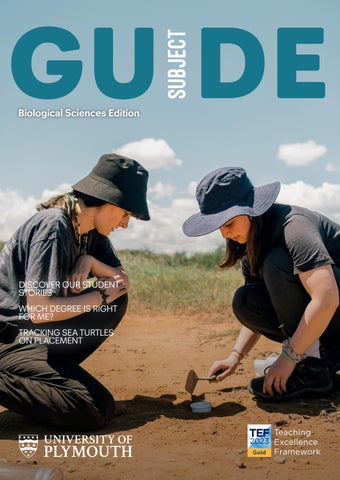
Biological Sciences Edition SUBJECT

DISCOVER OUR STUDENT STORIES

WHICH DEGREE IS RIGHT FOR ME?

TRACKING SEA TURTLES ON PLACEMENT

Gold
Admissions

+44 (0)1752 585858 admissions@plymouth.ac.uk plymouth.ac.uk

Schools & Colleges Outreach

Faculty of Science and Engineering sciengoutreach@plymouth.ac.uk

University of Plymouth Drake Circus Plymouth Devon PL4 8AA

United Kingdom

Biological Sciences

Follow us @PlymUniApply

Biological Sciences Edition

SUBJECT

It’s never too early to start thinking about what you would like to do after school or college, or if you are thinking of a career move! At Plymouth, we know that choosing a university and course is a big decision. While you may have an idea of a profession, career or industry that you’re aspiring towards, if you’re unsure of exactly what you want to do or are keen to find out more – this is where our handy subject guide comes in.

Meet some of this issue’s contributors:

Beth BSc (Hons) Biological Sciences

Beth gives her advice as a Biological Sciences student. P.10

Josh BSc (Hons) Zoology Josh shares his experience as a student at Plymouth. P.14

Will BSc (Hons) Conservation Biology (now BSc (Hons) Ecology and Conservation)

Will describes his career pathway as an ecologist. P. 36

EXPLORE YOUR FUTURE HOME

Visit us at an Open Day

When it comes to finding out if university feels right for you, nothing compares to an open day. Talk to current students and quiz lecturers about your course. You can register to attend here: plymouth.ac.uk/open-days

Start exploring –take a virtual tour

Our virtual tour allows you to experience firsthand what it is like to be on campus and explore the environments and facilities that inspire and shape our learning every day. You can take a virtual tour here: virtual.plymouth.ac.uk

FEATURES:

P. 8 Which degree is right for me?

Learn more about each of our Biological Sciences courses.

P. 22 Studying abroad?

Dave shares his tips on why you should study abroad for a year.

P. 24 Discover placement stories! Louisa and Victoria discuss their placement experiences.

P. 32 Career support

Learn more about what careers are available in Biological Sciences.

10 REASONS TO STUDY AT PLYMOUTH

2. FIELD TRIPS

There are plenty of opportunities for local and international fieldwork. Field trips present opportunities to apply your knowledge to different environments, and apply your hands-on practical skills. Previous field trips across our range of courses include the Azores, Andalusia, Costa Rica and Kenya.

1. ACCREDITED DEGREES

Learn on a degree accredited by the Royal Society of Biology (RSB). The RSB assesses biosciences degrees to support their ongoing advancement, equipping graduates with a well-rounded skill set making them highly employable.

4. PLACEMENT OPPORTUNITIES

Benefit from our extensive network, and boost your employability by taking a placement year anywhere in the world! See pages 23–31 to find out more.

3. UNIQUE LOCATION

The South West offers many amazing ecosystems, providing perfect opportunities to get hands-on with the practical aspects of the course.

5. PRACTICAL SKILLS

Within our Biological Sciences degrees, we believe that all of our students should have the ability to conduct practical work confidently and independently. The skills you will develop are popular with employers and make more employable graduates!

6. FRIENDLY ENVIRONMENT

Your personal tutor will provide both academic and personal support throughout your years at Plymouth. We take special pride in the enthusiasm and approachability of our staff, whose expertise is endorsed with years of research and work in the private sector.

"The lecturers are brilliant and are all really passionate. Our course is quite small so they're really personal, hands on and they know you!

Laoise, BSc (Hons) Conservation Biology (now BSc (Hons) Ecology and Conservation)

7. FACILITIES

We have well-equipped undergraduate laboratories, with specialised facilities including controlled environment chambers, Skardon Garden (the University’s glasshouse facilities), Plymouth Electron Microscopy Centre, Marine Station and a Lower Vertebrates and Invertebrates Laboratory. Access to these means you will enter the workplace familiar and confident in the use of the latest technologies.

8. CAREER OPPORTUNITIES

Graduates go on to work in varied areas from conservation organisations, ecological consultants, drug companies and industrial research labs. We’ll assist you throughout your degree to ensure that by the time you graduate you’ll be en-route to the career of your choice! Find out more on pages 32–33.

9. RESEARCH

Throughout your course, you’ll be taught by academics who are engaged in a wide range of research. Students have the opportunity to collaborate on some of these projects – see pages 16–17 for more information.

10. INTERNATIONAL OPPORTUNITIES

Students on our degree courses come from all around the world and will be supported by our international team. We also provide opportunities for you to study with an overseas partner institution or take part in an overseas work placement or internship. For example, Victoria (pages 28 -31) relocated nests, tagged nesting turtles and evacuated nests in Greece! See page 22 for more information. Find out about the opportunities available in your subject area:

WHICH DEGREE IS RIGHT FOR ME?

BS c (H ons) BIOLOGICAL SCIENCES

The broadest of all of our degree courses allows you to study the whole spectrum of biology from atoms to ecosystems. The balanced mixture of both laboratory and fieldwork will allow you to develop skills, so you can keep your options open to go on to a wide range of careers within biology and beyond.

ZIAD

BSc (Hons) Biological Sciences student

“I love the course as it meant I could do anything biology related. The lecturers are amazing; they are really helpful, so don’t be afraid to ask them anything.”

Find out more About our BSc (Hons) Biological Sciences degree

BS c (H ons) ECOLOGY AND CONSERVATION

Ecologists and conservation biologists are at the heart of our efforts to mitigate against biodiversity loss and anthropogenic climate change, and they will become ever more important in the future. You will be provided with the knowledge to understand biodiversity and ecosystems, and the practical skills to assess habitats and develop solutions to environmental issues.

LAOISE

BSc (Hons) Conservation Biology student (now BSc (Hons) Ecology and Conservation)

“I was first attracted to the course in Plymouth because I knew I wanted to study something with conservation, but I wasn’t sure what, and the modules and facilities really appealed to me.”

Find out more About our BSc (Hons) Ecology and Conservation degree

BS c (H ons) ZOOLOGY

This degree gives you the knowledge to be able to understand the biology of animals from their physiology and genetics, to their ecology and behaviour. Practical skills learned both in the field and the lab will allow you to go on to investigate a wide range of aspects of animal life.

OSCAR

BSc (Hons) Zoology student

“We go to labs almost every week and the lab facilities are amazing, as well as the things you learn in the lectures. Everything about the course so far has been above what I thought it would be.”

BS c (H ons) BIOLOGICAL SCIENCES WITH FOUNDATION YEAR

Our foundation year course provides you with the opportunity to progress on to any one of our three degrees. This pathway is for you if your current qualifications don’t allow you direct entry onto one of the degrees. This is also ideal if you are returning to education.

EDWARD BSc (Hons) Biological Sciences with Foundation Year student

“The foundation year route gave me the confidence to further my understanding of the key concepts that I needed to grasp in order to progress on to the first year of the BSc (Hons) Biological Sciences degree. The extra year to consolidate my learning was invaluable for me.”

Find out more About our BSc (Hons) Biological Sciences with Foundation Year degree
Find out more About our BSc (Hons) Zoology degree

BETH

BS c (H ons ) BIOLOGICAL SCIENCES

HOW I CHOSE MY COURSE

I chose the University to study Biological Sciences because of the vast array of environments within a radius of Plymouth. You can be by the sea scouring the rockpools at Devil’s Point and then in 20 minutes be up on Dartmoor studying the wildly different organisms there. I also thought that the academics here seemed so approachable and friendly, even as someone without any experience in the field, I felt welcomed and encouraged.

WHY I WOULD RECOMMEND MY COURSE

I would absolutely recommend Biological Sciences at Plymouth as it covers so many areas of biology, and the career prospects are so broad. The lecturers are also experts in the field themselves and they are fountains of knowledge when it comes to their subjects.

EXPANDING FACILITIES

The facilities at Plymouth are great and ever-expanding with more students taking an interest in biology as the years have gone by. From the laboratories in Davy Building to Skardon Gardens (the University greenhouses), there is so much to learn about and use to give you transferable industry skills that employers want.

SUPPORTIVE STAFF

The wide variety of academics and support staff at the University is unmatched. There truly is someone for everything. Whether you have a question about psychedelic fungi, mangrove tree populations, or abiotic stress in wheat, there is someone always willing to answer any questions you have and are almost always happy to get you involved where you can.

MY CAREER GOALS

After my degree, I am hoping to get some experience in the workplace by working as a technician for a few years before I study for a PhD. The end goal for me is most likely a role in academia. However my ideas have changed so much over the course of my study and the degree is so broad that I wouldn’t be surprised if it changes again!

SUPPORTING EFFORTS IN FOOD POVERTY AND FOOD SECURITY

Studying Biological Sciences has made me more aware of global challenges. However, it has given me much more hope as you see all the academics, researchers, technicians and students working on solving these problems. I am particularly interested in the area of food poverty and food security, and having the chance to make a real difference is a motivating factor in the continuing of my studies.

NICCOLET

BS c (H ons ) CONSERVATION BIOLOGY

(NOW BS c (H ons ) ECOLOGY AND CONSERVATION)

MY CHOICE

I chose to study at Plymouth because of all the great STEM courses the University offers, along with opportunities to study in a hands-on, independent way. This has encouraged my growth as a science student interested in both sustainability and wildlife protection. The course I chose, BSc (Hons) Conservation Biology (now BSc (Hons) Ecology and Conservation), provides me with both practical field experiences, lots of fun and activities that I feel will help me succeed. My first month was exciting, as I made new friends and delved into the focused and hands-on work provided by my course.

MY MOST MEMORABLE CLASS

My most memorable class thus far is probably the Methods in Biology (BIOL234Z) module, where we took DNA samples and used them to identify the species of fish the samples were from. It was exciting and interesting as I had limited experience in a lab setting. Seeing potential for a career and learning complex information about genetics and DNA has inspired me to pursue something on this pathway.

MY SUPPORT

Moving to a new country is exciting, but it can sometimes be a little lonely at the beginning. The University has provided me with support by being there for my mental health and offering counselling services and opportunities to meet other international students. Not only that, but the Students’ Union can also help with a wide range of things, from housing to

employment and work placements – all aspects which have helped me to be a more successful student and welladjusted adult.

MY SOCIETY

I joined the Wildlife and Ecology Society at the University. I picked it because it relates a lot to my chosen course and gave me a lot of opportunities to meet new friends and volunteer in areas and activities that are close to my heart.

MY MOST MEMORABLE EXPERIENCE

One of my most memorable nonacademic experiences since moving to Plymouth, has been morning hikes in the beautiful scenery surrounding the city. It was so satisfying to take the Cremyll Ferry and hike a few miles to a pretty and hidden beach and just bathe in the sun.

MY TYPICAL WEEKDAY

A typical weekday starts with a lecture or two, followed by lunch with a friend or at one of the cafes on campus. After that, I usually head home and do some revision or attend my next lecture, and then spend my afternoons trying new recipes, spending time with my friends or going on walks by the Hoe or Barbican, where there’s always lots of cool handmade art or live music playing.

SUPPORTIVE STAFF

My lecturers are great, they’re all really passionate and you can go to them about anything. If you find something difficult in a lecture, they’re always happy to stay behind for ten minutes and explain it to you, or you can go to their office, as they’re always available to help!

MY ADVICE ABOUT STUDYING ZOOLOGY

I would say 'do it' even if you have the slightest passion for animals. I genuinely think you’ll love it and it will push you further into the fields you want to be in!

“ There are so many options out there, but studying zoology has really helped me narrow down what I would like to do.”

UNDERSTANDING DIFFICULT CONCEPTS

There are in-depth areas such as data analysis where we use software like RStudio, and as someone who didn’t come from a coding or technical background, it was difficult for me to understand it at first, but thankfully there was help in place. This included a whole module which taught us how to use it; in addition, the lecturer was always there to help. We also have online courses which the lecturer set up for us and there are loads of different things on the digital learning environment.

MY FUTURE CAREER

There are so many options out there, but studying zoology has really helped me narrow down what I would like to do. I would like to do something with conservation or research because I enjoy those two fields. They can make a good impact and the coursework really helps you get into the research side which I really enjoy.

RESEARCH EXPEDITION

There are opportunities for undergraduate students across the school of Biological and Marine Sciences to participate in our staff's field research.* This opportunity means students get to experience what research is like first-hand, in addition to learning transferrable skills such as project management, dynamic troubleshooting and resilience in context.

Past expeditions include:

• Local fish sampling to aid research in addressing conservation and fisheries management issues.

• Monitoring an Indonesian coral reef in North Sulawesi and learning about the reef’s organisms' biodiversity, ecology and identification.

• Conducting experiments and surveys to understand the ecology and diversity of fishes and coral health on the Great Barrier Reef, Australia.

• Yacht-based marine mammal and seabird surveys to contribute to conservation of coastal populations between Plymouth and the Isles of Scilly and Sussex.

• Understanding colour variations in butterflies in the Azores archipelago.

"I can confidently class this expedition as one of the most poignant and fulfilling experiences of my life.”

Ana, BSc (Hons) Marine Biology and Oceanography

“This research expedition was the most breathtaking experience. I feel honoured to have had the chance to help conduct such amazing research on the current state of the Great Barrier Reef."

Josh, BSc (Hons) Zoology

OUR FIELD TRIPS

Fieldwork presents opportunities to apply your knowledge to different environments, and to consolidate your practical skills. Field trip locations for our courses have included Spain, Kenya, Costa Rica and the Azores.*

Past topics and activities in these locations have included:

• forest sampling methods

• habitat investigation

• camera trapping

• habitat surveys

• morphological measurements

• boat-based surveys for cetaceans

• invertebrate survey techniques

*Locations are subject to change.

• acoustic analysis

• animal tracking and ID

• biochemistry of extremophilic microorganisms

• detection of human parasites and their vectors using eDNA.

“Today we were lucky enough to see howler monkeys on the way to breakfast!”

Holly, BSc (Hons) Conservation Biology (now BSc (Hons) Ecology and Conservation)

“There are so many things out here that you would not see anywhere else in the world.”

Ryan, BSc (Hons) Biological Sciences

“This field trip has been the highlight of the course!”

Marilyn, BSc (Hons) Zoology

“This field course has introduced a lot of new skills, like tracking animal footprints and using them to survey what’s in the area.” Josh, BSc (Hons) Zoology

“It’s a great experience to be in an unfamiliar environment and do techniques you perhaps can’t do in the lab, and have some fun while you’re doing it!”

Josh, BSc (Hons) Conservation Biology (now BSc (Hons) Ecology and Conservation)

“My favourite experience was visiting a rhino sanctuary. We were able to see the last two Northern White Rhinos – it was a really special experience and it’s something I’m never going to forget.”

Sophie, BSc (Hons) Zoology

"Field trips are really important because they give us a chance to get out in the field, and we get really in-depth time with lecturers to absorb their knowledge, which is an amazing experience.”

Hannah, BSc (Hons) Biological Sciences

"The field trips for Biological Sciences were incredible. During my time studying, we went to Slapton Sands in the first year and the Azores in the second year. The fieldwork and assignments there gave me a chance to use skills we had been taught on campus, like ID and data collection,

in real instances and also teamwork and presenting data. From a social perspective, it also provided me a chance to get to know my course mates more, and even the lecturers too which was great."

Beth, BSc (Hons) Biological Sciences

“Going into the field motivates you and allows you to visualise things you’ve seen in real life and how you would apply that in the field.”

Erin, BSc (Hons) Zoology

Studying Abroad

DAVE WALKDEN

Dave leads a small team whose job is to make your study abroad aspirations come true.

WHY SHOULD YOU GO ABROAD?

The sheer excitement of experiencing a new culture, meeting new and interesting people, and understanding the world from a bigger perspective – can change you, your life, your career and your future, and will improve your academic and job

“We try our best to get you to where you want to go, but wherever you do go, you will not regret it. It is always interesting to hear their experiences.”

prospects. This is backed up by research over many years, tracking the careers of our graduates.

WHAT IS YOUR EXPERIENCE WITH BIOLOGICAL SCIENCES STUDENTS?

We regularly help students on any of the Biology related courses study aboard. Previously, they have studied abroad in the USA, Canada, the

Netherlands, Germany, Spain, Portugal and Croatia. We try our best to get you to where you want to go, but wherever you do go, you will not regret it. It is always interesting to hear their experiences.

IS THERE FINANCIAL SUPPORT FOR STUDENTS TAKING PART IN AN INTERNATIONAL EXCHANGE?

Yes, depending on your circumstances, there is a range of possible financial support such as tuition fee reductions, maintenance loan enhancements, and cost of living and travel grants to help you on your way. Keep in mind: we want you to go and will do our best to make it happen!

Find out more about our exchange opportunities.

PLACEMENTS AROUND THE WORLD!

You are given the opportunity to gain real-world experience with an optional work placement between your second and final years. With a minimum of six months, though many students opt to spend up to 12 months, you can work in a company or university anywhere in the world! You will be supported by a Placement

Adviser – a member of academic staff from the School of Biological and Marine Sciences – who will act as your point of contact.

Examples of placement providers have been highly diverse, from working in nature reserves and bird sanctuaries in Denmark to fieldwork in the Arctic Circle!

PLACEMENTS

AMAZON ADVENTURE AN

HOW DID YOU HEAR ABOUT YOUR PLACEMENT OPPORTUNITY TO THE AMAZON?

I knew I wanted to go to the tropics as it would be a valuable experience. I discovered Merazonia – a wildlife rescue and rehabilitation centre situated on 250 acres of rainforest in Ecuador – on Volunteer World while searching for placements.

What drew me to Merazonia is that they have a strict hands-off policy with their rehabilitation (obviously there are some exceptions to this policy) meaning that they are an ethical organisation and put the welfare of the animals in their care as their top priority.

The Amazon stood out to me because going there had been on my bucket list ever since I did a school project on it back when I was eight years old. I managed to make that happen with the help of the Turing Scheme funding.

WHAT WAS WORKING IN THE AMAZON LIKE?

Working in the Amazon was amazing! So much so I am planning on returning next year and maybe long term once I have done a masters.

WAS IT WHAT YOU EXPECTED?

I have done voluntary work in the rainforest of Costa Rica before and so I had an idea of what to expect. However, the experience I had definitely exceeded my expectations by far. I really liked living in a wood cabin with only mesh windows and no electricity.

WHAT DID YOU LEARN WHILE YOU WERE THERE?

Where do I begin? I learnt so much at Merazonia to do with rehabilitation, especially for young animals. I was lucky enough to be trusted with, and actively involved in, the one-toone rehabilitation of three young animals throughout my time there –

Shimi, a baby woolly monkey, a baby giant anteater called Goliath and a young tamandua named Federico. I witnessed the tamandua successfully be released and thrive out in the wild on his own. He taught me a lot about how dedicated you need to be when providing one-to-one rehabilitation.

As I want to go into primatology, being trusted to take a very young and vulnerable woolly monkey out into the jungle to teach her what her mother would be showing her was a highlight. It taught me a lot about how they communicate and behave.

Plus, I witnessed her doing behaviours and trying to communicate with me in ways that I had seen the other baby woolly monkeys had done with the adult woolly monkeys that they were with.

“ It is incredibly rewarding to see animals going from being on the brink of death to thriving and living the life they should be – which is what I witnessed with the young tamandua I cared for.”

DID YOU PICK UP ANY NEW SKILLS?

I became a plant expert (although not in the technical sort of way) because due to the diets of the primates, they often have a particular palate related to leaves that they will eat. I had to be able to quickly identify leaves that a woolly monkey would eat compared to more sparse leaves that the red howlers would eat. When working with these primates, most of the day consisted of being out in the jungle finding these particular leaves. This was crucial to learn because some leaves could have adverse effects on their health.

Before learning all the different leaves, I would just look at the jungle and see green. Now I can spot certain ones from afar and strangely, even though I’m no longer in the jungle, I am still unconsciously thinking about if the primates would like the leaves I see in my everyday life.

WHAT WAS THE MAIN LESSON THAT YOU LEARNT WORKING IN WILDLIFE REHABILITATION IN THE AMAZON?

I quickly learnt that wildlife rehabilitation isn’t for the faint-hearted and requires a lot of hard work and patience. In South America especially, rehabilitation centres are receiving animals that have been seized by the ministry out of the illegal pet trade, and so it can be hard witnessing animals in such distress and poor condition as a result.

It is incredibly rewarding to see animals going from being on the brink of death to thriving and living the life they should be – which is what I witnessed with the young tamandua I cared for.

HAS THE EXPERIENCE CHANGED YOUR IDEAS OF YOUR CAREER PATH?

My experience at Merazonia has enhanced my career path. Before going out, my focus was in situ

primate research. However, the experience I gained in wildlife rehabilitation, especially with a variety of primate species, showed me that I would also like to go into primate rehabilitation. This works hand-inhand with the research part of my career path, and means I could do both at the same time.

WOULD YOU RECOMMEND SIMILAR PLACEMENT OPPORTUNITIES TO OTHER STUDENTS?

1000%, the rainforest is a lifechanging place! It not only teaches you a lot about the natural world, but it also allows you to discover things about yourself that you may not have realised. It is an invaluable experience to have on your CV. If there are any students looking to go to the rainforest, I really do recommend Merazonia, it was truly amazing there.

Gerakas beach and rocky peninsula, a clear water sandy shore and natural protected hatchery of Caretta caretta sea turtles, Zakynthos island, Ionian Islands, Greece.

PLACEMENTS

TRACKING SEA TURTLES IN GREECE

Victoria

BSc (Hons) Conservation Biology (now BSc (Hons) Ecology and Conservation)

My first placement was with the Sea Turtle Protection Society of Greece in Archelon, Zakynthos. I was fortunate to work in two different projects, in three different roles, across the year.

During the first summer, I spent two and a half months on a loggerhead sea turtle nesting project in the Bay of Lagana, working in collaboration with the National Marine Park of Zakynthos. My January was spent at a rescue centre in Athens, before I returned to Zakynthos in my second summer for a leadership role. My responsibilities involved the monitoring and data input of three nesting beaches and leading surveys with groups of volunteers. I was fully trained to relocate nests, tag adult nesting

“One day we did a release of a sea turtle I had known from the rescue centre, so it was really nice to see her go back to the sea.”

turtles, insert Passive Integrated Transponder (PIT) tags and excavate nests.

As a morning survey leader for both nesting and hatchling season, I was responsible for leading a small group of volunteers on the beaches each morning. I learned how to read and interpret tracks of both adult and hatchling turtles, determine whether a

nest had been laid or hatched, take necessary data, implement protection measures and inform the public. I also led on expeditions to deal with stranded sea turtles, and on night surveys, where we would tag and take data on turtles that were currently nesting.

One day, we did a release of a sea turtle I had known from the rescue centre, so it was

really nice to see her go back to the sea. It just felt that was what we were there to do – the monitoring of the research but also educating the public.

It was amazing to see all the volunteers interacting with the tourists. Everyone spread out on the beaches, all with their own roles, mingling with the tourists and informing them what we were doing.

I would definitely recommend doing the placement year option because you have the time, the support of the University and the chance to get as much experience in as many different places as you can.

Find out more about Victoria’s placement experience.

CAREER SUPPORT

Our courses are specifically designed to cover a wide range of topics and develop hands-on practical and technical skills on campus and in the field, meaning you will be highly employable across a range of careers.

Graduates have gone on to work in areas from conservation organisations and ecological consultants to drug companies and industrial research labs. See a list of roles and employers from past graduates within the cluster of biological sciences to the right.

ROLES:

• Associate Regulatory Publishing Specialist

• Biological Researcher

• Data Analyst

• Environmental Consultant

• Molecular Scientist

• Policy and Communications Officer

• Seasonal Ecologist

• Trainee Countryside Ranger

• Water Quality Inspector

EMPLOYERS

• Conservation Chat UK Ltd

• Environment Agency

• Lighthouse Laboratory

• Marine Academy Plymouth

• Natural England

• RSPCA

• Thomson Environmental Consultants

• Tropic Biosciences

• Wessex Water

Get in touch!

Follow us on ,  or @uniplymcareers

Contact us or visit our website for more information.

 careers@plymouth.ac.uk

 +44 (0)1752 587456

 plymouth.ac.uk/careers

Meet Jon Christie, our Careers and Employability Consultant (STEM specialist). Jon has been working in the university careers sector for over 20 years.

HOW DO YOU SUPPORT THE CAREER PROSPECTS OF OUR STUDENTS?

One of the important parts of my job is to make students aware of the breadth of opportunities that are open to them, both during and after they graduate.

THIS IS FACILITATED BY:

• course-based lectures on employability in all three years of study

• the opportunity of doing a year-long work placement

• inviting employers and alumni onto campus via careers fairs, employer panels and specific academic activities.

WHAT CAREER SUPPORT SERVICES DOES THE UNIVERSITY OFFER?

The Careers Service offers students one-to-one careers guidance at any point during their studies, and continues after graduation so that graduates can continue to benefit from support with:

• Job hunting, application writing, CVs,

networking and interview skills.

• Attending five on-campus careers fairs including a specific STEM fair in November.

• A work placement programme using our extensive industry contacts (with many opportunities being paid).

• An industry mentoring scheme that matches you with a specific industry individual who will meet with you on a regular basis to provide valuable insights into a specific sector.

University of Plymouth alumni, who are now working in key areas are invited to become mentors and use the scheme to give something back and to spot future talent.

• Our myCareer vacancy platform hosts an extensive database of graduate, placement and part-time opportunities. You can sign up for events such as employer panels, enterprise competitions or mentoring. myCareer also holds a range of highly specialised

digital tools such as a CV builder, an interview simulator, online courses and video resources. Access to myCareer is available to our graduates at any time in the future.

HOW DO YOU JUDGE THE JOB PROSPECTS FOR BIOLOGY GRADUATES?

Excellent – currently demand for all science graduates is extremely high in a number of sectors, but also many of the academic skills learned are transferable across a very broad range of STEM employer sectors. Graduate salaries are also very competitive and for many students doing work placements, it is highly likely that you may well be offered a graduate role with the placement host after completing your final year. This is also reflected by the great willingness of employers seeking to recruit our students by engaging with our events, recruitment fairs and online vacancy platform.

GRADUATE STORIES

NICHOLAS

P h D STUDENT

MY CAREER PATH

After finishing my undergraduate study, I chose to remain at Plymouth where I began a PhD. The aim of my project is to investigate the impact that changes in the agricultural landscape may have upon ecosystem processes and services.

Being given the opportunity to carry out a PhD is very challenging, but a huge privilege with studentships being highly sought after and competitive. I enjoy the diverse subject matter that my PhD has allowed me to investigate.

MY BEST MOMENT IN MY CAREER

I attended and presented at my first major conference, the annual British Ecological Society conference held in Liverpool, which is the largest ecological conference outside of North America. The three day event was a very enjoyable experience that allowed me to meet and discuss my work with students and researchers in both similar and diverse fields.

WHY I CHOSE PLYMOUTH

Plymouth offered a very broad-based degree which provides a diverse range of experience well suited to both scientific research and employment, where interdisciplinary skills are seen as very important. The ability to undertake a work-based placement was also invaluable and allowed me to gain

ecological experience working for the Whitley Wildlife Conservation Trust on their reserve at Slapton Ley.

MY FAVOURITE MEMORY STUDYING AT PLYMOUTH

Fieldwork is always a highlight for me and visiting ‘my’ field site at Slapton Ley during the summer of my placement, was probably one of the most enjoyable aspects of my degree. I have an interest in all taxa but studying insects, as I was at the time, meant that every square metre becomes something of a rainforest with a wealth of biodiversity.

HOW PLYMOUTH PREPARED ME FOR MY CAREER

Plymouth provided me with a sound theoretical knowledge base in a broad range of disciplines, as well as giving me the practical experience required to undertake future projects. My time at the University also gave me a confidence and resilience that is invaluable to scientific study where solutions are not always easy to come by.

WILL

ECOLOGIST AT JOHNS ASSOCIATES LTD

WHY I WANTED TO STUDY AT PLYMOUTH

I was drawn to study at Plymouth as the course allowed for freedom to choose from a wide range of modules and design your own personal project for your dissertation. I have an interest in tropical biology so the field course to tropical Costa Rica was a big draw! The staff were also very friendly and were very passionate about what they did, which greatly improves the quality of the course.

I would definitely recommend studying at Plymouth, particularly for a biological science degree, as there are scholars with a wide range of interests and there is something for everyone. There certainly was for me, and I greatly benefited from this throughout my time at uni. The surrounding area is also a beautiful part of the country with lots of potential interest to a budding biologist. Certainly, one of the best areas of the country to get outdoors!

FACILITIES

During my final year, working on my dissertation, I found myself using the labs a lot. I was in there every day for about four weeks straight. They were equipped with all that I needed, and I was able to speed through my data without a hitch. They also had an excellent collection of creatures and critters which, as an entomologist, I greatly appreciated.

MY PLACEMENT EXPERIENCE

My placement year was one of my favourite parts of my degree. It opened me up to potential career paths I could go

down to work in a field of my interest. I was able to learn skills outside of the curriculum of my degree, and improve my skills for the final year of my degree and my career following. I learned lots of theoretical, taxonomic skills while working in a collection at the Natural History Museum in London, work-based community outreach skills at Pollenize CIC in Plymouth, and field skills in Panama with a local researcher who I can now call a close friend. I made contacts all over the world, particularly in the Americas, such as the USA, Panama and Colombia. My placement year sent me on a trajectory I am now following to develop my career as a scientist and researcher.

MY

CAREER PATH

So far, I have worked for two consultancy companies. For one I have worked with a variety of species from bats, mice and newts and learned a variety of survey techniques. For the other company, I have been practising my invertebrate surveying skills using light traps and my insect identification, while going through the samples. I have greatly enjoyed practising my survey skills and learning new techniques along the way.

MY MOST REWARDING CAREER MOMENT

During my placement year, I produced a manuscript at the Natural History Museum, cataloguing a tribe of scarab beetles stored in the collection. This manuscript was published in late 2022. To be published before I finished my degree has been a great personal achievement of mine, and to have a paper in my area of work will hopefully open

doors in the future. I have more manuscripts in the work, and I hope to continue to publish throughout my career.

THE IMPORTANCE OF STUDYING WITHIN THE BIOLOGICAL SCIENCES CLUSTER

My degree within the Biological Sciences cluster educates a student on a variety of issues, such as biodiversity loss, habitat destruction/fragmentation, pollution, over-exploitation and much more. Making students aware of these causes facilitates progress and allows them to work towards resolving these global issues by in-depth explanation of theory and methods.

I knew I wanted to work with tropical montane forests and my degree showed me issues in these ecosystems, in this case, climate change and habitat destruction, and what this environment provides for nature and communities. I then looked more in depth at these issues and explored work in this area that were touched on in lectures and workshops. This allowed me to explore a variety of methods to help resolve global challenges in my own way in my area of work.

ECOLOGIST AT ATMOS CONSULTING LTD

ELLIE

WHY I WOULD RECOMMEND PLYMOUTH

Absolutely I would recommend studying at Plymouth. It is such a great community and the amazing societies and sports clubs run by UPSU, that you can take part in alongside the course are a brilliant way to make the most of your time at university. Plymouth has so many incredible projects happening on its doorstep that you can get involved in. I had the opportunity to do work with the South West Lakes Trust checking bat boxes around Devon, developing skills that I am putting to use in my current job role today.

USING THE FACILITIES

The facilities for conservation biology are very good. The labs for lab work are really modern and have some incredible technology in them that will enable you to learn skills that can be used in the workplace after graduation. For my dissertation, I used the computer labs for a lot of my data analysis and was able to use new and exciting software for this.

MY PLACEMENT EXPERIENCE

I completed a placement year as a research assistant to Dr Louise Firth at the University. We were studying molluscs, ranging from changes to their reproductive behaviour as a consequence of climate change, to the benefits of the ‘greening’ of infrastructure such as sea walls on mollusc communities. The year helped me in so many ways. Firstly, I made some great contacts in the field on

marine ecology, broadening my prospects for future careers as up to this point I had been mainly involved in terrestrial ecology. Furthermore, I was able to aid fieldwork with PhD students, and lab work with masters students, therefore opening my eyes to the world of further education, a path I may go down in the near future.

FIELD TRIPS

The field trip to Slapton Ley FSC was what inspired me to pursue a career in local British wildlife. Learning skills such as small mammal trapping, bat detection, and plant identification is what, I believe, got me my most recent role as an ecologist in Scotland.

HOW STUDYING AT PLYMOUTH INFLUENCED ME

Seeing such motivated lecturers that were passionate about the subjects that they study had such a large influence on me. Having meetings and discussing my future career with different lecturers was really beneficial and helped with getting contacts for jobs post-university.

MY CAREER PATH

After finishing my final year exams, I went on to do a research internship in Costa Rica, studying bird community composition as a result of differing reforestation techniques. This was an incredible experience as I had not been able to go as a result of the pandemic, so finally getting out there felt like a dream come true. Upon returning to the UK, I took the role of graduate

ecologist at Atmos Consulting Ltd in Inverness and now travel the Highlands completing ecological surveys.

THE IMPORTANCE OF STUDYING WITHIN THE BIOLOGICAL SCIENCES CLUSTER

Studying my degree in the biological sciences cluster is essential for any change to happen in terms of reversing the effects of climate change etc. If more people study the challenges the Earth faces, then there will be more people that want to fight to do something about it. During my course, I learnt about the devastating effects of a changing climate on terrestrial, marine and freshwater environments, and how we are already seeing drastic declines in the biodiversity within them. Furthermore, the course opened my eyes to the other challenges the natural world faces, such as land use change and anthropogenic infrastructure. These issues are a large part of my current role as an ecologist, in which I take steps to mitigate such negative effects on the natural world.

IT’S YOUR ADVENTURE MAKE IT COUNT

Over 95% of our graduates are in work or further study* Apply now

Turn static files into dynamic content formats.

Create a flipbook
Subject Guide Biological Sciences Edition by University of Plymouth - Issuu