
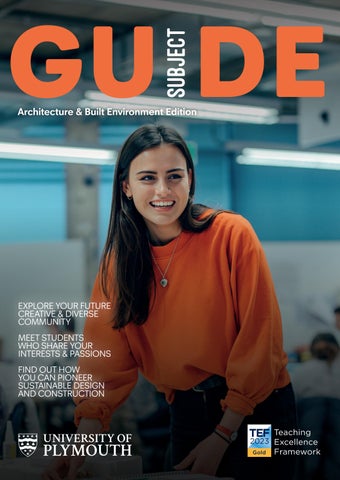
Subject Guide Architecture & Built Environment Edition

Page 1


Architecture & Built Environment Edition

EXPLORE YOUR FUTURE CREATIVE & DIVERSE COMMUNITY

MEET STUDENTS WHO SHARE YOUR INTERESTS & PASSIONS

FIND OUT HOW YOU CAN PIONEER SUSTAINABLE DESIGN AND CONSTRUCTION

Gold
Admissions

+44 (0)1752 585858 admissions@plymouth.ac.uk

Schools & Colleges Outreach

Faculty of Arts, Humanities and Business foabhoutreach@plymouth.ac.uk

University of Plymouth Drake Circus Plymouth Devon PL4 8AA United Kingdom

Follow us @plymuni @plymuniapply @plym.built.environment @plymuniarch

Architecture & Built Environment Edition

SUBJECT

It’s never too early to start thinking about what you would like to do after school or college, or if you are thinking of a career move! At Plymouth, we know that choosing a university and course is a big decision. While you may have an idea of a profession, career, or industry that you’re aspiring towards, if you’re unsure of exactly what you want to do or are keen to find out more – this is where our handy subject guide comes in.

Meet some of this issue’s contributors:

Inside...

FEATURES:

P.8 Which degree is right for you? A summary of the degrees on offer within our Architecture & Built Environment subject area.

P.29 Beyond the lecture theatre Learn through experiences – we take you off-campus on insightful site visits and inspiring study trips.

P.30 Work experience and placements Your time at Plymouth will encourage you into the professional workplace, enabling you to gain real-world skills.

P.46 Offering an ultra-low carbon alternative to concrete Discover our CobBauge Building – a living lab for energy-efficient buildings of the future.

EXPLORE YOUR FUTURE HOME

Visit us at an Open Day

When it comes to finding out if university feels right for you, nothing compares to an open day. Talk to current students and quiz lecturers about your course. You can register to attend here plymouth.ac.uk/open-days

Start exploring –take a virtual tour

Our virtual tour allows you to experience first hand what it is like to be on campus and explore the environments and facilities that inspire and shape our learning every day.

P.48 Where will your degree take you? Alongside your studies, we’ll support you in the realisation of your career goals, and help you get to where you want to be.

Asala BSc (Hons) Architectural Engineering
Asala shares her special memories of studying at Plymouth and her sense of belonging. P.54
Freya BA (Hons) Architecture
Freya shares what she enjoys about her course and her motivations for choosing Plymouth. P.18
Sam BA (Hons) Architecture
Sam describes his architecture adventures to Vanuatu, after graduation. P.52

10 REASONS TO STUDY AT PLYMOUTH

With ever evolving challenges in the field of architecture and the built environment, are you ready to join us on our mission to deliver climate responsive and inclusive design for diverse communities?

1. LEARN IN OUR STATE-OF-THE-ART FACILITIES

You’ll have extensive access to our Digital Fabrication and Immersive Media Laboratories, MAC Labs, as well as our brandnew, £63m engineering and design facility, Babbage Building.

“The facilities are great. A student couldn’t want for anything more at the University of Plymouth.”

Katelin, BA (Hons) Architecture

2. BUILD LINKS WITH INDUSTRY

Plymouth is the perfect springboard to build your own influential network with industry professionals. With the support of our Careers Service, we help you secure work experience and placement opportunities with industrial partners, enabling you to make a strong impression on big name employers.

“The course provided great opportunities for networking, which assisted me in securing my placement year with Arcadis as a Project Manager.”

Jagoda, BSc (Hons) Construction Project Management

3. DEVELOP YOUR ETHOS

Your coursework will address pressing contemporary issues, including cultural diversity, climate sensitivity, as well as material and carbon lifecycles. You will produce work that is contextually relevant and ethically sensitive to its time, place, and people. When you graduate, you will have developed your awareness and ability to deliver sustainable and community centred projects, based on your distinct Plymouth ethos and values.

4. VENTURE BEYOND THE CLASSROOM

Enrich your learning each year with inspiring architecture field trips and construction site visits, which will expose you to innovative urban developments across Europe. Previous destinations have included (amongst many others): London, Barcelona, Paris, Rome and Porto.

5. COLLABORATE ON LIVE PROJECTS

You’ll have the opportunity to engage with industry professionals, clients and partner organisations on the development and resolution of live projects, as part of your degree.

“We take initial concepts and proposals right through to the end build. You see the whole process.”

Samantha, BA (Hons) Architecture

7. DRIVE SUSTAINABILITY

6. WORK BEFORE YOU GRADUATE

One of the biggest sector-wide challenges for new university graduates is having demonstrable skills and experience after their studies. At Plymouth, you will be guided and encouraged to gain valuable work

experience between your years of study, and on some of our courses you will have the option to undertake an optional placement year. Such experiences carry huge value, as you can impress employers not only with your sound knowledge, but crucially with your demonstrable experience, which is often the clincher for recruiters!

Be part of the climate solution. You will learn what it really takes to design and manage the construction of truly sustainable buildings that use less energy, while still providing comfortable and usable indoor environments. As a University, we’re on the path to deliver a net zero carbon future, not only for our institution, but also for the global communities that we support through our research. This commitment has earned us the accolade of the second carbonneutral university in the UK, verified to PAS 2060 standard.

9. BE PART OF A CREATIVE AND DIVERSE COMMUNITY

Our inclusive culture will support you to develop your own creative identity and practice in a way that is authentically true to you. You will feel a sense of belonging, as part of a cohort of like-minded students, where all values and beliefs are respected and harnessed throughout your time at Plymouth.

8. LEARN FROM EXPERTS

Alongside building close, professional relationships with our knowledgeable, accomplished (and yet highly relatable!) lecturers, you will also benefit from numerous industry-specific events, with guest lectures and workshops delivered by globally distinguished and multidisciplinary practitioners and scholars.

10. STUDY AN ACCREDITED DEGREE

All of our Architecture & Built Environment degrees are accredited – reflecting the academic rigour, quality and relevance of our courses – by one or more of the following industry-leading external bodies:

Royal Institute of British Architects (RIBA)

Chartered Institute of Building (CIOB)

Chartered Association of Building Engineers (CABE)

Royal Institution of Chartered Surveyors (RICS)

WHICH DEGREE IS RIGHT FOR YOU?

BA (Hons) ARCHITECTURE

Ready to channel and apply your creative impulses and imagination to real-world built environment problems? Through critical thinking, hands-on work with a community of expert practitioners, designing and making, our professionally accredited architecture degree will give you the experience, skills and resilience to become a progressive thinker who can confidently design sustainable and inclusive solutions to our planet’s future challenges.

*BSc (Hons) BUILDING SURVEYING

Build your knowledge and skills in the physical care, repair, conservation, restoration and refurbishment of buildings. The combination of lectures, site visits, tutorials and an optional year-long paid industry placement will prepare you for a range of routes in the construction and surveying sector, including building surveying, property management, project management or building regulation.

*BSc (Hons) QUANTITY SURVEYING

This industry-recognised course will help you develop knowledge and skills in the commercial and financial management of construction projects. Through lectures, tutorials with industry partners, real assessments and projects briefs, and an optional year-long paid industry placement, you will learn the requirements for managing risk and proving value for a variety of clients, considering sustainable and ethical dimensions.

BSc (Hons) ARCHITECTURAL ENGINEERING

With an increasing demand for architects and engineers who can provide multidisciplinary knowledge and skills, our architectural engineering degree combines the creativity of architecture with the rigour of building engineering, preparing you for a successful future career designing and engineering the built environment. Learn how to apply the principles of environmental design and engineering and deliver the sustainable buildings of the future.

*BSc (Hons) CONSTRUCTION PROJECT MANAGEMENT

Build your knowledge and skills in construction technology, processes and management to develop a successful career as a construction project manager. The combination of lectures, site visits, tutorials with industry partners and an optional year-long paid industry placement will prepare you for a range of routes in the construction sector, including project management, site organisation, estimating and planning.

*FLEXIBILITY

If you’re unsure, or your interests change as you get to know more, look for our select degrees* that share common first-year modules. Transferring from one of these select degrees to another (upon successful completion of your first year) may be an option, enabling you to redirect your learning to suit your evolving interests.

“One of the best parts of the course so far are the real-world design projects. They are a great way to learn how to manage and be part of a team.”

Daniel, BSc (Hons) Architectural Engineering student

“It was at Plymouth that I began thinking critically about agency, participatory design and the social context of architecture.”

Grace, BA (Hons) Architecture graduate

“I would recommend my course to anyone who enjoys working in a team but also to people who enjoy taking the lead on projects. My course is for people who care about the environment and for anyone who wants to have a great start in their professional life.”

Jagoda, BSc (Hons) Construction Project Management student

ARCHITECTURE AN ETHOS FOR

“BA (Hons) Architecture at the University of Plymouth is foremost about people. The contexts in which we operate, as well as the people that inhabit them, are diverse and nuanced. As are our students and the research and backgrounds of our academic team. Our embrace and appreciation of diversity is the strength of our community and the value of what we give back to the world through our architecture.”

HOW WILL STUDENTS DEVELOP THEIR PRACTICE?

We believe that meaningful proposals for climate-responsive design – at the core of all our design work – begin with empathy and understanding for people and their communities in the places where we work. Hence, you will work in real contexts and engage with real-world stakeholders to inform your work and respond supportively with propositions that are strategically aligned from their urban contexts, through spatial sequences, to the details and experiences of inhabitation.

WHAT FACILITIES ARE AVAILABLE?

Our state-of-the-art fabrication and prototyping facilities, as well as our broad network of technical and professional practitioners, support our commitment to low-carbon architecture through projects centred on material and constructional innovations, and regenerative design. We are interested in the enhancement of the crafts of making and encourage learning through handson experimentation with tools and materials to find contextually relevant structures and aesthetics.

WHAT DOES IT MEAN TO STUDY ARCHITECTURE AT PLYMOUTH?

You will study architecture as a discipline, exploring more than the practical delivery of structures and spaces, but also appreciating the social and experiential meanings of environments. We are conscious of the importance of identity. To intervene in an environment is to bring about change, and we encourage personal and community focussed changes that respect cultural and human diversity. We hence imbue our design thinking with critical sensitivity towards the

histories and theories of architecture past, present, and future to develop critically conscientious architects.

HOW DOES TECHNOLOGY INFORM STUDENTS’ WORK?

Architectural practice is increasingly diverse. As technological innovations and modes of design and construction advance with increasing rapidity, architects are required to adapt accordingly. Our architecture is thus explored through multi-modal toolkits and encourages experimentation with advancing media approaches, such as

gaming; virtual space; parametricism and data; and film, animation, and sonic experimentation. This is supported by our cutting-edge equipment and immersive media laboratory, which will allow you to explore spatial perceptions from prototypical to highly experimental propositions.

HOW ARE STUDENTS PREPARED FOR SUCCESS?

Throughout this course of study, you will engage with the research informed approaches of our academic team to become a critically

engaged professional. Concerns for advancements in public safety, professional responsibility, and collaborative practice are at the root of our programme of study, as we seek to shape you as an architect that can lead, as well as respond, to the needs of the future.

ENVIRONMENT SHAPING THE FUTURE BUILT

With Built Environment Studios to learn in, as well as a diverse range of advanced instrumentation – including thermal cameras, as well as light and sound meters – Plymouth equips you with the knowledge and skills you will need to thrive in the construction sector.

“The University’s focus on digitalisation and the environment attracted my attention. Whilst studying, I also appreciated the final group projects, as we were able to cooperate and learn from the industry professionals.”

Jagoda, BSc (Hons) Construction Management student

Choosing to study one of our built environment programmes – BSc (Hons) Architectural Engineering, BSc (Hons) Building Surveying, BSc (Hons) Construction Project Management, or BSc (Hons) Quantity Surveying – you will develop your understanding of the building and construction sectors through lectures, taught group workshops, tutorials, seminars, and practical sessions. You will learn using cutting-edge resources and equipment and have access to a designated design studio

space, specialist laboratories (materials and immersive visualisation), as well as Mac and PC suites with industry-standard software (such as Revit, AutoCAD, MS Project and BCIS database).

Experiencing guided site visits with your lecturers and host contractors will demonstrate to you the variety of roles involved on building sites, as well as the regulations and procedures required to maintain safe, sustainable, and productive operations on-site.

We regularly welcome external expertise from industry leaders to demonstrate the most specialist equipment, such as our SoundCam Ultra acoustic camera. This enables you to get hands-on with innovative and emerging technologies that are currently being utilised in industry.

In practical sessions, you will undertake thermal comfort studies to assess occupants’ thermal sensations and judge spaces’ thermal conditions. To do so, you will gain experience using thermal cameras and drones to examine building

fabrics, with the goal being to identify potential defects that might impact the energy efficiency of buildings. You will also be taught how to employ a range of tools to evaluate lighting and sound levels in and around buildings.

An annual highlight that offers valuable opportunities for you to develop during your studies are our End of Year Project Presentations. These events regularly attract over 60 leading industry professionals to campus to provide feedback to our students, which presents them will the ideal chance

to network with industry influencers and make strong, positive impressions upon future, potential employers. Prizes are also awarded to the best and most innovative projects presented.

We also host a built environment Careers and Employability Week each year, which welcomes over 20 companies to campus. Employers present, advise and talk to our students directly, which provide additional networking opportunities for our students, helping them to develop their ideas for the types of roles they can progress to upon graduation.

STUDENT STORIES

STORY F REYA’ S

BA (Hons) Architecture student, Freya, is laying the foundations for her architectural ambition, fulfilling her dream of becoming a professional architect in Italy.

“I have felt really empowered by being able to take responsibility for my own learning and development.”

WHY DID YOU DECIDE TO STUDY AT PLYMOUTH?

I’m from the other side of the country, a small town in Kent, where the average age feels about 80! Therefore, I definitely wanted to use my university experience as a way to broaden my horizons. I wasn’t really worried about moving away – I saw university as a valuable stepping stone to living an independent and ‘real’ life.

Throughout my childhood, I’d travelled to Cornwall quite a lot with my family, so I knew the South West before I came to university here, but I had never experienced Plymouth itself until I came to an Offer Holder Day.

WHAT WAS YOUR OFFER HOLDER DAY EXPERIENCE LIKE?

It might sound a bit cliché, but as soon as I arrived on-campus I fell in love with the place! ♥ It was a sunny day and I was lugging my portfolio around in a large folder. I felt so welcomed

by a friendly Student Ambassador, who straight away offered to carry my portfolio for me and showed me where I needed to be.

When we got to the Architecture Studio, I was instinctively warmed by the positive feeling of creativity that the environment conveyed to me. My Offer Holder Day was the last step that sold this city and University as the best study destination for me. I used to live in a seaside town called Rye, in East Sussex. This sentimental connection to the sea might have also played a part in pulling me towards Plymouth.

WHAT DREW YOU TOWARDS BA (Hons) ARCHITECTURE?

I’ve wanted to do architecture since I was about four years old – I was a weird child who didn’t want to be a fairy but wanted to be an architect! I feel like everyone is affected by and is, on some level, fascinated by buildings.

“I wanted to study a degree that ensured I was grounded in creativity, the freedom for expression and connected to artistic ideologies.”

I was always really taken by art and the sciences at school. I recognised very early on that the field of architecture perfectly epitomised my childhood attraction to buildings, with the symbiotic relationship between art and science at its core. I felt that this degree would give me (which it certainly has given me, thus far) the unique freedom to operate between creative and scientific thresholds.

WHAT ARE SOME OF YOUR HIGHLIGHTS OF YOUR UNIVERSITY EXPERIENCE, SO FAR?

So far, I’ve had the chance to go to Porto and Edinburgh on course study trips, and this year we’re going to Copenhagen.

The way that real-world live projects are incorporated into the course at Plymouth feels really unique – I don’t know of other universities that have those kinds of live projects that get built, let alone by the students.

In my first year, I project-managed a collaborative live project for a nursery school, for underprivileged children within the city. Together, we designed and built physical structures that could function in the nursery’s outside space, which was really rewarding.

All of the technicians in the University’s workshops are absolutely amazing. They help you to overcome challenges in making something you have designed. You’re able to quickly build a rapport and know them all by name. We’re really lucky because we each get our own studio space and I don’t think all universities can provide that. We have access to the computer-aided design (CAD) suite, laser-cutters, printers, metal and wood workshops for model-making – all on campus!

Beyond the course itself, the location is perfect to go running along idyllic seafront routes. As a course, we socialise quite a lot with surf trips, or

go walking on Dartmoor. I’m all for the spontaneity of an adventure!

WHAT ARE YOUR ASPIRATIONS FOR THE FUTURE?

Ever since I was young, my family and I have been going to Italy. When you are overwhelmed at an early age by the most beautiful 16th century Italian baroque architecture, it is no great surprise that I developed a romantic appreciation for buildings.

In the future, I want to take my architecture to Italy, I’d love to be fluent in Italian. It could mean that I look to work out there after study. I’ve made an unbreakable handshake promise with my personal tutor that in five years’ time I will be in Italy in one way, shape or form. Hopefully one day, I’ll be able to call myself an architect, run my own practice and fulfil my Italian dream!

MACIEJ

BSc (Hons) Construction Project Management student, Maciej, is combining his passion for leadership with an ambition to create a more sustainable construction sector.

WHAT’S YOUR DEGREE ABOUT?

My course is building my fundamental knowledge of the construction industry. What I’m taught is stimulating and challenging my thoughts on management and leadership. Meanwhile, my eyes are being opened to the wide range of key environmental challenges facing our generation.

WHAT’S BEEN THE HIGHLIGHT OF YOUR DEGREE, SO FAR?

So far, as part of my degree, I have taken the opportunity to complete a year-long industrial placement with Morgan Sindall Construction and Infrastructure, which I would highly recommend to anyone.

The experience is helping me to put my knowledge into practice, it’s improving my grades in my final year of study and putting me in a strong position to secure a job afterwards.

WOULD YOU RECOMMEND YOUR DEGREE?

I would encourage anyone with an interest in management or the construction industry to consider studying BSc (Hons) Construction Project Management at the University. It is a great course, with very supportive staff, and opens doors to many exciting career prospects.

“I chose to study construction management, as I enjoy leading and managing. Construction seemed like the ideal industry in which I could develop and apply these skills on large-scale projects.”

STUDENT STORIES

OLIVIA

BSc (Hons) Building Surveying student, Olivia, is gaining real-world experience using industry-standard software.

WHY DID YOU CHOOSE YOUR DEGREE?

I chose to study BSc (Hons) Building Surveying as the course offers numerous opportunities for my future career in industry. The option of undertaking a placement year, sandwiched between my second and third years, really appeals to me. This made my course at Plymouth stand out from those elsewhere.

WHAT HAVE YOU LEARNED ON YOUR DEGREE, SO FAR?

So far, I have particularly enjoyed learning about the fundamentals of construction and the software used in industry. Getting used to applying software such as AutoCAD and Revit will be invaluable for my future career in industry. Having lectures dedicated to teaching me how

to utilise industry-standard software is extremely useful. Learning about site surveying and the construction materials used is giving me further insight into how buildings and their surrounding environments work in conjunction with each other.

WHAT ADVICE WOULD YOU GIVE OTHERS?

I would highly encourage others, especially girls, to study building surveying if they are interested in the process of the built environment. If you have an enthusiasm for making the future of the construction industry more sustainable, this course could be for you.

“The University has many links with companies to enhance and strengthen the learning process.”

FACILITIES

As a student studying within the Architecture & Built Environment subject area, you will have access to a plethora of specialist laboratories, social learning spaces and innovative teaching environments. Let’s take a look!

FACILITIES

ROLAND LEVINSKY BUILDING

Your hub for arts and culture on campus.

Combining progressive teaching spaces, specialist laboratories, exhibition areas, as well as cafes, a cinema and an art gallery, our prestigious Roland Levinsky Building sits at the heart of the city’s arts and cultural offering. It will provide you with an inspirational environment to work and collaborate in.

DIGITAL FABRICATION & IMMERSIVE MEDIA LABORATORIES

These labs will offer you access to cutting-edge technologies, such as motion capture, 3D scanning and printing, virtual and augmented reality, as well as a wide array of digital fabrication tools; all of which will enable you to visualise your ideas as you develop and prototype new concepts and spaces.

“With a teaching emphasis on the use of digital tools used in industry, such as Revit and AutoCAD, this knowledge has equipped me to embark upon real-world design projects with other students. I applaud this approach to learning, as it’s gaining me crucial skills, which will be of great advantage for me, when I enter the industry.”

Jamie, BSc (Hons) Architectural Engineering

ARCHITECTURE STUDIOS

Liberate your creative spirit within an inspirational and supportive environment.

Plymouth has one of the very few architecture courses in the UK in which every student has their own studio and desk space, seven days a week (08:00 – 22:30), so you can work whenever you feel inspired. You will be part of a vibrant, creative community alongside students and staff from fine art, art and performance, graphics and photography, 3D design and humanities.

“Architecture offers each student a desk in a studio, a space that is yours to do as you wish with it. The studio culture here is amazing, integrating both a working and social environment into one place.”

BA (Hons) Architecture

Find out more Take a virtual tour (produced by architecture student, Corey) of the Roland Levinsky Building, including studio spaces.

BABBAGE BUILDING

Where engineering meets design.

Open to students since November 2023, the University’s £63m investment in its engineering and design facilities provides you with the very best environment for your studies. Featuring spaces that complement those in the Roland Levinsky Building, you will make use of its digital design fabrication, wood fabrication and metal fabrication workshops; along with its social learning and innovative teaching spaces.

DIGITAL DESIGN, WOOD & METAL WORKSHOPS

Experience a blend of creative craft skills and modern digital fabrication techniques.

Technical expertise and workspace areas are available for you to use during your studies and throughout each stage of the design processes you initiate. Whether you are looking for inspiration, creating CAD models, developing prototypes or producing final outcomes, our workshops will provide you with the perfect playground for you to experiment with your ideas.

“Plymouth is undergoing something of a creative revolution. It is bringing design and digital innovation to the fore and ensuring the city’s creative sector can offer new opportunities, spaces and skills. This new facility [Babbage Building] enhances the University’s place at the forefront of that, and means we can continue to attract and nurture the design stars of the future.”

Professor Chris Bennewith, Executive Dean for the Faculty of Arts, Humanities and Business

BEYOND THE LECTURE THEATRE

Live projects will play a pivotal role in your professional development and student experience, as an architect, at Plymouth. In collaboration with your course mates, you will engage with industry professionals and partner organisations; developing design solutions, to meet clients’ needs, on real-world projects. This is not just theoretical or hypothetical. This is doing it for real!

With your designs agreed, it will be up to you and your peers to build your designs and problemsolve challenges along the way.

We will encourage and enable you through the hands-on nature of making your builds a reality. We believe that the very act of being hands-on with a build will help to shape you as a well professional with a firm grasp on how your conceptual design choices impact the construction process. Your holistic understanding of projects – from initial design, to construction, and through to final delivery – is what will set you apart from others in the job market, upon graduation.

“On live projects, we build our designs with our own hands, and I think this aspect has been invaluable for my architectural education so far.”

projects.

THE BIG TENT

The Dartington Hall Trust wrote a competition brief for a temporary 7m × 5m timber shelter campsite and a meeting space.

A total of 14 groups – comprising of second and third year architecture students – worked over a period of five days to respond to the competition brief for a demountable structure. The winning scheme was highly praised both by Dartington Hall and the wider community. Our students underwent the process of completing the costing, measurement, planning permission and construction manual. The construction stage saw second year students stay in

accommodation on-site to construct the project, with third year students making site visits in smaller groups each day, acting as project managers.

“Architects don’t usually get a chance to realise their projects practically, so being able to do so, on this project, has offered us a unique perspective on our work.”

Ryan, BA (Hons) Architecture

THE TINY HOUSE

Our students were asked to design The Tiny House, an ecopod which would become part of new camping facilities on the Dartington estate.

Situated on a 1,200-acre country estate, Dartington Hall Trust is an internationallyrenowned centre for progressive education, ecology, the arts and architecture. The brief given to our students was that the design of the eco-pod should embody the values of the estate’s strategy and be an exemplar in sustainable construction, as well as positively contributing to its surroundings.

Consequently, the pod was constructed using local and sustainable materials including larch, Douglas fir and sheep’s wool.

“Being able to form such a wide skill set is something that employers are really going to value in the workplace.”

OUTDOOR CLASSROOM & FIREPIT

An outdoor learning space constructed out of 130 recycled wooden pallets.

The outdoor classroom, with the brick fire pit as its central point, was designed and built by our first year architecture students and was one of the 11 projects shortlisted for the annual, national RIBA MacEwan Award.

The design of the outdoor learning environment was developed – in

collaboration with Education students from the University – for the client, Riverside Community School. Its sophisticated design – which enabled the students to engage in various stages, from briefing, design to post-completion evaluation – is an ecologically strong and socioeconomically robust structure.

“We designed and built something which is used by primary school children now, and will continue to be for many years to come. It was amazing to be part of a project that has made a difference to a local community. Having the opportunity to deliver a project (with my stamp on it), which was built before I even graduated, was incredible. It has since become an invaluable part of my portfolio.”

SITE VISITS

Seeing and experiencing construction sites first-hand is an insightful way to learn how the sector operates.

A common aspect of all our degrees is the range of visits to active construction sites, of all varieties, from local and communityinitiated builds, all the way through to large scale, multi-million pound, urban regeneration projects. Understanding how theoretical concepts apply to all manner of construction projects will offer you a valuable and varied understanding of applications in the real world. When attending construction site visits, you will be provided with full Personal Protective Equipment (PPE): safety boots, hi-vis jacket, gloves, safety glasses and hard hat.

“The course is industry focused and the fieldwork/real-life studies allow me to use what I have learnt in the classroom in the field.”

Finnigan, BSc (Hons) Construction Project Management

“Site visit opportunities are plentiful. You can really advance and grow during these opportunities. You can learn a lot of new skills and meet interesting people with the same interests.”

Daniel, BSc (Hons) Architectural Engineering

STUDY TRIPS

Transporting oneself outside the studio is sometimes the best way to seek inspiration.

As a student of architecture, you will experience many study trips as part of your professional training. Previous destinations have included: Barcelona, Berlin, Bilbao, Copenhagen, Paris, Porto, Rotterdam, Rome, Stockholm and Venice (to name just a few). Study trips will broaden your horizons, as well as build your understanding of cultural awareness and diversity, and how such matters can help to influence and shape the environments you will design, as an architect.

“The study trips allowed me to explore different cultures and to understand how architecture changes with culture and geography.”

Emilie, BA (Hons) Architecture

“My favourite memory is of going to Paris as part of a first-year study trip, getting to know coursemates and exploring the city. It provided me with a lot of inspiration, fuelling my projects for the year. I also made some great friendships.”

Katelin, BA (Hons) Architecture

VISIT TO FATKIN LTD

Fiona Petch and Dan Gullock, both University of Plymouth alumni and directors of architecture firm, Fatkin Ltd, invited a group of current Plymouth architecture students and staff to visit their studio in London, to show how they practice using skills and knowledge that they first acquired during their time at Plymouth.

Fiona and Dan showed Plymouth students and staff around their studio in Shepherd’s Bush – a cool and quirky cluster of spaces around the circulatory spine of an old high street alleyway, which provides a space of shared creativity and conversation. Students were introduced to Fatkin’s creative neighbours (designers, joiners, cereal makers, and classic car restorers) who work out of studios and workspaces accessed off the creative arcade. Their studio environment exuded a sense of work, creativity, and liveliness. The team clearly enjoyed working in each other’s company, which was an important dynamic for our students to see.

The directors agreed that “the practice is small, and everyone needs to be able to get on and bring their complementary skills to the table to allow for the practice to continuously evolve. The practice adopts a very open policy, and everyone is aware of what is happening on all projects”. Hearing this, our visiting students likened Fatkin’s space and attitude as something akin to the studio environment at Plymouth, where students are encouraged to work collaboratively, as well as discuss each other’s projects and coursework in environment where complementary skills and interests take creativity to unexpected places.

After the visit to Fatkin, the group met up with more recent alumni now working in London, for a gathering along London’s Southbank. The group were on a mix of paths, from further study, to working in practice, with some diversifying into other areas of design and construction. The exchange between students – past and present – was a powerful reminder of the connected and supportive community created around the discipline, and of the friendships cast through generations of studying architecture at the University.

WORK EXPERIENCE & PLACEMENTS

Using our extensive industry connections, we will support you to apply your skills in the workplace, turning your conceptual knowledge into professional experience. Whether you undertake voluntary internships during summers in between your years of study, or embark on a paid placement year with one of the our approved list of employers, our aim is to ensure you graduate with a broad portfolio of workbased experiences that will impress prospective employers and enable you to succeed in your chosen field.

MARCUS’ STORY

After two years of BA (Hons) Architecture study at Plymouth, I was lucky enough to travel to Kuwait to do three weeks of work experience with an architecture firm called Pace.

Based in their new studios on the 30th floor of Baitak Tower, with amazing views of Kuwait City’s skyline, I was assigned to a project alongside a design team of five architects to design and present a competition proposal for the typology of Kuwait’s New Public Schools, aimed to be built by 2035.

I took part in creating the presentation boards ready for the final submission. I was asked to design a timeline to map the history of Kuwaiti schools, as well as highlight the key design ideas that the Pace team had taken from their research.

I found that this linked very closely to the processes that I had already learnt at university, in terms of clearly identifying and articulating, through diagrams and images, the main research that influences design.

Overall, I really enjoyed my work experience at Pace, and I got the opportunity to work with some great people from all over the world. I learnt a lot from my time there. Fortunately, our bid was successful, and we won the competition!

STORY FAYE ’ S

As a BSc (Hons) Architectural Engineering placement student, my role entailed working as part of a Project Delivery team to ensure the successful delivery of a wide range of projects across the Parliamentary Estate.

“A work placement year is a fantastic opportunity for students to gain invaluable experience, develop essential skills and enhance their employability.”

HOW DID YOU COME BY YOUR CURRENT PLACEMENT OPPORTUNITY?

For the third year of my BSc (Hons) Architectural Engineering degree, I decided to undertake a placement year. I came across an article from the Guardian stating that Parliament was looking for placement students to embody the role of a ‘Project Leader’. This job appealed to me as I knew it would be a unique insight into the building industry and provide me with project management skills, which is a career path I have an interest in.

HOW DID YOU SECURE THE POSITION?

I applied online through their process, which included a 30-minute hybrid interview with two Assistant Directors. Daunting nonetheless, I was able to provide strong answers to a series of competency questions, providing

examples of certain skills relating to communication and problem-solving that I’d been able to develop during my degree. When I received confirmation that I’d been accepted, I was over the moon!

WHAT ARE THE ROLES AND RESPONSIBILITIES OF YOUR POSITION?

The nature of projects varies between conservation, mechanical, construction and maintenance. My responsibilities include stakeholder engagement with contractors, programming projects, identifying and mitigating risks, as well as ensuring projects are delivered within their proposed scope and budget.

WHAT HAVE BEEN SOME OF YOUR HIGHLIGHTS, SO FAR?

I have worked on and led a range of projects, such as the House of

Commons Chamber lighting, the House of Lords cast iron roof, and Westminster Hall. My day-to-day varies from working on-site to being at a desk. I have led pre-tender site walks, submitted RIBA Stage 4 designs for approval, provided monthly progress reports and updated project programmes. I also got to experience being carried up a 75m Mobile Elevating Work Platform, which gave me an amazing panoramic view of Parliament and had the experience of being inside the Elizabeth Tower (commonly known as Big Ben!) to see the mechanics behind the incredible clock face.

WHAT HAS THE SUPPORT BEEN LIKE?

Throughout my placement, I have been supported by a multitude of people including my line manager who is a Senior Project Leader. Weekly team meetings, as well as a fluid and open

working environment, has enabled me to feel at ease and confident to ask for help when needed. On each project, I’ve been able to engage with so many different professionals, who have vast amounts of knowledge. I have made connections with a diverse range of people and learnt so much about the industry, which has been both challenging (in a good way!) and rewarding.

HOW HAS YOUR DEGREE PREPARED YOU FOR YOUR PLACEMENT?

During my placement, I have utilised my knowledge gained from course modules in Economics and Management, Property Refurbishment and Contract Procedures. My degree has equipped me with a strong technical understanding of construction principles, building systems and materials.

WHAT’S NEXT FOR YOU?

Looking ahead, I am eager to complete my degree and looking forward to applying the diverse range of skills I have acquired during my placement year to my first graduate role. My potential future working for the Parliamentary Estates team has also been discussed (which is very exciting!). I would love to fully immerse myself into this role on permanent basis. I have witnessed that job progression within this workplace is hugely promoted, which I think will be beneficial for expanding personal knowledge and building my professional experience.

WHY WOULD YOU RECOMMEND UNDERTAKING A PLACEMENT YEAR?

A work placement year is a fantastic opportunity for students to gain invaluable experience, develop essential skills and enhance their

employability. It can shape your career trajectory, build confidence and provide a strong foundation for success in your chosen field. I strongly encourage students to consider embarking on a work placement journey to unlock the many benefits it offers and enrich their educational and professional pursuits.

“During my placement, I have utilised my knowledge gained from University modules in Economics and Management, Property Refurbishment and Contract Procedures.”

SHAPING SMART CITIES AND COMMUNITIES

Katharine Willis, Professor of Smart Cities and Communities at the University, is a leading voice in the exploration of our interactions with and perceptions of our spatial environment and technology, developing innovative ways of creating inclusive urban spaces through new technologies.

Katharine’s approach to smart cities is focused on the community in the spaces, and the need to build from the ground up to create inclusive environments. Her research has investigated how people shape technologies to their needs in the UK, India and Brazil, questioning the role of civic inclusiveness in the process and bridging architecture, urban planning, urban studies and ubiquitous computing disciplines. Her published work with colleague Professor Alessandro Aurigi has helped define the characteristics of a smart city.

Her Green Minds project is altering the dynamic between people and green spaces. Working with a city-wide partnership led by Plymouth City Council, the project rethinks nature as a solution to health and wellbeing challenges, recognising the benefits those spaces bring to citizens. Using innovative digital tools such as sensors and augmented reality to make nature more visible and exciting, Katharine is contributing to creating a new co-stewardship model in the city.

“Technology is not just a ‘thing’ but how we make sense of the world. We can design buildings, but we can also design how we interact with those buildings and the space around them. I see it in an expanded sense; not bricks and mortar, but how we inhabit space.”

Professor Katharine Willis

Steve Goodhew, Professor of Environmental Building at the University, is an expert in the use of thermography to improve building performance.

As Principal Investigator of the €4million-funded CobBauge project, Steve leads a team of researchers who aim to reduce the amount of carbon emissions created by the building sector, by scientifically upgrading the ancient building material of cob so that it meets modern thermal regulations.

Since its recent construction, the CobBauge Building has become a ‘living lab’ building on the University campus. Even though it stands at just one storey high, with a floor space little more than 30m2 , it has never been about its size. Its sights are set far higher. Bringing together a range of partners from across construction and academia in Plymouth and France, his project team has succeeded in scientifically upgrading the ancient building material of cob so that it meets modern thermal regulations.

Now, in phase two of this multi-million Euro-funded endeavour, they’re putting it to the test – both here on the campus with this living lab and classroom, and in Norfolk with Hudson Architects’ new dwelling. Both will be tested rigorously – “sciencing the hell out of it”, says Steve – and will be actively used by people.

“This building is a combination of a research building and a real-life exemplar, where we are trying to take a natural material – i.e. subsoil, mixed with fibre – to be able to build ultralow carbon buildings. The climate crisis is now. The energy that’s saved within buildings like this are going to contribute huge amounts to be able to reduce our overall carbon footprint. They are needed. This is where concepts finish, and the act of transforming the way we do things begins.”

Professor Steve Goodhew

WHERE WILL YOUR DEGREE TAKE YOU?

Throughout your time at Plymouth, our Careers Service will encourage and support you to discover employment and further study opportunities. All the experiences offered to you will be centred around helping you to stand out to graduate employers.

Q: WHAT KNOWLEDGE AND SKILLS WILL I HAVE DEVELOPED UPON GRADUATION?

A: You’ll have gained numerous (and most importantly, evidenced!) skills and experiences, upon graduation, including:

• presentation skills

• written and verbal communication

• teamwork and collaboration

• creativity, with proficiency in drawing and modelling

• awareness of industry trends and adherence to regulations

• flexibility and the ability to problem solve

Q: WHICH COMPANIES COULD I END UP WORKING FOR?

A: Plymouth students have historically secured positions across the globe, including within the following companies, upon graduation:

• AG Design and Construction

• Bond Bryan

• Design Engine Architects

• Eric Cole Ltd

• Holder Mathias Architects

• Hyde and Hyde Architects

• Make Architects

• Mark Waghorn Design

• Prewett Bizley

• Quattro Design Architects Ltd

FIND OUT MORE

Learn how our Careers Service can help you realise your ambitions.

• project management

• time management

• attention to detail, particularly with data interpretation and analysis

• digital design skills (such as cad, autocad, revit, adobe photoshop, etc)

• research skills

• writing project proposals

• decision-making and negotiation

• personal development, through professional performance reflection

• stakeholder management.

Q: WHAT KIND OF JOBS COULD BE OPEN TO ME?

A: Below is just a snapshot of what some of our graduates told us they were doing, 15 months after graduation:

• Architect

• Architectural Assistant

• Building Surveyor

• Building Energy Consultant

• CAD Technician

• Quantity Surveyor

• Freelance Designer

• Assistant Site Manager

• Mechanical/Architectural Engineer

• Graduate Project Manager/ Construction Manager

• VFX Designer

• Client Advisor

• Architectural Technologist.

• RS Studio

• South Central

• SRA Architects

• Studio Lime Architect.

“The two crowning moments in my career so far have been the establishment of my Athensbased office of architectural studies (AGT Architecture), as well as my London-based design firm, AGT Design London Ltd. I have made my passion my career. I heartily recommend every prospective student, who wants to have a solid career, to choose the University of Plymouth.” Asimina-Georgia, BSc (Hons) Architecture graduate. Director and Designer at AGT Architecture and AGT Design London Ltd

“During my degree, I attended many CPD events and managed to log time against my postgraduation qualification to become a Chartered Surveyor. My course and the teaching staff have opened up many doors in terms of my future career.”

Oliver, BSc (Hons) Building Surveying graduate. Associate Director at SERGO plc

“The lecturers at the University were always available to answer any questions – not only construction questions, but also with personal and career help. They pushed each and every individual, and played a big role in helping me to get to where I am today.”

Anisha, BSc (Hons) Construction Project Management graduate. Senior Planner at ISG Ltd

STORY SAM’ S

Crediting his BA (Hons) Architecture student experience at Plymouth for providing solid foundations, Sam has gone on to engage in projects abroad, utilising his skills and expertise for the benefit of marginalised communities.

“Dialogue, collaboration and empathy was at the heart of the course. I had found a place where I felt heard, empowered but also knew I would be challenged.”

WHAT DID YOU DO AFTER GRADUATING?

After graduating from the University, I was presented with the opportunity to start as an Architectural Assistant at Feilden Clegg Bradley Studios (FCBS) and start a new life in London.

FCBS have an international reputation for their pioneering work, progressive social and environmental approach and are extensively experienced across a range of sectors, including schools and higher education.

Part of what drew me to FCBS was being exposed to ongoing projects around the University campus, such as the refurbishment of Babbage Building, as well as completed projects such as Portland Square.

WHAT PROJECTS HAVE YOU WORKED ON DURING YOUR TIME AT FCBS?

My time has been punctuated by playing a supportive role on a range of projects at various stages in the design process. This has required a broad skillset;

technical detailing, conveying emotive stories, architectural illustrations, sketching, diagrammatic site analysis and strong communication just to name a few.

Since starting, I’ve had the privilege of being involved in the early design stages of a school in West Africa with a mind to design for decolonised methods of teaching. I’ve also taken the opportunity to volunteer with CAUKIN to help design and construct a classroom and library space at Tanbok School in Vanuatu.

Being able to collaborate and connect with locals on this project, as well as helping to provide a suitable education space for those who were previously without access to a school environment, was a once in a lifetime experience.

Working with a team of volunteers and locals, we constructed one of the island’s first cyclone resistant classrooms and library spaces. It was a crucial project that bound the local

villages and people closer together; responded to the demands of the climate crisis; and now offers a safe and durable educational space for future generations.

“If it weren’t for my time at Plymouth, I wouldn’t have been prepared for the complexities and natures of these projects. Plymouth unlocked a path on which I’ve remain curious and excited. This means the world to me.”

STORY ASALA’ S

“My time studying at the University was an unforgettable, positive experience. I never felt out of place or that I didn’t belong. You will always find people similar to you, no matter what your background.”

Asala made the transition from Egypt to Plymouth and found a lot to love in her experience, including friends, the countryside and study.

WHAT LED YOU TO PLYMOUTH?

I joined architectural engineering as a transfer student from the British University in Egypt. The wide-branching nature of my education in Egypt introduced me to many aspects of the construction industry and I decided mid-way through that I wanted to gain a deeper understanding of sustainability, energy, technology, innovation and BIM (Building Information Modeling). I felt those specialisations in the industry would trend well into the future. Looking at the modules offered at Plymouth, I noticed they were current and relevant to my interests.

WHAT WAS THE TRANSITION LIKE FOR YOU?

The process of transferring between universities was easy, based upon an evaluation of my academic university transcript. The modules I had taken in Egypt qualified me to transfer straight into the second year without repeating any years.

My sister also moved with me, starting in the first year of BSc (Hons) Architectural Engineering directly from her sixth form, upon completing her A levels. The year after, I recommended the course to a friend from my former university, who then joined us while I was in my final year.

WHAT WAS YOUR PLYMOUTH STUDENT EXPERIENCE LIKE?

Joining in different societies meant that I made a diverse and incredible group of friends I would have never otherwise met. It was always fun being around them and we made so many exciting memories. Being an international student is much more comfortable than I would have ever expected it to be. Being Muslim, I joined the Islamic Society, which made me feel at home. I got to compete in large competitions in Bristol and London, and to present and meet people from universities across England. It was an experience of a lifetime.

Even around campus and the city everyone is friendly and welcoming. There is also a university office for international students where I could ask for anything I needed.

HOW DID YOU ENJOY THE CITY AND THE SURROUNDING AREA?

I loved going down to The Hoe [Plymouth’s seafront promenade] whenever it was sunny, and having a walk by the sea, as well as going to Drake Circus for some shopping. Whenever I was feeling adventurous, I’d go for a walk in a forest, gardens or across the coastline around Plymouth, as those were always beautiful. There were loads of things to do in Plymouth, but I liked the more relaxed activities at the weekend to wind down. I definitely loved the beaches, which were a 10–15-minute drive away. And the VUE cinema, theatre, bowling centre and Adrenaline trampoline parks were awesome too.”

WHAT ARE YOU UP TO NOW?

Now that I have graduated and secured a job specialising in energy and sustainability at a reputable consultancy firm in Kuwait, I feel that the state-ofthe-art knowledge and skillsets I gained, while studying at the University, have been the distinguishing factor in my employability. Employers look to fresh graduates to move their businesses forward.

Find out more View Asala’s digital portfolio of projects undertaken during her studies.

MADHUSA’S STORY

BA (Hons) Architecture and MArch Architecture

Principle Designer at M2H Design Studio, and Co-Founder of Code Atelier

Madhusa fell in love with the University’s architecture studios, took a leap of faith in joining a start-up company, and is now liaising with customers all over the world.

“My degree has influenced potential employers to hire me because Plymouth has placed me amongst a cohort of qualified candidates in the job market. Even today, it really helps when dealing with clients, as they really look into your educational background prior to deciding if they want you to be the one who designs and handles their project.”

WHAT HAS BEEN YOUR CAREER PATH SINCE GRADUATION?

After completing my studies, I started working for the University as a tutor, while simultaneously looking for job opportunities. Even though I got offered jobs within well-established practices, I felt something was missing in all those opportunities compared to what I could be offered. I felt that I could contribute to the growth of a practice with all the professional experience I had gathered. At this point I took a risk and joined M2H Design Studio, a young and upcoming design and engineering practice in the Middle East at that time.

This was one of the best decisions I have ever made in my career because it gave me the freedom, confidence, and resources to explore my potential, ability, interests, and improve my skills. I was also allowed to improve the team which in turn led me to the position I’m currently occupying. Moreover, it helped me to form my own alliance, CODE Atelier, which consists of architects, product designers, curators and graphic designers, etc, from around the world who are dispersed geographically.

Since graduation, I have designed, managed and realised a great number of projects ranging from villas, high rise towers, commercial buildings, urban regeneration projects, master-planning projects and furniture designs.

WHAT ADVICE WOULD YOU GIVE TO STUDENTS WANTING TO GET INTO THE SAME LINE OF WORK?

Architecture is a competitive field, and you will experience this competitive

nature during your education, as well as when you step out into the real world. That said, competition should not be taken as a challenge to defeat someone, but as an opportunity to improve yourself and to push yourself a bit beyond where you stand today. Competition should be the nitrous oxide for your engine, which gives you additional energy to improve your performance. Never forget to offer your helping hand and to carry others with you. If you can do this – as my Plymouth education enabled me to do – then you will start to see competition within you disappear and turn into strength. This reveals a wonderful purpose and a meaning to all the design work you do.

HOW DID STUDYING AT PLYMOUTH HELP YOU?

My Plymouth education widened my knowledge of architecture through a very well laid out programme. Secondly, it helped me to redefine and refine my architectural agenda by letting me explore my own interests and abilities. Thirdly, it helped me by providing me with the tools and the confidence to face challenges, situations, and then react and respond sensibly. As a person originating from Sri Lanka, obtaining an

educational qualification from a wellrecognised British university helped me receive international recognition.

WHAT ARE YOUR FAVOURITE MEMORIES OF STUDYING AT PLYMOUTH?

My favourite memories are from my experiences in Plymouth’s architecture studios. I’ll never forget how much I enjoyed working long hours immersing myself in these spaces, surrounded by like-minded individuals sharing thoughts, ideas and dreams. As an environment to work in, they were so full of beautiful and creative energy. This feeling of a passion for our work is what became the driving force that led each one of us to produce beautiful pieces of art, which now enables us to make significant contributions to society. Plymouth consists of very professional staff who are very resourceful, who understand you well and have the ability to guide you towards achieving your goals.

PLYMOUTH ARCHITECTURE SOCIETY (PARCS)

PARCS is the architecture student run society. Our aim is to run events to widen student knowledge and to bring energy and enhance the sense of studio community. We are an established society that welcomes anyone to join and take advantage of the wonderful activities we have to offer!

SOCIALS

We treat socials as time to wind down and connect with others, whether that be a wild fancy dress social or a chilled movie with a few beers. We celebrate the years success at the Annual End of Year PARCS Ball which is certainly the highlight of the social calendar!

EVENTS

Throughout the year we host a fortnightly lecture series during which we invite architects, theorists, designers, writers and staff to talk about their projects, agendas and interests. This aims to inspire members own research and projects which has proven very successful!

SPORTS

We also emphasise the importance of a work life balance with the opportunity for students to come and be part of our sports teams. As a society we take part in a sporting league where we can have competitive downtime against other subject societies and teams.

“Throughout the year, we host an incredible guest lecture series, a great variety of socials, excursions, joint society events and a sporting league. We treat socials as time to wind down and connect with others, whether that be a wild fancy dress social or a chilled movie with a few beers! We celebrate the year’s success at the Annual End of Year PARCS Ball, which is certainly the highlight of the social calendar!” Alastair and Ellie, Co-Presidents of PARCS

Find out more Follow PARCS on Instagram.

There is a lot to consider on your student journey, from deciding which course to study to having your application accepted. Explore our top tips to help you prepare.

HOW SHOULD YOU CHOOSE BETWEEN OUR COURSES?

At Plymouth, you can choose between five different degrees (please see page 8 for a reminder) within the subject area of Architecture and the Built Environment. We recommend that you look into the details of each course online, and consider the following:

• What UCAS points tariff and subject profile do you need for each degree?

• Which set of entry requirements best suit you?

• Does the degree include modules that sound interesting to you?

• Will your degree forge a career in an industry you aspire towards?

DO YOU NEED TO PRODUCE A PORTFOLIO ONCE YOU’VE APPLIED?

Only BA (Hons) Architecture requires its applicants to produce and submit a portfolio for consideration, before your offer to study can be made unconditional. Your portfolio is a record of your creative potential. It’s your chance to make an impression, and to show us work that best showcases you.

SCAN HERE FOR EXTRA INFORMATION AND A VIDEO WITH HELPFUL ADVICE ON OUR PORTFOLIO PROCESS.

WHAT IS THE BEST APPROACH TO BEING ORGANISED WHEN APPLYING TO UNIVERSITY?

We recommend going onto the UCAS website and making a list of all their key dates that you ought to be aware of. Also, when trying to make decisions between universities and courses, we’d suggest that making a list of pros and cons, which you can then talk through with friends and family, would be a really good way of making choices that are right for you.

“I was sold on the University of Plymouth after attending the Open Day. I looked at other unis but didn’t get the same feeling compared to the Plymouth campus. The University is so close to everything that you need including the main shopping centre, accommodation and the train station which is handy. After researching my course here at Plymouth, and with the information provided to me by the lecturers, I felt strongly that it was the right decision to apply and choose Plymouth.”

Oliver, BSc (Hons) Building Surveying

WHAT ARE MY NEXT STEPS?

It all depends on where you’re at in your student journey, and at what point you’re reading this. Chronologically, here’s what we’d recommend:

• Do your research and compile a list of potential degrees and universities that could be right for you

• Attend one of our open days before you apply

• Make your application to Plymouth

• Attend one of our Offer Holder Days after you’ve received your offer

SCAN NOW TO BOOK YOUR VISIT TO OUR CITY-CENTRE CAMPUS.

IT’S YOUR FUTURE MAKE IT COUNT

Over 95% of our graduates are in work or further study*

Turn static files into dynamic content formats.

Create a flipbook