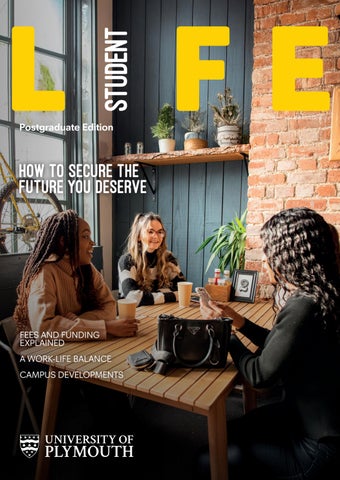
FEES AND FUNDING EXPLAINED A WORK-LIFE BALANCE CAMPUS DEVELOPMENTS
Admissions
+44 (0)1752 585858
admissions@plymouth.ac.uk
University of Plymouth Drake Circus Plymouth Devon PL4 8AA
United Kingdom
Follow us on social media @PlymUni
Beautiful moorland and green spaces are right on your doorstep in Plymouth
Postgraduate Edition
Welcome to the postgraduate edition of Student Life. In this issue you will meet some of our postgraduate students and alumni. Read about their experiences of studying at postgraduate level, and their ambitions and achievements beyond their degree.
You will also find information about funding options, careers support and how our students find a work-life balance. We’re committed to ensuring the success of our postgraduate community, and we will support you in making your dream a reality.
Meet some of this issue’s contributors:
Megan Computing graduate
Find out how a conversion course allowed Megan to change career P.10
Aminah Marketing student
Balancing study, work and other commitments P.14
Adhithi Marine Conservation student
Discover how Adhithi made the transition from undergraduate to postgraduate study P.18
DON’T BE A STRANGER
Visit us at our open evening
Embarking on a postgraduate programme is a major decision, and one for which you may need further advice and guidance. Take this opportunity to have your questions answered, or find out more about your subject of interest. Scan the QR code below for more information and to book your place.
Discover more find your programme
Explore our programmes and find the best path for you, whether that’s a taught degree, a research degree, or a conversion course enabling you to make a career change. Scan the QR code below to find your programme.
Inside...
P.8 Application advice
Discover our top tips to help ease you into your application.
FEATURES
P.12 Your finances
Discover all you need to know about funding your future.
P.22 Making change happen
How our students seized the opportunities that postgraduate study has provided to make positive change.
P.28 Graduate success
How studying in Britain’s Ocean City has helped shape the future for our postgraduate students.
FIND OUT MORE
If you studied an undergraduate degree at Plymouth, you may be eligible for a discount.
STEP INTO THE FUTURE WITH POSTGRADUATE STUDY
In a fast-changing world of work, standing out takes more than just a degree — it takes expertise, the confidence to lead and often higher level qualifications. Postgraduate study equips you with the advanced skills employers are looking for: innovation, research, critical thinking, and the ability to solve complex problems.
Whether you’re aiming to boost your earning potential, switch careers, or deepen your expertise in a specialist field, a postgraduate qualification opens doors to new opportunities — and gives you a competitive edge in the job market.
Now’s the time to invest in your future and shape the career you want.
“I found it very insightful to reach out to current Plymouth students, and recent graduates of my MSc, to get a well rounded idea of what to expect.” Melissa, Biological Sciences student
A STUDENT’S INSIGHT
Who better to give you insight into postgraduate study and the wider university experience than our postgraduate students? Take the opportunity to ask about their programme, funding support and their future aspirations, as well as reading their blogs around all manner of topics from application advice to life as a student in our city by the sea.
POSTGRADUATE OPEN EVENING
Embarking on a postgraduate programme is a major decision, and one for which you may need further advice and guidance in helping you to make your final choice. Why not come along and visit us at our postgraduate open evenings?
This is your chance to find out more about the range of postgraduate and professional development opportunities that are available to you. Both academic and professional support staff will be available to answer your questions and give you advice, guidance and information about our programmes and the support available to you.
WHY
STUDY A POSTGRADUATE DEGREE?
ENHANCE YOUR EMPLOYABILITY
Gain a postgraduate degree from a triple Gold-rated university (Teaching Excellence Framework, 2023).
EARN MORE WITH A MASTERS QUALIFICATION
The Department for Education reports that working-age postgraduates typically earn significantly more than undergraduates (LEO Graduate and Postgraduate Outcomes).
PROGRESS IN YOUR CURRENT CAREER
Learn in new state-of-the-art facilities and graduate ready for the fast changing world of employment.
AN OPPORTUNITY TO CHANGE DIRECTION
Conversion programmes allow you to study something completely different from your undergraduate degree, making a career change a realistic future! Find out more on P.10.
Aaron – an arts student who studied both his undergraduate and postgraduate degree here – felt like he’d found a second home and a family at Plymouth. He has valuable advice for you, as well as snippets about his love for Plymouth, so make sure to look out for those throughout the magazine!
TAUGHT MASTERS DEGREE
(MA, MArch, MBA, MClinRes, MDes, MRes, MSc)
Delivery: similar to an undergraduate degree, although there are higher expectations regarding your academic achievement. Two-thirds of study will be lectures, tutorials and assignments related to taught modules, and onethird engaged in a research project. Duration: usually, a programme is offered either as one year full time or two years part time, although this can vary. Some programmes offer an extra year’s placement for full-time students.
We offer taught masters programmes in the following subject areas.
• Architecture and building
• Biology
• Business and management
• Chemistry
• Computer science
• Creative arts
• Design
• Earth, geography and environment
• Education
• Engineering
• Games
• Health professions
• Humanities
• Law, criminology and policing
• Marine biology and ocean science
• Mathematical and data science
• Medicine, dentistry and biomedical sciences
• Nursing and midwifery
• Psychology
• Social studies
RESEARCH MASTERS DEGREE (ResM)
Delivery: incorporates taught elements and an extended research project, which concludes in the submission of a thesis.
Duration: 12–18 months full time or 24–36 months part time.
MASTER OF PHILOSOPHY (MPhil)
Delivery: this programme requires individual research and advanced scholarship research, undertaken independently under the supervision of a small team of academic experts. You may be required to complete taught modules as part of your study. You are expected to develop your research skills and present your research in seminars and other academic contexts.
Duration: 24–36 months full time or 36–48 months part time.
DOCTOR OF PHILOSOPHY (PhD)
Delivery: an advanced research project with a small supervisory team of academic experts under the direction of a Director of Studies. You are expected to fully engage with your personal skills development and to present your research in a range of scholarly contexts.
Duration: 36–48 months full time or 48–72 months part time.
PROFESSIONAL DOCTORATES (EdD, DClinPsy)
Professional doctorates are an advanced programme of study and research which, while satisfying University criteria for the award of doctorate, are designed to meet the specific needs of a professional group external to the University. Duration: please check individual programme pages on our website.
POSTGRADUATE DIPLOMAS AND CERTIFICATES (PgDip, PgCert)
These taught modules are for graduates looking to improve their career prospects by building on their existing skills and knowledge. Both qualifications offer masters-level study without the dissertation, while allowing you to discover a greater range of career options. Postgraduate diplomas and certificates give the chance of fast-track entry into a new career or field, or act as a springboard for further study.
DOCTOR OF MEDICINE (MD)
A research degree available with the Faculty of Health for qualified doctors registered with the GMC and working in a clinical setting within the UK. The degree can be undertaken part time alongside clinical commitments. As well as undertaking research, the degree offers a range of professional skills courses designed to support your degree and personal development.
Duration: 24–36 months full time or 36–48 months part time.
PhD ON THE BASIS OF PRIOR PUBLISHED WORKS
Enables candidates who have not previously been registered for a higher degree but have been research active and publishing (or making research available in the public domain) to submit a collection of works for consideration for the award of a PhD. The submission must evidence that you have personally made a systematic study; that you have shown independent, critical and original powers; and that you have made a distinct contribution to knowledge. The submission as a whole must be framed as a single coherent research project. Duration: 12 months part time only.
PROFESSIONAL DEVELOPMENT
(GradDip, GradCert)
Progression from an undergraduate honours degree in a health-related area. Each programme supports and challenges you to understand and implement the values and principles of advancing your practice.
Duration: up to 3 years part time.
CONVERSION PROGRAMMES
Conversion programmes are an ideal route to take if you want to study
a different subject area from your undergraduate degree or professional career, gain new skills or improve your job prospects.
POSTGRADUATE DEGREE APPRENTICESHIPS
Degree apprenticeships are workbased development programmes that enable the learner to develop a suite of knowledge, skills and professional behaviours at a specialist and professional level that are job related. They are a combination of university study and employment in the workplace combining academic and vocational education. Degree apprenticeships have a higher education award as part of the mandated outcome which enables the learner to achieve the essential learning requirements of the chosen apprenticeship standard.
GETTING STARTED WITH YOUR POSTGRADUATE APPLICATION
We’ve compiled a list of our most asked questions and some top tips to help ease you into the process.
HOW DO I APPLY?
Applying for postgraduate study couldn’t be easier – on each programme page there’s an ‘Apply now’ button which will take you directly to the application form.
MY UNDERGRADUATE DEGREE IS NOT IN THE AREA I WISH TO DO POSTGRADUATE STUDY IN; WILL I BE CONSIDERED?
We offer many conversion programmes which are designed for people wanting to change direction from their undergraduate degree. Other
postgraduate programmes do require a related degree; if you feel you have relevant work experience, the admissions tutor will still often consider your application. Head to P.10 to read more about our conversion programmes and how student Megan made big changes to her career.
CAN I GET HELP WITH FUNDING?
You could be eligible for a Postgraduate Masters Loan. There is also a variety of scholarships and discounts available for our postgraduate taught and research students. You can find out more about funding support on P.12.
CAN I STUDY PART TIME?
Yes, many programmes offer parttime options, this information is available on the website – detailed in the individual programme pages.
CAN I UNDERTAKE WORK ALONGSIDE?
Yes, absolutely! Many of our students work alongside their studies – it’s just a case of managing your time. They share their stories and advice on P.14.
HOW DIFFERENT IS POSTGRADUATE STUDY TO UNDERGRADUATE?
Postgraduate programmes are usually shorter than undergraduate degrees, taking around a year to complete. They are more specialist, often there’s a requirement for more research and you’ll have to work harder. Who could be better placed to tell you the difference between undergraduate and postgraduate study than our students? Turn to page 18 to read more.
HOW WILL POSTGRADUATE STUDY IMPROVE MY CAREER PROSPECTS?
An undergraduate degree will get you started in your career, but a postgraduate degree can make you even more employable. You could even earn nearly 20% more (LEO Graduate and Postgraduate Outcomes)!
“The
application process at Plymouth was quick and smooth; this was because I was able to speak to the right people when I needed to.”
OUR TOP TIPS
APPLICATION
Check the application deadline. Give yourself plenty of time to get your application together.
Do your research. Make sure the programme is right for you – remember our Admissions team are on hand to answer any questions.
Upload certificates and supporting documents. If you can, get ahead and upload your supporting documents with your application. It will save additional emails later in the process.
PERSONAL STATEMENT
Preparation
Describe how your undergraduate degree and other experiences have prepared you for postgraduate study.
Skills
Outline your skills and how you believe they will help you in your studies.
Motivations
Explain your reasons for choosing to study your subject and your passion and knowledge for it.
Aspirations
Convey your career goals and how your postgraduate study will help you achieve them.
Find out more about how to change direction with our conversion programmes.
TIME FOR A CAREER CHANGE
We sat down with PhD student Megan to discuss her journey from an undergraduate degree in history to a doctorate in computing – two very different subject areas.
TELL US ABOUT YOUR CAREER PATH FROM WHEN YOU COMPLETED YOUR UNDERGRADUATE DEGREE.
Between my undergraduate degree and now, I’ve done a lot of different jobs. I did my undergraduate degree in history, but I decided not to pursue that as a career. The first job that I had out of university was as a domiciliary care worker, which I thought would be a nice, helpful thing to do; I was going to people’s houses and providing personal care. Then I decided I was interested in becoming a detective with the police, so I became a special constable, which is a voluntary police officer, and there I did a number of civilian police roles – I was a 999 call handler, and I worked in major crime
preparing evidence for court, and then finally, I worked in roads policing.
At that point, I had decided that having worked in major crimes, I’d had a lot of experience working with detectives and that I decided it perhaps wasn’t the job for me.
I was particularly interested in going back to academia because I really missed university, and at school I had always loved maths and sciences, and I felt that I had kind of missed out on applying that in life. So that’s how I ended up doing the masters in data science.
WHAT WAS IT LIKE RETURNING TO STUDY? WAS THERE A BIG JUMP BETWEEN UNDERGRADUATE AND POSTGRADUATE STUDY?
It was a very interesting experience – it’s almost impossible to compare. For one thing, I was at such a different point in my life when I went to do my history degree: I was 18 and I was leaving home for the first time. I was setting out to establish myself and work out who I was. Whereas about ten years later, coming to the postgraduate degree, I was a lot older, and I knew what I wanted in life.
I think it was really important for me to have had that big break between undergraduate and postgraduate. I had
done a lot of work and a lot of quite serious real life work for the police. I’d done the 9 to 5 jobs and been very stressed at various points. It allowed me to mature and get to know what I wanted in life, and from my studies. I enjoyed being part of a community of students again. It’s been particularly great being able to meet other mature students, like myself, who had had different life experiences and were coming to this at different stages of their lives.
I came to the postgraduate degree very focused, very set on working hard and on getting a lot out of it. What I wanted to study was entirely unrelated to history, so that’s why I did the conversion programme.
WHAT ADVICE WOULD YOU GIVE TO SOMEONE CONSIDERING A CAREER CHANGE OR A COURSE CONVERSION?
Absolutely go for it! It’s been so important and positive in my life and I’m so much happier now having had time to think about my career over the past years. It’s obviously something you have to think carefully about before you undertake a big change like that. But if you are sure that this is something that could work well for you, then you should do it.
I’ve now started a career that I intend to go on in. I finally feel, after ten years of studying and working different jobs, that I’m in the place that I’m supposed to be.
IMAGINE YOU’RE ABOUT TO START UNIVERSITY AGAIN. WITH THE BENEFIT OF HINDSIGHT, WHAT WOULD YOU NOW TELL YOURSELF?
I probably ask myself that question every day because I’ve had such a strange career path and I’ve done all these different things. The answer that I come to all the time is that I wouldn’t actually do anything differently. Everything has been so valuable and has got me to where I am today. It’s given me all sorts of skills that I personally don’t think I would have gained if I had gone straight into what I’m doing now. Life has just been serendipitous – I met my husband when I was doing my history degree and I wouldn’t change that for the world.
So, it might seem strange, but I wouldn’t change a thing.
“I really enjoyed my work and experiences in the marketing world, but I have also always had a real passion for helping others and began thinking about how I could incorporate this into my career path. I realised I wanted to seek a new challenge and to make a difference. Occupational therapy appealed to me because it is a professional role but with people’s wellbeing at the heart of it.”
Matt, Occupational Therapy graduate
“I wanted a bit of challenge and to push myself; it felt like a logical step to complete a postgraduate qualification. I think the job opportunities available to me after having graduated and thinking longer term about my career was probably the biggest driver to study a postgraduate degree.”
Mike, Physiotherapy graduate
“I worked in London as a business development worker but when the pandemic happened, I ‘boomeranged’ back home to my parents and I ended up working in a care home. I realised that style of working suited me so much better. I enjoyed feeling like I’d made a difference in people’s lives. I then began to consider the idea of a healthcare career and found out I could apply to train with the experience I already had. As I already had a degree, I could apply for a masters meaning nothing I had done previously felt like it had gone to waste.”
Anna, Nursing student
FUNDING YOUR POSTGRADUATE STUDY:
SUPPORT AND OPPORTUNITIES
Thinking about how to fund your postgraduate journey? You’re in good company — and there’s plenty of support available to help make it affordable. From loans and scholarships to financial advice, we’re here to help you take the next step with confidence.
POSTGRADUATE LOANS
If you’re starting a master’s degree or are a doctoral student, you can apply for a Government loan. You can use this only for tuition, accommodation, books, or living costs. Check your eligibility, find out how much you’ll get and apply via the Government website.
TUITION FEES AND PAYMENT OPTIONS
If you’re self-funding, you’ll normally pay your fees at enrolment. Can’t pay all at once? No problem — you can pay in three instalments (33/33/34%), aligned with student loan payment dates. Fees vary by course and may change yearly. Visit your programme page or the fees page for details.
BURSARIES AND SUPPORT FUNDS
If you’re experiencing financial hardship due to extra costs, unexpected health issues or other factors, there may be bursaries and support funds that can help you.
BURSARIES & SUPPORT FUNDS
UNIVERSITY SCHOLARSHIPS
The University offers a range of postgraduate scholarships. Check out what scholarships are available.
SCHOLARSHIPS
ALUMNI LOYALTY REWARD
If you’ve studied with us before, you may be eligible for a tuition fee discount:
• 20% off most UK postgraduate taught programmes
• 10% off selected psychology and health-related MScs
• International alumni also get 20% off (some exceptions apply)
“In Plymouth, you won’t spend too much on your monthly expenses because it’s a very compact city. You don’t spend too much on transportation. It’s also easy to find a part-time job to cover your expenses.”
Abdalbast, Data Science and Business Analytics graduate
“For most, there will be concerns with programme fees and living costs, but I applied for a loan, which I am very thankful for because it made postgraduate study accessible for me. I also applied for the Santander business bursary, which helped me create the small studio where I work now, and there are some other ways to apply for funding – the Student Hub is a great place to get advice.”
ALUMNI DISCOUNT
For many students considering a postgraduate degree, they need to know they can balance their studies with other elements of their life, whether that’s employment, family responsibilities or getting the most out of all the experiences university offers. Our students all have their own story to tell, wisdom to impart and hopefully some reassurance that it’s possible for you to succeed in postgraduate study, no matter your circumstances.
AMINAH
Marketing student
Aminah has a part-time weekend job, works as a Student Ambassador for the University, and has carried out two internships while studying.
“When I began my postgraduate journey, I knew that managing my
time effectively would be crucial. My academic schedule required approximately ten hours of in-class learning per week, with an additional 20–25 hours dedicated to independent study. On top of that, I wanted to gain practical experience in my field.
I secured a part-time weekend job that fitted alongside my academic
commitments. It allowed me to keep weekdays free for lectures, coursework, and self-study.
This arrangement provided me with financial stability while still opening doors for work experiences relevant to my field of study.
With the support of the Careers Service, I secured internships that allowed me to apply my academic knowledge in real-world scenarios. I also currently work as a brand ambassador for the University – a role that complements my studies perfectly.
Managing these responsibilities required a structured and disciplined approach. I prioritised my studies by creating a detailed weekly schedule, allocating specific time slots for lectures, independent study, work and personal activities.
While work and academics are important, staying connected with family and friends, participating in community events and engaging in hobbies have also been an essential part of my routine.
For those considering working while pursuing postgraduate studies, my biggest piece of advice is to embrace the challenge with an open mind and a positive attitude.”
HOLLY
Cybercrime, Terrorism and Security student
Did the idea of working while studying for a postgraduate degree concern you prior to applying?
For me, I think there was a little concern about working at the same time as studying. I talked to students and asked them how they found it, which reassured me.
What other commitments do you have alongside your studies?
I currently work three jobs: one as a Student Ambassador with the Uni which is not regular work for me, so it doesn’t affect my studies. My other two jobs are very similar: one is a barista supervisor which I work when I go home during holiday periods, and the other is a barista for the cafes on campus during term times.
As well as work, I volunteer with two charities. One is Jeremiah’s Journey where I help at events. My other charity is the Girl Guides where I work with three units: Rainbows, Brownies and Guides. This is a lot of work: most of the time goes into training, planning, and organising the meetings and activities for the girls. Then, it’s the fun part which is running them!
I am also a volunteer student warden for my accommodation. For this role, I oversee making sure that parcels are secure and can be collected out of hours, that residents are comfortable, and taking care of any issues that happen during my shift. Similarly, I volunteer as a course representative for my programme, where I make sure that my fellow students are OK and managing their workloads, and I let the lecturers know of any issues that have been raised.
Despite the number of things I do, I still find ample time to socialise and enjoy the life of a university student.
What are the benefits to working alongside studying?
I think the main benefit is that it makes you take a break from your work. Especially in postgraduate study, you are reading, writing and constantly trying to do your best and developing your knowledge. However, having all these commitments alongside studying makes you physically take a break, allowing you to come back with a clear head. Additionally, working alongside your studies helps you not become too concerned with financial issues.
What would your advice be to someone considering postgraduate study who has other responsibilities? Make sure you have a solid foundation to your time. Find out what’s coming up and make sure you are planning in advance. Talk to your lecturers about any work you do because they are very understanding and will make sure that you receive any help that you need. Lecturers love to talk about what they do, so don’t be afraid to ask to go over things.
FYONA
Education graduate
“I have an amazing family who supported me, and my daughters were old enough to help at home. During this year, as a family, we made sure that we spent Saturdays together and I did not think about my programme for that day. I used Sundays to work on my assignments. My advice to anyone returning to study who is managing other commitments, is to make sure that you have down time and if you need help, ask for it.”
BENEDIKT
Geography graduate
Being around professors and lecturers made Benedikt eager to get out into the world of work, and he began his journey while still studying.
“During my masters degree, me and some friends had started planning and working on the LiMnADs project which, just after finishing my studies, started to unfold into a fantastic scientific research opportunity for me, in which I am applying my knowledge to create a positive impact. The LiMnADs project uses scientific research, technical innovation and education to protect alpine wetlands.
If you want to be more than just a hard-working student, achieving their degree, but also want to be heard, valued, inspired and supported to create an impact, then there is nowhere better, in my opinion, than the University of Plymouth.”
JOYITA
Psychology graduate Joyita, a mum of three, has now graduated from Plymouth with not only an undergraduate degree, but also a masters in psychology. An inspiring mix of resilience, support and enthusiasm has got her to this point.
"There was a moment in my life when I thought, ‘Is it really going to happen?’ because I’m a mum of three and sometimes it can be a bit challenging but thankfully, I’ve had a lot of support from the University.
I worked as a chartered banker for ten years and, although I liked helping people with their finance, I found a lot of times I was chatting to people about what they were going through. I found myself asking, ‘Do I want to stay in finance, or do I want to do something that perhaps deals with people – whether it’s clinically, socially, educationally?’ and I found that psychology ticked all those boxes for me.
One day, I went into the University when they had an open day. I’m the first in my immediate family to go to university, so walking up to the University was somewhat difficult because I didn’t have any point of reference. I thought I’d just see what it was like and if I was persuaded by it then I'd just go ahead and do it. I still remember the day because I remember saying to my daughter, ‘One day Mummy is going to graduate from here,’ (even though I didn't know if I was!).
I'm a mature student and I remember my first few months. I was thinking, ‘Is this for me or is this not for me?’ But it’s the way that they teach you: everything is broken down for you. I felt at ease, and you’re encouraged to give your views; your views are always welcomed. That meant a lot to me."
“The most important thing I could ever impart to anybody about a good worklife balance, is to know when to rest. There is a lot to be said about getting work done, but there is also the necessary element of letting work breathe.”
THE UNDERGRADUATE TO POSTGRADUATE LEAP
The transition from undergraduate to postgraduate study may feel like a big leap. Many students have successfully made the shift and are surprised to discover it’s not the difficult step they imagined. We chatted to Adhithi, a Marine Conservation student on her experience of managing the study transition.
WHY DID YOU CHOOSE TO STUDY A POSTGRADUATE PROGRAMME?
I felt like I needed a little more experience in the field, and I wanted the opportunity to network with practitioners in the industry – I felt like the programme was perfect for that. I also, like most other postgraduate students, wasn’t ready to take the step into the real world and start working. I felt like another year of academia could help me gather all the skills that I needed to be in the field.
HAVE YOU FOUND THE TRANSITION FROM UNDERGRADUATE TO POSTGRADUATE STUDY CHALLENGING?
I’d say it wasn’t too bad. I feel like postgraduate studies are more independent, in the sense that you’re able to set more of your schedule. Postgraduate study is just an extension of an undergraduate degree: you already have the benefit of working at that academic level so if anything, it’s a smoother transition.
HAS THE UNIVERSITY HELPED YOU WITH THE TRANSITION?
There are many resources online and in person, such as recorded lectures and drop-in sessions that are easily available to anyone. Tutors always make themselves available to reflect on the learning in lectures or to help if you’re struggling.
HOW DO YOU MANAGE YOUR WORKLOAD?
I usually start by creating a list of tasks and ensuring I’m aware of upcoming deadlines. I find it helpful to stay organised and stick to this
plan. If I start feeling overwhelmed, I turn to my course mates. It’s reassuring to study together because it reminds me that we’re all in the same boat and can support each other. If I’m still struggling and need more help, I reach out to my personal tutor who’s always available and ready to assist. I also think it’s important to recognise that everyone works differently, so it’s essential to figure out what methods work best for you. Taking breaks is crucial too, because mental health is just as important as keeping up with university work.
IS THERE ANY ADVICE YOU WOULD GIVE TO SOMEONE WHO IS CONSIDERING POSTGRADUATE STUDY BUT IS WORRIED ABOUT TAKING THE STEP?
If you’re passionate about the programme and the topics you’ll be studying, I would encourage you to go for it. Don’t worry too much about the step up—there are plenty of resources and support available. Your lecturers and University staff are there to help you succeed, so you’re never really on your own. Plus, postgraduate study is about more than just academics. You’ll have the chance to gain new experiences and meet a diverse range of people, many of whom could become great friends. With all the support and opportunities the University provides, it’s definitely worth pursuing.
BUT WHAT ABOUT THOSE WHO HAVE HAD LONG BREAK BETWEEN STUDIES...
“I took a five-year break between my degrees, so don’t be afraid if you have had some time away from academia. Of course, I had to learn how to write at an academic research level and adjust to the communal goings on of student life… but after a month or two it was like I had never left!”
Aaron, Illustration graduate
“Getting back into studying was easier than I thought because I’m so much more focused than I was when I was 18. During my first degree, I barely remember doing any work, I just went out a lot and focused on the extracurricular side of uni. Now all I care about is the course and I’m getting so much more out of it.”
Anna, Nursing student
“From mental health to financial, academic and pastoral support, I was blown away by the additional services and resources that were available to me at the University. There are multiple different academic writing support options available, which was a real positive as I had never been the strongest academically. This really helped me to get back into the swing of things having had eight years out of education. Having a specific postgraduate induction week was helpful in getting me back up to speed with being a student again.”
Mike, Physiotherapy graduate
MY UNIVERSITY EXPERIENCE
MRes Marine Biology graduate Isobel talks about how she’s made friends and connections at uni from undergraduate to postgraduate.
My name is Isobel and I have recently graduated with an MRes in Marine Biology here at Plymouth. Having spent four years as an undergraduate student here, I fell in love with Britain’s Ocean City and the marine biology opportunities available here. Therefore, the decision to study an MRes postgraduate programme here was very easy.
I became a course representative for MRes Marine Biology, where I attended trimonthly meetings with senior staff to discuss peer feedback on the way the programme was operating. Taking on this role allowed me to engage with a variety of academic staff, and present the opinions of others in a diplomatic way – all great skills to put on my CV.
By continuing as a postgraduate student at Plymouth, I was also able to continue my role as a student ambassador for the Outreach team. This role allowed me to travel around the country attending higher education events, and deliver presentations to students from Year 9 to Year 12 about my university experience.
The team understood that studying comes first and so it was really easy to fit a part-time job around my MRes research project, while still gaining new skills and meeting new people in the process!
Being a postgraduate student also allowed me to continue as part of the University of Plymouth Dance Club and be a part of their competition teams, which compete in two national competitions at Portsmouth and Loughborough. Having been dancing since the age of two, being part of the club allowed me to continue a passion of mine throughout my university experience and
“Don’t be afraid to put yourself forward and take opportunities.”
was a great way to meet like-minded people across different courses at the University. I was also a member of the Marine Biology Society, which offers exciting events and talks throughout the year.
At Plymouth, there are over 150 sport clubs and societies, ranging from A capella to water sports, and everything in between! As the class cohorts on postgraduate programmes tend to be smaller, joining a club or society is a great way to meet people with similar interests and to take a break from studying. There is definitely something for everyone! If you’re thinking of staying on to study a masters degree after your undergraduate degree, I would totally recommend it!
“Having
been dancing since the age of two, being part of the University of Plymouth Dance Club allowed me to continue a passion of mine throughout my university experience and was a great way to meet like-minded people across different courses at the University.”
AARON’S THOUGHTS ON COMMUNITY…
Being a postgraduate student has given me an everlasting bond to the University, and the staff have been so supportive, I really feel like I’ve found a second home here.
I recently gave my first lecture at the University where I talked about my experiences and my projects in relation to the Illustration programme. It was something else to see the students from the point of view of an academic and it gave me a deeper insight into the work I had done. I can still remember when I was just like them, sitting there listening – I shed a tear over how far I’ve developed, personally and professionally.
My peers in the postgraduate community share that feeling of continual progression in knowledge and ability. We all want to do the best we can, and we all want to help each other achieve this. It can really feel like you’re part of a family.
I cannot express greater satisfaction towards the staff at the University for the support they have given me as a queer person during my time here.
Such was the support, that for my final project, I decided to create a graphic memoir about a hate crime I suffered in 2015.
Coming back as a postgraduate in 2019, I knew I wanted to create a project that would talk about these issues. I was apprehensive at first, but the support that the University gave me, as well as personal encouragement from staff, set my mind at ease and helped me become the creative I am today.
I felt comfortable enough to talk about anything and everything with them. No one looked shocked or made judgemental comments when talking about sensitive topics. Without the support of my academics, I would never have been able to achieve what I have now.
Our students are making changes for themselves, for others and for the environment. Their positive attitude to learning and the way they have seized the opportunities that postgraduate study provides, is truly inspiring and we’re proud of all they achieve.
Thiago, at the age of 36, left his national marketing managerial role in the fashion industry in Brazil to chase a dream of working with games and creation.
“In my home country, I graduated from courses in Social Communication, specialising in Advertising and Marketing and Digital Games, before obtaining an MBA in Project Management. I speak five languages (Portuguese, English, Italian, French and a little German) and have worked for some big companies in
Brazil. But even having this nice life and a career with my name in the national market, something was still missing… so, I decided to save my money and pursue a masters in Game Design here in Plymouth, as part of my plans to change my career, expand my network, improve my knowledge and build a good portfolio.
There were many reasons I wanted to pursue a masters: to be more prepared for the job market, construct a network
of people in the industry, and so that in the future I would be able to teach at a university in Brazil, where having a masters is mandatory. I want to be a game designer, so a masters in Game Design seemed logical!
I’ve always been a creative person and have loved video games since I was a little kid. When I was a manager, I had to deal with reports, meetings, planning, budget and so on – managerial stuff! But I felt I was missing a creative part. I wanted to not only have ideas, but also to be able to put them out into the world myself. So I decided I didn’t want to live my life without trying to realise my dream. I started studying Digital Games in Brazil alongside working and saving my money. After graduating and saving enough money, I then made the plunge! I love creating, and I’m so happy I made that choice and that I’m here right now.
Using the work I have developed here –as well as the Uni name to help promote myself – has been great as it’s a very respected programme in the industry. The feedback I’m getting on my work from my professors is great, and they’re helping to direct me to the companies and paths I should be pursuing to achieve my goals.”
Jenita is using her undergraduate and postgraduate degrees to make positive change and pioneer diversity in healthcare.
“There have been plenty of challenges along the way. I moved to Cornwall for this adventure and, coming from London, was naïve about the cultural differences I’d encounter in the South West. In particular, I found people of different skin tones to be underrepresented among the nursing staff. It was this that prompted me to get involved in the equality and diversity work at the University. I thought, ‘If I don’t do something about this, who will?’ As a young British Asian woman, I felt it was my duty to be a pioneer of diversity among my peers and colleagues.
We’ve already made some progress with the nursing curriculum; some of the new anatomy models in the medical school now have different skin tones. Changes like this are about making us better healthcare professionals. We’re taught in lectures about skin conditions, but the pictures usually show these symptoms on pale skin. I need to know what conditions like rashes would look like on my skin, so I can identify them correctly on all of my patients. I hope that through my next 40 years of nursing, things will continue to change for the better.”
Joanna has used a childhood passion to forge a career in marine protection. She has advanced understanding of reef manta ray migrations, habitat use and feeding ecology, which have been used to develop effective protection strategies.
“After learning to snorkel when I was very little, I fell completely in love with the ocean and marine life conservation, so when it came to choosing a university, Plymouth seemed like the ideal option as it is world renowned for its marine science facilities and researchers.
My passion for reef manta rays was cultivated through my undergraduate degree, thanks to an assignment I had to do on the species. While researching, I came across the Manta Trust, a UK and US registered charity, and learnt about everything they do to protect threatened ray species. The hard work and dedication of the Manta Trust’s scientists and staff was inspiring. I knew then that I wanted to dedicate my research to helping protect mantas, so I contacted them with an idea for a research project.
With the support of the University and the Manta Trust, I conducted the research for my honours project. I then continued as a researcher for the charity for my MRes and PhD, and became the Project Lead for the Manta Trust’s Chagos Manta Ray Project. My research involves studying the dynamic relationship between reef manta rays (Mobula Alfredi), zooplankton and physical oceanography. This research is crucial in allowing us to understand how reef manta rays use the Chagos Archipelago’s ecosystems and which environmental cues dictate their movements. Much like the Plymouth Sound and Tamar Estuaries marine protected area (MPA), the remote reefs of Chagos’ MPA are a refuge for many species, including rays. Studying this setting in depth will give us precious insights into the importance of such areas for mantas in the Indian Ocean.
I believe this study will also highlight the impacts of human activity and climate change on reef manta rays. If we can accurately identify these threats, we can work to ensure the conservation of ray populations worldwide.”
“My final year project for the masters degree was a graphic novel, Fractures, which I continued working on and published after my graduation. Without Plymouth, I would not have the skill, professional network, or accolades behind me that I gained from the years studying here.”
CAMPUS DEVELOPMENTS
WHEN YOU ARE CHOOSING A UNIVERSITY, YOU WANT TO GO SOMEWHERE THAT WILL FULLY PREPARE YOU FOR YOUR FUTURE CAREER.
That means learning about technologies and techniques that you will use on a day-to-day basis. Rated the 2nd top modern UK university (Times Higher Education, Young University Rankings 2024), the University of Plymouth can live up to such expectations.
We are significantly investing in our campus and facilities to ensure a first-class learning, research and working environment for you to thrive academically and professionally. Our facilities are designed to enhance your learning experience, and offer
practical, hands-on opportunities to develop your skills.
We are committed to building inspiring and sustainable spaces for the next generation of forward thinkers. Two major building projects were opened in 2023 alone: InterCity Place has been transformed into a brand new space to train and develop the next generation of nurses, midwives and allied health professionals, while the Babbage Building is a state-of-the-art space to inspire the engineering and design pioneers of the future.
Our investments build on the excellent facilities we already offer, including our life-changing medical Derriford Research Facility; the Marine Building, where we create renewable energy solutions and help the world adapt to climate change; The House, our performing arts centre where we foster artistic innovation and excellence; and the Marine Station, our unique and exceptional teaching and research facility on Plymouth’s waterfront.
Alongside the valuable experience gained at the Law Clinic on campus, law students benefit from practising
their courtroom skills in the new moot court Foulston Room in the historic surroundings of Plymouth’s museum, The Box. criminology and policing students understand real life investigations in the University’s Crime Suite, housing simulated crime scenes, forensics and interviews.
Plymouth Business School students enjoy specialist facilities and social learning spaces in the sustainably transformed Fitzroy Building including the Language Lab and Bloomberg Interactive Suite for tracking stock markets. The Cube, our award winning
“Civil engineering combines my fascination of construction with my love of science. Babbage supports this, with a range of specialised laboratories from structural tests to the development of novel composite materials. These state-of-the-art facilities elevated my academic experience. They also inspired a sense of innovation and creativity. Being part of a space that fosters a dynamic and practical approach to engineering was what excited me the most about the Babbage Building.”
Nilesh, Civil Engineering graduate
support service for our student and graduate entrepreneurs is also located here.
Our facilities are built to make your learning experience more exciting and hands-on, focusing on allowing you to level up your skills. Don’t just take it from us – find out what our students think.
“The facilities are tremendous! It’s such a luxury to be able to transition from theoretical learning into a practical within the same room. Having these specialist spaces for such a practically-driven programme and vocation was a big draw. Having a designated floor specifically for p hysiotherapy, as well as a building – InterCity Place – specifically for our school (School of Health Professions) was fantastic and had really made us feel valued.” Mike, Physiotherapy graduate
YOUR CAREERS SERVICE
The Careers Service is here to support you throughout your journey here at University and beyond graduation.
Our goal is to help you make the most of your studies to shape and develop a fulfilling career. One of the great things about being in a university setting, is the wealth of opportunities and experiences available to you that you wouldn’t find elsewhere, designed to prepare you for your dream career.
Our services are free and easy to access as both a current student and a graduate. Our services are hugely popular and worth taking the time to explore.
PERSONALISED CAREER SUPPORT
We offer one-to-one appointments providing you with career guidance, advice on job searches, CVs, LinkedIn, interview preparation and more. The
great thing about these appointments is that we can really hone in on your personal journey and specific needs.
WORKING ALONGSIDE STUDYING
We know a lot of postgraduate students work alongside their studies. To support them, we have developed great relationships with a wide range of local employers who advertise through us and provide our students with employment opportunities. We also have a vast number of on-campus jobs.
The jobs vary from mentoring to academic support, content creation to event supervision – all of which offer transferable skills that will help build your CV. Not to mention, the
hours fit around your schedule! You can find out more about our students’ experiences of working alongside their studies on P.14.
A CAREER CHANGE
For some postgraduate students, they are seeking a career change. Our specialist advisers have a wealth of knowledge about the many careers out there and will help you find your new path. We can help you find out about different career opportunities that are available, and to evaluate and prioritise what your preferred next steps might be. Explore our conversion programmes on P.10; they are specifically designed for you to take that new direction in your career.
MENTORING
Mentoring is another fantastic opportunity provided for our postgraduate taught students. With this, you’ll have networking opportunities and a chance to make contacts in the industry, as well as receive insight into, and top tips for entering, your chosen sector. Some of our students have even been offered positions in industry as a result!
PROGRAMME CAREER SESSIONS
Many of our subject areas provide curriculum-based sessions and workshops, tailored to their subject area and industry sectors. Through strong partnerships with businesses, work experience and hands-on learning, we hope to give you valuable insights on
your different career options, as well as equipping you with the knowledge and skills to be successful. For students looking to pursue a career in research or academia, we offer a range of workshops to help explore and prepare for these areas of work.
Our goal as a Careers Service is to support every student who needs it. Our team is friendly, encouraging, and have a genuine desire to help our students achieve their goals. If you choose to study your postgraduate degree at Plymouth, we will do all we can to get you where you want to be.
KICK-START YOUR OWN BUSINESS
The Careers team offers workshops and professional advice alongside our dedicated business start-up service, The
EXPLORE THE CAREERS SERVICE
Cube.
GRADUATE SUCCESS
OUR ALUMNI COMMUNITY
Find out how studying in Britain’s Ocean City has helped shape the future for our postgraduate students.
Caitlin
Sustainable Environmental Management graduate
Since graduating from my BSc in Marine Biology and Coastal Ecology at the University, I was hugely encouraged to continue my studies via the MRes Sustainable Environmental Management, alongside working for ARC Marine.
Following my masters, my main goal is to eventually complete my PhD in ecological engineering and nature-inclusive designs, which develops on my findings from my masters thesis. Hopefully, it will lead to real-world experiments. I am looking into Knowledge Transfer Partnerships to create a research relationship between ARC Marine and the University, which would lead to the development of my academic and commercial skills.
Caitlin’s top tip: Grab any opportunity you can. Get involved with university researchers, commercial researchers, citizen science projects. Volunteer your time; this will allow you to build your profile of experience. Be prepared. For interviews, assignments, anything! The more prepared you are, the better your chances of success, and you can increase your time for relaxing and going on adventures!
Melissa Zoo Conservation Biology graduate
I worked during and after my undergraduate degree where I developed many skillsets, both professionally and academically. I was regularly looking for even more opportunities to learn as much as possible. Although I was also able to take advantage of many unique opportunities to further explore the industry, including virtual internships in Costa Rica and South Africa, the zoo industry is intricate and complex, and
I still wanted to learn more. This led me to search for a postgraduate programme that could allow me to gain more in-depth experience in the many aspects of the zoo and aquarium industry.
Melissa’s top tip: It can be difficult to manage limited finances while also trying to get the full experience with new friends and unique opportunities, but I find that saving money on short-term items is better spent on experiences that create lifelong memories!
Pursuing my MSc in Robotics at the University was an absolute eye-opener – the programme was accessible despite my non-robotic background, yet rich in both detail and opportunity. I was able to work with and learn from many talented and passionate people, both staff and students. I feel that overall, I graduated as a much more fulfilled and employable engineer than when I enrolled. After my masters, the contacts and skills I gained directly helped me secure my first job working at the University itself! I am extremely thankful to Plymouth for this, as it has proved to be a great start to my career. I have worked in many
fields since then that are unrelated to robotics, but wherever I go, I find myself making excellent use of the skills and confidence that Plymouth equipped me with.
Sami’s top tip: You are smarter than you think! No matter how complex a problem is, it can be broken down into small and manageable parts that you can navigate. Whether it is studying a new subject, making a career change, or picking up a new hobby, you will always be able to succeed eventually – just be sure to give yourself plenty of time, and don’t be embarrassed to revisit the basics or ask silly-sounding questions. This is how everyone learns, and it is never inappropriate to learn.
Carrie, Law graduate
My journey into family law wasn’t intentional – I initially pursued criminal law because I wanted to help people and make a difference in their lives. When I was introduced to public law cases involving children, I saw an immediate crossover with criminal law. The same desire that had drawn me to criminal law – working with vulnerable people who are often overlooked – was just as relevant in family law. My role is to make sure their experiences are heard, that they are treated fairly, and that they receive the support they need. As President of Plymouth Law Society, I focused on access to justice, legal aid, social mobility, and women in law. I found a strong sense of belonging in the law student community
Architecture graduate
My degree has influenced potential employers to hire me because Plymouth has placed me amongst a cohort of qualified candidates in the job market. Even today, it really helps when dealing with clients, as they really look into your educational background prior to deciding whether they want you to be the one who designs and handles their project. Since graduation, I have designed, managed and realised a great number of projects, from villas, high rise towers and commercial buildings to
urban regeneration projects, masterplanning projects and furniture designs
Madhusha’s top tip: Architecture is one of the most competitive fields. Competition should not be taken as an opportunity to defeat someone, but to improve yourself and to push yourself a bit beyond where you stand today. Never forget to offer your helping hand and to carry others with you, so that you will see competition within you disappear and turn into strength. This reveals a wonderful purpose and a meaning to all the design work you do.
– we supported each other, shared resources, and formed enduring friendships. The culture of mutual support made my university experience especially meaningful.
Carrie’s top tip: Success in the legal profession requires perseverance. Aspiring lawyers must stay focused on their long-term goals, pushing forward despite challenges and setbacks. Building a professional network is crucial, even at a junior stage. Attending events – like university networking receptions –provides a great starting point. Networking and self-promotion don’t always come naturally, but they can be learned. Observing others, practicing, and using platforms like LinkedIn can help build confidence.
GRADUATION IS JUST THE BEGINNING!
There are a range of amazing benefits open to you as a graduate of the University. If you haven’t done so already, make sure you update your details and enjoy benefits such as invites to networking events, ongoing career and start-up support, and up to 20% off your postgraduate fees!
Madhusha
Sami Robotics graduate
A RESEARCH-RICH INSTITUTION
The University is staffed by academics whose research has impact, is innovative, operates across disciplinary boundaries, and provides outstanding training for postgraduate students.
STRATEGIC RESEARCH INSTITUTES
Our strategic research institutes are aligned with our diverse research strengths and reflect our interdisciplinary approach. They support and encourage collaborative activities, provide a first-class research environment, and help to showcase the impact of our groundbreaking work to key audiences on a global stage.
MARINE INSTITUTE
For over 100 years, Plymouth – Britain’s Ocean City – has been a focal point for marine research. With support from our partners and collaborators, the University is guiding the way in sustainable approaches, with the aim of ensuring future generations can enjoy the environmental, economic and social benefits of our marine ecosystems.
We adopt a transformative, systemsthinking, transdisciplinary approach to tackle global environmental challenges, bringing together physical, environmental and biological sciences,
engineering and maritime business, but also human health, social science, coastal geography, economy, art, history and law.
SUSTAINABLE EARTH INSTITUTE
We unite researchers from natural and social sciences, engineering, arts, humanities, health and business to take an interdisciplinary approach to help tackle sustainability challenges. We also connect the University’s worldleading research and expertise with the wider world.
Our research responds to the call of the UN’s 17 Sustainable Development Goals, contributing to both global efforts and the needs identified locally where our capabilities can make a difference. We engage with government, industry, community groups and individuals to work together on innovative solutions for a more sustainable Earth.
THE DOCTORAL COLLEGE
The Doctoral College works with staff and students in all areas of the University to ensure that our research students are offered the best possible experience. We support
excellence and employability across all stages of the researcher journey by providing first-class training and supervision, networking, development opportunities and mentoring.
RESEARCH OPPORTUNITIES
We supervise postgraduate research at doctoral and masters levels. You are encouraged to contact potential supervisors in your proposed area of study at the earliest stage in your application process. If you are unsure who to contact, please email one of our advisers at doctoralcollege@plymouth.ac.uk.
We are happy to discuss all the potential research opportunities open to you.
Find out more about our postgraduate research degrees.