

Name of Policy PLC SYDNEY PRESCHOOL CHILD PROTECTION POLICY
Policy Number POL2 3 1
Policy Status APPROVED
Date Effective January 2020
Last Edited April 2026
Date of Next Review April 2027
Review Period Every year or as required as a result of legislative changes
Contact Person Director of Preschool
1 RELATED LEGISLATION AND REFERENCES
This information refers to Quality Area 2 of the National Quality Standards: CHILDREN’S HEALTH AND SAFETY.
● Council of Social Services of NSW 2010, www.ncoss.org.au
● NSW Government Department of Communities and Justice, Resources for Mandatory Reporters, accessed from: Mandatory reporters: What to report and when | Communities and Justice
● NSW Government, Department of Premier and Cabinet, Child Wellbeing & Child Protection: NSW
● Interagency Guidelines, accessed from: NSW Interagency Guidelines for Practitioners | Communities and Justice
● Child Story Reporter Community, accessed from: ChildStory Reporter
● Children and Young Persons (Care and Protection) Act 1988 and Regulation 2000
● Children's Guardian Act 2019
● Education and Care Services National Law and Regulations: 84, 175 & 176
● Link to National Quality Standard: 2.3
● NSW Government Office of the Children’s Guardian, Guide to the Child Safe Standards, accessed from: Guide to the Child Safe Standards
2 INTRODUCTION
This policy is guided by the Paramount Duty of Care, where the safety, health, and wellbeing of children take precedence over all other considerations, including the privacy of adults or the reputation of the service.
PLC Sydney Preschools is committed to providing an environment that fosters health, development, spirituality, self-respect, and dignity, free from violence and exploitation.
Under the Children and Young Persons (Care and Protection) Act 1998, children and young people must receive the care and protection necessary to ensure their safety, welfare and wellbeing. All educators, volunteers and students of our service are Mandatory Reporters and are required to report to the Child Protection Helpline (Phone: 132 111) if they have reasonable grounds to suspect a child or young person is at risk of significant harm and have
current concerns about the safety, welfare or wellbeing of a child or young person where the concerns arise during or from their work.
We are committed to ensuring that all educators have a full understanding of their responsibilities as Mandatory Reporters and are supported in fulfilling them.
3 EXPLANATION AND DEFINITIONS
The Approved Provider, Nominated Supervisor, Educators and staff based are responsible for taking every reasonable precaution to protect children being educated and cared for by the service from harm, recognising indicators and responding effectively if issues arise, including mandatory reporting of child abuse.
‘Mandatory reporters’ are people who deliver education or children’s services, wholly or partly, to children as part of their professional work or other paid employment, and those in management positions in these services. Refer to Appendix 1 for indicators of abuse.
‘At risk of significant harm’ - in relation to a child or young person, means that there are current concerns for their safety, welfare or wellbeing because of the presence to a significant extent of any one or more of the following circumstances:
● The child’s or young person’s basic physical or psychological needs are not being met or at risk of not being met;
● The parents or other caregivers have not arranged and are unable or unwilling to arrange for the child or young person to receive medical care;
● In the case of a child or young person who is required to attend school in accordance with the Education Act 1990, the parents or other caregivers have not arranged and are unable or unwilling to arrange for the child or young person to receive an education in accordance with that Act;
● The child or young person has been, or is at risk of being, physically or sexually abused or ill-treated;
● The child or young person is living in a household where there have been incidents of domestic violence and, as a consequence, the child or young person is at risk of serious physical or psychological harm;
● A parent or other caregiver has behaved in such a way towards the child or young person that the child or young person has suffered or is at risk of suffering serious psychological harm; or
● The child was the subject of a pre-natal report under section 25 of the Children and Young Persons Care and Protection Act 1998, and the birth mother of the child did not engage successfully with the support services to eliminate, or minimise to the lowest level reasonably practical, the risk factors that gave rise to the report
As described in the Children and Young Persons (Care and Protection) Act 1998 No 157, Chapter 3, Part 2, Section 23:
● Danger to self or others – a child/young person is demonstrating suicidal or self-harming behaviours, posing a danger to self or others, and it is not known whether the parent/carer's behaviours contributed now or in the past
● Relinquishing care – the parent/carer states they will not or cannot continue to provide care of the child/young person, and they are unable to make an informed decision (temporarily or permanently); or the child/young person is in care for longer than the legislation allows.
● Carer Concern – a child/young person is significantly affected by carer concerns such as substance abuse, mental health or domestic violence.Unborn child – concerns for the welfare of an unborn child at birth.
‘Reasonable grounds’ - means that you suspect a child may be at risk of significant harm based on:
● Your observations of the child, young person or family; or
● What the child, young person, parent or another person has told you. It does not mean that you are required to confirm your suspicions or have clear proof before making a report.
● What can reasonably be inferred based on professional training and/or experience.
ROLE
Approved Provider
AUTHORITY/RESPONSIBILITY FOR
● Ensure that any adult working directly with children signs a Prohibited Employment Declaration Form and a Consent to a Working with Children Check, and ensure their clearance, prior to employment;
● Ensure every adult working with children is made aware of The Children and Young Persons (Care and Protection) Act 1998 and Keep Them Safe: A shared approach to child wellbeing and of their obligations under this law and action plan (Education and Care Services National Regulation, Regulation 84, National Quality Standards QA 2);
● The Approved provider will ensure that persons placed in day-to-day charge of the service are trained in current Child Protection policies and procedures, and hold the appropriate qualification
Child protection training requirements - Government protocol
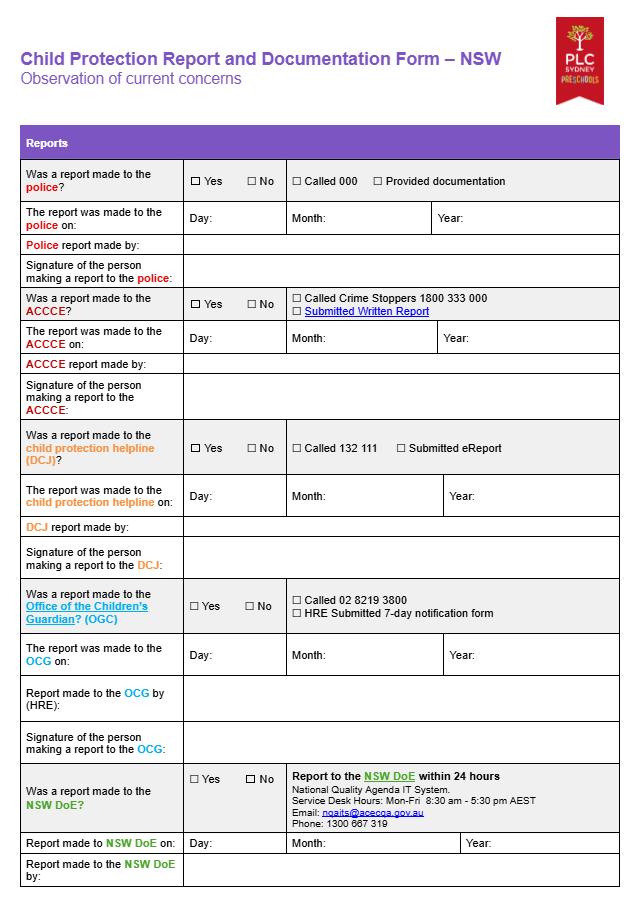
● In consultation with the Head of PLC Junior School, the Director of Preschools, or the Approved Provider will ensure that written notice to the Office of the Children’s Guardian is given within 24 hours of becoming aware of a reportable
The Director of Preschools as Nominated Supervisor
allegation A Final Report must be submitted within 30 days of becoming aware of a reportable allegation, upon conducting further investigation. If a final report cannot be provided within 30 calendar days of becoming aware of reportable conduct, the Director of Preschools must contact the Office of the Children’s Guardian and submit an Interim Report.
The Director of Preschools, as the Nominated Supervisor, will inform the Head of PLC Junior School AND notify the Australian Children’s Education and Care Quality Authority (ACECQA) through the NQA-ITS within 24 hours of the following:
● Any incident where any employee reasonably believes that physical abuse or sexual abuse of a child or children has occurred or is occurring while the child is or the children are being educated and cared for by the education and care service;
● Allegations that physical or sexual abuse of a child or children has occurred or is occurring while the child is or the children are being educated and cared for by the education and care service (other than an allegation that has been notified under section 174(2)(b) of the Law).
● The Approved Provider or Director of Preschools, in consultation with the Head of PLC Junior School, must notify the Office of the Children's Guardian (OCG) of a reportable allegation within 24 hours A Final Report is due within 30 days of becoming aware, following further investigation. If the Final Report is delayed, the Director must submit an Interim Report to the OCG and contact them.
● If the allegation concerns the Director of Preschools, the Head of PLC Junior School will follow the above steps.
● Orientate every working adult to this child protection policy, the Keep Them Safe protocols, and the Mandatory Reporter responsibilities, and ensure their regular review of these.
● Ensure all adults working or volunteering with children have a verified Working with Children Check (WWCC) before commencing employment Employment will cease if an individual is disqualified or fails a WWCC renewal The WWCC must be verified upon renewal Working with Children Check
● Report any allegation of abuse against staff members of the service.
● Ensure that Child Protection training on the Geccko platform is kept up to date when any significant changes are made to legislation.
● Implement the Child Safe Standards to create and maintain a child safe organisation.
● Completion of a Child Protection register, which is kept up to date at all times
● Provide continual child protection training opportunities to ensure that all staff and educators have adequate knowledge of child protection, being able to clearly explain
○ Their obligations as a mandatory reporter:
○ The circumstances that would require them to make a report:
○ How to submit a report.
Educators
● Develop trusting and secure relationships with all children at the service;
● Make reports of current concerns for any child at risk of significant harm to the Child Protection Helpline for Mandatory Reporters; and
● Ensure that Child Protection training is kept up to date when any significant changes are made to legislation
● Be guided by the Child Safe Standards to create, maintain and improve child safe practices, ensuring that children’s interests and rights are prioritised.
● Participate in training conversations to deepen understanding of child protection law, mandatory reporting obligations, and reporting procedures.
● Be aware that any use of a personal device to capture images of a child will be treated as a serious breach of this Child Protection Policy and may be reported as a 'Reportable Allegation' to the Office of the Children’s Guardian, depending on the nature of the images captured.
4 DOCUMENTATION OF CURRENT CONCERNS
The Director of Preschools, as Nominated Supervisor, will:
● Support staff through the process of documenting and reporting current concerns of children at risk of significant harm;
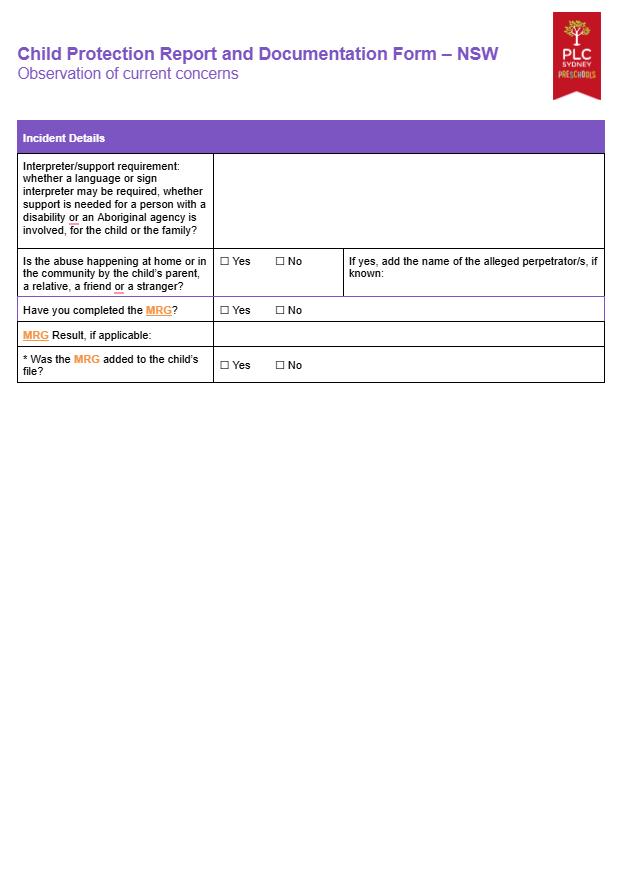
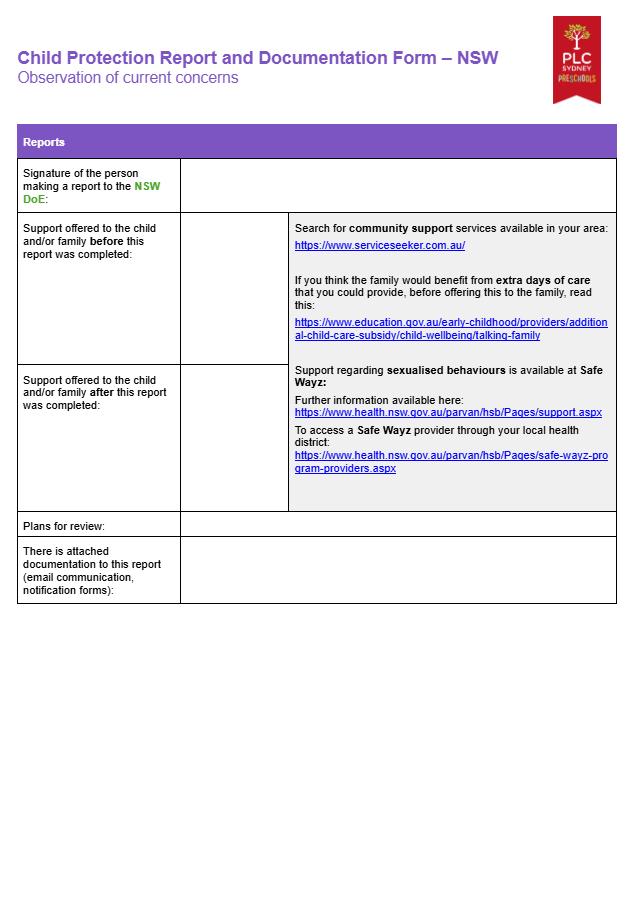
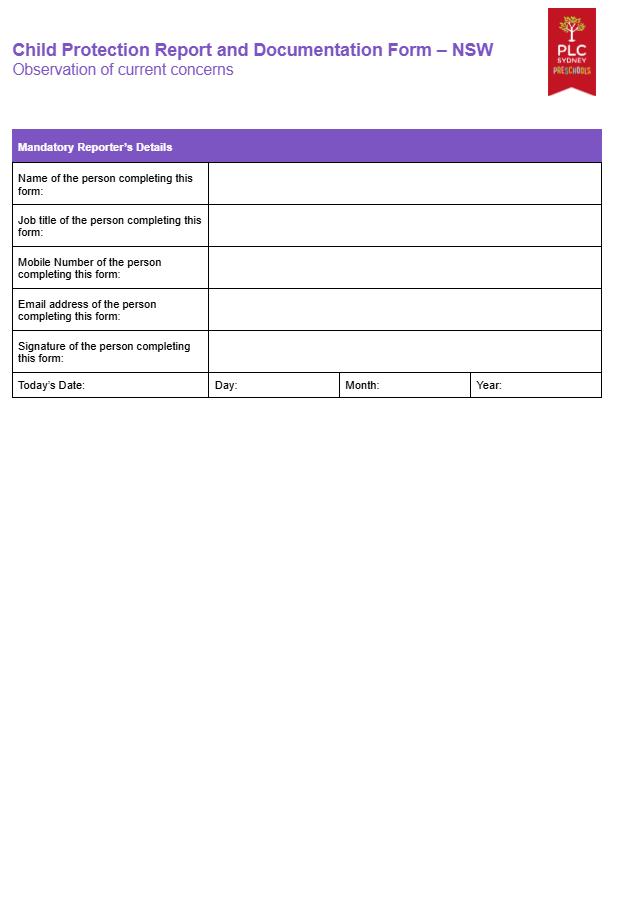
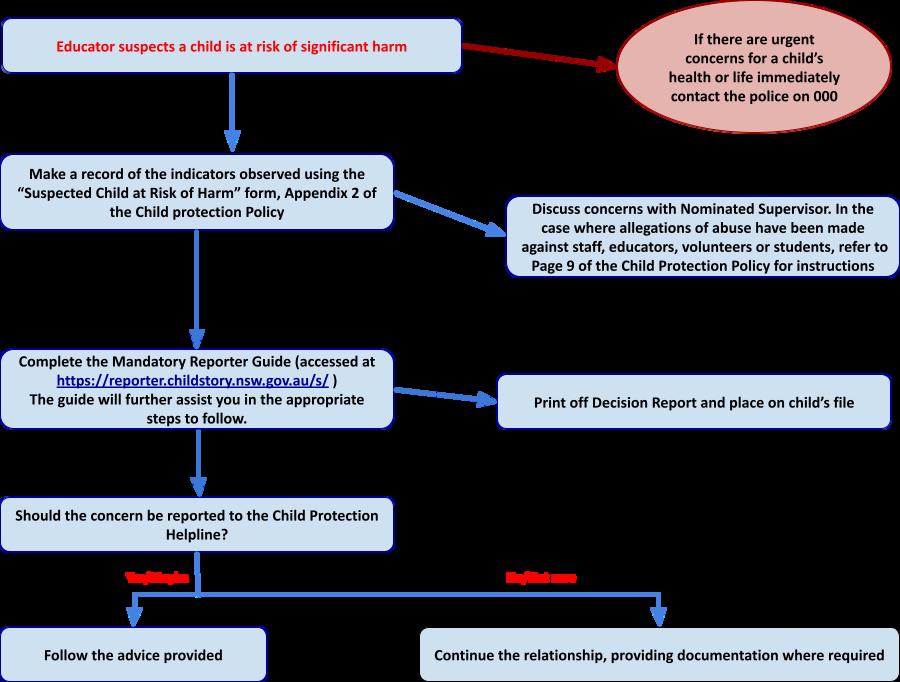
● Provide all staff and educators with clear guidelines for documentation, along with a template to support them. Refer to Appendix 4 of this policy, “Responding to a Child Wellbeing concern or Child Protection Report” Flowchart for guidance; and
● Provide all staff with a copy of the Child Safe Standards
● Refer to Child Safe Standards when undertaking risk assessments.
Educators and staff will:
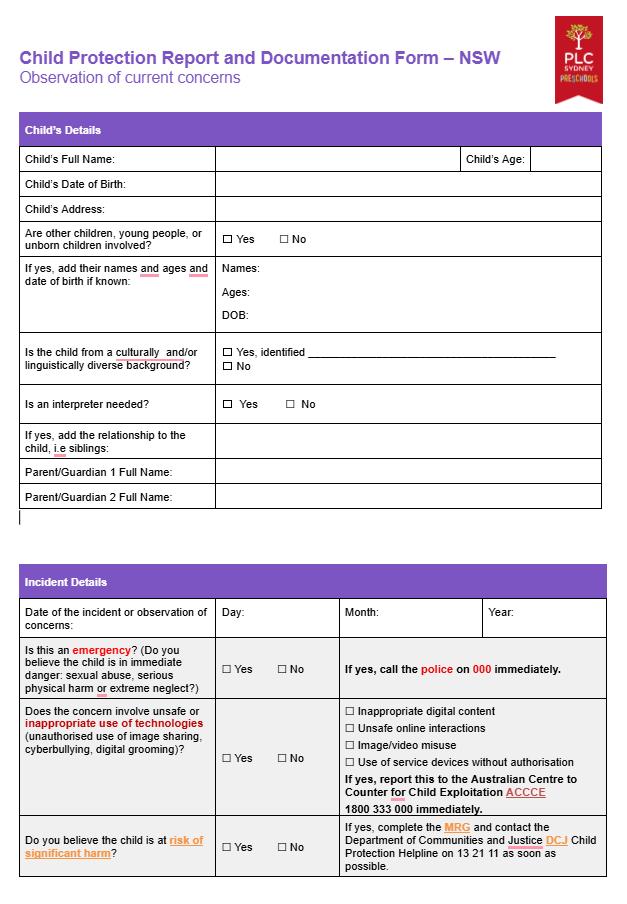
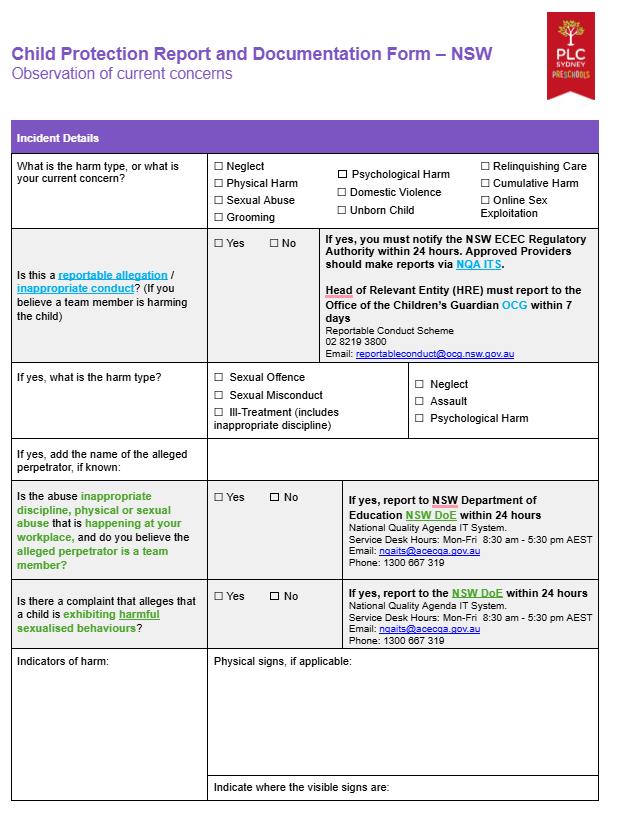
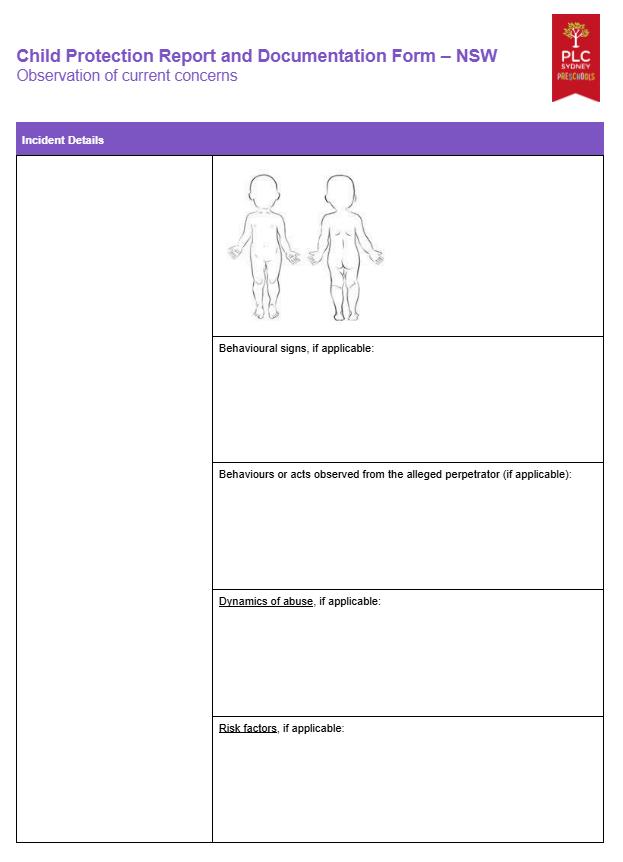
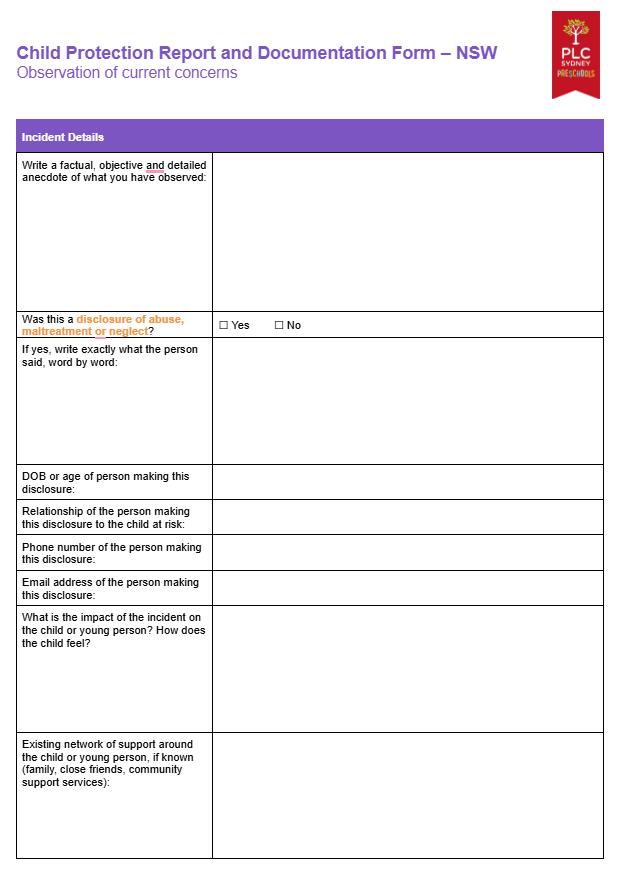
● Make a record of the indicators observed (using the “Suspected Child at Risk of Harm” form attached to this policy) that have led to the belief that there is a current risk of harm. Information on indicators of risk of harm is outlined in the NSW Mandatory Reporter Guide.
Welcome to the NSW Mandatory Reporter Guide
● Discuss any concerns with the Nominated Supervisor of the service and involve them in the process of any report.
● Advise the Nominated Supervisor of their intention to make a report to the Child Protection Helpline (132 111);
● Advise the Nominated Supervisor when a report has been made to the Child Protection Helpline.
● Refer to the Child Safe Standards when undertaking risk assessments.
5 MANDATORY REPORTING
The Approved Provider/Nominated Supervisor will:
● Provide all staff and educators working directly with children with a copy of this Child Protection Policy
● Display the Child Protection Helpline number (132 111) on all lists of emergency contact numbers in the interests of timely reporting
Educators and staff will:
1. In an emergency, when there are urgent concerns for a child’s health or life, it is important to contact the police via the emergency line ‘000’.
2 If a staff member suspects that a child is at risk of harm or significant harm, they should use the Mandatory Reporter Guide to determine appropriate steps. The guide will assist mandatory reporters in determining the most appropriate reporting decision.
3 Each time the Mandatory Reporter Guide is used, a copy of the Decision Report needs to be printed off and placed in the child’s file for future reference. The Decision Report will provide an explanation of the outcome based on your completion of the decision tree.
4 If the Mandatory Reporter Guide determines that an educator or staff member’s concerns do not meet the risk of significant harm threshold, they do not need to make a report to the Child Protection Helpline; however, they should discuss the matter with the Nominated Supervisor to determine whether the child or family would benefit from the assistance of another agency.
5. The staff member or educator should monitor the situation, and if they believe there is additional information that could be considered, please repeat steps 1 to 4 as required.
6 DISCLOSURE OF ABUSE
Educators and staff WILL:
● Move to a suitable environment, free of distractions;
● React calmly and patiently to the child making the disclosure;
● Listen attentively, let the child or young person use their own words and later write down the child’s exact words;
● Provide comfort and care to the child.
● Reassure the child or young person that it is right to tell, it is not their fault; recognise their bravery and strength for talking about something so difficult:
● Respect that the child or young person may only reveal some details;
● Avoid making promises you can’t keep – manage their expectations;
● Explain what will happen now, as part of your job, so you can tell people who can help the child or young person
● Follow the steps for reporting as per the Mandatory Reporter Guide.
Educators and staff WILL NOT:
● Prompt or quiz the child for further details or ask leading questions, which would make the child feel uncomfortable or have the potential to jeopardise any future legal proceedings that may arise as a result of any investigation
● It is important to understand that our role is solely to support the child's wellbeing at all times, not to investigate any further any disclosure made by the child.
7 ALLEGATIONS OF ABUSE AGAINST STAFF, EDUCATORS, VOLUNTEERS OR STUDENTS
The Director of Preschool, as Nominated Supervisor, will:
● Develop and maintain a system of appropriate record-keeping for all allegations to ensure detailed documentation is prepared and stored as required All child protection documentation, including records of injuries, concerns, or disclosures, is treated as confidential In line with NQS 2 2 1 and 2 2 3 and Regulations 181, 183 and 184, these records are securely stored in a locked cabinet at all times Access is restricted to authorised personnel only (the Director and the 2IC) to protect children’s privacy, dignity, and wellbeing, and to ensure compliance with legislative and regulatory requirements
● Take all allegations of abuse seriously and clarify what is being alleged with the person who is making the allegation.
● Assess whether or not a child or young person is ‘at risk of significant harm’ and, if so, make a report to the Child Protection Helpline.
● In consultation with the Head of Junior School at PLC Sydney, determine whether or not the allegation is a reportable allegation, a reportable conviction, or reportable conduct For determination, reference can be made at: Reportable Conduct Scheme | Office of the Children's Guardian
● Report reportable allegations and reportable convictions to the Office of the Children's Guardian within 24 hours of receipt;
● Consider whether or not the police need to be informed of the allegation, and if so, make a report.
● If a report is made to the police, complete a SI01 Notification Of Serious Incident Form located on the NQA ITS website and submit to the Department of Education within 24 hours of the incident.
● If a report has not been made to the police, complete an NL01 Notification of Complaints and Incidents (other than serious incidents) Form and submit to the Department of Education and Communities within 24 hours of the incident.
● Ensure confidentiality is maintained at all times and that systems are in place to deal with any breaches of confidentiality;
● Undertake a risk management approach following an allegation to ensure the protection and safety of children, staff and visitors to the service. Based on this risk assessment, decisions will be made to manage the identified risks
● Develop an investigation plan. Obtain relevant information from various sources, including statements from the person making the allegation, witnesses, the person against whom the allegation is made, and any other relevant documentation.
○ If the allegation is being investigated by the Department of Communities and Justice (DCJ) or the Police, the service will be guided by their advice on whether to independently investigate the allegation.
○ If the investigation is carried out by the service, the gathered information will be assessed, and a finding will be made as to whether the allegation is false, vexatious, misconceived, not reportable conduct, not sustained, or sustained The reasons for the finding will be clearly recorded to ensure transparent decision-making
● The educator, volunteer, or student will be informed in writing of the investigation's outcome, findings, and any required follow-up. They will also be advised of their appeal rights and that the Office of the Children’s Guardian and the Commission of Children and Young Persons have been notified of the relevant employment proceeding (if applicable).
● The Department of Communities and Justice (DCJ) will also be informed of the investigation's outcome.
● If the person subject of the investigation is an Early Learning Teacher, accredited through NESA, and the allegation of reportable conduct is sustained, then NESA must be notified
8 INFORMING THE EDUCATOR, VOLUNTEER/ STUDENT
The Approved Provider/Nominated Supervisor will:
● Inform the Principal of PLC Sydney and the Head of Human Resources of PLC Sydney
● Treat the staff member/educator/volunteer/student with fairness at all times and uphold their employee rights.
● Depending on the nature of the allegation, arrange to inform the person immediately (though be guided by the advice of DCJ or the Police);
● Ensure the individual against whom an allegation has been made is accompanied by a support person at the meeting. This support person is restricted from participating in the meeting discussions.
● Document all conversations accurately and ensure all records remain confidential
● Offer counselling or support to the person subject to the allegation;
● Depending on the nature of the allegation made, the person subject to the allegation may be suspended pending further investigation
● After all investigations are completed, provide the educator/carer/volunteer with verbal and written notification of the investigation's outcome.
9 RIGHTS OF ALL PARTIES
The decision-making process throughout the investigation will be based on the safety and wellbeing of the child/ren and the staff/carers/carer's household members
Consideration will be taken in relation to actual or potential 'conflicts of interest' that may be held by the investigator.
All reportable allegations are sent to the Office of the Children’s Guardian. The person alleged will be informed of this, the investigation findings, and subsequent action, including notification to the Commission of Children and Young Persons, if applicable.
The person accused will be informed of appeal options if they are dissatisfied with the investigation or its outcome.
The Approved Provider and Nominated Supervisor, or any other nominated person who conducts the investigation, will ensure they act without bias, without delay, and without conflict of interest.
10 INFORMATION EXCHANGE AND INTERAGENCY COLLABORATION
● Interagency collaboration in systems of care is the process by which agencies and families join together to engage in interdependent problem-solving focused on improving services to children and families within the ECEC sector.
● Information Exchange can only occur under certain conditions Information must relate to the safety, welfare and wellbeing of a child or young person The information could assist the agency in making decisions, undertaking an assessment or plan, initiating or conducting an investigation, providing a service, and/or managing any risk to the child or young person Staff and educators are to use Appendix 3 when requesting information under Chapter 16A
● Types of information that can be exchanged are: the child or young person’s circumstances or history; information on a parent or family member; information about people with a significant or relevant relationship with a child or young person; or information about an agency’s dealings with the child or young person or their family
● Why is Interagency Collaboration important? Provides a whole picture of a child or young person and their family. Agencies often hold small parts of information, which on their own may not constitute a risk of significant harm, but together with information held by others, may be considerably more serious.
● Points to consider when exchanging information with other agencies, such as Police, Hospitals, General Practitioners, and other children’s services the child may be attending:
○ Consider the information you have and what additional information you may need
○ Consult with your supervisor
○ Ensure that the request meets best practices
○ Document the process and consult with your supervisor
○ Seek the information.
○ Consider all of the information.
○ Document your progress.
○ Take action as required.
11 CHILD INJURY / BRUISE RECORD (ON ARRIVAL) EXCHANGE AND INTERAGENCY COLLABORATION
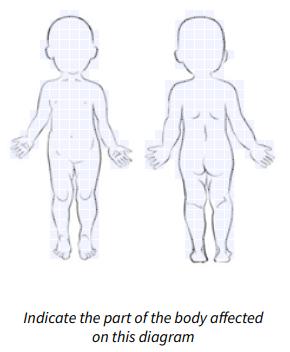
● In accordance with National Quality Standard 2.2.1, the service maintains clear and consistent procedures for documenting any injuries, marks, or bruises observed upon a child's arrival at the preschool (refer to Appendix 5). This ensures that children’s health, safety and wellbeing are protected at all times and that accurate records are maintained as part of the service’s duty of care.
● In line with National Quality Standard 2.2.3, documenting injuries on arrival supports the service’s child protection responsibilities by enabling the early identification of patterns, concerns or indicators of harm. These records assist educators in responding appropriately, following mandatory reporting requirements where necessary, and working in partnership with families and relevant authorities to safeguard children from harm and neglect
If an "Injury on Arrival" meets the threshold of "at risk of significant harm," it triggers a mandatory report immediately.
12 POLICY EVALUATION AND REVIEW
This Policy will be monitored and reviewed to ensure compliance with legislative requirements, and, unless deemed necessary due to identified practice gaps, the Preschool will review it every year.
In accordance with R.172 of the Education and Care Services National Regulations, the Preschool will ensure that families of children enrolled at the Preschool are notified at least 14 days before making any change to a policy or procedure that may have significant impact on the
provision of education and care to any child enrolled at the Preschool; a family’s ability to utilise the Preschool; the fees charged or the way in which fees are collected.
Policies are reviewed each year, in response to legislative or regulatory changes, or following an incident at the Preschool.
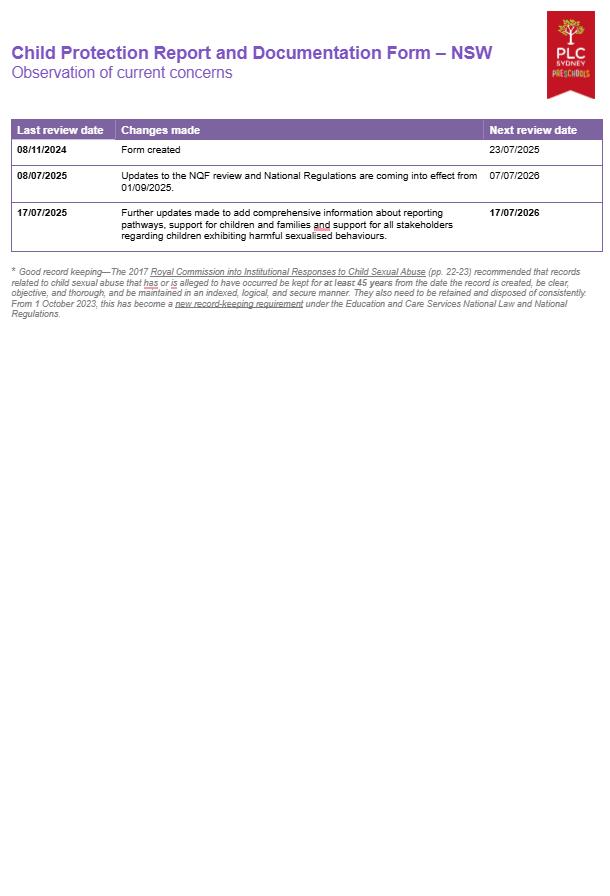
13 CHANGE REGISTER
Policy review date
Modifications
February 2021 Changes made to reflect the reportable conduct allegations reporting moving from the Ombudsman's Office to the Office of the Children’s Guardian
Appendix 4 updated
March 2021 Updated link to childstory
Updated Child Protection Helpline phone number
May 2021 Appendix 4 update to childstory weblink
August 2023 Include a definition of significant risk of harm. Amend the role of the educator.
July 2024
Checked for currency
Updated NSW Mandatory Reporter Guide and Mandatory Reporter links
Clearly identified ‘The Director of Preschools as Nominated Supervisor’ (pp 6 & 7)
Numbered steps 1-5 ‘Educators and staff will’ (p9)
Next review date
March 2022
March 2022
March 2022
August 2024
July 2025
June 2025
Checked for currency
Added reference: Child Safe Standards
● Included Child Safe Standards in Role of Director of Preschools & Role of Educators (p8)
● The Director will provide staff with a copy of Child Safe Standards & will refer to Child Safe Standards when undertaking risk assessments (p8)
● Educators will refer to Child Safe Standards when undertaking risk assessments (p 9)
Updated informing and reporting Roles & Responsibilities for both Approved Provider & Director of Preschools as Nominated Supervisor to include:
● Reporting to the Head of PLC Junior School
June 2026
August 2025
February 2026
April 2026
● Written notification to the Office of Children’s Guardian in consultation with the Head of PLC Junior School
Updates to the NQF review and National Regulations coming into effect from 1/09/2025
Included child injury/bruise record (on arrival)
Revision of the April Legislation amendments
August 2026
February 2027
April 2027