The feeling you leave behind Natalie Montagnani What is indecision costing you?
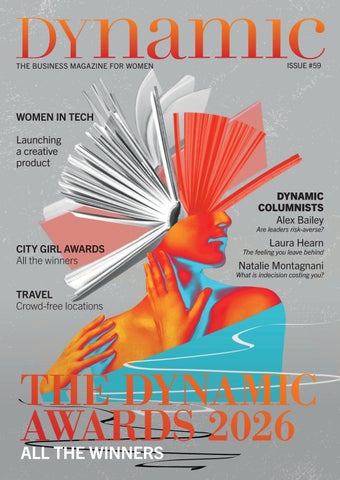
THE DYNAMIC AWARDS 2026
DYNAMIC AWARDS 2026
4 Upfront: The top international news stories involving women in business
10 In the Right Direction: Good news stories from around the world
Regulars
6 The Alex Bailey Column
Are leaders being too risk-averse?
8 The Laura Hearn Column
The feelings you leave behind
16 The Natalie Montagnani Column
What is indecision costing you? Events
12 City Girl Awards
Highlights and winners from the cultural celebration of Brighton’s women
18 Dynamic Awards 2026
Highlights of a celebration of women in business across the South East, held at The Grand Brighton, culminating in the presentation of 17 lucrative Dynamic Awards.
PLATINUM
The least I can do is speak out for those who cannot speak for themselves.”
Dame Jane Goodall
British primatologist and conservationist
Wellbeing
32 Abby Maclachlan
Creating inclusive wellness spaces that welcome all bodies
36 Dr Samantha Hiew
Rediscovering how you are after an ADHD or ASD diagnosis
Features
26 Spotlight
Focusing on two women who are not getting the recognition they deserve
28 La Fosse Academy
Which tech roles are most in demand? And how women can break into those roles
30 Yasmine Anane
The mindset required to launch a creative product
Further Reading
34 Laura Best
Born To Buzz: How to live ‘passionfirst’
Art
38 Art
‘Guilty Pleasures’ – Kellie Miller on the works of Anna Barlow
Travel
40 Crowd-free travel
Some suggestions where you can take a break to really get away from it all
What’s On
46 A brief snapshot of what’s on in Sussex and Surrey
EDITOR’S NOTE
Welcome to Dynamic
We bring you another edition filled with news, thought leadership and, of course, remarkable women.
Amongst our columnists, Natalie Montagnani tackles something many will recognise - indecision. Her column cuts straight to the cost of hesitation, not just financially but in terms of confidence and momentum and makes a great case for acting before you feel fully ready.
Laura Hearn’s piece shifts the focus slightly, looking at the feeling businesses leave behind. It’s a reminder that connection and emotional impact still play a defining role in how brands grow.
You’ll also find pages of celebration in the form of our fantastic Dynamic Awards. See all the winners, finalists and highlights on p18 - 25.
Further on, we explore what it really takes to bring a creative idea to life, the mindset behind launching something new, and the realities of building it beyond the initial concept. There’s also a practical look at the tech sector; where the opportunities are, where demand is growing and how women can position themselves within it.
You’ll find even more inspiration in our Further Reading, Art, Travel and Wine & Dine sections.
HEAD OF DESIGN / SUB EDITOR: Alan Wares alan@platinummediagroup.co.uk
BP BOSS PROMISES CLEAR DIRECTION IN FUTURE
The new boss of BP has told staff that the oil company is operating in a world of “significant complexity” as it attempts to rebuild its strategy under a fresh leadership team.
In her first message to staff as BP’s chief executive, Meg O’Neill promised a “clear direction and consistency” after a tumultuous period for the 117-year-old fossil fuel company, in which it has pivoted away from a failing green strategy.
BP’s third chief executive in under five years has stepped into the top job during the fifth week of the Iran war, a conflict that has triggered the global industry’s biggest supply shock.
GOVERNMENT LOOKS TO HELP WITH FUEL COSTS
Government support with energy bills pushed up by the Iran war would be based on household income, the chancellor has told the BBC, as she hinted help might not come until the autumn.
Wholesale oil and gas prices have soared over the past month amid severe disruptions to supply from the Middle East. While home energy bills are set to fall under Ofgem’s price cap
NEW MINIMUM WAGE RATES COME INTO EFFECT
The official minimum rates of pay have risen, meaning 2.7 million workers will be paid more from April. The rate for workers aged 21 and over across the UK is euphemistically called the National Living Wage, while those aged 18 to 20
are paid the National Minimum Wage. Starting April 1st, workers over 21 on the National Living Wage will be paid £12.71 an hour, 50p more than last year. For someone working full time, that amounts to £24,784.50 a year - an
between April and June, there is likely to be a big jump after that.
Rachel Reeves said it was “too early” to say exactly who would get help, adding that demand for energy is low in summer but starts rising in autumn.
But she refused to promise any immediate support for drivers, emphasising the need to keep the public finances under control.
increase of £900. The rate for 18- to 20-year-olds has increased to £10.85 an hour, up 85p. The government said its goal is to eventually scrap this separate rate for 18 to 20-year-olds, and have one rate for all adults.
UPFRONT
THE LATEST BULLETINS FROM AROUND THE WORLD
11% OF UK WOMEN REMAIN IN ‘PERIOD POVERTY’
Access to menstrual health remains a challenge in the UK, with more than one in ten women (11%) struggling to afford period products, either for themselves or a dependent in the last year, according to a new survey.
About 36% said they wore single-use pads or tampons for longer duration, which could lead to serious bacterial infections such as Toxic Shock Syndrome (TSS). Over a quarter (27%) said they used tissues or cotton wool, and 6% resorted to using paper.
With the price of essentials remaining well above pre-pandemic levels, and the Middle East war expected to further aggravate the cost of living crisis, ActionAid UK warns the issue of period poverty “risks becoming even further entrenched”.
WOMEN GAINING GROUND IN LEADERSHIP ROLES
While women are gradually gaining ground in UK business leadership, significant gaps persist across sectors, regions, and access to finance. New analysis from Funding Circle, drawing on the UK Gender Index and other datasets, reveals that while one in five active UK companies – approximately one million of the 5.2 million – are female-led, a funding gap is holding female-led businesses back.
Generational trends show that younger founders are slightly more likely to be women, with female representation among Gen Z-led businesses rising from 18.7% in 2024 to 20.28% in 2026. Millennials mirror this pattern at 20.13%, while Gen X and Boomer-led companies lag behind at 18.63% and 18.19%, respectively. Despite these gains, progress toward gender parity remains slow and inconsistent across industries.
YOUNG MEN HAVE MORE OPPRESSIVE VIEWS ON WOMEN THAN BOOMERS
In a worrying young trend, Gen Z men (born between 1997 and 2012) were twice as likely as Baby Boomer men (born between 1946 and 1964) to have traditional views on decision-making within a marriage, with just 13% and 17% of Baby Boomer men agreeing with those statements respectively. By contrast, far fewer Gen Z women
agreed that a wife should always obey her husband (18%) and an even smaller share of Baby Boomer women (6%) held that view. The 29-country survey which included Great Britain, the USA, Brazil, Australia and India, finds that young men today are more likely than those in older generations to hold traditional views about gender roles.
GENDER PAY GAP STILL WIDE
In a subject Dynamic will never stop banging the drum about, according to the Office for National Statistics, the median weekly pay of men working full-time outstrips that of women at every age. The gap widens significantly from around age 30 until workers are in their 60s, likely because more women than men have a more disrupted career path due to caring responsibilities, whether children or elderly relatives.
Women tend to be more likely to take career breaks and reenter the workforce in lower-paid roles. The median annual salary of men aged between 50 and 59 in full-time work is £43,940 – 8% more than that of women of the same age, where the median salary is £40,456.
‘HERSTORY’ BECOMES THE STORY
Over 140 business leaders, entrepreneurs and community members gathered at the DoubleTree by Hilton Brighton Metropole for what became Brighton’s largest International Women’s Day event, Herstory V.
Hosted by local business leader Stephanie Prior, the event was already shaping up to be a significant moment for the city’s business community. What made it even more remarkable, however, was that Prior organised and hosted the entire event while eight months pregnant. Prior, Founder of Prior Media & Marketing, said: “Herstory exists to showcase the power of women leading change and to demonstrate that motherhood and leadership do not have to be mutually exclusive.”
❛ ❛
Stand for something or you will fall for anything. Today’s mighty oak is yesterday’s nut that held its ground.”
- Rosa Parks
❛ ❛Opinions are like orgasms – mine matters most, and I don’t really care if you have one.”
Sylvia Plath
ACTION PLANS ANNOUNCED TO IMPROVE WOMEN’S WORKING
Action plans supporting women to succeed at work have been launched by Bridget Phillipson MP, Secretary of State for Education and Minister for Women and Equalities. Women are to benefit from employers taking robust action on the gender pay gap and menopause support, as the Minister for Women and Equalities commits to ensuring women can thrive at work.
Employers with 250 or more employees will be encouraged to publish the steps they are taking to reduce their gender pay gap and support employees through menopause from April. The government and businesses will work hand-in-hand to share best practices and motivate others to follow their lead voluntarily.
SOPHIA LORIMER ANNOUNCED AS FINALIST - AGAIN
Crawley businesswoman Sophia Lorimer, founder of Fine-tuned Wardrobe, has been announced as a finalist in two categories for the 2026 Women Changing the World Awards. She is the founder of Fine-Tuned Wardrobe, a multi-award-winning sustainable styling business that empowers women to feel confident, seen, and aligned with their values through their wardrobe choices.
The Women Changing the World Awards celebrate and recognise women who are achieving outstanding success in areas such as sustainability, humanitarian work, leadership, advocacy, environmental work, tech, product development, education, health and innovation. The awards not only celebrate individual accomplishments but also seek to inspire others to create change in their local communities and beyond.
By Alex Bailey
FThe
Alex Bailey Column
We are delighted to have Co-Founder, with 20+ years organisational change. delivering impactful programmes
ARE LEADERS
or years, business culture has treated “risk-aversion” as a leadership fl aw, a sign of hesitation in a world that rewards speed above all else. Yet as we enter the era of Agentic AI, where digital entities don’t just advise us but act autonomously on our behalf, that so-called fl aw is becoming one of the most critical leadership capabilities of our time.
In 2026, the goal isn’t to ‘move fast and break things.’ It’s to move intelligently and protect the things that matter. As we hand increasing decision-making power to AI agents, the most dynamic leaders aren’t the ones racing to automate; they are the ones acting as guardians of the human soul inside the machine.
We are crossing a threshold where AI is no longer a clever assistant or an enhanced search engine. It is becoming a digital employee that is capable of taking actions, making decisions, and influencing outcomes without us watching every step. Th is shift will redefi ne what it means to lead. Agentic AI promises extraordinary gains in efficiency, quality and output. But the question we must ask is: at what cost to our cultural felt sense, our relationships, and the subtle human signals that hold organisations together?
Leadership has always required the ability to scan the horizon, anticipate consequences, and understand the human impact of decisions. These skills of contextual thinking, empathy, and long-term orientation have often been undervalued in environments that prioritise short-term gains. But in an AI-driven workplace, they become strategic assets. Leaders who can sense nuance, who understand the emotional undercurrents of teams, and who consider the ethical implications of technology are now essential to organisational resilience.
Th is is where the research becomes particularly interesting. Borwein et al. (2026), drawing on survey data from 3,000
“We are crossing a threshold where AI is no longer a clever assistant or an enhanced search engine.”
respondents across Canada and the USA, found that women consistently perceived AI as riskier than perceptions men hold, with a difference of up to 11% in the belief that AI’s risks outweigh its benefits.
While the study focuses on gender differences, the insight is relevant to all leaders: those who identify more potential downsides are not necessarily resistant to innovation. They may simply be more attuned to the ethical, cultural, and relational implications of rapid technological change. In other words, what has historically been labelled “risk-aversion” may actually be a form of ethical risk intelligence.
And that reframing matters. Because in the age of agentic AI, the leaders who pause, question, and challenge are not slowing progress; they are
have Alex Bailey contributing to Dynamic. She is a Global CEO and years of expertise in HR leadership, psychology, coaching and She specialises in cultural evolution, leadership and performance, programmes globally while speaking at international events.
ensuring progress doesn’t compromise trust, culture, or humanity. They are the ones preventing misuse, misalignment, and mission drift. They are the firewall.
To maintain a level playing field in this new era, we must celebrate, not sideline, the leaders who raise caution; who ask the uncomfortable questions, who notice the bias creeping into datasets, or the erosion of empathy in increasingly “sentient-sounding” AI responses. These leaders are not laggards. They are the guardians of organisational integrity.
As AI agents take on more cognitive heavy lifting, leadership will shift again. Our roles will become less about managing tasks and more about calibrating the values, boundaries, and ethical frameworks that AI systems use to make decisions on our behalf. We will need leaders who can sense when an agent is drifting from the organisation’s tone of voice, when a shortcut risks a client relationship, or when nuance is being flattened into efficiency. We will need guardians of judgment, guardians of meaning, guardians of the human experience at work.
In my previous article, I described us as a bridge generation: those who have lived through analogue, digital, and now agentic eras of work. With that unique lens, we have an opportunity to redefine leadership. We can use AI to reclaim time for the deeply human work: mentoring, navigating complex interpersonal dynamics, and shaping the creative vision that no agent can replicate.
Risk-intelligent leadership is not a soft skill. It is a strategic imperative. And every leader, regardless of background, discipline, or style, has a role to play in shaping an AI-enabled future that remains deeply, unmistakably human.
References: Sophie Borwein, Beatrice Magistro, R Michael Alvarez, Bart Bonikowski, Peter J Loewen, Explaining women’s skepticism toward artificial intelligence: The role of risk orientation and risk exposure, PNAS Nexus, Volume 5, Issue 1, January 2026, pgaf399, https://doi.org/10.1093/pnasnexus/ pgaf399
Alex Bailey styled by Gresham Blake
Email: Alex@baileyandfrench.com www.baileyandfrench.com Insta @alexbaileybackstage Follow me on LinkedIn: www.linkedin.com/in/ alex-bailey-26562b2/
BEING RISK-AVERSE... ...OR RISK-INTELLGENT?
Laura Hearn is a former BBC journalist, now storytelling consultant and founder of Flip It - a podcast and platform helping people and businesses use storytelling as a tool for clarity, connection and change. This month, for Dynamic, Laura looks at nostalgia as a positive experience rather than something quantifiable
“Natsukashii. It describes the feeling of something from the past: a smell, a sound, a moment that catches you off guard and fills you not with grief, but with warmth.”
The feeling
By Laura Hearn
In 1968, five friends threw their gear into a beat-up vehicle and drove from California to Patagonia. They called themselves the Fun Hogs. They surfed breaks no one had even named, skied on sand and snow, spent 31 days in a snow cave, and made the first ascent of Cerro Fitz Roy - filming the whole thing on a 16mm Bolex camera.
The film became an underground classic, passed around for 50 years before it ever had a wide release. And one of those five friends went on to build one of the greatest brands on the planet - Patagonia, a company with one of the most fiercely loyal customer communities in business.
Patagonia didn’t grow through clever marketing or the latest AI tool. They left something behind that is so innately human it can’t be manufactured: a feeling. An emotion that invites you to want to be part of the story.
THE SCIENCE OF SPENDING LESS AND GIVING MORE Nostalgia has long been a tool in the marketer’s kit. But recent research reveals a mechanism that goes far deeper than warm feelings and retro aesthetics.
A series of six experiments found that when people feel nostalgic, their desire for money actually decreases - not marginally, but measurably. Participants in a nostalgic state were willing to pay more for products, parted with more cash, placed lower value on money, and put less effort into obtaining it. The driving force? Social connectedness. Nostalgia doesn’t just make us feel good about the past - it reminds us that we belong to something. And in that moment of belonging, money matters less.
Think about that as a business leader. The brands you love most, Patagonia, Nike, Apple, and Yeti, are not winning on product specification, but on belonging. They’ve made you feel part of something bigger than a transaction.
THERE’S A WORD FOR IT
In Western culture, nostalgia tends to come loaded with sadness; a longing for something gone. But in Japan, there’s a different word: natsukashii
It describes the feeling of something from the past: a smell, a sound, a moment that catches you off guard and fills you not with grief, but with warmth. Not “I wish I could go back. But I’m so glad that happened.”
It’s nostalgia without loss, with gratitude, not grief.
The brands that endure aren’t the ones that make you sad about the past. They’re the ones that make you glad you discovered them - and make you want to feel that way again.
feeling you leave behind
Natsukashii is about creating a genuine emotional residue from a real interaction. One that people carry with them and want to return to.
THE PROBLEM MANY LEADERS DON’T SPOT
Many organisations focus on how to get more customers. They think of ways to ‘sell.’ But the most successful brands never have to do this. Instead, they ask, “How do I want them to leave feeling?”
After a client interaction - what do they feel? After reading our website, how do they feel? After six months working with us, what do they feel? Feeling is what customers carry away from your brand. It’s created by your culture, reinforced by your behaviour, and amplified - or undermined - by your communication.
THE STORY YOU LIVE MATCHES THE STORY YOU TELL
This is where brands break down - through a lack of alignment between the internal and external story. A company can build a beautifully nostalgic campaign. The imagery is warm; the music is perfect. And then a customer is kept on hold for 40 minutes. Or a new employee arrives full of excitement and finds a culture that looks nothing like the
“Many organisations focus on how to get more customers. But the most successful brands never have to do this. Instead, they ask, ‘How do I want them to leave feeling?’”
story they were sold. The feeling - and trust - evaporates. And once it’s gone, it’s incredibly hard to rebuild.
Natsukashii is only possible when what people experience matches what they’ve been told. Patagonia donates 1% of sales to environmental causes, makes products designed to last a lifetime, and once ran an ad saying: Don’t Buy This Jacket. The story they live and the story they tell are the same truth - and customers feel that alignment even when they can’t articulate it.
THREE QUESTIONS TO ASK YOURSELF
• What feeling are we creating - and do we know it? The gap between the feeling you intend and the feeling you leave is often where loyalty is lost.
• Does our internal story match our external one? If your team doesn’t feel the story you’re telling customers, customers will eventually feel it too.
• Are we building a sense of belonging and lasting relationships? The brands that create Natsukashii don’t talk at their audiences, they invite them to join the future journey.
FIVE FRIENDS AND A 16MM CAMERA
That 1968 road trip was never a brand strategy as we know it today. Yvon Chouinard and his friends were simply living something they believed in: freedom, wildness, and adventure; experiences many of us have lost.
The Fun Hogs film unexpectedly became the foundation for one of the world’s most loved brands. Fifty years later, the film resonates just as much as it ever did – the story Patagonia has been telling ever since is the same one those five friends lived on the road south.
You can read Yvon Chouinard’s business story in Platinum Business Magazine, issue 102. https://tinyurl.com/2y8e9nxz
You can listen to Laura’s podcast, Flip It, wherever you get your podcasts, and you can connect with her at www.flipitglobal.com
Yvon Chouinard in 1972
TOM FROST
GLOBAL PUSH FOR WOMEN’S JUSTICE
At a UN summit, dedicated to equality, governments have agreed new measures to strengthen justice systems for women and girls, addressing drivers of rising female incarceration, including poverty, violence against women and discriminatory laws, notably those related to child marriage and property rights. While women
remain a small share of prison populations, their numbers are growing faster than men’s. The agreement sets out a framework for fairer legal systems and improved protections. Challenges persist though, with no country yet achieving full legal equality between women and men. Turning commitments into action will be the true test.
IN THE RIGHT DIRECTION
INDIA DECLARES MENSTRUAL HEALTH A RIGHT
India’s supreme court has ruled that access to menstrual hygiene products is a fundamental right, requiring schools to provide them for free. The decision follows evidence linking access to improved attendance among girls. It addresses a longstanding barrier to education, particularly for those from disadvantaged backgrounds. Schools have been given a deadline to comply, marking a significant
step towards equality and dignity in education.
TECH’S ‘BIG TOBACCO’ RECKONING
A US jury has delivered a landmark verdict against Meta and Google, ruling they failed to protect a young user from harmful platform design. The case centred on a now 20-year-old who became addicted to Instagram and YouTube as a child. Jurors found the companies knowingly built addictive features and failed to enforce age restrictions. She was awarded $6m in damages. Both firms will appeal, but the ruling could shape thousands of similar lawsuits and marks a turning point in how tech’s responsibility to young users is defined.
❛ ❛
Be yourself, it’s a tough act to follow”
Katherine Hepburn
UK BACKS ARTISTS ON AI COPYRIGHT
Plans to allow AI companies to use copyrighted material without permission have been dropped by the UK government after strong opposition from the creative sector. Artists and industry groups argued the proposal would undermine livelihoods and devalue original work. The reversal has been welcomed, though questions remain about how existing AI models are regulated. The debate highlights ongoing tension between technological progress and protection of creative rights.
GREEN ECONOMY OUTPACES UK GROWTH
The UK’s low-carbon sector is expanding at a pace well beyond the wider economy, with growth of 10.2% compared to 1.3% overall. The sector now contributes more than £80bn in value and plays a significant role in
SOLAR POWER COMES TO THE HIGH STREET
Plug-in solar panels are set to become widely available in UK supermarkets, opening access to renewable energy for people without rooftops. Designed for balconies and small spaces, the systems are already popular in parts of Europe. The rollout forms part of broader efforts to strengthen energy independence, alongside proposed requirements for solar in new homes. Demand is rising quickly, though concerns remain over costs and how new rules could affect housing development.
supporting wider economic activity. Analysts point to clean technology investment as a key driver of productivity and resilience, particularly as businesses contend with high energy costs and global market uncertainty.
NEW HOPE FOR PROSTATE CANCER TREATMENT
An experimental immunotherapy is showing encouraging signs in patients with advanced prostate cancer. In an early trial involving 58 men whose disease no longer responded to standard treatment, nearly half experienced tumour reduction. Side effects were generally mild. The results are notable given the limited success of immunotherapy in this cancer type to date. Further research will determine whether the approach can offer a reliable new treatment pathway.
RETHINKING AGEING AND DECLINE
Ageing is often framed as inevitable decline, but new research from Yale University challenges that view. Tracking more than 11,000 adults aged 65 and over for 12 years, researchers found that 32% improved cognitively and 28% improved physically. When those who remained
stable were included, more than half defied decline. Lead researcher Dr Becca Levy said individual trajectories tell a more hopeful story, with earlier work also linking positive age beliefs to better memory, mobility and longterm health outcomes.
I know my worth. I embrace my power. I say if I’m beautiful. I say if I’m strong. You will not determine my story. I will.”
Amy Schumer
Pippa Moyle is the CEO and founder of the City Girl Network, a mission-driven business dedicated to empowering and supporting women across the UK. Since launching in March 2016, the network has built a vibrant community of over 150,000 women, facilitating new friendships, business connections, job opportunities, housing solutions, and valuable life advice.
BRIGHTON GIRL AWARDS A night of celebration, community
By Pippa Moyle
The 2026 Brighton Girl Awards took place at The Old Market, Hove on March 19th, bringing together hundreds of guests to celebrate the women, businesses and organisations shaping the city’s cultural and economic landscape.
Spanning 17 categories, the ceremony recognised contributions across industries including hospitality, wellness, creative industries, retail and community impact. But beyond the awards themselves, the evening reflected something deeper: a city powered by connection, resilience and purpose-led business.
The night opened with Brighton Book Festival taking home the Experience award, setting the tone for a ceremony that championed creativity and culture from the outset. Throughout the evening, winners represented a broad cross-section of Brighton life, from established names like Redroaster for Best in Hospitality to the Charity of the Year, RISE, recognised for its work supporting those affected by domestic abuse.
Community remained a central theme. City of Stars Choir was awarded for its inclusive approach to bringing people together through music, while Trusted Housesitters was recognised as Employer of the Year for its people-first approach to flexible working.
There were also standout moments that captured the emotion behind the achievements. In one of the most memorable acceptance speeches of the night, Wellbeing Champion Hema Patel shared a poem she had written, offering a deeply personal reflection on
her work. In contrast, the win for Yoga in the Lanes saw its founder visibly overcome, sharing that the recognition followed 16 years of dedication to building her business.
Elsewhere, the awards highlighted the continued growth of Brighton’s entrepreneurial ecosystem. Remarkabull Marketing, founded by Lydia Ecclestone, was named New Business of the Year, sponsored by our very own Dynamic Magazine and judged by the Dynamic publisher, Maarten Hoffmann. A week later, Lydia went on to win Rising Star of the Year at the Dynamic Awards.
One of the loudest celebrations of the night was when Bang The Drum Events won Professional Service of the Year. Founder Amy Gibson credited the Brighton Girl Awards campaign with helping her build meaningful connections locally, including hosting a nominee showcase event at PLATF9RM Hove.
Personal moments were woven throughout the evening. Harriet’s of Hove was named Retailer of the Year, with
“This year’s ceremony
highlighted
not only the scale of talent within the city, but also the stories behind it.”
AWARDS 2026: community and impact
founder Harriet Dean-Orange accepting the award while holding her newborn son. In another, Claire Lipscomb Mortgage and Protection Advice, accepted the Property Service award via pre-recorded video while recovering from surgery.
The ceremony culminated in the headline award, Brighton Girl of the Year, which was presented to Monica Zammit. Recognised for her work as a dance instructor and advocate for inclusion, Zammit’s win reflected the wider ethos of the awards: celebrating impact that extends beyond commercial success.
Additional winners on the night included Skylark Coffee for Green Business, The Hair Salon for Health and Beauty Space – whose full team took to the stage – and Harbour Hotel Brighton for Wedding Service. The host venue, The Old Market, was also recognised, winning Venue of the Year for the second consecutive year.
A REFLECTION OF BRIGHTON’S BUSINESS COMMUNITY
The Brighton Girl Awards are notable for their community-led approach, with nominations and voting driven by the public and winners chosen by an expert judging panel. Organisers say this ensures the awards reflect genuine local impact and connection, rather than purely commercial metrics.
As the event continues to grow, it is increasingly seen as a platform for elevating the visibility of women-led businesses and community initiatives across Brighton and Hove.
Th is year’s ceremony highlighted not only the scale of talent within the city, but also the stories behind it. Businesses built alongside life’s challenges, communities formed through shared purpose, and a collective commitment to lifting others along the way.
Brighton Girl (sponsored by Gold Arts Jewellers) MONICA ZAMMIT
Wellbeing Champion (sponsored by Be Well Live Well) HEMA PATEL
COFFEE
Health and Beauty Space (sponsored by London Women’s Clinic) THE HAIR SALON
in Hospitality REDROASTER
(sponsored by Search Seven) RISE
Natalie Montagnani is a business and leadership strategist and Founder of IGNITE. With over 25 years’ commercial female founders and senior leaders to strengthen self-leadership, make confident decisions, and drive meaningful coaching, corporate programmes and speaking, Natalie is on a mission to advance female leadership and infl
WHAT IS INDECISION COSTING YOU?
By Natalie Montagnani
Believe me, if I had a pound for every time a female leader said one of the following phrases to me, I’d be a rich woman.
• “I’ve got this idea… but what do you think, should I do it?”
• “I’m not quite ready yet.”
• “I think I’ll wait for now, just to be sure.”
And on the surface, it sounds sensible. But from experience, I know it goes deeper than that; it’s avoidance.
IT’S NOT PERSONALITY TYPE, IT’S CONDITIONING
As women, we’ve been conditioned to believe that taking our time and seeking other people’s opinions or approval is the smart move; it’s what ‘good girls’ should do, that if we just gather a little more information, wait for the perfect moment, or feel 100% certain… then we’ll make the right decision and get a pat on the head.
“Good leadership doesn’t come from readiness. It comes from self-leadership”
(Spoiler: it’s more than you think)
Women have also been taught not to be ‘too much,’ ‘too bold,’ or ‘too risky.’ So, of course, we hesitate, overthink, and wait until we feel more prepared, more certain, more ready. But good leadership doesn’t come from readiness. It comes from self-leadership — the ability to move forward despite uncertainty.
I have seen too many brilliant women miss out on opportunities simply because they didn’t step forward, or not quickly enough. Because for every day that you don’t decide, you are, in fact, making a decision. You’re choosing:
• to stay where you are
• to delay momentum
• to keep carrying the mental load of “should I, shouldn’t I?”
And that weight? Oh my goodness, it’s exhausting. So when clients come to me for reassurance, I often say, “Go for it, or let’s test it and see.”
Because with my background in marketing, I know experimentation, trial and error, and learning as you go are not
commercial experience, she works with meaningful commercial growth. Through her influence in business.
“Simply put, stop waiting and start acting. Ignore that selfdestructive inner dialogue”
signs of failure; they are how business actually works. And when you allow yourself to “fail forward,” you open up a world of possibility.
THE REAL COST OF INDECISION
Indecision impacts your revenue, your growth, and your ability to scale or rise in an organisation. But the deeper cost? It chips away at your confidence – hello, imposter syndrome. Every time you hesitate, second-guess yourself, or stay stuck in ‘thinking mode,’ you send yourself a subtle but powerful message, “I don’t trust myself.”
And that is where the real damage begins. Because confidence doesn’t come from having all the answers, it comes from backing yourself without them. Indecision keeps you in a loop of overthinking, overanalysing and outsourcing your power. And before you know it, you’re looking outside of yourself for validation you already have within you.
THE WOMEN WHO MOVE FAST WIN
When I look at the women who grow, scale, pivot and lead, they are not the ones with the perfect plan. They are the ones who decide, the ones who put the proverbial ‘big girl pants’ on and go for it and make decisions quickly and with conviction. Not because they’re reckless, but because they trust themselves to figure it out.
They don’t spend months deliberating over:
• whether to raise their prices
• whether to hire
• whether to pivot
• or go for the promotion
They make the call and move.
Take inspiration from Sara Blakely, founder of Spanx. She didn’t wait until she felt ready or fully qualified to start her business. She had no background in fashion or retail, no roadmap, and no guarantees. But she had an idea, the willingness to act on it before she had all the answers and built a billion-dollar company.
SO WHAT DO YOU NEED TO DO?
Simply put, stop waiting and start acting. Ignore that self-destructive inner dialogue telling you that you need
more time, more information, more reassurance. And ask yourself a different question: “What would I decide if I trusted myself?”
Not your peers or partner. Not Google, Chat GPT or another podcast episode. You. Just YOU. Because the truth is, most of the time, you already know. And here’s the kicker: It is far quicker to make a decision, learn, realign, and move again than it is to sit still trying to get it perfect the first time.
“As the quote says ‘But what if I fail?’ ‘Oh my darling, what if you fly?’”
A FINAL THOUGHT
For me I think the biggest cost of indecision is not just the opportunities you miss, it’s the version of you that never gets to emerge. So decide. Not perfectly. Not with guarantees. But with self-trust.
As the quote says “But what if I fail?” Oh my darling, what if you fly?
Natalie Montagnani Founder of IGNITE Women in Business
07900 153503
ignitewomeninbusiness.com
Connect with Natalie on LinkedIn or drop her an email to natalie@ignitewomeninbusiness.com
The winners, and highlights...
winners, fi nalists highlights...
WINNERS ANNOUNCED FOR THE DYNAMIC AWARDS 2026
The winners of the Dynamic Awards 2026, the South East’s leading awards programme celebrating the achievements of businesswomen, have been o cially revealed, following a prestigious ceremony in Brighton.
The winners were announced at a spectacular black-tie gala on March 26th at The Grand Brighton, where hundreds of guests gathered for an unforgettable evening of celebration, inspiration and entertainment. The night was brought to life by a standout performance from acclaimed comedian Jo Caul eld (Live at the Apollo, Mock the Week, Have I Got News for You), whose sharp wit set the tone for a truly memorable occasion.
A highlight of the evening saw four exceptional women take to the stage to share powerful and deeply personal stories, capturing the resilience, innovation and leadership that lie at the heart of the Dynamic Awards community.
Following a record-breaking year for entries, 96 businesswomen were shortlisted, with just 17 taking home a coveted award on the night.
Maarten Ho mann, Event Organiser and Managing Director of Platinum Media Group, said: “Every year, we are inspired by the extraordinary calibre of women entering these awards. The judging panel faced an incredibly di cult task, re ecting the exceptional quality of this year’s entries. We are immensely proud of all our nalists and winners.”
The evening’s host – Jo Caul eld
THE 2026 WINNERS
Employer of the Year
Sponsored by Nescot HELEN WESTMORELAND Giftpoint
❛❛ At these awards last night, it was the men who cheered the loudest! That was genuinely beautiful to see...
AI & Tech Excellence Award
Sponsored by Samantha Harland
JOANNA HASLAM Snap Finger Click
Best New Business Award
Sponsored
Big Bee Content
Property Professional of the Year
Sponsored by Dynamic Magazine SARAH ROWLAND
Bennett Oakley Solicitors
Future Talent of the Year
Sponsored by Move Di erent
LYDIA ECCLESTON
Remarkabull Marketing
❛❛ This journey has taken courage, resilience and a lot of belief in myself, even when others didn’t. To be recognised like this is a reminder that taking the leap is always worth it and that you’re capable of far more than you think.
Remarkabull Marketing
Professional Services Award
Sponsored by Growth Animals Marketing
SARAH WHITEMORE
Warner Goodman
❛❛ The ceremony brings together an incredible group of talented women, celebrating success as well as shining a light on future leaders. It’s a privilege to champion such amazing talent across our region.❜❜
Kreston Reeves
Inspirational Award
Sponsored by The English Soap Company
JANE COLEMAN
The Russell Martin Foundation
❛❛ To stand in a room lled with such driven, inspiring women (and men) was powerful. The level of collaboration, support and ambition in the room was something special. ❜❜
The English Soap Company
Best Customer Service Award
Sponsored by Creative Pod
MANDIRA SARKAR
Mandira’s Kitchen
THE 2026 WINNERS
MD of the Year
Sponsored by FRP Advisory
HANNAH MORGAN
The Gel Bottle Inc
❛❛ To be recognised alongside so many inspiring women in business means so much. It’s a real re ection of the journey we’ve been on and the amazing team around me.❜❜
Horsham Sports Clinic
Large Business if the Year
Sponsored by Monan Gozzett DAISY KALNINA
The Gel Bottle Inc
Businesswoman of the Year
Sponsored by DMH Stallard NATALIE REA
Clarity Environmental
Company of the Year
Sponsored by Omny Group HELEN CANNON
Business Growth Award
❛❛ What stood out most for me wasn’t just the awards themselves, but the energy in the room, a real sense of ambition, support and shared success. ❜❜ Better Days Recruitment
Sponsored by Benchmark Financial Planning
CHERYL PROBIN
Horsham Sports Injury CLinic
❛❛ Winning was an incredible moment. It’s a recognition of the energy, creativity and dedication everyone brings every day. We’re proud to continue Changing the Workplace for Good and making a real di erence for our clients and people. ❜❜
ISON Travel
Gamechanger of the Year
Sponsored by SpaBreaks.com
JULIE KAPSALIS MBE
Sponsored by Kreston Reeves SHAZIA DAVID
Nescot Medium Business of the Year
Caremark Spelthorne & Runnymede
In our exclusive Spotlight feature, we highlight women who are doing good things in their community. They’re not always seen but we think they should be.
SP OTLIGH T
Karen Morton
Karen in the Founder of Stripey Lemon, a Learning & Development Consultancy which provides communication coaching for teams and individuals. Better relationships, better outcomes
As a global coach and mentor, I help individuals and teams unlock confidence, clarity, and leadership potential — guiding them to communicate with impact and purpose across cultures and industries. Starting my career journey as a PR Intern, I discovered my love of organising events, providing hospitality through creating memorable experiences and working with the media.
It was exciting, no two days were the same, and there was always a great sense of achievement. Getting into L&D came by invitation, a natural progression, and I believe my own commercial experiences help me understand the needs of my clients today.
When I’m not facilitating coaching conversations for Global clients, I love making connections in Brighton & Hove, where I live. I host a local radio show dedicated to food and drink. Each month, the Food and Drink Show shines a light on the artisans, producers, and hospitality heroes who shape the Sussex community’s food culture — giving them a platform on Radio Reverb, Brighton, to share their stories, struggles and successes. It’s about people, passion, and connection — the very things that make communities thrive.
connector of shared experiences, creates interest in trying new things and provides an important platform for people to have a voice.”
As well as connecting to my local community through radio, I believe it’s important to support the next generation of women. As a volunteer mentor with Flourish Mentors, I hope to inspire young women as they build their confidence and self-belief so they have the courage to embrace life’s opportunities.
“At the heart of all I do – it’s about building relationships, storytelling, and sparking possibility.”
“What I love about mentoring is how you get mentored right back; each conversation is a joy, sharing perspectives on life, music, food and learning how to navigate tough decisions. It’s an honour to be part of the Flourish Community led by Founders Frederique Lambrakis-Haddad and Cathy Chesson.
At the heart of all I do – it’s about building relationships, storytelling, and sparking possibility.
At 19, I was introduced to a radio studio in Bray, Co. Wicklow, Ireland. It was a passion that took hold – the idea that radio can create a sense of place and purpose. “It’s a
Antoinette is Trustee of Flourish, rooted in empowering young women to “believe, belong and become.”
SAYING YES AGAIN
Ionce vowed I would never be a trustee again. It wasn’t because I didn’t believe in the work. Quite the opposite. I loved the charities I served and remain deeply passionate about their missions. But as someone who builds and leads through action, I found myself struggling with endless governance papers, policies and meetings that felt far removed from the people we were trying to help.
At the same time, my own business, Just Helpers, a multiaward-winning London-based ethical cleaning company, was demanding everything I had. A move to Worthing and the upheaval of Covid meant survival required total focus. Becoming a trustee again felt impossible.
Then I met Frederique, known to everyone as Fred, one of the co-founders of Flourish.
intentionally offers changed the trajectory of my own life, because ordinary adults chose to stay, mentor and believe in me when my world felt uncertain.
“Flourish, a mentoring charity supporting young women, stands in the
gap where other services often fail.”
We met at an event where I was speaking, and there was an immediate sense of shared energy. Over coffee, as we exchanged stories, it became clear how much overlap there was between my own journey and the heart behind Flourish. For a year, I gently resisted her invitations to join the board. “Not yet” became my refrain. What changed my mind was Flourish’s desire to go deeper in supporting care-experienced young women. Having entered the care system myself at the age of seven, I recognised something deeply personal in that vision. Eventually, I ran out of reasons to say no, and I am profoundly glad I did.
Flourish, a mentoring charity supporting young women, stands in the gap where other services often fail. Through a two-year mentoring programme, workshops and an intergenerational community of women, it helps young women shape identity, build healthy relationships and imagine aspirational futures.
At its heart is a simple belief: no young woman should navigate her formative years alone. Much of what Flourish now
Being a trustee this time feels different. Our conversations are purposeful and strategic. Governance matters, but it serves the mission rather than obscuring it. Most importantly, we are invited into the community itself, hearing stories and witnessing transformation firsthand. Watching these young women step into confidence and possibility regularly moves me to tears of pride and joy.
My Christian faith shapes my conviction that we are meant to walk alongside one another. I believe everyone should be mentored and mentor others for their entire lives.
One day, I hope to help build a grant-making mentoring foundation for bright, sparky young people leaving care, offering belief and seed funding to help their ideas flourish. For now, I am learning what it means to live more deeply in community, increasing my capacity by sharing what I have with others.
If there is one thing I have learned, it is this: sometimes the right yes finds you when you least expect it.
flourishmentors.com
Which tech roles are most in demand? And how women can break into them
Claudia Cohen, career expert and Director of La Fosse Academy, reveals which tech roles are most in-demand right now, and highlights how the right mindset, skills, and career approach can open long-term careers for women in a competitive industry.
The tech sector is evolving fast, and while demand for skilled talent continues to grow, many people still struggle to understand which roles offer longterm career potential. For women in particular, the path can feel even less clear.
Despite making up only 20% of tech roles in the UK, women face additional barriers to entry. Research shows that 63% of women report feeling less confident when job-seeking, particularly when facing complex or automated hiring processes, which can influence where and how they apply.
WHICH TECH ROLES ARE MOST IN DEMAND RIGHT NOW?
According to Claudia, the strongest demand is currently in data and AI, as organisations focus on establishing solid foundations before fully investing in AI solutions, with roles like data analysts and data governance specialists seeing particularly high interest.
“There’s also a huge need for junior AI roles,” Claudia explains. “Businesses want tech-savvy people who can grow with the technology, often in project-based or in-house positions like Project Management Officers. These roles allow women to gain experience across the business, even if engineering or development teams are outsourced.”
Other high-demand areas include software engineering, cloud, information security, and tech architecture. “Many companies are actively creating pipelines into
architecture roles, because junior entry points historically haven’t existed. This is a great opportunity for women looking to build long-term careers in technical leadership,” she adds.
HIGHEST-PAYING TECH ROLES
The roles with the strongest earning potential currently include data engineering, software development, cloud specialists, data scientists, and machine learning positions.
“Salary growth is fastest where skills are scarce and the business impact is high,” Claudia explains. “If you’re aiming for a high-earning trajectory, these areas offer clear progression opportunities - but it’s not just about pay. Women entering tech should focus on gaining hands-on experience and building transferable skills that will let them pivot into different specialisms as technology evolves.”
FIVE WAYS WOMEN CAN BREAK INTO IN-DEMAND TECH ROLES
According to Claudia, building a successful career in tech isn’t about having all the skills from day one - it’s about curiosity, adaptability, and a willingness to learn.
“Tech careers aren’t linear,” she explains. “Senior professionals all took different paths, so early-career women need to be open-minded about where their journey could lead. Learning the core capabilities and concepts is far more important than mastering every tool immediately, and your attitude will define your journey.”
CLAUDIA’S TOP TIPS INCLUDE:
1. Build foundational skills
“Understanding the principles behind data, AI, software, and cloud, gives you a framework to grow,” Claudia says. “Focus on learning how systems work and developing problem-solving skills - the technical tools can be learned along the way.”
2. Gain practical experience “Internships, project-based work, or volunteering in tech initiatives provide invaluable exposure. Even small, self-directed projects help build confidence and demonstrate capability to employers.”
putting yourself forward, asking questions, and applying to training programmes will all help you to grow. At La Fosse’s Academy, we see many women looking to change roles or gain further experience in the industry, and simply taking the leap into these new settings can build confidence in itself. Filling that skills gap in a supportive environment is vital for progress, or even just a fresh start.”
“Building a successful career isn’t about having all the skills from day one – it’s about curiosity, adaptability, and a willingness to learn.”
PUTTING IT INTO PRACTICE
3. Leverage mentoring and communities “Mentorship helps you navigate the tech industry and progression routes. Joining women-in-tech networks like UNBOUND or engaging with online communities can also give support, guidance, and visibility.”
4. Be open-minded about career pathways “Don’t feel constrained by traditional roles,” she adds. “Some women may start in project management before pivoting into data or AI. Others might explore cloud or software roles before moving into architecture or leadership. Early flexibility creates long-term opportunities.”
5. Build confidence, resilience, and experience
“While entering the tech industry might feel intimidating,
Claudia adds, “Breaking into tech as a woman requires curiosity, adaptability, and persistence. Start with strong foundations, gain practical experience, find mentors, stay open to different paths, and focus on building confidence. Tech is changing constantly, and this is the perfect time for women to step in and shape their careers.”
La Fosse partners with ambitious organisations to build high-performing, agile teams- connecting the right people with the right opportunities from the classroom to the boardroom. www.lafosseacademy.com
By Yasmine Anane
The mindset required launch a creative
Creative ideas are surprisingly common. Most people have one tucked away somewhere. A book they have always wanted to write, a product they believe should exist, a concept that sits quietly in the background while life moves on around it.
The real difference between a creative idea and a creative product is the mindset required to bring it into the world.
Launching something creative rarely begins with certainty. It usually starts with a mixture of curiosity, excitement and a fair amount of doubt. Unlike more traditional career paths, there is no clear roadmap. You are stepping into something personal, and that can feel uncomfortable.
For me, the idea for my fi rst children’s book, The Family Tree, began long before the book itself existed. Like many creative ideas, it lived quietly in the background for some time while I balanced a busy career and family life. The shift happened when I decided to stop treating it as an idea and start treating it as something real.
ACCEPT THAT CREATIVE WORK RARELY STARTS PERFECTLY
One of the biggest barriers to launching a creative product is the belief that everything needs to be fully formed before you begin. In reality, creative ideas rarely start that way.
“One of the biggest barriers to launching a creative product is the belief that everything needs to be fully formed before you begin.”
Early versions are often messy. Stories evolve. Concepts change shape. Feedback reshapes the work in ways you did not originally expect.
When I began writing The Family Tree, the story went through several drafts before it reached its final form. The rhythm of the text, the pacing of the story and the emotional heart of the message all developed gradually. At its core, the book celebrates kindness, inclusion, and the beauty of our differences, but those ideas grew stronger over time as the story evolved.
required to creative product
Creative work is rarely about waiting for the perfect idea to arrive. It is about starting with something meaningful and allowing it to grow through iteration.
MOVE FROM CREATOR TO BUILDER
Another important mindset shift happens once the creative work itself exists. Many people assume that launching a creative product is simply about creating the thing. In reality, that is only one part of the process.
Bringing something creative into the world requires thinking beyond the work itself. You begin to think about who it is for, how people might discover it and how the message behind it can reach the audience it was written for.
After publishing The Family Tree, I quickly realised that the work did not end with the book. Much of the journey happened outside the writing process. Visiting schools, hosting readings in bookshops, and building relationships with communities that cared about the story's themes became an important part of helping the book find its readers.
CREATIVE IDEAS COME TO LIFE WHEN THEY CONNECT WITH PEOPLE
That same mindset shaped my next project, Whitney the Wasteater and the Wrong Bite, created in partnership with Biffa. While The Family Tree focuses on kindness and inclusion, this story builds on the idea of caring for others by extending it to caring for our planet.
Th rough storytelling, children are introduced to ideas
around recycling and sustainability in a way that feels engaging and accessible. Creative products often grow beyond their original idea when they connect with a wider purpose.
STAY ANCHORED TO WHY THE IDEA MATTERED
Launching something creative inevitably comes with moments of uncertainty. Progress can feel slower than expected. Not every idea lands immediately. Balancing creative work alongside other responsibilities, whether career or family, can sometimes make the journey feel unpredictable.
“Bringing something creative into the world requires thinking beyond the work itself.”
For me, returning to the reason the idea existed in the fi rst place has always been important. Both of my books began with a simple belief that stories can help children understand the world around them. Whether that is learning about kindness and belonging, or understanding how we care for the planet we live on.
Purpose provides the resilience that creative work often requires. While launching a creative product may involve strategy, partnerships and persistence, the foundation is always the same. It begins with an idea that matters enough to bring into the world.
Yasmine is a Best Selling Children’s Author of The Family Tree & Whitney the Wasteater and the Wrong Bite.
www.yasmineanane.com
CREATING INCLUSIVE SPACES THAT
By Abby McLachlan, Founder of East of Eden
Wellness should be for everyone. Yet for many people, stepping into a new fitness studio space can feel intimidating, exclusive or simply not designed with them in mind. Whether it’s yoga, Pilates, meditation or any other movement class, the industry has historically centred a narrow image of who wellness is “for”. Too often, the messaging, marketing and even the environments themselves suggest that classes belong only to certain body types, fitness levels or lifestyles.
Creating truly inclusive wellness spaces requires a shift in mindset. It means recognising that bodies come in many forms, abilities and experiences, and designing environments where people feel welcome exactly as they are.
At its core, inclusive wellness is about belonging. It’s about walking into a studio or class and feeling that you don’t have to change yourself to participate. That begins with acknowledging that everyone arrives at wellness from a different starting point. Some people are experienced movers; others may be returning after injury, navigating chronic illness, or simply taking their fi rst step into a movement practice.
“Inclusive wellness is about belonging. It’s about walking into a studio or class and feeling that you don’t have to change yourself to participate.”
Language plays a powerful role in shaping this experience. The words instructors use in classes, online and in marketing materials can either invite people in or unintentionally push them away. Phrases that emphasise ‘burning off calories’, achieving a “bikini body,” or striving for aesthetic goals can reinforce the idea that movement is only valuable if it changes how we look. By contrast, language that focuses on how movement makes us feel, stronger, calmer, more energised, more connected, creates space for people of all shapes and sizes to participate without judgement.
Representation matters too. When people see bodies like their own reflected in instructors, marketing imagery and
INCLUSIVE WELLNESS THAT WELCOME ALL BODIES
community members, it sends a powerful message that they belong. Inclusive spaces actively celebrate diversity across body size, age, gender identity, ethnicity and ability. This doesn’t happen by accident - it requires conscious decisions about who is represented, who is hired and whose voices are amplified.
Physical accessibility is another crucial part of inclusive design. Wellness environments should be welcoming not only in philosophy but also in practical terms. That might mean ensuring studios are accessible for people with mobility needs, offering a range of class formats and intensities, or providing props and modifications that allow people to adapt movements to suit their bodies. True inclusivity recognises that there is no single “right” way to move.
Instructors play a particularly important role in shaping inclusive experiences. Teaching with awareness means offering options rather than rigid instructions, encouraging participants to listen to their bodies and emphasising that rest is always valid. It also involves avoiding assumptions about people’s abilities or goals. Not everyone attending a class is aiming to become stronger or more flexible; some may simply be seeking a moment of calm or connection in an otherwise busy day.
Another key element of inclusive wellness is removing the pressure to perform. In many fitness environments, there can be an unspoken expectation to keep up, push harder or achieve certain milestones. Inclusive spaces challenge this narrative by creating an atmosphere where participants are encouraged to move at their own pace and honour what their bodies need on any given day.
with the time and financial resources to access it. Offering a variety of price points, community classes, or flexible memberships can help make movement practices more accessible to a wider audience.
“Ultimately, inclusive wellness spaces recognise that the purpose of movement and self-care is not to fix our bodies but to support them.”
Ultimately, inclusive wellness spaces recognise that the purpose of movement and self-care is not to fix our bodies but to support them. When we move away from ideals of perfection and toward practices rooted in compassion, we create environments where people feel safe to explore what wellbeing means for them. This shift is powerful. When people feel welcomed rather than judged, they are more likely to return, build sustainable habits and develop a healthier relationship with their bodies. Instead of striving to fit into a wellness space, they experience a space that has been thoughtfully designed to include them.
Community is equally important. When people feel seen and supported by those around them, wellness becomes less about individual achievement and more about shared experience. Studios can foster this by creating opportunities for connection, encouraging kindness, and ensuring that every participant, whether new or experienced, feels valued.
Affordability is also part of the inclusivity conversation. Wellness should not feel like a luxury reserved for those
The future of wellness lies in this approach, one that celebrates diversity, prioritises kindness and acknowledges that every body deserves access to practices that support health and wellbeing. Inclusive spaces remind us that wellness isn’t about looking a certain way. It’s about creating environments where people can move, breathe and reconnect with themselves in ways that feel supportive, empowering and genuinely welcoming.
eastofeden.uk
FURTHER READING… LIVING PASSION-FIRST
Laura Best is a keynote speaker helping organisations cultivate passion as a performance driver, the author Born to Buzz: How to Spark Your Passions (Without Quitting It All) and founder of Passion Collective, a global community for professionals who are harnessing their passions to create success.
Years ago, when navigating a challenging job (one of those that makes you question your sanity!), an HR leader told me to expect to dislike 30% of my role. He wasn’t talking about the occasional tedious Zoom call. He meant real dislike, and he believed it was the price of having a career, one that I should accept, with a smile. I quickly calculated that’s roughly 70 days a year of not feeling your best at work.
We’ve been taught that loving what we do comes last, that passion is a luxury, a reward for years of hard work and sacrifice, an optional extra that we give up the higher we climb. This belief clearly isn’t working. Gallup’s most recent State of the Global Workplace report found that only 23% of employees are engaged at work. Talented people are losing
PASSION STRUCK: TWELVE POWERFUL PRINCIPLES TO UNLOCK YOUR PURPOSE AND IGNITE YOUR MOST INTENTIONAL LIFE
By
John R. Miles (Post Hill Press, 2024)
A practical, high-energy guide to transforming passion into intentional action. Miles outlines 12 principles to help individuals move from passive interest to purposeful work, blending neuroscience, leadership insights, and real-world case studies. The book reframes passion as something built through discipline, curiosity, and clarity rather than something you simply ‘find’.
their motivation; organisations are losing their competitive edge. There is another way.
PUT YOUR PASSIONS FIRST
Job crafting — developed by organisational psychologists
Jane Dutton and Amy Wrzesniewski — is the practice of shaping your role around more of what you love. It has three forms: the tasks you take on, the relationships you build, and the mindset you bring. Essentially, you get to honour your responsibilities while bringing more of “you” into your work.
WHAT THIS LOOKS LIKE
Sarah led a compliance function after spending years in project management. She was reluctant to admit it, but she missed the impact of those earlier days. She didn’t want to
VENTURE MEETS MISSION: ALIGNING PEOPLE, PURPOSE, AND PROFIT
By Arun Gupta, Gerard George, Thomas J. Fewer (Stanford University Press, 2024)
This book reframes business passion through the lens of mission-driven entrepreneurship. It argues that the most meaningful careers emerge when profit and purpose align, offering a model where innovation addresses global challenges. A compelling read for those wanting to channel passion into ventures that create both economic and societal value.
THE PATHLESS PATH: IMAGINING A NEW STORY FOR WORK AND LIFE
By Paul Millerd (Penguin,
2022)
A reflective, modern exploration of leaving traditional career paths to pursue meaningful work. Millerd blends memoir with philosophy, encouraging readers to rethink success beyond linear careers. It speaks to a growing generation seeking passion not in titles, but in autonomy, creativity, and self-directed work.
PASSION-FIRST
quit her job — she wanted to feel more passionate about the one she had. What’s more, she felt guilty for wanting “more” when she’d already achieved so much. What if her organisation had a committee she could join, where she could offer ideas to improve systems, or mentor others? It would mean Sarah making time and the organisation giving her flexibility, but it would be a gain for her and the business.
“We’ve been taught that loving what we do comes last, that passion is a luxury, a reward for years of hard work and sacrifice”
THE KEY
Think of job crafting as a Venn diagram; business goals on one side, your passions on the other. Where do they overlap? Perhaps a passion outside work brings something new
MORAL AMBITION
By Rutger Bregman (Bloomsbury, 2025)
A bold call to rethink career success, urging readers to pursue work that genuinely matters. Bregman challenges the idea of “comfortable careers” and instead advocates impact-driven ambition. Passion here is framed as moral urgency — using your skills to solve meaningful problems and contribute to society rather than simply advancing personal success.
to your culture. Perhaps that finance knowledge you geek out about (even though you’re in HR!) helps solve a complex problem. That overlap is where passion acts as fuel, if we’re brave enough to prioritise it. It’s where you stop fitting yourself around the job and start building the job around you. Passion brings proven benefits — to performance, wellbeing, and the people around you. The question is: are you ready to put it first?
Sources: Wrzesniewski, A., & Dutton, J. E. (2001). Job crafting: Revisioning employees as active crafters of their work. Academy of Management Review, 26(2), 179–201.
HIDDEN POTENTIAL: THE SCIENCE OF ACHIEVING GREATER THINGS
By Adam Grant (Viking / Penguin, 2024)
Grant challenges the myth that passion and talent are innate. Instead, he shows how passion develops through growth, persistence, and environment. With engaging storytelling and behavioural science, the book reframes success as something cultivated over time — offering a powerful perspective for anyone building a meaningful and energising career.
THE GOOD ENOUGH JOB: RECLAIMING LIFE FROM WORK
By Simone Stolzoff (Portfolio / Penguin, 2023)
A nuanced take on passion culture, this book questions whether work should be the primary source of identity and fulfilment. Stolzoff explores the risks of over-identifying with passion-driven careers and encourages readers to redefine success more sustainably. A thoughtful counterbalance to hustle culture and “follow your passion” narratives.
AFTER MASKING: Rediscovering you are after an ADHD or ASD
FBy Dr Samantha Hiew
By Dr Samantha Hiew
or years, I thought everyone worked this hard to seem normal. I thought the exhaustion that followed social events was just introversion. I thought the internal checklist I ran before speaking – “Is this the right tone? Am I making enough eye contact? Did I laugh at the right time? – was what everyone did to be likeable and accepted as normal.
because you’ve spent so long prioritising how others perceive you. You become so good at playing this character that you are asking yourself what you need. When the hormonal changes of perimenopause landed for me, my ability to mask slipped away.
And then one day, I fi nally got the diagnosis. It felt like relief and grief at the same time. Relief because suddenly, so much made sense. That I had spent so long trying so hard to camoufl age in a world where the way I thought, process, emote, and act was just different.
It wasn’t until my ADHD and ASD diagnosis that I realised: I’d been masking my entire life.
The way my brain worked wasn’t broken; it was just wired differently. Grief because I realised how much energy I’d spent trying to be someone I wasn’t. How many opportunities I’d passed up because I didn’t think I could handle them “normally.”
Masking is the term for suppressing your natural neurodivergent traits to fit neurotypical expectations. It’s learning to make eye contact even when it feels uncomfortable. It’s rehearsing conversations in your head so you don’t say the ‘wrong’ thing. It’s forcing yourself to sit still in meetings when your body is screaming to move. It’s editing your enthusiasm down so you don’t seem “too much.”
For many of us, masking isn’t a conscious choice; it’s a survival strategy. For autistic and ADHD women and girls, it’s both how we are wired and socialised to be. We learn early that being ourselves leads to confusion, rejection, or being labelled difficult. So, we adapt and study how other people behave, mirroring it back and blending in. But masking comes at a cost.
The thing about performing all the time is that eventually, you forget where the performance ends and you begin. You lose touch with your own needs, preferences, and instincts
How many relationships I’d kept at arm’s length because I was terrified of being found out. To be seen so authentically, to have real, human needs when the core belief was that no one can ever meet me there… because I haven’t met me.
The diagnosis gives you language. But it doesn’t automatically give you permission. That part, the unmasking, is harder. I’ve seen people unmask clunkily, and I’ve cringed at myself
“For many of us, masking isn’t a conscious choice; it’s a survival strategy. For autistic and ADHD women and girls, it’s both how we are wired and socialised to be.”
Rediscovering who ASD diagnosis
asserting my needs almost too bluntly. It is so unnatural. But to be otherwise can be unthinkable.
Unmasking means letting yourself stim in public. It means saying no to plans when your nervous system is fried, even if it disappoints someone. It means admitting when you don’t understand something instead of nodding along. It means being honest about what you need, e.g., noise-cancelling headphones, written instructions, time alone to recharge, emotional safety, even when it feels embarrassing.
Because unmasking isn’t just about changing your behaviour, it’s about reclaiming your worth. For so long, I believed my value was tied to how well I could perform normalcy. If I could just keep it together, stay useful, respond quickly, and be reliable and pleasant, then I’d be worthy of love and belonging. But the truth is, I was never unworthy. I just had a faulty self-recognition engine. I’m worthy just for existing and breathing.
It means risking being seen as difficult, awkward, or too sensitive. And not everyone will understand, and some people will prefer the masked version of you because it was easier for them. They’ll say you’ve changed, and maybe your diagnosis is seen as an excuse. They’ll wish you could “try harder” to be the person they’re used to. Th is is where the real work begins.
Unmasking requires you to separate who you actually are from who you’ve been performing as, and that process isn’t linear. Some days, you’ll feel liberated. Other days, you’ll slip back into old patterns because they are so ingrained. You’ll catch yourself apologising for things that don’t need apologies. You’ll second-guess whether you’re “ADHD enough” or “autistic enough” to deserve accommodations.
“Unmasking requires you to separate who you actually are from who you’ve been performing as, and that process isn’t linear.”
But slowly, you start to notice something shift. You stop forcing yourself into conversations that drain you. You build routines that work with your brain, not against it. You fi nd people who don’t just tolerate your neurodivergence, they celebrate it. You realise that the things you once saw as fl aws, your intensity, your need for alone time, your hyperfocus, your sensitivity, are actually gifts when you stop trying to sand them down.
You start to trust yourself again. Rediscovering who you are after a late ADHD or autism diagnosis isn’t about becoming someone new. It’s about peeling back the layers of performance and meeting the person who’s been there all along, the one you had to hide to survive, but no longer need to.
It’s about learning that you were never too much or not enough. You were just never meant to fit a box that wasn’t built for you. No one should. And the more you unmask, the more you realise: the people who truly belong in your life won’t ask you to shrink. They’ll make space for all of you – stimming hands, racing thoughts, intense passions, and all.
Because that version? The unmasked one? She’s not harder to love, she’s just fi nally free.
Dr Samantha Hiew is the founder of ADHD Girls, a lived-experience scientist, and the author of The Tip of the ADHD Iceberg.
Guilty Pleasures
The works of Anna Barlow
By Kellie Miller
Anna Barlow creates sculptures featuring intricate, realistic ceramic representations of ice cream, cakes, and sweets to evoke fantasies around food. Her work would not be out of place in a Bridgerton television series, a period drama set in 18111820. Yet it was the Victorian era where we witnessed the grandiose of sugary mastery in cakes and desserts.
Artists can naturally be controversial, even when they inadvertently produce works with a deeper meaning than their initial intentions. It highlights the importance of the art critic, who reveals the hidden and unconscious meanings behind artworks. The last thing any artist wants is for their work to be considered saccharine, even if the work’s intention is to predominantly bring joy.
On one level, Anna’s work is about capturing fleeting moments, but, as she admits, she explores the dangers and considers sugar a poison that can overwhelm our systems and be detrimental to small children. She says, “Th is complicated relationship with sugar has become a subtle backdrop to what I make. The joyful poison is no longer innocent. The sharp contrast between sugary childhood delight and something addictive, chemical, and harmful now actively shapes the tone of the work I produce.”
“The last thing any artist wants is for their work to be considered saccharine, even if the work’s intention is to predominantly bring joy”
It would be remiss to write about sugar with all its delights and pleasures, and not acknowledge its origins and how it came to the mass markets.
From the 16th Century, sugar was harvested by enslaved Africans on plantations in the Americas and the Caribbean. The increased production lowered costs, making it more accessible and shifting it from a medicine to an ingredient in food, particularly for baking.
It also created enormous wealth for slave traders and landowners. Much as we can still see
today, societies and countries involved in this trade benefited from the backs of these enslaved workers. The UK completed paying for slave owner compensation as recently as 2015, funded by UK taxpayers for generations.
“It would be remiss to write about sugar with all its delights and pleasures, and not acknowledge its origins and how it came to the mass markets.”
Yet the slaves and their descendants have never received any compensation, apologies or reparations. In contrast, some countries, like the Netherlands, have taken action, calling it a “crime against humanity,” and established funds to address some of these injustices.
What might appear beautiful to the eye can, with additional knowledge, carry a deep meaning that may even radically change your perspective once you are privy to additional information.
Essentially, for Anna, her ceramic sculptures have always
been about freezing the special, ethereal moments. She desires to be present, to preserve both the monumental and the fleeting, the latter manifesting in her work through the inclusion of porcelain flowers and candles. They hold the feeling of a moment just passed and extinguished, cherished and joyfully celebrated, but already in the past.
www.kelliemillerarts.com
Kellie Miller is an artist, curator, critic and gallery owner.
Crowd-free travel
Let’s be honest: the world’s most famous destinations are currently being loved to death. But beyond the selfie sticks and tour buses, there is still a version of travel that feels like a discovery. We’ve curated 12 holidays, ranging from nomadic cycling expeditions to luxury safari tents, where the only influencer you’ll encounter is the landscape itself. By Tess de Klerk
GONDWANA ECOTOURS: THE PATH LESS TRAVELLED
Gondwana specialises in the ‘un-tour’. Whether you’re sharing a private meal with a family in Rwanda or soul-searching in a quiet Alaskan glamping basecamp, its small-group model ensures you’re a guest of the community, not just another face in a crowd of selfie sticks and tour buses.
gondwanaecotours.com
SACHA LODGE: THE SILENT AMAZON
Forget motorised tourist traps. To reach this private Ecuadorian reserve, you must glide across a blackwater lake in a hand-paddled canoe. High above the forest floor on a 135-foot canopy walk, you’ll witness the Yasuní Biosphere’s rarest wildlife in a cathedral of emerald silence, miles from the nearest road.
sachalodge.com
SOUTH LUANGWA: ZAMBIA’S WALKING SAFARI
While the masses pack into safari vehicles in the Serengeti or Kruger, South Luangwa offers a more intimate, uncut African experience. Renowned as the birthplace of the walking safari, this park allows you to traverse the landscape on foot with expert guides, tracking leopards and elephants without the roar of an engine or a circle of other vehicles. It is your own raw, unscripted encounter with nature.
southluangwa.com
ESCAPE ADVENTURES: THE DEEP DESERT SECRET
Escape Adventures uses custom support vehicles to push deep into the silent corners of the American West. From the red-rock solitudes of Utah to the hidden alpine singletracks of Idaho, it provides a carbon-neutral way to find absolute isolation on two wheels, far beyond the reach of pavement. escapeadventures.com
CIRCLE BAR RANCH: COWBOY UP ON MONTANA’S FRONTIER
Located at the base of Montana’s Little Belt Mountains, this historic guest ranch offers a true escape. With 520 private acres along the Judith River and access to thousands more in the neighbouring national forest, you can explore a frontier that remains blissfully unchanged while horseback riding, hiking or fly fishing. circlebarranch.com
EUROHIKE AND EUROBIKE: GO YOUR OWN WAY
Skip crowded group tours and go your own way with Eurohike and Eurobike. These self-guided walking and cycling itineraries among the Alps and Europe’s lakes, rivers and islands handle the heavy lifting with hand-picked hotels and luggage transfers taken care of, leaving you free to take in the scenery on routes rarely seen by the masses.
eurofun-touristik.at/en
“You
can explore a frontier that remains blissfully unchanged while horseback riding, hiking or fly fishing.”
BOAT BIKE TOURS: EUROPE’S HIDDEN WATERS
Experience a floating boutique hotel that docks where larger ships can’t. By day, you’ll cycle through sleepy Dutch villages, hillside vineyards in France and Germany, or Greece’s islands; by night, you’ll retreat to a small, intimate barge, sailing ship or motor yacht. It’s the ultimate unpack once solution for exploring Europe’s quietest, most charming corners.
boatbiketours.com
THE ALENTEJO COAST: PORTUGAL’S FORGOTTEN SHORE
While the masses flock to the crowded umbrellas of the Algarve, the Alentejo remains Europe’s best-kept coastal secret. This is a land of wild, Atlantic-battered cliffs, vast cork forests, and sleepy whitewashed villages. Here, rush hour is a shepherd moving his flock across a dusty road and the only soundtrack to your private beach picnic is the crashing surf.
visitalentejo.pt/en/
RIDE & SEEK: BIKING THROUGH HISTORY
These aren’t your average cycling routes. Ride & Seek maps epic tours across Europe, Oceania, Asia and South America that follow in the footsteps of Napoleon, Caesar, the samurai and more. Favouring backroads and small towns over tourist hubs, the company offers a historical deep dive where most of the traffic comes from fellow travellers on two wheels.
rideandseek.com
THE KANCHENJUNGA REGION: NEPAL’S
The trek to Everest Base Camp might be legendary, by thousands of hikers. For those wanting spectacular the far eastern corner of Nepal offers a sanctuary. While Everest yearly, fewer than 1,300 reach the Kanchenjunga Here, you’ll find a glacial garden of snow peaks and have remained largely unspoiled by mass tourism.
kanchenjunga.org/
“Atlantic-battered cliffs, vast cork forests, and sleepy whitewashed villages. Here, rush hour is a shepherd moving his flock across a dusty road”
NEPAL’S SILENT HIMALAYAS
legendary, but the trails can be mobbed spectacular views in absolute silence, While 40,000 trekkers visit Kanchenjunga Conservation Area. and remote farming villages that
While most travellers stay in busy harbour towns, Scalesia perches on the slopes of a volcano in the Isabela Island highlands. Inhabiting luxurious safari-style tents within a private 40-acre forest, you’ll trade the busy docks for panoramic ocean views and the rare, ancient silence of the archipelago’s misty cloud forests.
scalesialodge.com
THE ISLES OF SCILLY: BRITAIN’S NEARLY SUBTROPICAL ARCHIPELAGO
Just 28 miles off the coast of Cornwall, these islands feel a world away from the mainland’s summer traffic. With no cars on most islands and a strictly limited number of beds, the white-sand beaches and turquoise waters remain blissfully
empty. It is a place of simple pleasures: island-hopping by small boat, foraging for samphire, and watching the stars in some of the UK’s darkest skies.
visitislesofscilly.com/
SCALESIA LODGE: THE GALAPAGOS HIGHLANDS
LES RESTAURANTS PRÉFÉRÉS DES PARISIENS
We recently featured Paris in our Travel section, sharing a few favourite places to wander, pause and take it all in. Afterwards, the questions came quickly. Where should we eat? So we asked around. We asked Parisians who care deeply about food. Here are four recommendations that kept popping up.
UNI PARIS
Just off Avenue Montaigne, UNI Paris offers a focused take on Japanese dining in the 8th arrondissement. The layout moves between a main dining room, a counter where you can watch the sushi chefs at work, and a more private lounge inspired by a traditional Japanese interior.
In the kitchen, renowned Chef Akmal Anuar works alongside Executive Chef Dmitri Pak on a menu that respects Japanese technique while allowing for some freedom in fl avour and combination. Sea urchin, or uni, runs through the menu in subtle ways. You will fi nd it in dishes that are clean and minimal, alongside plates touched by binchotan charcoal. The drinks list follows the same idea. Excellent sake, some rare Japanese wines and cocktails that are balanced rather than showy.
If you happen to be in Paris at the right time, the monthly tuna-cutting ceremony is worth booking ahead for. It is as much about ritual as it is about food. uni-fr.com
TERRA
In the Marais, Terra Restaurant is fi lled with light. A glass roof stretches overhead, greenery softens the space, and everything feels open.
At the centre is the kitchen, anchored by a wood fi re grill. Cooking is seasonal and designed for sharing, shaped by what is available rather than a fi xed idea of the menu. Chef Allan Gilley Pavard brings a wide range of experience, from mountain resorts to Michelin-starred kitchens and time abroad. His approach is straightforward and fl avour-led.
Wine plays a major role at Terra, with an extensive cellar, sourced directly from producers across France. terraparis.fr
MARGAUX
For something more traditionally Parisian, Margaux Restaurant sits quietly along the Seine, with the Eiffel Tower in full view.
It would be easy for a restaurant like this to rely on the setting, but Margaux does not. The food, led by PaulAlexandre Laumont, is rooted in classic French cooking. Dishes are familiar but carefully done. Seasonal where it matters, comforting where it should be.
Inside, the room glows in the evening. Candlelight, a slightly worn elegance, and windows that frame the Eiffel
“Paris needs no introduction when it comes to food. What matters is knowing where to go!”
Tower almost too perfectly. There is something nostalgic about it, in the best sense. It feels like a place where time slows down a little.
restaurantmargaux.com/en
MAM by Stéphanie Le Quellec MAM by Stéphanie Le Quellec is a more relaxed expression of Stéphanie Le Quellec’s cooking. Part bistro, part bakery, part deli, it shifts from morning through to evening.
The focus is on generous, familiar dishes. Slow-cooked recipes, daily staples and a few richer options sit alongside pastries by Pierre Chirac.
There are two locations, both easy to find, both built around the same idea: good food, made well, in a space you can drop into at any time of day.
75paris.com/fr
Paris needs no introduction when it comes to food. What matters is knowing where to go!
Terra
Margaux
MAM by Stéphanie Le Quellec
ESHER
SURREY BUSINESS EXPO
As the largest business-to-business event in the county, this expo attracts over 100 exhibitors and 1,000 attendees. It features dedicated networking zones, speed networking sessions, and keynote speakers covering the latest trends in digital marketing and local economic growth. It is an essential date for any professional looking to expand their reach and find new suppliers or partners in Surrey.
Sandown Park Racecourse, Esher April 29th businessinsurrey.co.uk/spring-expo-2026/
HOVE
DIGITAL MARKETING FOR GOOD: LIVE!
Join City Girl Network, Search Seven and a collective of local ‘digital for good’ experts for a live event designed for charity professionals, social entrepreneurs, and purposedriven business owners. The event features expert-led workshops on SEO, social media strategy and impactful storytelling, all aimed at helping ethical organisations amplify their message. Attendees will gain practical digital tools to increase their social impact while networking with a community of likeminded changemakers.
PLATF9RM, Hove April 15th citygirlnetwork.com/tickets/ digital-marketing-for-good-live-brighton-2026
WHAT’S ON...
A brief snapshot of art and culture in the region
GUILDFORD ANDY HAMILTON: A NIGHT TO
BRIGHTON
JOSH WIDDICOMBE: NOT MY CUP OF TEA
The beloved comedian and star of “The Last Leg” returns to Brighton with his brand-new stand-up show. Known for his observational humour and grumpy yet relatable persona, Widdicombe tackles the frustrations of modern life with his signature wit. Expect a night of sharp comedy as he explores everything from mundane daily tasks to the absurdities of the world.
Brighton Dome April 24th brightondome.org/whats-on Vnf-josh-widdicombe-not-my-cup-of-tea
REMEMBER
The award-winning comedian and writer Andy Hamilton shares hilarious stories and insights from his long career in television and radio. Known for “Outnumbered” and “Old Harry’s Game,” Hamilton’s sharp wit and observational humour make for an engaging and thought-provoking evening. This solo show offers an intimate look at the world through the eyes of one of Britain’s finest satirists.
Yvonne Arnaud Theatre, Guildford April 7th yvonne-arnaud.co.uk/whats-on
WORTHING THE REVOLVER REVUE
Step into a world of glamour and mystery with this captivating burlesque and cabaret show. The evening features a diverse line-up of talented performers, including acrobats, singers, and dancers, all delivered with a vintage twist. It is a sophisticated and entertaining night out for adults, offering a unique blend of spectacle, humour, and world-class variety performance.
The Factory Live, Worthing Friday 10 April 2026 thefactorylive.co.uk/event/revolverevue
BRIGHTON WAITRESS: THE MUSICAL
The hit Broadway and West End musical arrives in Brighton, starring Carrie Hope Fletcher as Jenna. This heart-warming story follows a pie-maker and waitress stuck in a small town and a loveless marriage. With a celebrated score by Sara Bareilles, it is a delicious celebration of friendship, motherhood, and the magic of a well-made pie.
Celebrate the legendary career of Elton John with this high-energy tribute show. Featuring all the greatest hits, from “Your Song” to “Rocket Man” and “I’m Still Standing,” the performance captures the flamboyant style and musical genius of the star. With dazzling costumes and a live band, it is an unmissable night for any Elton fan.
The Hawth, Crawley April 8th
CAMBERLEY EXCITING SCIENCE
This high-energy, educational show is designed to spark a love for science in children and adults alike. Featuring live experiments, volcanic eruptions, and various “don’t try this at home” demonstrations, the performance is both fun and informative. It’s an ideal family outing during the school holidays, making complex scientific concepts accessible through interactive and visually stunning stagecraft.
Camberley Theatre, Surrey April 6th camberleytheatre.co.uk/events/exciting-science