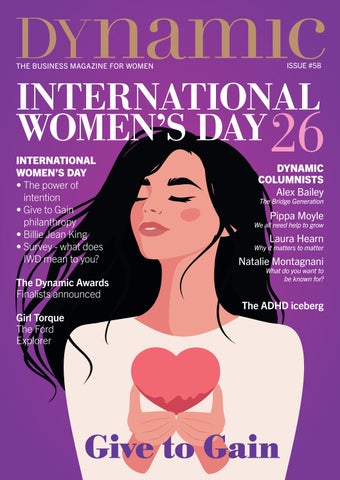
Alex Bailey The Bridge Generation Pippa Moyle We all need help to grow
Laura Hearn Why it matters to matter
Natalie Montagnani
What do you want to be known for?
The ADHD iceberg
News
4 Upfront: The top international news stories involving women in business
12 In the Right Direction:
Good news stories from around the world
Regulars
8 The Alex Bailey Column
Exploring the ‘Bridge Generation’
10 The Laura Hearn Column
Why it matters to matter
16 The City Girl Column
Pippa Moyle explains the benefits of attending the Help To Grow course
18 The Natalie Montagnani Column
What do you want to be known for?
Events
36 Dynamic Awards 2026
The judges have been busy, and announced this year’s finalists
Wellbeing
46 Abby Maclachlan
Community over competition: the future of well being and fitness
50 Dr Samantha Hiew
The ADHD iceberg
52 Gudiya Dagur Patel
The power of selective outrage
PLATINUM MEDIA GROUP
COVER STORY
INTERNATIONAL
WOMEN’S DAY 2026: GIVE TO GAIN
Dynamic has 15 pages of stories, views and inspiration regarding the international celebreation of women
Features
6 Kreston Reeves
Want to grow your business?
Challenge the familiar
14 Help To Grow
Spaces are available for the next course at the University of Brighton
INTERNATIONAL
WOMEN’S DAY 2026
20 Throwback hero: Billie Jean King
22 Give to Gain: The women shaping a new era of philanthropy
26 Methods of incorporating Give to Gain into your business
28 Charities where you can give for women’s advancement
30 What does International Women’s Day mean to you?
Dynamic asked local female business leaders for their thoughts on IWD
38 Women, leadership and the power of intent
Dynamic looks at Grant Thornton’s latest figures on the role of women in business
The
spirit of hope, inner strength, enthusiasm and persistent determination are the pillars for any success.”
Lailah Gifty Akita
Ghanaian philanthropist, and founder of Smart Youth Volunteers Foundation.
Further Reading
48 Dr. Poornima Luthra
Why fear is the real reason DEI is stalling
Art
54 Art
‘Life is a Stage’ – Kellie Miller on the works of Emma Forrester Travel
56 The micro-retirement revolution
How taking four to six weeks off can re-charge you in your work
Fine Dining
58 Stem, Hove
A new restaurant in the heart of Hove’s gourment scene has opened Girl Torque
60 The Ford Explorer EV
Fiona Shafer, MD of MDHUB road tests Ford’s latest EV offering
What’s On
62 A brief snapshot of what’s on in Sussex and Surrey
EDITOR’S NOTE
March is a wonderful month of celebration for us at Platinum Media. On March 8th, we mark International Women’s Day, and on March 26th, we host the Dynamic Awards. Both represent progress, recognition and momentum.
This year’s International Women’s Day theme, Give to Gain, feels particularly relevant. In business, in leadership and in life, the women who move forward are often the ones who understand this instinctively. They share knowledge. They mentor. They invest. They open doors. And in doing so, they strengthen not just others but themselves also.
Inside this issue, you’ll find stories that reflect that exchange. Women redefining philanthropy. Leaders questioning what they want to be known for. Founders reshaping their businesses after disruption. Conversations about bias, visibility and growth. None of it abstract. All of it practical.
Later this month, at the Dynamic Awards, we will celebrate women who are building serious businesses, leading teams and creating impact while doing so against a backdrop of challenge. The awards are always a highlight – not only because it’s a brilliant night out but also because it’s a chance to pause and recognise just how much this community is achieving. What strikes me each year is the incredible grit, the willingness to keep going, building, step by step, together.
As you read this issue, I encourage you to think about where you are choosing to give – your time, your energy, your support and what that might unlock, for you and for others.
Progress rarely happens by chance. It happens when people decide to step forward.
HEAD OF DESIGN / SUB EDITOR: Alan Wares alan@platinummediagroup.co.uk
FIRST-EVER FEMALE CABINET SECRETARY APPOINTED
Sir Keir Starmer, the prime minister, has appointed Dame Antonia Romeo as cabinet secretary and head of the civil service. Romeo, who is currently the permanent secretary of the Home Office, will become the first woman to hold the UK’s most senior service role in its 110-year history.
She was previously subject to bullying allegations from her time as UK consul-general in New York, but the Cabinet Office dismissed the claims at the time “on the basis there was no case to answer”. She succeeds Sir Chris Wormald, who left the position after a 14-month tenure.
TOP WOMEN’S FOOTBALL CLUBS CONTINUE TO GROW
In its 29th edition, the Deloitte Football Money League has profiled 15 of the top revenuegenerating women’s clubs in some of football’s leading international markets.
The growth trajectory of women’s football has continued, with the women’s clubs analysed on average generating revenues in excess of €10m for the first time. The cumulative revenue generated by the 15 top
revenue-generating women’s clubs included in its report reached €158m during the 2024/25 season. This represents an increase of 35% compared with last year’s top 15, mirroring exactly the previous season’s growth rate. The composition of this year’s top 15 remains largely consistent with the 2025 edition. Women’s Super League (‘WSL’) clubs continue to dominate the rankings, with the same eight representatives as last year.
UK BUSINESSES HIT GENDER BOARDROOM TARGETS
Most of the UK’s biggest businesses have hit targets for gender representation in their boardroom, but fall short when it comes to women leaders who face greater scrutiny and unconscious bias, according to a
Government-backed report.
Data from the FTSE Women Leaders Review shows that women held 43% of board positions on FTSE 350 companies in 2025. It marks a significant leap towards gender balance in the
boardrooms of the UK’s biggest listed companies, from the 9.5% recorded when the review began 15 years ago. Nevertheless, the proportion is roughly the same as in 2024.
UPFRONT
THE LATEST BULLETINS FROM AROUND THE WORLD
“AGE
IS NO BARRIER,” CLAIMS APPRENTICE CONTENDER
At 46, Andrea Cooper is the oldest candidate by over a decade on the latest series of The Apprentice. She is one of a group of women defying the stereotype of Gen Z start-up entrepreneurs. “I’ve got a wealth of life experience,” Cooper said. “You develop all those personal skills as you get older. There are things a younger person might get really upset about, but I just think, ‘actually nobody’s died’.”
A survey by small business support organisation Enterprise Nation suggested Yorkshire and the Humber boasted the “strongest entrepreneurial intent”.
It found that 45% of those surveyed planned to start a business in the coming year, and that 41% of female founders in the region were aged between 45 and 55.
SANTANDER INVITES WOMEN TO MENTORING PROGRAMME IN CI
Santander International is inviting female founders and business owners in Jersey to take part in the popular annual mentoring programme running from April through to November.
Since its launch in 2019, the Santander Women Business Leaders’ Mentoring Programme (WBL) has supported nearly 1200 female entrepreneurs and business owners across the UK and Crown Dependencies, developing leadership skills at all stages of their business journey.
The Programme is in partnership with Moving Ahead, a specialist award-winning mentoring and development organisation which connects mentees to experienced business owners, or leaders with corporate experience, for 1:1 sessions alongside virtual masterclasses from inspirational role modelsand speakers.
SECOND-CITY WOMEN’S TEAM ACQUIRED BY INVESTORS
THE RISE
Birmingham City’s owners have completed the purchase of the women’s team, with England legend Karen Carney part of several independent investors involved in the deal. Shelby Companies Ltd (SCL) is a subsidiary of Knighthead Capital Management - an investment firm co-founded by Birmingham City chairman Tom Wagner. It bought a controlling share of the
REPORT:
A COMPREHENSIVE LOOK AT FEMALE BUSINESS IN THE
UK
Championship club in July 2023, before increasing its stake to a full takeover in November 2025, acquiring a 97% stake in the women’s side. The remaining 3% has been taken up by a group of “prominent female business leaders and global professional sporting icons” including 144-cap Carney and three-time US Open tennis champion Kim Clijsters.
Early March marked the release of The Rise Report, a report built around a new nationwide study commissioned by one of the UK’s biggest communities of female founders, Female Founders Rise, in partnership with Barclays.
The Rise Report is one of the largest grassroots studies of its kind, with findings that capture the detailed views, stories and experiences of 2,225 UK-based female founders – who collectively generate approximately £1 billion in annual turnover.Its findings are both fascinating and wide-ranging. And, while the journey of every founder is unique, one message comes through loud and clear - when women are backed with the right networks, support and opportunities, their businesses don’t just survive - they thrive.
Almost half of female founders say funding challenges are their primary obstacle, with 78% finding grants bureaucratic and time-consuming to access, and 73% frustrated by business loans, venture capital, and angel investment.
Other findings in the report showed that around a third said public funding applications are overly complex, while one in 10 cited negative investor behaviour, including dismissive attitudes, ghosting and power imbalances.
The study follows a 2025 report by the Women and Equalities Committee, which warned that female entrepreneurs remain significantly under-resourced.
“I am thankful for my struggle because, without it, I wouldn’t have stumbled across my strength.”
- Alex Elle Author, wellness educator & podcast host
ONGOING PROBLEMS WITH FEMALE INVESTMENT
Additional to the Rise Report, International Women’s Day on March 8th brings renewed attention to the fact that womenled businesses receive significantly less funding than maleled counterparts. Their ventures are transforming industries, creating jobs and reshaping what leadership looks like. But behind those success stories, an endemic disparity remains between male and female founders.
As things stand, women entrepreneurs receive only a fraction of the support and funding available to their male counterparts. In 2024, all-female founder teams secured only 2% of equity investment in the UK, with 80% going to all-male teams. Addressing the gender gap in entrepreneurship goes far beyond merely promoting equality – it’s essential for driving greater innovation and growth for the whole economy. If women started and scaled businesses at the same rate as men, it would deliver a potential £250bn boost to the UK economy.
GOVT TO INTERVENE IN VC INVESTMENTS IN WOMEN
The Government has said it is not ruling out interventions in the future if the level of venture capital investment in female entrepreneurs shows no sign of improvement,’ Ministers have said in response to the Women and Equalities Committee’s (WEC) report on Female entrepreneurship.
MPs identified access to finance for female founders as a crucial issue. In its report published last October ahead of the Budget, WEC said it did not support mandating gender quotas on investment committees at this stage, as recommended measures to improve transparency and increase incentives to change behaviour in the venture capital sector should be given time to take effect.
“It is never too late to be what you might have been.”
- George Eliot
The Government rejected the Committee’s recommendations, citing concerns over complexity and regulatory burden – arguments which were challenged during the Committee’s inquiry.
By Alison Jones, Partner, Kreston Reeves
Want to grow your business? CHALLENGE THE FAMILIAR
Ican understand if right now growth is not your top priority, as many of you are in survival mode. However, a growth strategy is even more important in the current economic climate. But if you feel like you spend all day, every day, firefighting within your business, it will be much harder to step back, see the bigger picture, and identify where growth opportunities will come from.
Businesses have shown extraordinary resilience in recent years, and the ability to adapt is a defining characteristic of those that enjoy continued growth and success. There are, however, some steps I would encourage you to take now to help you get back on track, stay focused, and stay enthusiastic about success.
change to enable a growth mindset, shape a clear strategy and build a team capable of delivering it.
“Businesses have shown extraordinary resilience in recent years, and the ability to adapt is a defining characteristic of those that enjoy continued growth and success.”
Adaptability comes from a willingness to change, and businesses that will achieve growth this year will have been asking themselves key questions such as:
• What can we improve for our clients and customers?
• What can we improve for our people?
• What can we do to improve the planet and our communities?
• How can we cover all of the unexpected additional costs
• How can we protect or increase our profits?
These questions are not just tactical; they are at the heart of the identity and purpose of your business, why it exists, and what differentiates it from the competition. They help you understand the impact you want it to make and the legacy you want to build and leave. Once you have a clear purpose, then decision-making becomes more focused, teams stay more motivated, and growth becomes more achievable and sustainable.
If you can’t clearly identify your purpose or why your business exists, it’s time to take a step back. Something needs to
Our purpose, for example, is to guide clients, colleagues, and communities to a brighter future through trusted advice, support, and guidance, helping them achieve their goals. This is our primary focus every day.
It can sometimes be useful for businesses without senior management to outsource some of these functions to specialist advisers, consultants, or Non-Executive Directors, enabling them to draw on their expertise and allocate specific responsibilities to identify and deliver growth opportunities. You don’t need to carry the responsibility of doing everything yourself.
“For those of you facing greater challenges due to factors beyond your control, additional advice and support may be needed”
With the right expertise in place, a business can explore how growth can be unlocked through:
• Measuring systems and data, and how they can be used to understand your whole business.
• Incentivising your employees to improve productivity and how you can develop people to take on their next role within the business.
• Reducing waste – whether that be time, resources or cash.
• Building loyalty and advocacy through customer and client service.
• Identifying opportunities to expand markets nationally and internationally.
• Reviewing staff resourcing – full or part-time employees, subcontractors, outsourcing key functions or offshoring.
• Review where technology, especially AI, can be used to support growth, including around your sales systems and customer experience.
• Overall review of budgets and spending to protect and hopefully improve the bottom line.
For those of you facing greater challenges due to factors beyond your control, additional advice and support may be needed to help you navigate through these turbulent times. They could also help you diversify and find new markets or help you exit the business. Taking early advice gives you more options to consider.
ON THE HORIZON
Surprisingly, a lot of business owners I’ve met recently have yet to consider what the changes to Business Property relief might look like for them and their business interests. Given the changes that come into force from April 6th, this shouldn’t be forgotten.
There is a thought that if there is a change in government at the next election, then things might change again, which is, of course, true. But there is
Finally, a mention for International Women’s Day, which takes place on Sunday, March 8th. This year’s theme is Give to Gain.
We can all do our bit to help all women in business, not just on one day of the year but on every day of the year. Whether that is giving some support or mentoring, using their services or buying their products, taking time to review their business or thanking them. We all have something to contribute – and even more to gain every day of the year.
I look forward to being a part of International Women’s Day once again this year, and I encourage you to look out for opportunities to Give to Gain over the next year.
also a risk that this won’t be reversed, and so you should always consider plans for your business under current rules.
We are always very happy to have an informal chat to talk about your future plans and how changes to tax rules might affect them.
Kreston Reeves works alongside clients to understand their goals and help them achieve their ambitions. Please contact Alison Jones, Partner:
Call: +44 (0)33 0124 1399
Email: alison.jones@krestonreeves.com
Visit: www.krestonreeves.com
Alex Bailey Column e
We are delighted to have Co-Founder, with 20+ years organisational change. delivering impactful programmes
THE BRIDGE
By Alex Bailey
In the rush to crown AI gurus as the future of business, we’re overlooking the most powerful competitive advantage in the room: the leaders who have lived through three decades of disruption and are still standing. The analogue natives who have lived through digital acceleration and now the age of AI. We are the Bridge Generation, fluent in both worlds.
Much of today’s narrative celebrates digital-fi rst skills, automation, pace and efficiency on scales we’ve never seen before. The assumption is that competitive advantage belongs to those who are quickest off the blocks.
But the real sweet spot is where digital fluency meets analogue human experience. Where Artificial Intelligence and Human Intelligence combine, not just for digital-fi rst speed, but to create more human-fi rst depth.
I often talk about human intelligence and the importance of being human on purpose, regardless of demographics. Yet it’s only recently dawned on me that, while many in my cohort speak about our age, wisdom, or era as something to apologise for or reinvent away from, it is, in fact, our greatest strategic advantage.
We have lived through the 2008/2009 economic crisis, navigated Brexit, led through a global pandemic and the years of turbulence that followed. We have supported the rise of mental health awareness at work and rapidly developed leadership skills grounded in listening, empathy and emotional data.
“While many in my cohort speak about our age, wisdom, or era as something to apologise for or reinvent away from, it is, in fact, our greatest strategic advantage.”
Th is lived experience gives us a truth-sense, an ability to understand what is real, what matters and what sits at the soul of an organisation. No amount of content or digital training can replicate that. It’s the human intelligence of noticing burnout before someone sees it in themselves, or sensing cultural drift long before it appears in a dashboard.
We can feed symptoms into an AI assistant, but it cannot interpret what we can feel.
A digital-fi rst response is fast, but often transactional. It doesn’t understand the power of the pause, the unplanned corridor conversation, or the walk-and-talk that help people make sense of complexity. These moments aren’t inefficiencies; they are the connective tissue of leadership.
Our mid-career cohort brings advantages that are increasingly rare and increasingly essential, ten of which I’ll highlight here, but I suspect there are many more:
1. Pattern memory: We’ve lived through cycles of disruption,
have Alex Bailey contributing to Dynamic. She is a Global CEO and years of expertise in HR leadership, psychology, coaching, and She specialises in cultural evolution, leadership,and performance, programmes globally while speaking at international events.
BRIDGE GENERATION
recession and reinvention, and we recognise the early signals.
2. Contextual judgement: We know what is noise and what is the underlying issue that truly needs attention.
3. Emotional radar: We can sense when someone is not okay, when a team is losing hope, or when a strategy is misaligned with culture.
4. Relational capital: Decades of trust, reputation and influence built on consistency, not visibility.
5. Legacy mindset: A shift from climbing the ladder to creating impact, bringing others in for their benefit, not for efficiency.
6. Translation capability: The ability to cut through
complexity, see the core message and integrate diverse perspectives into a workable solution.
7. Intergenerational mentorship: Mentoring upwards on AI risk, ethics and culture, and mentoring downwards on emotional intelligence and resilience.
8. Systems thinking: Building structures and practices that endure, not just delivering outputs.
9. Psychological flexibility: Having adapted through huge transitions, we understand consequences and can make decisions with weight and wisdom.
10. Digital fluency with historical context: We learned digital as it evolved, understanding not just what it does, but what it replaces.
What I love about the businesswomen I surround myself with is their ability to practise the human abilities that AI cannot replicate. A year ago, I wrote about “winning as a process” and celebrated those who boldly lead with their age and experience rather than apologising for it.
I see that even more clearly now. The women in my world are seizing the moment, recognising the positive influence that age brings, and carrying it confidently into the age of AI. But we can’t slow down or take our eye off the ball. AI is advancing at an ever-increasing pace, and that means we need to remain aware of and able to use our bridge capability continuously.
The next step is to openly claim our strategic relevance. To lead as the Bridge Generation. To integrate the artificial and the human with intention. To protect the meaning as machines accelerate work.
Alex Bailey styled by Gresham Blake Email: Alex@baileyandfrench.com www.baileyandfrench.com Insta @alexbaileybackstage Follow me on LinkedIn: www.linkedin.com/in/ alex-bailey-26562b2/
Laura Hearn is a former BBC journalist, now storytelling consultant and founder of Flip It - a podcast and platform helping people and businesses use storytelling as a tool for clarity, connection and change. This month, for Dynamic, Laura points out why it really matters to matter –to yourself and everyone else
“When the external environment feels unstable, our need for significance grows stronger. Change unsettles identity. It makes us question where we fit and whether we are still needed.”
Why it matters especially in
By Laura Hearn
It’s 1pm on a Saturday afternoon, and the blue sky has finally returned to the Sussex hills. After what feels like an eternity of grey, it has never been more welcome.
Yet when I sat down to write, I found myself thinking about an unexpected encounter earlier this week. It was a routine hospital appointment, and I was one of the nurse’s last patients of the day. She had likely seen 20 people before me, tired and ready to finish. And yet, for ten minutes, she made me feel as if I were her first.
She listened without rushing. She showed compassion and genuine interest. We laughed. We swapped stories. At the end, she gave me an almighty hug. I left feeling so uplifted that I went straight to reception to tell her colleagues how wonderful Juliet was.
Feeling like you matter, and offering that feeling to someone else, is both rare and powerful. It is also a fundamental human need. In times of transition and turbulence, it becomes even more important.
WHEN EVERYTHING IS CHANGING
We are living through relentless change. Technology is advancing. Roles are evolving. Businesses are restructuring. Many of us are reassessing what we want from work and from life.
I have been doing just that. Journaling about what this current chapter of my life means…what it is teaching me and what I want it to look like going forward. And in turn, I have found myself pondering, ‘Do I matter here and to whom? Am I seen? Am I valued? Does what I do make a difference?’
When the external environment feels unstable, our need for significance grows stronger. Change unsettles identity. It makes us question where we fit and whether we are still needed.
MATTERING IS FOUNDATIONAL
Mattering is not about needing or looking for applause or praise, but about knowing that who you are and what you do positively contributes to the lives of others. That your absence would be felt. Inside organisations navigating change, this shows up quickly.
• Where do I fit now?
• Does anyone notice what I bring?
• Does my contribution still count?
matters to matter, in times of transition
If those questions linger unanswered, people disengage. They stop offering ideas. They retreat into tasks. This is where mattering shifts from a human concept to a commercial one.
When people feel that they matter:
• They take ownership.
• They contribute ideas.
• They raise concerns early.
• They care about outcomes, not just outputs.
What differentiates organisations is not process, but engagement. And engagement grows where mattering exists.
WHAT TRANSITION REVEALS
Turbulence exposes fragility. If culture is built purely on performance metrics, pressure drives self-preservation. Collaboration narrows. Creativity shrinks.
Yet when people feel valued beyond their function, the opposite happens. They step forward. They stay committed even when the path is unclear. They invest discretionary effort and remain loyal. The most resilient organisations are the ones where individuals feel valued beyond their function.
LEADERSHIP AS ATTENTION
“Thank you, Juliet, and to every person who chooses, even at the end of a long day, to make someone else feel that they matter.”
Creating a culture where people matter requires active attention. It needs:
• Leaders who listen without interruption.
• Managers who ask, ‘What do you think?’ and are genuinely curious to hear the answer.
• Founders who share the real story, not just the polished version.
• Mattering is built in small but consistent moments. Eye contact. Remembering a detail. Acknowledging effort.
During transition, leaders may not have certainty to offer. But they can offer presence. And presence communicates that you count here.
BEYOND THE WORKPLACE
Transition also happens in our personal lives. Career changes, parenthood, illness, loss. When identity shifts, the need to feel that we still matter becomes deeply personal.If I am no longer defined by this role or stage of life, then who am I?
The people who support us best are those who recognise our worth beyond productivity. They see the human being, not just the output.
WHY IT MATTERS TO MATTER
Standing on the West Sussex hills overlooking the valley where I live, grateful for the return of the sun, I thought again of Juliet. For ten minutes at the end of her day, she offered full attention. She reminded me that we all want to feel seen and significant.
When people know they matter, they navigate uncertainty with greater resilience. They adapt. They rebuild. They write their next chapter with hope rather than fear. We cannot remove change from our lives or organisations. But we can choose how we show up for one another within it.
So, thank you, Juliet, and to every person who chooses, even at the end of a long day, to make someone else feel that they matter.
You can listen to Laura’s podcast, Flip It, wherever you get your podcasts, and you can connect with her at www.flipitglobal.com
ONE THIRD OF CANCERS ARE ‘PREVENTABLE’
A sweeping global study spanning 185 countries suggests over a third of cancer cases stem from modifiable risk factors. Researchers linked 7.1 million diagnoses to behaviours such as smoking, alcohol consumption and preventable infections. Lung, stomach and cervical cancers accounted for a large share of avoidable cases. The World Health Organisation says prevention represents one of the most powerful tools for reducing the global cancer burden, alongside advances in treatment and vaccines.
IN THE RIGHT DIRECTION
AUTOMATION BOOSTS IVF EGG RETRIEVAL
A new automated system developed by US firm AutoIVF could improve egg retrieval during IVF. Traditionally, embryologists manually search follicular fluid under a microscope. The new method automatically scans the fluid, identifying additional eggs that might otherwise be discarded. In trials across four US clinics, extra viable eggs were found in over half of patients. Published in Nature Medicine, the early results are
‘BONDING
promising, though larger studies and regulatory approval are still needed.
BENCHES’ TACKLE PARENTAL ISOLATION
Historic sites across England will introduce “bonding benches” to help new parents connect.
Installed by English Heritage, the benches feature movable signs indicating whether someone is open to conversation or prefers quiet time. The initiative responds to research from the National Childbirth Trust showing widespread loneliness among new parents. Inspired by Zimbabwe’s friendship bench model, the scheme aims to spark small but meaningful connections.
❛
Be the kind of woman that, when your feet hit the floor each morning, the Devil says, ‘Oh crap, she’s up...’ ”
ONLINE ABUSE LAW TARGETS IMAGE TAKEDOWNS
A proposed change to UK crime legislation would require tech companies to remove intimate images shared without consent within 48 hours. The amendment, currently moving through the House of Lords, would mean survivors need to report an image only once, rather than chase multiple platforms.
Prime Minister Sir Keir Starmer said the aim is to end the exhausting “whack-amole” process victims face when content resurfaces. Enforcement could include fines and further penalties, signalling a tougher stance on digital abuse.
STORMZY CHAMPIONS ACCESSIBLE READING
Rapper Stormzy is backing The Reading Agency’s Quick Reads campaign, which partners with bestselling authors to produce short, accessible books priced at just £1. Aimed at new, lapsed and neurodivergent readers, as well as
IRELAND MAKES ARTISTS’ INCOME PERMANENT
Ireland has made its pandemic-era basic income for artists a permanent policy. The €325 weekly payment, launched in 2022, supports over 2,000 creatives and has reportedly generated significant social and economic returns. Backed by the Government of Ireland, the initiative is the first of its kind to become permanent. Recipients say the financial stability enables full-time creative work and greater artistic risk-taking, strengthening Ireland’s cultural landscape.
those with limited time or shorter attention spans, the initiative lowers barriers to reading. This year’s titles will be available in shops nationwide from April, with audiobooks launching for the first time. Half a million copies will also be distributed to UK prisons.
CHILE PROTECTS DARK SKIES
Plans for a major industrial hydrogen project near Chile’s Atacama Desert have been shelved following sustained public opposition. Scientists warned the development would damage some of the world’s clearest night skies, threatening observatories and ecosystems. Campaign group DarkSky International praised the coalition of activists who broadened the debate beyond astronomy to include environmental and cultural concerns — a win for global dark-sky preservation.
COLOMBIA’S FOREST LOSS FALLS AGAIN
Colombia has recorded a 25% year-onyear drop in deforestation, with losses decreasing significantly across the Amazon and other high-risk regions. Data from the Institute of Hydrology, Meteorology and Environmental Studies credits conservation
partnerships and financial incentives such as the Conservar Paga scheme, which pays families to protect forests. Officials say collaboration with local and Indigenous communities has been central to sustaining the downward trend.
❛I didn’t belong as a kid, and that always bothered me. If only I’d known that one day my differentness would be an asset, then my early life would have been much easier.”
Bette Midler
SPONSORED PLACES FOR LOCAL SMEs
Help to Grow | Management Course
250 local businesses have completed the course at the University of Brighton
Help to Grow is proud to have worked with the Dynamic Women in Business Awards over the last few years, supporting the celebration of local women in business. In fact, many of the winners and nominees have taken the course with the University of Brighton.
This mini MBA-style programme is designed for business owners and senior leaders of small and medium-sized businesses. Help to Grow is a 12-week course that helps your business reach its full potential for growth and resilience.
The course is taught over 12 weeks, and to facilitate busy work schedules, it’s a mix of both online
and in-person workshops. Learning alongside other business owners, you have the opportunity to learn from your peers and network.
You will also be supported by your own experienced business mentor who will support you in producing a growth plan, and taught by experienced academics and practitioners from the School of Business and Law at the University of Brighton.
The programme is 90% government-funded and delivered by leading business schools across the UK that have been awarded the Small Business Charter (SBC) by the Chartered Association of Business Schools (CABS).
10,000 business leaders have completed the Help To Grow course nationally
Delphine’s business takes flight after graduating
“The modules were super relevant and the cohort itself, as well as the facilitator, were some of the best aspects of the programme.
“Nearly every module had some ‘to dos’ for my business. Some were implemented right away, some are a work in progress. There is always something to think about!
“I also found the mentoring amazing. I would absolutely recommend the programme to others. It should almost be mandatory for every small business.
93% of participants would recommend the course
“I will most likely have one of my employees do it next year as I think on a personal level and for the company it gives great questioning and insight.”
Delphine Kennedy, DBK Aero Ltd
90% Government funded
Claim your Dynamic sponsored place now
If your business employs between five and 249 people you are eligible to join and claim one of the limited sponsored Dynamic places for the next cohort in April, which means no cost to you.
Places are already being booked so sign up now at Help to Grow quoting Dynamic for your sponsored place or email helptogrow@brighton.ac.uk with any questions on the course.
Pippa Moyle is the CEO and founder of the City Girl Network, a mission-driven business dedicated to empowering and supporting women across the UK. Since launching in March 2016, the network has built a vibrant community of over 150,000 women, facilitating new friendships, business connections, job opportunities, housing solutions, and valuable life advice.
“I’d like to spotlight a national programme that’s had an impact: Help To Grow, locally operated by the University of Brighton”
“I absolutely loved Help To Grow, from learning with and from the other brilliant business, to helpful insights from the professors and invaluable lessons from the case studies. It has helped me refine my marketing and has resulted in palpable growth in my business.”
Lyndsey Clay, Connected Brighton
We all need
By Pippa Moyle
Twenty one years ago, my school rejected my request to do a Business Studies GCSE. I appealed their decision, highlighting the importance of having ‘real world’ education and how I felt it would support me in later life. They still said no. My IQ was too high, and they needed me in more academic subjects.
More specifically, they needed to uphold their reputation as one of the best state schools in the area, with gender equality in academics. My head of year justified the decision by explaining that if I were to do a vocational course, then I would be distracting my brain from developing the academic skills needed in my other subjects.
When I questioned why boys of the same IQ were allowed to study business, it was explained that their brains were “built differently”. Th is was followed by an anecdote about how boys who study business tend to go on to build multimillion-pound businesses, and they can’t hold them back from doing so. The misogyny, the hypocrisy, the madness: it makes my blood boil every time I think about it.
Alas, this was 2005. The conversation around gender equality was in its infancy. The culture of “calling things out” on social media was not a thing. Beyoncé had not yet declared that girls ran the world. The suff ragettes were a mere footnote in our history lessons, ruined by sniggering boys in the back of the classroom.
I dropped my campaign after my head of year shut me down. He’d highlighted how lucky I was to have so many high-earning professions ahead of me; his wife didn’t get any of that at my age. Eleven years later, I became an entrepreneur, and that’s when the anger truly set in.
Where my male counterparts had terms like balance sheets, cash flow, market analysis, and budgeting as part of their natural vocabulary, I was learning on the job and making crucial mistakes they would see as ‘rookie errors’.
I would later discover that many of these brilliant businessmen learned through a whole plethora of school education, conversations at home and selling contraband at school (i.e. cigarettes and Pokémon cards). A multi-faceted education that millions of women in my generation didn’t have growing up. Instead, we were given microaggressions that business was not built for us.
That’s why UK female founders only get 2% of equity funding. It’s also why there’s been a sharp rise in the number of
need some help to grow...
“I’m incredibly proud to be part of Team Dynamic, which is offering totally free places for women on the programme”
female entrepreneurs joining our gang; business education is more accessible than ever before.
It’s here I’d like to spotlight a national programme that’s had a significant impact: Help To Grow, locally operated by the University of Brighton with multiple chapters run by Universities across the country. It’s a 12-week programme for small to medium-sized businesses designed to be completed alongside full-time work and pitched as a ‘mini MBA’.
I’ve witnessed the evolution of several business owners who have been on this course, and have learned a lot from those who have completed it. Conversations have evolved from ‘blue sky thinking’ to strategic action, and many businesses have developed stronger revenue streams as a result. The ripple effect is amazing, as are the testimonials from numerous women who took part.
Colette Whiting of Delta Xero echoes that evolution of self: “Beyond the tools, it was a real confidence boost. It helped me trust my instincts while also giving me the language and evidence to articulate future decisions clearly.”
Then there are the incredible transformational stories, like this one from Bernita Willoughby at the Well At Work Project: “I did the course in 2022/3 after my husband and business partner suffered a large brain clot and stroke in 2021, leaving me with a business where he made up 50% of the turnover to then be absent and our only source of income plus our 2-year-old in the mix. The course helped me navigate reshaping the business to become what it is today, fall in love with business and launch two more since then.”
I’m incredibly proud to be part of Team Dynamic, which is offering free spaces for women on the programme.
It’s programmes like these, campaigns by Small Business Britain, organisations like The Girls’ Network and conversations with local schools about their own initiatives that give me hope for a more equal business landscape. Not everyone wants to build a business, but we should all know that we can.
Claim your Dynamic sponsored place now
If your business employs between five and 249 people you are eligible to join and claim one of the limited sponsored Dynamic places for the next cohort in April, which means no cost to you.
Places are already being booked so sign up now at Help to Grow quoting Dynamic for your sponsored place or email helptogrow@brighton.ac.uk with any questions on the course.
Natalie Montagnani is a Business & Leadership Coach and Mentor for Female Founders and Senior Leaders, championing self-leadership before commercial strategy. As Founder of IGNITE Women in Business, she partners with organisations to cultivate confident, decisive future leaders
WHAT DO YOU WANT TO BE KNOWN FOR?
By Natalie Montagnani
START WITH SELF
International Women’s Day invites us to rally with women and girls around the world, to demand equal rights and equal justice. It encourages women to take up space, to speak up, to be seen.
And a key part of my work with female leaders is helping them to answer a crucial question: What do you want to be known for? Because visibility without clarit y is just noise. Confidence without conviction will exhaust and deplete you. And showing up without alignment leads only to feelings of imposter syndrome.
We are often encouraged to build a profile, raise our visibility and put ourselves out there. However, visibility is easy when you’re deeply connected to what you stand for. It’s painfully hard when you’re not.
THOUGHT LEADERSHIP IS A DECISION
Thought leadership doesn’t start with content. It doesn’t start with LinkedIn posts or keynote stages. And it definitely doesn’t start with what you think will perform well. It starts with self-leadership.
It starts when a woman stops asking, “What should I be saying?” And starts asking, “What do I believe?” This changes everything.
When you’re plugged into something that genuinely matters to you, something shaped by your lived experience, your values, your journey, confidence follows naturally. Then you don’t have to hype yourself up to be visible, and you don’t have to force it.
TRYING ON IDENTITIES IS PART OF THE WORK
Defining your personal brand and thought leadership is a bit like buying new shoes. You need to try on different styles. Different roles. Different versions of yourself. It’s only with some trial and error that you find the perfect pair – the ones that feel made for you.
So many of us are multi-faceted, multi-talented, and we need to decide which parts to highlight. My own journey to clarity has taken years, not weeks. There was no shortcut,
“Visibility is easy when you’re deeply connected to what you stand for. It’s painfully hard when you’re not.”
stop building inside someone else’s framework and start defining your own.
WHEN SUCCESS ISN’T ENOUGH
I built and ran a successful marketing agency for years. On the outside, it looked like an achievement. Growth. Credibility. But when it got to our 16th birthday, I realised that inside, something had shifted.
“Most of us are operating inside invisible boxes we didn’t consciously choose. Self-leadership is the courage to notice the box and step out of it...”
no single conversation, no magic framework that handed me the answer. Instead, it’s been a journey.
I had to listen to myself. I had to notice what energised me and what quietly drained me. I had to unlearn external expectations and tune out other people’s projections.
You have to accept that it may not be perfect at first, that you might one day look back and cringe, that people might judge you and be critical. But as the fabulous Mel Robbins says, “let them.”
THE INNER WORK
You can’t shortcut this process. It’s not something AI can solve in a two-minute chat. It’s not something a boss can define for you. And it’s not something your clients should dictate, no matter how well-intentioned they are. Because discovery is deeply personal. True thought leadership comes from a woman who has done the work to understand herself. Her motivations. Her lived experience. Her why.
But here’s what makes it difficult, especially for women. Most of us are operating inside invisible boxes we didn’t consciously choose; boxes which tell us what success should look like, what kind of leader is acceptable, how to be likeable, agreeable, impressive, but not too bold.
Self-leadership is the courage to notice the box and step out of it, and true thought leadership begins the moment you
What once felt exciting began to feel like a job, like work. And beneath that, there was a deeper longing, not for more success, but for more meaning.
I didn’t want to just apply my skills and expertise anymore. I wanted to use my story, my experience, my deep understanding of what it really takes for women to lead themselves. That realisation didn’t arrive loudly either; it arrived quietly. But then became so persistent, I couldn’t ignore it anymore. And when I finally allowed myself to follow it, everything changed…
AN INVITATION
So, on this International Women’s Day, I want to extend an invitation. Before you ask how to be seen, ask what you want to be known for. Before you push yourself to speak louder, ask whether what you’re saying feels true. And before you chase confidence, check to see whether you’re aligned.
Because when a woman leads herself, when she’s grounded in her values and connected to her purpose, confidence becomes a by-product, visibility becomes natural, and leadership becomes magnetic.
Natalie Montagnani Founder of IGNITE Women in Business
07900 153503
ignitewomeninbusiness.com
Connect with Natalie on LinkedIn or drop her an email to natalie@ignitewomeninbusiness.com
In our International Women’s Day throwback, we celebrate the global advocate for gender equality and enthusiastic supporter of IWD, the amazing, iconic...
Billie Jean
Former tennis player, Billie Jean King, is one of the most influential figures in sports history. She won 39 Grand Slam titles, including 12 singles, 16 doubles, and 11 mixed doubles, and is an incredible trailblazer for gender equality in sports. She claimed her fi rst singles major win at Wimbledon in 1966, won all three titles – singles, doubles and mixed doubles – in 1972, and sealed a record-breaking 20th Wimbledon title in 1979 in the doubles alongside another tennis great, Martina Navratilova.
Widely respected for her strong advocacy for equality in sport, this former world No. 1 tennis player remains a key role model for women worldwide.
"Happy International Women's Day! Did you know that at the current rate of progress, it will take until 2158 to reach full gender parity, according to the World
Economic Forum?" she said in her IWD social media post. "We can all take steps in our daily lives to positively impact women's advancement."
Billie Jean King outlined a few ways we can all help to accelerate acceptance of everyone's diversity, such as calling out stereotypes, challenging discrimination, questioning bias, and celebrating women's success.
"Each of us is an influencer, and each of us can make a difference," said the former world No.1 tennis player. Billie Jean King's career is fi lled with many remarkable accolades.
Billie Jean King made her Grand Slam debut at the US Championships in 1959 at the age of 15 and won her fi rst major title in the Ladies’ Doubles at Wimbledon with Karen Hantze two years later. She has received significant recognition; opposite are some of her highlights.
King
2019 The Billie Jean King Main Library opened in King’s hometown of Long Beach, California, and ESPN established the Billie Jean King Youth Leadership Award. In the same year, she was announced as Global Ambassador for Federation Cup.
2020 In the same year she was honoured with the release of the Billie Jean King Barbie doll, part of Mattel’s Inspiring Women Series, the competition was renamed in her honour: the Billie Jean King Cup - which is owned by the International Tennis Federation (ITF), the world governing body of tennis.
1967 and again in 1973, Billie Jean King was named Associated Press Female Athlete of the Year.
1971She became the fi rst female athlete to win $100,000 in prize money in a single season.
Founded in 1913, ITF's purpose is to ensure long-term growth and sustainability of the sport, delivering tennis for future generations. Alongside the Davis Cup, the Billie Jean King Cup by Gainbridge, is one of the largest annual international team competitions in tennis.
2021 She received the Laureus Lifetime Achievement Award and the Sports Illustrated Muhammad Ali Legacy Award.
1972 She became the fi rst woman and the fi rst tennis player to be named Sports Illustrated Sportsperson of the Year, and that same year, she won singles, doubles and mixed doubles titles at Wimbledon.
2022
1973
Billie Jean founded the Women's Tennis Association (WTA) and famously defeated Bobby Riggs in the "Battle of the Sexes".
Billie Jean received France’s highest order of merit, the Ordre national de la Légion d’honneur, from President Macron, and was inducted into the United States Olympic & Paralympic Committee Hall of Fame as a special contributor.
1974 She co-founded the Women's Sports Foundation, an educational nonprofit charity focused on women's participation in sports, which has invested over $100 million to help girls and women play, compete, and lead in sports. She also founded the Women's Tennis Association.
1976
Billie Jean King was named Time Magazine's Woman of the Year.
Furthermore, the ongoing work and impact of the Billie Jean King Foundation are remarkable. The entity is a living extension of the purpose-driven life of Billie Jean King, dedicated to creating an equitable future for all through the power of sport, education, and activism. As a grant-making non-profit, it partners with diverse organisations to create a more equitable and inclusive world where everyone has the opportunity to thrive.
1987 She was inducted into the International Tennis Hall of Fame.
The impressive rally of Billie Jean King continues ...
1990 She was listed in Life Magazine's 100 Most Important Americans of the 20th Century.
Th is article originally appeared on internationalwomensday.com
2003Billie Jean received the ITF's Philippe Chatrier Award.
2006 The USTA Billie Jean King National Tennis Center was dedicated in her honour, and in 2009, she was awarded the Presidential Medal of Freedom by President Barack Obama.
2014 She and Ilana Kloss founded the Billie Jean King Leadership Initiative, a non-profit dedicated to addressing the critical issues required to achieve diverse, inclusive leadership in the workforce.
2018
Billie Jean received a Lifetime Achievement Award as part of the prestigious BBC Sports Personality of the Year Awards.
GIVE TO GAIN: Women shaping a new era of
As International Women's Day 2026 embraces the theme 'Give to Gain', we celebrate the extraordinary contributions of UK women redefining what it means to give - from major donors to social innovators who prove that the greatest return on wealth is the progress of others.
The theme for this year's International Women's Day, 'Give to Gain', serves as a powerful reminder that when we invest in the potential of others, the return is measured in the strength of our entire society. In the UK, a formidable
group of women is redefining what it means to lead with a giving mindset. Some write cheques worth millions from their personal fortunes.
Others have built businesses where giving is woven into the corporate fabric. Still others lead foundations, facilitate collective action or use their platforms to advocate for systemic change. What unites them is a commitment to using their resources—whether financial, intellectual or reputational—to create a multiplier effect of opportunity.
philanthropy
Chrissie Rucker OBE represents the entrepreneur who built her business with giving embedded in its DNA. The founder of The White Company, which she started in 1994 with £6,000 in savings after leaving school at 16, Rucker grew her vision into a beloved British brand with an annual turnover of over £300 million. But her success story is incomplete without understanding her commitment to using that platform for social good. Through Chrissie’s White Heart Foundation, established in 2014, and
her role as founding patron of the Change A Girl’s Life campaign at The King’s Trust, she has focused her energy on empowering disadvantaged young women. The White Company donates £10 from every Love Candle sold year-round to The King’s Trust, and £1 from every product sold on International Women’s Day.
Rucker speaks with passion about the young women she supports: ‘These young women arrive at the Prince’s Trust completely broken and, after
they’ve been through the programme, they come out with their confidence restored.’ She acknowledges the disproportionate challenges facing young women today, noting that, “even before Covid-19, young women in the UK were disproportionately disadvantaged compared to young men.” For Rucker, who assumed greater philanthropic responsibility at age 50, the benefit of giving is seeing the restoration of confidence and potential in young women who needed someone to believe in them.
CHRISSIE RUCKER OBE
Women who are philanthropy
J.K. Rowling is perhaps the most famous example of a woman who understands that wealth is a tool rather than a trophy. Having famously dropped off the billionaire list due to the scale of her lifetime donations— estimated at over £200 million—she has often spoken about the moral imperative that comes with an unexpected fortune.
Through her Volant Trust and the international charity Lumos, she
‘You
WOMEN’
focuses on the most vulnerable: children trapped in the institutional care system and women facing domestic crisis. Rowling’s approach is deeply personal, rooted in her own history of struggle before her literary success. ‘You have a moral responsibility when you’ve been given far more than you need, to do wise things with it and give intelligently,’ she has said. For her, the ‘gain’ is the dismantling of outdated social structures that keep families apart.
have a moral responsibility when you’ve been given far more than you need, to do wise things with it and give intelligently,’
J.K Rowling
Erica Wax has pioneered a distinctly modern approach to philanthropy through collective giving. As co-founder of Impact100 London (now Impact London Collective) in 2020, she transformed how individuals engage with charitable giving by creating a democratic, collaborative model. Members each contribute £1,000, which is pooled to award transformative grants of £100,000 or more to charities supporting marginalised women and girls in London.
With a background in banking at Merrill Lynch and a lifelong passion for empowering young people and women, Wax understands that philanthropy is most powerful when it brings people together. The model she created ensures that 100% of member donations go directly to grant recipients, with all operations run by volunteers. Her approach demonstrates that the benefits of giving extend beyond financial impact; it creates an engaged community of informed philanthropists who learn, connect, and create lasting change together.
ERICA WAX
J.K. ROWLING
SIGRID RAUSING
Sigrid Rausing represents the strategic, human-rightsfocused arm of philanthropy. As the head of the Sigrid Rausing Trust, she has distributed hundreds of millions of pounds since the trust's inception in 1995, making her one of the most influential figures in international human rights funding.
Rausing is a champion of 'core funding', believing that giving should empower organisations to exist and grow on their own terms. She encourages new philanthropists to 'recognise that it's all a work in progress - that what you fund now may be different from what you do in five years’ time, and that evolution and change is an intrinsic part of any work which involves pushing for a change in the status quo.' Her giving is a quiet, steady force that gains its power from the resilience of the activists she funds, ensuring that those on the front lines of justice have the shield of financial security.
“Rausing’s giving is a quiet, steady force that gains its power from the resilience of the activists she funds”
LIVIA FIRTH
Livia Firth has spent nearly two decades proving that advocacy and entrepreneurship can be powerful vehicles for systemic change. As a co-founder of Eco-Age and a founding board member of The Circle NGO, she has championed women’s rights and sustainable fashion globally.
Through The Circle, founded with Annie Lennox, she leads advocacy work that has reached over 1.4 million people globally, focusing on ending violence against women and securing economic empowerment. Her campaign for a living wage for garment workers challenges the fashion industry to recognise that women’s rights are human rights. Firth argues that solidarity is essential to creating change: she describes how women around the world gather in circles to discuss their challenges, making the community an active participant in individual lives.
“At a time when so much polarity and division exist, our vision for “global feminism” offers people from every walk of life a chance to break down division and join the global community,” she reflects. For Firth, the ‘gain’ from giving is measured in the strength of the global feminist movement and the dismantling of systems that exploit vulnerable women.
ANN GLOAG
Ann Gloag, the co-founder of Stagecoach, has focused her philanthropic energy on global health, particularly through her work with Mercy Ships and her own Freedom From Fistula Foundation. Having started her career as a nurse, Gloag’s giving is an extension of her original vocation of care. Through the Gloag Foundation, she covers all administrative costs, ensuring 100% of donations reach projects in Africa.
“I set up Freedom From Fistula because it is a scandal that in the 21st century women and girls across large parts of the world do not have access to quality maternal healthcare,” she has said. “If this were a man’s problem, it would have been solved by now!” She believes that those with the means to help are essentially ‘holding the keys’ to someone else’s survival, and that unlocking that potential is the greatest privilege wealth can offer.
“For Dame Sarah, the ‘gain’ from giving is measured in the strength of the movements she supports and the structural barriers she helps to dismantle.”
DAME SARA LLEWELLIN
Dame Sara Llewellin represents a different approach to philanthropy - one focused on structural change rather than traditional charity. As CEO of the Barrow Cadbury Trust from 2009 until early 2025, she transformed the centuryold Quaker foundation into a thought leader in social justice philanthropy. With roots in activism, particularly in the domestic violence and equality movements, Llewellin has championed what she calls 'agents of change' philanthropy, using all of the Trust's resources to pursue systemic transformation.
Under her leadership, the Trust pioneered impact investing, launched the UK's first Social Impact Bond and became a founding signatory of the UK Funder Commitment on Climate Change. Made a Dame in 2021 for services to social justice, Llewellin often speaks about the collaborative nature of change-making. 'I am a great believer that awards and honours are symbolic of the achievements of many hands and not of one person alone,' she reflects.
For her, the 'gain' from giving is measured in the strength of the movements she supports and the structural barriers she helps to dismantle.
These seven women embody the 'Give to Gain' spirit in remarkably different ways. Some are major donors who distribute millions from their personal fortunes. Others pioneer new models of collective giving or embed generosity into their businesses. Still others lead through advocacy and the strategic direction of charitable trusts.
Together, they prove that impactful giving takes many
forms—from the cheque book to the boardroom to the barricades. They remind us that the most significant gains are not found on a balance sheet but in the progress of the people we choose to support.
As we celebrate International Women's Day 2026, their example challenges us all to consider: what will we give to gain a better world?
Methods of incorporating Give to Gain into business
Every March, when International Women’s Day (IWD) comes around, it arrives with energy, visibility, and intention. Campaigns are launched. Panels are hosted. Social feeds fi ll with purple. Th is year’s theme, Give to Gain, is both a call to action and a promise: when organisations invest in women - through time, opportunity, and advocacy - everyone benefits.
BUT WHAT HAPPENS AFTER MARCH 8TH?
For many businesses, the challenge isn’t showing up for IWD. It’s sustaining the momentum once the spotlight fades. If Give to Gain is to mean anything beyond a day of celebration, it must translate into consistent, practical action.
Why do they work? Because culture shifts through conversation. A Circle might meet monthly to discuss career development, leadership challenges, or navigating bias. The format encourages participants to share experiences, set goals, and hold one another accountable. Over time, this builds confidence, cross-departmental relationships, and a stronger internal network of advocates.
“The official International Women’s Day website offers ready-to-use, credible resources that help organisations move from awareness to impact”
The good news? The official International Women’s Day website offers ready-to-use, credible resources that help organisations move from awareness to impact - without having to reinvent the wheel.
TURN INSPIRATION INTO ONGOING CONVERSATION
For businesses, the commitment is modest: a meeting space (virtual or physical), scheduled time, and visible leadership endorsement. The return is powerful: engaged employees who feel seen, supported, and equipped to grow.
That’s Give to Gain in practice.
MOVE BEYOND AWARENESS WITH “50 WAYS TO FIGHT BIAS”
Another standout resource highlighted on the IWD platform is 50 Ways to Fight Bias, a free, interactive porgrammeme designed for all employees - not just women.
One of the most practical tools available is the Lean In Circles framework, which is a small, peer-led group that meets regularly to support professional growth, confidence, and accountability. Originating from LeanIn.Org, Circles are structured but flexible, making them easy to adapt within companies of any size.
Also developed by LeanIn.Org, this porgrammeme provides short, research-based activities that help teams recognise and interrupt workplace bias. Each session takes roughly 20 minutes and can be integrated into team meetings or leadership development sessions.
Where you can give
The South East of our country is home to numerous remarkable charities and NGOs that work tirelessly to support women and girls. We wish we could feature them all in this article - each one deserves recognition for their vital work. Here are eight inspiring organisations where your time or financial support can make a tangible difference.
ROUTES
Based in London, Routes runs transformative mentoring programmes connecting professional women with refugee and asylum-seeking women. Their twice-yearly programmes offer 10 mentoring sessions focused on professional development, helping women navigate employment pathways and build confidence in their new communities. Last year, 64% of participants started a new course or job within six months.
How to contribute: Apply to become a mentor through their website (programmes run in spring and autumn with full training provided). Make financial donations to support programme delivery and expand their reach across London.
Operating across Sussex, Hampshire, and Greater London (including schools in Brighton, Eastbourne, and Shoreham-by-Sea), The Girls' Network matches disadvantaged teenage girls with professional women mentors. These year-long mentoring relationships tackle educational inequality head-on, with over 1,000 girls supported annually.
How to contribute: Become a mentor if you have three or more years of work experience (full training provided, monthly meetings required). Financial donations support programme expansion.
With centres in Croydon and other locations across the UK, Smart Works helps unemployed women secure jobs through professional interview clothing and career coaching. Their statistics speak for themselves: 68% of clients gain employment within one month of their appointment. The charity transforms lives through the simple but powerful combination of confidence-building and practical support.
How to contribute: Volunteer as a wardrobe organiser, dresser, or career coach (senior management experience required). Donate workappropriate clothing in excellent condition or contribute financially through their website.
Contact: smartworks.org.uk 020 7288 1770
THE LUCY RAYNER FOUNDATION
Operating throughout Surrey, this mental health charity supports young people aged 14-39, with dedicated women’s support groups running weekly. They offer six free counselling sessions, mental health workshops, and a suicide bereavement service. Their holistic approach addresses the critical gap in accessible mental health support for young adults.
How to contribute: Volunteer at events, join their fundraising initiatives, or make your workplace partner with them. Donate directly—every £35 provides one hour of professional counselling for a young person.
For over 50 years, this Sussex-wide charity has supported women facing homelessness, poverty, criminal justice involvement, or health challenges. Their services stretch from Crawley to Eastbourne and into Kent, providing casework, counselling, and childcare. Last year alone, they helped 868 women and 14 children.
How to contribute: Volunteer in frontline support or administrative roles. Join their Fundraising and Communications Group. Make them your workplace's charity of the year or donate directly.
This volunteer-led charity in Eastbourne helps women across East Sussex overcome barriers to employment and personal success. Operating a welcoming dropin hub at their Eastbourne centre, they provide free workshops, coaching, and peer support in a safe, non-judgmental environment. Over 1,000 women have been supported since their inception, earning them the Queen's Award for Voluntary Service.
How to contribute: Join their diverse volunteering opportunities (from workshop facilitation to fundraising support). Donate to help maintain their drop-in hub, which costs £10,000 annually to operate. Support them through the Eastbourne Local Lottery.
Based in Brighton & Hove, Flourish Mentors provides LGBTQIA+ inclusive support for young women aged 16-25 through one-to-one mentoring and wellbeing workshops. Their personalised programmes address anxiety, self-esteem issues, and mental health challenges, with 86% of participants reporting improved wellbeing. All services are free to young women, funded entirely through grants.
How to contribute: Volunteer as a mentor (no therapy background needed—just a listening ear and fortnightly commitment). Donate to enable them to continue offering free services to young women.
This award-winning London-based charity, run by young women for young women, supports vulnerable girls aged 16-25 from disadvantaged backgrounds. Based in Barking and Dagenham, they offer mentoring, skills workshops, and youth safety awareness programmes. Their 2025 Community Impact Award from Barking and Dagenham Council recognises their exceptional work.
How to contribute: Volunteer as a mentor or workshop facilitator. Donate through their website to support their expanding services across London.
From business mentoring to mental health support, these organisations demonstrate that women supporting women creates ripples of change throughout entire communities. Whether you have time to volunteer or funds to donate, your contribution will make a difference.
What are your views about International Day, and the 2026 theme, ‘Give
Dynamic Magazine asked some of the region’s most active and influential female business leaders about what International Women’s Day, and the theme for 2026, means to them
“International Women’s Day, to me, is about ensuring women are truly heard and recognised for their strength, resilience and unwavering dedication to their careers, their families and their communities.
“I am proud that 70% of my senior leadership team are women, it reflects a culture where equality is lived, not labelled. I believe in leading from the front, with courage, conviction and a clear commitment to creating opportunities for others. International Women’s Day reminds me that progress happens when we back ourselves, support one another and make space for future generations to thrive.
“When women rise together, they lift others and raise the standard for us all to be our very best.”
SUSANNAH ATHERTON Managing Director
The English Soap Company
“This IWD I reflect with sadness that it continues to feel like global equality for women is going backwards. The United Nations stated that the “basic rights of women and girls are facing unprecedented growing threats worldwide, from higher levels of discrimination to weaker legal protections - and less funding for programmes and institutions which support and protect women.”
“This makes the 2026 theme of ‘Give to Gain’ so important. Those of us with a voice need to use it – calling out discrimination and championing success. Those of us with a platform need to use it - advocating, training and mentoring.”
JULIE KAPSALIS MBE Chief Executive, NESCOT
“Those of us with a platform need to use it - advocating, training and mentoring.”
“Give to Gain, to me, means contribution before recognition.
“Many leaders (especially women) hold back from visibility because it feels self-promotional. Yet in my experience, the moment they share their experience and perspective, others benefit and opportunities follow.
“International Women’s Day is a reminder that progress rarely comes from pushing louder; it comes from creating space, sharing
knowledge and lifting others with you. In business, trust is built this way too. When leaders give clarity, honesty and encouragement, they gain credibility, momentum and connection.
“When women use their voice not just to be seen, but to help others move forward, everyone grows together.”
TERI THOMAS Founder Beyond & Co
International Women’s ‘Give to Gain’?
“IWD is important to me as it is a reminder that by working together, we can shine a light on the need for greater equality across the world. Sadly, the UK gender pay gap is increasing and inequality still exists globally so by coming together and speaking up we can persuade Governments to listen and make changes.
“IWD is brilliant at bringing us together as there is more power in a collective voice and it encourages us to remain hopeful and united. By standing together, and sharing our voices, hopefully we can build a brighter and fairer future for generations to come.”
ALISON JONES Partner Kreston Reeves
“International Women’s Day is a moment to pause, reflect, and recognise the strength, resilience, and brilliance of women everywhere. For me, it’s a celebration of progress—both personal and collective—while acknowledging the work still ahead.
“It’s a reminder to champion equality not just in words, but through everyday actions that lift others up. IWD inspires me to lead with empathy, create space for diverse voices, and support women’s growth in all environments. Most of all, it reinforces the belief that when women rise, we all rise together.
EMMA LANE Moneycorp
“International Women’s Day is a moment to pause, reflect, and recognise the strength, resilience, and brilliance of women everywhere”
“IWD is brilliant at bringing us together as there is more power in a collective voice”
“Launching my personal styling business has reinforced how vital “give to gain” truly is. From day one, I’ve focused on championing fellow female founders by collaborating on projects, sharing recommendations, and celebrating their wins as loudly as my own.
“That spirit of generosity has been proven to doors, build meaningful relationships and create opportunities. In 2026, community matters more than competition. When women back each other, visibility, confidence and opportunity multiply. Giving first builds trust, strengthens networks and creates momentum that no marketing budget can buy. For me, success is shared, and generosity is a powerful strategy for sustainable growth.
LISSIE SQUIRES Founder Senaya Styling
What are your views about International Women’s Day, and the 2026 theme, ‘Give to Gain’?
“International Women’s Day has generated significant visibility for 115 years, but I worry it’s starting to get lost in a sea of themed days that demand attention without always creating real change.
“This year’s ‘Give to Gain’ theme is powerful in theory, but many women are already giving far beyond what’s reasonable — time, care, emotional labour, and community support. The idea of giving more can feel like yet
another expectation. I’d love to see the IWD theme expanded to include protecting capacity, redistributing the load, and creating the conditions where women can gain without having to deplete themselves first.
“That’s the shift we actually need.”
ALEX BAILEY Global CEO Bailey & French
“This year’s ‘give to gain’ theme is powerful in theory, but many women are already giving far beyond what’s reasonable”
“International Women’s Day is a moment to reflect on progress, but also a call to keep pushing for meaningful change. For me, it’s about recognising the women who have paved the way, supporting those around us and creating opportunities for the next generation to thrive.
“In law and business, progress happens when we actively champion diverse voices, challenge bias and foster inclusive leadership. As Managing Partner of Morr & Co, I am proud to champion a culture that encourages talent to grow and lead. When women are supported to succeed, the impact extends far beyond the workplace.”
CATHERINE FISHER Managing Partner Morr & Co.
“When women are supported to succeed, the impact extends far beyond the workplace.”
“FlexMatters believes that International Women’s Day is a celebration of womankind and a call to action for responsible leadership. We are committed to leading by example - advocating, mentoring and creating opportunities so women are heard and not marginalised.
“Flexible working is a sustainable and responsible part of a business’s DNA and demonstrates great leadership in making all forms of work inclusive. When businesses embrace flexibility, they open the door for talented women to build and continue careers without compromising their professional ambition and personal responsibilities. I
“t allows skills and experience to remain in the workforce, strengthens organisations and creates workplaces where performance is measured by impact, not hours at a desk.”
EMMA
CLEARY Director and Founder Flexibility Matters
“As Founder of Prior Media & Marketing and creator of the IWD empowerment networking event HerStory, International Women’s Day is deeply personal to me. It’s about leading by purpose, recognising that success is not measured solely in titles or turnover, but in impact, courage and integrity.
“Through HerStory, we celebrate women in business who are making history in ways big and small: challenging norms, building inclusive workplaces, and lifting others as they rise. IWD is a reminder that when women lead authentically and purposefully, they don’t just grow businesses, they change industries, communities and futures.”
STEPHANIE PRIOR Managing Director Prior Media
WOMEN’ S D
“International Women’s Day is a reminder that progress is rarely achieved in isolation. As a woman in law, the principle of “give to gain” holds true for me. I aim to invest in promoting female led businesses, mentoring junior colleagues and calling out discrimination wherever I can.
“Supporting opportunities and access for female clients and team members in M&A is particularly important. I believe that by giving time, assistance and opportunity to others we build more resilient teams, better outcomes for clients, and a legacy of leadership that extends far beyond a single career.
KATE PARTRIDGE Partner DMH Stallard
“For me Give to Gain is a powerful reminder that progress doesn’t happen in isolation. Women have always risen by lifting one another. We stand on the shoulders of those who fought for our rights, equity, and opportunity long before us.
“When we give our voice, our time, our mentorship, and our belief in each other, we create shoulders for each other to stand on. Supporting women isn’t just kindness - it’s strategy - it accelerates our collective success. As a lifelong campaigner for human rights, I know that when women give to gain, we are providing the shoulders for the next generation to rise up on.”
DONNA HOLLAND Chief Executive Officer Rockinghorse Children’s
Charity
“When we
give our voice, our time, our mentorship, and our belief in each other, we create shoulders for each other to stand on.”
What are your views about International Women’s Day, and the 2026 theme, ‘Give to Gain’?
“On International Women’s Day, I’m reminded that true equality includes financial freedom of the kind that gives women real choices: to leave an unhealthy job or relationship, to start a business, to invest with confidence, and to retire securely. As a Chartered Financial Planner, I see every day how financial education, disciplined saving and long-term planning transform lives.
“This year’s theme, ‘Give to Gain’, reinforces my commitment to giving women the knowledge, support and tools they need to build independence and lasting confidence. When we give empowerment, we gain more resilient futures, stronger communities and a more equitable financial landscape.
ELOISE JENNER APFS BA (HONS) Head of Financial Planning Shackleton
“Last year, I attended an IWD event at Brighton’s School of Business and Law. Listening to an allfemale panel, the discussion included great solutions supporting gender equality for women. We heard about financial literacy for girls, salary transparency, confidence-building, better access to funding, visibility, internships, universal childcare and active allyship.
“Yet looking around the room, there were so few men. It felt like preaching to the converted. Real change needs shared ownership. IWD shouldn’t be women talking to women... it should invite men in. So this year, bring a bloke.
Dynamic Business Magazine is proud to support International Women’s Day
International Women’s Day (IWD) is a global day celebrating the social, economic, cultural, and political achievements of women. The day also marks a call to action for accelerating gender parity. Marked annually on March 8th, IWD is one of the most important days of the year to:
• celebrate women’s achievements
• educate and awareness raise about women’s equality
• call for positive change advancing women
• lobby for accelerated gender parity
• fundraise for women-focused charities
Everyone, everywhere can play a part in helping forge gender equality. From a wide range of IWD campaigns, events, rallies, lobbying, and performances - to festivals, parties, fun runs, and celebrations - all IWD activity is valid. That’s what makes IWD so inclusive.
JEN MELBERT Co-Founder Growth Animals Marketing
So make IWD your day and do what you can, in your own way, to help forge a gender equal world.
DYNAMIC AWARDS 2026 FINALISTS ANNOUNCED
The finalists for the Dynamic Awards 2026 have officially been revealed, following an intensive three-stage judging process that showcased the very best of female leadership across the South East.
Widely recognised as the region’s leading awards programme celebrating businesswomen, The Dynamic Awards honour those driving innovation, growth and excellence across every sector. The distinguished judging panel – comprising respected business leaders and industry experts – undertook a rigorous evaluation process.
Each entry was carefully reviewed and scored, and followed up with in-depth interviews with the shortlisted candidates. The process culminated in a powerful judges’ meeting, where finalists – and ultimately category
winners – were decided after passionate discussions and deliberations.
Maarten Hoffmann, Event Organiser and Managing Director of Platinum Media Group, said: “Every year, we are inspired by the extraordinary calibre of women entering The Dynamic Awards. The judging panel has faced an incredibly tough task, reflecting the strength of this year’s entries. We are immensely proud of all our finalists and cannot wait to celebrate their achievements on the night.”
Winners will be announced at a prestigious gala celebration on March 26th 2026 at the The Grand Brighton. This flagship event will bring together influential leaders and decision-makers from across the South East for an unforgettable evening of recognition, inspiration and connection. A limited number of tickets are available.
2026 FINALISTS
EMPLOYER OF THE YEAR
Sponsored by NESCOT
Shazia David, Caremark Spelthorne & Runnymede
Helen Stone, GBH Law
Helen Westmoreland, Giftpoint
Eva Agnew, Lionel Hitchen
Jo Sutherland, Magenta Associates
Nicky Calladine, Paladone
GAMECHANGER OF THE YEAR
Sponsored by SpaBreaks.com
Laura Coleby, 67 Degrees
Nina Alexander, Annahitah
Sally Garner-Gibbon, Chichester College Group
Julie Kapsalis MBE, Nescot
Natalie Desty, STEM Returners
Pip Rothwell, Technology Triumphs
AI & TECH EXCELLENCE AWARD
Sponsored by Samantha Harland Ltd
Mary Kemp, AI Potential
Amber Foster, Amber Foster Consulting
Tiffany Willcox, Attercop
Nikki Laker, Opus Technology
Fiona Lomas, Porky Whites
Joanna Haslam, Snap Finger Click
PROFESSIONAL SERVICES AWARD
Sponsored by Growth Animal Marketing
Elaine Gosden, Blue Gnu
Kate Doody, GBH Law
Lucy Macnamara, Do Good. Well.
Marieke Schrauwers, Birketts
Sarah Brouner - SBTutoring
Sarah Whitemore, Warner Goodman
BEST NEW BUSINESS AWARD
Sponsored by Chichester College Group
Emma Youell, Emma Youell Design
Gina Hollands, Hollands Associates
Dagmar Albers / Ursula Tavende, Innovationin
Julia Foxwell, Old House at Home
Lydia Eccleston, Remarkabull Marketing
Donna Beddis, The Accountant’s Best Friend
PROPERTY PROFESSIONAL OF THE YEAR
Sponsored by Dynamic Magazine
Sarah Rowland - Bennett Oakley Solicitors
Zoe Masterson - Joint Living
Rebecca Geer - Oakdene Mortgages
Charlotte Kingsland - Orange Property Group
Philippa Klaschka - Stride Treglown
Charlotte Oakley - Your Mortgage Room
BUSINESS GROWTH AWARD
Sponsored by Benchmark Financial Planning
Mary Kemp, AI Potential
Natalie Rea, Clarity Environmental
Lara Squires,Consortium - more than marketing
Leah Boxell, Enablists
Cheryl Probin, Horsham Sports Injury Clinic
Sophie Mogford-Revess, L G M Products
FUTURE TALENT OF THE YEAR
Sponsored by Move Different
Vanessa Chang, Artivist Haven
Demi Darbey, Healy’s
Zara Mizen, Koala Kids Parties
Niamh Looby, Surrey Chambers of Commerce
Chloe Hopkins, The Oracle Group
Lydia Eccleston, Remarkabull Marketing
BUSINESSWOMAN OF THE YEAR
Sponsored by DMH Stallard
Kathy Caton MBE, Brighton Gin
Shaleeza Hasham, CHD Living and Adopt a Grandparent
Natalie Rea, Clarity Environmental
Janet Dodd, Identity
Helen Cannon, ISON Group
Alice Rivers Cripp, Posh Totty Designs
BEST CUSTOMER SERVICE AWARD
Sponsored by Creative Pod
Gemma Wall, Galloways Accounting
Benita Wright, Hayley Georgiou Property
Lisa McWilliams, HempWell
Zara Mizen, Koala Kids Parties
Mandira Sarkar, Mandira’s Kitchen
Winnie Bandela, Prsnt
SMALL BUSINESS OF THE YEAR
Sponsored by MDHUB
Joana Santos, Visit Staines BID
Louise Stevenson, Tiger Marketing
Michelle Morton & Charlotte Waters, Morton Waters Communications
Pip Rothwell, Technology Triumphs
Sarah Brouner, SBTutoring
Vanessa Lanham-Day, Green Hub Project for Teens
MEDIUM BUSINESS OF THE YEAR
Sponsored by Kreston Reeves
Elaine Gosden, Blue Gnu
Shazia David, Caremark Spelthorne & Runnymede
Lara Squires, Consortium - more than marketing
Mandira Sarkar, Mandira’s Kitchen
Katie de la Rosa, Silvermere Gymnastics/ Softplay
Natalie Desty, STEM Returners
LARGE BUSINESS OF THE YEAR
Sponsored by Monan Gozzett
Christina Handasyde Dick, Guardian Angel Carers
Janet Dodd, Identity
Helen Cannon, ISON Group
Eva Agnew, Lionel Hitchen
Daisy Kalnina, The Gel Bottle Inc
Abi Cleeve, Ultrasun
INSPIRATIONAL AWARD
Sponsored by The English Soap Company
Sophia Lorimer, Fine-Tuned Wardrobe
Aysha Nasim, Interstock
Kate Parkin, NHS Sussex
Rachel Fairweather & Meghan Mari, The Jing Institute
Jane Coleman, The Russell Martin Foundation
Sarah Whitemore, Warner Goodman
MD OF THE YEAR
Sponsored by FRP Advisory
Pam Loch, Loch
Francesca Wyatt, Porky Whites
Alice Rivers Cripps, Posh Totty Designs
Susannah Atherton, The English Soap Company
Hannah Morgan, The Gel Bottle Inc
Rachel Watkyn OBE, Tiny Box Company
COMPANY OF THE YEAR
Sponsored by Omny Group
Mary Kemp, AI Potential
Carlene Jackson, Cloud9 Insight
Helen Westmoreland, Giftpoint
Helen Cannon, ISON Group
Eva Agnew, Lionel Hitchen
Rachel Watkyn OBE, Tiny Box Company
WOMEN, LEADERSHIP THE POWER OF
The latest Women in Business 2025 –Impacting the Missed Generation report by Grant Thornton International arrives at a moment when conversations about leadership are becoming more nuanced, more accountable and, in many ways, more urgent.
For over two decades, Grant Thornton has tracked the proportion of women in senior management roles across mid-sized businesses globally. Few longitudinal studies offer such a clear lens on how leadership composition evolves over time. The 2025 edition shows measurable, steady progress: women now hold 34% of senior management roles worldwide. In 2004, that number was just 19.4%.
At face value, those figures mark an undeniable
LEADERSHIP AND OF INTENTION
advancement. They represent thousands of boardrooms and executive teams that no longer look as homogenous as they once did. They represent decisions shaped by broader lived experience. They reflect more women influencing capital allocation, risk management, operational strategy and longterm growth.
And yet, progress invites perspective. 34% is meaningful. It is also not parity. The projected timeline suggests gender balance in senior management could be reached within a
generation. But what distinguishes the 2025 findings is not so much the distant horizon as the practical insight into what accelerates change. The message running through the report is clear: progress is strongest where it is intentional.
As Karitha Ericson, Global Leader for Network Capability, Culture and Corporate Sustainability at Grant Thornton International, explains: “We celebrate mid-market businesses for their agility and invention. Their actions and decisions can be a catalyst for change, and
when applied to gender equality in senior management positions, that effort can be transformational.”
Transformation, in this context, is neither abstract nor symbolic. It is operational, measurable and deeply tied to performance.
THE MID-MARKET MATTERS
To understand the weight of this report, it helps to consider the mid-market’s influence. Mid-sized businesses account for approximately 90% of companies worldwide and generate close to two-thirds of global employment. They sit between start-ups and multinational corporations, often combining entrepreneurial agility with meaningful scale. They are ambitious. They grow quickly. They are frequently family-founded, privately held or investor-backed. They drive supply chains and shape local and regional economies. When leadership shifts in this segment, the impact is systemic.
Mid-market fi rms are typically leaner in governance structures than large listed corporations. Their decision-making cycles are shorter. Their boards are often smaller. Cultural shifts can happen faster because there are fewer layers of bureaucracy to navigate. That agility becomes powerful when applied to diversity. “What’s good for women is also good for business,” says Matiana Behrends, Partner and Human Capital Consulting Lead at Grant Thornton Argentina. “Organisations perform better when they have greater gender diversity at the very top level.”
The 2025 report reinforces this link between representation and results. Gender diversity is increasingly discussed not only as a social imperative but as a strategic lever. In many ways, the tone reflects maturity. The question is no longer whether diversity matters. It is how effectively organisations embed it into their growth strategy.
A GLOBAL LANDSCAPE IN MOTION
The global average of 34% female representation masks considerable regional variation.South America leads the world, with women holding 37.2% of senior management roles. Africa follows at 36.6%. Europe stands at 34.9%,
North America at 34%, and Asia-Pacific at 32.9%. These figures matter not as a ranking exercise, but as evidence that cultural context, policy frameworks and corporate commitment interact in complex ways.
In South America, consistent advocacy and regulatory shifts have contributed to steady gains. Africa’s strong representation reflects, in part, the presence of entrepreneurial
Global: Women in Business roles
ecosystems in which women play visible roles in business ownership and leadership. Europe’s progress is shaped by a mix of legislative quotas, investor expectations and corporate governance codes.
“What’s good for women is also good for business. Organisations perform better when they have greater gender diversity at the very top level.”
Matiana
Asia-Pacific presents a more varied picture. Thailand stands out with 43.1% female representation in senior management, one of the highest globally. Japan, long characterised by traditional corporate hierarchies, has more than tripled its percentage of women in senior management since 2018. The absolute number remains below the global average, but the trajectory signals purposeful national effort and corporate reform.
Perhaps one of the most telling fi ndings in the 2025 report is the decline in all-male leadership teams. Globally, only 4.1% of mid-market fi rms report entirely male senior management. In major economies, including China, Indonesia and the United States, there are no mid-market fi rms reporting all-male senior teams.
Nicole Julius, National Managing Partner at Grant Thornton US, articulates what many executives now recognise: “In the corporate world, it is now almost completely inexcusable to have all-male leadership teams. Organisations just aren’t comfortable doing business with companies that
Behrends, Partner and Human Capital Consulting Lead at Grant Thornton Argentina
have an all-male board or management.”
Representation has moved beyond internal optics. It has become part of external credibility.
WHERE WOMEN ARE GAINING GROUND
The report offers granular insight into the roles women occupy within senior management. Each of these figures tells a story about pathways to power.
• 47.6% of Human Resources Officer roles
• 44.6% of Chief Financial Officer roles
• 33.3% of Chief Marketing Officer roles
• 21.7% of Chief Executive Officer roles
Human Resources has traditionally been a gateway for women into senior leadership. That representation remains strong. However, the growing presence of women in fi nance roles is particularly significant. The CFO position often serves as a stepping stone to the CEO
Chairperson
position. Financial leadership requires oversight of risk, capital allocation, investor relations and operational performance. As more women occupy these positions, the succession pipeline strengthens.
Source: Grant Thornton International Business Report (IBR) research
CEO representation at 21.7% signals both progress and remaining distance. The upward trajectory over two decades is clear, yet the top role continues to lag behind other executive functions.
Agnes Dire, Board Chair and Director at SNG Grant Thornton South Africa, reflects on the structural importance of leadership distribution: “It’s positive that women have consistently been well represented in senior HR positions. It puts them in a position to drive transformation and support the pipeline of female talent.”
Pipeline thinking matters. Sustainable progress depends on ensuring women are not clustered in specific functional areas but are distributed across operations, fi nance, strategy and governance.
THE BUSINESS CASE, QUANTIFIED
One of the most compelling sections of the report moves beyond representation into outcomes. Leaders identify measurable benefits arising from gender equality strategies. 31% report that these initiatives create a workplace culture in which employees feel treated equally. 27% say they foster an inclusive environment. Nearly one in four cite increased innovation as a direct outcome. Around one in five link diversity strategies to stronger client attraction, improved investor confidence and enhanced decision-making. These are not abstract ideals. They are performance indicators.
Karitha Ericson notes: “Balanced teams make better decisions, able to draw on broader perspectives and have more
“CEO representation at 21.7% signals both progress and remaining distance. The upward trajectory over two decades is clear, yet the top role continues to lag behind other executive functions.”
informed discussions. At the root of it all, more equal fi rms are better places to work, and this has a transformative impact on every aspect of a fi rm.”
Innovation, particularly in the mid-market, is closely tied to survival. Many mid-sized fi rms are investing heavily in research and development, digital transformation and new market expansion. Leadership diversity broadens the lens
through which opportunities and risks are evaluated. It reduces groupthink. It encourages debate.
In volatile economic climates, those qualities become competitive advantages.
“Sustainable progress depends on ensuring women are not clustered in specific functional areas but are distributed across operations, fi nance, strategy and governance.”
EXTERNAL PRESSURE AND MARKET EXPECTATIONS
The 2025 report highlights another accelerating force: accountability from outside the organisation.
More than 77% of mid-market fi rms report receiving requests from clients, investors or regulators to demonstrate gender balance or commitment to diversity initiatives. These requests range from formal reporting requirements to informal due diligence conversations. The impact is measurable. Among fi rms that experienced such external pressure, more than half increased the proportion of women in senior management over the past year. Companies under this scrutiny average 37.1% female representation, notably higher than the global average.
Agnes Dire explains the investor dynamic: “Investors themselves are under a lot of pressure and subject to regulation to demonstrate their own DE&I credentials. They’re unlikely to put money into a business which isn’t committed to gender diversity, and so they have the power to really drive change.”
In many markets, procurement processes now include diversity metrics. Large corporations are examining the leadership composition of their suppliers. Private equity fi rms are embedding diversity expectations into portfolio oversight. The message is consistent: leadership composition signals the quality of governance and long-term viability.
Belinda Tan, CEO of Grant Thornton Singapore, connects this to corporate transactions: “If you’re looking at a merger or seeking investment, what message does it send if there isn’t good diversity at the board level? It could put deals under threat if people don’t feel your values match up.”
Diversity has become part of commercial alignment.
TARGETS, TRANSPARENCY AND ACCOUNTABILITY
over the next 12 months. With a strong, diverse senior team in place, firms will be well placed to make the most of their investment.
One in five (20.3%) say they have made their business attractive to prospective clients and investors. A similar proportion (19.3%) say equality strategies have led to better decision-making. These elements are crucial to the success of mid-market businesses, and so it’s positive to see that leaders are linking greater diversity to these key areas.
While most mid-market fi rms report having gender equality strategies, fewer have formalised measurable targets. Around one-third set specific goals for senior leadership representation. Just over a quarter establish board-level diversity targets. Approximately 40% set targets related to equal pay.
Where measurable targets exist, outcomes tend to improve more quickly. Board appointment goals, networking initiatives and linking executive
There are a diverse range of opinions on the benefits of gender diversity, but one thing is clear: gender-balanced teams boost business performance and so action on diversity should be considered a business-critical priority. Starve a business of women in senior roles and it will likely be starving itself of the opportunity to grow and outperform.
20.3% say gender equality strategies have made their business attractive to prospective clients and investors.
compensation to diversity metrics all correlate with higher female representation. Targets create clarity. They transform intention into accountability. Pay transparency is another growing focus. Legislative changes in various regions have increased reporting obligations around gender pay gaps. Transparency alone does not close disparities, but it exposes them. It shifts conversations from anecdotal to data-driven.
MENTORING, NETWORKING AND RETENTION
Perhaps one of the most overlooked yet powerful fi ndings relates to mentoring and networking. More than half of the fi rms that set formal mentoring or networking targets increased female representation in senior management. Yet these initiatives are less frequently prioritised than recruitment strategies.
“We know that mentoring and networking are key to removing the barriers to entry to senior management.”
The report suggests that sustained progress depends not merely on hiring more women into senior roles but on reshaping organisational systems. Promotion pathways, performance evaluation criteria, flexible work policies and sponsorship programmes all influence long-term representation.
Agnes Dire underscores their importance: “We know that mentoring and networking are key to removing the barriers to entry to senior management.”
Access to informal networks has long influenced leadership trajectories. Sponsorship, in particular, plays a critical role in advancing high-potential talent. Structured mentorship
Impact of gender equality strategies by gender
22.5%
of women say their firm’s gender equality strategy has led to teams within the business making better decisions
Do men and women see different impacts?
It attracts ambitious professionals seeking pathways for growth.
FROM INCREMENTAL CHANGE TO STRATEGIC PRIORITY
For both men and women, the most acknowledged benefit is that employees all feel they are treated equally within the business – but there are some notable differences.
programmes, leadership coaching and visibility opportunities can counterbalance systemic bias.
Retention also matters. Leadership pipelines falter when talented women exit mid-career due to inflexible structures or limited advancement prospects. Organisations that address caregiving policies, flexible work arrangements and inclusive cultures see stronger continuity. Sustainable progress is cumulative. It is built over years, not quarters.
For example, 22.5% of women say their firm’s gender equality strategy has led to teams within the business making better decisions, while only 17.7% of men say the same. However, men are more likely than women to identify an improvement in the financial performance of their firm as an impact of gender equality strategies. 18.0% of men feel their firm’s financial performance has improved due to their gender equality strategies, compared to 15.1% of women. This suggests that businesses could do more to fully understand and recognise the full potential of their gender equality initiatives.
GENERATIONAL IMPACT AND THE “MISSED GENERATION”
The subtitle of the 2025 report, Impacting the Missed Generation, invites reflection. It refers to the women whose careers were shaped by systems that limited advancement opportunities in previous decades. While representation has improved, the report recognises that some cohorts experienced slower progress due to structural barriers.
The emphasis now is on ensuring that the next generation does not face similar stagnation.
Young professionals entering the workforce today encounter organisations that are more conscious of representation, more transparent in reporting, and more accountable to stakeholders. They expect inclusion as a baseline rather than an aspiration. Th is generational shift is not merely cultural. It is economic. Companies competing for top talent understand that inclusive leadership signals opportunity.
The most powerful message emerging from the 2025 report is that gender diversity has moved from incremental improvement to strategic priority. It is woven into conversations about innovation, resilience, investor relations and long-term competitiveness. It influences reputation and deal-making. It shapes employer branding and talent retention. Parity may still sit ahead on the timeline. Yet the systems driving progress are clearer than ever.
Karitha Ericson concludes: “Reach parity quicker and we will all see the benefits of stronger economies, better performing businesses and fairer, more inclusive cultures. The pressure is on to take action, but the opportunity is also there for us all to grasp.”
There is confidence in that statement. It recognises both urgency and possibility.
The data shows momentum. The strategies are visible. The accountability mechanisms are strengthening. Leadership, ultimately, is about choices. About who sits at the table. About whose perspective shapes the future.
The mid-market has always been a space of ambition and adaptability. In recalibrating leadership, it is not simply adjusting representation. It is redefi ning what growth looks like for the next generation of businesses and the women who will lead them.
www.grantthornton.co.uk www.grantthornton.global
“Reach parity quicker and we will all see the benefits of stronger economies, better performing businesses and fairer, more inclusive cultures.”
COMMUNITY connection
By Abby McLachlan, Founder of East of Eden
For years, the fitness industry has been built on comparison. Faster times. Smaller waistlines. Before and after photos. The message has often been that progress is something to prove and that success is measured against someone else’s results.
But as both a studio founder and instructor, I have seen a quiet but powerful shift take place. People are no longer looking for competition. They are looking to feel good and fi nd connection.
At East of Eden, we see this every day. Clients arrive carrying the weight of busy lives, stress, loneliness, or the pressure to be everything to everyone. What they are searching for is not just a workout. They are searching for a space where they feel seen, supported and part of something bigger than themselves. Movement becomes the vehicle, but community is the reason they stay.
There is a growing understanding that wellbeing is not achieved in isolation. You can follow the perfect programme at home, but if you feel disconnected, motivation fades. When people move together, something shifts. Energy lifts. Confidence grows. There is accountability without pressure and encouragement without judgement. Being surrounded
“There is a growing understanding that wellbeing is not achieved in isolation. You can follow the perfect programme at home, but if you feel disconnected, motivation fades.”
by others who are showing up for themselves creates a sense of belonging that no app or solo session can replicate. Th is does not mean competition disappears entirely. A healthy sense of challenge can be motivating. But the focus is changing from outperforming others to supporting one another. In our classes, you will see clients celebrating small wins together, whether that is holding a plank a few
OVER COMPETITION: is the future of fitness
seconds longer, returning after an injury, or simply making it through the door on a difficult day. These moments matter. They remind us that progress is personal and that every step forward deserves recognition.
Connection also plays a vital role in mental health. Many people arrive feeling overwhelmed or anxious, unsure if they have the energy to participate. By the time they leave, they are lighter. Not because they burned a certain number of calories, but because they laughed, made eye contact, shared space and felt part of a collective experience. Human beings are wired for connection. When we remove that element from fitness, we strip away one of its most powerful benefits.
At East of Eden, we have built our model around accessibility and shared experience. Our community pricing approach allows clients to choose a rate that reflects their financial circumstances, helping remove barriers and ensuring movement remains inclusive rather than exclusive. Fitness should not be reserved for those who can afford premium memberships. By trusting our community to pay what they can, we foster a culture rooted in honesty, respect and mutual support.
Beyond the studio floor, we prioritise connection through community events and workshops designed to bring people together in meaningful ways. From wellbeing talks and movement workshops to social gatherings and collaborative events with local practitioners, these moments create space for conversation, learning and shared growth. They allow clients to connect not only with their bodies, but with each other, strengthening the sense of belonging that keeps a community thriving.
For studio owners and instructors, this requires intention. Community does not happen by accident. It is created through inclusive language, thoughtful programming and a culture where everyone feels welcome, regardless of experience, age, gender, race or ability. It means celebrating effort rather than aesthetics and recognising that showing up is often the biggest victory.
“The future of fitness is not about who can push the hardest or achieve the fastest results. It is about how we support one another...”
For clients, choosing community-based fitness can be transformative. It turns movement from a task into a ritual. It replaces dread with anticipation. It creates friendships that extend beyond the studio walls and builds support networks that carry into daily life. When people feel they belong, they are more likely to stay consistent, not out of obligation, but because they want to return.
The rise of digital fitness brought convenience and accessibility, and it continues to play an important role. But it also revealed what people miss when community is absent. Screens cannot replace the warmth of a shared room, the reassurance of a teacher who knows your name, or the quiet comfort of moving in sync with others. As we look to the future of fitness, the most successful spaces will not be those with the newest equipment, but those that foster genuine relationships.
The future of fitness is not about who can push the hardest or achieve the fastest results. It is about how we support one another in feeling stronger, calmer and more connected in our own bodies and lives. Community over competition is not just a slogan. It is a shift in values. And in a world that can often feel fragmented, spaces that bring people together through movement will continue to matter more than ever.
eastofeden.uk
FURTHER READING… CAN I SAY THAT? WHY FEAR IS THE REAL REASON DEI IS STALLING
Dr. Poornima Luthra is a globally recognised expert on developing inclusive workplaces, a leading academic, Fortune 500 consultant, keynote speaker and award-winning author of Can I Say That?
In today’s world of work, Diversity, Equity and Inclusion (DEI) is everywhere you look, but with increasing backlash and resistance. As DEI positions and initiatives are being axed, it seems we are moving backwards in making our workplaces fairer for everyone.
I have heard the phrase ‘can I say that?’ countless times when it comes to the topic of workplace DEI, reflecting the emotions of worry, anxiety and nervousness that many experience when engaging with it. The bottom line is: people fear DEI.
THE FEAR OF DEI
The fear of DEI, experienced by the well-represented and the underrepresented alike, can be split into six main areas:
REIMAGINING FAIRNESS: AN EQUITY, CULTURAL DIVERSITY, AND INCLUSION COMPETENCY APPROACH
By
Billy Vaughn (DTUI, 2025)
This book proposes a competencybased approach to workplace inclusion that links equity goals directly to organisational performance and culture. Through case studies and legal insight, it offers leaders tools to move beyond superficial metrics toward systemic DEI strategies that withstand cultural and political backlashes.
1. Fear of change
This includes fear of the unknown; fear of needing to do things differently; fear of the negative impact of DEI on the business; and fear of losing one’s freedom of speech.
2. Fear of getting it wrong
This includes fear of saying/doing the wrong thing; fear of not knowing enough about DEI; and fear of having a negative or unintended impact.
3. Fear of discomfort
This includes fear of discussing difficult topics about DEI with others; fear of losing one’s self-image of being a good person; and fear of the discomfort of addressing one’s own bias.
4. Fear of taking DEI-related actions
This includes fear of losing friendships and relationships; fear of being in situations of conflict or confrontation with
CONSCIOUS CHANGE: HOW TO NAVIGATE DIFFERENCES AND FOSTER INCLUSION IN EVERYDAY RELATIONSHIPS
By V. Jean Ramsey & Jean Kantambu Latting (She Writes Press, 2024)
An accessible guide to building inclusive workplace relationships through self-awareness and interpersonal skill building. It synthesises a proven framework that leaders use to navigate cultural differences, address interpersonal conflict, and strengthen inclusion through daily leadership practice and communication.
MAKE WORK FAIR: DATA-DRIVEN DESIGN FOR REAL RESULTS
Iris Bohnet & Siri Chilazi (Harper Business, 2025)
Written by behavioural science experts, this book reframes DEI as “fairness” in organisational practices. It offers evidence-based interventions — from anonymised hiring to equitable parental policies — showing how organisations can design processes that genuinely create equal opportunity and reduce bias at work.
IS STALLING
colleagues when addressing inequity, bias, and discrimination witnessed or experienced; and fear of pushback or a lack of commitment from decision-makers.
5. Fear of the personal consequences of taking DEIrelated actions
This includes fear of being cancelled; fear of the impact of addressing bias on one’s career; and fear of the impact of addressing bias on how one is perceived by others.
6. Fear of the lack of a positive impact of DEI effort
OVERCOMING FEAR TO DRIVE DEI FORWARD
“As DEI positions and initiatives are being axed, it seems we are moving backwards in making our workplaces fairer for everyone.”
This includes fear of the negative impact of performative DEI work; and fear of not having a significant enough impact.
INCLUSION UNLOCKED: A
GUIDE FOR LEADERS TO ACT
Marc Woods, Dev Modi & Melissa C. Thomas-Hunt (Wiley, 2024)
Designed for executives and HR professionals, this book offers a clear roadmap from intention to execution. It unpacks inclusive leadership behaviours, organisational interventions, and systemic levers that enable leaders to build workplaces where all employees feel valued, seen and equipped to succeed.
Fears about DEI hinder organisations from making real progress in creating more inclusive workplaces. Leaders and employees alike must let go of their fears at the individual level by practising openness, curiosity, vulnerability, courage and resilience. This personal growth and development, in turn, leads to greater empowerment, engagement, and continuous improvement in organisations, creating a positive ripple effect by helping us let go of our fears about DEI.
EQUALITY, DIVERSITY AND INCLUSION IN THE WORKPLACE
Ciarán McFadden (Kogan Page, 2024)
A contemporary textbook on DEI, blending theory with practical insight for HR and organisational leaders. This book explains key concepts, legal contexts, and everyday workplace practices — from intersectionality and allyship to countering resistance and embedding inclusive policy. Includes international case studies and tools to help leaders turn commitment into action.
THE MORAL CIRCLE: WHO MATTERS, WHAT MATTERS, AND WHY
By
Jeff Sebo (W. W. Norton & Company, 2024)
Philosophical yet accessible, this book challenges readers to broaden moral consideration beyond humans — questioning who we include in our ethical community and why. Sebo links inclusion to broader moral responsibility, offering fresh insights relevant to DEI conversations on empathy, justice, and ethical expansion.
The female ADHD Hormones, masking, and the hidden
WBy Dr Samantha Hiew
hen we talk about ADHD, we still tend to picture what appears on the surface. The distractibility, missed deadlines, and restlessness. What we don’t talk about enough is the invisible layers beneath the tip of the iceberg that hold everything together.
THE SURFACE: WHAT IS SEEN
For many women, ADHD isn’t loud. It’s internalised distress, hidden in plain sight via coping strategies such as over-functioning, hyper-competence, and being the reliable one. It’s hidden beneath colour-coded calendars, emotional labour, and the exhaustion of holding everyone else’s world in place.
That’s the iceberg, and the deeper you go, the more complex it becomes.
On the surface, a woman with ADHD or AuDHD (when autism co-occurs with ADHD) may look capable, even exceptional. She’s described as “driven,” “intense,” or “a bit of a perfectionist.” She may meet deadlines or manage children. She may even build businesses.
What others see as resilience is often adaptation, as many women learn early that being scattered or overwhelmed isn’t socially tolerated. So, they compensate, rehearse conversations, double-check emails, stay up late fi nishing tasks that took others half the time because their brain needed the pressure spike of urgency to initiate.
Beneath this perplexing behaviour lies a nervous system with neurotransmitters in flux, regulated by sex hormones. Dopamine, the neurotransmitter involved in motivation and reward, operates differently in ADHD and AuDHD brains. Tasks that lack novelty or urgency simply don’t generate enough internal activation. So, women create external pressure. They become their own crisis managers.
THE MIDDLE LAYER: MASKING AS SURVIVAL
Masking is the cause of most of our problems. AuDHD, ADHD, and autistic women tend to scan for social cues and develop masks to fit in. Th is is more a survival strategy than deception – ADHD Girls’ AuDHD women survey found that participants named the pain from bullying and social rejection as the biggest trauma they have experienced.
As a girl, I knew that I was expected to be calm, to smooth over confl ict, to anticipate others’ needs, and to be agreeable. If you are ADHD or AuDHD, that social demand intensifies. You may script your responses, study facial expressions, over-prepare for meetings, or over-explain to avoid being misunderstood.
“For many women, ADHD isn’t loud. It’s internalised distress, hidden in plain sight”
Over time, this becomes invisible even to you, and the mask becomes you. But masking comes at a cost. Research shows that sustained camoufl aging in neurodivergents is associated with increased anxiety, depression, and burnout. The body can only run on hypervigilance for so long before it collapses.
Th is is why many women get diagnosed in their 30s,40s or 50s, not because they suddenly “developed” ADHD, but because the compensation strategy stopped working, especially when perimenopause makes it impossible to mask.
The iceberg cracks, and we emerge.
THE DEEP LAYER: HORMONES AND THE HIDDEN MENTAL LOAD
And then there’s the part almost nobody integrates into the conversation: hormones.
Estrogen indirectly regulates key neurotransmitters implicated in ADHD, such as dopamine, serotonin, and acetylcholine. When estrogen levels rise, these neurotransmitters signal stabilisation, and when they drop premenstrually, postpartum, during perimenopause and menopause, many women report increased distractibility, impulsivity, cognitive fatigue, and mood swings.
Th is is largely because neurobiology and hormonal changes are intertwined, but we don’t talk about how this compounds the hidden mental load women already carry – managing family life, remembering birthdays, noticing emotional
ADHD iceberg: hidden mental load
shifts in tone in a room. The anticipatory anxiety prevents problems from arising. All this is exhausting.
For a neurodivergent woman, that mental load requires executive function, the very system that is already under strain. Add hormonal variability, masking, relational labour, and the iceberg deepens.
WHY LATE DIAGNOSIS FEELS LIKE GRIEF
“I should be able to cope.”
When women are diagnosed later in life, there is often relief and grief, because the struggle fi nally makes sense, but they have spent years believing they were a failure.
“Why is this so easy for everyone else?”
It wasn’t easy. It’s like swimming with weights attached. Th is is where real safety begins, not in pathologising the individual, but in contextualising her.
ADHD in women does not exist in a vacuum. It lives inside gendered expectations, fluctuating hormonal systems, and relational roles that demand emotional containment. We cannot treat it as a checklist condition and expect meaningful change.
A MORE INTEGRATED FUTURE
• Cycle-aware prescribing
• Hormone-literate psychiatry
• Trauma-informed therapy
If we want to move beyond the iceberg metaphor, we need integrated care.
• Workplaces that understand executive function variability
• Communities that do not reward burnout as proof of worth
Systems that ignore complexity create unnecessary suffering. The future of ADHD care in women must be relational and biological. It must include lived experience alongside neuroscience. It must acknowledge masking as information on where the nervous system sits.
And it must recognise that beneath the surface of competence is often a woman who has been carrying far more than anyone realised. When we see the whole person, we soften our judgment and are kinder to the woman. And
“For
many women, ADHD isn’t loud. It’s internalised distress, hidden in plain sight”
perhaps for the fi rst time, women begin to redistribute the weight they were never meant to carry alone. That’s where healing starts, not in fi xing the woman, but in fi nally understanding her.
Dr Samantha Hiew is the founder of ADHD Girls, a lived-experience scientist, and the author of The Tip of the ADHD Iceberg.
THE POWER OF
selective outrage Protect your emotional energy
By Gudiya Dagur Patel
In the modern world, a person’s most valuable currency is no longer just time—it is attention. For many people, the digital age has ushered in a peculiar new demand: the expectation of constant emotional availability. Between the 24-hour news cycle and the relentless scroll of social media, we are bombarded with a non-stop stream of global crises, political upheavals and social injustices.
The result is a phenomenon known as "outrage fatigue". When people attempt to give their full emotional weight to every headline, they find their reserves depleted before the day has even truly begun. To maintain mental wellbeing, it is becoming increasingly necessary to master the art of selective outrage.
THE BIOLOGY OF THE OUTRAGE LOOP
From an evolutionary perspective, outrage is a useful tool. It is a protective mechanism that signals when a value has been violated. However, our brains cannot easily distinguish between a local threat to our community and a viral video of an event occurring thousands of miles away.
Psychologists suggest that the human brain did not evolve to process the suffering of eight billion people simultaneously. When we spend our emotional energy on global concerns without an outlet for action, we experience "learned helplessness" - a state where we feel overwhelmed and paralysed rather than motivated to help.
EMOTIONAL BUDGETING
Think of emotional energy as a finite capital fund. If it is all spent on reactive comments or doomscrolling during a morning coffee, a person is essentially bankrupting themselves for the day's real-life challenges.
1. The 24-hour rule
Before reacting to a viral story, give it 24 hours. The digital economy thrives on urgency. By waiting, you allow the initial emotional spike to subside, enabling you to decide whether this issue truly aligns with your core values or is merely a temporary distraction.
2. Curate your feed
You wouldn’t allow a disruptive, shouting stranger into your living room, so why allow them into your mind? Audit social media following with intention. If an account consistently leaves you feeling drained or angry without providing actionable insights, unfollow or mute.
“The digital economy thrives on urgency. Before reacting to a viral story, give it 24 hours.”
Dr Judith Orloff, a psychiatrist and author of The Empath’s Survival Guide, notes that "emotional empaths" and highly sensitive people are particularly susceptible to absorbing the collective anxiety of the world. When we engage with "outrage bait" online, our bodies release cortisol and adrenaline.
For people already managing busy lives, this constant state of "micro-stress" leads to chronic exhaustion and decision fatigue. We are essentially running our emotional engines at redline for events we often have no power to influence.
THE "COST OF CARING"
A study by the American Psychological Association (APA) found that more than half of people report that the news causes them stress, yet many feel compelled to stay tethered to it. This creates a "cost of caring" where the empathetic response that makes us human becomes a source of psychological harm.
3. Move from sentiment to substance
Outrage is a "cheap" emotion; it feels like action, but it rarely produces a result. If a particular cause truly resonates, move it from the screen to the real world. Donate, volunteer or use your voice in a local community setting. Real action is far more restorative than "performative" outrage.
GUARDING OUR PEACE
Ultimately, selective outrage is an act of self-preservation. In a world that profits from distraction, staying focused on one’s own mental health is a radical act. By choosing where to direct their fire, people ensure they don’t burn out, but rather preserve their energy for the causes and the individuals that matter most.
By protecting emotional energy, we are not being indifferent; we are being intentional. We are ensuring that when a situation arises in which our help is actually required, we have the full capacity of our empathy ready to meet it.
outrage
“Psychologists suggest that the human brain did not evolve to process the suffering of eight billion people simultaneously.”
Life is a stage The works of Emma Forrester
By Kellie Miller
Emma Forrester’s paintings epitomise the very nature of how artists approach their creations. Through her works, she makes the unconscious conscious. Her art embodies her past, present and ultimately her future. Her upbringing in Staffordshire, the heart of the English pottery manufacturing, had a powerful impact, so much so that she, initially unwittingly, presents vases and vessels in her paintings; these are her muses.
The home of ceramics is East Asia, originating in China, then Korea and Japan. She pays homage to these countries not only by the representation of ceramic objects but also by her use of gold leaf.
Eastern artworks tend to be flat, emphasising the two-dimensional aesthetics of symbolism, philosophy, poetry, and line, with a preoccupation towards simplicity and capturing the essence of what needs to be expressed. In contrast, Western art generally leans towards realism, with a focus on three-dimensional perspective and photographic-based qualities.
Emma’s work mimics the Eastern decorative approach, with “Emma’s work mimics the Eastern decorative approach, with strong lines, woodblock effects, and vivid colours.”
Harbour
strong lines, woodblock effects, and vivid colours. However, she is mindful that these elements should never be interpreted solely by their surface. Each of her pieces has a great emotional reading. The works embrace the spirit of her subject matter, which alludes to and references the female gaze.
“Having worked as a scenic artist in the theatre on many West End shows and Royal Opera House productions, the works also portray theatrical elements, such as the form of a stage set.”
She says: “I love using figures in my vases, maybe with a foot or garment transgressing the boundaries of the object. It helps reinforce that I’m playing around with this genre of still-life painting. The female figures then take on a narrative element, not trapped or defined by their surroundings, nor to be seen as purely decorative.
With the introduction of gold, her pieces are elevated to majestic levels, not only underlining the mystical and religious symbolism but also attracting further attention, adding stature, and enhancing the beauty of her paintings.
The inclusion of gold in her work, with dramatic effect, is further illustrated by the characters she paints on her
vessels. Having worked as a scenic artist in the theatre on many West End shows and Royal Opera House productions, the works also portray theatrical elements, such as the form of a stage set. This continues to draw on her past experiences to produce captivating, luminous, divine paintings.
www.kelliemillerarts.com
Kellie Miller is an artist, curator, critic and gallery owner.
The micro-retirement
By Tess de Klerk
Retirement used to be a promise at the far end of the road - a promise earned after decades of proving, building, carrying. But more and more people are questioning that model. Why wait until the final chapter to pause, breathe, recalibrate? Can I not weave rest and reinvention into the middle of the story? Particularly as the stresses and strains of modern life are not what they were in the 50s.
Enter the micro-retirement: a purposeful, extended hiatus taken in the prime of one’s career to recalibrate, before returning to work with renewed strategic vision. Unlike a standard two-week holiday, which often serves merely as a recharge to survive the next quarter, the micro-retirement is an investment in longevity. Research shows that, particularly for Gen Z and Millennial leaders, these three-to-six-week life pauses are becoming an important part of the career path.
such as immersing oneself in a new culture like the Rif Mountains in Morocco, can disrupt these thought patterns. Research also indicates that multicultural immersion can boost divergent thinking, the ability to generate multiple solutions to problems. This suggests that significant professional insights often occur when the mind is allowed to explore without strict objectives.
HOW DO YOU ACTUALLY LEAVE FOR 4 - 6 WEEKS?
This is, of course, the big issue. Such a sabbatical sounds lovely but how do I do it? And perhaps the most reassuring insight here, echoed by both coaches and industrial psychologists, is this: we often overestimate our indispensability.
“The micro-retirement: a purposeful, extended hiatus taken in the prime of one’s career to recalibrate, before returning to work with renewed strategic vision.”
Extended leave works best when treated as a structured transition rather than a spontaneous escape. Members of the Forbes Coaches Council, a vetted group of executives and career coaches, advise the following steps
This isn’t a two-week holiday spent mentally drafting emails by the pool. It’s long enough for your nervous system to soften. Long enough for your thinking to shift from reactive to reflective. Not a crisis response. A strategic reset. For many women navigating business ownership, corporate roles, creative careers or demanding family seasons, it can make the difference between burnout and a powerful second act.
THE PSYCHOLOGY OF THE PAUSE
The goal of a micro-retirement isn’t just relaxation; it’s immersion. When we operate at 100mph, our internal software rarely gets an update. By stepping away for a month, you allow your brain to exit what psychologists call ‘survival mode’, a state of chronic stress where the prefrontal cortex is hijacked by immediate demands and enter ‘discovery mode’. Discovery mode acts as a cognitive system update, forcing the brain out of autopilot and into a state of heightened neuroplasticity where truly innovative ideas are born.
The constant demands of high-level performance are a recipe for keeping the brain in the Default Mode Network (DMN), which is associated with rumination and self-referential thoughts. Stepping away from familiar surroundings,
• Set clear goals and expectations. Be honest about why you’re stepping away - restoration, exploration, recalibration - and define what a successful return looks like for you.
• Rank your top intentions. Choose two or three priorities for your time away so there is shape without pressure.
• Develop a strategy with key people. Have early, transparent conversations with colleagues, collaborators or clients to align expectations and confirm coverage.
• Delegate and empower. Assign clear ownership of responsibilities so others can lead confidently in your absence.
• Plan to genuinely unplug. Boundaries are not rude; they are restorative. Decide what constitutes an emergency and what doesn’t.
• Prepare financially. A planned buffer removes anxiety and allows you to exhale properly.
NOTICE THE THEME: CLARITY REPLACES CHAOS
Sabbatical advocate Lindall Thomas, founder of Beyond a Break and host of Sabbatical Stories, frames extended leave not as indulgence, but as intentional space for recalibration. In her work guiding professionals through structured career
revolution
breaks, she consistently emphasises that preparation is what protects the freedom.
The systems you build before you leave frequently become the systems that strengthen your business, role, or creative practice long after you return.
THE ROI OF STEPPING AWAY
Critics might call it a shortened gap year for adults, but the data suggests otherwise. Companies are increasingly seeing the value in retained talent that has been allowed to breathe. A leader who returns from a micro-retirement brings back more than just a tan; they bring back global insights, a lowered cortisol baseline and a perspective that isn’t clouded by the day-to-day noise of the office. The payoff isn’t just rest. It is recalibration.
The most fulfilled people aren’t those who never stop. They are the ones who know exactly when to hit pause, ensuring they have the stamina to finish the marathon on their own terms.
“The most fulfilled people aren’t those who never stop. They are the ones who know exactly when to hit pause”
STEM HOVE
By Charlin Thompson
Hove’s food scene has a brilliant new regular in Stem, which opened its doors on Church Road at the end of January. It’s the brainchild of Tom Stephens and Madeleine Riches - the duo who’ve already made waves with Dilsk - and it feels perfect for the area. The vibe is a chef-led bistro that manages to be effortlessly cool, blending a vinyl-heavy soundtrack with an arts concept that sees the walls double as a rotating gallery for local Sussex artists.
The kitchen is headed up by Anthony Raffo, who has been brought in with a serious pedigree from London’s Anglo. His cooking is technical but accessible, focusing on bold, seasonal British flavours. We started with oysters and rhubarb ice, a combination that sounds wild but works perfectly; the freezing, tart rhubarb is a genius counterpoint to the oysters’ saltiness.
For the mains, the hoggett was the standout. The meat had
that wonderful, deep maturity you only get with older lamb, but the real star of the plate was the gravy - it was absolutely exceptional, the kind of rich, reduced jus you find yourself trying to mop up every last drop of.
We paired it with purple sprouting broccoli, topped with roasted almonds, for a bit of crunch. The vegetarian option, Crown Prince squash with Brighton Blue, was delicious, with the sweet, velvety squash cutting through the sharp tang of the local cheese.
The wine selection is just as much of a draw as the food. It’s an extensive, slightly adventurous list that isn't afraid to get geeky. They have a great range of unfiltered wines for those who like things a bit more raw, plus skin contact wines.
If you haven't tried them, these are wines in which the skins are left in during the fermentation process to add a unique texture and grip. Don't worry, the wine is beautifully clear
“Stem feels very Hove: a spot that takes the art on the walls, the wine and the food on the plate equally seriously”
by the time it reaches your glass, with no actual skins floating around!
One area that felt a bit overlooked was the gluten-free offerings, which we really hope they’ll look into as the menu evolves. It’s also worth noting the atmosphere, because music is such a core part of the Stem identity - complete with a DJ spinning vinyl at times - it isn't the best option for a quiet, intimate conversation. It’s definitely more of a vibrant night out spot than a place for a hushed whisper.
Stem feels very Hove: a spot that takes the art on the walls, the wine and the food on the plate equally seriously, but still feels like a place you can just relax and have a good time.
Stem, 41 Church Road, Hove BN3 2BE www.stemhove.co.uk
Fast Ford–ward PREMIUM EXPLORER
By Fiona Shafer, MD, MDHUB
Ihave only ever reviewed two Fords as Motoring Editor for Dynamic. The fi rst was a Mondeo in 2019, and now the new Explorer Premium. I am pleased to report that both have exceeded my expectations of the Ford brand, and I am very glad that they have.
I have had the privilege of reviewing a lot of cars from a Fiat 500 to a Jaguar F-Pace, and there have been so many occasions when the more expensive the car, the more complex the design, build and technology, which have not added to the driver’s experience at all. Th is is a fact that continues to mystify me.
which the ID.4 is built, the launch was delayed in 2023 due to the new battery regulations, which took effect in 2024. And meet it they did…
To promote the launch of the Explorer in Europe, Ford announced that the electric vehicle would embark on a journey around the world, led by influencer Lexie Alford, who holds the Guinness World Record for the youngest person to visit every country of the world. She achieved this at the age of 21 years 177 days.
“It was very easy and straightforward to drive. It offers a solid and comfortable driving experience that balances practicality and performance”
We all live in an increasingly complex and uncertain world, and I am a very busy person who loves driving and wants to be able to jump in a car, work it all out, not have it answer back at me, and enjoy the ride. I don’t believe I am alone in wanting and needing this.
The Ford Explorer has been a highly successful model in the US market since 1991, and this is its fi rst new full foray into the European electric market. Partnering with Volkswagen to use its modular electric drive matrix (MEB) platform, on
On March 26th 2024, she set a world record as the fi rst person to circumnavigate the globe in an electric vehicle, completing a 30,000-kilometre (19,000mile) journey in the then-new all-electric Ford Explorer. The expedition, part of her "Charge Around The Globe" initiative with Ford, spanned six continents and 27 countries. Th is represents a pretty ambitious and impressive way to launch a car and is very fitting for the readers of Dynamic magazine.
SO WHY DID I LIKE THE EXPLORER?
It was very easy and straightforward to drive. It offers a solid and comfortable driving experience that balances practicality and performance. The acceleration is brisk, from 0 to 62 mph in 6.4 seconds, and, like many EVs, you have to really keep an eye on your speed. As ever, I was grateful for the
TECH STUFF
Model tested: Ford Explorer
Premium Power: 286 PS
Speed: 0-62 - 6.4s
Top: 112 mph
Range: 354 miles combined
Price from: £43,895
As tested: £49,035
“Reviewing the Explorer is probably the fi rst time that I have written about an EV without mentioning ‘range anxiety’”
RWD (EV )
windscreen head-up display, which kept me in check.
The switch to a standard RWD platform gives the Explorer a sportier, more balanced feel compared to earlier frontheavy generations, with a better weight distribution, which means more confident cornering and reduced understeer.
The steering is precise for its class, with a sense of stability, especially on motorways, and the suspension is pretty good over the increasingly rough and damaged roads in East Sussex.
Its overall EV range is 354 miles (combined), and with extra-high motorway driving, it offers 272 miles.
Reviewing the Explorer is probably the fi rst time that I have written about an EV without mentioning ‘range anxiety’ – until now. Th is is most likely because the Explorer is very good at communicating your range, and because our EV charging structure is getting so much better. I treated it to an Instavolt Charge, and whilst not the cheapest way of charging on the block, I didn’t have to download yet another app, and it was seamless – happy days!
It has been introduced to the UK, based on a deep brand value and US heritage, at a starting price of £43,895. Both my friend and I believe it to be a little ‘toppy’ for the UK market. At a lower entry price of between, say, £35,000 - £38,000 with all the extras, I think it could well be a market leader and be here for the long haul.
YAY +
• The design is pretty cool, and with a lot of light in the cabin
8.0 /10
• Plenty of leg and elbow room in the back
• A very clear infotainment system offered up in over 25 languages
• Super easy to connect your phone
• Hugely comfortable to drive, and this was seconded by a friend who is a BMW driver who hopped onboard as a passenger.
• There is a cheeky hidden massage option in the Driver’s seat that just seems to turn itself on and off at will, and for the life of me, I could not work out where to find the fix, but I soon decided to look on it as an unexpected delight. Who wouldn’t?
• Huge boot space.
NAY –
• Wing mirrors are not easy to adjust or reverse, even with the camera, which took a while to get used to.
• The stitching on the steering wheel was very rough and, frankly, unacceptable, rather like an irritating bra strap.
• If you go out of lane, it is quick to correct, but a little unnerving in the process and takes some getting used to.
BRIGHTON FISHERMAN’S FRIENDS
The world-famous sea shanty group from Port Isaac brings their authentic Cornish folk music to the Sussex coast. Having evolved from friends singing on the harbour to national superstars, their live performance celebrates maritime history and community spirit through powerful vocal harmonies and traditional songs of the sea.
Brighton Dome March 5th www.brightontheatre.co.uk/dates/2026/03
DORKING BEN FOGLE – WILD
Adventurer and broadcaster Ben Fogle brings his acclaimed live show to Dorking Halls for an evening of extraordinary storytelling. Fogle recounts some of the most remote and awe-inspiring places on earth he has visited, from the polar ice caps to the Amazon, celebrating the transformative power of the wild.
Dorking Halls, Dorking March 16th www.dorkinghalls.co.uk
WHAT’S ON...
A brief snapshot of art and culture in the region
SUTTON SUTTON & EPSOM RFC COMEDY NIGHT
CHICHESTER
ROALD DAHL’S THE BFG
Fresh from the RSC, Tom Wells’ magical stage adaptation of Roald Dahl’s best-loved story brings dream jars, giants, and genuine theatrical wonder to the Festival stage. Directed by Daniel Evans, this critically acclaimed production is packed with frobscottle, whizzpoppers, and big-hearted adventure for audiences of all ages.
Chichester Festival Theatre March 9th – April 11th www.cft.org.uk
A popular community fundraising event that combines top-quality stand-up comedy with the social atmosphere of a rugby club. Featuring a curated lineup of circuit comedians, the evening includes food and drinks, providing a fun and affordable night out while supporting local grassroots sports and community facilities in the Ewell area.
Sutton & Epsom RFC March 13th
www.tickettailor.com
EPSOM ART SURREY FAIR
This major contemporary art fair brings together a diverse selection of professional artists and galleries under one roof. It offers collectors and enthusiasts the opportunity to discover and purchase unique artworks directly from the creators, ranging from modern abstract paintings to traditional landscapes and bespoke sculpture.
Art Surrey, Epsom March 20th-22nd www.artsurrey.co.uk
POLEGATE BLUEBELL SPECTACULAR & WOODLAND WALK 2026
Since 1972 the Arlington Bluebell Walk and Farm Trail has developed into seven interesting walks over three working farms. In addition to the walks there are a number of special events taking place throughout the opening period
Photographic Competition - get creative on the walks. Children’s Quiz - collect your quiz sheet from the animal barn.
Art Competition - run by Arlington Arts Group. Working with wood - various displays on the theme of wood.
Tye Hill Road, Arlington, nr Polegate April 3rd - May 10th www.bluebellwalk.co.uk
A free, art-filled day of discovery and creativity at one of the UK’s finest collections of Modern British art. Explore the stunning Queen Anne townhouse and contemporary extension, take part in workshops, meet gallery experts and enjoy special programming for the whole family — all at no charge.
Pallant House Gallery, Chichester March 13th www.pallant.org.uk
The county’s largest free-to-attend business show brings together 300–400 professionals at the prestigious Fontwell Park Racecourse. Explore a packed exhibition hall, hear from leading keynote speakers, join speed networking sessions and attend free seminars — a must for anyone looking to grow their business across West Sussex.