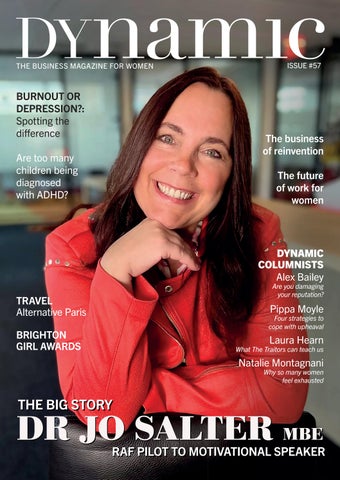
Dynamic Business Magazine - issue 57

Page 1


BURNOUT OR DEPRESSION?:

Spotting the difference

Are too many children being diagnosed with ADHD?

TRAVEL Alternative Paris

BRIGHTON GIRL AWARDS

The business of reinvention

The future of work for women

Alex Bailey

Are you damaging your reputation?

Pippa Moyle Four strategies to cope with upheaval

Laura Hearn

What The Traitors can teach us

Natalie Montagnani

Why so many women feel exhausted

DR JO SALTER

4 Upfront: The top international news stories involving women in business

10 In the Right Direction: Good news stories from around the world

Regulars

6 The Alex Bailey Column Workslop alert! Are you damaging your reputation?

8 The Laura Hearn Column

What The Traitors teaches us about how we communicate

12 The City Girl Column

Pippa Moyle with four strategies to cope with upheaval

14 The Natalie Montagnani Column

Why so many women feel exhausted

PLATINUM

THE BIG STORY

DR JO SALTER

MBE

The first female to fly a fast jet for the RAF, before moving into commerce, Jo is now considered the country’s most effective motivational speaker

26 Spotlight

Focusing on Rachael Dines and Kellie Miller – two women who deserve more recognition than they current receive

Features

28 The future of work for women in 2026

Dynamic looks at how women are perceived in the workplace, and how to empower themselves further

32 The business of reinvention

You don’t have to stick with who you are – but how to change course?

Events

16 City Girls Awards 2026

Dynamic Magazine is sponsoring the New Business Award.

24 Dynamic Awards 2026

Back for their fifth year, tickets for the premier awards for women in business are going fast

Wellbeing

34 Are too many children being diagnosed with ADHD? Is is too many, or is it the quality of diagnoses and support?

I measure the progress of a community by the degree of progress which women have achieved.”
B.R.

Ambedkar

Indian jurist, economist, social reformer and politician

36 Gudiya Dagur Patel

Burnout or depression? Why so many women don’t see the difference

Further Reading

38 Anne-Maartje Oud

How to handle a colleague who keeps making excuses

Art

40 Art

‘Whispering Landscapes’ – Kellie Miller on the works of Valérie Wartelle

Travel

42 Alternative Paris

There’s more to gay Paree than the Eiffel Tower and Jim Morrison’s tomb

What’s On

46 A brief snapshot of what’s on in Sussex and Surrey

EDITOR’S NOTE

Welcome to this edition of Dynamic.

If there’s one thing that feels increasingly important right now, it’s clarity. Knowing what matters, knowing what doesn’t. And being honest about where we are and where we think we should be.

That perspective runs through this issue of Dynamic. Our Big Story features Dr Jo Salter MBE. Much has been written about her as the RAF’s first female fast jet pilot but what’s just as impressive is what came after – the transition into business, advisory work and global leadership. Her career has been shaped by courageous decision-making in complex environments, where clarity matters.

Our regular columnists explore questions many women are dealing with in their working lives. Alex Bailey looks at how AI is being used day-to-day and where it risks diluting judgement rather than supporting it. Laura Hearn examines how trust is formed and how quickly certainty can replace curiosity when pressure is high. Pippa Moyle writes honestly about change – the disruption it brings, professionally and personally and what it takes to keep moving through it. Natalie Montagnani reflects on success, exhaustion and the mental load women carry, asking what happens when we stop second-guessing ourselves and start listening instead.

Elsewhere in this issue, we dissect a study that summarises how women navigate work today. We also look at the importance of pivoting when the time is right for your business.

Beyond work, we bring you balance with Alternative Paris in Travel, the works of Valérie Wartelle in our Art section and plenty of culture in What’s On.

We hope that you enjoy Dynamic this February.

Editor, Dynamic Magazine tess@platinummediagroup.co.uk

CONTACTS

PUBLISHER: Maarten Hoffmann maarten@platinummediagroup.co.uk

EDITOR: Tess de Klerk tess@platinummediagroup.co.uk

MOTORING EDITOR: Fiona Shafer fionaas@platinummediagroup.co.uk

COMMERCIAL DIRECTOR: Lesley Alcock lesley@platinummediagroup.co.uk

EVENTS DIRECTOR: Fiona Graves fiona@platinummediagroup.co.uk

HEAD OF DESIGN / SUB EDITOR: Alan Wares alan@platinummediagroup.co.uk

BORING MACHINE NAMED IN HONOUR OF FEMALE ENGINEER

A giant 1,600-tonne machine called Madeleine that will bore a tunnel taking HS2 trains into central London has been switched on.

Named after Madeleine Nobbs, the former president of the Women’s Engineering Society, the 190m-long contraption will create a 4.5-mile link connecting Old Oak Common in west London to a proposed expanded station at Euston. However, the design, cost and timescale of the new station are still unknown. Ministers promised an update later this year. In 2023, work on a new station at Euston to accommodate HS2 was paused so a new “affordable” design could be developed, with former Prime Minister Rishi Sunak stating it would need to be funded by private firms, not the taxpayer.

WASPI CAMPAIGNERS DENIED BY GOVERNMENT AGAIN

Women affected by changes to the state pension age have reacted with fury after ministers again rejected their claim for compensation. The government reconsidered the case after a new document came to light, but has again concluded that no compensation should be paid.

Campaigners say 3.6 million women born in the 1950s were not properly informed of the rise in their state pension age, which brought it into line with men. The Women Against State Pension Inequality (Waspi) group said the latest decision demonstrated “utter contempt” for those affected. In 2024, a parliamentary ombudsman recommended compensation of between £1,000 and £2,950 each for those affected.

WORTHING ENTREPRENEURS MAKE WOMEN’S TOP 100 LIST

Two Worthing women with a combined 50 years of specialist marketing experience have been named on the f:Entrepreneur iAlso 100 list for 2026.

Kelly O’Haire, director of Constructive Marketing, and Rachael Dines, director

of Shake It Up Creative, have been recognised for helping hundreds of businesses scale and improve their digital presence.

Kelly has a degree in public relations and her company specialises in the building

and construction sectors, while Rachael is a chartered marketer and specialises in small businesses and non-profits.

Kelly said: “I am incredibly honoured to be recognised alongside such a dynamic group of women.”

(See this month’s Spotlight, page 26)

UPFRONT

THE LATEST BULLETINS FROM AROUND THE WORLD

WOMEN’S START-UP EVENT IN HASTINGS ON IWD 2026

Let’s Do Business Group will mark International Women’s Day 2026 with a free, inperson event in Hastings, designed to provide practical business support and startup support for women at the early stages of entrepreneurship.

Taking place on March 6th at The Palace Workspace, the event is inspired by the International Women’s Day 2026 theme, “Give To Gain”, which highlights the value of sharing knowledge, experience, and connections to help women build confidence, skills, and momentum in business.

The event is aimed at women who are either considering starting a business or have been trading for under three years. It combines expert-led learning sessions with face-to-face networking, creating a supportive and welcoming environment for women to learn, connect, and grow.

MEGAN GREENE OFFERS WARNING ON UK INTEREST RATES

The Bank of England may not be able to lower interest rates as much as expected this year, due to strong UK pay growth and expected rate cuts in the US, one of its top policymakers has said.

Megan Greene, a member of the Bank’s monetary policy committee (MPC), which sets interest rates in the UK, said she was concerned that wages appeared to be growing strongly again this year, and this could stop inflation from easing.

In a speech in London at the Resolution Foundation, a leading thinktank, Greene said a decline in wage growth “may have run its course”, pointing to recent Bank of England surveys that suggest employers are planning to hand out pay rises of 3.5% or more this year.

FUNDING FOR FEMALE BUSINESSES STILL FALLING SHORT

Four in five businesses plan to seek external funding this year, with 47% expecting to raise more than £1 million. The research, conducted by Santander UK, found 88% of business leaders expect their business’s revenue to grow in the next 12 months and 54% expect an improvement in the UK economy.

However, women business leaders are likely to experience the same barriers they’ve always faced, with 48% reporting higher costs and 40% saying

processes are more complex.

Digital and challenger lenders are also influencing funding decisions, with 41% of leaders applying to a digital or neobank last year. While approval rates vary across providers, founders repeatedly highlighted the appeal of speed, userfriendly platforms and more streamlined application processes.

SUSSEX BRIDAL SHOP SHORTLISTED FOR AWARD

Wedding hair and makeup artist TK Bridal Beauty of Seaford has been named a Finalist in the Guides for Brides Customer Service Awards 2026, recognising outstanding customer experience within the UK wedding industry.

Guides for Brides celebrated its 30th anniversary last year and is one of the UK’s leading wedding directories and planning platforms, supporting couples with expert advice and trusted recommendations for wedding venues and suppliers nationwide.

The Customer Service Awards have been running for 10 years in 2026 and provide national recognition for wedding businesses, based on the quality and quantity of reviews left on guidesforbrides.co.uk. They are open to every business represented on the platform over the past year.

WSL OFFERS ITS OWN VERSION OF THE GREEN GUIDE

The Women’s Super League has unveiled design guidelines to support the building or upgrading of venues for women’s teams. The guidelines have been produced to help clubs, local authorities and architects achieve this, with the aim of making venues “better equipped” for both female athletes and fans. Brighton & Hove Albion is already pressing ahead with its plans and is close to announcing final plans and a location for its women’s team.

Brighton’s women’s team currently plays the majority of its home matches at the Broadfield Stadium in Crawley, a situation the club says is not ideal, and something Chief Executive and Deputy Chairman Paul Barber and Chairman and Owner Tony Bloom are keen to address.

“The best protection any woman can have … is courage.”
- Elizabeth Candy Stanton
“Not knowing you can’t do something, is sometimes all it takes to do it.”
- Ally Carter
SARAH’S CHARITY CLOSES ‘FOR THE FORESSEABLE FUTURE’

Sarah Ferguson’s charity, Sarah’s Trust, has announced it will close “for the foreseeable future” just days after new details emerged about the former Duchess of York’s friendship with late sex offender Jeffrey Epstein. A spokesman for the foundation said the decision comes after “some months” of discussion.

Among the more than three million documents released by the US Department of Justice (DoJ) were emails appearing to show Ferguson was in contact with Epstein while he was in prison. The charity Sarah’s Trust was established in 2020 and is “dedicated to supporting frontline, grassroots work to address the humanitarian and environmental crisis, the hunger crisis and issues perpetuating cycles of extreme poverty”, according to its website.

GIRLS’ SCHOOL TEAMS UP WITH GIRLS’ SPORTSWEAR FIRM

A Winchester school is partnering with a women-founded sportswear brand to help girls reach their full potential in sport. St Swithun’s has partnered with Bournemouthbased Flyhawk to get more girls moving, competing and loving sport at every level.

Jon Riley, director of sport at St Swithun’s, said: “Working with a female-led brand that truly understands the needs of young sportswomen has elevated both the confidence and performance across our senior teams. St Swithun’s was named as the top school for sport in Hampshire in 2025, ranked as the top girls’ boarding school for sport and was also shortlisted for Independent School of the Year in the sporting category.

The

Alex Bailey Column

We are delighted to have Co-Founder, with 20+ years organisational change. delivering impactful programmes

WORKSLOP ALERT! DAMAGING YOUR

• Less trustworthy

We’re all gradually experimenting more and more with AI, and this year, AI augmentation takes centre stage beyond simple AI Google-type assistance, but do we really understand what that means, and are we protecting ourselves from potential reputational damage in how we use AI?

Recent research shows that “workslop” is the low-quality AI-generated content that causes more problems than it solves – think AI-written emails and line text copied directly from ChatGPT without thought. You know – the bits that you can’t easily edit in Word for some reason.

• Less intelligent

Adding to this, I’m sad to say that further recent research shows reluctance to use AI is higher for women, but not perhaps for the reasons assumed.

A large study (Kate Niederhoffer et al 2025) on 29,000+ software engineers in a global tech company introduced a new AI tool, and uptake was just 41% overall, but only 31% amongst women. Exploring perceptions to understand the low uptake showed that women were perceived to be 13% less competent at using AI.

“I have tried using AI email responses to help reduce workload pressure and retreated rapidly.”

I have tried using AI email responses to help reduce workload pressure and retreated rapidly. I am an expressive person and already feel limited when not able to communicate verbally and in person, so giving AI the chance to represent me leaves me feeling my personal expression is lost, and that reduces my influence and impact, which is not helpful for me.

I am, however, starting to regularly receive the workslop from others, are you? It’s immediately identifiable, every single line. I know how people sound and write, and it’s obvious when it’s not their words.

How do you feel about the person sending it? Does it make you hesitate to do it yourself? Well, it should...

Research shows that receiving workslop changes your perception of your colleagues as:

• Less creative

• Less capable

• Less reliable

Furthermore, those male engineers reluctant to use AI themselves rated women who did use AI even more harshly: 26% less competent. Results showed that women were aware and concerned about this negative perception and, because of this, were avoiding using AI as a method of rational self-preservation, rather than out of reluctance.

I’m surmising from this that women in business need to up our game this year and share our AI competence to smash this growing stigma before it becomes a bigger problem.

Business leaders must support real AI skill development and not just allow people to work it out themselves by experimenting with Co-Pilot, but with encouragement, inclusively across everyone.

This starts with:

• Raising awareness, educating and knowledge building of the whole AI landscape that is appearing on our horizon

• Skill development that means invested time in experimenting with new behaviours, adopting new ways of working and learning to be more psychologically flexible; developing our human agility alongside to support us throughout (not as an afterthought)

have Alex Bailey contributing to Dynamic. She is a Global CEO and years of expertise in HR leadership, psychology, coaching, and She specialises in cultural evolution, leadership,and performance, programmes globally while speaking at international events.

ALERT! ARE YOU YOUR REPUTATION?

“Business leaders must support real AI skill development and not just allow people to work it out themselves”

• Real-world impactful incorporation into work that produces demonstrable results aligned to organisational vision and strategy

• And the important follow on of the recognition and celebration of significant achievements as role models for others to follow.

In the same way, through the pandemic, we all had to “get online” and “pivot to virtual” ways of working alongside the business as usual, we must undergo that parallel learning whilst delivering this year and not leave anyone behind.

For those leaders with multiple demands on their lives beyond work, it may be the hardest. What more can we do to avoid what could start as a divide and grow into a huge chasm of those who can, and those who can’t…?

As a champion of inclusion of everyone’s unique human contribution, I find this is a scary prospect, so share research like this, raise it with key influencers and recognise it when you can choose who’s the first cohort for your AI training this year. Bear this in mind, it matters.

Alex Bailey styled by Gresham Blake

Email: Alex@baileyandfrench.com www.baileyandfrench.com Insta @alexbaileybackstage

Follow me on LinkedIn: www.linkedin.com/in/ alex-bailey-26562b2/

Laura Hearn is a former BBC journalist, now storytelling consultant and founder of Flip It - a podcast and platform helping people and businesses use storytelling as a tool for clarity, connection and change. This month, for Dynamic, Laura articulates the strong links between The Traitors and basic emotional reactions

“We

rarely communicate from a place of full knowledge. We read rooms. We make assumptions. We infer intent. We misjudge tone. We cling to stories that make us feel safe, while quietly leaving gaps unexamined.”

What The Traitors how humans

Ihave to admit, I was late to the party. But once I joined, I could not seem to leave. I am talking about the compelling and at times jaw-dropping series The Traitors. On the surface, it looks like another reality entertainment format. Yet there is something about this show that has audiences of all kinds completely hooked. Cloaks, candles, a castle, dramatic music, what is not to love?

But beneath the theatre sits something far more familiar and far more revealing: a study of how humans behave when trust is fragile, stakes feel high, and certainty is in short supply.

What makes the show so compelling is not the twists or the betrayals. It is watching ordinary people try to communicate, persuade, defend themselves and belong, all while operating with incomplete information. Which, if we are honest, is how most of life works.

We rarely communicate from a place of full knowledge. We read rooms. We make assumptions. We infer intent. We misjudge tone. We cling to stories that make us feel safe, while quietly leaving gaps unexamined.

The Traitors strips all of that bare. It acts as a mirror, leaving us questioning not just the players but ourselves.

One of the most striking patterns in the show is how quickly belief turns into certainty. Once someone is labelled “a Traitor”, every action becomes evidence. A pause in breath feels suspicious, confidence feels manipulative, and silence feels like guilt.

Once we decide who someone is, we stop listening for who they actually are. We stop testing our assumptions. We stop being curious. From that moment on, communication becomes performance rather than exchange. What looks like logic is often loyalty to a narrative we have already chosen.

The show also exposes a truth we do not like to admit. Confidence often wins over accuracy. The most convincing voices are not always the most truthful ones. They are simply the ones who can act as if they are.

We see this play out far beyond the castle walls. In meetings, the calm and assured voice is trusted more than the hesitant one. In public discourse, strong opinion is rewarded over thoughtful doubt.

Traitors teaches us about

really communicate

Yet some of the most honest communicators on The Traitors are those wrestling with uncertainty. They question themselves. They hold competing possibilities, and ironically, that very humanity can make them seem less trustworthy to the group.

Another lesson the show delivers is how much meaning we assign to silence. Someone who struggles to speak up is quickly suspected. Someone who observes before contributing is seen as evasive. Yet silence does not have a single meaning. It can signal fear, thoughtfulness, overwhelm, or simply a different way of processing.

In real life, we are remarkably poor at allowing space for this. We fill gaps with stories that may or may not be true. And of course, there are always multiple versions of any one story. The question is, which one do we choose to believe and trust?

to stay inside the group. I have come to recognise this in myself, not as a flaw, but as part of being human.

Trust, as The Traitors reveals so clearly, is built emotionally rather than rationally. It is relational and often illogical. People trust those who make them feel safe, seen, or aligned, not necessarily those who are correct. Shared humour builds more loyalty than shared facts. A sense of belonging often outweighs evidence.

“Perhaps the most human insight of all is this. Many players do not act to win. They act to belong.”

This matters deeply in how we communicate at work and in leadership. You can have the right data, the right strategy, the right answer. But if people do not feel connected to you, they will not follow you. Trust is less about what you say and more about how you make people feel when you say it.

Perhaps the most human insight of all is this. Many players do not act to win. They act to belong. They align with groups even when their instincts tell them otherwise. They stay silent to avoid exclusion. They turn against others to protect their place at the table. It is uncomfortable to watch because it is familiar. It is essentially like holding up a mirror to ourselves.

Belonging shapes communication more than honesty ever will. We soften truths. We hide doubts. We edit ourselves

The Traitors works because it exaggerates what already exists. Pressure. Ambiguity. Fear of being misunderstood. And it reminds us that communication is never just about words. It is about power, trust, emotion, and identity.

If there is one lesson to take from the castle into everyday life, it is this. Slow down your certainty. Question the story you are telling yourself about others. Listen for what is not being said, as much as what is.

Most communication breakdowns do not come from malice. They come from fear, assumption, and the deeply human desire to belong.

And perhaps the irony is this. The more space we create for doubt, curiosity, and difference, the safer communication becomes. Which may be the most important lesson the show offers. Long after the torches go out.

You can listen to Laura’s podcast, Flip It, wherever you get your podcasts, and you can connect with her at www.flipitglobal.com

BBC /
Studio Lambert
/ Euan Cherry

CRIME MYTHS PUNCTURED BY THE NUMBERS

Fresh figures from the Office for National Statistics cut through the “lawless Britain” rhetoric. The murder rate in England and Wales has fallen to its lowest level since 1977, with domestic burglary and vehicle theft also down sharply over the past year. Homicide, gun crime and knife crime are all at historic or near-historic lows, trends supported by hospital data. While shoplifting and sexual offences have risen, the latter is partly explained by new laws broadening definitions. Overall, survey and police data point to a gradual, if uneven, decline in crime.

IN THE RIGHT DIRECTION

JUNK FOOD ADS FACE TIGHTER UK CURBS

New UK rules now restrict junk food advertising on TV before 9pm and ban it entirely online, aiming to tackle childhood obesity. Products such as sweets, pizzas and ice creams are covered, though companies can still promote their brands. Health campaigners welcomed the move but warned that loopholes — including outdated nutrient models and broad brand exemptions — could blunt its impact. With one in eight

young children in England classified as obese, advocates say strong enforcement will be key to making the policy count.

EXERCISE SHOWS PROMISE AGAINST DEPRESSION

A major review suggests exercise can be as effective as antidepressants and therapy in easing depression symptoms. Researchers analysed 73 trials involving nearly 5,000 adults and found moderate-intensity activity worked best, particularly when cardio was combined with strength training. While the findings highlight exercise as a safe, accessible option, researchers caution that evidence gaps remain. Long-term effects are unclear, and some activities, including yoga and stretching, were not studied. Even so, the message is clear: movement matters for mental health.

❛ I am no longer accepting the things I cannot change. I am changing the things I cannot accept”
Angela Davis

A QUIET TRIUMPH IN CANCER SURVIVAL

The US has reached a major milestone in cancer care: 70% of patients now live at least five years after diagnosis, up from about 50% in the 1970s. The gains are especially striking for oncedeadly cancers such as lung, liver and myeloma. The American Cancer Society credits decades of sustained research for transforming many cancers into manageable, chronic conditions. While disparities remain, the figures underline a broader truth — long-term investment in science saves lives, often quietly and cumulatively.

WIND POWER SLASHES UK ENERGY COSTS

Britain’s wind farms cut electricity prices by around a third last year, according to new analysis from the Energy and Climate Intelligence Unit. Wholesale power prices averaged £83 per MWh in 2025; without wind, they could have hit £121. While consumers

BAMBOO STEPS INTO THE BUILDING SPOTLIGHT

Long prized in Asia and South America, bamboo is edging into Europe’s low-carbon construction future. A new manual from the UK’s Institute of Structural Engineers sets out how the fast-growing material can be used safely in permanent buildings. Advocates say bamboo could dramatically cut emissions from a sector responsible for nearly 40% of global carbon output. Regenerative, durable and versatile, bamboo is increasingly seen not as a niche material, but as a serious contender in the race to decarbonise construction.

AID FINALLY MEETS GAZA’S BASIC FOOD NEEDS

For the first time in two years, humanitarian aid has supplied enough food to meet Gaza’s minimum nutritional requirements, the UN has reported. The progress follows the ceasefire and hostage-release deal agreed in October. However, the UN warned that Israel’s decision to ban dozens of NGOs could severely disrupt aid delivery. Israel says the organisations failed to meet new registration rules, a move condemned

haven’t yet seen the full benefit — due to grid upgrades and levies — some charges are set to fall in April. A record offshore wind auction has boosted optimism, though experts warn the government’s 2030 clean power target remains ambitious.

A LITERARY PRIZE PUTS READERS IN CHARGE

The newly launched Libraro Prize is rethinking how new writers get discovered. Instead of relying on industry gatekeepers, the readerled award invites the public to help shortlist manuscripts submitted online. The winning author will receive £50,000

by 10 countries, including the UK and France. Despite some violations, the ceasefire has broadly held, keeping fragile gains intact.

and a publishing deal with Hachette UK, while engaged readers can also win cash prizes. Open to over-18s worldwide, the prize aims to democratise publishing and lower barriers for emerging voices — shifting power from the slush pile to the reading public.

“Any human anywhere will blossom in a hundred unexpected talents and capacities simply by being given the opportunity to do so.”
Doris Lessing

Pippa Moyle is the CEO and founder of the City Girl Network, a mission-driven business dedicated to empowering and supporting women across the UK. Since launching in March 2016, the network has built a vibrant community of over 150,000 women, facilitating new friendships, business connections, job opportunities, housing solutions, and valuable life advice.

“Hanover. It’s a part of Brighton that’s infamous for its community, creativity and a decades-old nickname ‘Muesli Mountain.’”

Four strategies

By the time you read this, I will be living in Brighton. That’s not a sentence I expected to write when I peeled open my laptop on Monday, January 5th. Yet, here I am, diving into my monthly 800word column with regular interruptions from estate agent calls, moving company emails and my neighbours collecting things I’ve posted in our road WhatsApp Group. Every neighbour has the same reaction when I tell them where we’re moving to: “Oh, that’s a big change!”

My response is the same: nervous laughter, a smile, and a variation on “it certainly is.” For the past five years, I’ve been living in the suburban town of Haywards Heath. Home has been a detached house with a driveway, a small garden and a cul-de-sac of families who have lived here for decades. You walk up to a 71-acre wood, down to the train station, and to the “big Sainsbury’s” and Waitrose for spelt sourdough.

My partner and I moved here for economic reasons in 2021, after the pandemic raised rental prices in Brighton & Hove. We knew nothing of Haywards Heath, except the hospital and the train station. Now, our footprints are painted across every street of this almost 40,000-person town, 15% of whom are members of the City Girl Network we have here. The mayor even sent me a Christmas card.

At the end of January, we turned the keys to a colourful terraced house in Hanover with a kitchen in the basement and a bedroom in the loft. One chip shop on the right, another around the left corner and more pubs in our neighbourhood than the whole of Haywards Heath. It’s a part of Brighton that’s infamous for its community, creativity

strategies to cope with upheaval

and a decades-old nickname “Muesli Mountain”. Oh, that’s a big change. The turnaround had to be that quick...

I’m moving house for the same reason as nearly a third of renters right now: our landlord is selling. It’s the very defi nition of a “spanner in the works”, whilst simultaneously being the personal development course that I’ve needed for some time. In less than two weeks, I’ve been thrown into an all-encompassing masterclass of four core lessons.

Firstly, real change is not glamorous. It’s boxes, forms, logistics and decisions. It’s stomach knots, mess and chaos. Whether you’re changing your job, business direction, relationship or location, you’re making the decision to shake up your snowglobe, knowing that the pieces will not fall into the same place.

Secondly came the lesson in futureproofi ng your business to ensure it’s prepared for the moments when life has to come fi rst. I was a wreck when we found out how little time we had to move. It was around two hours after I’d announced the nominees for the Brighton Girl Awards. My socials, inbox, and WhatsApp were blowing up even louder than last year, but nothing could match the panicked scenarios running through my head.

targets. It’s a purpose-driven guiding light that helps work and life to be truly balanced. In my case, I’ve had to face the truth that I’m not where I’m supposed to be, even though there’s nothing wrong with where I am.

“Create a ‘the business will collapse if this is not done’ list, and come up with a plan for how to tackle them.”

Then there’s the fi nal lesson in courage and resilience. We romanticise courage as one wrapped in armour standing up to the overlords, but the real armour is resilience, and the overlord is resistance. Change opens up portals to confl icts, uncertainties and instability, posing as three little words: “Are you sure?”

As I’ve shared in previous columns, I live with a chronic health condition that’s already taught me the importance of prioritising, planning, automating and delegating. Th is experience has been an amazing test bed for that, exposing what’s working and what isn’t.

My advice for anyone fi nding themselves in a similar situation is to decide on the time that you realistically have to spend on the business (and then take off at least half a day). Create a “the business will collapse if this is not done” list, and come up with a plan for how to tackle them. The chances are, you’ll realise they’re not as business-threatening as you think, but that’s a whole other lesson in itself. Then set clear expectations for your colleagues, partners and clients.

My third lesson has been in understanding the power of alignment. It’s not just a phrase we use to describe the succinct correlation between teams, SOP documents and ROI

Change also increases the weight of domestic, logistical, professional and emotional load. It’s real-life resilience training that strengthens your trust in yourself. As the days go down and the load gets heavier, I’m reminded with every lift that the most courageous thing we can ever do in life is change.

Our Communities: Brighton, London, Manchester, Bristol, Bath, Leeds, Edinburgh, Birmingham, Worthing, Liverpool, Newcastle, Chester, Milton Keynes, Oxford, York, Cardiff, Glasgow, Perth and Rural Sussex

The colourful Hanover area of Brighton aka ‘Muesli Mountain’

Natalie Montagnani is a Business & Leadership Coach and the founder of IGNITE Women in Business. With over 25 years’ commercial experience, she empowers women through coaching, corporate workshops and events to lead and claim the visibility, confidence, influence and commercial impact they deserve.

THE HIDDEN COST OF SUCCESS: Why so many women feel exhausted

For a long time, I believed the answer to most challenges in my life and work was more thinking things through until I felt absolutely sure I was making the right move. Like many women, I assumed that if I could just get clearer on my goals, then everything would fall into place. After all, I am a strategist at heart, and I know how powerful clarity is.

But what I’ve come to understand, through my own journey and years of working closely with women, is this: clarity on its own is rarely the thing that changes everything.

What truly creates movement is honesty, transparency and authenticity – not with others, but with yourself.

THE MISSING PIECE

One of the most powerful moments in my work comes when a woman realises she has been caught between what she wants and what she believes she should want. It shows up in careers that no longer fit, in businesses that have outgrown their original shape, and in roles or identities that once felt right but now feel heavy.

Often, what is needed isn’t motivation or encouragement. It is permission to want something different, to stop doing what no longer works, or to choose a new direction without

judgement. When women stop fighting themselves and give themselves that permission, a much more honest form of clarity can emerge.

BENEATH THE NOISE

The women I work with are not lacking ambition, intelligence or drive. They are founders, leaders and decision-makers, women who are already doing a great deal and doing it well. From the outside, their lives often look enviable. Successful careers. Thriving businesses. The kind of progress others assume must feel deeply satisfying.

And yet, many of the people I work with come to me feeling stuck, exhausted, or quietly frustrated. Not because they don’t know enough — but because they are carrying too much internally. They are holding multiple possibilities in their heads. Running scenarios. Second-guessing decisions. Weighing the impact of every choice. Not just on themselves, but on their teams, families and futures.

carrying the weight of those decisions internally for too long. The solution does not come from pushing harder in those moments, which can often create more confusion. It comes from creating space to speak, to reflect, to hear yourself think. This is why I place such a high value on bringing women together where they can have the opportunity to do this.

CONFIDENCE OR RE-CONNECTION?

Many women tell me they want more confidence. What they usually mean is that they want to feel steady again, because when women reconnect with that internal steadiness, that instinctive knowing, everything shifts. They feel lighter and more energised. They set clearer boundaries. They respond to challenges with greater ease. Not because life suddenly becomes simpler, but because they are no longer constantly questioning themselves.

THE WAY FORWARD

What I’ve found is that women don’t want another rigid framework, another version of hustle, or a prescribed definition of success. They want a way forward that feels right for them. Because as women, our seasons change, our priorities shift, and our needs evolve. When we ignore that, we often feel disconnected from ourselves and from our sense of power. This is where success becomes deeply personal. It requires tuning out comparison and trusting your own context instead.

“Many of the people I work with come to me feeling stuck, exhausted, or quietly frustrated. Not because they don’t know enough — but because they are carrying too much internally.”

LEADING DIFFERENTLY

As we head further into 2026, I find myself thinking less about doing more and more about doing things differently.

Because real change doesn’t always come from striving, proving or pushing harder too often, that simply breaks us. Instead, it comes from respecting the season we are in and creating the conditions in which we can return to ourselves and lead from there.

And sometimes, the most powerful action a woman can take is simply this: To trust herself again.

What they are often seeking is not more answers or more things on their to-do lists - but just relief from the mental load of having to figure everything out alone. Someone to sense-check their thinking, reflect it back to them, and help them see what is really going on beneath the noise.

OVERTHINKING IS YOUR SIGNAL

When thoughts loop endlessly, it is rarely because a woman does not know what to do. It is because she has been

07900 153503

ignitewomeninbusiness.com

Connect with Natalie on LinkedIn or drop her an email to natalie@ignitewomeninbusiness.com

Brighton Girl Awards: Top 10 ‘New Business’

The Brighton Girl Awards are the City Girl Network’s community-driven awards celebrating the businesses, communities and pioneers that make Brighton and Hove a great place to belong. The 2026 edition of the Brighton Girl Awards features 17 awards, elevating the very best ways to live, work and play in the city.

It’s currently in the voting stage, with 170 nominees battling it out across socials, newsletters and collaborative events to get your vote by March 4th. The Top 5, announced on

International Women’s Day, move into the judging phase where a winner is decided and announced on March 19th at The Old Market, Hove.

Dynamic Magazine is the proud sponsor of the New Business category, championing the city’s most exciting emerging brands and founders. Th is award recognises new businesses that have brought determination, community spirit and exciting energy to Brighton’s business scene. Here we meet the Top 10 New Businesses battling it out for your vote...

NEW BUSINESS AWARD

Sponsored by DYNAMIC MAGAZINE

Remarkabull Marketing

Marketing agency

Founder: Lydia Eccleston remarkabull.co.uk

Remarkabull Marketing, created by Lydia Eccleston, supports growing businesses with social media, SEO, PR, content strategy and websites. With over a decade of marketing experience, they deliver practical, results-driven marketing solutions across Sussex and beyond.

Beyond & Co

Personal branding & leadership Founder: Teri Thomas beyondandco.uk

Beyond and Co specialises in personal brand and leadership visibility. Founded by Teri Thomas, Beyond & Co. partners with leaders to turn experience and personality into business growth.

Flamingo Styling

Event & venue styling

Founder: Sarah King flamingo-styling.com

Flamingo Styling, built by Sarah King, creates feel-good installations and standout event styling for celebrations, venues and seasonal campaigns. They help brands and spaces visually stand apart.

Rachel Mailer Coaching

Dating & relationship coaching

Founder: Rachel Mailer rachelmailercoaching.com

Rachel Mailer Coaching supporting ambitious women to build deeply aligned relationships through psychologyled coaching, feminine energy mastery and bespoke modern dating strategies.

The Archives

Neighbourhood café-bar

Founder: Laurie thearchivesbrighton.com

The Archives is an inclusive café-bar offering cocktails, one-unit and alcohol-free drinks in North Laine. It’s quickly become renowned for creative community events in a welcoming neighbourhood space.

Pearson Keehan

Property & construction consultancy

Founder: Amy Newman pearsonkeehan.com

Reformed Pilates

On-demand Reformer Pilates Studio Founders: Sarah Blyth and Kate Croxton thrive-pilates.uk

Reformed Pilates, created by best friends Sarah and Kate, is a flexible, welcoming on-demand Reformer Pilates studio designed around modern lives, offering accessible movement without rigid schedules.

The Lola Store

Independent lifestyle & retail

Founder: Frankie Tynan-Feighery thelola.store

Pearson Keehan is a Brighton-based Estate Agents supporting residential and commercial projects with expert surveying, project management and clear, client-focused guidance.

Bee May Bakery

Artisan bakery Founder: Becky beemaybaker.com

Bee May Bakery is an artisan bakery on Gloucester Road creating beautifully crafted bakes using quality ingredients, combining creativity, flavour and community-led values for Brighton customers.

The Lola Store is a vibrant independent shop in the Kings Road Arches on Brighton Seafront. They sell curated lifestyle, gifting and homeware pieces by creative businesses.

Gucky Studio

Hair and Beauty Salon

Founder: Krista Amira Calvo instagram.com/ guckystudio

Gucky Studio is a Brighton-based hair and beauty salon specialising in alternative hair, nails, lashes and tooth gems. Based in Church Street, they pride themselves in being a neurodivergent conscious, LGBTQIA+ space space.

THE BIG STORY

The fi rst fast-jet RAF pilot who has become the UK’s leading motivational speaker JO SALTER MBE

Dr Jo Salter MBE BEng (Hons), MBA, DA (h.c.), is a trailblazer in both aviation and corporate leadership. She is celebrated for her historic role as the first female fast jet pilot in the Royal Air Force.

Her transition to the corporate world has seen her excel in various leadership roles, including her current position at PwC, and being listed as the most motivational speaker in the UK.

Dynamic looks at the life of an entrepreneur and leader who made the transition from the skies to the boardroom

Doctor Joanna Salter MBE was born in Bournemouth in 1968, attending Shirley High School in Croydon, and later attending the nearby John Ruskin College. Her early years did not indicate that she would ultimately make aviation history.

“It wasn’t my plan. I grew up in Croydon and did not know anyone in the military. I loved hair and make-up and, when I was 13, thought maybe I’d become a hairdresser.” Yet, thanks to a national initiative – the WISE bus (Women in Science and Engineering) – and some encouragement, Jo started to consider a career in engineering.

“Th is lady on the WISE course asked me what I wanted to do. I loved maths,

so I said accountancy, and she replied, ‘If you study accountancy, you can only become an accountant. If you study engineering, you can be whatever you want.’ “

For Jo, that changed everything.” With her mother’s support, she pursued A-levels in science and began seeking an engineering sponsorship. In the end, she gained eight O-levels and three A-levels in Maths, Physics, and Electronics.

In 1986, just as the RAF began offering engineering scholarships to women for the fi rst time, Jo applied and was among the inaugural cohort. “They had only ever given them to men before, but that year, 10% went to women,” she recalls.

“She was the fi rst woman to be an operational Tornado pilot. This achievement was more than a personal triumph; it represented, for her and all women, a breakthrough in a traditionally male-dominated field”

Military regulations and the armed forces’ exemption from sex discrimination law meant women would be legally excluded from flying for much of the 20th century. Th is changed in 1989, when the UK government removed these exemptions, effectively allowing women to serve in any role in the armed forces, including flying fighter jets.

So, at 18, Jo joined the Royal Air Force and began studies at the Royal Military College of Science, initially focused on becoming an engineering officer. The pivotal policy change opened the door for women, particularly Jo, to pilot jet aircraft, redirecting her career path towards the skies. In 1992, aged 23, a milestone was reached when Jo earned her wings, a testament to her skill and determination. Her journey didn’t stop there; she completed her fast jet training by the year’s end, a rigorous process that polished her flying prowess.

“At

In August 1994, Jo joined 617 Squadron (a squadron historically remembered for being the Dambusters, operating out of RAF Scampton in Lincolnshire during World War II) at RAF Lossiemouth in the rank of fl ight lieutenant, and was declared ‘combat ready’ by the RAF on February 21st 1995.

She was the fi rst woman to be an operational Tornado pilot, and later flew from both Turkey and Saudi Arabia in the protection of the nofly zone over Iraq. Th is achievement was more than a personal triumph; it represented, for her and all women, a breakthrough in a traditionally male-dominated field, challenging stereotypes and inspiring a new generation of women in aviation.

Asked in 2024 if she found the whole experience frightening, she told Cazenove Capital online, “I was young. I don’t think I feel fear the same way as other people, or at least not until I had children.” When she was asked about her experience flying on the frontline with the RAF, she feels, “After my fi rst was born, suddenly danger was everywhere, though never for myself – always for her,”

Whilst flying ground attack Tornados, Salter started an MBA course with the Open University in 1996, being sponsored by the Ministry of Defence; a course she completed three years later.

18, Jo joined the Royal Air Force and began studies at the Royal Military College of Science, initially focused on becoming an engineering officer.”

Jo’s ride of choice – the Panavia Tornado fighter jet
A very youthful-looking Jo Salter poses in front of her beloved fighter jet

POST RAF

After 12 years of full-time service, Jo left the military but has remained engaged with the RAF as a reservist. She is now an honorary Group Captain on 601 Squadron – once nicknamed the “Millionaire Squadron” due to its aristocratic membership. She was a guest of honour when she attended the Top Gun: Maverick premiere, meeting Tom Cruise, and, in 2025, had the opportunity to fly in a Eurofighter Typhoon.

Transitioning from a distinguished military career, Dr Jo Salter seamlessly integrated her skills into the business world. Her expertise in leadership, analytical thinking, and performance under pressure, honed in the RAF, propelled her to senior roles at NetConnect, Automated Power Exchange, and Saltin Ltd., and to the role of Director of Global Transformative Leadership at PwC (formerly PriceWaterhouse Cooper).

She joined PwC in 2015 as Director of People & Organisation and played a pivotal role in steering a vast, global team of 10,000 experts across 138 countries. Th is team, renowned for its diverse expertise spanning industry knowledge, business acumen, talent management, strategy, HR, analytics and technology, worked collaboratively to develop bespoke solutions for clients. In 2020, she moved to the role of Director of Risk Technology Strategy at PwC, where she played a pivotal role in shaping the fi rm’s approach to technology-related risks. Her job involves developing strategies to manage and mitigate risks associated with adopting and integrating new technologies into business operations.

She moved on from this role the following year, to become the Director of Global Transformative Leadership. Jo is also responsible for leading Application Management Services Consulting for the global implementation of Workday, a major project spanning 157 territories and impacting over 240,000 people.

“As an officer, 10% of your career is spent on leadership training, whereas in business, it’s almost none.”

Decisions are frequently stalled by fear of failure or drawnout consensus-building. “In the military, it’s about lifting people up, valuing followership as well as leadership.” She told Cazenove Capital. “My success is about having clear conversations, decisive actions – just saying, ‘Th is is what we’ll do, by this date. Does anyone disagree?’ You’d be amazed how long others have been waiting just for someone to decide. As an officer, 10% of your career is spent on leadership training, whereas in business, it’s almost none.”

Most recently, Jo was appointed Global Advisory GenAI at PwC. In this role, she steers the responsible and ethical implementation of artificial intelligence technologies throughout the company.

CORPORATE LIFE

Jo feels that corporate life can feel more hierarchical than the military.

She later worked for the Open University Business School, ran her own consultancy, became a Director at PwC, and now speaks full-time. Her time in the RAF shaped the qualities she brings to business today, including decisive leadership and the ability to nurture talent.

As she told Cazenove Capital online, “My ability to cut through the noise, to get to the root of the problem – that stems from the military. As an officer, 10% of your career is spent on developing your leadership skills, whereas in business, it’s almost none. We tend to promote technical skills, rather than enabling people to become leaders.”

+WHAT THEY SAY – TESTIMONIALS OF JO’S MOTIVATIONAL SPEECHES

“I can tell you that Jo was excellent, everything she delivered hit the spot and I have been told the day was better because of her contribution, we really enjoyed her participation, thank you very much”

Michael, Learning Sourcing Manager, EDF Energy

“Without a doubt, Jo was the best speaker I’ve ever had the pleasure of listening to. Totally outstanding. A perfect balance of content within Jo’s story, so relevant to our team, our lives and the event. Couldn’t be rated higher, and so many amazing comments from the team about being inspired and taking insights away for change. Please pass on our enormous gratitude.”

Stuart, Head of Business Delivery, Three UK

“We have received tons of positive feedback on Jo – she was amazing and did exactly what we wanted: she was inspirational, conveyed the right messaging on mindset, overcoming obstacles and energised the team. I think many of my colleagues would have loved to spend more time with her … a warmhearted thanks!”

Eva, Head of Marketing & Communications, Deutsche Bank

“Listening to Jo recount her experiences really brought home just how ground-breaking her career has been. Yet, despite her impressive achievements, she was willing to talk frankly about the mistakes she made along the way. We were delighted to be able to welcome Jo into the organisation. She spoke with warmth and humour – and had an infectious energy that gave everyone attending a boost.”

Jamie, Learning Programme Manager, Ministry of Defence

“The group got so much inspiration and learning from her and were very impressed with the amount of time she gave to the group over the evening.”

Allied Irish Banks AIB & AIB Group

PUBLIC SPEAKER

Jo’s public motivational speeches, something she now does full-time, cover a variety of topics. These may range from empowering female leadership in the workplace; how to build high-performance teams; adopting a changed mindset; disruption and transformation and all points in between.

In 2025, she topped a poll ranking keynote speeches delivered in the UK and across Europe. The report, by Champions Speakers, compiled feedback from 2,245 events and conferences which took place between January to the end of November that year.

Th is gave speakers a score out of 10, and Salter came out on top, securing a score of 9.9. Jack Hayes, director of Champions Speakers, who led the research, said: “Th is list identifies the best of the best when it comes to keynote speakers working in the UK and Europe. Congratulations to Jo for coming in fi rst and underscoring her position as a superb and inspirational speaker.

Upon receiving this accolade, Jo said: “It’s an honour to be at the top of this list, as there are so many inspirational people on there, it’s humbling really. My only wish when taking on speaking engagements is to inspire someone in the audience to have the confidence to take that big step they’ve been thinking about but maybe lacked the self-belief to take.

“In 2025, she topped a poll ranking keynote speeches delivered in the UK and across Europe.”
Jo with actor Tom Cruise at the London premiere of ‘Top Gun: Maverick’, 2022

“If just one person can be persuaded, then that is a positive life-changing decision for them, and I am delighted to be able to facilitate those transformational moments.”

The top ten on the list, which Jo heads, contains an impressive alumni of speakers, including former sprinter-turned-motivator, Derek Redmond; Nicky Moffat CBE, previously the highest-ranking woman in the British army; cyber-security expert Sarah Armstrong-Smith; and Katie Piper, a sexual assault victim, who now campaigns on behalf of other victims.

AWARDS, ACCOLADES AND ACHIEVEMENTS

In addition to her professional achievements, Jo offers her expertise to various philanthropic and educational roles. As a Trustee of The Royal Air Force Club, she supports the RAF community, leveraging her experience to benefit the organisation.

Jo’s commitment extends globally as a Trustee for Ripples Charity and an Ambassador for Global Angels, a charity that provides essential resources such as clean water, education, and healthcare to communities worldwide, with a strong emphasis on empowering women and youth.

“In

addition to her professional achievements, Jo offers her expertise to various philanthropic and educational roles.”

Her influence in education is evident in her role as an Associate Lecturer at the Open University Business School, where she shares her extensive knowledge and experience with students, particularly in the MBA Programme, helping shape the next generation of business leaders.

Jo was appointed MBE by HRH Prince William in the 2022 New Year Honours for services to aviation. In that same year, Salter was awarded an Honorary Doctor of Arts by Bournemouth University in recognition of her efforts to promote inclusivity and motivate others.

Enquries for Jo’s public speaking can be made at https://champions-speakers.co.uk

Queen Elizabeth II being shown the new stained-glass window in the RAF Club by Jo Salter, 2018

Judging commences to honour the South East’s most inspirational businesswomen

Entries for The 2026 Dynamic Awards have now o cially closed… and it’s been a record-breaking year.

process promises to be both rigorous and inspiring.

An exceptional and diverse group of inspiring businesswomen have stepped forward, putting themselves forward for some of the region’s most respected accolades. Together, they represent the very best of female leadership, innovation and impact across the South East.

The winners will be unveiled at the female business event of the year - a powerful, electric celebration not to be missed. The spectacular awards ceremony will take place on March 26th at The Grand Brighton, where ambition, leadership and impact take centre stage.

With entries now complete, the spotlight turns to the judging panel.

Our distinguished panel of judges – made up of respected leaders and industry experts – is carefully reviewing each submission, considering not just success but the stories behind them. With such a powerful eld of contenders, the judging

Hosted by comedian Jo Caul eld, this exclusive evening brings together inspiring female leaders and allies from across the region for a night of recognition, connection and empowerment.

WATCH THE HIGHLIGHTS FROM LAST YEAR: https://tinyurl.com/d84bw6nc

SPONSORED BY

“We had a fantastic evening at the event that was loaded with ambience, positive energy and amazing women. Connections and great memories were made…”

In our exclusive Spotlight feature, we highlight women who are doing good things in their community. They’re not always seen but we think they should be.

SP OTLIGH T

Rachael Dines

The accidental businesswoman building a creative agency with purpose and impact

Rachael Dines never planned to run a business. Her path into entrepreneurship began unexpectedly when a recession-related redundancy occurred during early pregnancy. She gained Chartered Marketer status and, as a temporary measure, turned to freelancing. But as any marketer would, she built a complete brand around herself. What began as a practical solution soon became the seed of something much bigger: Shake It Up Creative.

Over ten years later, Shake It Up Creative is a thriving boutique marketing and web agency specialising in the hospitality, arts and culture, and charity sectors. Known for its collaborative, purpose-led approach, the agency partners with organisations that want to grow through authenticity and impact. Rachael’s leadership style blends commercial courage with creative clarity - a balance that has become the company’s signature.

Over time, her role has grown far beyond agency founder. Rachael is a marketing mentor, speaker, magazine contributor and advocate for women in business. Alongside running the agency, Rachael is also a parent of three and a charity Chair who has raised thousands of pounds for her sons’ primary school.

one-to-one marketing advice to startups. And, she is an ambassador for her local Chamber of Commerce. This breadth of responsibility and impact has earned her a place on the 2026 f:Entrepreneur #iAlso 100 list from Small Business Britain, a list which recognises women combining business leadership with community contribution.

Her voice in marketing and small business has recently gained international recognition. In November 2025, Rachael was invited to Boston to speak at the MarketingProfs B2B Forum (one of the world’s leading marketing conferences), where she shared her expertise in search engine optimisation and building visibility online.

“Rachael is a marketing mentor, speaker, magazine contributor and advocate for women in business.”

She has mentored more than 100 small business owners across Sussex and beyond through funded support programmes, helping founders build confidence, develop strategy and sharpen their messaging. She is a Business & IP Centre (BIPC) Expert in Residence, providing pro bono

For Rachael, success has never been defined solely by revenue or awards. It is measured in strengthened communities, empowered founders, and organisations that find their voice and grow with integrity. Her hopes for the future centre on a world where all genders have equal opportunity and where human stories and meaningful collaborations guide better choices for the next generation and for the planet.

www.ShakeItUpCreative.com

Kellie Miller

Kellie

For as long as she can remember, Kellie Miller has wanted to live a creative life. She has dedicated her life to the Arts as an artist, curator, critic, gallerist, mentor and educator. Her lecturing and teaching span from the early years to Master’s level.

Kellie champions and encourages all forms of creativity.  She feels that creative pursuits and careers have been downplayed and devalued in society, and particularly eroded in our educational systems.  She says, “Promoting the Arts produces well-rounded individuals who not only have the resilience to problem solve and be adaptable, but also make life worth living. Every aspect of our world is shaped by creative minds who transform ideas into reality, yet this contribution is rarely acknowledged or fully valued.”

in time. The act of transforming and making magic is exactly what alchemy is about. It is how she creates her art, her exhibitions and her writing. Finding a seed of an idea and nurturing and growing it are what Kellie excels at.  With a strong belief in herself, she has found it to be her guiding force, enabling her to seemingly create something from nothing.

“Her ability to seize opportunities, sense potential, and take risks has earned her the title of an entrepreneur. “

Her commitment to her art has earned her international recognition, with works in museums in Europe and Asia, as well as in private collections.

She holds Beauty in art dearly, both in what she creates and in how she curates. She believes Beauty is powerful and not frivolous, but can often be political. Kellie also thinks art is critical to our well-being and can be beautiful without being deliberately crude or aggressive. Many different messages can be conveyed through art, but foremost by being approachable and inclusive.

All roads and opportunities have stemmed from her artistic practice. Her ability to seize opportunities, sense potential, and take risks has earned her the title of an entrepreneur. Wearing many hats, she has immersed herself in the creative world and is recognised for her business acumen.

She has the skill to bring people, objects, ideas, textures, and concepts together in places and spaces at any one point

When she set up her studio in 1996, there were very few provisions for artists in Brighton. Biscuit Studio has been a forum for cultural exchange and artistic practice, where many artists and designers have worked, including makers from Japan and Turkey.

In 2013, Kellie opened a pop-up gallery in the Brighton Lanes, initially representing eight artists, at a time when there were few exhibition spaces for artists in the city.  After the project ended, she realised she had a talent for curating and presenting artwork.  Kellie has since secured and developed an iconic space in the heart of Brighton’s cultural quarter, Kellie Miller Arts (KMA), which now represents and supports over 100 artists, has a global reach, and aims to be the best contemporary art gallery in Sussex.

www.kelliemillerarts.com

is the proprietor of her eponymous art gallery in Brighton’s North Laine

The future of work

Here at Dynamic, we look forward to Allbright everywoman’s yearly white paper. Drawing on insights from 363 women across industries, seniority levels and career stages, this year’s research is a true reflection of what we hear from women day to day. The paper explores how women navigate work today, what enables their success, and where organisational systems still need to change to better support them.

And it tells a clear story. Women are not waiting to be fi xed. They are ambitious, adaptable and actively shaping their working lives. The problem is not a lack of drive or capability. It is that systems and cultures are still, too often, failing to keep pace.

WHAT’S WORKING AND WORTH SCALING

There are clear conditions under which women perform, progress and stay. Flexible working, varied ambition pathways and purposeful engagement with technology stand out as enablers of effectiveness rather than compromises.

Flexibility remains one of the strongest drivers of women’s success at work. When women are able to work flexibly – whether through adjusted hours, hybrid arrangements or greater autonomy over when and where work happens – the benefits are immediate and measurable. Nearly nine in ten report better work–life balance. Productivity, focus, and job satisfaction increase, while feelings of overwhelm decrease.

“Women are not waiting to be fi xed. The problem is not a lack of drive or capability. It is that systems and cultures are still, too often, failing to keep pace.”

The future of work for women is often talked about in terms of aspiration. More flexibility. Better balance. Faster progress. But when you strip away the rhetoric and look at women’s lived experience, the picture is more complex and far more practical.

Importantly, most women do not see flexibility as a career risk. Seven in ten say the flexible working options they currently use have had a mostly positive impact on their career growth. Th is challenges the lingering idea that flexibility is a perk or concession. For women, it functions as a foundation for sustained performance, wellbeing and retention.

Ambition, too, is alive and well – but it is not one-dimensional. Most women rate themselves as highly ambitious,

work for women 2026

yet the shape that ambition takes varies widely. For some, it is about increasing salary or achieving promotion. For others, it is about deepening expertise, building influence, diversifying a career, or starting something new alongside or beyond a traditional role.

Th is matters because many organisations still rely on narrow defi nitions of success. Linear progression models risk overlooking women whose ambition does not follow a single upward ladder. When employers recognise multiple ambition pathways and legitimise different ways of growing, more women are able to see a future for themselves inside the organisation.

AI’s long-term impact and excited by its potential. Yet the majority have developed these skills through self-learning rather than employer support – a gap that carries real consequences.

WHERE THE SYSTEM STILL FALLS SHORT

Despite this momentum, significant barriers remain. These are not personal shortcomings. There are structural and cultural issues that shape women’s daily experience of work.

“While women are investing heavily in their own development, organisational support is not keeping pace.”

Women are also moving quickly in technology. Engagement with AI is widespread and increasingly sophisticated. Many women use it daily or weekly to summarise research, write reports, brainstorm ideas, improve communication, and reduce administrative workload. They are not simply saving time. They are using these tools to think more effectively, prepare more effectively, and improve the quality of their work.

AI use often extends beyond work, supporting organisation, learning and mental load management. There is a strong appetite to learn more. Most women are curious about

Training is one of the most obvious gaps. While women are investing heavily in their own development, organisational support is not keeping pace. Fewer than three in ten women report receiving employer-provided AI training that leaves them feeling equipped. More than half do not feel adequately prepared, despite already using these tools regularly.

Leadership and development training designed specifically with women’s lived experience in mind is also limited. Many women report that their employers offer no women-specific training, or that available programmes are difficult to access. Generic training often fails to address gendered realities such as visibility penalties, confidence erosion or the impact of life stages, including pregnancy and menopause.

Progression is further constrained by structural realities. Nearly half of women say the lack of more senior roles to apply for has had the most detrimental impact on their careers. When next steps are unclear or scarce, momentum stalls – even when ambition remains high.

Stress and burnout feature prominently, alongside reduced confidence. These pressures often sit alongside limited access to development, inconsistent managerial support and, in some cases, hostile or toxic cultures. Over time, the cumulative effect erodes well-being and belief in what is possible.

“Women are equally clear about what would help. This is not about special treatment. It is about retaining experienced talent and protecting performance.”

Flexible working, despite its clear benefits, still carries hidden penalties. Women who use flexible arrangements report lower visibility, slower progression and reduced access to training, networks and informal opportunities. These are not fl aws of flexible work itself, but consequences of how it is perceived and managed.

When flexibility is unavailable altogether, retention risks rise sharply. A significant proportion of women whose employers do not offer flexible options are actively looking to leave. Almost all say they are more likely to choose or stay with an employer that offers flexibility. The message could not be clearer.

Menopause remains another critical and often mishandled issue. Symptoms affect concentration, confidence, energy and stress levels, directly influencing performance and

ten workplaces provide menopause support, and only a similar proportion take it seriously as a workplace issue.

Women are equally clear about what would help. Better manager training, access to healthcare support, reliable information, flexibility during symptomatic periods and, for some, paid leave. Th is is not about special treatment. It is about retaining experienced talent and protecting performance.

WHAT EMPLOYERS NEED TO PRIORITISE NOW

The implications for employers heading into 2026 are practical rather than theoretical. The work is not about fi xing women. It is about fi xing systems.

First, flexible working must be treated as a performance asset, not a career risk. That means making it routine at all levels, designing meetings and communication that do not privilege physical presence, and monitoring progression and training access to ensure flexible workers are not sidelined.

Second, organisations need to support multiple ambition pathways. Progression should not be limited to promotion alone. Skill building, lateral moves, influence, portfolio careers, and new ventures are all legitimate forms of growth. Transparent frameworks and well-equipped managers are essential to making this real.

progression at a stage when many women are stepping into senior roles. Yet fewer than four in

Third, the training gap must be closed. Learning opportunities need to be visible, accessible and aligned with the skills women want and need to build. Leadership and technical training should reflect gendered realities in the workplace, rather than assuming a one-size-fits-all approach.

Fourth, employers must move from self-learning to employer-supported AI confidence. Women are already using these tools. What they need now is structured, role-relevant support that builds clarity and confidence, rather than leaving individuals to keep up on their own.

Fifth, menopause support should be standard practice. Clear policies, trained managers and practical adjustments protect performance and retention at a critical career stage. Finally, cultural drivers of burnout, toxicity and confidence loss need to be addressed head-on. Workload expectations, behaviour standards and manager capability all shape whether women can sustain momentum or are gradually worn down.

“Perhaps the most striking finding in the research is not what women lack, but what they are already doing. They are ambitious. They are adaptable.”

+WORKING WOMEN IN NUMBERS

44% use AI daily at work; most learned without employer training

47% say a lack of senior roles is the biggest barrier to progression

98% are more likely to stay with an employer that offers flexibility

71% say flexibility has had a mostly positive impact on career growth

89% of women with flexible working report better work–life balance

67% rate their ambition at seven out of ten or higher

20% have taken time off work due to menopause symptoms

MATCHING THE MOMENTUM WOMEN ALREADY BRING

Perhaps the most striking finding in the research is not what women lack, but what they are already doing. They are ambitious. They are adaptable. They are building future-ready skills and reshaping how work fits into their lives.

In 2026, employers have an opportunity to match that momentum. When systems, training and culture evolve in step with women’s realities, organisations do more than support equity. They strengthen performance, retention and leadership pipelines.

The future of work for women is already taking shape. The question is whether employers are ready to meet it.

www.everywoman.com

The business of

In today’s rapidly changing economy, the word ‘pivot’ has become one of the most repeated in boardrooms, investor decks, and strategy sessions. But while agility and adaptability are essential, there’s a growing recognition among business leaders that ease of change isn’t the same as strategic wisdom. Reinvention must be a deliberate choice rooted in insight, timing, and deep understanding of market signals; not chasing trends.

WHAT A PIVOT REALLY IS

In academic and strategic circles, a pivot isn’t a dramatic overhaul for its own sake. Rather, it’s a strategic reorientation of your business in response to new information that challenges the assumptions underlying your current model. Research published in the Strategic Management Journal shows that entrepreneurial firms make pivot decisions only after encountering information that conflicts with or expands their prior beliefs about the business environment or

their capabilities. This process isn’t spontaneous but iterative and evidence-based, not whimsical.

In short, a pivot should be a systematic shift, not a reactionary reset.

SIGNALS IT’S TIME TO CHANGE COURSE

Deciding to pivot is perhaps the most consequential strategic decision a leader makes. Several reliable indicators suggest it may be time to consider a strategic reorientation:

• Market signals are weakening: stagnant sales, declining customer engagement, and a shrinking addressable market suggest the current strategy is no longer driving momentum.

• Customer needs have evolved: When your core offering no longer aligns with what customers value, and the gap can’t be closed with incremental improvements, reinvention becomes imperative.

• Competitive disruption is imminent: When new entrants or technologies carve away your advantage, sticking with the status quo risks obsolescence.

“A pivot isn’t a dramatic overhaul for its own sake. Rather, it’s a strategic reorientation of your business in response to new information”

of reinvention

• Internal feedback points to misalignment: Your team may notice patterns - lost deals, repeat feature requests, or operational friction - that the current model doesn’t address.

These aren’t vague hunches; they’re measurable pressures that, when taken together, indicate a strategic pivot could unlock growth rather than squander effort.

THE COST OF PIVOTING WITHOUT PURPOSE

“Not every challenge requires reinvention. Some market disruptions are temporary or may be better met with optimisation rather than transformation”

PIVOT WITH A STRATEGY, NOT A SWING

While the pivot narrative is compelling, it’s not a silver bullet. Business leaders increasingly caution against unfocused, frequent changes that reset momentum rather than build it. In a 2025 analysis, industry commentators warned that when companies pivot every 6–12 months without clarity, they effectively reset their strategy repeatedly, fragmenting execution and eroding trust both internally and externally.

Constant reinvention risks what some analysts describe as leadership drift: the unintended signal that a company lacks conviction. When direction changes too often, stakeholders and staff can become disengaged and uncertain, ultimately undermining the very agility the pivot was meant to create.

So how do you decide when a pivot is strategic and when it would be premature or costly? The best pivots share several characteristics:

1. Data precedes decision. Informed pivots rely on validated market signals, not instincts alone. This includes customer behaviour analytics, competitor benchmarking, and trend data that collectively point toward meaningful shifts.

2. Grounded in core strengths. Successful pivots don’t abandon what you do well; they extend it. Leveraging existing assets, technologies, or brand equities provides stability while opening new avenues for growth.

3. Managed in stages. Rather than an all-or-nothing shift, the smartest companies pilot changes in incremental phases. This allows them to test assumptions, mitigate risk and course-correct quickly.

4. Balanced by perseverance. Pivoting isn’t mutually exclusive with staying the course. Some of the most successful organisations maintain a stable strategic core while exploring adjacent opportunities - a balance between innovation and execution discipline.

WHEN IT’S BETTER TO HOLD YOUR GROUND

Not every challenge requires reinvention. Some market disruptions are temporary or may be better met with optimisation rather than transformation. In these cases, doubling down on execution excellence, improving customer experience, and refining operations can yield more predictable value than repositioning the business entirely.

Persevering with your strategy makes sense when:

• Existing advantages have not yet fully matured.

• Market disruptions are cyclical or short-lived.

• Customer loyalty still drives sustainable revenue.

Notably, many strategic pivots in business history didn’t happen because old models were broken but because leaders recognised a clear adjacent opportunity that amplified their core value proposition.

www.rachaelbessconsultants.com

Are too many children being

Specialists say the real issue is something else entirely

According to specialists at The ADHD Centre, recent claims in the press that ADHD is being overdiagnosed are missing the real point. The issue is not a surge in incorrect labels; it is rushed assessments, long NHS waiting lists and inconsistent standards across parts of the private sector.

Only 26.6% of children with ADHD in the UK receive any form of treatment. Rising diagnosis numbers, therefore, reflect unmet needs being recognised, not the overdiagnosis suggested in recent coverage. As awareness of neurodiversity grows, more parents are seeking answers to help their children. Th is does not mean families are pushing for labels or that clinicians are handing out careless diagnoses. It may feel as though more children are being identified with ADHD, yet if they are receiving the right support, that is a positive outcome.

The data shows the challenge lies in access, not excess. Around 549,000 people were on NHS waiting lists for an ADHD assessment in March 2025, which reflects system strain rather than widespread overdiagnosis. Prevalence studies estimate that 5–8% of children have ADHD, yet UK diagnosis rates remain below 3 %, so many children are not being identified at all.

“Rising diagnosis numbers, therefore, reflect unmet needs being recognised, not the overdiagnosis suggested in recent coverage.”

The whole point of diagnosing a child or adult with ADHD is to give them the understanding, structure and support they need to thrive at school and in their social lives.

Currently, many children are given a diagnosis and then simply labelled, and then receive only basic support from the SEN at school without the practical tools or guidance that would help them and their parents manage their symptoms. Research consistently shows that when ADHD is identified and properly supported, children experience significant gains in confidence, behaviour and academic progress.

Growing up is challenging enough, so a careful and robust ADHD assessment supported by coaching, school adjustments and/or medication can make a real difference to their confidence and progress. At the same time, thousands of

children still genuinely need a proper assessment and remain overlooked, which is why a balanced and thorough approach is essential.

Dr Kripalani, Consultant Psychiatrist at The ADHD Centre, says: “ADHD is a complex condition. You cannot properly assess a child in a single brief appointment. When the process is rushed, the danger is not that too many diagnoses are made; the danger is that they are inaccurate. Some children get missed, others get misunderstood, and families are left confused.”

A robust assessment is essential. UKAAN and AQAS standards recommend two- to three-hour structured assessments incorporating information from parents, teachers, and clinicians, which is far from what many families currently experience.

“ADHD touches every part of a child’s functioning,” said Dr Kripalani, including emotional regulation, friendships,

being diagnosed with ADHD?

and learning. When we take the time to assess properly, we can see the whole child and give families clarity and practical support.”

“ADHD

is often linked with poorer

academic outcomes and higher risks of anxiety, depression and low self-esteem, which reinforces the importance of early and accurate assessment.”

ADHD is often linked with poorer academic outcomes and higher risks of anxiety, depression and low self-esteem, which reinforces the importance of early and accurate assessment.

Another factor behind the rising demand is the structure of the education system itself. Many parents turn to a formal diagnosis because additional help in school often depends on having a recognised condition. Clinicians say this reflects pressure within schools rather than eagerness for a label. This matches national findings that only children with formal identification can reliably access extra time or support plans in exams, making diagnosis a gateway to fairness rather than a trend.

The ADHD Centre believes the way forward is not fewer diagnoses. It is better, more consistent assessments so every child receives an accurate understanding of their needs.

The ADHD Centre is a UK-based clinic specialising in the diagnosis, treatment and ongoing support of children and adults with Attention Deficit Hyperactivity Disorder (ADHD). With a multidisciplinary team of psychiatrists, psychologists, and specialist ADHD coaches, the Centre offers a comprehensive, personalised approach to managing ADHD at every life stage.

www.adhdcentre.co.uk

+REFERENCES

NHS England, ADHD Management Information (May 2025) www.england.nhs.uk/long-read/attention-deficithyperactivity-disorder-adhd-managementinformation

NICE Guidelines for ADHD: Diagnosis and Management (NG87) www.nice.org.uk/guidance/ng87

Royal College of Psychiatrists, ADHD in Children and Young People www.rcpsych.ac.uk/mental-health/mentalillnesses-and-mental-health-problems/ adhd-in-children-and-young-people

UKAAN – Adult ADHD Assessment Quality Assurance Standard (AQAS) www.ukaan.org

Government SEN Statistics, England www.gov.uk/government/collections/ statistics-special-educational-needs-sen

Girls and ADHD underdiagnosis research (various peer reviewed sources)

Example overview: https://www.additudemag.com/ girls-with-adhd-underdiagnosis

IS IT BURNOUT OR Why so many women don’t

or many women, exhaustion doesn’t hit all at once. It creeps in slowly. You wake up tired but get on with it. You feel flat but still push through. Sleep gets lighter and more disturbed, digestion gets unsettled and irregular, focus gets harder and memory patchier , but nothing feels urgent enough to pause.

So, you don’t.  So, burnout often slips in unnoticed.

We live in a world that rewards momentum. There is always something to respond to, something to manage or solve and women are particularly good at adapting. Used to responsibility and high standards, we slip easily into autopilots. We keep working, caring, organising and showing up often without questioning the cost.

Over time, this ‘just get on with it’ attitude becomes the default. The body adjusts, and the nervous system learns to function under constant pressure. And because life keeps moving, we rarely pause long enough to recognise that something isn’t right.

Burnout and depression can look remarkably similar. Low mood, lack of motivation, poor sleep, brain fog, irritability and emotional flatness - the overlap is significant. Many women are told they’re depressed when what they’re actually experiencing is nervous system overload.

When stress becomes chronic, the nervous system stays switched on. The body remains in a low-level state of alert, rarely dropping into true rest. Sleep becomes disrupted. Digestion slows or becomes erratic. Energy dips unpredictably. Low mood and anxiety can set in, and life can feel meaningless, but this is because the nervous system is exhausted.

From the outside, this can easily look like depression.

What’s often missed is context. How long have you been pushing? How much emotional and mental load are you carrying? When was the last time you truly rested - not just slept or flicked channels but switched off? These questions matter, yet lifestyle and nervous system health are still not always explored deeply enough.

Women are particularly vulnerable to this misdiagnosis because we are so good at functioning while unwell. We meet deadlines, appear capable, look “fine.” Inside, though, the nervous system is running on overdrive. Over time, that state becomes familiar. Exhaustion feels normal. Overwhelm feels expected.

At that point, burnout doesn’t register as burnout - it feels like life.

The risk of labelling burnout as depression is that treatment can focus on managing symptoms rather than addressing the cause. Therapy and medication can be supportive, but if the underlying issue is chronic stress and nervous system dysregulation, recovery can feel slow or incomplete. Many women sense that something is still off, even when they’re doing everything they’ve been advised to do.

Recognising burnout requires space, and that’s often the hardest thing to allow. Space to slow down enough to

“Burnout and depression can look remarkably similar. Low mood, lack of motivation, poor sleep, brain fog, irritability and emotional flatness - the overlap is significant.”

OR DEPRESSION? don’t see the difference

notice patterns. Space to step out of survival mode and reassess how life is actually being lived. Without that pause, women continue to push through fatigue, low mood, and fog, assuming this is just how things are now.

“Burnout and depression deserve different conversations and different approaches.
When we understand that distinction, we stop blaming ourselves and start listening instead.”

Burnout isn’t a lack of resilience or motivation. It’s a stress injury and a sign that the system has been running without recovery for too long. Healing often begins not with doing more, but with doing less and learning to respond rather than react. By allowing the nervous system to soften, rather than constantly demanding performance from it.

Burnout and depression deserve different conversations and different approaches. When we understand that distinction, we stop blaming ourselves and start listening instead.

That’s why I created Just Be… Retreats. I wanted to offer women a space to pause, to step out of the constant doing, and to reconnect with themselves in a way that feels safe and nurturing. These retreats are designed to help you notice the patterns of stress and exhaustion in your body, to release what you’ve been carrying, and to give your nervous system the support it needs to truly rest and reset.

Investing this time isn’t indulgent - it’s essential. It’s a chance to slow down, reflect, and practice self-care in a way that goes beyond quick fixes or surface-level rest. By giving yourself this space, you allow clarity, energy, and balance to return, helping you move through life with more ease and presence and to stay grounded.

Just Be… isn’t about doing more. It’s about creating space to simply be, to reconnect, and to remember that calm, clarity, and wholeness aren’t things you have to chase-they’re already within you.

For more information about the retreats, go to www.justberetreats.co.uk

You can find out more about Gudiya at www.gudiyawellness.com or on Instagram @wellnesswithgudiya.

+ABOUT GUDIYA DAGUR PATEL

Gudiya Dagur is a wellness expert with more than 15 years of experience in holistic health, aesthetics and mindfulness. She is the Managing Director of the multi-award-winning PHI Clinic on Harley Street in London and founder of Gudiya Wellness. With qualifications in Clinical Nutrition, Transformational Coaching and Mindfulness, she blends science-backed practices with Ayurvedic and naturopathic principles. Her personalised, heart-led approach helps clients cultivate balance, inner peace and authentic wellbeing.

FURTHER READING… HOW TO HANDLE A COLLEAGUE EMPLOYEE WHO KEEPS MAKING

AnneMaartje Oud is author of ‘What to do if...? How to handle any situation at work and come out winning’, a book published by Kogan Page

If you are dealing with someone who consistently underperforms and makes excuses, it can be extremely frustrating. It slows down the team’s progress, lowers the quality of work, and forces others to take on extra tasks. Sometimes it even leads to conflicts among team members due to the uneven distribution of effort and responsibility.

“If we listen to the reasons behind their excuses, we might be able to help them.”

If the issue isn’t addressed, it can create distrust among team members. And if leaders, in particular, fail to address the problem, people may perceive the situation as unfair and feel there is a lack of accountability for behaviour.

EMOTIONALLY CHARGED: HOW TO LEAD IN THE NEW WORLD OF WORK

By Alicia A. Grandey & Dina Denham Smith (Oxford University Press, 2025)

Blending research and real-world case studies, this guide helps leaders manage emotional complexity at work. It offers evidence-based strategies for emotional regulation, difficult conversations, supporting staff wellbeing and navigating tensions between productivity and compassion in modern workplaces shaped by hybrid work, AI and psychological demands.

It might be that the goals weren’t clear enough to begin with, so it’s important to delve deeper by asking open-ended questions to uncover the root cause. “Why are you not meeting your goals?” can be a simple but helpful question. Sometimes, what initially appears as an excuse may come from valid obstacles that you hadn’t previously recognised.

If we listen to the reasons behind their excuses, we might be able to help them. Is the task too challenging for them? Are they bad at time management? Do they need training or other resources?

GETTING ALONG: HOW TO WORK WITH ANYONE (EVEN DIFFICULT PEOPLE)

by Amy Gallo (Harvard Business Review Press, 2024)

This guide explains psychological and communication tools for dealing with difficult colleagues and stressful interactions. With evidence-backed techniques, it prepares readers for real workplace friction, negotiations and personality clashes with actionable strategies.

SUPERCOMMUNICATORS:

HOW TO UNLOCK THE SECRET LANGUAGE OF CONNECTION

By Charles Duhigg (Penguin, 2025)

Pulitzer-winning author Charles Duhigg explores why strong communication is the cornerstone of workplace success. Drawing on research and vivid case studies — from jury rooms to corporate teams — he shows how mastering different conversational dynamics helps you navigate difficult conversations, build trust and resolve conflict more effectively.

COLLEAGUE OR MAKING EXCUSES

However, we should also communicate the impact their behaviour has on work, on you, and on others. This way, they’ll understand how their actions slow everyone down and why it’s important to do better. Give feedback that is kind but also specific, objective and focused on behaviour and outcomes.

“I’ve noticed that you’ve missed a deadline three times now. You often have an explanation, which I understand, things come up. But when it happens more than once, it comes across as avoiding ownership, and it impacts the team’s momentum. Meeting deadlines is a basic expectation, so I need you to

AUTHENTIC: THE MYTH OF BRINGING YOUR FULL SELF TO WORK

Jodi-Ann Burey (HarperCollins, 2025)

A searing critique of the corporate myth that being “yourself” at work solves everything. Through research, memoir and interviews, Burey shows how employees — especially marginalised ones — are asked to perform emotional labour without structural support, and how authenticity can become a burden rather than liberation

take full responsibility and let me know early if something might slip.”

“We should also communicate the impact their behaviour has on work, on you, and on others.”

If things aren’t working out, as a leader you may decide it’s time to rethink an employee’s tasks. If necessary, consider reassigning some of their tasks (temporarily) to better align with their capabilities.

Sometimes, however, enough is enough. If after support and opportunities to improve, the behaviour doesn’t change, it may be necessary to take more formal steps. You can always remember the phrase: we help first, but we hold firm!

POWERFUL PHRASES

FOR DEALING WITH WORKPLACE

CONFLICT

A practical, employee-centred guide to handling conflict with colleagues and supervisors. It provides ready-to-use phrases and communication strategies to defuse tension, assert boundaries and protect your interests without escalating disputes.

MINDSET MATTERS: HOW ATTITUDES SHAPE YOUR WORK AND WELL-BEING

For employees wrestling with stress, change and career uncertainty, this book uncovers how mindsets influence job satisfaction and resilience, and gives readers practical exercises to shift thinking, reclaim agency and reduce burnout.

Whispering landscapes The works of Valérie Wartelle

Valérie Wartelle’s wet felt artworks draw you in. At first glance, you perceive the works to be constructed of layers of paint. On closer inspection, you become aware of the way the light dances on the surface of her works. The blurring effect creates Turnerlike imagery, giving each piece a more profound meaning and inviting you to engage further.

Wool is Valérie’s language; she layers, teases, and tames - blending the lines between surface and depth, merging landscape and emotion. This slow, deliberate craft mirrors nature’s own rhythms: unpredictable yet purposeful, grounded yet ever shifting.

Drawing inspiration from the rural environment, Valérie creates contemplative, semi-abstract artworks rich in climate, texture, and light. These are highly textured pieces

in which cloth is embedded, and threads unravelled, as a painter with her brush.

The wet felt process is unpredictable, yet Valérie takes meticulous control and ownership of her medium. She builds her imagery by positioning individual strands, taking delight in the fact that she isn’t leaving any aspect of her process to chance. Building layer upon layer, often ten or more, until she is satisfied, not only with the overall composition but with the balance of colour, contrast and textures.

“Drawing inspiration from the rural environment, Valérie

creates contemplative, semi-abstract artworks rich in

climate, texture, and light.”

Strata

She says, “I explore the deep emotional and sensory connections we hold with the natural world. These works are not literal landscapes, but evocations - intimate responses shaped through fibre, textile, and colour.

Using the traditional craft of wet felting and the expressive qualities of natural fibres, my process is both tactile and

immersive, allowing me to work in a way that feels instinctive and meditative.”

Suspended between abstraction and landscape, each piece offers a space for quiet contemplation. Inviting you to reconnect with the quiet knowing we carry within - an emotional memory held in the body. Valérie hopes to offer not just imagery, but a felt presence: a tactile whisper that draws the viewer inward, toward their own intimate relationship with the land.

Kellie Miller is an artist, curator, critic and gallery owner.

Kellie Miller Arts, 3 Church Street, Brighton, BN1 1UJ

www.kelliemillerarts.com

“Who doesn’t love Paris? But is it feeling slightly ‘been there, done that’ these days?”

Who doesn’t love Paris? But is it feeling slightly ‘been there, done that’ these days? It doesn’t have to – for each tourist-saturated attraction, there’s an equally compelling corner of the city that rewards curiosity with local colour and culture. Here’s how to see Paris differently this year. Love culture, hate crowds?

Try the Musée AlbertKahn just outside central Paris in Boulogne-Billancourt. The space is unexpected and feels

like a philosophical project rather than just a museum. It houses a large and fascinating collection of early 20th-century colour photography - the Archives de la Planète – and is surrounded by hectares of gardens that flow from French formality into Japanese serenity. It’s contemplative, beautiful and a real counter-rhythm to crowded galleries.

Closer to the Seine, the Musée Guimet (Place d’Iéna, 16th arrondissement) opens Paris outward to the world. As Europe’s leading museum of Asian art, it houses serene Buddhist sculptures, Khmer stone carvings, Japanese prints and Indian ritual objects. Its galleries are calm and spacious with an atmosphere that inspires slow wonder rather than quick photos.

PaRiS ALTERNATIVE

My Parisian favourite, with its peaceful heartbeat, is the Musée Rodin. Housed in what used to be the gracious Hôtel Biron with its lovely garden, you’ll fi nd an extensive collection of Rodin’s sculptures, including The Th inker and The Kiss, all presented in natural light and unguarded spaces that you can inhabit rather than peer at through crowds. The setting creates a feel of intimacy that’s hard to fi nd in major capitals.

atmospheric. The surrounding Musée de l’Armée provides layered insights into French history, while the complex itself feels meditative rather than crowded.

A stone’s throw from Musée Rodin, you can get your fi ll of history at an alternative to bustling Notre-Dame. Les Invalides delivers quiet drama. Beneath its gold-leaf dome lies Napoleon Bonaparte’s tomb, monumental and

THE EIFFEL TOWER – DEFINITELY BEEN THERE, DONE THAT?!

Paris’s skyline is famously low and wide, with fantastic views available from more than just the Eiffel Tower. Head instead to Parc de Belleville in the city’s east. From its upper terraces, Paris unfolds in a wide panorama of rooftops, church spires, and distant monuments, all without crowds. Locals come here at sunset with coffee or wine, turning the view into a shared ritual.

“If you find yourself in Paris with beautiful weather, head to La Petite Ceinture, an old railway line partially reclaimed by nature...”

Another timeless choice is the Arc de Triomphe terrace, where you can climb above the Place de l’Étoile and enjoy sweeping perspectives over the avenues radiating outward, showing the city’s geometry and glimpses of landmarks without the dense crowds below. The Montparnasse Tower observation deck is the best choice if you’d like a perfect photo of the Eiffel Tower, but it is popular and can get busy. For a truly panoramic vantage point with minimal fuss, head to Galeries Lafayette’s rooftop terrace near Opéra. It’s free to access and gives towering views over Haussmann rooftops, with the Eiffel Tower on the distant skyline - especially lovely at sunset.

HIDDEN CORNERS

Clearly, not everything worth seeing in Paris comes with a queue. Often, it’s the weird and wonderful little shops, unexpected galleries or old bookstores that stay with you after the big names fade.

I like to dive into the city’s literary soul in antiquarian bookshops nestled around Saint-Germain-des-Prés and the Latin Quarter. These aren’t just shops; they’re living archives where first editions, vintage prints and forgotten maps wait to be discovered.

Not exactly alternative Paris, but the Absesses Metro station in Montmartre is a great little piece of history. One of the city’s deepest stations, it’s best experienced on foot, climbing the narrow spiral staircase lined with lovely tiled murals. At street level, you emerge through one of Hector Guimard’s original Art Nouveau entrances, all curved iron and glass. Outside, Place des Abbesses is lively with cafés and regular pop-up weekend markets.

Musée Guimet
La Petite Ceinture

If you find yourself in Paris with beautiful weather, head to La Petite Ceinture, an old railway line partially reclaimed by nature, for an adventurous stroll where overgrown vines and quiet tracks feel like a secret Paris park. It’s a lovely way to escape the boulevards and see the city through a different lens.

Neighbourhoods like Belleville and Ménilmontant are evolving too - multicultural, youthful, and full of street art, local cafés and vibrant energy far from tourist itineraries. There are soft edges to explore here: boutiques, murals, small galleries and cafés that feel like they belong to the city’s everyday life.

AUTHENTIC EVENINGS

Paris’s nights can be as memorable as its days, and if you skip the big shows and cabarets, you step into the city’s real after-dark rhythm.

Admittedly becoming a bit touristy these days, Caveau de la Huchette has been hosting jazz since the 1940s and still feels hidden in a vaulted cellar in the Latin Quarter. It’s the kind of place where it’s all about the music and locals mingle with travellers over wine and rhythm.

For something younger and slightly rough-edged, L’International is a long-standing live-music venue showcasing indie bands, experimental sounds and emerging artists. It’s casual, affordable, and distinctly local - the kind of place you discover through word of mouth rather than listings.

Another treasure, Le Louxor is an Art Deco cinema restored to its former

glory, screening independent and classic films in French and English. Watch a film, then post-screening wine for an evening that feels authentically Parisian.

Paris is an easy destination to reach from the UK. A hop, skip and jump and you can find yourself a whole world away from home. Don’t be discouraged by the throngs of tourists and queues – simply choose alternatives, and you might find yourself newly inspired by The City of Light.

“Paris’s nights can be as memorable as its days, and if you skip the big shows and cabarets, you step into the city’s real after-dark rhythm.”
Classic architecture at Abbessess Metro station
Street art in Ménilmontanant

WOKING

CYBER RESILIENCE & AI COMPLIANCE WORKSHOP

Interactive training designed for SMEs to understand digital risks, AI compliance and practical resilience strategies. Delivered by experts, this session helps businesses prepare for modern tech challenges with confidence.

Surrey Chambers of Commerce Dukes Court Office, Woking February 11th www.businesssurrey.co.uk/events/ cyber-resilience-and-ai-compliance-training-for-smes/

GUILDFORD GENERATION NEXT PUB MEETS

Casual networking evening for young professionals (18–35) focused on conversation, career growth, leadership and local connections. A welcoming space to meet peers, share ambitions and expand your professional circle. Organised by Surrey Chamber of Commerce

Three Pigeons, 169 High Street, Guildford February 11th www.businesssurrey.co.uk/events/gen-next-pub-meets/

WHAT’S ON...

A brief snapshot of art and culture in the region

BORDE HILL

KIDS TRAIL: MISSION SPRING AT BORDE HILL

A family-friendly outdoor garden trail where kids follow clues to find signs of spring, learn about nature and earn a reward — great for half term or weekend fun.

Borde Hill Garden, West Sussex February 14th - March 22nd bordehill.co.uk

WEYBRIDGE HALF TERM AT BROOKLANDS MUSEUM

Hands-on experiments, engineering challenges and interactive demonstrations will keep curious minds entertained this half term. A lively and educational programme set within a landmark museum.

Brooklands Museum, Weybridge February 14th-17th brooklandsmuseum.com

LEATHERHEAD LEATHERHEAD THEATRE: ROYAL BALLET WOOLF WORKS

Virginia Woolf defied literary convention to reveal rich inner worlds through heightened, poetic realism. Choreographed by Wayne McGregor, Woolf Works translates her stream-of-consciousness style into movement, rejecting traditional narrative.

Leatherhead Theatre, Leatherhead February 9th leatherheadtheatre.com

BRIGHTON BRIGHTON DOME: CLASSICAL COFFEE CONCERTS

Mid-morning classical performances in an informal setting, featuring chamber music and emerging talent. A relaxed way to experience live music during the winter months.

Brighton Dome, Brighton Selected dates throughout February brightondome.org

A programme of contemporary art exhibitions presented in the iconic modernist building, pairing ambitious visual work with one of Sussex’s most dramatic coastal settings.

De La Warr Pavilion, Bexhill February – March dlwp.com

BRIGHTON WHERE ARE ALL THE LESBIANS? RESEARCHING THE MUSEUMS’ COLLECTION FOR REPRESENTATION

Join Lisa Hinkins, Collaborative PhD Researcher with Brighton & Hove Museums, for an introductory workshop inviting local cis, trans and non-binary lesbian women to explore how lesbian lives are represented in Brighton & Hove Museums’ collections.

Brighton Museum & Art Gallery February 22nd Brightonmuseums.org.uk

BEXHILL DE LA WARR PAVILION: WINTER EXHIBITIONS

Turn static files into dynamic content formats.

Create a flipbook