How Digital Documentation Improves Construction Accuracy and Project Coordination
Modern construction projects depend on clear communication, accurate measurements, and reliable documentation When architects, engineers, and contractors collaborate on large developments, even minor misunderstandings in drawings can lead to delays and costly revisions Digital documentation helps eliminate these risks by providing structured technical information that teams can interpret easily.
One of the most important tools supporting this process is CAD drafting services, which convert design concepts into precise digital drawings used throughout planning and construction. These drawings define layouts, dimensions, structural details, and technical specifications that guide teams during project execution
Because digital drawings are created in structured environments, they remain consistent and easy to update This allows project teams to maintain accuracy and ensure that all stakeholders are working with the same reliable information
The Importance of Accurate Technical Drawings
Technical drawings act as the operational guide for construction projects They provide the visual language that connects design ideas with real-world execution Every component of a building's structural elements, electrical systems, plumbing layouts, and mechanical systems must be clearly represented to avoid confusion during construction
Accurate drawings help teams understand how different building systems interact with each other When these relationships are documented correctly, potential conflicts can be identified during the design phase rather than during construction
Digital drafting environments also improve efficiency because revisions can be implemented quickly without affecting the overall project documentation This flexibility allows architects and engineers to refine designs while maintaining consistency across the project.
How Advanced Data Capture Improves Project Accuracy
Reliable documentation becomes even more powerful when it reflects real-world site conditions. Construction projects often involve existing structures, complex terrain, or renovation work that requires highly precise measurements
Modern data capture technologies help gather this information with remarkable accuracy. Detailed spatial data provides architects and engineers with a realistic understanding of the environment before they begin design development.
A widely used method for collecting this information is 3D laser scanning services, which capture millions of data points from a building or site to create highly accurate spatial
references When this information is integrated into project documentation, teams can develop designs that align closely with actual conditions.
This approach significantly reduces the risk of design conflicts and improves the reliability of project planning.
Strengthening Collaboration Across Project Teams
Construction projects require collaboration between multiple professionals working across different disciplines Architects focus on design aesthetics, engineers ensure structural integrity, and contractors manage the physical construction process
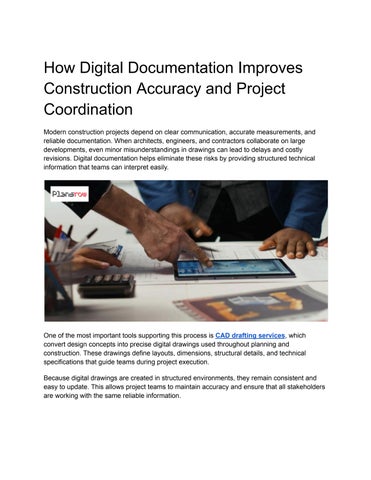
Digital documentation creates a shared reference point that allows these professionals to coordinate their work effectively Instead of relying on isolated drawings or outdated documents, teams can access updated information and collaborate within a unified workflow.
Clear documentation also improves communication between stakeholders Project managers can track design updates, contractors can interpret instructions accurately, and clients can visualize project progress more easily
Companies such as Plansrow contribute to this collaborative process by supporting structured digital documentation that improves coordination and helps teams deliver projects efficiently.
Key Advantages of Digital Drafting Workflows
Digital drafting systems offer several advantages that support modern construction workflows:
Higher Accuracy
Precise measurements and standardized documentation reduce the risk of design discrepancies
Efficient Design Updates
Digital drawings allow quick revisions without redrawing entire plans
Improved Visualization
Detailed layouts help teams understand spatial relationships and construction sequences
Better Coordination
Shared documentation improves collaboration between architects, engineers, and contractors.
Reduced Project Risk
Accurate technical drawings help identify potential conflicts early in the planning phase.
These advantages make digital drafting a critical component of modern construction planning
The Future of Digital Design Documentation
The construction industry continues to evolve as digital technologies reshape project planning and execution As buildings become more complex and projects involve more stakeholders, the need for accurate documentation will continue to grow.
Future workflows will likely combine advanced measurement technologies, collaborative digital platforms, and automated design tools to improve efficiency. These innovations will allow project teams to manage information more effectively and maintain accuracy throughout the construction lifecycle
By adopting modern documentation strategies, organizations can reduce risks, improve collaboration, and deliver projects with greater precision and confidence