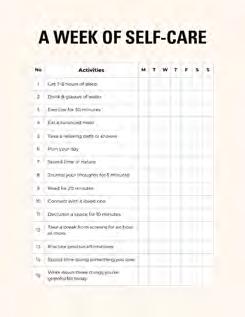
50 CREATE BALANCE: 3 SELF-NURTURING PRACTICES TO TRY by Kelley Grimes
52 SUMMER SEASON ORACLE CARD READING with Patty Lennon
56 SACRED ON THE GO
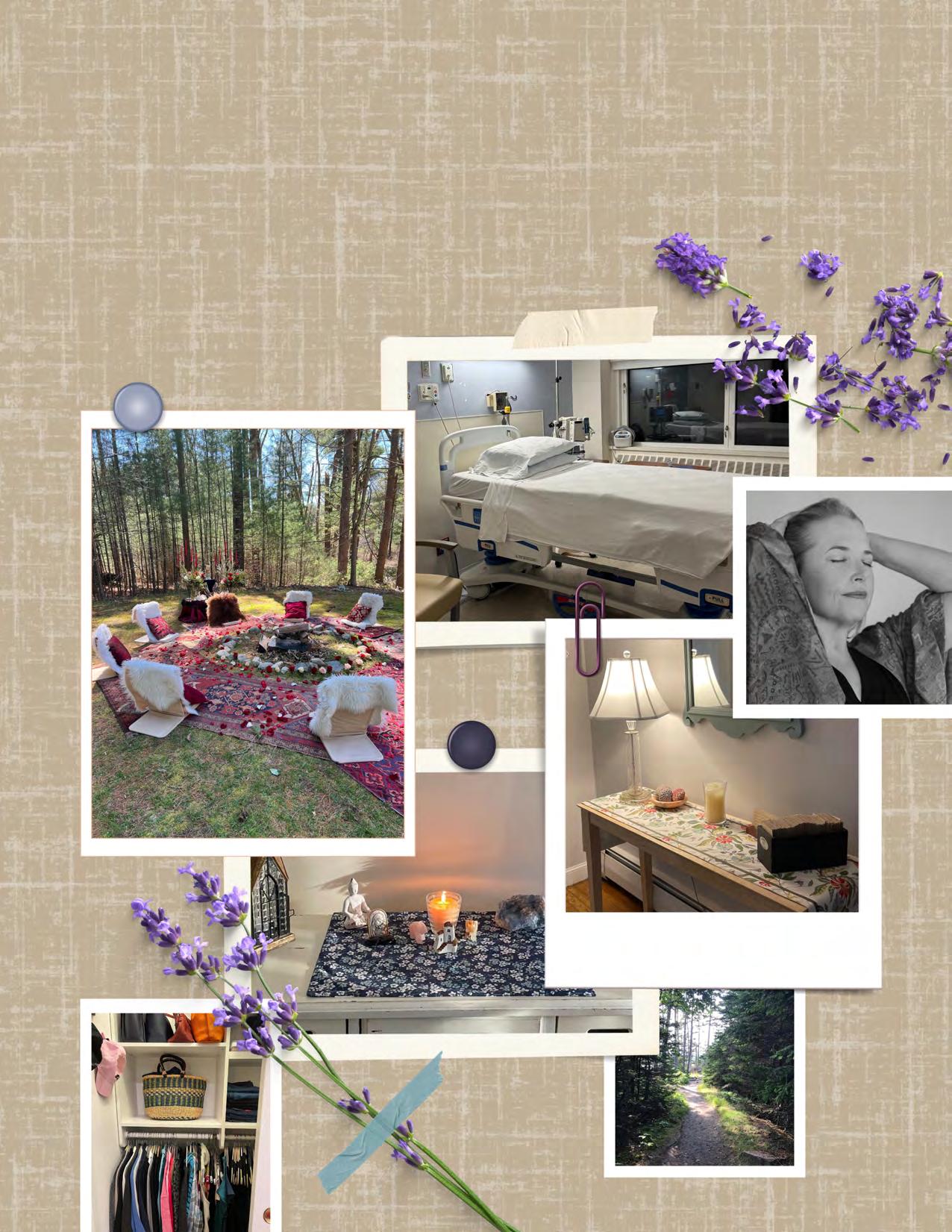
88 TEMPLE KEEPER with Catherine Clapp
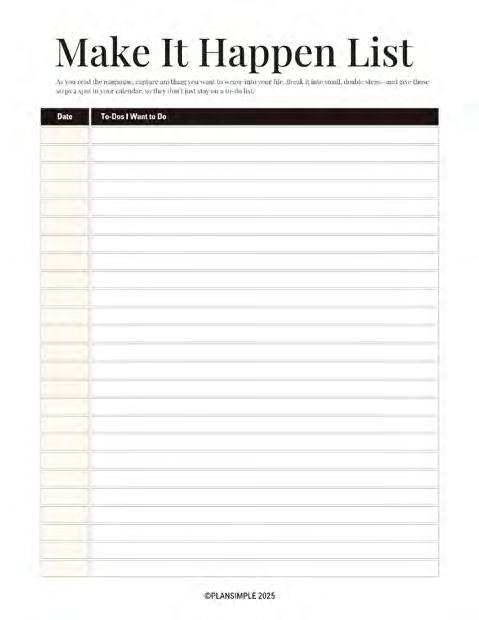
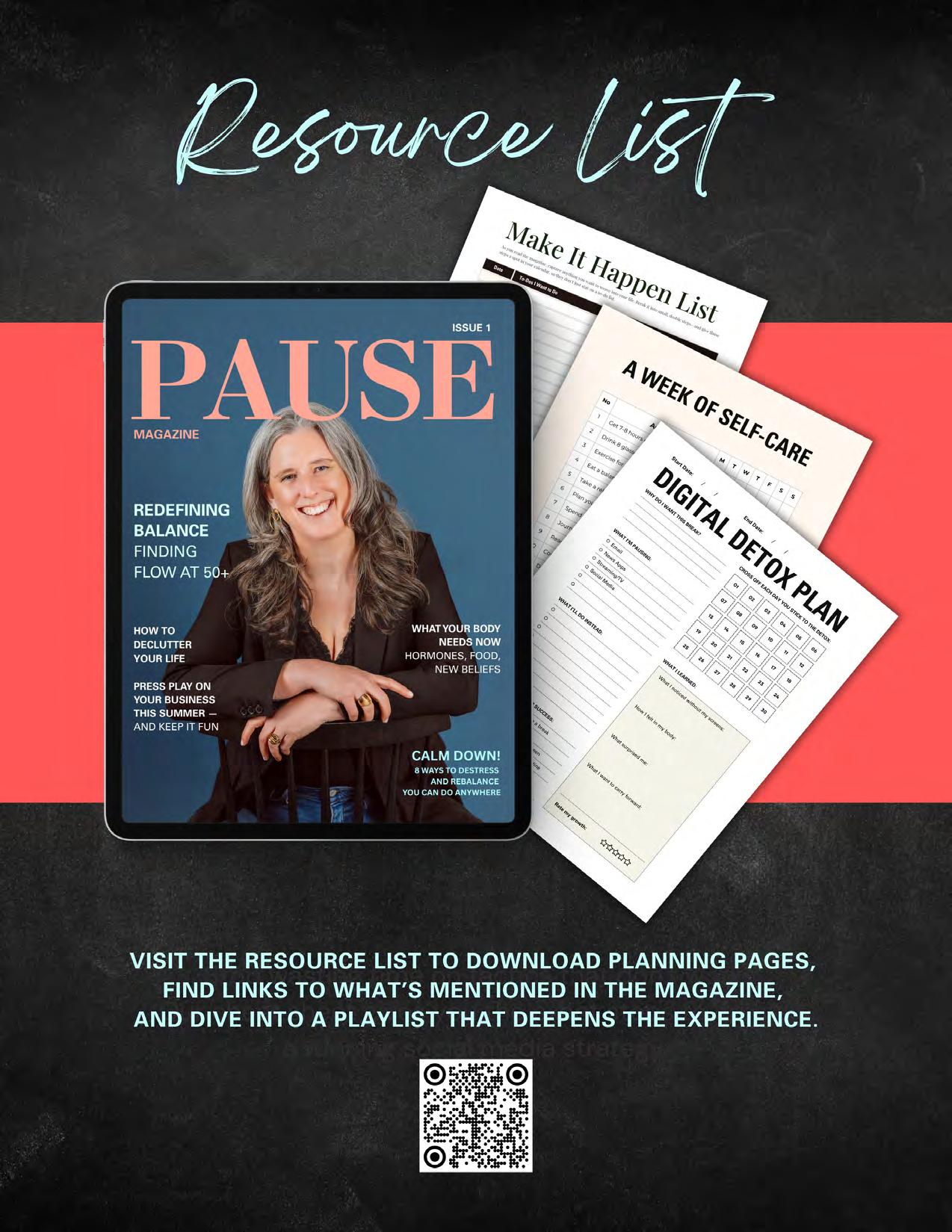
Visit the Resource List to download planning pages, find links to what’s mentioned in the magazine, and dive into a playlist that deepens the experience.
26 TAKE A DIGITAL PAUSE Your Digital Detox Plan
28 STRENGTHEN YOUR FRIENDSHIPS THIS SUMMER by Sara
Barry
42 MONEY IN HER HANDS 4 experts weigh in to demystify money
45 OOH, WHAT’S IN HER BAG?
79 HOW TO BE A MORE HUMAN, HEART-LED MOM THIS SUMMER by Heather Hester
12 SIMPLE BUSINESS MOVES TO KICKSTART YOUR SUMMER 3 tips you can implement today
36 HOW I FOUND MY VOICE AND YOU CAN TOO by Dolores Hirschmann
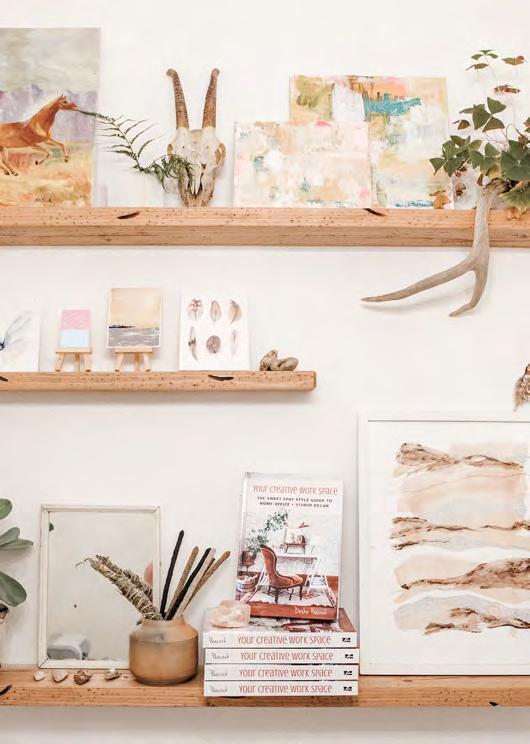
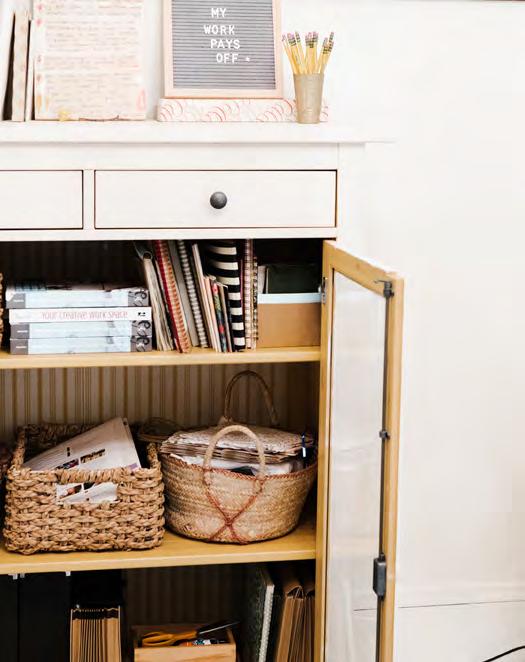
82 HOME OFFICE REFRESH with Desha Peacock
84 UPGRADE YOUR LINKEDIN Baby steps that move you forward
92 SPACE TO GROW Use downtime to improve your business
MAGAZINE TEAM
Mia Moran Editor in Chief
Sara Barry Senior Editor & Contributor
Regina Evangelista Social Media
ISSUE 1 CONTRIBUTORS
Kaitlyn Carlson
Catherine Clapp
Christi Collins
Denise Costello
Chella Diaz
Jenny Fenig
Megan Flatt
Shira Gill
Tanya Goodrich
Dahiema Grant
Kelley Grimes
Sarah Haas
Julie Hannon
Heather Hester
Dolores Hirschmann
Patty Lennon
Roxanne Lowery
Kelly Lubeck
Tess Masters
Lynda Monk
Lisa Mullis
Desha Peacock
Janice Porter
Sil Read
Jeannie Spiro
Carrie Rene Thomas
Christine Walsh
Tess Waresmith
Kate Wells
Laura West
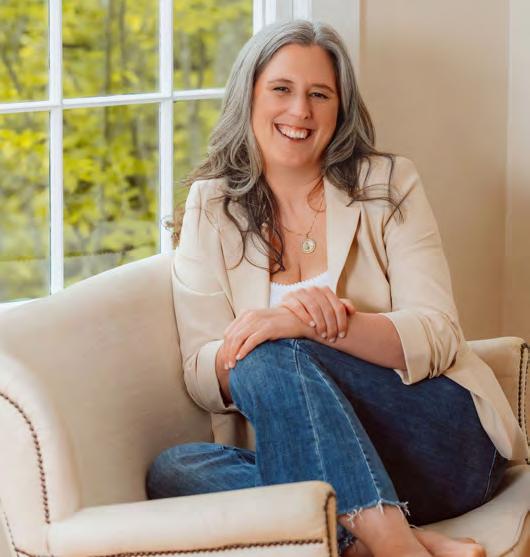
From the Editor
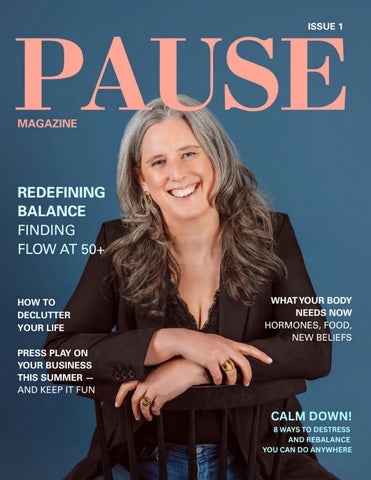
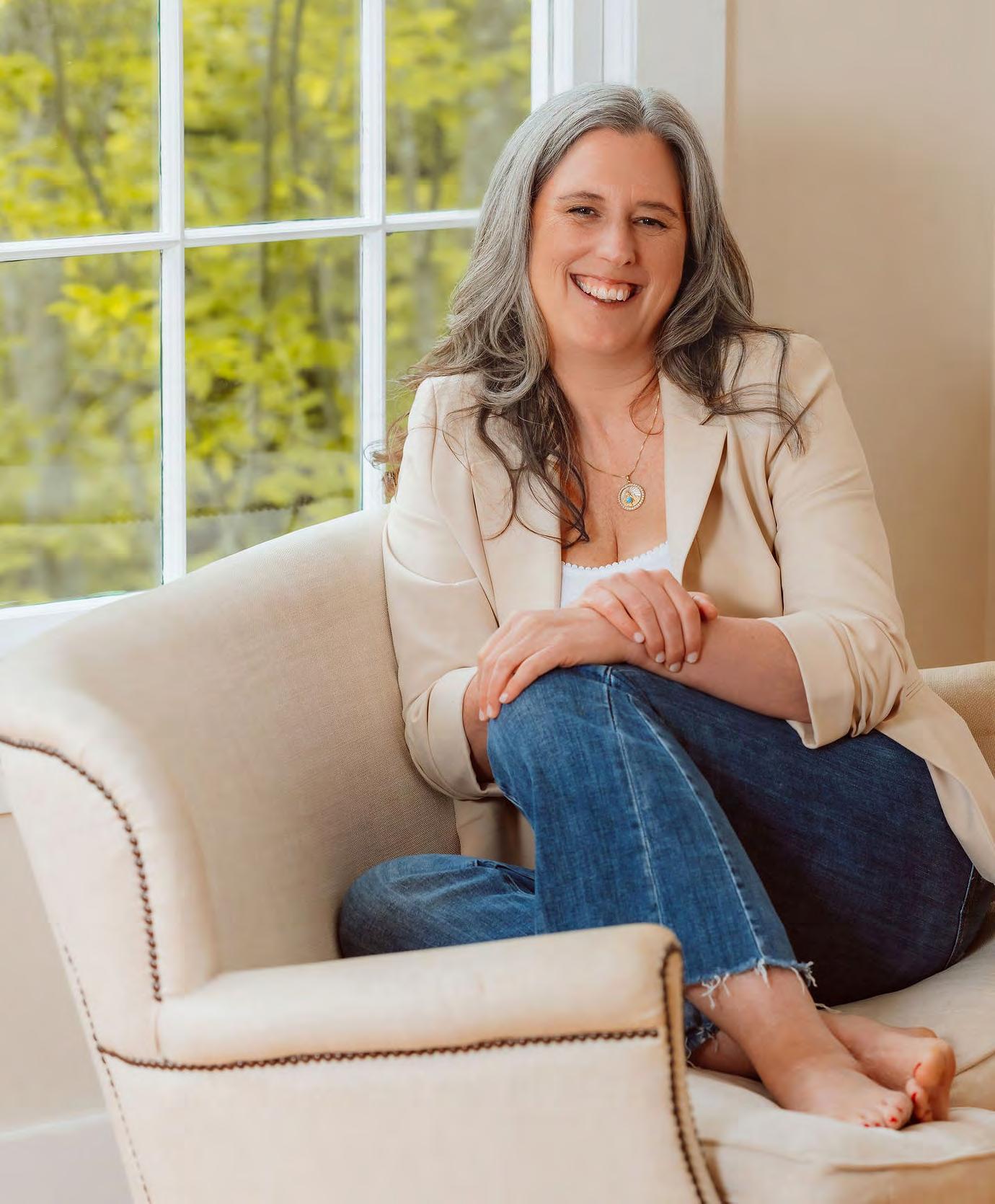
Welcome to the first issue of Pause Magazine.
This idea came in just a few months ago — one of those intuitive hits I couldn’t ignore. I kept thinking about how I used to wait for magazines to arrive like letters from a friend. As a teenager it was Seventeen, then Mademoiselle, then Real Simple. When I first became a mom, I adored Cookie.
I remember carrying magazines to the beach, tucking them into bags, sitting with them for days because there was so much to read and savor.
But over the years, magazines have changed. Many now feel like glossy extensions of social media — beautiful, but often fleeting. And I haven’t found one made for women over 45 with content that’s both useful and deep. So I decided to make one.
Pause Magazine was born from that desire — to honor this season of life and offer something steady and nourishing.
The name Pause speaks to where we are: perimenopause, menopause, post-menopause. But it also speaks to something deeper. A call to slow down. To reflect. To plan. To be intentional.
Planning is a form of pause. So is journaling. So is reading a magazine with your feet in the sand.
Inside these pages, you’ll find reflections on wellness, lifestyle, spirituality, money, and entrepreneurship. You’ll find tools to help you plan, practices that invite you inward, and stories that remind you that you are not alone.
Working with hundreds of women in midlife on being productive and showing up for their whole lives, I’ve noticed something powerful:
At the very stage when society suggests we slow down, many women are stepping into their greatest work.
I want this magazine to support that unfolding — to help make it feel more doable, more aligned, and more supported.
Our mission is to go deep over wide. We’ll definitely share quick tips and favorite finds, always through content that supports your joy, health, and purpose.
For now, Pause is digital — designed to be read slowly, on your own time. And because midlife eyes don’t always love small fonts (mine included!), we’ll send the longer articles by email, so they’re easier to read and revisit.
This first issue is being released on my 50th birthday — and I can’t think of a better way to mark the moment. Inside, we’re exploring summer. The next issue will guide us into fall. You’ll also find QR codes throughout, linking to planning pages, featured products, and resources to explore.
Whether you’re curled up on the couch, sipping tea, or flipping through this on your porch, I hope Pause feels like an exhale. A reconnection. A remembering.
With so much love,
In Her Flow
a Conversation with Mia
What are you balancing right now?
What does being in your flow mean in this moment?
I’m in a new stage of motherhood. It’s less about getting people places and more about being the mom a young adult needs. I still have one at home in high school, but even the driving feels delightful now. I find there’s a lot more holding space — for them to explore who they are, ask big questions, and become their most authentic selves. Mostly, I have to practice deep listening, and resist the urge to have all the answers. Easy? Not necessarily. But rewarding? Always.
I feel like I get to step into a new version of marriage too. My husband and I are redefining what “us” means now. We love being home, but we’re also working on making that time about more than work or tech.
In my body, I’ve been working toward becoming the healthiest version of myself. Perimenopause caught me a little off guard. Right now, a big part of my health journey is being patient — really listening and adjusting.
And then there’s work. It keeps getting better and more purpose-driven. We’re innovating how we support women in follow-through, and I’ve even dusted off my designer hat to create the new version of our planners — and this magazine.
Life feels full and right. There’s a lot happening, but instead of feeling busy, I feel balanced.
Being in flow doesn’t mean everything gets equal time or energy. What’s rising to the top in this season?
My own well-being — mind, body, and spirit — is at the top, but not just for me. It’s for a bigger mission. I want to model a new way of being for my kids and for this community.
I wake up earlier. I eat what my body really needs. I move daily. And then I pour that energy back into my family and my work.
Right Now
What I’m focusing on right now in all four
FLOW
categories.
FOOD + WELLNESS
Eating from Tess Masters’ 60-Day reset, so my gut is so healthy as I head into surgery later this summer.
LIFE
Decluttering. My kids call it “nesting in menopause.”
OM
This season is about meditation. Deepening my practice. Trying different teachers. Expanding how much time I have to just be.
WORK
Expanding my capacity. Creating. Creating. Creating.
What shifts are you noticing as you head into your 50s?
My grandmother Momo lived to 105, so 50 feels like the halfway point — the start of something big and exciting.
My body feels different. I have this deep sense that I’m going to feel better than ever — even though I’ve been navigating plantar fasciitis (I couldn’t even take a step out of bed four months ago!) and have surgery coming up involving my ear and brain. I feel pretty willing to make lemonade out of two not-so-great body circumstances.
These experiences have pushed me to move more regularly, listen more closely, and get really honest about what I can — and can’t — do right now. I’ve learned so much about my body. And I’ve learned that energy work and meditation, which once felt like “extras,” are actually foundational to my wellness. They’re no longer optional — they’re how I stay steady.
I also feel like I’m stepping into a new archetype. In business, it’s like I’m moving from solopreneur to CEO. In life, I’m dancing between Virgin and Crone. (That will make more sense when you read my mentor Sil Read’s article in this issue.)
As a 4/6 in Human Design, I’m told I live life in three stages. Erin Claire Jones explains it like this:
“The first 30 years are for discovery and experimentation. From 30 to 50, you observe, refine, and invest in what works. At 50, you hit your prime — re-engaging with life from a place of wisdom, modeling what it means to live as your true self.”
That’s exactly how it feels.
Life feels full and right. There’s a lot happening, but instead of feeling busy, I feel balanced..”
How have your priorities shifted over the past decade?
I used to chase “more.” Now, simplicity brings me the deepest joy.
Decluttering feels better than shopping. A day at home feels like a win. FOMO isn’t really a thing anymore — unless it’s missing a moment with one of my kids who’s now out in the world.
What do your morning and evening routines look like now?
Mornings are sacred. I need to fill my own cup before showing up for anyone else.
I start with meditation — right now I’m loving guided ones focused on healing and preparing for surgery.
Then I pull an Oracle card and fill out my planner. Some mornings I exercise or journal. I always try to check in with a particular tree in my yard — a practice inspired by my shamanic training and a way I’m learning to connect with nature.
Lately, there’s been a lot of yoga too — usually after I see my people but before work begins.
I close my workday by reviewing my planner, drinking water or tea, and taking the dog for a walk.
Evenings are still evolving. When the kids are home, they tend to be a little chaotic — sometimes I fall asleep mid-movie, still in my clothes. So this summer, I’m working on creating more soothing nighttime rituals: changing earlier, washing my face, meditating again, and taking my evening supplements.
What word embodies this season for you?
Devotion.
It means love, loyalty, or enthusiasm.
For me, it’s a shift away from motivation and willpower. Devotion is powered by love — and that’s what I want to be right now.
Favorite tool you’re loving right now?
Time blocking — but with a twist.
I’ve used it for years, but recently my categories have changed.
They used to be things like: marketing, sales, client work.
Now they look more like: creation, reflection, connection, future self.
I recommend time blocking — and also checking in with the tools you’ve outgrown. It might be time for a seasonal upgrade.
What’s on your 5-year plan?
Spending more time with my kids — wherever they are in the world.
Traveling more, both solo and with my husband. What if we lived and worked in Paris or Mexico for six weeks? That feels exciting. I’ve been thinking a lot about what “home” really means. Is it this house, or can we create it wherever we land?
That said, I’d also love to finish this house. It needs some upgrades, and I’d love to make that happen.
I definitely have another book in me. FLOW365 is serving women in such powerful ways. When women are given space to dream — and the support to follow through — their lives change. I’m already in awe. I can only imagine what the next five years will bring.
Tell us about this birthday.
Well, I’ve been on a year-long journey into 50. One of my biggest lessons has been learning how to ask for what I need — and receive it without guilt.
As an introvert who loves her full household and her clients, what I crave most is solitude… or deep, one-on-one connection. This birthday year gave me both.
I went to Paris with my mom, visited my son abroad, and spent quality time with each of my kids. My husband and I had quiet time together in our home for the first time in forever. I really took time to know myself, to let go of what I’ve been holding, and to honor my body on a whole new level. I really allowed myself to be supported in all of those areas.
During my birthday week, I finished this magazine, planted flowers, and went to a lot of yoga. I drove to the beach and had a personal ceremony at my favorite spot — releasing old expectations and calling in what’s next. My husband and I had two days to admire each other (and catch up on some TV). All three kids made it home before summer took them off again. I walked with the dog. I slept. I even had a whole day alone at home.
Life feels so full. And I feel so grateful.
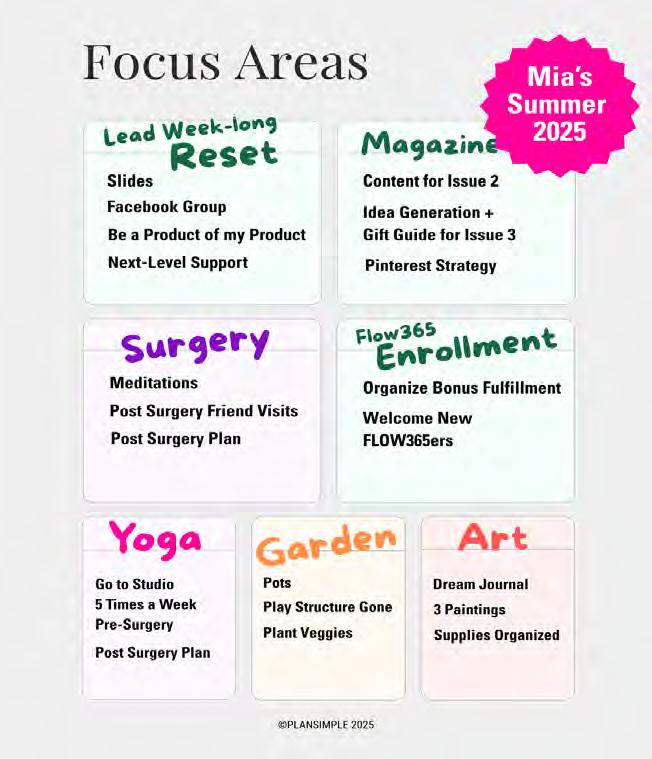
focus areas for the summer with the process outlined
Simple Business Moves your Summer Season
to Kickstart
Why we love these moves
Seasonal shifts are the perfect moment to check in on your boundaries— and to refresh what you’re willing to tolerate (or not).
Summer often brings a more social energy, making it an ideal time to reconnect with colleagues, past clients, and warm leads. We love this sales strategy that encourages natural, meaningful outreach.
If creating video content is on your list, summer can also give you the space to build that habit. We’ve got a strategy to help make it faster— and way more fun.
Set Boundaries to Build Your Business
If you want a business that gives you the time, money, and energy to live the life you actually want — it starts with one powerful shift: set clear boundaries with your time.
Stop trying to be accessible 24/7 and decide when you work — and when you don’t. Setting work hours isn’t limiting — it sets clear expectations for your clients and for yourself. Just like a fence keeps your yard safe or store hours help customers know when to show up, your time boundaries protect your focus, your energy, and your joy.
This one habit helps reduce overwhelm, strengthens client relationships, and makes space for everything else you care about.
Try this today:
• Decide when your workday starts and ends — and write it down.
• Tell your clients, team, and family what those hours are.
• Remember: your schedule doesn’t have to be traditional or the same every day — just clear.
Quick tip from Megan Flatt, an anti-hustle business growth strategist on a mission to make entrepreneurship easier, specializing in the trifecta of business success: revenue, time, and fulfillment, https://letscollective.co
IMPLEMENT WHAT EXCITES YOU
As you explore the magazine, notice which ideas excite you—that’s your intuition guiding you.
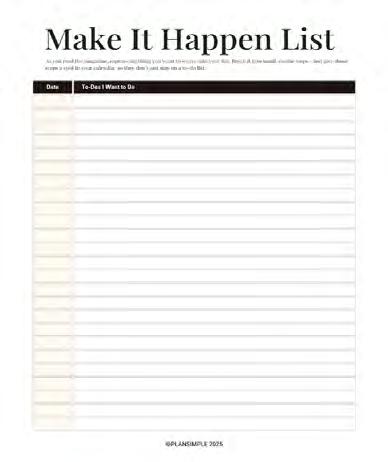
Create your own step-by-step plan or adjust the one we provide. Break it down to make it feel doable, then use the Implementation List to capture it.
Next, block time in your digital calendar. Label it “Business Growth”, and paste your steps into the description. Treat it like a real appointment—because it is.
Repeat this for other strategies or areas of life. Just space them out so each one gets the time it deserves.
Create Your Super Signature
A Super Signature is a simple way to boost sales without any tech, scripts, or big changes.
At the bottom of every email — whether one-to-one or a newsletter — add a line that says, “When you’re ready, here are a few ways I can help you,” and list 1–3 next steps (like booking a call, grabbing a free resource, or joining your program).
It keeps your offers visible in a low-key way and makes it easy for people to move forward when they’re ready.
Create yours now:
• Write a short invitation (“When you’re ready, here are a few ways I can help you.”)
• List 1, 2, or 3 clear next steps. Examples could be: schedule a call, get this free class, check out my upcoming retreat.
• Add it to your email signature and use it in your newsletters too!
Quick tip from Lisa Mullis, founder of Paraphrase Communications, https://paraphrasecomm.com/.
Stay Consistent at Making Social Media by Creating a Content Corner
If you’re showing up on video (or want to), a go-to recording spot makes it so much easier. Prep a content corner — a space you can return to again and again that’s always camera-ready.
Design your content corner like this:
• Choose a clean, well-lit space with personality (add plants, photos, or art from your home).
• Set up in portrait mode: both shoulders in frame, with a little space above your head.
• Use the “high-low” rule: place one item higher (like a picture frame) and one lower (like a plant or chair) to naturally draw focus to your face.
• Avoid cluttered or overly detailed backgrounds — they distract from your message.
Bonus: Create 2–3 content corners around your home with different vibes. Then schedule a batching day where you move between them and record a month (or more!) of short-form video content.
Try this today: Pick your first spot, style your frame, and hit record — no overthinking required.
Quick tip from Carrie Rene Thomas, visibility coach and short-form video director helping entrepreneurs batch 30+ days of content in just a few hours. Follow her on Instagram at @carrierenethomas.
“It’s important to be willing to make mistakes. The worst thing that can happen is you become memorable.”— Sara Blakely
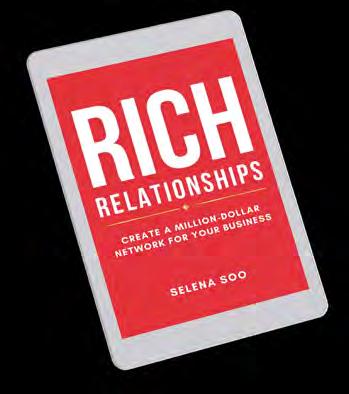
We’re loving Selena Soo’s new book, Rich Relationships. With just one hour a week, you can start building meaningful connections that elevate your business and life—even if you’re an introvert!
7 Ways to Start Cultivating Body Love, Respect and Compassion
with Sarah Haas
Most of us can relate to that feeling of looking in the mirror and being harsh and judgmental about what we see. That inner critic? She’s loud, and she’s been there for way too long.
When we spend too much of our energy picking ourselves apart and being preoccupied with feelings of not-enough-ness, it takes a toll on our confidence, making it difficult to manifest the life we want and deserve.
It can hold you back from putting yourself out there, going for that dream job, taking that vacation, or believing you’re worthy of the relationships you desire.
So many women think they have to wait to really live until after they reach a certain weight, clothing size, or other self-imposed standard.
But what if you could transform the way you see yourself and start living the life you want right now? Not through criticism or constant striving, but by recognizing your body as worthy of love and respect just as it is.
You have the power to change your relationship with your body into one rooted in respect, care, and trust. When you do this, you’ll naturally feel more motivated to care for yourself with habits that support your health.
The Mindset Shift
Instead of punishing, depriving, and criticizing yourself, which only makes you feel worse and keeps you stuck repeating the cycle of disappointment, frustration, and shame, AKA the decision to honor and appreciate your body for how powerful, wise, and miraculous it is.
Start focusing on kindness, care, and nourishment for your physical and mental well-being. This doesn’t mean you don’t set goals or continue taking action to reach them. It means you unconditionally love and accept yourself wherever you are on your journey.
Body love might feel like a stretch for some of us, especially if we’ve been in a tortured relationship with our bodies for years. Instead, begin with something that feels more approachable: body respect.
Respecting your body doesn’t mean you have to be thrilled with your reflection in the mirror at this very moment. What it does mean is learning to treat your body with dignity and honoring its needs.
SHOW GRATITUDE
Start by expressing gratitude for everything your body does for you. It works tirelessly every day to keep you alive and thriving. Your legs take you wherever you want to go. Your arms do your work, carry your load, and hold your loved ones. Your lungs breathe and your heart beats. Your body is strong and resilient and heals itself from injury and illness. It is the most complex, miraculous living thing ever created.
Take a pause every day to acknowledge three things your body does for you without you even having to think about it.
FOCUS ON NOURISHMENT
Your body needs to be nourished, rested, and cared for. Many of us have become disconnected from our bodies’ needs and signals. Ask your yourself, “What can I do for you right now that would feel good?” Then listen and respond with care. Make sure you’re feeding yourself adequately, staying hydrated, and getting enough sleep.
ADD IN SELF-CARE
Simple, nurturing acts like a bubble bath, light stretching, a nap, or a massage can help you feel more connected to your body. These acts of care are meaningful ways to show appreciation. Treat your body as you would someone you love.
QUIET THE INNER CRITIC
Everyone has that harsh voice that constantly whispers false beliefs. These thoughts pass through our minds over and over, then they take root and become repetitive mantras. It’s important to start noticing those thoughts, identifying where they come from, and challenging them.
Ask yourself: Are these thoughts based on fact or opinion? Where did they come from?
What would I say to a loved one who was having these thoughts about themselves?
CREATE NEW MANTRAS
Now, flip the script and create new mantras to help you reconnect with your body in a positive way. It’s important to make them believable to you. Forced positivity and trying to go from zero to 100 won’t feel authentic.
Try something like:
I’m capable of honoring my body’s needs and am committed to working towards that.
I’m doing my best to listen to and reconnect with my body.
My body does not need to look a certain way to be worthy of love and care.
Repeat these when your inner critic shows up. Over time, your kind voice will grow stronger than the critical one.
ZOOM OUT
BE PATIENT WITH YOURSELF
Changing how you relate to your body takes time. Especially if you’ve spent years in a cycle of self-criticism. Be gentle with yourself along the way. You’re learning, growing, and honoring yourself more every day.
As you begin to treat your body with more respect, you’ll start to feel lighter, more joyful, and more motivated to continue caring for yourself in a way that feels good.
You don’t have to wait for a “better” version of you to start living more fully. You’re worthy of love, compassion, and joy today.
Start where you are and choose one small way to care for your body with kindness this week.
It’s easy to zoom in on the areas you feel most self-conscious about, but you’re not just a collection of body parts. You’re a beautiful, whole human being. Step back and acknowledge your gifts and strengths—your intelligence, creativity, kindness, and the love you bring to those around you. Start to acknowledge what and who you are outside of your physical appearance.
Sarah Haas is a Women’s Weight Release & Body Love Coach, Integrative Nutrition Health Coach, Certified Personal Trainer, yoga instructor, host of the Boss Body podcast, expert columnist for Aspire Magazine, and breast cancer survivor. Connect with Sarah. https://sarahhaaswellness.com/
Declutter Your Life
An Interview with Shira Gill
How would you describe your mission these days? Has it evolved since you started your work around minimalism and organization?
At its core, my mission has always been to help people edit and organize their homes and lives so they can show up as the best version of themselves. Over the years, that mission has expanded far beyond closets and junk drawers. These days, I write and speak about everything from grief and loss to style, sustainability, small space living, and personal growth. Whether I’m helping someone clean out their garage or reimagine their relationship with time and energy, the heart of my work remains the same: helping people cut the clutter— physical, mental, and emotional—so they can make space for what really matters.
Your work goes beyond “decluttering.” What does creating a more intentional life mean to you?
For me, creating an intentional life means getting really clear on what matters most and designing your space and schedule around that clarity. It’s about choosing with purpose instead of reacting by default. My version of minimalism isn’t about restriction—it’s about alignment. It’s a way of saying, “This is who I am. This is what I care about. And this is how I want to live.” It’s incredibly empowering.
What’s a common misconception people have about minimalism that you wish you could rewrite?
So many people picture minimalism as this cold, joyless aesthetic—like a white box with one chair and a sad little fern. But to me, minimalism is not about deprivation or scarcity; it’s about living with enough. It’s a flexible, personal framework that allows you to curate a life that reflects your values and priorities. I’m not interested in rules or rigid checklists—I’m interested in helping people create homes and lives that feel like a true reflection of who they are and what they care about.
What does a typical day or week look like for you right now? What are your nonnegotiables?
No two days look exactly the same, which I actually love—it keeps things fresh. Some days I’m deep in writing mode, working on a new book from the comfort of my bed. Other days, I’m meeting with clients, coaching creatives, or working behind the scenes on upcoming events. What stays consistent are my non-negotiables: 8 hours of sleep (lights out by 10!), lots of water, nourishing meals (I never skip lunch!), and daily movement—ideally a CorePower yoga class, but even a quick walk with my dog makes a difference. I’ve learned that taking care of myself isn’t optional—it’s the fuel for everything else.
What’s one thing in your home or routine that always brings you peace or clarity?
Each night before bed, I jot down my schedule and top priorities for the next day on a simple white index card. It’s such a tiny habit, but it gives me so much clarity.
My version of minimalism isn’t about restriction— it’s about alignment. “ ”
Are there rituals or practices that help you reset when life starts to feel cluttered— physically or emotionally?
Decluttering is my reset button. When life feels overwhelming, I don’t shop—I tidy. A five-minute surface clear, folding laundry, even just taking out the recycling helps me feel back in control. There’s something powerful about taking tangible action, even if it’s small. It reminds me that I can shift the energy in my space—and in my mind.
What’s something you’ve let go of (personally or professionally) that made space for something better?
Honestly? I’ve let go of at least 60% of the things I used to own. Letting go allowed me to create a home that feels spacious, curated, and radically easy to care for. But beyond the physical stuff, I’ve also let go of chasing every opportunity. I’ve learned to protect my time and energy, which has opened up space for deeper creative work and more presence in my life.
You create a lot of content!
Do you have a simple system for that too?
I’ve found that structure can actually boost creativity. I send out my Life Edit newsletter every single Tuesday—no matter what. That commitment keeps me writing consistently, even when inspiration is running low. My “system” is pretty simple: I make sure a draft is done by Monday night. Sometimes it’s a last-minute scramble, but that deadline keeps me honest and has built a real sense of trust with my readers. When I’m working on a book, I aim for a crappy chapter per week until I’m done with a messy first draft. Then I work on editing and refining!
What are the boundaries you’ve had to build to protect your creativity?
I’ve become really intentional about protecting my time and saying no to anything that doesn’t align with my core values or big-picture goals. I rarely go to big events or social gatherings unless they light me up. I delegate the things I don’t enjoy or don’t do well. And each year, I pick one major goal to focus on—that helps me stay clear and avoid the trap of overcommitting.
What’s next for you? Anything you’re dreaming about or quietly working on?
I’ve started hosting in-person retreats, and it’s been one of the most joyful parts of my work. There’s nothing like gathering a group of thoughtful, creative women in real life to connect and grow. I currently run an annual retreat for female founders. A book publishing retreat might be next! I’m also quietly developing a new book concept about the emotional blocks that prevent us from creating a home we truly love. Stay tuned.
What advice would you offer a woman in midlife who’s feeling like her environment—or her life—needs a reset?
Start by getting curious.
Ask yourself:
What do I want to create space for?
What’s one outcome I’d love to bring to life this year?
Then get honest:
What’s one thing I need to start doing to move toward that vision?
What’s one thing I need to stop doing that’s standing in the way?
Small shifts can lead to big transformation. You don’t need to overhaul everything—just take one meaningful step at a time.
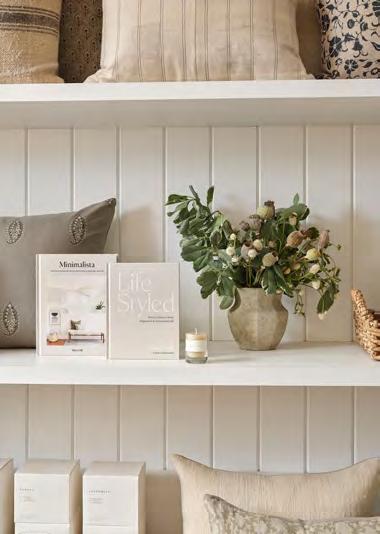
Shira Gill is a world-renowned organizing expert and the bestselling author of three books: Minimalista, Organized Living, and LifeStyled.
Get on her Life Edit newsletter list! https://shiragill.substack.com
Coyuchi Bedding and Towels
My motto is “fewer, better things,” so I recently upgraded our tired bedding and towels with Coyuchi - a local brand I’ve long admired for their commitment to organic materials and ethical production. Their bedding and bath essentials contain no chemicals or synthetics, using only 100% certified organic fibers that support soil health and sustainable farming practices. Every box checked!
Shira’s Favorite 5
Fresh Flowers
My absolute favorite way to elevate my home. I always have a little bunch of fresh florals on my nightstand and a larger vase full of olive branches next to our kitchen sink.
Brooklyn Candle Studio Santorini Classic
This candle has been my ride-or-die for years and makes a great gift. It smells like fig trees and vacation!
Handwoven Baskets
Baskets are my number one organizing hero — I use them for storing pillows and blankets, laundry, entry essentials, and more.
Jenni Kayne Pacific Breakfast Bowls
I love these bowls in my kitchen for storing fruit or for serving everything from breakfast cereal to ice cream.
TAKE A DIGITAL PAUSE: RECLAIM YOUR ENERGY, CLARITY, AND TIME
Inspired by a conversation with Jenny Fenig, grounded in research, and supported by a planning sheet
Now, I take a digital pause regularly. It’s not about demonizing technology—it’s about resetting your nervous system, returning to your natural rhythm, and remembering that your time and attention are sacred.
WHAT THE RESEARCH SAYS
Science backs it up too.
Studies show:
Heavy social media use is linked to anxiety, depression, and poor sleep. One study from the University of Pennsylvania found that reducing social media use to just 30 minutes per day significantly reduced levels of anxiety, depression, and loneliness.
A few years ago, I got the idea to take a digital detox from my friend and colleague, Jenny Fenig. She had just come off a twoweek break from social media—no posting, no scrolling, no replying. Just space. Her words stuck with me:
“It’s not easy to do because I enjoy being online—but I think it’s important to really look at where we may have fallen into too deep of a habit, where we might have given away some of our energy and need to restore it.”
And she was right.
That first time I logged off, I didn’t know what to expect. But within days, I felt lighter. Calmer. More creative. The constant pressure to check, respond, compare, and consume had faded—and in its place came clarity, ideas, and a sense of presence I didn’t even realize I’d been missing.
Detoxing helps rewire habits. According to habit researcher James Clear, our devices create reward loops that train us to seek shortterm hits of dopamine—likes, views, replies— while stealing energy from long-term goals.
WHAT A DIGITAL PAUSE REALLY LOOKS LIKE
This isn’t about disappearing for months or deleting your accounts. A digital pause can be as simple as:
• Logging off social media for a set period (I recommend 7–14 days)
• Turning off notifications
• Deleting apps from your phone temporarily
• Checking email only at designated times
• Replacing screen time with something soul-nourishing: books, journaling, creating, nature walks, connection
As Jenny says, “You won’t miss anything. You really won’t. And what you gain will be more than you expect.”
WANT TO TRY IT?
We created a Digital Detox Planning Sheet to help you get started. Inside, you’ll find:
• A space to choose your start and end dates
• Prompts to clarify your why and set intentions
• Checklists to decide which platforms or apps you’ll pause
• Ideas for what to do instead (creativity, connection, rest, movement)
• A simple setup guide to make your break smooth and successful
DOWNLOAD THE TECHNOLOGY PAUSE PLANNING SHEET
• A reflection space to capture the insights that come through
Because here’s the truth: We don’t realize how much of our energy we give away— until we take it back.
This summer, give yourself the gift of less noise and more clarity. Your nervous system, your creativity, and your relationships will thank you.
STRENGTHEN YOUR FRIENDSHIPS
THIS SUMMER
Summer offers a more casual attitude and longer days … why not use this season to strengthen your friendships?
Making and keeping friends as an adult can feel hard. A big part of that is that friendship takes time. Studies have shown it can take 40–60 hours to make a casual friend, 80–100 hours to shift to friend, and around 200 hours to become close friends. And once we have friends, we need to maintain them.
If friendship is something that matters to you, you need to make the time for it. That means creating simple touch points and opportunities to connect in person.
Unlike personal goals, friendship can be challenging because you and your friend both have to prioritize making time for it — and find common time in your busy schedules. It can start to feel like another to do until you have that deep conversation, laugh so hard your belly hurts, or find yourself struggling and have a friend show up for you.
3 WAYS TO MAKE TIME FOR FRIENDSHIP
Know you want stronger friendships, but daunted about getting started? Here are 3 ways to get started — and keep going. So pick a friend, pick something to do and reach out.
INITIATE AND SCHEDULE.
How many times have you said, “We should get together!” … and then nothing happens?
Be the person who initiates with a specific suggestion: Let’s take a walk! I’m free from 7–9 every morning next week or after 5 on Tuesday. Get something on your calendars.
Content advisor and copywriter Sara Barry is all about creating connections and deepening relationships and helps heart-centered entrepreneurs do that for their business through their content and communities. Find her and connect at SaraBarry.com.
MAKE A RECURRING FRIEND DATE.
I have a monthly pie date with a friend. At the beginning of the month we check our calendars and block off two hours to meet for pie (it’s amazing) and conversation (it’s also amazing.) We both look forward to it, and make it a priority even with other demands on our time.
I highly encourage picking a friend and activity and making it a regular thing. If your schedule works to say the first Thursday of the month, block them out ahead. Otherwise, set a reminder to pick your next date and offer up your availability.
DOUBLE UP.
If you’re struggling to find time, can you and a friend do something together that you need to do anyway? I have friends I work out with and friends I walk with — both things I would spend time on alone. You could also run errands together or batch cook meals that you both get some of.
It doesn’t mean you never do anything “fun,” but you’ll make the things you do more fun and get some quality time together.
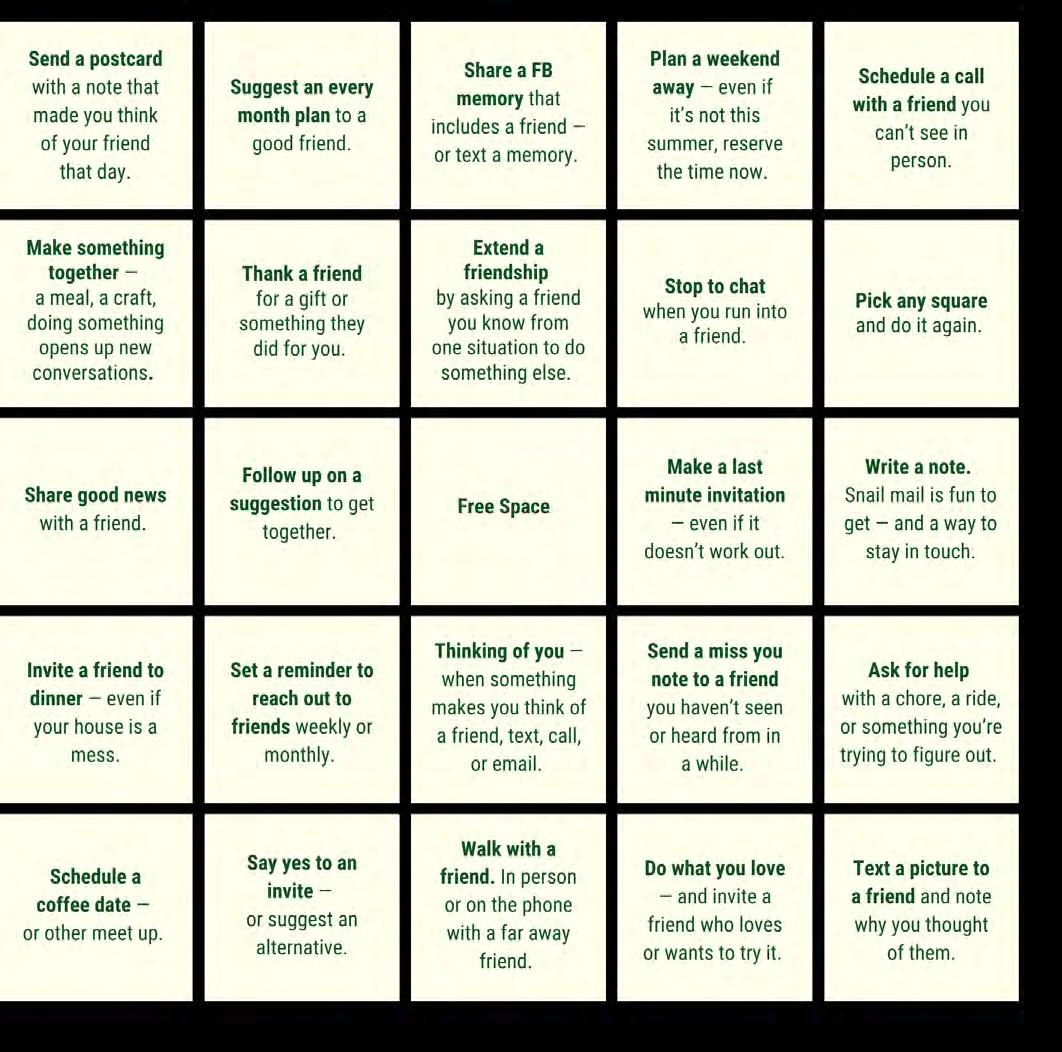
Friendship Bingo
HERE ARE 25 THINGS YOU CAN DO TO BOOST YOUR FRIENDSHIPS THIS SUMMER
“
Despite the mythology and what we see on our TVs, building meaningful, intimate, vulnerable friendships requires meaningful and hard work.” —Brené Brown
Bring a smile to a friend with a card in the mail. We love Hello!Lucky —check out their friendship cards for pun-filled, neon-bright joy. Hand-crafted and sustainably made in Portland, Oregon, these letterpress cards support local artisans and meaningful connections. For 17 years, their bold designs and signature humor have made them a beloved favorite. hellolucky.com
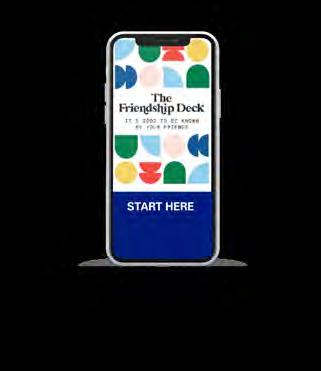
The bestselling Friendship Deck is now available in a DIGITAL VERSION!
Longing for deeper, more meaningful friendships but unsure where to begin? Created by a licensed therapist and friendship educator, the Friendship Deck is here to help.
Inside, you’ll discover 62 thoughtfully crafted questions, organized into three levels of increasing vulnerability. With each card, you’ll unlock new layers of connection, intimacy, and joy—making it easier (and more fun) to grow closer with your friends.
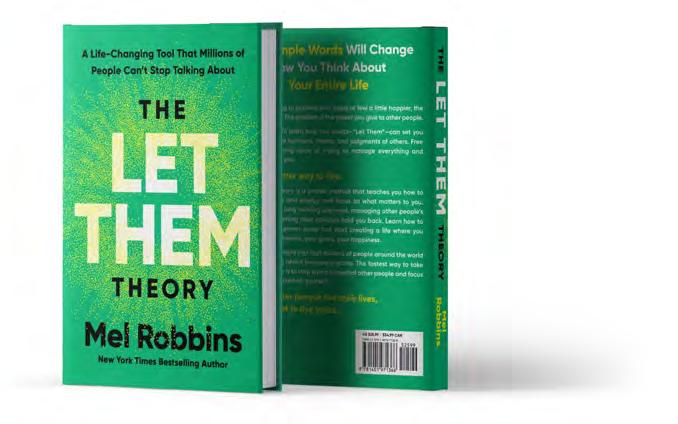
Mel Robbins’ book The Let Them Theory is a great resource for learning how to make friends as an adult. She covers why it’s so difficult, why it’s worth the effort, and how to build meaningful connections with people who are truly compatible.
Wearing the Crown of Age
The Surprising Rewards of
Conscious Aging
by Sil Read
Recently I was in line at my local pharmacy and the woman in front of me was grumbling to the youngish pharmacist about growing older. In a ‘just you wait’ kind of rant she went through a list of her diminishing capacities and insisted that there was no advantage to aging.
Without thought, I blurted out, “What about wisdom?”
She was as taken aback as I was, and from the look on her face it seemed like wisdom hadn’t occurred to her. How could it have? Our culture idealizes and glorifies the beauty of youth and it’s all downhill from there. Furthermore, just an aisle away, there were shelves and shelves of anti-aging products for women. And that’s just the tip of the iceberg.
Let’s face it, old women in our culture are considered pretty irrelevant.
Here’s the antidote to this problem of our being sidelined: We ‘old women’ need to be the guardians of our own relevance. We need to honor our wise woman status even if, and especially if, no one around us does.
When we are old, we find ourselves repeating George Bernard Shaw’s words, “Youth is wasted on the young!” wishing we had appreciated our physical strength, quick minds, and perfect skin more; wishing that we could have it all again and savor it. We wish we could have it now that we are older and wiser.
We are older, but are we wiser?
I think we could be wiser if we valued our own wisdom of experience.
I am concerned that the wisdom of our own experience is wasted on us, and more importantly, on our family, community, and the culture at large. I want so much for us oldsters to step into our rightful place as the wise elders that we are and that we are meant to be.
In these apocalyptic times, we wise elders are more relevant than ever. We need to be a steady, grounding presence in our families and communities. We are needed for our wisdom of experience.
In midlife, I had the good fortune of having a wise elder as a teacher, mentor, and model of relevance. To me, she became more beautiful — not less — as she aged. She was incredibly wrinkled and incredibly radiant. She embodied the paradox of growing old — that while our appearance changes, and our physical strength wanes, our spiritual strength can blossom, ‘petal by petal’ as she used to say.
Her name was Marion Woodman, and she was a Jungian analyst and best-selling author who died in 2018 in her 90th year. She was also a self-proclaimed ‘crone’; she chose to embody the archetype with dignity and presence and threw away the standard dictionary definition of a crone being an ugly old hag. It seems to me that Woodman ‘wore the crown of age’ by knowing her value and relevance as a wise woman.
As she taught us (her students) about archetypal psychology and working with dreams, she wove in Emily Dickinson, Sylvia Plath, T.S. Eliot and Shakespeare. She had taught literature and theater for 25 years, and in midlife, she changed course and went to Zurich to become a Jungian analyst.
She was part erudite scholar, part mystic, and it was pure delight to learn from her. Developing a deep understanding of Jungian archetypal psychology, how to work with dreams, and how to decipher the wisdom of the body, was all invaluable knowledge for me to put to use in my psychotherapy practice.
What I didn’t expect, though, was the way in which Woodman would teach me what it means to pass through life’s many crossroads and thresholds, emerging as an elder: as the embodiment of wisdom and wholeness.
She once said:
“Arriving at middle age is agony for those who cannot accept the mature beauty of autumn. They see their wrinkles hardening into lines, and new liver spots appearing every day, without the compensating mellowing in their soul. Without the rites of the elders, they cannot look forward to holding a position of honor in their society, nor in most cases will they treasure their own wisdom.”
The genius of Woodman’s scholarship, and her personal loving containment, were crucial for me in developing a capacity to meet difficulties with patience, courage, and compassion. For example, a very painful divorce became a kind of embodied scholarship — a lived alchemical experience — of moving through what Woodman showed me could be a rite of passage. By showing me how to honor my difficult passages as meaningful and universal initiations, Woodman helped me to find infinitely resilient places in myself.
In these fateful moments, I had the courage to consciously step into my destiny. Woodman had given me a safe container, and a map, for transmuting my pain and fear into nourishment for my soul. She knew the territory: initiations had tenderized her heart, and she was able, little by little, to embody her feminine soul along her way home to her own true self. She mined the riches of her own life, including anorexia, and a battle with cancer that nearly ended it.
C.G. Jung once said, “Life really does begin at forty. Up until then, you are just doing research.”
For Jung, the second half of life is when one has the opportunity to do the ‘real work,’ to look within. It’s in this transition to the second half of life when, if we are lucky, we can have a reckoning with our soul.
That’s when we might ask, “Am I just going through the motions? What’s it all for?” That’s when we might ask, “Whose life am I living, mine or the life my parents or the culture wanted of me?”
That’s when we might find ourselves standing at the crossroads.
In midlife, quite reluctantly, Woodman found herself standing at the crossroads when her soul called her to leave her comfortable job as a teacher. She realized how deep her longing was to live a more meaningful, a more spiritual, life.
Also, as much as she loved teaching, she knew her creative process was drying up. She decided to go to an ashram in India where she thought she could find the answers that she was seeking. But before she arrived at the ashram, she became very ill with dysentery and nearly died. During this spiritual crisis, she even considered leaving her marriage of 20 years. Everything was up for grabs.
She once said of this time in her life:
“If we fail to nourish our souls, they wither, and without soul, life ceases to have meaning.... The creative process shrivels in the absence of continual dialogue with the soul. And creativity is what makes life worth living.”
Woodman laid out a ‘map’ for her students, drawn from her own lived experience, to be in continual dialogue with our soul. She gave us an archetypal map of the heroine’s journey so that we could consciously move through the inner psychological and spiritual stages that she had moved through.
Woodman taught us that we are crowned twice in this lifetime. Much is written about the promise of the first crowning, at birth, but what of the second, which comes after a lifetime of experience? She called this second crowning the “crown of age,” which she said was a symbol for the conscious culmination of our inner and outer development as human beings.
I am now 70 years old, the same age Woodman was when I studied with her. I’m a self-proclaimed crone teaching a younger generation of women who have discovered her magnificent body of work. It is in younger women’s growing interest in Woodman’s work that I sense a shift in the cultural zeitgeist. This shift was also echoed in my recent discovery of a new definition for crone in the Cambridge Dictionary online: “a woman who is venerated for experience and wisdom.”
Sil Read is a mother, grandmother, crone, best-selling author, teacher, coach for women, and creator of The Soul-Making School.
Learn more and connect here: https://www.silread.com/
Aging is a pathway for our soul to grow.
If you’ve heard of Maiden – Mother –Crone, you might think of it as menarche, fertility and menopause, our body’s journey.
But Marion Woodman re-imagined that triple goddess into psychological stages:
CONSCIOUS MOTHER — We do the work of healing our mother wound through loving our body and mirroring our inner Maiden.
INNER VIRGIN — From the grounded mother matrix, the Inner Virgin — the woman who is whole unto herself — can come into being. Like the virgin forest, she is psychologically sovereign.
CRONE — This stage is reached, not simply because we are chronologically ‘old,’ but because one has, as Woodman said, “lived, and suffered, and having suffered, can draw back and see with her heart.”
The crone is very much a woman whole unto herself. She just is more badass. She doesn’t care what people think.
She lives with life changing, brutal honesty. She knows what she values and lives by those values.
How I Found My Voice How You Can Too
&
by Dolores Hirschmann
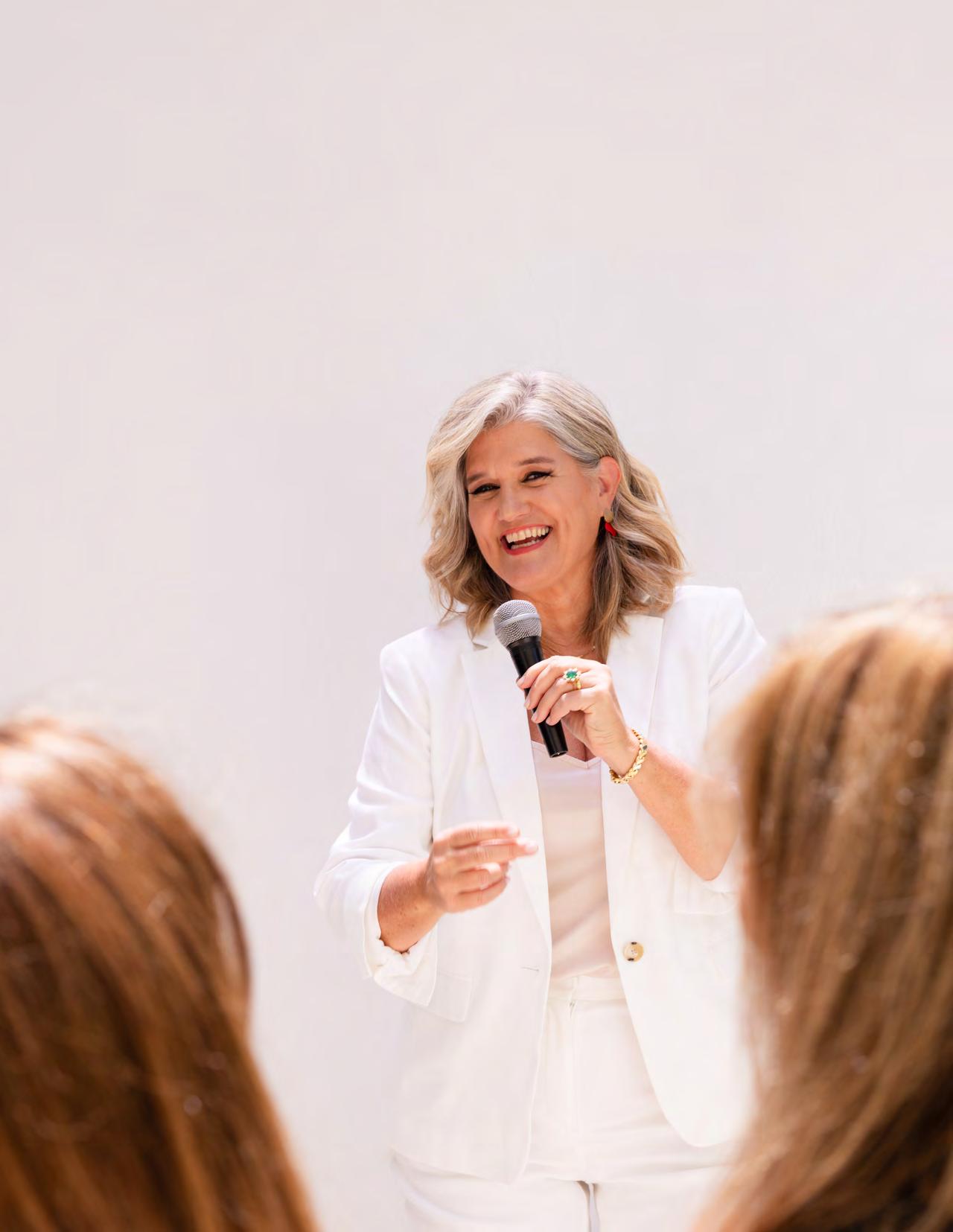
Standing under the lights with a mic in hand used to terrify me. Not because I didn’t know my topic — but because I had so much to say, and no clear way to say it.
My message felt important. But every time I tried to put it into words, I’d get stuck, overthink, and end up sounding like a robot. That changed the day I realized: speaking isn’t about sounding perfect. It’s about connecting.
Speaking isn’t about sounding perfect. It’s about connecting.”
Dolores Hirschmann is an internationally recognized strategist, investor, TEDx organizer, speaker & author with over 20 years of experience helping companies realize their potential by guiding them to CLARITY to define their vision, message, and market strategy needed to reach their next level of growth. If you’re curious about learning more about finding your voice, get speaking tips, free tools, and a 7-step framework at www.mastersinclarity.com.
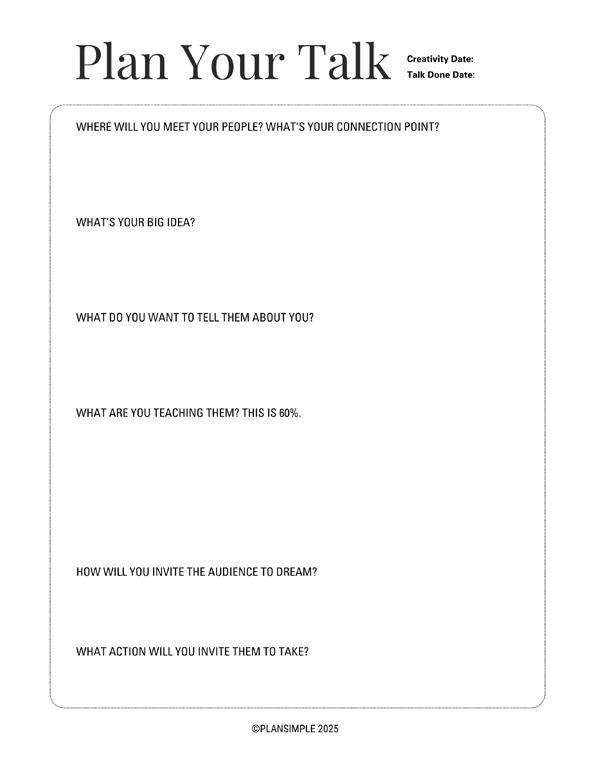
Now, as someone who helps others bring their message to life — whether they’re preparing for a big keynote, a TEDx Talk, or just want to finally stop dreading Zoom introductions — I want to share the exact 7-step framework I use for every talk I write. For myself. For my clients. For anyone ready to share something meaningful.
This process isn’t stiff or formulaic. It’s more like a creative sandbox — a place where your truth can play, be heard, and most importantly: move people to action.
7 Steps to Write Talks that Move People
Whether you’re speaking to a room of 10 or 1,000, these steps help you create something people feel, remember, and act on.
STEP 1: MEET YOUR AUDIENCE WHERE THEY ARE
I never start with “Thank you for having me.” Instead, I open with a question, a story, or a moment they can see themselves in.
Example: I once opened a talk with, “Raise your hand if you’ve ever promised yourself you’d start journaling… and it lasted two days.”
Instantly, I saw smiles, nods, connection. That’s when they’re ready to listen.
STEP 2: PRESENT THE BIG IDEA
Once I’ve made that connection, I offer my core belief — the heartbeat of my talk. It might sound like: “I believe that clarity is not a luxury — it’s a leadership skill.”
This anchors everything. One simple statement can shift the whole room.
STEP 3: NOW (AND ONLY NOW) I INTRODUCE MYSELF
After I’ve earned their attention, then I share who I am. I keep it personal and real — not a résumé dump.
Example: “For years, I struggled to talk about what I really do until one day, as a TEDx Organizer, I was helping one of my speakers organize their talk and I realized that every successful talk out there followers a framework and if I could reverse engineer the framework of a great talk, then I could use it for myself and later on teach it. Now, I help people uncover their message and turn it into talks that transform lives — starting with their own.”
Why do I wait until Step 3? Because before they care about me, they need to care about the message.
STEP 4: THE MEAT AND POTATOES
This is where you will deliver your “GIFTS,” your brilliance. Here, you will teach them something new or open their minds to a possibility. This should take up 60 to 70% of your time on stage. This is where I share stories, examples, maybe some data — but always in a way that’s relatable.
STEP 5: REMIND THEM OF YOUR BIG IDEA
This step ties the bow. If my talk is about clarity, I might say, “Remember — it’s not about saying more. It’s about saying the right thing, at the right time, in your voice.” By this point, I want my message to feel woven into their thoughts — not floating above them.
STEP 6: IMAGINE WHAT’S POSSIBLE
Here, I invite the audience to dream. To feel what’s possible. I might say, “What if the next time someone asked what you do, you didn’t freeze or fumble — you lit up, and they leaned in?”
I’m not painting a fantasy. I’m showing them what’s already within reach.
STEP 7: INVITE ACTION
This is where I say, “Here’s your next step.” Sometimes it’s a small habit. Sometimes it’s a deeper invitation. Example: “If this resonates, I’ve put together a guide that walks you through the framework I use — just let me know, and I’ll send it your way.” No pressure. Just a nudge. A door opening.
DOWNLOAD YOUR SIGNATURE TALK PLANNING SHEET USING THE QR CODE.
Write your talk over the summer and be ready to present it in the fall. Or gather a small group one month from today, on your porch, and start practicing this summer.
FIND AND USE YOUR VOICE
I’ve coached TEDx speakers, helped entrepreneurs clarify their brand by crafting their signature story, and seen people go from nervous wreck to standing ovation — not because they learned to perform, but because they learned to be clear and real.
One speaker told me, “I finally stopped hiding behind my PowerPoint and started showing up with my full self. The difference? People really heard me.”
Another shared, “I thought I was just writing a talk. But what I found was my voice.”
You don’t need a stage or a spotlight to start using your voice with clarity and power.
Because when your message is clear, everything changes — your confidence, your business, your impact.
And it all starts with one story. Yours.
Soothing Journaling for Summertime Serenity
Journaling is more than just writing about the events of your day or about venting your stressors. Journaling can be a soothing practice that helps you feel more serene, calm and peaceful.
Journaling is a contemplative practice that can help you slow down, breath, pause and replenish. Writing about your thoughts and feelings offers you a place of refuge both on the page and within yourself and your life!
When you take time for yourself to journal, you are taking time to turn your attention towards your inner world. While listening within, you can become aware of your true thoughts and feelings in a non-judgmental and more self-compassionate way. Journaling can help you find stillness within, a place where all things are possible, and this can help you feel more serene and calm.
Try This: Take 5 minutes to sit quietly. Simply sit and become aware of your breathing. Breathe in and breathe out. Be still, quiet, and listen within. Notice your own thoughts and feelings without judgment, simply notice. Then take some time, even just 5–10 minutes, to journal with the help of the following journaling prompts.
4 Journaling Prompts for Serenity and Inner Peace
What does serenity or inner peace feel like to you? Describe it in as much sensory detail as you can.
Describe a place, real or imagined, where you feel truly calm and relaxed.
What stress can you let go of today to create more space for stillness, serenity, and ease?
What parts of summertime bring you feelings of serenity and soothe your soul?
“Within you, there is a stillness and a sanctuary to which you can retreat at any time and be yourself.”
– Hermann Hesse
Lynda Monk, MSW, RSW, CPCC, is the Director of the International Association for Journal Writing (IAJW.org).She is passionate about the healing and transformational power of journaling. She lives on Salt Spring Island, BC, Canada where she starts each day with journaling and a great espresso.
in MoneyHandsHer
Too many women get stuck thinking they aren’t good at money or feel uncomfortable with it. We asked 4 experts for tips to help demystify money and get you going on financial goals.
FIND YOUR FREEDOM DATE NUMBER
“I define wealth as the luxury of choice.”
Use a retirement calculator to figure out how much you need to live the lifestyle you want based on when you want to be work optional.
If your freedom date number scares you, change one of the levers. You can adjust how long before your freedom date, how much money you want to live on monthly, or play with your savings rate. You can keep adjusting too.
Kaitlyn Carlson is the Founder & CEO of Theory Planning Partners, a boutique wealth creation firm for the top female entrepreneurs in the United States.
Learn more and connect here: theoryplanning.com.
REVIEW YOUR SPENDING THROUGH
YOUR VALUES
“Money’s not about getting more things. It’s about changing things — and I think women have the capacity, we have the desire, we have the community of changing things. And money is a facilitator of that. It’s a tool in that toolbox.”
Get really clear on your values for your business and yourself (they may be the same or have overlap). Then look at where you are spending money and what you are spending it on. For each thing you spend on, assess whether it is in alignment or not with your values.
Christine Walsh, master certified coach, fractional CFO, speaker, and author is revolutionizing the way women access financial independence in their businesses and their lives.
Find her at rebelrisefinance.com/
MONEY FOR FUTURE YOU
“Opening an account and transferring even a super small amount every single week is incredibly powerful for shifting your mindset and building financial confidence over time.”
Start paying attention to where your money goes. Identify the key buckets your spending fits into. How much income is going to necessary expenses? How much is extra? Where does that money go? Is what you are spending on important to you?
Could you move some of it to the future you bucket? Create a regular investing account or a retirement account with a brokerage, such as Vanguard or Fidelity. Set up a weekly investment, even if it’s small.
Tess Waresmith is a speaker, financial educator, and the founder of Wealth with Tess, a financial education community that helps women learn how to grow their money using simple investing strategies so that they can retire comfortably and live life on their terms.
Learn more: moneyconfidentclub.com/
CHECK YOUR MONEY MINDSET
“It doesn’t matter how much money I have, the mindset is the same: the gratitude of having what I have and being a good steward of what I have.”
Dahiema’s money approach works no matter how much she is making. Try creating your own attitude of gratitude around your money.
Choose to be a good steward of your money. Keep the attitude steady and flex your money habits. How can you live within your means no matter what you are making?
CEO & Founder, Dahiema Grant, is a purpose-driven entrepreneur who walks a path of faith, empowerment, and service. Learn more and connect with Dahiema on LinkedIn @dsg-advisory-cpa.
Because it’s so fun to get a look inside...
Bag In Her
JULIE HANNON IS A SHAMANIC HEALER, COACH, TEACHER, AND MENTOR—KNOWN TO MANY SIMPLY AS A SHAMAN.
She’s a radiant force who creates sacred, heart-centered spaces where people reconnect with joy, love, and the earth. Her work helps others release the weight of life and remember what it means to feel fully alive.
Often on the go—whether at home or off for a swim—Julie lives a spiritually connected life wherever she is. That’s why she keeps a little magic in her bag: items that bring ease, intention, and fun to her work and life on the road.
COLORED PENS + PENCILS IN A STAND-UP POUCH
Perfect for tossing into any bag and setting up anywhere. Color-coding helps me see things more clearly, quickly. I love MIZU pens and FriXion erasables—because sometimes you do want a do-over.
POCKET-SIZED ORACLE DECK
Sure, there are great app versions now, but I love the ritual of spreading cards out and pulling one by hand. It keeps me grounded and connected.
PENDULUM
You never know when you’ll want to ask Spirit a question—or check someone’s chakra. Small, mighty, always with me.
MAGIC WAND (OKAY, HAIR STICK)
It keeps my hair up and stirs up energy when needed. Whether I’m clearing the soup of it all or calling in support, this wooden hairstick is more than it seems.
INSIGHT TIMER APP
My go-to for meditations. It has beautiful chimes, programmable intervals, and now — lots of amazing teachers... including me!
WANT TO TAKE YOUR PRACTICE ON THE ROAD—AND BRING MORE BEAUTY, EASE, AND JOY INTO YOUR EVERYDAY LIFE? Join Julie Hannon’s SacredCircle—a weekly, heart-connected space to stay in rhythm with your path, your spirit, and your own wild wisdom. Come feel the shift: innerpeaceandwellness.com/sacredcirclewithjulie
A FAVORITE STONE
If something’s bothering me, I blow it into the stone and let it carry the heaviness—stones love that. They’re also my allies, guides, divination tools, and impromptu healing session supports.
DENISE COSTELLO IS A TRAILBLAZER IN HOLISTIC WELLNESS, BLENDING SCIENCE, SOUL, AND LIVED EXPERIENCE TO EMPOWER WOMEN OVER 40 TO THRIVE.
A former Air Force Flight Nurse and the visionary behind Your Elevated Way, Denise has turned decades of healthcare experience—and her own healing journey—into a mission to redefine aging with vitality and intention.
Whether she’s leading workshops, supporting clients, or catching a moment of calm between it all, Denise carries a bag filled with tools that support balance, ease, and elevated living—reminders that wellness isn’t a destination, but a way of moving through the world.
TUMI VOYAGEUR CARSON BACKPACK
As a traveler and soulopreneur, I love this bag—it’s classy, durable, and lightweight. Thoughtfully designed pockets keep my work and wellness essentials organized, so I stay productive and energized wherever I am.
FOCUS CBD Tincture
As a holistic nurse and lifestyle medicine coach, I turn to plant medicine to support my body naturally. One of my daily essentials is the FOCUS CBD tincture. I use it for energy, focus, and metabolism support—and I love how it makes me feel. It keeps me energized and clear-minded while I work, boosts my metabolism, and even helps curb those mindless snack cravings — no more snacking at the computer!
INTERESTED IN ANY OF THESE PRODUCTS? Connect with Denise through her website — https://yourelevatedway.com
B3 BFR BANDS
I’m obsessed with my B3 Bands—just 10 minutes a day, anywhere, and I’m building strength, boosting energy, and feeling years younger. These lightweight bands use blood flow restriction (which I discovered during knee rehab) to maximize gains without heavy weights. Whether I’m at the park, in a hotel, or in my backyard, they turn any space into a gym. So simple, so effective for staying fit on the go.
PURIUM ULTIMATE LIFESTYLE SUPER GREENS APPLE POWER DRINK
I finally found a simple, affordable way to get nutrient-dense, organic superfoods into my daily routine—without spending hours in the kitchen! My go-to is a delicious Apple-Berry shake that supports healthy blood sugar, burns fat, satisfies hunger, and is made with 100% organic ingredients. It tastes amazing, fuels my active lifestyle, and even my picky-eater kids love it—major win! Whether I’m traveling or just juggling a busy day, I never have to worry about missing my nutrition. I’m hooked!
Create Balance
Balance is not something you find; it’s something you create.”
—Jana Kingsford
Kelley Grimes, MSW, is an empowering counselor, speaker, workshop facilitator, author of The Art of Self-Nurturing: A Field Guide To Living With More Peace, Joy and Meaning, and founder of Cultivating Peace and Joy.
Learn more at cultivatingpeaceandjoy.com
When we experience overwhelm and exhaustion, it is usually because we are out of balance in our lives. When we take on more responsibility than there is time in the day, we end up feeling chronically stressed and overscheduled. The more we give without filling back up, the more out of balance we feel.
Over time we find ourselves giving from the last drops of our cup and feeling resentful, unwell, and unfulfilled. If you are yearning for more balance in your life, self-nurturing is the key.
To create more balance, embrace self-nurturing as you cultivate self-compassion, self-awareness, and make intentional choices about how you spend your time. Recognizing you have choices is essential to cultivating balance in your life.
3 Self-Nurturing Practices to Try
Cultivating these empowering self-nurturing practices will help you create more balance in your life and nurture peace, love and compassion in the world from the inside out!
EMBRACE A GROWTH MINDSET
One of the most impactful self-nurturing practices to create balance is to release expectations of perfection and embrace a growth mindset.
Unrealistic expectations of yourself feed a pattern of overworking and causes conflicting priorities at work and home. When you embrace a growth mindset, you allow mistakes to turn into lessons and find self-compassion and selfacceptance.
To embody this practice, repeat the phrase “progress not perfection” and find the lesson in every challenge.
LET GO OF WHAT’S NOT SERVING YOU
When you feel out of balance with your overflowing work and life calendars, it is usually because you need to let something go. This letting go can come in the form of decluttering any area, such as: your home or office, your schedule, your negative thoughts, your responsibilities, or your expectations.
Every time you set a boundary and say no to activities that no longer bring you joy you create more balance in your life.
Reflecting regularly on what you need to let go of in order to cultivate more balance can be empowering and clarifying. Start by choosing one thing to let go and reflect on the space opened in your life.
ACKNOWLEDGE YOURSELF
When you are overwhelmed and live from a place of busyness, you often move onto the next item on your overflowing to do list without pausing to celebrate your completion or success. When you don’t acknowledge yourself, you devalue your efforts, miss your growth, and often feel stuck in the doing without feeling a sense of purpose or meaning.
Being intentional about acknowledging yourself can deepen your gratitude practice, increase your confidence in yourself, and support a more balanced life.
Begin an acknowledgement and gratitude practice today.
SUMMER ORACLE CARD SPREAD
WITH PATTY LENNON
HOW TO DO A 3-CARD SPREAD
When we have a challenge, we immediately want the challenge fixed. We want a magic wand that just takes it away, but we’re here on the planet to learn. Most of the time when we have a challenge, we need to learn something in order to release the challenge.
Whether it’s a relationship challenge, a time management challenge, a money challenge, or a lack challenge, it’s there because there’s something that needs to shift. Using Oracle cards can help you understand the challenge better.
WHAT EACH CARD STANDS FOR
1. The first card is about getting insight into the challenge
2. The second card is the insight card or the advice card
3. The third card, the outcome, only applies if you take the advice of the second card
Note that you don’t have
CHALLENGE OUTCOME ADVICE CARD
COMMUNITY READING
We did a spread to help our community of women experience pause. Whether it’s menopause, perimenopause, or just stopping for a bit, we often find it challenging to be in the in-between, liminal moment of pause. We asked for insight into the challenge, advice on overcoming that challenge, and the outcome if we follow the advice.
CARD 1: CHALLENGE CARD
JOURNEY CARD tells the story of walking the path of our life and how easy it is to see how other people are walking their particular life journey. They’re doing things a certain way, and the more we do that, the more we get distracted from our own journey.
We’re in compare and despair, or we’re wondering if we’ve missed the boat or a turn. We haven’t measured up, or we have to catch up. This card reminds you that your journey is yours and yours alone.
The card invites you to put down your pack and really look out at the horizon and decide where you’re going next, not worrying about where everyone else is on the path because their journey is completely different and they’re going to a completely different place. What they’re doing has no relevance to you.
The challenge: It’s hard to stop and look away from what everyone else is doing.
JOURNEY
SELF LOVE
WHAT DO YOU SEE?
You always have authority and agency over the message coming for you, even when someone else is doing the reading. If you’re feeling resistance to a reading, look at the imagery and find your own meanings.
For instance, the self-love card has a lot of garden plantings around it as part of the altar picture. You might feel that you should get out in your garden or make an altar.
You can look at the imagery in each card individually and look for similarities between the cards. For example, the first and the last cards both have beautiful light cloud energy. What does that energy mean for you?
CARD 2 —ADVICE CARD
THE SELF-LOVE CARD advises us to point the lens of your attention inward. That is what will bring you the resources to pause in your life, to navigate perimenopause or menopause, to take a break, whether it’s an actual physical break, a mental break, or a social media break.
Whatever kind of pause is calling to you, the guidance is clear: self-love is the key to overcoming the fear of stopping. It’s what allows you to honor your own journey without getting caught up in everyone else’s.
CARD 3 —OUTCOME CARD
If you choose to follow the advice to focus on self-love, the outcome is RELEASE. It’s the ability to just let go of the bullshit.
You can let go of all the stuff that you put into your pack that isn’t coming with you from this point forward. You can hand off anything you are not meant to hold to the divine, let it flow up to spirit. It’s a feeling of lightness.
THE DECK WE USED IS PATTY’S THE SPACE FOR MAGIC ORACLE DECK — AVAILABLE AT HER ONLINE STORE, ALONG WITH THE MAKE SPACE FOR MAGIC JOURNAL.
Patty Lennon is a best-selling author, keynote speaker, certified coach, and founder of The Receiving School®. She is a former type-A corporate banker who discovered there was more to life than making money. Patty holds a masters in psychology and has been featured in Forbes, Fast Company, and Daily Worth. She blends brain science and metaphysics to help her fellow humans manifest their dreams into reality.
You can find Patty each week on her youtube channel — https://youtube.com/pattylennon
SACRED ON THE GO
JUST HUM
Sometimes the best tools are always with us. So simple, yet so easy to forget.
HOW TO DO IT
Just hum. Allow yourself to bathe in your own personal sound.
Take a relaxing deep breath or two before you begin. You can place one or both hands onto your body to bring your focus to you. When you are ready, simply hum. You may place your awareness on body sensations, on the sound itself, on just being. A lower pitch can be felt in the chest or abdomen while a higher pitch may be sensed in the throat or head. Allow yourself to explore and discover what feels good to you.
Roxanne Lowery is a therapeutic sound practitioner and the founder of Infinite Flow. Roxanne creates space for deep sacred work through sound, transformational tools and a loving heart connection.
Learn about Roxanne’s work and listen to the Gratitude Gift in the “listen : see” tab at www.infiniteflow.one
WHY IT WORKS
Scientific research has shown that humming reduces stress, stimulates your vagus nerve, activates the parasympathetic nervous response of relaxation and has a myriad of benefits for body, mind and spirit.
WHEN IT WORKS
Anytime! Any situation, any state, any reason.
Feeling stressed? Hum.
Feeling emotional? Hum.
Not sleeping? Hum.
Feeling uncomfortable? Hum.
Waiting a long time? Hum.
In traffic? Hum.
In nature feeling gratitude and peace? Hum.
Feeling happy? Hum.
THE 60-SECOND LIGHT BREAK
HOW TO DO IT
Every hour, step away from your screen and go outside.
Let natural sunlight hit your eyes (no sunglasses for this moment).
Look far into the distance to relax your eyes.
Stand barefoot on the earth or touch something living (like a tree or plant).
If you can’t get outside, open a nearby window to let in natural light — and wear blue light blocking glasses while on screens, especially in the evening.
Set a recurring hourly alarm on your phone as a gentle reminder: Pause, step away, reset.
WHY IT WORKS
Screens emit blue light, which can throw off your circadian rhythm, increase cortisol, and suppress melatonin — leading to anxiety, insomnia, and low mood.
Natural light, distance gazing, and grounding help reset your internal clock, calm your nervous system, and recharge your energy — just like plugging in your phone.
WHEN IT WORKS
Use this tool any time you’re spending long hours at your screen — especially during workdays, launches, content batching, or evening scroll sessions.
The more screen time you log, the more light breaks you need. Even 60 seconds makes a difference.
Christi Collins is a certified holistic health coach and Applied Quantum Biology practitioner with 20+ years of experience helping women naturally reset energy, sleep, mood, and hormones. She specializes in circadian wellness, sugar cravings, IBS, and low-tox living—and mentors women in building soul-aligned, home-based wellness businesses.
Connect at https://www.christicollinswellness.com/
THE FIVE SENSES SAFETY RESET
HOW TO DO IT
Pause.
Take a series of slow, deep breaths.
Then bring your awareness to:
• Three things you see (color, shape, movement)
• Three things you hear (near or far)
• Three things you feel (your feet on the floor, clothing on your skin, the way your body is supported by the chair)
• Something you smell (in the space you’re in, or perhaps a memory of a scent you love)
• Something you taste (or take a sip of water)
• Then acknowledge to yourself, “In this moment, I am here. All of my senses are showing me that I am safe.”
If you’d like to name them aloud, you can.
WHY IT WORKS
Your nervous system speaks in sensation, not logic. Engaging your five senses helps anchor you in the present moment and signals to your brain and body that there’s no current threat here – now, just this, just you. This allows your system to down-regulate and come back to center.
WHEN IT WORKS
Use this tool any time you feel anxious, overwhelmed, or disconnected. It’s simple and potent before a tough conversation, while parenting, at bedtime, after reading the news, or anytime you want to come back to yourself and your steadiness.
Kelly Lubeck, MPH, helps visionary women, changemakers, and caregivers move from overwhelm to resilience—so they can lead, love, and live without burning out. Blending nervous system healing, shamanic practice, and soul-rooted coaching, she supports clients in reclaiming power and deepening resilience.
Get her free calming audio and 5 tools to ease anxiety at www.kellylubeck.com.
Your BRAIN Hormones on
by Kate Wells
If there’s such a thing as hormonal harmony, many women experience it in their younger years—often in their twenties or thirties—when cycles are more predictable and hormone levels tend to follow a familiar rhythm. But as we enter perimenopause, that rhythm starts to shift.
Hormones, which ebb and flow daily and monthly, begin to behave differently. For some, the changes are subtle; for others, they can feel like a seismic shift—impacting mood, energy, sleep, and cognitive clarity. Perimenopause pulls back the curtain on just how deeply hormones shape our experience, especially in the brain.
HERE IS A LIST OF KEY HORMONES AND HOW THEY INFLUENCE BRAIN FUNCTION.
When you look at that list, you have to sit back in awe about the power of hormones. We operate on hormones and their messages; they are like yeast in bread, seasonings in stew, magic in mushrooms. Without them – we’re toast.
Progesterone Cognitive performance, relaxation, sleep, mood regulation, anti-inflammatory, protection and healing from brain injury and stress, formation of new blood vessels especially after a stroke
Testosterone Memory, mood regulation (especially confidence and motivation), neuroprotection, decision making, spatial awareness and navigation, thinking speed and information processing, brain repair after injury
DHEA New information processing, memory formation, brain processing time and reaction time, emotional intelligence, problem solving, attention, anti-inflammatory, increases serotonin and dopamine to improve mood
Cortisol Influences memory, mood, motivation, attention, stress management, digestion, metabolism. It’s the Goldilocks hormone –important to get it just right.
How 4 Hormones Shift in Perimenopause
The early stirrings of perimenopause in our early forties are where we first begin to think that something may be amiss with our hormone patterns. It’s true, we are right –don’t let your doctor dismiss you – it IS your hormones, and you are not too young!
Progesterone and Estrogen. The first patterns we see as perimenopause progresses are imbalances between progesterone and estrogen. These two hormones are the two sides of a teeter-totter and when balanced all is good. But as progesterone starts to drop before estrogen does, the lack of progesterone can lead to mood swings, changes in memory, and brain fog.
The menopause transition is the phase that lasts about 2–4 years around age 50 where cycles can get much shorter or much longer, and we start to skip periods, going 3, then 4, then 8, then 2, then 7 months between periods, for example. At this point, estrogen is also diminishing. With low progesterone and dropping estrogen, we are now losing two hormones that have a crucial role on cognitive function, memory formation, and information processing. This is the time we really start to have challenges with word finding, when our brains don’t seem to work as fast as they used to or to hold more complicated patterns of information in mind. This is the time where obsessive list making starts. and we often then lose those lists! It’s nuts, I tell you, nuts!
All these cognitive changes are often going on while other symptoms such as weight gain, loss of energy, hot flashes, changes in genitourinary health grab attention. With a wide range of symptoms appearing, it can be hard to step back and assess your overall cognitive function.
Testosterone and DHEA. These hormones peak around our late twenties and then steadily decline thereafter. By age 75, DHEA levels can be 10–15% of where they were at their peak with testosterone not far behind. These hormones affect the size and connectivity of certain brain regions, including areas responsible for emotional regulation, decision-making, and memory. For example, testosterone is known to influence the volume of the hippocampus, a region critical for memory and spatial navigation. Studies have linked optimal testosterone and DHEA levels to improved spatial abilities, memory recall, and faster processing speeds.
Testosterone and DHEA have been shown to reduce inflammation, protect neural tissue from damage, and promote the survival of neuronal cells. These effects could have significant implications for the prevention and treatment of conditions such as Alzheimer’s disease, Parkinson’s disease, and traumatic brain injuries.
Where does cortisol fit in?
Cortisol is like the Goldilocks hormone – it needs to be just right. This hormone, often known as the “stress hormone,” is a key player in our body’s response to stress and has far-reaching effects on our brain function, memory, and overall cognitive performance.
Cortisol is a steroid hormone produced by the adrenal glands, situated atop our kidneys. It’s an essential component of our body’s stress response system, also known as the “fight or flight” response. When we encounter a stressful situation, our body releases cortisol to help us deal with the perceived threat. While this mechanism is crucial for survival, the intricate relationship between cortisol and our brain function is a double-edged sword, capable of both enhancing and impairing our cognitive abilities depending on the circumstances.
The prefrontal cortex, responsible for executive functions such as decisionmaking, planning, and impulse control, is one of the brain regions significantly affected by cortisol. Chronic stress and elevated cortisol levels can lead to a reduction in the prefrontal cortex’s gray matter volume and alter its connectivity with other brain regions. This can result in impaired decision-making abilities, reduced cognitive flexibility, and difficulties in regulating emotions. One of the most significant impacts of high cortisol is on the hippocampus, a part of the brain crucial for memory formation and spatial navigation.
While high levels of cortisol have dangerous influences on the brain, low levels of cortisol also have an impact. Prolonged stress will eventually result in cortisol levels falling because the body cannot sustain production of cortisol for too long. Without adequate cortisol the brain is seriously affected. Low cortisol will result in fatigue, depression, anxiety, brain fog, disrupted sleep (which makes it hard to repair the brain overnight).
Postmenopausal Brain
Postmenopause is really where the rubber hits the road. By the time we head into our late fifties and the following forty plus years, the steady decline in our five key hormones has a profound effect on our overall ability to think, feel, manage, and move. Brain changes rarely happen overnight, so it can be hard to track the slow, steady diminishment of capacity and cognitive function. (See diagram for changes over time.)
Our ovaries are the power production plant for estrogen but once they decline – so do estrogen levels. Ovulation is the source of most progesterone and once we stop ovulation, progesterone drops. Our adrenal glands need to be healthy and functional to make cortisol, DHEA, and testosterone, but lives are often stressed, and our bodies are dealing with toxicants and disease, which reduce the resources to make hormones. When the body no longer makes hormones, it’s time to supplement.
HORMONE LEVELS AND BRAIN HEALTH OVER TIME
Progesterone (P)
Questions About Hormone Supplementation
What are the options for making sure we have sufficient hormones after menopause?
Here are four ways to deal with changing hormonal levels:
Pharmaceutical hormone replacement is an option, but it comes with risks and so is usually used only to manage the worst symptoms during the menopause transition. These hormones don’t have the same structure as hormones made by the body and so are used and metabolized slightly differently – and that’s where the potential risks are.
Herbal support can go a long way to both ameliorating symptoms and encouraging cells to produce some hormones, but amounts are often low and rarely raise levels significantly to optimal levels.
Lifestyle actions – organic foods, plenty of sleep, clean water, etc. etc. — can all help the body optimize hormones.
Bioidentical hormone replacement is seen by many practitioners as the safest way to consistently increase and sustain hormone levels for the duration. Bioidentical hormones DO have the same chemical structure as those made by the body and so are ideal to use as the body knows how to use them and metabolize them. Many bioidentical hormones are delivered topically as they are absorbed quickly.
I could not be running the company I co-founded at age 57 if I didn’t have a supplemental supply of DHEA, estradiol and progesterone. My brain wouldn’t do the thinking, the learning, the analyzing, the researching, and then the sleeping I need to make the Parlor Games magic work. At age 62, I still wake up ready to go to work every morning and to take long hikes in the mountains on the weekend. My hormone supply makes this possible!
How long should I take hormones? It’s like a tank of gas in the car…you can fill it up, drive steadily and slowly, but eventually, that gas gets used up and the tank is empty again. Because the body no longer makes sufficient hormones after menopause and because we can live another 40 plus years afterwards, the only way to ensure a consistent regular supply of hormones is to supplement.
While funding for research on women’s health after menopause is still lacking, some researchers are starting to investigate further. Estrogen is the hormone that gets all the press, but there is plenty of research in smaller groups on the importance of progesterone, testosterone, and DHEA. Hopefully this article will help you have a conversation with your doctor about how YOU can have a happy, healthy, wellfunctioning brain for many years to come.
Kate Wells, MBA, the CEO and co-founder of Parlor Games LLC, is on a mission to save the world one vagina at a time by continuing to educate women and health practitioners on the role of hormones in optimal longevity. Learn more: https://www.parlor-games.com/
A little extra from the PlanSimple
Team
Most of didn’t learn about this — and it seems like our healthcare providers aren’t much help. Most of them didn’t learn about menopause in med school.
Let’s start with some key terms:
PERIMENOPAUSE — Also called the menopause transition, this period leading into menopause can last 8–10 years
MENOPAUSE— Marks 12 months from your last period, average age is 51, but there is a wide range
POST-MENOPAUSE—Life after reaching menopause
HORMONE THERAPY (HT) — Sometimes referred to as hormone replacement therapy (HRT). There are many options that can be used in perimenopause and menopause.
BIOIDENTICAL HORMONES — Hormones that are the same chemically and structurally as those made by your body. They can be FDA approved or compounded.
ARE HORMONES FOR YOU?
In 2002 the alarm was incorrectly sounded about the dangers of hormone therapy, which had a chilling effect on hormone therapy for years. Studies have found that in many cases, hormone therapy is safe and effective.
Hormone therapy can be super helpful in perimenopause and menopause, but It isn’t recommended for everyone, nor is it required.
This is where having healthcare providers who understand menopause and are clear on current research on hormone therapy and other options will really help you sort out risks and benefits.
Try the Menopause Society’s Find a Healthcare Practitioner resource to find one (https://menopause.org/).
In addition to hormone therapy, lifestyle changes and some supplements can help you stay healthy and feel good in this stage of life. Your body and brain will change, but it’s not all bad.
POTTY PSAs
with Tanya Goodrich
PEE: WHAT’S NORMAL, WHAT’S NOT
“There’s one person in every friend group who knows where all the bathrooms are and has to pee all the time. They don’t realize it, but they’ve trained their bladder to be small.”
Surprised? Tanya Goodrich, DPT, founder of Healthy Pelvis Physical Therapy, says most of us were never taught what normal peeing looks like—and that matters for pelvic health.
THE POO-POO RITUAL
Tanya and her team at Healthy Pelvis Physical Therapy developed a 4-part morning ritual to help combat constipation—one of the most common pelvic floor issues they treat.
1. Drink something warm. Bonus if it’s coffee! It jumpstarts your digestive system and gets things moving.
2. Do the “I Love You” massage. Starting at your right hip bone, make big, sweeping clockwise circles across your belly to stimulate your colon.
3. Apply heat. Use a microwavable hot pack or hot water bottle to relax abdominal muscles and encourage flow.
4. Move. Take a walk, do high knee marches, or perform deep squats to help your body do what it’s designed to do.
Here’s what she wants you to know: Normal peeing is every 2–4 hours.
Peeing every 45 minutes? “You’ve trained your bladder to love being 25% full. It’s a vicious cycle.”
Each pee should last at least 12 seconds. Start counting: “One Mississippi, two Mississippi…” If it’s only 6 seconds? “It’s a false alarm.”
Retraining your bladder starts with awareness. “Start counting the length of your pee—and tell that friend who knows all the bathrooms!”
And for those who hold it too long (teachers, doctors, parents—we see you): “That’s not good either. You don’t want to overstretch the bladder and lose the signal to go.”
Tanya Goodrich, DPT, is the founder of Healthy Pelvis Physical Therapy and a specialist in women’s pelvic health. Connect with Tanya: https://healthypelvis.com/
Tess Masters is an actor, presenter, coach, author of The Blender Girl series, and founder of Skinny60®, which has helped over 30,000 people get healthy through science-based food and lifestyle strategies. Her recipes, wellness tips, and podcast It Has To Be Me have been featured widely, where she shares tools and stories for inspired living.
Show-stopping Salads for Summer Gatherings
with Tess Masters
The arugula salad will be the little black dress in your salad repertoire: effortlessly gorgeous and never goes out of style. The herbaceous combo delivers full flavor fever! Serve with or without parmesan. Warning: The mint vinaigrette is magic, and you’ll want to drizzle it on everything in sight! It goes beautifully on steamed or roasted veggies and other green salads.
The same can be said for the orange dressing on the quinoa salad. It has a complex sweet and spicy flavor that will make you weak at the knees. I did a delirious dance of joy when I got the salad combo juuuust right. The zesty, sweet, peppery, and earthy notes will make you mmmmm your delight with every bite.
And, the potato salad is proof that the simple things in life are often the best. Super quick and easy to throw together and full of fabulous fresh flavors, this dairy-free spin on the classic favorite is always a crowd pleaser.
Photo: Trent Lanz
ARUGULA SALAD WITH LEMON MINT VINAIGRETTE
Serves 4
Dressing:
1/2 cup (120ml) fresh lemon juice
1/3 cup (80ml) extra virgin olive oil
1 tablespoon (24g) Dijon mustard
1 teaspoon (4g) minced garlic (1 clove)
1 teaspoon (5g) finely chopped shallots
1/2 teaspoon (2.5ml) apple cider vinegar
1/4 teaspoon (1.5g) sea salt
1/4 teaspoon (0.5g) freshly ground black pepper
1 tablespoon (15ml) pure maple syrup
1 cup (31g) firmly packed fresh mint leaves
Salad:
2 (5oz/141g) packs arugula
1 large bunch cilantro leaves
2 (16th/inch) slices red onion, left whole with rings separated
1 medium avocado, pitted, peeled, and diced
1 cup (140g) toasted pine nuts
1 cup shaved parmesan (optional)
TO MAKE THE DRESSING: Pour the lemon juice, olive oil, mustard, garlic, shallots, apple cider vinegar, salt, pepper, and sweetener into your blender, and blast on high for 20 to 30 seconds until the ingredients are pulverized and the mixture is emulsified. Add the mint leaves, and process on a medium speed for 10 to 20 seconds until the mint is almost pulverized, but is still loose and speckled.
TO ASSEMBLE THE SALAD: In a large salad bowl, add the arugula, and top with the cilantro leaves, onion, avocado, pine nuts, and shaved parmesan, if using. Right before serving, pour the dressing over the salad, and gently toss just a few times so that the salad is evenly coated but not wilted. Season with salt and pepper, to taste.
QUINOA SALAD WITH ORANGE DRESSING
Serves 4
Dressing:
1 teaspoon (4g) finely grated orange zest
1/2 cup (120ml) freshly squeezed orange juice
1/4 cup (60ml) extra-virgin olive oil
2 1/2 tablespoons (37ml) fresh lemon juice
1 tablespoon (15ml) pure maple syrup
1 1/2 tablespoons (22.5g) finely chopped shallots
1 1/2 teaspoons (7.5ml) wheat-free tamari
1 garlic clove, peeled
3/4 teaspoon (4.5g) sea salt
3/4 teaspoon (1.5g) ground cumin
3/4 teaspoon (1.5g) ground coriander
1/8 teaspoon cayenne pepper
Salad:
4 cups (120g) firmly packed arugula
2 cups (290g) cooked tri-color quinoa (or white quinoa)
1 (15oz/425g) can chickpeas, drained and rinsed
1 cup (24g) cubed English cucumber (skin on)
1/2 cup (24g) firmly packed roughly chopped cilantro leaves
1/2 cup (65g) toasted pine nuts
2 (1/8th-inch) slices red onion, cut into half moons, plus more to taste
1 medium orange, peeled, pith removed, cut into pieces
TO MAKE THE DRESSING: throw all of the dressing ingredients into your blender, and blast on high for about 30 seconds until well combined. Set aside..
TO ASSEMBLE THE SALAD: In a large bowl toss all of the salad ingredients together, pour the dressing over the salad, toss gently to combine, and serve immediately.
Photo: Trent Lanz
Photo: Trent Lanz
LEBANESE POTATO SALAD
Serves 4
INGREDIENTS
1 lb (480g) roughly chopped red-skinned potatoes
1 tablespoon (15ml) extra-virgin olive oil
1 tablespoon (15ml) fresh lemon juice, plus more to taste
1/4 teaspoon (1.5g) sea salt, plus more to taste
Pinch of freshly ground black pepper, plus more to taste
2 tablespoons (4g) finely chopped fresh mint, plus more to taste
1 small green onion, finely chopped (green and some white parts)
INSTRUCTIONS:
To cook the potatoes, place them in a medium pot and cover with cold water. Add a pinch of salt, and bring the water to a boil over high heat. Reduce the heat to medium, and simmer the potatoes, uncovered for about 8 minutes, just until fork-tender. (You don’t want to overcook your potatoes, or you will end up with a mash rather than a chunky salad.)
Drain the potatoes in a colander, rinse them with cold water, and drain again thoroughly. Allow them to cool and pat them dry to remove any excess water.
In a large salad bowl, whisk the olive oil, lemon juice, salt, and pepper until well combined. Add the cooled potatoes, mint, and green onion, and toss gently until well combined. Add more lemon juice, mint, salt, and pepper, to taste.
7 WAYS TO MAKE WATER SPECIAL
Sometimes we don’t drink enough water because it feels... boring.
Try these simple upgrades to make hydration feel more like a treat:
Add citrus slices — lemon, lime, orange, or grapefruit.
Infuse with fresh herbs like mint, basil, or rosemary.
Drop in a few frozen berries instead of ice cubes.
Add a splash of coconut water for natural electrolytes.
Use a beautiful glass.
Stir in a tiny bit of sea salt or mineral drops.
Drink it with a str\aw.
5 SIMPLE WAYS TO ADD PROTEIN TO ANY MEAL
Protein supports your energy, focus, and fullness — especially important for women in midlife. Try adding one of these to your next meal:
Add hemp seeds to smoothies, salads, or toast (3 tbsp = 10g protein).
Flake in wild-caught salmon or chopped chicken to salads, grain bowls, or soups.
Top with a soft-boiled or fried egg.
Blend in nut or seed butter — almond, tahini, sunflower — to dressings, dips or oats.
Toss in cooked lentils — they’re great in tacos, wraps, and even chilled salads.
EATING OUT TIP: Keep a running list of restaurants that align with how you like to eat. Literally—make a note on your phone called “Restaurants.” Start with your go-to spots, then add new ones as you discover them. That way, when an invite pops up or a busy day hits, you’ve already got options that feel good and taste good.
MIA’S GO-TO GREEN SMOOTHIE
Need a reset on a busy day? This smoothie is like a nutrient infusion — hydrating, grounding, and packed with plant power. One healthy choice often leads to the next.
1 handful spinach
½ cucumber
½ avocado
A few sprigs fresh parsley
½ cup frozen mango
½ cup frozen pineapple
1–1½ cups water
Blend until smooth. Enjoy immediately or pour into a jar to take on the go.
5 Yoga Poses to Transition from Your Work to Evening Rhythm
DOWNLOAD YOUR WEEK OF SELF-CARE WORKSHEET USING THE QR CODE.
Highlight the practices you’ll try, block out time on your calendar, and remember to celebrate your wins and reflect on what you learn along the way!
MOTHERING MOMENTS
HOW TO BE A MORE HUMAN, HEART-LED MOM THIS SUMMER
by Heather Hester
Heather Hester is a butterfly in motion—a fierce advocate and gentle guide who uses her voice to build bridges across divides; she doesn’t just speak on love, allyship, and authenticity—she embodies them.
Connect with Heather at Chrysalis Mama: https://chrysalismama.com/
Summer invites us to slow down—at least in theory. Schedules change, and there’s a flicker of spaciousness that beckons us to breathe deeper. Yet, even amidst the sunshine and longer days, it’s easy for the pressure to do it all to creep in: make it magical, keep the kids off screens, plan the perfect vacations, curate core memories on demand.
But what if this summer we choose something different? What if we make space to be a little more human and a little more heart-led? Here are ten gentle, intentional ways to mother with more compassion, presence, and connection this season— both for your kids and yourself.
1. EMBRACE THE IMPERFECT DAYS.
Not every day will look like a Pinterest board or be Instagram-worthy. In fact, more often than not, your days will be chaotic, messy, or emotionally heavy. That’s okay. Let your kids see that life is beautifully imperfect and that love lives in the showing up, in the living, not the flawless execution. Be the safe place they can land, even when everything else feels uncertain.
2. LET GO OF THE PRESSURE TO ENTERTAIN.
You are not a cruise director. You are a mom. They are not synonymous. Boredom isn’t a failure—it’s an opportunity. I can still hear my mom telling us to “go outside and play!” Step away from the computer before you try to squeeze one more planned activity into your child’s summer calendar. Give your kids space to be creative, explore their inner and outer worlds, and discover what lights them up. And in the quiet moments, allow yourself the same. Create gentle rhythms, not rigid routines. Instead of micromanaging every hour, lean into flexible rhythms: mornings outside, tech-free dinners, evening walks. This gentle approach creates grounding without rigidity, offering structure and freedom in equal measure.
3. FIND A CAUSE.
With so much upheaval in almost every avenue of our existence, this summer is the perfect time to model activism or volunteerism for your children. Create fun and age-appropriate conversations around projects and organizations that are doing good in the world. Even more fun, find out what your child feels passionately about and get involved alongside them. We live in a time where using our voices really matters. Empathy and compassion matter. Volunteering for a cause opens space for learning, growing, and bonding like no other activity. Can’t find an organization that has openings for people your kid’s age? Get creative and find a way to support the cause.
4. PRIORITIZE PRESENCE OVER PRODUCTIVITY.
Your worth isn’t tied to how much you do. This summer, practice being present—really present—for your kids and for yourself. Put down your phone. Look into their eyes. Linger in the conversation. It doesn’t matter whether they are 3, 13, or 30, ask questions that allow them to share who they really are with you. Hint: they are wise, magical creatures who have a beautiful perspective to share with you! I promise that you will never regret prioritizing connection with your child!
5. PROTECT QUIET MOMENTS.
In a world that’s noisy and fast, quiet is a gift. Whether it’s early morning journaling, reading under a tree, walking barefoot in your garden, or sipping your coffee before anyone wakes up—protect the moments that return you to yourself. When you tend to your inner world, you model emotional regulation and soul-care for your children.
6. PRACTICE LISTENING WITHOUT FIXING.
Your kids (especially teens) don’t always need answers—they need to be heard. Practice holding space for their big feelings without jumping to solutions. I know, it’s hard. It can feel like your heart is being ripped out when your child is struggling or in pain. But what they need in these moments is for you to validate their emotions. Ask, “Do you want advice, or do you just want me to listen?” That simple question can change everything.
7. SPEAK THE HARD TRUTHS WITH LOVE.
Heart-led parenting doesn’t mean avoiding hard conversations—it means approaching them with compassion and clarity. Whether it’s about body image, boundaries, identity, or friendship struggles, be the one who brings honesty wrapped in unconditional love.
8. MODEL BOUNDARIES AS ACTS OF LOVE.
Boundaries aren’t barriers—they’re bridges to healthier relationships, with others and with yourself. Let your kids see you say no. Let them hear you ask for what you need. Show them that loving others well includes honoring yourself.
9. CELEBRATE THE SMALL JOYS.
The sun-drenched kitchen table. A shared laugh over melting popsicles (or a summer cocktail if they’re of age!). The way your child still reaches for your hand. These are the moments that shape a life. Don’t miss them because you are chasing something “bigger.” This summer, let “enough” be redefined by joy, not perfection.
10. REMEMBER: YOUR HUMANITY IS A GIFT, NOT A FLAW.
Let’s leave the ideal of a “super mom” in the past. You get to be a human mom—a mom who cries, messes up, apologizes, grows, and keeps choosing love. You get to laugh until you hiccup, put your hair into a messy bun for the third day in a row, and swear under your breath. Your kids don’t need a perfect mom. They need a real one. And the more you lead from your heart—tender, tired, resilient, and true—the more they’ll know it’s safe to be human too.
Summer doesn’t need to be a performance. It can be a sacred pause. A season of remembering that love doesn’t require spectacle—it requires presence. It asks us to show up as we are, lead with our hearts, and trust that’s more than enough.
I always imagine mother earth exhaling and relaxing during summer months, allowing growth, warmth, and a soft stillness to be abundant. Take off your shoes and walk in the grass. Linger in the moments of doing “nothing.” Listen to your child tell you the same story over and over, feeling deep gratitude for the gift of their precious existence in your life.
Here’s to the human, heart-led summer. May it be gentle. May it be real. May it be exactly what you and your family need.
summer home office refresh
with Desha Peacock
When your to-do list is overflowing, it’s easy for your workspace to become an afterthought—but don’t underestimate how much your environment impacts your focus, energy and productivity.
Ask yourself: Do you work best in a clean, quiet space or with a little creative chaos around you? Maybe it’s a mix.
If you get stuck, here’s my favorite little trick. Think about the next iteration of yourself in business- — the dreamy, aspirational version. Now imagine what kind of space this version of you is working in. How is it different from where you work now? Create a space for the future version, the highest version, of yourself. That’s your design inspo.
So, is it time for a full refresh—or can you pick one thing to upgrade this month?
Start there.
International Retreat Leader, LifeSTYLE Design Coach, and Founder of Sweet Spot Style, Desha Peacock is the author of Create the Style You Crave and Your Creative Work Space. She’s also the co-host of the SheDESIGNS Podcast, amplifying stories of female founders. Peacock works with creative entrepreneurial women to upgrade their business and live fully in their sweet spot. Connect with Deaha at https://sweetspotstyle.com/
Take a break to refresh your LinkedIn Strategy
We made you a simple checklist and asked two experts to share their top tips to get you started. Set up a system you’ll actually use— maybe during a sunny afternoon outside or a quiet hour at a café.
HERE’S A CHECKLIST OF THE BASICS:
• Update your headline
• Change your profile photo
• Add a new banner image
• Rewrite your “About”
• Update your Skills List
• Get new recommendations
Use a 3-Step Posting Plan to Attract Clients on LinkedIn
You don’t have to post every day to get clients on LinkedIn — but you do need a simple, intentional plan. This 3-step strategy helps you show up consistently, build real engagement, and become visible to the exact people you want to work with.
Post with Purpose. Start with what you’re already teaching. Look at week one of your program and pull three ideas from that lesson. Turn each one into a post. Schedule one to go out — just once a week is enough to start — using LinkedIn’s built-in scheduling tool.
Engage Before You Post. About 20 minutes before your post goes live, go comment on 5–10 posts by people you’d love to connect or collaborate with. Don’t just say “great post” — pick something specific and write at least six thoughtful words. This increases visibility and builds goodwill before you even publish.
Reply to Every Comment. After your post goes live, respond to everyone who comments — whether it’s within the hour or later that day. This is where relationships begin. This is where people start to trust you.
Start small. Start weekly. And most importantly — start showing up.
Get started today:
• Choose one idea from your program to post about.
• Schedule it.
• Do 10 minutes of meaningful commenting on posts in your feed before it goes live.
• Reply to every comment that comes in.
Quick tip from Chella Diaz. Chella is passionate about guiding entrepreneurs to step into their value and charge their worth. One way she helps is by being consistent on LinkedIn.
Nurture Your LinkedIn Garden
If you’re a thoughtful entrepreneur — someone who values connection over cold outreach — LinkedIn can be more than a place to scroll. It can become a rich, intentional space to grow opportunities over time… like tending a garden.
Begin by exporting your current LinkedIn connections so you can actually see who’s in your network — and start nurturing from there.
Here’s how:
• Go to Settings & Privacy on LinkedIn.
• Under Data Privacy, choose “Get a copy of your data.”
• Select Connections only and request the file.
• LinkedIn will email you a CSV file you can open in any spreadsheet tool.
• Now you can see your full list. Sort it into simple categories like: People to nurture, Potential clients or collaborators, Connections who may no longer align
Each week, choose 10 people from your spreadsheet. Reach out with a thoughtful message — something simple like: “I know we’ve been connected for a while but haven’t really connected one-to-one. I’d love to hear what’s going well for you this week!”
You’ll begin to build real momentum, grounded in real relationships — not awkward pitches or algorithms.
Start now by asking yourself:
• Who in your network are you genuinely curious about?
• What message would you love to receive?
• How can you make this a weekly rhythm you enjoy?
Choose your first 10 names. Plant the seeds. Then watch what grows.
Quick tip from Janice Porter. Janice is a relationship marketing expert who helps professionals grow their businesses through strategic networking and LinkedIn training. With a passion for connection, she teaches clients how to build authentic relationships online and offline, using personalized follow-up systems to stay top of mind.
Learn more from Janice at www.janiceporter.com
Temple Keeper
with Catherine Clapp
Welcome to Temple Keeper, a space to examine how women bring deep meaning into their homes, studios, meditation spaces, and personal altars. Together, we’ll explore how these intentional environments inspire and support women in expressing their magic and spiritual depth. So, make a cup of tea, light a candle, and join in as we explore the art of temple keeping—creating sacred space in a busy, modern world.
BEFORE YOU READ
Take a moment.
Close your eyes. Inhale deeply, and then exhale fully.
Now: Picture yourself in your favorite place in all the world.
How do you feel?
What do you see?
Who is with you?
Allow this vision to gently unfold. Let it speak to you. When you feel complete, open your eyes and read along.
A temple space is not defined by walls, architecture, or
It could be...
A screened-in porch on a rainy summer morning with the scent of heliotrope in the air.
Your grandmother’s rocking chair, a warm mug of coffee nestled in your
A quiet forest path that leads to a stone boulder where you pause to reflect.
A lively dinner table adorned with heirloom linens, flowers, and
The soft stillness of your altar, incense rising in sacred swirls as you meditate.
A worn antique desk where you journal your deepest thoughts and dreams.
These are all temple spaces—altars in our everyday lives where spirit moves, healing begins, and sacredness aligns. These spaces elevate our hearts and connect us to something larger than ourselves.
Creating a Ceremonial Temple Space
As the Temple Keeper for a sacred feminine priestess, a role that continues to deeply nourish my spirit, I create ceremonial spaces where energy can rise, spirit can move, and women can gather in sacred connection.
I thoughtfully lay antique rugs, arrange back jacks in a circle, and place cushions and sheepskins with care and intention. At the heart of the space is a center altar, adorned with crystals, flowers, and sacred tools—each item chosen to reflect the energy and purpose of the gathering.
When I set the space, it is with prayer and presence. I cleanse the room with sage, and elevate the energy with incense. Throughout the ceremony, I support the priestess in holding both the women and the energetic container of the gathering. Each ceremony becomes a moment infused with intention—beautifully held, sacred, and alive with meaning.
Temple Keeping in Everyday Life
Ceremonial temples are sacred, but we also create temples in our everyday lives.
As a registered nurse, I view the hospital room as a temple. Even amidst sterile walls and fluorescent lights, I strive to infuse love and healing into the space. I see my patients’ bodies as temples—sacred, resilient, and in need of compassion. I bring care not only to the patient, but to the energetic field of the room and the staff around me.
At home, I am a temple keeper for my family—my spouse, my two adult children, and our beloved animals. My desire is to create a space where they feel loved, seen, and received every time they walk through the door. This, admittedly, is where my humanity shows up the most—this space needs regular tending and grace.
And in my business, Simply Light Home, I support others in transforming their environments. Whether through video coaching or hands-on organizing, I help women clear stuck energy, create intention, and curate spaces that align with their soul-led vision. Sometimes, it all starts with cleaning out a single closet.
We are all temple keepers
You may not call it that, but if you’ve ever fluffed pillows to comfort someone you love, lit a candle to mark a new beginning, or carefully placed a keepsake on your shelf—you’ve kept a temple.
Even as a child, my favorite activity was “playing house”—building blanket forts, creating hideaways under the dining table, arranging corners of the woods into sacred spaces. That instinct lives in me still, and I see it in the women I meet. Whether their spaces are minimalist and serene or vibrant and eclectic, each one tells a story. Each one reveals the soul.
Before the next issue, I invite you to try these small but meaningful practices: Create an altar for yourself using items feathers, or flowers. Let it reflect your spirit.
There is no single way to keep a temple — but there is a thread of devotion in all of them.
Give Your Business Space to Grow
There’s something special about summer— it offers a natural opportunity to pause. When we do this with intention, and resist the urge to fill the space, some of our best ideas can surface.
Think: time in a hammock, long walks, a notebook at the beach.
What’s next for your business? We’re sharing two powerful strategies from two incredible business coaches we love.
Create a Beacon Marketing Experience
If you’re a highly attuned entrepreneur — sensitive, creative, intuitive, empathic — your marketing needs to feel aligned with your heart and soul. One of the best ways to make marketing feel natural and easy is to create a beacon marketing strategy: a consistent, creative experience you love offering, that you can invite people to anytime.
Your beacon could be something like:
• a monthly workshop
• a quarterly planning session
• a networking event
• a meditation circle. It should be interactive, something that shows off your soul work, your expertise, and your community, and most importantly, something you enjoy doing.
Instead of chasing people or worrying about constant follow-up, you’ll have a natural, shining place to send new connections — whether you’re in between launches, too busy for lots of coffees, or just wanting your marketing to feel more authentic.
Start now by asking yourself:
• What is my creative brilliance?
• Do I love to speak, write, teach, create, or record audio?
• How could I turn that into a regular experience people can join?
Brainstorm two or three ideas — and choose one to turn into your beacon!
Quick tip from Laura West, CEO of the Center for Joyful Business, international business success coach and host of Joyful Business TV, JoyfulBusiness.com.
“Your purpose doesn’t need permission. It just needs your commitment.”
— Lisa Nichols
We love She Builds by Jadah Sellner. If you’re looking to build a business that truly fits your life—with plenty of reflection questions and real-life examples—it’s a great pick. Plus, it’s a relaxing and inspiring listen!
Launch Your High-Ticket Offer with a Low-Lift Process
If you want a simple, low-effort way to launch your high-ticket program without a big sales page, webinar series, or hiring a team, here’s what to do:
• Create an interest or wait list — gather names of people who are already curious about your offer.
• Put together a simple document or a few slides that explain what your program is and what they’ll get.
• Record yourself presenting it using a simple tool like Loom, and send the video to the people on your interest list.
Get started now:
• Make a list of a few people who might be interested.
• Create a simple outline or slides about your offer.
• Record a short video to introduce it — no fancy sales page needed!
Quick Tip from Jeannie Spiro, business and sales strategist who helps women entrepreneurs and conscious coaches with building an impact-driven, high-end coaching business, jeanniespiro.com.
The EMyth Revisited is a great book for understanding the power of taking the time to imagine what your business could be. It’s a great listen or read.
PLANNING TIP: There will always be emails to answer and projects to manage—but when will you take time to work on your business, not just in it? Open your calendar and block out that time. It could be one full day each month this summer, or every Monday morning. What will inspire you? Time at a café? A notebook and laptop in the park? Whatever it is, make it a priority. Make it an appointment.
Design Your Weekly Flow
How to Design Your Easeful Summer Flow
Ready
to create a balanced and intentional flow for your
summer?
Let’s simplify the process so you can move into this season with clarity and ease. Grab your favorite beverage, light a candle, and pull out your colorful pens as we design a flow that aligns with your life and business goals. Here’s your step-by-step guide to get started.
Center Yourself &
Visualize What’s Next
Before jumping into the details, take a moment to connect with your future self. Close your eyes and imagine it’s one year from now—or even five years from now. Picture how you want to feel in that moment. What does your future self want for you? Let her guide your desires and vision for the coming season
Prompt: What does my future self want for me? How do I want to feel?
Tip: Allow yourself to dream from this future perspective, and use that vision to set the tone for your fall.
Understand Where You Are This Season
Now it’s time to acknowledge your current reality, but remember—this isn’t to limit you! Think about your cash flow, projects, and life circumstances. Whether you see yourself writing a book or launching a new offer, getting healthy or traveling the world in your distant future, there are next steps that can align perfectly with where you are now.
Prompt: What season am I in right now? What does my cash flow situation look like? What are my current responsibilities?
Tip: Your current situation is just a starting point, not a boundary. It helps you choose the next steps that fit with your life right now.
Choose Your 7 Focus Areas This Summer
Using your Focus Areas Sheet, it’s time to pick the 7 blocks that will define your summer.
I suggest focusing on no more than 4 work-related blocks and the remaining 4 are lifestyle, wellness, and personal growth blocks. I’ve given a few examples below.
Top 4 Work Blocks:
• Marketing: Social media, emails, or podcast outreach
• Sales: Daily outreach, sales calls, or pitching offers
• Business Development: Creating new products, scaling services, or systems improvement
• Client Work: This can be whatever you do—writing, painting, coaching, etc.
DOWNLOAD YOUR PLANNING PACKET AND MAP OUT YOUR SUMMER FLOW.
Get clear on what truly matters to you this season—not from regret or comparison, but from what you want and need right now to become your future self.
Supporting Blocks:
• Lifestyle: home organization, family time, personal projects, travel, relationships
• Om (Mindset, Soul, Purpose): morning meditation, journaling practice, reading time
Tip: Your weekly flow will evolve over time as you get more clear about how to fill these blocks.
Map Out Your Weekly Rhythm
This is where the magic happens! Using your Weekly Flow Sheet, map out the rhythm of your week. Start by blocking out non-negotiable commitments (like family or meetings), then add your focus areas. This sheet is your anchor— something you can post on your wall to guide you into your new rhythm.
Work Examples:
• Money Hour: Dedicate an hour each morning to sales calls or client follow-ups.
• Client Days: Have 1-2 full days each week where your only focus is client work.
• Marketing Time: Block out a day (or two afternoons) just for marketing efforts, and say no to client work during that / time.
Life Examples:
• Family Dinners
• Meal Prep
• Daily Morning Practice
• Regular Decluttering
• A Relationship
Tip: This isn’t about filling every minute with tasks. It’s about creating “containers” for your focus areas and helping you stay grounded in your flow. Learning how to have downtime is a great one for summer.
Anchor Your Plan in Time & Check-in
Once you’ve mapped out your summer flow, it’s important to anchor it in time. This flow will serve as your guide for the season, but remember, it’s flexible. If life throws you a curveball, you can always adjust while staying aligned with your overall goals.
Weekly Check-In:
At the end of each week, revisit your flow. Is it working? Do adjustments need to be made? Use this time to reflect on what’s working well and what might need a tweak as you move through the season.
Tip: When you need to shift a task or focus, simply move it to another time. It’s all about maintaining the rhythm, not perfection.
By following these steps, you’ll design a balanced, structured summer flow that supports your goals and well-being. You’ve got this!
Take the time to create your summer rhythm with intention and enjoy the journey ahead.
Now, grab your sheets and let’s get started!
A Final Moment to Pause
Before you turn the page on today, take one deep breath. You don’t need to earn your rest. You’re allowed to pause— right now.
What’s one way you can invite pause into your day today?
How might you make space for it, like sunshine through open windows?