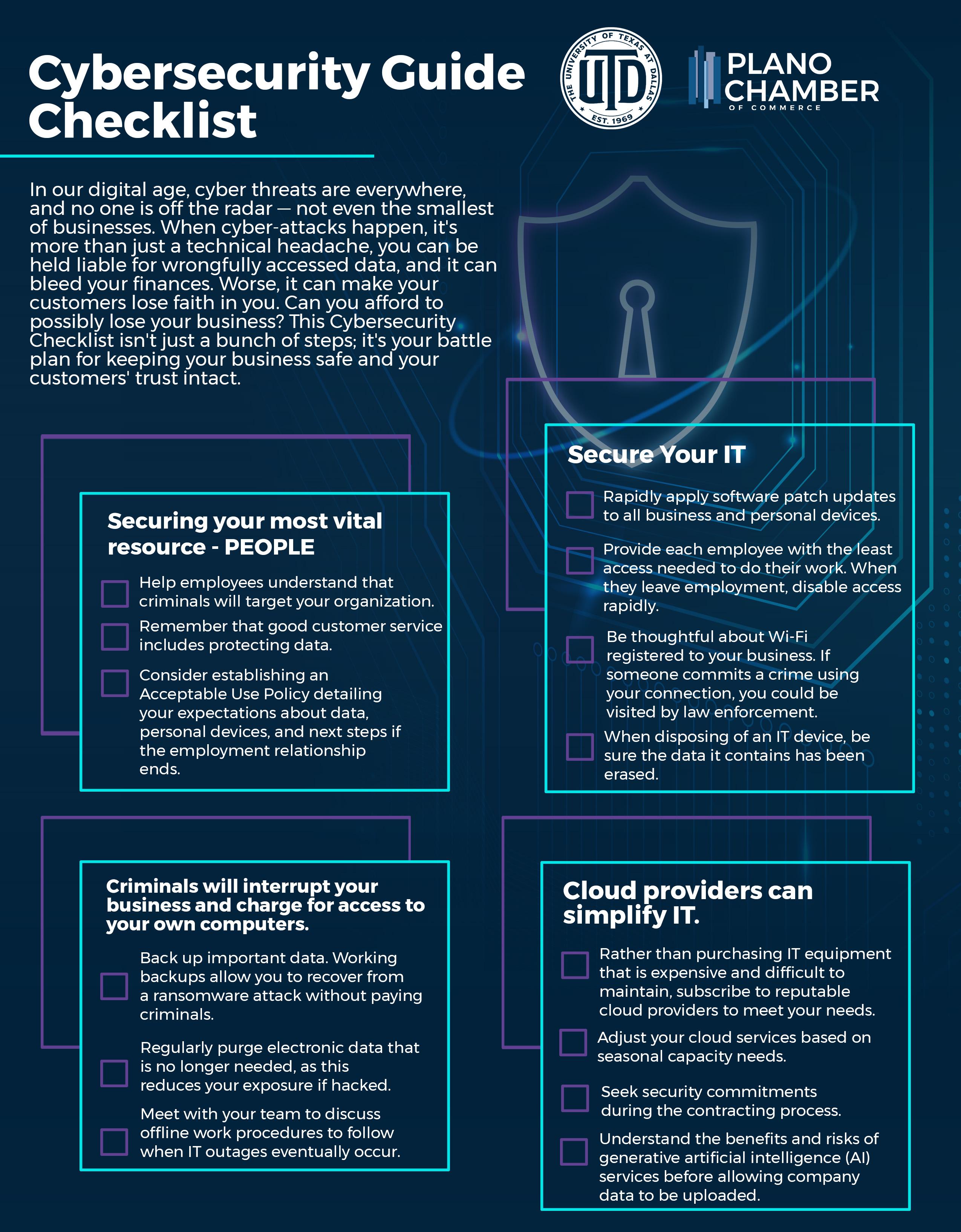
Welcome to the world of cybersecurity, where every digital interaction is a potential battleground, and every organization, regardless of size, is a potential target. As we navigate the complexities of the digital age, understanding and implementing effective cybersecurity measures are paramount to safeguarding our businesses, our livelihoods, and our future.
The Plano Chamber of Commerce, in collaboration with Flair Data Systems, Kehr Technologies, and The University of Texas at Dallas (UTD), is pleased to introduce this comprehensive guide on cybersecurity. Designed to serve as a practical resource for small to mid-sized businesses, this guide aims to demystify the intricacies of cybersecurity and empower organizations to protect themselves against ever-evolving cyber threats, whatever your size. While risk can never be fully eliminated, this manual will help any organization improve its risk management and mitigation capabilities.
As we embark on this journey together, I encourage you to approach cybersecurity not as an isolated concern but as an integral part of your overall business strategy. By prioritizing cybersecurity and investing in proactive measures, we can collectively strengthen our defenses and protect the prosperity and vitality of our Plano business community for years to come.
Thank you for joining us on this important journey!
Kelle Marsalis
from our sponsors
Kehr Technologies recognizes the critical importance of cybersecurity for businesses of all sizes. That’s why we’ve partnered with the Plano Chamber of Commerce to create this Cyber Security Guide, designed to provide businesses with straightforward protection strategies.
Our goal is to help businesses balance security and productivity. This guide outlines key threats, beneficial measures, and services to enhance protection while fostering a culture of security. Remember, the most crucial layer of protection is an informed user.
As a long-time Plano Chamber member, Kehr Technologies is committed to helping businesses tackle cybersecurity challenges. We support our clients with training, advanced IT solutions, and a friendly support team.
Make the most of this guide, which offers simple, practical protection methods. If you need further assistance, Kehr Technologies is here to help.
Bob Kehr Owner/Chief Technical Officer Kehr Technologies
| https://www.kehrtech.com/
Flair Data Systems is happy to announce the launch of the Cybersecurity Manual and thank the Plano Chamber of Commerce for asking us to join them on this mission to help Plano Businesses protect what’s important. For us, this has been a labor of love and necessity. With cyber threats exponentially increasing, we could see that our small business community would be impacted by cybercrime but may be oblivious to the Monster lurking in the room.
Partnering with the Plano Chamber of Commerce underscores our commitment to supporting the local business community in navigating the complex landscape of cybersecurity. Flair Data Systems understands the critical importance of cybersecurity in today’s interconnected world. With our expertise in providing cutting-edge IT solutions and cybersecurity services, we have witnessed firsthand the profound impact that effective cybersecurity practices can have on businesses, from enhancing resilience to mitigating risks and ensuring operational continuity. Together, we recognize the shared responsibility we have in promoting cybersecurity awareness and fostering a culture of cyber resilience among businesses in our community.
We hope you find this manual a valuable resource for your business. Please reach out and let us know how we can support you.
Bob Burgess- President and Robert Burgess- VP Technology Flair Data Systems
| https://www.flairdata.com/
safeguarding your small business
Navigating Cybersecurity
An organization loses $4.8 million in the average data breach
Cyber-attacks on small businesses are increasing, with significant financial and reputational damage from data breaches and ransomware. Small businesses are often seen as easy targets due to limited resources and security measures. As more businesses go digital, the risk of cyber-attacks is higher than ever, with threats like phishing and malware posing serious risks. It’s estimated that 43% of cyber-attacks target small businesses, underscoring the need for strong cybersecurity measures.
The cost of Cybercrime is projected to reach a staggering $10.5 trillion by
2025
The following list includes some alarming statistics and potential risks facing companies today:
· The cost of cybercrime is projected to reach a staggering $10.5 trillion by 2025.
• The average cost of an organization detecting and escalating a data breach is $1.58 million.
· Did you know that cybersecurity is a big deal for people and businesses everywhere, not just in the U.S., but globally? California, Florida, New York, Texas, and Georgia are the top five hit by cybercrime when it comes to money lost. (Cybersecurity Stats: Facts And Figures You Should Know – Forbes Advisor)
· Phishing attacks remain one of the top cybersecurity threats. Roughly 90% of data breaches begin with phishing a vulnerable employee. According to the Federal Bureau of Investigation, phishing attacks may increase by as much as 400% year-over-year.
· Ransomware attacks have increased with businesses of all sizes being targeted, costing an estimated average of $650,000, though the actual median ransomware payment was 46% less at $350,000, according to the “2023 Unit 42 Ransomware and Extortion Threat Report.”
· Insider threats remain a major concern, accounting for 60% of reported data breaches, with malicious insiders and negligent employees being the primary sources of insider-related security incidents. A data breach costs $4.45 million on average. IBM Cost of a Data Breach Report 2023
· Email remains the predominant channel for malware distribution, with approximately 35% of malware being delivered via email in 2023 (Verizon 2023 Data Breach Investigation Report). An alarming 94% of organizations have reported email security incidents (Egress 2024 Email Risk Security Report). Moreover, business email compromises resulted in staggering losses totaling $2.7 billion in 2022 alone (FBI Internet Crime Report 2022).
· Cloud (which comprises most of the technology used by small business) security incidents are a concerning trend. According to the IBM X-Force Cloud Threat Landscape Report 2023, there was a 194% increase in new cloud-related vulnerabilities (CVEs) between June 2022 and June 2023 compared to the previous year- Cloud CVEs Surge 200% in a Year - Infosecurity Magazine (infosecurity-magazine.com)
types of cyber attacks
phishing & Smishing
Phishing attacks, where cybercriminals trick users into revealing sensitive information, are one of the top cyber-attacks facing small businesses. Smishing combines SMS and phishing, targeting mobile devices with unwanted text messages.
Other types: Spear Phishing
malware
Malicious software (malware) poses a significant risk. It comes in various forms, including viruses, Trojans, and spyware.
Other types: Ransomware: This type of malware encrypts data to make it unusable to the victim and demands payment for decryption, with the promise of restoring the system and data to a useable state. Small businesses are often targeted.
Vulnerable Web Applications
Misconfigured, unpatched, and poorly designed applications available on the Internet (for example, your company’s website) can be exploited by anyone in the world. Your weakness could become a path to your internal network and most valuable records. Specialized testing of web applications is needed to identify flaws and develop stronger coding practices.
insider threats
Sometimes, the most dangerous actors come from within an organization. There are even reports of cyber criminals approaching employees and offering to split the proceeds of an attack, if the employee will participate in helping the attacker successfully extort a ransom.
types of cyber attacks cont.
fraud & identity theft
Cybercriminals steal personal information for financial gain.
Denial of Service (DoS) Attacks
These types of attacks overload systems, disrupting services, and are one of the most prevalent attacks across all sizes of business.
supply chain attacks
Targeting third-party vendors or partners can compromise a business’s security.
data breaches
Unauthorized access to sensitive data can lead to severe consequences. This includes unauthorized parties gaining access to sensitive or confidential information including personal and corporate protected data (Social Security numbers, banking information, healthcare data, etc.),
preventing cyber attacks
As a small business owner, understanding the different types of cyber attacks and how to prevent them is crucial for safeguarding your business. Stay informed, stay prepared, and protect your business from potential threats. Your efforts in maintaining robust cybersecurity practices will not only protect your data but also preserve the trust and loyalty of your customers.
so, you have become a victim.
now what? It Can Happen to You!
As a small business owner, you might think you are immune to cyber threats, but the reality is that no one is too small to be targeted. Cybercriminals often see small businesses as easy targets due to limited resources and inexperience with security measures.
The following section outlines preventive measures you can take to secure your business, while providing a step-by-step guide on what to do during a cybersecurity compromise.
first steps
1. Obtain guidance from a licensed attorney experienced with security and breach notification (organizations suffer many types of cyber incidents, but not all are treated as reportable breaches – an attorney can help you sort through requirements specific to your industry)
2. Contact technology provider/security consulting firm(s) equipped to support your incident response efforts
3. Strongly consider avoiding paying ransoms to cybercriminals, as this emboldens them and could lead to further attacks across the economy
4. Contact law enforcement
5. Investigate your liability
6. Disclose or Not to Disclose? Know when and who to tell about data compromise.
Liability and Reporting: Next Steps
What is your liability if identity theft, breach, or data theft occur due to a system failure or weak process within your business? Here is a checklist of next steps when an individual or a company experience a cybersecurity breach:
STEP 1 | CONTAIN THE INCIDENT
o Isolate affected systems
o Disconnect compromised systems from the network
STEP 2 | ASSESS THE DAMAGE
o Identify the type of incident and scope of the damage; in consultation with an attorney, determine if a reportable data breach has occurred
o Determine what data or systems were affected
STEP 3 | NOTIFY RELEVANT PARTIES
o Inform internal stakeholders and executive management
o Notify affected customers and partners, as appropriate based on attorney guidance
o Report the breach to relevant authorities and regulatory bodies, as appropriate based on attorney guidance
STEP 4 | INVESTIGATE THE INCIDENT
o Conduct a forensic investigation to determine the cause and method of the breach
o Collect and preserve evidence for analysis
step 5 | Mitigate the Threat
o Apply necessary patches and updates
o Remove malware and unauthorized access
o Strengthen security controls to prevent recurrence
o Format and reinstall IT systems to ensure that malware and threat actors are fully purged
step
6 | Communicate Externally
o Prepare a public statement, if required
o Manage public relations and media inquiries
step
7 | Recover and Restore Systems
o Restore data from trusted backups, preferably those taken before the system compromise occurred
o Verify the integrity of restored systems
o Resume normal operations
step
8 | Review and Improve Security Measures
o Analyze the incident to identify weaknesses
o Update security policies and procedures
o Provide additional training to employees
step
9 | Document the Incident
o Create a detailed report of the breach, actions taken, and lessons learned
o Maintain records for compliance and future reference
step
10 | Follow Up
o Monitor systems closely for any signs of further compromise
o Conduct regular security audits and assessments
o Discuss lessons learned with organization leaders and IT staff to further refine procedures
o Conduct periodic incident exercises and incorporate lessons learned from previous incidents
o Format and reinstall IT systems to ensure that malware and threat actors are fully purged
STEP 11 | Disclosure
Disclosing a cybersecurity breach to the public or law enforcement involves understanding regulatory requirements and best practices. Here are the key considerations:
When to Disclose a Breach Regulatory Requirements:
o Federal Regulations: The Gramm-Leach-Bliley Act (GLBA) and Health Insurance Portability and Accountability Act (HIPAA) require notification of data breaches involving financial and health information, respectively.
o State Laws: Most states have data breach notification laws that mandate disclosure to affected individuals and, in some cases, state regulators within a specific timeframe (typically 30 to 90 days) after discovering a breach.
o General Data Protection Regulation (GDPR): If operating in the EU, GDPR requires notification of personal data breaches to the relevant supervisory authority within 72 hours and to affected individuals without undue delay.
o Securities and Exchange Commission (SEC) new rules introduced in 2023 require Board of Directors oversight of cybersecurity and reporting of incidents which may be material to financial performance, in as little as four business days, for publicly traded companies.
Federal Bureau of Investigation (FBI) Notification:
o Immediate Threats: Notify the FBI if the cyber incident involves a significant threat to national security, critical infrastructure, or significant financial fraud. Go to www.ic3.gov for more information.
o Legal Obligations: Certain incidents, especially those involving ransomware, espionage, or attacks from foreign entities, are considered breaches and require notification under federal laws.
o Contact Methods: Use the FBI’s Internet Crime Complaint Center (IC3) at www.ic3.gov for online reporting or contact the local FBI field office directly.
o Information to Provide: Include a detailed account of the breach, types of data affected, suspected source of the breach, and any steps taken to mitigate the impact.
How to Disclose a Breach To the Public:
o Notification Methods: Use multiple channels (email, website notices, press releases) to reach affected individuals promptly.
o Content of Notification: Include details about the breach (what happened, what data was affected), steps taken to mitigate the breach, and recommendations for individuals (such as monitoring accounts or changing passwords).
glossary
What is cybersecurity?
Cybersecurity refers to protecting information assets from disruptions to confidentiality, integrity, and availability. These three objectives, sometimes referred to as the “CIA triad,” simply mean that your information should only be observed by those with a legitimate need, should not be altered unless such changes are legitimate, and needs to be useable and efficient in the operation of your business.
Cybersecurity can be categorized into five distinct types:
Application security- Application security focuses on protecting software applications from threats by reducing vulnerabilities introduced throughout their development lifecycle. Key components of application security include:
o Authentication and authorization
o Data input validation
o Encryption
o Error handling and logging
o Patch management
o Penetration testing and code reviews
o Secure coding practices
o Secure configuration management
o Secure deployment practices
o Session management
Cloud security- Don’t let the term “cloud” confuse you. This refers to using IT services hosted by a business partner and accessed via the Internet. These services are usually delivered in a subscription model and can be adjusted rapidly to meet the needs of your business. Though you may use cloud services that are owned by your business partner, remember that your ownership rights to your data follow it into the cloud service. Cloud security encompasses various technologies, processes, and controls designed to protect data, applications, and infrastructure hosted in cloud environments.
Critical infrastructure security- involves protecting the systems, networks, assets, and facilities that are essential for the functioning of a society and economy.
Internet of Things (IoT) security- IoT security encompasses various practices, technologies, and protocols designed to protect Internet of Things (IoT) devices and networks from cyber threats.
Network security- Network security refers to the practices and measures adopted to protect the integrity, confidentiality, and availability of data and resources within a computer network. Network security aims to secure both the internal network infrastructure (such as routers, switches, and servers) and the data transmitted over the network (such as emails, files, and communications).
resources
Businesses Must Provide Victims and Law Enforcement with Transaction Records Relating to Identity Theft Link
2023 Business Impact Report- idtheftcenter.org
Cisco Secure Small Business Solutions (Flair Data Systems- reseller)
Small Business is a Big Priority: NIST Expands Outreach to the Small Business Community
Flair Data Systems: Cybersecurity and Tech Insights Blog
Federal Trade Commission: Data Breach Response: A Guide for Business
NAIC Cybersecurity Insurance Guidelines
SBA.gov Cybersecurity
National Cybersecurity Alliance
Texas Data Privacy and Security Act
On March 6, 2023, National Institute of Standards and Technology (NIST) launched a new small business initiative that will create more opportunities for the exchange of information, resources, and ideas between NIST and the nation’s small business community via the creation of a new Small Business Community of Interest.
NIST Small Business Cybersecurity Act, which directed us to “disseminate clear and concise resources to help small business concerns identify, assess, manage, and reduce their cybersecurity risks.” This resource repository has grown over the years and offers videos, planning guides, case studies, topical guidance (e.g., ransomware, phishing, and teleworking), and important information that small businesses can put into action.
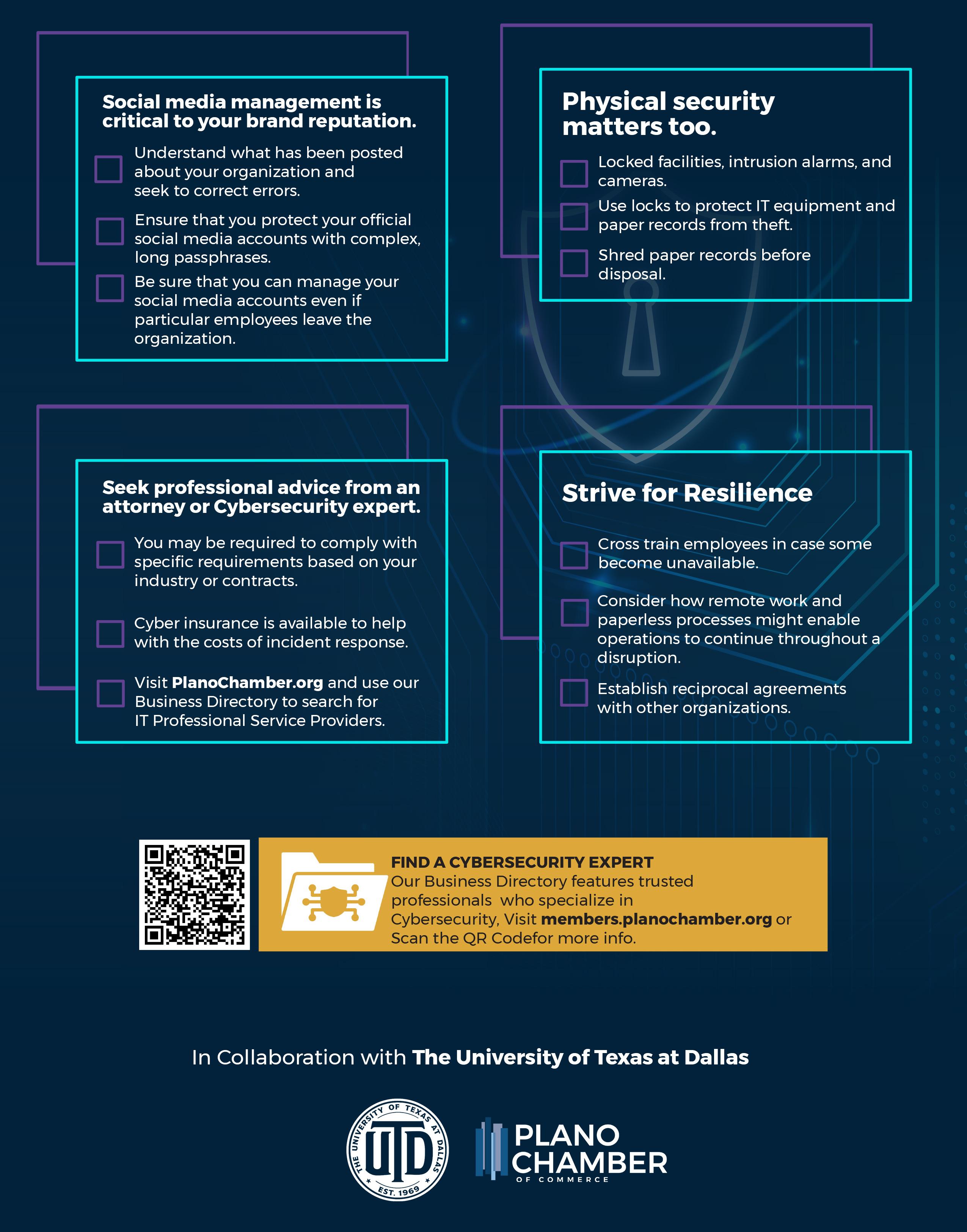
FIND A CYBERSECURITY EXPERT
Our Business Directory features trusted professionals who specialize in Cybersecurity, Visit members.planochamber.org or Scan the QR Codefor more info.