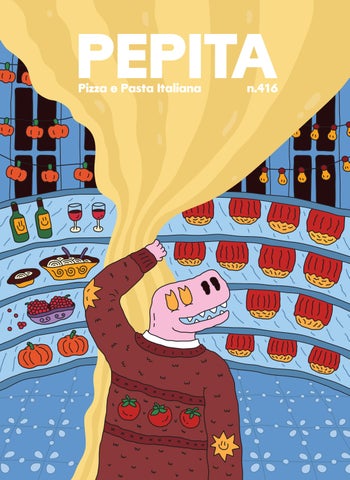
PEPITA Pizza e Pasta Italiana
n.416
C
M
Y
CM
MY
CY
CMY
K
LA PIZZA MIGLIORE SOLO CON IL MIO SAN MARZANO IL MIO SAN MARZANO
L A COSTANTE D E L TU O TALE NTO
le5stagioni.com
Oltre 70 Paesi. Una sola firma: quella dell’eccellenza italiana. I nostri forni uniscono innovazione tecnologica e cura artigianale.
Pizza e Pasta Italiana
n.416
" I l Natale non è
un tempo né una stagione, ma uno stato d’animo".
/ ‘Christmas is neither a time nor a season, but a state of mind’.
Calvin Coolidge, 30° Presidente degli Stati Uniti d'America
QUESTO NUMERO È STATO RESO POSSIBILE GRAZIE A /THIS ISSUE HAS BEEN MADE POSSIBLE THANKS TO 2 Solania, 3 Le 5 Stagioni, 4 Rinaldi Superforni, 11 Sanfelici, 13 Industria Alimentare Tanagrina, 15 Sitta, 25 La Torrente, 31 Marana Forni, 33 Valledoro, 39 Sacar, 55 Molino Scoppettuolo, 59 Scuola Italiana Pizzaioli, 61 Avanzini Bruciatori, 63 Grangusto, 69 Molino Casillo, 75 Molino Dallagiovanna, 77 Millberg, 83 Molino Pasini, 85 Dr. Zanolli, 91 Ab Mauri, 93 Sigma, 97 Demetra, 98 Salone DeGusto, 99 Latteria Sorrentina, 100 Caseificio Valcolatte
6-SOMMARIO /CONTENTS
Menu n.416
PEPITA N.416
OTTOBRE / O CTO B E R 2 0 2 6
8 ENTRÈE
Antonio Puzzi
10 PIZZA NEWZ
redazione /editorial staff
16
14 ON THE ROAD Eventi del Mese Events of the Month redazione /editorial staff
16
26
RORATO'S
Chi ha inventato il lievito? Who invented yeast? Giampiero Rorato
34
20
GALEOTTO FU(D)
Iole: impasti, riti e altre forme di cura Iole: mixtures, rituals and other forms of healing Anna Marlena Buscemi
64
26
WRITING ABOUT
«Qui gli influencer non entrano» ‘No influencers allowed here’ Annatina Franzese
-7
Pizza e Pasta Italiana
34
TECH FORWARD
La cella non si mette mai in vetrina "The cell never takes centre stage Domenico Maria Jacobone
40
FOOD FOR THOUGHT
78
Se cambia la terra, cambia anche la pizza: come il clima modifica la nostra cucina If the land changes, so does pizza: how the climate is reshaping our cuisine Giampiero Rorato
44
INTERVIEWZ
Massimo Montanari: la cucina italiana tra identità e contaminazione Massimo Montanari: Italian cuisine, between identity and fusion Caterina Orlandi
50
PIZZA PEOPLE
L'enciclopedia degli impasti di Francesco Pompetti The Encyclopaedia of Doughs by Francesco Pompetti Giusy Ferraina
56
PIZZA PEOPLE
Pinsa Club - Roma nelle Langhe Pinsa Club - Roma in Langhe Noemi Caracciolo
64
GLUTEN FREE
Il profumo dei lievitati gluten free
70
PIZZA WORLD
I lievitati delle feste ai quattro angoli del globo Festive baked goods from the four corners of the globe" Giuseppe A. D'Angelo
78
FOODTELLING
Il Natale italiano, oltre lo Stivale Italian Christmas, beyond the Boot Caterina Vianello
86
EAT WELL STAY WELL
Cibi afrodisiaci: esistono davvero? Tra chimica e magia d'amore Aphrodisiac foods: do they really exist? Between chemistry and the magic of love Marisa Cammarano
94
THE TIP
Libro. La cucina dei perché Book. The Kitchen of Whys redazione /editorial staff COMPANY SPOTLIGHT
The aroma of gluten-free baked goods Alfonso Del Forno
49
Scuola Italiana Pizzaioli
8-ENTRÈE
di/by Antonio Puzzi
Mancano meno di 60 giornial Natale
PEPITA N.416
e i supermercati se
ne sono già accorti: da più parti, infatti, si assiste al proliferare di panettoni (per decenza, definiti “estivi”) che iniziano ad affollare le corsie dei negozi. Ad ogni modo, però, per chi lavora con le mani nell'impasto, è tempo di mettere sul banco le idee e, soprattutto, iniziare la produzione. Un grande lievitato non si improvvisa: richiede tempo, pazienza, prove, pianificazione. Per questo, il numero di ottobre è interamente dedicato a loro: i lievitati. Perché è proprio quando le feste sembrano ancora lontane che i banchi dei laboratori devono già essere pronti. Ottobre è il momento giusto per guardare avanti: provare, sbagliare, correggere e arrivare a novembre con qualcosa da offrire che racconti la propria identità. È un numero dedicato come sempre a chi produce, per fornire spunti e strade da percorrere, offrire consigli su produzioni e farine ma c’è una cosa che proprio non troverete: le ricette da copiare, perché crediamo che sia più bello e giusto avere idee da far proprie e reinterpretare con la propria mano. Al centro di questo numero, c'è una domanda che ci riguarda da vicino: come vengono percepiti i lievitati italiani nel mondo? Il panettone è ormai un simbolo riconosciuto ben oltre i confini nazionali ma tra icona e stereotipo il passo è breve. Raccontarne la percezione significa capire come il nostro patrimonio di impasti, tecniche e tradizioni venga letto, desiderato e, a volte, frainteso da chi lo osserva da lontano. Pizza, focaccia, pane e grande pasticceria da forno: la nostra tradizione è più ampia di ciò che spesso arriva sulle tavole straniere. Poi, c'è il viaggio. Perché il Natale, ovunque, ha il profumo di un impasto che lievita. Dallo stollen tedesco al roscón de Reyes spagnolo, dalla vánočka ceca ai pani dolci dell'America Latina, le feste dei quattro angoli del mondo si raccontano attraverso pani e dolci lievitati, ciascuno con un clima, una dispensa, una storia alle spalle e con i suoi gesti, i suoi ingredienti, i suoi significati. Metterli a confronto non serve solo a curiosare: è un modo per allargare lo sguardo, trovare ispirazione e ricordare che ogni tradizione è, a suo modo, una storia di scambi. Sessanta giorni non sono molti. Sono abbastanza, però, per costruire delle feste di fine anno che meritino di essere ricordate. Anche da chi – come il sottoscritto – non ha esattamente lo spirito del Natale. Buona lettura e… buon lavoro!
-9
ENG
There are less than 60 days to go until Christmas, and the
supermarkets have already taken notice: in fact, all round, we’re seeing a proliferation of panettone (euphemistically referred to as ‘summer’ panettone) beginning to fill the
shop aisles. In any case, however, for those who work with their hands in the dough, it is time to put their ideas on the table and, above all, start production. A great leavened bake cannot be improvised: it requires time, patience, trial and error, and planning. That is why the October issue is entirely dedicated to them: leavened bakes. Because it is precisely when the festive season still seems a long way off that the bakery workbenches must already be ready. October is the right time to look ahead: to try, make mistakes, correct them, and arrive in November with something to offer that reflects your identity. As always, this issue is dedicated to those in the trade, to provide inspiration and new directions, and to offer advice on production and flours; but there is one thing you simply won’t find here: recipes to copy, because we believe it is better and more rewarding to take ideas and make them your own, reinterpreting them in your own way. At the heart of this issue lies a question that concerns us closely: how are Italian leavened baked goods perceived around the world? Panettone is now a symbol recognised far beyond our national borders, but it’s a fine line between icon and stereotype. Exploring how it is perceived means understanding how our heritage of doughs, techniques and traditions is interpreted, desired and, at times, misunderstood by those observing it from afar. Pizza, focaccia, bread and fine baked pastries: our tradition is far broader than what often reaches tables abroad. Then there’s the journey. Because Christmas, wherever you go, carries the scent of rising dough. From the German stollen to the Spanish roscón de Reyes, from the Czech vánočka to the sweet breads of Latin America, festive celebrations across the four corners of the world are told through leavened breads and cakes, each with its own climate, pantry, history behind it, and with its own rituals, ingredients and meanings. Comparing them isn’t just a matter of curiosity: it’s a way to broaden our horizons, find inspiration and remember that every tradition is, in its own way, a story of exchange. Sixty days isn’t a long time. It’s enough, however, to create end-of-year celebrations that are worth remembering. Even for those – like myself – who don’t exactly have the Christmas spirit. Enjoy the read and… good luck!
Nio
10-
PIZZA
PIZZA NEWZ
MOLINO COSMA CELEBRA "100 ANNI DI VITALYTÀ E OLTRE": QUATTRO GENERAZIONI DI PASSIONE GUARDANO AI MERCATI DEL FUTURO
PEPITA N.416
NEWZ
MOLINO NALDONI, GRANDE SUCCESSO PER “APERITIVO IN MOLINO”: ALLA SCOPERTA DEL VIAGGIO DEL CHICCO
Oltre 150 ospiti per l’evento di Molino Naldoni che ha aperto le porte dello stabilimento di Faenza per raccontare oltre 320 anni di storia, innovazione e legame con il territorio. Protagonisti l’impianto molitorio del 2019 e la filiera di grano italiano: 450 tonnellate al giorno, l’80% di origine nazionale e circa il 20% romagnola. Ad accogliere la famiglia Naldoni, le istituzioni e i partner del territorio. La giornata si è chiusa con un ricco aperitivo dedicato a pane, pizza, pasta, piadina e pasticceria.
Oltre 200 ospiti hanno festeggiato a Villa Pacchierotti De Benedetti di Limena la storia di una delle realtà molitorie più importanti del Veneto, quella del Molino Cosma di San Martino di Lupari. E’ stato inoltre presentato il marchio celebrativo che guarda al prossimo secolo di attività. L'emozione della storia, l'orgoglio delle proprie radici e lo sguardo rivolto al futuro. Sono stati questi i fili conduttori della grande festa organizzata dal Molino Cosma per celebrare i suoi cento anni di attività. ENG
MOLINO COSMA CELEBRATES “100 YEARS OF VITALITY AND BEYOND”: FOUR GENERATIONS OF PASSION LOOK TO THE MARKETS OF THE FUTURE.
Over 200 guests gathered at Villa Pacchierotti De Benedetti in Limena to celebrate the history of one of the Veneto region’s most important milling businesses, Molino Cosma of San Martino di Lupari. The commemorative logo, looking ahead to the next century of operations, was also unveiled. The thrill of history, pride in one’s roots and an eye on the future. These were the guiding themes of the grand celebration organised by Molino Cosma to mark its hundred years in business.
MOLINO NALDONI: ‘APERITIVO IN MOLINO’ PROVES A HUGE SUCCESS – EXPLORING THE JOURNEY OF THE GRAIN.
Over 150 guests attended the Molino Naldoni event, which opened the doors of the Faenza mill to showcase over 320 years of history, innovation and ties to the local area. The stars of the show were the 2019 milling plant and the Italian wheat supply chain: 450 tonnes a day, 80 per cent of which is sourced nationally and around 20 per cent from the Romagna region. The Naldoni family, local institutions and partners were all in attendance. The day concluded with a lavish aperitif featuring bread, pizza, pasta, piadina and pastries.
12-
PIZZA
PIZZA NEWZ
“FRANTOI APERTI® IN UMBRIA 2026” DAL 17 OTTOBRE AL 15 NOVEMBRE 2026 LA XXIX EDIZIONE
PEPITA N.416
NEWZ MOLINO DALLAGIOVANNA INCORONA RUGGIERO FRANCAVILLA PIZZA AMBASSADOR 2027-2028
Il 33enne pizzaiolo di Barletta ha conquistato la quarta edizione della Pizza Bit Competition, al termine di un percorso durato oltre un anno e culminato nella finale del 12 settembre a Gragnano Trebbiense, nell’ambito della Festa dei Granai. A decretarne la vittoria, una prova sulla pizza Margherita, che ha messo in campo tecnica, gestione dell’impasto, cottura ed equilibrio. Premiati anche gli agricoltori del territorio con il riconoscimento Chicco d’Oro.
L'Umbria rurale si prepara a tornare protagonista dell'autunno italiano con la XXIX edizione di Frantoi Aperti®, l'evento che racconta il territorio attraverso il suo prodotto identitario per eccellenza: l'olio extravergine di oliva. Dal 17 ottobre al 15 novembre 2026, per cinque fine settimana consecutivi, la manifestazione offrirà un ricco calendario di iniziative dedicate alla raccolta delle olive e alla produzione dell'olio nuovo, accompagnando i visitatori alla scoperta dei frantoi in attività, dell’olio extravergine di oliva, dei paesaggi olivati, dei borghi storici e dell'eccellenza agroalimentare dell'Umbria. ENG
“FRANTOI APERTI® IN UMBRIA 2026” FROM 17 OCTOBER TO 15 NOVEMBER 2026: THE 29TH EDITION.
MOLINO DALLAGIOVANNA CROWNS RUGGIERO FRANCAVILLA PIZZA AMBASSADOR 2027–2028.
Rural Umbria is preparing to take centre stage once again in the Italian autumn with the 29th edition of Frantoi Aperti®, the event that showcases the region through its quintessential product: extra virgin olive oil. From 17 October to 15 November 2026, over five consecutive weekends, the event will offer a packed programme of activities dedicated to the olive harvest and the production of new oil, guiding visitors on a journey of discovery through working oil mills, extra virgin olive oil, olive-covered landscapes, historic villages and Umbria’s culinary excellence.
The 33-year-old pizza chef from Barletta won the fourth edition of the Pizza Bit Competition, following a journey lasting over a year which culminated in the final on 12 September in Gragnano Trebbiense, as part of the Festa dei Granai. His victory was decided by a challenge involving a Margherita pizza, which tested his technique, dough handling, cooking skills and balance. Local farmers were also honoured with the Chicco d’Oro award.
Per fare un’ottima pizza,
Scarica il catalogo Download catalogue
ci vuole un’ottima mozzarella.
Fiordilatte e Mozzarella di Bufala in vari formati, per ristoranti e pizzerie. Fiordilatte and Mozzarella di Bufala in various formats, for restaurants and pizzerias. Fiordilatte per pizza in filoni, cubettata e julienne in vari formati Fiordilatte for pizza in loaves, diced and julienne in various formats
Mozzarella Fiordilatte Mozzarella Fiordilatte
Mozzarella di Bufala Campana DOP Mozzarella di Bufala Campana PDO
Formaggi filanti e affumicati Pasta filata and smoked cheese
La mozzarella che non ti delude mai. Specialità casearie: Burrata, stracciatella Dairy specialties: Burrata, stracciatella
www.tanagrina.com
Industria Alimentare Tanagrina s.r.l. Via della Sorgente 84030 San Pietro al Tanagro, SA - Italy +39 0975 398100 - +39 0975 398201 commerciale@tanagrina.com
14-
PEPITA N.416
ON THE ROAD
GLI EVENTI
/EVENTS
Ottobre /October 2026
IN EUROPA E NEL MONDO /IN EUROPE AND AROUND THE WORLD
IN ITALIA /IN ITALY
→
Fiera Internazionale del Tartufo Bianco d’Alba 10 ottobre/october – 6 dicembre/december Alba (CN) www.fieradeltartufo.org
→ Fruit Attraction 6–8 ottobre/october IFEMA Madrid, Madrid (Spain) www.ifema.es/en/fruit-attraction
→ FoodTech Barcelona
→ iMEAT 11–13 ottobre/october BolognaFiere, Bologna www.imeat.it
→ TriestEspresso Expo 21–23 ottobre/october Trieste Convention Center, Trieste www.triestespresso.it
6–9 ottobre/october Fira de Barcelona – Gran Via (Spain) www.alimentariafoodtech.com/en/
→ Conxemar 6–8 ottobre/october IFEVI, Vigo (Spain) www.conxemar.com/en/exhibition/
→ SIAL Paris
→ Cibus Tec 27–30 ottobre/october Fiere di Parma, Parma www.cibustec.it
DEL MESE
17–21 ottobre/october Paris Nord Villepinte (Francia) www.sialparis.com/
→ südback 24–27 ottobre/october Messe Stuttgart, Stoccarda (Germania) www.messe-stuttgart.de/ suedback/en/
→ Gastrónoma 26–28 ottobre/october Feria Valencia, Valencia (Spagna) www.gastronoma.es/
/OF THE MONTH
AD AZTECDESIGN.IT
ilfaggetto.com
Zero batteri, zero pensieri Certificato Biomass Plus A1, Il Faggetto ha superato le più severe analisi di laboratorio.
Perché per un professionista come te, qualità e sicurezza vengono prima di tutto. E ai tuoi clienti piace mangiare sano!
16-RORATO'S
PEPITA N.416
RORATO'S
UNA STORIA ANTICA QUANTO IL PANE
Chi ha inventato il lievito? di/by Giampiero Rorato
-17
Pizza e Pasta Italiana
Chi ha inventato il lievito? La risposta, in realtà, non porta il nome di un uomo o di un popolo. Il lievito è stato scoperto molto prima che ne fossero comprese le cause. Tra le diverse tipologie oggi in commercio, la più antica è comunemente definita “lievito madre”, proprio perché rappresenta la prima forma di lievitazione individuata e utilizzata dall’uomo.
ENG
Who invented yeast? A story as old as bread Who invented yeast? The answer, in reality, does not bear the name of any one man or people. Yeast was discovered long before its mechanisms were understood. Among the various types available today, the oldest is commonly known as ‘sourdough’, precisely because it represents the first form of leavening identified and used by humankind. Even the ancient peoples of the ‘Fertile Crescent’ in the Middle East ate bread and, from the fourth millennium BC onwards, also produced ‘risen’ bread, without knowing the cause of this transformation. Historical records mention leavened bread among the Assyrians, Babylonians and Ancient Egyptians, whilst the very concept of yeast would not be understood until many centuries later. An ancient Egyptian legend tells of a woman who, after preparing a dough of water and flour, was distracted by other chores. On her return, she accidentally knocked over a jug of beer onto the dough.
Già le antiche popolazioni della “Mezzaluna fertile” del Medioriente si nutrivano di pane e, a partire dal quarto millennio prima di Cristo, producevano anche un pane “gonfiato”, senza conoscere la causa della trasformazione. Le testimonianze ricordano pane lievitato presso Assiri, Babilonesi e Antichi Egizi mentre il concetto stesso di lievito sarebbe stato compreso molti secoli più tardi.
Una leggenda dell’antico Egitto racconta che una donna, dopo aver preparato un impasto di acqua e farina, fu distolta da altre faccende. Al suo ritorno, rovesciò accidentalmente un boccale di birra sull’impasto. Preoccupata, lo lasciò da parte e ne preparò un altro. Quando tornò a controllare il primo, si accorse che si era gonfiato.
18-RORATO'S
Non volendo sprecarlo, lo trasformò in pane e lo mise nel forno insieme al secondo impasto. Una volta cotto, assaggiò il pane gonfiato: era più leggero e buono. La notizia si diffuse e altre donne provarono a versare birra non del tutto fermentata nella farina, ottenendo lo stesso risultato. Al di là della leggenda, il racconto contiene una spiegazione che oggi possiamo comprendere. Gli Antichi Egizi furono grandi produttori di vino: lo testimoniano gli affreschi delle tombe dei maggiorenti. E arrivarono a indicare sulle anfore l’anno di produzione, il luogo e il nome del proprietario, una sorta di primitiva denominazione d’origine. Sapevano lavorare prodotti nei quali avvenivano trasformazioni che non erano ancora in grado di spiegare.
PEPITA N.416
ENG
Worried, she set it aside and prepared another batch. When she returned to check on the first one, she noticed that it had risen. Not wanting to waste it, she turned it into bread and put it in the oven alongside the second batch of dough. Once baked, she tasted the risen bread: it was lighter and tastier. The news spread, and other women tried pouring beer that was not fully fermented into the flour, achieving the same result. Beyond the legend, the story contains an explanation that we can understand today. The Ancient Egyptians were great wine producers: this is evidenced by the frescoes in the tombs of the nobility. They even went so far as to mark the amphorae with the year of production, the place and the owner’s name – a sort of primitive designation of origin. They knew how to work with products in which transformations took place that they were not yet able to explain. The key players in this story are the saccharomycetes, microorganisms that feed on the sugars present in must and dough. During fermentation, the sugar is converted into alcohol and carbon dioxide. It is precisely the CO₂ trapped within the dough that causes it to rise. The saccharomycetes, which were also present in the sweetish beers of the peoples of the Fertile Crescent, produced this gas when they came into contact with the flour, making the bread lighter and more voluminous.
-19
Pizza e Pasta Italiana
ENG
This story takes us to Armenia, at the foot of the biblical Mount Ararat, whose summit now lies within Turkish territory. In a cave, known to archaeologists as the ‘Cave of the Birds’, buried amphorae containing residues of Vitis vinifera grape seeds have been discovered. The cave, dating back some eight thousand years, is considered the world’s oldest wine cellar. Clearly, this process was already known at that time. Bread and wine thus tell an important part of the history of food and civilisation. Wheat, grapes and their processing bear witness to knowledge that originated in the East and subsequently spread far and wide. There is a lesson to be learnt from all this: understanding the discoveries of the most ancient civilisations means fully appreciating what we put on our tables every day. Today, of course, but also tomorrow.
I protagonisti di questa storia sono i saccaromiceti, microrganismi che si nutrono degli zuccheri presenti nel mosto e negli impasti. Durante la fermentazione, lo zucchero viene trasformato in alcol e anidride carbonica. È proprio la CO₂ trattenuta dall’impasto a provocarne il gonfiore. I saccaromiceti presenti anche nelle birre dolciastre delle popolazioni della Mezzaluna fertile, entrando in contatto con la farina, producevano quindi quel gas che rendeva il pane più leggero e voluminoso. Questa storia ci porta in Armenia, ai piedi del biblico monte Ararat, la cui vetta si trova oggi in territorio turco. In una grotta, chiamata dagli archeologi “Grotta degli uccelli”, sono state rinvenute anfore interrate con residui di vinaccioli di Vitis vinifera. La grotta, risalente a circa ottomila anni fa, è considerata la più antica cantina del mondo. Evidentemente, questo processo era conosciuto anche allora. Pane e vino raccontano così una parte importante della storia dell’alimentazione e della civiltà. Frumento, uva e le loro trasformazioni sono testimonianze di conoscenze nate in Oriente e poi sviluppatesi ovunque. In tutto questo c’è una lezione: conoscere le scoperte delle civiltà più antiche significa comprendere appieno cosa abbiamo in tavola ogni giorno. Oggi, certo, ma anche domani.
Galeo fu(d) 20-GALEOTTO FU(D)
PEPITA N.416
ENG
FOOD - STORIES - UNEXPECTED EVENTS
IM
PR ST CIB E V OR O IS IE TI
Iole: mixtures, rituals and other forms of healing
Iole: impasti, riti e altre forme di cura by Anna Marlena Buscemi
For more than seventy years, every Monday, pasta has been made in the back room of ‘Trattoria Anita’. The women mix flour and eggs and roll out the dough for tagliatelle, tortelloni and vincisgrassi. Iole entrusts the dough to them, whilst the filling is her domain because – amongst her home-style culinary instructions – there are also a few secrets: only experience can bring precision to even the vaguest instructions, which range from ‘a pinch’ to ‘as much as it takes’. Alongside Monday’s pasta-making, other rituals take place throughout the week: Friday is eagerly awaited for Iole’s salt cod, cooked in oil; Saturday, market day, is porchetta day. The village wakes up early, and the trattoria with it. As early as seven o’clock, the porchetta is placed on a huge wooden table, still warm and with a crispy rind, after spending the night inside, cooking slowly in the bread oven, making the most of the residual heat left over from baking a generous number of loaves. Few of those who go to the market can resist the temptation to make a quick detour to the trattoria, which doubles as a shop, from where you can leave with a packet of hand-sliced porchetta or, better still, a sandwich to eat straight away.
otto Pizza e Pasta Italiana
di/by Anna Marlena Buscemi
-21
Da più di settant’anni, il lunedì, nella retrobottega della “Trattoria Anita” si fa la pasta. Le donne impastano farina e uova e tirano la sfoglia per tagliatelle, tortelloni e vincisgrassi. Iole affida loro l’impasto, mentre il ripieno è appannaggio suo perché - tra le sue indicazioni da lessico culinario di casa - si annida anche qualche segreto: solo l’esperienza può dare precisione anche alle indicazioni più vaghe, che vanno dal pizzico al quanto basta. Insieme alla pasta del lunedì, durante la settimana si svolgono altri riti: il venerdì è atteso per il baccalà di Iole, cotto in oliocottura; il sabato, giorno di mercato, è invece il giorno della porchetta. Il paese si sveglia presto, e la trattoria con lui. Già dalle sette, la porchetta è posta sopra un enorme tavolo di legno, ancora tiepida e con la cotenna croccante, dopo una notte interna trascorsa a cuocere lentamente nel forno del pane, approfittando del calore in discesa, dopo la cottura di un generoso numero di pagnotte. Pochi di coloro che vanno al mercato riescono a resistere al richiamo, senza fare una piccola deviazione in trattoria che diventa bottega e da cui puoi uscire con un pacchetto di porchetta affettata a mano o direttamente con un panino da mangiare subito. Anche l’anno segue un suo ritmo: Iole rimane aperta per tutta l’estate e si ferma solo dopo la Festa dell’Uva, a ottobre, quando della vendemmia resta solo la voglia di festeggiare. I suoi piatti segnano il tempo del paese, puntuali come lo scoccare delle campane: da un lunedì all’altro, da un mercato all’altro, da una Festa dell’Uva alla successiva.In un paese
22-GALEOTTO FU(D)
ENG
piccolo, un’osteria tiene insieme sia le persone che le cose. Qui circolano notizie, si prendono le decisioni e si affrontano conflitti, si incontrano e scontrano le generazioni da quando questo luogo esiste. Prima di Iole, c’era la sua mamma e, prima ancora, la signora M. della precedente gestione. Lei aveva sei anni quando, nel 1952, sua mamma Anita rilevò la trattoria. Crebbe tra quelle stanze e ricevette dalla madre cucina e sala, quando decise di portare avanti l’impresa con Donatello, prima fidanzato e poi marito, interpretando il concetto di “casa e bottega” con piena e fiera coerenza: al piano di sotto si lavorava e a quello di sopra si abitava. Poi, sono venuti i figli e infine i nipoti. Agli stessi tavoli si sono seduti bambini, genitori e nonni: condividendo piatti e forchettate, senza aver mai bisogno di prevedere un menù dei bambini per far mangiare tutti con appagamento. Ho conosciuto questo luogo grazie a Daniela, la loro secondogenita, produttrice di vino e mia
The year, too, follows its own rhythm: Iole remains open throughout the summer and closes only after the Grape Festival in October, when all that remains of the grape harvest is the desire to celebrate. Its dishes mark the passing of time in the village, as punctual as the striking of the bells: from one Monday to the next, from one market to the next, from one Grape Festival to the next. In a small village, a tavern holds both people and things together. News circulates here, decisions are made and conflicts are resolved; generations have met and clashed here ever since this place has existed. Before Iole, there was her mum, and before her, Mrs M. from the previous management. She was six years old when, in 1952, her mum Anita took over the trattoria. She grew up within those walls and took over the kitchen and dining room from her mother when she decided to carry on the business with Donatello, first her fiancé and then her husband, embodying the concept of ‘home and business’ with complete and proud consistency: they worked downstairs and lived upstairs. Then came the children, and finally the grandchildren. Children, parents and grandparents have all sat at the same tables: sharing dishes and mouthfuls, without ever needing a children’s menu to ensure everyone ate to their heart’s content. I discovered this place thanks to Daniela, their second daughter, a wine producer and a dear friend of mine. Ever since then, whenever I found myself passing through that area, I would try to stop by at least one Monday, just to spend it amongst the ladies of the pasta. Whilst each sheet of pasta took on a different shape, I listened to their confidences and fears, their desires and
PEPITA N.416
-23
Pizza e Pasta Italiana
di/by Anna Marlena Buscemi
their losses. Words, laughter and even the odd tear mingled with the flour. Now, to say that kneading dough heals pain would sound so rhetorical as to be almost offensive, because we all know that there are wounds that cannot be healed. Yet a repeated gesture gives time a measure; a shared table prevents each person from bearing the weight all on their own. Pasta does not dissolve pain: it offers it a place to be without taking up the whole room, let alone the whole of one’s life. But when a tortellone breaks, you realise that, even if something is compromised, not all is lost; so you salvage the filling to stuff another batch of pasta. That gesture says a great deal about Iole’s way of facing life and, at the same time, suggests something to us all: not everything can be saved, but we must take care of what remains. In a few days’ time, ‘Trattoria Anita’ will close its doors for good. Along with the flavour of the dishes, we will lose the knowledge safeguarded by Iole and a place where the village has come together and found its identity, in various ways. That is why, now that Donatello and their two children are no longer with us, I never miss an opportunity to say to her: ‘Iole, write down the recipes for your grandchildren. Not for the whole world, just for them.’ So that they may preserve the memory of their history, so that they may have a compass to find their way home
cara amica. Da allora, quando mi trovavo a passare da quelle parti, cercavo di fermarmi almeno un lunedì, proprio per trascorrerlo tra le signore della pasta. Mentre ogni sfoglia prendeva una forma diversa, ascoltavo confidenze e paure, desideri e assenze. Insieme alla farina si mischiavano, parole, risate e anche qualche lacrima. Ora, dire che impastare guarisce il dolore suonerebbe così retorico da risultare quasi offensivo, perché tutti noi sappiamo che esistono ferite impossibili da sanare. Però un gesto ripetuto dà al tempo una misura; un tavolo condiviso evita che ciascuna regga il peso tutto da sola. La pasta non dissolve il dolore: gli offre un luogo in cui stare senza occupare l’intera stanza, quando non l’intera vita. Ma, quando un tortellone si rompe, si capisce che, se anche qualcosa è compromesso, non tutto è perduto; così si recupera il ripieno per farcire un altro giro di pasta. Quel gesto dice molto del mondo di affrontare la vita di Iole e al contempo suggerisce qualcosa a tutti noi:
24-GALEOTTO FU(D)
non tutto si può salvare, ma di ciò che resta bisogna avere cura Tra qualche giorno, la “Trattoria Anita” chiuderà per sempre. Insieme al sapore dei piatti, perderemo il sapere custodito da Iole e un luogo nel quale il paese si è ritrovato e rico nosciuto, sotto varie forme. Per questo, oggi che Donatello e i loro due figli non ci sono più, non perdo occasione per dirle: «Iole, scrivi le ricette per i tuoi nipoti. Non per il mondo intero, solo per loro». Perché conservino memoria della loro storia, perché abbiano un bussola per trovare casa ogni qual volta che si sentono perduti o li consoli quando il dispiacere fa la voce più alta di tutte le altre emozioni. Non so se oltre i quanto basta, un pizzico, un po di questo, esiste una dimensione in cui ognuno di noi possa ritrovare serenità, ma so che il detto “finché esisteranno le osterie, nessun uomo resterà da solo”, qui a Cupramontana, nella “Trattoria Anita”, ha trovato casa, cucina e altre forme di cura.
ENG
PEPITA N.416
whenever they feel lost, or to comfort them when sorrow speaks louder than all other emotions. I do not know whether, beyond ‘just enough’, a pinch, a little of this, there exists a realm where each of us can find peace of mind, but I do know that the saying ‘as long as there are taverns, no man will be alone’ has found a home, a kitchen and other forms of comfort here in Cupramontana, at ‘Trattoria Anita’. Galeotto fu(d) vuol essere una piccola opera corale, dove il cibo non è solo ciò che cuciniamo, ma ciò che ci capita mentre lo cuciniamo. È sorprendente quante storie inizino da un ingrediente sbagliato o da un impasto che sfugge alle regole della scienza, davanti ai fornelli o intorno a una tavola: a volte bastano pochi grammi o attimi per cambiare (o complicare) il finale di una storia o della Storia. Ogni mese ne sceglieremo una, in linea con il tema del mese. Se pensi che la tua meriti di uscire dalla cucina ed entrare su questa rubrica, puoi scriverla a amarlena.buscemi@gmail.com
ENG Galeotto fu(d) aims to be a small choral work, where food is not only what we cook, but what happens to us while we cook it. It is surprising how many stories begin with the wrong ingredient or a dough that defies the rules of science, in front of the stove or around a table: sometimes a few grams or moments are enough to change (or complicate) the ending of a story or of History.
Each month we will choose one, in line with the theme of the month. If you think yours deserves to leave the kitchen and enter this column, you can write it to amarlena.buscemi@gmail.com
“Gli artisti della pizza”. Ogni mese, ci lasciamo sorprendere da dodici straordinarie creazioni dei nostri 'Artisti della Pizza'. Per ottobre, vi presentiamo “Le bontà d’autunno”, ideata dal talentuoso pizzaiolo Saverio Ciampi. La dolcezza dei pomodorini incontra il gusto deciso dei friarielli e della pancetta, mentre mozzarella e parmigiano completano una pizza ricca di sapori e profumi di stagione. Un equilibrio di ingredienti che racconta l’autunno, un morso alla volta.
scopri di più
www.latorrente.com - info@latorrente.it
26-WRITING ABOUT... INFLUENCERS
PEPITA N.416
by Annatina Franzese
Pizza e Pasta Italiana
-27
ENG
«Qui gli
inf luencer
non entrano» ‘No influencers allowed here’ A clearly visible sign at the entrance and a phrase that sounds like a declaration of independence from the digital world: ‘No influencers allowed here’. Recently, such stances taken by restaurateurs, hoteliers and venue managers have sparked immense media interest, triggering heated online debates. The latest case concerns a well-known Sicilian pizzeria that has barred content creators from its premises. The decision came after two customers, having finished their dinner and complimented the staff, left without paying the bill, assuming that their social media visibility would be enough to cover the cost. Beyond the sensationalist news story and the inevitable media furore, the incident sheds light on a much deeper issue. The restaurant owner’s action – who chose not to report the incident in order to focus on a broader message – is not merely an act of aversion towards the digital world but a clear symptom of a creeping malaise affecting the culture of hospitality and the relationship with craftsmanship.
Un cartello ben visibile all’ingresso e una frase che suona come una dichiarazione d’indipendenza dal mondo digitale: «Qui gli influencer non entrano». Negli ultimi tempi, prese di posizione di questo tipo da parte di ristoratori, albergatori e gestori di locali hanno fatto schizzare alle stelle la curiosità dei media, scatenando accesi dibattiti online.
28-WRITING ABOUT... INFLUENCERS
ENG
L'ultimo caso riguarda una nota pizzeria siciliana che ha sbarrato le porte ai content creator. La decisione è arrivata dopo che due clienti, finita la cena e fatti i complimenti allo staff, se ne sono andati senza saldare il conto, dando per scontato che la loro visibilità social bastasse a coprire la spesa.
To understand this phenomenon, we
Al di là della notizia di colore e dell'inevitabile polverone mediatico, la vicenda apre uno squarcio su una questione molto più profonda. Il gesto del ristoratore – che ha scelto di non denunciare l'accaduto per focalizzarsi su un messaggio d'indirizzo generale – non è un semplice atto di avversione verso il digitale, ma il sintomo manifesto di un malessere strisciante che colpisce la cultura dell'ospitalità e il rapporto con il lavoro artigianale.
PEPITA N.416
need to analyse how the role of the influencer has transformed the way physical venues are experienced. For years, collaboration between venues and wellknown online personalities was seen as a winning partnership: promotional visibility in exchange for a reserved table. Over time, however, this mechanism has revealed structural flaws and distorted patterns of behaviour. We have witnessed an inflation of demands, often made with implicit expectations or the unspoken assumption that a post or a fifteen-second ‘story’ on Instagram is worth more than someone else’s labour. The first major point for reflection concerns the concept of value and respect for work.
Pizza e Pasta Italiana
ENG
A naturally leavened pizza, a signature dish or a stay at a hotel are not free intangible goods: behind every service lies the selection of raw ingredients, the hard work of the kitchen staff, the rent, the utility bills and years of study or tradition. When the logic of demanding something for free or engaging in unagreed bartering tries to establish itself as the norm, we end up devaluing genuine craftsmanship in favour of fleeting virtual popularity. The decision to display a ‘no photography’ sign therefore stems from the need to reaffirm a fundamental principle: food has an economic and human value that deserves respect and cannot be unilaterally negotiated. The second issue concerns the quality and authenticity of the experience.
di/by Annatina Franzese
-29
Per comprendere il fenomeno, occorre analizzare come la figura dell’influencer abbia stravolto la fruizione dei luoghi fisici. Per anni, la collaborazione tra locali e volti noti della rete è stata considerata una sinergia vincente: visibilità promozionale in cambio di un tavolo riservato. Con il tempo, tuttavia, questo meccanismo ha mostrato crepe strutturali e distorti automatismi. Si è assistito all’inflazione delle richieste, spesso avanzate con pretese implicite o con l'assunzione implicita che un post o una "storia" da quindici secondi su Instagram valgano più del lavoro altrui. La prima grande riflessione riguarda il concetto di valore e di rispetto per il lavoro. Una pizza a lievitazione naturale, un piatto d'autore o un soggiorno in struttura non sono beni immateriali gratuiti: dietro a ogni servizio ci sono la selezione delle materie prime, il sacrificio delle brigate, l'affitto, le bollette e anni di studio o tradizione. Quando la logica dell'omaggio preteso o del baratto non concordato prova a imporsi come norma, si finisce per svalutare l’artigianalità reale a favore di un'effimera popolarità virtuale. La scelta di esporre un cartello di divieto nasce quindi dall’esigenza di riaffermare un principio basilare: il cibo ha un valore economico e umano che merita rispetto e non può essere unilateralmente negoziato. La seconda questione tocca la qualità e l’autenticità dell'esperienza.
30-WRITING ABOUT... INFLUENCERS
ENG
PEPITA N.416
L’avvento della narrazione social compulsiva ha trasformato sale da pranzo e pizzerie in veri e propri set fotografici. I piatti arrivano in tavola ma, prima di essere degustati, devono essere illuminati, ripresi e fotografati da ogni angolazione. Nel frattempo, la temperatura cala, la consistenza muta e la convivialità sfuma nell'ossessione per l'inquadratura perfetta. Porre un limite a questo modus operandi significa invitare il cliente a un ritorno al presente: guardare ciò che si ha nel piatto anziché lo schermo del telefono, godendosi i sapori e il piacere della conversazione con i propri commensali.
The rise of compulsive social media posting has transformed dining rooms and pizzerias into veritable photo shoots. Dishes arrive at the table but, before being tasted, must be lit, filmed and photographed from every angle. Meanwhile, the temperature drops, the texture changes and the convivial atmosphere fades into an obsession with the perfect shot. Setting a limit on this behaviour means inviting the customer to return to the present moment: to look at what is on their plate rather than at their phone screen, savouring the flavours and the pleasure of conversation with their dining companions. Finally, this situation highlights the crisis in the promotional model. How sincere can a review of a restaurant be if it is written under the influence of personal gain or a free meal? The public is beginning to show clear signs of saturation with regard to advertising content disguised as impartial advice.
Certificato per l’iperammortamento italiano!
PER CHI VUOLE CRESCERE SENZA DIPENDERE DALLE INCERTEZZE
FORNO MARANA LEONARDO 4.0
ecco la soluzione per te
vuoi l’eccellenza
vuoi più risultati
vuoi più controllo
vuoi più tranquillità
vuoi una qualità costante
vuoi un servizio più veloce
vuoi più serenità gestionale
vuoi valorizzare il tuo pizzaiolo
LA CONTINUITÀ È IL VERO INGREDIENTE DEL SUCCESSO
32-WRITING ABOUT... INFLUENCERS
ENG
PEPITA N.416
Those who choose to step away from this cycle are banking on another form of communication: transparency and good old-fashioned word of mouth, fuelled by the genuine satisfaction of customers who pay their own bill and return simply because they had a good time. Of course, demonising digital communication would be a naive mistake. Influencer marketing, when conducted professionally, with clear contracts, transparency and mutual respect, remains a valid promotional tool. But the provocative ‘no entry’ stance has the great merit of having established an ethical boundary. It is not a question of rejecting modernity, but of reaffirming the boundary between professional promotion and arrogance.
A reminder that there are contexts in which reality still carries greater weight Infine, la vicenda pone l'accento sulla crisi del modello di promozione. Quanto può essere sincero il giudizio su un locale se viene formulato sotto la spinta di un beneficio personale o di un pasto offerto? Il pubblico comincia a mostrare un'evidente saturazione nei confronti di contenuti pubblicitari mascherati da consigli spassionati. Chi sceglie di sfilarsi da questo circuito scommette su un'altra forma di comunicazione: la trasparenza e il caro, vecchio passaparola, alimentato dalla soddisfazione reale di clienti che pagano il proprio conto e ritornano semplicemente perché sono stati bene. Naturalmente, demonizzare la comunicazione digitale sarebbe un errore ingenuo. L' influencer marketing, se condotto con professionalità, contratti chiari, trasparenza e rispetto reciproco, rimane uno strumento di promozione valido. Ma la provocazione del "divieto d'ingresso" ha il grande merito di aver piantato un paletto etico. Non si tratta di rifiutare la modernità ma di ribadire il confine tra promozione professionale e arroganza.
than its virtual representation, and that true luxury, today, might well be simply sitting down at the table, enjoying your dinner and remembering to pay at the till.
Un richiamo a ricordare che ci sono contesti in cui la realtà ha ancora un peso specifico superiore alla sua rappresentazione virtuale
e che il vero lusso, oggi,
potrebbe essere proprio quello di sedersi a tavola, gustare la cena e ricordarsi di passare dalla cassa.
i Rustici
Il gusto più autentico dell’accoglienza. I grissini monoporzione Valledoro Rustici: il sapore del pane, in una proposta curata per la ristorazione. Lievitati e dalla tipica spaccatura, hanno un aspetto casereccio e un gusto genuino che accompagna ogni portata con naturalezza
Per un benvenuto che parla di tradizione, scegli la bontà dei grissini Valledoro Rustici.
34-TECH FORWARD
PEPITA N.416
La cella non simette mai in vetrina: lievitati e nuove tecnologie by Domenico Maria Jacobone
Pizza e Pasta Italiana
-35
ENG
The cell never takes centre stage: Leavened products and new technologies
At four in the morning, in a bakery, often
↧
the only sound you hear is the compressors of the fridge and, for the past few years
Alle quattro del mattino, in un laboratorio,
or so, the compressor of the proofing room,
spesso l’unico rumore che si sente sono i
which starts and stops to maintain ideal
compressori del frigo e, da qualche anno
temperature and humidity levels. Inside
a questa parte, il compressore della cella
the proofing room, in complete darkness,
che parte e si ferma mantenendo ideali i
the rising dough breathes at a pace that
livelli di temperatura ed umidità. Dentro
nobody watches or notices. Other stars
la cella, rigorosamente al buio, la massa
will take centre stage in the shop window:
in lievitazione respira a un ritmo che
a small piece of ‘sourdough starter’
nessuno guarda e percepisce. In vetrina
in its jar, perhaps a few photos of a
andranno altri protagonisti: un pezzettino
bread crust captured against the light,
di “pasta madre” nel suo barattolo, magari
a slice of honeycomb-textured panettone.
qualche foto di un cornicione fotografato
The cold room, the protagonist of this
controluce, una fetta alveolata di
story, remains at the back, and in that
panettone. La cella, protagonista di questa
intermittent silence it determines much
storia, resta sul retro, e in quel silenzio
of what the customer will attribute to the
a scatti decide buona parte di ciò che il
baker’s hands.
cliente attribuirà alle mani.
I’ll start with a provocative thought that stems from my long experience with fermented products: think of Champagne produced using the method that involves hand-riddling, rather than the same product with around ninety bottles in a steel basket, handled by a machine. Which is the better production method? Undoubtedly, the most consistent is that managed by the machine, with perfect movements calculated to the millimetre
Parto con una provocazione che viene da lontano nella mia esperienza a proposito di prodotti che fermentano: pensate allo Champagne prodotto con il metodo che prevede il remuage a mano, piuttosto che allo stesso prodotto con una novantina di bottiglie in una cesta d’acciaio e gestite da una macchina. Qual è la migliore produzione? Sicuramente quella più costante è ciò che gestisce
36-TECH FORWARD
ENG
la macchina con movimenti perfetti e studiati al millimetro imitando i migliori maestri remuer. Le più poetica quella fatta a mano, dove la mano di un professionista piuttosto che di un altro dà un’impronta al prodotto.
imitating the finest master remueurs. The more poetic is the handmade method, where the touch of one professional’s hand, rather than another’s, leaves its mark on the product.
PEPITA N.416
Permettetemi di sostenere una scomoda tesi: un lievitato fatto senza alcuna macchina di governo non è necessariamente migliore di uno lavorato a mano e lievitato in ambiente controllato. La prova di questa tesi viene da un esperimento scientifico: su mSphere, nel gennaio 2020, un gruppo della North Carolina State University con l’Università di Gand ha riunito diciotto panificatori professionisti di quattordici paesi, dando a tutti stessa farina, stessa ricetta, stessa attrezzatura e stesso forno, in un’unica sede in Belgio. Azzerata ogni variabile dichiarabile, il pH della pasta madre è andato da 4,12 a 5,26 e l’acidità titolabile da 7,67 a 12,69. Gli autori scrivono che quello scarto si ritrova nel sapore del pane. La temperatura conta e ce lo spiega il gruppo di Luc De Vuyst alla “Vrije Universiteit” di Brussel, su Applied and Environmental Microbiology nel 2011, ha propagato la stessa pasta madre a 23, 30 e 37 gradi: a ogni temperatura vince un batterio lattico diverso, e con la specie cambia il rapporto fra acido lattico e acetico, cioè il gusto. La semplice deduzione è che chi non controlla i gradi non sceglie il prodotto, lo riceve casualmente senza essere in grado di controllarlo o riprodurlo. Chi si aspetta che l’industria abbia risposto con celle sempre più intelligenti resta deluso, me in primis! Osservando dodici mesi di fiere, da Host Milano nell’ottobre 2025 all’ Interpack del maggio 2026, sulle celle frigo non è uscito quasi nulla di nuovo. Le novità principali non hanno a che fare con questo ambito: sono interessanti per i lievi-
Allow me to put forward a controversial argument: a leavened product made without any automated equipment is not necessarily better than one made by hand and leavened in a controlled environment. The proof of this argument comes from a scientific experiment: in January 2020, on mSphere, a team from North Carolina State University, in collaboration with the University of Ghent, brought together eighteen professional bakers from fourteen countries, providing them all with the same flour, the same recipe, the same equipment and the same oven, at a single venue in Belgium. With every identifiable variable eliminated, the pH of the sourdough ranged from 4.12 to 5.26 and the titratable acidity from 7.67 to 12.69. The authors note that this variation is reflected in the flavour of the bread.
Pizza e Pasta Italiana
ENG
Temperature matters, as explained by Luc De Vuyst’s team at the ‘Vrije Universiteit’ in Brussels in a 2011 paper in *Applied and Environmental Microbiology*: they cultured the same sourdough starter at 23, 30 and 37 degrees; at each temperature, a different lactic acid bacterium dominated, and as the species changed, so did the ratio of lactic to acetic acid – that is, the flavour. The simple conclusion is that those who do not monitor the temperature do not choose the product; they receive it by chance without being able to control or reproduce it. Anyone expecting the industry to have responded with ever-smarter cold rooms will be disappointed – myself included! Looking back over twelve months of trade fairs, from Host Milano in October 2025 to Interpack in May 2026, there has been virtually nothing new in the way of cold rooms. The main innovations do not relate to this field: of particular interest to the bakery sector is the launch of Bongard’s ‘Spiral Evo Smart’ dough mixer – which won awards in Paris in January 2026 and at ‘südback’ in Stuttgart in July – which automatically calculates the water temperature by analysing the flour and ambient conditions, thereby determining the fermentation kinetics. The rest of the innovations come from funded start-ups such as Crustello and Doubot, which, in the United States, have raised a million dollars by measuring the height and carbon dioxide levels of the dough. The counter-evidence comes from Italy, although we have to go back in time: in 2012, in the same journal, Marco Gobbetti and Fabio Minervini of the University of Bari cultured seven sourdough starters in parallel for eighty days, in a bakery and in a laboratory, using identical flour, recipes and timings. The only variable was the environment. Lactic acid bacteria thrived everywhere, but yeasts did not: in several sourdough starters, Saccharomyces cerevisiae disappeared precisely where conditions were clean and controlled. The environment of the artisan bakery is an ingredient in its own right, and the incubator does not replicate it faithfully. The industrial baked goods sector, however, promises more than science can confirm through research alone. For example, the study by the CNR in Avellino, in collab-
-37
tati la presentazione dell’impastatrice “Spiral Evo Smart” di Bongard, premiata a Parigi nel gennaio 2026 e allo “südback” di Stoccarda a luglio, che calcola da sé la temperatura dell’acqua, incrociando farina e ambiente, dove si decide la cinetica della fermentazione. Il resto delle novità sono startup finanziate come Crustello e Doubot che, negli Stati Uniti, hanno raccolto un milione di dollari misurando altezza e anidride carbonica dell’impasto. La controprova ha una matrice italiana, anche se dobbiamo andare indietro nel tempo: nel 2012, sulla stessa rivista, Marco Gobbetti e Fabio Minervini dell’Università di Bari, hanno propagato per ottanta giorni sette lieviti madre in parallelo, in panificio e in laboratorio, con farina, ricetta e tempi identici. L’unica variabile era l’ambiente. I batteri lattici hanno retto ovunque, i lieviti no: in diverse paste madri il Saccharomyces cerevisiae è sparito proprio dove tutto era pulito e regolare. L’ambiente del laboratorio artigiano è un ingrediente, e la cella non lo replica fedelmente. Il settore dei grandi lievitati, però, promette più di quanto la scienza confermi nella mera ricerca. Ad esempio, lo studio del CNR di Avellino in collaborazione con l’Università Federico II di Napoli pubblicato il 20 aprile 2025 su Foods non trova differenze di digeribilità proteica fra pizze a lievito madre e a lievito di birra fino a quarantotto ore. Precedentemente il lavoro di Covino e Masi, pubblicato su Foods del 26 marzo 2023, colloca l’optimum reologico (il punto in cui la maglia glutinica è perfettamente formata ed è in grado di trattenere l’anidride carbonica nel modo più efficiente possibile, garantendo il massimo sviluppo del prodotto in cottura) dell’impasto napoletano a sedici ore, non a quarantotto.
38-TECH FORWARD
Intanto, è cambiata la legge: dal 7 aprile 2026 l’articolo 16 della legge 34/2026 vieta di richiamare l’artigianalità nella promozione dei propri prodotti a chi non è iscritto all’albo degli artigiani, con sanzione minima di venticinquemila euro e il Ministero delle imprese indica come ripieghi «fatto a mano» e «tradizionale». La parola è diventata uno status amministrativo. Il decreto del 22 luglio 2005 riserva la denominazione panettone al prodotto ottenuto per fermentazione naturale da pasta acida, di crosta screpolata e «aroma tipico di lievitazione a pasta acida», una delle rare volte in cui il legislatore descrive un odore invece di un risultato. Non fissa però alcuna durata minima, e ammette fino all'uno per cento di lievito di birra sull'impasto tal quale, canditi e uvetta compresi.
Vi lascio con una domanda: se la tecnologia si dichiarasse invece di restare sul retro? «Quarantotto ore di lievitazione» non dice nulla finché manca la temperatura, perché quarantotto ore a quattro gradi e quarantotto ore a venti sono due prodotti diversi. Sapere che c’è una cella non toglie nulla al lavoro, lo rende verificabile. Il compressore sa tenere quattro gradi per dodici ore. Non sa dire quando è il momento: quello resta un dito che ha migliaia di ore di esperienza, affonda nella massa e la sente tornare su.
ENG
PEPITA N.416
oration with the Federico II University of Naples, published on 20 April 2025 in *Foods*, found no differences in protein digestibility between sourdough and brewer’s yeast pizzas for up to forty-eight hours. Previously, the work by Covino and Masi, published in *Foods* on 26 March 2023, placed the rheological optimum (the point at which the gluten network is perfectly formed and able to retain carbon dioxide as efficiently as possible, ensuring maximum expansion of the product during baking) of Neapolitan dough at sixteen hours, not forty-eight. Meanwhile, the law has changed: from 7 April 2026, Article 16 of Law 34/2026 prohibits anyone not registered on the register of artisans from referring to their products as ‘artisan’ in promotional material, with a minimum fine of twenty-five thousand euros; the Ministry of Enterprise suggests using ‘handmade’ and ‘traditional’ as alternatives. The word has become an administrative status. The decree of 22 July 2005 reserves the name ‘panettone’ for the product obtained through natural fermentation from sourdough, with a cracked crust and the ‘typical aroma of sourdough leavening’ – one of the rare occasions on which the legislator describes a smell rather than a result. However, it does not specify any minimum duration, and permits up to one per cent brewer’s yeast in the dough as it stands, including candied fruit and raisins.
Pizza e Pasta Italiana
-39
PULCINELLA BABY
Forno con alimentazione elettrica, dalle dimensioni contenute, concepito per la cottura di 1 o 2 pizze da 33 cm.
PULCINELLA BABY 1T - 2T
Forni elettrici a una o a due camere concepiti per la cottura di pizze e pinsa, in teglia e a pala.
PULCINELLA LEON
I’ll leave you with a question: what if technology stepped into the spotlight rather than staying in the background? ‘Forty-eight hours’ proving’ means nothing without the temperature, because forty-eight hours at four degrees and forty-eight hours at twenty are two different products. Knowing that there’s a proofing cabinet doesn’t detract from the work; it makes it verifiable. The compressor can maintain four degrees for twelve hours. It cannot tell you when the time is right: that is down to a finger with thousands of hours’ experience, which plunges into the dough and feels it spring back.
Il Pulcinella Leon è un forno elettrico professionale che simula la cottura a legna, raggiungendo i 510°C per una vera pizza napoletana. È dotato di piano rotante in refrattario e tecnologia di gestione dell'energia per alta efficienza e bassi consumi.
PULCINELLA DRAGO
Il nuovo forno ibrido Pulcinella Drago, dal design compatto e cuore napoletano, unisce la cottura a legna e quella elettrica per pizze fragranti e uniformi.
PULCINELLA NAPULE
Forno da record elettrico a una camera disponibile nei modelli 4, 6 e 9 pizze, concepito per la cotture di pizze e pinse.
VULKAN
Forni a tunnel con tappeto di cottura in refrattario. Montato su ruote e configurabile per ogni esigenza. Disponibile anche con tecnologia Industria 4.0.
La scelta definitiva MADEINITALY
40-CIBO PER LA MENTE / FOOD FOR TOUGHT
PEPITA N.416
SE CAMBIA LA
terra,
CAMBIA ANCHE LA
pizza:
COME IL CLIMA MODIFICA LA NOSTRA CUCINA. by Giampiero Rorato
Pizza e Pasta Italiana
di/by Giampiero Rorato
-41
Dai nuovi prodotti alla trasformazione delle tradizioni gastronomiche: il cambiamento dell’agricoltura è destinato a modificare anche ciò che portiamo a tavola. La cucina italiana cambierà insieme all’agricoltura. Ciò che arriva nei nostri piatti nasce dalla terra, dall’acqua, dagli allevamenti e dal mare. Se il clima modifica questi equilibri, prima o poi cambiano anche i sapori e le abitudini a tavola.
/IF THE LAND CHANGES, SO DOES PIZZA: HOW THE CLIMATE IS RESHAPING OUR CUISINE. ENG From new produce to the transformation of culinary traditions: changes in agriculture are bound to alter what we put on our tables too.
Italian cuisine will change alongside agriculture. What ends up on our plates comes from the land, water, livestock and the sea. If the climate alters these balances, sooner or later flavours and dining habits will change too.
La nostra cucina è, prima di tutto, una cucina di prodotti. Ed è proprio la varietà del territorio italiano ad averla resa così ricca. Dalle mele dell’Alto Adige agli agrumi della Sicilia, dal grano duro del Mezzogiorno alle produzioni delle pianure del Nord, ogni area ha costruito nel tempo una propria identità alimentare. Una diversità diventata cultura e capace di rendere la cucina italiana apprezzata in tutto il mondo. Ma questo patrimonio non è immobile. L’agricoltura sta affrontando trasformazioni profonde e il cambiamento climatico è una delle più evidenti. Temperature più alte, periodi di siccità, precipitazioni improvvise e violente, tempeste, riduzione delle riserve d’acqua e difficoltà legate ai ghiacciai stanno modificando le condizioni nelle quali crescono le piante e si allevano gli animali. In alcuni casi i raccolti diminuiscono, in altri cambiano tempi e modalità di maturazione. E quando cambia ciò che produce la terra, inevitabilmente cambia anche ciò che cuciniamo.
42-CIBO PER LA MENTE / FOOD FOR TOUGHT
ENG
A queste difficoltà si aggiungono l’aumento dei costi dell’energia e delle materie necessarie all’agricoltura, insieme alle tensioni internazionali che possono rendere più complessi e costosi gli approvvigionamenti. Sono problemi agricoli ma anche politici e, per estensione, anche culturali: mettono alla prova la continuità delle nostre tradizioni alimentari.
Our cuisine is, first and foremost, a cuisine of produce. And it is precisely the diversity of the Italian landscape that has made it so rich. From the apples of South Tyrol to the citrus fruits of Sicily, from the durum wheat of the South to the produce of the northern plains, each region has developed its own culinary identity over time. This diversity has become part of our culture and is what has made Italian cuisine so highly regarded around the world. But this heritage is not static. Agriculture is undergoing profound transformations, and climate change is one of the most evident. Higher temperatures, periods of drought, sudden and violent downpours, storms, dwindling water reserves and issues relating to glaciers are altering the conditions in which plants grow and animals are reared. In some cases, harvests are declining; in others, the timing and manner of ripening are changing. And when what the land produces changes, what we cook inevitably changes too. Added to these challenges are rising costs of energy and agricultural inputs, alongside international tensions that can make supply chains more complex and expensive. These are agricultural problems, but also political ones and, by extension, cultural ones too: they are testing the continuity of our food traditions.
La domanda, allora, non è soltanto come difendere quello che abbiamo ma anche come sarà la cucina italiana di domani. Perché il cambiamento è già in corso e, accanto alle difficoltà, porta con sé anche nuove possibilità. L’aumento delle temperature, infatti, rende possibili coltivazioni che fino a qualche decennio fa sarebbero sembrate estranee ai nostri territori. In Sicilia sono già presenti mango, papaya, avocado e litchi. Il grano duro, da secoli legato soprattutto al Mezzogiorno, si è diffuso anche in aree della pianura padana. In Sardegna, inoltre, il fico d’India ha trovato condizioni particolarmente favorevoli.
PEPITA N.416
The question, then, is not only how to safeguard what we have, but also what Italian cuisine will look like tomorrow. For change is already underway and, alongside the difficulties, it also brings with it new possibilities. Rising temperatures, in fact, are making it possible to
Pensiamo anche alla pizza, uno dei simboli della nostra cucina. Il legame con l’agricoltura è evidente: farina, pomodoro, olio, mozzarella e formaggi raccontano territori e stagioni.
ENG
di/by Giampiero Rorato
-43
grow crops that, until a few decades ago, would have seemed out of place in our regions. In Sicily, mangoes, papayas, avocados and lychees are already grown. Durum wheat, which for centuries has been associated primarily with the South, has also spread to parts of the Po Valley. Furthermore, in Sardinia, the prickly pear has found particularly favourable conditions. Let us also consider pizza, one of the symbols of our cuisine. The link with agriculture is clear: flour, tomatoes, olive oil, mozzarella and cheeses reflect different regions and seasons. If the crops change, so too do the raw ingredients we use to prepare it, without this necessarily meaning it loses its identity. It is not merely a matter of new produce. It is a process that can gradually alter the way we eat and, with it, our gastronomic culture. Italian cuisine has always been able to evolve without losing its identity, embracing diverse ingredients and influences. The challenge will be to preserve the memory of the flavours we know whilst the land offers us new ones. The cuisine of the future could emerge in this way, from the meeting of tradition and change. And its richness will once again depend on the ability to transform what the land offers into culture, flavour and new forms of conviviality.
Se cambiano le coltivazioni, cambiano anche le materie prime con cui la prepariamo, senza che per questo debba venir meno la sua identità. Non si tratta soltanto di nuovi prodotti. È un processo che può modificare lentamente il nostro modo di mangiare e, con esso, la nostra cultura gastronomica. La cucina italiana ha sempre saputo trasformarsi senza perdere la propria identità, accogliendo ingredienti e influenze diverse.
La sfida sarà conservare la memoria dei sapori che conosciamo mentre la terra ci propone sapori nuovi. La cucina del futuro potrebbe nascere così, dall’incontro tra tradizione e cambiamento. E la sua ricchezza dipenderà ancora una volta dalla capacità di trasformare ciò che offre il territorio in cultura, gusto e nuove forme di convivialità.
44-INTERVIEWZ
PEPITA N.416
MASSIMO MONTANARI:
la cucina italiana, di/by di Caterina Orlandi
TRA IDENTITÀ E CON
Pizza e Pasta Italiana
ENG
di/by di Caterina Orlandi
-45
Massimo Montanari: Italian cuisine, between identity and fusion Massimo Montanari, historian and professor emeritus at the University of Bologna, is one of the leading scholars in the history of food. Founder of the Master’s programme in the History and Culture of Food at the University of Bologna, he has devoted his research to the relationship between food, history, society and culture, demonstrating how cuisine is one of the key arenas through which identities are constructed and transformed. His work is now also closely linked to the process that led to the recognition of Italian cuisine as an Intangible Cultural Heritage of Humanity by UNESCO. This is a topic to which he has dedicated his most recent book, written together with Pier Luigi Petrillo, *Tutti a tavola. Perché la cucina italiana è un patrimonio dell’umanità* (Laterza, 2025). But what does it mean to speak of ‘Italian cuisine’? Is there really such a thing as a national cuisine, or is it rather a collection of regional traditions? And what role have exchanges, cross-fertilisation and the circulation of products and knowledge played in its development? These are some of the questions at the heart of this interview, in which Montanari reflects on the identity of Italian cuisine, the relationship between territory and culture, and the need to preserve that creative freedom which, over the centuries, has nourished its richness.
Massimo Montanari, storico e professore emerito dell’Università di Bologna, è tra i principali studiosi della storia dell’alimentazione. Fondatore del Master in Storia e cultura dell’alimentazione dell’Università di Bologna, ha dedicato la sua ricerca al rapporto tra cibo, storia, società e cultura, mostrando come la cucina sia uno dei luoghi privilegiati attraverso cui si costruiscono e si trasformano le identità. Il suo lavoro è oggi strettamente legato anche al percorso che ha portato al riconoscimento della cucina italiana come patrimonio culturale immateriale dell’umanità da parte dell’UNESCO. Un tema al quale ha dedicato, insieme a Pier Luigi Petrillo, il suo libro più recente, Tutti a tavola. Perché la cucina italiana è un patrimonio dell’umanità (Laterza, 2025). Ma che cosa significa parlare di “cucina italiana”? Esiste davvero una cucina nazionale o si tratta piuttosto di un insieme di tradizioni territoriali? E quale ruolo hanno avuto, nella sua formazione, gli scambi, le contaminazioni e la circolazione di prodotti e saperi? Sono alcune delle questioni al centro di questa intervista, nella quale Montanari riflette sull’identità della cucina italiana, sul rapporto tra territorio e cultura e sulla necessità di preservare quella libertà creativa che, nel corso dei secoli, ne ha alimentato la ricchezza.
TAMINAZIONE
46-INTERVIEWZ
ENG
PEPITA N.416
Professore, lei che ha fondato all’Università di Bologna il Master in “Storia e cultura dell’alimentazione” e che è il padre della candidatura all’Unesco della Cucina italiana, come risponde a quanti sostengono che una cucina italiana in realtà non esiste perché sarebbe solo una somma di cucine locali? Rispondo che è esattamente questo a tenere insieme la cucina italiana, a darle un senso unitario. Può sembrare un paradosso ma proprio il legame con i singoli territori, le singole città, i singoli luoghi è ciò che caratterizza la nostra cucina e che le garantisce straordinaria ricchezza e varietà. Il nostro è un patrimonio che si declina nel senso della diversità. Quanto poi a pensare che sarebbe solo “una somma di cucine locali”, beh, questo ci porta davvero fuori strada, perché la cucina italiana si è costituita nel tempo non come somma ma come moltiplicazione di esperienze locali. Nessuna di queste esperienze è mai stata autoreferenziale e chiusa in sé stessa. Sempre si è aperta a confronti, incroci, ibridazioni. La condivisione delle diversità è il vero paradigma della cucina italiana, condizione e premessa della sua ricchezza di contenuti.
Nei suoi libri, lei parla spesso di “esportazione del territorio”. Ci spiega cosa intende con questa espressione? Penso al fatto che, appunto, le mille culture territoriali italiane sono abituate a circolare. Penso al gran numero di denominazioni locali che accompagnano i nostri prodotti e le nostre ricette. Non solo oggi, in un quadro normativo (italiano
Professor, as the founder of the ‘History and Culture of Food’ Master’s programme at the University of Bologna and the driving force behind Italian cuisine’s nomination to UNESCO, how do you respond to those who argue that Italian cuisine does not actually exist because it is merely a sum of local cuisines? I would reply that this is precisely what holds Italian cuisine together and gives it a sense of unity. It may seem paradoxical, but it is precisely the link with individual regions, individual cities and individual places that characterises our cuisine and guarantees its extraordinary richness and variety. Ours is a heritage defined by diversity. As for the idea that it is merely ‘a sum of local cuisines’, well, that really leads us astray, because Italian cuisine has developed over time not as a sum but as a multiplication of local experiences. None of these experiences has ever been self-referential or closed in on itself. It has always been open to dialogue, cross-fertilisation and hybridisation. The sharing of diversity is the true paradigm of Italian cuisine, the very condition and premise of its richness of content. In your books, you often speak of ‘exporting the territory’. Could you explain what you mean by this expression?
Pizza e Pasta Italiana
ENG
I am thinking of the fact that, indeed, Italy’s myriad regional cultures are accustomed to circulating. I am thinking of the vast number of local designations that accompany our products and recipes. Not just today, within a regulatory framework (both Italian and European) that also serves to protect local specificities, but for centuries, freely and spontaneously, from a purely gastronomic perspective: as far back as the 15th and 16th centuries, texts have emphasised the provenance and local identity of agricultural products and culinary preparations. In a certain sense, this reaffirms local identities and differences. But above all (and this is a fundamental observation, one I often find myself repeating) it means that those customs and that knowledge circulate beyond their places of origin: because only in this case does it make sense to ‘designate’ them as typical of a particular place. If Parmigiano were used only in Parma, it would not be called that. Therefore, the prevalence of local names – which, I repeat, dates back centuries – implies precisely this: the spread and sharing of something that has left, has been exported beyond its territory. In the cookbook by Maestro Martino, the most famous chef of the Italian Middle Ages, we find recipes for preparing maccheroni ‘alla romanesca’, ‘alla siciliana’ and ‘alla genovese’. This means that these culinary traditions circulate and that the country of Italy can be referred to by a single name precisely by virtue of a culture which, by circulating, holds it together. So you are telling us that it is culture, not politics, that holds Italy together? That is exactly what I think. The fact that I speak of Italian cuisine even in relation to the Middle Ages or the Renaissance does not stem from any bias on my part as a historian who has spent a lifetime studying those periods: it was the protagonists – that is, the people of that time – who felt ‘Italian’ and spoke of ‘Italy’, even whilst living in an era when Italy did not exist as a political entity and was fragmented into many different entities. It was culture that held it together. Culture knows no boundaries and, if it encounters them, it overcomes them. In a different way, this also holds true today: Italian cuisine certainly
di/by di Caterina Orlandi
-47
ed europeo) che serve anche a proteggere le specificità locali ma, da secoli, in modo libero e spontaneo, in una prospettiva semplicemente gastronomica: fin dal Quattro-Cinquecento, i testi insistono sulla provenienza e sull’identità locale di prodotti agricoli e preparazioni culinarie. Per un certo verso, ciò ribadisce le identità e le differenze locali. Ma soprattutto (questa è un’osservazione fondamentale, che mi capita spesso di ripetere) ciò significa che quegli usi e quei saperi circolano fuori dai luoghi di origine: perché solo in questo caso ha senso “nominarle” come tipiche di un determinato luogo. Il parmigiano, se lo usassero solo a Parma, non si chiamerebbe così. Dunque la frequenza delle denominazioni locali – che, ripeto, è antica di secoli – implica esattamente questo: la diffusione, la condivisione di una cosa che è uscita, è stata esportata fuori dal suo territorio. Nel libro di cucina di Maestro Martino, il cuoco più famoso del Medioevo italiano, troviamo ricette per preparare maccheroni “alla romanesca”, “alla siciliana”, “alla genovese”. Ciò significa che quei modelli di gusto circolano e che il paese Italia può chiamarsi con un nome unitario proprio in virtù di una cultura che circolando lo tiene unito.
Lei quindi ci sta dicendo che è la cultura, non la politica, a tenere insieme il paese Italia? È esattamente quello che penso. Il fatto che io parli di cucina italiana anche per il Medioevo o per il Rinascimento non dipende da una mia deformazione di storico che per una vita ha studiato quei periodi: erano i protagonisti, ossia gli uomini di quel tempo, a sentirsi “italiani” e a parlare di “Italia”, pur vivendo in un’epoca in cui l’Italia non esisteva come entità politica ed era spezzettata in tante realtà diverse. Era la cultura a tenerla insieme. La cultura che non conosce confini e, se li trova, li supera. In modo diverso, ciò vale anche oggi: la cucina italiana non si può certo far coincidere con l’Italia politica, visto che è diffusa in tutto il mondo. Questo può far sorgere problemi dal punto di vista della tutela commerciale ma io considero la cosa da un punto di vista culturale
48-INTERVIEWZ
ENG
e sono convinto che la cucina italiana sia universale e (come ha riconosciuto l’Unesco) “patrimonio dell’umanità” proprio perché è capace di diffondersi ovunque, interagendo con le culture locali. Così si è formata: mettendo insieme esperienze di tante culture. Così continua a esistere: confrontandosi col mondo e rimettendosi ogni volta in gioco, con un grande spirito di libertà e di creatività
cannot be equated with the political entity of Italy, given that it is found all over the world. This may give rise to problems from the point of view of trade protection, but I view the matter from a cultural perspective and am convinced that Italian cuisine is universal and (as recognised by UNESCO) a ‘World Heritage’ precisely because it is capable of spreading everywhere, interacting with local cultures. This is how it came into being: by bringing together the experiences of many cultures. This is how it continues to exist: by engaging with the world and constantly reinventing itself, with a great spirit of freedom and creativity.
Come vede lo sviluppo della cucina italiana negli anni a venire? Il segreto della diversità è la libertà di esprimersi. Per mantenere e valorizzare la ricchezza storica della cucina italiana è necessario non ingabbiarla e non volerla “codificarla”, come a volte si sente dire. Codificare vuol dire museificare, reprimere lo spirito di libertà che ha sempre sostenuto la nostra cultura gastronomica. Cosa succederà, dipende solo da noi.
PEPITA N.416
How do you see Italian cuisine developing in the years to come? The secret to diversity lies in the freedom to express oneself. To preserve and enhance the historical richness of Italian cuisine, we must not confine it or seek to ‘codify’ it, as is sometimes suggested. To codify is to turn it into a museum piece, stifling the spirit of freedom that has always underpinned our gastronomic culture. What happens next depends entirely on us.
Pizza e Pasta Italiana
-49
www.scuolaitalianapizzaioli.it
PEPITA N.416
Progettare il Natale in pizzeria A questo augurio di Massimo Montanari, la nostra rivista si unisce con convinzione: perché la cucina italiana continui a vivere proprio nella sua capacità di incontrare, contaminarsi e rinnovarsi, custodendo il passato senza smettere di guardare al futuro.
Our magazine wholeheartedly echoes Massimo Montanari’s wish: that Italian cuisine may continue to thrive precisely through its ability to engage, blend and renew itself, preserving the past whilst never ceasing to look to the future.
Il Natale può diventare un piccolo laboratorio di idee per la pizzeria. Si può partire da una pizza che recuperi un piatto delle feste o un ingrediente della tradizione oppure lavorare sull’impasto, introducendo farine di castagna, segale, grano saraceno, capaci di richiamare preparazioni tipicamente invernali. Ma il forno può produrre anche altro. Panettone, focacce, dolci della tradizione possono affiancare la normale attività e diventare prodotti da asporto. Un packaging dedicato completa il lavoro, rendendolo anche una proposta da regalare. Anche il menu può cambiare per qualche settimana: un fritto, una pizza, un dessert o una bevanda possono comporre un piccolo percorso delle feste, senza stravolgere la carta. E lo stesso racconto può proseguire nella sala, nell’esposizione dei prodotti e nella comunicazione. Prepararsi al Natale significa quindi mettere a frutto competenze, attrezzature e identità della propria pizzeria per creare nuove occasioni di vendita. Perché la stagionalità, quando è progettata, non è soltanto atmosfera: diventa valore.
Planning Christmas at the pizzeria
ENG
Christmas can provide a wealth of ideas for a pizzeria. You could start with a pizza that draws on a festive dish or a traditional ingredient, or experiment with the dough by incorporating chestnut, rye or buckwheat flour – ingredients that evoke typical winter fare. But the oven can produce other items too. Panettone, focaccia and traditional desserts can complement the usual menu and be offered as takeaway items. Special packaging completes the package, making it an ideal gift option too. Even the menu can be tweaked for a few weeks: a fried dish, a pizza, a dessert or a drink can form a small festive journey, without completely overhauling the menu. And this same narrative can continue in the dining room, in the product display and in your marketing. Preparing for Christmas therefore means capitalising on your pizzeria’s skills, equipment and identity to create new sales opportunities. Because seasonality, when planned effectively, is not just about atmosphere: it becomes value. Enrico Bonardo Direttore commerciale e marketing di Scuola Italiana Pizzaioli Sales and Marketing Director at Scuola Italiana Pizzaioli
50-
PEPITA N.416
PIZZA PEOPLE
Impastatori Pompetti, Roseto degli Abruzzi (TE)
L’ENCICLOPEDIA DEGLI IMPASTI DI FRANCESCO POMPETTI by Giusy Ferraina
Francesco Pompetti, classe 1993, è stato definito un giovane fuoriclasse della pizza. Un pizzaiolo sui generis, che si forma tra tecnica ed estro nelle cucine stellate, si innamora degli impasti e con il suo nuovo bagaglio torna nella pizzeria di famiglia e rivoluziona tutto. Non un atto di ribellione il suo, ma una metamorfosi necessaria, un’evoluzione verso la ricerca e una visione sempre più moderna della pizza. Dall’altra parte, la piena fiducia di una famiglia che oggi in “Impastatori Pompetti” trova la sua dimensione, tra laboratorio, impasti, cucina, servizio curato e cocktail pairing. Siamo precisamente a Roseto degli Abruzzi (Te) e quella che un tempo era una gelateria diventa un fervido laboratorio che mette insieme passato e futuro, tradizione e modernità. L’impasto è al centro, così come la famiglia, intorno c’è la stagionalità, il territorio abruzzese, l’estro e tanta ricerca. E noi ce lo siamo fatti raccontare… COSA TI HA AFFASCINATO DELLA PIZZA E DEGLI IMPASTI. DA DOVE NASCE LA SCINTILLA? Nasco cuoco, non pizzaiolo. Sono cresciuto, però, guardando mio padre Luigi mentre impastava; poi, la scintilla vera arriva da Uliassi, dove ho imparato rigore, squadra e materia prima e mi sono innamorato della panificazione.
The Encyclopaedia of Doughs by Francesco Pompetti
Francesco Pompetti, born in 1993, has been described as a young pizza prodigy. A one-of-a-kind pizza chef, who honed his skills through a blend of technique and creativity in Michelin-starred kitchens, he fell in love with dough and, armed with his newfound expertise, returned to the family pizzeria to revolutionise everything. His was not an act of rebellion, but a necessary metamorphosis, an evolution towards innovation and an increasingly modern vision of pizza. On the other hand, there is the full trust of a family that today finds its niche in ‘Impastatori Pompetti’, amidst the workshop, doughmaking, kitchen, meticulous service and cocktail pairings. We are, to be precise, in Roseto degli Abruzzi (Te), where what was once an ice-cream parlour has become a bustling workshop that brings together past and future, tradition and modernity. The dough takes centre stage, as does the family; surrounding it are seasonal
Pizza e Pasta Italiana
1949
-51
52-
PIZZA PEOPLE
PEPITA N.416
Impastatori Pompetti, Roseto degli Abruzzi (TE) ingredients, the Abruzzo region, creativity and a great deal of research. And we asked him to tell us all about it… Così, ho intrapreso un percorso di formazione sui lievitati. Quando sono tornato in famiglia, nel 2015, non potevo stravolgere tutto. Allora ho pensato: metto i miei piatti sopra le pizze di mio padre. RISPETTO A PRIMA COM’È CAMBIATO IL PROGETTO? COME STA EVOLVENDO “IMPASTATORI POMPETTI”? Prima, era una buona pizzeria classica. Mio padre mi chiese: «perché dobbiamo cambiare?», poi mi ha dato fiducia. Così siamo passati da “Tropical 2” a “Impastatori Pompetti”: non un rebrand ma un vero cambio di genere. Oggi il locale è pizzeria, laboratorio di lievitati, una parte di cucina. Ci sono percorsi degustazione. Quello che non cambia è la famiglia: papà al forno, Chiara e Samuele in sala. QUANTI TIPI DI IMPASTO HAI, DOVE SI INDIRIZZA LA RICERCA? Il menu è una vera enciclopedia di impasti, non li conto per vanità (dice ridendo, ndr): cambia la forma ma l’impasto è sempre centrale. Pasta madre viva, giuste maturazioni, farine italiane, grani che cambiano e poi fermentazioni spontanee (come nel caso delle “Consistenze di Margherita” che nasce dall’acqua di pomodoro fermentata), impasti con acqua di mare e plancton, doppia lievitazione, padellino, pala, fritto, sfogliati dolci e salati, pane, grandi lievitati. E, per ognuno, c’è un lavoro diverso, una ricerca in cui non voglio trovare l’esagerazione ma capire come un impasto possa portare con sé territorio e memoria. COME POSIZIONI “IMPASTATORI POMPETTI” NEL DUALISMO TRADIZIONE / MODERNITÀ? Non è un dualismo. La tradizione per me è il gusto di partenza, non un museo. La Margherita resta, la pizza classica di mio padre resta. La modernità è lo strumento: fermentazione spontanea, consistenze diverse, ingredienti ricercati, percorsi degustazione con abbinamento cocktail, vini e birre acide. Memoria e innovazione stanno insieme senza litigare. Se togli la radice, diventa moda. Se togli la ricerca, diventa ripetizione.
What fascinated you about pizza and dough? Where did the spark come from? I started out as a chef, not a pizza chef. I grew up, however, watching my father Luigi knead the dough; then, the real spark came from Uliassi, where I learnt about precision, teamwork and ingredients, and fell in love with breadmaking. So, I embarked on a training course in leavened products. When I returned to the family business in 2015, I couldn’t just turn everything upside down. So I thought: I’ll serve my own dishes alongside my father’s pizzas. How has the concept changed compared to before? How is ‘Impastatori Pompetti’ evolving? Before, it was a good, classic pizzeria. My father asked me, ‘Why do we need to change?’, then he put his trust in me. So we went from ‘Tropical 2’ to ‘Impastatori Pompetti’: not just a rebrand but a real change of direction. Today, the place is a pizzeria, a bakery specialising in leavened products, and a kitchen area. We offer tasting menus. What hasn’t changed is the family: Dad at the oven, Chiara and Samuele in the dining room. How many types of dough do you have, and what is the focus of your research? The menu is a veritable encyclopaedia of doughs; I don’t count them out of vanity (he says with a laugh, ed.): the shape changes, but the dough is always central. Active sourdough starter, the right maturation times, Italian flours, varying grains and then spontaneous
-53
Pizza e Pasta Italiana
fermentation (as in the case of the ‘Consistenze di Margherita’, which is made from fermented tomato water), doughs with sea water and plankton, double proving, small pans, peel, fried items, sweet and savoury puff pastries, bread, and large leavened baked goods. And, for each one, there is a different approach, a quest in which I do not seek exaggeration but rather to understand how a dough can embody both territory and memory. How do you position ‘Impastatori Pompetti’ within the tradition versus modernity dichotomy? It’s not a dichotomy. For me, tradition is the starting point for flavour, not a museum. The Margherita remains, my father’s classic pizza remains. Modernity is the tool: spontaneous fermentation, different textures, soughtafter ingredients, tasting menus paired with cocktails, wines and sour beers. Memory and innovation coexist without conflict. If you remove the roots, it becomes a fad. If you remove the research, it becomes repetition. How would you describe your products, what are you looking for and what do you want to convey? Living products, linked to memories and the local area, without being weighed down. I seek purity: structure, crust, a topping that doesn’t overwhelm the dough and remains elegant even in the most daring versions. I want the customer to realise they’re in Abruzzo, but with the elegance I’ve learnt from working in haute cuisine.
COME DEFINIRESTI I TUOI PRODOTTI? COSA CERCHI E COSA VUOI COMUNICARE? Prodotti vivi, legati ai ricordi e al territorio, senza peso. Cerco pulizia: struttura, crosta, un topping che non copra l’impasto e che sia elegante anche nelle versioni più coraggiose. Voglio che il cliente capisca di essere in Abruzzo ma con l’eleganza che ho imparato lavorando nell’alta cucina. LA PIZZA CHE TI RAPPRESENTA DI PIÙ? IL CLASSICO CHE NON TOGLIERESTI MAI? Consistenze di Margherita. Nata nel 2015, dopo tantissime prove. Impasto a fermentazione spontanea di pomodoro, fritta, con aggiunta di burrata, polvere di Pomodoro e polvere di basilico, olio finale per reidratare le polveri. È la prima che mi ha aperto questo mondo: la tradizione in altre consistenze. Il classico che non cambierei è un omaggio che ho fatto a mio nonno Marino, che mi ha insegnato la vera tradizione abruzzese: un maritozzo con pecora alla callara. IL PANETTONE È IL TUO MANIFESTO CREATIVO. COM’È? CLASSICO O SPERIMENTALE? Sì, è il lievitato che mi rappresenta di più! Quello a cui ho dedicato più tempo e studio, quello che mi rende più orgoglioso perché anche molti chef stellati lo hanno apprezzato e mi hanno chiesto di produrlo per loro.
54-
PIZZA PEOPLE
PEPITA N.416
Impastatori Pompetti, Roseto degli Abruzzi (TE)
Lo cambio sempre, dolce o salato. Lo adatto in base a quello che voglio ottenere e alla materia che uso, quindi molte volte mi ritrovo a dover ribilanciare l’intera ricetta (e forse questa è la parte che più preferisco). Alla base pasta madre, burro importante, canditi fatti con frutta del territorio, parti aromatiche vere, rispetto dei tempi e strutture. STAGIONALITÀ O TUTTO L’ANNO? Se ci riferiamo agli ingredienti ovviamente c’è il rispetto della stagionalità, il mio menù cambia 4 volte l’anno. Se ci riferiamo al panettone, quello ce l’ho tutto l’anno! Ovviamente con proposte differenti: ad esempio, il classico con uvetta e canditi lo propongo solo nel periodo di Natale.
Which pizza best represents you? The classic you’d never take off the menu? ‘Consistenze di Margherita’. Created in 2015, after countless trials. A naturally fermented tomato-based dough, deepfried, with added burrata, tomato powder and basil powder, finished with a drizzle of oil to rehydrate the powders. It was the first to open up this world to me: tradition in different textures. The classic I’d never change is a tribute I paid to my grandfather Marino, who taught me the true Abruzzo tradition: a maritozzo with pecora alla callara. Panettone is your creative manifesto. What’s it like? Classic or experimental? Yes, it’s the leavened dough that best represents me! The one I’ve devoted the most time and study to, the one I’m most proud of because even many Michelin-starred chefs have appreciated it and asked me to make it for them. I always adapt it, whether sweet or savoury. I adapt it depending on the result I’m aiming for and the ingredients I’m using, so I often find myself having to rebalance the whole recipe (and perhaps that’s the part I enjoy most). It’s based on sourdough starter, highquality butter, candied fruit made from local produce, genuine aromatic ingredients, and a careful respect for timing and texture. Seasonal or all year round? When it comes to ingredients, I obviously follow the seasons; my menu changes four times a year. As for panettone, I have that all year round! Naturally, with different variations: for example, I only offer the classic version with raisins and candied fruit during the Christmas period.
Non le abbiamo tolto nulla. Nemmeno l'eccellenza.
PINSA CLUB 56-
PEPITA N.416
PASTA PEOPLE
Pinsa Club, Marco Miconi Santa Vittoria d'Alba (CN)
by Noemi Caracciolo
Rome in the Langhe
Behind ‘Pinsa Club’ – which originated in the Langhe and began with the meeting of Marco and his wife – lies a story of encounters, passions and courageous choices. From Rome to the hills of Piedmont, they brought with them their roots and the desire to build something authentic, without compromising their identity. Marco, how did you two meet and how did you end up in the ‘world of pizza’?
ROMA NELLE LANGHE C’è una storia fatta di incontri, passioni e scelte coraggiose dietro “Pinsa Club”, nato nelle Langhe e partito dall’incontro tra Marco e sua moglie. Da Roma alle colline piemontesi, hanno portato con sé le proprie radici e il desiderio di costruire qualcosa di autentico, senza rinunciare alla loro identità.
I met my wife during a business trip, and the funny thing is that I met her just a few hundred metres from where the “Pinsa Club” now stands. At the time, I was working in the large-scale retail sector as a manager, and she was working at a venue I was overseeing. We met and fell in love. We had different hobbies, passions and goals. What we had in common was that she was determined to run her own business in the catering sector, as she’d spent quite a long time working for hotel chains. I, on the other hand, had a huge passion for baking and the art of bread-making.
Pizza e Pasta Italiana
1949
-57
58-
PASTA PEOPLE
PEPITA N.416
Pinsa Club, Marco Miconi Santa Vittoria d'Alba (CN)
MARCO, COME VI SIETE CONOSCIUTI E COME VI SIETE RITROVATI NEL “MONDO PIZZA”? Ho conosciuto mia moglie durante un viaggio di lavoro e la cosa buffa è che l’ho conosciuta proprio a poche centinaia di metri da dove adesso sorge il “Pinsa Club”. All’epoca lavoravo per la GDO, ero un manager e lei lavorava in una struttura che io seguivo. Ci siamo incontrati e ci siamo innamorati. Avevamo hobby, passioni e obiettivi diversi. Ci accomunava il fatto che lei volesse a tutti i costi avere un’attività propria nel campo della ristorazione, perché aveva dei trascorsi piuttosto lunghi all’interno di catene alberghiere. Io invece avevo una grandissima passione per la panetteria e l’arte bianca. Abbiamo deciso di unire i suoi desideri e la mia ambizione e creare qualcosa di nostro a Roma. A lei, però, Roma iniziò a stare un po’ stretta e a un certo punto mi disse che avrebbe voluto tornare nelle Langhe: vendemmo il nostro locale e dieci giorni dopo scoppiò il Covid. Io l’ho preso come un segnale. Abbiamo fatto le valigie e siamo partiti e da lì è arrivato “Pinsa Club”. MI INCURIOSISCE MOLTO IL TUO “METODO”. NON LO INTENDI SEMPLICEMENTE COME UNA TECNICA MA COME UN INSIEME DI SCELTE QUOTIDIANE… Non è una tecnica, non è un singolo particolare, non è una ricetta. Il mio metodo è l’essenza del mio modo di pensare. Probabilmente è qualcosa che mi accompagna da sempre nella vita: sono ossessionato dalla ricerca della perfezione. Questa non sempre arriva dai libri, piuttosto dall’osservazione, dall’ossessione. È l’insieme delle scelte che fai, l’attenzione che ci metti, il non fermarti. COME HAI TROVATO IL TUO EQUILIBRIO TRA LE TUE RADICI E IL LUOGO IN CUI HAI SCELTO DI VIVERE E LAVORARE? E questa è una domanda che a me piace molto. Perché io credo fortemente che si possa rispettare un territorio, profondamente, senza necessariamente doverlo imitare. Le cose buone fatte con passione,
We decided to combine her dreams with my ambition and create something of our own in Rome. For her, however, Rome began to feel a bit too confining, and at one point she told me she’d like to return to the Langhe: we sold our business and ten days later the Covid pandemic broke out. I took it as a sign. We packed our bags and left, and that’s how ‘Pinsa Club’ came about. I’m very curious about your ‘Method’. You don’t mean it simply as a technique but as a set of daily choices… It’s not a technique, it’s not a single detail, it’s not a recipe. My method is the essence of my way of thinking. It’s probably something that’s always been with me throughout my life: I’m obsessed with the pursuit of perfection. This doesn’t always come from books, but rather from observation, from obsession. It’s the sum of the choices you make, the attention you pay to them, and never stopping. How have you found a balance between your roots and the place where you’ve chosen to live and work? And that’s a question I really like. Because I strongly believe that you can respect a region deeply without necessarily having to imitate it.
La pizza si impara dai migliori. Dal 1988. Crediamo fortemente nel valore della formazione e quotidianamente condividiamo passione, tecniche e conoscenze per chi vuole fare della pizza la propria professione.
scuolaitalianapizzaioli.it
60-
PASTA PEOPLE
PEPITA N.416
Pinsa Club, Marco Miconi Santa Vittoria d'Alba (CN)
con attenzione, con tecnica, con metodo, possono essere apprezzate anche senza necessariamente appartenere alla tradizione del luogo in cui vengono proposte. È poi il territorio, con la sua vita, le sue forme, le sue persone, i suoi ritmi, che inevitabilmente entra in ciò che fai. E allo stesso tempo sei anche tu, portando qualcosa di nuovo, qualcosa di diverso o comunque una cultura differente che in un certo senso diventi parte di quel territorio. Abbiamo selezionato inizialmente dei birrifici artigianali, capaci di accompagnare il nostro modo di fare la pizza. Abbiamo fatto lo stesso con alcuni ingredienti fortemente legati al territorio, come il peperone o il porro, oppure semplicemente un vino. E forse è proprio questo l’equilibrio che abbiamo trovato. Le radici che avevamo sono rimaste fortemente romane e le Langhe le hanno incontrate. HAI DETTO CHE SEI VERGINE E CHE PER TE OGNI COSA DEVE AVERE UN PERCHÉ. ORA, IO SO CHE I VERGINE HANNO ANCHE LA FAMA DI ESSERE UN PO’ TESTARDI: QUANTO TI RICONOSCI IN QUESTA DESCRIZIONE? Da buon Vergine io sono molto pragmatico, realista, molto con i piedi per terra. E, come dici tu, anche un po’ testardo. La mia testardaggine non è rivolta al fatto di difendere necessariamente un’idea, al contrario. Se metto sotto stress qualcosa che funziona, sono proprio i punti di rottura che trovo a darmi, poi, un margine per cercare di migliorarla.
Good things made with passion, care, skill and method can be appreciated even without necessarily belonging to the tradition of the place where they’re served. It’s the local area itself – with its way of life, its character, its people and its rhythms – that inevitably finds its way into what you do. And at the same time, it’s you too, bringing something new, something different or, in any case, a different culture, which in a sense becomes part of that local area. We initially selected craft breweries that complemented our approach to making pizza. We did the same with certain ingredients deeply rooted in the local area, such as peppers or leeks, or simply a wine. And perhaps this is precisely the balance we’ve found. Our roots have remained firmly Roman, and the Langhe have come together with them. You said you’re a Virgo and that, for you, everything must have a reason. Now, I know Virgos also have a reputation for being a bit stubborn: how much do you recognise yourself in this description? As a typical Virgo, I’m very pragmatic, realistic and very down-to-earth. And, as you say, a bit stubborn too. My stubbornness isn’t about necessarily defending an idea – quite the opposite. If I put something that works under pressure, it’s precisely the breaking points I find that then give me room to try and improve it. It’s an approach that’s helped me enormously, but it’s also something that’s held me back countless times. I’m reminded of something my father told me many years ago, when I was much younger. He told me that we are slaves to ourselves. Pizza is a dish that everyone thinks they know and which, for that very reason, risks seeming simple.
Wood-scented gas flame
free-edit.com
For over 60 years our company has been designing and manufacturing gas burners for use specifically by BAKERIES, PATISSERIES and ROASTERS. Over 20 years ago we designed the first VERTICAL DOUBLE FLAME ATMOSPHERIC DRAGO burner, used to uniformly heat the dome of the traditional pizza oven. Later many others copied our idea but we were the first and we are proud of it. Commercial burners, especially those equipped with electric motors from competitors, concentrate heat around the burner itself, so much so that the refractory material on the side of the oven becomes incandescent and the hob undergoes negative differences of over 100°/150° on the side opposite the burner. This makes oven management problematic and gas consumption excessively high. In our wide range of burners specific for the heating of pizza ovens, the market leader is the DRAGO SIX, the only one in the world that combines two individual burners in a single body, each with its own gas and combustion air regulation. The only one therefore that allows independent adjustment on each individual flame of the power of the fire and of its brightness which is variable in 6 STEPS which, multiplied by the two nozzles, result in 12 FLAME STEPS manageable by the SIX DRAGO CONTROL UNIT available to the pizza maker. The DRAGO SIX control unit can therefore be used to set the desired cooking temperature but also to manage the power of the flame to avoid burning the pizza even at temperatures of over 400°; in addition, for those who cook Neapolitan pizza it is possible to use the typical flame with the TIMED BOOSTER, which can be controlled directly from the control unit or on request also through a practical PEDAL CONTROL, therefore offering ample freedom to the pizza maker. The DRAGO SIX is INVISIBLE inside the oven, its flame is VERY BRIGHT, SILENT and SLIDES up the wall of the oven until it reaches the centre of the dome. The hob thus heats evenly throughout its surface and incorporates the heat necessary to cook the pizza, avoiding sagging throughout the work cycle and with GUARANTEED GAS SAVINGS. The DRAGO SIX is now known and popular worldwide, is the most advanced and high-performing burner on the market today and is the tool that allows the pizza maker to easily manage and tame the FORCE OF THE FLAME necessary for their oven at that precise moment in order to maximise cooking of the dough and to always offer the best pizza to customers. In this the DRAGO SIX IS UNRIVALLED.
Pedal control for booster function
62-
PASTA PEOPLE
PEPITA N.416
Pinsa Club, Marco Miconi Santa Vittoria d'Alba (CN)
È un modo di fare che mi ha aiutato tantissimo ma è anche una cosa che mi ha frenato tantissime volte. Mi torna in mente una cosa che mio padre mi disse tanti anni fa, quando ero molto più giovane. Mi disse che noi siamo schiavi di noi stessi. LA PIZZA È UN PRODOTTO CHE TUTTI PENSANO DI CONOSCERE E CHE, PROPRIO PER QUESTO, RISCHIA DI SEMBRARE SEMPLICE. TU INVECE SOSTIENI CHE NON SIA TUTTA UGUALE E CHE NON SERVA COMPLICARE CIÒ CHE ARRIVA NEL PIATTO. CHE COSA SIGNIFICA? Credo che risultato e semplicità del processo siano due cose completamente diverse. Una pizza può arrivare al tavolo in tutta la sua semplicità ma dietro ci sono processo, lievitazione, temperature, tempi, tecnica, equilibrio, cottura, organizzazione, tutta la scelta di materie prime che poi andranno a valorizzare il lavoro che hai fatto. E tutti questi aspetti di semplice hanno veramente poco. Non serve aggiungere complessità per dimostrare che dietro ci possono essere tecnica e conoscenza. Anzi, spesso è vero proprio il contrario, cioè: più togli e più diventa difficile nascondere gli errori quando ci sono pochi elementi. FACCIAMO FINTA CHE IO VENGA A TROVARVI PER LA PRIMA VOLTA E TI DICA: “MARCO, SCEGLI TU, FAMMI ASSAGGIARE QUALCOSA CHE RACCONTI DAVVERO PINSA CLUB”. CHE COSA MI PORTERESTI? È chiaro che se tu venissi per la prima volta probabilmente non sceglierei solo una pizza. Noi abbiamo creato due menù che abbiamo chiamato “Degustazione” e “Metodo”, pensati proprio come piccoli percorsi gastronomici. Partiamo dai fritti tipici romani (supplì, filetti di baccalà e fiori di zucca ripieni, la crocchettina cacio e pepe), ai quali poi abbiamo aggiunto una pizza per ciascun menù. Da una parte, trovi l’Amatriciana, con salsa di pomodoro, pecorino romano dalla buccia nera e guanciale che facciamo arrivare direttamente da Amatrice. Dall’altra, la Norcina, con la cicoria ripassata in padella, aglio, olio, che è un po’ come per il napoletano la “salsiccia e friarielli”.
You, on the other hand, maintain that not all pizzas are the same and that there’s no need to overcomplicate what ends up on the plate. What do you mean by that? I believe that the end result and the simplicity of the process are two completely different things. A pizza may arrive at the table in all its simplicity, but behind it lies a process involving proving, temperatures, timings, technique, balance, cooking, organisation, and the careful selection of ingredients that will ultimately enhance the work you’ve done. And all these aspects have very little to do with simplicity. There’s no need to add complexity to prove that there’s technique and knowledge behind it. In fact, the opposite is often true: the more you take away, the harder it becomes to hide mistakes when there are few elements involved. Let’s pretend I’m visiting you for the first time and I say to you, ‘Marco, you choose – let me try something that truly embodies Pinsa Club.’ What would you bring me? It goes without saying that if you were visiting for the first time, you probably wouldn’t just choose one pizza. We’ve created two set menus, which we’ve called ‘Degustazione’ and ‘Metodo’, designed specifically as minigastronomic journeys. We start with traditional Roman fried dishes (supplì, salt cod fillets and stuffed courgette flowers, and the cacio e pepe croquette), to which we’ve then added a pizza for each menu. On the one hand, you’ll find the Amatriciana, with tomato sauce, black-rind Pecorino Romano and guanciale that we source directly from Amatrice. On the other, the Norcina, with pan-fried chicory, garlic and olive oil – which is a bit like the Neapolitan ‘salsiccia e friarielli’.
Campagna finanziata con l’aiuto dell’Unione Europea
Ottimo impasto. Ma il pomodoro?
Inquadra il QRCode per accedere al catalogo completo. Scopri la gamma dedicata ai professionisti su www.grangusto.it
Le nuove Vellutate Grangusto Texture perfetta, gusto intenso 100% pomodoro italiano
64-
GLUTEN FREE
PEPITA N.416
GLUTEN — FREE—
IL PROFUMO DEI di A lfonso Del Forno
Pizza e Pasta Italiana
ENG
The aroma of gluten-free baked goods
IL NATALE, IN ITALIA, HA IL PROFUMO DEI LIEVITATI
-65
In Italy, Christmas smells of leavened cakes. Panettone and pandoro mark the real countdown to the festive season – the one you can sense even before you see the Christmas tree lit up. For those with coeliac disease or gluten sensitivity, however, this time of year brings with it a recurring question: can you still sit down at the table with everyone else, without having to go without and without compromising on flavour? The answer, now more than ever, is yes. And it’s not just a yes for the sake of it.
A MARKET THAT HAS GROWN ALONGSIDE DEMAND In recent years, the range of gluten-free Christmas baked goods has made huge strides, and driving this growth have been some of the big names in Italian pastrymaking, who have decided not to relegate the gluten-free segment to the fringes of their production. We are no longer talking about ‘niche’ products designed solely for a limited audience, but about artisan panettone bearing the signature of recognised master bakers, capable of applying the same care, the same natural leavening and the same selection of ingredients to gluten-free leavened products as they would to a traditional one.
Panettone e pandoro sono il vero conto alla rovescia delle feste, quello che si sente prima ancora di vedere l’albero acceso. Per chi vive la celiachia o la sensibilità al glutine, però, questo periodo porta con sé una domanda ricorrente: si può ancora sedere a tavola con tutti, senza rinunce e senza compromessi sul gusto? La risposta, oggi più che mai, è sì. E non è un sì di circostanza.
UN MERCATO CHE È CRESCIUTO INSIEME ALLA DOMANDA Negli ultimi anni l’offerta gluten free dedicata ai lievitati natalizi ha fatto passi da gigante, e a trainare questa crescita sono stati anche grandi nomi della pasticceria italiana che hanno deciso di non lasciare il segmento senza glutine ai margini della propria produzione. Non parliamo più di prodotti “di nicchia” pensati solo per un pubblico ristretto, ma di panettoni artigianali che portano la firma di maestri riconosciuti, capaci di applicare al lievitato gluten free la stessa cura, la stessa lievitazione naturale e la stessa selezione di materie prime che riserverebbero a un prodotto tradizionale.
66-
GLUTEN FREE
ENG
PEPITA N.416
È QUI CHE SI GIOCA LA VERA SFIDA TECNICA. IL GLUTINE, NELLA PANIFICAZIONE CLASSICA, È CIÒ CHE DÀ STRUTTURA ED ELASTICITÀ ALL’IMPASTO. TOGLIERLO SIGNIFICA DOVER RICOSTRUIRE QUELLA RETE CON ALTRI STRUMENTI: IDROCOLLOIDI NATURALI, UN BILANCIAMENTO PRECISO DI LIQUIDI, TEMPI DI LIEVITAZIONE STUDIATI AL MINUTO. I pasticceri gluten free più seri lavorano da anni su questi equilibri, e il risultato si sente al morso: non più il compromesso “accettabile” di qualche stagione fa, ma un prodotto che regge il confronto.
I MAESTRI DEL LIEVITATO SENZA GLUTINE Se c’è un modo per capire quanto sia maturato questo
This is where the real technical challenge lies. In traditional bread-making, gluten is what gives the dough its structure and elasticity. Removing it means having to rebuild that network using other methods: natural hydrocolloids, a precise balance of liquids, and proving times calculated down to the minute. The most dedicated gluten-free bakers have been working on achieving this balance for years, and the result is evident with every bite: no longer the ‘acceptable’ compromise of a few seasons ago, but a product that stands up to comparison.
settore, è guardare a chi lo ha reso un’arte anche in versione gluten free. Giuseppe Pepe, con la sua pasticceria, ha fatto del panettone senza glutine un vero e proprio fiore all’occhiello, dimostrando che la ricerca sulla lievitazione naturale può reggere perfettamente anche senza farina di frumento. Sal De Riso, uno dei nomi più autorevoli della pasticceria campana e italiana, ha portato la stessa attenzione maniacale al dettaglio che lo ha reso celebre sui suoi lievitati tradizionali anche nella linea gluten free, offrendo un prodotto che non chiede sconti in termini di sofficità e aromaticità. E poi c’è Claudio Gatti, la cui interpretazione del lievitato senza glutine è diventata un punto di riferimento per chi cerca un panettone capace di competere, boccone dopo boccone, con le eccellenze “tradizionali”. Sono solo tre esempi, ma raccontano bene una tendenza: il panettone gluten free non è più relegato a un laboratorio parallelo di serie B. È diventato un terreno su cui i grandi nomi della pasticceria italiana scelgono di mettere la faccia, la reputazione e l’esperienza.
THE MASTERS OF GLUTEN-FREE LEAVENED BAKED GOODS If there is one way to understand just how far this sector has come, it is to look at those who have turned it into an art form, even in its gluten-free form. Giuseppe Pepe, with his patisserie, has made glutenfree panettone a real flagship product, demonstrating that research into natural leavening can work perfectly well even without wheat flour. Sal De Riso, one of the most respected names in Campania and Italian pastrymaking, has brought the same obsessive attention to detail that made him famous for his traditional leavened products to his gluten-free range, offering a product that makes no compromises in terms of softness and flavour. And then there is Claudio Gatti, whose take on gluten-free leavened products has
Pizza e Pasta Italiana
di/by Alfonso Del Forno-67
ENG
become a benchmark for those seeking a panettone capable of competing, bite after bite, with the finest ‘traditional’ examples. These are just three examples, but they illustrate a trend well: gluten-free panettone is no longer relegated to a second-rate, parallel production line. It has become a field in which the big names in Italian pastry-making choose to stake their reputation, experience and credibility.
NATURALLY GLUTEN-FREE: A PHRASE TO BE USED WITH CARE
NATURALMENTE GLUTEN FREE: UN’ESPRESSIONE DA USARE CON CRITERIO
It is worth pausing to consider a point that is all too often brushed aside: ‘naturally gluten-free’ is not a slogan, but a precise technical distinction. There are ingredients and recipes that, by their very nature, do not contain gluten – such as certain doughs made solely from rice or chestnut flour, traditionally common in some parts of Italy – and products that have been reformulated to become gluten-free by replacing wheat with other flours, often blends of rice, maize, buckwheat or millet. Both approaches are legitimate, but communicating them clearly is a duty towards the consumer, especially when we are talking about coeliac disease rather than a voluntary dietary choice. For those with coeliac disease, in fact, a mere declaration of gluten-free status is not enough: what is needed is the guarantee of a controlled production process that rules out any cross-contamination. And it is precisely in this area that the great masters make the difference: working with dedicated production lines and rigorous protocols is not a technical detail; it is the foundation of the trust that a gluten-free panettone must build with those who choose it out of necessity rather than as a fashion statement.
Vale la pena soffermarsi su un punto che troppo spesso viene liquidato in fretta: “naturalmente gluten free” non è uno slogan, è una distinzione tecnica precisa. Esistono ingredienti e preparazioni che per loro natura non contengono glutine, come accade per alcuni impasti a base di sole farine di riso o di castagne, tradizionalmente diffusi in alcune zone d’Italia, e prodotti che invece sono stati riformulati per diventarlo, sostituendo il frumento con altre farine, spesso miscele di riso, mais, grano saraceno o miglio. Entrambe le strade sono legittime, ma comunicarle con chiarezza è un dovere verso il consumatore, soprattutto quando si parla di celiachia e non di una scelta alimentare volontaria. Per chi soffre di celiachia, infatti, non basta l’assenza di glutine dichiarata: serve la garanzia di un processo produttivo controllato, che escluda ogni contaminazione crociata. Ed è proprio su questo terreno che i grandi maestri fanno la differenza: lavorare con linee dedicate e protocolli rigorosi non è un dettaglio tecnico, è la base della fiducia che un panettone gluten free deve costruire con chi lo sceglie per necessità e non per moda.
68-
GLUTEN FREE
UN INVITO ALLA CONSAPEVOLEZZA, NON SOLO AL CONSUMO Il consiglio, per chi si avvicina a questi prodotti per la prima volta, magari per un invitato celiaco a cena o per curiosità personale, è di non fermarsi all’etichetta “senza glutine” come garanzia assoluta di qualità. Vale la pena informarsi sul produttore, capire chi c’è dietro il prodotto, se si tratta di un laboratorio dedicato o di una linea a rischio contaminazione. La qualità, in questo settore, si misura ancora sulla competenza e sulla trasparenza di chi produce, e i nomi che hanno fatto scuola sono la prova che l’eccellenza gluten free
ENG
PEPITA N.416
A CALL FOR AWARENESS, NOT JUST CONSUMPTION The advice for those approaching these products for the first time – perhaps for a coeliac guest at dinner or out of personal curiosity – is not to rely solely on the ‘gluten-free’ label as an absolute guarantee of quality. It is worth finding out about the manufacturer, understanding who is behind the product, and whether it comes from a dedicated production facility or a production line at risk of contamination. In this sector, quality is still measured by the expertise and transparency of the producers, and the leading names in the field are proof that gluten-free excellence is possible.
è possibile. Il Natale gluten free non è più un’eccezione da giustificare, ma una parte normale dell’offerta dolciaria italiana. E questo, per chi ogni giorno convive con la celiachia, è forse il regalo più prezioso: poter scegliere un panettone non perché è “l’unico che si può mangiare”, ma perché porta la firma di chi ha fatto del lievitato senza glutine la propria arte.
A gluten-free Christmas is no longer an exception that needs justifying, but a normal part of the Italian confectionery range. And for those who live with coeliac disease every day, this is perhaps the most precious gift of all: being able to choose a panettone not because it is ‘the only one you can eat’, but because it bears the signature of someone who has made glutenfree leavened baked goods their art.
70-PIZZA WORLD
PEPITA N.416
I LIEVITATI DELLE FESTE AI QUATTRO ANGOLI DEL GLOBO
Giuseppe A. D’ Angelo
Pizza e Pasta Italiana
ENG
di/by Giuseppe A. D'Angelo
-71
Festive baked goods from the four corners of the globe
If we look back just ten years or so, a product such as panettone was virtually unknown internationally, and Italians living abroad had to go to great lengths to find it wherever they were and celebrate Christmas in the traditional way. For the lucky few living in major capital cities, there were certainly delis (specialist food shops, ed.) stocking Italian products that would buy small quantities of the best-known supermarket brands, reselling them, of course, at triple the price. Not everyone, however, had such easy access.
S
Se guardiamo ad appena una decina di anni fa, un prodotto come il panettone era praticamente sconosciuto a livello internazionale e gli italiani che vivevano all’estero dovevano fare salti mortali per reperirlo nel luogo in cui si trovavano e festeggiare il Natale come da tradizione. Per i fortunati che vivevano nelle grandi capitali, c’erano sicuramente dei deli (gastronomie, ndr) di prodotti italiani che acquistavano piccole scorte delle marche da supermercato più note, rivendendole ovviamente al triplo del prezzo. Non tutti però avevano un accesso così semplice.
A decade on, panettone has become one of Italy’s most famous leavened cakes, now available even out of season and exported by small Italian artisans all over the world – or even found directly in local bakeries. Much like pizza chefs, bakers and their expertise have travelled far and wide, bringing panettone out of its niche and making it part of the world’s cultural heritage. So much so that in the latest world championship – because there’s always a world championship – it was the Taiwanese team that clinched the trophy for first place.
A A distanza distanza di un decennio, decennio, il il panettone è è diventato diventato uno dei lievitati lievitati italiani italiani più famosi, famosi, disponibile disponibile ormai anche anche fuori fuori stagione ed ed esportato esportato da piccoli artigiani artigiani italiani italiani in tutto ilil mondo, mondo, quando non addirittura addirittura reperibile direttamente direttamente sul posto da da bakery bakery locali.
72-PIZZA WORLD
Un po’ come come ii pizzaioli, pizzaioli, i fornai e le le loro loro conoscenze hanno hanno viaggiato, facendo facendo uscire il panettone panettone dalla sua nicchia nicchia e rendendolo rendendolo un un patrimonio mondiale. mondiale. Tanto che nell’ultimo nell’ultimo campionato mondiale mondiale - perché c’è c’è sempre sempre un campionato campionato mondiale - è è stata stata la la squadra taiwanese taiwanese ad ad aggiudicarsi aggiudicarsi il il trofeo trofeo primo posto. posto. per il primo
Il che fa pensare: ma se il panettone è così ubiquo e ha ormai trasceso non solo i confini nazionali ma anche quelli della festività natalizia, a quali prodotti di lievitazione dovremmo guardare nei vari Paesi per tornare a mangiare qualcosa che sia autoctono e tradizionale? Salta fuori che il panettone non è neanche così unico come prodotto. Nelle comunità ortodosse dei paesi dell’Europa centro-orientale, per le festività pasquali si mangia la Paska, un dolce ucraino che assomiglia in tutto e per tutto al nostro lievitato natalizio, a partire dagli ingredienti: farina, burro e uova sono tra quelli principali, anche se poi l’impasto viene realizzato con il latte, invece che con l’acqua.
ENG
PEPITA N.416
Which begs the question: if panettone is so ubiquitous and has now transcended not only national borders but also those of the Christmas season, which leavened products should we look to in different countries to return to eating something that is indigenous and traditional? It turns out that panettone isn’t even that unique as a product. In the Orthodox communities of Central and Eastern European countries, people eat Paska at Easter, a Ukrainian sweet that resembles our Christmas yeast-raised cake in every respect, starting with the ingredients: flour, butter and eggs are among the main ones, although the dough is made with milk rather than water. The interior is denser and has no air pockets whatsoever, and the top is often covered with various types of icing.
Christian festivals are the ones that drive bakery production the most.
Pizza e Pasta Italiana
ENG
di/by Giuseppe A. D'Angelo
-73
L’interno è più compatto e non presenta alveolature di nessun tipo, e la cupola è spesso ricoperta da glasse varie. In Germany at Christmas, they make Stollen – also known as Weihnachtstollen or Christollen, to highlight its religious association – which, like panettone, is packed with raisins and candied fruit, but is otherwise completely different: it takes the form of a loaf that can be sliced like bread. The shape of everyday bread actually recurs in many European cakes made at Christmas or Easter: the Norwegian Julekake, the Romanian Cozonac, and the Czech Vánočka. In the Balkans, and extending as far as Greece, Turkey, Georgia, Armenia and Azerbaijan, bread takes on the plaited shape of Tsoureki, which is eaten at Easter. Many of these cakes, flavoured with various spices, share the use of raisins and candied fruit. There are many meanings behind this. On the one hand, drying grapes was the best way to preserve them out of season and to celebrate the biblical symbolism of wine associated with Jesus. On the other hand, the process of candying fruit used to be very expensive, and adding candied fruit was a way of enhancing the quality of leavened baked goods, making them more precious and thus emphasising the exceptional nature of the sweet treat during a festive period. Easter and Christmas are undoubtedly the most prominent religious festivals, and listing all the traditional desserts associated with them is a mammoth task. They are not the only ones, however. Halloween also has its own traditional dessert in Ireland, called Barmbrack – a loaf that is sometimes round, sometimes shaped like a loaf of bread, which also contains sultanas and raisins. Moving across the ocean to Mexico, for the famous Día de los Muertos, people eat Pan de los Muertos: a sweet, orange-scented loaf with a decoration on top resembling the bones of the dead.
Le festività cristiane sono quelle che più alimentano la produzione dei forni. In Germania a Natale si realizza lo Stollen - chiamato anche Weihnachtstollen o Christollen, per ricordarci l’associazione religiosa - che in comune con il panettone ha l’abbondanza di uvetta e canditi, ma per il resto sono totalmente diversi: la forma è quella di un filone che può essere affettato come il pane.
74-PIZZA WORLD
ENG
La forma del pane da tavola in realtà ritorna in molti dolci europei realizzati a Natale o a Pasqua: la Julekake norvegese, il Cozonac rumeno, il Vánočka ceco. Nell’area balcanica, ed estendendosi fino in Grecia, Turchia, Georgia, Armenia e Azerbaigian, il pane assume la forma intrecciata dello Tsoureki, che si consuma a Pasqua.
Baked goods for religious festivals are also common in various countries across the African continent. The Orthodox cross features on the Himbasha, a round sweet bread flavoured with cardamom seeds, cumin and raisins, which is prepared in Ethiopia and Eritrea on special occasions, including Orthodox Christmas and the Ethiopian New Year (11th or 12th September). The occasion for which Mosbolletjie is baked in South Africa, however, is entirely different: it marks the grape harvest season, and indeed this leavened bread, similar in shape and texture to our ‘Danubio’, is made with a dough based on grape must.
Molti di questi dolci, conditi con spezie varie, sono accomunati dall’uso di uvetta e canditi. I significati sono molteplici. Da un lato, far appassire l’uva era il modo migliore per preservarla fuori stagione e poter celebrare la simbologia biblica del vino legata a Gesù. Dall’altra, il processo di canditura della frutta era in passato molto costoso e l’inserimento dei canditi era un modo per nobilitare i lievitati, rendendoli più preziosi e sottolineando quindi l’eccezionalità del dolce in un periodo di festa. Pasqua e Natale sono sicuramente le feste religiose più prominenti ed elencare tutti i dolci abbinati è un’impresa epica. Non sono le uniche però. Anche Halloween ha il suo dolce in Irlanda, chiamato Barmbrack, una pagnotta a volte tonda, a volte in forma di pane in cassetta, che pure contiene uva sultanina e uva passa. Spostandoci oltreoceano, in Messico, per il celebre Día de los Muertos si mangia il Pan de los muertos: una pagnotta dolce e profumata all’arancia con una decorazione in cima che ricorda le ossa dei morti. Panificati in occasione di festività religiose non mancano neanche in vari Paesi del continente africano. La croce ortodossa fa capolino sull’Himbasha, un pane tondo dolce condito con semi di cardamomo, cumino e uvetta che viene preparato in Etiopia e in Eritrea in occasioni speciali, tra cui il Natale ortodosso e il Capodanno etiope (l’11 o il 12 settembre).
PEPITA N.416
In East Asia, the story is completely different: here, the star of the show is rice – either glutinous or fermented – and steaming is the preferred method of cooking. In China, we find Fa Gao, the ‘bread of prosperity’ baked for the Chinese New Year, characterised by a crossshaped opening resembling a blossoming flower.
C
M
Y
CM
MY
CY
CMY
K
76-PIZZA WORLD
ENG
Totalmente diversa invece è la ricorrenza per cui in Sudafrica si sforna il Mosbolletjie: l’occasione è la stagione della vendemmia, e infatti il lievitato, simile al nostro Danubio per forma e consistenza, è realizzato con un impasto a base di mosto d’uva.
In Vietnam, we have Bánh Bò Nướng, a spongy cake made with coconut milk, popular during the Tết New Year. Korean Jeungpyeon form part of the vast family of tteok – rice cakes – and are eaten during Chuseok, the harvest festival.
In Asia orientale, la musica cambia totalmente: qui il grande protagonista è il riso, glutinoso o fermentato, e la cottura al vapore è la favorita. In Cina troviamo il Fa Gao, il pane della prosperità sfornato per il Capodanno cinese, caratterizzato dall’apertura a croce come di un fiore che sboccia. In Vietnam abbiamo il Bánh Bò Nướng, spugnoso, a base di latte di cocco, popolare durante il capodanno Tết. I Jeungpyeon coreani fanno parte della vasta famiglia dei tteok - dolci di riso - e vengono consumati durante il Chuseok, la festa del raccolto.
One would need to devote chapter after chapter simply to cover the leavened baked goods associated with religious traditions across different countries, such as those linked to Jewish festivals (including babka, kubaneh and challah), Islamic festivals (Ramadanrelated sweets such as pidesi and maarouk) or even colonial heritage (Hot Cross Buns from Commonwealth countries).
Occorrerebbe aprire capitoli su capitoli poi solo per coprire i lievitati delle tradizioni religiose diffuse in diversi Paesi, come quelle legate alle festività ebraiche (tra Babka, Kubaneh, Challa), islamiche (i dolci legati al Ramadan come il Pidesi e il Maarouk) o persino dell’eredità coloniale (gli Hot Cross Buns dei paesi del Commonwealth).
D’altronde, lievitazioni e fermentazioni sono vecchie quanto la storia agricola dell’uomo: non c’è da stupirsi che ogni popolo del nostro pianeta abbia saputo trasformarle secondo i gusti della propria cultura.
After all, leavening and fermentation are as old as the history of human agriculture: it is hardly surprising that every people on our planet has adapted them to suit the tastes of their own culture.
PEPITA N.416
dal
1994
LA SUPERFIAMMA CHE RISPETTA LA TRADIZIONE
SPITFIRE, il bruciatore a gas perfetto per esaltare il sapore della tua pizza mantenendo inalterato il gusto, l’aspetto e la fragranza di sempre. Ideale per tutti i tipi di pizza.
FINO AL 70%
di risparmio sui costi di gestione del tuo forno.
www.spitfire.it Contattaci per una consulenza gratuita
+39 035 525065 +39 347 2470046
SPITFIRE è un marchio
Millberg srl - via Fiume 21, Zanica 24050 BG - IT info@millberg.it - commerciale@spitfire.it
78-
FOODTELLING
Il Natale italiano, oltre lo Stivale by Caterina Vianello
PEPITA N.416
ENG
Italian Christmas, beyond the Boot
ENG A domestic market worth 195 million euros, 50 million units produced and exports totalling 500 million euros, with France, Germany and the United Kingdom as the main European markets, and the United States, China and Middle Eastern countries among the leading non-European importers: these are the figures (source: Conpait) that capture the world of Christmas sweets (panettone and pandoro, above all, given that nougat and other specialities are losing ground) produced in Italy.
But what happens beyond Italy’s borders? In other words, is it possible to paint a picture of Italian producers abroad? The question is not trivial when, looking at the ranking of the world’s leading panettone producers, it turns out that our country (where the recipe originated and is protected by the decree of 22 July 2005) is only in third place, behind Brazil and Peru. Looking at what happens abroad, however, is not merely a matter of numbers; it also allows us to reflect on the very identity of the product, which does not necessarily lose its Italian character once it leaves our country and which ultimately becomes a symbol of belonging to a community as well as simply a ‘matter of taste’. Here, then, is an overview of the most representative stories of panettone’s fortunes around the world.
di/by Caterina Vianello
-79
Un volume di consumi interno che vale 195 milioni di euro, 50 milioni di unità prodotte ed esportazioni che toccano quota 500 milioni di euro, con Francia, Germania e Gran Bretagna come principali mercati europei, e Stati Uniti, Cina e Paesi mediorientali tra i primi importatori extraeuropei: sono i dati (fonte Conpait) che fotografano l’universo dei dolci natalizi (panettoni e pandori, su tutti, visto che torroni e altre specialità cedono il passo) prodotti in Italia.
Ma cosa succede fuori dai confini nazionali? È possibile cioè tratteggiare un quadro di produttori italiani all’estero? La domanda non è banale se, a guardare la classifica dei maggiori produttori mondiali di panettoni, risulta che il nostro Paese (dove la ricetta è nata ed è tutelata con il decreto del 22 luglio 2005) è solo al terzo posto, dietro a Brasile e Perù. Guardare cosa accade all’estero non è tuttavia solo una questione di numeri ma consente anche di riflettere sull’identità stessa del prodotto che non necessariamente una volta fuori dal nostro Paese perde la propria italianità e che finisce per essere anche un simbolo di appartenenza ad una comunità oltre che, semplicemente, un “affare di gusto”. Ecco allora una carrellata sulle storie più rappresentative delle sorti del panettone nel mondo.
80-
FOODTELLING
ENG
PEPITA N.416
Brasile Con una produzione media annua di 200 milioni di pezzi (il quadruplo di quella italiana), il Brasile è il maggior produttore mondiale di panettone. Una capacità basata sulla standardizzazione (realizzata sulla sostituzione della madre acida con lieviti selezionati) e che deve molto all’abilità imprenditoriale della famiglia Bauducco, la cui storia è quella tipica dell’emigrazione italiana di metà ‘900. Carlo Bauducco, piemontese di origine, arrivò a Minas Geiras (San Paolo), insieme alla moglie Margherita e al figlio Luigi e iniziò a produrre panettone in una piccola pasticceria, seguendo una ricetta di famiglia. Nel 1962, aprì la prima fabbrica e, nel tempo, il marchio è divenuto un impero globale. Nel 2001, l’azienda ha acquisito il suo principale concorrente, Visconti, consolidando la sua leadership di mercato con il 70% del segmento del panettone. Nel 2018 è stato aperto il primo stabilimento internazionale a Miami e, nel 2026, la famiglia ha portato la produzione direttamente negli Stati Uniti, con il nuovo stabilimento di Zephyrhills, in Florida.
Brazil With an average annual production of 200 million loaves (four times that of Italy), Brazil is the world’s largest producer of panettone. This production capacity is based on standardisation (achieved by replacing sourdough starter with selected yeasts) and owes much to the entrepreneurial skill of the Bauducco family, whose story is typical of Italian emigration in the mid-20th century. Carlo Bauducco, originally from Piedmont, arrived in Minas Gerais (São Paulo) with his wife Margherita and son Luigi and began making panettone in a small bakery, following a family recipe. In 1962, he opened his first factory and, over time, the brand has grown into a global empire. In 2001, the company acquired its main competitor, Visconti, consolidating its market leadership with a 70 per cent share of the panettone segment. In 2018, the first international factory was opened in Miami and, in 2026, the family moved production directly to the United States, with the new factory in Zephyrhills, Florida.
ENG
di/by Caterina Vianello
-81
Peru The history of panettone in Peru once again follows the fortunes of Italian emigrants, and in particular that of Pietro D’Onofrio, who, having left the province of Caserta in the late 19th century, arrived in South America where he initially made his living selling ice cream from a cart (according to legend, he is said to have made his ice cream using snow from the Andes), before expanding his business to include chocolate and sweets. His son Antonio, having taken over the company in the 1960s, decided to specialise in panettone and signed an agreement with Alemagna, which granted him the original recipe and the right to use the Milanese company’s distinctive packaging. Today, D’Onofrio (which has been sold to Nestlé) is a thriving business, one of the market leaders in the country, even though the recipe places great emphasis on its ‘Peruvian character’.
Perù La storia del panettone in Perù segue ancora una volta i destini degli emigrati italiani ed in particolare quello di Pietro D’Onofrio che, partito dalla provincia di Caserta a fine ‘800, arrivò in Sud America dove si dedicò inizialmente alla vendita di gelato con un carrettino (secondo la leggenda pare che facesse i gelati utilizzando la neve delle Ande), poi allargò il proprio business includendo anche cioccolata e dolci. Il figlio Antonio, rilevata l’azienda negli anni ’60, decise di dedicarsi al panettone e siglò un accordo con Alemagna che gli consentì di ottenere la ricetta originale e il diritto di utilizzare la caratteristica confezione dell’azienda milanese. Ad oggi, D’Onofrio (che ha venduto a Nestlè) è un’industria fiorente, tra i leader di mercato nel Paese, anche se la ricetta punta molto sulla “peruvianità”.
82-
FOODTELLING
ENG
PEPITA N.416
Australia
Australia Il maggiore produttore australiano è “Ital Biscuits”: a fondare l’azienda nel 1972 è stato Giorgio Angele, emigrato in Australia dal Salento che, nonostante una serie di difficoltà iniziali (la carenza di pasticceri specializzati e il fatto che il Natale australiano cada in piena estate), riuscì nell’obiettivo prefissato, quello di produrre un autentico panettone italiano nel Paese. L’azienda è oggi ancora attiva e rappresenta un riferimento nel paese.
The largest Australian producer is ‘Ital Biscuits’: the company was founded in 1972 by Giorgio Angele, who had emigrated to Australia from Salento. Despite a series of initial difficulties (a shortage of specialist pastry chefs and the fact that Christmas in Australia falls in the middle of summer), he succeeded in his set objective: to produce an authentic Italian panettone in the country. The company is still in business today and is a leading name in the country.
United States In 1992, Antonino – known as Nino – Settepani, who was born in Sicily, opened ‘his’ bakery in Williamsburg, a trendy neighbourhood in Brooklyn (New York), after working in a number of cafés and bakeries. He offers panettone all year round, complementing the classic version with different recipes featuring Nutella, pomegranate, pistachio and apple, to cater to American tastes. From Brooklyn, the business has expanded and today Settepani includes a café and a restaurant.
Stati Uniti Nel 1992 Antonino, detto Nino Settepani, nato in Sicilia, dopo aver lavorato in una serie di locali e bakery, apre a Williamsburg, quartiere di tendenza a Brooklyn (New York), il “suo” forno. Propone il panettone tutto l’anno, affiancando al classico, ricette diverse con Nutella, melagrana, pistacchio e mela, per venire incontro al palato americano. Da Brooklyn, l’attività si è ampliata e oggi Settepani comprende un caffè e un ristorante.
Ph. by Stefania Giorgi
Tonda, in teglia, alla pala.
LA ROMANA
www.molinopasini.com
84-
FOODTELLING
ENG
PEPITA N.416
Canada È Montréal la città canadese che ha saputo più di altre accogliere il panettone. Due le insegne da citare. La prima è “Viva Panettone” ed è stata fondata nel 2021, tra gli altri, da Anthony Daniele, di origine italiana. L’azienda utilizza lievito madre centenario, proveniente dalla famiglia Morandin in Piemonte e la lavorazione complessiva del prodotto richiede oltre 72 ore. Il secondo nome è quello di “Arte & Farina”. Fondata dallo chef Sandro Carpené (insieme a Mirko D’Agata), originario di Bassano del Grappa e arrivato in Québec nel 2010, guarda alla tradizione italiana unendo ad essa ingredienti e prodotti del Québec: così, oltre alla versione classica del panettone, eccone una decisamente più nordamericana con acero, mela, mirtillo e mandorla.
Canada Montreal is the Canadian city that has embraced panettone more than any other. Two brands are worth mentioning. The first is ‘Viva Panettone’, founded in 2021 by, amongst others, Anthony Daniele, who is of Italian origin. The company uses a century-old sourdough starter from the Morandin family in Piedmont, and the entire production process takes over 72 hours. The second brand is “Arte & Farina”. Founded by chef Sandro Carpené (together with Mirko D’Agata), originally from Bassano del Grappa and who arrived in Québec in 2010, the brand draws on Italian tradition whilst combining it with ingredients and products from Québec: thus, alongside the classic version of panettone, there is a decidedly more North American version featuring maple syrup, apple, blueberry and almond.
DOVE C’È PIZZA, C’È ZANOLLI
SYNTHESIS
AVGVSTO TEMP. MAX
500° FACILITÀ D’USO
PROGRAMMI MEMORIZZABILI
VERSATILITÀ
GESTIONE DA REMOTO
IPERAMMORTAMENTO 2026 Fino al 43% di risparmio fiscale
zanolli.it
FORNO BOUTIQUE PERSONALIZZABILE
COTTURA PIZZA NAPOLETANA
AIR TRAP SYSTEM BREVETTATO
GESTIONE DA REMOTO
86-
PEPITA N.416
EAT WELL, STAY WELL
Cibi afrodisiaci: esistono davvero? Tra chimica e magia d’amore
by Marisa Cammarano B I O L O G A N U T R I Z I O N I S TA /
N U T R I T I O N I S T A N D B I O LO G I S T
di/by Marisa Cammarano
ENG
-87
Aphrodisiac foods: do they really exist? Between chemistry and the
L'idea che certi alimenti possano accendere il desiderio risale a millenni di tradizioni popolari ma la scienza moderna, ovviamente, distingue chiaramente tra "magia erotica" e reali benefici biologici. Sebbene la scienza moderna sottolinei che non esistano "cibi magici" capaci di accendere il desiderio istantaneamente, una dieta ricca di questi elementi supporta la salute vascolare, che è la base biologica della risposta sessuale. Per migliaia di anni, molte tribù e popolazioni hanno cercato di ricavare queste sostanze da ciò che disponevano in natura, come minerali, piante o derivati animali. Sebbene molte di queste sostanze abbiano gli effetti desiderati, l’efficacia degli alimenti afrodisiaci non è stata ancora dimostrata con evidenza scientifica. Ma cosa significa "alimento afrodisiaco"? Il termine deriva da Afrodite, dea greca della bellezza e dell'amore. Scientificamente, un cibo può essere definito afrodisiaco se è in grado di agire su due fronti: - Psicologico ovvero attraverso la suggestione (forma, colore, profumo). - Fisiologico, agendo, cioè, sul sistema vascolare, migliorando, dunque, l'afflusso di sangue, stimolando neurotrasmettitori legati al piacere ed al rilassamento. Tra alcuni cibi che risvegliano l'energia vitale e sessuale ci sono frutta secca, cioccolato fondente e peperoncino.
magic of love
The idea that certain foods can spark desire dates back to millennia of folk traditions, but modern science, of course, draws a clear distinction between ‘erotic magic’ and genuine biological benefits.
Although modern science emphasises that there are no ‘magical foods’ capable of instantly arousing desire, a diet rich in these elements supports vascular health, which is the biological basis of the sexual response. For thousands of years, many tribes and peoples have sought to extract these substances from what nature provided, such as minerals, plants or animal products. Although many of these substances have the desired effects, the efficacy of aphrodisiac foods has not yet been proven by scientific evidence. But what does ‘aphrodisiac food’ mean? The term derives from Aphrodite, the Greek goddess of beauty and love. Scientifically, a food can be defined as an aphrodisiac if it is capable of acting on two fronts: - Psychologically, that is, through suggestion (shape, colour, scent). - Physiologically, by acting on the vascular system, thereby improving blood flow and stimulating neurotransmitters linked to pleasure and relaxation. Some foods that awaken vital and sexual energy include nuts, dark chocolate and chilli.
88-
PEPITA N.416
EAT WELL, STAY WELL
Peperoncino Contiene capsaicina, un potente vasodilatatore che stimola la circolazione sanguigna e provoca il rilascio di endorfine. Favorisce il microcircolo, essenziale per la funzione erettile e la sensibilità dei tessuti. Un consumo eccessivo, però, può irritare la prostata in soggetti predisposti. Il peperoncino è considerato il re dei cibi stimolanti grazie alla capsaicina, il principio attivo che conferisce la piccantezza.
È un potente vasodilatatore. Aumentando la frequenza cardiaca e dilatando i vasi sanguigni, facilita l'afflusso di sangue verso gli organi periferici, imitando le reazioni fisiche dell'eccitazione.
ENG
di/by Marisa Cammarano
-89
Chili It contains capsaicin, a powerful vasodilator that stimulates blood circulation and triggers the release of endorphins. It promotes microcirculation, which is essential for erectile function and tissue sensitivity. Excessive consumption, however, can irritate the prostate in susceptible individuals. Chilli is considered the king of stimulating foods thanks to capsaicin, the active ingredient that gives it its heat. It is a powerful vasodilator. By increasing the heart rate and dilating the blood vessels, it facilitates blood flow to the peripheral organs, mimicking the physical reactions of arousal.
In moderate doses (around 2–6 mg of capsaicin per day), it has anti-inflammatory and antioxidant properties that protect the prostate and the cardiovascular system. However, excessive consumption can irritate the mucous membranes and cause gastric or urological problems.
Experts from the Italian Society of Urology have, in fact, issued a warning, particularly relevant for men: excessive consumption of chilli peppers, precisely because of their capsaicin content, could end up having an effect that is anything but aphrodisiac, as this substance also has an irritating effect on the prostate, which in turn could have detrimental consequences for sexual function; for example, it can alter the mechanisms of ejaculation as well as those of erection.
In dosi moderate (circa 2-6 mg di capsaicina al giorno), ha proprietà antinfiammatorie ed antiossidanti che proteggono la prostata ed il sistema cardiovascolare.
Tuttavia, un eccesso può irritare le mucose e causare problemi gastrici o urologici. Dagli esperti della Società italiana di urologia, infatti, arriva un monito, valido soprattutto per il versante maschile: un consumo eccessivo di peperoncino, proprio per il contenuto di capsaicina, potrebbe finire per avere un effetto tutt’altro che afrodisiaco, poiché questa sostanza ha anche un’azione irritante sulla prostata, che a sua volta potrebbe avere conseguenze deleterie per la sessualità, per esempio può alterare i meccanismi dell’eiaculazione oltre che quelli dell’erezione.
90-
EAT WELL, STAY WELL
Cioccolato Fondente Quando ci si innamora il nostro corpo risponde con alcune manifestazioni come il battito cardiaco accelerato, l’alterazione del ritmo respiratorio, la sensazione di un nodo allo stomaco, la perdita di appetito ed una maggiore sudorazione. Ma cosa c’è dietro a questo turbinio di sensazioni? Ovviamente, la chimica. Chimica e amore: due sostantivi che appaiono distanti e inconciliabili senza alcuna correlazione logica. Le sostanze che sono responsabili di questo turbamento appartengono a quella classe di composti che si formano nel cervello e partecipano all’attività neurale ovvero la feniletilamina, la noradrenalina e la dopamina. Il cioccolato, rigorosamente fondente con almeno il 70% di cacao, agisce principalmente sul cervello, aiuta a migliorare l'umore ed abbassare la pressione arteriosa. Ricco di flavonoidi e feniletilamina meglio conosciuta come la "molecola del piacere", ovvero, stimola il rilascio di altri neurotrasmettitori come la dopamina e la noradrenalina. Le proprietà antiossidanti del cioccolato fondente, in aggiunta, proteggono l'apparato cardiovascolare, facilitando indirettamente l'eccitazione grazie ad un migliore afflusso di sangue.
Un quadratino al giorno è un toccasana per il cuore ma bisogna limitarsi per via dell'apporto calorico.
ENG
PEPITA N.416
Dark Chocolate When we fall in love, our bodies respond with certain physical reactions such as a racing heartbeat, changes in breathing pattern, a knot in the stomach, loss of appetite and increased sweating. But what lies behind this whirlwind of sensations? Chemistry, of course. Chemistry and love: two nouns that seem distant and irreconcilable, with no logical connection. The substances responsible for this turmoil belong to a class of compounds formed in the brain that play a part in neural activity, namely phenylethylamine, noradrenaline and dopamine. Chocolate – strictly dark chocolate with at least 70 per cent cocoa – acts primarily on the brain, helping to improve mood and lower blood pressure. Rich in flavonoids and phenylethylamine – better known as the ‘pleasure molecule’ – it stimulates the release of other neurotransmitters such as dopamine and noradrenaline. Furthermore, the antioxidant properties of dark chocolate protect the cardiovascular system, indirectly facilitating arousal thanks to improved blood flow. One small square a day is a boon for the heart, but you must limit your intake due to the calorie content.
92-
EAT WELL, STAY WELL
ENG
PEPITA N.416
Frutta Secca Contiene elevate quantità di L-arginina, un amminoacido che favorisce la produzione di ossido nitrico, fondamentale per dilatare i vasi sanguigni e sostenere l'erezione. Fornisce grassi "buoni", ovvero gli omega-3, che riducono il colesterolo cattivo ed acidi grassi monoinsaturi, necessari per la sintesi degli ormoni sessuali come il testosterone. Contengono zinco anch’esso essenziale per la produzione di testosterone e la qualità dello sperma.
Il consumo regolare aiuta a prevenire malattie metaboliche che sono spesso causa di cali della libido.
La ricerca scientifica mostra che, in massima parte, il potere degli afrodisiaci è tutto nella nostra testa, ovvero che questi cibi “funzionano” per via del cosiddetto effetto placebo ma ciò non significa che non possano avere benefici sulla libido. Si parla di “effetto placebo” quando una sostanza, senza benefici medici dimostrati scientificamente, ha un effetto positivo sulla salute semplicemente perché quella persona ne è convinta. In conclusione, non basta un singolo pasto a base di questi ingredienti per cambiare la propria vita sessuale. Tuttavia, integrarli in una dieta equilibrata come quella mediterranea ha un impatto significativo sulla salute vascolare ed ormonale, basi necessarie per una libido sana.
Nuts They contain high levels of L-arginine, an amino acid that promotes the production of nitric oxide, which is essential for dilating blood vessels and sustaining an erection. They provide ‘good’ fats – namely omega-3s, which reduce ‘bad’ cholesterol – and monounsaturated fatty acids, which are necessary for the synthesis of sex hormones such as testosterone. They also contain zinc, which is essential for testosterone production and sperm quality. Regular consumption helps prevent metabolic disorders that are often the cause of a reduced libido.
Scientific research shows that, for the most part, the power of aphrodisiacs is all in our heads – in other words, these foods ‘work’ because of the so-called placebo effect – but this does not mean they cannot have benefits for libido. We speak of the ‘placebo effect’ when a substance, without scientifically proven medical benefits, has a positive effect on health simply because the person is convinced of it. In conclusion, a single meal containing these ingredients is not enough to transform your sex life. However, incorporating them into a balanced diet such as the Mediterranean diet has a significant impact on vascular and hormonal health – the foundations necessary for a healthy libido.
ORIGINAL
THE TIP
BOOK
LA CUCINA DEI PERCHÉ AUTORE /AUTHOR CASA EDITRICE /PUBLISHER
Marino Niola Slow Food Editore
ANNO DI USCITA /YEAR OF PUBLICATION
2026
NUMERO DI PAGINE /NUMBER OF PAGES
160
LINGUA /LANGUAGE PREZZO DI COPERTINA /COVER PRICE
Quante volte portiamo a tavola gesti che ripetiamo senza chiederci da dove vengano? È da questa domanda che parte La cucina dei perché. Le origini delle nostre abitudini a tavola, il nuovo libro di Marino Niola pubblicato da Slow Food Editore. Antropologo napoletano, tra le voci più note nello studio della cultura gastronomica italiana e docente all’Università “Suor Orsola Benincasa” di Napoli, Niola non firma un ricettario né un manuale per cuochi: la sua è un’indagine sulle origini, spesso dimenticate, di pratiche che diamo per scontate. Perché il panettone è
Italiano /Italian € 16,50
PEPITA N.416
the Tip
94-
diventato il dolce simbolo del Natale italiano? Che differenza c’è, davvero, tra un bar e un caffè? Da dove nasce l’espressione “rendere pan per focaccia”, che usiamo ancora oggi ma che affonda le radici nella lingua di Boccaccio? Il libro procede per brevi capitoli, ciascuno dedicato a un singolo “perché”: una scrittura agile, quasi aforistica, pensata per restituire in poche pagine una storia intera, senza appesantire il lettore con tecnicismi accademici. È il proseguimento naturale di un percorso che Niola porta avanti da anni, tra editoriali su la Repubblica e saggi come Homo dieteticus e Si fa
Pizza e Pasta Italiana
-95
di/by editorial staff
ENG
presto a dire cotto, nei quali il cibo diventa sempre chiave di lettura del presente. Il volume non è però un saggio accademico in senso stretto, quanto un invito - nello spirito di Slow Food e del suo fondatore Carlo Petrini - a riscoprire il valore delle cose semplici: quelle abitudini quotidiane che sembrano banali e che invece custodiscono secoli di storia, scambi culturali, superstizioni e necessità pratiche trasformate, nel tempo, in tradizione. È qui la cifra del lavoro di Niola: mostrare come il cibo non sia mai solo nutrimento ma linguaggio, memoria collettiva, identità in continuo movimento. Ogni piatto, ogni gesto a tavola, porta con sé la traccia di incontri, migrazioni, equivoci storici e invenzioni geniali, spesso nate per caso più che per progetto. Un libro che si legge con la leggerezza di un aneddoto raccontato a cena e la curiosità di chi non dà mai per scontato ciò che ha nel piatto. E che lascia, pagina dopo pagina, la voglia di continuare a chiedersi “perché”, anche sapendo di non riuscire mai a “stringere” la risposta esatta.
How often do we perform rituals at the table without ever asking ourselves where they come from? This is the question that forms the starting point for *La cucina dei perché. Le origini delle nostre abitudini a tavola* (The Cuisine of Why: The Origins of Our Dining Habits), the new book by Marino Niola published by Slow Food Editore. A Neapolitan anthropologist, one of the leading voices in the study of Italian gastronomic culture and a lecturer at the “Suor Orsola Benincasa” University in Naples, Niola has not written a recipe book or a cookbook: his is an exploration of the often-forgotten origins of practices we take for granted. Why has panettone become the symbolic dessert of an Italian Christmas? What is the real difference between a ‘bar’ and a ‘caffè’? Where does the expression ‘rendere pan per focaccia’ come from – a phrase we still use today but which has its roots in Boccaccio’s language? The book is organised into short chapters, each dedicated to a single ‘why’: the writing is light and fluid, almost aphoristic, designed to convey an entire story in just a few pages, without burdening the reader with academic jargon. It is the natural continuation of a journey that Niola has been pursuing for years, through editorials in *la Repubblica* and essays such as *Homo dieteticus* and *Si fa presto a dire cotto*, in which food always serves as a key to understanding the present. However, the book is not an academic essay in the strict sense, but rather an invitation – in the spirit of Slow Food and its founder Carlo Petrini – to rediscover the value of simple things: those everyday habits that seem trivial but which, in fact, hold within them centuries of history, cultural exchanges, superstitions and practical necessities that have, over time, become tradition. This is the hallmark of Niola’s work: showing how food is never merely nourishment but a language, a collective memory, and an identity in constant flux. Every dish, every gesture at the table, bears the traces of encounters, migrations, historical misunderstandings and ingenious inventions, often born of chance rather than design. A book that reads with the lightness of an anecdote told over dinner and the curiosity of someone who never takes what’s on their plate for granted. And which, page after page, leaves you wanting to keep asking ‘why’, even whilst knowing you’ll never quite ‘pin down’ the exact answer.
96-
COLOPHON
PEPITA N.416
PEPITA - Pizza e Pasta Italiana
Mensile di Pizza, Pasta, Enogastronomia e Cultura /A monthly magazine on pizza, pasta, food, wine, and culture
EDITO DA /PUBLISHED BY
REDAZIONE /EDITORIAL OFFICE
PIZZA NEW S.p.A.
Via Sansonessa, 49 - 30021 Caorle (VE)
Autorizzazione Tribunale di Venezia n.1019
Tel. 0421/ 212348
del 02/04/1990 Anno XXXVII - n.416 / ottobre
E-mail: redazione@pizzaepastaitaliana.it
2026 - Repertorio ROC n. 5768
www.pizzaepastaitaliana.it
/ Authorisation from the Court of Venice No. 1019 of 02/04/1990 Year XXXVII - No. 416 /
ART DIRECTION & GRAPHIC DESIGN
October 2026 - ROC Register No. 5768
Manuel Rigo, Paola Dus — Mediagraf Lab
DIRETTORE EDITORIALE /EDITOR-IN-CHIEF
ILLUSTRAZIONE DI COPERTINA /COVER ILLUSTRATION
Massimo Puggina
Sancho Sancho
DIRETTORE ONORARIO /HONORARY DIRECTOR
FONTS
Giampiero Rorato STAMPA /PRINTING DIRETTORE RESPONSABILE /PUBLISHING DIRECTOR
Mediagraf S.p.A. — Noventa Padovana (Pd)
Antonio Puzzi antonio.puzzi@pizzaepastaitaliana.it
AFFILIAZIONI INTERNAZIONALI /INTERNATIONAL AFFILIATIONS Pizza Today (U.S.A.)
PUBBLICITÀ /ADVERTISING
P.M.Q. (U.S.A.)
Caterina Orlandi caterina.orlandi@pizzaepastaitaliana.it
PER LA PUBBLICITÀ SULLA RIVISTA /
COMITATO TECNICO E REDAZIONALE /
PEPITA - Pizza e Pasta Italiana;
FOR ADVERTISING IN MAGAZINE: TECHNICAL AND EDITORIAL COMMITTEE
TEL. / PHONE +39 0421 83148
Alfonso Del Forno, Annatina Franzese,
caterina.orlandi@pizzaepastaitaliana.it
Antonella Mignacca, Antonio Puzzi, Caterina Vianello, Domenico Maria
INFO E NUMERI ARRETRATI /INFO AND BACK ISSUES
Jacobone, Giampiero Rorato, Giuseppe
TEL. / PHONE +39 0421 212348
A. D'Angelo, Giusy Ferraina, Marisa
dal lun. al ven. / Mon–Fri:
Cammarano, Marlena Buscemi,
10:00 – 12:00 / 15:00 – 17:00
Massimiliano Bruno Gallo, Noemi Caracciolo
redazione@pizzaepastaitaliana.it
A tutela del diritto d’autore e ai sensi della Legge 132/2025, si informa che gli articoli presenti in questa rivista sono opere dell’ingegno umano. Nella fase di realizzazione di alcuni tra questi, potrebbero essere stati utilizzati strumenti di intelligenza artificiale ma il risultato finale qui pubblicato è comunque frutto del lavoro intellettuale dell’autore che firma l'articolo.
/ To protect copyright and in accordance with Law 132/2025, please note that the articles in this magazine are works of human intellect. During the creation of some of these, artificial intelligence tools may have been used, but the final result published here is nonetheless the intellectual work of the author who signed the article.
Authentic food COLLECTION
DEMETRA FUNGHI TRIFOLATI Prestigiosa e ricca “collezione” di funghi di prima scelta lavorati con cura e attenzione, tagliati e trifolati delicatamente secondo tradizionale ricetta. Indicati come accompagnamento per primi o secondi piatti, contorni e per la farcitura di pizze. DEMETRA FOOD COLLECTION i prodotti che fanno tendenza.
demetrafood.it
food passion
OFFICIAL DEALER I TA LY. F R A N C E . S PA I N