EXPERIENTIAL LEARNING AND PROFESSIONAL ENGAGEMENT
CO-OP/INTERNSHIP | GLOBAL | CORPORATE ENGAGEMENT


Biannual Publication of the University of Pittsburgh
Swanson School of Engineering


![]()
EXPERIENTIAL LEARNING AND PROFESSIONAL ENGAGEMENT
CO-OP/INTERNSHIP | GLOBAL | CORPORATE ENGAGEMENT


Biannual Publication of the University of Pittsburgh
Swanson School of Engineering


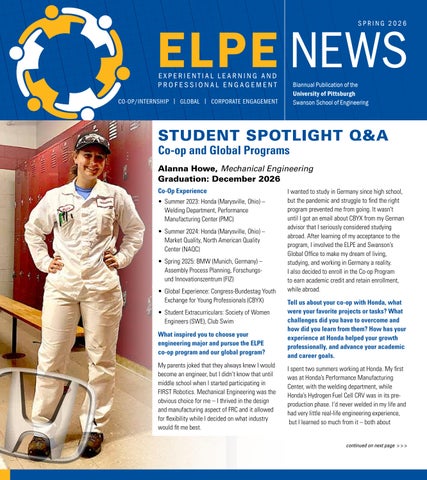
Alanna Howe, Mechanical Engineering
Graduation: December 2026
Co-Op Experience
• Summer 2023: Honda (Marysville, Ohio) –Welding Department, Performance Manufacturing Center (PMC)
• Summer 2024: Honda (Marysville, Ohio) –Market Quality, North American Quality Center (NAQC)


• Spring 2025: BMW (Munich, Germany) –Assembly Process Planning, Forschungsund Innovationszentrum (FIZ)
• Global Experience: Congress-Bundestag Youth Exchange for Young Professionals (CBYX)
• Student Extracurriculars: Society of Women Engineers (SWE), Club Swim
What inspired you to choose your engineering major and pursue the ELPE co-op program and our global program?
My parents joked that they always knew I would become an engineer, but I didn’t know that until middle school when I started participating in FIRST Robotics. Mechanical Engineering was the obvious choice for me – I thrived in the design and manufacturing aspect of FRC and it allowed for flexibility while I decided on what industry would fit me best.
I wanted to study in Germany since high school, but the pandemic and struggle to find the right program prevented me from going. It wasn’t until I got an email about CBYX from my German advisor that I seriously considered studying abroad. After learning of my acceptance to the program, I involved the ELPE and Swanson’s Global Office to make my dream of living, studying, and working in Germany a reality. I also decided to enroll in the Co-op Program to earn academic credit and retain enrollment, while abroad.
Tell us about your co-op with Honda, what were your favorite projects or tasks? What challenges did you have to overcome and how did you learn from them? How has your experience at Honda helped your growth professionally, and advance your academic and career goals.
I spent two summers working at Honda. My first was at Honda’s Performance Manufacturing Center, with the welding department, while Honda’s Hydrogen Fuel Cell CRV was in its preproduction phase. I’d never welded in my life and had very little real-life engineering experience, but I learned so much from it – both about

engineering in industry and myself. Since we were in pre-production trials, everything had to be tested – most notably, every single spot weld on a car chassis. We welded up an entire car with the newly installed welding robots before we spent three 10-hour days tearing every single weld apart (nearly 3,000 in total) and measuring its diameter. I learned that engineering goes beyond the design phase and that design isn’t just about aesthetics. Manufacturability is the difference between success and failure but also a key point of contention between the designers and the production workers.
My second term there was in market quality. There we investigated part failures and failure patterns from dealerships worldwide. I was assigned to the team responsible for the fuel system: fuel pumps, sensors, catalytic converters, and injectors. The fuel system in a car is extremely complex, especially when it’s a hybrid. Often, we would only receive a single part from the dealership. Installing it on a car would result in inconclusive results, since the problem is a result of circumstances or multiple faulty parts together.
The position was more “engineer-like.” Most of our work was on the computer analyzing failure trends. I felt as if I was reacting to problems that were 3-5 years in the making rather than preventing them.
These two co-ops taught me that the fast-paced nature of manufacturing combined my desire to constantly solve problems, work in a diverse team environment, and occasionally get my hands dirty. Since narrowing down where I want to focus my interests, I am more intentional about the courses I take as electives and my final internship before I graduate.
What were some of the biggest lessons you learned about teamwork and communication while working for Honda and abroad?
All three of my opportunities required me to communicate with and work alongside those whose backgrounds were extremely different from my own. At Honda, I interacted with production associates, contractors, engineers, and our Japanese colleagues daily. At BMW my network spanned 7+ countries. I could be meeting with colleagues from a Chinese plant at 8 a.m. and then coworkers from the South Carolina plant at 3 p.m. Interacting with coworkers, whose cultural and language backgrounds differed from my own meant that I needed to be intentional about what words I used. I learned that even if you are comfortable working in multiple languages, the process of translating the work from one language to another is more difficult than expected, so care must be taken to clearly communicate what is needed.
The process of launching a new car model is one that requires the expertise of thousands of people. Each employee has a specific background which makes them valuable to the development of the car and it’s important to listen to those that will be affected by your decisions. At both Honda and BMW, I was making decisions which would impact the day-to-day lives of production associates. I made it a priority to ask them for guidance when making those decisions because they were the ones carrying out the tasks on a daily basis for the life of the product.
You also spent some time working at BMW Europe. Tell us about your experience! What was your favorite thing about working abroad? What surprised you the most about working in Germany? What skills did you learn at BMW Europe that will help you the most when entering the workforce after graduation?


I spent the last five months of my year in Germany working as an Assembly Process Planning Intern at BMW’s Forschungs- und Innovationszentrum (Research and Development Facility). I was motivated to integrate myself into the German city where I was located, and use my language skills that I had been learning since eighth grade. I pushed myself to speak mostly German at work – even though my colleagues could speak English. In this position, I was responsible for assisting full-time colleagues with various topics related to the launch of new BMW models worldwide. I spent a good portion of my time in BMWs “Plant Zero” or prototype production plant with production associates from the model’s future plant. Together we worked through problems related to the assembly of the vehicle. I met often with the design team and advocated on behalf of the production team for changes which would improve manufacturability.


Working in a different country (and language!) taught me to be more confident in myself and my abilities. My team valued the ideas that I brought to the table and my unique perspective on problems


even if they weren’t communicated with perfect grammar. At a meeting with a German fixture supplier and our American colleagues, I applied my U.S. manufacturing experience to clarify the functionality of said fixture in relation to OSHA standards, so that it could be approved for further production and then utilized.
What aspects of your undergraduate experience helped your application to CBYX stand out?
The goal of the CBYX Program is to cultivate transatlantic relationships between young Germans and Americans. I centered my application on my experience with the German language and in the automotive industry. Although the program does not require German language experience, it showed the program organizers that I was serious about wanting to be in Germany and was prepared to integrate myself into the community. In addition to my language experience, I was very clear about what I wanted to learn about Germany’s automotive industry. This goal was supported by the knowledge I acquired during my internships at Honda.
Can you share a bit about your future career goals and how you’re preparing to transition into the full-time workforce? In what ways do you feel the experience with the domestic and global programs ha s helped you grow professionally?
Participating in CBYX and interning at BMW helped me identify what exactly I wanted from a future position. I took classes to learn rather than to pass an exam at the end. Internships/ co-ops are great for building experience, but for me, they have been crucial in helping me figure out what I want from a future position and a future company. My three terms taught me what industry and capacity I want to work in but it was my time abroad that helped me learn how I want to live. Honda was great to me, but there was something about BMW that was different. For the longest time, German was only a class. After my year abroad, it evolved into something different. I unlocked a different side of myself that I didn’t know existed, one that would never have been found had I not lived abroad. Working on such a diverse team, both in terms of the
physical location of my coworkers and their roles as planning engineers, designers, or production associates created the team environment that was similar to what I experienced during FIRST Robotics. It showed me the work atmosphere where I can flourish.
Anything else you’re looking forward to professionally, or advice for current Pitt students?
Although short-term study abroad programs are easier to build into your engineering degree, I highly recommend studying abroad longer. I feel that you gain a different perspective on the city/ country you move to when you are there longer. I also highly recommend taking language courses. Our engineering degrees are jam-packed with so many STEM classes. For me, pursuing a German Language Certificate at Pitt gave me the opportunity to take a break from the science and engineering that consumes my semesters.
Honda and BMW logos credit: liubomir118809 - stock.adobe.com

Do you have an opportunity for a Swanson School student in the U.S. or around the world? We’d love to help you advertise the opening – reach out to anyone on the ELPE team!


Emilio Hoyos-Sosa
Chemical Engineering, The Sherwin Williams Company
Emilio is also the finalist for the 2025 American Society for Engineering Education Cooperative and Experiential Education Division (ASEE CEED) Co-Op of the Year award! A very warm congratulations to him!
Our warmest congratulations to our nominees and winners of the 2025 Co-Op Student and Employer of the Year Awards! This recognition is a testament to your dedication to the program and your outstanding work.
Conair Group
Back

Jayson Baggett
Bioengineering
Philips


Cheers for our 2025 Co- op and Global graduating students. Your perseverance and dedication to your student career have truly paid off! Our best wishes to all our students for their continued success as they enter their next adventure.
× students who completed co-op programs * students who completed Global programs *× students who completed both co-op and Global programs
Allison Brunswick×
Amila Niksic×
Amirtha Maria*
Andrew Hoang×
Anna Randolph×
Danielle Scott×
David Wang*
Gabriella J. Brubach*
Grace Melloy×
Hallie Maytin×
Isabella F. Gaydosh*
Jake M. Doran*
Jared Kolarcik-Schmitt*
Jayson James Baggett×
Jiaheng “Jasmine” Wu×
Kasey Loehr Forsythe*
Kassidy Helene Felsinger*
Kate Dumitru Bonifacic×
Kennedy Snook*
Kevork Zeibari*
Kyle Norcross×
Logan Marsalko×
Madison P. Smith*
Maya Franklin*
Mia C. Chupein*
Moriah Eley*
Nicholas Pho×*
Peter B. Wood*
Rebecca L. Miller*
Sarai Morato×
Sindhu Nalamothu*
Victoria Lieu×
Yugma Patel*
Zachary Alexander Miller*
Zachary O. Nellas*
Abigail G. Kocher*
Brenda L. Rea*
Christopher Kretschman×
Emilio Hoyos-Sosa×
Evan Konigsberg×*
Gabrielle Fernandes*
Giuliana Romeo×*
Henry Gaffur×
Jason M. Bonavita×
Jenna Rogish×
John P. Lake*
John Ufer*
Joseph C. Nypaver×
Kayla Dombach×
Keaton A. Wnuk×
Lucy E. Strazis*
Meghan C. Keppler×
Riley Bender×
Samuel M. Landon×
Stacy Akua Bediako*×
Stacey Ngo×*
Tyler Bindas×*
Taylor M. Mincin×
Theresa A. Kelly×
Benjamin H. Hardy*
Daniel G. Schaub*
Erica K. Beigi*
Faith Aldrich*
Griffin A. Graham×
Jake Jordan×
Joshua Douglas Truesdell×
Liam T. McLaughlin*
Madelynn E. Bennett*
Owen A. Gaskill×
Riley Rodriguez*
Tyler H. Jacobson ×
Abigail M. Magistro*
Abigail Q. Maier*
Annabelle Werner×
Amber J. Earnest×
Arissa J. Buchina×
Benjamin Esquieres*
Dikchhya Kharel×
Dylan M. Renaldi×
Elizabeth Novikova×
Ethan J. Lee×
Isabella Terick×
Jonah Belback×
Joshua Krymgold*
Julia Koma*
Lauren A. Gilfillan*
Lucas Z. Connell×
Michael A. VanDemark×
Morgan K. Visnesky×
Nathaniel Ethan Ginck*
Nischal Kharel×
Oday Abushaban*
Son Vu×
Thomas Gallagher-Teske×
William Muckelroy III×
Yuheng Lin×
Alek M. Barter×
Cara Jean Buck×*
Connor Watson×
David Z. Zhang×
Felipe Junqueira×*
Gianni E. Diacopoulos*
Gregory R. Soltys×
Kevin Gu×
Kushal Parekh*
Lily G. Grech×
Ruizhe Gao*
Seth G. Blain*×
Sophia Shoemaker*
Tyler A. Hansen*
Yubin Wu×
Allison L. Hastings*
Carina E. Rose*
Heather Phillips×*
Natan Herzog*
Amy Zhang*
Hope Blair×
John Schlegel*
Jordan DeWeese×*
Matthew Brancaccio×*
Paige M. Flinchbaugh*×
Quincey Kilbride*
Rae Templeton*
Rebecca Jalboot×
Samantha J. Eckenrod*
Adam R Price×
Alexa Velasquez×
Alison L. Ngau×
Allison Bergkoetter*
Allison E. Haflett*
Amelia J. Ossman×
Andreea V. Toader×
Cameron L. Case×
Cameron K. Kiebort*
Camryn L. Grizzetti*
Christos Mavrogeorgis*
Emily K. Bosworth*
Ethan J. Snyder*×
Ethan T. Staudt×
Henry J. Veltum×
Jackson T. Warters*
Jake B. Johnson×
James Pottieger×*
Jason N. Wiedmann×
Joshua B. Lee×
Juan Manuel Lugo*
Julia Roselli×*
Katherine Gonzalez×
Maggie Altscaffl×
Maggie R. Piro*
Maiah Santiago Ruby×
Maksim Djokic*×
Margaret Elyse Altschaffl*
Megan L. Suess*×
Morgan Powers*
Nathanail K. Sexton×
Rachel S. Thomas×
Roan McCall×*
Rylee N. Shaffer×
Samantha L. Alfieri*
Vaani Bansal×
Addison Mueller×*
Isaac D. Ellis×
Jakub Wasielewski×
Jenna N. Donohue*
Pocket Pizzutillo×
Rose Sharga×
Simeona Hein×*
Steven T. Panico*
Steven Smith×*
Mechanical Engineering
Adam Browning×*
Alexandra Greiner*
Anagha Venkatesh×
Andrew R. Cohen*
Anna George×*
Annabella R. Peretti*
Anthony Sandone×
Austin C. Pierce*×
Benjamin E. Krauss*
Brittany Sadej×
Bryce Patterson×
Claire E. Rossi*×
Connor Fallon*
Connor Ruark×
Dalia Chemaitilly*×
Daniel Stratman Chimes*×
Eli Marks×
Emily McShane×
Emma Murphy×
Ethan G. Smelko×
Harkamal Singh×*
Isabelle McGowan×
Jackson Morrow×
James M. Hill×
Jerry Peng*
Jingyu Jean Chen×
John E. Profozich*×
John Tochney×
Juliette Caroline Davoine×
Logan Huwe×*
Madison M. Hughes*
Matthew R. Renda×*
Maya N. Connors*
Nicholas Chiaro*×
Oscar Oliva×
Paige L. Dillon×
Paul C. McPartland*
Phoebe E. Katz*
Rebekah G. Burns*
Rigel J. Voelker*
Shokhzhakhon Anarmetov×
Tai R. Roberts*
Thien H. Chu×
Timothy J. Chango Gassett×
Timothy J. Sullivan*


Rosy Li is a current PhD candidate in the Department of Bioengineering and a Graduate Student Researcher in the Tumor Microenvironment Engineering Laboratory. She completed a co-op at Merck during the summer and fall 2025 terms. As a Retinal Biology Co-op working with the ophthalmology group at the Merck Research Laboratory, Rosy collaborated on a pipeline program validating genetic targets for eye disease treatment. She shared the following about her co-op experience: “The co-op experience was a great addition to my grad school experience. I was very lucky to actively engage in a pipeline program, where I learned how decisions are made and how to prioritize experiments. I was able to work with scientists doing R&D work, which is a crucial step to translating knowledge from bench to bedside. It feels very rewarding and encouraging to see how research in academia can advance drug development in industry.” Rosy also noted that her co-op experience gave her a broader vision of the potential health challenges that the world will be facing in the future as aging continues to be a prevalent global health challenge, impacting the demand for effective treatments for aging-related diseases.
Upon graduation in 2026, Rosy aspires to work in a postdoc or scientist role as she desires to keep working on scientific and early discovery research. She has the following advice for fellow PhD students interested in pursuing a co-op or internship during their program: “Bioengineering is a very broad subject. It is important to dive deep in a technical area, such as cell and molecular biology, molecular profiling, imaging, statistics or coding. For co-ops and interns in industry, your skills matter more than the specific research question you are working on as a graduate student. I had very little knowledge in ophthalmology before my coop, but in co-op or internship roles, most of the work will be technical. The current job market is very competitive, and if you have a chance to do a co-op or internship, do not hesitate.”
We wish you continued success in your career, Rosy!


Former Major: Mechanical Engineering
Graduation Month/Year: April 2018
Co-Op Experience: Yuba Bicycles
Student Extracurriculars: Human Powered Vehicle Club

Current Position: Sr. Mechanical Engineer – Four Growers
What inspired you to choose your engineering major and pursue a co-op program?
After spending time in the non-profit world, I found myself wanting a more technical, handson path. Before coming to Pitt, I earned a dual degree in Physics and Art from Goshen College. After graduating, I had the privilege of traveling internationally by bicycle and later spent a year in PULSE (Pittsburgh Urban Leadership Service Experience) working for a community development organization in Pittsburgh’s Northside.
My desire to further apply my Physics degree and mathematical problem-solving skills led me back to school for a mechanical engineering degree. Pitt’s co-op program was a major factor in my decision – I knew that real-world experience would be just as important as anything I learned in the classroom.
Besides co-op, what other experiences at Pitt did you feel were most impactful to you professionally and otherwise?
I tried to tie my passion for bicycles into my engineering education whenever possible. When I arrived at Pitt, there weren’t any clubs focused on bicycle design, so I founded the Pitt chapter
of the Human Powered Vehicle Club, which went on to compete in ASME’s Human Powered Vehicle Competition.
Starting the club from scratch taught me an incredible amount– not just about bicycle design, engineering, and fabrication, but also about leading, learning from mistakes, delegating responsibility, and finding funding. By our second year, we placed 4th out of 47 teams overall and 1st in the 2.5-hour endurance race. The friendships and connections I made through this experience are ones I still carry with me today. Some of my teammates went on to found a local machine shop called Three Rivers Precision, and we’ve continued to work together professionally.
Can you describe one of your most memorable or challenging projects during your co-op?
One of the most memorable projects I worked on was the redesign of a Yuba bicycle accessory called the “Monkey Bars:” a bolt-on, wrap-around handlebar for kids riding on the rear rack of a cargo bike. We began by polling customers on social media to learn what features they wanted in an updated design, such as water bottle mounts or quick-release functionality.
One of my earliest prototypes was literally hacked together with electrical tape and a hacksaw. Over time, I developed the idea into a full CAD model with detailed drawings. I collaborated with an overseas supplier on a first-article sample, and even designed sustainable cardboard packaging. Today, the Adjustable Monkey Bars are still sold on Yuba’s website, and I’m proud every time I spot a set “in the wild” on the streets of Pittsburgh.
In what ways has your co-op experience continued to influence your career or learning today?
I often think back to a moment when my manager, Tim, held up the Yuba “Ring” (a rack-mounted handhold for rear passengers) and asked, “How much do you think this would cost?” I had very little reference at the time, but the exercise pushed me to consider how fabrication techniques like tube bending, welding, and sheet metal cutting affect overall cost.
That mindset has stayed with me. Even now, I routinely think through manufacturing cost implications during the early stages of a design.
Tell me a little more about your current role, what does a typical day look like for you? What are your favorite parts?
I’m currently working on the development of Four Growers’ GR-200 tomato-harvesting robot. No two days look the same – I may spend one day prototyping or assembling hardware in the shop and the next creating detailed CAD drawings and documentation.
Complex problems surface regularly, and I love being able to solve them through hands-on experimentation and creative engineering. That combination of variety and problem-solving is one of my favorite parts of the role.
What was the biggest challenge you faced when transitioning from college to full-time work? How do you think your co-op program prepared you for the transition?
Early in my career, one of the biggest challenges was building confidence in my designs and engineering decisions. Tim, my co-op manager, encouraged me to trust my analysis or validate it quickly through subsystem testing. That advice has stuck with me, and I still rely on it today.
My co-op experience helped make the transition smoother by exposing me to real engineering workflows, timelines, and expectations long before I graduated.
Anything else you’re looking forward to professionally, or advice for current Pitt students?
Pursue what you love to do. I knew I wanted to work as a mechanical engineer in the bike industry, which wasn’t a typical path for Pitt engineering students. But by proactively reaching out to companies and staying persistent – even reapplying multiple times over several years – I eventually landed a dream role in Yuba. If you’re passionate about a particular field, lean into it. Persistence and enthusiasm go a long way.
It is worth noting that a dream job is more than the work itself. Healthy work life balance, a supportive work environment, even the ability to easily get to a work place are all factors that are important to consider. While I no longer work in the bike industry, my current job allows me to bike to work and live in a city that I love. These external factors are just as important to consider when landing a dream job.

Engineering employers today are seeking graduates who bring more than strong technical foundations. The most competitive candidates are those who can collaborate across teams and cultures, communicate effectively with diverse stakeholders, and adapt quickly in fast-moving, global work environments.
At the Swanson School of Engineering, global experiences are a key component of how students develop these workforce-ready competencies. Through faculty-led programs, international research, internships, and applied learning abroad, students gain firsthand experience working in settings that mirror the realities of modern engineering workplaces.
When students engage in engineering studies abroad, they are operating in environments shaped by different business practices, regulatory frameworks, and cultural norms. These experiences strengthen skills employers consistently identify as critical to early-career success, including:
• Cross-cultural teamwork – collaborating effectively with international peers, faculty, and industry partners
• Professional communication – explaining technical ideas clearly to varied audiences
• Adaptability and initiative – navigating new environments, expectations, and constraints
• Problem-solving under real-world conditions – applying engineering principles when information is incomplete or conditions change
As one industrial engineering student noted after participating in a global engineering program:

Working in a different country required me to communicate more clearly, adapt quickly, and take ownership of my work. Those are skills I now use in every professional setting.
At a Glance: Global
Students who participate in global programs consistently demonstrate qualities that employers value in early-career engineers:
• Comfort working on diverse, multidisciplinary teams
• Strong communication and collaboration skills
• Ability to adapt quickly in new or uncertain situations
• Broader understanding of global markets, standards, and operations
These experiences complement technical training, and help graduates transition more smoothly into professional positions.
Access to global experiences is essential for building a strong, diverse talent pipeline. For some students, logistical barriers – such as obtaining travel documentation – can limit participation before learning even begins.
By proactively addressing these barriers, the Swanson School ensures students can focus on developing professional competencies rather than navigating obstacles. In 2024-25, 14 students received passport support, enabling them to participate in international programs and gain experience relevant to global engineering careers.
A mechanical engineering student who completed a program in Germany reflected:

18% of Swanson School undergraduates graduated with a global experience last year – nearly three times the national average for engineering students (5.4%, IIE Open Doors Report)
Students engaged in engineering learning experiences across 24+ countries, gaining exposure to global engineering practices
14 students received passport grants sponsored by SSoE Alumni in 2024-25, removing first barrier to participation in a global professional experience
This experience gave me confidence that I can work effectively in any environment. I learned how to adapt, communicate with different teams, and approach engineering challenges from a global perspective.

Alyssa Smeltz, Industrial Engineering, Global E3: Lappeenranta University of Technology (LUT) Finland
My Global E3 semester long exchange to Lappeenranta University of Technology (LUT) in Lappeenranta, Finland was a truly wonderful experience. LUT is extremely welcoming to exchange students and makes it so easy to make friends of all different cultures. I gained a deep appreciation of Finland’s emphasis on independence and the sauna culture, which I will forever miss. Throughout my time in Finland, I was able to see multiple different regions of the country through different programs at LUT including Helsinki, Tampere, and Lapland. I will forever treasure my short time I was able to spend in Finland!

Carson Curley, Civil Engineering, Sustainable Engineering in Iceland
Studying abroad in Iceland was truly a transformative experience. Seeing the Northern lights in person revealed the powerful interaction of natural beauty and science. Exploring Reykjavík and learning thermodynamics with Dr. Barry, then applying that knowledge during our visit to a geothermal power plant, was the perfect example of learning brought to life.
Daniel Cooper, Chemical Engineering, SERIUS: Engineering Summer Research at NUS
Being able to participate in the SERIUS program through Pitt and the National University of Singapore has made my college experience. I loved the chance to work across the world and connect with people I never would have met otherwise. I also appreciated that the program is connected with several American and Canadian universities, so I got to meet some other great people from here. Overall, I enjoyed being able to get hands on research experience while expanding my cultural horizons to make me a better fit in the interconnected world we live in.

Matthew Ketas, Computer Engineering, Plus3: SSoE Transfer Plus - Czech Republic “Plus3 Czech Republic gave me the invaluable opportunity to visit Europe for the first time and broaden my perspective as an engineer. It sparked my interest in Virtual Power Plant technology and large-scale power systems, while strengthening my relationships with faculty and peers, allowing me to form lasting interdepartmental connections. I highly recommend this program to engineering students who want to shape their study abroad experience around their academic and professional interests.”


Arth Shah, Industrial Engineering, Moving the Cities: Chile
“Participating in MTC 2025 in Santiago, Chile was one of the most inspiring academic experiences I’ve had at Pitt. Working alongside Chilean and international students on real sustainability challenges pushed me to communicate across cultures, adapt quickly, and turn complex problems into practical, community-centered ideas. I returned more globally aware, more confident in interdisciplinary teamwork, and more motivated to pursue impactdriven work

Studying abroad in Singapore was an experience like no other. I met amazing people, tried decadent foods, expanded my knowledge in the field of bioengineering, and saw sights I will dream of for the rest of my life. I encourage anyone that can to go out into the world and see what it has to offer, for you will be forever changed in ways you could never imagine.
Studying abroad in Iceland has been one of the most impactful experiences of my education so far. This program gave me an immersive look at a country with unique resources and climate, and I was able to see firsthand how Iceland leverages its challenging environment in sustainable and innovative ways. As an industrial engineering student, this weeklong program fulfilled my international requirement while broadening my understanding of sustainability and global problem solving. The highlight of my trip was seeing the Northern Lights!


Participating in The German Way program was such a life-changing experience, from exploring the intersection of engineering and innovation in Germany to bonding with students in Munich over culture, language, and late-night laughs. I returned more inspired than ever to work in international engineering, and more confident in my ability to thrive outside my comfort zone. I’ll always carry the memories, friendships, and a heart full of gratitude for this incredible program.

My global experience made me realize that engineering is a universal language. The language of the region we were in was mainly Spanish, and Basque. The real connection with me was how we could still have similar goals and motives for what we want to accomplish in engineering. It was fascinating hearing about the various Spain based products and the goal we all share to want to help others and create useful products. This is something that does not get lost across an ocean.
Going to the Czech Republic was my first time in Europe. The trip focused on how engineering and society are interconnected. My favorite trips related to this theme were Podolí Waterworks, Kutná Hora, the silver mine, Kunsthalle Praha, ČEZ, and Škoda. As an environmental engineer, it was interesting to visit ČEZ’s open coal mine and see their remediation projects and plans to transition to nuclear energy. This trip was so unique, and I am so grateful for the opportunity to have this experience!


My time in the Czech Republic was filled with so many amazing experiences I will carry with me forever. I made so many new friends, got to try so much delicious food, and learned more about Czech history and engineering. One of my favorite visits was when we got to go inside the Škoda factory and take a tour of their Motorsport facility. It was amazing to see behind the scenes of the factory and learn more about the complexities of automotive manufacturing. I hope I have the opportunity to travel abroad again to learn more about how engineering impacts our world.
The ELPE team had a blast at the 2025 Fall Co-op and Internship Fair! A very special thank you to our attending employees and students for their participation! We hope to see you on January 23 at the spring fair! October 2, 2026 | 9:30 a.m.


SSoE ELPE office now has a LinkedIn page!
Office of Experiential Learning and Professional Engagement Staff
Chris Ann Frankovic Director, Cooperative Education and Internships caf54@pitt.edu
Alicia Olalde Director, Global Experiences and Engagement a.olalde@pitt.edu
Dana Romano Director, Career and Industry Engagement Dar19@pitt.edu
Tyler Kimmel Assoc. Director, Cooperative Education and Internships Tjk58@pitt.edu
Valerie Kerr Assoc. Director, Graduate Professional Development, Cooperative Education and Internships vek32@pitt.edu
Megan Amoroso Global Program Manager m.amoroso@pitt.edu
Nora Dougherty Global and Engineering Professional Development Consultant clc369@pitt.edu
Kristie Frazier ELPE Administrator Kmw257@pitt.edu