October 3, 2025 | 11 Tishrei 5786
Candlelighting 6:40 p.m. | Havdalah 7:37 p.m. | Vol. 68, No. 40 | pittsburghjewishchronicle.org
NOTEWORTHY LOCAL Developing leadership — and community
Pitt law students attend D.C. summit LOCAL
Page 2
$2
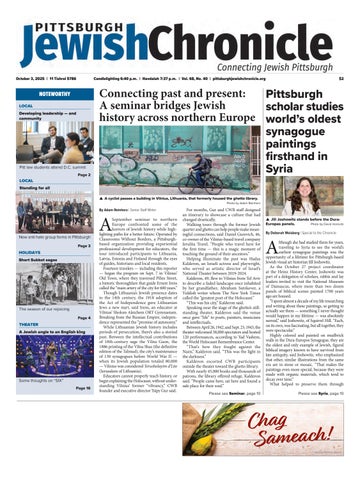
Connecting past and present: Pittsburgh A seminar bridges Jewish scholar studies history across northern Europe world’s oldest synagogue paintings firsthand in Syria
Standing for all A cyclist passes a building in Vilnius, Lithuania, that formerly housed the ghetto library.
Photo by Adam Reinherz
By Adam Reinherz | Senior Staff Writer
New anti-hate group forms in Pittsburgh Page 3
HOLIDAYS Short Sukkot sagas
The season of our rejoicing Page 4
THEATER A Jewish angle to an English king
Some thoughts on “SIX” Page 16
A
September seminar to northern Europe confronted some of the horrors of Jewish history while highlighting paths for a better future. Operated by Classrooms Without Borders, a Pittsburghbased organization providing experiential professional development for educators, the tour introduced participants to Lithuania, Latvia, Estonia and Finland through the eyes of guides, historians and local residents. Fourteen travelers — including this reporter — began the program on Sept. 7 in Vilnius’ Old Town, where they traversed Pilies Street, a historic thoroughfare that guide Ernest Irens called the “main artery of the city for 600 years.” Though Lithuania’s Jewish presence dates to the 14th century, the 1918 adoption of the Act of Independence gave Lithuanian Jews a new start, said Irens, an educator at Vilnius’ Sholom Aleichem ORT Gymnasium. Breaking from the Russian Empire, independence represented the “promise of autonomy.” While Lithuanian Jewish history includes periods of persecution, there’s also a storied past. Between the intellectual contributions of 18th-century sage the Vilna Gaon, the 1886 printing of the Vilna Shas (the definitive edition of the Talmud), the city’s maintenance of 130 synagogues before World War II — when its Jewish population totaled 80,000 — Vilnius was considered Yerusholayim d’Lite (Jerusalem of Lithuania). Educators cannot properly teach history, or begin explaining the Holocaust, without understanding Vilnius’ former “vibrancy,” CWB founder and executive director Tsipy Gur said.
For months, Gur and CWB staff designed an itinerary to showcase a culture that had changed drastically. Walking tours through the former Jewish quarter and ghetto can help people make meaningful connections, said Daniel Gurevich, 46, co-owner of the Vilnius-based travel company Jerulita Travel. “People who travel here for the first time — this is a magic moment of touching the ground of their ancestors.” Helping illuminate the past was Hadas Kalderon, an Israeli actress and playwright, who served as artistic director of Israel’s National Theater between 2019-2024. Kalderon, 49, flew to Vilnius from Tel Aviv to describe a faded landscape once inhabited by her grandfather, Abraham Sutzkever, a Yiddish writer whom The New York Times called the “greatest poet of the Holocaust.” “This was his city,” Kalderon said. Speaking near the stage of the ghetto’s stillstanding theater, Kalderon said the venue once gave “life” to poets, painters, musicians and intellectuals. Between April 26, 1942, and Sept. 23, 1943, the theater welcomed 38,000 spectators and hosted 120 performances, according to Yad Vashem, the World Holocaust Remembrance Center. “That’s how they fought against the Nazis,” Kalderon said. “This was the light in the darkness.” Kalderon escorted CWB participants outside the theater toward the ghetto library. With nearly 45,000 books and thousands of patrons, the library offered refuge, Kalderon said. “People came here, sat here and found a safe place for their soul.” Please see Seminar, page 10
Jill Joshowitz stands before the DuraEuropas panels. Photo by David Horovitz By Deborah Weisberg | Special to the Chronicle
A
lthough she had studied them for years, traveling to Syria to see the world’s earliest synagogue paintings was the opportunity of a lifetime for Pittsburgh-based Jewish visual art historian Jill Joshowitz. As the October 27 project coordinator at the Heinz History Center, Joshowitz was part of a delegation of scholars, rabbis and lay leaders invited to visit the National Museum of Damascus, where more than two dozen panels of biblical scenes painted 1700 years ago are housed. “I spent almost a decade of my life researching and writing about these paintings, so getting to actually see them — something I never thought would happen in my lifetime — was absolutely surreal,” said Joshowitz, of Squirrel Hill. “Each, on its own, was fascinating, but all together, they were spectacular.” Highly colored and painted on mudbrick walls in the Dura-Europos Synagogue, they are the oldest and only example of Jewish, figural biblical imagery known to have survived from late antiquity, said Joshowitz, who emphasized that other, similar illustrations from the same era are in stone or mosaic. “That makes the paintings even more special, because they were made with organic materials, which tend to decay over time.” What helped to preserve them through Please see Syria, page 10
Chag Sameach!
JacZia/Adobe Stock