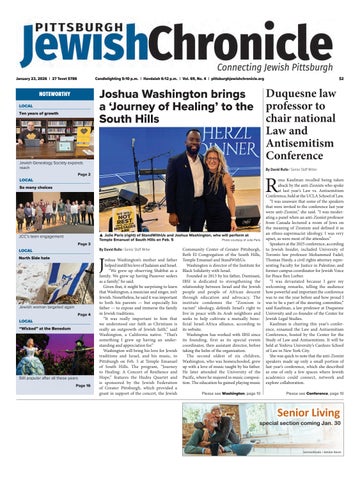

Joshua Washington brings


Jthat Washington, a musician and singer, isn’t Jewish. Nonetheless, he said it was important to both his parents — but especially his father — to expose and immerse the family in Jewish traditions.


“It was really important to him that we understood our faith as Christians is really an outgrowth of Jewish faith,” said Washington, a California native. “That’s something I grew up having an understanding and appreciation for.”
Washington will bring his love for Jewish traditions and Israel, and his music, to Pittsburgh on Feb. 5 at Temple Emanuel of South Hills. The program, “Journey to Healing: A Concert of Resilience and Hope,” features the Hudra Quartet and is sponsored by the Jewish Federation of Greater Pittsburgh, which provided a grant in support of the concert, the Jewish
Community Center of Greater Pittsburgh, Beth El Congregation of the South Hills,
Washington is director of the Institute for

Founded in 2013 by his father, Dumisani, IBSI is dedicated to strengthening the relationship between Israel and the Jewish people and people of African descent through education and advocacy. The institute condemns the “Zionism is racism” ideology, defends Israel’s right to live in peace with its Arab neighbors and seeks to help cultivate a mutually beneficial Israel-Africa alliance, according to its website.
Washington has worked with IBSI since its founding, first as its special events coordinator, then assistant director, before taking the helm of the organization.
The second oldest of six children, Washington, who was homeschooled, grew up with a love of music taught by his father. He later attended the University of the Pacific, where he majored in music composition. The education he gained playing music
Duquesne law professor to chair national Law and Antisemitism Conference
By David Rullo | Senior Staff Writer
ona Kaufman recalled being taken aback by the anti-Zionists who spoke at last year’s Law vs. Antisemitism Conference, held at the UCLA School of Law.
“I was unaware that some of the speakers that were invited to the conference last year were anti-Zionist,” she said. “I was moderating a panel when an anti-Zionist professor from Canada lectured a room of Jews on the meaning of Zionism and defined it as an ethno-supremacist ideology. I was very upset, as were most of the attendees.”
Speakers at the 2025 conference, according to Jewish Insider, included University of Toronto law professor Mohammed Fadel; Thomas Hardy, a civil rights attorney representing Faculty for Justice in Palestine; and former campus coordinator for Jewish Voice for Peace Ben Lorber.
“I was devastated because I gave my welcoming remarks, telling the audience how powerful and important the conference was to me the year before and how proud I was to be a part of the steering committee,” said Kaufman, a law professor at Duquesne University and co-founder of the Center for Jewish Legal Studies.
Kaufman is chairing this year’s conference, renamed the Law and Antisemitism Conference, hosted by the Center for the Study of Law and Antisemitism. It will be held at Yeshiva University’s Cardozo School of Law in New York City.
She was quick to note that the anti-Zionist speakers made up only a small portion of last year’s conference, which she described as one of only a few spaces where Jewish academics could connect, network and explore collaboration.

Photo courtesy of Julie Paris
Headlines
Jewish Genealogy Society of Pittsburgh marks 10 years with growing membership and expanded programming
By Adam Reinherz | Senior Staff Writer
As the Jewish Genealogy Society of Pittsburgh approaches its 10th anniversary, the once small local group is marking the milestone with ambitious programming, a growing global membership and a renewed commitment to helping people uncover — and make sense of — their family histories.
Steve Jaron, JGS’ president, touted several upcoming events and reflected on the group’s near-decade of growth.
On Jan. 25, JGS will welcome Janice Lovelace, a genealogical researcher, author and lecturer, with over 30 years of experience, for “The Emotional Roller Coaster of DNA Testing.” The Zoom program will allow participants to explore the messy side of DNA testing and address strategies for navigating genealogical surprises, such as what to do when discovering previously unknown relatives or non-responsive matches.
Weeks later, on Feb. 15, JGS will welcome Ava Cohn, a genealogist referred to as “Sherlock Cohn,” for a program aimed at helping participants make sense of old photographs and the confusions arising from dating pictures and identifying individuals.
Then, on May 17, JGS will host Janette Silverman, a professional genealogist with over four decades of experience, for an exploration of how a Lithuanian family arrived in Pennsylvania in the late 19th century and somehow ended up in Bisbee, Arizona.
JGS events, which include both hybrid and online-only gatherings, enable like-minded

individuals to explore their own histories while creating community, Jaron said. “There is some sort of genealogical learning opportunity for everybody.”
Jaron said he is proud of JGS’ “supportive” environment and noted the organization’s continuous growth: As of last week, the group includes 228 members, with many living nowhere near western Pennsylvania.
The fact that members worldwide belong to an organization rooted here “shows how far-reaching we are,” Jaron said. Whether in Pittsburgh or at genealogy-related gatherings across the country, “people are always coming up to me and saying they love our programming.”
Eric Lidji, director of the Rauh Jewish History Program at the Heinz History Center,
called JGS a “real success story in the local Jewish community.”
“Starting out with little more than a name and a lot of passion, they have created a robust programming calendar drawing participants from all over the world,” Lidji said.
In recent years, the Rauh has partnered with JGS, while also providing “space, administrative support and seed funding,” Lidji said. “We celebrate their milestone.”
A growing interest in genealogy isn’t only occurring in Pittsburgh.
With people purchasing DNA tests, access to online records, digital family tree building tools and other services, the global market for genealogy products and services was valued at $6.6 billion in 2024 and expected to grow to $16.6 billion by 2032, according

SUBSCRIPTIONS
subscriptions@pittsburghjewishchronicle.org
412-687-1000, ext. 2 TO ADVERTISE advertising@pittsburghjewishchronicle.org 412-687-1000, ext. 1
EDITORIAL DEPARTMENT
Email: newsdesk@pittsburghjewishchronicle.org
BOARD OF TRUSTEES
Evan H. Stein, Chair
Evan Indianer, Vice Chair
Derek Smith, Treasurer
Gayle R. Kraut, Secretary
Gail Childs, Dan Droz, Malke Steinfeld Frank, Karen Gal-Or, Seth Glick, Judith Kanal, Cátia Kossovsky, Charles Saul, Lynn Zelenski
GENERAL COUNSEL
Stuart R. Kaplan, Esq.
Jim Busis, CEO and Publisher 412-228-4690 jbusis@pittsburghjewishchronicle.org
EDITORIAL Toby Tabachnick, Editor 412-228-4577 ttabachnick@pittsburghjewishchronicle.org
Adam Reinherz, Senior Staff Writer 412-687-1000 areinherz@pittsburghjewishchronicle.org
David Rullo, Senior Staff Writer 412-687-1000 drullo@pittsburghjewishchronicle.org
ADVERTISING Amy Weiss, Account Executive (412) 613-0697 aweiss@pittsburghjewishchronicle.org
PRODUCTION
Jeni Mann Tough
Production Manager
Carl Weigel
Art/Production Coordinator
to Kings Research, a global consulting and research group.
The attraction to genealogy, according to Psychology Today, stems from its ability to “make abstract history real, and we want to know if the past has guidance for us.”
Regardless of what initially drew someone to JGS — membership costs $18 per year — there’s a shared sense of camaraderie among members, Jaron said. During warmer months, the group often congregates and “talks about their genealogical brick walls and their success stories.”
The get-togethers are something generations of Jews can appreciate, Jaron said. They’re a “kibbitz session.” PJC
Adam Reinherz can be reached at areinherz@pittsburghjewishchronicle.org.
5915 Beacon St., 5th Floor Pittsburgh, PA 15217
Main phone number: 412-687-1000
Subscriptions: 412-687-1000, ext. 2
Subscriptions subscriptions@pittsburghjewishchronicle.org 412-687-1000, ext. 2
Published every Friday by the Pittsburgh Jewish Publication and Education Foundation 5915 Beacon St., 5th Floor Pittsburgh, PA 15217
Phone: 412-687-1000
POSTMASTER: Send address change to PITTSBURGH JEWISH CHRONICLE, 5915 BEACON ST., 5TH FLOOR PITTSBURGH, PA 15217 (PERIODICAL RATE POSTAGE PAID AT PITTSBURGH, PA AND AT ADDITIONAL MAILING OFFICES)
USPS 582-740
Manuscripts, letters, documents and photographs sent to the Pittsburgh Jewish Chronicle become the property of this publication, which is not responsible for the return or loss of such items.
The Pittsburgh Jewish Chronicle does not endorse the goods or services advertised or covered in its pages and makes no representation to the kashrut of food products and services in said advertising or articles. The publisher is not liable for damages if, for any reason whatsoever, he fails to publish an advertisement or for any error in an advertisement. Acceptance of advertisers and of ad copy is subject to the publisher’s approval. The Pittsburgh Jewish Chronicle is not responsible if ads violate applicable laws and the advertiser will indemnify, hold harmless and defend the Pittsburgh Jewish Chronicle from all claims made by governmental agencies and consumers for any reason based on ads appearing in the Pittsburgh Jewish Chronicle

Photo courtesy of he Jewish Genealogy Society of Pittsburgh

By Adam Reinherz | Senior Staff Writer
Teen engagement requires a multipronged approach: Deliver diverse programming, offer space and wait.
At the Jewish Community Center of Greater Pittsburgh, staffers design and implement numerous activities, including those promoting study, socialization and communal improvement, all while keeping a bevy of kosher snacks on hand.
Jewish communal professionals meet regularly as a team to discuss best practices, work toward creating a welcoming site and address new needs.
Maria Carson, director of Jewish education and arts at the JCC, listed nearly a dozen programs available for adolescents at the JCC this year.
Apart from open gym hours for playing basketball, there are clubs dedicated to self-defense and Dungeons & Dragons. Fellowships include She’elot, where teens explore Jewish texts weekly in a search for meaning; Visions of Shalom, where participants study how Jewish thinkers approach peace in the Middle East; and Diller, where an annual cohort learns leadership skills in preparation of a three-week summer trip to Israel. There are even internships, Carson continued, where teens are paid to create programming for peers.
Since the start of the school year, Carson has noticed increased attendance at formal programs as well as more people using The Second Floor, a JCC site funded by the Jewish Federation of Greater Pittsburgh. Complete with couches, tables, video games and a supply of kosher treats, The Second Floor serves young people regardless of faith, background or identity.
The Squirrel Hill-based space, Carson said,
without needing to necessarily do something, but just to literally take a break from their busy lives and exist with one another.”
They’re always glad you came
On a typical weekday afternoon, teens from various local schools congregate inside The Second Floor. Some are waiting for a program to begin. Others are there, Carson said, “because often, they don’t feel like they have a place to go.”
For many teens there’s an interim period between school and afterschool programming.
“They kind of don’t know what to do for those two hours,” Carson said. “To have somewhere to just exist, where they are allowed to be in community with other people, and allowed to interact with people who they’re not related to, is really powerful.”
Researchers point to the value of afterschool programming, saying it yields “higher levels of self-control and assertion skills” among children, while also serving as a boon for at-risk youth. Similarly, access to a third place — a space other than home, school or work — can “significantly reduce the risk of problematic behaviors in adolescents.”
Rachael Speck, chief program and innovation officer at the JCC, said she often considers teen engagement — and communal engagement — through the prism of wellness.
Whether it’s joining an activity or simply entering the gym or another JCC venue, this is a reprieve “from whatever is going on out there,” Speck said. “This is a safe space and an opportunity to escape a little bit.”
From bad to still bad
Throughout the pandemic and in the years following, researchers, public health officials and mental health experts cited a youth
generations, there’s growing concern about Gen Alpha (infants to early teens).
“Compared to their predecessors, Gen Alpha is more pragmatic, anxious, and risk-averse,” according to a report from Human-ology, a consulting service.
“Feelings of loneliness crop up at least sometimes over a four-week period for four in ten 13-year-olds. Half feel worried or anxious at least sometimes during the same period,” noted a study of 1,000 13-year-olds by the Springtide Research Institute.
Data reinforces the importance of creating spaces where adolescents can “connect in person,” Carson said. Having a dedicated space to develop relationships with those from different schools and backgrounds is essential.
“This is a center that is open and accessible to everybody. And one of the most beautiful things that happens here — and I think why we are so attractive to our local teens — is that they can come here with both their Jewish friends and their non-Jewish friends and, with very few exceptions, engage in the exact same ways,” Speck said.
An inclusive environment creates opportunities for teens to explore modern challenges.
“ Teens have a lot of pride in their Jewish identity, but also some ambiguity about things like rising antisemitism and difficulties with relating to the state of Israel, or being concerned about anti-Israel sentiment,” Carson said.
There’s a broad consensus among those who work with teens that the past few years have been particularly “challenging,” Speck said. “We really want this to continue to be a safe space.”
It’s the climb
After-school challah bakes, pre-Shabbat activities, crafting while learning about
gym, as an entry point — not only for rela tionships between teens, but for greater communal connection.
The Second Floor doesn’t simply create a pathway to participating in a fellowship or the Maccabi Games, an annual Jewish youth event — it often leads to a first job, Speck said. Whether that’s seasonal summer employment through camp, lifeguarding, childcare, a customer service position at the front desk or in the membership office, “there are quite a few opportunities depending on a teen’s interests.”
In many instances, that employment expands and a teen becomes a unit head at camp or a supervisor or coordinator. The path is designed for continuance; and while every teen won’t stay at the JCC, she said, there’ll be those who do and those who opt for other “human service or nonprofit Jewish communal work because of the valuable experience that they had here early on in life.”
Speck referenced her own childhood.
“I started my journey with the JCC, and my connection to the JCC, as a camper at Emma Kaufmann Camp. I didn’t even grow up in Pittsburgh, and here we are,” she said. “We often don’t realize it until later in life, what a meaningful and special place somewhere is to us.”
Growing research will offer new insights on Gen Alpha, but data sets and published papers aren’t needed to know that adolescence is a time when lifelong friendships develop and values are established. Being a partner in that period and fostering engagement yields profound change, Speck said. “And I’d sit here and say that to you whether I worked here or not.” PJC
Adam Reinherz can be reached at areinherz@pittsburghjewishchronicle.org.
Headlines
North Side women’s home targeted by antisemitic vandal for fourth time
By David Rullo | Senior Staff Writer
ANorth Side women’s home has been targeted by an anti-Israel vandal for the fourth time in less than two years.
In 2024, a vandal spray-painted the antisemitic phrase “For blood and soil” outside of Deena Blumenfeld’s North Side home and left antisemitic literature. Another individual stole the Israeli flag Blumenfeld placed in her yard and threw it into a nearby trash can. A third individual was caught afterward continually spitting on the flag.
Police eventually arrested Michael Walter Lawlor for the last incident. He was charged with stalking, harassment, ethnic intimidation, disorderly conduct and criminal mischief. His case is set to go to trial in February.
On Jan. 17, Blumenfeld’s Israeli flag was vandalized again. This time, a male was caught on video slicing the flag with a knife.
“We were leaving for the symphony,” Blumenfeld said. “I always look at my flag when I leave the house and I was like, ‘Yeah, that’s not good.’ So, we took photos and went to the symphony. As we were driving, I took out my phone and reviewed the video.”
On the video, the perpetrator is seen getting

p
out of an older model white pickup truck with the license plate seemingly covered by a blue sheet of paper. He walks to Blumenfeld’s home, looks in her living room window, walks back to his truck to retrieve his knife, returns to the yard and slices the flag.
Blumenfeld, who has grown accustomed to constant attacks on her flag, was disturbed by
the vandal looking through her window.
“I was upstairs,” she said. “That’s the part that bothers me because it’s weird. Why were you looking into another person’s window?”
Blumenfeld has already spoken with both the Pittsburgh police and FBI.
Despite the frequency of the attacks, Blumenfeld said she isn’t entertaining the idea of moving. Her home, she said, is located near a coffee shop that attracts people from all over the city who most likely see the flag on their way to café.
“Honestly, my neighbors are very supportive,” she said. “I got a text from someone up the street, who is getting me his Ring camera video. The vast majority of neighbors that live here are very supportive.”
Jewish Federation of Greater Pittsburgh Security Director Shawn Brokos characterized the attack as “brazen” and said she is certain the perpetrator will be caught.
Brokos said it was ironic that Blumenfeld has been targeted so many times in a neighborhood known for being welcoming and is home to City of Asylum, the world’s largest sanctuary for writers in exile.
“We have excellent mechanisms in place when something happens,” Brokos said. “We collaborate closely with local and state police as well as federal law enforcement and community leaders. We have a system down.
What we need to focus on is, why does this keep happening?”
Brokos said there is ample video and camera footage capturing the incident. In fact, the Pittsburgh Bureau of Police has posted still shots from the video on social media as well as a description of the incident. They are asking anyone with information to call the Zone 1 police department.
For Blumenfeld, the targeting of an Israeli flag is symbolic of the state of the world.
“If it was a Pride flag or a Black Lives Matter flag or even a Trump flag people would be like, ‘I can’t believe this happened.’ But it’s an Israeli flag and for some, it’s like ‘Well, maybe you deserve it.’”
That hasn’t lessened her resolve, however, to report antisemitic attacks or to question her support of Israel.
“No matter how small the antisemitic incident, we have to speak out about it because when we let the little stuff go, that’s when the bad guys feel emboldened to do bigger stuff,” Blumenfeld said.
Anyone with information about this or any other incident they believe to be antisemitic can report it on the Federation’s security page at jewishpgh.org/form/incident-report. PJC
David Rullo can be reached at drullo@ pittsburghjewishchronicle.org.
Australian festival sorry for barring Palestinian who denied the Oct. 7 atrocities
By JNS Staff
Organizers of a major literary festival in Australia apologized last week for their decision, made following the Dec. 14 Bondi Beach massacre, to cancel the appearance of a Palestinian-Australian writer who has denied the atrocities of Oct. 7.
In their letter of apology to the writer, Randa Abdel-Fattah, organizers of the Adelaide Writers’ Week said she was invited to attend the 2027 event following her exclusion from this year’s event, which was due to begin on Feb. 28. This year’s event was canceled following a writers’ boycott of the event over Abdel-Fattah’s exclusion.
On Jan. 8, in announcing the cancellation of Abdel-Fattah’s appearance, the organizers wrote that although they see no “connection” between her writings and “the tragedy at Bondi, given her past statements, we have formed the view that it would not be culturally sensitive to continue to program her at this unprecedented time so soon after Bondi.”
Two suspected jihadists murdered 15 people on Dec. 14 on Bondi Beach in Sydney, where they were filmed targeting a Chanukah celebration.
On the day after Oct 7, 2023, AbdelFattah posted to social media an image of a Hamas terrorist paragliding into Israel with a PLO flag as the parachute. Hours

earlier, Hamas-led terrorists had invaded Israeli towns, some using paragliders, and murdered some 1,200 people.
She has also denied claims of Zionists to “cultural safety” and reportedly doxed Jewish creative professionals on WhatsApp.
In their apology, the organizers wrote: “We apologize to Dr Abdel-Fattah unreservedly for the harm the Adelaide Festival Corporation has caused her. Intellectual and artistic freedom is a powerful human right. Our goal is to uphold it, and in this
instance, Adelaide Festival Corporation fell well short.”
Abdel-Fattah wrote on Instagram that the apology was a vindication “of our collective solidarity and mobilisation against anti-Palestinian racism, bullying and censorship.”
Louise Adler resigned as the festival’s director last week in protest of the cancellation of Abdel-Fattah’s invitation.
Tony Berg, a former board member of the festival, wrote in a statement to the media that Adler and Abdel-Fattah had a
“selective” and “utterly hypocritical” devotion to free speech.
This was a reference to the successful campaign led by the two women to cancel the appearance of New York Times columnist Thomas Friedman from the 2024 festival over a column in which he’d likened Middle Eastern politics to the power dynamics of the animal kingdom.
“They both exhibit hypocrisy in defending free speech for some, when I observed them both to stridently oppose free speech during my time on the board,” Berg said.
Abdel-Fattah wrote to the festival board on Feb. 6, 2024, asking that it cancel Friedman. Three days later, the festival board said that Friedman “is no longer participating in this year’s program.”
Adler and two other board members threatened to resign unless Friedman was dropped, Berg revealed. “In the face of that threat, the board felt it had no alternative but to … withdraw the invitation to Friedman,” he wrote.
Abdel-Fattah disputed Berg’s claims that she, along with Adler, led the charge to cancel Friedman.
South Australia Premier Peter Malinauskas, whose government is a key backer of the festival, said that he “wholeheartedly” supported Abdel-Fattah’s exclusion and had “absolutely made clear to the board that I did not think it was wise” to invite her. Abdel-Fattah said she would pursue a defamation lawsuit against him, The Guardian reported. PJC
p Randa Abdel-Fattah, who teaches in the sociology department at Macquarie University in Sydney, spoke about her Dec. 27, 2023, opinion piece, “On Zionist Feelings,” with Mohammed El-Kurd, the culture editor at Mondoweiss.
Photo by Mondoweiss/Creative Commons, via Wikimedia Commons.
Deena Blumenfeld’s Israeli flag has been targeted by a vandal for the third time. It’s the fourth antisemitic incident to happen at her home in less than two years. Photo courtesy of Deena Blumenfeld
Headlines
An undercover reporter joined France’s anti-Israel movement. Here’s
what she found
By Robert Sarner | The Times of Israel
If antisemitism has long plagued France, dating back to the Middle Ages, it’s now metastasizing in new, alarming ways, according to a recently published book by French journalist Nora Bussigny.
Titled “Les Nouveaux Antisémites” (“The New Antisemites”), it exposes virulent Jew-hatred endemic to many far-left organizations in France, infiltrated by Bussigny as part of a lengthy undercover investigation. Using a false identity, Bussigny uncovered pervasive antisemitism and anti-Zionism, now a common denominator among diverse groups that often disagree on other matters.
“I saw with my own eyes to what degree Islamists, far-left so-called ‘progressive’ militants and feminist, LGBT and ecological activists are closely linked in their shared hatred of Jews and Israel,” Bussigny told The Times of Israel during a recent interview on Zoom.
“It’s ironic because historically, the extreme left was fragmented. Many radical groups never got along despite dreaming of a convergence of their struggles. Before Oct. 7, [2023,] I was convinced they could only unify around a common hatred of the police and what it symbolizes for them. But I’ve now seen how their hate for Jews, or rather Zionists, to use their term, is more effective in bringing them together in common cause.”
The Hamas-led invasion on Oct. 7, 2023, saw some 1,200 people in southern Israel slaughtered by thousands of marauding terrorists, and 251 abducted as hostages to the Gaza Strip. The massacre touched off the two-year war against Hamas in Gaza and an unprecedented spike in global antisemitism.
“Les Nouveaux Antisémites” — whose subtitle translates in English as “An Investigation by an Infiltrator within the Ranks of the Far Left” — opens with a dedication to Régine Skorka-Jacubert, a Holocaust survivor and member of the French Resistance.
“While writing the book, I was invited to the Mémorial de la Shoah in Paris,” said Bussigny, 30, speaking in French. “As part of its education program, they have a terminal which scans your face and attributes to you someone deported to a Nazi concentration camp. You’re then asked to commit yourself to help preserve the person’s memory and keep their story alive. I told myself I’d dedicate my book to Régine.”
In the book’s introduction, Bussigny explains her incognito endeavor, for which she risked her personal safety.
“During an entire year, I participated, with full discretion, in demonstrations, meetings, online discussions,” she writes. “I investigated university campuses. I applauded next to hysterical crowds glorifying terrorism. I took part in feminist protests and dialogued in municipal facilities with members of an organization [Samidoun] outlawed in many countries for its close, proven links to terrorism. I chanted against ‘genocide’ and for ‘Palestinian resistance’ — obviously armed ‘resistance’ — during demonstrations supposedly defending the rights of women and LGBT

people, with no mention of homosexuals being tortured or murdered in the name of Sharia law in the Gaza Strip, governed by Hamas.”
At the outset, Bussigny faced a learning curve.
“At first, I went too quickly,” said Bussigny, whose mother is from Morocco, her father from France. “Participating in demonstrations, I made mistakes. For example, I’d say ‘Israel,’ which militants never say except for insults. They usually say ‘the Zionist entity,’ or if writing, they call it ‘Israhell.’ They also never say the IDF, but rather ‘the genocidal army.’ There were terms I had to learn to have the ‘right’ vocabulary.”
Bussigny also needed her best performance skills.
“Initially, some of the people looked at me with mistrust,” she added. “I had to really concentrate on how I spoke and acted when I was among them. They watch you to see if you’re chanting, if you’re happy to be there, if you’re filming. They’re suspicious. I made sure to look cheerful and excited to chant with everyone the glory of Hamas and Operation Al-Aqsa Flood [the terror group’s name for the October 7 atrocities]. I was so careful to play the part that it became almost schizophrenic for me.”
In the book, Bussigny shows how radical anti-Israel groups, including Urgence Palestine, Palestine Vaincra and Samidoun (designated a terrorist organization by several countries), receive political support in France, sometimes public funding and access to municipal facilities where they hold meetings and workshops seeking to radicalize young people.
Making “Les Nouveaux Antisémites” more noteworthy is that its author is not only not Jewish, but half Arab-Muslim, adding to the enmity she faces.
“Since the book came out [in late September], I’ve been the target of death threats, horrible insults and an enormous amount of hate, especially on social media,” said Bussigny, who requires special police protection when appearing at public events. “Part of this hostility is because I’m Franco-Moroccan, and some people treat me as a traitor to the Palestinian cause and an accomplice of Zionists. Those attacking me denounce me as complicit in ‘genocide,’ and some also make baseless accusations that I’m receiving money from Israel.”
The malice doesn’t stop there.
“Many bookstores in France have boycotted my book,” she added. “Some have even told customers who tried to order it that they don’t want to order this type of book.”
Despite this animus, much to the consolation of Bussigny, “Les Nouveaux Antisémites” has been widely acclaimed in the media, is on bestseller lists in France and received the 2025 Prix Edgar Faure award for best political book of the year.
“For all the negativity, there’s been lots of positive feedback,” said Bussigny, who writes
regularly for French publications Le Point, Marianne and Franc-Tireur. “Given how well the book is selling, obviously, many non-Jews are reading it, which is important. I’ve received lots of support.”
Not surprisingly, some of that support has come from France’s Jewish community, the second largest outside Israel.
“I’m quite touched by the response from French Jews,” said Bussigny, who recently spoke at a Paris event hosted by CRIF, the representative body of Jewish institutions in France, which also featured Israel’s Ambassador to France, Joshua Zarka. “I’ve received so much gratitude. Many say my book has helped them see what’s behind much of the current antisemitism. They’re worried and grateful to better understand everything that’s at stake for them.”
“They’re happy I’m not Jewish,” said Bussigny, noting that part of the reaction surprised her.
“At first, I didn’t understand this. I was a bit embarrassed to be invited to speak about antisemitism because I’m not Jewish and I don’t experience antisemitism,” she said. “I’d ask them, isn’t it better to give the floor to someone who’s directly affected by it? And they’d say to me, ‘No, on the contrary.’”

p Nora Bussigny at the podium of the French Senate as she receives the 2025 Prix Edgar Faure for best political book of the year Photo courtesy Nora Bussigny
Calendar
Submit calendar items on the Chronicle’s website, pittsburghjewishchronicle.org. Submissions also will be included in print. Events will run in the print edition beginning one month prior to the date as space allows. The deadline for submissions is Friday, noon.
q FRIDAY, JAN. 23
Celebrate Shabbat with Chabad of the South Hills’ Mommy and Me. Celebrate Shabbat with movement, music, shape and challah. Age 0-3. 10:30 a.m. Free. 1700 Bower Hill Road. chabadsh. com/mommyandme
q SATURDAY, JAN. 24
Come in your cozy pajamas for Chabad of the South Hills’ Family Havdalah PJ Party. Make your own havdalah kit, enjoy a musical havdalah featuring a s’mores and hot cocoa bar and family game show. 6:45 p.m. $5 per child. 1700 Bower Hill Road. chabadsh.com/havdalah
q SUNDAY, JAN. 25
Families with young children are invited to come play at and explore Temple Ohav Shalom’s Early Learning Center during their Early Learning Open House featuring sensory and art experiences. Families will get to meet the temple’s educators and look around the school. 3 p.m. 8400 Thompson Run Road. centerforearlylearning.org
q SUNDAYS, JAN. 25–FEB. 1
Jewish Art Camp: Fun Jewish learning through the arts for ages 0 to third grade. Mommy and Me (0 to 3-year-olds and their moms), Mini Makers (4 to 5year-olds), Master Makers (grades 1-3). Ages 0 to 5: $40/semester; grades 1-3: $65/semester 10:30 a.m. 1700 Beechwood Blvd. chabadpgh.com/art
q SUNDAYS, JAN. 25–JULY 26
Join Chabad of Squirrel Hill for its Men’s Tefillin Club. Services and tefillin are followed by a delicious breakfast and engaging discussions on current events. 8:30 a.m. 1700 Beechwood Blvd. chabadpgh.com
Join a lay-led online Parashah study group to discuss the weekly Torah portion. No Hebrew knowledge needed. The goal is to build community while deepening understanding of the text. 8:30 p.m. For more information, visit bethshalompgh.org/online-parashah.
q MONDAYS, JAN. 26–JULY 27
Join Congregation Beth Shalom for a weekly Talmud study. 9:15 a.m. For more information, visit bethshalompgh.org.
Join Temple Sinai for an evening of mahjong every Monday (except holidays). Whether you are just starting out or have years of experience, you are sure to enjoy the camaraderie and good times as you make new friends or cherish moments with long-term pals. All are welcome. Winners will be awarded Giant Eagle gift cards. All players should have their own mahjong cards. Contact Susan Cohen at susan_k_cohen@yahoo.com if you have questions. /$5. templesinaipgh.org
Join Chabad of the South Hills for Lift Your Life, a Rosh Chodesh Society series. This month’s topic is “The Art of Managing Food and Munching for Meaning.” 7 p.m. 1700 Bower Hill Road. For more information or to RSVP, email batya@chabadsh.com. chabadsh.com
q TUESDAYS, JAN. 27–JUNE 30
Join Beth El’s Rabbi Alex Greenbaum and his Bible/ Talmud Adult Education class for a thoughtprovoking weekly session of Bible and Talmudic study. This program is available both in person and virtually. Call the office at 412-561-1168 to receive the Zoom link or to make an in-person reservation. 10:30 a.m. 1900 Cochran Rd. bethelcong.org
q WEDNESDAYS, JAN. 28–FEB. 18
Join Chabad of South Hills for its new JLI course, Captivating Cases in Rabbinic Responsa, a six-week course on the real-life questions Jews asked sages
across history. 7:30 p.m. In person or online. 1700 Bower Hill Road. chabadsh.com
Join Chabad of Squirrel Hill for its new JLI course, Captivating Cases in Rabbinic Responsa, a six-week course on the real-life questions Jews asked sages across history. 7:30 p.m. $90. 1700 Beechwood Blvd. chabadpgh.com
q SUNDAY, FEB. 1
In honor of Jewish Disability Awareness and Inclusion Month, join Beth El Congregation of the South Hills for a musical exploration of the five senses and celebrate the different ways people experience the world. With multi-sensory activities led by Azure musicians, you’ll discover the magic in how our own perceptions make us special. All ages, abilities and behaviors are welcome. An instrument petting zoo follows the concert. Free. 2 p.m. Beth El Congregation, 1900 Cochran Road. autismpittsburgh.org/azureevents
q THURSDAY, FEB. 5
Join Rabbi Amy Greenbaum and the Beth El community for the all-virtual Beth El’s Virtual Hope and Healing Program on the first Thursday of the month. This is a safe space to chant, breathe, pray for healing and seek peace. Feel free to keep your camera off and just listen. Call the office at 412-561-1168 to receive the Zoom link. 5:30 p.m. Free. bethelcong.org
q SATURDAY, FEB. 7
Join Congregation Beth Shalom for Clues and Schmooze (with some booze), a fun trivia event, including an open bar and snacks. There will be a 50/50 raffle, so bring cash to participate. Trivia will be played with teams of three to six. Bring your own team or be matched up at the door. Must be 21 or older to participate. 7 p.m. $30. 5915 Beacon St. bethshalompgh.org/clues-and-schmooze-2026
The Pittsburgh Jewish Chronicle invites you to join the Chronicle Book Club for its March 1 discussion of “Snow in August,” by Pete Hamill.
q SUNDAY, FEB. 15
Chabad of the South Hills presents Jewish Comedy Night with Ami Kozak. Kozak’s show will blend stand-up, spot-on impressions and music. 7 p.m. $54. Address provided upon RSVP. Sponsored by Chabad of the South Hills, Jewish Federation of Greater Pittsburgh, StandWithUs and the Pittsburgh Jewish Chronicle. Chabadsh.com/comedy
q WEDNESDAY, FEB. 18
“The Final Solution” is a fearless, hour-long stand-up cabaret that takes on Oct. 7, 2023, and its aftermath with biting wit and raw humanity. Fresh from a smash run at Estonia’s Freedom Festival and now on a U.S. tour, this performance transforms unimaginable pain into something incisive and deeply human. 7:30 p.m. $18 per ticket; $5 per student. Beth Shalom Congregation, 5915 Beacon Street. cwbpgh.org/event/the-final-final-solution
q SUNDAY, FEB. 22
Join Chabad of the South Hills for its Family Hamantash Bake, a sweet, hands-on Purim adventure for the whole family. 3 p.m. 1700 Bower Hill Road. chabadsh.com/hamantash
q THURSDAY, FEB. 26
Join Rodef Shalom Congregation for “Understanding Online Risks for Our Kids – What Every Parent Needs to Know,” an informative and empowering session that helps parents understand the online behaviors and trends impacting today’s teens and young adults. John Pulcastro, supervisory intelligence analyst, FBI Pittsburgh, will provide a clear, accessible overview of emerging digital risks so you can better support and protect the young people in your life. 7 p.m. Free. Rodef Shalom Congregation, 4905 Fifth Ave. jewishpgh.org/event/understandingonline-risks-for-our-kids-what-every-parentneeds-to-know PJC
What to do


From Amazon.com: “Brooklyn, 1947. The war veterans have come home. Jackie Robinson is about to become a Dodger. And in one close-knit working-class neighborhood, an eleven-year-old Irish Catholic boy named Michael Devlin has just made friends with a lonely rabbi from Prague.
“'Snow in August’ is the story of that unlikely friendship — and of how the neighborhood reacts to it. For Michael, the rabbi opens a window to ancient learning and lore that rival anything in Captain Marvel. For the rabbi, Michael illuminates the everyday mysteries of America, including the strange language of baseball. But like their hero Jackie Robinson, neither can entirely escape from the swirling prejudices of the time. Terrorized by a local gang of anti-Semitic Irish toughs, Michael and the rabbi are caught in an escalating spiral of hate for which there’s only one way out — a miracle ... .”
Your hosts
Toby Tabachnick, Chronicle editor
David Rullo, Chronicle senior staff writer
How it works
We will meet on Zoom on Sunday, March 1, at 1 p.m.
Buy: “Snow in August.” It is available from online retailers, including Amazon and Barnes & Noble, and in some local Barnes & Noble stores. It is also available through the Carnegie Library system.
Email: Contact us at drullo@pittsburghjewishchronicle.org, and write “Chronicle Book Club” in the subject line. We will send you a Zoom link for the discussion meeting. Happy reading! PJC

Headlines
‘We are not made of wood and paper’: Jackson synagogue marks first Shabbat after arson
By Grace Gilson | JTA
JACKSON, Mississippi — The emotion was palpable in the pews Friday night at Beth Israel Congregation’s first Shabbat service since its synagogue was targeted by an arsonist earlier this month.
“We will not only survive, we will thrive,” the congregation’s student rabbi and spiritual leader, Benjamin Russell, told his community. He was draped in the only surviving tallit from the synagogue’s library, where the arsonist lit the fire.
“A few days ago, someone tried to wound us, someone tried to destroy what we love, someone tried to tell us that we do not belong in our own city, that being visibly Jewish is dangerous, that being proudly Jewish is a risk, that being a synagogue is an invitation for hatred,” Russell said. “What they failed to understand is that we are not made of wood and paper and shelves. We are made of Torah, memory, community, stubborn love and 3000 years of defiance.”
Roughly 170 Beth Israel congregants filled Northminster Baptist Church in Jackson on Friday night, after the church lent its space to the displaced community.
Founded in 1860, Beth Israel has always been the only synagogue in Mississippi’s capital. The arson attack last week, which burnt out the synagogue’s library and destroyed two of its Torahs, was not the first time that Beth Israel’s congregants were faced with the task of rebuilding. In 1967, the Ku Klux Klan bombed the synagogue, and, months later, also targeted the home of Rabbi Perry Nussbaum after he advocated for civil rights and desegregation.
Reflecting on the congregation’s 160-year-old roots in Jackson, Russell said, “We have prayed through wars, depressions, pandemics, demographic shifts and antisemitism in every decade, and every single time we did more than survive, we adapted, we rebuilt, we showed up, and that is exactly what we are doing and will continue to do now.”
Throughout the service, little mention was made of the suspect who confessed to the arson, Stephen Spencer Pittman, a 19-year-old resident of a suburb of Jackson who told the FBI that he had targeted Beth Israel because it was a “synagogue of Satan.”
Standing outside of the charred entrance to the synagogue earlier in the day Friday, Abram Orlansky, a lifelong Jackson resident and past president of Beth Israel Congregation, said that most of the conversations within the congregation had not revolved around Pittman.
“To the extent we’re talking about him, we’re just saying what he wanted to do was interrupt or destroy Jewish life in Jackson, and all he’s going to succeed at is making it more vibrant,” said Orlansky. “All he’s done is reaffirm the connection between this Jewish community and this city.”
On Thursday, a host of Christian faith leaders and Jackson city officials said a prayer for the congregation during a citywide prayer service. Zach Shemper, the president

of Beth Israel Congregation, said more than 10 churches had offered to host the synagogue for Shabbat.
“We’ve been persecuted for thousands of years, and just like we survived that, we will survive this,” said Shemper outside of the synagogue. “All this atrocity did was relocate where we’re having services.”
Support from other Jewish congregations across the South was also visible throughout the services.
Temple B’Nai Israel, a Reform synagogue in Hattiesburg, Mississippi, lent the community a Torah as well as 50 prayer books. A synagogue in Memphis, Tennessee, sent another 100 prayer books.
The oneg after services was provided by Touro Synagogue in New Orleans, Louisiana, and included a pecan praline challah king cake, a Jewish twist on the traditional Mardi Gras dessert.
The challah king cake loomed large over the evening. When Shemper announced the pastry at the end of the service, several children in the audience cheered and audience members applauded.
On Friday morning, Orlansky showed a photo of the cake on his phone and said, “That’s
has acted as a central hub of Jewish communal life. (The city’s only Jewish restaurant, OldeTyme Deli, closed in 2000 after serving the Jewish community for 39 years.)
“We are the minority in the area, and so we don’t have all of the Jewish delis and JCC down the road and all of those things,” Russell said. “Our synagogue is that place for us to meet.”
About a 45 minute drive from the synagogue is Jacobs Camp, a Jewish summer camp run by the Union of Reform Judaism.
Sarah Thomas, the synagogue’s first vice president, read an address by Rabbi Rick Jacobs, the URJ’s president, aloud during the service.
“Beth Israel family, like our ancestors, who endured the plague of hate and still found light, we think of all of you and know that there’s much light in your midst,” Jacobs said in the comments. “We pray that you continue to bask in the light of community and the light of solidarity and the light of hope for better days ahead.”
In the absence of Jewish infrastructure in Jackson, Russell said the congregants “make every space that we are in Jewish by our own presence there.”
According to Russell, some of the local spots that have become surrogate Jewish
so popular with his congregants that he now announces during services when its owners make their annual monthlong trip to Thailand.
“Something that we see across the South’s Jewish communities is that there is a level of pride, because you may be the only Jewish person in your high school,” said Russell. “I think there’s just a little bit of charm in that resilience or that stubbornness that we have that says we’re going to be here, we’re going to always be here.”
In high school, Orlansky recalled, there were two other Jewish students in his grade. Today, he said his two children are the “only Jewish kids in their class, or either class on either side of them.” That makes Beth Israel a haven, he said.
“A shared experience I have with my kids is being able to come to this building and not be the sort of constant representative of the Jewish people to everyone you know,” said Orlansky. Orlansky said that the responsibility of representing the Jewish community was both an “honor” and a “challenge.”
“It is an honor to live in a place like this where people ask you about your religion, and people kind of look to you for answers about Judaism, but it can be a challenge, and so having a home where everyone around you is also Jewish is a respite,” he said.
Thomas, who is also a lifelong Beth Israel congregant, said growing up she was also the only Jewish student in her grade, but when she came to Beth Israel Congregation on Wednesdays and Sundays she found a “safe space.”
“We talked about things that were happening outside of here and, and how we were going to respond with our Jewishness to a world, or a community, that was just different, and we knew that here was our safe space,” said Thomas.
Thomas said the Beth Israel building was an “epicenter of life” for the community’s 140 families.
“What I want people to know about the southern Jewish communities, especially the smaller ones, or the only ones within a 90-mile

p Beth Israel Congregation in Jackson, Mississippi, on Jan. 16, 2026.
Photo courtesy of Jewish Telegraphic Agency
p Beth Israel Congregation hosts Shabbat services at the Northminster Baptist Church in Jackson, Mississippi, on Jan. 16, 2026. Photo courtesy of Jewish Telegraphic Agency Please see Arson, page 11
Headlines
Pennsylvania’s Shapiro: Harris team asked if I was ever ‘a double agent for Israel’
By Times of Israel Staff
Pennsylvania Gov. Josh Shapiro wrote in a new book that during his vetting by Kamala Harris’ team as a potential vice presidential candidate for the 2024 election, he was asked by her team whether he had at any time “been a double agent for Israel.”
Excerpts from Shapiro’s book “Where We Keep the Light” were reported on by The New York Times and The Atlantic on Sunday. The book will be released on Jan. 27.
Shapiro, who is Jewish, recalled being highly offended by the question by former White House counsel Dana Remus (“Was she kidding?”) and intensely uneasy with the general process, which included more questions regarding his positions that have been generally supportive of Israel, according to the book.
“Have you ever communicated with an undercover agent of Israel?” Remus asked, according to Shapiro. “If they were undercover, I responded, how the hell would I know?”

Additionally, Shapiro said he was asked if he would apologize for comments criticizing antisemitism at anti-Israel protests on university campuses that had erupted that year due
tionally protected. But some wasn’t peaceful.”
He wrote that the fact he was asked these questions “said a lot about some of the people around [Harris].”
“I wondered whether these questions were being posed to just me — the only Jewish guy in the running — or if everyone who had not held a federal office was being grilled about Israel in the same way,” the book read.
“These sessions were completely professional and businesslike,” Shapiro wrote. “But I just had a knot in my stomach through all of it.”
During the vetting process, Shapiro faced an aggressive campaign from far-left and anti-Israel activists, who branded him “Genocide Josh” and warned Harris against
Remus and a representative for Harris did not respond to The Times’ requests for
Also in the book, Shapiro recounted that his wife, Lori, voiced opposition to his joining the Harris campaign during a phone call.
“I am in a Canadian Walmart right now.
Maybe not the ideal time for this conversation,” Shapiro recalled her telling him. “I don’t think we are ready to do this. It’s not the right time for our family. And it’s not on our terms.”
Eventually, Shapiro pulled out of the running. When he asked to talk to Harris about his decision, her representatives told Shapiro that “the VP would not handle bad news well and that I shouldn’t push.”
Harris later picked Minnesota Governor Tim Walz as her running mate, and the

two went on to lose the general election to Donald Trump.
Shapiro’s spokesperson told The Times that he “wrote a very personal book about his faith, his family, and the people of Pennsylvania he has learned from and fought for throughout his life in public service. The 2024 election is one small part of his much broader story.”
Shapiro, 52, a traditional pro-Israel Democrat, will run for a second term as Pennsylvania governor. He is also a likely 2028 presidential candidate.
Shapiro has visited Israel often and firmly backed its right to self-defense since Hamas’ invasion and slaughter in southern Israel on Oct. 7, 2023. He has also called Prime Minister Benjamin Netanyahu “one of the worst leaders of all time,” saying that the prime minister was steering Israel in the wrong direction.
Last year on Passover, the governor’s mansion was set on fire. Shapiro and members of his family had to be awakened and evacuated, but no one was injured in the fire.
Arsonist Cody Balmer told police he believed Shapiro was encouraging the war in Gaza, and that he “needs to stop having my friends killed,” and “our people have been put through too much by that monster.” PJC
JTA contributed to this report.


p Gov. Josh Shapiro announces plans to seek reelection Photo by David Rullo
Headlines
French publisher recalls books portraying Oct. 7 victims as ‘Jewish settlers’
France’s largest publisher, Hachette, announced last week that it was recalling three high school textbooks that describe the victims of the Hamas-led Oct. 7, 2023, massacre in southern Israel as “Jewish settlers,” AFP reported, according to JNS.
The textbooks read, “In October 2023, following the death of more than 1,200 Jewish settlers in a series of Hamas attacks, Israel decided to tighten its economic blockade and invade a large part of the Gaza Strip, triggering a large-scale humanitarian crisis in the region.”
“Jewish settlers” is a term employed by Hamas to imply that all Jews in Israel are illegally occupying land that belongs to Palestinians.
The textbooks’ historical revisionism is “intolerable,” French President Emmanuel Macron tweeted last week.
“Revisionism has no place in the Republic. I have asked the government to take measures,” he said in French, adding that relativism has no place with regard to the “terrorist and antisemitic” onslaught on Oct. 7, 2023.
The French publisher has launched an internal probe and is recalling an estimated 2,000 copies of the manuals, the report continued.
Hachette’s chairman, Arnaud Lagardere, in a statement offered his personal “apologies to all those who may rightly have felt hurt, to the teaching staff, to the parents of students, and to the students themselves,” per AFP.
Circumcision could be ‘child abuse’ if done wrong, UK prosecutors warn after deaths
British Jews are weighing in after authorities said they are considering deeming some circumcisions “a form of child abuse” following deaths from the procedure, JTA reported.
The Crown Prosecution Service, the region’s chief agency for criminal prosecutions, said that while male circumcision is not a crime, it may constitute child abuse “if carried out incorrectly or in inappropriate circumstances,” according to a draft document seen by the Guardian.
This document, which looked at circumcision as a potential “harmful practice” alongside virginity testing, breast flattening and exorcisms, has driven heated debate among Jewish and Muslim leaders since it was revealed last week.
The draft guidance follows a coroner’s report from Dec. 28 about Mohamed Abdisamad, a 6-month-old boy who died in London from a streptococcus infection caused by his circumcision in 2023.
The coroner warned of “a risk that future deaths could occur unless action is taken,” noting that “any individual may conduct a Non-Therapeutic Male Circumcision (NTMC) without any prior training.” He said there was no system to ensure that people who conduct religious circumcisions have accreditation or meet requirements for infection control.
Some Jewish leaders swiftly condemned the Crown Prosecution Service document.
“Calling circumcision child abuse is fundamentally antisemitic,” said Gary Mond, founder of the Jewish National Assembly, to the Jewish News Syndicate.
Today in Israeli History
Items are provided by the Center for Israel Education (israeled.org), where you can find more details.
Jan. 23, 1950 — Knesset declares Jerusalem the capital
The Knesset votes 60-2 to adopt a Cabinetdrafted resolution declaring Jerusalem the capital of Israel. Mapam and Herut abstain. The no votes are two Communists who favor an international status for the city.
Jan. 24, 1965 — Syria arrests spy Eli Cohen
Syrian police arrest businessman Kamel Amin Tha’abet at his Damascus home and charge him with espionage. Tha’abet is Mossad agent Eli Cohen, who is hanged four months later but whose intelligence is crucial in the 1967 war.
Jan. 25, 1956 — Eban, Dulles discuss arms deal
Israeli Ambassador Abba Eban and U.S. Secretary of State John Foster Dulles discuss a proposed $50 million weapons deal to counter a Soviet sale to Egypt, but President Dwight Eisenhower is not interested.

Jan. 26, 2006 — Hamas wins parliamentary elections Hamas wins 76 of the 132 seats in the Palestinian Legislative Council during elections in which 77% of eligible voters cast ballots. Fatah, the party of Palestinian Authority President Mahmoud Abbas, wins 43 seats.
Jan. 27, 2001 — Taba summit ends Israeli-Palestinian peace talks in Taba, Egypt, conclude after a week of progress based on the Clinton Parameters, but Ariel Sharon rejects the discussions when he is overwhelmingly elected prime minister 10 days later.
Jan. 28, 1790 — France grants citizenship to Sephardi Jews
The National Assembly of revolutionary France decides to give citizenship to Sephardi Jews after debating Jewish rights in December. The majority Ashkenazim are not emancipated until September 1791.

p An 1806 painting depicts Napoleon emancipating the Jews across his empire.
Jan. 29, 2005 — Filmmaker, writer Ephraim Kishon dies Writer, playwright and filmmaker Ephraim Kishon dies at 80. His films include Golden Globe winners “Sallah Shabati” (1964) and “The Policeman” (1971). His books have sold more than 40 million copies. PJC
He sold a house to Justin Bieber. Now this LA investor has given Chabad $100M to build one of the world’s largest Jewish centers.
A Los Angeles real estate investor known for selling homes to celebrities has donated a $100 million office tower to Chabad, the global Orthodox Jewish outreach movement, to create what is slated to become one the world’s largest Jewish centers, JTA reported.
Alon Abady and his wife, Monique, transferred the 16-story, 300,000-square-foot complex at 9911 W. Pico Blvd. to Chabad of California, which plans to transform it into the Chabad Campus for Jewish Life.
The property sits in the Pico-Robertson neighborhood, the heart of Jewish Los Angeles, down the street from the Museum of Tolerance and near the Simon Wiesenthal Center, Fox Studios and, since 2023, the Ziegler School of Rabbinic Studies, a Conservative movement seminary.
Chabad officials say the building was appraised last fall at $103 million, making it one of the largest single gifts ever to a Jewish organization. The new campus is expected to serve as a regional hub for Jewish religious life, social services and education, as well as a global center for the Lubavitch movement’s worldwide network of emissaries.
The campus will include a synagogue, life cycle venues, youth and senior programs, mental health and social services, museums and support for Jewish students on college campuses, along with facilities for large communal and international gatherings.
Abady is best known for high-profile real estate deals in Los Angeles, including the $96 million purchase of the Sofitel Beverly Hills
hotel in 2021. He has also been involved in a series of widely noted residential transactions, including buying and later selling Simon Cowell’s former Beverly Hills home and selling a property to Justin and Hailey Bieber.
US district judge lacked authority to release Mahmoud Khalil, appeals court says
A federal appeals court ruled last week that a judge had no jurisdiction to release Mahmoud Khalil, a recent Columbia University graduate who the Trump administration alleges has terror ties, from immigration custody, the New York Post reported, according to JNS.
In a 2–1 ruling, a panel of judges on the U.S. Court of Appeals for the Third Circuit ordered the dismissal of a habeas action that Khalil filed against the U.S. Department of Homeland Security and U.S. Immigration and Customs Enforcement officials, challenging his detention. It vacated the lower court’s release order and cleared the way for immigration authorities to potentially detain him again.
U.S. circuit judges Thomas Hardiman and Stephanos Bibas wrote that under the Immigration and Nationality Act, Khalil’s claims must be raised through a petition for review following a final order of removal, rather than in a district court lawsuit.
Khalil, who holds a green card and is married to a U.S. citizen, led the Palestinian protests at Columbia University and was a spokesman for the campus encampment. Federal agents arrested Khalil, who is from Syria, on March 8, 2025. PJC
— Compiled by Toby Tabachnick


p Abba Eban, shown during a U.N. General Assembly debate over a ceasefire along the Suez Canal in November 1956, failed to win a U.S. arms
Headlines
Washington:
in churches while growing up, he said, was as valuable as his formal education.
“Having the skills of playing the piano and learning how to follow singers, learning how to lead worship and direct choirs and bands, that really helped me to what I do now,” he said.
While in college, Washington got more involved in “Israel advocacy,” he said, including visiting the Jewish state several times. He began speaking out in support of Israel around 2016.
Washington said a pivotal moment came while on campus.
“I remember seeing posters saying, ‘Kids are being bombed,’ we need to raise money for them, and ‘Israel is committing genocide.’ I was raised as a critical thinker and that really didn’t give any information, so I did my own research,” he said.
Washington learned about Israel’s work to minimize civilian casualties, which ignited a passion inside of him to share information with others, he said.
“Some people want to hear,” he said, “and some people don’t.”
Despite the talk of a schism between the Black and Jewish communities, Washington
said, in his experience the Black community either doesn’t know much about Israel or supports it.
“The tensions exist, but they have been amplified,” he said. “What we’ve found is that people are a blank slate when it comes to this and so it gives us an opportunity to do what we do. For a lot of people, it blows their doors off.”
dynamic speaker and writer and lawyer that spoke at the U.N. several times.”
Olga’s love of Israel, he said, has made his connection to the land “much deeper. And it makes my advocacy stronger.”
Washington’s “Journey to Healing” concert will feature music from the tour he put together after his wife died. The program will include songs and a Q&A
The concert, Paris said, is a “powerful evening of uplifting music and storytelling, showing what it means to be a partner and ally in the struggles that both of our communities are facing right now.”
Washington’s support of Israel and the Jewish people is more than window dressing on a music career. He’s visited the country seven times and his South African wife, Olga, who died earlier this year, is buried there.
Conference founder Robert Katz is a professor at Indiana University’s McKinney School of Law and author of the first casebook on law and antisemitism. He’s on this year’s steering committee along with former Squirrel Hill resident and law professor Seth Oranburg; Ruthy Lowenstein Lazar, dean of the Striks Law Faculty at Colman College in Israel; Andrea J. Martin, law professor at Penn State University’s Dickenson Law School (and co-founder of the Center for Legal Studies); and Zalman Rothchild and Suzanne Stone, representing the Cardozo School of Law.
Kaufman first became aware of the conference after Oct. 7, 2023, when she was invited to speak about her experiences in academia following Hamas’ terrorist attack. She will serve as the conference chair for the next two years.
She said that while the conference, taking place March 8-9, is primarily directed at the academic and legal fields, it’s “open to anyone who wants to learn about intersections of law and Jew-hatred. It’s for law faculty, other scholars, lawyers, policy people, Jewish community professionals, students and anyone else interested.”
In addition to the Cardozo School of Law, the conference is sponsored by the Center for the Study of Law and Antisemitism, the Academic Engagement Network, the Center for Legal Studies and Stirk’s Center for Law and Antisemitism.
The conference will feature more than 15 panels addressing various topics, including the IHRA definition of antisemitism; conceptual and legal approaches to defining antisemitism; international law and human rights; political violence; freedom of speech; new initiatives to combat antisemitism; and historical perspectives on antisemitism and
with StandWithUs’ Mid-Atlantic Regional Director Julie Paris.
Paris stated that Washington, along with his late wife, has been part of the StandWithUs “family” for many years.
“They’re allies and partners in the work of
first heard Washington sing.
“I was blown away both by his music and his message, and said I need to bring him to our region,” she said.
The concert, Paris said, is a “powerful evening of uplifting music and storytelling, showing what it means to be a partner and ally in the struggles that both of our communities are facing right now.”
The moderated conversation following the concert will touch on the relationship between the Jewish and Black communities, Israel, extremism and more.
Paris urges people to bring friends to the program, especially those outside of the Jewish community. Washington’s music, she said, “weaves a message that incudes Jerusalem and the story of Zionism and why it matters, in addition to his personal journey and the challenges he’s faced with the loss of his wife and being a single father of two.”
She said the idea is to plant seeds and engage in vital conversations.
“We want to amplify these messages and bring in people who are curious, who want to learn and maybe wouldn’t come otherwise,” she said. PJC

the law, among others, according to the conference website.
Kaufman said the conference is important because, although much of the Jewish community is focused on antisemitism on college campuses, many are overlooking the growing influence of anti-Zionism within academia and “the very significant legal ramifications it will have.”
She pointed to a pending bill in Vermont that seeks to clarify that anti-Zionism and antisemitism are not the same; BDS legislation at local, state and federal levels; and the targeting of Jewish organizations, like Jewish
National Fund, which recently lost its taxexempt status in Canada.
“There are major consequences of anti-Zionist infiltration into academic spaces that then make their way to the law in the United States. We’re seeing it happen now,” Kaufman said. “We’re seeing what happens when you have a mayor that may not enforce the FACE Act [Freedom of Access to Clinic Entrances], for example, to protect Jews going to synagogue.”
The 2025 conference attracted more than 150 attendees. This year, Kaufman hopes to attract more.
David Rullo can be reached at drullo@
“Last year’s conference at UCLA was like a secret conference. It was during spring break, there were no students on campus, even the professors didn’t know about it. That’s not how I’m approaching it. I’m broadcasting this widely. I want people to know. I want people to attend. This is an incredible opportunity to build this community of people dedicated to this area of legal scholarship. I’m really excited.” PJC
David Rullo can be reached at drullo@ pittsburghjewishchronicle.org.
p Rona Kaufman presenting her article “Never Again: Zionism and the Jewess” at the third annual Law vs. Antisemitism Conference at FIU College of Law in Miami on Feb. 26, 2024
Photo courtesy of Rona Kaufman
Headlines
Reporter:
Continued from page 5
Mixing with militants
For the book, Bussigny interviewed more than 100 people, Jewish and non-Jewish, from hardcore militants to university students and professors to elected officials. She also visited the Free University of Brussels and Columbia University in New York.
This is her fourth book and follows “Les Nouveaux Inquisiteurs,” published two years ago, just before October 7, for which she also went undercover, to investigate the woke movement.
“Before working on ‘Les Nouveaux Antisémites,’ I didn’t know many Jews,” said Bussigny, who’s hoping to visit Israel for the first time in the coming months for an event centered on her book. “I think if it wasn’t for my parents, I could’ve become antisemitic. I grew up in a Paris suburb where I didn’t meet any Jews and didn’t even realize what antisemitism was. When I was a teenager, I wanted to go to a performance of [antisemitic French comedian] Dieudonné. But my parents said, ‘No, that’s going too far.’ They alerted me and explained to me what antisemitism is.”
Citing many individuals by name in the book for their extreme antisemitism and anti-Zionism and their affiliation with nefarious groups, Bussigny devotes an entire chapter to one person in particular, Rima Hassan, a Palestinian, Syrian-born senior member of the left-wing antisemitic La France Insoumise party.
“Rima Hassan has the potential of
Arson:

This could have electoral consequences.
“I worry about what’s happening with Gen Z, those born after 1995, many of whom will be voting for the first time next year in the municipal elections, and then in 2027 in the presidential elections,” Bussigny said. “We could have several Mamdanis in France. He’s called the TikTok mayor for a reason. He was elected in large part thanks to Gen Z voters, and he used his anti-Zionism as a motor for his campaign. What does this mean for our upcoming elections?”
which I participated. The speakers spoke of a supposed ‘Zionist conspiracy’ in France in which ‘Zionists’ control the media and have infiltrated the government. These accusations are nothing but a faithful reworking of traditional antisemitic tropes, already observed historically on the extreme right.”
Push to fight antisemitism before all is
lost
Continued from page 7
radius, is everything related to Jewish life happens here,” said Thomas.
But while the building had served as a focal point of the community, Thomas added that “the building is not what makes up our community.”
“The building is not what makes up our community, our community is made up of the people,” said Thomas. “We’re going to be in other places, and we’ll make that our home, but really together, we the people are going to be home to one another.”
Shari Rabin, an associate professor of Jewish studies and religion at Oberlin College and the author of the 2025 book “The Jewish South: An American History,” told the Jewish Telegraphic Agency that the sentiment was common in small Jewish communities in the region.
“Synagogues are such important institutions in these smaller Southern communities,” said Rabin. “This is the center of Jewish life, and it’s really important for Jewish communities there to have a public address to show we’re here, we’re part of the landscape, other Jews can find us here.”
But Rabin said that public visibility also has a potential dark side.
“It can also make these institutions a target for those who are poisoned by various ideologies and decide that they want to make Jews a target,” said Rabin.
Following the attack, most of the synagogue’s leaders said they had initially assumed the fire had been caused by an electrical malfunction
becoming France’s [Zohran] Mamdani,” said Bussigny, referring to New York City’s anti-Israel mayor. “She’s succeeded in radicalizing much of [left-wing political party] La France Insoumise. As she’s the mostfollowed political figure in France on social media, along with Jordan Bardella [of the far-right Rassemblement National], she has tremendous influence. Hassan is obsessed with Jews and is the most dangerous politician connected to antisemitism and Islamism. Today in La France Insoumise, she’s more prominently featured by [party leader] Jean-Luc Mélanchon, who understands her ultra-radical discourse appeals to the young generation.”
or another accident.
While antisemitism has risen across the country, in many Southern states, including Mississippi, the trend has felt less pervasive. From 2022 to 2024, the number of antisemitic incidents in the state rose from 7 to 20, according to the Anti-Defamation League’s annual antisemitism audit.
In media interviews and at conferences, Bussigny is outspoken in condemning antisemitism and its danger to French society. She’s met with government ministers and parliamentarians about her investigation and its sobering implications. In late October, she testified at length before the National Assembly’s commission of inquiry into Islamist movements in France supporting terrorism and promoting Islamist ideology, and their strategy of building relationships with national and local politicians.
Forgoing the option to speak behind closed doors, she told the commission of troubling developments and individuals whose names and actions she identified as threatening the future of France due to their anti-democratic agenda. She stressed that in her work, she distinguishes between support expressed for Palestinian civilians versus for armed groups and the glorification of terrorism.
“While undercover, I identified classic antisemitic stereotypes, reformulated by simply substituting the term ‘Zionist’ for ‘Jew,’” she told the hearing. “This rhetoric was flagrantly apparent during training by the Urgence Palestine organization in
you are the ones that work so hard to make Jewish life happen, and we’re going to continue to make Jewish life happen,” said Myers.
For the teens in the synagogue, Myers said the main question that was asked was “why.”
While Myers said she hadn’t yet planned her lesson for the teens, she said she would lead with explaining that “when people are bad and
“This is the time to say, out loud, I am Jewish, I am proud, this is my community, and I belong here.”
–BENJAMIN RUSSELL
“To know that someone could do this in your own community is frightening, but it’s also eye-opening,” said Russell. “We always say, not me, not me, not me, not us, not our community, and I think what I have learned, and my message for everyone, is that you never know.”
The day after the arson attack, Rachel Myers, the second vice president and co-director of the religious school at Beth Israel, hosted the synagogue’s Sunday school at the Mississippi Children’s Museum, where she works as the director of exhibits.
There, Myers showed the class of 14 children a slideshow of the damage inside the synagogue and helped them brainstorm ways to rebuild it. She said one child imagined a cotton candy machine while another said, Let’s do a mural of all the rabbis on the wall.”
“I just was trying to focus on: this thing happened to us, all of these grown-ups around
angry, they look for somebody to blame, and in this case, this young person decided to blame Jewish people.”
After being a part of the congregation for almost 20 years, Myers said she had never before experienced antisemitism in Jackson.
“I think I know that there’s a rise of antisemitism, and I think I know that there’s a rise of mis- and disinformation on the internet,” said Myers. “I know there’s crazies on the internet, I don’t read the comments, but the fact that someone, that crazy, left the internet and came and did a physical act of harm to us — it is surprising.”
Russell said that he was concerned for the teens of Jackson.
“I think the biggest thing is we have to watch our kids and our teens, the fact that they’re being radicalized so quickly online by social media and other things on the internet,”
Bussigny recently joined a group of prominent French Jews and non-Jews in signing a public letter denouncing rampant antisemitism and calling on the French government to make the fight against Jew-hate and racism a major national cause in 2026 and to create a special judiciary office for the prosecution of antisemitism.
Bussigny’s book isn’t just a report of her investigation, as reflected ominously in the introduction’s final sentence — “My concern continues to grow regarding the future marked by the persecution of Jews.” Equally sobering, she titles the book’s last chapter: “This Isn’t a Conclusion But a Cry of Despair in the Face of What’s Happening,” which ends with: “I complete this book by simply saying to you that now that you’ve read what I’ve written, you can no longer say you didn’t know.”
When asked if her perspective has changed since completing the book last spring, Bussigny didn’t hesitate.
“No,” she replied. “Even if I have a bit of hope, it’s so little next to the despair I have. My heart is heavy. I’m very, very afraid for France. I think in the long run, this might be a lost cause, but I’m among those who are going to fight until the end.” PJC
said Russell, later adding, “Of course, we have to monitor, but the real antidote is just to stop breathe and love each other, even when we disagree.”
As the congregation mingled over the challah king cake following the service, Joshua Wiener, a Beth Israel Congregation member since 1981, said he believed that Russell and Shemper had represented the community well.
“As [Russell] said, antisemitism has been around since even before Pharaoh, but it hasn’t touched us here, and so I think there’s just shock at what happened, maybe a little relief that it wasn’t worse, and maybe some relief that it was not an organized effort,” Wiener said.
He described Jackson’s Jewish population as a “drop in the bucket,” but said they had always had an “outsize presence and influence, and a lot of that is just because of how welcomed we have been in the community.”
At the end of his sermon, Russell offered an instruction to the worshippers, several of whom were visibly emotional.
“This is the time to say, out loud, I am Jewish, I am proud, this is my community, and I belong here,” he said.
“I want to say something clearly. Beth Israel is still here, Jewish life in Jackson is still here, and we are not going anywhere, because the opposite of fear is not bravery, it is presence,” Russell continued. “Every time we gather, every time we pray, every time we teach a child to read aleph bet, every time we put on a tallis, every time we celebrate a bat mitzvah or mourn with the family, we are safe. We belong, we matter, we will outlive every Pharaoh history produces.”
PJC
p An anti-Israel demonstration in Paris organized by Urgence Palestine at Place de la Nation, in which Nora Bussigny participated undercover, Sept. 8, 2024
Photo courtesy of Nora Bussigny
Why Pittsburgh’s Jewish Community should care about the massacre in Iran
Guest Columnist
Jennifer Brick Murtazashvili

This past year has seen an Iranian convulsion: first in a 12-day armed confrontation with Israel and the United States in June 2025, and now in one of the deadliest internal crackdowns in modern Iranian history. Since nationwide protests began in late December, Iranian security forces have responded with overwhelming force.
Multiple monitoring groups estimate a death toll of more than 20,000 protesters and as many as 330,000 injured under a regimewide campaign of lethal violence. Many of the victims are young people: high-school students, university students and young adults. Hospitals report thousands of serious injuries, including hundreds of eye injuries caused by live fire, indicating tactics designed not only to kill, but to maim.
Any regime that deploys this level of violence against its own population has forfeited its legitimacy. But dismantling a government that views nothing as off the table, mass killing included, will be extraordinarily difficult.
For many in Pittsburgh, Iran may seem like just another crisis in a region already marked by instability. But what is happening in Iran today directly affects Jewish communities in Israel and around the world, including here in the United States.
For Jews, Iran has long mattered not only because of its hostility toward Israel, but because of the regime’s global reach. Iran is the world’s leading state sponsor of terrorism. Through long-standing networks with Hezbollah, Hamas, Palestinian Islamic Jihad, Iraqi militias, the Assad regime in Syria and the Houthis in Yemen, Tehran has exported violence across the
Middle East, destabilizing entire societies and normalizing attacks on civilians.
That record includes direct attacks on Jewish communities far from the region. In 1994, Iranian operatives working through Hezbollah bombed the AMIA Jewish Community Center in Buenos Aires, killing 85 people. It remains the deadliest antisemitic attack in the post-Holocaust era. This was not an isolated incident. It was part of a broader pattern of state-backed violence that has made Jews — and others — targets well beyond Iran’s borders.
exist, justified violence, or created hostile environments for Jewish students and faculty.
Analyses of social media activity surrounding campus activism reinforce this concern. Researchers have identified clusters of accounts linked to Iranian-aligned messaging ecosystems amplifying inflammatory narratives, calls for escalation, and rhetoric that crosses the line from political protest into hostility toward Jews. Civil society organizations have documented how Iranian state media and affiliated outlets disseminate antisemitic content including
Antisemitism today is not only domestic. It is global, networked and increasingly shaped by regimes that view Jewish vulnerability as strategically useful.
Today, this strategy has expanded beyond physical violence into influence operations within Western societies. Over the past year, U.S. intelligence officials have publicly stated that actors linked to the Iranian government sought to financially support and encourage anti-Israel demonstrations in the United States following Oct. 7. The explicit goal was not to direct individual student protesters, but to amplify unrest, escalate rhetoric and deepen social divisions.
On campuses, we have seen clear patterns: rapid replication of slogans, coordinated messaging across universities and protest playbooks that appear simultaneously in multiple locations. These dynamics are consistent with organized influence efforts rather than purely organic student activism. In too many cases, protests moved beyond criticism of Israeli policy into rhetoric that denied Israel’s right to
Holocaust denial, conspiracy tropes, and dehumanizing language, which circulates globally and seeps into activist spaces.
This does not mean most protesters are acting at the discretion of Tehran alone. They are not. But Iran is a hostile actor that has deliberately sought to magnify tensions and normalize extremist rhetoric. For Jewish students and faculty, the consequences are real.
For Pittsburgh’s Jewish community this matters deeply. Antisemitism today is not only domestic. It is global, networked and increasingly shaped by regimes that view Jewish vulnerability as strategically useful. Iran’s efforts to foment antisemitism abroad do not remain abstract.
Their actions put my children and my family at risk.
There is, however, another part of this story that deserves attention. Since Oct, 7, 2023, the
Iranian diaspora in the United States has been one of the most consistent sources of public solidarity with Jewish communities. Iranian activists — Persians, Kurds, Azeris, Baloch and others — and ordinary citizens spoke out clearly against the atrocities of Hamas when many others were silent or equivocal.
This should not surprise us. Many Iranians recognize the language and methods of extremist movements because they have lived under them: violence justified by ideology, dissent erased by force, repression normalized through state rhetoric. Those same voices are now among the targets of the regime’s lethal crackdown.
Yet many Iranians feel abandoned, by parts of the international progressive left that focus almost exclusively on American power as a source of evil, while overlooking or excusing repression by regimes like Tehran, or by groups such as Hamas. Increasingly, they are also ignored by elements of the antisemitic right. This selective outrage leaves both Iranians and Jews increasingly isolated in public discourse and more insecure.
Caring about what is happening in Iran means recognizing a regime that has targeted Jews globally, exported terrorism across an entire region, and is now responsible for the mass killing of its own youth. It also means understanding how that regime seeks to exploit divisions here at home.
What is happening in Iran is not a domestic concern for Iranians alone. It is a warning about how extremism operates, how it spreads and how quickly violence becomes normalized when societies become driven by ideology. This is something we cannot afford to ignore. PJC
Jennifer Brick Murtazashvili is the founding director of the Center for Governance and Markets and a professor at the University of Pittsburgh School of Public and International Affairs.
Human swastikas: When Holocaust education is no longer considered relevant
Guest Columnist
Jan Lee
As I was gathering research to write about International Holocaust Remembrance Day on Jan. 27, a story about a swastika landed on the front page of J. The Jewish News of Northern California. It wasn’t a particularly good rendition — the photo was grainy and the angle odd — but I still felt a chill when I saw it.

education in California were taking a lunchtime moment on their school’s lawn to show heir support for Jewish genocide. Whether they realized it or not, they were talking about the murder of their neighbors — the children they grew up with, their teachers, the strangers down the street.
A group of teenagers from Branham High School in San Jose, California, was sprawled across the school’s sports field in one massive Hakenkreuz, or “hooked cross” (the Nazis’ name for a swastika). At the bottom of the Instagram post (since removed) was a quote from the speech Adolf Hitler delivered to troops, heralding “the annihilation of the Jewish race in Europe.”
Eight young students who appeared to be about the age at which they would have been required to take Holocaust and genocide
At the time, I had been looking for information to support my argument that Holocaust ducation was failing to meet its goals. The memorials held twice a year across the world to honor victims of the Shoah should have been enough over the decades to educate future generations about the pitfalls of Jew-hatred. With the majority of U.S. states and Canadian provinces now offering some level of Holocaustrelated education in classrooms, that message would have seemed destined to make its mark. Yet it obviously has not.
Holocaust education has failed because it cannot keep up with a changing world.
That seems almost offensive to write: A memorial for the victims of the world’s worst genocide shouldn’t have to change its vernacular to inspire compassion and understanding when it comes to humanity’s worst mistakes. But yes, we are asking new generations to learn from and absorb history they don’t relate
to. We’re asking children and young adults who have grown up with smartphones, social media and instant messaging to examine 80-year-old events and a world that looks nothing like their own — and, in many cases, a culture that isn’t their own.
There have been countless attempts over the years to determine why Holocaust education continues to miss the mark. Holocaust illiteracy isn’t just a North American problem; it’s a global phenomenon. A survey by the Claims Conference in 2023 found that 25% of millennials in France had not heard of, or were unsure they had ever heard of, the Holocaust.
Let’s put that in perspective: One-quarter of voters age 29 to 44 remain uninformed about the role that antisemitism, hate and bigotry played in the deportation and death of more than 70,000 residents from their neighborhoods and cities. Furthermore, in the countries surveyed (the United States, Canada, France, Germany, Austria, Poland and Hungary), 31% of all respondents (41% of millennials) weren’t aware that 6 million Jews had been murdered during the Holocaust. Yet all of these countries mandate some sort of education about the history and impact of the Shoah.
The most telling statistics about the general
public’s view of Holocaust education, however, came from U.S. surveys. An overwhelming number of American respondents (70%) acknowledged that they feel people care less about the Holocaust than they used to. Another earlier U.S. survey found that 41% of millennials felt that people talk too much about the Holocaust. These statistics send a worrisome message: For many young Americans who take this compulsory education, there’s a disconnect between the history they are learning about and the dangers of hate rhetoric in their own communities.
What is needed to bridge this gap?
Dara Solomon, CEO of the Toronto Holocaust Museum in Ontario, Canada, suggests that inspiring empathy — the human response that makes it possible for one to show compassion toward another — is crucial to changing mindsets.
“By introducing young minds to [Holocaust] survivors … we build connections, give students a chance to find shared experiences and construct a generation that embraces cultural diversity,” Solomon wrote in a 2024 commentary on the eve of Yom Hashoah. Add to that
Please see Lee, page 13
Chronicle poll results: Abolishing ICE
Last week, the Chronicle asked its readers in an online poll the following question: “Are you in favor of abolishing ICE (United States Immigration and Customs Enforcement)?” Of the 385 people who responded, 48% said “Yes”; 30% said “No, but I believe it should be reformed”; and 22% said, “No." Comments were submitted by 117 people. A few follow.
They are illegally killing U.S. citizens. They are brutal, wearing masks and have no restrictions. Horrific!
The concept is fine; the execution (no pun intended) is deplorable. As long as respectable and properly vetted civil servants are hired instead of jackbooted thugs, I would support ICE.
The United States needs some governing body; every other country appears to have more stringent policies on immigration.
They are American storm troopers. This ought to resonate with Jews everywhere. The level of violence, indiscriminate beatings, arrests and murders is alarming and reminiscent of the sort of police state we witnessed in Europe and Latin America in the 20th century. No one is safe unless we all are safe. And make no mistake: It may
Lee:
Continued from page 12
one-on-one dialogue with actual Holocaust survivors that can create a shared appreciation of what a victim of antisemitism went through, which not only can illuminate but also build mutual trust between generations.
Still, as the number of Holocaust survivors diminishes, that valuable connection and the immediacy of its message are going to be lost soon. That’s why a new program by the Shoah Foundation, which now allows visitors to pose questions to holographic likenesses of survivors that can endure far into the future, provides a partial answer to that problem.
Still, the question remains: How can we translate the Shoah’s testimonies into actionable, practical lessons for the 21st century?
We can do so by reframing how we talk
Are you in favor of abolishing ICE (United States Immigration and Customs Enforcement)?
not include Jews now, but it is certain these brown-shirt types will eventually come for us, too. Be forewarned.
We need immigration enforcement. The problem is the leadership. Kristi Noem should not be allowed anywhere near the Department of Homeland Security.
They have a very specific law enforcement mission, and should be encouraged and supported in doing their job as efficiently and effectively as possible. If not ICE, who will enforce our immigration and customs laws? Who will deport illegals from our
about the Holocaust in relation to the events of today. Since the Hamas-led terrorist attacks in southern Israel on Oct. 7, 2023, more than 16,000 incidents of antisemitism have been reported in North America alone, making Jews the highest targeted group in the United States and Canada. A significant number of these incidents included physical attacks against Jews and Jewish communal institutions. If the aim is to make students aware of the spiraling effects of hate and cultural prejudice, then shouldn’t current events that take place at home be part of the mandated curriculum, too?
An increasing number of states and provinces now say that yes, they should be studied, and so are broadening their mandates to include lessons about contemporary antisemitism. Wisconsin, Georgia and British Columbia have upgraded their curricula to reflect this need. Ontario, Canada, has begun integrating lessons
Lamenting the loss of the Post-Gazette
country? Certainly not local or state police. They have a very different mission than ICE. Immigration is a federal issue that requires federal agents. The administration has offered voluntary deportation and many have chosen that route, but not enough. We must clean up our house before letting guests back in. How do we do that without ICE? Give me a better solution and we can talk, but to simply criticize and condemn is not at all helpful.
The current ICE leadership should be prosecuted as well as individual agents that break the law.
Abolishing ICE is as bad of an idea as “abolish the police.”
Abolish it quickly and for all time. Establish instead the U.S. Immigration Compassion Commission.
Big time reform is necessary! There is no reason for ICE agents to be masked nor should they be allowed to just grab people off the streets or out of homes or cars without warrants. It feels like a version of the SS!
ICE’s actions indicate that the organization is not fixable, but the problem does not end there. We need our leaders in
that teach kids the value of empathy and inclusiveness. In 2021, Texas changed the name of its Holocaust advisory commission to include mention of “antisemitism” in its title.
Classroom discussions, though, aren’t enough. Field trips, one-on-one discussions with witnesses, medical personnel and aid groups who responded during an attack can drive home the immediacy of the Holocaust’s message. Jewish institutions like Tree of Life in Pittsburgh, and the Chabad Center in Poway, California — both sites of antisemitic shootings in houses of worship — are making their resources available to teach the public about the impact of prejudice and xenophobia on communities. Museums are also creating exhibits that talk about the association between contemporary antisemitism and the events surrounding the Holocaust.
If society at large — and Jewish communities,
— LETTERS —
I share the concern and sadness that many have expressed over the apparent upcoming demise of the Pittsburgh Post-Gazette, the longtime newspaper of record for the region (“Community reacts to announced closure of Pittsburgh Post-Gazette,” Jan. 16).
As the Post-Gazette whittled down the number of days that it printed, I feared that the newspaper would soon become digital only, but did not anticipate that it would cease business entirely.
I have been reading the newspaper for more than 60 years and my opinions have appeared on its pages countless times since 1973. As a boy, I delivered both the Post-Gazette and the Pittsburgh Press, of blessed memory. It was a great experience and helped to instill responsibility. It is unfortunate that youngsters do not deliver newspapers today.
Congress — particularly Sens. Fetterman and McCormick — to stand up and demand humane immigration enforcement policies that respect international law.
ICE is attempting to enforce the law of our democracy as written. Local officials and their police departments are violating their oaths to protect and defend the Constitution by failing to maintain order within their jurisdictions. As Diaspora Jews, the rule of law protects us from the mob. A mob is a mob regardless of its members’ motivation. Surrendering to the mob endangers all of us. So, I support ICE in its efforts to enforce the law.
While we do need an agency to monitor and enforce immigration law, ICE is assaulting and killing people in the streets. They have become the gestapo and that is wholly unacceptable. The agency needs to be dissolved and a new agency, with moral and legal clarity should be built. PJC
— Compiled by Toby
Tabachnick
Chronicle weekly poll question: Do you support the Trump administration’s efforts to acquire Greenland? Go to pittsburghjewishchronicle.org to respond. PJC
especially — want kids to appreciate and learn from history, then we must not be afraid to talk about the present in context to those lessons. Holocaust education is as relevant today as it was at its inception in the 1970s, when its teachers (often survivors themselves) found ways to embed discussions about current-day bigotry to make it more relevant to listeners. Their efforts gave rise to a young generation of “upstanders” who weren’t afraid to speak out against the hate speech and cultural prejudice they witnessed in their communities. By finding new ways to link Holocaust education to what we see today, we can do so as well. PJC
Jan Lee is an award-winning editorial writer and former news editor. Her articles and op-eds have been published in a variety of Jewish and travel publications. This article first appeared on JNS.
How will we be able to continue to avail ourselves of features of the Post-Gazette that are important to us: vital statistics, death notices, sports, local news, editorial commentary, restaurant and entertainment news, and investigative reporting?
I wondered if the Tribune-Review might be able to step in to pick up where the Post-Gazette ends, but it recently announced that it will become a five-day-a-week print newspaper rather than seven — not encouraging.
I hope that some organization or organizations will come to the rescue so that Pittsburgh will not be the largest American city without a comprehensive and significant daily newspaper.
Oren Spiegler Peters Township
We invite you to submit letters for publication. Letters must include name, address and daytime phone number; addresses and phone numbers will not be published. Letters may not exceed 500 words and may be edited for length and clarity; they cannot be returned. Send letters to:letters@pittsburghjewishchronicle.org or Pittsburgh Jewish Chronicle, 5915 Beacon St., 5th Floor, Pittsburgh, PA 15217
We regret that owing to the volume of correspondence, we cannot reply to every letter.
Life & Culture

By Miriam Szokovski | Chabad.org
Chicken paprikash is a Hungarian comfort food, adapted by prewar Hungarian Jews to fit with the kosher laws, and passed down through the
generations with love. Because we do not mix meat or poultry with dairy in kosher cooking, the kosher version omits the sour cream that is often mixed in at the end of non-kosher versions. Those who grew up with Hungarian parents or grandparents will tell you that the smell of chicken paprikash evokes memories of warmth, comfort, home and family.

Hungarian chicken paprikash
Because paprika is the main ingredient, and a more subtle flavor, it’s important to use good quality paprika. If you can, use Hungarian sweet paprika. If you can’t find specific Hungarian paprika, at least buy a new container (from a store that has a high rate or turnover, so you know it hasn’t been sitting on the shelf forever).
Chicken paprikash is traditionally served with nokedli, little Hungarian egg dumplings, like spaetzle. Potatoes or egg noodles are good alternatives, and really any starch of your choosing will do. I tend to favor short grain brown rice with this type of dish.
By the time it’s ready, the chicken should be falling off the bone soft. In fact, you may opt to pull it all off the bone and return it to the sauce and serve it like that.
Ingredients:
Serves 4-6
3 onions
⅓ cup olive oil
1 red bell pepper, diced
1 green bell pepper, diced
4-5 garlic cloves, sliced
4 tablespoons sweet paprika
4-6 chicken thighs
Kosher salt
Black pepper
Directions:
Cut the onions into thin quarter rounds (or dice).
Use a deep frying pan with a cover. Heat the pan over high heat, and once the pan is hot, add the onions. Dry fry for a few minutes, then add the oil and 1 teaspoon kosher salt. Sauté until translucent.
Add the diced bell peppers and sliced garlic cloves. Cook until just starting to soften. Transfer the onion mixture to a bowl/ plate/container and mix in the paprika. Return the pan to the heat.
Season the chicken with salt and pepper on both sides.
Place chicken skin-side down in the pan, and brown for 5-7 minutes, uncovered.
Add the onion mixture and 2 cups of water, and cover.
Simmer on a low flame, covered for 90 minutes. Remove cover, and simmer for another 30 minutes (this will help the sauce reduce a little).
Chicken should be falling off the bone. Serve with generous lashings of the sauce. PJC
Miriam Szokovski is a writer, editor, and member of the Chabad.org editorial team. She also shares her cooking and baking on


FOOD —
p Hungarian chicken paprikash
Photo courtesy of Chabad.org
p Hungarian chicken paprikash
Photo courtesy of Chabad.org

Haviv Rettig Gur is a veteran Israeli journalist, host of the ‘’Ask Haviv Anything’’ podcast, Middle East analyst at The Free Press and senior analyst at The Times of Israel. He has covered Israel’s politics, foreign policy, education system and relationship with the Jewish diaspora since 2005, reporting from over 20 countries. He served as director of communications for the Jewish Agency for Israel, Israel’s largest NGO, and has taught at prestigious pre-military academies.
The Story Behind the Headlines Israel Right Now
With Haviv Gur
Monday, February 2 • 7 pm
JCC Squirrel Hill • Katz Theater
$36/person
VIP Reception • 6 pm
Light dinner and closed discussion before the event; limited tickets for an intimate gathering
$250/person

For more info: Fara Marcus fmarcus@jccpgh.org
Register here

Life & Culture
Still ‘popular’: ‘Wicked’ soars again in its return to Pittsburgh
By Toby Tabachnick | Editor
After more than two decades on stage, “Wicked” remains, in Glinda’s words, undeniably “popular.” And it’s easy to see why. With an inventive story, resonant themes and an iconic score, the show continues to strike all the right notes.
The touring production has made its sixth stop in Pittsburgh. It opened on Jan. 14 and runs through Feb. 15 at the Benedum Center as part of PNC Broadway Pittsburgh series.
The fourth-longest running show in Broadway history, “Wicked” has won three Tony awards and has been performed in more than 100 cities in 16 countries around the world. Its appeal is universal, not only for its sheer entertainment value, but in its messaging about the dangers of unjust persecution.
“Wicked” the musical is based on the book by Geoffrey Maguire, which delves into the hidden histories of the witches of Oz. Set years before Dorothy’s arrival, it traces the story of Elphaba, fierce and misunderstood, and Glinda, ambitious and adored, whose unexpected friendship upends Oz’s understanding of good and evil.
The show has a strong Jewish history. It was co-written by two Jewish artists: Carnegie Mellon University graduate Stephen Schwartz, who wrote the music and lyrics, and Winnie Holzman, who write the script. On Broadway, the show was produced by Marc Platt, and its original cast included Idina Menzel and Joel Gray. The film, which was released in two parts, features Pittsburgh native Jeff Goldblum as The Wizard.
While its themes are not overtly Jewish, it’s easy to draw parallels between Oz’s intolerance of those who are different — in the show, the

green-skinned Elphaba and the anthropomorphic goat, Doctor Dillamond — and the prejudice Jews and other minorities have faced for millennia. As Doctor Dillamond explains, when there was a drought in Oz, and people became hungrier and angrier, they asked: “‘Whom can we blame?’ Can anyone tell me what is meant by the term ‘scapegoat’”?
The production at the Benedum is outstanding. Zoe Jensen plays Glinda with the over-the-top narcissism that defines the role and makes it so fun, but also delivers depth of character. She is the perfect complement to Jessie Davidson’s Elphaba, who strikes an inspired balance of nerdiness, compassion, intellect and determination. And, boy, can she
sing. The show’s third number, “The Wizard and I,” left this audience member wanting more, and Davidson delivered later in the first act with a plaintive “I’m Not That Girl,” and then the show-stopping “Defying Gravity.”
The entire cast in this show is excellent.
Ethan Kirschbaum plays Fiyero with a blend of bravado and warmth, and leads an exuberant rendition of “Dancing Through Life.” Other standouts include Nicolas Garza as Boq, the Munchkin tormented by unrequited love, and Blake Hammond as The Wizard, who somehow makes the villainous character almost lovable.
The ensemble in this production is stellar, delivering picture-perfect choreography and bringing the scenes to life, whether portraying
Shiz students, citizens of Oz or flying monkeys.
A word about the flying monkeys: I have never actually seen a real flying monkey, but if they did exist, I imagine they’d move exactly as they were depicted in this show.
The production is enhanced by clever costumes and inventive lighting, particularly in the Emerald City and during “Defying Gravity,” the final number before intermission. The song itself is powerful, but combined with the vivid staging and seemingly magical light effects, it’s impact is, as Elphaba might say, “unlimited.” PJC
Toby Tabachnick can be reached at ttabachnick@pittsburghjewishchronicle.org.
Orthodox Jewish baseball catcher Elie Kligman to play for University of Michigan team
By Jessica Russak-Hoffman | JNS
University of Michigan Baseball welcomed newcomer Elie Kligman as the “first Orthodox Jew to play Division 1 baseball,” as he joins the team this spring in the position of catcher. The 22-year-old, originally from Las Vegas, is a graduate student at the university.
“Elie Kligman is making history,” Michigan Baseball wrote.
Jonathan Greenblatt, CEO and national director of the Anti-Defamation League, wished a “Mazal tov to Elie Kligman on “breaking barriers as the first Orthodox Jew to play Division I baseball! Seeing him take the field for Michigan Baseball fills me with hope that this opens the door for more Jewish athletes to follow.”
Tal Pearlman, a catcher for Montgomery Blair High School in Maryland, said that “it’s been a struggle for me, but I’ve worked through it. Got the pleasure to meet Eli

Photo courtesy of Pexels
Kligman last year, and he’s a humble man who works hard, and it paid off.
Super proud of him.”
“I was recruited to the University of Michigan this summer out of the transfer portal,” Kligman, a catcher known for hitting as a switch-hitter, told JNS. “I graduated from Sacramento State University, and had one year of eligibility and entered the transfer portal. In the portal, the coaches reached out to me, offered me, and I committed soon after.”
He said he became the first Orthodox
Jew to play Division 1 baseball during his freshman year in 2022. “I put that in the fun fact section of our intro posts,” he said. “The post got some views, and it was awesome to see the love from lots of people — and the haters.”
Baseball, a constant in his life, began at home. Kligman’s father, Marc Kligman, is a sports agent who represents his sons, Elie and Ari Kligman; the Blue Jays’ Nathan Lukes; and longtime catcher for the Philadelphia Phillies, Carlos Ruiz.
“My dad being an agent and my brother playing as well was the perfect environment,” Kligman said. “I always had a partner to go to the field with, and my dad coached me through high school.”
He credits the sport for their family bond.
“We are a lot closer through baseball, and getting to learn the game from my dad has been incredible,” Kligman said.
One of his favorite memories is playing with his brother for the Portland Pickles.
“The Pickles was the first time my brother and I teamed up in college, and it was definitely a fun and special connection,” he
said. “And he did really well, which made it even more fun.”
While Kligman’s all-in on baseball, he’s fully committed to living as an Orthodox Jew, which means dealing with the challenge of playing games that run into Shabbat. “Fridays are actually simpler than you may think,” he said. “While the sun is still up, I play. Once Shabbat begins, I leave and go to shul. Or when I am on the road, back to the hotel.”
He noted that he’s had “lots of fun teaching my teammates. On the road, we have always been able to find kosher restaurants, catering and even a Chabad rabbi who is willing to help along the way.”
Kligman said he doesn’t have a sports hero, though “Sandy Koufax is someone I get linked to a lot.”
This spring, Kligman will add U of M to a baseball journey that has included Wake Forest, Fullerton College and Sacramento State. Now that he’s in Ann Arbor, Kligman said he’s ready to play. “This team is special, and I can’t imagine playing with a better group of guys,” he said. PJC
p Zoe Jensen as Glinda and Jessie Davidson as Elphaba in the National Tour of “Wicked”
Photo by Joan Marcus
Life & Culture
He works at a Holocaust museum by day. How’d he end up in ‘Marty Supreme’?
By Louis Keene | Forward
Heading into his audition for Marty Supreme, Isaac Simon was nervous. But not for the reasons you’d expect.
“I was taking a long lunch break from the museum,” he said, “and at the time I was three or four months into my job.”
Appearing in a Josh Safdie movie was something Simon, who runs internship programs at the Museum of Jewish Heritage, had genuinely never dreamed of. He wasn’t an actor, or an aspiring one. He’d never taken an acting class or been in front of a camera.
But two years after he was scouted at a baseball card convention, Simon was invited to try out for the role of Roger, a cocksure amateur who gets hustled on the ping pong table by Timothée Chalamet’s Marty Mauser. Standing 6-foot-9 with ice-blue eyes, low eyebrows and flowing brown hair, Simon had the look, the paddle skills and, clearly, the temperament to land a pivotal part in an Oscar-bound — and richly Jewish — cinematic hit.

The film, Simon said, touches on Jewish identity in a way that reminds him of his own family and their experience in this country.
“I don’t get starstruck,” Simon, 31, said. “I get excited.”
The slew of non-actors who feature in Marty Supreme alongside A-listers like Chalamet, Gwyneth Paltrow and Tyler, The Creator has already become part of the film’s lore. Safdie and veteran casting director Jennifer Venditti have a penchant for casting street regulars; among the first-timers in the movie are basketball legend George Gervin, viral TikTok and YouTube personas and the guy from Shark Tank.
But perhaps none had as personal a connection to the film’s story of postwar Jewish striving as Simon, a native New Yorker whose graduate study at Queens College focused on the development of Holocaust studies in the U.S. In Marty Supreme, which is loosely based on the story of real-life midcentury table tennis star Marty Reisman, one of the protagonist’s best friends is a Holocaust survivor; one of the film’s most arresting scenes is an Auschwitz flashback.
Simon’s day job is, of course, at the largest Holocaust museum in New York. The fateful coincidence of his casting, Simon said, was “like a bizarre lottery ticket I was able to cash in.”
A fateful encounter
The story of Simon’s star turn begins in summer 2022, when Venditti spotted him at a baseball card show in Long Island. Venditti was there with Safdie; Simon — then still in grad school — was there with his dad. Venditti said they were there to cast extras and non-actors for a baseball-related movie, and asked if she could take a two-minute video of him talking about himself. He obliged, and in the recording told her where he was from (New York City) and what he was doing at the show (chasing the famously rare T206 tobacco card series).
“I thought to myself, ‘Wow, could I really
have been at the right place and the right time for something I wasn’t even expecting?’” Simon recalled. Then two years passed, and the run-in faded from memory.
It was not until summer 2024 that he received an email from Venditti: “Isaac Simon audition opportunity – scouted at card show.” No script was provided and nothing about the project was disclosed — just a date and a location.
On his elevator up to the audition, he heard the hollow bouncing of a pingpong ball. Having seen a headline about Chalamet being attached to a Reisman biopic a few days earlier, he realized what the next few minutes might entail.
“The first audition was a total blur,” Simon recalled. “I remember playing pingpong with the assistant casting director and he was like, ‘Oh you’re good!’” At a subsequent callback, he played out a few improv scenarios — some light trash talking, or being cheated in a game. A few weeks later, he got called in for costume fittings.
He hadn’t solicited any acting tips or studied film prior to his audition. But his work at the museum, where he trains educators on how to teach the Holocaust in 90 minutes, had prepared him.
“Because teaching is a performance, there is sort of an inherent performative quality to the work I do,” Simon said. “And so I think that that lent itself well — or at the very least, it didn’t hurt — to the work I was being asked to do for Josh.”
‘Cast for a reason’
Having run through his lines with his dad and his girlfriend, Simon headed upstate that fall to play Roger — and play opposite Chalamet. (This time, he took two days off of work.)
Roger, the reigning hotshot at a humdrum bowling alley, features in two scenes. In the
first, he’s goaded into wagering $40 against Marty, who’s feigning amateurism, and loses. He reappears a few minutes later as Marty fills up at a nearby gas station, realizing he was hustled by the reigning American champion; he and his pals want their money back.
Walking into the converted Bowlero where they shot the first scene, Simon was floored by the set. “Each individual looked like they were from the 1950s, and yet their outfit was distinctly their own,” he recalled. Miyako Bellizzi, the costume designer, had fitted him in a striped button-up and faded blue work pants; Simon’s hair was slicked back and to the side.
He hadn’t met Safdie before he got to set, and his cues from the Uncut Gems co-director were limited.
Over the course of his scenes, there were times when he wasn’t sure he was doing what Safdie wanted. Here, it was his inexperience that Simon drew on. “I kept reminding myself that I was cast for a reason, and I was cast as a non-actor for a reason,” he said, “and what I’m bringing to this experience is inherently different than what a trained actor would be. Therefore, if I were a trained actor, I would not be what Josh was looking for in the scenario.”
He didn’t have too much time to banter with the film’s stars during the shoot; most of his time on set was spent with other bit-players. But when the camera was shooting other actors, Safdie wanted to keep the sound of live table tennis in the background, so he had Chalamet and Simon play each other off-camera.
As to who had the upper hand? “We’re probably about even,” Simon said.
Jewish mythmaking
Even after the shoot, Simon couldn’t quite believe it was real. He told almost no one outside his family, superstitious that the
scene would get cut. But then the premiere arrived. “It was surreal,” he said.
He’s now seen the film nine times — yes, all the way through — indulging friends who want to see it with him. And his acting has won some praise, with one X post calling it an “incredible underrated performance” liked more than 2,000 times.
Simon likes the movie, if you couldn’t tell, echoing its director and star in calling it a love letter to New York. The film, Simon said, touches on Jewish identity in a way that reminds him of his own family and their experience in this country.
“The way in which it captured intergenerational relationships in Jewish homes in postwar America, in New York specifically, felt very autobiographical for the way that my relatives talked amongst each other,” he said. “There’s a love there that transcends.”
As a Holocaust educator, Simon felt the movie handled that theme appropriately. He found the honey scene — an Auschwitz flashback too intense to explain here — moving, and the Holocaust humor tactfully dispatched. He loved the Yiddish.
Yet Simon still couldn’t wrap his head around his own involvement in such a fitting project. His work passing on the history and memory of the Holocaust to future generations was already meaningful before he got an IMDb page.
“So to be cast in a film and have a speaking line,” he said, “and it just so happens that that film is also this incredibly Jewish film — which has direct references in the scene at Auschwitz — is equally bizarre, but also really beautiful, and oddly perfect.” PJC
This story was originally published on the Forward. To get the Forward’s free email newsletters delivered to your inbox, go to forward.com/newsletters.
p “Marty Supreme” casting director Jennifer Venditti has a penchant for scouting non-actors in public places.
Photo courtesy of A24
Celebrations
Bar Mitzvahs


Matan Taylor Love will be called to the Torah as a bar mitzvah at Congregation Beth Shalom on Jan. 24, 2025, parshat Bo. Matan is the son of Suzanne Pritzker and Andrew Love, and the brother of Mori Love. Proud grandparents are David and Charlene Pritzker, and Alison and George Love. A recent transplant from Houston, Texas, Matan finds a great deal of joy in the abundant nature and photography opportunities in his new Pittsburgh home. Matan is a seventh grader at Colfax, and loves playing games (video and physical), reading, helping others in any way he can, spending time with his family (sometimes even including Mori), and summers at Ramah in the Rockies.
Mori Daniel Love is the son of Suzanne Pritzker and Andrew Love, and the brother of Matan Love. Mori will be called to the Torah as a bar mitzvah at Congregation Beth Shalom on Jan. 24, 2025, parshat Bo. Proud grandparents are David and Charlene Pritzker and Alison and George Love. Matan is a seventh grader at Colfax and loves attending camp in the mountains at Ramah in the Rockies. Having recently moved to Pittsburgh from Houston, Texas, Mori is grateful to now live in a city with so many libraries. He enjoys hanging out with friends, reading, writing creative works, playing Dungeons & Dragons, hiking and spending time with his family.

Elaine and Todd Miller of Squirrel Hill joyfully announce the marriage of their son, Isaac, to Elizabeth Yakubova, daughter of Drs. Yuriy and Elvira Yakubov of Queens, New York. The ceremony and reception were held on Dec. 14, 2025, at Tribeca Rooftop in Lower Manhattan. Rabbi Rafi Cohen of Masorti Olami (The World Council of Conservative Synagogues) officiated. Isaac is the grandson of Newell Miller and the late Myrna Miller of Sarasota, Florida, and of the late Isadore and Shirley Krouse of New Bethlehem, Pennsylvania. Elizabeth is ddaughter of Yakub Yakubov and Yelizaveta Damatova, and of Yuriy and Zoya Mullokandov, all of Queens. Isaac is a management consultant with Applied Value Group in Manhattan, and Elizabeth is a third-year medical resident in anesthesiology at Mount Sinai West & Morningside Hospital in Manhattan. The couple resides in

Torah
Darkness

In this week’s Torah portion we continue to read about G-d’s punishment of the Egyptian people for their oppression of the Jewish people.
The idea that we as human beings have free will is a foundational Jewish concept. Without the ability to choose, the concept of responsibility for our actions would be meaningless. The very fact that G-d issues commandments and holds us responsible for observing them affirms that human beings have the freedom to choose.
This however raises a fundamental question. Long before the slavery in Egypt had begun, G-d revealed to Avraham that it would take place. G-d said, “Know for certain that your descendants will be . . . enslaved and mistreated.” If this slavery and suffering was foretold, how can the Egyptians be held responsible for simply acting out their pre-scripted role in this story?
Throughout the generations, this question has been the subject of discussion and debate among scholars. Some suggest that while the slavery would have taken place regardless, each individual Egyptian was free to choose whether they would participate. No individual could claim that their participation in the oppression of the Jewish people was preordained.
Others explain that the punishment was for the zeal and cruelty with which they played their role. True, G-d had decreed that the Jewish people would suffer, but the Egyptians subjected the Jewish people to affliction that went beyond the vision G-d had shown to Avraham.
Each of these answers provide some insight, but fall short in one way or another. More importantly, there is another approach to resolving this question,


which provides an essential life-lesson in facing hardship.
But first, a general point about prophecy. One of the signs that the Torah gives for determining the legitimacy of a true prophet is that their predictions come to pass. However, there is an exception to this rule. When a prophet foretells of an event which is negative in nature, such an event not coming to pass is not proof that they are a false prophet. This is because (in the words of Maimonides) “G-d is benevolent and compassionate, and may have forgiven … ”
A well-known example of this is Jonah, who was instructed to warn the people of Ninveh about G-d’s impending punishment. Jonah was reluctant to do so, since he feared being branded as a false prophet if the people were to repent and earn G-d’s forgiveness.
This then is a new approach to explain why the Egyptians were punished. True, G-d had decreed that the Jewish people would suffer, but such decrees are always subject to change. The Egyptians could not absolve themselves of responsibility because the suffering they inflicted was not inevitable.
In addition to the philosophical message regarding free will, this teaching provides comfort in difficult times. It serves as a reminder that no matter how bleak the forecast, darkness is never inevitable. At the same time, this demands our action, even when facing what seems to be unavoidable darkness. If our actions can even reverse a Divine prophecy, we can be sure that we have the ability, and therefore the responsibility, to take on any challenges no matter how how great. PJC
Rabbi Yisroel Rosenfeld is the rabbi at the Lubavitch Center and the executive director of Chabad of Western Pennsylvania. This column is a service of the Vaad Harabonim of Greater Pittsburgh.


Rabbi Yisroel Rosenfeld Parshat Bo Exodus 10:1 – 13-16
Obituaries

ASHER: Sanford Abraham Asher, born Sane Abram Ascher in 1947 in the Landsberg am Lech Displaced Persons camp to Holocaust survivors Pnina Ascher (Pearl Asher) and Dow Ascher (Leo Asher), lived a life shaped by curiosity, careful thinking and a deep commitment to understanding the world. From early on, Sandy was driven by a need to know how things worked. That instinct — persistent, patient and sometimes stubborn — became the guiding force of his life, informing not only his scientific work but the way he approached ideas, conversations and people. He believed that questions were worth sitting with, and that clarity was something you earned. He met his wife, Nancy Day, at the University of California, Berkeley, while both were in graduate school. Together they built a life defined by family, partnership and discovery. Nancy was his life partner, and their marriage was grounded in shared curiosity, respect, a love of adventure and travel, and a genuine enjoyment of one another. They would have celebrated their 50th wedding anniversary in just a few months. Sandy was the father of three children: Rachel, David and the late Dianne. He was a loving grandfather to Liv and Nova Silver; David and Karen Asher’s children Gregory Asher (Michaun “Bunny” Asher) and Benjamin Asher; and Dianne’s children Zachary and Dylan Lescisin. He loved his grandchildren deeply and took great joy in being part of their lives. He is survived by his brother Rabbi Michael (Robin) Asher, and Michael’s children Ash (Erica) and Phillip (Kristin). He was preceded in death by his brother Harvey Asher. Sanford Asher received his PhD in chemistry from the University of California, Berkeley, completed a postdoctoral fellowship at Harvard University, and was a distinguished professor of chemistry at the University of Pittsburgh. Dr. Asher is best known for pioneering ultraviolet (UV) resonance Raman spectroscopy, a laser-based technique for studying the shapes and motions of proteins in aqueous solutions-molecules that control the biological activity of all forms of life. His work also included the development of ultraviolet laser light sources for the detection of explosives to improve military safety, the search for signs of life on Mars, and the study of optical growth conditions for commercial materials. He also studied crystalline colloidal assemblies for use in optical sensing, switching and displays. Reflecting the breadth of his work, he received funding from a wide range of agencies including the NIH, NSF, ONR, DOD, NASA and JPL. Sandy believed curiosity was not a luxury, but a necessity for an interesting and meaningful life. He often reminded students: “If you are not confused, you are not thinking hard enough.” Many of the students and postdoctoral trainees in his laboratory, as well as new and junior faculty in the department, were inspired by his curiosity, intellect and adventurous spirit and went on to highly successful academic and industrial careers. He will be remembered not only for the discoveries he shaped, but for the way he helped others approach the mysteries of life with humility and wonder. In keeping with his lifelong commitment to science and discovery, Sandy donated his brain to scientific research. Services were held at Ralph Schugar Chapel, Inc. Interment private. schugar.com

FEINER: It is with deep sorrow that we announce that Richard “Dick” Feiner passed away on Wednesday, Jan. 14, 2026, at age 87. Though born in Cleveland, Ohio, Dick spent the majority of his life in suburban Philadelphia, Pennsylvania, with his beloved wife of 57 years, Charlene, where they raised their two sons, Adam and Drew. After his love for his family, his other personal passions included volunteering with the Oakmont and later Bryn Mawr Fire Departments, first as a firefighter and later as a fire photographer. The latter allowed him to combine his hobby of photography with his love of the fire service. He was also an avid model railroader and collected

O-Gauge model trains from childhood through the time of his passing. Anyone who visited their home in Havertown, Pennsylvania, would easily recall Dick’s authentic 5-foot square Pennsylvania Railroad sign mounted to their basement wall and full around-the-room train display. Or they might recall Dick turning on the blue light atop his car as he raced to fight a fire and save lives and property for public service. Since 2020, Dick enjoyed his relocation to Pittsburgh, where he and Charlene cherished their opportunity to meet new friends at New Riverview Towers and spend more time with their son, Drew, daughter-in-law, Maggie, and grandchildren, Caroline, Penny and Leo. Dick also enjoyed his role as treasurer of the Riverview Towers Renters Association and of his role designing the annual model train displays he would run every December for all the residents and visitors to see. Dick was an electrical engineer, having earned his degree from Villanova University. He joked that he put his training to good use in designing his elaborate basement model train display. Dick is survived by his beloved wife, Charlene Feiner. He was the loving father of Adam (Tara) Feiner and Drew (Maggie) Feiner, and cherished brother of Viki Roth. He was the devoted grandfather (Pappa) of Caroline, Penny and Leo Feiner and uncle of David Panzer, Marco Roth, Lauren Burns and Melissa Panzer. Dick’s presence will be sorely missed, especially his warmth, kindness and sense of humor. In lieu of flowers, donations may be made to the American Heart Association at heart.org/en or the National Volunteer Fire Council at nvfc. org/donate-to-the-nvfc/, both of which support causes meaningful to Dick. Services for Dick were held at Ralph Schugar Chapel, Inc. Interment followed at Homewood Cemetery, 599 S Dallas Ave, Pittsburgh, PA 15217. schugar.com

GEFSKY: Rhoda Barnett Gefsky: “Wherever she was, there was Eden.” On Monday, Jan. 12, 2026. Beloved wife of Jay Gefsky for over 72 years. Cherished mother of James, who did everything for her and always made her laugh. Also grandson, David Gefsky and sister Bernita Barnett (Alex Ahart). Rhoda was born Nov. 14, 1933, to Mollie and Allan Barnett. She grew up in Oakland and Squirrel Hill. She graduated from Taylor Allderdice High School in 1951 and then attended the University of Pittsburgh where she was a member of Phi Sigma Sigma sorority. She loved reading, playing cards and mahjong and looked forward to spending winters in Florida. Services and interment were private. Arrangements entrusted to Ralph Schugar Chapel, Inc. schugar.com
HERMAN: Jean Meltzer Herman (Feb. 17, 1923 – Jan. 12, 2026). Dear mother of Deborah (Dr. Thomas) Wein, grandmother of Matthew, Steven (Erika) and Charlie Wein. Greatgrandmother of Clara, Meira and Jude Wein. A lifelong member of The Workers Circle (formerly The Workmen’s Circle) and a career teacher, she was a tenacious advocate for causes of equality and social justice. Donations in her memory may be made to the food bank of
Howard Kubitz, on Monday, Jan. 12, 2026. Beloved husband of 62 years of Ethel Kubitz. Loving father of Jenifer Ann Fisch (Stephen) and Shari Dana Kubitz. Son of the late Rose and Paul Kubitz. Brother of the late Donald Jay Kubitz (Rosalee Szabo). Uncle of Laura Szabo-Kubitz, Philip Borcover and Lee Mark, and beloved grand-niece Sloane. Howard grew up in Squirrel Hill, was a graduate of Taylor Allderdice High School and Robert Morris College. He was a proud veteran of the U.S. Army. Howard was a member and past president of New Light Congregation


Judge orders Ohio State to revoke student’s expulsion over anti-Israel videos
By JNS
Adistrict judge issued a preliminary injunction last week, ordering Th e Ohio State University to revoke its expulsion of a student who made anti-Israel videos.
Edmund Sargus Jr., a judge in the U.S. District Court for the Southern District of Ohio, stated the student, Guy Christensen, who is believed to be from western Pennsylvania, was expelled from the university on the grounds that his videos were incitement and risked disrupting the campus.
According to Sargus, Christensen had said in a May video that he retracted his earlier condemnation of the shooting deaths of two Israeli embassy staffers in Washington, D.C., stating, “I take it back. I do not condemn the elimination of those two Zionist officials, who worked at the Israeli embassy last night.”
He also said in that video, “Israel has murdered thousands of Palestinian civilians in cold blood without any shame, with pride, rejoicing in the streets of Israel over this, and they get no attention in this country, while this attack is being used to weaponize violence

against the movement.”
Christensen added that “we will meet it with our own greater resistance and escalation.”
In a separate May video responding to a comment by Rep. Ritchie Torres (D-N.Y.) that Israel is not committing genocide in Gaza, Christensen stated that

Jewish Association on Aging gratefully acknowledges contributions from the following:
A gift from ... In memory of...
Anonymous
Anonymous
Anonymous
Dava Berkman
Faye J Bleiberg
Faye J Bleiberg
Faye J Bleiberg
Susan Cohen
Carl Krasik
Bernice and Jack Meyers
Sanford Middleman
Howie & Shelley Miller
Mal & Ann Powell
Ross Rosen
Karen K Shapiro
“screenshots are forever, and what you’ve said and done will haunt your family for eternity as you will eventually, if you’re still alive, end up in a Nuremberg trials for all the elected officials in America who facilitated and protected this genocide.”
Sargus said Christensen’s videos did not constitute incitement because in past
Obituaries
Obituaries:
.Barbara Berenfield
.Morris Lipkind
.Eleanor Toker
Esther Berkman
.Diane Friedman
Esther Mallinger
.Jack I Mallinger
Blanche L Schwartz
.Julius H Belle
.Sarah A Epstein
.Katie Middleman
.Brenda Miller
.Pearl Sheckter
.Anna Gross Rosen
Ann Tergulitza
Contact the Development department at 412-586-2690 or development@jaapgh.org for more information. THIS WEEK’S YAHRZEITS —
Sunday January 25: Clara Deutch, Myer Feldman, Isadore F Frank, Benjamin Harris, Bess M Levenson, Albert Dale Malyn, Frank Miller, Sophie Paransky, Max Rosenfeld, Louis E Rosenthall, Harry Schlesinger, Leon Stein
Monday January 26: Sidney J Alpern, Samuel J Amdur, Julius Belle, Beverly Renee German, Harry Kalson, Tillie Krochmal, Dee (Dolores) Laine, Joseph H Levin, Jeremy Marcus, Samuel Miller, Ida B Shaffer, Edith Nayhouse Thorpe, Minnie Weller
Tuesday January 27: Marcella Apter, Anna Cohen, Celia Cohen, Edythe B Dickerman, Julia P Farbstein, Katie Fireman, Jennie Gold, Sarah Goldstein, Ruth W Gusky, Max Jeremias, Harry Kaplan, Marian Papernick Lindenbaum, Morris Lipkind, Alice Lipp, Manuel L Mason, Harry Miller, Anna Schwartz, David S Shermer, Albert Sherry, Ruth K Slotsky
Wednesday January 28: Jennie Bluestone, Bernita Buncher, Charles Fishkin, Ida Karp, Freda Lenchner, Katie Middleman, Lillian Myers, Louis Rosenfield, Rebecca Schutte, Meyer H Siegal, Maurice Smith, Harry L Steinberg, Roslyn Weinberg
Thursday January 29: Joseph Baker, Rebecca Belkin, David Allen Bertenthal, Helen Citron, Max Elinoff, Jennie Greenberger, Rachel Grinberg, Maurice J Ives, Minnie S Kopman, Sylvan A Mendlovitz, Wallace Norman, Ciril Perer, Manuel Regenstien, Anna Gross Rosen, Jacob Rosenberg, Jacob Rosenzweig, Merle Nancy Scolnik, Pearl Sheckter, Morris Singer, Herman Smith, Eleanor Goldberg Toker
Friday January 30: Ethel Graff Braun, Moses Brown, Brenda Cramer Miller, Sarah A Epstein, Anna C Feigus, Minnie Feldman, Max Green, Meyer Grossman, William Gusky, Jesse L Kann, Samuel Karp, Ida A Leff, Fannie London, Samuel Robins, Ethel Ruben, Louis Samuels, Belle Sokolow, Sidney Stark, Louis B Stein, Irvin H Tapper, Phyllis Weiner Unger, Ida Winer, Morris Wolk
Saturday January 31: Jacob Bahm, Barbara Berenfield, Jack Hart, Helen Betty K Israel, Edward Josephs, Pearl Karp, David Kart, Diane L Katz, Anna Lazier, Marian Levine, Belle Wise Levy, Joseph G Luptak, Erna Metzger, Beverly Pattak, Morris Roth, Mollie Simon, Samuel Sloan, Max Spodek, Herman Spolan
ones, he advocated for nonviolence and in subsequent ones, he stated that he is nonviolent. In the judge’s view, Christensen’s use of the words “resistance” and “escalation” was meant in a nonviolent manner, and that his videos had “no specific call to action” and “were unlikely to result in the imminent use of violence or lawless action.”
As for the university’s claims that Christensen’s presence could disrupt campus activities, Sargus stated this would be unlikely given that Christensen was on summer break at the time of the videos and did not identify himself as an OSU student, nor did any students express concern to the university about it.
Sargus said Christensen’s lawsuit is “likely to succeed on the merits” and ordered the school to remove his expulsion from his academic record.
Benjamin Johnson, the university’s assistant vice president of media and public relations, told JNS that “we’re disappointed in the ruling.”
David Carey, managing legal director of ACLU Ohio, said the ruling vindicates “a student’s right to free expression” and that “universities must and should stand against efforts to silence or punish dissenting ideas, not facilitate those efforts at the expense of their students.” PJC
and volunteered with the Jewish War Veterans. He was an avid sports fan, especially of the Steelers and the Pirates. One of his favorite memories of his youth was meeting Babe Ruth when they were both on their way to Forbes Field. Howard was a lifelong dog lover; he loved when his neighbors brought Charlie and Bentley to visit. He also looked forward to visits from friends and neighbors and sharing stories about his life. Services were held at Ralph Schugar Chapel, Inc. Interment Beth Shalom Cemetery. Contributions may be made to New Light Congregation (newlightcongregation.org/donations/) or a charity of your choice. schugar.com
SPATZ: Ruthie Spatz on Jan. 13, 2026, adoring wife of Sherman “Sonny” Spatz for 59 1/2 years. Loving mother of Abby and William (Helena). Bubbie of Danny, Zack and Benny. Sister of Judy Robinson and Kathy (Arnie) Green, and the late Robert Katz and Larry Ruttenberg. Aunt of Heather Robinson, David (Bridget) and Grant Robinson, and the late Sandy Robinson. She loved so many of her family and friends fully and completely, always giving her unconditional love support and heart to them. Her memory will forever be a blessing to all who knew and loved her so much. Services were held on Wednesday, Jan. 14, 2026, at Mount Lebanon Cemetery, Temple Emanuel section. Contributions may be made to the National Kidney Foundation ( ) or the American Cancer Society (donate.cancer.org/). Arrangements entrusted to Ralph Schugar Chapel, Inc. schugar.com PJC

— NATIONAL —
p The Ohio Union building at The Ohio State University Photo by Robert Chriss, CC BY-SA 3.0 , via Wikimedia Commons
Real Estate

Contact me today to discuss all of your real estate needs!
Sherri Mayer, Realtor Squirrel Hill Office C: 412-760-0412 O: 412-421-9121x225 sherrimayer@howardhanna.com HowardHanna.com

5125 Fifth Ave. 2 & 3 Bedrooms Corner of Fifth and Wilkins Spacious 1500-2250 square feet ”Finest in Shadyside” 412-661-4456 www.kaminrealty.kamin.com


Smith-Rosenthal Team
Jason A. Smith & Caryn Rosenthal
Jason: 412-969-2930 | Caryn: 412-389-1695 Jasonasmith@howardhanna.com Carynrosenthal@howardhanna.com

pittsburghjewishchronicle.org


5000 Fifth Ave, Unit #101


Life & Culture
Black and Jewish people were allies
By Andrea Cooper | Forward
The Rekindle graduates laugh, clap their hands, and twirl to “Hava Nagila.” They are Black and white, Jewish, Christian, and agnostic.
It’s the sort of scene that Matt Fieldman, a white Jew, and Charmaine Rice, a Black Christian, envisioned when they launched Rekindle in Cleveland in 2021. The organiza tion, now with 20 chapters nationally and six more in development, aims to revitalize BlackJewish relations in the U.S. and help rebuild the groups’ historic connections.
Other initiatives share similar goals. Exodus Leadership Forum from CNN commentator Van Jones brings together Black, Jewish and Black-Jewish leaders over dinner in multiple cities for “nights of deep conversation” and “a space to share history, confront hard truths and imagine a shared future,” according to a promotional video. The organization antici pates holding more than 300 dinners this year in partnership with community groups, Jones told the Forward.

Hillel International, the Foundation to Combat Antisemitism, and UNCF (formerly the United Negro College Fund) are hosting Unity Dinners with speakers and dialogue for students on college campuses in 14 cities. Additional efforts include local groups for teens or adults, such as Challah and Soul in Los Angeles and the Charlotte Black/Jewish Alliance in North Carolina.
For some, nothing less than democracy is at stake. “I think the most powerful alliance for good in the history of Western civilization is Blacks and Jews together,” said Jones, who is Black.
Advocates point to rising rates of antisemitism and more than 3,000 hate crimes committed against African Americans in 2024. Blacks and Jews were effective allies for social change during the civil rights era and can be again, the thinking goes, even amid such painful obstacles as the turmoil in Gaza.
“There were relationships that were hurt as a result of the war, but we still have to continue to work as hard as we can to heal them,” said Rabbi Judy Schindler, executive director of Spill the Honey, which creates films, educational curricula for students, and workshops to help “the Black-Jewish alliance today” fight antisemitism and racism. “There’s just too much work to do right here,” said Schindler, who is white.
How bridges are being rebuilt
Movement leaders point to the need for education as a foundation for reconnection and action today. Jews were among the NAACP’s founders in 1909. Soon after, Julius Rosenwald joined Booker T. Washington to build thousands of schools for Black students.
During World War II, Black soldiers fought Nazism, while Black colleges and universities offered faculty positions to Jewish academics fleeing Europe. In the civil rights era, “the
Black and Jewish people have an historic alliance, said Shonda Isom Walkovitz, the Black Jewish co-founder of Challah and Soul.
“It’s in both our DNAs what we have experienced, not only across Europe but in the United States. It was ‘no Blacks, no Jews, no dogs,’” she said.
Still, historical understanding is just a start, those involved in this work said. Renewing the alliance requires opportunities for moderated, honest conversations to see where the groups’ current values, experiences and priorities intersect locally and nationally.
People need to build relationships and trust, said Fieldman, before allyship can happen.
The five-session Rekindle curriculum, with an optional sixth session on Israel, is designed to deepen knowledge of each community while providing a place for questions and dialogue. Among the topics: Who benefits from the Black and Jewish communities not getting along?
“People are hungry for a space to have meaningful conversations,” Fieldman said. “They want to get off social media, and they want to have a space where they can’t be canceled or have negative ramifications of asking a question or talking honestly about their opinions.”
Jones has seen the same need at the Exodus dinners, where people enter cautiously but once “you break the seal and let people speak about their own personal experiences, not politics, not geopolitical events, but our own experiences as Jewish people, as Black people, as people who might be both Black and Jewish, the heart opens up,” he said.
Meaningful experiences are key. Rekindle participants can join each other for Shabbat dinners, church services, arts and cultural events, and holiday celebrations, including Juneteenth. Friendships have led to joint projects, such as joining a community
wrote a Haggadah at the Seder together that incorporated the Black American story of enslavement. This year, they will add part of the Latino experience into the same Haggadah.
The Charlotte Black/Jewish Alliance honored the 60th anniversary of the Edmund Pettus Bridge crossing in Selma, Alabama, by recreating the journey from Atlanta to Selma. The group visited museums on Black history, along with synagogues and Black churches that supported protestors.
“The questions and discussions that happened on the bus — it was eye-opening,” said Ty Green, a Black Christian leader of the group. “We unfolded and opened up about our feelings about what we saw.”
Experiences like these can allow each group to see that the other is not a monolith. “Some of the bias and stereotypes of both communities exist because they’ve really never talked to anyone who was from the other community,” said Harriette Watford Lowenthal, a Black Jewish woman who has led Rekindle cohorts and trained with Exodus Leadership Forum.
She believes the voices of Jews of color are essential to this work. “In my experience, the Black community isn’t very well educated about Jews of color,” she said. Knowing there are Jews from a variety of backgrounds can boost African Americans’ connection with the Jewish community. Those perspectives may be especially important among younger people. One 2024 study found that 18-year-old registered voters are five times more likely to have an unfavorable opinion of Jewish people than 65-year-olds.
Attempts to “bring the band back together,” as Jacques Berlinerblau puts it, have their skeptics. Berlinerblau, a professor in the Center for Jewish Civilization at Georgetown University, wishes these organizations well but doesn’t believe the juggernaut from 60 years ago can be revived. “For the overwhelming majority
Invitation to Dialogue.”
Jones acknowledges that interest in reuniting is higher in the Jewish community than the Black community. “Black people have so many of our own problems that have been accelerated in the past couple of years and feel quite isolated,” he said, pointing to the collapse of job opportunities in the public sector, the end of DEI initiatives, and other challenges. “It’s something of a revelation to Black leaders sometimes that our help would be needed or appreciated in the Jewish community.”
Still, there are signs of momentum. In post-fellowship surveys, 93% of Rekindle graduates report they feel “empowered to address hatred of the other community that I see in my own community” and 80% have “advocated for the other community” six months after graduation.
Exodus Leadership Forum, Spill the Honey, and other leaders are planning to collaborate this spring on a combined national strategy for advancing the Black-Jewish partnership. Collaborations could include students from historically Black colleges and universities traveling to Tel Aviv to study its tech industry, or Black residents accompanying Jews at synagogue for support, Jones said.
The work is crucial during the country’s 250th anniversary, according to Benjamin Franklin Chavis Jr., chairman of Spill the Honey and North Carolina youth coordinator for Martin Luther King Jr. in the early 1960s.
“This is a pivotal year in terms of what defines an American,” Chavis said. “Where are we going? What is the ethos? Can pluralism work, and can we be mutually supportive of one another as brothers and sisters?” PJC
This story was originally published on the Forward. To get the Forward’s free email newsletters delivered to your inbox, go to forward.com/newsletters.
p Participants at the Rekindle Fellowship Exodus Over Dinner program in December
Photo courtesy of Rekindle Fellowship
Community
Here with the band
Fifth grade students at Community Day School explored Hebrew vocabulary while making T-shirts for mock music festivals in Israel.


Like a surgeon
Chabad Young Professionals and Chabad of Squirrel Hill hosted a Jewish Physicians Network event at the home of Dr. Farrel Buchinsky.

Somebody’s closer
The Friendship Circle of Pittsburgh’s South Hills Winter Sports League kicked off Jan. 7 at Topgolf Pittsburgh. Participants worked on their golf games, practiced sportsmanship and increased their team of friends.


p
Photo courtesy of Community Day School
Photo courtesy of The Friendship Circle of Pittsburgh
p Pass the dip, stat.
Courtesy of Chabad Young Professionals
Oh so cool
Yeshiva Schools of Pittsburgh students made the most of winter weather.
p
p
Photos courtesy of Yeshiva Schools of Pittsburgh

