Super Newsletter | February 2026

Page 1


Super Newsletter

General Transfer Balance Cap to Increase on 1 July 2026

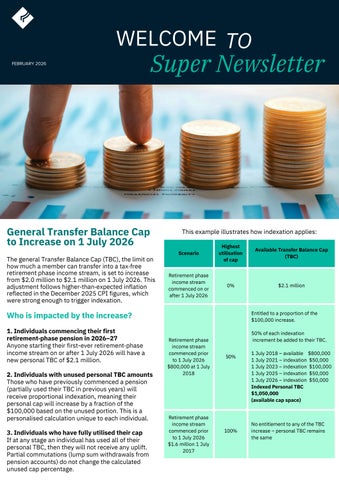
The general Transfer Balance Cap (TBC), the limit on how much a member can transfer into a tax free retirement phase income stream, is set to increase from $2.0 million to $2.1 million on 1 July 2026. This adjustment follows higher than expected inflation reflected in the December 2025 CPI figures, which were strong enough to trigger indexation.

Who is impacted by the increase?

1. Individuals commencing their first retirement‑phase pension in 2026–27

Anyone starting their first-ever retirement phase income stream on or after 1 July 2026 will have a new personal TBC of $2 1 million

2. Individuals with unused personal TBC amounts

Those who have previously commenced a pension (partially used their TBC in previous years) will receive proportional indexation, meaning their personal cap will increase by a fraction of the $100,000 based on the unused portion This is a personalised calculation unique to each individual

3. Individuals who have fully utilised their cap If at any stage an individual has used all of their personal TBC, then they will not receive any uplift. Partial commutations (lump sum withdrawals from pension accounts) do not change the calculated unused cap percentage

The table illustrates the complexity surrounding the TBC system and the confusion that can arise regarding an individual’s available TBC. The Australian Taxation Office keeps record of your current personal TBC, and this information can be accessed through your MyGov account or via your personal tax agent.

Flow-on Effects

The general TBC is tied to several other key superannuation thresholds, so each indexation event has broader strategy implications for SMSF members One of the most significant flow on effects is the impact on contribution caps.

The concessional contribution cap for the 2026–27 financial year is determined by movements in Average Weekly Ordinary Time Earnings for the December 2025 quarter, with the official figures not expected until late February 2026. However, based on the most recent available wage data, industry experts indicate it is highly likely the concessional contribution cap will increase from $30,000 to $32,500 from 1 July 2026.

This expected increase then flows through to the non concessional contribution (NCC) thresholds, because the NCC cap is set at four times the concessional cap As a result, if the concessional cap increases to $32,500, the standard NCC cap is expected to rise from $120,000 to $130,000, with the three year bring forward cap increasing to $390,000

These potential increases may offer expanded contribution opportunities for members planning to maximise their superannuation in 2026–27

Final Thoughts

The upcoming TBC indexation to $2.1 million presents planning opportunities, particularly for individuals who have not yet commenced a retirement‑phase pension or who have remaining cap space. Combined with the anticipated increases in contribution caps, this provides an opportunity to review and refine retirement planning strategies If you would like to understand how these changes may impact your personal circumstances, please contact one of our superannuation specialists.

Payday Super – A Timely Reminder for Employers

From 1 July 2026, the way employers meet their superannuation obligations will fundamentally change with the introduction of Payday Super. Under this new framework, super guarantee (SG) contributions must be paid at the same time as employee salary and wages, rather than quarterly.

This shift is designed to improve employee retirement outcomes, reduce unpaid or late super, and provide more frequent contribution flows to members’ accounts

What is changing?

Under the current system, employers generally pay super quarterly, with strict due dates applying. From 1 July 2026:

Super must be paid on payday, regardless of payroll frequency

Employers will need to integrate their payroll systems with super clearing houses capable of processing contributions in real time or near‑real time.

The ATO will gain improved visibility over unpaid super, with enhanced reporting obligations expected to accompany the reform.

The intention behind Payday Super is to ensure that employees receive their super contributions more regularly, increasing the benefit of compounding while reducing compliance gaps.

Employers

are encouraged to:

Although the law takes effect from 1 July 2026, preparation should begin well in advance. Employers are encouraged to:

1. Review payroll systems and software

Check whether your current payroll software can facilitate super payments on payday. Many providers are already developing or releasing updates to meet the new requirements.

2. Discuss the changes with your bookkeeper or payroll provider

Understanding how Payday Super will integrate with your existing processes is essential, especially if you outsource payroll or use multiple systems.

3. Review cash flow management

Moving from quarterly to payday contributions will require more frequent cash outflows Employers may need to re forecast cash flow to understand the impact of the increased payment frequency.

4. Ensure employee data is accurate and up to date

Incorrect or incomplete super fund details may cause failed contributions, which will be more visible to the ATO under the new regime

5. Consider alternate clearing house arrangements if using the ATO Small Business Superannuation Clearing House (SBSCH)

For those currently using the ATO SBSCH you must transition to an alternate service solution by 1 July 2026, alternatives include integrated payroll solutions or other commercial clearing houses

At Pitcher Partners, we’re here to help you navigate these changes with confidence, offering expert guidance and tailored solutions to keep your business compliance and future ready.

Lodgement due date fast approaching

This is a friendly reminder that the majority of SMSF 2025 income tax returns are due for lodgement by 15 May 2026

To ensure we can meet this deadline, we kindly request that you provide your SMSF information as soon as possible. Adequate time is required not only to prepare the return but also to complete the audit process

If you believe you may need a lodgement extension or would like a detailed checklist of the information required for your Fund, please contact our office and we will be happy to assist.

Turn static files into dynamic content formats.

Create a flipbook