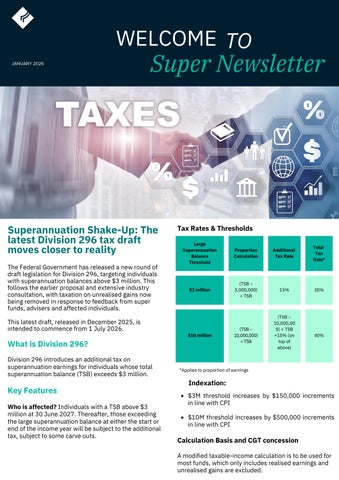
Super Newsletter

Superannuation Shake-Up: The latest Division 296 tax draft moves closer to reality
The Federal Government has released a new round of draft legislation for Division 296, targeting individuals with superannuation balances above $3 million. This follows the earlier proposal and extensive industry consultation, with taxation on unrealised gains now being removed in response to feedback from super funds, advisers and affected individuals.
This latest draft, released in December 2025, is intended to commence from 1 July 2026.
What is Division 296?
Division 296 introduces an additional tax on superannuation earnings for individuals whose total superannuation balance (TSB) exceeds $3 million
Key Features
Who is affected? Individuals with a TSB above $3 million at 30 June 2027. Thereafter, those exceeding the large superannuation balance at either the start or end of the income year will be subject to the additional tax, subject to some carve outs
For small super funds/SMSFs, a cost base reset of assets to market value at 30 June 2026 is available. The key features of this reset are:
Excludes pre-Division 296 unrealised gainsElecting this reset ensures that unrealised capital gains accrued before commencement of Division 296 are excluded from this additional tax.
Applies to all assets - The reset requires an opt‑in election and must be applied to all fund assets - it cannot be applied selectively.
Applies only to Division 296 taxes - The reset applies solely for Division 296 capital gains calculations and does not affect the fund’s normal capital gains tax position
The opt‑in is not automatic - The fund must actively elect to apply the reset, in the approved manner
Eligibility not linked to member balances - An SMSF doesn’t need members with balances over $3million to be eligible for the CGT opt in election
Benefits for growing SMSFs - Opting in may be beneficial for funds with members currently under $3 million, particularly where: the fund has significant unrealised gains and members’ balances are expected to exceed $3 million in future years
For defined benefit and certain legacy products, Division 296 earnings will be determined using a formula-based method, referencing changes in TSB value, adjusted for contributions and withdrawals and multiplied by a prescribed factor to ensure there is broadly comparable treatment across differing superannuation interests
Reporting
Super funds are required to calculate and report realised earnings attributable to each member to the ATO. Small funds/SMSFs must use a proportionate method for the attribution of earnings, and this must be supported by an actuarial certificate. Note, this is still to be confirmed through Treasury and ATO guidance.
Special Rules and Exclusions
Earnings from certain constitutionally protected funds, judicial pension schemes, and noncomplying funds are excluded from Division 296 tax, though their balances count towards an individual’s TSB
Temporary residents who receive a departing Australia superannuation payment can apply for a refund of Division 296 tax paid
Payment and Administration
Division 296 tax will be assessed by the Commissioner and generally payable within 84 days of notice.
Individuals can pay from their superannuation fund or personal monies and can elect which super interest to release funds from
Defined benefit tax liabilities may be deferred until retirement, with interest accruing on the deferred amount.
Division 296 Tax - Methodology
STEP 1 - Does Division 296 Apply?
Check your TSB
At 30 June 2027 determine your TSB; for each subsequent income year, determine your TSB at both the end and start of the year (for 2026–27, only year-end TSB is used).
If either value is greater than $3 million, you must calculate Division 296 taxable earnings
If both values are $3 million or less, no Division 296 tax applies - stop here.
STEP 2 - Fund calculates “Division 296 fund earnings”
For each income year, a superannuation entity calculates Division 296 fund earnings using a modified taxable income framework:
Division 296 fund earnings = relevant taxable income or loss – assessable contributions + net Exempt Current Pension Income (ECPI) – non-arm’s length component + Pooled Superannuation Trust (PST) Component (if any)
The relevant taxable income or loss of the Fund includes franking credit gross ups and foreign tax offsets If the resulting Division 296 fund earnings are negative, it is taken to be nil in the relevant year. There is no carry‑forward of “negative Division 296 earnings” (however under ordinary taxation principles the fund’s tax losses will carry forward and reduce “relevant taxable income” in the following year).
Why ECPI is added back? Division 296 is designed to apply across all fund earnings (including retirement‑phase earnings that are exempt from fund tax under ECPI). The add back ensures those exempt earnings are counted in the Division 296 earnings base before attribution to members.
STEP 3 - Fund attributes Division 296 fund earnings to member interests
Small funds/SMSFs (≤6 members): Use a proportionate, time weighted method backed by an actuarial certificate, effectively attributing each member’s share of the fund’s total Division 296 earnings over the year.
General rule (APRA funds): Attribute on a “fair and reasonable” basis in line with regulations (not released with draft legislation), considering product characteristics, actual investment returns, tenure, equal treatment within products and fairness across the fund.
Defined benefit/certain legacy income streams: A special formula to be used.
STEP 4 - ATO calculates your “taxable superannuation earnings”
1 - Your TSB reference amount is the greater of your opening or year-end TSB for the income year (integrity feature). For the transitional year 2026/27, only the year-end TSB is used
This is different from the previous draft legislation, where the earnings proportion was based on the 30 June balance each year, and now it is on the higher of your starting and ending TSB. This is intended to capture those realising large gains in a particular year and then withdrawing their balance to below $3 million to avoid the imposition of Division 296 tax
The higher of the two values is the TSB reference amount for the below calculations (except in FY27 transitional year)
2 - Proportion above thresholds (round to two decimals):
Large Super Balance [LSB] - Proportion above $3m = TSB ref amount 3,000,000 / TSB ref amount.
Very Large Super Balance [VLSB] - Proportion above $10m = TSB ref amount 10,000,000 / TSB ref amount.
3 - Apply proportions to your total superannuation earnings:
Taxable superannuation earnings [LSB] = Proportion above $3M X Total Superannuation Earnings
Taxable superannuation earnings [VLSB] = Proportion above $10M X Total Superannuation Earnings
Division 296 tax = 15% Taxable superannuation Earnings [LSB] + 10% x Taxable superannuation Earnings [VSLB]
STEP 4 ATO Calculates your “taxable superannuation earnings”
Proportion above $3M= 5 5M - 3M = 0 4545 ⇒ 0 45 5.5M
Prop above $10M = 0
Taxable super earnings = 0.45 x $310,000 = $139,500
STEP 5 Tax is imposed on those amounts
Tax = 15% x $139,500 = $20,925
Jordan’s Division 296 tax liability is $20,925
This tax is assessed to the individual and in addition to the usual SMSF fund taxes. Overall, the total tax paid by Jordan is $48,825 ($20,925 + $27,900 usual fund taxes). This equates to an effective tax rate of 15.75% (increased from 9.0% prior to implementation of Division 296).
Planning for Division 296
Consultation on the latest draft legislation closed midJanuary 2026, with final regulations and guidance expected in the coming months. Based on the short consultation period and timing, we do not anticipate any significant changes to the draft legislation Given the complexity of the rules, if you have over $3 million or expect to exceed the $3 million threshold in the future, obtaining an understanding of the impacts of the additional tax and the value of opting in to the CGT concession is valuable Please contact us to discuss your situation or explore how you can optimise your position prior to the commencement of Division 296