Sector Pulse
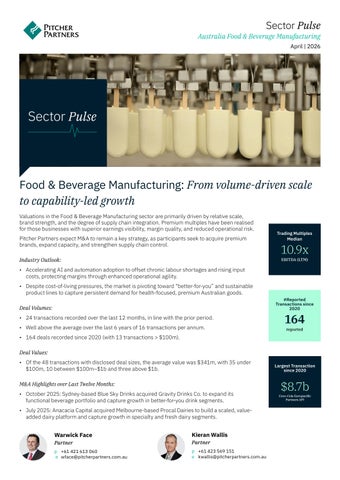
Valuations in the Food & Beverage Manufacturing sector are primarily driven by relative scale, brand strength, and the degree of supply chain integration. Premium multiples have been realised for those businesses with superior earnings visibility, margin quality, and reduced operational risk. Pitcher Partners expect M&A to remain a key strategy, as participants seek to acquire premium brands, expand capacity, and strengthen supply chain control.
Industry Outlook:
• Accelerating AI and automation adoption to offset chronic labour shortages and rising input costs, protecting margins through enhanced operational agility.
• Despite cost-of-living pressures, the market is pivoting toward “better-for-you” and sustainable product lines to capture persistent demand for health-focused, premium Australian goods.
Deal Volumes:
• 24 transactions recorded over the last 12 months, in line with the prior period.
• Well above the average over the last 6 years of 16 transactions per annum.
• 164 deals recorded since 2020 (with 13 transactions > $100m).
Deal Values:
• Of the 48 transactions with disclosed deal sizes, the average value was $341m, with 35 under $100m, 10 between $100m–$1b and three above $1b.
M&A Highlights over Last Twelve Months:
• October 2025: Sydney-based Blue Sky Drinks acquired Gravity Drinks Co. to expand its functional beverage portfolio and capture growth in better-for-you drink segments.
• July 2025: Anacacia Capital acquired Melbourne-based Procal Dairies to build a scaled, valueadded dairy platform and capture growth in specialty and fresh dairy segments.


The Australian Food & Beverage manufacturing sector has experienced a wave of strategic M&A activity, driven by a fundamental shift from pursuing “scale for scale’s sake” toward securing supply chain “influence and capability”.
Private equity interest has continued in the sector, notably:
• KKR acquired ProTen in July 2025, a move that expands its footprint in high-quality agricultural infrastructure and secures a critical role in Australia’s sustainable poultry supply chain.
• Allegro Funds acquired a majority stake in BE Campbell in August 2025, a move that accelerates the value-add pork processor’s next phase of growth and capitalises on increasing consumer demand for premium protein products.
Vertical Integration & Supply Security

• Supply Control: Secures cattle pipeline and maximises plant utilisation.
• Premium Mix: Expands exposure to high-margin export programs.
• Margin Capture: Enables full farm-to-hook value capture.

Portfolio Diversification & Transformation

Manufacturing & Category Expansion

• In-house Manufacturing: Secures critical Australian production capability.
• Category Expansion: Enters premium, high-growth pet food segments.
• Innovation Upside: Accelerates premiumisation and SKU development.


• Earnings Stability: Reduces volatility through portfolio diversification
• Growth Exposure: Adds access to under-capitalised agricultural niches
• Operational Synergies: Integrates pollination to support core assets

Geographic Diversification

• Market Entry: Establishes presence in premium frozen food in Australia.
• Cost Efficiency: Leverages local manufacturing to reduce imports.
• Revenue Diversification: Adds high-demand Asian cuisine categories.
The current median EBITDA multiple of listed AU Food & Beverage Manufacturers is 10.9x, down 13% on the 3-year average of 12.5x.
Large-scale food & beverage manufacturers trade at higher multiples due to stronger brand equity, scale advantages, and greater earnings visibility. A2 Milk leads the sector, supported by robust revenue growth, upgraded FY26 guidance, China market share gains, premium branding, vertical integration, and expansion into senior nutrition.
Relevant Australian transactions with disclosed multiples* are grouped into seven underlying business categories: (1) Bakery; (2) Beverage; (3) Dairy; (4) Livestock & poultry; (5) Pet Food; (6) Ready-made meals; and (7) Seafood.
• Earnings stability. Note:
Higher valuation multiples are primarily driven by:
• Brand strength;
• Scale;
• Growth profile;
• Margin quality; and
Businesses with strong brands, larger scale, recurring demand, and value-added products typically command premium multiples, whilst smaller, commodity-exposed or processingheavy operators tend to trade at lower multiples driven by higher input cost volatility, cyclicality, capital intensity, and more limited scale advantages.
Yumbah Aquaculture announced its $43m acquisition of Clean Seas Seafood Limited on 19 February 2025. The offer price represented a 52% premium to the previous trading day’s closing price of $0.09. The transaction combines Clean Seas’ yellowtail kingfish operations with Yumbah’s shellfish portfolio, strengthening scale and diversification across Australia’s premium aquaculture segment.
Implied EV/EBITDA (forward-looking): 3.3x
Transaction Overview: Yumbah’s offer implies an EV/EBITDA multiple of 3.3x, representing a significant discount to the 6.1x median observed in Australian small-to-mid-cap comparable transactions since 2020. This valuation reflects Clean Seas’ inherent earnings volatility and operational risk profile. The discount relative to the 7.9x listed peer median further highlights the size and illiquidity adjustments applied to the target.

Note: Trading multiples as of 10/03/2026. *Includes egg, livestock & poultry, almonds, rice and seafood.
7.9x
• Strategic Capability Focus: M&A is shifting from volume scale to acquiring supply chain influence and advanced operational expertise.
• Divergent Valuations: A “flight to quality” awards premium multiples to scaled, brand-led platforms with vertical integration, whilst commodity-exposed operators trade at discounts.
• Premium Product Demand: Manufacturers capture resilient growth through “better-for-you” and sustainable products, safeguarding margins via value-driven innovation.
• Operational Agility via Tech: Industry leaders are accelerating AI and automation adoption to offset chronic labour shortages and rising input costs