Ref: AMK:lg
18 December 2025
The Board of Taxation c/- The Treasury Langton Crescent PARKES ACT 2600
By Email: taxboard@taxboard.gov.au Dear Board Members RED TAPE REDUCTION REVIEW 1.
Thank you for the opportunity to provide comments on the Board of Taxation’s (“Board”) review of ways to reduce red tape in the tax system.
2.
Pitcher Partners specialises in advising taxpayers in what is commonly referred to as the middle market. Accordingly, we service many privately owned business and investment groups that are impacted by compliance burdens in the tax system, both legislative and administrative. Our submission focuses on compliance burdens affecting privately controlled groups.
3.
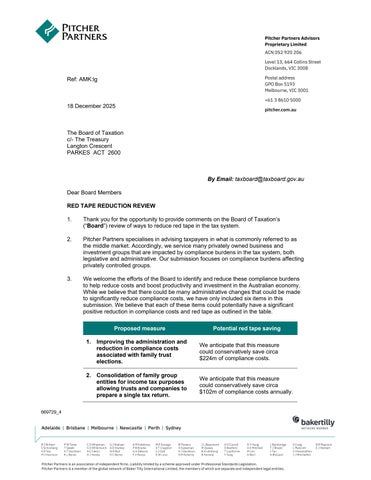
We welcome the efforts of the Board to identify and reduce these compliance burdens to help reduce costs and boost productivity and investment in the Australian economy. While we believe that there could be many administrative changes that could be made to significantly reduce compliance costs, we have only included six items in this submission. We believe that each of these items could potentially have a significant positive reduction in compliance costs and red tape as outlined in the table. Proposed measure
669729_4
Potential red tape saving
1. Improving the administration and reduction in compliance costs associated with family trust elections.
We anticipate that this measure could conservatively save circa $224m of compliance costs.
2. Consolidation of family group entities for income tax purposes allowing trusts and companies to prepare a single tax return.
We anticipate that this measure could conservatively save circa $102m of compliance costs annually.
Proposed measure
Potential red tape saving
3. Creating certainty on the treatment of bare trusts
We are unable to quantify the compliance cost savings associated with this proposal.
4. Addressing resettlement risks by ensuring minor amendments to trusts do not result in a trust resettlement.
We anticipate that this measure could conservatively save circa $0.6m of compliance costs annually.
5. Reducing differences in the treatment of companies and trusts
We anticipate that this measure could conservatively save circa $20m of compliance costs annually.
6. Allowing an entity to use accounting numbers for income tax purposes.
We anticipate that this measure could conservatively save circa $44m of compliance costs annually.
Potential compliance savings (circa)
$391 million
4.
While we have tried our best to estimate compliance costs in the above table (and within this submission), it is not possible for us to verify the accuracy of such numbers. We have tried to be conservative in our estimates but note that Treasury and other government departments are more likely to be able to estimate these items more accurately that us. We would be more than happy to discuss these estimated costs and our thoughts on these items.
5.
Our detailed recommendations are contained in the attachment to this submission. If you would like to discuss any aspect of this submission, please contact either Leo Gouzenfiter on (03) 8612 9674 or me on (03) 8610 5170.
Yours sincerely
A M KOKKINOS Executive Director
ATTACHMENT ITEM 1 – IMPROVING THE ADMINISTRATION OF FAMILY TRUST ELECTIONS Background to issue 7.
Family trust elections (“FTEs”) are a necessity by almost all non-fixed trusts in order for them to be able utilise tax losses, flow through franking credits, and for other administrative purposes. The provisions require that a test individual of a family group be nominated by a family trust (and that their family and certain other entities be classified as being part of that person’s family group).
8.
While the provisions were introduced with effect from 9 May 1995, the ATO have only recently commenced reviewing compliance with FTEs, interposed entity elections (“IEEs”) and investigating potential family trust distribution tax (“FTDT”).
9.
FTDT can be payable where distributions are made by a trust outside of the family group at 47%. FTDT essentially seeks to ensure that there is integrity around loss trafficking schemes. As outlined by the Minister and by Parliament on the introduction of the provisions, it was never intended that FTDT be payable by ordinary family trusts. Extract from Second Reading Speech by the Hon Chris Miles M.P. Family trusts Family trusts (as defined) that distribute only to members of the family group will generally not be affected by the proposed measures. The income injection test will generally apply to family trusts only where income is injected from outside the family group. A trust will become a family trust for the purposes of the measures if it makes a family trust election. A consequence of making the election is that a special tax, called family trust distribution tax, is payable where a family trust gives income or capital to persons who are not members of the family group. This tax will be levied at the top marginal rate applying to individuals, plus Medicare levy. The family trust distribution tax is an anti-avoidance measure designed to ensure that the tax benefit of a family trust's losses cannot be transferred to non-family members. The government hopes the tax will never need to be paid. Extract from the Explanatory Memorandum 11.2 This tax need not ever be paid by any trust or interposed entity and in that sense is optional. The tax only becomes payable if a trust or interposed entity makes a distribution or confers a present entitlement that is inconsistent with its election to be treated as a family trust or member of the family group of a family trust.
10.
Due to the nature of FTDT being a tax that automatically gives rise to a debt with no review or limitation period, the ATO is now conducting reviews spanning all the way back to the inception of the provisions for trust taxpayers.
11.
Such disputes invariably involve disagreements on evidence regarding the existence or non-existence of valid FTEs or IEEs, some of which were purported to have been made in the distant past and the taxpayer’s advisors may have changed many times since (or in many cases have passed away).
12.
We are aware of a case currently before the Federal Court1 in which a taxpayer is challenging a substantial liability for FTDT for merely specifying the wrong individual for a newly established trust. The taxpayer appears to have obtained a record of a 2004 FTE for a family trust specifying Person X as the test individual and made an FTE for the new trust also specifying Person X to ensure that a proposed distribution would not give rise to FTDT. The ATO appears to have identified a 2000 FTE (which was not reported on the ATO’s portal) where Person Y (Person X’s sibling) was specified as the test individual.
13.
Due to the taxpayer not knowing of the earlier FTE and having selected the wrong test individual, the taxpayer is now exposed to tax liabilities of millions of dollars merely for filling out a form the wrong way because if was not aware of the existence of a form completed two decades prior. In substance, the case does not seem to involve a matter where distributions have been made outside of the family group. The taxpayer is seeking rectification from the Court due to the inflexibility of the variation or revocation rules regarding FTEs.
14.
Importantly, there is no mischief in this case. Whether the new family trust specified Person X or Person X’s sibling, the family groups of each are almost identical. There is no suggestion of trafficking of losses to members outside the family.
15.
This dispute is a paradigm example of the absurd situation many taxpayers and advisors find themselves in. Many taxpayers do not always have original records dating back to the start of the provisions period. As more years pass, such records will recede even further into the past.
16.
Further, the ATO are taking a very black letter law approach to the provisions, resulting in significantly disproportionate tax liabilities being raised by the ATO, where the GIC often dwarfs the amount of primary tax. Reference is made to the CPA submission (link) which outlines the technical issues with the provisions that could potentially result in FTDT being imposed in absurd situations under the current ATO view.
17.
This issue has become a major concern for taxpayers exposed to this risk. A simple mistake in filling out a form, failing to fill out of form, or not keeping records for decades, may very well be financially catastrophic and result in the closure of many small-tomedium businesses.
18.
This issue is not one that is only affecting the wealthy. It is an issue for all trusts that have made an FTE. In the latest ATO statistics, there were 1,022,229 trusts that lodged income tax returns for the 30 June 2023 income year. The ATO do not report on the number of these trusts that have made FTEs but we understand that, by the date of this letter, over 280,000 trusts have lodged on the basis of having made an FTE in that year2.
19.
The recent ATO activity is now forcing a significant proportion of those taxpayers to spend significant resources on: (a) evidencing their elections; and (b) considering
1
John Seymour Property Investments Pty Limited (In its capacity as trustee of the John Seymour Property Trust) & Ors v FCT, File Number SAD 210/2025. This figure was provided to us by the ATO directly in July 2025. We note that at the time this figure was provided, the total number of trusts that had lodged for 2023 had increased to 1,078,610.
2
complex technical positions dating back to the inception of the provisions. The technical positions outlined by the ATO are generally beyond the common knowledge of a tax advisor requiring specialist advice to be obtained. Again, we note that the potential FTDT that may be applied in such cases is not in accordance with the original intent of the provisions. Red tape concerns 20.
Many taxpayers have now commenced reviewing the items identified above. A lot of unproductive time and effort is being spent on confirming the existence and validity of elections, where records are not available outside of the ordinary record keeping period. For larger mature groups, a review of FTEs within a group can often involve hundreds of hours of efforts and investigation.
21.
Even for a group with a single trust, many hours could be spent going through old records, ensuring that they have the signed version of the record, confirming what records are available and whether they match what the ATO has disclosed on the taxpayer portal. Where there are discrepancies, this only exacerbates the time involved to obtain certainty about the group’s FTE and IEE status.
22.
Furthermore, many taxpayers have commenced engaging legal advisors to review and advise on any potential technical risks associated with the recent ATO views. These reviews are significantly expensive (at a minimum would cost $10,000) but should be unnecessary.
23.
Conservatively, assuming that for all trusts that have made an FTE, only 2 hours were spent on average by each applicable trust to examine this issue, this could result in around 560,000 compliance hours being spent on examining this issue (for no real productivity benefit to the economy).
24.
Conservatively, the average cost of a tax advisor is circa $400 per hour in Australia. Using this approximate cost, the cost of this compliance issue to the system could be in the vicinity of $224m. It is noted that this is likely to be a very conservative number. We would encourage the Board to conduct their own analysis on this estimated cost.
25.
This estimation does not include the actual cost of FTDT being imposed, GIC or SIC being imposed, the closure of businesses unable to pay FTDT, the loss of employment from the closure of such businesses, the flow effect on economic activity, the legal suits that will occur in respect of advisors and other wasted resources on this issue.
Recommendations Limit the amendment period to 4 years 26.
The most significant aspect causing red tape is the ability for the ATO impose FTDT with an unlimited amendment period.
27.
We request that the Board recommend limiting the recovery of FTDT liabilities to four years consistent with income tax periods of review, in the absence of fraud or evasion. We note that this is in line with the Treasury Report “Report on Aspects of Income Tax Self-Assessment” August 2004, recommendation 3.7.
28.
Taxpayers should be able to close the books on latent tax risks from years in the distant past. There is no obvious reason to warrant an unlimited review or collection
period for FTDT as these liabilities are not the kind that arise due to contrived schemes or dishonesty. 29.
Part IVA and most other anti-avoidance periods do not have an unlimited amendment period. Further, FTDT exposures should be highly visible given that entities must disclose their FTE and IEE status and must report all distributions on an annual basis. An unlimited review period is not justified due to the time and resources that would be required to uncover FTDT liabilities. The ATO should have all the data to identify most exposures and could easily identify these by building the right data matching systems.
30.
Alternatively, the ATO could simply adopt an administrative practice such as that in PS LA 2015/2 to create a four-year limitation period for FTDT. However, we note that the ATO (to date) has outlined that it is not able to comply with such a request.
Providing some flexibility to the ATO 31.
The ATO’s current practice of assessing FTDT from the inception of the provisions is based on: (a) the liability being imposed without the requirement to issue an assessment; and (b) there being no discretion in the provisions.
32.
We recommend minor technical amendments be introduced that: (a) amend Division 271 in Schedule 2F by adding the words “upon an assessment by the Commissioner” wherever FTDT liability is imposed by that Division; and (b) introduce a Commissioner’s discretion to allow for the correction of elections or disregarding FTDT liabilities in cases of honest mistakes or inadvertent omissions (which would replicate the discretion contained in section 109RB).
Reducing the record keeping administrative burden 33.
We recommend that the ATO ensure all records contained on the ATO portal be updated so that it contains all information in the hands of the ATO. An option should be provided, whether legislative or administrative, for taxpayers to be able to rely on ATO records as conclusive evidence of an election being made3.
34.
Going forward, rather than completing a separate FTE form, the ATO should update the tax return form to allow for an extra label to be included (the test individuals name) such that the lodgement of the income tax return should be regarded as an approved form for the FTE. This would help reduce the administrative compliance burden of keeping a separate approved form.
ITEM 2 – CONSOLIDATION OF FAMILY GROUP ENTITIES FOR INCOME TAX PURPOSES Background to the issue 35.
Family groups that operate through trusts cannot deal with their tax affairs by lodging a single income tax return for all trusts within the family group. Further, in order to be able to offset losses in one entity against taxable income in another entity, this requires intra-group distributions to be made. Such transactions give rise to various tax issues
3
To be clear, the conclusive evidence should only relate to proving a fact that an election in the approved form was completed at a particular time. If the entity did not pass the family control test at that time or otherwise failed to meet other conditions for making an election (e.g. because it is a retrospective election and distributions were made outside the family group) then the validity of the election could still be challenged by taxpayers or the ATO on these grounds.
including tax loss and income injection rules as well as the potential application of section 100A or Part IVA. Further, restructures are often difficult as transfer of assets give rise to taxing events, whether on revenue or capital account. 36.
By contrast, large corporate groups can merely automatically offset deductions in one group entity against income of another entity under tax consolidation.
37.
A private group may consist of a number of discretionary trusts (e.g. 5) running separate businesses or holding separate parcels of land. Using separate trusts may be necessitated by commercial reasons (e.g. bank finance can be provided to a specific land project, which requires the land to be held in a separate vehicle).
38.
Trusts are often used instead of companies for non-tax reasons including, asset protection purposes (e.g. no individual is taken to hold ‘ownership interests’ in a discretionary trust unlike shares in a company), estate planning purposes and reduced compliance on financial reporting (i.e. they are not subject to mandatory audit and financial reporting requirements of ASIC).
Red tape concerns 39.
Each trust requires: (a) an income tax return to be lodged; (b) trust distributions to be managed on an annual basis; and (c) intragroup transactions to be documented through loan agreements, service agreements and other formal legal documentation.
40.
The average cost of a trust tax return is generally quoted as being between $1,000 to $5,000 (plus GST). However this cost can vary substantially depending on the complexity of the tax return.
41.
Even if this cost was as low as approximately $1,000 per return, the cost of preparing 1,022,229 trust tax returns each year would be approximately $1.022 billion per year. If this measure reduced trust tax returns by only 10%, this measure could result in a compliance cost saving of approximately $102.2m.
Recommendations 42.
While there are issues with the FTE system, if changes were made to the system to correct the problems identified in Item 1, the system could be leveraged to allow resident discretionary trusts to consolidate for income tax purposes.
43.
We have not provided any further detail on this measure but believe this measure could help reduce the compliance burden and tax risks for private groups who choose to operate through multiple vehicles. To the extent that the Board sees merit in this recommendation, we would be happy to discuss this further.
ITEM 3 – CREATING CERTAINTY ON THE TREATMENT OF BARE TRUSTS Background to the issue 44.
The treatment of bare trusts for income tax purposes (and the creation of a separate entity under section 960-100 for every relationship that can be categorised as a trust) creates a number of difficulties.
45.
44.1.
First, it is unclear if a bare trust (or absolute entitlement) exists as the ATO’s draft ruling (TR 2004/D25) has not yet been finalised.
44.2.
Secondly, where a trust is recognised for income tax purposes, there are substantial tax issues that occur (including the potential for tax and capital losses to be trapped in a bare trust type vehicle). Bare (or transparent) trusts should be ignored for income tax purposes and should not have to lodge returns.
44.3.
Thirdly, cases such as Leighton v Commissioner of Taxation [2011] FCAFC 96 indicate the significant complexity that can occur where a bare trust may exist, yet concepts such as “dispositive power” under the trading stock provisions can ignore the trust relationship for certain purposes only.
There are numerous nominee or custodian arrangements through which (we would assume) trillions of dollars are held. The Board have previously reviewed bare trusts and identified key tax issues.
Red tape concerns 46.
This issue gives rise to many red tape issues. It includes the compliance cost of identifying whether a bare trust exists, whether the applicable provisions are CGT or other, whether absolute entitlement can be satisfied, and how the provisions outside of CGT operate. Furthermore, there is a cost of putting in place a bare trust agreement and in ensuring it meets the requirements of the income tax provisions.
47.
We believe that this compliance issue is unquantifiable but is nonetheless a significant compliance cost within the system.
Recommendations 48.
We recommend the introduction of a simple rule that can identify and ignore these trusts for all federal tax purposes.
ITEM 4 – ADDRESSING RESETTLEMENT RISKS Background to the issue 49.
In relation to trusts in general, unlike a company, natural person or other incorporated entities which have separate legal identity and perpetual succession, there can be risks that a trust ceases to exist or becomes a new kind of trust.
50.
Any time a trust deed is amended, taxpayers and their advisors have to consider whether the trust relationship has changed in a way that triggers CGT liabilities or results in a loss of continuity so that losses are forfeited or elections no longer remain in place. This often involves questions of trust law beyond the capability of most accountants and may involve expensive legal advice merely to confirm some minor amendments do not give rise to these unintended tax consequences. This can also arise in respect of self-managed superannuation funds as they take the form of trusts.
Red tape concerns 51.
While the ATO have a taxation determination on resettlement (TD 2012/21), the binding part of the ruling states it does not apply if “the change causes the existing trust to terminate and a new trust to arise for trust law purposes”. Accordingly, a taxpayer is required to obtain an opinion on the application of trust law to the proposed amendments in order to rely on TD 2012/21.
52.
The question of whether a new trust exists, or resettlement issues, often involve questions of trust law beyond the capability of most accountants. Furthermore, it is questionable whether the provision of advice on this aspect can be provided by an accountant and whether this would be the provision of legal advice.
53.
As such, an amendment to a trust deed may involve expensive legal advice merely to confirm some minor amendments do not give rise to these unintended tax consequences. This can also arise in respect of self-managed superannuation funds as they take the form of trusts.
54.
We note that over 60 income tax rulings were requested in the last 3 years in relation to the question of resettlement. We understand that the overwhelming majority of private rulings resulted in no resettlement. We would that such rulings only cover a small proportion of all of the amendments that have occurred during that period of time.
55.
From our experience, the cost of a taxation private ruling can often be in the vicinity of $5,000 to $10,000 (plus GST). We would expect that the cost of legal advice may be similar. We note that 60 private rulings at a cost of $10,000 each would give rise to a compliance cost of up to $600,000. While this covers a three-year period, we believe that this would be a conservative annual cost in managing this compliance issue as many more taxpayers would be considering the rules without obtaining a private ruling.
Recommendations 56.
We recommend that a legislative change or an administrative practice be adopted so that taxpayers can apply TD 2012/21 without the need for obtaining legal advice or obtaining a taxation ruling.
57.
This could allow for minor or technical amendments to the trust deed to be ignored as giving rise to the creation of a new trust so that taxpayers can navigate the rules with certainty without having to seek specialist legal advice. We note such a practice is adopted in respect of partnerships, which otherwise technically dissolve each time there is a change in the makeup of the partnership4.
ITEM 5 – REDUCING DIFFERENCES IN COMPANY AND TRUST TAXATION Background to the issue 58.
An extraordinary amount of time and cost is spent by taxpayers in navigating the tax system when managing groups that involve a mixture of trusts and companies.
59.
The difference in the tax treatment of these two vehicles incentivises groups to hold appreciating assets in trusts (to allow access to the CGT discount) and to operate
4
https://www.ato.gov.au/businesses-and-organisations/starting-registering-or-closing-a-business/changingselling-or-closing-your-business/changing-the-makeup-of-a-partnership
businesses out of companies (to allow access to the lower corporate tax rate where profits are reinvested in the business). Red tape concerns 60.
The difference in tax treatment between companies and trusts can result in complex structures and complex interactions. This can result in the requirement to manage complex taxation issues such as Division 7A and other integrity provisions.
61.
Given that this is prevalent (for example the use of a bucket company), the difference in treatment of these two vehicles creates a significant drag on the economy in terms of efficiency.
62.
While it is difficult to provide a cost to this issue, we note that there were 1,246,361 companies that lodged an income tax return for 30 June 2023 per the ATO statistics. In that same year, there were 9,866 trusts that reported unpaid distributions to corporate entities (indicating at least circa 10,000 trusts that have adopted a more complex corporate beneficiary structure).
63.
This measure could eliminate the need to have both a company and a trust and thus could eliminate the need for up to 10,000 additional entities within the system. At an annual conservative cost of $2,000 per annum for an additional entity, we estimate that this measure could save approximately $20m in compliance costs annually.
64.
We note that this is likely to be an understatement of the potential benefits of addressing this issue. That is, we would expect that this issue would affect a lot more than 10,000 entities out of the approximately 2.2m trusts and companies that lodge income tax returns annually.
Recommendations 65.
A few simple, but fundamental, changes could be adopted which eliminates the need to manage most of these issues: 65.1.
Allow flow-through of the CGT discount through companies (e.g. similar to the mechanism for Listed Investment Companies). It is possible that this could be applied to future asset acquisitions and could also be limited to private companies that meet the base rate entity thresholds (i.e. aggregated turnover of less than $50m). We believe that this change alone would eliminate the need for many small private groups to have both a trust and a corporate beneficiary.
65.2.
Allow trusts to be taxed as companies. By making the previous change, this would eliminate differences between a company and trust structure and would allow trusts to accumulate taxable income without the need for there to be a corporate beneficiary.
65.3.
Extend Division 7A to trusts which have elected to be taxed as companies, such that only benefits to natural persons would be caught within the provisions of Division 7A. Accordingly, this would reduce the scope of Division 7A to benefits provided to individuals.
65.4.
Clarify that unpaid present entitlements to corporate beneficiaries do not give rise to Division 7A loans. This is because these arrangements would be between entities that are taxed under the same corporate regime.
66.
While we understand that this is likely to be considered a more significant “policy” question, we note that this measure should not result in any cost to the revenue (as the use of dual structures is already providing the tax benefits of the corporate tax rate and discount capital gains to private groups. These measures are likely to reduce significant (but unquantifiable) compliance costs associated with having complex structures.
ITEM 6 – ALLOWING AN ENTITY TO USE ITS ACCOUNTING NUMBERS FOR TAX PURPOSES Background to the issue 67.
Significant time and effort are spent in analysing accounting data for preparing tax returns. Many of the adjustments relate to short timing differences, both to the advantage and disadvantage of taxpayers. Tax timing differences include: 67.1.
Adjustments for non-deductible accounting and audit accruals.
67.2.
Adjustments for non-deductible leave provisions.
67.3.
Adjustments for other reasonable accruals (e.g. superannuation, electricity, rent, etc).
67.4.
Adjustments for deductible prepayments (e.g. land tax).
67.5.
Adjustments for non-assessable WIP amounts.
Red tape concern 68.
For smaller taxpayers (e.g. small and medium business entities) with fewer resources, aligning tax to accounting would simplify the tax return process for these businesses. The items covered are those that are expected to generally reverse within a short period of time.
69.
We note that there were approximately 2.2m trusts and companies that lodged income tax returns for 30 June 2023. If this measure saved one hour of compliance costs annually for only 10% of such entities at an average accountant’s cost (not being a tax specialist advisor) of approximately $200 per hour, this measure could save conservatively $44m in compliance costs annually.
Recommendations 70.
We recommend that the Board consider whether such taxpayers are able to rely on accounting profit and loss amounts for various tax items where financial statements are prepared consistently with generally accepted accounting principles.
71.
We note that there is significant robustness with such a method. For example, reference is made to the case Zeta Force Pty Ltd v the Commissioner of Taxation [1998] FCA 728 which made the following comments in relation to a disputed amount prepared in accordance with accounting principles. The Commissioner took issue with this characterisation of what had occurred, in my view correctly. The basis of the applicant’s argument was that the $435,035 was properly an expense of the 1990 year and not the
1991 year. A trustee which carries on a business must use generally accepted accounting principles, including accrual accounting. It would have been inappropriate for the trustee to have treated the 1990 payment for goods to be delivered in 1991 as an expense of 1990. It was proper to treat it as an expense of the period to which it related. That is what the trustee did. In its profit and loss account for the 1990 year the payment was treated as an asset. It was treated as an expense in the following year. The alternative argument thus fails. 72.
If the cost to revenue would be high, this could be introduced with a first-year transitional adjustment that is amortised over five income years.