

Pioneers’ Eye

Dapa cops warns public to be vigilant
Recent buy-bust operations conducted by the Dapa Municipal Police Station (Dapa MPS) underscore the ongoing threat of illegal drugs and the security risks they pose to students.
Rhian B. Consigna, a Senior high school student, expressed concerns regarding the multiple buy-bust operations. “I’m kind of scared because sometimes I need to go home late... so it’s quite concerning, especially when it comes to my security,” she remarked.
The recent arrest made by Dapa MPS on February 2, 2025, highlights the importance of law enforcement in maintaining order. “This successful operation demonstrates the relentless efforts of our police force to fight against the spread of illegal drugs and ensure the safety and security of the community.”
Despite these efforts, the persistence of illegal drug operations near communities remains a concern. While police operations aim to eliminate criminal activities, schools and communities must remain vigilant.
Law enforcement continues its commitment to ensuring a drug-free and crime-free environment. PCPT Violeto D. Pepito, Jr. stated, “Their work not only brings justice to those affected but also strengthens public trust in law enforcement.” Authorities urge the public to cooperate in reporting suspicious activities to prevent further risks to students.







Scihiyistas fear for safety as cop violence, ‘Oplan Tokhang’ strikes
Siargao Island, known for its serene environment, is now clouded with fear and uncertainty following an alleged unlawful police operation related to “Oplan Tokhang” in General Luna that ended the life of a High Value Individual (HVI). The incident has left students at Siargao National Science High School (SNSHS) feeling uneasy about the safety, raising concerns about law enforcement practices on the island.
The recent events in General Luna have reignited concerns due to a citizen known to be a drug user getting shot by a police officer in civilian and a personal experience from Scihiyista, Danica
proliferation, Oplan Tokhang faced widespread criticism due to allegations of human rights violations and extrajudicial killings. However, the program has since been officially terminated. Students have voiced their anxiety.
Highlighting security risks for students
Truth beyond the Campus, Voice for the Community
The Official School-Community Publication of Siargao
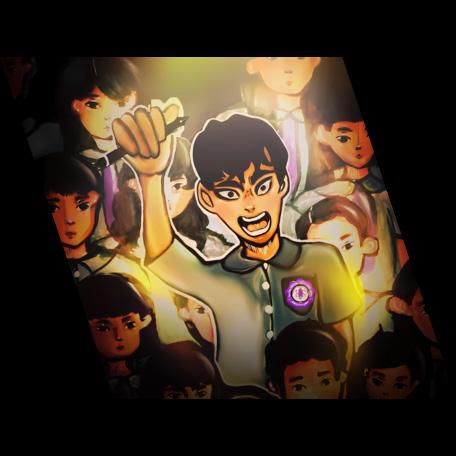
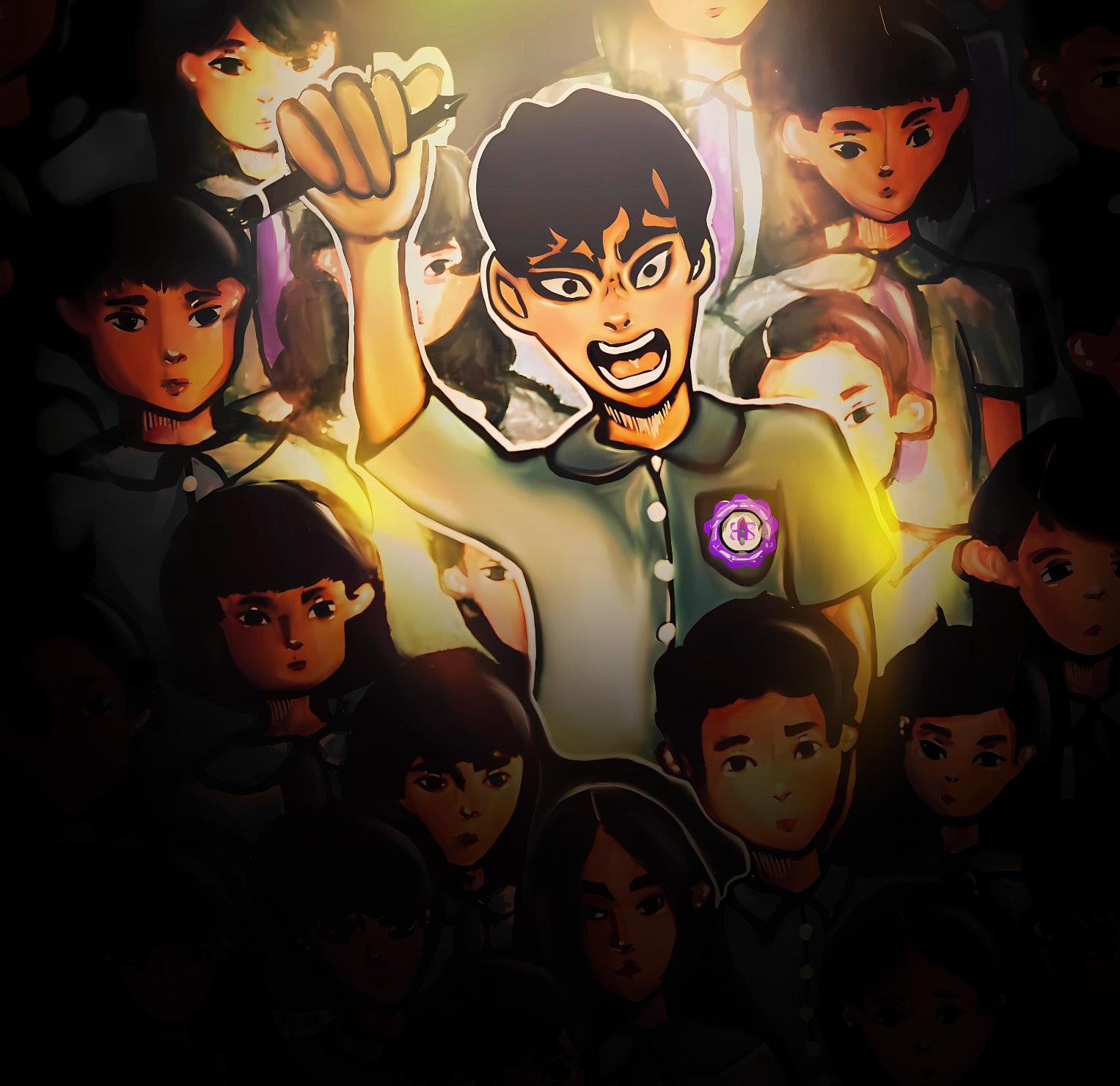
Art by: Danica Lim

Domestic abuse prompt SNSHS to act
by: ZYESHA SOLLOSO
Silence shutters like glass as students across different grade levels from Siargao National Science High School bravely shared their personal experiences of sexual harassment inside their homes, sparking an immediate action from the school to address the issue.
“My 2nd cousin touched me; he wanted to have sex with me while I was asleep. I felt the anger of not telling my parents about it, until now,” as elaborated by a pupil who encountered domestic abuse during childhood.
It is determined that certain students experienced being sexually harassed or abused by their own family member but have been too afraid to inform someone due to the trauma and fear caused by these incidents.
One of the respondents revealed the offence they encountered, “Unhon ko man pag kalimot kun kada adlaw ko ra sija kitan?”
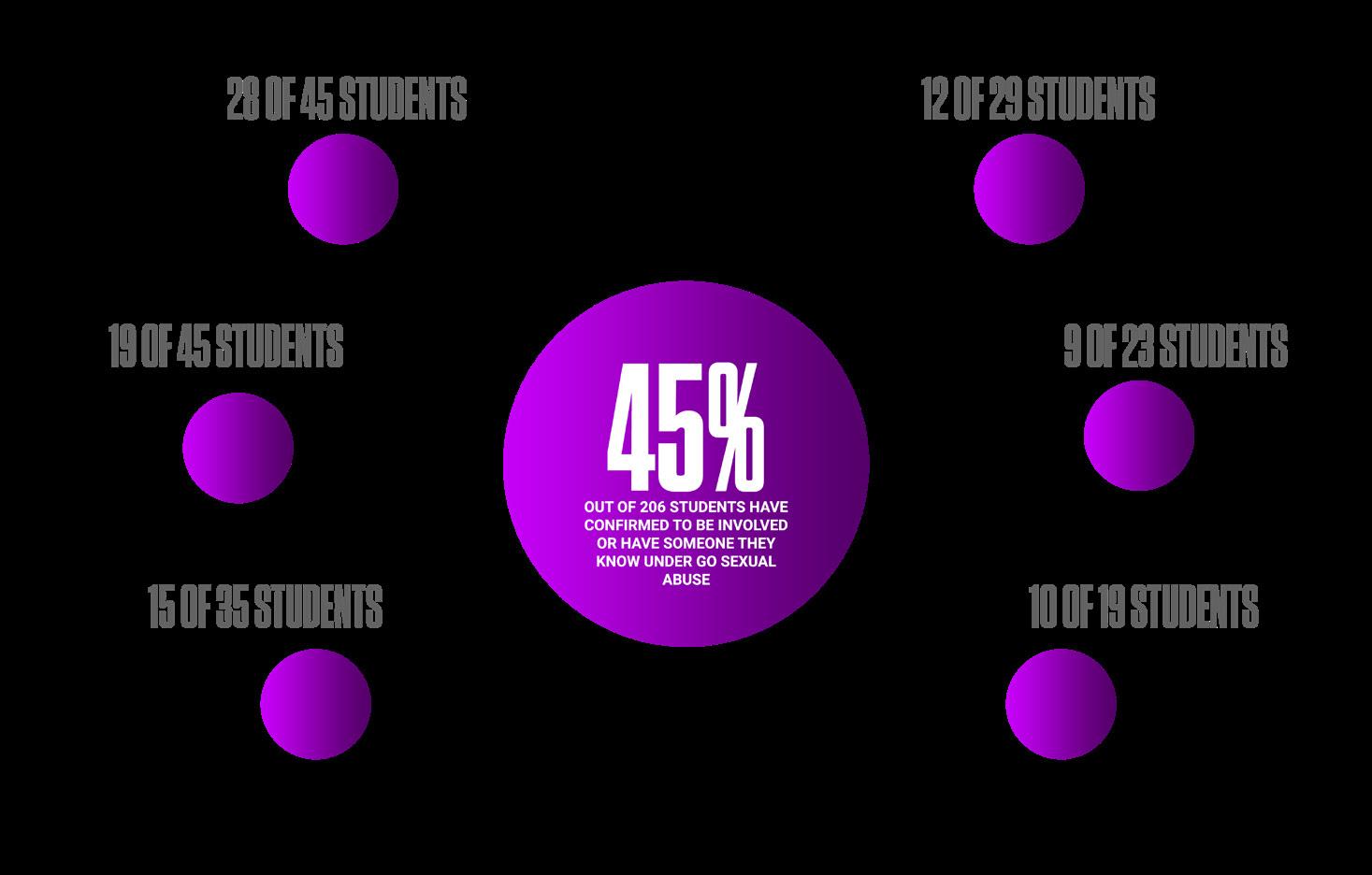
45% out of 206 students have confirmed to be involved or have someone they know undergo any form of sexual abuse.
However, School Principal III Rex Mardy Labe was instantly apprised of the incident and considered the implementation of homeroom guidance with educators and students, to raise awareness.
“A serious matter that needs immediate call to action [incidents of sexual abuse] Certain claims need to be addressed in a strategic manner so the plan is to start with homeroom guidance with adviser and student so that they will feel more comfortable to open up in a safe environment,” he emphasized.
Mr. Labe also assured every student’s privacy will remain confidential along with stating their stand on the affair.
“[We are] ensuring the privacy of the people involved remain hidden…even if there is no official support system but the entire school is ready to stand against all injustice in school and at home,” he added.
Apart from this, unanimous answers suggested the school should propose programs developing the teaching approach in regards with sexual abuse, pornography or sexuality education in general.
bythenumbers
DIVIDED VOTES

As the upcoming elections draw near, first-time voters find themselves divided on whether local politicians should align with national leaders. Some believe it ensures stability and resources, while others argue that independent governance is necessary for true development.
For 18-year-old Jessa Formilles, a senior at Siargao National Science High School (SNSHS), political alignment is necessary for progress. “Having a good alliance with those in power is important—just like during Typhoon Odette, when the response was fast because of our strong connections with the national government,” she said.
However, not all students share the same view. Alias Justin, also a senior and a first-time voter, worries that political alignment could mean prioritizing party interests over the needs of the people. “What if ang gobyerno ay gumawa ng hakbang na hindi suitable sa problema ng ating syudad?” he asked. “ Ang mga lokal na politicians ay dapat maging independent at gawing kung ano ang dapat...,hindi yung sinusunod kung ano lang ang gusto ng kanilang kapartido.”
Some students, like Akyssa Borga, remain undecided. “I see both sides,” she admitted. “I want to vote for a politician who can bring development, but I also don’t want a leader who just obeys higher ups na without thinking about local needs.”

It also highlights potential violations of Republic Act (RA) 10591, also known as the Comprehensive Firearms and Ammunition Act, which regulates the uses of excessive force or acts outside legal procedures, they can be held accountable and face criminal charges.
Under this law, those who unlawfully engage in the manufacture, importation, sale, or misuse of firearms may face penalties ranging from temporary imprisonment to life imprisonment.
Many locals, especially students, are struggling to process the situation. According to some residents, Siargao are generally less exposed to such incidents, leading to heightened fear and uncertainty.
“For me, our island has a low crime rate, so naturally, locals are less exposed to any type of crime. This leads to us panicking because we do not have enough knowledge on what to do in situations like this,” another SNSHS student shared.
For Regine Gonzaga, a first-time voter passionate about politics, the issue goes beyond development—it’s about accountability. “Sometimes... when local officials are too loyal sa mas mataas, minsan hindi nila na kukwestiyon ang mga maling polisiya,” she said.
Meanwhile, another senior, Alias Rein, believes alignment brings consistency,
“Having local leaders who work well with national politicians means fewer conflicts and smoother governance, diba?,” she argued. “It avoids delays in projects, and mas convenient.”
According to Alias Max, political connections play a crucial role in securing resources. “ I agree, kay if may connection ang may power saato sa higher ups is mas abundant ta ng budget/ ayuda,” he stated.
However, he pointed out that Siargao faces a different challenge, as key leaders—including the governor, vice governor, congressman, and mayors of municipalities like Dapa and General
Luna—belong to different political parties. This division, he noted, leaves the people caught in the middle.
“Pero saato case sa siargao knowing na lahi na Political Party ang sa Governor, Vice G, Congressman and Mayors ng Siargao example Dapa and General Luna ang people ang naipit sa jaon na situation,” he stressed.
‘Jaoy may gajud jaon barrier between two parties, which is dili ma resist’, which translates to, ‘There is a strong barrier between the two parties, which cannot be avoided,” Max highlighted.
Despite this, he emphasized the need for professionalism, urging leaders to set aside political differences for the sake of progress. ‘Pero they should do some professionalism na magcommunicate sila sa isat isa about budget.... future projects,’ he uttered.
While their opinions vary, their discussions reflect the broader political debate in the country—whether local leaders should align with national politicians or remain independent in serving their communities.
them work hard to protect the community and build trust,” said Anika Alisan, a student from General Luna.
To curb gun violence and build trust between law enforcement and the community, agencies like Dapa MPS implement initiatives such as “Oplan Katok.” This door-to-door campaign ensures firearms are properly registered and stored, preventing illegal use while educating gun owners on their responsibilities. By promoting safety and respecting citizens’ rights, the program helps maintain peace and accountability.
For many Overseas Filipino Workers (OFWs), having a child born in the United States was once seen as a guarantee of a better future. But with re-elected U.S. President Donald Trump’s proposal to end birthright citizenship is now in question.
Filipino families, especially in Siargao National Science High School (SNSHS), are growing anxious about what this change could mean.
Parents fear that years of hard work abroad might not be enough to secure their children’s future. Melissa Guma, an OFW in the U.S. for over a decade, who has a daughter studying at SNSHS is one of many facing uncertainty. “I followed the law, worked hard, and provided for my family. Now, I’m afraid my child’s citizenship might be taken away,” she remarked, noting that she has a son in the United States of America (USA).
14th Amendment, which guarantees citizenship to anyone born in American soil.
However, it is important to note that not every police officer abuses their authority. “There are many good officers who uphold their duty with integrity. Not all police are like that. Many of
Dapa MPS also runs public awareness campaigns to inform the community about the dangers of illegal firearms and the importance of reporting suspicious activities. These campaigns emphasize the role of residents in maintaining safety while respecting their rights, encouraging vigilance and cooperation with law enforcement. Authorities must remain transparent and accountable, while citizens must stay vigilant and informed. Only through mutual respect and cooperation can Siargao maintain its reputation as a peaceful and safe island for all. continuation from P1
Many other Filipino parents share this fear of losing the opportunities they had hoped for their children. Legal experts argue that Trump’s proposal directly challenges the U.S. Constitution’s
George Donoso, a citizen at Dapa who has a sister working abroad, has noticed the rising concerns among his family. “My sister has children born in the U.S and her daughter is left with me. Now she is worried about whether her children will still have the same rights,” he uttered. Beyond legal battles, families worry about practical concerns like education, healthcare, and future employment. “If my children lose U.S. citizenship, they could face barriers to schooling and government benefits, making it harder to build a stable future for them,” Guma emphasized, adding that she is hoping for a resolution that protects the children’s rights and the future they build.
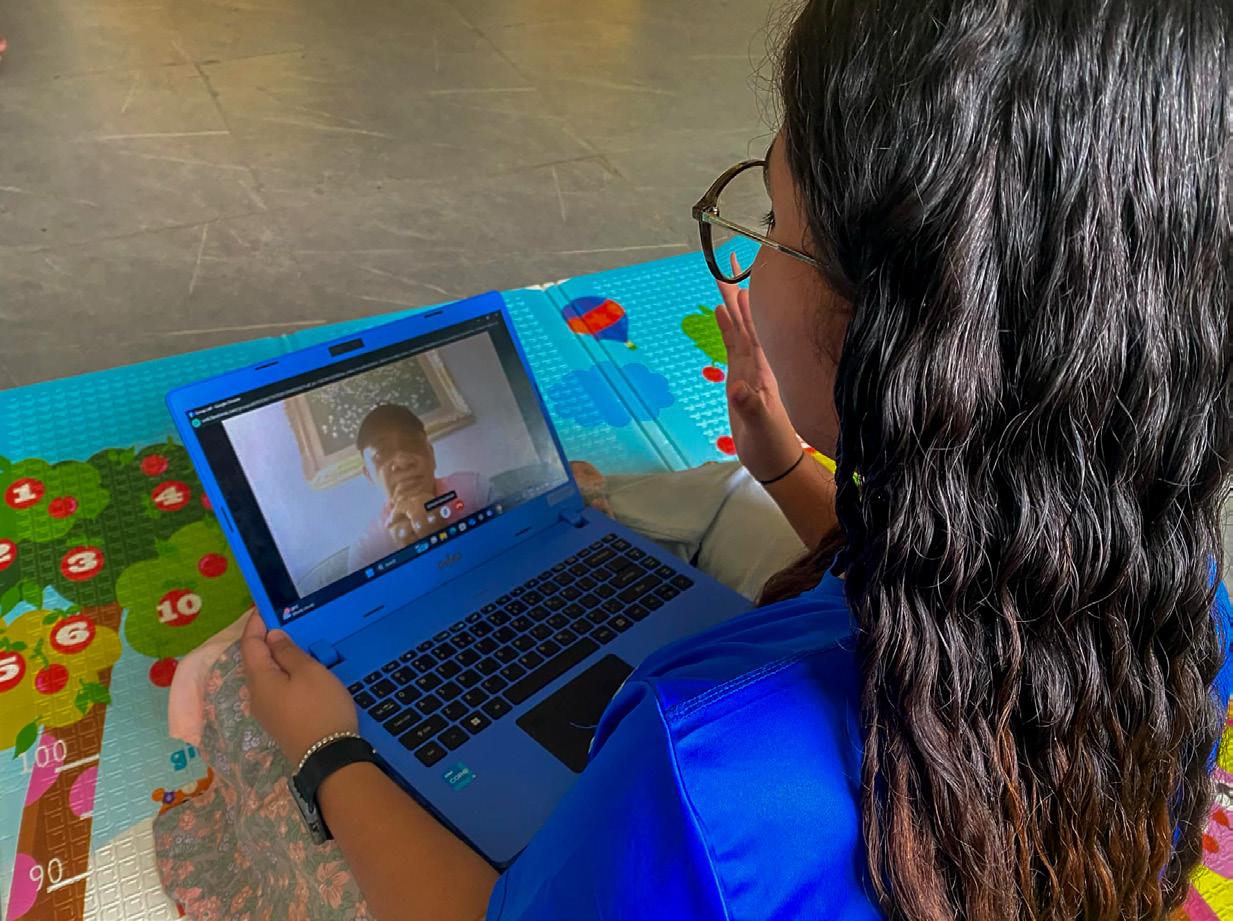
DREAM IN DOUBT. Georlyn Donoso, 16, calling his father, George Donoso, a hardworking OFW, to seek reassurance amidst potential changes to U.S. birthright citizenship laws.
Photo by: Danica Lim Caption by: Dustin Jumandos
Photo by: Gueen Lim Caption by: Dustin Jumandos
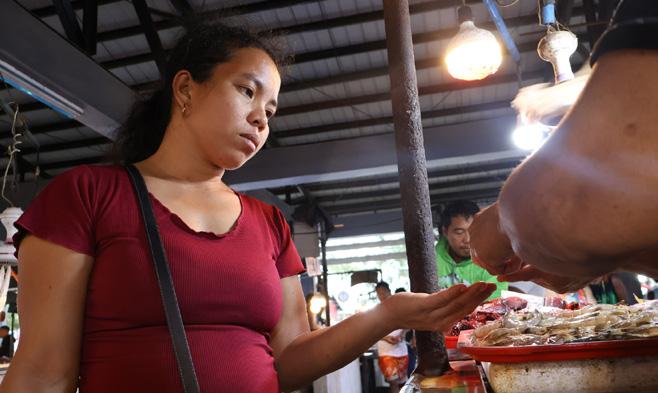
Siargaonons cry plight cost of tourism boom
As the upcoming elections draw near, high school students who are first-time voters find themselves divided on whether local politicians should align with national leaders. Some believe it ensures stability and resources, while others argue that independent governance is necessary for true progress.
According to the Philippine Statistics Authority (PSA), Surigao del Norte’s inflation rate rose from 2.5% in December 2024 to 2.9% in January 2025, driven by higher food and utility costs. In Siargao, the situation is further aggravated by the increasing demand from tourists.
For small business owners like Charmaine Apolo, who runs a local eatery, the benefits of tourism come with serious challenges. “Mas maraming customers..., ibig-sabihin mas lago ang ekonomiya, pero halos lahat ng bilihin ang mahal—mga sangkap, ‘yung renta, kahit kuryente. Sobra ‘yung kayod namin pero mas lumiliit ‘yung kita namin,” she expressed. Apolo added that many small business owners feel the same pressure. “Kailangan namin taasan ‘yung presyo ng ibinibenta namin pero sa mga lokal hindi nila kaya. Ang hirap i balanse.”
The Department of Tourism reported that Siargao welcomed 529,822 visitors in 2023, a massive increase from just 125,088 in 2022. While this boom has brought economic opportunities, it has also led to a surge in rental prices and transportation costs.
Mary Ann Leyros, a lifelong resident, shared how inflation has affected her family. “Nung una makakabili ka ng sariwang isda sa maliit na halaga, pero ngayon parang imposible. Kahit nga ‘yung mga bangka tumaas din ‘yung pamasahe. Parang lahat ay para sa mga kano (foreign), at ‘yung mga tao sa Siargao ang nag hihirap,” she said.
NEDA assured the public that measures are being taken to stabilize prices, but many locals remain skeptical.
“Yung pagtaas ng mga presyo ay hindi lang numero—talagang naaapektuhan yung mga tao,” said barangay councilor Ronnie Ruaya “We need policies that make sure Siargao’s economic growth benefits everyone, not just businesses that cater to tourists.”
As inflation continues to strain daily expenses, Siargao’s residents hope for long-term solutions that will allow the island’s economy to thrive— without making life unaffordable for those who call it home. “Masaya kami na mas nakikilala ang Siargao,” said Apolo, “ pero gusto rin naming tumira dito araw-araw ng hindi naghihirap.”
communitynews
Slashing ₱10 billion from education sector’s budget
technological

or also known as DepEd’s Computerization Program (DCP)
UNDERFUNDED

newsbits
First-ever 4PH project in Caraga region, opens in Siargao
Designed to assist estimated 600 low-income families in Siargao, specifically Dapa. The ground-breaking ceremony of the Pambansang Pabahay para sa Pilipino (4PH) and also called as “Dapa Island Residence” is introduced by Municipal Vice Mayor Gerry M. Abejo, together with Secretary Jose Rizalino Acuzar, Regional Development Council 13 Chair and Dinagat Islands Governor Hon. Nilo Demerey Jr.
The Dapa Island Residence is located at Sitio Bingag, Barangay Osmeña, Dapa, Siargao Island. One of the project’s purposes is to build comfortable surroundings for the residents and provide a steady home for financially unstable families.
newsbits
Siargao Island bags 3 awards in span of 2 months
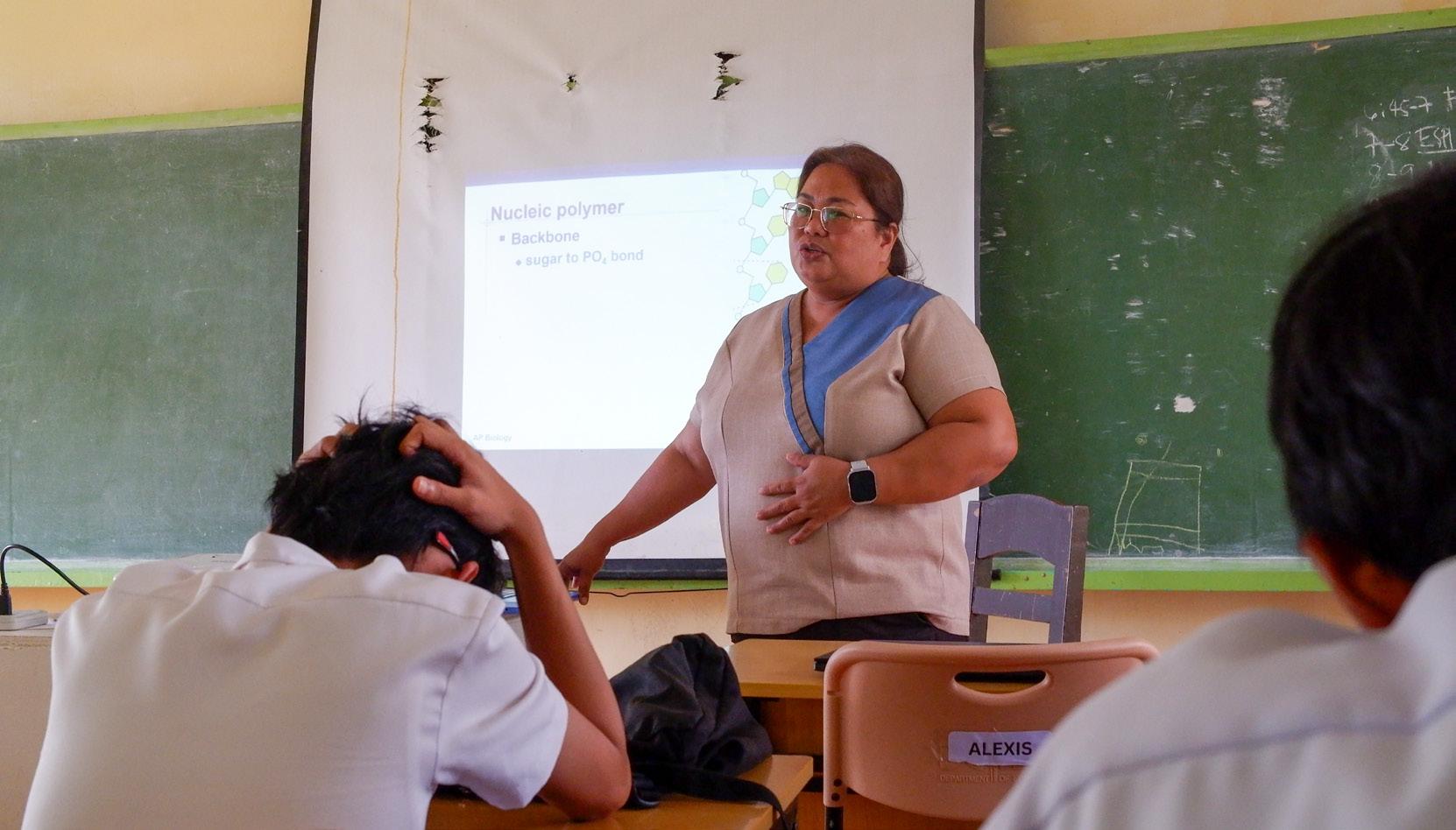
What happens when the House of Congress cuts P12 billion from the Department of Education’s proposed P748.65 billion 2025 budget? Teaching staff from Siargao National Science High School (SNSHS) claimed that it will deprive students of access to quality education.
Majority of the teachers have indicated that the financial cutback would only contribute to the learning crisis of the students, particularly in technology.
“In the first place, kuyang na gajud ta nan budget, even sa classroom nato or facilities…Compared to other countries, inclined dapat ta sa technology pero waya ta jaon,” According to SNSHS educator Ms. Suzette Ann Mantilla.
Moreover, the 12 billion slashes including 10 billion could’ve been used as a fund for the DepEd’s computerization program (DCP), sector’s initiative to supply public schools with technological equipment such as laptops and stable internet connection aiming to improve teaching-learning strategy while addressing the challenges in 21st century.
In addition, public schools in rural areas were also brought up as they are most likely to be affected given their already existing insufficient financial support.





Ms. SIPLAS 2024 initiates coastal clean-up operation
Crowned as Ms. Siargao Island Protected Landscape and Seascape (SIPLAS) 2024, Jazmine Añasco led her advocacy, protecting the ecosystems and among of them is the enterprise for coastal clean-up drive on February 5, 2025, at Brgy. 6, Dapa, Siargao Island.
The clean-up drive’s main target is to propose effective waste management, avoiding any health risks while securing the essence of the Island.
Añasco together with Supreme Secondary Learner Government (SSLG), Boy Scouts of the Philippines (BSP), and Girl Scouts of the Philippines officers also volunteered to participate in the said event.
Over 172 kilograms of trash, mostly plastics, were accumulated in one area alone.
Moreover, she highlighted the whole purpose of her advocacy and why she selected this as her initial project.
“The point of all this is to value and preserve marine life, which also serves as a livelihood for the locals, and to encourage others to participate in this activity that offers benefits to the lives underwater and for me myself to serve as an instrument and inspiration especially for the youth,” she explained. According to Añasco, she is also excited to discuss her other future projects with the community, aiming to benefit them and the ocean as well while trying her best to balance studies and an advocate for change.
“Mas mugamay ang budget, mas mag lisud ang Department of Education especially schools na waya sa mainland,” asserted from another SNSHS instructor Mrs. Kristi Venna Arlan.
On the other hand, educators observed the lack of budgetary leads to students’ academic incompetence due to limited resources, lessening the quality of education including reading proficiency.
The results of Programme for International Student Assessment 2022 (PISA) highlighted the Filipinos’ inadequate performances in Reading, Science and Mathematics after ranking 77th out of 81 countries, alarming the DepEd to provide an immediate action.
Aside from the computerization program initiative, different projects were implemented before to solve the problem such as the known ‘Catch-Up Fridays’ or ‘Drop Everything and Read’ (DEAR).
Known for being the surfing capital of the Philippines, Siargao Island has been recognized as the 10th Top Island based on Readers’ Choice Awards 2024, having a score of 89.2 from Condé Nast Traveler readers posted last October 01, 2024 along with earning the 17th spot on Lonely Planet’s list, due to its popular “good waves” and “surf breaks.” Lonely Planet also shared entertaining events on the Island such as “You can island-hop, kayak through the palm-fringed mangrove marshes and swim in aquamarine rock pools. And if none of this is right for you, it’s also the ideal place to slow down, take midday naps on a hammock and watch the sun go down with a margarita in hand.” It was published on December 17, 2024. Furthermore, Siargao’s wetland or Del Carmen Mangrove Reserve was also officially included in the Ramsar International Conservation List being the 10th Ramsar sites in the Philippines.
Scihiyistas on fake tribal leaders: Do not use social media to propagate absurd platforms

Due to strategies of spreading their wrong doings through internet, a notorious bogus tribal group known as Federal Tribal Government of the Philippines (FTGP) provokes backlash and comments not only on the internet but also from students at Siargao National Science High School.
It alarmed the internet when a group of “Indigenous Peoples” led by “Datu Adlaw” or Jorgeto Corpuz Santisas would randomly raid and scare locals in Surigao City, padlocking their houses without a warning which violates a specific law called Republic Act No. 8371 that promotes the rights of Indigenous Peoples.
“Hindi naman sila part of an Indigenous group tapos they are using social media pa to propagate their absurd platforms kahit na katatawanan lang sa halos lahat ng tao,” stated by a SNSHS student Jazmin Figuron when asked regarding her perspective.
Instead of a threat they became more of a ridicule object to everyone.
On the other side, Lourdes Latraca Infante, one of the tribal leaders has warned of a massacre in Surigao City during her Facebook life if the police authority won’t liberate her comember, Ronald Baluca Siahay.
Siahay was detained considering the illegal
possession of a deadly weapon as well as resisting arrest.
“Nakakaawa sila kasi akala nila tama yung ginagawa nila,” according to a concerned learner Shamaine Bato after watching the broadcast.
Moreover, most of the students also stated the importance of using social media in other ways instead of this strategy.
“Dapat imbis na gamitin nila ‘yung internet sa ganiyan nag share nalang sila sa kung ano ba ang good governance, hindi ‘yung gagawa sila ng kanila na hindi naman authorized in the first place,” another student expressing their worries about the issue.
Indigenous Peoples (IP) leaders in Caraga along with the National Commission on Indigenous Peoples do not claim FTGP as part of their organization and latest updates revealed all FTGP face 10 charges filed by the Police.
by: ZYESHA SOLLOSO
by: ZYESHA SOLLOSO
by: ANGEL BUO
by: ZYESHA SOLLOSO
by: ZYESHA SOLLOSO
by: ANGEL BUO
Photo by: Gueen Lim Caption by: Adelle Rosete
TEACHER’S
Photo by: Brigette Esparrago
Caption by: Dustin Jumandos
Free dialysis centers set to launch in Siargao
schoolnews
Dialysis centers in Dapa and General Luna municipalities are expected to be accessible to the public by 2nd quarter of 2025, offering free health services.
“Sa isla talaga, maraming may mga problem in kidney na nag da-dialysis na...Even
91 studes travel far from home, eye school dorms as solution
It is an everyday battle for students who commute from their houses to school, with 91 pupils from Siargao National Science High School attesting to it, but with the help of newly constructed school dormitories, it can now be addressed.
Following the Typhoon Odette’s damage, the said dormitories are anticipated to be available by next year, as there are still some discussions about the lack of utilities or repairs that must take place.
“We have to discuss some things with our school’s staff before we can fully open it to our students,” School Principal lll Mr. Rex Mary Labe stressed. It is identified that 50% out of 263 students rely on public transport daily.
Scihiyistas have also mentioned the convenience of having dormitories inside the campus.
“Hindi na kami mahihirapan pa sa pag byahe from Pilar kasi magkakaroon naman na dito…Less hassle for us na malayo ‘yung mga bahay,” as explained by a senior high school student, Joshua Shann Espanola, who travels from Pilar to Dapa.
SNSHS educators believe that it also provides a great advantage for students, as they would be less likely to be late from classes.
“Napapansin ko lang na madalas may mga late talaga pumasok sa class, especially kung first, and most of them malalayo ang bahay…May advantage talaga ‘yung dorms sakanila,” SNSHS teacher Mafel Tokong expressed.
The only requirement for the dormitories is the monthly payment of 100.
regionalnews
dito [Siargao Island Medical Center] we have plans of having dialysis,” according to the Medical Center Chief, Dr. Chloe Digal said. One of the main purposes of the project is to extend hands to residents who are incapable of affording health guidance.
“Syempre ‘yung pamilya ng dialysis patients ay makakasave, imbis na pamasahe ipangkakain nalang nila,” she added.
Additionally, General Luna and Dapa will contain 15 dialysis machines from Japan, which will assist 45 patients every day.
Siargao Island Medical
Center (SIMC) is also in the process of hiring more health professionals along with a plan to develop the hospital and an addition of Rehabilitation and Wellness Centers for stroke patients.
SELLING WITH PURPOSE.
A teacher making an impressive sales at the Bazaar for a Cause, an event maanaged by DepED Siargao. The proceeds of the event will go to the victims in Bicol Region, held at Siargao National Science High School during the division’s anniversary celebration on December 9, 2024
COMPASSION IN ACTION
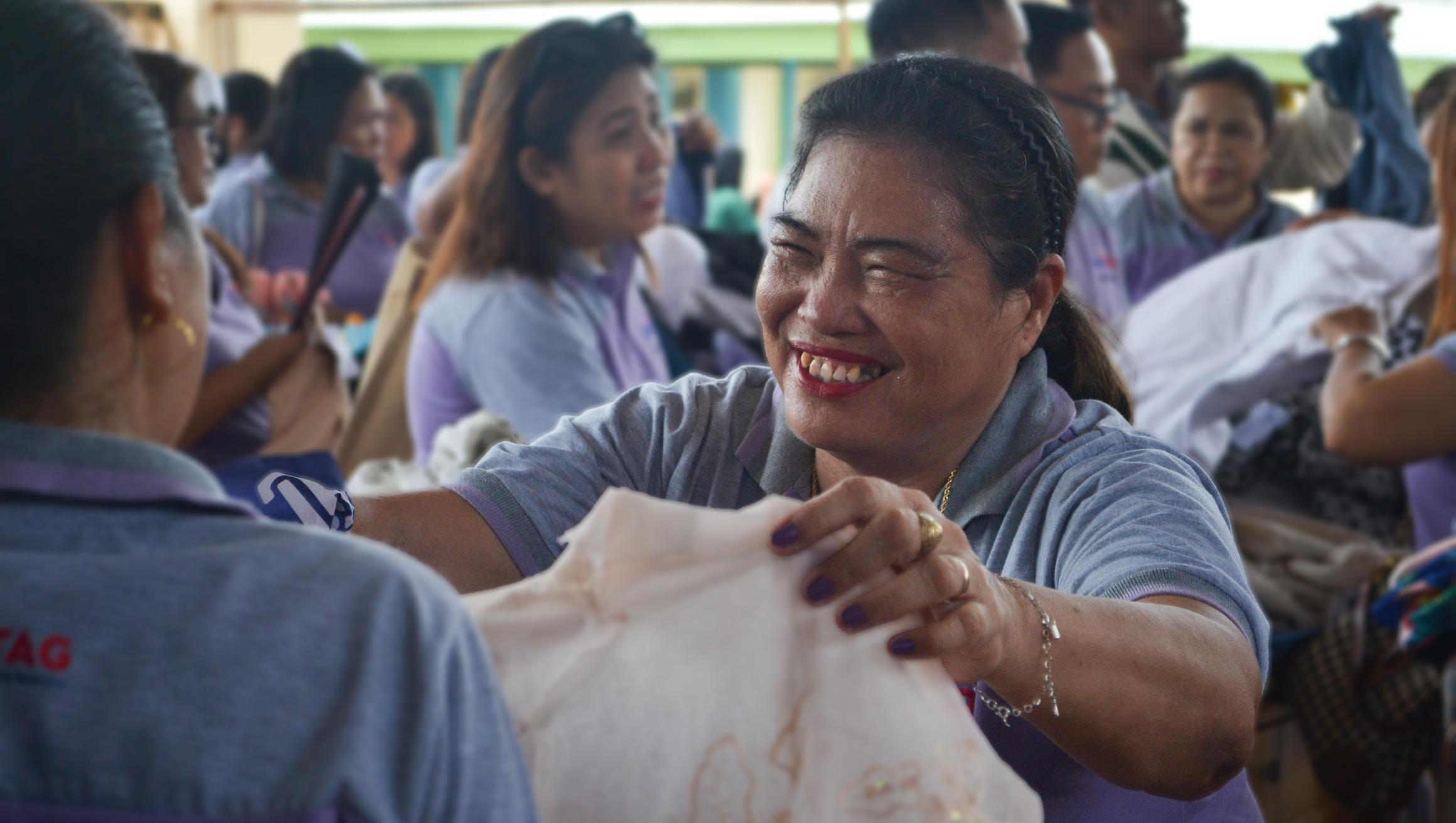
Following the success of its first-ever pre-loved bazaar, the Schools Division Office (SDO) of Siargao, along with various school districts, has further strengthened its commitment to helping typhoon victims in Bicol by donating ₱116,562 in additional aid.
Alongside this pledge, 50% of the proceeds from the charity bazaar, amounting to ₱22,648, have already been donated to affected families in the region.
Held on December 9, 2024, at the Siargao National Science High School (SNSHS) covered court, the bazaar was organized to support residents of the Bicol Region who suffered severe devastation from Tropical Cyclone Kristine.
Siargao tourism influx fuels surge in HIV cases; public concerns arise
Siargao Island, considered as major tourist destination, is facing a sharp rise in HIV cases, with health officials linking the surge to the island’s booming tourism industry. According to Dra. Chloe C. Digal, Center Chief I, Siargao has recorded 43 cases, with 12 in Dapa, making it the second highest in the Caraga region.
Increasing number of visitors has led to heightened social interactions and risky behaviors, fueling the spread of the virus.
Tourist destinations often see a rise in HIV cases due to casual encounters, unprotected sex, and substance use. Siargao’s vibrant nightlife and party scene attract young travelers, many of whom engage in risky behaviors. Limited awareness and misinformation about HIV prevention make the situation worse, increasing the likelihood of transmission.
Stigma is an attribute causing people to be perceived as less or shamed. Many individuals avoid testing due to fear of discrimination or judgment.
Misconceptions about condom effectiveness also contribute to the problem, as many young Filipinos still doubt their role in preventing HIV transmission. Without
proper education, the infection rate may continue to climb.
Additionally, access to treatment is another challenge. Siargao lacks a dedicated HIV Treatment Hub, meaning residents must travel to other areas for antiretroviral therapy (ARV). According to the Philippine News Agency on its latest report, nationally, only 63% of HIV-positive Filipinos know their status, and just 41% receive treatment. Health experts stress the importance of collaboration between the government, tourism stakeholders, and local communities.
“Strengthening healthcare facilities, establishing Treatment Hubs, and launching awareness campaigns are crucial,” said Dra. Digal adding that tourists and locals alike need proper education on safe sex practices to reduce the risk of infection.
The initiative, spearheaded by SNSHS faculty and backed by teachers and DepEd personnel from the Siargao Division, was part of the celebration of “Education Week” under Proclamation No. 409, s. 1953.
The event commenced with a ribboncutting ceremony led by Schools Division Superintendent Karen L. Galanida, who underscored the importance of the bazaar.
“This is our way of expressing our love

VOICE FOR AWARENESS.
Dr. Chloe Digal, president of the School ParentTeacher Association (SPTA), addresses the alarming rise in HIV cases at the Siargao National Science High School’s Red Run for a Cause, emphasizing the importance of education and awareness.
and care to our fellow Filipinos who are also victims of disasters like us,” she stated, recalling the support Siargao received after Super Typhoon Odette devastated the island in December 2021.
Through the generosity of SDO Siargao and its school districts, the community is extending the same compassion and support they once received, helping Bicol’s typhoon survivors rebuild their lives.
schoolnews
School head notes environment upgrades
after
5S Lean implementation
Influenced by Assistant Schools Superintendent Manuel O. Caberte, Siargao National Science High School (SNSHS) applies Sort, Set in Order, Shine, Standardize, and Sustain (5S) Lean, which led to School Principal III Mr. Rex Mardy Labe noticing the improvements in the institution’s environment.
To raise health awareness,
Siargao National Science High School (SNSHS) took part in the Red Run for a Cause on October 19, 2024, to help raise HIV awareness in the community, aiming to educate people about how HIV is transmitted and ways to prevent it.
Students from SNSHS participated in the run alongside both professional and amateur runners. Their involvement showed the school’s commitment to public health and community service.
The event was organized by school officials and local community leaders. They planned the run carefully to mix physical exercise with important health information.
School administrators played a major role by encouraging students to take part and learn more about HIV. The administration believed that spreading accurate information is key to curbing the spread of viruses.
A highlight of the day was
a symposium led by Dr. Chloe Digal, the president of the School Parent-Teacher Association (SPTA). She addressed the alarming rise in HIV cases in Surigao del Norte, highlighting that Siargao has one of the highest recorded cases in the province, with 13 new diagnoses, including four in Dapa.”This event can make you more updated on what HIV is all about,” she emphasized.
The event concluded with an awarding ceremony that recognized the hard work of the participants and organizers. The combined efforts of SNSHS, its students, and community partners made the Red Run a successful step toward fighting HIV.
“Na-influence talaga ako ng Asst. Schools Superintendent, Mr. Caberte… Because he applied it sa office nila, and kita talaga yung pagbabago,” Mr. Labe said.
The 5S program seeks to establish a clean, organized environment that enhances productivity while minimizing waste.
Prior to its implementation, Mr. Labe needed to ensure that the school’s staff adapted to the new normal for it to be successful in the community.
“At first, it was hard as I had to make our dear teachers and non-teaching staff muna na masanay rito, then it required discipline talaga…Especially, ‘yung pag pasok ng outside things such as Don Macchiatos [Coffee Franchise], pero as time goes by, nakikita pa rin ‘yung development like may trash bins everywhere, students learned to segregate rin,” he elaborated.
Mr. Labe also noted the significance of being the first one to initiate the program, as it is the vital step to influence the students to develop.
“Also, everything should start with me first dahil this is the way to influence ang dear students to be disciplined,” he added Aside from garbage cans and proper segregation, the Materials Recovery Facilities (MRF) were also improved and are now well maintained.
SDO-Siargao launches pre-loved bazaar to aid Bicol typhoon victims
SNSHS partakes Red Run for a Cause
by: ZYESHA SOLLOSO
by: ZYESHA SOLLOSO
by: ANGEL BUO
by: ANGEL BUO
by: ANGEL BUO
by: ZYESHA SOLLOSO
Photo by: Gueen Lim Caption by: Adelle Rosete
Photo by: Gueen Lim Caption by: Adelle Rosete
FEARLESS EXPRESSION
In a world where misinformation runs rampant and political polarization deepens, campus journalists hold an increasingly crucial role in shaping the future of democracy. As the 2025 Philippine Senatorial Elections approach, there’s a growing need for student journalists to shine a light on the dangers of vote buying—a practice that undermines the integrity of democracy and the future of the nation.
In the Philippines, vote buying has been a persistent issue that distorts the electoral process. It’s a practice that manipulates the will of the people, turning an election—a fundamental democratic right— into a mere transaction. As elections grow closer, political candidates often resort to these unethical tactics, offering money, goods, or services in exchange for votes. This practice erodes the public’s trust in the system and weakens the foundation of democracy.
As students, especially campus journalists, this demographic holds significant influence in shaping the next generation of voters.With such power comes a responsibility: to inform, to challenge, and to prevent the manipulation of voters through dishonest means like vote buying.
Campus journalists are uniquely positioned to lead this fight. Not only are they

engaged in uncovering and analyzing important issues, but they also have the trust of their peers. Their work is essential in dissecting campaign promises, fact-checking candidates, and calling out the unethical practices that can distort the political landscape. By reporting on the issue of vote buying, campus journalists can hold politicians accountable and prevent the practice from gaining ground in their communities.
Catherine Gubaton, a Grade 10 journalist at Siargao National Science High School, strongly opposes vote-buying, calling it a deceptive practice that undermines democracy and leads to poor governance. She believes that student journalists play a crucial role in educating their peers, empowering them with the knowledge to reject unethical practices like vote-buying. By raising awareness, she hopes to encourage responsible voting
and ensure that leaders are chosen based on integrity rather than money.
While it’s true that campus journalists may lack the experience of seasoned political reporters, they are equipped with a rigorous approach to research and a deep commitment to truth. The transparency of student journalism, combined with its dedication to uncovering facts from reliable sources, makes it a powerful tool in the fight against corruption. By focusing on the dangers of vote buying, campus journalists can help ensure that the youth’s voice is not swayed by financial incentives, but instead by the issues that truly matter to the future of the nation.
Campus journalism is more than just writing articles; it’s a platform for critical thinking and civic engagement. By encouraging students to investigate social and political issues, campus journalism
fosters a generation of informed individuals who are not afraid to challenge the status quo. It empowers students to become active participants in the democratic process, equipping them to fight against practices like vote buying that threaten the integrity of the election process.
The issue of vote buying is not one that can be ignored, especially when young people are so heavily involved in elections.
Campus journalists must take the lead in raising awareness, educating their peers, and exposing any attempts to undermine the electoral system. The student press has the responsibility to act as the voice of the voiceless, standing up for those who might fall victim to manipulation.
Campus journalists, as part of the youth, have the power to protect the future of their country. Their pens can be mightier than any form of political manipulation, and

by shining a light on the issue of vote buying, they can play a pivotal role in ensuring that democracy remains intact. Campus journalism does not end at the gates of schools. It extends into the broader community and into the heart of politics. It’s time for student journalists to take a stand against vote buying—because the future of the Philippines depends on it. Write, fight, and protect the integrity of democracy through responsible journalism. Let’s make sure that no amount of money can buy our future.
Campus journalism produces a generation of informed citizens who are not afraid to challenge the mainstream. “
Those in power often abuse their authority when people believe they are safe under authoritarian rule, it is that unjustified bullets are fired by those who are supposed to protect them. These issues, deeply rooted in in systemic flaws, expose a crisis of accountability and underscore the urgent necessity for transformative change. Trigger Warning
by: BRIGETTE ESPARRAGO
While firearms are vital tools for maintaining peace and order, they become dangerous instruments of oppresion when wielded irresponsibly or unlawfully.
On December 29, 2024, a shooting incident in General Luna, Siargao, ignited outrage and fear among the locals, highlighting the potential for abuse of authority. The occurrence involved a police officer shooting a man in the arm, which unfortunately hit vital organs and eventually led to his death. This tragedy reflects a disturbing pattern of excessive force and abuse of power by those entrusted with public safety, revealing systemic flaws that demand urgent attention. Addressing these issues and restoring trust in the justice system is an imperative task for authorities.
Not only are the direct victims affected, but practically everyone else as well. The impact of such violence ripples through the community, leaving witnesses and bystanders— many of whom may be students or young individuals—deeply traumatized. Experiencing such brutality firsthand can create long-lasting fear, anxiety, and distrust in law enforcement. For students who may have been
nearby, witnessing a violent confrontation can lead to emotional distress, disrupting their sense of safety in their own community. Schools, which should be places of learning and security, can instead become environments of fear, where young minds are forced to grapple with the harsh reality of violence and injustice.
The prevalence of gun violence, coupled with allegations of abuse by those in authority, underscores the need for systemic change. While firearms are vital tools for maintaining peace and order, they become dangerous instruments of oppression when wielded irresponsibly or unlawfully. The lack of accountability for such incidents sends a chilling message: that those in power can act with impunity, further eroding public confidence in the justice system.
For perspective, former president Rodrigo Duterte’s “War on Drugs” stands as a stark example of authoritarian misuse of power. Duterte authorized law enforcement
officers to use lethal force against suspected drug users and dealers who resisted arrest. This policy led to a significant number of extrajudicial killings.
By September 30, 2021, the Philippine government reported that 6,201 individuals had died during anti-drug operations. These actions have drawn widespread condemnation from human rights organizations and have raised serious concerns about the abuse of power and the violation of human rights in the Philippines.
Addressing these issues through comprehensive reforms is crucial. First, stricter regulations on the use of firearms, especially by law enforcement officers, must be enforced. Policies should ensure transparency in operations, including the mandatory use of body cameras and independent investigations into police-related shootings. Second, the culture within the police force must be transformed through regular training on ethical conduct, human rights, and de-escalation techniques. Finally, the justice
system must hold those who abuse their power accountable, ensuring that perpetrators of violence face the full force of the law, regardless of their position.
The tragic incident in General Luna should not be dismissed as another statistic. It is a call to action—for the government, civil society, and the public—to demand accountability, push for reforms, and foster a culture of respect for human life and the rule of law. This can be achieved by strengthening oversight and accountability, implementing comprehensive training programs for law enforcement, promoting community policing, enhancing transparency, and supporting the mental health and well-being of officers. These measures are essential for creating a safer and more just society. Only by addressing these systemic issues can we hope to prevent future tragedies and build a society where justice and peace prevail.
DISCLAIMER. The views and opinions of the writers do not neccessarily reflect the views and opinions of Siargao National Science High School and its administration. Any opinion or insight that unintentionally harrass a cultural or religious belief is solely under the accountability of the writer.
Can’t teens afford the canteen?
by: GIULIANA ABELARDE
SOURCE: A survey conducted by the Pioneers’ Eye Publication

by: Shyrien Sulapas
Students already face challenges that push them closer and closer to the edge each time—and worrying about whether they can afford a meal at the school canteen only turns it from bad to worse. This makes even a 100 pesos “baon” barely enough for a day. The expenses combined with the unreasonable prices can cause great detrimental impact to the learners’ well-being.
The Ascendens Asia Journal of Multidisciplinary Research Abstracts showed that school canteen prices are higher than outside. At Siargao National Science High School, fried chicken with rice costs PHP50 outside, but is 15 pesos more in the canteen. The canteen should consider students’ financial constraints, especially those who travel or stay at boarding houses, and show empathy in pricing.
Moreover, a survey conducted in Siargao National Science High School found that students’ spending is 28.3% on transportation, 26.6% on school fees, 21.3% on food, 12.1% on school supplies, then
11.7% on personal expenses. This financial burden is even heavier because of the other expenses mentioned. This added pressure makes it hard for students to get their daily nutritional needs, putting their health at risk. Balancing these expenses often means they have to make difficult choices, sometimes sacrificing their well-being to cover essential costs. It’s a reminder of the importance of addressing financial barriers to support students’ overall health. It is important to remember that the people they are selling to are students. Kids who still depend on their parents for money. Not just that, the other expenses
THE “ED” IN BED
are already enough. As much as they are told to budget, a trip on the bus back and forth General Luna and Dapa is 60 pesos, 100 if they take the tricycle. These can also be doubled depending on where one resides. It’s no better if one is to reside in a dorm or boarding house either. Instead of worrying about transportation, it’s housing. School fees and perhaps even tuitions can pile up. The constant payments one after another for school projects, events, and activities come in like a blizzard. Of course, students can’t neglect their personal needs too. Books, school supplies, they even have the responsibility of buying
the tools and materials needed for projects and activities. Balancing all of these costs make it tight to squeeze in the need for food.
Let it be time to not only lower the cost of the overpriced items, but also serve more nutritious options at the school canteen. Providing accessible, affordable, and healthy snacks and meals are essential to fueling one’s mind and body. The wellbeing of students should be prioritized, and the canteen is a place where they can come out fulfilled without financial strain.
bythenumbers
by: SHYRIEN SULAPAS
As we navigate the drastic changes of the educational system, the number of provisions to be made for the aimed globally competitive education along with the heightening percentile of pregnancy rate is becoming more evident. The Philippine education system has always been honed to be in par with the leading countries in the field of academics, yet as Filipinos suffer from understanding concepts, the rising controversy between the newly published senate bill and the Filipino citizens seems to reflect the circumstances we often avoid.
Senate Bill 1979, the Prevention of Adolescent Pregnancy Act of 2023, aims to address the root causes of adolescent pregnancy and provide social protection
in mass media. The act ensures discussions are age-appropriate and based on students’ developmental stages.

Letter to the Editor

Dear Editor,


I aim to grasp your attention about the potentials of misusing AI (artificial intelligence) which can affect the learning of students as it can be manipulative in terms of dependency and originality of work. Originality is often a concern in this Science-Techno Age as AI can perfectly imitate human like responses and can deliver certain commands and works based on prompt engineering.
Like any other fields that can encompass the use of AI, Journalism is also affected as this field requires dedication, patience and skill to operate well. Nonetheless, the use of AI shouldn’t be disregarded as it can be indeed useful in many situations as long as it is used properly and it doesn’t diminish the originality of work. It should be used for grammatical corrections and as a learning tool and not for generating a whole work.
Time management can be one of the factors that can lead to the use of AI as journalists also have their own personal lives and since they work on a tight schedule, the use of AI is indeed tempting which can lead to unoriginal work if not used ethically.
Overall, this shouldn’t discourage you all about journalism in today’s era as any modern solution if abused will lead to poor outcome. That is why as journalists, you must utilize modern solutions which includes the use of AI in a correct manner.
Best Regards, Hanns Galwisky
11
encourage active discussions between informed teachers and students, ensuring educational and informative conversations. The bill’s true purpose contrasts with the misinformation circulating on social media. Understanding the bill is crucial before believing baseless claims.
Many disapprove of the provision, viewing it as promoting teenage pregnancy rather than preventing it.
Pres. Ferdinand Marcos Jr. initially supported the sex education bill but later withdrew his support, calling it “heinous” and promising to veto it if passed. Additionally, Sen. Joel Villanueva also exhausted it as a scamming proposal to title it as Preventing Teenage Pregnancy when the matter inside the bill is opposite.
Teaching 4-year-olds to masturbate and trying different sexualities are indeed ridiculous— even beyond ridiculous. But just as the principal author of Senate Bill 1979, Sen. Risa Hontiveros, exhausts, words such as masturbation are never on the bill, nor is the phrase “trying different sexuality.” Letting rubbish words prevail without apprehending the matter critically will not solve the matter at
Subsequently, sex education is not about letting go of our values but about ensuring a safe space for the children as they navigate the complexity of growing, responsibly and independently. Ignorance and disapproval won’t help achieve that—education will. May the high government officials be united in bringing down the national crisis of teenage pregnancy in our country, for a goal could not be achieved by only one but by everyone.
Response by the Editor

Dear Sender,
Thank you that you made your letter with regards the use of Artificial Intelligence in journalism and the impact of it that can have originality and dependency.
We can’t deny the fact that AI provides potential advantages like learning aid and grammar support, it must be used wisely and within ethical framework. The fundamental skill of journalism includes critical thinking, in-depth reporting, and creating gripping narratives, are compromised by an over-reliance on AI.
However, the need for ethical standards and timekeeping strategies is also imperative in today’s fastpaced news cycle. Journalists must adopt modern solutions like artificial intelligence, but also do so within a critical framework of maintaining creativity and integrity. Internally, they will continue to advocate for these values and encourage open discussions about the ethical applications of AI in journalism. Thank you for underscoring the importance of responsible AI usage. We are committed to ongoing dialogue and thoughtful implementation of these tools within our organization.
Sincerely,
Dustin Jumandos Editor-in-Chief
3,135
SOURCE: Dr.

Inday SarADIEU
by: GIULIANA ABELARDE
The Philippines achieves another remarkably embarrassing feat as impeachment complaints were filed against Vice President Sara Duterte. These include charges of graft, corruption, etc. The House of Representatives impeached her on February 5 with 215 votes, surpassing the required majority. This makes Duterte the first VP in Philippine history to be impeached. A Senate trial in July will determine whether she will be removed from office or not. One thing not many give notice to is how it affects those in marginalized sectors.
The overall state significantly impacts marginalized sectors in the Philippines, especially in remote areas like Siargao The urban poor, farmers, fisherfolk, and women are most affected by the lack of support.
The VP’s impeachment highlights the need for leaders to prioritize citizens’ welfare, especially the most vulnerable, and work towards a functioning country.
In Siargao and many parts of the Philippines, the urban poor face challenges. Families struggle with housing, sanitation, and job opportunities. Vulnerabilities like earthquakes worsen these issues. The lack of basic needs makes it hard to escape poverty. Without sufficient government support, residents continue to face life-threatening dangers.
Rural areas also often face neglect, overshadowed by cities. In 2021, farmers in the Cordillera Administrative Region had the highest poverty incidence at 15.6%, according to the Philippine Statistics Authority. Despite their hard work, political instability hinders reforms that could improve their situation. These communities become more vulnerable due to political. Without committed leaders, they continue to face significant obstacles.
Political instability in the country worsens the issue of gender inequality. Women’s healthcare needs, such as maternity and menstruation, often go unnoticed. With no steps towards addressing these necessities, women remain vulnerable. The absence of targeted support deprives them of the safety they deserve.
Although marginalized sectors may not hold power, they still have the right to vote. This right should be exercised wisely. By the next election, marking a box can influence the country’s future. It’s crucial to make informed choices and strive for a more reliable Philippines.
no. of babies born to mothers aged 10-14 in Caraga Region last 2022
Art by: Leo Castronuevo

CLASH OF CLOUTS
Feud between two powerful political dynasties of SDN
by: BRIGETTE ESPARRAGO

When you talk about Surigao del Norte, you can’t ignore the massive shadow cast by two powerful families: the Barbers and the Matugases. While political dynasties like theirs might seem like a source of stability, they also raise serious questions about the health of democracy in the province.
The Barbers and Matugas families are influential political dynasties in Siargao, Surigao del Norte. The Barbers family, with figures like Robert Zabala Barbers and Ace Barbers, have promoted tourism and sports, especially surfing. The Matugas family, including Francisco “Lalo” Matugas, Sol Matugas, and Francisco Jose “Bingo” Matugas II, have led development projects like the Siargao Island Sports and Tourism Complex. Both families have significantly contributed to Siargao’s growth and popularity as a surfing destination, despite occasional political rivalries.

At first glance, the Barbers and Matugases seem to offer a sense of continuity and experience. They know the ins and outs of the region, and their longstanding influence can attract investment and drive development. Their wellestablished networks often translate into

Harm Born from Porn
by: SHYRIEN SULAPAS
When we seek freedom, we tend to overlook its consequences and limits, resulting to a rift between right and wrong, justice and injustice.
Pornography, once seen as sexual expression, has fueled inhumane activities and unlawful acts. A 2023 study by Fight the New Drug found that users face addiction, isolation, aggression, and distorted beliefs. Therefore, pornography should be banned on all social media platforms and websites.
Children are visual learners, and exposure to pornography can lead to obscene behavior with negative impacts. Pornography also supports harmful stereotypes, normalizing abuse, portraying violence, and degrading dignity, which can result in sexual abuse over time.
Porn addiction among youth can be attributed to various factors, including the easy accessibility of online pornography. Sexual assault victims may use pornography to cope with trauma, distorting their understanding of healthy boundaries and increasing vulnerability to addiction.
A survey at Siargao National Science High School revealed 74% of students are exposed to pornography, with 34% watching regularly. Worse, 93 out of 208 students experienced sexual harassment, including 28 Grade 7 students who faced it between ages 8 and 12. Learning about students’ exposure to pornography is disheartening, but their experience with predators is even more disturbing. Their fear of telling parents and exposing predators, shows their helplessness. These young individuals are powerless and vulnerable.
“We are not on good terms, and I’m fine with that,” a student says about her predator cousin. This betrayal taints trust. Alarmingly, many incidents happen at home, behind busy parents’ backs. How can children feel safe when danger lurks where they should be protected?
A complete ban on pornography may be challenging, but its effects on mental health, relationships, and societal norms raise awareness. The link between porn and sexual abuse is not a coincidence but an obvious cause-and-effect dilemma.
Pornography should be entirely banned to prevent the rising number of sexual abuse victims. Now is the time to prioritize what truly protects the young generations. Our adulthood is shaped by our experiences during youth; thus, protection should start by preventing men in sexual heat from acting on their urges. This can be done by prohibiting content that fuels sexual tension that may drive them to commit a crime that exploits young minds.
to dynasties. Families like the Dutertes and Binays use their influence to secure more power, limiting competition, discouraging fresh leadership, and threatening democratic progress.
The 2022 surfing competition on Siargao Island, meant to celebrate surf culture, became a stage for political manoeuvring. The Matugases promoted their tourism initiatives, while the Barbers highlighted their contributions to the island’s growth. Instead of a fun, inclusive event, it reflected the region’s deep political divide, turning a unity opportunity into a platform for political one-upmanship.
expect democratic progress when power is held by just a few families? It’s like being stuck in a loop where nothing really changes, and no one new can step up. In Surigao del Norte, the Barbers and Matugases have long been the political giants, but the question remains: should we continue to prioritize their families’ power, or should we finally open the door for the next generation of leaders? The people deserve better than this tired, old cycle. It’s time for a change, and it’s time for Surigao del Norte to be led by voices that represent everyone, not just a select few.
real benefits for Surigao del Norte: more infrastructure, better tourism initiatives, and a stronger economy. But that’s where the perks of political dynasties start to lose their shine.
Powerful political families dominate the scene, drowning out young, innovative voices. A once-independent candidate, tired of being shunned by the two parties, eventually accepted money from one side and now holds a position under them. Pressured to choose a side, he lost his will and voice.
Political dynasties shape the Philippines’ political landscape. In the May 2025 elections, at least 80 city mayors from dynasties are seeking reelection, reinforcing family rule. Advocate Eirene Aguila warns that related mayors and vice mayors entrench family power. The PCIJ notes that 113 out of 149 city mayors belong

One of the government employees under the legislative building of the Municipality of Dapa expressed, “The changes I’ve noticed in their leadership so far suggest that these elected officials only deliver infrastructure projects and economic aid, or ‘ayuda,’ to gain the support or votes of locals during election time.” Despite having a significant political and economic impact in the province, these officials seem to harness their full leadership potential only when they need the votes of their constituents. This behaviour raises concerns about their genuine commitment to long-term development and the well-being of the community.
It’s not just the surfing event, though. The bigger picture is how political dynasties make it harder for the people to truly feel represented. Sure, they bring experience and know-how, but they also block the rise of fresh voices that might bring new solutions to old problems. How can you
Polished paradise
How
by: GIULIANA ABELARDE
Where national treasures are, a great deal of tourists come to indulge. Although it seems like high tourism rates are beneficial to a place, the situation in several areas of the Philippines, like Siargao, is becoming a concern.
Siargao Island, a popular vacation spot in the Philippines, faces gentrification. The influx of affluent people and businesses makes the area more expensive, pushing out original residents. Tourism increased by 323% in 2024, leading to foreigners dominating the local landscape at the locals’ expense. This trend is occurring across popular tourist destinations in the country.
“We feel like foreigners in our own country,” some Filipinos express. In Siargao, locals are often forced to leave their homes due to rising living costs, inflation, and increased property values. A local government report shows the average rent for a onebedroom apartment has increased by 50% over the past five years, evident in numerous online complaints.
Many locals have adapted their businesses to cater to foreign tastes,
often sacrificing cultural authenticity for tourism and profit. Over my 6 years of residence, I’ve seen restaurants and resorts modernize to fit tourists’ standards. This trend is also observed in other tourist hotspots like Boracay and Palawan.
As can be seen on the Inquirer.Net, leading local hotel operator Robinsons Hotels & Resorts (RHR) will debut on Siargao Islands’ thriving tourism property scene in 2026 with the launch of an “eco-friendly” luxury villa resort, with a total area of 2,856 square meters. Instead of local and longterm residents conquering their land, it is outsiders instead. Large, fancy establishments pose possible threat to the “island vibe” Siargao is known for. Reports indicate foreignowned businesses in the Philippines prohibit Filipinos from entering. Such discrimination on their own land

Puff Offtrack
crosses the line, with abuse of Filipino people being known but insufficiently addressed.
Despite these challenges, many locals continue to highlight the culture and beauty of their regions. In places like Siargao, Siargaonons thrive in the comfort of their home island, showing everyone who and what is truly authentic. Through these efforts, the island remains a vibrant, living testament to the resilience and spirit of its people. Siargaonons are not just surviving but flourishing, as they share the true essence of their home with the world, ensuring that Siargao remains a cherished and authentic destination for generations to come. Embracing and preserving culture is essential to ensuring that these areas remain more than just another polished paradise.
by: SHYRIEN
In a world filled with constant changes in state and warnings on the danger of smoking, the number of smokers just came out growing. But what seems to worsen the matter is that instead of a decrease in the number of consumers, it’s the total opposite that happened—dropping of the average age of consumers each year. These are despite all the non-smoking campaigns, banners about its threat, warnings on cigarette packs, and recorded health risks. But what could be the factors influencing them? Could it be influence of social media, society, peer pressure, family, or simply curiosity?
An anonymous post on the Dapa Siargao Business Class page shows male students, aged 11-13, smoking at Dapa Sunrise Boulevard. Netizens claim today’s high school generation is worse, with cigarettes replacing keyboards in their fingers. Teenagers are naturally explorative. Some try new things, while others ponder nicotine consumption.
According to the 2019 Global Youth Tobacco Survey, 12.5% of Filipino students aged 13-15 use tobacco, including 18.3% of boys and 6.9% of girls. Any percentage of young students smoking is a serious issue.
Family plays a crucial role in shaping a child’s habits and behaviors. Seeing

family members smoke can create the perception that it’s acceptable. A study shows that among 5,290 Filipino secondary students, many have parents who approve of smoking, leading to increased smoking rates as they reach adolescence. Family influence is only part of the picture. As children grow, peer pressure shapes behaviors. The desire to fit in and be seen as ‘cool’ is undeniable, often leading to smoking. They are victims of a society that normalizes smoking, but also participants by choosing to engage in nicotine use. Cigarettes exist as a business, but engaging in such activity is an intentional misstep. However, while the

on them alone is ultimately unfair. We cannot disregard the fact that the environment they grow up in substantially impacts their behavior and the choices made thereafter. Fighting teenage smoking goes beyond “No Smoking” banners. Education and awareness must start early in elementary school. Schools, families, and communities should promote healthier coping mechanisms for stress and social pressure, rather than just informing about smoking dangers. We should support a society where smoking is deglamorized, and
generation admires health over nicotine addiction.

Cover your gEARS
by: GIULIANA ABELARDE
Siargao is an island where one could expect the sound of wind and waves not obnoxious motorcycle engines and exhausts. And without properly enforced traffic regulations on the island, the people are forced to continue listening and enduring. The problem has proven itself to be far more harmful than mere annoyance, taking a moment to think and consider the danger it brings is a step closer to a more peaceful, comfortable environment.
The National Institutes of Health reports that motorcycle noises are more annoying than other traffic noises and pose a safety hazard. Exposure to excessive motorcycle noise can damage hearing at levels as low as 94 decibels. The World Health Organization states that noise pollution contributes to hearing loss, affecting 432 million adults and 34 million children globally as of 2021.
According to the Environmental Protection Department, 242,141 noise complaints were filed from January to May 2021, a 21.5% increase from the previous year. Particularly during the night, a single motorcycle’s noise can disturb people and animals across several blocks.
Unlike other forms of pollution, noise pollution is invisible but has a major impact.
A University of the Philippines Manila study found that traffic enforcers on Quezon Boulevard and Reco Rizal Avenue are exposed to noise levels exceeding Philippine Occupational Safety and Health standards, highlighting its harmful effects.
In Siargao, encountering unlicensed drivers,
uncommon. A passing motorcycle can disturb a pleasant Sunday at church or a day at school. Motorcyclists blast their engines without shame, and when in packs, the roaring noise stretches and lingers. I hear them before they come and go.
One may argue it’s “fun and cool,” but such boastful behavior should be reprimanded due to its impact on the public. Motorcyclists should consider public comfort before buying a loud exhaust.
“Makaalingitay jaon mga mabujong na motor, samot na kay malisud na daan amo pandungog, dungagan pa man,” said Teofila Jumandos, a senior citizen residing along the highway of General Luna. Reports indicate foreign-owned businesses in the Philippines prohibit Filipinos from entering. Such discrimination on their own land crosses the line, with abuse of Filipino people being known but insufficiently addressed.
Public decency and traffic etiquette are also traits to be learned with driving. It is vital to understand that with one driver’s enjoyment comes the pain and suffering of many others.
Manyak Mentality
by: GIULIANA ABELARDE
Catcalling. Lewd gestures. Sexual jokes and comments. Many young girls such as I have probably been through “the talk” with their mother when she felt the time is right. It is always “Don’t walk alone at night,” “Cover up before you leave the house,” but never “Be respectful to girls,” or “Keep it in your pants.” It is sad but true, the victim is blamed for showing too much skin, and the harasser is understood for who they are because apparently, “boys will be boys.”
A study by the Social Weather Stations (SWS) revealed that three in five women have experienced some form of sexual harassment at least once in their lifetime. Whether it be wolf whistling or groping, this shows just how prevalent these disgusting behaviors are. Women and men alike are targeted no matter their age, race, or clothes they wear. The harm and trauma that they inhibit onto others only reflects their vile intentions.
survey at Siargao National Science High School by The Pioneers’ Eye Publication
revealed several students’ traumatic experiences with pornography exposure and sexual harassment. Many students shared instances of being sexually harassed or assaulted. It is hard to comprehend the lengths some individuals will go to for their own sexual gratification, even at the expense of others. No matter what she was wearing or saying, without consent, the act should not have

Girls are often told not to wear revealing clothing, to be careful, and to be home before dark. It’s sad that girls can’t freely express themselves and have fun because it will be used against them. “Walang mababastos kung walang bastos.” The mentality should be fixed, not how someone presents themselves.
Instead of focusing on what girls should or shouldn’t do, we should teach

regardless of how they dress or behave. Let’s shift the narrative and hold harassers accountable for their actions, not the victims. It is a dangerous world, so teach your daughters to defend themselves and call for help. More importantly, teach your sons to protect and respect women. True strength lies in kindness and respect. Schools, families, and communities must teach children about boundaries and consent from an early age. The problem is not the lack of defense, but the lack of decency.

Killer Smiles
by: SHYRIEN SULAPAS
First impressions are lasting impressions, but printed graphics on paper last the longest.
As the 2025 election approaches, the influx of political posters along roads and highways has become a normalized phenomenon. Despite being a tradition, the nuisance it causes to people is rarely discussed. During election season, political posters on trees, walls, poles, and homes aim to persuade and inform voters. However, their exaggerated smiles and catchy slogans are hard to ignore. These campaign banners cause distraction and contribute to clutter and waste.


I’ve witnessed various trivialities along national highways, such as political candidate posters, prompting the government to establish a law prohibiting the act. Under Section 23 of Presidential Decree No. 17 and the National Building Code of the Philippines (PD No. 1096), obstructions within the road rightof-way (RROW) are prohibited as they distract motorists and pose serious threats by blocking their view of official safety signage.
Unfortunately, Dapa, Siargao Island in Surigao del Norte appears to disregard the law. Posters are often plastered on homes, street poles, and trees instead of official posting sites. The municipal government’s tolerance of such acts, and candidates’ audacity to display their big smiles while risking motorists’ lives, shows a lack of care for the Dapan-ons and tourists, despite Dapa being labelled the leading municipality in

Some argue that political posters are essential during election season as they are a common medium for candidates to communicate their platforms, qualifications, and promises.
In Dapa, people heavily rely on banners to evaluate candidates’
personalities. Unfortunately, voters sometimes choose candidates with catchy taglines. I understand this, as I believe campaign banners help nurture voters’ freedom to choose a deserving candidate. Without these posters, ignorance may prevail, which may go against the idea of a ‘smart choice.’
However, recognizing their role in promoting wise voting does not negate the environmental impact they create. The nonbiodegradable tarps and plastics significantly increase our carbon footprint during the 90-day campaign period, raising pollution levels beyond normal. I believe the impact of this waste will last far longer than the lives of the candidates, winners, and losers alike.
While political posters educate voters and promote candidates, the environmental and safety risks they pose should not be overlooked. Stricter regulations on campaign materials are necessary to protect the environment and society. Therefore, the use of political posters should be reduced, if not entirely banned. Section 9 of Republic Act 9006, the Fair Election Act of 2001, mandates that campaign materials should only be posted in designated areas, which should be reiterated to the public and strictly implemented by government officials to ensure a safe campaign.
Character goes beyond graphics and catchy slogans; it extends beyond printed promises. The safety of Dapan-ons should be prioritized over risky banners. Distracting smiles could kill, and we never want a criminal leader. Therefore, smiles should be placed properly to prevent road accidents and violence.

by: BRIGETTE ESPARRAGO
While focusing on academics, Siargao National Science High School (SNSHS) has become more active in sports and journalism. Consequently, an increasing number of Grade 10 students are being pulled out of class to participate in these activities. Grade 10, already the smallest group with only 28 students, highlights this imbalance. Out of 28 students, 20 are on the journalism team and 2 are athletes, leaving just 6 students to shoulder the full weight of academic responsibilities.
Exempted students train hard, and while training for competitions builds skills and character, it is not the same as attending lectures, taking exams, and completing assignments. Their sacrifices don’t erase the fact that they skipped the true aspect of education, while the unexempted students carry the full weight of learning.
Students are exempted to brighten the school’s image, allowing them to skip exams and academic responsibilities to “represent the school.” They enjoy exemptions and receive the highest scores from exams and quizzes they didn’t take. When rankings are released, these exempted students, who do only half the work, smile confidently at the top. Their high scores and ranks aren’t earned; they are stolen. The system takes the hard work of unexempted students—the ones who stay in class, complete assignments, and ace exams—and gives it to the exempted students to gain their rankings.
“A balance must be maintained, ensuring they fulfill both their journalistic duties and academic requirements,” said Mr. Rex Mardy Labe, the school principal. To ensure fairness, accountability, and the integrity of learning, the academic knowledge of exempted students must be evaluated through equivalent projects. This way, students meet the same standards as their unexempted peers.
The school needs to understand that education cannot wait for competition. If exempted students miss classes and exams, they must catch up in both knowledge and understanding. Otherwise, their academic performance will reflect privilege rather than ability. Trophies gather dust, medals lose their shine, and applause fades, but the knowledge gained through consistent learning lasts a lifetime.
Lastly, a reminder for all exempted students that if you can handle the glory of representing the school, you’d better handle the work waiting for you after the applause fades. Exemption may end when the contest does, but the responsibility of learning never does.
THE STORY THEY TRIED TO BURY
by: ALEAH TAGANAHAN

Over the years, my life had been wounded by cycles of violence, betrayal, and pain; inflicted from home and from outside of it. From the bruises of bullies from school to the swelling of pain and fear withing my own house—every step felt like walking on a tight rope of survival. The sense of safety and innocence every child deserves shattered within my palm. This is the story behind the scars and silence of my battles I had to endure.
I had only ever told one person about my story—my childhood classmate. We have been close since we were in elementary; he was my only friend during that time, and I was his too. The other boys in our class did not like him; they said he acted gay, so they steered clear of him. We only ever had each other.
During our elementary days, I was constantly bullied. It wasn’t as simple as words being thrown at me—they threw punches. There was this girl from another class who had her friends hit me for some reason I don’t know. I tried my best to dodge their fists because my waist had a fresh stitch due to my appendicitis; despite what they did, I was afraid to report them
because I did not want any more trouble; not even my parents knew.
Questions flew out of my mouth; I wondered why they did that to me. They said it was all for fun; how could they consider bullying fun? There were other groups with other reasons for hating me. They envied how I easily got what I wanted, even though it was not within my control.
Whenever I was home, the scenarios did not change; there was always an angry man in the house, and I was unfortunate enough to have that angry man as my father. The younger me did not understand it back then, but he always hit my mother, even when she was pregnant with my younger brother.
As my mind grew older, my thoughts changed, but my father’s exploits did not; I once tried to defend my mother, and instead of stopping, he turned his angry gaze towards me, and my body became a new target for his fists. My skin would swell and bruise, but he never gave a single sign of remorse. What did I do to deserve that?
High school was not of much help either; I was somehow always the target of gossip. Their words would sting my heart,
but I did not let myself fall. Many rumors surrounded me, pregnant, a whore, and a cheater; they called me all kinds of names. They have no idea what I’m going through, yet they are so confidently judging me and ruining my life—what did I do to deserve that?
Additionally, our neighborhood had turned into a place of eerie instead of bringing me a sense of comfort and security. My parents had left me with my two cousins at home; I was a child back then; they were teenagers. They invited me to a room; I assumed it was to play—sweet talks began to slip out of their mouths as I listened and respected them; I didn’t notice the hands that were slowly slipping off my clothes.
I felt weird. I didn’t know the feeling back then, but I was uncomfortable. My mother suddenly burst the door open, and there she witnessed me in clothes that were trying to cling to my body—my cousins’ hands were on my skin, not with the intention to cover it.
My mother yelled for them to exit the room as tears began to fall from my cheeks. I felt the need to hide—to never show
myself again. My skin became unbearable; I wished to crawl out of it. What did I do to deserve that?
Despite being unable to get near me, I saw it in the glint of their eyes. No sense of remorse or guilt was shown on their faces; I never even heard a simple apology come out of their vile mouths. They wished to do it again. There was never a minute I didn’t dread a repeat of the occurrence.
I just want rest—I want peace. I want to run away, away from all the things that have hurt me. Despite being physically healed, the wounds and bruises beneath my skin haven’t. I wish to crawl out of who I am and who I am known for, because what did I do to deserve that?
Even now, the weight of the scars lingers; they become quiet reminders of the stories hidden for the sake of others’ peace. Each of them is etched into the skin that I am known for, woven into the moments I hide from the world. My words are constantly stripped from my voice,
the
me
yet
agony within
endlessly yells.
Every scar, every bruise, they all tell a story. Some stories are too much of a burden to carry alone yet too painful to share. The shadows held most of mine, only spoken once to someone who helped me carry the burden.
Art by: Danica Lim & Leo Castronuevo

Charting The “Siargao Curse”
by: HANNAH GOCELA
They say that Siargao casts a spell to them whispered on the wind by siren song. Sun-drenched beaches and world-class waves are only half the story. The other half is a mystery they call the “Siargao Curse.” Is it a cruel hex? A mischievous spirit? Or something far more captivating? For the explorers of the past your quest must start now. Forget the postcards, this is a treasure hunt for the truth behind the island’s irresistible appeal. Prepare to uncover the layers of history, tradition and community that bind you to this island as we look into Siargao’s captivating cultural mystery.
Blood is Thicker Than the Sea
Our first clue lies in the strength of the Siargaonon family and community—bonds as unbreakable as the coral reefs. Extended families who live in close proximity share not only kinship but entwining lives. Shared meals, common chores, and steadfast mutual aid—this is not merely tradition but the very basis of our lives. The Bayanihan spirit is a communal effort to overcome adversity, like a group of neighbors coming together to build their own home. This is a vital part of our society, and it gives us a simple source of strength and unity. Time-honored practices like the Umufele feast, a ritual performed before the harvest season to pray for plentiful crops from the gods, and the Me’e’afo teu atu ritual, presenting fish to placate spirits for a good fishing season, demonstrate the strong bonds that are still alive and enduring. This serves as the groundwork, the first piece of the Siargao puzzle, and it helps explain the island’s undeniable charm. The strong ties of family and community foster a sense of belonging that visitors cannot help but experience.
Sun-Kissed Flavors
The culinary traditions of the island provide another aspect of our exploration. Beyond the fresh catch of seafood and coconut-infused dishes, Siargao’s unique specialties— Bukhayo, a sweet bread infused with coconut sap; Poot-Poot Ginamos, a type of fermented fish; and Pan de Surf, sweet bread shaped like a surfboard—carry the island’s secrets and history. Each dish is a radiant gem, a delightful taste of both land and sea, showcasing the abundance of this fruitful island. Sharing meals during celebrations highlights the value of community, mirroring the essence of the island itself. The flavors found here, which evoke the spirit of the island, are both welcoming and memorable.
Between Heaven and Island
The next clue is found in Siargao’s spiritual landscape, an intriguing mix of Roman Catholicism and ancient animistic beliefs. Lively
religious fiestas, such as the Feast of the Immaculate Conception, coexist with a deep respect for nature spirits, demonstrating the island’s lasting connection to nature and the sea.This is a vital element of our society, serving as a fundamental source of strength and unity. Long-standing customs such as the Umufele feast, a ritual performed before the harvest to seek
bonds of family and community create a sense of belonging that visitors inevitably feel.
Events like the Buklog Festival, a distinctive blend of traditional customs and Catholic influences, the Taktak Sinukwan Festival, which honors the indigenous tribes of Siargao, and the firewalking ceremony provide a rich spiritual tapestry, unveiling hidden
rich in history and tradition, strongly express Siargaonon identity—serving as reminders of their past, present, and future. These are Siargao’s material treasures, waiting to be discovered.
Where Island Music Enters the Soul

Keeping It Lokal In Siargao Island
As the sun sets, the island comes alive with music and dance. Traditional dances and songs, complete with the dynamic beat of indigenous drums, sing of history, the environment, and daily existence. The Kuratsa courtship dance, a dynamic showcase of community life, provides an insight into Siargaonon society. Allow yourself to immerse in these performances, and you will feel the pulse of Siargao’s cultural essence—a rhythmic gem that resonates deep inside.
Believe It or Not
One more of Siargao’s cultural enigmas is its fascinating belief system. Such traditions, rooted in profound respect for nature and ancestors, filter into everyday life in subtle yet surprising ways. Believe it or not, belief in the power of the tides and sea spirits even influences the most mundane of things. For instance, fishermen hold the conviction that women experiencing menstruation should not be on board their boats, as it is thought to bring bad luck. Similarly, women are advised to avoid working the farm during menstruation for the same reason. These were handed down through the generations and present a vivid image of the tapestry of traditions surrounding Siargaonon life that shows a culture where the ordinary is bound up with the extraordinary.
The “Siargao Curse,” therefore, is not a curse. This is an invitation—an invitation to explore the rich history, traditions, and community that make Siargao incredibly captivating. It’s a journey to the essence of the island,
The smell of freshly prepared rice hung in the air, blending with that of salty sea wind. Within a small, wooden snackbar, a serving of locally grown vegetables and coconut-flavored meals was prepared to be devoured. But outside, beyond the comforting clatter of wooden utensils, supermarket shelves overflowed with imported goods—produce that had traveled miles across the sea, while Siargao’s own farmers struggled to find a local market for their crops. Why taste the world when you can taste home?
It was this jarring contrast that fueled Lokal Lab’s purpose. In 2017, what started as a humble concept for a hidden snackbar soon turned into a movement. The founders had a vision of a place where guests could taste the island’s relaxed culture, all while enjoying meals that reminded them of home. But their path took a surprising turn when they discovered that 97% of the island’s fruits and vegetables weren’t even cultivated on Siargao. This discovery ignited their passion for reconnecting the island to its own agricultural heritage.

Lokal Lab’s flagship project, the Lokal Snackbar, provides genuine Filipino rice dishes, snacks, and drinks, with 80% or more of its ingredients coming directly from Siargao farmers. It is more than a coffee shop, it is a sustainable ethos—composting food waste, reducing disposal, and supporting community involvement.
Outside the kitchen,
Lokal Lab further reaches through the Tabo Slow Market, a zero-waste market where Siargao’s farmers offer fresh seasonal produce without plastic packaging. The market not only promotes eco-friendly living but also empowers local growers, giving them a direct connection to consumers. Flavors that linger—because they were cultivated this way.
But Lokal Lab doesn’t just stop at food. Caridad and Bitaug’s traditional weavers have rediscovered their purpose through collaborations with the organization, ensuring that their centuries-old craft is kept alive. Handwoven products, steeped in history and craftsmanship, are being sold at the Tabo Slow Market, benefitting both the artisans and cultural heritage preservation.
Lokal Lab’s sustainability efforts also encompass a network of small-scale farmers trained in regenerative agriculture. This network guarantees that locally grown food remains accessible while offering farmers a viable livelihood. Additionally, the organization collaborates with Siargao’s coconut industry, finding innovative ways to repurpose coconut waste into useful products, furthering the island’s push toward self-sufficiency.








by: STEPHANY ORALIZA
Art by: Aleah Taganahan




“And the darkness has continued to spread, chasing away our fish—draining the life from island after island.” Moana’s people witnessed the island of Motunui suffer under a hidden curse, Siargao has its fair share of these challenges; repeated cycles of corruption, broken promises, and a political landscape where hope and pessimism constantly collide.
Different generations of voters stand at the shore, each carrying their own beliefs, experiences, and strategies of survival. Despite the abundance of advice passed down throughout many decades, the island remains divided. Each generations pull different sides of the same rope, unable to move as one.
In the movie, only one person required the courage to sail beyond the reef and that was all it took to break the cycle of ignored corruption. In Siargao, there is yet to be the one who will cut the circle, who will be brave enough to journey beyond the reef?
Young Moana
Similar to pre-voters, the young Moana was uncertain, yet eager to learn—often questioning the world around her. As they are the youngest batch who are given the privilege to speak up, their views adapt to what is shown. They often engage in online discussions and battle against misinformation. The unfinished four hundred-million-peso Concreting project and the false promise on a boardwalk close to Dapa Sunset Boulevard became significant in shaping their perspective.
involved.” They believe elections are similar to mystery boxes, where your choice of politician will not determine the island’s improved future because of the history of political failures.
Moana’s Rebellion
Moana had her own beliefs which defied her father’s rules— young adults are passionate about change but struggle against obstacles such as the elder’s influence as traditional voters. These voters are already into the thick of it, marching confidently and undeniably with rallies, community organizations, and social media campaigns. Young voters are passionately fighting against the corrupt establishment, but disappointment is on the horizon.
Energetic rallies are contrasted with the bitter reality of vote-buying.
of experience and carefulness. They recognize vote-buying while also attempting to make an impact.
Thirty-five-year-old Eugene Menil’s words explained their complex situation, “Siargaonons choose those who truly develops our area,” he then admits with a sigh, “In these hard times, what can you do but accept it? If you’re offered money, you have no choice but to accept it because life is hard.” It is a fine balancing act—a political tightrope walk, a juggling act between idealism and the harsh realities of life.
Increased demand for tourism and its effects on the local industry further muddle their visions, providing a further layer to their already complex game. They are the veteran players, carefully considering their choices before casting their ballots. It’s a political tightrope— idealism against tough realities. Tourism’s influence makes it even more complicated as veteran voters carefully consider their options.
There is another group that relate to Grandma Tala, the most experienced voters have witnessed decades of political conspiracies, weighing pessimism against hope. They are aware of such traditions as vote-buying run deep, from the words of 62-year-old Idita Durero Dologan, “It’s a tradition, not just in Siargao, but the entire Philippines.” This is their last stand—to maintain accountability and leave a legacy of integrity. Their participation is a testament to their abiding commitment. They have witnessed it all and will not back down, weighing their decisions carefully before making their votes.
As Moana had the courage to defy her village’s tradition to bring back balance, Siargaonons today are at a critical situation. The future of the island—its infrastructure, economy, and leadership—depends on the decisions of the citizens. Will they remain in the reef of vote-buying and support politics or move forward to genuine progress?

Sixteen-year-old John Ryan Santua’s voice captured the concerns that dwell on the pre-voters’ minds, “Some young people are happy and hopeful about voting… But others don’t want to get involved in politics because of these failed promises that they have no hope in getting

Twenty-three year-old Jay Clint Sumando represents his generation, “We are very active. Vote-buying is frequently justified… they say you can’t win without money.” They need to fight to be heard, break through pessimism, and remain active for issues like the delayed construction of the Barangay 6 road. They’re the high-wire walkers who carefully choose their path toward the ballot box.
Chief Tui
Moana’s father, Chief Tui, balances hope and caution. He fears change but stands firm on protecting his people; likewise, middle-aged voters may want improvement but also fear instability. Seasoned voters walk a risky tightrope between realism and idealism, balancing economic requirements against political ideals. Their steps are within their society—their voice a mixture
Grandma Tala
Many older voters have wisdom from experience and believe in change despite past struggles, similar to Tala, Moana’s grandmother. Some may advocate to improve, while others hold onto traditions. This group votes with caution and determination, relying on experience and community ties. They prioritize integrity, are not easily manipulated, and seek leaders who truly care.
As fifty-six c006Dyear-old Irene Hamero puts it, “I want candidates who care about people, not just votes.” Their honest engagement, such as coastal cleanups, demonstrates their desire for honest and responsible leaders.
Like Moana, voters have to choose whether to support the status or adopt bold leadership that represents real change. Every vote, like Moana’s journey, is part of forging Siargao’s future. The youth voters, passionate like the rebellious Moana, have to push against barriers. The middle-aged voters, like Chief Tui, have to weigh caution against the desire for change. And the wise elders, like Grandma Tala, know it all but remain hopeful for change.
Each Siargaonon possesses the power of choice, as Moana did when she accepted her destiny. Make your voice heard, let your vote determine the future, and let Siargao discover its path. Be the Siargaonon that goes beyond the reef.

ith a dramatic tilt of her head and a singsong cadence, she drags out the syllables like a vendor at a carnival, making heads turn and people chuckle. How she delivers it, with equal measures of excitement and playfulness, makes the thing sound less like something to be bought and more like something to be experienced. Locals and tourists alike can’t help but laugh, some covering their mouth in amazement and others
eye to reality. She saw how foreigners, mostly backpackers looking for some fun, engage in random trysts on the bridge with little concern for safety. Rather than sit on the sidelines, she took action.
“Hindi naman ako nagpapaka-moralista, gusto ko lang sigurado silang lahat safe,” she explains. “Tapos sa halip na magulat sila, ginagawang fun na lang para hindi nakakahiya bumili.”
Her approach is successful. People are buying condoms from her either in amusement or in real need—sometimes literally, as she jokingly hurls packs at hesitant buyers who linger around too long. Others even tease her about operating a public service, making a forbidden subject so informal as buying a cold drink.
But under the wit and confident personality, Ms. Segaret carries the weight of being an eight-time single mother, fathered by different men. She is aware of the gossip and criticism of others, with the majority referring to her as “malandi” due to her circumstances. She, however, remain unfazed.
“Sabi daw ng tao malandi daw ako kaya iba’tiba ang ama ng mga anak ko, pero ‘di talaga nila alam yung sitwasyon ko. Mahal ko mga anak ko,” she repeats, her tone laced with exhaustion and courage.
Selling cigarettes and condoms isn’t just a strange sideline—it’s how she survives. With every pack she sells, every joke she cracks, she gets closer to being able to feed her kids and keep them in school.
“Sa pagsisikap ko, para sa kanila ‘yun lahat,” she says with a bittersweet smile.
Aside from the show and comedy, Ms. Segaret’s selling condoms is a statement:
and
sex don’t have to be accomplished in a classroom. All it takes sometimes is a woman on a bridge, a big voice, and a condom to make a difference.
So the next time you find yourself in Siargao and overhear a long, dramatic “CondoOoOom~~~”, don’t be shocked. That’s just Ms. Segaret,




by: ALEAH TAGANAHAN
by: HANNAH GOCELA
Art by: Aleah Taganahan
Art by: Leo Castronuevo

t is a long-standing tradition, something that must be left behind. But in Brgy. San Miguel, Dapa, Surigao del Norte, it continues to occur. Residents, both young and ol_d, continue to relieve themselves in the sea, despite the passing of time and the supposed advancement of sanitation efforts. Some find it humorous, others ignore it—but beneath the surface, the issue runs deeper than just an unsanitary habit.

ence—it’s about circumstance. A much bigger issue looms over the residents of Brgy. San Miguel, one that makes sanitation concerns even harder to solve:
Marife Buo, a Barangay Health Worker (BHW), explains how unresolved land disputes prevent residents from improving their homes, including the construction of proper toilets, “Maraming bahay sa barangay ang walang maayos na palikuran. Kailangang mag-apply ang mga residente upang mabigyan ng tulong, ngunit isa sa mga requirements ay ang pagtatayo ng “safety town” na hindi nila magawa dahil hindi kanila ang lupa.” (Many

The culture of ‘Bring-home’ Food
STEPHANY ORALIZA

by: HANNAH GOCELA
as you step into the digital world, let us share what

“Balutin mo ako ng hiwaga ng iyong pagmamahal…”
Sang the timeless voice of Sharon Cuneta, the “Megastar” of Philippine entertainment. This line was in no doubt iconic, a song that’s been sung by many Filipinos in karaoke and one that’s like a wrapped gift. Ironically, the word balutin and the lyrics itself has taken a more literal meaning at gatherings. As the plates of pansit and lumpia are placed on the table, some guests begin to unveil their plan: they pull out plastic bags and food containers, and suddenly, the event turns into a by:

a, one of the first people in Generation Alpha— Now 14 years old and a Grade 8 student at Siargao National Science High School. I admit, I felt like I can’t stop scrolling. I know it’s a waste of time, but I kept doing it. Like many, I have spent nights glued to the screen, eyes heavy, mind dulled, yet unable to look away. I sleep late
he darkness. My eyes sting, yet I refuse to blink. The screen calls—no, commands—me to stay. One more video. One more scroll. But time warps, slipping through my fingers like sand in a storm. The room is silent, yet the whispers of algorithms hum in my brain. Am I still in control, or have I already lost myself to the endless feed? Have I ever wondered, is this a mere timeline, or a lifeline at this point? We thought we were in control… until we weren’t.

Our message to you? Learn to control your time. It starts small, like setting a limit on your screen time or making time for other activities. If you don’t start now, it only gets harder.
We’ve also noticed a shift in how people communicate. Before, we talked more, had real conversations. Now, we just send memes or react to posts. Sometimes, it feels like we don’t really understand each other anymore. Our advice? Don’t lose the ability to talk to people in real life. Online is fun, but face-to-face connections matter more.
Academics have also suffered under the weight of social media. I try to study, but the urge to check TikTok is always there, It’s like I can’t focus anymore. Resist the pull of instant gratification. Learn to focus on one thing at a time. Reading a book, studying for an hour, even just sitting in silence—these things will help your brain stay sharp.
But beyond attention spans, social media shapes perspectives. The things I watch on TikTok influence the way I think, sometimes without me even realizing it. Like, I see people romanticizing certain behaviors, and it starts to feel normal, even when it’s not. Just because something is trending doesn’t mean it’s right. Question what you see. Don’t just accept it.
We’ve also seen how easily opinions shift. One day, people support something, and the next, they cancel it. It’s like we’re always being told what to think, but never how to think for ourselves. Our message to you? Make up your own mind. Social media is loud, but you don’t have to listen to everything. Choose what you believe in.
Despite the challenges, we remain hopeful. Maybe we just need to control our time better. Setting limits, finding other things to do—maybe that’s the way out.
As you step into this ever-evolving digital world, you have a choice. Will you craft a timeline that reflects growth and knowledge? Or will you cling to a lifeline, lost in an ocean of fleeting trends? The feed never ends. The scroll never stops. But the choice? That’s still in your hands—and your thumbs. We let the screens control us. Will you?
Sincerely,
Generation Alpha
after a play on the “share on” phrase. It is Filipino in every way with its resourceful and practical nature, which are fueled by an undeniable love for food. Sharon culture is all about carefully wrapping the handa on the table; it’s about making sure not a piece of lechon goes underappreciated. So, with their reusable containers, plastic bags, and sometimes just sheer determination, titas and titos transform every gathering into a Bring Your Own Tupperware contest.
It’s a classic scene at any Filipino gathering: the food is laid out, everyone’s enjoying themselves, and then—bam—the first plastic bag appears. It’s no big deal at first because someone might be just saving a little something for later. The party goes on but then out of nowhere, the bags and Tupperware multiply faster than the other guests asking for a second round of desert. Spaghetti? Gone. Fried Chicken? Vanishing before everyone’s eyes. Barbecue? Packed up like it’s the last item on sale.

This is Sharon culture at its finest. It’s about the urge to take something home, and who can really blame anyone for wanting to save food so they still have some when the party’s over?
The problem only arises
save leftovers from going to waste, but it’s another when someone’s eyeing the last stack of lumpia like it’s a grand prize they can’t let anybody else have. It’s not that Sharon culture should be banned or anything, it’s just that it tends to get a bit out of hand at times. In order to keep things light and joyful, Sharon culture could use a sprinkle of good ol’ communication. Guests can master the art of asking “Pwede bang magbalot?” while hosts can respond a casual “Sige, pero magtira din kayo para sa iba.” It’s a win-win: no hurt feelings, no sudden shortages, and, most importantly, no panic over food disappearing out of nowhere.
This practice, though flawed, is really just an attempt to feast longer after the celebration is over. However, nothing pops the after-party bliss faster than realizing the tray of barbecue skewers you saved for your kids are now somehow in another person’s freezer. Sharon Cuneta might not have written her song or that specific lyric for this exact situation, but it fits perfectly. Love shines brightest when shared—and with just a little courtesy, even leftover pansit can feel like a thoughtful keepsake, not a culinary heist.


art by LEO CASTRONUEVO


LIGHTS ON, FLOOD GONE

refuge where we find comfort and safety, at times considered a sanctuary, yet in a nation oftentimes pounded by typhoons and monsoon rains, can this really be the case? Floods are becoming an increasingly dire threat; therefore, an affordable and effective early warning system is more necessary than ever Scihiyista’s Flood Alarm System Shines in Disaster Preparedness

Seeing the challenge, a student from Siargao National Science High School (SNSHS) designed an innovative solution: the Flood Control Device with Integrated Powerbank and Flashlight, a multi-purpose system that enhances community safety during flooding.
A Lifesaving Innovation
Flooding in the Philippines is an everpresent danger, putting towns at risk for power disruptions, communication failure, and delayed emergency assistance. The floodmonitoring device conceived by the students aims to address such issues by having an early warning system for floods as well as continuous access to power and lighting in the event of emergencies.
The device, with its water level sensors, buzzer warning, LED signals, in-built powerbank, and lamp, sends more than just flood warnings; it also carries vital survival equipment. The integration of these components ensures that residents get adequate warning before floodwater levels rise too high, and they can safely evacuate.
“Most current flood warning systems are either too costly or in need of constant upkeep. We sought to create something that was easy but effective,” said the inventor of the device, Hanns Kristof P. Galwisky.
With this technology, people will be able to have an affordable and reliable safety net that does not involve complex infrastructure or expensive installations. The structure allows the system to function even when there are no external sources of power, thus making it perfect for use in rural or disaster-stricken communities.
Science Behind the Device
Powerbank and Flashlight works based on a

series of water sensors that pick-up flooding at different levels. The sensors produce an audible warning sound through a buzzer as well as power-on LED lights for lighting up visual warnings, ensuring that even the hearing-impaired receive the message.

What sets the device apart is its in-built powerbank and flashlight, offering emergency power solutions during a blackout—a common scenario after intense storms. The powerbank enables residents to charge essential devices like mobile phones for emergency calls, and the flashlight gives a consistent source of light for evacuation during nighttime flooding. The flood alarm system measures water levels with conductive water probes, which measure by electrical resistance the amount of water present. Once the water is at a critical level, the unit responds automatically, without the need for manual observation. This automatic approach is particularly useful for homes with older or young members, who may not always be quick enough to react to flood risks.
Field Testing and Performance
Laboratory testing was performed by Galwisky at SNSHS to validate the device’s performance, such as response time and accuracy of water level detection. The buzzer and LED system responded in less than a second after submersion, proving to be a potential real-time flood warning system. Water detection was found to be over 95% accurate, minimizing false alarms while still being able to provide an early warning for

In addition, the energy efficiency of the powerbank was tested to show that it would take a standard smartphone at least twice before it would need to be charged—an important factor in the event of prolonged electricity outages. The flashlight, powered by
visibility even for prolonged emergencies.
To establish its lifespan, the device was subjected to stress tests like extended submersion in water and flooding simulation. Notwithstanding these issues, the system continued to work, proving itself to be usable for extended periods in flood-afflicted regions.
Impact and Future Potential
The technology, which is intended to be cost-effective and accessible, holds tremendous potential for flood-risk areas across the Philippines. With further advancements, including wireless connectivity for remote notifications through SMS or mobile applications, this student project has the potential to become a national standard for disaster preparedness.
The local disaster response units have already identified the potential of the project for integration into early warning systems at the barangay level. Disaster risk reduction experts have received the invention positively, highlighting how community-based solutions like it could complement government efforts to enhance climate resilience.
With climate change increasing severe weather conditions, local resourcefulness like this flood prevention mechanism could be the difference between life and death. By giving back to communities genuine, student-based solutions, tomorrow’s problem solvers show us that resilience starts with creativity.
With additional support and development, the Flood Control Device with Integrated Powerbank and Flashlight might soon be deployed throughout many communities, providing a ray of hope amid rising seas of uncertainty.
National Aeronautics and Space Administration(NASA) has raised the probability of Asteroid 2024 YR4 colliding with Earth to one in 43, with a possible impact date of December 22, 2032. The asteroid, estimated to be 40 to 91 meters wide, could release energy equivalent to 500 times the Hiroshima bomb, depending on its composition.
Now, YR4 is heading away from Earth, and astronomers find it challenging to correct its path. It will not be visible again until 2028, and scientists will have little data to figure out its precise course. If the asteroid is metal-rich, an impact may lead to extensive destruction, producing mass casualties, extensive damage to infrastructure, and tsunamis if it falls in an ocean.
The 2024 YR4 threat revived talk of planetary defense. The 2022 DART mission by NASA effectively proved that it is possible to deflect asteroids by kinetic impact, but experts advise that it would be difficult to get a mitigation mission ready on time. Some alternatives are the use of nuclear detonation to nudge the asteroid aside or laser propulsion to achieve a finer, non-damaging mechanism.

through Facebook and catch a Taylor Swift post. You like it, scroll on—and before you know it, your feed is

easily because algorithms reward engagement over accuracy.

time to keep you hooked. Certain behaviors have more heft than others—a like is lighter than a share, and a comment even heavier. The algorithm works this data, crossreferencing it: Have you interacted with this kind of content previously? Are others like you liking and commenting on it? Is it trending? With this, your profile gets instantly updated, solidifying what it appears that you like. This forms a feedback loop: the more you engage with a subject, the more it takes over your feed. Though this makes scrolling addictive, it also keeps you within a filter bubble. That’s okay for music or memes, but dangerous when dealing with news and politics. Misinformation gets around
And it’s not only what you see—it’s also what you don’t. As your feed gets smaller, you’re missing out on opposing opinions, diverse perspectives, or even big world events. Over time, this reinforces biases and makes it more difficult to think critically about various issues.
You can’t control the algorithm, but you can manage your feed. Be thoughtful—follow various sources, interact with various content, and refrain from clicking sensationalized posts. Most sites also allow you to adjust settings so you can shape what you view.

Khadijah Ahmed, operations manager for the Dubai Astronomy Group, stressed that the biggest challenge now is tracking YR4. “The trajectory of the asteroid remains unknown, and it’s leaving Earth, so it’s more difficult to track,” she added. “We require advanced tracking technology and quicker decisionmaking to be totally ready for such threats.”

The smarter algorithms become, the more they will anticipate your interests before you are even aware of them. That makes for easy scrolling— except that you can escape the echo chamber by learning how the systems operate.

Despite being rated a Level Three threat on the Torino Scale, which means that it should be monitored closely, scientists remain cautious. Previous asteroid collisions, such as the Tunguska collision in 1908 that destroyed 2,000 square kilometers of Siberian forest and the Chelyabinsk meteor of 2013 that injured over 1,500 people, illustrate the havoc an asteroid of this size can cause.
Astronomers are now turning to space-based infrared observatories such as James Webb and Neowise to monitor YR4. Upcoming missions, including NASA’s NEO Surveyor, might also be able to offer useful information. But with not much time left to react if the asteroid is on course, scientists demand global cooperation and asteroid deflecting technology.
science and environment
Waking up early is a sore—but when it is done for the sake of nature, it’s a different story. It was the 5th of February when I, along with Girls Scouts, Boy Scouts, and journalists of Siargao National Science High School rose before the sun did to participate in a clean-up drive at Brgy. 6, Dapa, Siargao Island. The project was spearheaded by Jazmine Nicole E. Añasco, Ms. SIPLAS (Siargao Islands Protected Landscape and Seascape) 2024 and a student of SNSHS.
As we gathered hundreds of plastic trash, the harsh reality hit us—Siargao paradise is drowning in pollution. Under its crystal-clear waters is a pressing crisis: plastic trash overflowing streets, contaminating rivers, and threatening marine life. Dapa, one of the worse-hit areas, lacks effective waste management, with single-use plastics overwhelming its ecosystem.
For residents, the impacts extend beyond the environment. The livelihood of many fishermen depends on these waters, but plastic pollution taints fish, harms coral reefs, and jeopardizes eco-tourism. Plastic pollution has already reduced fish catch, as indicated by environmental reports, and many are left without a means to survive. “Every time we go out to fish, we see more plastic than fish,” a fisherman complained.
In spite of the crisis, hope is not lost. Clean-up and sustainability activities led by communities are picking up, but they require more support from the government to bring about sustainable change. Ms. SIPLAS 2024 reiterated the need for advocacy: “This is about saving marine life and keeping livelihoods local. I hope to inspire others, particularly the young people, to take action—not just for today, but for the future of our island.”
Tougher policies are needed. The municipal government needs to impose stricter rules on the use of plastic, enhance waste management, and ensure disposal. But authorities are not alone in this responsibility—residents, enterprises, and tourists must all play their part. Taking a cue from other coastal towns that have been able to minimize waste may give Dapa a blueprint to follow.
Plastic pollution in Dapa isn’t only a local problem—it’s a world crisis. Keeping Siargao beautiful and healthy is everyone’s responsibility. The tide of filth is turning, but we can turn it back if we act together.
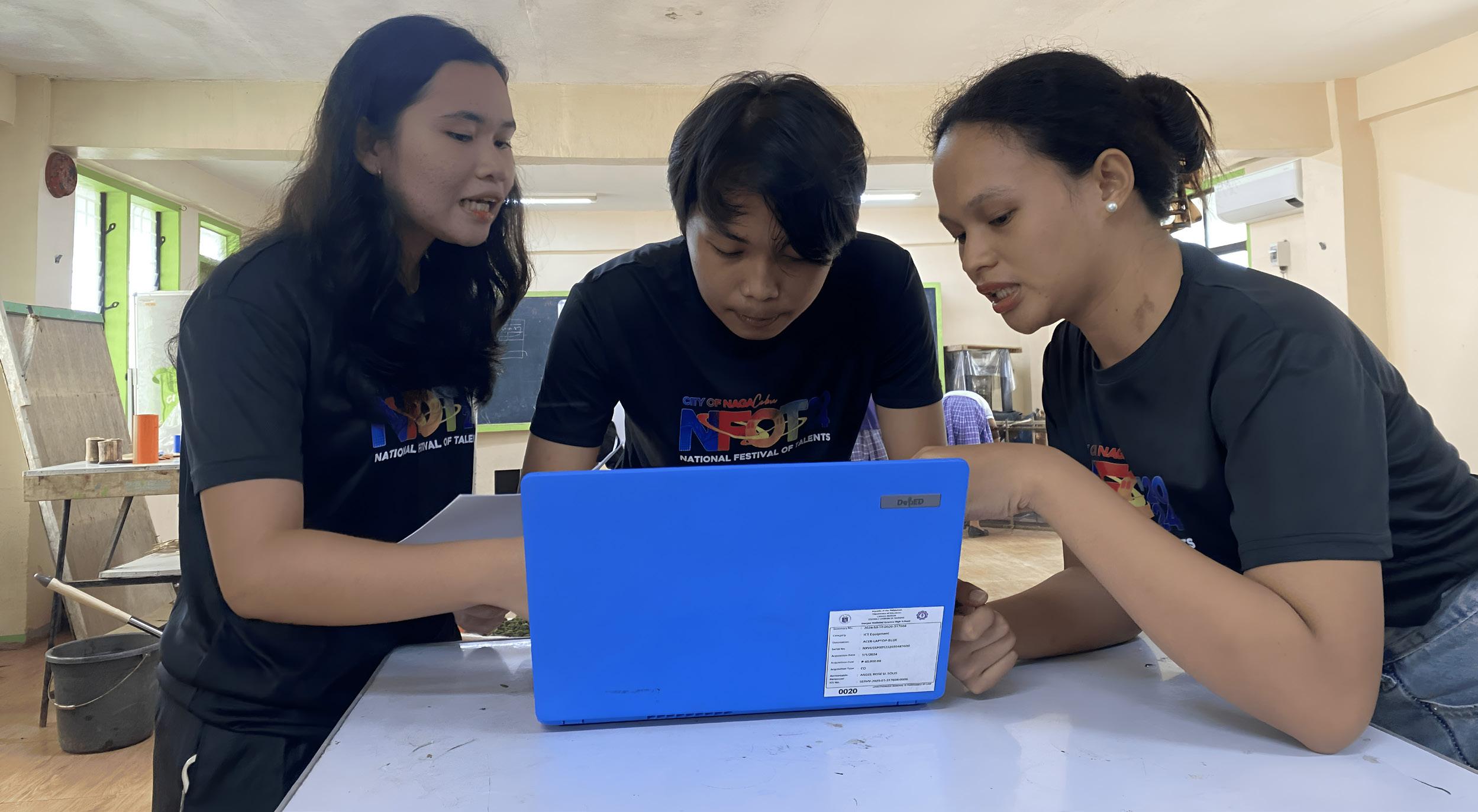

FARMTECH
Scihiyistas’ pioneers AI-Integrated Food Logistics Platform
by: NIKKI ASTRONOMO
While tons of fresh crops spoil before reaching consumers, farmers are struggling with market access, rising food waste, and the environmental toll of inefficient disposal. But a group of young innovators from Siargao National Science High School (SNSHS) is proving that a smarter, more sustainable food logistics system is within reach.
AI as a Game Changer
Farmers in the Philippines, especially in Siargao, encounter significant challenges in food distribution as they have no easy access to buyers and inadequate transportation networks, even studies shows that the waste collection rate of Siargao is merely 10%, resulting food waste and environmental problems.
FarmTech, a logistics platform driven by artificial intelligence presented by Grade 11 students Daryl Gordita, Precious Feby Congreen, and Roella Jay Villamor, which won 4th runner-up at the 2024 STEMAZING competition in the National Festival of Talents (NFOT), aims to link farmers to buyers, streamline transport, and reduce food wastage.
Airing Contingencies
It operates based on the mechanism of registering the farmers through an app or online platform, providing information such as farm location, type of crop, and likely harvest date. Legitimization is assured using AI verification processes, limiting spoofing activities.
After then, farmers will input excess produce details, such as type, quantity, and estimated shelf life. AI algorithm processes market demand to automatically match produce with available buyers like supermarkets, food banks, and restaurants.
Optimizing the supply chain
Farmers can select delivery alternatives from within the platform, with AI planning transport routes based on traffic, weather, and distance to ensure timely delivery of fresh product while monitoring transparency and avoiding losses from
Bin-vesting in Math to Subtract Waste, Multiply Impact
by: NIKKI ASTRONOMO
delays, and AI sensors will monitor temperature and humidity to protect food quality; if these values deviate, the system delivers an instant alarm to farmers, allowing them to take preventative steps.
Sustainability
In addition, FarmTech provides farmers with information on crop demand, price patterns, and sustainability statistics, allowing farmers to make informed decisions about planting cycles, irrigation, and land management.
Furthermore, government support would guarantee nationwide roll-out and access to funds, as what Daryl Cordita stated that they require government partnership to undertake it at scale, especially with the Department of Agriculture.
Challenges and the Road Ahead
However, FarmTech is confronted by challenges in internet access and digital literacy, particularly in rural agricultural communities having AI-based solutions slow to be embraced by some farmers due to their conventional trading practices. Data privacy concerns and cybersecurity need to be assuaged for users to place their trust.
Ms. Marielle Gubaton, the students’ adviser, also declared her pride in their passion and appreciation of sponsors for backing them. Ms. Gubaton is certain FarmTech would be a difference-maker in augmenting food security and enhancing the livelihoods of farmers if given the proper support.
Greener Future for Food Distribution
FarmTech is not just a project, with
In the midst of Siargao National Science High School (SNSHS) packed corridors, there is a certain type of problem-solving— not in textbooks or blackboard

results, students used the linear function f(x) = mx + b to forecast waste trend over time using Jamovi, an open-source statistical software.
fluctuations or fluctuations in behavior.
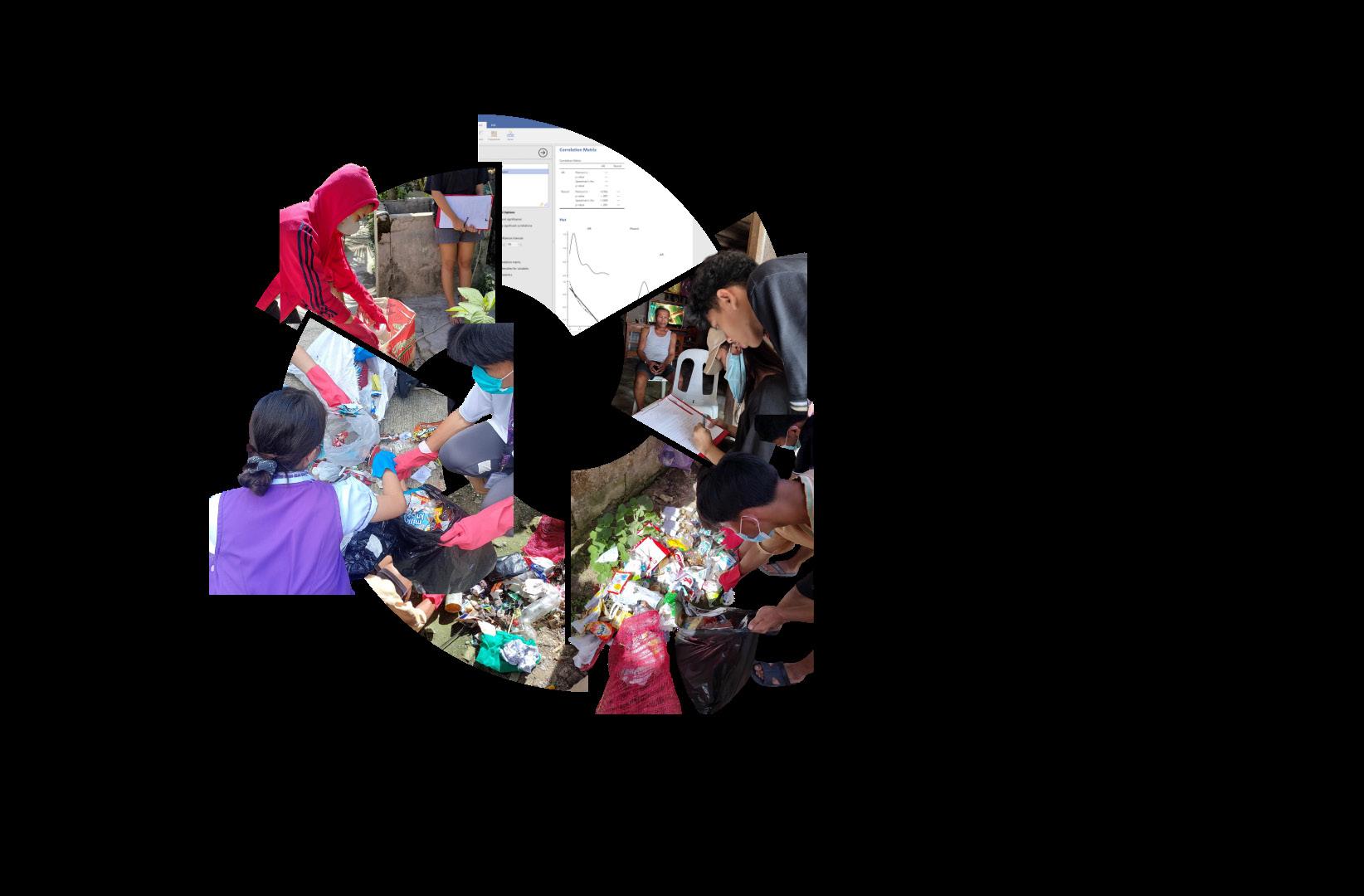
“We made our own equation based on the data we collected, and Jamovi helped us figure out the values we required,” a student explained. There were problems with the research, however. Residents were wary of questionnaires, and academic constraints prevented data collection. Sorting trash still had to be done by hand because most houses did not have separate trash. Interpreting statistical results into useful recommendations also required technical expertise.
The project was guided by Mr. Jimbo Juanito B. Villamor, a former SNSHS head teacher and present associate professor of mathematics education at Surigao del Norte State University. Presently a PhD in Mathematics Education student at Ateneo de Manila University, he introduced mathematical modeling to SNSHS as part of his dissertation.
Findings of the study were reported to school and local authorities, showing waste patterns and possible interventions. While the model performed well, there were some limitations. The linear function was based on a constant rate of waste increase, and this may not reflect completely seasonal
To ensure the impact is sustained, the students also proposed working with SNSHS’s YES-O Club to monitor waste trends on a regular basis and promote green habits in and out of school. Their campaign was officially endorsed by PAMB SIPLAS, DepEd Siargao, and the LGU of Dapa, which assisted local solid waste management. The method is simple to implement but highly effective, and therefore other societies can readily implement it. Interested parties can do the following to implement their method: gather waste generation rate data, weigh and sort biodegradable and nonbiodegradable waste, account for external variables like household size and income, use Jamovi or other programs to create a predictive model, and generate actionable waste management policy recommendations based on trends.
By applying mathematics to resolve real-life problems, this study verifies that math is not all about numbers—it is a tool for changing the environment. And while you can compute what is going to happen, SNSHS students are proving that garbage is not an abstract issue—it can be addressed.
AI-MPOWERING FARMERS, ELIMINATING WASTE. Tackling food waste and supporting local farmers, Siargao’s Daryl Gordita, Precious Feby Congreen, and Roella Jay Villamor developed FarmTech—an AIpowered logistics platform. Their innovative solution earned them 4th runner-up at the 2024 STEMAZING contest in the National Festival of Talents (NFOT).
Photo by: Emmanuel Quizon Caption by: Dustin Jumandos
by: NIKKI ASTRONOMO

FROM BOOST TO BURNOUT
A Student’s Experience with Energy Drink


Sting was my new energy drink of choice, something I consumed daily and felt was boosting my productivity. At first, it was its distinct flavor and the energy it provided, helping me stay alert and focused during class hours. I consumed Sting once or twice every day, thinking it was the key to staying on top of my work.
Initially, the effects were just as I had hoped. The caffeine in Sting helped me stay awake and fight off tiredness. Studies show that caffeine, a central nervous system stimulant, can improve alertness and attention. On top of that, taurine, an amino acid found in energy drinks, is believed to support mental and physical performance, especially during physical exertion. I was hooked. There wouldn’t be a day I forgot to
But after a while, things started changing. The stimulating effect of caffeine no longer felt as stimulating. Rather, I began experiencing fast heartbeats and occasional palpitations. That is a commonly known effect of caffeine, especially when consuming huge quantities of it.According to the National Institute of Health (NIH), excessive caffeine intake can lead to heart arrhythmias and high blood pressure.
It wasn’t long before I started to feel the side effects more intensely. Trouble
sleeping became a regular issue. What worried me the most was the hyperacidity and stomach discomfort, including a burning sensation and pain, a clear sign of acid reflux.
My research on energy drinks revealed alarming statistics. Teenagers are warned by the Department of Health (DOH) to be careful with the amount of energy drinks they consume due to the high levels of caffeine in it, which disrupts the body’s natural sleeping cycle. Adenosine, a brain chemical that induces sleep, is inhibited by caffeine, a drug that inhibits sleep, particularly when taken in the evening. Also, the acidity of certain beverages such as Sting may also lead to upset stomachs. Energy drinks are extremely acidic, pH less than 4, and lead to acid reflux, which I myself have experienced. As per one study in the Journal of Clinical Gastroenterology, in which they have carried out and published the same, frequent consumption of acidic beverages can lead to gastrointestinal problems in the long run, thereby leading to chronic acid

Since I had these health issues myself, I realized that my Sting addiction was harming me. Although energy drinks have short-term benefits like increased
alertness, the long-term effects are not worth the gamble. The DOH has always warned against the dangers of energy drinks, particularly among teenagers. They advocate moderation and warn people against consuming energy drinks daily or in the evening.
I’ve discovered the importance of knowing what goes into my system through experience. I’ve reduced my consumption of energy drinks and opted for more natural beverages such as water, herbal tea, and juices, which are much less taxing on the system and do not disrupt sleep patterns. As much as energy drinks will make one productive for the time being, the possible dangers, ranging from palpitations of the heart and insomnia to an upset stomach, are too serious to be overlooked. Students are well informed of the long-term effects and will make their own health choices.
The DOH advises students to be careful with energy drinks, especially because they can cause such conditions as sleep disorders, increased heart rates, and irritable stomachs. It is always better to coexist and avoid excesses of stimulating substances. Ultimately, health should be more important than temporary highs.



The most loyal friend a person could have is a buddy who is always waiting for them to come home. However, life is never a path without thorns. Parvovirus, according to American Kennel Club, is every new puppy and dog owner’s nightmare. Within a few days, a healthy puppy can be happy and active and then terminally ill.
Although parvo is believed to be noncurable, it is fortunately avoidable—thus, it is highly important for every new puppy owner and breeder to be familiar with its threat. Parvovirus is a contagious virus that produces an infectious GI disease in young dogs and puppies. It is potentially lethal if left untreated and prevented.
In fact, 90% of the puppies who have parvo, according to Dr. Kevin Horecka, have died when not treated. On the other hand, 86.6% of those who receive attention during the initial five critical days from when the symptoms have first been exhibited will fully recover. Symptoms of parvo in a dog often occur in early stages such as lethargy, vomiting, diarrhea, and a lack of appetite. There is also a very noticeable, unhealthy sweet, sick smell that indicates feces infested with parvo.
How Parvovirus Spreads
The canine parvovirus (CPV) spreads in two ways. First, through direct contact with infected feces, such as when a dog sniffs or licks a contaminated surface or another dog. Second, it spreads indirectly, as the virus can survive on clothing, equipment, human skin, and in various environments making CPV particularly dangerous in areas where dogs frequently interact.
Since puppies explore their world through smell and love to mouth things, it’s easy to see how a curious puppy could contract the virus. In fact, CPV can survive indoors at room temperature for at least two months and is resistant to many commonly used cleaners and disinfectants. Outdoors, the virus can survive for months, or even years, when protected from direct sunlight. Maintaing proper hygiene, including disinfecting areas and quarantining infected dogs.
Firsthand Experience
One pet owner from Siargao National Science High School shared their heartbreaking experience:
“On the first day, my puppy was still playing, though a bit weaker than usual. By the second day, he stopped eating entirely and rapidly lost weight—his once-full belly looked empty. I tried feeding him liquid food with a syringe, but his mouth had already stiffened. By the third day, he could barely move, standing still as if frozen. His body weakened so quickly that by nightfall, he was gone. It was shocking how fast parvo took him from being an energetic pup to lifeless in just three days.”
The virus spreads like wildfire, much like COVID-19 in humans, making strict
precautions essential. While some dogs may survive due to stronger immunity, unvaccinated and purebred puppies are often more vulnerable. Keeping pets indoors, avoiding unnecessary contact with other dogs, and ensuring vaccinations are up to date can mean the difference between life and death.
Prevention is Key
The most effective way to guard dogs against the lethal parvovirus is by sticking to vaccination protocols. The parvovirus vaccine is among the core canine vaccines. Puppies must be vaccinated at 6 to 8 weeks (about 2 months) old with the first dose, then doses every two to four weeks up to 16 to 20 weeks (about 4 and a half months) of age. A booster shot is recommended at one year old, with boosters every three years. Keeping your dog up to date on vaccinations is the best method of preventing infection. Though parvo appears to be an inevitable menace, caution and attentiveness can mean everything. Time is short, and a dog’s life—his loyal best buddy—rests on the shoulders of humans. Owners must go that extra mile to see that their animal friends have many more years at their side.
by: BIANCA PETALLO
Too young to vote, too young to drive— but old enough to be drowned in a drink. To others, alcohol is not a sip but a getaway. But a swallow’s hideous, awful truth is a brain developing, emotions knotting, and an addiction that clutches before they even know it.
A survey conducted from SNSHS presented a devastating result: 79% of youth below the age of 18 have tried drinking alcohol, and personal problems and pressure from peers are the most frequently cited reasons why. Curiosity or the desire to fit in can quickly degenerate into an alcoholism-related habit, and science warns may have a permanent impact.
Teenage brains remain in development. The prefrontal cortex, the region responsible for reasoning and self-control, won’t be fully developed until the mid-20s. In the meantime, alcohol re-wires reward circuits and increases the susceptibility of young drinkers to addiction. Research indicates that drinkers under 18 are five times more likely to become alcohol dependent as adults. The brain gets used to alcohol just like it gets used to learning— but rather than building the knowledge, it builds the craving.
Alcohol is supposed to dull pain by most, but neuroscience tells a different story. It may calm feelings in the short term, but alcohol disrupts serotonin and dopamine levels, piling on stress and grief in the long run. It’s a trap—tomorrow’s problem can be today’s comfort, depression, and addiction. Outside of the brain, the body is also harmed. Alcohol makes people think less clearly, erase memories, and compromise immune function. Even the occasional use leads to an increased risk of accidents, risk-taking behavior, and long-term damage to health. And teen drinking is still normalized, all too often a “phase” rather than a concern.
But prevention doesn’t have to frighten—science-based education has the power to change the teenager’s attitude about alcohol. To create lasting change, communities, schools, and families need to work together: open communication, improved coping abilities, and brainprotective youth policies.
Alcohol can appear to be an escape, but it is a thief—taking clarity, control, and potential. Teenagers are worth more than warnings; they’re worth enough for the truth, the tools, and the opportunity to make decisions that will safeguard their futures.
TEENAGE
(200 RESPONDENTS)
STUDENTS WHO HAVE TRIED ALCOHOL 79%
MAIN REASONS FOR DRINKING (PERSONAL STRUGGLES) (PEER PRESSURE)
LONG-TERM IMPACTS
HIGHER RISK OF ALCOHOL DEPENDENCE IF DRINKING STARTS BEFORE 18
INCREASED RISK OF ACCIDENTS & INJURIES MYTH VS REALITY
OF
SOURCE: SNSHS Survey, Neuroscience Research
me that extra kick. A survey estimate revealed that more than 50% of SNSHS students consume Sting more than they consume water, the guys consuming more than the gals. Including me.
by: NIKKI ASTRONOMO
by: NIKKI ASTRONOMO
Photo by: Brigette Esparrago
Caption by: Dustin Jumandos
Graphics by: LEO CASTRONUEVO
science, livelihood, and innovation
Threads of Heritage
by: NIKKI ASTRONOMO
Monica weaves, the machine hums, and a tradition continues. In Caridad’s quiet recesses, hands move methodically, pushing and tugging, threading and locking, exactly as generations before them. Banig weaving is more than just a skill; it is a tradition, an art passed down through generations. An essential component of Caridad’s cultural legacy for a long time has been the ancient craft of banig weaving. Mrs. Monica Politan Ruaya is one of the most devoted weavers, and her family has continued this custom with the ‘Habyonan’, a traditional handoperated loom that needs two people to work effectively. For them, weaving serves as their main source of income in addition to being a craft.
The Weaving Process


drying the material become particularly difficult, making it a challenge for weavers to maintain production. Additionally, the weaving process itself is physically demanding, requiring significant strength, coordination, and endurance. Each mat takes hours of precise movements, making the craft both labor-intensive and timeconsuming.
Furthermore, the traditional Habyonan machine and its components, including the bakayan, banjakan, and likisan, require regular upkeep to ensure seamless operation. Any damage or wear can slow down production and impact the quality of the woven mats.

NETTING THE FUTURE
by: NIKKI
To fishermen, our oceans are not only a part of the world but their living and bread and butter, and when under attack by overfishing and worse, requiring smarter, more efficient, and more sustainable fishery practices than ever before. Traditional fishing practices often waste too much fuel, generate an excessive catch, and require frequent manual sorting of the net, leading to wastage and harm to the environment.
The basic raw material for weaving, ‘alahiwan’ (reed grass), must be gathered and prepared first. For about 500 pesos, weavers usually buy three bunches. They must, however, dry and prepare the material themselves before weaving because the supply becomes limited during the rainy season. The alahiwan goes through the dyeing process once it has dried. Consumers select hues that complement the design they want, and the straw It takes teamwork to operate the Habyonan. A weaver, like Mrs. Ruaya, pushes and pulls the ‘bibitan’ (heddle) to interlock the straws while another weaver supplies the machine with the dyed alahiwan, guaranteeing a consistent supply of material.
To preserve the banig’s strength and beauty, she carefully painstakingly locks the ends in exact patterns. Until the entire mat is braided, this complex procedure is repeated.
The Physics of It
The fundamentals of physics are at the core of this process; friction, force, and tension all contribute to the loom’s effective operation. By applying an alternate force to the alahiwan, the heddle combines compressive and tensile forces to produce an interlocking weave pattern. The structure is held together by the friction between the strands, which keeps it from unraveling. The mat would lose its integrity if these forces weren’t properly balanced, demonstrating the scientific accuracy of what seems to be a completely manual art.

Struggle
for Recognition and Support
Local weavers, including Mrs. Ruaya and her community, have received occasional assistance from livelihood programs such as the Sustainable Livelihood Program (SLP). However, they face difficulties in selling their products, as there is minimal government support in finding buyers. “We can weave, but what we truly need is help in selling our products,” says Mrs. Ruaya. “We want more people to appreciate our work and for the government to assist us in reaching customers.”
Currently, there are no plans to upgrade the Habyonan, as weavers believe it produces superior-quality mats compared to modern machines that primarily use plastic materials. Each banig created through traditional methods carries the mark of patience, dedication, and hard work—values deeply rooted in Caridad’s cultural identity.
Keeping the Tradition Alive
More than just mats, these woven creations include placemats, doormats, and decorative items. Each piece tells a story of craftsmanship and resilience. With proper support and recognition, the weaving legacy of Caridad can continue to thrive for generations to come. As Mrs. Ruaya puts it, “Ang amo raman gud gusto kay jaun, naay mutabang sa pagbaligya, kay kami nagahimo lang, nagalaom na lang nga aduna may mopalit.”

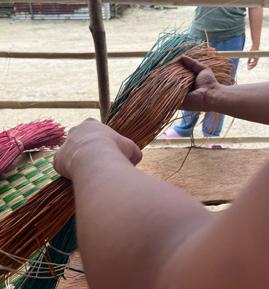
Students from Siargao National Science High School, namely Eric A. Jovita, Kyra Nicole G. Imperial, and Necoleigh Kates R. Salvaloza, are designing the Marine Life Detection System, which is a technology-based product using a Raspberry Pi, an ultrasonic sensor, and a camera, that aims to increase the accuracy, efficiency, and sustainability of fishing.
How It Works
The fishing nets are tracked in real-time using a combination of image processing and sensor technology. The movement is detected by the ultrasonic sensors, which trigger the Raspberry Pi to analyze the data and verify the presence of fish. Once verified, it takes a photo with high-grained cameras, and the fishermen are notified on the spot on their phones— enabling them to bring their nets ashore only when required.
By not being regularly inspected by human beings, the technology conserves fuel, labor expense, and bycatch, making the fishery more selective and sustainable.
Testing & Development
In order to ensure reliability and consistency, the system will be subjected to testing in terms of levels of water, intensity of lights, and water turbulence. It will be checked for optimal usage to separate the real fish from the false calls of sea flows or pieces of floating trash.
Not only does it optimize net catches and reduce discarded fishing effort, but
it also prevents marine life from being unintentionally caught. It is therefore a beneficial gear for both small-scale and industrial fisheries because it provides more responsible fishing.
Economic and Environmental Benefits
The Marine Life Detection System is economically as well as environmentally sound. Fishermen earn money, burn fuel, and labour cheaper—more fish for the effort. If employed on a mass scale, the technology holds potential to restore the fish populations to their balanced position and discourage overfishing and leave fish in the oceans to generations yet unborn. Besides its financial advantage, the system also advances world conservation by ensuring sustainable fishing. Through reduction of bycatch and maximization of resource usage, it ensures that delicate sea ecosystems and sustainable fisheries future are ensured.

Future Directions and Developments
As the team keeps improving the Marine Life Detection System, it is working towards a means of incorporating AI-based image recognition capability to improve the identification of species. This would be able to recognize target fish against conservation sea life so that fishermen could make more intelligent and responsible choices before hauling in the nets. Solar models are also being developed to further make the product energy-efficient as well as distribute it to more people in remote fishing communities.
Cooperation with marine conservation societies, government agencies, and coastal fishery sectors can also facilitate the success of this innovation. Integrating technology into sustainable fishing, the Marine Life Detection System can potentially revolutionize the process of fishing— leaving the next generation a healthy, balanced, and booming ocean to enjoy.

by:
Photo by: Charles Gocela Caption by: Dustin Jumandos

Lights poured in over the court as players fought through fatigue, jerseys dripping with sweat, movements driven by sheer will. The shouts of the crowd reverberated through the stadium, a pulsating throb of energy with every dribble, every pass, every last attempt to get around the defense. And then, suddenly, a player fell—a twisted grimace on his face as he doubled over, holding his leg in agony. His teammates ran toward him, but before they could reach his side, an opposing player intervened. Rather than seize the moment to score, he knelt down, stretching out the injured player’s cramping leg. For a moment, the roar faded, the game faded, and in their place stood an unassuming but potent demonstration of sportsmanship—a demonstration that some moments are more important than the game itself.

Amidst the intense match between both teams, Netripperz and Unleashed, exhaustion’s grip held some players down. Numerous participants experienced a sudden muscle lock, hindering them from performing well during the match. During these unexpected circumstances, opposing teams lend a helping hand rather than seizing the opportunity of their opponent’s distress.
Justin Lyle Espuerta—Netripperz’s team captain—experienced an unanticipated leg cramp, pausing him from playing the game. This circumstance gave a huge disadvantage to his teammates, leaving them headless during an intense match. Unbeknownst to them, a player from the opposing team came rushing to aid Espuerta.
Team Unleashed’s player, Johncons Borja, instinctively ran towards the distressed opponent. He immediately performed a massage technique to ease the muscle lock that Espuerta is experiencing. “Basketball is about more than just winning,” said Espuerta. “In that moment, I was just grateful to have a fellow athlete there, showing that

sometimes, the game is bigger than any score on the board. Johncons didn’t hesitate to help, and that meant everything to me.”
These instances can do a lot of good to all athletes because it reminds them of the need for solidarity. To make them understand that all sporting competitions are not about hate; intense competition should never cloud the deep values that sports should impart, such as respect for one another and integrity.
“It wasn’t even a second thought. I saw a teammate in need, and that’s what it’s about, we’re all here to support each other, not just compete. I’m glad I could help Justin out,” Borja shared.
The match between the two teams emphasizes the significance of creating bonds, giving value to the true meaning of the event—the friend-shelf day—where enmities can’t break the solidarity that have been formed, which strengthened the connections that they’ve made as things unfold.
BATO-BACK WIN
by: GEORLYN DONOSO
Clinching her third table tennis title, Shamaine Bato from Siargao National Science High School (SNSHS) defeated Mona Louise Erong from Oguing Navarro Memorial National High School in straight sets, 11-9, 11-6, 11-7, securing her place in the Caraga Regional Athletic Games (CRAG) on December 12, 2024, at the SIARELCO Multipurpose Building.
Both players began the first set with powerful rallies, exchanging powerful serves and quick reflexes.
Bato set up an 8-3 advantage early on, playing great with her backhand and forehand shots, Erong launched a comeback, receiving some fine down-the-line shots.
But Erong had made some errors on her part that allowed Bato to take the first set 11-9.
Bato kept the pressure on in the second set by playing well and using her speed to outwit Erong.
Erong’s powerful forehand rallies earned her a few points, but Bato swept the game, 11-6, in pursuit of the championship.

SPORT-ACULAR SUCCESS
SNSHS Launches New Sports Program
by:
For years, sports at Siargao National Science High School (SNSHS) meant just two things—chess and table tennis. With no official sports program since its founding, Scihiyistas had little opportunity to step onto the competitive stage beyond those two events in the Siargao Division Athletic Meet (SDAM). The sport program launch transformed every aspect of Scihiyistas’ world. Scihiyistas have left their pawns and paddles behind to play volleyball with spikes and execute taekwondo kicks together with aggressive shuttlecock plays. Students who were previously limited to sports activities can now break new boundaries by showing their abilities in sports competitions that were previously unlikely for them.
Principal Rex Mardy Labe sees this as a change of direction. “This is not just about creating teams,” he states. “It’s about preparing students with the skills to create leadership, discipline, and resilience—qualities which extend far beyond the playing field.” His vision is clear: a school in which academic and personal development are nurtured through structured, competitive, and recreational sport.
For parents, the project is a chance and a challenge. Levie Dacera, whose two children attend school there, is hopeful but cautious. “Sports teach you perseverance and teamwork, but we have to ensure it is inclusive and safe,” she says. “All students,
to participate.”
Among educators, the mood is also upbeat. Twenty-year veteran teacher Ma’am Camille Martel believes the program can transform student engagement. “A healthy body goes well with a healthy mind. If this program caters to both, then it will be a game-changer,” she adds. Educators are already brainstorming ways to integrate sports into the curriculum, exploring interdisciplinary approaches that link sports to such areas as mathematics and science. Students, however, are probably the most excited. Nemuel Salgado, one of several more than pleased with the announcement, talks openly about his excitement. “I’ve been waiting for this! I just want to be on a team, challenge myself, and make new friends,” he says. His excitement is representative of a larger student body eager for structured extracurricular activities that offer both fitness and friendship.
As the program develops further, its success will be measured by implementation—whether it successfully addresses the competition versus inclusion issue and if it really works to improve the educational process of the school. One thing is sure, though, that this program has already made our way of schooling different. It is no longer only about academics; it is about creating a balanced setting where students can succeed in every area of development.
During the third set, Erong switched gears, altering her shots and focusing on returns. Despite her efforts, Bato remained calm, deflecting each blow with sharp retorts. Erong was able to get some good smashes but was unable to break through Bato’s defense, Bato taking the set 11-7 after getting a good backhand to win at 3-0.
“I was just concentrating on playing my game and being consistent throughout. I’m glad to be able to share this win with my school and proud of all the training that came through,” Bato said.
With this victory, the Scihiyista paddler will compete again for the third time in regional level this 2025, marking a significant achievement for SNSHS.
I’m
happy to bring school and proud of all the training that

MARK AIVAN DACERA
Bato clinches third table tennis title, secures ticket to CRAG 2025

sportsnews
Team Hope triumphs in five-set thriller against Team Love, 3-2
Team Hope won the Friend-Shelf Volleyball Game championship title in one of the most exciting games played this season after edging Team Love with a heart-stopping 3-2 victory at Siargao National Science High School (SNSHS) grounds last November 22, 2024.
The game started with Team Love performing well led by captain Shann Espanola, who led his team to a 2-0 set lead with strong spikes.
Combined efforts of Espanola and Solloso put Team Love in total command in the first two sets, both of which they won at 25–20.
In the third set, spiker Nemuel Salgado ignited a miraculous turnaround by getting into rhythm and handing in a string of blistering spikes and service aces.
The momentum turned in favor of Team Hope after winning the third set with a mercilessly chilling 25–6 thanks to Eadward Omas-as’s aggressive receives and Mark Aivan Dacera’s keen settings that went well with Salgado’s sensational display.
With Dacera’s precise sets feeding Salgado’s spikes, Team Hope moved on to stamp their authority in the fourth set, taking it 25-22.
Now that the match was tied 2-2 and the clincher was the fifth set, this was now a battle of mind and body where team Hope emerged stronger as they finished off their stunning turnaround with the slenderest margin of 15-12.
As part of English Month Friend-Shelf Day remembrance, the two groups received notebooks and pencils, appropriate for the event’s

After their impressive victory at the 2nd International Dragon Boat Festival in 2023, the reigning champions returned with a powerful performance, securing the championship in the Men’s 200m10-seaters, 1st runner-up finishes in the Mixed 200m - 20-seaters, Women’s 500m - 10-seaters, and Men’s 200m - 10-seaters, and 3rd runner-up positions in the Women’s 200m - 10-seaters and Men’s 500m10-seaters categories.
The women’s 200-meter race kicked off with Siargao Dragons taking the pace immediately after taking a lead in the first stroke while keeping flawless synchronization and a pace of 100 bpm.
Despite an intense push by Alliance of Masters on the same round, the Siargao paddlers were able to hold on, crossing the finish line in 1:08 minutes—far ahead of the pack.
On the other hand, Siargao Dragons was similar in control in the Men’s 200-meter sprint in spite of having multiple series of intense heats that morning, they were off and running at such a pace they quickly distanced themselves from everyone else and maintained it until they crossed the finish line at 54 seconds, two seconds ahead of WPS Dragonboat Pinoy Workers.
sportsfeature
Afterwards, at Mixed 500-meter event, Siargao took their rhythm at the halfway mark of the event leaving other competitors behind including Bakunawa (Iligan City), who failed to bridge the gap.
The team secured the victory after they successfully maintained an unbeatable lead at the final stretch and completing the race with 2:05 minutes, while their competitors trailed far behind.
The second round Women’s race was a fierce contest from beginning to end, the Siargao Dragons took charge as usual, controlling the early part of the course with synchronized paddling and incessant power.
It was during the second round of the women’s division when Puerto Princesa Dragonboat Team intensified their effort in narrowing the lead during the mid-stage of the competition, leading to a head-to-head finish with Siargao’s bet who dug inside and unleashed an impressive last quarter run that delivered them first position.
Siargao Dragons continued to dominate in the second round of the Men’s 200-meter race, they paddled ahead early in perfect rhythm leaving the WPS Dragonboat Pinoy Workers and Alliance of Masters at their back. The race ended with powerful strokes and strategic timing from the crossing the finish
line with a comfortable lead.
As the Men’s 200-meter finals approached, Team A of the Siargao Dragons never let up. Right from the beginning, their synchronized performance gave them the reign of the race and never let go. They reached the finish line first, and Team B followed closely to take the 1st runner-up spot.
In Men’s 500-meter finals, Siargao Dragons’ Team A gave their all to keep the game; however, they lost narrowly to another team in a hard-fought battle making them to settle with the 1st runner-up title.
In the Women’s 200-meter race, Siargao Dragons performed well and stayed consistent to end up with a 3rd runner-up position.
During Women’s 500-meter race competition the female members of Siargao Dragons battled intensely for their secondplace finish, their excellent coordination and pacing strategy enabled them to maintain
Siargao skater clinches place at Surfskate Championship
Malaysia.
During his first moments on the board David performed flowless aerial movements which established his dominant position while his perfect control of the board heightened his self-confidence before demonstrating a fighting routine.
David used accurate maneuvers and well-timed turns throughout his show which maintained his momentum based on his initial strong performance.
At the halfway point of his performance, David monitored his rivals, working out his next steps.
David’s concentration was put to the test in his most trying moment in the run when a slight slip jeopardized his rhythm.
In the last bit of his routine, David performed his last trick — a perfect board slide along the rail, the trick was smooth and perfectly timed, ending his routine strongly, with fluid precision, he completed his run, keeping both control and smoothness throughout the last few seconds.
David thought back on the triumph his regular training had achieved for him, conceding that the work he devoted to his every-day routine had enabled him to compete at so high a standard in the Surfskate Championship.
Looking forward, David identified areas in which he could still improve and hone his skills, showing that he is open to change and development, especially in how he reacted to his opponent’s remarkable moves.
In spite of having no official competitions scheduled, David’s commitment to practicing every day does not waver.


“I think our daily training from here in the island went well, it really pays off,” he expressed.
“I don’t have any lined-up competitions as of the moment, but if there is, I always practice skateboarding on a daily basis and attempt to hone my skills in surfskating,” he said.
As my name suggests, KYTH, i will fly to new heights!



KICK, FIGHT, KYTH WILL BITE!
Scihiyista flykicker wins gold in SDAM 2025, secures spot in CRAG
After taking a deep breath, he settled into a chair in the red corner of the mats, across from him was his opponent in the blue corner. Both fighters, in full gear, stared into each other’s eyes as fire rages behind them.
Kyth Quijano had sparred against countless people with varying fighting styles, a taller opponent did not intimidate him. Representing One Dapa during the Siargao Division Athletic Meet, with his experience up in his sleeve, he carried confidence that did not dwindle.
In the Fin category. Kyth’s first opponent came from Sapao District. The referee checked if both Chung (Blue) and Hong (Red) had their gear properly worn before the fight began with a decisive “Si jak!” Kyth acted to strike first, after a minute and a half, he dominated against Chung and
secured a place in the next round to spar General Luna’s player.
During his second match, Kyth, once again in the red comer, fought against General Luna in the blue corner. For the first round, he experimented with mimicking his opponent’s kicks, which drew scoldings from his coach. Despite this, the round ended with a narrow score of fourteen to sixteen, in favor of Kyth.
Determined to improve, he abandoned his tactics of imitation and relied on his own calculations. His determination was not wasted
as he pulled ahead with a total score fsixteen to twenty-four, attaining victory and qualifying for the regionals as Siargao’s Kyurogi player in the Fin category. With every sharp slap of Kyth’s foot against his opponent’s trunk gear, the noise of the crowd cheering for him became a distant noise in his mind. With the weight of his gold medal, he will continue to train for more athletic meets. He will carry the promises of the fighter in him that will thrive under pressure, using the challenges to his advantage.
Siargao Dragons defend their throne in 3rd int’l Dragon Boat Tilt
Siargao Dragons once again paddled their way to dominance at the 3rd International Dragon Boat Festival 2024, held in Puerto Princesa, Palawan, on October 27, 2024.
Building on his success in surfskating, Laurenz Emmanuel David from Siargao claimed 5th place in the Men’s Cup category at the 2nd Milo x Wavvy Hub Surfskate Championship, held in November 2024, at Putrajaya,
Photo by: Gueen Lim
Caption by: Adelle Rosete
by: GEORLYN DONOSO
by: GEORLYN DONOSO
by: MARK AIVAN DACERA

their status as dragon boat champions. With a powerful performance that showcased flawless synchronization and unwavering determination, they secured top honors in key categories and solidified their reputation as one of Asia’s premier dragon boat teams.
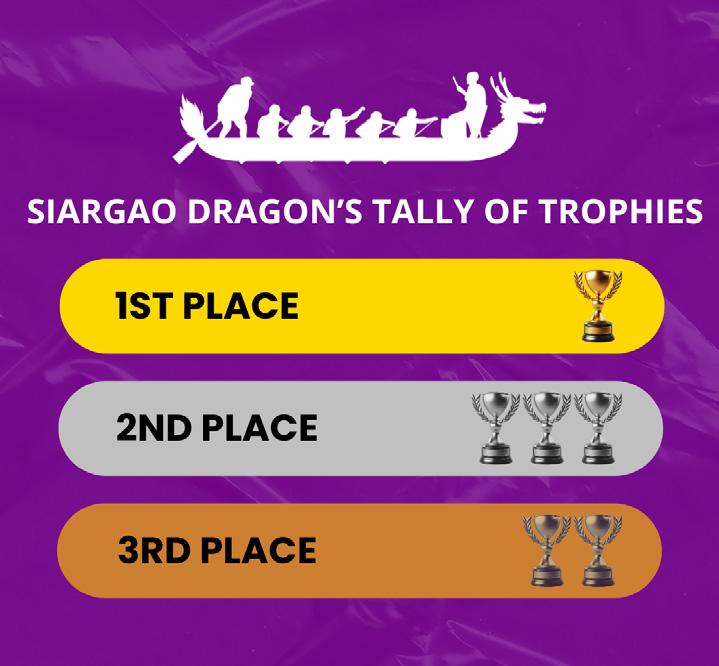
Esquivel Secures Three-Peat at WSL La Union
World’s no. 4 surfer Rogelio
“Jay-R” Esquivel Jr. conquered the waves once again and completed a three-peat in the men’s edition of the World Surf League’s (WSL) La Union International Pro Longboard Qualifying Series (LQS) held from January 20 to 22 at Urbiztondo Beach, San Juan.
sportsfeature
In a total of 10 waves, Esquivel defeated his opponent, Reynie Ventura, achieving the highest heat score of the event with a 15.67.
With a go-ahead abovethe-lip surfing, Ventura took the lead in the first wave with 4.00, widening the score with 2.18-point difference.
According to the World Surfing League (WSL), Esquivel quickly accumulated a score of 10.50 points after securing 1.83 and 8.67 in his second and third attempts.
Ventura was unable to recover after Esquivel seized the fourth wave, raising the bar by posting the highest single wave score of the event with a 14.50, which brought his heat
total to an event-high of 15.67, according to the WSL.
Esquivel faced tough competition from his long-time friend Reyniel “Perry” Ventura, who applied pressure with his aggressive style, but Esquivel’s strategic wave selection and precise maneuvers, including nose rides and cutbacks, ultimately earned him the victory.
After the win, Esquivel stood with the Philippine flag draped over his shoulders, reflecting on the significance of his victory.
“I’m super stoked to win this event once again. It’s been an awesome Finals Day, and this is a big win for the Philippines,” said the 28-year-old.
Esquivel dominated the same category in the men’s longboard event in the World Surf League La Union International Pro, where he secured a back-to-back championship, outshining his opponent, Kai Hamase of Japan, with a score of 18.00-16.55.
The La Union native displayed excellent control and confidence on the large waves of Monaliza Point, taking advantage of his local knowledge.
Esquivel’s victory added to his milestone achievement from the previous year when he became the first Filipino to qualify for the 2023 World Surf League Longboard Tour.



The young surfers today have better boards and better opportunities. I see so much potential in them. For them, I say, ‘Be competitive.
sportsbits

one of the original local surfers who broke the ice with the waves, rides another smooth wave. The 56-year-old Siargao legend, who is normally seen cutting through the waves with ease and finesse, has witnessed the surfing culture evolve in his home island—now the Philippines’ surfing capital. But for him, it was all due to one wave, an unwritten challenge, and boundless curiosity.
Siargao preps up for 15th International Game Fishing Tournament


parABILITY:
During the early ‘90s, Siargao was a secret surfing haven with only a few surfers sprinkled on the horizon. One of them was Rudy, and his path to becoming a legend began with nothing more than the sheer curiosity to learn. “I was watching the surfers, and then after a couple of months, I was wondering about surfing—if I can give it a shot,” Rudy recalls.
He got his initial introduction to surfing through a Swedish expatriate, who invited Rudy to surf with them in the water. “I had a sailboat, so I used it to take them surfing,” he describes. Rudy’s first experience in Guyam Island in General Luna was a learning experience. “I kept falling off my board, but I really liked it,” Rudy admits, laughing at the recollection. “After a week, I stood up by myself.” Without people to consult with and coaches, Rudy’s process of learning was trial and error. His dedication paid off, and he found himself practicing in Siargao’s world-famous Cloud 9, an area famous for its strong, fast waves.
A beginner, Rudy’s passion for the sport was immediate. “It was very addictive, and I couldn’t stop,” he says. He soon found himself surfing nearly every day, fueled by an irrepressible desire to get better. “Every after work, I’d go to Cloud 9,” Rudy says. His initial attempts to compete in local events were riddled with struggles and victories. In 1996, Rudy competed in his first official contest, where he won the “Best Filipino Surfer” prize. “I trained only for 3-4 months but outranked surfers with years of experience,” Rudy humbly admits, still shocked that he was able to do so.
Following the 1996 competition, Rudy retired from competitive surfing, choosing instead to surf for himself. “I didn’t compete anymore in the competitions. I was just surfing, and as I grew older, I just kept surfing for the fun of it,” Rudy says. While not contesting as regularly, Rudy’s name was the one that the surfers in Siargao thought of. His humble beginnings opened the way for other homegrown surfers, and his status as the island’s very first local champion cemented his position in the history of surfing.
Now, Rudy watches the new crop of surfers catch the waves, amazed at how far they’ve come. “The young surfers today have better boards and better opportunities. I see so much potential in them,” he says with a smile in his voice. “For them, I say, ‘Be competitive.’” Although not involved in any official projects or coaching, Rudy’s enthusiasm for the sport is still infectious, and he is still a figure young-surfers look up to.
Perhaps one of the most cherished memories in Rudy’s past was his very first surfboard, which the Swedish surfer he met gave him. “I was given a shortboard, and after that, I borrowed boards from Australians and friends. Sometimes the boards would break, and we’d repair them ourselves. It was a different time then, not like today when boards are everywhere,” Rudy shares.
With Siargao’s surfing community thriving and growing now, Rudy is still a humble witness and surfer. He still surfs whenever he has the chance, catching the waves that took his heart many years ago. Today, he is not only a surfer but a living legend of the humble roots of the sport in the island.
Fueling Dreams, Breaking
Limits
History is made as inclusivity was used by the Siargao Division Athletic Meet (SDAM) by including Paralympic competitions in the island’s much-awaited sports tournament. This was a new page in the sport history of the island, and that is how the ability-challenged sportsmen are also given their own recognition and applauds for what they can really do. In the past, SDAM has been an arena where disabled athletes can highlight their abilities in track and field, swimming, basketball, volleyball, and other sports. This year, the competition, however, made a significant leap as disabled athletes were given a level playing field to compete with their able-bodied peers.
Local athletes with varying abilities, such as Jancent P. Mante, who again clinched First Place as the Ortho Boys Champion at the Paralympics during the Siargao Division Athletic Meet, exemplify the face of perseverance and talent. “I never see my condition as a hindrance. It is simply a part of who I am,” Mante said in a statement reflecting his unrelenting determination.
Born with deformities in his limbs and feet, Jancent might have been held back by his own fears or other individuals’ expectations.
But this Socorro runner will not buy into the idea that his affliction is a disadvantage. Rather, he views it as an obstacle to be overcome, and overcome it he has through sheer will power. On the track, Jancent runs with one-track-minded dedication and perseverance. Off the field, he is a humble and diligent student who always inspires fellow students with confidence and strong work ethic.
It is a historic moment for Siargao to integrate Paralympic events into the Siargao
Division Athletic Meet, showing that the island is committed to inclusivity and unity in sports. It is a beacon of progress not only for the region but for the entire nation, as it shows that the true spirit of competition lies in the hearts of athletes, regardless of their abilities.
the power of sport—when open to everyone— can ignite a greater sense of hope, unity, and possibility.
Siargao Island is set to host the 15th International Game Fishing Tournament in Pilar, attracting anglers from various countries.
The tournament, which will run for three days, will have several competition categories such as Biggest Billfish, Biggest Trevally, and Biggest Tanguigue, with cash prizes for the winners.
With all in place, municipal officials are emphasizing the competition as well as environmental awareness.
“We are promoting game fishing without exhausting the marine resources that make Siargao a global destination,” said Pilar Mayor Maria Liza Resurreccion.
Meanwhile, co-founder of the tournament Francisco Matugas underscored the participation of the competition in Siargao’s recovery.
“Having events like this welcomed from all over the world shows that Siargao is back on its feet.

RIDING HIS-STORY. Rudy Figuron, a Siargaonon surfing legend, glides effortlessly across the waves of his beloved island. A pioneer in shaping Siargao’s surf culture, Rudy reflects on how curiosity and determination transformed this once-secret paradise into the Philippines’ surfing capital.
Photo by: Oli Bayar Caption by: Dustin Jumandos
Splash! The sound of waves crashing against the shore of Siargao Island echoes in the distance, as Rudy Figuron,
PADDLING TO PERFECTION. Siargao Dragons reign supreme at the 3rd International Dragon Boat Festival in Puerto Princesa, Palawan, with a dominant performance that solidifies
NEVER A HINDRANCE.
Jancent P. Mante, 17, a Paralympic Long Jump athlete from Socorro, Surigao del Norte, presents oneself at the opening of the Siargao Division Athletic Meet 2025 held at Siargao Island Sports Complex on Tuesday, December 10, 2024.
Photo by: Siargao Dragons Caption by: Dustin Jumandos
Photo by: Brigette Esparrago
Caption by: Adelle Rosete
WHEEL TO GO!. Siargao’s Laurenz Emmanuel David clinching 5th place in the Men’s Cup category at the 2nd Milo x Wavvy Hub Surfskate Championship, showcasing his mastery of flips and spins in Putrajaya, Malaysia.
Photo by: Emmanuel David
Caption by: Dustin Jumandos
by: MARK AIVAN DACERA
by: GEORLYN DONOSO
by: GEORLYN DONOSO
by: GEORLYN DONOSO
by: GEORLYN DONOSO







sportsfeature
Ink It to Win It: Anajawan holds 5th Squid Fishing Game
Rhythmic plop sounds echoed as bait hit the water, blending with the quiet murmur of fishermen readying their boats, their lanterns casting golden ripples on the ocean’s surface. On July 2, 2024, Anajawan Island came alive with the 5th Annual Squid Fishing Game—a remarkable tribute to the hardworking fishermen who rely on the sea for their livelihood.
The one-time local tradition developed into an international event which recognizes the island’s long-standing maritime history. At first squid fishing functioned as a survival method but it now stands as a remove which symbolizes survival and economic capability. Opening their boats at dawn the professional fishermen operate simultaneously in the open sea using their nets and lines as they compete for the largest catch until the competition ends.
As the sun colored the sky with gold and crimson, the village was alive with anticipation. Children ran along the beach, waiting for the incoming boats, while laughter and traditional music filled the air. Tourists came to see the colorful maritime tradition.
At noon, the activity reached its peak when fishermen proudly paraded their harvest. Cheers arose when Mr. Vergelio Forcadilla received the grand prize—a 7-horsepower engine—for his record 8.3kilo catch. Mr. Roladan Conte’s 7.2-kilo catch gave him a brand new television set, while Mr. Wenceslao Murillo took home a gas stove for his 5.1-kilo squid. All the participants were given a Php 1,000 consolation prize as a token of appreciation from the community for their hard work.
With the sun dipping into the horizon, the island came together for a big feast, relishing squid dishes that were inspired by Anajawan’s food traditions. “This game honors our fishermen and the soul of our island,” said Barangay Captain Hon. Rosebelt S. Lim. Beyond being a competition, the Squid Fishing Game reflects Anajawan’s strength, culture, and tradition. Year by year, it reinforces communal ties and pays tribute to the sea in their lives, preserving the island’s heritage.

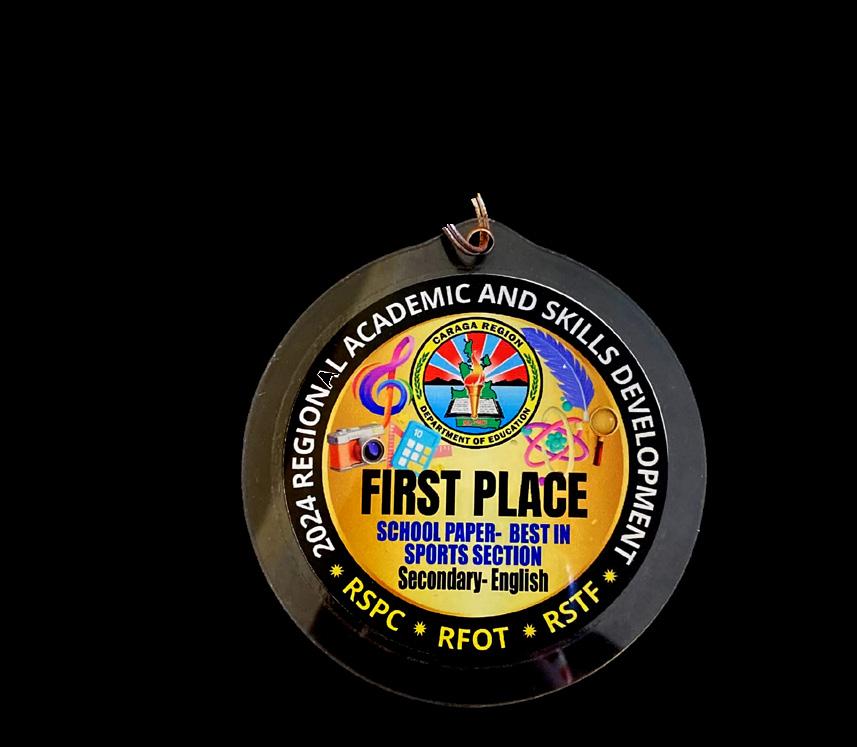

RGLIDING TO

by: GEORLYN DONOSO
Siargao bet claims Men’s Open Longboard championship title, tops World No. 4
eigning from the ‘Surfing Capital of the Philippines,’ Siargao’s Reynie “Perry” Ventura tamed the waves to capture the Men’s Open Longboard Championship at the 2024 Cabugao National Surfing Championship, defeating World’s No. 4 Rogelio “Jay-R” Esquivel Jr. in a thrilling final on December 10, 2024, in Cabugao, Ilocos Sur.
Ventura battled Esquivel Jr. in a combined 12 waves, eventually outscoring his opponent 14.40 to 11.75.
No. 4 in the world took control early when he laid down a good 6.25 on his initial wave, but Ventura counterpunched with a 4.75, making the heat very competitive from the beginning.
As the heat progressed, Ventura’s strategic wave selection and precise maneuvers, including nose rides and cutbacks earned him the victory.
On his third wave, Ventura scored 6.00, inching closer to Esquivel’s 6.25, by the time he landed a 6.90 on his fourth wave, he had
surpassed Esquivel’s 5.35, taking the lead for the first time in the heat.
Ventura became more confident as he persisted in adding on to his initial success, the fifth wave proved to be his turning point moment, as he rode almost to perfection, recording 7.50 to increase his lead with a total score of 14.40.
During the fifth round Esquivel missed the opportunity to recruit more points even though his final move scored him a 5.50 and raised his total to 11.75.
The consistency with which Ventura surfed all his waves as well as his ability to catch crucial waves earned him victory in the

Men’s Open Longboard Championship.
Looking back at the victory, Ventura expressed his elation on an Instagram page post, thanking for the opportunity to beat Esquivel.
“I’m glad I was given the chance to beat the World’s number 4, Jay-R, someone who has knocked me out so many times before,” he shared. He won the Men’s Open Longboard category at Calicoan Odyssey Waves based on his solid participation in the 2nd Leg of the 2023 NextGen Pilipinas Surfing National Tour.
Continuing his domination in the Siargao Division Athletic Meet (SDAM), Juvan Despoy from Siargao National Science High School (SNSHS) conquered again the Men’s Secondary chess category claiming two major victories at SDAM 2025 on December 12, 2024 held at Siargao Island Convention Center.
Despoy’s victory included the first place in both Secondary Blitz Individual Category and the Standard Individual Category, defeating top competitors from schools across the division.
Despoy, playing as White, employed the Ruy Lopez opening to control the center and develop his pieces actively, while Aparente focused on maintaining a solid defense.
As the middle game went on, Despoy castled kingside, pushed his pawns, and brought more and more pressure, building a material edge and limiting Aparente’s counterplay.
Eventually, Despoy’s better placement and accurate coordination resulted in a flawless checkmate, winning him the game.
In the blitz division, Despoy developed his pieces effectively while coping with the fast tempo, while Llano tried to develop threats on the queenside.
As time pressure increased, Llano erred, and Despoy took advantage by gaining a material and positional lead.
During the last few seconds, Despoy executed a tactical sacrifice and, through precise moves, achieved a checkmate within less than 20 moves to win.
The young chess genius has already gained three successive championships since SDAM 2022 and played for the Siargao Division at the Caraga Regional Atheletic Games (CRAG) for some years now since elementary.
“Feelings are neutral, not too happy and not too sad. Actually, being a regional qualifier feels natural because of how many times I’ve competed,” Despoy shared.
Preparations and focus were key to Despoy’s success, according to his coach Mr. Lauris Marx Congresso.
Together with other SDAM gold medalists, the Siargao chess representative is now currently preparing for the next Caraga Regional Athletic Meet (CRAG) 2025.
“Feelings are neutral; not too happy and not too sad. Actually, being a regional qualifier feels natural because of how many times I’ve competed.” “

by: GEORLYN DONOSO
Truth beyond the Campus, Voice for the Community
WAVE WARRIOR. Siargao’s bet Reynie ‘Perry’ Ventura rides to victory, claiming the Men’s Open Longboard title at the 2024 Cabugao National Surfing Championship.
Photo by: Perry Ventura Caption by: Dustin Jumandos
CRAMPions. Netripperz and Unleashed showcases sportsmanship, despite fierce competition
UNDEFEATED CANOERS. Siargao Dragons defend their throne in 3rd int’l Dragon Boat Tilt
SURF-PER LEGENDARY. Siargao Surf’s
CHECKMATE IN GOLD. Juvan Despoy, bags two major victories claiming two gold medal at SDAM 2025 in the Secondary Blitz Individual Category and Standard Individual Category, ensuring his spot in the distinguished CRAG 2025 to compete again, held at Siargao Island Convention Center, Dapa, Surigao del Norte, December 12, 2024.
Photo by: Danica Lim Caption by: Dustin Jumandos
by: GEORLYN DONOSO