THE
MAGAZINE FALL 2026
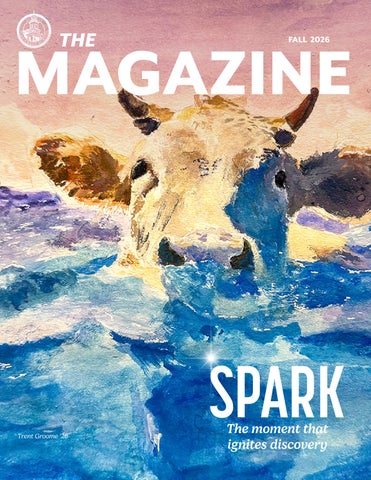
SPARK Trent Groome ’26
The moment that ignites discovery
After-School Enrichment Every afternoon becomes an opportunity to explore something new. Pine Crest Community Engagement offers dynamic after-school programs for pre-kindergarten through grade eight students designed to inspire creativity, curiosity and connection beyond the classroom.
Summer That spirit of exploration continues through Pine Crest Summer, where currently enrolled students and the children of Pine Crest alumni can build skills, pursue new interests and create lasting memories through athletics, arts, STEM and specialty programs in Boca Raton and Fort Lauderdale.
Registration for Pine Crest Summer opens in early 2027. Learn more at pinecrest.edu, on My Pine Crest in the Community Engagement tile.
CONTENTS 1 | DR. MARKHAM’S LETTER
3 | TEACHING AND LEARNING IN THE AGE OF AI
EDITOR 9 | IGNITING THE SPARK FOR CIVIL DISCOURSE
17 | THE SPARK IS GLOBAL
Andrea Vallejo
COVER ART Trent Groome ’26
CONTRIBUTORS AND PROOFREADERS 23 | LIFE THROUGH THE LENS OF JOSH ARONSON ’12
31 | FROM PINE CREST TO A GLOBAL STAGE
Shatarah Betts Jillian Conway Melanie Connors Joanna Craik Christine Dardet Rachel Fallet-Lax Keri Kolettis
36 | THE SPARK FOR GROWTH
39| BUILDING WEBSITES THAT ENGAGE
Dr. Tom Lolis ’94 Jamie Blosser Morris ’02 Stacy Nisman Meagan Obst Dr. Lisa Ockerman J. O’Rourke Dean Shiff ’26
43 | THE SPARK OF BELONGING
49 | THE ARCHITECTURE OF EXPERIENCE
Charlie Siegel ’25 Rachel Sylvester
DESIGNER Michelle Samplin-Salgado
55 | THE SPARK TO RETURN
Dr. Dana Markham ’18H 1
PINE CREST MAGAZINE | FALL 2026
“To love what you do and feel that it matters—how could anything be more wonderful?” — KATHERINE GRAHAM
Dear Pine Crest School Community, Every school year begins with a moment of opportunity. It might be a question in the margin of a notebook, a brave comment in class or a new friendship on the field. It might also be a performance, a research breakthrough or a service project that changes how a student sees the world. Regardless of how it appears, that first flicker of curiosity, purpose or connection is where meaningful growth starts. In this issue of “The Magazine”, you will see how those first moments grow into enduring fires of learning and leadership at Pine Crest. Our students and alumni live in an age of instant information and powerful tools, yet their most important work still begins with a simple human impulse: to ask, “What if?” and “Why not?” When a student wrestles with a difficult problem instead of seeking the quickest answer, they are building perseverance. When a class engages in thoughtful debate, they are cultivating empathy and critical thinking. This is the kind of meaningful work that makes learning feel as rewarding as Katherine Graham describes. As a school, our calling is to create and protect the conditions in which this kind of learning can take hold. In a time that often prizes speed over depth, we deliberately encourage our students to slow down, reflect and revise their thinking. We champion the beauty of messy experimentation, rich discussion and careful reading and writing, as these experiences build resilience, focus and character. These are the practices that keep technology a powerful tool rather than the driver of the learning experience. You will also see in these pages that the most powerful moments are shared ones. Learning at Pine Crest is deeply relational: between students and teachers, across Divisions and among alumni and families. A single conversation, collaborative project or alumni connection can illuminate a path a student had not yet imagined. Our community ensures that each new idea finds encouragement, guidance and room to grow. Thank you for all the ways you help nurture this meaningful work through your partnership and support. Together, we are preparing Pine Crest graduates who will carry their curiosity, integrity and sense of purpose into a world that needs their leadership more than ever. Sincerely,
Dr. Dana Markham ’18H President
THE DISCOVERY ISSUE
2
Authorship in the Algorithmic Era
TEACHING AND LEARNING IN THE AGE OF AI In November 2022, ChatGPT, the generative Artifical Intelligence (AI) chatbot developed by OpenAI, went live. Some schools panicked. Some banned it outright. Others waited, hoping the technology would recede like other digital trends that had promised to transform education and then quietly hadn’t. Pine Crest chose a different path. Within weeks of ChatGPT’s release, Pine Crest convened a crossDivisional think tank of faculty to wrestle with a forward-looking question. How do we empower students to harness this technology ethically, creatively and with purpose? That deliberate shift, from reaction to intention, has become the driving philosophy behind Pine Crest’s approach to AI. It reflects a belief that education’s role is not to shield students from the future, but to prepare them to shape it. For Dr. Lisa Ockerman, Vice President of Academics and Strategic Initiatives, hesitation was never an option in the face of a technology evolving at unprecedented speed. “AI is not a tool for tomorrow,” she said. “It is truly a tool for today. It is our responsibility as educators to teach students how to use it ethically, with integrity and how to be AI creators, not simply its users.”
3
PINE CREST MAGAZINE | FALL 2026
A decade in the making Teaching students how to use AI did not begin in 2022. Pine Crest’s engagement with AI stretches back nearly a decade, rooted in a question the curriculum has been asking since long before “generative AI” entered popular vocabulary: What does it mean to prepare students for a world that does not yet exist? The computer science curriculum launched in 2015 with a foundational emphasis on machine learning and autonomous robotics. A post-AP AI course followed in 2017. By the time ChatGPT was introduced, Pine Crest had already built the scaffolding, conceptually, pedagogically and institutionally to engage with the technology.
“ AI is not a tool for tomorrow. It is truly a tool for today. It’s our responsibility as educators to teach students how to use it ethically, with integrity, and how to be AI creators, not simply its users.” DR. LISA OCKERMAN VICE PRESIDENT OF ACADEMICS AND STRATEGIC INITIATIVES
That history matters because it shapes how the school approaches each new development: As the
faculty and staff across all divisions. That commit-
next chapter in a curriculum designed to evolve,
ment is further underscored by something rare in
rather than as a disruption to manage. “Some
K-12 education: Pine Crest has a faculty member
schools were really nervous and hoped it would
whose sole focus is AI, supporting teachers and
just go away,” Dr. Ockerman said. “We knew it
students. The approach is deliberately graduated.
wasn’t going away. We knew it was just going to
Some teachers are already modeling AI fluency
keep progressing. Our students are going to go
in their classrooms regularly. Others see the val-
into a world where AI is a predominant element,
ue for their own workload but are moving more
even more advanced than what it is now.”
cautiously with students. “As technology evolves
The most overlooked dimension of AI in education is not the student. It is the teacher. A 2024 EdWeek Research Center survey of more than 1,100 educators found that only 43% had received a single training session on AI, demonstrating that the majority were navigating it entirely on their own, absorbing the technology unevenly and carrying that uncertainty into classrooms where students were arriving with questions their teachers had not yet been equipped to answer.
at such a remarkable pace, we have an incredible opportunity to empower teachers with the tools they need to lead students with confidence,” Dr. Ockerman said. “At Pine Crest, 100% of our faculty and staff have engaged in robust training in artificial intelligence, an investment in our educators that truly sets our community apart. That is something Pine Crest practices that not many other schools do.” She emphasizes that the goal is partnership, not replacement: “Great teaching remains at the heart of everything we do. AI sim-
Under the leadership of President Dr. Dana
ply enhances that work as a powerful support.”
Markham ’18H, the school committed to making
The most immediate application has been free-
faculty development the first priority, offering
ing teachers from the administrative weight that
more than 170 training sessions this year alone to
competes with the relational work at the heart of
THE DISCOVERY ISSUE
4
Middle School students investigate how small language models interact in an open-source robot.
the profession. If AI handles lesson differentia-
into their own reasoning. NotebookLM, an AI re-
tion, assessment design and routine documenta-
search and note-taking assistant, serves a dif-
tion, teachers reclaim time for personalized, one-
ferent function, particularly in Middle and Upper
on-one engagement with students, which is what
School, where students upload notes and readings
matters most.
and ask the tool to synthesize them into podcasts or concise study formats. The cognitive work of
A curated portfolio The school’s approach to student-facing tools reflects the same philosophy of intention. Pine Crest maintains what Dr. Ockerman describes as a curated AI tool portfolio, spanning pre-kindergarten through grade 12, in which every platform has been evaluated not only for functionality but
selection and curation remains the student’s. For teachers, platforms like Curipod and Brisk Teaching are designed specifically to reduce administrative load, restoring time for the parts of the profession that no algorithm can perform. The through line across every tool in the portfolio is the same: AI as a thought partner, not a shortcut.
for what it demands of the learner. The central
Long before Upper School students are debating
question is not efficiency but cognition: does this
the ethics of AI-generated content, students in
tool deepen thinking, or does it replace it? Snorkl,
pre-kindergarten are learning something more
introduced as early as fourth grade, exemplifies
foundational: that AI is built by humans, gov-
the standard as an AI-powered educational tool.
erned by patterns and subject to the same errors
When a student submits an essay, it does not re-
and biases as the people who built it. Pine Crest
turn a revised draft. It returns questions, a chain
structures its pre-kindergarten through grade 12
of prompts designed to push the student further
curriculum around five big ideas: that computers
5
PINE CREST MAGAZINE | FALL 2026
perceive the world through sensors; that AI agents maintain models of the world and use them for reasoning; that computers learn from data provided by humans; that intelligent agents require continuous human input to function; and that AI applications carry consequences, positive and negative, for the societies they touch. By the time students encounter generative tools in Upper School, they have spent
PINE CREST AND AI 2015
Pine Crest expands its computer science curriculum to include early machine learning and robotics experiences
years understanding what is happening behind them, and that foundation changes the nature of the encounter entirely. “When students understand that AI is a tool built by humans, they feel empowered to control it,” Dr. Ockerman said. “They understand that when YouTube or Netflix suggests a video, it’s
2017
Development of a post-AP AI course
guessing based on patterns, not reading their minds.” The curriculum also leans into what Dr. Ockerman calls the more demanding literacy: knowing when not to trust AI. A recent Pine Crest neXt Collabsite™ brought librarians onto campus to teach students in
2018
Broader integration of AI-related learning experiences across Divisions
grades four through 12 how to use AI for research while understanding its failure modes: how to verify a citation the model may have invented, how to recognize a confident-sounding hallucination and how to remain the author of one’s own inquiry. “We’re teaching them about the biases AI can have, the hallucinations it can give you and how to verify informa-
2022
ChatGPT launches publicly; Pine Crest immediately convenes faculty think tanks and pilot groups
tion,” she said. “That critical thinking, that synthesis, that’s where the real learning lives.”
Taking our time At the heart of Pine Crest’s approach to AI is a conviction that deep learning takes time. True understand-
2023
Intentional schoolwide AI integration accelerates through curated tools, pilots and classroom implementation
ing is rarely instantaneous, and some of the most meaningful learning occurs when students are asked to slow down, sit with uncertainty, refine their thinking and shape ideas before they are truly formed. Pine Crest embraces this intentional balance. Technology-free spaces, real-world problem-solving and
2025
More than 800 AI-focused faculty and staff trainings completed; AI literacy embedded pre-K through grade 12
human-centered dialogue exist alongside AI-inte-
THE DISCOVERY ISSUE
6
grated learning, reinforcing the belief that efficiency should never come at the expense of depth. Through Pine Crest’s partnership with Vanderbilt University’s Open Dialogue program, students are challenged to articulate and defend ideas both verbally and in written form at a level that cannot be replicated by even the most sophisticated prompt. Data privacy is woven throughout the curriculum as well. Students developing ventures through the science research and social entrepreneurship programs, for example, are taught to distinguish between tools that feed data into larger AI systems and those with stronger privacy guardrails. “We take it seriously that students are working to solve real
Middle School students investigate how small language models interact in an open-source robot.
problems, and those problems deserve real protection,” Dr. Ockerman said. The school has extended this education to families as well, providing access
is the ability to evaluate, to connect, to persuade
to AI courses through Pine Crest neXt, scheduled
and to create with genuine intent. That is ultimately
after parent association meetings, so that parents
what Pine Crest is trying to protect.
can learn alongside their children rather than feel left behind.
The word Dr. Ockerman returns to most often is not “efficiency” or “innovation.” It is “creator.” “We want
When asked which human capacities matter more
our students to be architects of the future,” she said.
because of AI, Dr. Ockerman is clear: analytical and
“How can they use AI or any other technology to ac-
creative thinking, ethical judgment and contextu-
tually create the future? That’s what this curriculum
al decision‑making, adaptability and resilience and
has been building toward for decades. We want our
the leadership and motivation to collaborate, to lead
students to be leaders in the world. Our goal is to de-
and to step forward, or aside, when the moment de-
velop students who don’t just succeed, but lead—ap-
mands it.
plying everything they learn to contribute thought-
Creating architects of the future What matters less, she argues, is rote recall. The
fully and positively to the world.” The tools will keep changing. The pace will keep accelerating. But the goal, she says, is the same one Pine Crest has held for more than 90 years: to send students into the world capable of shaping it.
capacity to retrieve facts on demand, once a meaningful proxy for learning, has been rendered less distinctive by tools that can surface any piece of information in seconds. What remains irreducibly human
7
PINE CREST MAGAZINE | FALL 2026
THE SPARK BEHIND EVERY OPPORTUNITY Every story in these pages reflects what is possible when students are inspired to explore, create, question and discover. Through the generosity of families, alumni and friends, those experiences come to life every day at Pine Crest.
Make a Gift. Help Spark What’s Next.
THE DISCOVERY ISSUE
8
IGNITING THE SPARK FOR CIVIL DISCOURSE How a partnership with Vanderbilt University is supporting open dialogue
9
PINE CREST MAGAZINE | FALL 2026
THE DISCOVERY ISSUE
10
There is a skill that no app can replicate, no artificial intelligence (AI) model can approximate and no standardized test has ever managed to measure. It is the
conversation: the ability to be present with an-
ability to sit across from someone whose con-
leadership in the world that students are being
victions are genuinely different from your own,
prepared to enter.
to hear them out completely and to respond in a way that advances understanding rather than hardens division. It is, in a word, conversation.
other person, to stay curious when you’re uncomfortable, to disagree without dissolving the relationship. These are the skills that will define
The strong relationship between Pine Crest and Vanderbilt was exemplified when President Dr. Dana Markham ’18H, Dean of College and Aca-
Pine Crest School has partnered with Vanderbilt
demic Advising Mrs. Marcia Hunt ’12H and the
University on their Dialogue Vanderbilt initiative
Vanderbilt leadership team engaged in a dis-
promoting open dialogue and civil discourse. It
cussion on the critical issue of discourse on col-
is a rethinking of something foundational: how
lege campuses. Reflecting a shared institutional
students learn to think alongside people who do
character and vision, this collaboration resulted
not think like them, and what it costs when they
in Pine Crest becoming Vanderbilt’s exclusive in-
don’t. The partnership began as a relationship
dependent school partner for a summit on open
built on mutual respect between two institutions
dialogue and civil discourse. The summit brought
that believe education carries a responsibility to
together heads of school, faculty, students and
the health of public life.
thought leaders from across the country to the
The timing is not incidental. As Dr. Lisa Ocker-
Vanderbilt campus.
man, Vice President of Academics and Strategic
Mrs. Jamie Blosser Morris ’02, Assistant Head of
Initiatives, argued in these pages, AI is reshaping
Upper School and Dean of Student Services, Dr.
what it means to produce knowledge, and Pine
Tom Lolis ’94, Upper School English Instructor
Crest has met that challenge with intention and
and Mrs. Stacy Nisman, Upper School Social Sci-
purpose. Open dialogue answers the question that
ence Instructor, were among Pine Crest’s repre-
follows: if AI can generate content, synthesize re-
sentatives at the summit. What they encountered
search and offload the cognitive tasks that once
in Nashville was a set of principles that the school
required sustained human effort, what remains
was already reaching toward.
irreducibly ours? The answer, it turns out, is the
11
PINE CREST MAGAZINE | FALL 2026
“English I Honors is the only course that every ninth grader at Pine Crest takes,” said Dr. Lolis. That universality made it the ideal place to establish something the school wants every student to carry for four years and beyond. Dr. Lolis led the curriculum redesign of English I Honors alongside Mrs. Morris and Mrs. Nisman. The first quarter of the course now functions as an interdisciplinary reader, drawing from poetry, essays and texts across science, history and philosophy, assembled not to survey a canon but to surface a question: how do disciplines that seem to speak different languages actually talk to each
“How do we learn to be uncomfortable with not knowing the right answer? Our aim is not to have a debate every day where one side wins and one side loses. It’s to have ongoing discussions where we all accept that we come at things from different viewpoints, backgrounds and ideologies. And that’s alright.”
other, and what happens when they don’t agree?
DR. TOM LOLIS ’94 Upper School English Instructor
“The aim is to show students how these disciplines work together and talk to each other,” Dr.
points, backgrounds and ideologies. And that’s
Lolis said, “and to hook students who might not
alright,” he said.
have a vested interest in novel X. We want to create some buy-in for both the work of the English classroom and the process of communicating well.” More than that, the course asks students to do something genuinely difficult: to sit with the discomfort of not having a resolution. “How do we learn to be uncomfortable with not knowing the right answer? Our aim is not to have a debate every day where one side wins and one side loses.
The course introduces two specific practices that are designed to travel well beyond English I. The first is Harkness discussion, in which the teacher steps back and lets students drive the conversation, intervening only when the discussion drifts from inquiry toward contest. The second, drawn directly from Dialogue Vanderbilt faculty, is a method called From Every Angle.
It’s to have ongoing discussions where we all ac-
From Every Angle works by removing the element
cept that we come at things from different view-
that makes difficult conversations most difficult:
THE DISCOVERY ISSUE
12
the direct exchange. Students sit in a circle
to a much more calm environment, and by
with a moderator at the center. A topic is
being calm, a much more meaningful con-
introduced. One student addresses a per-
versation.”
spective, directed not at any peer but at the moderator. When another student wants to respond or push back, they do not speak to the original speaker. They ask the moderator to pose the question on their behalf. The response comes back through the moderator as well. At no point do students in disagreement address each other directly. The effect is disarming in the most literal sense. Mrs. Nisman described what it does for the students most likely to go unheard in a conventional discussion. “There are students who are much more naturally inclined to speak their mind, and they can be almost bulldozer-like,” she said. “And so the ones who may have a difference of opinion might shrink into themselves. What From Every Angle does is take a lot of the ‘I’ out of it. A more reluctant student doesn’t have to be in the center of the room, but they
Mrs. Nisman added that the deeper gift of the method is not what it teaches students to do in the circle. It is what it teaches them to do in every conversation afterward. “Where there may not always be a moderator, there’s always the ability to take a moment before you respond,” she said. “That simple pause, especially where things are getting heated, diffuses tension.” Mrs. Morris approaches this work from a unique vantage point as a counselor. “When we get down to what open dialogue is actually about,” she said, “it’s about having a skill set to effectively communicate in the world and effectively relate to others in the world. Those are social and emotional skills. How do you assertively communicate a perspective while thinking about your tone, your timing and your audience? And
can still ask the questions and share their thoughts in a way that doesn’t feel like a confrontation.” The method has been tested on topics that would ordinarily fracture a room. Pine Crest alumnus Charlie Siegel ’25 serves on the student advisory board for Dialogue Vanderbilt, and has watched it work on some of the most charged subjects in American public life. “Directing your feelings away from the person and toward an indifferent chair diffuses a lot of the reactionary moments that you’d otherwise have,” he said. “You can’t really insult someone if you’re not talking to them. I’ve seen it contribute
13
From left to right: Darren Reisberg, Vice Chancellor for Operations and the Campus Network; Dr. Dana Markham ’18H, President; Dr. Daniel Diermeier, Chancellor; Marcia Hunt ’18H, Vice President of College and Academic Advising; Doug Christiansen, Vice Provost for University Enrollment Affairs and Dean of Admissions and Financial Aid; Amy Huffman, Chief of Staff; Mike Drish, Executive Director of Undergraduate Admissions; John Palmer Rea, Associate Director of Admissions PINE CREST MAGAZINE | FALL 2026
“When we get down to what open dialogue is actually about, it’s about having a skill set to effectively communicate in the world and effectively relate to others in the world.”
then on the other side, being able to actively listen, to
MRS. JAMIE BLOSSER MORRIS ’02 Assistant Head of Upper School and Dean of Student Services
what happens when students learn to suppress their
regulate your emotions when you hear something you disagree with. How do you stay open-minded and curious about what someone is telling you, rather than starting to formulate your reaction before they’ve finished speaking?” One of the most important insights to emerge from the Vanderbilt summit, Mrs. Morris said, focused on perspectives instead of sharing them. Institutions have found that many high-achieving students were self-silencing, reshaping what they said or believed to avoid social friction. As a result, some left their educational experience with a diminished, rather than expanded, sense of self. “The question was: how do we prevent an entire class of amazing talent and perspectives from reaching the end of their experience having redefined their identity based on the opinion of a majority?” Mrs. Morris said. “When we create these opportunities in the classroom, how are we helping students develop as individ-
The Pine Crest School delegation at Vanderbilt University’s Open Dialogue Summit.
uals and as a group by forming opinions and learning to articulate them thoughtfully?” That question carries particular weight in a community as close as Pine Crest, where students often know each other across many years and the social cost of disagreement can feel more immediate than it might elsewhere. What Mrs. Morris observes in students who struggle with these conversations is rarely a deficit of ideas. It is more often anxiety: the fear of being wrong in front of people who will remember it, or the absorbed conviction, drawn from a digital landscape that rewards conflict and punishes nuance, that disagreement is inherently destructive. “We’re moving toward automation and written communication, and the art of conversation is potentially getting lost or underpracticed,” she said. “The relational skills are what continues to make humans valuable. That feeling of real heart-to-heart connection, of realizing that you
THE DISCOVERY ISSUE
14
Charlie returned to Pine Crest’s campus this past spring as part of a Vanderbilt delegation, leading workshops with students and sitting in conversations with faculty he had known as a student. He described the day as one of the most meaningful since his graduation. What struck him most was not the sophistication of the method or the ambition of the curriculum. It was the recognition of what Pine Crest builds in students, the willingness to push past surface-level conversation, share a perspective on something, that can’t be replicated. That’s the power of giving people intentional opportunities to have dialogue.” Redesigning English I Honors is not the destination; it is the point of entry. The skills introduced in the first quarter of ninth grade are intended to become a shared language across four years of Upper School, surfacing in AP social science dis-
to stay present in a hard exchange, to remain curious rather than defensive, now had a name, a structure and a growing movement behind it. This summer he is traveling to Northern Ireland with Dialogue Vanderbilt to study conflict resolution. He is going as someone who has tested these ideas in real rooms with real disagreement and found them to hold.
cussions, in science classes where the data points to uncomfortable conclusions, in advisory periods and in the informal spaces where students actually negotiate their relationships with each other. “Pick a controversial topic in science,” said Mrs. Nisman. “Global warming, for example. You pick any topic where people might have polarizing viewpoints, and you’re going to be practicing these skills.” The work is also moving through the Divisions deliberately. Middle School faculty have been part of ongoing planning conversations, and Lower School leaders have mapped where open dialogue principles already live in existing curricula, giving the Upper School a clearer picture of what students have already internalized when they arrive. The goal is not to introduce a new idea in ninth grade, but to name and deepen one that has been growing since the earliest years of a student’s time at Pine Crest. Charlie Siegel ’25 leads Pine Crest School faculty in From Every Angle dialogue method. 15
PINE CREST MAGAZINE | FALL 2026
Ask him what has changed in him through this work, and he does not point to his ability to argue. He points to his capacity to listen. “I think it has built a stronger sense of empathy in me,” he said. “I not only listen better and understand better, but I feel more deeply for people. The more conversations you have, the more nuance you build in how you understand people’s situations, and the way they feel and the way they would react.” He paused before adding something that functions as both a conclusion and a beginning: “It becomes easier to have great conversations once you learn how to have great conversations. It’s a skill I didn’t know needed to be developed. And because I have it now, I just want to dive in more.” Mrs. Nisman sees disagreement as an essential
“In life, it doesn’t matter if someone is your best friend, your spouse, your sibling, your child. You’re not always going to agree, and you need to learn how to have a healthy conversation around it. Even when you’re mad. Especially when you’re mad. Disagreement isn’t an end. It’s a means to something different, and possibly something better.”
part of growth, not something to avoid.
MRS. STACY NISMAN Upper School Social Science Instructor “Disagreement is not necessarily a bad thing,” she said. “Oftentimes, having a disagreement and having a discussion about it leads to new avenues you may not have thought of, new ideas, a new understanding of something you didn’t have the experience to understand before. In life, it doesn’t matter if someone is your best friend, your spouse, your sibling, your child. You’re not always going to agree, and you need to learn how to have a healthy conversation around it. Even when you’re mad. Especially when you’re mad. Disagreement isn’t an end. It’s a means to something different, and possibly something better.” In a world being reshaped by tools that generate language instantly, the ability to use it carefully has never mattered more.
Dr. Dana Markham ’18H and Dr. Lisa Ockerman welcome Vanderbilt students and faculty, including Charlie Siegel ’25 to Pine Crest School. THE DISCOVERY ISSUE
16
THE SPARK IS GLOBAL How global research partnerships are preparing Pine Crest students for an evolving world A man in Tokyo stood behind the counter of his small fish pie shop, greeting visitors with enthusiasm and pride. He was 100 years old. For students in Pine Crest School’s Social Entrepreneurship Program, the encounter was memorable not simply because of his age, but because of what it revealed. He was still working. Still contributing. Still connected to the people around him. His days remained filled with purpose.
17
PINE CREST MAGAZINE | FALL 2026
THE DISCOVERY ISSUE
18
Experiences like this are intentional. They reflect Pine
explored one of the defining
Crest’s 2024–29 Strategic Plan,
century: how societies adapt as
which prioritizes globally con-
people live longer.
nected students
learning
that
beyond
moves
traditional
classroom, disciplinary and geographic boundaries. The goal extends beyond exposure to other places and cultures; students learn how people, systems and ideas intersect and they prepare to navigate an increasingly complex and interdependent world.
demographic questions of this
Japan offered a powerful case study. Students examined economic, social, technological and cultural dimensions of an aging population and met with researchers, policymakers and community
leaders.
Through
ethnographic fieldwork and qualitative research, they explored issues such as workforce par-
That vision comes to life through
ticipation, social connection and
Pine Crest’s partnership with
community design.
the London School of Economics (LSE) and Political Science and LSE Generate. Through this collaboration, students engage directly with complex global challenges, working with researchers, entrepreneurs and community leaders rather than studying issues at a distance. “The future of education involves students who actively
Clockwise from top right: Jainam Dadia ’27 presents with his group in Lisbon, Portugal; Students met Dr. Hiroko Akiyama, founder of the Kamikura Living Lab; Students in Lisbon prepare their research for a pitch presentation; Students and faculty participated in a traditional Japanese Tea Ceremony in Tokyo, Japan; Pine Crest School visits the Unicorn Factory in Lisbon, Portugal
They discovered that longevity extends far beyond healthcare. It functions as a complex societal challenge shaped by public policy, economics, technology and culture, revealing the value of interdisciplinary thinking. A second seminar in Portugal used the same mindset. Students arrived without a pre-
investigate the world,” said Dr. Lisa Ockerman, Vice President of Academics and Strategic Initiatives. “They slow down, ask better questions and learn to connect ideas in ways that spark deeper understanding.” In
February
2026,
students
traveled to Tokyo as part of a two-year research initiative on longevity and healthy aging. Working with LSE faculty, they
19
PINE CREST MAGAZINE | FALL 2026
“When you focus on understanding human needs, you become better equipped to design solutions that truly matter.” MRS. KERI KOLETTIS Vice President of Global Innovation and Entrepreneurship
defined research question and immersed themselves in local communities. Through interviews, observation and systems mapping, they identified challenges related to tourism, transit, food systems and economic development. Their work centered on understanding experiences and perspectives before proposing solutions. Together, these experiences express a deliberate educational model. In one setting, students investigate a clearly defined global issue. In another, they learn how to surface and frame challenges within a living system. Both pathways cultivate the habits of mind outlined in the strategic plan. A consistent theme across this work is deep engagement with the core problem. “Entrepreneurs must fall in love with the problem,” said Mrs. Keri Kolettis, Vice President of Global Innovation and Entrepreneurship. “When you focus on understanding human needs, you become better equipped to design solutions that truly matter.” In Tokyo, that mindset became vivid during a visit to a living laboratory led by Dr. Hiroko Akiyama of the Stanford University Center for Longevity. There, residents in their 80s, 90s and beyond remain active through intentional
THE DISCOVERY ISSUE
20
Student Perspective:
LEARNING TO LOOK BEYOND THE SURFACE When Jainam Dadia ‘27 traveled to Japan and Portugal through Pine Crest’s partnership with LSE, he expected to learn about entrepreneurship and research. What surprised him most was learning a completely new way of thinking.
Students visited the Porto Business School in Porto, Portugal.
During a research project in Portugal, Jainam’s group was assigned a broad topic: public spaces. At first, the assignment seemed straightforward. “We thought we’d be looking at parks or cafés,” he said. Instead, students spent the week interviewing residents and examining the systems that shaped everyday life in the community. What began as observations about elderly residents sitting alone in public spaces eventually led to deeper questions
community design that supports connection, independence and purpose. The 100-year-old shopkeeper belongs to a community built to sustain meaningful aging. Students saw that complex challenges rarely yield to a single innovation or policy. Effective responses arise through interdisciplinary thinking, human-centered design and a deep appreciation for how systems interact.
about youth emigration, family structures and so-
These experiences align closely with Pine Crest’s Por-
cial isolation.
trait of a Graduate, which highlights global-minded-
“We went from a broad topic of public spaces to interviewing people on the street and then finding so many deeper root causes,” Jainam said. The experience introduced him to systems thinking, an approach that encourages students to look beyond symptoms and investigate the forces driving them. “You never really understand the full picture unless you interview someone who’s experiencing it firsthand,” he said. For Jainam, that lesson extended far beyond Portugal or Japan. “The mindset they taught us has been really valuable for me. It’s changed the way I solve problems; I’m always looking for root issues rather than just what is on the surface.”
21
ness, resilience, curiosity and forward thinking. They also influence the broader curriculum, including courses in entrepreneurship, social impact, human-centered design, data analytics and emerging work in artificial intelligence and innovation. Global learning at Pine Crest extends beyond travel across borders. It focuses on how students engage with the world. They listen before they form conclusions, investigate before they propose solutions and approach complexity with curiosity and humility. Through this work, Pine Crest delivers on a central promise of its strategic plan: preparing students not only to understand an evolving world, but to contribute to it with thoughtfulness, insight and a strong sense of purpose.
PINE CREST MAGAZINE | FALL 2026
PERSPECTIVE BRINGS POSSIBILITY APPLICATIONS ARE OPEN A Pine Crest education challenges students to think critically, explore deeply and engage with the world around them with purpose and curiosity.
Discover the Pine Crest Perspective.
THE DISCOVERY ISSUE
22
The photographer and visual storyteller uses his camera to explore identity, community and the people who shape the places we call home.
23
PINE CREST MAGAZINE | FALL 2026
THE DISCOVERY ISSUE
Portrait of Josh Aronson ‘12 with his artworks on the porch of the William Wagner House, the oldest known home in Miami, Florida, by photographer Nicole Combeau. 24
At just three years old, a very young Josh Aronson ’12 and his family made the move from Toronto, Canada to South Florida, seeking warmer weather and better working opportunities for his parents. In what was
television-only format, to embracing
meant to be a temporary, two-year
that Pine Crest connected him to
long stop, Miami eventually became
the individuals that he would remain
the permanent residence for the Ar-
close to, even after graduation. “The
onson family, and the place that Josh
friends I made at Pine Crest, but
still calls home. After living there for
more specifically through those cre-
several years, Josh’s parents knew
ative channels, became my friends
they wanted something more for
for life.”
their children’s education. “When I was getting ready to start middle school, my parents were seeking a more challenging environment, a community that would inspire and a clearer path toward the future for
more film and cinema work. Having access to something like that right there at school really helped cement my interest in making images, whether photographically or cinematically,” he said. Josh also noted
Josh also highlighted his experience in theater at Pine Crest, where he acted in plays, assisted with directing, and took a theater class as an elective. “I found the theater pro-
my siblings and me,” he explained. So, committed to making the commute every day from Miami to Fort Lauderdale, Josh’s parents landed on Pine Crest School. “It was well worth it,” said Josh. “At Pine Crest, I was certainly challenged academically, but I was also inspired, like my parents had hoped, to explore and pursue different things. It was my fellow classmates at Pine Crest who introduced me to photography, and pushed me to really dive into it. They were the ones who encouraged me to continue getting better at the craft.” Josh also took advantage of other opportunities unique to Pine Crest at that time, like an expanding PCTV platform. “When I was there, around 2010-11, the program had begun transitioning from a broadcast
25
PINE CREST MAGAZINE | FALL 2026
“At Pine Crest, I was certainly challenged academically, but I was also inspired, like my parents had hoped, to explore and pursue different things. It was my fellow classmates at Pine Crest who introduced me to photography, and pushed me to really dive into it.” –JOSH ARONSON ’12
Clockwise from top right: Josh Aronson, Capsized, 2025, from Florida Boys; Josh Aronson, Julian, 2024, for PALMER Vol. 07; Josh Aronson, Creek, 2024 from Florida Boys
THE DISCOVERY ISSUE
26
Clockwise from top right: Josh Aronson, Sirens, 2025, from Florida Boys; Josh Aronson, Puddle, 2025, from Florida Boys; Portrait of Josh Aronson ‘12 in Big Cypress, Florida by photographer Angie Vero.
27
PINE CREST MAGAZINE | FALL 2026
gram, and my teacher Mr. Jim Patrick
school, I reconnected with them. They
in particular, pretty galvanizing. He
were very supportive in helping me
was someone that encouraged me to
pursue a career in the arts,” he said.
explore my creative side. While I’m not
Josh moved back to South Florida
a professional actor now, it was those
from Chicago and worked for LeBron
moments and principles he instilled
James’s clothing boutique in Miami,
in me that helped me feel confident
creating content, photos and videos
enough to do something creative in
to advertise and promote the clothing
life; that it was worth pursuing. I really
line. “While working at the boutique
credit Pine Crest with instilling in me
in Miami, I started taking on freelance
so much of that eagerness to explore
photography assignments on the side.
and push myself that feels so essential
Different artists found me online and
to the work I do now.”
commissioned me to take their por-
Upon graduating from Pine Crest, Josh knew he wanted to pursue something in the arts professionally, but had not decided on a specific college major at Northwestern University. “I knew the
working in the creative world, and it also provided me with a small glimpse into how my life could look if I pursued photography professionally.”
arts would be my end goal, but I figured
Josh’s work even managed to get no-
that if I was going to spend the rest of
ticed across the Atlantic. In 2018, a cu-
my life as a creative, I might as well take
rator who lived in a rural area of Rus-
those four years of college to explore
sia called Nizhny Tagil, saw some of
and study things that would make my
his portraits online and invited him to
art richer and more interesting.” Josh
exhibit his work in a remote, indepen-
found philosophy to be an eye-opener,
dent museum. “I had no connection
especially for a young person in their
to Russia, but here I was, a young, up-
formative college years. “It provided
and-coming artist that was being giv-
an avenue for me to study, to read and
en a great opportunity to get my work
learn about other people’s perspectives
out.” Josh explained that while he
on life and the world and how we’re all
was on board with exhibiting, he felt
meant to move through it. It really end-
the time was right to take a chance. “I
ed up helping me gain deeper insight
told the curator that I had no problem
and better grasp over my own beliefs
showing the portraits he had already
about the world,” he said.
seen, but I asked him how he felt about
After building a solid philosophical foundation, Josh used the time after graduation to get his bearings. “I went into college having made some really amazing friends in the creative world in New York City, and when I finished
THE DISCOVERY ISSUE
traits. That was a gig that kept me
a new body of work that I had been creating. I sent him some pictures, he agreed, and we ended up doing the show.” Titled, “With Mind Dyed Blue,” the show featured portraits of people styling their body hair similarly to how they style the hair on their heads. “It
28
was definitely out there conceptually, but it was
and The New York Times, Josh shared that he
very cool to observe the audience respond and in-
returned to South Florida during the pandemic
teract with the portraits. They were much more
in 2020 to be closer to home and family. “It was
outlandish, eccentric pieces, and nothing like the
interesting,” he said, “because when I got back, I
work that I do now, but I suppose part of being an
found that the local photography scene had grown
artist is the journey,” Josh quipped.
significantly. There were so many companies and
In the year leading up to his showing in Russia, Josh shared that he found himself flying to New York for photography once every few months, then once a month, then once every two weeks, until eventually, he was getting work so frequently that he decided to move to New York City. “That was really when my life as a freelance editorial and commercial photographer began, and I’ve been doing that ever since,” he said.
business leaders that moved south because of the pandemic, just like I had.” Josh explained that where there are major industry players, there is a need for photography. “The work followed me. That’s something I wasn’t expecting. It allowed me to continue my career successfully, and I’m now living a life I never imagined possible in Florida. I’ve been able to use photography as an excuse to meet fascinating people, to collaborate and share ideas. The camera is like a passport that allows me to ex-
Though he was finding notable success working
plore so many different worlds. That is ultimately
with prestigious brands and publications that
what I’ve always been most interested in.”
included Vogue, ULTA Beauty, Financial Times
As Josh continued to reestablish his permanence in the Sunshine State, he became intrigued by the
creative freedom of Floridians and the attractive natural landscapes surrounding him. He took the liberty of exploring more of the state’s parks and protected areas. “The weather and environment
Portrait of Josh Aronson ‘12 in Big Cypress, Florida by photographer Angie Vero. 29
Josh Aronson, Ladybugs (White Socks), 2020 from Tropicana PINE CREST MAGAZINE | FALL 2026
I believe the best art comes from a personal place, and my own journey has certainly shaped the work I make. I would want the same for young people getting ready to find their own paths: Be your own biggest advocate, lean on others and don’t be afraid to push the envelope. You’ll be amazed at the life you can create.” –JOSH ARONSON ’12
here are so charming, and unlike those found
tial to life, because as humans we are expressive
anywhere else in the U.S.,” said Josh. “As a visual
and communal in nature. It should be the one me-
person, those elements are really attractive. I’ve
dium that feels inclusive for everybody.”
spent the last five to six years since coming back exploring the state at length, visiting the parks, springs and beaches, and using the time as an excuse to get to know Florida better.”
Art has given Josh the confidence to be bold and take risks, something he again credits to Pine Crest. “I was a Canadian kid with family from the Middle East and Eastern Europe, and when
Arguably his most recognized styling, Josh ex-
we got to Florida and my parents enrolled me at
plained that he is most known for his artistic
Pine Crest, I didn’t know many people. More than
approach of creating staged, utopian, fantastical
wanting to stand out, I wanted to find my people. I
photographs featuring young Floridians, some-
wanted to make friends, feel seen and understand
times as individuals but often in groups, amidst
where I fit in. Pine Crest gave me the space to
natural landscapes. Motivated by both his per-
become more comfortable with myself and, over
sonal connection to Florida and a desire to rep-
time, more willing to take risks,” said Josh.
resent overlooked or even marginalized aspects of Florida life, he described his specific body of work “Florida Boys” as telling stories of young men. “I employ staged scenes of these young men in moments of repose or play or joy—moments of connection with one another and with the natural world around them. I try to present the side of Florida life that I want to see in the world, so that hopefully a young student at Pine Crest can pick up a photo book one day with some of my work in it and see themselves; if not in the physical loca-
“Even skills like pitching myself and cold emailing, which are so important for freelance professionals, are skills I began developing during my time at Pine Crest. I believe the best art comes from a personal place, and my own journey has certainly shaped the work I make. I would want the same for young people getting ready to find their own paths: Be your own biggest advocate, lean on others and don’t be afraid to push the envelope. You’ll be amazed at the life you can create.”
tion, then in the kind of stories that I’m telling or the types of identities I’m expressing. Art is essen-
THE DISCOVERY ISSUE
30
31
PINE CREST MAGAZINE | FALL 2026
FROM PINE CREST TO A GLOBAL STAGE
Andre Radensky ’17 on Economics, Big Decisions and Finding Meaning in Media By Dean Shiff ’26
THE DISCOVERY ISSUE
32
There is a moment, usually sometime in high school, when your perspective on learning shifts. Before that moment, much of your learning feels rooted in questions and answers. You study, you prepare and you respond to those questions with your answers. Over time, however, you realize that the questions themselves begin to matter more than the answers.
“It makes you ask why economics underpins so much of how the world works.” After graduation, Andre moved to New York City where he accepted a finance position at a global firm, following a path familiar to many economics majors. Working in the media and telecom group, he analyzed companies and learned how businesses operate at scale. Soon, the experience
For Andre Radensky ’17, that shift began in an
clarified something important. “I realized I didn’t
economics classroom. “I liked taking economics
want to be a professional investor,” he said. The
with Mr. Kashdan a lot,” he said. “It was a dif-
realization was gradual, shaped by long hours and
ferent way of looking at things, blending math
a high-pressure environment where precision
with analyzing world events and behavior at the
mattered, but perspective often felt constrained.
same time.” What he discovered was not simply a subject, but a framework, one that would stay with him long after he left Pine Crest, and one that helped shape how he approached decisions in college, in his career and in the industries he would eventually enter.
What stayed with him, however, was the vantage point. In his role, he had a front-row seat to a major shift in media. Traditional television was declining while streaming was rising, and companies were trying to manage both at once. “These businesses were trying to balance an old medium
At Princeton, Andre studied economics, though
that was still making money with a new platform
not without some uncertainty along the way. He
that wasn’t yet profitable,” he said. “It was fasci-
had always been interested in both history and
nating to watch.” That tension, between what ex-
math, but economics offered a way to connect
ists and what is emerging, became the inflection
the two and understand how large systems actu-
point in his career.
ally function. “When you learn about the Roman Empire or the Great Depression, so much of it is described through an economic lens,” he said.
33
Andre left investment banking and moved into the industry itself, first at NBCUniversal and later
PINE CREST MAGAZINE | FALL 2026
at Netflix. “The scale is immediate at Netflix,” said Andre. “You’re in meetings with people in London, Tokyo and Korea. You really get the sense that you’re making content for the entire world.” Yet what defines the work is the level of ambiguity. Streaming, as a business, resists simple explana-
“ I liked taking economics with Mr. Kashdan a lot,” he said. “It was a different way of looking at things, blending math with analyzing world events and behavior at the same time.”
tions. Millions of people pay a monthly subscrip-
– ANDRE RADENSKY ’17
tion, but the reasons they stay are not always clear. “If someone pays for Netflix each month, why do they stay?” Andre said. “Is it one show?
by a way of thinking; one that values curiosity, em-
The whole library? Even if they don’t watch any-
braces uncertainty and recognizes that the most
thing?” Questions like these cannot be answered
important questions are often the ones without
with a single metric. They require interpretation
the most obvious answers.
of behavior, patterns and meaning. “In media and entertainment, storytelling and perception can be just as important as the data,” he said. In that sense, the work sits at the intersection of analysis and narrative, where numbers explain part of the story, but not all of it. That duality, logic and storytelling continue to motivate him. “I’ve always loved video,” Andre explained, recalling early YouTube videos that took an entire car ride to load. Today, that early fascination has scaled into something global. The platforms are larger, the stakes are higher, but the core idea remains the same. People are drawn to stories. Even in a non-creative role, Andre sees himself as part of that process. “What I do helps support the people who are actually making these stories,” he said. Looking back, he connects that mindset directly to Pine Crest. Not to a single moment, but to a shift in how he learned to think. “At some point, you have to start asking the questions yourself,” he said. “In the real world, things aren’t clear-cut. You have to define what success even means.” From economics to finance to global media, Andre’s path has not been linear. It has been shaped Andre with his sister Marissa ’15 and mother Laura. THE DISCOVERY ISSUE
34
35
PINE CREST MAGAZINE | FALL 2026
THE SPARK FOR GROWTH Rooted in mission and guided by long-term vision, Pine Crest prepares to expand its impact across South Florida.
THE DISCOVERY ISSUE
36
For generations, Pine Crest School has measured success not by size, but by impact. The School’s history has been shaped by moments of thoughtful evolution, guided by a
“This expansion is an intentional evolut deepen our resources and help secure our futu guided us for generations.”
belief that education should prepare students not only to succeed in the world they inherit, but to help shape what comes next. Pine Crest has begun another chapter in that story. Following years of careful study and strategic planning, Pine Crest School intends to open a third campus in West Palm Beach, marking a significant milestone in the institution’s evolution and expanding its ability to serve students and families across South Florida. The opportunity has been accelerated through a landmark philanthropic commitment from the Stephen M. Ross Foundation, an investment that will support the development of the new campus while also strengthening Pine Crest’s existing Boca Raton and Fort Lauderdale campuses through continued in-
37
PINE CREST MAGAZINE | FALL 2026
tion. It will broaden our School’s impact, ure while staying true to the values that have ”–PRESIDENT DR. DANA MARKHAM, ’18H
Since 2023, Pine Crest’s senior administrative team and Board of Trustees have been carefully studying the Palm Beach County educational landscape, evaluating opportunities that align with the School’s mission and longterm strategic priorities. Any future expansion would need to strengthen the institution as a whole and create meaningful opportunities for students and faculty across every campus. The result is a vision centered on connection. The future West Palm Beach campus is expected to contribute to a shared institutional ecosystem, one that expands opportunities for collaboration, innovation and academic exploration across Divisions and campuses. Investments tied to the initiative are expected to enhance programs connected to research, technology, entrepreneurship, engineering, artificial intelligence and experiential learning. The Pine Crest core will remain unchanged. As plans continue to take shape, an emphasis will be placed on preserving the School’s cul-
vestment in academics, faculty and future-focused learning environments. This moment is not about growth for growth’s sake. It is about ensuring that Pine Crest remains positioned to lead in an educational landscape that is changing rapidly while pre-
ture of personal connection, academic excellence and community while thoughtfully preparing Pine Crest for the future. Additional details related to location, grade levels, admissions, staffing and opening timelines will be shared in the months ahead.
serving the close-knit culture and enduring
As Pine Crest begins this next
values that define the School.
chapter, alumni and friends are
“This expansion is an intentional evolution,” President Dr. Dana Markham, ’18H, said in a message to the community. “It will broaden our
invited to stay connected and follow the School’s progress at pinecrest.edu/growingtogether.
School’s impact, deepen our resources and help secure our future while staying true to the values that have guided us for generations.”
THE DISCOVERY ISSUE
38
The Spark of Connection:
BUILDING WEBSITES THAT ENGAGE For many families, a school’s website is their first campus visit. Long before they walk through a gate, attend an open house or meet a teacher, prospective families begin forming impressions online. They search for answers to
This type of visual engagement is always
practical questions, but are also looking
sage to discerning audiences.
for something less tangible. They want to understand what a school values, what student life feels like and whether their child can see themselves there. At Pine Crest School, that responsibility shapes every decision we make about our digital presence. You know the feeling when you see an image that jumps off the digital page and stops your scroll?
39
the goal. We review color contrast, varied graphic treatments and font size and scale to determine the most impactful and effective way to convey our mes-
We know the digital landscape has many competing visuals, applications and platforms to explore. With all the e-clutter, how can a brand like Pine Crest stand out while clearly articulating the school’s mission and vision? We research, we explore, we interview and we lean into new trends and refine our existing messaging so we capture
PINE CREST MAGAZINE | FALL 2026
our talented faculty members emphasizing the importance of professional development about artificial intelligence and how it can support student essay iteration and drafts through impactful commentary made possible by clear teacher-created guidelines or a group of 11th grade students capitalizing on the latest TikTok trends to highlight the student union and the latest coffee craze. These stories do more than fill a website. They help visitors understand what it feels like to be part of the Pine Crest community. A family exploring schools online may never attend a class in Japan or sit in on a discussion about artificial intelligence, but through thoughtful storytelling they the intentional story and the
can begin to see how students
powerful lore of our 92-year-
learn, grow and engage with
old institution. This approach
the world around them.
allows us to curate our content to reflect the everyday student
The Marketing Communica-
experience on our campuses in
tions team works daily to dig-
a way that is compelling and
itally articulate the lived expe-
engaging for our target audi-
riences of students and faculty
ences and everyday scrollers.
at Pine Crest School in ways that resonate with the broader
When visiting pinecrest.edu,
community, prospective fami-
you will see a flurry of con-
lies and educators.
tent such as student takeovers
THE DISCOVERY ISSUE
sharing the class trip to Japan
Every few years, however, we
designed to maximize student
have an opportunity to take a
learning about longevity and
deeper dive into our website and
wellness on our Instagram ac-
put our research and practice to
count, a blog written by one of
work to elevate the experience
40
for our digital visitors. In the spring of 2025, we
news. Our challenge is not simply to organize
began brainstorming what a new website should
information. It is to help people find what they
look like.
need while also helping them understand what
We started the ideation process by simply asking questions. How can we enhance user experience (UX) and user interface (UI)? What do we want people to see and feel when they visit us online? How can we communicate our unique value proposition in a way that feels both fresh and consistent? Does our mission come to life on our website? How do
makes Pine Crest distinct. We then brought data into the conversation, heat-mapping our current site to identify which content pieces visitors were gravitating toward and evaluating our website statistics to determine which pages audiences were visiting most and for how long, how they found us and where they originated.
we begin the prospective family journey online and
Lastly, we determined the current marketing
follow with our in-person admission experience?
objectives and goals. We asked ourselves, do we
Behind every website visit is a person searching for information. A prospective parent may be exploring schools for the first time. An alumnus may be reconnecting with their alma mater. A current family may be looking for resources or
want to drive awareness, inquiries, applications or all of the above? We meet internally and with other departments to determine a strategy to meet the goals of the institution. Once we complete the process, we launch. See the possibilities unfold at www.pinecrest.edu.
THE CREATIVE WORK
IN WEBSITE DESIGN, YOU NEED TO UNDERSTAND SEVERAL TRUTHS: Design for your audience. Know your primary audience, acknowledge secondary users and use language they understand—not internal jargon.
Design for simplicity. Keep primary navigation focused and intuitive so visitors can quickly find what they need.
Design for the journey. Prioritize your most important user paths and organize your sitemap around them.
Design for mobile. Optimize for smaller screens, fast load times and streamlined experiences by reducing oversized images and unnecessary animations.
Design for scanning. Capture attention in the first few seconds with a strong visual hierarchy, clear headings, compelling imagery and concise copy.
Design for search. Build for SEO with descriptive metadata and structured headings, for AEO with direct, concise answers, and for GEO with original expertise, data and thought leadership.
Design for action. Every page should guide visitors toward a clear next step, whether that’s inquiring, applying, scheduling a visit or donating.
Design for evolution. Treat your website as a living product—refresh content regularly and
41
use analytics to guide continuous improvement.
PINE CREST MAGAZINE | FALL 2026
Save the Date! April 16 and 17, 2027
ALUMNI REUNION WEEKEND We look forward to welcoming you and your fellow Pine Crest alumni back to campus.
Join us for a weekend of events and reconnecting with old friends, former teachers and more. More details coming soon
THE DISCOVERY ISSUE
42
THE SPARK OF BELONGING How Adonica Black ’07 turned a formative sense of belonging into a philosophy of leadership, service and creating opportunities for others to thrive.
43
PINE CREST MAGAZINE | FALL 2026
THE DISCOVERY ISSUE
44
Three years ago, Adonica Black ’07 was asked to contribute a message to a presentation for Pine Crest School’s Board of Trustees. Reflecting on an institution she had first entered as a fourth grade student, she described Pine Crest in a way that resonated deeply with those who heard it. “A beacon of belonging.”
“Pine Crest creates a space where it’s cool to be smart. Pine Crest makes it exciting to be curious, to challenge yourself and to pursue excellence” - ADONICA BLACK ’07.
For Adonica, the phrase described something
That conviction has stayed with Adonica far be-
more consequential than feeling welcomed or in-
yond Pine Crest, evolving from confidence in
cluded. It captured the confidence Pine Crest had
her own place in the room to a commitment to
instilled in her: the belief that she belonged wher-
helping others find theirs. Throughout her pro-
ever her journey might take her and that she had
fessional career and extensive volunteer service,
something meaningful to contribute.
she has focused on creating an environment that
“Pine Crest creates a space where it’s cool to be smart. Pine Crest makes it exciting to be curious, to challenge yourself and to pursue excellence. There is a culture that celebrates learning and encourages you to discover the full extent of your potential,” she said. “There are so many resources to support you in being successful, not just academically, but also in other ways in which they nurture the whole student and the whole person.” She remembers that feeling as clearly as she remembers the physical spaces where it began. Mrs. Powers’ fourth grade homeroom, near the playground and below Mr. Anastasis’ classroom on the second floor. Pine Crest became, in her
allows others to contribute and lead. “Every major opportunity I’ve had, from Duke to law school to becoming a global executive, to serving on boards, started because someone invested in my potential before I fully saw it myself. Pine Crest was one of those places. That’s why I believe education is not just about preparing students for careers. It’s about expanding what they believe is possible for their own lives,” she shared. Her career has spanned law, global business and people leadership. Fields that, on the surface, may appear distinct but that Adonica sees as connected by a consistent purpose: creating change for the better.
words, both “a place of comfort” and “a place of
Even her name reflects that purpose. Created
opportunity,” where being challenged and being
by her father by combining his name, Donald,
known existed alongside one another.
with her mother Diann’s middle name, Veronica,
“It gave me such confidence in knowing that as I go into other rooms, as I go into other challenges, I can face them,” she said. “If you’re in the room, you belong in the room and you can contribute and lead in that space.”
Adonica was given the meaning “the change.” Fittingly, that meaning has become a through line in a career devoted to creating positive change through people and institutions. She has always been interested in advocacy, fairness and the systems that shape people’s
45
PINE CREST MAGAZINE | FALL 2026
experiences. As a litigator, she found herself
comes next. “I learned over time that leadership
thinking beyond the work of addressing harm
is not having all the answers. Leadership is ask-
after it occurred.
ing the right questions and empowering the right
“I wanted to be part of the beginning,” she said, “building the systems and experiences so that we could create better outcomes from the start.”
people to find the answers together,” she said. “I think leadership is all about listening and then being able to respond with empathy and impact.”
That instinct eventually drew her toward work
“Belonging is essential not only for individuals,
centered on people and organizations, where the
but also for institutions, because institutions ben-
questions are less about any single individual
efit when everyone within them is empowered to
than about the environments surrounding them
contribute their perspective,” she said. “Belonging
and the systems in which they operate. How do
creates that bilateral benefit, allowing for greater
leaders bring forward the perspectives of others?
outcomes for everyone involved.”
What allows talented people to operate at their full capacity? How do institutions become stronger because of the people within them?
It is an idea that connects Adonica’s professional work with the many ways she has chosen to serve others. The settings may differ, but the underlying
Earlier in her career, Adonica admits she believed
values remain remarkably consistent: creating
leadership carried an expectation of having all
opportunities for people to participate fully and
of the answers. Experience changed that under-
helping build institutions capable of benefiting
standing. The leader’s role, she came to believe, is
from individual perspectives.
to ask the right questions, bring the right people into the conversation and create enough space for their knowledge and perspectives to shape what
For Adonica, joining Pine Crest’s Board of Trustees brought her journey with the School full circle.
Adonica presents to Upper School Social Entrepreneurship students. THE DISCOVERY ISSUE
46
Adonica Black ’07 with the Class of 2027 cohort of the Social Entrepreneurship Program
“When people ask why I devote my time to Pine
derstand business as a mechanism for address-
Crest, the answer is simple. I see it as more than
ing human challenges and building solutions. For
giving back to a school. I am investing in the
Adonica, mentoring these students is another
place that invested in me. Pine Crest became my
expression of the same cycle of investment that
second family, gave me the confidence to dream
shaped her own life: someone sees possibility in
beyond what I thought was possible and helped
a young person, gives them the tools and confi-
shape the leader I am today.”
dence to pursue it and watches that possibility
Today, returning to campus as a Trustee carries particular meaning for Adonica. “It is about investing in the next generation of students, so they can discover their own spark and realize possibilities beyond what they can see today. That ripple effect creates a profound impact, reaching across lives, communities and generations in ways we may never fully see or measure.”
become impact. “I think business drives impact,” she said. Working with students has also given Adonica an unusually close view of the generation Pine Crest is preparing to send into the world. She has mentored Headstart, a student team developing a wearable medical device designed to support people who experience migraines, and watched its members wrestle with the practical work re-
Her involvement has extended beyond the Board.
quired to move an abstract idea toward a viable
Adonica has returned to campus to mentor stu-
solution. “The students at Pine Crest today are
dents in Pine Crest’s Social Entrepreneurship
already thinking about big issues to help the
Program, bringing her professional experience
world move forward,” she said.
into conversations with young people who are already testing their ability to influence the world around them. The program fascinates her because it gives students something she wishes she had access to at their age: the opportunity to un-
47
At a time when conversations about young people frequently center on uncertainty about artificial intelligence, technology and the future of work, Adonica sees students approaching those changes with considerable agency.
PINE CREST MAGAZINE | FALL 2026
“I really think that this generation is willing, able
“To me, a spark is the moment possibility becomes
and taking their future into their hands,” she said.
belief. It’s when someone begins to see a future
“They understand what they’re facing, and they
that feels bigger than their current circumstanc-
understand the new ways of facing it better than
es. Pine Crest sparked that belief in me as a stu-
we even do.”
dent. It gave me a community that felt like family,
There is a meaningful continuity in seeing Adonica alongside those students. The opportunities available to them are different from those she encountered as a student, but she recognizes
encouraged me to think beyond perceived limits and helped shape the leader I’ve become. Today, I see that same spark being ignited in the next generation of the Pine Crest community.”
the culture underneath them: young people are
That enduring foundation matters because Adon-
encouraged to explore what they are capable of,
ica knows what they can make possible. “Pine
trusted with consequential work and surrounded
Crest did not just educate me; it helped shape who
by adults prepared to invest in their growth.
I am. It gave me a sense of family and belonging,
From her seat on the Board of Trustees, that responsibility operates at a different scale. Working alongside fellow trustees, President Dr. Dana Markham ’18H and School leadership, Adonica helps shape the institution that future generations of students will inherit, considering how Pine Crest
challenged me to think bigger than myself and gave me the confidence to pursue possibilities I may not otherwise have imagined. The values strengthened during my years at Pine Crest continue to guide how I lead, how I serve and how I seek to create opportunities for others to thrive.”
evolves, where it invests and how it continues cre-
That experience has shaped a broader conviction
ating opportunities while preserving the culture
about the transformative power of education. “I
that has sustained generations of students.
believe education is one of the greatest catalysts
“Today, my hope is to help ignite that same spark in every student who walks through Pine Crest’s doors.”
for lasting impact. It transforms individual lives, strengthens families, builds communities and ultimately changes the trajectory of society. Pine Crest has done that for me, and I am honored to
Adonica believes that alumni who have not re-
help ensure it continues doing that for genera-
cently experienced Pine Crest might be surprised
tions to come.”
by what they find. “Pine Crest is still the place that we know and love, but it has leveled up in such an amazing way that it’s worth getting familiar with again,” she said. “The things we know and love about Pine Crest, its values, its teachers and the communities that have always made it exceptional, remain true.”
Continuing that legacy is ultimately what bringing the spark forward means. “If my story encourages one student to dream a little bigger, or inspires one alumnus to reinvest in the institution that helped shape them, then this opportunity to share my story has been worthwhile.”
For Adonica, that enduring sense of possibility is the essence of Pine Crest’s spark.
THE DISCOVERY ISSUE
48
THE ARCHITECTURE OF EXPERIENCE How Tatjana Crossley ’07 Explores the Spaces We Inhabit, Real and Virtual
49
PINE CREST MAGAZINE | FALL 2026
Tatjana Crossley ’07 and her team at ArchiTAG THE DISCOVERY ISSUE
50
Virtual reality (VR) is often thought of as a modern technology, but Tatjana Crossley ’07 sees it as something much older. Long before headsets and digital
“ What I work to demonstrate in my book...is that humans have always been driven, for whatever reason, to create these immersive virtual environments.” – TATJANA CROSSLEY ’07
worlds, Tatjana posits that humans were creating immersive environments centuries ago to transport
themselves
beyond
their immediate surroundings. Paleolithic cave paintings, Roman frescoes and theatrical spaces all sought to reshape perception, blur the boundaries between observer and environment and create experiences that felt larger
An ArchiT
than everyday life. It is a perspective that has shaped Tatjana’s career as an architect, researcher, educator and author. A graduate of Rice University, Harvard University and the Architectural Association School of Architecture in London, Tatjana is currently working as an Assistant Professor at Went-
A look at Tatjana's book, “Virtual Reality: Architecture, Culture and the Body” (Routledge, 2026)
worth Institute of Technology
and how those experiences re-
to how she approaches virtual
in Boston, the co-founding part-
flect the values of a particular
reality. Rather than viewing VR
ner of the architecture research
time and place. “People don’t
purely as an emerging technol-
practice ArchiTAG and author of
generally relate the breadth of
ogy, Tatjana sees it as the latest
the book titled “Virtual Reality:
architectural history to con-
expression of a much older hu-
Architecture, Culture and the
temporary design,” Tatjana said.
man impulse. “What I work to
Body” (Routledge, 2026).
“With a lot of my work, what I’m
demonstrate in my book, for ex-
Her work explores the intersec-
trying to show is that there is
ample, is that humans have al-
coherence between the two, that
ways been driven, for whatever
what we design in the contem-
reason, to create these immer-
sive environments, examining
porary is deeply tied to history.”
sive virtual environments,” she
how people experience space
That historical lens is central
tions of architecture, culture, history, art, media and immer-
51
said. “Today, we have these VR headsets and digital pixels, but
PINE CREST MAGAZINE | FALL 2026
and different ways to create immersion into space,” says Tatjana. “Over time, you see several versions of this. I argue that virtual reality is a means of producing an immersive experience that has had multiple media throughout our history. In a contemporary context, that media exists to challenge how people experience other environments or process different types of information.” Tatjana explains that while VR is a key element in her research and teaching, she is increasingly using augmented reality (AR) for her work, which layers dig-
TAG rendering
years old. “These early cave people were drawing pictures of their rituals and practices, and most of the time these drawings were not situated in an easily accessible spot; they seemed to be deliberately tucked away deep into the
Tatjana Crossley ’07
THE DISCOVERY ISSUE
ship between physical and constructed environments.
moving beyond the assump-
graphed experiences.”
tion that virtual experiences
Tatjana,
understanding
technologies
requires
are somehow less meaningful
“With those paintings, you can
estimated to be 17,000-20,000
people navigate the relation-
ate these very distinct, choreo-
out history.”
ing Paleolithic cave paintings
runs throughout her work: how
these
in Rome as another example.
Heritage site in France hous-
reflects a larger question that
them under flame light, to cre-
tations of immersion through-
of Lascaux, a UNESCO World
ing it entirely. The distinction
For
She offers the fresco paintings
ies are the prehistoric Caves
ical world rather than replac-
cave, where you could only see
there have been many manifes-
Among the examples she stud-
ital information onto the phys-
physically see the care taken by the painters to create depth in unique ways, even though they didn’t have linear perspective. They used a different kind of perspectival strategy
than physical ones. “When we talk about VR, many people automatically think of it as a false reality,” Tatjana said. “In my research, I preface it as an alternate reality. We can’t say one is real and one is not because both are real; both are experiences that people
52
are having. That is why I don’t distinguish between real and false; we simply have different realities that are produced within the context of our environments, and what we value in the moment.” Sharing what Tatjana believes are the driving societal values of today based on her experience, she explains that there is a big drive toward community and activism. “A lot of avenues you see using VR at the moment are about creating some sort of community,” she said. “We see it largely in the gaming world, but it is not exclusive to that. Gen-
A virtual reality scape designed by ArchiTAG
erally, there is a sense of collaboration among people all over
relevant as virtual and augment-
the world. There are a growing
ed technologies continue to in-
number of platforms, like De-
fluence how people connect,
centraland and Sunken Blimp,
learn and preserve knowledge.
that provide collective VR spac-
Many of Tatjana’s projects focus
es, and their primary focus is
on expanding access to informa-
about bringing people together.
tion, creating community and
Because platforms like this are
preserving cultural heritage.
digital, they’re not beholden to the same laws of physics, so you could potentially have portals and overlaps and funny moments of intersection between spaces that we won’t see in the physical world. I find that to be another interesting area of study; how we tend to superimpose these laws that apply to the things we’re all very familiar with in spaces that don’t require those same logics.”
“There have been many conversations about how VR can be used to give people access to information that was once inaccessible to them, like the presentation of different artifacts and museum spaces, for example,” she said. “We can also use these technologies to scan and map out historical sites that have been tragically altered or destroyed. There is a sense of
Tatjana Crossley and George Guida at MUDI Reality ArchiTAG’s AR design installation.
using VR, AR and even AI to help
This perspective is particularly
53
PINE CREST MAGAZINE | FALL 2026
y+,
“As someone who considered themselves awkward in school, the creative side of Pine Crest gave me a community, and for the first time I felt as though I was among my people and that I belonged. I had wonderful teachers who inspired all of us, and encouraged us to just be ourselves.” – TATJANA CROSSLEY ’07
preserve history and shared
and that I belonged. I had won-
knowledge from all aspects of
knowledge.”
derful teachers who inspired all
your education and life. “I feel
of us, and encouraged us to just
that these days, we are so pro-
be ourselves.”
grammed to think methodolog-
While Tatjana’s work and studies span centuries of architectural history and emerging technol-
The connection between those
ogies, she acknowledges that it
artistic experiences and her
was actually her time as a stu-
eventual career may not seem
dent at Pine Crest that sparked
obvious, but for Tatjana, the re-
her desire to explore how im-
lationship is clear.
mersive environments, history, art and architecture engage with the body and the human experience. “I enrolled at Pine Crest in first grade because my parents were attracted to the opportunities the school afforded, coupled with a well-rounded education,” she said. “For me, though, the most impactful experience I had was through the arts and having the ability to be creative. I became engrossed in as many of the art offerings as I could: visual arts, orchestra, musicals, chorus and ballet. As someone who considered themselves awkward
structured way. There isn’t anything wrong with that, because we are all going to need those skills to successfully engage with our environment moving
“Design itself is such a creative
forward. But it can sometimes
practice, and being immersed in
feel restrictive. My hope for the
the arts informed how I came
future is that young people con-
to where I am now,” she said.
tinue to value things like poetry,
“Perhaps ballet and architecture
literature and art because they
seem completely unrelated, but
ask you to think in a different
in reality, while they are prac-
way. We should not take those
tices that manifest themselves
things for granted, especially in
differently, they have the same
this era of emerging technolo-
goal. In architecture, we are de-
gies. Critical thinking, breaking
signing spaces that choreograph
the rules and a willingness to
movement; in ballet, we are us-
push back against standards
ing choreographed movement
and norms is the very founda-
to form identities and tell stories
tion for innovation. That is what
and show the audience the ways
drives humanity forward!”
we can interact with space.”
in school, the creative side of
Urging young people to have the
Pine Crest gave me a communi-
courage to challenge norms and
ty, and for the first time I felt as
think critically, Tatjana stress-
though I was among my people
es the importance of absorbing
THE DISCOVERY ISSUE
ically and scientifically, in a very
54
55
PINE CREST MAGAZINE | FALL 2026
THE SPARK TO RETURN
For Kimberly (Altschul) Straker ’90 and Sean Altschul ’92, Pine Crest was never just a school. It was a foundation worth coming home to. Long before either imagined returning to South Florida, siblings Kimberly (Altschul) Straker ’90 and Sean Altschul ’92” carried the lessons, relationships and confidence they developed as students into adulthood. Both siblings had successful careers as attorneys in New York City, had gotten married and started families of their own. While they had built their lives in the northeast and their respective roots were deep, one conversation resurfaced again and again. What if their children could experience Pine Crest, too? “The idea always came up,” Kim said. “We would always talk about how amazing it would be to move to Florida and send our kids to Pine Crest.” For years, the conversation remained hypothetical. Professional obligations kept both families in New York and New Jersey. The move they imagined seemed increasingly unlikely. Still, neither sibling forgot what Pine Crest meant to them.
THE DISCOVERY ISSUE
56
Looking back, both point to benefits that extended far beyond academics. For Kim, Pine Crest was where she discovered her voice. As class president, student council president, captain of the varsity tennis team and an active participant in school life, she developed confidence, leadership skills and the ability to advo-
“We would always talk about how amazing it would be to move to Florida and send our kids to Pine Crest.” – KIMBERLY (ALTSCHUL) STRAKER ’90
cate for herself. “The lifelong skills that I developed while at Pine Crest fully prepared me for college,” she said. “Public speaking, study skills, independence and learning how to advocate for myself.” Sean remembers the same sense of preparation, along with a community that continued to shape his life long after graduation. “Pine Crest taught me leadership skills and built my confidence,” he said. “As a member of the debate team, I strengthened my public speaking skills. Those experiences laid the foundation for my career as an attorney and ultimately for my role as Head of the Real Estate Department at Smith, Gambrell and Russell.” Academic excellence was one of the primary reasons he want-
Kimberly ’90, Chloe ’26, Alexa ’27 and David Straker
ed his own children to attend Pine Crest. “But it was also the friendships and relationships that I had through the school community,” he said. “Those relationships remain an important part of my life today.” More than three decades after graduation, Sean is still close with many of his classmates. “My friends from college and law school do not have the same special bond with their high school friends as I have with the friendships I made at Pine Crest,” he said. “Most are no longer in touch with their high school friends. But, the Pine Crest bond has remained very strong for me and my family.” Those friendships became one of the strongest examples of what Pine Crest had given both
57
Sasha ’29, Lauren, Ryan ’26 and Sean ’92 Altschul
PINE CREST MAGAZINE | FALL 2026
siblings. They watched classmates grow
an’s daughter Sasha ’29 has immersed
into leaders, entrepreneurs, physicians,
herself in dance, ballet, cheerleading and
attorneys and business executives. The
student life.
connections formed during childhood evolved into lifelong friendships and professional connections. That sense of community stayed with them. It became part of what they hoped to give their own children someday. Then came an unexpected opportunity. When remote work became commonplace during the pandemic, a move that once seemed impossible suddenly became realistic. For the first time, both families could envision continuing their careers while living in South Florida.
familiar and entirely new. “The campus is almost unrecognizable in a lot of ways,” Sean said. But what stands out most to him is what has not changed. “The foundation is the same. The standards are the same. The commitment to excellence is the same.” Kim sees that continuity as well. While today’s students have access to advanced technology, research opportunities, innovation spaces and entrepreneurial programs that did not exist during
“Neither one of us applied our kids any-
her years on campus, she recognizes the
where else.” In fact, neither family put
same emphasis on character, confidence
their homes on the market until they
and preparation that shaped her own ex-
knew their children had been accepted.
perience.
ing to Florida. It was about recreating an experience they believed had shaped their lives. Today, both families are watching that vision unfold.
“I think Pine Crest is giving students even more opportunities to learn and grow as innovators, independent thinkers, advocates and leaders,” she said. Some of the most meaningful moments since returning have come through unex-
Kim’s daughters, Chloe ’26 and Alexa ’27,
pected connections between generations.
have embraced opportunities ranging
Sean was surprised to learn that one of
from PCTV and psychology research to
his favorite teachers, Spanish instructor
the Social Entrepreneurship Program
Mr. Frank Kruger-Robbins, was still teach-
and varsity tennis, like Kim, and the
ing at Pine Crest. Years after sitting in his
Technology Student Association. Sean’s
classroom as a student, Sean watched his
son Ryan ’26 spent four years on the var-
son Ryan learn from the same teacher. “It
sity golf team, following in his father’s
was incredible,” he said.
footsteps, and was a two-time team cap-
THE DISCOVERY ISSUE
have discovered a Pine Crest that is both
“It was Pine Crest or bust,” Kim said.
The move was about more than return-
Sean and Kimberly at commencement 1990
Through their children, both siblings
tain. He also was a member of the Beta and Economics and Investing Clubs. Se-
Kim experienced a similar full-circle moment.
58
“I also hope they’ll leave with a real sense of pride, confidence and independence,” Kim added. “I hope they’ll feel like they can do anything they put their minds to.” – KIMBERLY (ALTSCHUL) STRAKER ’90
When Chloe began working with Mrs. Marcia
Sean sees the same preparation taking place
Hunt ’12H, Dean of College and Academic Advis-
through a different lens.
ing during the college process, Kim found herself reflecting on her own meetings with Mrs. Hunt decades earlier. Mrs. Hunt had played a significant role in helping Kim navigate the path to the University of Pennsylvania. “Seeing my daughter have that same opportunity to work with Mrs. Hunt is amazing,” Kim said. There have been other reminders of Pine Crest’s enduring culture as well. Sean and Kim both reconnected with classmates whose families remain deeply connected to the school. They watched former classmates become parents, alumni leaders and school administrators. Familiar names appeared once again as their children built friendships of their own. Those moments reinforced something both siblings already believed before returning: While Pine Crest has evolved, its culture remains remarkably
For him, one of Pine Crest’s greatest strengths remains the people students encounter every day. “You’re surrounded by similarly motivated students,” he said. He believes that the environment creates opportunities for students to challenge one another, support one another and develop friendships grounded in shared values. When Kim and Sean reflect on their own Pine Crest classmates, they see people who pursued ambitious goals and achieved incredible success. More importantly, they see people who have remained friends. That is what they hope their children will carry with them. “I also hope they’ll leave with a real sense of pride, confidence and independence,” Kim added. “I hope they’ll feel like they can do anything they put their minds to.”
consistent. That consistency matters because the
More than 30 years after their own graduations,
world their children are entering is very different
both siblings remain grateful for the education,
from the one they experienced.
relationships and opportunities Pine Crest pro-
“Students today are entering into a whole different world,” Kim said. “They’re learning how to embrace technology and how to use it responsibly.” She sees students gaining practical experience through collaboration, leadership opportunities and real-world problem solving. Whether producing broadcasts, pitching business concepts or conducting independent research, students are
vided. Returning to South Florida allowed them to give their children something they valued deeply in their own lives: an academic community that supports them through growth and prepares them for whatever comes next. In many ways, the Pine Crest they remembered is still here. It has simply grown alongside the generations it continues to serve.
developing skills that will serve them well beyond graduation. 59
PINE CREST MAGAZINE | FALL 2026
“My Dearest” by Lilyanna Zameska ’28, First Place winner in the 2026 Congressional Art Competition for Florida’s 23rd District. Her artwork will be on display in the United States Capitol for one year.
THE DISCOVERY ISSUE
60
WHAT HAPPENS WHEN PANTHERS COME TOGETHER?
Panther Giving Week returns October 19 to 23, 2026. Join us in supporting the people and programs that shape the Pine Crest experience.