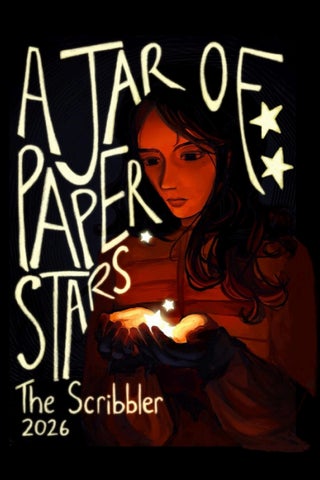
Editorial Staff Editor-in-Chief Daria Mamonova Assistant Editors Katerina Sutton L Guzinski Art Editor Caterina Farrell Managing & Design Editor Ulyana Sharapova Assistant Copy Editor Aanjini Bhatnagar Cover Design Ruocen Wan & Ulyana Sharapova Faculty Advisor Mrs. Susan Lolis
2
A Jar of Paper Stars In this 2026 edition of The Scribbler, our editors were captivated with works that garnered a profound sense of yearning–a desire, a poignant wish in the main characters, speakers, and artists. The stories, poems, and artwork within these pages explore moments of hope and the need for authentic relationships, love, and acceptance. To convey this yearning, the editors chose “A Jar of Paper Stars” as the theme. Much like folding paper into birds of peace, writers stretch their imagination and search for meaning, shaping and constructing words and images into more than what they signify. Our theme represents signifiers in a jar, each work a wishing star waiting to take flight– a testament to the alchemy of literature and the artistic spirit. We hope you enjoy these written and visual works of art created by the Upper School students. Let us all continue to make meaning from art, and find our way in this world with more optimism and renewal of hope and inner peace. We thank Dr. Stewart, Mrs. Rashbaum, and Mrs. Metzger for the making of this literary journal. Thank you to the administration for the possibility of creating this amazing collection of student works.
3
Table of Contents Poetry
Trace Ode to Sushi The Tide Apology Mood Ring The Maid’s Room Of Feathery Memories My Father and I Slip into the Sand Dimmed Lights On Night Pëtyr Pocket Dictionary Pigeon Blood Fisherman Femdivine Water Bird in a Prison Cell Words in Wax
Charlotte Montoya Sullivan L Guzinski Nicki Remmel Charlotte Montoya-Sullivan Chloe Wigoda Isa Moreno Morgan Cole Judah Mann Keegan Brin Tasha Bodmer Isha Mullapudi Daria Mamonova Ulyana Sharapova Aanjini Bhatnagar MJ Hamblett Ananya Patel Tyson Jacobs Zoraida de Souza Isa Moreno
.............06 .............08 .............08 .............11 .............11 .............12 .............13 .............15 .............19 .............19 .............25 .............26 .............27 .............27 .............30 .............32 .............37 .............40 .............47
Maya Todorov Ulyana Sharapova Madison Logan Maya Todorov Serena Xu Maya Todorov Caterina Farrell Madison Logan Ulyana Sharapova Ruocen Wan Ivana Fuegert Ruocen Wan Mylo Staller Madison Logan Maya Todorov Ivana Fuegert Daria Mamonova Sonia Shah Mylo Staller Daria Mamonova
.............07 .............15 .............16 .............21 .............22 .............23 .............24 .............25 .............26 .............28 .............29 .............30 .............31 .............33 .............37 .............38 .............41 .............44 .............46 .............47
Artwork Luminance Mother Mary Ladybug eating a lamb Wonder Tired Nobility Rush Hour LOOK UP Alënushka Under White Flower Trees Beneath the Net Painting of Fish Borzois in Pink Outburst Maestro Wired Tension Hyper Hyacinths Oopsie Daisy Caw-smic Express World Egg
4
Table of Contents Prose Bells To the Shell Girl Hypotheticals The Girl From Two Chairs Away Did I Grow or Did the World Shrink The Science of Almost The Artist Off I-40 The Silence Upstairs Fragments of Friday Workhorse Hush Hour Below the Hill Chipped I Can Still Feel Her Bus Ride Crosses Everywhere Dentures Unfixed The Shadow Splotches A Cup of Chai Usually I Would Mrs. Hatcher Her Shrine 11:58 pm A December Night in St. Petersburg Widow
Caterina Farrell Chi Perido Emmi Rogovin Ari Panjwani Mylo Staller Ananya Patel Katerina Sutton Eric Georgescu Rocco Garfi Elizabeth Sauby Zoë Lolis Alice O'Keefe Katerina Sutton Michaela Lang Daria Mamonova Ivana Fuegert L Guzinski Nika Norinsberg Rafa Teplitsky Vanessa Georgescu Aanjini Bhatnagar Michaela Lang Zoë Lolis Ivana Fuegert Melissa Alexis Mylo Staller
.............06 .............09 .............10 .............14 .............16 .............17 .............18 .............20 .............21 .............22 .............24 .............29 .............31 .............33 .............34 .............35 .............36 .............38 .............39 .............40 .............41 .............42 .............43 .............44 .............45 .............46
5
Trace by Charlotte Montoya Sullivan She dips, arcs feathers scratch the crisp air, over waters that gleam, plains that stretch, valleys folding under themselves. Her nestling, beady-eyed, mimics, trembles with the turns of wind, currents, every wingbeat precise, or the sky will devour. Seasons pass. The young swallow grows, now guiding its own fledgling, their flight a shared pattern, old as the air, persistent as the stars.
Bells by Caterina Farrell The bells on our front door jingled as Dad closed it behind us. The house was cold— not colder than outside— but chilly, and dark. Dad turned the lamp on and cranked the heater as I hung up our scarves. “Go, sit,” he said, “I'll be back in a second.” I held my hands out to the built-in space heater, made to mimic a fireplace, until I felt the cold melt off my fingertips. It had a big cast-iron pipe coming off it, up and into the wall. It wound and bent up with superficial bolts holding it together. There were scorch marks near it from January, two years ago, when Dad turned it till the knob stopped going. He put a piece of tape to remind him where to stop after that. Next to it hung some paintings, a dog, and a portrait of a lady, mixed in with crayon and chalk pastel drawings I did as a kid. I liked to think that he thought they were all just as good as each other. Soon enough he came back, carrying two blankets, and tossed one to me. He sat, wrapped up in his chair, and I laid down by the heater. “Do you wanna hear a story?” he asked. I nodded. He coughed to clear his throat.
6
Luminance by Maya Todorov
7
Ode to Sushi by L Guzinski Flavors evenly disperse on the tongue, revealing the complexity of its nature. A cold swallow of grain, a salty tang, whisks me away to a world where all is well.
The Tide by Nicki Remmel Awarded Scholastic Honorable Mention Salt stays behind when the rest disappears. On my skin. On my lips. On my hair. Left long after the water is gone, after I’ve left the ocean. It clings to me, relentlessly. Like memories I don’t mean to keep. Warm days that slip into colder nights. Waves that rush in only to pull away again. I do not notice the salt until later, Only when it dries white against my skin. It follows me to the kitchen. I sprinkle it over my food, Just a pinch. And suddenly everything wakes up. The plain becomes enough, Salt can make anything taste like home. I taste it on the sides of my lips when I run, Sweat coating my skin. As if strength has a glow to it. Effort leaving a trace.
8
Some days, Salt gathers on my eyelashes, Quiet and inevitable. Like the tide returning, It falls.
To the Shell Girl by Chi Perido Awarded Scholastic Honorable Mention I keep you around my neck every day. You’ve become a part of my morning routine: a step so ingrained in me I couldn’t forget about you if I tried. And I don’t think I’ll ever stop wearing your necklaces. People know me by you now, by the shells, by the coastal twinkle that rings through the air when I turn my head. You are my signature. My trademark. Do you still remember me? I’m sure you’ve had hundreds of customers since I met you, wild and free, on that beach in Santa Fe. Tourists, like me, silly Americans you can upcharge from twenty to fifty pesos without them batting an eye. Because what’s a thirty-peso upcharge to a silly American like me, soaking up the Philippine sun on her four-thousanddollar summer vacation? I’m sure all the silly American customers, like me, just smiled and shook their heads as you turned to your sister and giggled, dropping the pink bill into your basket with the other yellow ones. But did you sit with those other silly American customers like you did with me? Right near the shoreline, the ocean water tickling our toes, foraging through your box, that coastal twinkle ringing through the salty air, as the sun shifted from bright white to glaring orange? You picked out that one with the amber shells, remember, and held it up to my eyes? Maganda. Beautiful. That’s what you called the necklace — or my eyes, or me, or who knows. My parents never cared enough to teach me the language, and I never cared enough to learn. But I kicked myself for that as I sat with you on that beach, wishing so badly I could understand what you were saying about my eyes and how the light was hitting them and whatever, who cares, I was probably mistranslating and even if I wasn’t it was probably a seller’s trick, a ploy designed to get me to buy more necklaces — not because they complimented my eyes (which look just as mud brown in the sun as they do in a pitch-black room) but because I just wanted to sit with you, with your shells, with your hands so close to my face they might as well have been running through my hair, for a little while longer. I wanted the time to prove to you that I wasn’t just another silly American, just the next thirtypeso upcharge of the day. I wanted to prove to you that I, too, was wild and free on the Santa Fe shore. I wanted to be a shell girl too.
9
Hypotheticals by Emmi Rogovin If you give a girl a pen, she’ll examine its mechanics. The clicker is the most fascinating part. But if you give her some paper, too, she’ll start to scribble. Overlapping streaks form shapes that are unknown and, as yet, unnamed. And if you teach her to read, she’ll seek out books. She’ll obsess over foreign magic-possessing children and a schoolgirl with telekinesis. Nobody will tell her these are fantasies until she has already gotten her hopes up. If you give her a laptop, she’ll ditch the paper. She works better when she can read her writing. Soon, if you give her an idea, a spark of a story, she’ll never let it go. This is what she’ll keep in the back of her mind until the day she deletes the “Book: In Progress” tab on her laptop. The day that happens, she’ll want to smash her screen. It was never going to get finished, but it was nice to know it was always an option. If you remind her of that idea in the future, she’ll get sentimental. She’ll remember how much she longed to be an author. Back then, if you were to tell her that was unrealistic, she’d pretend that was obvious. In secret, she always believed she’d beat the odds. She’s special, after all. Most importantly, make sure you give her time. If you give her time to sit and wait, the work is sure to be the best it can be. She’ll be happiest if she can continue editing until absolute satisfaction. Then again, with time, her ideas will change. She’ll realize she wants more than just a book. She wants a play, a screenplay, a blog. The projects will pile up, mostly started on a whim. If you ask her, she will say she has plans to complete them all, but she won’t. On second thought, maybe don’t give her too much time. As long as she’s writing, she’ll be alright. So, give her the paper. Give her the books. Give her an idea. Give her time. But first, make sure she picks up the pen.
10
Apology by Charlotte Montoya-Sullivan Pleading words come easy, falling over many others. The page is filled with many words, busy; some are lousy, some spiteful, smothered, entangling into one, cursing someone’s brothers. The paper is rough, ash-covered, poor grey, wrinkled more by me than by its folds. The pen is a moving constellation, a small cylinder in cylindrical fingers, leaking black ooze into whispering words. The mind is entangled, forming and mourning, his own making of curses and blessings every stroke, twitching at shivering pleas, needy wants, a bead of sweat. Truth be told, lies are sung. The mind never apologizes for what it has stung.
Mood Ring by Chloe Wigoda I keep staring at what I already know to be true Tell me again, like repetition makes it new. You’ve been looking awfully dark— But in the light, you flicker soft and pink. The grayness of the clasp, Certainly blinks green—if I squint. Shining tones of auburn on my finger glisten, The writing is on the wall, but I still won’t listen Steer me down a path I’ve walked before, Or nudge me towards the truth, I’ll still ignore Today you settle quiet, tomorrow you bruise to blue. Still, I ask the question whose answer I already knew.
11
The Maid’s Room by Isa Moreno Chepita juices limes over a blue heart and green tears crust over her nose. Coughing mucus, crushing panela, she swirls boils against a hot pot. Spirits from burning sugar sting the edges of her eyes. Lime squirts into a bowl and she cries as she tastes her own spit, bitter in its dryness and clumped into white spots on her tongue. She is diseased with a sadness that metastasized between the Clorox cracks in her finger. Chepita folds the laundry in perfect squares on the counter across from her the way she folds her crinkled dollar bill under a cardboard pillow. She smoothes a smothering wish and returns to look at herself in the sink, asking herself, Can I live even if I leave?
12
Of Feathery Memories by Morgan Cole I saw him in the bush and knew he was dying. He had been my oddly speckled friend for years. Red bill, spreading right up through eager eyes. Tail wagging, with awkward bumps he flies to greet me with the morning sun. My mother warned me not to feed him, the first time we met him at the pond. He’ll be here greeting everyone, nudging all who fawn. I welcomed him anyway. Clumsy in both land and air, but magnificent in the dewy waters. He was my new friend during Covid, All he asked for was a bite of sandwich, Or a morsel of a chowder, and he would follow me for an hour. Soft nuzzling sounds. Satisfied shucks of a language I knew nothing of but understood. I walked the coquina path, and he showed me his world. Bristled woodlands, lily pads, bustling dragonflies. A place just miles, but moons away. Downy feathers, sturdy webbing. His mate. Nestled in their home of leaves and twigs and fate. And then one day, I came around to feel just empty space. An eerie silence, not unlike a calmy peace before a raging storm. And in the brush, I spotted him in shiny leaves of thorn. A final respite for my sick and shaking friend. What could I do? What could I do? She must wonder where you are. The park ranger came over to take a peek, my grim discovery quaking, eyes closed to this world. A wildlife refuge? I despaired. He shook his head, “rat poison”. No apology, no regret, just hard facts, unrepaired, spilling over into my helplessness.
Nothing you can do. You try to pick him up, you’ll kill him from the shock. With that, he walked with haste. A light in my life snuffed out by a small chalky disc, too tempting not to taste. I stayed with him for hours, Singing a gentle song about sunshine, about rain, about anything. Just so he knew I was there all along. I stayed until he shook no more. I left, cold and stiff from sitting. Drained and empty from sadness. The park ranger looked at me, said nothing and nodded, a recognition of my loss. Though his eyes showed no gloss. Just a few weeks later, I forced myself to go. Even if his absence haunts me in every memory that flows. When the ranger met me, he pointed to a flock of tiny little speckled angels on the pond, their mother taking stock. The ranger looked beyond my gaze, but spoke to me just the same. I rid the place of poison, so it never happens again. I rid the place of poison, so there is some happy end. I never voiced these last moments. It’s too hard, devastation into words. But if asked if gentle dignity exists, I’d say it’s for the birds.
13
The Girl From Two Chairs Away by Ari Panjwani Awarded Scholastic Gold Key You sat two chairs away from me, clutching a paper cup of coffee with both hands, like it was the only thing keeping you alive. It was two in the morning, fluorescent lights buzzing, the air too cold for comfort. You looked like you hadn’t slept in days. Hair tied back, a baggy sweatshirt, and your eyes fixed on the sliding glass door that never seemed to open fast enough. My mom was inside, hooked up to machines that I tried my best not to look at. I was distracting myself by scrolling on Instagram, pretending I wasn’t scared. You didn’t speak to anyone, and neither did I. But when a nurse came out and called out a name that didn’t seem to be yours, you jumped up anyway, like maybe if you stood quick enough, you could change what she was about to say. After a few minutes, you sat down again, breathing hard. I wanted to say something, “Are you okay,” or “Me neither.” But the words stayed in my throat. We both just sat there in silence, two people worried about the same thing. When my mom’s doctor finally came out, I didn’t even hear half of what he said. All I remember is that when I got up to leave, you looked at me and nodded. Just once. No words. But it felt like you were telling me something like “yeah, I get it.” I never saw you again after that night. I still wonder who you were waiting for, a parent, a kid, or maybe a friend. I hope they make it. I hope you got to go home and wake up to good news. But part of me knows maybe you didn’t. Sometimes when I pass hospitals now, I think of you, the coffee, the shaking hands, the way fear can make two random strangers feel like family for even a second. You didn’t say a word, but I think about you more than some people I’ve actually known. Wherever you are, I hope adversity in your life is behind you. And if it’s not, I hope you still have someone sitting close enough to you to notice the way your hands shake.
14
My Father and I by Judah Mann found poem from Elie Wiesel’s Night I want to stay with my father We live for each other, body and soul We would sometimes hum melodies My father next to me I thought of him He would be suffering more than I Lying on the ground To stay and rest I thought of my father Our eyes shone with hope
Mother Mary by Ulyana Sharapova
15
Did I Grow or Did the World Shrink by Mylo Staller I love my pajamas, but when they get washed, I can’t wear them. The downy facade of pink plastic softness fades after each tumble in the washer. I sit on cold tile, gazing into the swirling black hole of the machine’s door and watch my reflection watch itself. My irises mirror the tinted glass– a depth of swirling thoughts, sodden and wrung out after many cycles. I remain on this ground of stone, goose bumps dot my flesh that drains to a white almost as pale as the walls around me. My bottom hurts like a flat weight, the only sensation tethering me to my body. If the timer on the washer weren’t counting down, nothing would have changed to indicate the passage of time. Someday, when the washer beeps its merry tone of conclusion, I don’t know how to turn my limbs back on. They are now one with the floor, lacking any distinguishable sensation other than cold, cold, cold. Yet, somehow, they reach out. I rescue my pajamas from their cavern, heavy with water, and heave them over my head into the dryer above. And I return to my cradle of hard tile, waiting for something again. When I pull my pink pants from the dryer, the warmth seeping through my fingers, and I hold them over my face, burying the cold, cloaking myself in heat. Another tumble in the sea has stiffened their fibers, and something fades within me. And when I slip them over trembling legs, they no longer drape over my feet. They stop at my shins, leaving ankles exposed and cold.
16
Ladybug eating a lamb by Madison Logan
The Science of Almost by Ananya Patel Awarded Scholastic Silver Key There’s a silver chain around his neck with nothing attached to it, and we are parallel lines, close but never touching. I want to tell him he’s too warm for silver. It would be easy to flip his hand to the underside of his wrist and trace the branches stretching to the cusp of his palm. To tell him silver is too harsh and the green cast on his veins means gold better suits him. I don’t say that. Instead, I look over the seat next to me, the space between us, the palpable force of repulsion before magnets flip and snap together, and imagine him in the kitchen. I’ve never wanted anyone I couldn’t imagine in the heart of my body, side-by-side with his hands on a mixing bowl. He would pick up the recipe paper and crinkle it, holding it too tight without meaning to. He’s not careful with his things, but he plucked the stray piece of straw wrapper knotted into my hair like I was more precious than practiced inattention. He made his fingers delicate and leaned until we breathed the same air, and maybe he could have kissed me if our friend didn’t come up and ask about the Chem test. We like the same music and hate the same people, but the timing was never right. Nothing was spoken about the animal awareness of the other pulsing through our negative space, the way I knew it was him near without seeing, without speaking for months, like my cells had memorized his pattern. Two years later, he sees me in my stupid gold corset and gladiator cape. I’m dancing, but he’s only tapping his foot a little, staring at the action like his mind exists on a plane far away from us. There’s sweat in my hair, my laurel headband resting crooked against my new curtain bangs. He looks at me like he doesn’t expect to see me, eyes widening as he exhales loud enough that it echoes over the booming music into my chest. The lines intersect once more as we stare into each other, the dancing blurs coming to a still in a moment where we know each other again. We turn back to our friends, crossing the axis and slipping away from each other to infinity.
17
The Artist Off I-40 by Katerina Sutton Robbie stood behind the Subway counter, watching the window as the hours ticked down. Only one car idled under the neon-blue fluorescents of the Chevron, beaming down on the darkened ground. The door chime dinged and a man shuffled in, eyes drooping and expression shifty. He ordered a meatball sub and pulled a bottle of Diet Coke from the cooler. He counted out change. Tall, stubbled cheeks, rumpled hair, an old rucksack in his free hand. Probably had blown past Sanders somewhere along I-40. Most people ended up here that way; Robbie still missed it sometimes, though he had no excuse anymore. The man drifted toward a booth in the corner, and pulled out a sketchbook and pencil. He flipped through page after page—graphic panels, expressive figures, speech bubbles—as Robbie leaned against the counter and pretended not to look. If this was what the man told people he did for a living, what did his mother say? Probably made some gross exaggeration at brunches, like his own mother did with him. He could almost hear it: “Three years out of college, is that right? What is your Robbie doing now?” “Well… he’s working in the restaurant industry.” “Oh, Susan, that’s wonderful, just wonderful. You must be very proud. You know…” Robbie brought the man another bottle of Coke on the house, mainly to confirm the suspicion that the artist was much like himself. He was scribbling away with his head bent over the sketchbook, meatball sub untouched. Up close, it became clear that these weren’t sketches at all—but clean, confident panels, some inked, others marked up with colored sticky notes: “client this”, “client that.” One page bore a logo in the corner, glossy and corporate. This was no dreamer. Robbie often created stories about the people who came in, to feel some sense of kinship. It was rare to see more than a few people all night, and many were of the frightening sort—not the kind he could relate to. The face of a Rolex peeked from beneath the cuff of the man’s button-down, and Robbie felt suddenly angry—slighted—as he turned with a huff, away from the artist and the sickening neon station. The man was like the cars speeding along the I-40: visible for a moment, but unreachable, and then already moving on.
18
Slip into the Sand by Keegan Brin The sky bright blue and the lighthouse at the coastline. Your friends splash at the shoreline. You lie in the sun as the sand makes its way into your hair and under your nails. Your towel slowly begins to itch under you and the water that was once sun-kissed turns a chill as the sun meets the shore and the pink in your cheeks brightens and a dull burn blooms.
Dimmed Lights by Tasha Bodmer In a stream of lights there is a city filled with people who flip the switch, those who are stuck in a lightbulb, and those who observe from their lightless flat. You can infer the warm lit homes house peaceful families and the bright lit homes are filled with guests. But what about the houses with lightbulbs that have dimmed and now don’t turn on at all? When will the lights turn back on? Who will turn the lights back on? Why won’t the lights turn back on? So many things you can think of when staring through someone’s window, and yet so many things you already know by watching their lights.
19
The Silence Upstairs by Eric Georgescu Awarded Scholastic Honorable Mention It’s late at night on a Tuesday, and no one is supposed to be home, but the word noise keeps echoing in my head all night long. No actual noise, just the idea of it. The refrigerator hums, a car’s engine spurring outside. Suddenly, I am remembering the sound of my old neighborhood, the bikes hitting curbs, kids screaming and laughing outside, and my garage opening when my dad came home. All that is just a memory now. The word noise shifts in my head the more I think about it. Noise as in loud. Noise, as in distraction. Noise, as in the thoughts in your head, screaming at you. Noise as the memory of someone’s voice in a room. The second memory that then comes is the loud noise of the TV playing constantly in the living room. My dad always turned it on while doing anything in the house, even though he wasn’t even watching it. At the time, I found it immensely annoying. Now, sitting alone in my quiet room, I somewhat miss the messiness of it: the way it made the house feel alive. As I keep following the word noise, something else catches my attention, my own heartbeat. I notice it thumping in my ears. It reminds me of how, during fire drills at school, everything would be blasting and chaotic, but all I could hear was my heartbeat pushing through the sound. The house is fully silent now. It's strange how much noise you can hear even when everything is still. Maybe paying attention to those little "edge" moments is its own kind of listening, a way of hearing the things you didn't know you remembered.
20
Fragments of Friday by Rocco Garfi The gray rubble leading up to the house faintly lingers in my memories. The yells and shouts from my friends filling the small backyard. After school every Friday, the same place welcomed me and my friends. I barely remember the white acrylic side door that would always stay slightly unlocked. The bounce of the cheap rubber ball against the tile would ring in my head, a sound I barely remember to this day. The sound of the dilapidated springs of the trampoline creak, as the dark blue padding moved up and down with the movement of me and my friends. These days sit in the back of my mind, barely remembered. I remember, these afternoons would be the highlight of my week. There was never a time where I refused to go over to his house and play. The sound of the wrapper on the side of a gatorade bottle being crinkled as kids came up to finish the small bottles in a couple of large, and thirsty gulps. The times when we are young are the times that we take for granted, the times where we were carefree.
Wonder by Maya Todorov
21
Workhorse by Elizabeth Sauby I am a horse that is obedient enough to tame but wild enough to never get close to. I listen because I choose to, not because I don’t have the willpower to say no. If I wanted to, I could break free from my reins and from my holders and run into the abyss. I chose to stay. I am not captive; rather, docile. I am stronger than the people who command me, than the horses around me, both emotionally and physically, but I choose to step into the harness each day. I don’t know why, it just seems that I would be lost if I didn’t. What would I do in the forest anyway? I belong in a stable. I am supposed to be controlled; after all, I am just a horse.
22
Tired by Serena Xu
Nobility by Maya Todorov
23
Hush Hour by Zoë Lolis 6:30 p.m. in New Baden, Illinois, is the Red Porch Cafe’s hush hour. It’s one of only two eateries in town, the other being its long time rival, Good Old Days, and business is usually booming. Much to the town’s collective dismay, the porch was recently repainted gray. If someone were to fall ill—which happens too often for my liking, as most of New Baden’s residents are senior citizens—they have to drive eleven miles to get to the nearest hospital. When a McDonald’s opened just outside town, all 3,395 townies had a party. They gathered outside the windows to watch the mayor sample a burger. My family visits twice a year, and one evening, my dad and I had decided to go for a run. We stopped to take a break at a park on the outskirts of town. Lightning bugs hovered in the garden beside a dead fairground. None of the rides had attendants, and all the food trucks were dark. There were construction workers moseying around in the very back, holding clipboards and smoking cigars, and I remember feeling a baseless worry that we’d get in trouble if they saw us. Next to the fairground was a playground covered in woodchips. I walked past the fence and saw a child sitting on one of the swings. A woman dressed in a black dress with a lacy collar was limply pushing the swing back and forth. Over and over, the kid forced a guttural sound to emerge from the back of their throat. It wasn’t quite screaming. Both of them had vacant looks on their faces. After I took a few more steps forward, the woman stopped, lifted the child off the swing, and guided them toward the exit, on account of her wanting some privacy. They walked away together, moving at a steady pace, but even as they grew distant from me, the child’s hoarse cries rang through the air.
Rush Hour by Caterina Farrell 24
On Night by Isha Mullapudi your dreams stop moving you feel their edges, their cracks. twice as many words dissolve in your mouth, your wisdom teeth pulled, your tears aren’t warm enough saltwater to numb the thought that you saw God between sable and the moon’s pitch, and she told you to keep it secret. you stretch and crease the night trying to make it fit your frame, but you’ll always feel the draft.
LOOK UP by Madison Logan
25
Pëtyr by Daria Mamonova In the house on the main road, the one that looks out at the travelers’ flow, and in the morning sees the light of the morning rays, on the lake white, there lives a man, a cat, a maid, a gnat, and in the living room sits a storybook fat. Now many folks come through the village gates, and in the home tell their fateful fates. The maid will open for them the door, as it has always been before, feed them stew and give them bread, so that they can’t complain unfed. The gnat will sit upon their plates, stare directly at their face, hear their tale and see their faults, and then lock it in their vaults. The bespeckled cat, in spectacles sat, will rub their legs all with his back. Then heard enough, will give a mewl, jump on the man’s oak-crafted stool, and wait by the book, ordained and old, to pen the night’s new story told. And so the man is left to talk, with whatever stranger is that night brought. He hears their spiels, fills their beers, sends them up to bed with cheer, helps the maiden clean the kitchen, learns the secrets from the midge, and under candlelight helps the cat retell the legends that before them fell.
The book grows and people talk. Circles wind in circles taut. But on the edges of the woods, in depths of lakes and alleys crook, in the coals and in the clouds, Pëtyr tells of all the sounds. His daughter fills his cup with mead, his, whose head the people heed, Barsik purring upon her lap, the gnat flying from the flytrap. Another day brings more to say, and more will round in circles sway, to hear the stories Pëtyr has, but till then, can you pass the kvass?
Alënushka by Ulyana Sharapova 26
Pocket Dictionary by Ulyana Sharapova I was translating-Objective [Обджэктив] : объективный -- for an argument with my father. The pages are fine gossamer, crowded with thin-legged letters. They give underthumb like snowbank underboot. My eyes slip-Родина [rodina]: motherland Тоска [toska]: the grief of yearning Лазурь [lazur]: azure, the color of clean sky at noon -- and I taste and touch suddenly a snowswaddled March. The birch outside my window shudders, breathes in new spring. All is raw, scrubbed with road salt. He has to thump me on the back to get the word out. It stuck at the top of my throat as tree sap, and lands as a sparrow does into glass.
Pigeon Blood by Aanjini Bhatnagar Makrana marble decorated the prism Creeping Up and under and coiling between the hinges. Flawless Cambodian sapphire and Colombian emerald Wove across the top in infinite swirls and twists. The lid creaked Once Twice Threatening to open with a deafening Crack Before revealing it around the bust. The lost gem of Burma, A valley of rivers bleeding crimson at dusk Bathed in a silent glow Crackling like the fires that waged within.
27
Under White Flower Trees by Ruocen Wan 28
Below the Hill by Alice O'Keefe I don't know your name, but I've seen you every summer since we moved in. You live in the house at the bottom of the hill, the one that looks like it's older than the trees that surround it. It looks as if it's almost leaning, and when I pass by, I can almost swear I hear something coming from the small shed behind it. Every time I pass by, I notice you doing something that does not quite make sense. Hammering the same nail over and over again, repainting the same spot, stacking the same pieces of wood that you never seem to burn. When I wave to you, your hand seems stern. I can never read you, and at the same time, every night, I notice you waiting. Always waiting, but I never know for whom, or for what.
Beneath the Net by Ivana Fuegert
29
Fisherman by MJ Hamblett A fisherman throws his line out to sea, Hoping for a bite Or a hook. Then he will wait, Sometimes a minute Other times an hour, Maybe two. There is a tug. The bobber goes underneath the murky water— A man jumps from his chair, And tightens his grip on the handle. The fish escapes And the man will remain empty handed. He will wait once again, In search for a catch.
30
Painting of Fish by Ruocen Wan
Chipped by Katerina Sutton Mom had always been a decent cook, but in recent weeks I’d started to notice odd remnants in her meals: lemon seeds in the salad, chicken cartilage in the marsala. I inched around the food she served in my weekly visits, working each bite over until I knew it was safe to swallow. Even as the issue became more glaring, it somehow never concerned me much; cooking was a hobby she’d only begun to truly pursue in retirement, and I couldn’t remember if the food from my childhood had been any different. I only began to suspect when the plates she set in front of me became increasingly chipped, as if bites were being taken around the edges—Mom, I said, when did this happen?—and she shook her head, just as confused. As winter became spring, the plates dwindled on her dish rack. Once, entering the small home, I heard running water and a racket that made me pause in the hallway. She’d looked up, sponge in hand, and shrugged—washing the dishes, she said—and later, I found porcelain shards in the sink. The day before her fall, Mom had me over for dinner, and served tater tots on paper plates.
Borzois in Pink by Mylo Staller
31
Femdivine by Ananya Patel I scraped my elbow open when I was thirteen, and haven’t prayed for even longer, but the blood patched over to silvery skin, so that I might see the reflection of my mother’s six-armed gods. I tell the boy with his hand on my knee, chained cross pulsing against his collarbones, about Kali and her necklace of severed heads, Lakshmi’s birth from the churning sea. “How do you live without goddesses?” He laughs at that, with eyes so brown they swirl with the haze of party lights and looks at me half-lidded. He tells me there are real women in the Bible, no goddesses, just saints who bled quietly: Jeanne D’Arc on her pyre, next to Sati. We are separate and same with burning women everywhere, gods mirrored only through our closed wounds.
32
I Can Still Feel Her by Michaela Lang Every morning before school my Father is already awake, through an open door frame he takes his wet sponge and hydrates the same sculpture—the face of a woman, who’s only exposed to her shoulders. Her nose pointy, cheekbones high, lips unusually thin. The only thing he does is smooth her cheekbones and occasionally the back of her neck. Night and day, he stays in the same positions, legs spread open on a stool, chest pressed against a crumbly table, sculpture within breath range, surrounded by a room full of women’s faces, chipped pieces of frozen clay, and crumbled up drawings. Every week is a new sculpture, each slightly different from the last. A flatter nose, broader shoulders, fuller lips—but the eyes always remain the same. And on the eighth of every month, he sits in his room, first admiring the sculptures, then in anger with them. Every eighth ends the same, walking him—screaming, back to bed and spending the night sweeping broken pieces of clay. He never speaks about his sculptures, until one night a cry of joy is heard from the living room. “I can feel her,” he repeats as he clings to the wet clay. He can feel her, he keeps his whispers soft, into the ear of the sculpture. He stays clung to it until his body heat melts it down to nothing but an imprint.
Outburst by Madison Logan
33
Bus Ride by Daria Mamonova Sitting on cheap, old cushions masked by tough, leather-like upholstery is the trademark of bus riding. The bench structure doesn’t offer proper back support, and over time you learn to snatch the window side of the seat, or better yet, the single. Shimmy your back into the crux of the seat and the cold metal bus-wall, and you get the optimal view, recline, and claim over seat space. Lean your head against the cool glass and feel the fuzz of the day’s heat seep from your mind. When the vehicle hums to life with a palpable shudder and begins to pull out from the shadow of the garage, into the gray light of the world, you look forward to seeing the expected. The thousandth-time traversed journey is a pleasant constant in your life. It’s been raining for weeks, the rolling clouds a permanent fixture in the grisly sky. You expect now, for the rain to fall and lull you to sleep, a pitter-patter you can hypnotize yourself with to eclipse the screams of elementary school kids. And the rain does fall, like a spring shower springing the world to life. The grass blades aren’t a graying yellow, but a vibrant, granny-smith green. The trees aren’t dramatic shadows against the early-film backdrop, but evergreen, and coarse like horse hair paint brushes. Someone has punched a hole in the sky, reached in and down, and ripped the heart of the Cumulonimbus out to leave a gaping hole, and now the sun is shining on you. You can observe it, as it streams in–bold pale-yellow rays. The roads aren’t made up of dusty cement, but diamonds picked up by the wheels of cars. The air swirls around the tires in crystal-sparkly winds as they rush to new and awaiting destinations. Leaves are bejeweled, crowned in quartz and emeralds. Your window treasures watery pearls in their descent earthward. The bus drives over the train tracks without slowing down, and–for a couple of seconds–you fly. You won’t fall asleep this bus ride.
34
Crosses Everywhere by Ivana Fuegert Inspired by “Valentine” by Alison Townsend The winter sun shone golden rays across the silk curtains in the early afternoon, just for a moment, it felt like the light would never leave. The glare reflected upon the delicate cross that rested in the center of my collarbone. It was the one *Baka, my grandmother, fastened around my neck with shaking hands; she insisted she put it on me. *“Kreuze zeigen nicht nach oben, sondern nach innen”, she said as I hugged her, thanking her for the present. I didn’t understand what she meant then, but the words looped in my mind for years. With each breath I take, the cross lightly bumps against my chest, reminding me it's there like a heartbeat reminds you that you're not alone. Crosses are everywhere when you look for them. Cracks on the concrete in the lower school of Pine Crest, marble star and cross tile in my grandma’s kitchen, slightly lighter bricks camouflaging into the columns, intersecting lines on the xy graph in math; the grid feels like a map of things I haven’t figured out yet. When I was nine, I found a box with shiny gold metal, reminding me of my grandmother's necklace. After I made a circle for the chain, I struggled to bend the large-gauge wire into a cross. In fact, the wire was electrical wire, not jewelry, leading to it puncturing my wrist while I trembled to mold the arm. I stared at the small red puddle of blood dripping from my arm, warm like fresh strawberries from my grandmother’s garden. I couldn’t help but think something important was trying to get out. Later that night, I held the real cross between my fingers, the metal warming rapidly regardless of the chilly winter breeze flowing from the window. As I pressed my thumb tighter, I could feel it pulsing through my finger. Now, looking back, it might have just been my own pulse reflecting upon the cross, but at the time it felt like small, reminding flickers of faith from the Lord himself. Just for a moment, the spirit wasn’t around me, but inside me, flowing through my veins.
* “Baka”, a Serbian word, translates to grandmother in English * “Kreuze zeigen nicht nach oben, sondern nach innen”, a German phrase, translates to “Crosses don’t point upward, rather inward” in English
35
Dentures by L Guzinski There was a woman that lived up the street from us. She lived in a big white house with a large wooden porch, scattered with marigolds and chrysanthemums. She resided there with her husband, who died from old age when I was young. Every afternoon, she made a fresh cup of tea with milk and honey and sat on her porch in a wicker chair with its matching table. When I was in preschool, I played with my mother outside at dusk. She’d watch me run around, roll in the grass, and run down the street to say hi to the neighbors. They thought I was cute. When I ran past the house, I was always greeted with a warm smile and a wave. On occasion, the women would shout, “Don’t forget to watch for cars!” I never did. A few years passed and my parents decided to get me a bike for my birthday. Every night after dinner, I rode my bike along the familiar roads of my neighborhood. At the end of my ride I always left the best house for last. The women's wicker chair was now replaced for one with wheels and was now placed on the other side of the table. Her cup of tea sat nestled in her lap as her wrinkled hands wrapped around it for warmth. She’d greet me with the same warm smile and a shaky wave. Sometimes, she’d invite me onto her porch for one of the cookies she had assorted on a plate next to her. Or she’d offer me a cup of tea and a little chat. I always went inside and made my own cup so as to not inconvenience her. She’d talk about her son, who came by each week and gave her groceries. And about her husband, who loved poetry and gardening. She’d ask me about school and what my favorite subject was. I didn’t have one. And about how my mother was doing, to which I replied “fine.” I didn’t want to make her sad. The chain on my bike rusted and my dad couldn’t afford to get me a new one. Not with mothers medical bills. I stopped visiting the woman, which I knew made her sad. In middle school I joined the track team. I loved running. The wind in my face reminded me of riding through my neighborhood long ago. Every day after school I ran a mile around the neighborhood. When it came time to pass the white house, I was afraid of not seeing the women on her porch. To my surprise, she was sitting in the same spot she always was, nursing her cup while she watched the birds fly. I gave her a big smile and a wave. I was given that familiar warm smile back. I stopped in front of her house and walked up the rotten steps that led up her porch. “The flowers are starting to die,” I said. “It was just their time to go.” Her cup was cold. In the winter I stopped running. I stayed inside and watched the snow fall next to the fireplace. I sat on the end of my mother's bed while she laid there and coughed. I always wondered if the women sat outside during the winter. Or if her son came by to visit and gave her groceries during the coldest of nights. Or if she could light the fireplace by herself for warmth. My thoughts kept me wondering through the winter months. My mother died that spring. After the funeral, I stopped going outside all together. My dad was either too drunk to care or, didn't care at all. He was angry. He stopped going to work and eventually, was fired for not showing up. The only time he moved during the day was up from his chair to grab a beer, and back. Eventually, I went back to school, for whatever was left before summer break. I started going to the grocery store, once the only thing left in the house was a piece of moldy bread and a bottle of ketchup. Or when my father would bitch about not having any beer left. “Make yourself useful for once.” He echoed in every fold of my brain. That summer I tried to get out more. I went to the grocery store once a week, and every week I passed by the big white house. When I did, I could see the woman sleeping in her chair with her tea on the table next to her. I figured she was enjoying the summer air, so I never bothered her. One day in the middle of June, I was stopped by one of the neighbors while walking to the store. “Hey, do you know where this awful smell has been coming from?” “What?” “You can’t smell it? The whole neighborhood smells like a dead animal.” “I guess I never noticed.” She left me alone after that. By the end of the week the smell in the neighborhood had gotten worse. The walk to the grocery store had become almost unbearable. While I was walking home, I passed by the big white house. The woman was sitting outside like she always was, with her tea sitting next to her. But this time, her tea cup had been tipped over onto the table. She’d been asleep so I guess she didn’t notice. I stopped at her house and placed my bags at the foot of the steps and ascended. The smell was getting worse. I looked at the table to see where the tea had spilled. I couldn’t find any. I picked up the cup, and my hand was engulfed in little white bugs. They started crawling up my fingers, the little legs tickling my arm hairs. I dropped the cup out of fear and it shattered onto the porch. The white porcelain cup’s fuzzy green underbelly stared up at me. I looked back at the table. The plate that was once filled was now cracked and empty, aside from a few measly crumbs and a half eaten chocolate chip cookie. Nature ate it with its white mouth. I looked back at the woman, her flesh the bluish color of death. Her skin like a popsicle on a hot day. I leaned towards her melting face and agape mouth. The smell was getting worse. A thin brown leg of a cockroach hooked onto her lip from the fermented inside, riding the wave of her flesh down the bone and onto her summer dress. For all the years I've known her, I never noticed that she didn’t have any bottom teeth.
36
Water by Tyson Jacobs Have you ever explained your fondness for water? I am sure you have not. “It’s refreshing, it’s filling, it’s clean.” But all those attributes can be applied to various drinks It’s near impossible to qualify water as its own entity as it is a constant; a paradigm and bastion of need Unarguable, uncontingable, Unfaltering in its ubiquity and unamity. Which is why it is all the more fantastic when one forsakes it. It is almost impossible for most to understand; “How? How could you dare to defy what is right, what is good, what is moral?” “How? How can you chose a lifestyle so opposed to the status quo?” To connect ourselves and claim that this is such a fundamental truth in our universe is solely a result of environment; all species below us act this way, so so should we. Despite these fantastic revelations we have created and discovered, we limit ourselves to a “constant,” since we fear change so much. To abandon a “universal truth” implies a direct contrast; a “universal false” But it is not a differing lifestyle. It is not a choice or preference. It is a visceral reaction against not the act of drinking, not the act of aligning, But the act of dying. Dying of thirst.
Maestro by Maya Todorov
37
Unfixed by Nika Norinsberg Awarded Scholastic Honorable Mention There's a crack in the hallway wall that I keep meaning to fix. It runs up from the baseboard to the light switch like a strand of hair. When I first noticed it I thought it was just that, a hair. But now every night I walk past it, dragging my fingers along it to remind myself to call the repair guy. Every night I forget. And when I begin drifting into sleep, I imagine the crack growing, inching upward in the dark. The apartment makes noises in the evening, the refrigerator’s long breaths, the air conditioner’s sigh, and the waves hitting the shore just outside. I've learned to match my breathing to the noises, so I can't hear the eventual silence. When people ask how I've been, I tell them I like the quiet here, how peaceful it is. They smile, relieved. I smile back, even though the quiet I mean is the kind that hides in your chest and doesn't blink. I eat dinner at the table. One plate, one cup. Everything lined up neatly like a picture. A picture, not dinner. I usually leave the TV on in my brother's room just for the glow under the door, maybe someone just forgot to turn it off. I never open his door all the way. I open it just enough to see the light, never his room. I'm not sure what I'm trying to trick. The apartment or myself? Tonight, the hallway crack looks a little wider. I crouch down this time to get a closer look, the lines in the marble pressing into my knees. The crack is quiet, so thin and smooth, like it's been waiting to be acknowledged. If it weren't me living here, they'd probably call a handyman. I just sit there and stare until my eyes adjust to the dim.
Wired Tension by Ivana Fuegert 38
The Shadow by Rafa Teplitsky Behind the closed doors of Prinz-Albrecht-Street No.8, RSHA functionaries droned about, pacing in contemplation, mulling over paperwork, hoping for promotions, and holding brief conversation, just as with any other job. The difference for those at No.8 was that in their hands they held life and death. Yet as each twin strike of the pen condemned a mother, a father, a son, a daughter—at times all at once, at others dozens at a time—like lightning, a presence ascended from below. As if scored for his arrival, the symphony of ink on paper hastened, with each note properly hit another chance at appeasing this familiar intrusion, so that they too may bear the privilege of themselves intruding years later. As he stood in the midst of it all, it crescendoed, and with the satisfaction of knowing not a single player had lagged behind, he almost smiled. And then, pulling aside the surrogate, they called a manager. He took out a clipboard and began making marks of his own. Five numbers—not names—were called out, each only just barely below the average. Without skipping a beat, the five paused, returned the contents of their hands to the desks no longer theirs, and exited the building in a solemn procession, ironically efficient for those fired for their lack of this quality held above all else. Their futures, however, were not truly grim. They would find employment as bureaucrats and civil servants elsewhere in the state apparatus; it was simply that the standards of security were higher than even most professionals could reach. It was that fact that brought the man true pride and joy in his efforts, eternally dusting cobwebs and fending off decay to ensure a millennia of peace and prosperity. At least, such is the explanation he would give if questioned. But the truth is that he too had superiors to whom he had much to prove, that he too was driven by little more than naked ambition, and that he held a secret that he would never admit: that he, Manfred Roeder, was no better than the rest of them.
39
Bird in a Prison Cell by Zoraida de Souza Maybe it’s like a bird that has been locked in a cage Made for so much Meant to soar so high But locked up deep inside Constant reminders of the promise of outside The sun, the sky’s freedom, the taste of the sea, and its beauty But forced to watch as others enjoy For stuck in cage of its own making Steel walls built of restless sadness and disappointment, painless nothing A cage it made without knowing but can never undo Sadness a friend to a jailer A key lost and made all by the same maker
Splotches by Vanessa Georgescu It’s always something. The flash of headlights streaming into my eyes, the pulse of music, even the echoing of my heartbeat. Things that only start to bother you if you give them that importance. Things not supposed to be noticed but impossible to ignore. A single word reaching through my homework, hovering like it so badly wants to mean something else. One word opens the floodgates to the unpredictability of the stream of consciousness. This is the way a word can mean too much, yet somehow not enough. This is how my mind works—not backwards, not forward, yet still everywhere all at once. Like the flickering closet light I can never seem to fully turn off. I’ll be playing golf, folding laundry, drawing, pretending I’m focused—anything to create the false cover that is my “normality.” My best friend from 4th grade, who suddenly moved away without a goodbye. My mom’s horrified screams after picking up a dreaded call. Even the dog I got as a Christmas gift last year. They erupt into the front of my mind, while I grasp for understanding on why they keep coming back. Maybe that’s why things from the corner of my eye catch my view the most. Maybe the truth about my mind is that it won’t stop because it can’t. It keeps spinning, landing on the darkest yet vibrant parts of my mind, contrasting reality. And maybe the constant pulse and blurs isn’t something to control but to listen to. It calls me back into places of myself I didn’t even know existed. Just like that, the black splotches from the bright headlights fade away, making my vision clear.
40
A Cup of Chai by Aanjini Bhatnagar A cup of chai steams under the yellow hue of the light on the wooden counter that has one leg slightly shorter than the other. The door was left open most of the time, and the smells from below permeated into the house – kari patta, laung, and ilaayachee. My hands wrap around the kulhad clay cup, as I bring it to my lips and tilt my head back, the warmth spreading from my fingertips, through my stomach, and to my pedicured feet. In my Nani’s cotton pajamas from Jaipur, I stood over the balcony, careful not to bother the array of plants my grandmother had so carefully taken care of, and not to close the door all the way behind me so the rusty hinges didn’t jam. I watched the security guard a few houses down start to doze off as the sun rose, but being awakened by the doodhwala biking by and yelling out for milk. The homeless people who seemed to take over the streets started to wake up, eyeing the fruitwalas' basket or the mithai that the Auntie from four houses down was carrying. Her sari swished around her step by step, her bangles caught the sun’s rays, and her forehead lines deepened, no doubt because of the vendors that lined the street or biked down the lane who had woken her up and screamed the same phrases over and over. Somehow, I belonged here with my American roots and brown skin. I belonged here with my salwar-kameez that I wore on Diwali and the Bhagavad Gita that sat on my bedside table. I belonged here with my heavy appetite for butter chicken, rice, and jalebi. I belonged here with my hot chai bubbling up and down in the pot as spices gathered in the middle with froth surrounding them.
Hyper Hyacinths by Daria Mamonova
41
Usually I Would by Michaela Lang “Usually at this time, we would be on the back of your motorcycle, and I would complain about the loud engine, knowing I secretly like the way it blends into the sound of traffic. Usually, at this time, we would be halfway to your house. We would turn right onto a road that followed alongside a beach, and you would then scream at me to open my tightly shut eyes and gaze at the sunset over the ocean waves. I would shake my head in response and push my face deeper into your back for ‘stability,’ when the truth is, I just wanted to be near you. ‘Usually, at this time we would be stopped at your house. You would run inside to grab the wallet you supposedly forgot. I would beg to come with you, claiming I’ve had to pee since second period. Usually, you would sigh and then nod your head. Usually, at this time you would walk out of your bedroom, no wallet in hand, only my favorite sweatshirt of yours. You would throw it playfully in my face and say, ‘Since you always get cold.’ As you lead the way out of the house, usually I would take notice of your room, how the door always remained slightly cracked from you leaving in a rush, and how it always remained plain and clean. The only decoration was a hideous stuffed animal I made that was home to your nightstand. I told you not to keep it, but you did. Usually, I would notice your room, contrasted by the dirty dishes in the sink your little brother probably promised your mom he would wash. ‘Usually, at this time I would skip back outside to your motorcycle, you would give me your helmet, and as I take it, I would usually think about how lucky I am to have someone like you by my side. One day, I will be honest. ‘But today I stand in front of your family, I always begged you to know more about. At your funeral I never thought I would have to plan. And at this time, I wish I had been more honest and less embarrassed to greet you around the hallways…” The words sat in front of me, on a brown crumbled piece of paper. They stared at me, and I stared back. They spun and interlinked through my eyes, blurry with tears. I ducked my head and let them spill into the paper. I had two more minutes of my speech, but this is where I chose to end it. And in this moment, I hoped—and for the first time in years, prayed—that if you were watching over me, you knew how the speech would have ended if I didn’t cut myself off.
42
Mrs. Hatcher by Zoë Lolis Mrs. Hatcher, in some form or another, taught Marie’s class all throughout elementary school. In first grade, she was just another teacher’s assistant. Later, she received a promotion and became a lead teacher in her own right. She could teach anything, but she was best at English and Social Studies. She wore a red crewneck and blue jeans every other day. Her honey blond hair sweetly framed her face, and she had light green eyes that reminded Marie of the color of a Green Apple Icee. If Marie could have chosen her own eye color, she would have easily decided on that specific shade of light green. Every day, Marie walked into class holding a book—sometimes two or three at a time—and Mrs. Hatcher had read almost every single one of them. If it was a book that her teacher had loved, she said it had put her into a “reading coma,” meaning that she couldn’t stop thinking about it for days. Mrs. Hatcher spent a lot of time with Mrs. Wade, the director of the high school musicals, and even though they seemed to be very good friends, nearly all the other teachers, including the headmaster, hated it when the pair were together in front of students. One afternoon, Mrs. Hatcher gave Marie a big hug and told her she was a very sweet girl. The next day, she and Mrs. Wade had completely disappeared from the school. After Marie asked around and did some serious digging on her mother’s laptop through Mrs. Hatcher’s Facebook page, she found out the two women had moved all the way to Spain. She never found out all the details.
43 25
Her Shrine by Ivana Fuegert Inspired by “Sticks” by George Saunders Awarded Scholastic Honorable Mention Every year on Christmas morning, we would drag ourselves down to the breakfast table with thick blue blankets wrapped around our shoulders. Mom regally sat at the end of the table while softly bickering with Dad as we pushed around blueberries on the stacked pancakes. As Mom chewed her breakfast, red smile lines moved around her mouth. We left the house for service, passing the Christmas tree that sat permanently on a marble platform in the staircase niche. By spring, she replaced the shimmery ornaments with plastic tulips, their stems doing a foul job blending in with the neon needles. In the Summer, she spent most of her days scouring the internet for a sun ornament from a magazine featuring the artist Marcelli. Dad suggested we rather put up the paper machete sun I crafted in 2nd grade, but Mom insisted on Marcelli. Sometimes at night, I would find her staring at it, move an ornament an inch, and step back to stare again. The wood railing on the stairs began to decay, white paint peeled around the windows, and the kitchen tiles cracked—but the tree stood, gleaming, untouched. Even when the power went out, she lit the tree with candles. The day she died, we came home to see the marble split beneath it and the branches folded in on themselves.
44
Oopsie Daisy by Sonia Shah
11:58 pm A December Night in St. Petersburg by Melissa Alexis Curtains rustle as a woman closes them. She checks on the radiator before getting into her side of the bed. Another woman, Elena, lies in the bed next to her, reading Onegin. A lamp flickers above her head; she has yet to change the lightbulb. “I got us tickets to see the Bolshoi. That is, if you want to go,” she says. Elena stays head buried in her book. “Elena!” the woman snaps in her face. Elena jolts as she slammed her book shut. She takes off her earphones before she turns to look at the other woman. “You were saying something, Anna?” Anna gives an exasperated sigh and an unimpressed look before repeating herself. “Sure, why not?” Elena responds as she wraps her arms around Anna’s shoulders Anna shifts herself closer to her. “I thought you’d have something else planned.” The blaring of police sirens interrupts Elena’s response. The sound of blankets being hurriedly removed and nightgowns being pulled on merges with the sound of footsteps rushing towards the front door. A young man stands outside the door. His brows angled downward as he knocked thrice before placing his hand behind his back with utmost precision. His blue uniform looked as sharp as his movements. The thickness of his government-issued jacket did little to aid in the blueing fingers behind his back. His partner stayed in the car behind him. The partner was still young and inexperienced. Why punish him in this weather?, the policeman thought. Inside the house, Elena opens the door. She shivers as a gust of wind enters; she wears nothing other than her thin nightgown and her slippers. “Good morning, officer. What brings you here so late at night?” The officer looked down at her through icy lashes and responded quickly through blueing lips. “Good morning. There was some suspicious activity reported nearby, we were called to investigate. Have you seen anything queer nearby?” He looks past her into the house. He notes two pairs of boots, different sizes. Two sets of house keys hung on the same rack. “No, sir, I haven't. But I’ll be sure to let you know if I do. Goodnight, officer.” She tries to close the door, but the officer puts his foot in the doorway before she can. “Does anyone else live in the house with you?” Perhaps they may have seen something. Elena wiped her palms on the sides of her nightdress and tried to control her breathing so as to give a natural-sounding response. “No,” she thinks for a moment before continuing. “My cousin visits sometimes, but otherwise no.” By no means was the officer satisfied with this answer, but the numbing of his fingers reminded him of greater priorities. Thus, he bid her goodnight and turned to leave. Elena closed the door and sighed with relief as she heard the sound of the officer leaving. “You can come out now.” Anna cautiously stepped out of the closet she was hiding in. “Come, let's go to bed,” she said, and so it was done.
45
Widow by Mylo Staller She painted where she ate because that was the only table she owned. Before the grand palladian windows of her old apartment the New York City buildings sprouted like reeds around her. From the 16th floor the city ground disappeared as if the buildings only existed where she could see them, floating like lilypads atop still water. Sometimes she opened the windows so the cold could rush in to reignite her stiff fingertips. With those white hands, where the buildings cut the moonlight into squares on her dinner table, she could see no difference between herself and it. Through the nights her canvas slowly transformed the dark oak table; paint splatters and knicks from mishandled blades and nails ran in veins beneath the moonlight, like stains of streaky burnt sienna. Brush in hand, slumped on hard wood floor never worked, for her back had to bend to apply her brush strokes precisely. Yet her spine was too unstable, its mangled nerves stiffening in their sheaths and drawing her away from becoming a hunchback at twenty four. She could shift backwards and lean against the gaping windows in all their glass fragility, but she feared stained glass and its sacrilege.
46
Caw-smic Express by Mylo Staller
Words in Wax by Isa Moreno Feel like feeling. Find the freedom to taffy a sound. Sweet cut, strong roll smooth a consonant sound.
And I dare to try to mold it.
But it turns to mushy sloppy sludge and clarity slips over sides. Like Water that runs and snaps, Wet beads that crack–
A thick sticky stack meant flatten to the corners of a margined mat.
impenetrable To my words in wax.
Round its edges to a ball so it never stops moving. Stay looping. Twisting color yellow pink brown purple– stupid. Words in wax, laffy taffy sugar crust cracks, sweet sticky saccharine syntax. A zig zagging abstract.
World Egg by Daria Mamonova
47 25
Colophon The Scribbler, published annually, displays the best literary and artistic work of Pine Crest students. Our mission is to provide a forum and audience for emerging student writers and artists. Entries are solicited from the upper-school student body through a school-wide call for submissions. We accept online submissions in poetry, fiction, non-fiction, and art. Each year, the Editorial team decides on a theme for the issue, and the staff, comprised of students in the Talented Writers Program, read all of the submissions anonymously. The Editorial team is comprised of 3rd year TWP seniors, who accept and edit pieces, designing the magazine. The meeting and production of The Scribbler occur outside of school hours. This year’s title font is set in Times New Roman. The Scribbler offers print and digital versions of the magazine. Sandher Press prints the edition.
48
The Scribbler Pine Crest School Fort Lauderdale, FL 33334 http://www.pinecrest.edu/scribbler 954.492.4103
49