Signe V. Harriday, Senior Artistic Producing Director
Michael Hoyt, Creative Community Director
Masanari Kawahara, Naked Stages Director
Kurt Kwan, Breaking Ice Manager
Mankwe Ndosi, Resident Community Engaged Artist
Julia Snider Nickerson, Chicago Avenue Project Director
Noël Raymond, Senior Director of Arts & Culture
Rachael C. Rhoades, Production Manager Teaching Artists:
Aimee K. Bryant, Bart Buch, Masanari Kawahara, Clay Man-Soo
Associate Company Members
Jamila Anderson
Clare Brauch
Sharon Bridgforth
Laurie Smith Carlos (1949 – 2016)
John Catron
Christiana Clark
Paul de Cordova
Stephen DiMenna
Ellen Fenster
Brian Goranson
Signe V. Harriday
Daniel Alexander Jones
Jodi Kellogg
Blayn Lemke
Elizabeth MacNally
Marion McClinton (1954 – 2019)
Kimberly Joy Morgan
Sonja Parks
Heidi Batz Rogers
Michael Wangen (1954 – 2020)
James A. Williams
Payton J. Woodson
Pramila Vasudevan
Founder, Ralph Remington
Preceding Co-Artistic Director & Visionary, Faye M. Price
Late Night Founder, Laurie Smith Carlos (Ancestor)
Pillsbury House + Theatre’s mission is to co-create enduring change towards a just society through art. Pillsbury House + Theatre creates theatre productions, arts programs and projects aimed at increasing Access, Attachment and Agency among audiences, artists and community members.
LAND ACKNOWLEDGEMENT
Pillsbury House + Theatre acknowledges that we are on unceded Dakota territory. The Dakota and Ojibwe people continue to live on this land, including the sovereign nations of the Bois Forte Band of Ojibwe, Fond du Lac Band of Lake Superior Chippewa, Grand Portage Chippewa, Leech Lake Band of Ojibwe, Mille Lacs Band of Ojibwe, Red Lake Nation, White Earth Nation, Lower Sioux Indian Community, Prairie Island Indian Community, Shakopee Mdewakanton Sioux Community, and Upper Sioux Community. These Indigenous people and more continue to live on this land despite the genocidal efforts and forced removal by the State of Minnesota and the United States Government. The approximately $3 million promised in the 1851 Treaty of Traverse des Sioux, ceding Dakota land in southern and western Minnesota to the United States Government, has yet to be paid. The land we are on was, is, and will always be Indigenous land.
The Settlement House movement which gave rise to Pillsbury House + Theatre has a history of erasure with respect to Native communities. In alignment with our mission to create challenging art that inspires enduring change towards a just society, Pillsbury House + Theatre commits to continue including Indigenous voices, whether they be Dakota, Ojibwe, or any of the 30+ Indigenous Nations represented in the Twin Cities area and across the globe. We commit to working in partnership with, and providing resources and stage time for Indigenous theatre makers and artists. We strive to support Indigenous voices at every opportunity and we ask you to commit to supporting the Indigenous people wherever you are.
Pillsbury House + Theatre Presents
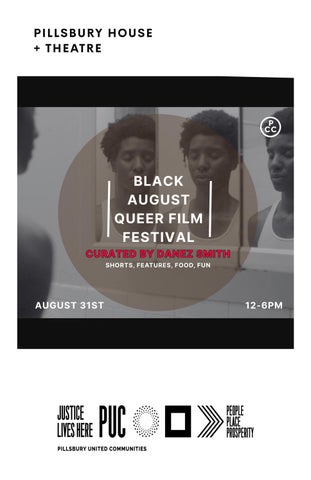
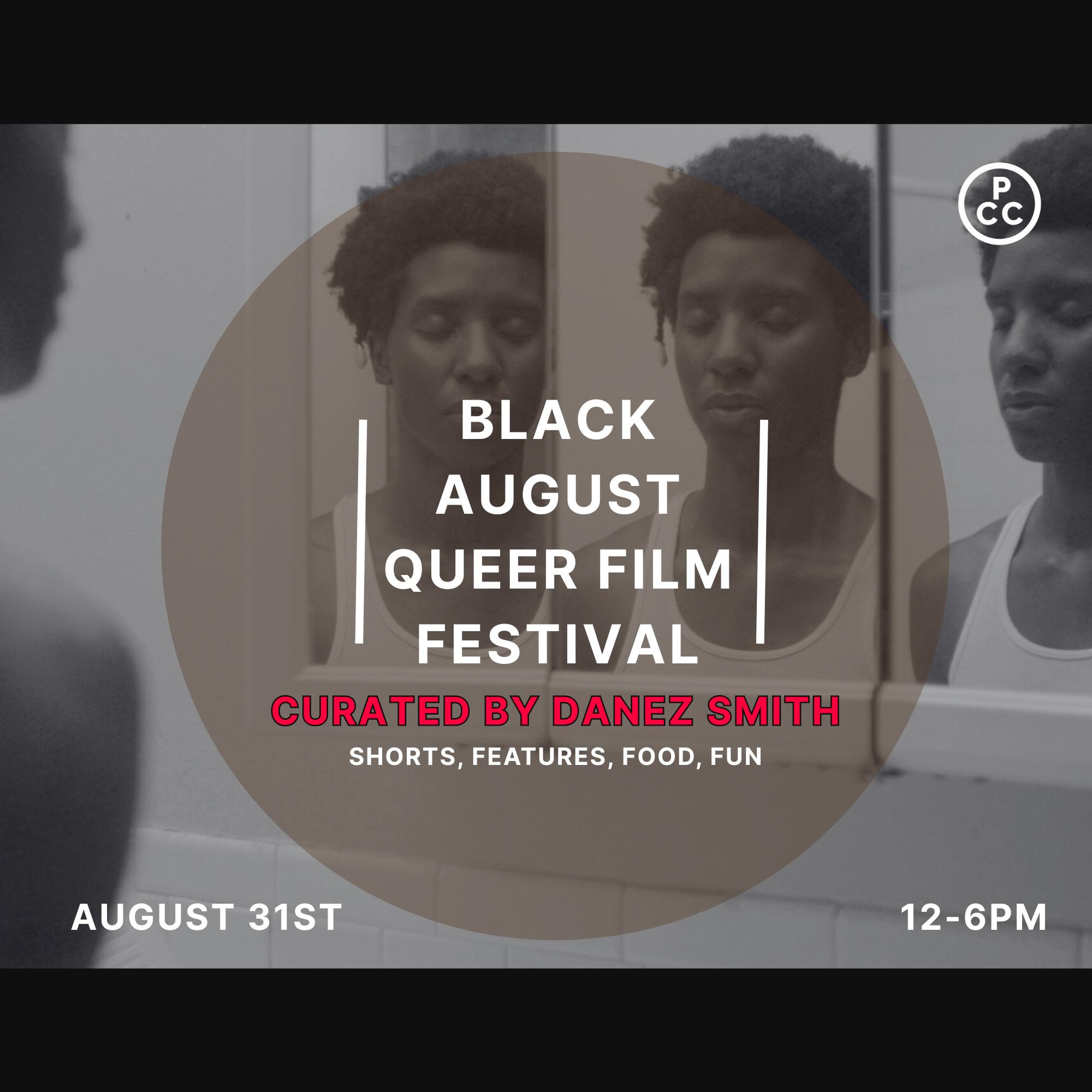
Black August Queer Film Fest
Curated by Danez Smith
August 31st, 2025
THE FILMS
*Love is Like - Ibimina Dominque Thompson
How to Witness a Miracle – Ajanaé Dawkins and Matthew Pitts
*Sweetness of Wild - Free Black Dirt (Erin Sharkey and Junauda Petrus)
*Erotics of Abolition - Junauda Petrus
*All My Niggas Surround me, And I’m Surrounded by All My Niggas - Jai
*Parental Discretion Advised
Curator
Danez Smith
Co-Producer
Tish Jones
Co-Producer
Signe V. Harriday
Production Staff
Rachael C. Rhodes
Production + Project Manager
Claudia Errickson
Technical Director
Sara Abdelaal
Audience Engage-
Partner
Artists/Filmakers
Ajane Dawksins is a poet, conceptual artist and theologian raised between. She works through poetry, visual art, performance, and audio to explore the politics of faith, grief, and intimate relationships between Black women. As a theologian, she blends cultural criticism, memoir, and theology as autotheory to consider the relationship between Black church history, spirituality, and creation. Her work has appeared in Academy of American Poets’ Poem-a-Day, The Rumpus, Prairie Schooner, and more. Her exhibition, No One Teaches Us How To Be Daughters, debuted at Urban Arts Space in 2024. Her chapbook, BLOOD-FLEX, won the New Delta Review prize. Ajanaé is an Elizabeth George Grant Recipient and Writing Freedom Fellow. She was the Taft Museum’s 2022 Duncanson Artist in Residence and Ohio State University’s 2024 UAS Community Artist in Residence. She is a fellow of Torch Literary, The Watering Hole, and Pink Door. She co-hosts the VS Podcast with Brittany Rogers at the Poetry Foundation.
Erin Sharkey is a writer, arts and abolition organizer, cultural worker, and film producer based in Minneapolis. Sharkey edited the anthology, A Darker Wilderness: Black Nature Writing from Soil to Stars, published by Milkweed Editions. She has an MFA in creative writing from Hamline University. She is the producer of film projects, including Sweetness of Wild, an episodic web film project, and Small Business Revolution (Hulu), which explored challenges and opportunities for Black-owned businesses in the Twin Cities in the summer of 2021. Erin teaches at Minneapolis College and with the Minnesota Prison Writing Workshop (MPWW)/ReEntry Lab. She has received fellowships and residencies from the Loft Mentor Series, VONA/Voices, the Givens Foundation, Coffee House Press, the Bell Museum of Natural History, the Jerome Foundation, and the Black Seed Fellowship from Black Visions and the Headwaters Foundation. Sharkey is a steward cooperative member of the Fields at Rootsprings Retreat, a land-based Cooperative stewarding space for the healing and development of Black, Indigenous, and People of Color (BIPOC) artists, activists, healers, and community centering Lesbian, Gay, Bisexual, Trans, and Queer (LGBTQ) folx in Central Minnesota. Black Lives Matter. Trans Lives Matter
Junauda Petrus is an abolitionist, writer, filmmaker, performance artist, runaway witch and soul sweetener of Black Trinidadian and Crucian descent, born on Dakota/Anishinaabe land (Minneapolis). Her work blends poetics, research, play, and ancestral dreaming to envision liberated futures grounded in sweetness, healing, and the sacred.
Her debut novel, The Stars and The Blackness Between Them, earned a Coretta Scott King Honor and was named a Best Book by Kirkus Reviews, YALSA, and the ALA Rainbow List. Her children’s book, Can We Please Give The Police Department to the Grandmothers? (2023), was a Minnesota Book Award Finalist, imagining a world led by grandmotherly wisdom and abolitionist care. Her writing also appears in anthologies like Pleasure Activism and Tasting Light.
She wrote and directed There Are Other Worlds (2015), a poetic circus-play exploring incarceration and Black mother-daughter love, and wrote Impact Theory of Mass Extinction (2022), which followed Black queer teens into a mystical dinosaur portal in South Minneapolis. In 2021, she was the librettist for The Cartography Project at the Kennedy Center, writing about George Floyd and Minneapolis.
Ibimina Dominique Thompson is a multi-hyphenate artist based in the Midwest. She creates work that centers Black transness and looks to remove a fictional veil of Maya created by whiteness on art. They were recently recognized among “Theater workers to watch” by American Theater magazine.
SPECIAL THANKS TO MY FRIENDS, AND FAMILY (CHOSEN AND BLOOD) FOR BRINGING ME THUS FAR.
Previous credits: Guthrie theater (little Prince), artistry theater (Godspell/ 25th annual Putnam county spelling bee), theater latté da (twelve angry men (world premiere)), underdog theater company x mixed blood (how it’s gon be (world premiere)), gremlin theater (samuel j and k), pillsbury House + Theater (close to home (world premiere)).
Film : love is like (North Carolina black film festival, cinè filmu festival, giants exhibit @ MIA, Walker Art Center)
Solo performance : bad Africans a guide to being oshey and bardest in a f*cked up world ( Walker Art Center, Weismann Art Museum)
Jai is a filmmaker, poet, and visual artist. They identify as trans, queer, non-binary and a second generation immigrant from Haiti and Jamaica.Their work doesn’t aim to be original as much as it aims to keep nothing hidden. In unveiling the idiosyncrasies of gender, race, spirituality and love, their work becomes a light for other queer bodies and a mirror that implores any audience to look at themselves in ways that are not always comfortable.
Matthew (Mathias) Pitts Is a Poet, Performer, Filmmaker and Photographer from Columbus who uses humor and myth to fantasize the mundane especially in a black lens. By accessing collective memory using his unique method of storytelling, Mathias is able to form a layer of familiarity to commonly unifying black experiences through poetry, photography and film. Outside of the multiple placements from Today.com, and Poets. org, he has had his photography placed in an exhibit with Urban Arts Space for Portable Paradise as well as over 100 publications both domestically and internationally. His short film work has been in multiple exhibitions such as Vessels in Red as well as in the Galaxy Film Festival.
Black August & Queerness
On September 9th, 1971 - nearly three weeks after the murder of abolitionist and author George Jackson and the resulting food strike - a year after the Marin Country Courthouse Rebellion - the Attica prisoners decided enough was enough. The prisoners rebelled, taking 38 people hostage, including 27 guards and 11 non-guard workers. This uprising is the seed Black August is born from. If June offers us a chance to begin summer with what has grown from the Stonewall Riots, then here we are at the end of summer with another rebellion to hold close,sharpen us, and point our attention toward Black liberation and the Black Power Movement.
In Attica, negotiations broke down when the state wouldn’t meet all of their demands and one of the hostages died. The rebellion ended four days later with the state raiding the prison, killing 33 prisoners and targeting Big Black - a former incarcerated person who was tasked with providing security in the prison yard during the Attica Prison Rebellion. Prison staff brutally tortured Big Black and the others, who were then all relocated to different prisons to minimize potential organizing.
Following the Attica uprising, Miss Major - “a veteran of the infamous Stonewall Riots who spent over fifty years on the front lines of struggles for queer liberation” (Miss Major Speaks) - found herself placed in a men’s prison, “Dannemora” in New York, for playing a “Bonnie” role to a love interest as they robbed stores together. In Dannemora, she met Big Black. Miss Major would refer to him as a mentor, talking about the way he transformed her sense of self and organizing with an intimacy that feels like that of a lover (Miss Major Speaks).
Miss Major and Big Black’s relationship represents the coming together of two traditions of resistance - prisoners rebelling against the state’s inhumane treatment of them and Black trans women leading queer liberation work, providing housing for trans youth and adults in the backdrop of surviving incarceration by the state. Liberation and art are inherently intertwined for any artist who is aware of the socio-political injustices swirling around them everyday, and we would all do good as Black queer artists to center and honor Black incarcerated people in practicing resistance through our art, especially in August. After all, a defining trait of queerness is resistance against a cis-heteronormative status quo that perpetually subjugates us, and what could one call a Black queer artistic practice that lives on an apolitical page, stage, or canvas alienated from the struggles of the communities they love, of the people who made them, anything other than complete surrender?
~Taiwana Shambley, with edits from Tish Jones and Danez Smith
Pillsbury House + Theatre is supported in part by:
This activity is made possible by the voters of Minnesota through a Minnesota State Arts Board Operating Support grant, thanks to a legislative appropriation from the arts and cultural heritage fund.