
![]()


By Jake Gregory Photographer
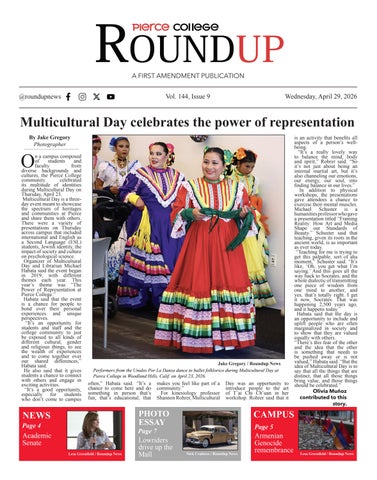
Ona campus composed of students and faculty from diverse backgrounds and cultures, the Pierce College community celebrated its multitude of identities during Multicultural Day on Thursday, April 23.
Multicultural Day is a threeday event meant to showcase the spectrum of heritages and communities at Pierce and share them with others.
There were a variety of presentations on Thursday across campus that included international and English as a Second Language (ESL) students, Jewish identity, the impact of society and culture on psychological science.
Organizer of Multicultural Day and Librarian Michael Habata said the event began in 2019, with different themes each year. This year’s theme was “The Power of Representation at Pierce College.”
Habata said that the event is a chance for people to bond over their personal experiences and unique perspectives.
“It’s an opportunity for students and staff and the college community to just be exposed to all kinds of different cultural, gender and religious things, to see the wealth of experiences and to come together over our shared differences,” Habata said.
He also said that it gives students a chance to connect with others and engage in exciting activities.
“It’s a good opportunity, especially for students who don’t come to campus

often,” Habata said. “It’s a chance to come here and do something in person that’s fun, that’s educational, that

makes you feel like part of a community.”
For kinesiology professor Shannon Rohrer, Multicultural
Day was an opportunity to introduce people to the art of T’ai Chi Ch’uan in her workshop. Rohrer said that it

is an activity that benefits all aspects of a person’s wellbeing.
“It’s a really lovely way to balance the mind, body and spirit,” Rohrer said. “So it’s not just about being an internal martial art, but it’s also channeling our emotions, our energy, our soul, into finding balance in our lives.”
In addition to physical workshops, the presentations gave attendees a chance to exercise their mental muscles.
Michael Schuster is a humanities professor who gave a presentation titled “Framing Reality: How Art and Media Shape our Standards of Beauty.” Schuster said that teaching, given its roots in the ancient world, is as important as ever today.
“Teaching for me is trying to get this palpable, sort of aha moment,” Schuster said. “It’s like, ‘Oh, you get what I’m saying.’ And this goes all the way back to Socrates, and the whole dialectic of transmitting one piece of wisdom from one mind to another, and yes, that’s totally right. I get it now, Socrates. That was happening 2,500 years ago, and it happens today.”
Habata said that the day is an opportunity to include and uplift people who are often marginalized in society and to show that they are valued equally with others.
“There’s this fear of the other and the idea that the other is something that needs to be pushed away or is not valued,” Habata said. “But the idea of Multicultural Day is to say that all the things that are distinct, that all those things
Olivia Muñoz contributed to this story.


6201 Winnetka Ave.
Woodland Hills, CA 91371
Room: Pierce College Village 8211
Website: www.theroundupnews.com
Email: newsroom.roundupnews@gmail.com


Editor-in-Chief..............Daisy Aguinada
Managing Editor.........Abraham Elizalde
Opinion Editor...............Gabriella Carlos
News Editor..................Natalie Baharian
Photo Editor.......................Josue Aguilar
Photo Editor........................Calvin Henry
Photo Assistant.................Alissa Nguyen
Photo Assistant..................Sandra Mazas
Campus Life Editor...........Olivia Muñoz
Entertainment Editor.....Chris Rubinstein
Entertainment Assistant...........Joy Mellk
Sports Editor....................Bryce Edwards
Newsletter Editor................Emily Garcia
Online Editor....................Brianna Fuerte
Social Media Editor........Zamourad Iqbal
Reporters
Anthony Adams
Mia Greer
Gisele Donan
Elizabeth Santana-Zavala
James Mondares
PierceCollege needs to do more emergency drills throughout the semester to ensure that students, faculty and staff are prepared in case of any crisis.
Pierce hasn’t done many emergency drills in the last few years. Last semester, the annual Great Shakeout, an event that ensures safety when an earthquake hits, was listed as an activity yet when the time came, there appeared to be no school wide action.
The Pierce website says that “faculty, staff, and students are encouraged to participate in the Great Shakeout earthquake drill,” but this shouldn’t be a matter where people are encouraged but rather mandated.
California lives on the San Andreas Fault, a 800mile tectonic plate system, which causes earthquakes to happen frequently.
Photographers
Nick Crabtree
Lesa Greenfield
Jake Gregory
Javier Ramirez
Advisers
Jill Connelly
Jeff Favre
Tracie Savage
Seam McDonald
Morgan Keith
Corrections? Email us at newsroom. roundupnews@gmail.com For advertising, call: (818)710-2960
Scan the QR code below to subscribe to our weekly newsletter

According to the California Residential Mitigation Program, CRMP, California experiences an earthquake every three minutes and Southern California alone experiences 10,000 earthquakes per year.
While most of these earthquakes are too small to notice, there are earthquakes that have caused significant damage, such as the Northridge earthquake in 1944, killing 57 people, injuring 9,000 and causing $40 billion in damages, according to CRMP.
It is important to continuously practice safety drills pertaining to earthquakes, such as the Great Shakeout, at least twice a semester, the Great Shakeout. It keeps everyone aware of what to do if an earthquake ever hits campus, especially because Pierce is located on an active fault line.
Pierce should also practice fire drills more often. At least twice a semester, the campus should do an all-day fire drill practice, where instructors and students leave their classrooms when the fire alarm goes off and head to their designated spots while they wait for the “all clear.”
While the campus has a lot of open space, there are still some places, such as the library or Welcome Center, that will benefit from students, staff and faculty knowing how to evacuate the building in a safe but quick manner.
Finally, the campus would benefit greatly from doing an active shooter drill at least once a semester.
In 2025, Cerritos College held an active shooter drill that partnered with local law enforcement, fire departments and emergency medical services.
The drill was “designed
to improve the college’s emergency preparedness and response systems, ensuring the safety of all students, faculty, staff, and community members.” There were sirens and emergency vehicles with emergency response teams throughout campus, and law enforcement conducted mock evacuations and staged rescue operations. Pierce should adopt this drill and make it a permanent occurrence on campus. Anything can happen, and students, faculty and staff need to be safe if this danger ever occurs..
The safety and wellbeing of students, staff and faculty is one of Pierce’s top priorities. But to achieve this, emergency drills need to happen more often. Without it, the people at Pierce are left wondering what to do if any of these situations were to happen.

ThePierce College men’s tennis team celebrates another successful season in this 1987 issue of the Roundup. Headlined “Tennis: Conference winners again,” the article highlights the team’s dominance, key players and continued conference success. The team completed the season undefeated at 16-0 and won the Western State Conference championship.
Featured photos show athletes in action during matches, reflecting the program’s competitive strength at the time. The coverage emphasizes both individual performances and the team’s overall achievement as repeat conference champions.
Copy by Daisy Aguinada

PRO: Artists’ actions should not be attached to the music they create
By Gabriella Carlos Opinion Editor
Artshould not be sacrificed because of a person’s mistakes. It is possible to appreciate the art while still condemning an artist’s actions. The ethical dilemma of whether to support an artist’s creations because of their actions has led many people to boycott many musicians’ discographies.
Instead of believing that it is impossible to separate moral values from an artist, it’s best to remember that the art is not equivalent to the artist.
For example, Michael Jackson has remained a household name since before and after the controversies of child abuse and grooming, but his music is still being streamed. According to Medium, “But with Michael Jackson, we did something else: we pressed pause. We didn’t defend him. We didn’t fully destroy him. We just moved him out of the frame. Quietly. We stopped talking about him in certain circles — but we never stopped listening. Why? Because his work is too powerful.”
CON: While art is self-expression, creators should be held accountable
By Mia Greer Reporter

Anmessages with their work is a conscious decision to protect audiences and uphold ethical standards.
artists’ work will always reflect the tiniest bit of the artist. Artists’ cannot avoid putting a piece of themselves into their creation, as every work of art is unique for that reason. Art is a reflection of the artist’s values, choices and worldview. When those values are harmful, consuming that artists work risks normalizing and rewarding that harm.

Pablo Picasso, one of the most influential artists of the 20th century, has had controversy surrounding his romantic relationships, such as emotional abuse, predatory behavior and misogyny. According to Artists, Arts, Artwork, “This perspective allows individuals to acknowledge Picasso’s monumental contributions to art history— such as pioneering Cubism and influencing countless artists—without condoning or endorsing his personal behaviour.”
Art is not temporary and will last beyond the artist. With the advancements of social media and “cancel culture,” many people online will decide that the smallest mistakes are controversial. People can and will make mistakes, but making mistakes should not put the art at fault.
The key difference is condemning the actions, not the music or art itself. Once art is released into society, it changes along with the culture of the time. In Roland Barthes’ “Death of the Author,” he said, “The reader has never been the concern of classical criticism; for it, there is no other man in literature but the one who writes.”
Oncesomething is published in society, it is beyond the author or artist’s work to decide how it is interpreted or what the meaning is. Shifts in societal values can create new meanings that are always changing, regardless of the creator, their flaws and intended meaning. Consuming and judging it goes beyond the value of the artist themselves, only focusing on the work, not the person as the subject matter. Critiquing a piece of work is not the same as criticizing its creator. Recognizing that terrible people can be talented, but also being conscious of their actions and calling them out, is critical to consume media. If we were to boycott every piece of media based on the mistakes artists made, it would be impossible to enjoy any form of art.
Art is self-expression. Every lyric, stroke or scene is from the perspective of its creators. As DailyArt Magazine points out, “Great art pushes boundaries. But how should we react to works by controversial artists with a history of abuse, racism, or misogyny?” If the boundaries being pushed are rooted in prejudice or exploitation, then the art itself becomes an outlet for those ideas.
Continuing to support these specific artists, through ticket sales, streaming or any purchase, does more than just separate the art from the artist. It upholds their platform and influence that they have on people. In a piece from The Forum, it is brought up that if there is a sense of negativity when you think about someone, their vision or the things they do, is that someone you want to be supporting? Every dollar spent on their work can help them maintain relevance and maintain their agendas relevance.
Some may argue that separating art from the artist allows us to preserve cultural treasures despite the artist’s personal flaws. But this argument ignores the fact that living artists benefit directly from our consumption of their work. Supporting them financially or socially sends a message that their actions do not matter as long as their work keeps us entertained. That is not neutrality, it is complicity.
Even with historical figures, we should be honest with ourselves about the harm they caused and the ways their beliefs shaped their work.

Consuming their art without acknowledging its origins risks rewriting our history in a way that erases victims and excuses abuse.
Do you think we should seperate the art from the artist? Why or why not?

“I think that they should be separated because even though some people may say or do things that I definitely don’t agree with, I can still appreciate the art that they’ve put into the world.”
EthanHashem-BiologyMajor

“I feel like you should separate it because it’s just music. It’s not like the music did anything bad.”
DamienOliva-Undeclaredmajor
Hyperallergic reports that the Pérez Art Museum in Miami suspended art exhibitions about inequities Black and Brown people face in society by American painter Kehinde Wiley due to accusations of sexual assault against the artist. This is not censorship, but it is accountability. Choosing not to give a platform to individuals directly or indirectly spreading harmful
We can either consume art with full awareness of the person behind it or we can pretend that art exists in a moral vacuum. But pretending comes at a cost, a cost paid by those harmed by the people we praise. If art is truly a reflection of the artist, then to embrace the art is, in some way, to embrace the artist. Our choices as consumers are not just aesthetic or for our simple enjoyment, there are ethics behind them.

““I think the person who made the art should be separated from it because I just see it as its own and it doesn’t have to be associated with the person who made it.”
JustinaWassef-NursingMajor
By Elizabeth-Santana Zavala Reporter
PierceCollege President Ara Aguiar discussed possible strategies for addressing the college deficit during the Academic Senate meeting on Monday, April 27, in Building 600.
The Los Angeles Community College District (LACCD) budget committee reported that four colleges, including Pierce, were in a deficit at the end of March. The district is facing an estimated $5.6 million deficit.
Pierce has made strides in reducing the gap but remains approximately $5.1 million in the red.
Aguiar said that although the college is receiving funding, it is not generating enough revenue to close the gap.
“We have a base of $500,000 that goes to every college across the district, and then the rest of the money comes based on performance,”
Aguiar said. “The gap is in the performance level, and that is completely under our control.
There’s no other question that it is on us.”
Aguiar highlighted approaches other colleges have taken to improve their financial standing. Valley College, for example, expanded its dual enrollment and non-credit classes. She said Pierce still needs to determine what exactly can be done, but she believes that adopting Valley’s strategy may be part of the solution.
Traditionally, colleges received more funding for credit courses than noncredit, but that has changed.
Curriculum Committee Chair
Phyllis Braxton explained that relatively recent changes to the state’s funding formula have made the two categories nearly equal.
“Non-credit programs help students transition into either the workforce, like short-term vocational programs, or they get the skills that they need to go into a job,” Braxton said. “So the state is really trying to get the colleges to support programs that help students get jobs. And the real benefit to students with non-credit courses is that it’s free, it doesn’t cost anything for the student.”
Aguiar added that dual enrollment is the only area where Pierce has seen growth, while credit classes have remained stagnant. Braxton said new programs such as the DJ Fundamentals Certificate could bring the numbers up. Which can later become a pathway to transition noncredit students into degree programs.
“We’re a big transfer institution, so that’s where we’ve really focused,” Braxton said. “So this idea that we’re gonna transition now and really focus on what we can do for the community, that’s like free classes, where you can get a skill and you can get a job. We think that that would be very valuable to the community, and so that’s what we’re trying to work on.”
Aguiar also provided a brief update on the college’s procurement audit, stating that the results and an afteraction plan will be shared at a later date.
In other senate business, ASO President Emma Ortega announced that voting has opened for Pierce’s 20262027 student government and the LACCD Student Trustee. The voting period runs from

Greenfield / Roundup News President Ara Aguiar speaks at Academic Senate at Pierce College on Monday, April 27, 2026, in Woodland Hills, Calif.
Monday, April 27, to Sunday, May 3. Students enrolled in credit or noncredit classes this spring semester can vote
through the student portal. The next Academic Senate meeting will be held Monday, May 11, in Building 600.
By Gisele Donan Reporter
East and West building construction is on schedule to complete by late 2026, and a major financial expectation from the board were some of the matters discussed during the Pierce College Council (PCC) meeting on Thursday, April 23.
Senior Lead Deputy Isaac Jorge started the meeting with an introduction to Deputy Butler as the new daytime sheriff on campus and discussed the issue of lost and stolen property.
“We can’t write a report that ‘some stuff is stolen,’” Jorge said. “It can’t be generalized. It has to be reported as soon as possible. We’ve gotten a report up to three, four years later and we want to help, but it’s impossible for us to do our job years later.”
Construction for the Academic East and West building is to be completed by September, with the
building being open for faculty to occupy by January winter semester. Construction
Manager Soufiane Boudiaf provides more updates on the two buildings as well as the ITB building.
“Students are not going to move in until spring of February 2027,” Boudiaf said. “This applies to both East and West. Now for the UTB building that one is about two semesters behind so we’re looking into occupying Industrial Technology in the fall 2027.”
Los Angeles Pierce College President Aracely Aguiar gave her report on Pierce’s financial citation regarding a short-fall of $6 million and the board and chancellor’s expectation to close out the year with a zero balance. “We need to be really strict, which puts a tremendous burden on all of the individuals that are over these particular cost centers,” Aguiar said. “We have a tendency to carry funds over into the next year, I want to save that couple $100,0oo,
because what’s coming up is the fact that we’re in the negative.”
Vice President of Administrative Services Rolf Schleicher added onto the discussion with the budget committee regarding the strict budget constraints and what it means for the college.
“Theres a lot built up at the district, but we’re going to have to run very efficient,” Schleicher said. “All the presidents are looking at how to increase class sizes that’s reasonable to generate the revenue we need to have while also looking at all the expenditures that are within the college.”
Associate Student Organization (ASO) President Emma Ortega reported on events such as the candidate form for the LACCD student trustee and the local elections for the ASO’s executive board.
The Sustainability committee highlighted the recent Earth Day event where architecture professor Patricio Gallegos led the
action to plant a new tree over a new one with about 2o student volunteers.
Concluding it as small but still be very impactful for students and faculty.
Dean of Student Services
Will Marmolejo discussed enrollment management focusing on summer program updates and completion strategies such as implementing an additional English course and offering more transitional classes.
Marmolejo also congratulated Pierce for 7,400 awards awarded from 2024-2025.
“Pierce is number one in the state for the CPL Award,” Marmolejo said.
“We’re doing a really good job of recording our awards so that’s really good news.”
The next PCC meeting will be on Thursday, May 28, and is accessible on Zoom.
Applied technology reported theft of $950 of tools and equipment over a four month period, from November 2025 to Feburary 2026.
Applied technology reported theft of more than $950 of equipment during a period of November 2025, through Feburay 2026.
crime log is made
By Daisy Aguinada Editor-in-chief
College hosted its annual “Day of Politics” on Monday, April 27, at the Great Hall, bringing together candidates, student organizers and faculty in an effort to encourage civic engagement ahead of upcoming elections.
The event featured forums for Los Angeles City Council District 3, California’s 32nd Congressional District and other regional races. Student clubs such as the Pierce College Democrats and PreLaw Society participated alongside voter registration efforts.
Students registered voters outside the venue, while organizations and campaign teams held tabling throughout the event. The program also included a “Dance for Democracy” segment featuring food and music.
During the second forum, candidates for California’s 32nd Congressional District discussed immigration, housing, affordability, health care, climate change and education.
Denise Robb, a science professor and adviser to the Pierce College Democrats,
said the event is designed to ensure students hear directly from candidates rather than relying on advertisements or mailers.
“The goal is always to inform the students about who’s running for office and what they stand for so they can be informed, which is important in a democracy,”
Robb said.
She added that youth engagement remains a concern in elections.
“Young people are proportionally much less engaged, and we want to make sure our community understands that politics is very important,” she said.
Robb noted that Pierce serves as a voting center during elections in Building 600.
Barri Worth Garvin spoke during the first forum, where three Los Angeles City Council District 3 candidates discussed their policies, economic developments and bringing more revenue to the entertainment industry.
Garvin said her campaign is centered on three main priorities, addressing the housing crisis, revitalizing the local economy and improving government accountability.
“People are tired of corruption in government,”
she said. “I will lead with integrity, be transparent and focus on delivering those core city services.”
When asked about issues affecting students, Garvin pointed to affordability and transportation, saying rising housing costs make it difficult for students to live independently.
“As a student, I remember what it was like to live in my parents’ house once I couldn’t afford to move out. That was 20 years ago and now I think it’s just even more critical that we have affordable housing and affordable work here,” she said.
Adam Miller, a Los Angeles mayoral candidate, said his administration would focus on preparing students and young people for future job markets by reshaping workforce programs and internships.
“We have to be thinking about the employment opportunities for the future. We shouldn’t keep training people for jobs in the past. We got to be training for jobs in the future,” Miller said.
Miller also said he would incorporate young people into advisory roles and city decision-making processes to better represent Gen Z needs.
John de la Cueva, treasurer of the Pierce Democrats and

The panelists at “Day of Politics” in the Great
in Woodland Hills, Calif., on April 27, 2026.
one of the event organizers, said the goal of the program is to connect students with candidates and increase political participation.
He said the event is designed to help students understand local representation and how the government affects their communities.
“Younger people are much less engaged, and we want to make sure our community understands that politics is very important,” de la Cueva said.
“I hope people walk away
at Pierce
with a better understanding of how our systems and governments work,” he said. “I also hope that if they aren’t registered, they register, and that they have a sense of hope, that they understand that their voice matters, that politics isn’t just for the people who are in power. It’s for everybody who can contribute to power.” Election Day in California is June 2.
By Anthony Adams Reporter
ArmenianStudent Association (ASA) hosted an Armenian Genocide Commemoration on Tuesday, April 21, at the Multicultural Center at Pierce College. The event remembers and educates students about the genocide that took place on April 24, 1915.
The Armenian Genocide Commemoration is about spreading awareness about genocide and helping prevent future genocides. The event honors the victims and showcases the resilience of the Armenian community.
Director of the Student Health Center Houry Tanashian is a secondgeneration Armenian who spoke during the event.
“It was ethnic cleansing,” Tanashian said. “The Ottoman Empire, which is no longer, fell in 1920. Around the area, they did ethnic cleansing of all the Christians, including

Lesa Greenfield/ Roundup News
(L to R) Pierce College neuroscience major/Armenian Student Association vice president Inga Kazaryan, business administration major/ Armenian Student Association president Ellen Meroyan and political science major/ASO representative Armen Apoyan during a moment of silence at the Armenian Genocide Commemoration event at Pierce College on Tuesday, April 21, 2026 in Woodland Hills, Calif.
Armenians, Greek people and Syrians in that area.”
ASA President Ellen Meroyan said that the event
is a reminder for future generations to understand how far they have come as a community.
“We try to recognize the genocide that occurred in 1915 every year,” Meroyan said. “However, we want to be known for more than that, and that we’re continuing to prosper and all as a community.”
Coordinator of the Multicultural Center Tatevik Melkuyan shared why it was important to facilitate the Armenian Genocide Commemoration.
“We do a lot of events for our students on campus,” Melkumyan said. “ It’s really important that we do events that speak to the diverse group of students that we have on campus. So, we always like to plan things that kind of make all the students feel included and welcome to the campus.”
ASA adviser Garineh Avakian said that it was important to have representation of the Armenian community on campus.
“I’ve made it of myself to represent the Armenian
student population at Pierce. And to spread awareness about our culture, about our history, about our rituals, about our traditions, because it’s important to pass down, it’s important to share it with other cultures.”
Environmental science student Sako Ourfalian said that it was important for him to be in attendance to keep his culture alive.
“And so people outside of our culture remember and learn about the army and genocide, something that happened 100 years ago, but it’s important still today,” Ourfalian said.
Tanashian said that she feels grateful for the fact that the Armenian community has been able to thrive throughout the world.
“We are very grateful for the countries that took us in,” Tanashian said. “We are so grateful we had this opportunity. Syria, Middle Eastern countries, the United States and the French. Basically, you find Armenians all around the globe.”
New Michael Jackson biopic delivers a good-time musically but fails
By James Mondares
Reporter anything of real substance besides that.
Thereis little denying that Michael Jackson’s music is great. From the minute the film starts, you’re already dancing in your seat.
Antoine Fuqua’s biographical picture of the King of Pop, “Michael” , recently released in theaters on April 24, 2026.
“Michael” stars real-life nephew of Michael Jackson, Jaafar Jackson, as well as Colman Domingo, who plays Joseph Jackson, Michael’s father. It’s notable that most of the Jackson family was heavily involved in the production of this film— hence why it fails to say anything remotely negative about Michael Jackson.
The story of “Michael” follows Michael Jackson and his journey to stardom— starting from his early childhood days with The Jackson 5, all the way to the peak of his fame with his release of “Thriller” and the Victory tour.
While the musical elements of the film are undoubtedly catchy and well-done, the film does little to provide
Firstly, Jaafar Jackson does a particularly great job portraying his uncle Michael. Jaafar’s dancing is on point and his overall performance is astute and certainly a highlight of the film. Young actor Juliano Valdi also delivers a great performance as young Michael. Additionally, Colman Domingo knocks it out of the park in his role as Michael’s father, Joseph. These three performances were considerably the best, and the difference is stark considering that the rest of Michael’s family was shown as no more than just witnesses to Joseph’s abuse toward Michael.
Where the music and few acting performances shine, the rest of the film crumbles. It feels like half of the movie is a concert film and half of the scenes take place on stage. There are segments of the film where the entirety of a song is played. This wouldn’t be a problem if the rest of the scenes that weren’t performance-heavy were also to the same caliber of quality as these.
In this film, Michael is already fully-formed and fully
realized. We hardly see any of his artistic struggles (outside of his antagonist father who’s overtly possessive and constricting). He just pops out perfect songs like candy. The struggles that Michael faces are downplayed. The third degree burns he got from the Pepsi commercial are treated as merely stepping stones for Michael to “shine his light.” The movie fails to mention the addiction to painkillers that grew from this. and his experience of racism from labels is resolved in one simple phone call. Being a little more than two hours, the film can also feel like it drags. The film’s skeleton is relatively simple to follow—life events, some personal struggle and boom, performance. The only thing keeping this movie from being a snooze is the music.
The Michael that is shown in this film conforms to what his father wanted him to be—a poster child for his family and globally famous. For some, simply seeing Michael perform and hearing his music is enough, but past that, there isn’t a lot to drive us off the wall.

By Emily Garcia Newsletter Editor
Pierce College celebrated Multicultural Day with a Q&A and screening of “Compensation” on April 21. Members who attended the screening viewed a range of storylines, from love and heartbreak to portrayals of the complexity of deaf culture in African-Americans relationships.
As part of the Multicultural three-day event, the Diversity Committee, Pierce Multicultural Center, Guided Pathways, Career Center and Associated Student Organization (ASO) organized a variety of showcases that represented inclusivity in gender, culture and social diversity. The screening was also presented by Media Arts professor Nora Sweeney, Modern Languages professor Kristine Hall and the ASL program.
“Compensation,” directed by Zeinabu Irene Davis, follows two storylines set in different time periods, the 1900s and 1990s, which are played by the same set of actors but different characters. The 1900s characters, Malindy and Arthur, come from different backgrounds but despite differences fall in love to then be separated by the illness of tuberculosis. Malaika and Nico find each other in the same city in the 1990s during the rise of HIV and AIDS. Both Malaika and Malindy are deaf African-American women guiding Nico and Arthur into their world while overcoming obstacles such as structural racism and emerging health outbreaks.
Hall, whose remarks were interpreted into ASL, said the film’s presentation of inclusivity of the deaf community was beautifully done.
“It was nice to show how Pierce College is able to connect
with different departments here and bring us together,”
Hall said. “I think the film is a really good example of cultural representation, having everything including both the past and the present, deaf, visual language, culture, history, and music. It was just beautifully done all around.”
History professor and panelist Christopher Strickland said the historical aspects found in the film such as the dynamics in class differences between the 1900s characters created a resistance.
“In regards to intersectionality of gender and race, we can add class to that as well,” Strickland said. “Her [Malindy] mother tells her not to get with a country man. When we juxtapose that, put it side by side with the later characters in the late 1990s we see that there’s also this reversion to not date someone who is not part of their deaf community. There’s a lot of meta within this movie.
There’s so many dynamics that’s a part of this movie here.”
Hall discussed the differences in Black ASL and ASL. Hall shared her mothers experience teaching at a public boarding school for deaf students where the teachers were raffled to different programs for students of color during the segregation period. Hall’s mother volunteered herself to work with the students of color because the other teachers did not want to. Hall’s mother said the students were confused on why they were separated from the white students because they weren’t taught about social regulations.
Hall said it was heart breaking to think about the segregation among deaf students at the time and her mothers first hand experience with it. “Those specific students being segregated would later develop Black ASL as a means of being socialized separately,” Hall said. “Being
in a community with the other students and through time and connecting and using the language is how we get the variety Black ASL through segregation when integration takes place.”
Biotechnology major Larae Jorgoo said the film was personally impactful for her because she related to the characters.
“This movie moved me very much as a disabled AfricanAmerican woman,” Jorgoo said. “The conversation encapsulated the feeling of being drained by inviting someone into your world who was overwhelmed by the disparities, even though you gained a connection, the connection still feels lost within the hierarchy.”


Culture has always been an integral part of Los Angeles and Mexican American culture. Originating in Southern California during the 1940s-50s, centered on customizing cars to drive “low and slow” as an expression of cultural pride, art, and resistance. Being a culture based on community, family, unique and intricate craftsmanship, often, all gather at car shows to share stories, representing their culture, and showcase their builds with one another. This week, the Pierce Automotive Program hosted the Low Rider Showdown event on-campus from 10:30 AM to 1:30 PM on Thursday, April 23, 2026. Celebrating LAPC Multicultural Day, we got to watch a history presentation and slide show to learn more about lowrider history and culture. There was food and snacks to eat and enjoy while you walked around, and gathered together around the many cars lining up for the showcase. Allowing students to appreciate the artistry shown in the many cars and bringing students together as a community, to learn and appreciate lowrider history and culture.
Pierce


