Corrections? Email us at newsroom. roundupnews@gmail.com
Scan the QR code below to subscribe to our weekly newsletter
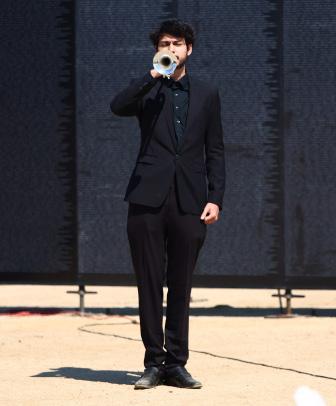
On the cover: U.S. Marine Corps Guard presents in the beginning of the Closing Ceremony at Pierce College in Woodland Hills, Calif. on March 22, 2026. Photo by Jake Gregory.
Lessthan 50% of college students meet physical activity guidelines, according to the National Library of Medicine (NLM).
The Obesity Medicine Association also reports that “44% of college students in the United States described their weight as more than normal,” falling into the overweight or obese categories.
College students face a greater number of stressors, including academic, personal and work pressures that adversely affect their health.
One way to combat this and promote exercise is by requiring students to take a physical activity class as a part of their mandatory curriculum.
Top colleges such as Columbia University, Massachusetts Institute of Technology (MIT) and Cornell University all have physical education requirements for students to graduate. These requirements can range in terms of how many hours a week students are expected to put in for each class, but the overall need for an activity
Laptops harm student’s ability to retain information Editorial: From
By Gisele Donan Reporter
Some Pierce college students ditch tradition and use laptops as a primary way to go about school. Although electronics provide fast and easy ways to study, such as textbooks being stored in an ipad, or digital typing when taking down notes, it can significantly reduce the way students are able to keep information. Attention spans are in danger as well. Electronics carry an endless amount of entertainment and distraction that can easily sway a student’s eyes from the classroom.
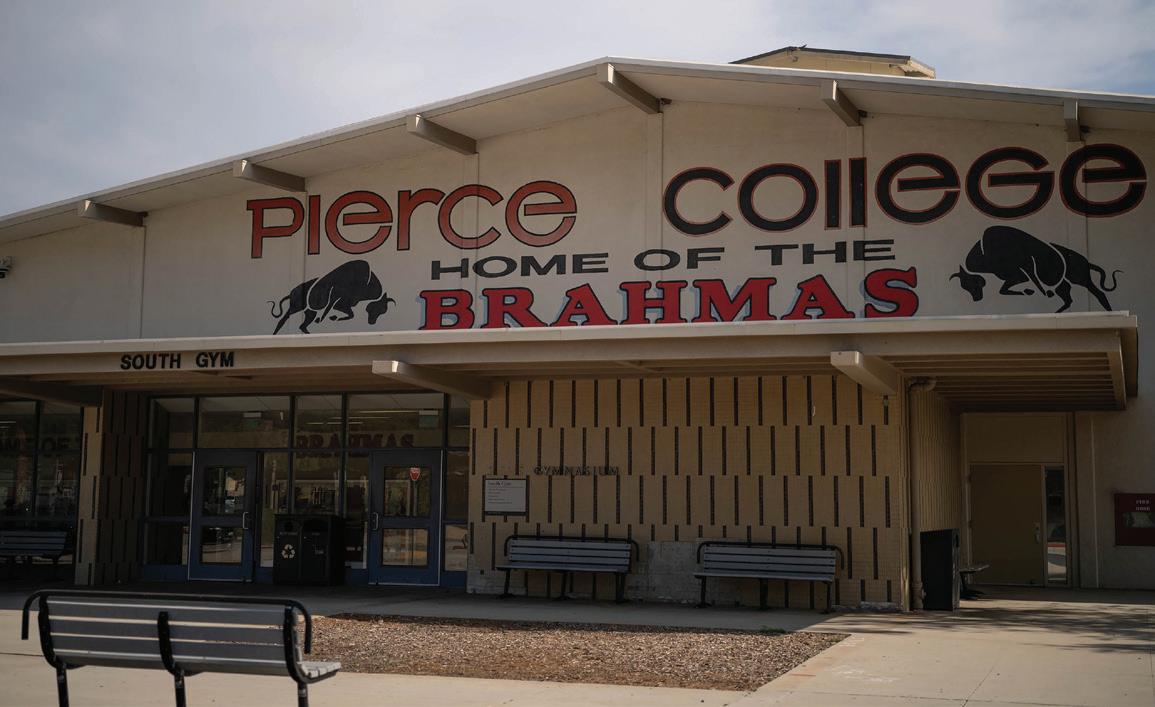
Outside of the South Gym at Pierce College in Woodland Hills, Calif., on March 24, 2026.
remains the same. Even with rigorous coursework, these institutions understand the need for students to engage in exercise.
Requiring physical activity allows students an outlet to move and to release builtup tension they may have accumulated from school, a job or other obligations.
An article from Harvard medical School links aerobic exercise to overall better mental and physical health, and a study done by the NLM
The endless amount of tabs and games can easily trick the students mind into what’s important during class time. Traditional notetaking like using pen or pencil or physically reading books can benefit students’ approach to the classroom and build good neurological habits.
According to The National Library Of Medicine, “Writing involves producing unique shapes that require individual attention and creativity, reflecting the gradual development of symbolic communication over millennia, while typing relies on pressing predefined keys, abstracting the act of communication from the shape of symbols, which reduces the cognitive load of creating unique forms.” Using handwriting as a core tool, students exercise a part of the brain that is able to refine handwriting skills and connect to functions that otherwise are dormant when pressing keys on a laptop. Professors and students talk and write at different speeds, which can make
found a significant correlation between consistently working out and lowered stress.
Structured exercise can help students who may be worrying about assignments or dealing with personal issues work through these problems and improve their well-being.
Students can avoid paying extra cost for a gym membership with a required class, saving them money and making it more convenient. Gym memberships can range in price, but the average cost
students fall behind when notetaking, but should speed be prioritized over thorough learning? Electronics not only encourage the ability to speed through notetaking but also has a talk-to-text feature, which allows students to turn off their active listening and let the feature do all the work.
While studies are still understanding the impact of text-to-speech bots, there is risk in using it for school.
According to Emerald, “Without such insight, there is a risk that these technologies, while well-intentioned, may fail to stimulate meaningful engagement, ultimately undermining their value.”
Schools are hesitant in implementing the bots, not only because of the lack of research, but the taboo nature of having AI in close proximity to students and their learning.
Reading has also come a long way in terms of technology. Students don’t need to stuff textbooks in their bag and haul it around as it can all be stored in a mini screen. Electronic reading can
per month for one is between $40 and $70, according to GoodRx.
This adds up over time for students who are struggling to support themselves already, paying off loans, bills, rent and other basic needs. The class would be on campus, so students wouldn’t have to travel and spend time or money.
A required physical activity course can help students stay connected to each other and build a support system.
A study done by the NLM found that group exercise can lead to improved social bonding and physical performance. Another study done by the NLM concluded that loneliness is higher in college students due to a variety of social, academic and personal pressures in their lives.
Having a dedicated time to work out with other students and forge these friendships can benefit students who may be feeling isolated and improve their mental health. Mandatory physical activity classes would be a benefit to students, not only for their bodies and physical needs, but also for their minds and emotional needs.
alleviate a students’ backpack as well as their wallet, but is it worth sacrificing the small ways a student can study better through a physical book?
According to Eastern Washington University, “When students have time limits to read a passage, screen reading suffers. Studies show that readers tend to overestimate their ability to read material on a screen. Often, they think they understand it more than they do, and this overconfidence could have consequences in testing situations.” Screens can provide the illusion of being helpful and built for your academic succession which can make a student be far too reliant on its tools as well as understanding important topics.
It’s good to be able to embrace the digital era and all of the ways it can progress us as a society. To shun away the future would be regressive, but to understand and put in practice the reason why traditional ways of writing or reading has lasted as long as it has is just as important.
Josue Aguilar/ Roundup News
Column: When war abroad hits close to home, fear grows
By Natalie Baharian News Editor
Formany of us, certain fears aren’t realized until we ourselves face it. There’s a difference between seeing something on a screen and actually living it.
The very concept of war in the United States is nothing new, but something that has been desensitized in our media.
While in class or work, we scroll through hundreds of headlines about conflicts overseas and casualties. We disassociate ourselves because we are not directly involved. But with the emerging war with Iran, it is becoming much more difficult to ignore it.
In my case, it now involves checking in with loved ones overseas and hoping for weekly updates to make sure your family is safe and healthy. Calls that go unanswered and long periods of unresponsive behavior is now my reality. Headlines have exceeded more than just news, but updates on the current circumstances of loved ones and ethnic origins.
The current war with Iran isn’t a singular conflict, but one that has become multi-
dimensional, indirectly involving many other countries, and many innocent people that have no choice but to endure chaos and war.
Places such as Armenia, Iran and Lebanon are nor just countries in tumultuous times, but a home to my parents and extended family. The challenge is not the confusion or even the suspense. It’s the feeling of being stagnant in everything that’s happening. Not being able to do anything or feeling like saying something will do very little.
With the recent violence inflicted on Lebanon by Israel on March 2, a country neighboring a conflict is now immersed into one and has no choice other than protecting itself.
This decision did not just put the U.S. at risk, but also the lives of innocent people. Families have already begun to flee to Syria, Armenia and Turkey from Lebanon and Iran, causing a chaotic housing issue.
As the situation intensifies with no sign of anything calming down, civilians are the ones who pay the price such as my father’s family, currently stuck in Beirut due to limited opportunities to flee and travel north.
Entire communities with thousands of years of history are being destroyed, families being separated, and children dying as casualties of war.
A war that none of us really asked for or even expected.
Being a college student, I may view it very differently compared to those of the older generations. But, outside of my family ties, I feel torn between focusing on an education and furthering myself in school while wanting to voice my thoughts. I would ask myself often, what would speaking up do for this situation? Especially if it’s just me. With anything revolving around politics, younger generations are encouraged to speak up and share their thoughts.
But, if we think about it, are older generations actually willing to listen? Would it matter if we collectively argued against a war that puts the U.S. in an extremely vulnerable position and poses a major security risk for practically every country in the Middle East?
It’s as if we must inherit the decisions of the current government and the legacy they leave behind without being included in the conversation. And for those of us with personal ties to the
region, we feel even more ignored and disregarded.
Removing the international politics of the circumstances, this is about families and every-day people being targeted and weaponized for a war meant for profit and increasing power of selective government and the toppling of others.
In this moment, we may be conflicted and confused, but it’s also the time to become more aware and educated, because we may have to endure the hand we were dealt with, and we must do that with care and the consideration of everyone, not the few.
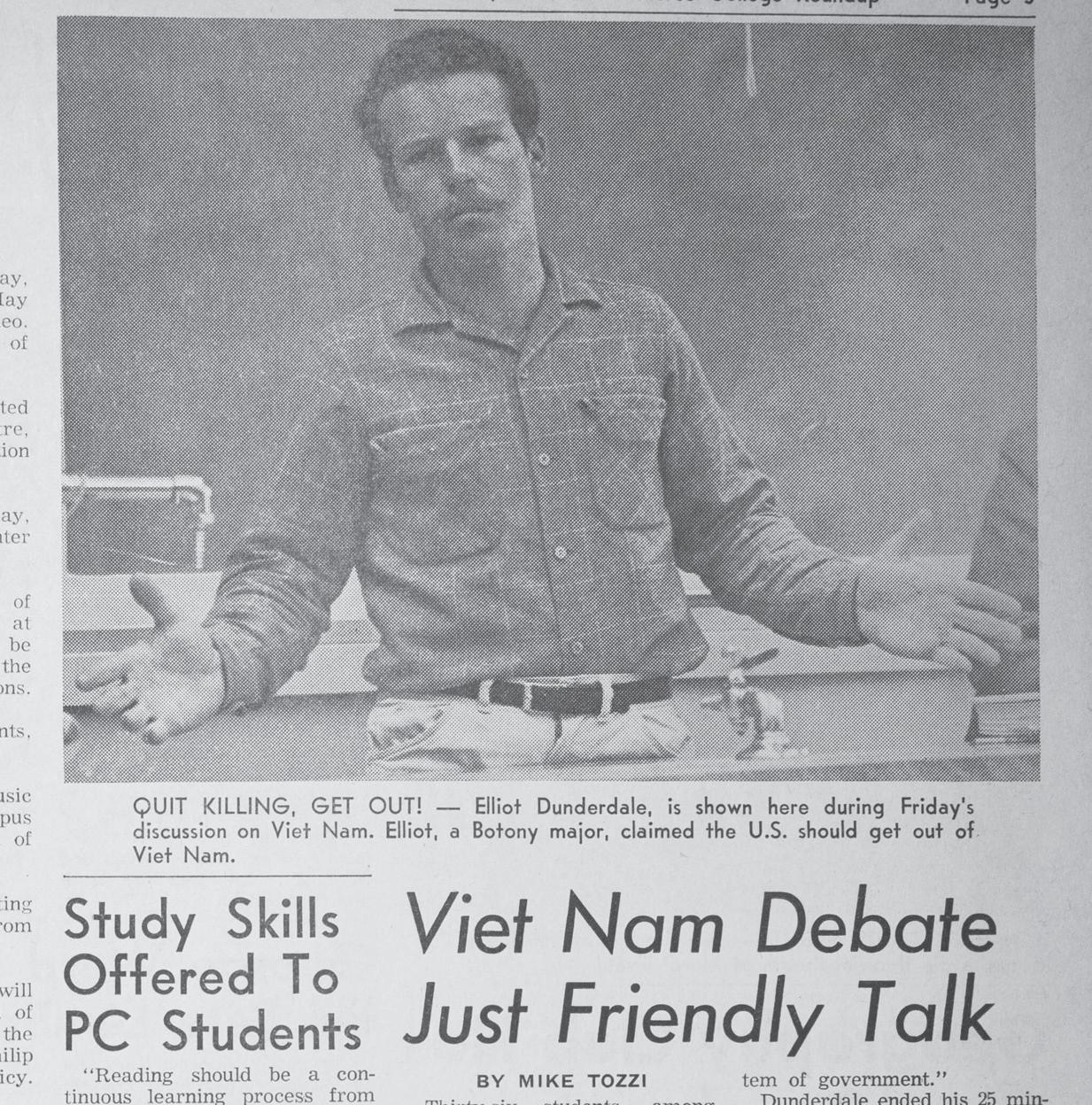
On March 25, 1966, the Pierce College Roundup reported on a campus event titled “Vietnam Debate Just Friendly Talk,” where Elliot Dunderdale and Mark Mikaljevich spoke to 36 students in a Business Education classroom about U.S. involvement in the Vietnam War. The event was originally planned as a formal debate, but the speakers agreed to turn it into a “teach-in” to focus on informing students.
Dunderdale represented students who supported the withdrawal of U.S. troops from Vietnam, describing a “get out first, negotiate later” approach. He read from “The Making of a Quagmire” by David Halberstam and criticized the destruction caused by the war, including harm to people, plants and animals. He also questioned the moral difference between U.S. actions and those of the Viet Cong, arguing that communism should be fought with a stronger system of government rather than military force.
Mikaljevich supported continued U.S. involvement and said his speech was an interpretation of the war. He emphasized democratic values, including the right to dissent.
The event ended with a question and answer session about troop morale, U.S. policy and possible outcomes.
Copy by Daisy Aguinada
Photo courtesy of Natalie Baharian / Roundup News
Jennifer Baharian and Ardo Baharian, mother and father of news editor Natalie Baharian, was photographed in Lebanon in 1999.
Is gentle parenting more effective than tough parenting?
PRO: Gentle parenting is more effective than tough parenting
By James Mondares Reporter
Kids and teens today already have a lot on their plate.
Four in 10 students had persisting feelings of sadness and hopelessness, as stated by the US Centers for Disease Control. The National Alliance of Mental Illness reports that, “20% of high schoolers report serious thoughts about suicide and 9% report a suicide attempt.”
During times of such political unrest and uncertainty, the last thing kids and teens need are parents that’ll add on more stress. Especially now when kids can be detained at their
whereas tougher parents are harder to approach and it’s easier to let things go under the rug, unnoticed.
For example, many queer youth need family support in order to feel secure in themselves. The Child Mind Institute notes that, “One of the biggest health and safety risk factors for queer youth is lack of familial support and acceptance.” Parents should be sensitive to anything that their child is going through, whether it be tackling their own identity or what goes on when they’re at school.
Laura H. Dawson writes for Brown University Health that, “When a child feels understood and validated, they will form secure attachment to their parents. Operating from a place of secure attachment allows a child to form equally strong bonds in other relationships.”
schools at any given moment and in an era where school shootings are rampant.
Parents should be more gentle with their children because they already go through a lot and need to feel supported. Families should provide a safe space for kids to grow as people, and should treat them as such, with love and care.
Parents aren’t mindreaders, they’re human. A parent wouldn’t know that their child was experiencing discrimination if they didn’t tell them. That’s why it’s important for families to create healthy and open relationships where it’s safe for the child to speak up when something is wrong. A gentle parent would be approachable enough for the child to be able to tell them that something bad happened to them,
CON: Tough parenting teaches respect and improves behavior
By Brianna Fuerte Online Editor
Thereis no right way to parent. Each child is different, and each parent is going to have a different parenting style. However, it’s important to understand that children need rules and boundaries, something that tough parenting provides.
To some, tough parenting is seen as being a “bully” to their child or being too strict. What they don’t see is that tough parenting is setting clear rules and expectations for the child to succeed.
students flat-out saying “no” to directions, and when trying to discuss this behavior with the parents, the parents have admitted to letting the child make all the decisions in their home life. Another reports having students trying to negotiate when given instructions, which, in a classroom, sometimes they don’t have the time to explain every instruction.
Compared to students who live in a tough parenting environment, studies have shown that this type of parenting style has led to children having better outcomes in academic performance.
“What
are your thoughts on the war on Iran?”
“I believe the war in Iran is very unconstitutional and morally wrong. I do not believe that we should be bombing sovereign nations.
Joshua Booker— Peer Mentor
Race can play a part in this. The Kaiser Family Foundation found that, “Black, Hispanic, and Asian parents are less likely than White parents to say their children received mental health services in the past three years.”
What can be drawn from this though is that systemic barriers in mental health cause the disparity between white parents and parents of color. The NCBI found in another study that, “Mental health care disparities, defined as unfair differences in access to or quality of care according to race and ethnicity, are quite common in mental health.”
It should always be in the best interest of parents to be lenient towards their children as they just need support and a safe space at home in order to grow into a fully realized being. Parents should also be sensitive to anything that the child is going through, so that way home can remain where the heart is.
According to the Mayo Clinic, there are four types of parenting styles, authoritarian, authoritative, permissive and neglectful. Tough parenting falls into authoritarian, which is strict rules and high expectations, and sometimes into authoritative, which is strict rules but still holds that warmth and comfort that is found in gentle parenting.
Children need discipline and firm boundaries, the opposite of what gentle parenting provides. Allowing children to take control of the parent-child relationship will cause more stress to both the parent and the child.
According to YahooLife, a British study created to track the impacts of education on a child’s
In a video uploaded by Dr. Mano Amin, a board-certified pediatrician, explains that gentle parenting often slips into permissive parenting, which is having few rules and low expectations, and often leads to parents not correcting bad behavior.
This then allows the child to believe they are able to do what they please, because if it’s not corrected by their parents, who else is going to be?
This non-corrected behavior has now made its way into classrooms, as We Are Teachers reported that some teachers are having issues with students who are showing behavioral issues. One teacher reported
development, found that students who had an authoritarian parent lifestyle were more likely to experience academic growth. Those same children who have 10 hours a week in a formal group child care were seen excelling in reading, writing and math.
Another study done by the Institute of Family Studies found that households that had enforced rules had better family relationships, even if the parenting difficulty did increase.
Parenting is one of the few things in life that doesn’t come with a manual. It’s unpredictable, messy and is constantly busy. If being strict and having rules are what is needed to allow a child to succeed in the best possible way, then maybe that’s what the children need.
“I myself am Iranian, and I was born and raised in Iran. Civilians are dying, that’s terrible. I hope whatever happens, I hope America and Israel stop killing innocent civilians. At the end of the day, civilians did nothing wrong, and a lot of people in Iran are antiregime.”
ArminSander— BuisnessMajor
“ I think a lot of people feel very lost and out of control. I think that can cause a little bit of ignorance; everything feels chaotic. The president is really stupid; it feels like you never know what’s going to happen next.”
Katie Gutierrez—
Multicultural Center Worker
Interviews by Valeria Estevez Photos by Nick Crabtree
New AI tool embedded in Canvas to help with online accessibility
Chewie, a ChatGPT-based assistant, raises some eyebrows during Academic Senate
By Mia Greer Reporter
Formany students, accessibility can shape whether a class feels manageable or overwhelming, especially in today’s online learning environments. That concern took center stage at the Academic Senate meeting on March 23 in Building 600.
District Academic Senator Wendy Bass announced the implementation of a new tool called Chewie, a ChatGPT based assistant for professors to use on Canvas to make their shells more accessible and Americans with Disabilities (ADA) compliant. Professors would put existing shells or textbook excerpts into Chewie, which would then put the text into a specific template and make it ADA compliant.
Faculty Senate Secretary Jennifer Moses mentions students often face things like the scroll of doom, where students click on a page to read and it seems overwhelmingly
long. She says things like accordion menus, which Chewie would implement, would prevent this.
“ADA compliance has always been our obligation, Chewie is an AI assistant
“My concern is some faculty are going to throw up their hands and say they’re not using Canvas anymore That may decrease the convenience for some students who rely on Canvas.”
Jennifer Moses Senate Secretary
that can help faculty ensure the ADA compliance of their Canvas shells.” Moses said.
“This can even help a student
who didn’t think to themselves they needed accessibility.”
Moses also acknowledged the fact that not all faculty members are fully comfortable adopting AI tools in their teaching.
“My concern is some faculty are going to throw up their hands and say they’re not using Canvas anymore,” Moses said. “That may decrease the convenience for some students who rely on Canvas.”
Chair of Anthropology
Ronald Faulseit echoed similar concerns, noting that while Chewie has clear benefits, it may discourage some professors from using Canvas altogether. He suggested that the shift could push certain instructors back toward traditional, paperbased teaching if they don’t understand the technology.
“It’ll be a good thing for the most part, it makes everything more accessible,” Faulseit said. “Chewie seems a little difficult, now I have to tell the rest of my faculty and make sure everyone’s catching up.”
Concerns were raised among some professors who worry that Chewie may not accurately read specialized symbols or formatting used in their courses. In fields like math, science, or physics, instructors often rely on unique notation that could be misconstrued by AI. Faculty mentioned that errors like these from the AI could confuse students rather than improve accessibility.
Academic Senate President Margarita Pillado mentioned she was not an expert in accessibility, so she found her early access to Chewie very useful in making her class shells in compliance with ADA. She also said the current accessibility tools provided can be time-consuming and difficult for professors.
“We already have a Canvas accessibility tool, but it is very laborious, with Chewie you copy the code, put it in your Canvas page, and voilà.” Pillado said. “It’s a whole new world we are exploring.”
Construction begins for ‘The Wall That Heals’ ceremony
Calvin Henry / Roundup News
Calvin Henry / Roundup News
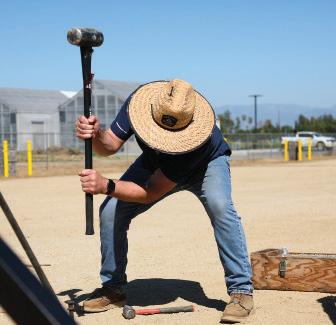
Iron Workers Organizer Jeff Bree hammered down a nail during the construction of The Wall That Heals event at Pierce College in Woodland Hills, Calif., on March 18, 2026.
(Left to Right) Machine Operator Quincy Burley and Painter Oscar Gomez stand on ladders while Volunteer Gustavo Omar Gomez and Business Agent Luis Porres push a panel into place during the construction of The Wall That Heals event at Pierce College in Woodland Hills, Calif., on March 18, 2026.
Ushering in healing: ‘The Wall That Heals’ opens on campus
By Anthony Adams Reporter
Pierce College welcomes the arrival of “The Wall That Heals” Vietnam Veterans Memorial Replica and Mobile Education Center with a motorcade by the Los Angeles Police Department. Also, volunteers in cars were a part of the procession with six motorcycle clubs to Pierce College Equestrian Parking Lot located at 7100 El Rancho Drive on Tuesday, March 17.
The 375-foot-long replica that will be built honors over three million Americans that served in the Vietnam War and commemorates the 58,281 individuals that sacrificed their lives. This exhibit will educate visitors about the Vietnam War’s impact as well as the legacy of “The Wall that Heals.”
The arrival ceremony gathered Pierce faculty, staff, and students in attendance alongside veterans, the Los Angeles Sheriff and Police Department, student volunteers from YouthBuild in Canoga Park, and volunteers from organizations like Jewish War Veterans (JWV) Post 603 Committee and West Valley Center Chamber of Commerce Community Benefit Foundation.
The event was organized by Volunteer Coordinator Greg Lee. Lee shared why it’s important to bring “The Wall that Heals” to Pierce.
“Los Angeles County has the largest Vietnam veteran populations in the nation,”
Lee said. “There’s thousands of Vietnam veterans in Los Angeles. Most of them can’t make it to Washington, D.C, to see the memorial there. We bring the memorial here in order to first serve them and their families.
And make it a community event that everybody can participate in. So that people can get good feelings about our veterans and the contributions that they made to our great nation.”
Pierce College President Ara Aguiar briefly spoke during the arrival ceremony.
Aguilar expressed the honor of hosting the memorial wall on campus.
“So, we’ve been working on this for about four months,” Aguiar said. ”Working with JWV and everybody has been working hard to pull this off. Getting volunteers, the motorcade prepared. I want to thank the LAPD and all the veterans that are here today commemorating this event here at Pierce.”
The event was hosted by Arny Krane, who is Chairperson and Logistic Chairperson with JWV Post 603 Committee.
Krane expressed what it’s been like collaborating with Pierce to bring “The Wall that Heals.”
“It’s been wonderful to bring the wall from Washington (D.C.) and represent 58,281 men and women who were on the wall,” Krane said. “Working with Pierce
College and bringing it to Pierce, Woodland Hills was a pleasure.”
Pierce President Aguiar also shared the events that will be taking place this week surrounding “The Wall that Heals” Vietnam Memorial.
.“We are looking forward to the next few days,” Aguiar said.” “Looking at the wall being built. We are also looking forward to the opening ceremony on the 19th, candlelight vigil on the 20th, and closing ceremonies Sunday afternoon.”
Volunteer Chris Martinez with YouthBuild in Canoga Park shared the importance of bringing his students to the arrival ceremony.”
“This is something that I’m exposing my students to,” Martinez said. “I have ten students here that we’re giving them direction on their life skills and part of volunteering is one the life skills that we teach them. Them coming to help and contribute is a great experience for them and our organization.”
Air Force veteran Terry Tatroe who served from 1976- 1980 shared why he came to lend his support, today.
“I support the wall and all the veterans,” Tatroe said. “And all the veterans that did get to come home. But also, I’m also PGR Road, right captain. And we also do accompaniments for veterans and first response.”
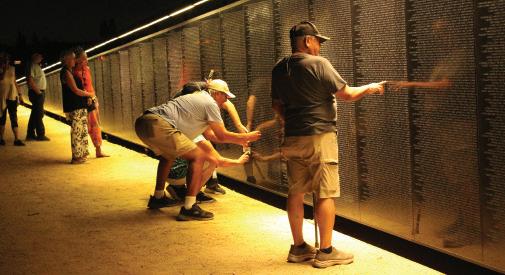
TOP: Attendees touch the wall during the Wall that Heals ceremony at the Equestrian Center at Pierce College in Woodlands Hills., Calif., on March 19, 2026.
BOTTOM: Veteran-Sergant Marc Thurston speaks during the Wall that Heals Cermony at the Equestrian Center in Pierce College in Woodlands Hills., Calif. on March 19, 2026.
Photos by Sandra Mazas
Candlelight commemoration shines light on veteran PTSD
U.S. Army Sgt. Marc Thurston gives a speech for the Light the Night Candlelight Ceremony at Pierce College in Woodland Hills, Calif., on March 20, 2026. Photo by Calvin Henry.
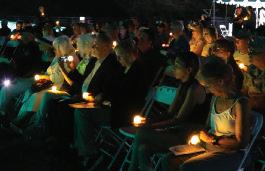
Families hold out their candles for the Light the Night Candlelight Ceremony at Pierce College in Woodland Hills, Calif., on March 20, 2026.Photo by Calvin Henry,
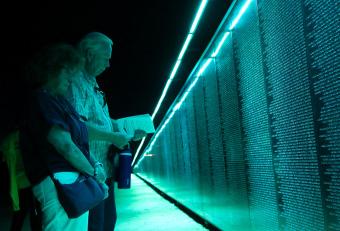
Cathy Bergstrom and Tim Bergstrom look for the name of their loved one during the Light the Night Candlelight Ceremony at Pierce College, Woodland Hills, Calif., on March 20, 2026. Photo by Calvin Henry.
U.S. Marine Corps Col. Victor E. Bianchini speaks at the Light The Night Candlelight Ceremony at Pierce College in Woodland Hills, Calif., on March 20, 2026. Photo by Abraham Elizalde.
Volunteers gather to deconstruct Vietnam War memorial
By Natalie Baharian News Editor
Pierce officially concluded the roughly week-long visit for the Wall That Heals memorial replica this past Sunday at the Equestrian Center, marking the end of the Vietnam memorial setup that brought together the local community of students, veterans, and others.
The traveling memorial had arrived on campus the previous Tuesday, while an official welcome ceremony was conducted the following day to signify its establishment on campus. For its entire stay, it had remained open to the public and those that were curious to see for themselves were welcomed by volunteer members and various slideshows on the history of the Vietnam War and The Wall.
This replica not only served as a memorial for Vietnam Veterans, but also signified as an educational experience in which students and community members could learn about the history of the Vietnam War, the U.S.’s involvement, and what the military endured while they were overseas.
“While the wall is basically a symbol of gratitude, honor, and respect for those who made the ultimate sacrifice in Vietnam, there’s also an educational component to it,” said Earl Roth,
a representative of the Jewish War Veterans who helped organize the event. “We’ve had around 500 students come through on bus tours and touch on all aspects from education, legacy, honor, and respect. I think it’s important for the public to be aware of it and to gain knowledge from it.”
In addition to the commemoration of those who had lost their lives in the war, the closing ceremony included the acknowledgment and recognition of the veterans that did survive the war, but passed away later on.
The exhibit expanded beyond recognition but also demonstrated an appreciation for those that not only served, but those that continued to live on and advocate for further military rights and protections.
“We had wanted this to be an all inclusive event. We didn’t want anyone who had done anything to help in the war feel as though they aren’t appreciated, said Arni Crane, one of the primary organizers and hosts for the exhibit. “The Wall was meant to acknowledge those who had sacrificed their lives, but we also wanted to shine light on both those who passed later on and those who are still alive and well today. We are all indebted to any and all of these servicemen and women.”
In order for the structure and destruction of The Wall to occur, hundreds of volunteers were required to help organize, set everything up, and make
sure there was a respectful environment during each ceremony.
Hundreds of volunteers, many of them having ties to the Vietnam War through their military families, helped in removing parts of The Wall piece by piece, as well as making sure all the equipment had been properly put back.
“Many of these volunteers here are from the Jewish War Veterans post and it’s not a young group… most of our members range from their 70s into their 80s,” said Crane. “My whole family served and me and my brother were in Vietnam when the war was happening so this
sort of event is something really special to us. But despite that, seeing people get involved and volunteering, working with our committee members was really meaningful.”
During the closing ceremony, the emotional heaviness could be felt throughout the field. From each surviving veteran present standing up in recognition, to each volunteer that had lost a loved one to the war. The importance of understanding our country’s history was prevalent throughout the entire ceremony.
As the event concluded, everyone in attendance had a moment of silence for those that
had lost their lives in the war. Following that, was a speech on the preservation of our history and the encouragement of the younger generations to remain literate on matters such as these.
“We decided to conclude the closing ceremony with this acknowledgement because we believe people should remember the people who fought to give you your freedom, the freedom to do what you’re able to do here and the opportunities you have now, said Holly Sbery, a volunteer and head organizer from the Jewish War Veterans post. “No one should take that for granted.”
Pierce College Applied Music Program Student Angelo Waterhouse performs for guests and veterans during the Closing Ceremony at Pierce College in Woodland Hills, Calif. on March 22, 2026.
The Wall That Heals Chairperson Arny Krane presents Pierce College President Aracely Aguiar with flower as a token of appreciation for allowing them to use Pierce College for the Wall during the closing ceremony in Woodland Hills, Calif. on March 22, 2026.
Jake Gregory / Roundup News
Jake Gregory / Roundup News
‘Project Hail Mary’ unexpectedly melds comedy and complexity
By Abraham Elizalde Managing Editor
Beneath its complicated scientific premise,
“Project Hail Mary,” directed by Phil Lord and Chris Miller, tells a deep, human story about isolation, sacrifice and an unexpected relationship.
Based on the novel by Andy Weir, “Project Hail Mary,” follows Ryland Grace, a molecular biologist turned middle school teacher played by actor Ryan Gosling, who wakes up approximately 12 light-years away from Earth with little memory of how he got there.
Despite the long two-hour and 36-minute runtime, Lord and Miller portrayed a brilliant pace to the movie. The film showed two timelines, switching between the past of Grace being recruited by Eva Stratt, played by Sandra Hüller, to assist the “Project Hail Mary,” operation
and the present with Grace on the aircraft four years later attempting to complete the mission while meeting an extraterrestrial
“Rocky,” who was voiced by James Ortiz.
the relationship between Grace and Rocky becomes the emotional core of the story. Their unexpected dynamic was the soul of the comedy for the movie, and is a breath of fresh air from the typical storyline of the alien being the antagonist.
acting versatility alternating from panic and determination to being a comedic relief alongside Ortiz with a hilarious screenwriting by Drew Goddard.
Despite their comedic advantages, the story does get lost in the first act with the scientific explanation for the mission.
The blend of speculative concepts and real-world science can be
away planet that was soon named “Adrian.”
“Project Hail Mary” stands out for its ability to balance sci-fi complexion with comedic relief.
The film is best watched on premium screens such Dolby or IMAX theaters, both nearby at the AMC Topanga 12 located in Canoga Park, or on 70mm IMAX with the nearest being Universal Cinema AMC at CityWalk Hollywood.
Musician Nigel Deane brings harmony and rhythm to ASO concert
By James Mondares Reporter
Sounds
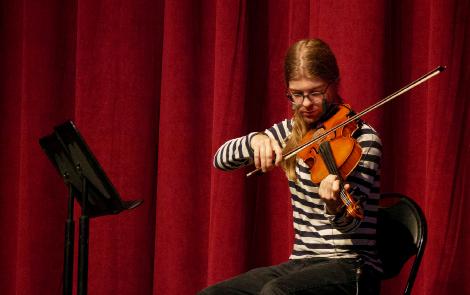
of strings plucked and played filled the air inside the Performing Arts Building on Tuesday, March 17 for an Associated Student Organization (ASO) Concert performed by violinist Nigel Deane.
Nigel Deane is a Los Angeles-based musician, educator and solo violinist/ violist. As part of their weekly music concerts, the Pierce College Music Department had Deane perform and answer audience questions.
Attendees were able to gain advice from Deane, who advised future musicians to be adaptable in the pursuit of their passions.
“Be flexible to unexpected opportunities,” Deane said. “Say yes to things that might seem like a ‘maybe’ at first. It’ll get you somewhere unexpected.”
The event brought many students who were curious about Deane’s style of music and their process. Music major Naiya Donovoan said she was interested in going to hear about how other music styles are played and worked.
Deane started off the concert by playing several of their songs. Playing solo, Deane used their violin and an MID foot controller which allowed them to loop rhythms and play multiple tracks at the
same time.
One piece they played includes a track titled “Wheel of Faith,” which Deane said was created for a friend’s film. Another piece that Deane played included one where
they were “writing it in their sleep about a dream.” The piece in question featured lots of “whimsical” plucking, according to Deane. When it comes to performing, Deane mentioned
loving how people are brought together through music and the communal experience of being able to listen to music with others.
Recording arts and vocal major Olivia Harring said Deane’s abilities impressed her.
“I mean, first of all– the skill was great,” Harring said. “But I really liked the technical side of it, how they have the loops adding all the effects and layers. I thought that was a very nice blend of the technical and the arts of music.”
Music therapy major Dylan Cronin echoed a similar sentiment to Harring’s, enjoying the atmosphere of Deane’s compositions.
“I like the ethereal, spacetime thing going on,” Cronin said. “The layers were great and the long, drawn-out notes as well. And the nice riffs looped in and the effects put on each instrument.”
The next ASO Concert will be a Faculty Spotlight held on Tuesday, March 24, as a Faculty Spotlight for High School and Academic Outreach instructor April Amante.
Javier Ramirez / Roundup News
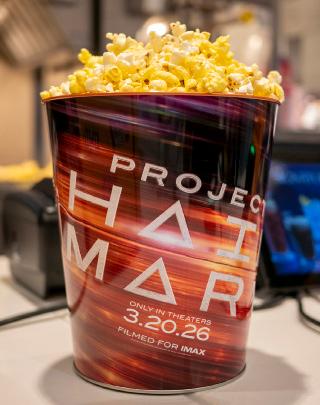
A “Project Hail Mary” popcorn bucket by AMC full of popcorn at the AMC Topanga 12 at the Westfield Mall in Canoga Park, Calif., on March 20, 2026.
Javier Ramirez / Roundup News
Nigel Deane performs at the Associated Student Organization (ASO) concert series at the Performing Arts Building in Pierce College in Woodland Hills, Calif. on March 17, 2026.
Preview: Meet the pack behind “The Wolves” at Pierce
An all-female cast tackles girlhood, belonging and coming-of-age issues
By Olivia Muñoz Campus Life Editor
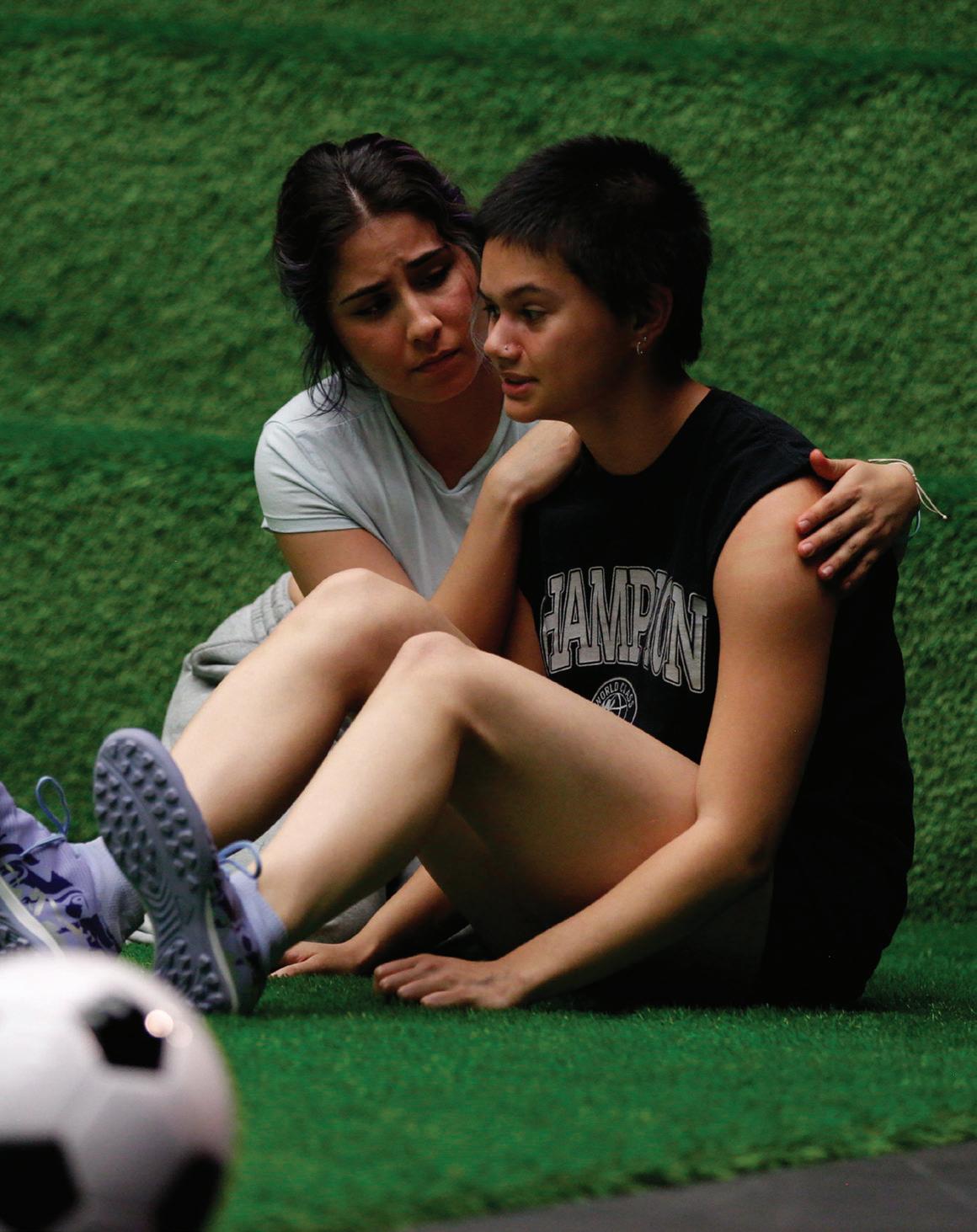
Justin time for Women’s History Month, the Pierce College Theatre Department will be premiering “The Wolves,” a play about a high school girls’ soccer team and their complex inner lives. The play opens Friday, March 27, in the Dow Arena Theatre.
The play features an allfemale cast of nine, with each representing a girl from the team. The plot revolves around the conversations that these teenage girls hold with one another about school, family, the world and life in general. These conversations take place over the span of six weeks, leading up to their final game.
Loumaile Finau, who acts as Player Number 46, described the dialogue-heavy story as a look into the minds of high school girls.
“It’s just the sort of conversations that girls have when they feel comfortable with each other, especially young girls,” Finau said. “So it’s a lot of teenage girl talk. It’s very chaotic but it’s a lot of fun.”
Director Shaheen Vaaz who led last semester’s productions of “Frankenstein” and “Georgia,” said that the play reflects the multidimensional lives of young women without the interference of a male perspective.
“It’s like real life, I think.
It’s a group of nine women together, and sometimes there’s three conversations happening at the same time. So that chaos of how girls talk when they’re together, without any adult, without any guy around,” Vaaz said.
“These girls talk about boys sometimes, but it really is very much about them, and they’re not being defined in relation to their dads or their brothers or their boyfriends.”
Actress of Player Number eight Cadence Palitang said that the exclusively female aspect of this production allowed her to express herself in a way she hasn’t been able to before on set.
“We talked a lot about our different experiences when we were girls in high school and at the age of the characters, and I feel like a lot of us got vulnerable in that position, and I feel like that’s something that we wouldn’t have been able to do with a larger cast,” Palitang said. “It’s really a space where I feel like a lot of us just feel free to exist. Like, you don’t have to be anything that you’re not, even though it’s acting.”
Besides the emotional aspect, the cast also had to explore their physicality at the same time. Player Number 11 actress Shannon Toledo said that they practiced their soccer skills with each rehearsal to slip into the minds of the characters.
“A lot of the cast have not played soccer before, and I was a soccer player my whole life,” Toledo said. “So, a lot of the time before rehearsal, or the first hour of rehearsal, we play soccer, we’d learn to kick the ball and pass. My dad is a coach, and he came a couple of times, and he ran a practice for us essentially.”
Through these practices, Toledo and the cast built a bond similar to that of a real team. Toledo added this connection to your castmate, or teammate, lies at the core of the story.
“All these girls, regardless of what their position or their status is, whether [they’re] popular or an outcast, they all deal with the same sense of wanting to be liked and wanting to have this sense of community with [their] team, with [their] fellow teenage girls,” Toledo said.
Vaaz said that she ultimately wants attendees to have an understanding of what it’s like to be a girl navigating these coming-of-age challenges, and come away with a greater sense of compassion.
“I want the audience to feel the humanity of these incredible characters, and maybe get a glimpse into what girls are like when there’s nobody else around,” Vaaz said. “It’s written with so much love and empathy, I can only hope that the audience sees these young women clearly at this really dicey, scary point in their lives and hears them.”
Lesa Greenfield / Roundup News Pierce College Theatre students (L to R) Eryn Salinas and Cadence Palitang rehearsing for “The Wolves” at Pierce College Dow Arena Theatre on Thursday, March 19, 2026 in Woodland Hills, Calif.
“The Wolves” will premiere on March 27 and run until April 5, playing on Fridays and Saturdays at 7:30 p.m.
and Sundays at 2 p.m. Tickets are available to purchase at LAPCTheatre.com.
‘ARIRANG’ by BTS: A sonic shift void of honorable authenticity
By Joy Mellk
Assisting Entertainment Editor
Following a difficult four-year hiatus, K-pop group BTS has handed over a programmed formula of an album to passionate fans—but it fails to keep that light alive.
“ARIRANG,” is BTS’s tenth studio album, and it was supposed to be a project dedicated to resistance, identity and reunion following separation, but these supposed themes were not as prominent as they should’ve been and were swallowed by the desire to pander to Western audiences.
The 14-song album jumps from hip-hop and R&B in the first half to branches of pop in the second half. This
41 minute-long album was their departure from the dance pop that helped them win over fans on a global scale, and yet the English to Korean ratio has caused fans to raise an eyebrow and question exactly who BTS is catering to despite having a passionate army of fans.
“ARIRANG,” translated to “my beloved one” in Korean, is a reference to a cherished traditional Korean folk song deemed as Korea’s unofficial national anthem. For centuries, this song has tied together Koreans of many generations, and for BTS to use the song title as their own to announce their comeback album is major, especially since it was announced months before its release.
It gives fans, particularly the fans in their homeland, the expectation that the theme of this album would be
resilience, pride and honor, just like the song. Many were left disappointed.
Though the members call for reunion in the introductory track “Body to Body” and honorably sample a recital of “Arirang” toward the end, this initial impression will later be diminished by lackluster lyrics, excessive instances of sexual innuendos and inconsistent production.
“Aliens” has potential to keep that first impression alive but its themes of isolation and identity are overshadowed by the incompatible production and scratchy vocal effects that take away from the potential strength of the message.
The group continues to deliver uninteresting lyrics and borderline annoying vocal deliveries until “No. 29” comes around. Though it is meant to represent South Korea’s 29th
National Treasure, the lack of direct cultural praise in this album prevents the bell from holding the significance it should.
BTS ventures back out into pop with “SWIM,” “Merry Go Round,” “NORMAL” and “Like Animals,” which briefly navigate inklings of themes like perseverance, emotional exhaustion and freedom. They eventually fall flat with unoriginal vocal deliveries and questionable lyrics that take away from the potential messages that they can effectively delve into.
Instead, they choose to sonically experiment with production styles as shown in “One More Night” and “Please,” which showcase lyrics of longing and love that we’ve seen before.
They choose to conclude with “Into the Sun,” which leaves listeners with grating
vocal effects in the chorus. Though the lyrics can be viewed as an ode to their fans where they showcase their devotion, it finds a way to be overshadowed by the antithesis between the jarring vocals and the gentle guitar. ARIRANG doesn’t live up to its expectations, whether that’s in regards to their longawaited comeback or the cultural praise. Though the group may have had good intentions with the project, speaking on behalf of the album will differ dramatically from how the album sonically speaks for itself. For a group known for storytelling through music, they failed to share much despite their attempts, especially with the big picture of the project.
Science Journal Club hosts event on Nobel Prize-winning research
By Mia Greer Reporter
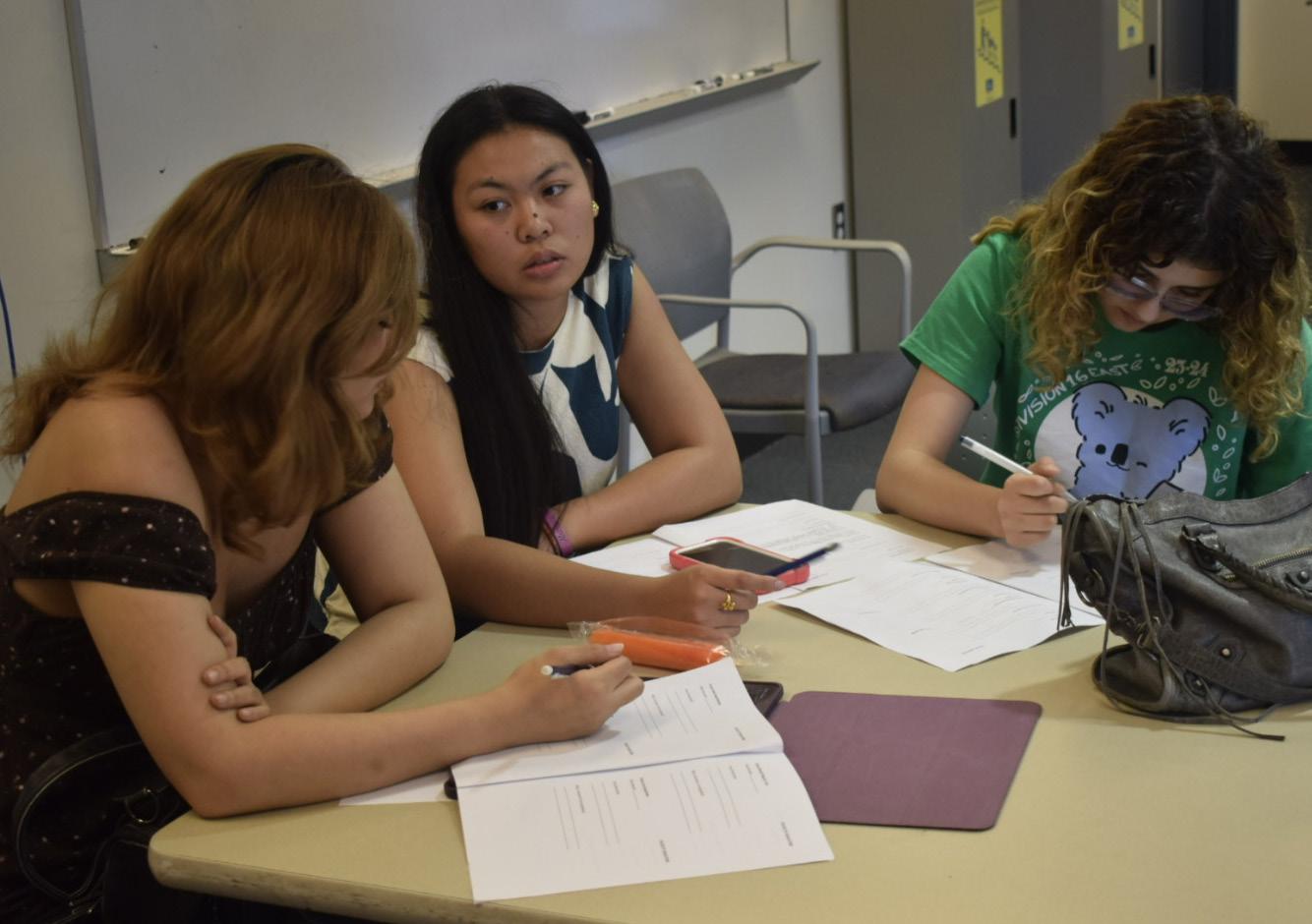
Graphs and models filled the tables as students traded textbooks for an award show-style showcase hosted by the Science Journal club. The club transformed Nobel Prize research into an interactive, approachable and fun experience during STEM Week 2.
The event was a Nobel Prize Party-themed meeting on March 17, from 2 to 3 p.m., encouraging students to explore scientific discoveries through interactive presentations.
The event was themed asan award ceremony and featured three booths dedicated to Nobel Prize-winning research in medicine and physiology, chemistry and physics. Students rotated around the tables while club members explained the scientific topics in a simplified, engaging format.
President of the Science Journal Club Anisah Khan said the event was inspired
L to R : 1st year biology Jaydeline Wooten 1st, 1st year biology major Mardee Liden Alipio, 1st year biology major Diana Midyan write down what happened during the STEM Noble Prize Stem Event in the Center for the Sciences Building 92032
by a similar one held last semester that drew student interest. She added that events like these help attract students by showing them the academic support and research opportunities the club provides.
“It’s a Grammy-style event, but for Nobel Prizes, we
wanted to replicate for STEM Week,” Khan said. “We go through these scientific papers because you need to be familiar with that heavy material, and it’s hard to read if you don’t have a group holding you accountable.”
At the physiology and medicine booth, members
explained the role of regulatory T cells, or T-regs, and the discovery of the FoxP3 gene, which plays a key role in controlling immune responses.
Speakers also highlighted how these discoveries contribute to a deeper understanding of how the immune system can be regulated.
Other stations focused on molecular design in chemistry and foundational concepts in physics, offering students a broad look at Nobel-recognized achievements. The variety of topics allowed attendees to explore multiple scientific disciplines within a single event.
Attendees were encouraged to ask questions and engage directly with presenters, creating an informal and collaborative learning environment. The interactive format aimed to help students feel more comfortable discussing topics that might have otherwise seemed intimidating.
Biology major Mardee
Liden Alipio attended the event and said she initially came for extra credit but found the experience worthwhile. She said the event exceeded her expectations and made difficult concepts easier to understand.
“I was curious about what I was going to learn here,” Alipio said. “We got to learn about T-regs and how it helps with autoimmune diseases.”
Secretary of the Science Journal Club Patric Capatayan said the research is important for treating autoimmune diseases and improving organ transplant success.
He emphasized how foundational scientific discoveries like the ones being discussed can translate into real-world medical advancements.
“By understanding how these cells work, we can prevent the immune system from attacking the body’s own tissues,” Capatayan said. “It’s a step forward in fighting things like organ rejection and even cancer.”
Brahmas on seven game winning streak after beating Monarchs
By Lesa Greenfield Reporter
ThePierce College Brahmas defeated the Valley College Monarchs during a two-game series with a final score of 2-0 on Thursday, March 19, at Valley College’s Monarch Baseball Field.
Coming off a 28-14 win two days earlier, the Brahmas closed out the series against the Monarchs with another victory, continuing their seven-game winning streak
Pitcher Dylan Adams picked up his first save of the season after going in to relieve pitcher Brayden Briscoe in the ninth inning.
Adams expressed his excitement about the Brahmas’ continued winning streak and the 28-14 win against the Monarchs two days prior.
“I feel excited, my energy is up right now. Big sevengame winning streak for us. Very happy,” Adams said. “I was very excited yesterday because it’s been a long time since we hit like that.”
Adams, who closed the game with a perfect inning, striking out two of the three batters he faced, reflected on how far the Brahmas have come this season.
“In the beginning, we were in a win, loss, win, loss situation. So everyone was thinking, what’s happening? But now everyone’s been in it as a team, each game, one game at a time. That’s how I play it.”
Pitcher Allen Olmos recorded his second win of the season while Shortstop JJ Fagfoomsintu and infielder Christian Santiago delivered the Brahmas’ only runs of the game. Fagfoomsintu had one hit and scored one run while Santiago had two hits and one run batted in (RBI).
After Thursday’s win, catcher Ethan Granillo expressed his feelings on the Brahmas seven game win streak and how the team is playing together now versus the beginning of the season.
“I feel great and it was a team effort from everyone. Being able to come together, winning or losing, up by runs or not, playing together feels super good for us now.”
“We had a rough start in the beginning, but now we’re putting it together, staying engaged the whole time, no matter if we’re up or down. I think right now we’re in a good situation.”
Granillo further discussed his thoughts on the Brahmas’ team chemistry and mindset.
“We want to win every
game and compete as best as we can. Pitchers got to do their job. Hitters got to do their job. So at the end of the day, we win as a team or we lose as a team. Being able to compete with these guys is really big and something that I wouldn’t want to do with anybody else.”
Head coach Bill Picketts expressed his satisfaction with the Brahmas’ winning streak.
“Everything’s kind of going our way right now and even when we were losing some games, I always felt like we were just, one at bat away or one pitcher away. So things are starting to come together and it’s kind of fun. It’s always fun when you’re winning a little bit more than when you’re losing. But everything’s good, the pitchers are doing well and the defense has been great. We scored 28 runs last game and that’s always nice when your offense does that.”
With the Brahmas now in conference, Picketts discussed his outlook on the remaining games of the season.
“This is where it all starts. We’re in conference but we’ve got a very good conference. So it’s going to be a battle for the next 15 games we have left.”
The Brahmas’ next home game is Thursday, March 26 at 2 p.m. against Cuesta College.
Bryce Edwards / Roundup News
Lesa Greenfield/ Roundup News
(L to R) Valley College Catcher Kona Valenzuela and Pierce College Brahmas Utility Matteo Rodriguez (28) batting at Valley College on Thursday, March 19, 2026 in Valley Glen, Calif.
Men’s volleyball swept against top-ranked Santa Barbara
By Abraham Elizalde Managing Editor
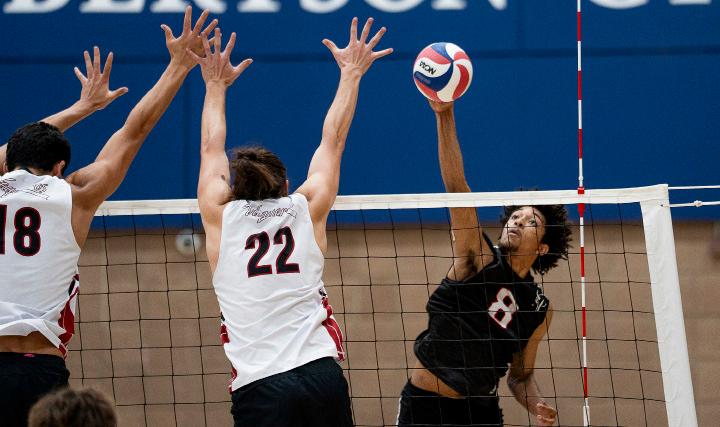
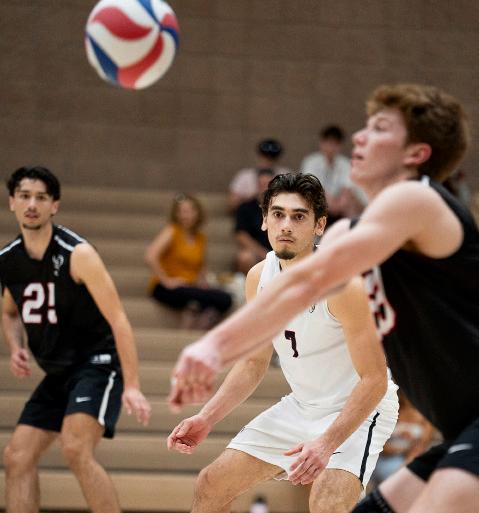
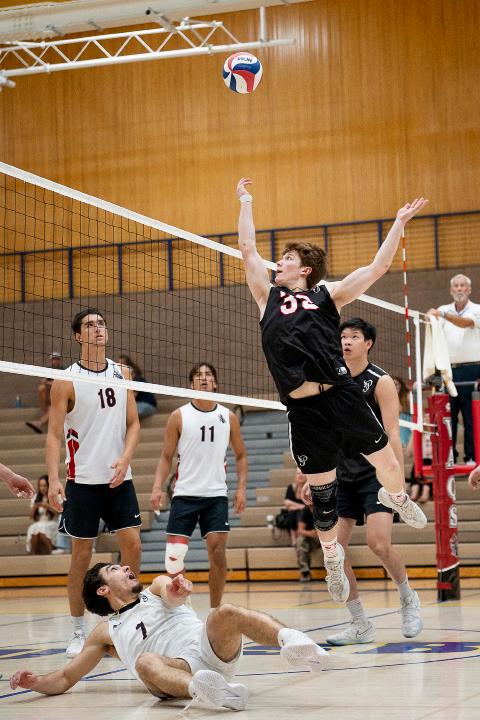
Strongserving and disciplined blocking propelled Santa Barbara City College to a 3-0 sweep over Pierce College in the Robertson’s Gym at the University of California, Santa Barbara on Wednesday, March 18.
The Vaqueros have enjoyed a successful first half of the season, with a 5-1 record in Northern Region-Canyon conference, 11-3 overall. Despite the matchup, outside hitter for the Brahmas, Steven Whalen, came into the game with the same mindset as his teammates.
“We play even, whether it’s the top team in the nation or against a random non-leagued school.” Whalen said. “But today we underperformed.”
The win against Pierce puts Santa Barbara at the top of their conference and sets the Brahmas at third, with a record of 2-6.
Serving was a major factor for the Vaqueros, especially for Santa Barbara outside hitter Mykolas Petritias who scored nine aces against the Brahmas, more than doubling his career high of four.
Head coach for the Brahmas Joseph Arechiga used his timeouts strategically to slow down Petritias, but ended up falling short.
“A lot of our timeouts were used to stop No. 11 [Petritias],” Arechiga said. “We tried to change up slight things here and there but we just couldn’t stop them in the service line.”
The blocking from the Vaqueros was another problem for the Brahmas with opposite Evan Thompson leading Santa Barbara with eight blocks off the bench and other middle blocker Nick Shultz shortly following with seven of his own.
Santa Barbara’s blocking shifted the Brahmas to playing more strategically and attempted to “recycle off the block,” according to Arechiga.
Pierce will take this loss as a way to change their defense to better perform in their upcoming games, according to libero Kenned Vea.
“We’re going to come up with some new schemes moving on with our shifting and passing,” Vea said. “That’s it, we have great hitters.”
Pierce was set for a rematch against the Fullerton College Hornets on Friday, March 20, after a tight five-set loss last time they played on Feb. 25.
Whalen acknowledged the driving force for the Hornets, outside hitter Curtis Lee, and wanted to go in with a
different mindset.
“We know about Curtis and their whole lineup,” Whalen said. “Every team is different, you have to come in with a different idea of who’s on the other side of the court.”
The Hornets went on to win against the Brahmas in another five-set game, winning in overtime of the fifth set, 17-15.
After a two-game road trip, the Brahmas will be back at home, going against the Long Beach City College Vikings on Wednesday, March 25.
Calif.,
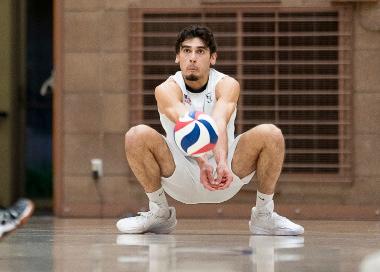
LEFT: Pierce College libero Kenned Vea (#7) watches outside hitter Steven Whalen (#33) receive a serve in game against Santa Barbara Community College at the Robertson Gym at the University of California, Santa Barbara in Santa Barbara, Calif., on March 18, 2026. Photo by Abraham Elizalde
TOP: Pierce College outside hitter Lorenzo Gonzalez (#8) hits against Vaquero blockers in game against Santa Barbara Community College at the Robertson Gym at the University of California, Santa Barbara in Santa Barbara,
on March 18, 2026. Photo by Abraham Elizalde
RIGHT: Pierce College outside hitter Steven Whalen (#33) saves the ball in game against Santa Barbara Community College at the Robertson Gym at the University of California, Santa Barbara in Santa Barbara, Calif., on March 18, 2026. Photo by Abraham Elizalde.