Volume 144 Spring 2026 Issue 1

Page 1


Umoja Club celebrates Black History Month

Pierce students pick up their brushes to create art and build community

the Multicultural Center on campus, the Umoja Club hosted a Paint and Dip event on Thursday. Students gathered to put on their aprons, use their selfexpression to paint and let their creativity color their canvases.

The event encouraged students to step out of their comfort zone and try to tackle the canvas to the best of their abilities. Offering a stressfree environment, the Paint and Dip also provided art materials for all to use freely and decompress with.

Alongside attendees, Pierce

College program coordinator and counselor Kalynda

McLean sat down to talk and paint with students. McLean used canvases with different outlines of diverse people to and encouraged students to reflect their self- expression comfortably without the intimidation of a blank slate.

“It was an opportunity for us to have different representations of people of color and allow the students to interpret what those people look like,” McLean said. “ We wanted any and every student to be able to participate, and there are some people like myself that are not artistic. And so we need a little something on the canvas.”

The Paint and Dip event

hosted at the Umoja Village opened up the importance of art and how it functions as a way to learn new perspectives, and the power of the voice as well as beyond verbal communication.

Fine Art and Game Design major Gemaiyesevn Pushmataha said that the event allowed them to express themselves, both creatively and personally.

“I love everything that Umoja does. You know, I love the opportunities they have for melanated creators,” said Pushmataha. “Art is my way to kind of feel the world, you know, I feel like if I don’t have a paintbrush, I don’t really have a way to speak.

So it’s my way to speak to

the world and communicate effectively.”

The intimidation factor is nothing new to some of the people attending the art event. Umoja counselor Lateaira Hockaday accounted for the hesitancy and made a space where students of all levels could unwind and use the resources provided.

Pre-vet and biotech major Khalil Robinson said the Umoja Village continues to be a unique place that allows students a break from the fast-paced world to be in the moment with people from all walks of life.

“We’re engaged and we’re talking amongst each other. We’re learning about each

“It was an opportunity for us to have different representations of people of color and allow the students to interpret what those people look like”

Kalynda McLean Umoja Coordinator

Hockaday believes that no matter the major or capability, all are welcome to surround themselves with company and engagement through creativity.

“I know art is not for everyone, so I want to make it a little bit more convenient and accessible for people who are not as artistic,” Hockaday said. “You are able to feed off of each other, you’re able to engage with each other. I do think it brings out even more expression, more happiness, more excitement.”

Students of all backgrounds are welcome to come together during events like Paint and Dip to engage in conversations that celebrate the many backgrounds each person comes from and the ability everyone has to support and uplift one another’s heritage and sense of belonging.

other. These gentlemen, I see them around campus, but we have different majors, different lifestyles, and social work, so we don’t really get to interact as much as we might like to,” Robinson said. “So the fact that we’re able to be in this moment, this space, this time, when there are people on the planet, a larger scope, is special. That is something that we can take hold of and just appreciate just being in that moment.”

Some of the most harmonious works of art are made from a multitude of colors that work together to share space and blend with one other. Communities are made from that same action, sharing culture and appreciating what each other brings, A shared voice, a shared vision and a shared village.

Abraham Elizalde / Roundup News
Jake Gregory / Roundup News
Javier Ramirez / Roundup News
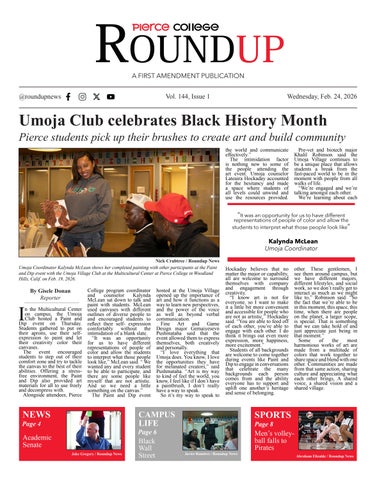
Umoja Coordinator Kalynda McLean shows her completed painting with other participants at the Paint and Dip event with the Umoja Village Club at the Multicultural Center at Pierce College in Woodland Hills, Calif. on Feb. 19, 2026.
Nick Crabtree / Roundup News

6201 Winnetka Ave.

Woodland Hills, CA 91371

Room: Pierce College Village 8211

Website: www.theroundupnews.com

Email: newsroom.roundupnews@gmail.com

Editor-in-Chief..............Daisy Aguinada

Managing Editor.........Abraham Elizalde

Opinion Editor...............Gabriella Carlos

News Editor..................Natalie Baharian

Photo Editor.......................Josue Aguilar

Photo Editor........................Calvin Henry

Photo Assistant.................Alissa Nguyen

Photo Assistant..................Sandra Mazas

Campus Life Editor...........Olivia Muñoz

Entertainment Editor.....Chris Rubinstein

Entertainment Assistant...........Joy Mellk

Sports Editor....................Bryce Edwards

Newsletter Editor................Emily Garcia

Online Editor....................Brianna Fuerte

Social Media Editor........Zamourad Iqbal

Reporters

Anthony Adams

Mia Greer

Gisele Donan

Elizabeth Santana-Zavala

Valeria Estevez

Shelby Saxton

James Mondares

Spencer O’Bosky

Photographers

Nick Crabtree

Lesa Greenfield

Jake Gregory

Cesar Banuelos Soto

Javier Ramirez

Advisers

Jill Connelly

Jeff Favre

Tracie Savage

Morgan Keith

For advertising, call: (818)710-2960

Corrections?

Email us at newsroom. roundupnews@gmail.com

Scan the QR code below to subscribe to our weekly newsletter

Editorial: From the desk of the Roundup Overbooked counseling is hurting students

In the first or final weeks of the semester, scheduling an appointment with a college counselor can be challenging due to limited availability.

During this period, it is difficult to find a meeting, especially online, because only dates in the current week and the next are available. There are so many students and few counselors, because the availability of online and in-person dates dwindles rapidly.

Pierce College offers an alternative option called Express Counseling, which allows students to have a meeting with a counselor for 10-15 minutes. This is great for students who want to address smaller issues, such as changing a major or checking course prerequisites.

But this poses a problem, because some students need more time to plan future semester schedules, discuss recommended classes or explore transfer and career paths.

For online students, this adds an extra layer of stress to an already frustrating

process. Without proper guidance, students are prone to making mistakes when creating their schedules.

A potential solution is for Pierce to recruit student volunteers who assist people as academic advisers. Several universities employ this method for specific departments.

For example, the University of California, Los Angeles, Herb Alpert School of Music has a student affairs team with an undergraduate peer adviser. The University of California, Irvine has a team of peer academic advisers for its Engineering department. Biola University in La Mirada also has student advisers within various fields.

These peer advisers connect students to campus resources, guide academic preparation and share their college experiences.

If Pierce is open to volunteers, they can save money from hiring more counselors, and the student volunteers gain professional experience for their resume. This is a positive outcome for the college, because we are currently in a budget deficit.

Another potential solution is

Letter from the Editor

Growing up, I spent my spare time writing stories, creating characters and designing book covers. I did not realize it then, but those moments sparked my love for storytelling and eventually led me to journalism.

I remember watching television news broadcasts in the morning at home and hearing my dad listen to reports on the radio throughout the day. The sound of reporters sharing updates and explaining events made the world feel larger and more connected. Even before I understood

using specialized AI chatbots to assist with students’ needs.

The AI chatbot could be refined to answer common questions students may have for counselors. It can also be trained to give responses that align with the rules and structure of Pierce’s education system.

According to a 2024 research article by Abel Uzoka, Emmanuel Cadet, and Pascal Ugochukwu Ojukwu, the AI chatbot H&M Virtual Assistant “successfully handled over 70% of customer queries without human intervention.” This saved the H&M company a considerable amount of operational costs and reduced response times.

KLM Royal Dutch Airlines also has a chatbot called “KLM Messenger” to help passengers with customer support and information about flights. The article states that 60% of customer interactions were handled effectively with the chatbot.

In a Fort Lewis College article on how AI can improve college advising, a student-faculty research team developed an AI Advising Assistant to “help students navigate the complexities

of academic planning with greater ease and confidence.”

Last year, the team launched a beta test by embedding the AI in a Canvas course with more than 100 students. The Canvas page received moderate interest based on average page views.

According to student feedback, 57% found the information provided by the AI on academic questions and concerns helpful. Additionally, 86% of students found the responses to be accurate.

Pierce can recruit volunteers, such as computer science majors to help create an AI chatbot specifically for college counseling. This can be useful for counselors, because they can spend less time answering common advising questions.

If Pierce adds a support system, such as volunteers or AI, to the counseling process, students will have an easier time getting their questions and concerns addressed promptly without dealing with congested scheduling slots.

journalism as a profession, I was drawn to how stories informed people and brought communities together. Those early memories shaped my curiosity about how information is shared and why truthful reporting matters.

It is an honor to introduce myself as the new editorin-chief of the Roundup. Journalism, to me, is more than reporting facts. It is about listening, understanding and documenting the voices that shape a community. Stepping into this role feels exciting and special because the Roundup represents the stories of Pierce College students, faculty and staff.

As a first-generation college student, my path has been shaped by the opportunities and guidance I found at Pierce. Programs such as Extended Opportunity Programs and Services (EOP&S) provided mentorship and support that helped me navigate higher education with confidence.

Joining the Roundup allowed me to grow as a writer, editor and leader while learning the responsibility that comes with telling other people’s stories.

Working in an academic newsroom has shown me the value of open conversation and freedom of speech on campus.Being involved in the Media Arts Department, has helped me build friendships, collaborate with passionate student journalists and grow my network.

As a student at California State University, Northridge and Pierce, I have been able to bring my journalism experience into new spaces, from classroom discussions to opportunities beyond campus.

These experiences have strengthened my confidence as a writer, while reminding me that journalism is rooted in while reminding me that journalism is rooted in truth and accountability.

As editor-in-chief, my goal is to keep the Roundup a welcoming and collaborative newsroom where curiosity is encouraged and student voices are heard. I believe journalism should spark thoughtful conversations and provide space to explore the issues that matter most.

This semester, I hope to strengthen our digital presence, expand multimedia storytelling and continue covering the issues that matter most to our campus community. Most importantly, I hope the Roundup reflects the diversity, creativity and resilience of Pierce.

Thank you to our readers for supporting student journalism and trusting us with your stories. I look forward to seeing what we will create together.

Pierce also introduced me to opportunities that expanded my worldview, including the Mayor’s Young Ambassadors Program. Through that experience, I traveled to Guangzhou, China, and immersing myself in another culture confirmed that I want to document stories everywhere, even beyond my country and lived experience. My academic and professional background spans journalism, digital publishing, marketing and public relations, all connected by storytelling. Whether through writing, photography, video or digital media, each form offers a way to inform and connect audiences.

Are student walkouts making a difference?

PRO: Walkouts are proven to be an effective way to make a change.

Studentwalkouts have long been one of the most visible ways young people demand to be heard. By stepping out of classrooms and into public spaces, students turn concern into action, forcing communities, media outlets and leaders to pay attention to issues that might otherwise be ignored.

On Feb. 6, students from about 85 schools walked out of class to protest the Trump administration’s immigration policies and the presence of ICE agents in Los Angeles.

Students across Los Angeles are taking a stand against federal

overlooked. The Museum of Protest explains how walkouts “literally stop the normal functioning of an institution,” making issues urgent to handle and visible to authoritative figures.

In 2006, roughly 40,000 students across Southern California left school to protest proposed federal immigration laws. The Museum of Protest noted these demonstrations kept public pressure on lawmakers and brought more attention to the issue.

While students leaving their campuses wasn’t the only factor in the outcome, they helped keep immigrant rights in the national spotlight and influenced public opinion and government decisions. The Feb. 6 walkouts were more than student activism. The Fresno Bee called them a “teaching moment” for students and the wider community. The Fresno Bee wrote, “When students gather, march

immigration policies and the fatal shootings in Minneapolis involving immigration agents. The walkouts are meant to call attention to how undocumented communities are being treated, demanding accountability and change.

About 12,000 students took part in coordinated demonstrations across campuses, carrying signs, holding rallies on school grounds and marching to public spaces such as Los Angeles City Hall to make their voices heard.

According to LAist, this was the largest student protest by number of schools in Los Angeles since 2006, when roughly 40,000 students walked out to oppose federal immigration legislation.

School walkouts are effective because they create disruption that cannot be

CON: Walk outs could divide rather than unify.

Thegoal of a walkout is to bring attention to an issue or stand in solidarity with a cause as a group. The idea is that if enough people come together to physically “walk out,” the collective action sends a message that something needs to change.

On the surface, it’s a powerful concept and an exercise of First Amendment rights. Many people see walkouts as an easy, visible way to show they care and want to be part of a movement. There is something appealing about the simplicity of it — just step out, join the crowd and you have participated in a protest.

While it is true that walkouts throughout history have helped spark conversations and push certain issues forward, it is also true that the world has changed.

responsibility on individuals, and if they choose not to participate, or simply cannot, they may be judged as unsupportive.

This dynamic does not bring people together. Instead, it can divide communities and create unnecessary tension. A protest that relies on absence can end up punishing the people who are already struggling, rather than challenging the systems that need to change.

Due to these complications, many communities have turned to alternative forms of protest that are often more effective and more inclusive.

One example is the “Walk Up Not Out” movement, which encourages students to reach out to one another, build

Do you think student walkouts are productive in changing issues? Why or why not?

“Personally, I believe they are productive. It helps not only younger generations demonstrate what they believe in but also introduces them to expressing their beliefs to mass crowds.”

MatthewAllenCastillo— MechanicalEngineering Major

and speak out they show interest in engaging with and shaping their environment.”

This shows how schools can help break cycles of disengagement and give young people the tools to stay involved. These walkouts show that students can make a difference and have their voices heard. By organizing, marching and speaking out, pupils show that caring about their communities means taking action.

These forms of protest remind adults and leaders that young people notice what is happening around them and they are seeking change.

When schools and communities support students in speaking up, they give them the skills and confidence to keep working for fairness and justice.

Since the 1970s, modern infrastructure has been built in ways that make it easier for

institutions to function even when employees or students walk out. Systems are designed to keep running, with or without the people who leave.

In schools for example, students missing class often becomes more of a burden on the students themselves, their parents and their teachers. Teachers are still responsible for completing the curriculum on time and students still have to make up missed work. The symbolic act of walking out can unintentionally create more stress for the very people who are trying to support the cause.

Another issue is that walkouts can sometimes enable victim-blaming. When participation becomes the expected or “correct” response, the pressure shifts onto students or employees who may not be able to join. Missing school or work as a form of protest puts the

connections and support peers who may feel isolated. Instead of stepping away from the community, this approach focuses on strengthening it from within. It promotes compassion, awareness and direct action that can create long-term change.

Other forms of activism have also proven powerful: digital campaigns, wearing symbolic clothing, lobbying, signing petitions, spreading information online and using insider strategies to disrupt harmful systems from within.

These methods require more effort than walking out, but they often lead to more meaningful results. They allow people to participate without sacrificing their education, income or safety. In the long run, these approaches can create more good than the harm that walkouts sometimes cause.

“[Walkouts] are like a bucket. The more attention you bring to something, you’re putting more drops in the bucket, and then the bucket overflows, and then eventually, change happens.”

MariaMelendez— BiologyMajor

“I feel like walkouts are to communicate when you feel like communicating isn’t working. It’s a form of communication instead of just a speech.”

SerenaAnaya— HumanBiologyMajor

Photos

College budget deficit shrinking, but concerns still remain

Administrators discuss revenue plans, housing updates and federal accessibility changes

Vice

President of Administrative Services Rolf Schleicher addressed the college’s budget challenges during the Academic Senate meeting on Monday, Feb. 23, in Building 600.

Pierce College administrators are working to close the budget gap as the projected deficit is expected to drop from $10 million to $7 million.

Schleicher emphasized that the college’s financial struggles reflect a broader crisis affecting community colleges throughout the state.

“We just don’t get that much allocation,” Schleicher said. “So it is a serious time for all colleges in our community college district but also for the state. It seems most districts are suffering through this budget shortfall that we’re seeing.”

Schleicher said the college must focus on strategies that increase revenue, including improving its performance under the Student Centered Funding Formula (SCFF).

“We need to be smart about how we capitalize on the SCFF model to maximize the revenue,” said Schleicher.

The SCFF model allocates state funding to community colleges based partly on enrollment and student

contaminated soil.

success metrics.

Academic Senate Treasurer Kalynda McLean also reported on the college’s finances.

She said the deficit has improved since the start of the year.

“In January, we reviewed a budget update, and it was reported at that time that the college started the year with

a $10 million deficit, and the deficit for the college is currently projected at $7 million,” McLean said.

Schleicher also updated the Senate on the college’s on-campus housing project, which may face a potential complication. A former faculty member raised concerns that one of the proposed housing sites may have slightly

“We’re wondering if that might be the most ideal choice. It’s something we’re going to investigate,” said Schleicher.

Despite this concern, Schleicher expressed optimism about student housing.

“We should be excited about student housing and not have anything overshadowing

it,” said Schleicher. “So I just want to declare that this is something we’re looking into. We are not missing that step, and we are being as transparent as possible.”

In other Senate business, Academic Senate Secretary Jennifer Moses discussed federal Title II accessibility standards and recent changes required for all public-facing websites and documents. The college must complete all updates by April 26, 2026 to comply with federal law.

Moses said most students will likely not notice significant changes because they already use Canvas, which is not public-facing and already meets accessibility standards.

However, she emphasized that responsibility shifts to faculty when they upload their own material to the platform.

“Hopefully this will make faculty more mindful about not uploading PDFs unless they’re accessible,” Moses said. “That means documents have to be tagged throughout so they’re readable, switching over to Word instead, and making sure that their auto caption videos have been checked for errors, or get them professionally captioned.”

The next Academic Senate meeting will be on March 9, in Building 600

Reporting by Daisy Aguinada Crime Log
Vandalism was reported at the card reader by the Auto Tech Building on Feb. 4, 2026. Blotter
Abraham Elizalde / Roundup News Pierce College Academic Senate President Margarita Pillado speaks at the Academic Senate meeting at Pierce College in Woodland Hills, Calif. on Feb. 23, 2026.
Abraham Elizalde / Roundup News
Child Developement Department Chair Trish Doelitzsch takes notes at the Academic Senate meeting at Pierce College in the Woodland Hills area in Los Angeles, Calif. on Feb. 23, 2026.

Umoja celebrates black history through board games

Umoja hosted a game day as a partnership with Play Black Wall Street for Black History Month in the Multicultural Center on Wednesday, Feb. 18.

The event opened with a history lesson from Play Black Wall Street gamemaster, Mysaiah Duke, about the Greenwood District in Tulsa, Oklahoma, nicknamed “Black Wall Street.”

The lecture included the formation of Tulsa, including the entrepreneur, O. W. Gurley, who purchased the land that would later be known as Black Wall Street.

“Black Wall Street: he Board Game,” is similar to games like Monopoly but includes many references to real historical businesses from Black Wall Street.

After Duke went over an explanation of the rules, the attendees were grouped into sets of 4 to play Black Wall Street the Board Game.

Sociology student, Aliyah Alexander, said she enjoyed learning about the history behind the game.

“It just

speaks Black excellence,” Alexander said. “I think a majority of our inventions and pathways to success stems from our people.”

The attendees played for about an hour with two intermissions, with tips from the gamemaster with history facts included in the game.

The winners of each game were given a copy of Black Wall Street the Board Game to take home.

Duke said he feels a special connection to Black Wallstreet the Board Game, both for its connection to history and for what it teaches.

“The fact that it incorporates real history but also teaches you business structure in a creative way is something I appreciate,” Duke said. “In school, I studied anthropology, so not just the history knowledge, but also being creative with how you get that knowledge I feel is very valuable.”

The Umoja coordinator/ counselor, Dr. Kalynda McLean, was happy to see her students getting to learn while socializing with one another.

“We had some students who attended who are usually more shy, so this is a great way for them to get to know people in a more relaxed environment

while they’re learning,” McLean said.

This isn’t the first time Umoja has partnered with Play Black Wall Street, and they have hosted game days during previous semesters.

Play Black Wall Street is

a board game company that hosts game sessions to raise awareness of Black Wall Street’s history throughout California.

Play Black Wall Street also hosts mentorship programs to teach students financial knowledge and how to start small businesses.

The Umoja village is open from 8 a.m. to 5 p.m. on Mondays and Thursdays, and 8 a.m. to 4 p.m. on Tuesdays and Wednesdays.

Car enthusiasts rev their engines for Supercar Sunday

PierceCollege parking lot seven was packed with all kinds of people– and cars, on Sunday, Feb. 22 for Supercar Sunday. Every week the event begins at 7 a.m., and goes on until 10 a.m., but the general consensus among attendees is that 9 a.m. is prime time.

Supercar Sunday is a weekly morning event presented and sponsored by Porsche Woodland Hills. The event began outside a little coffee shop 25 years ago, and has now evolved into a larger event where auto enthusiasts gather to show others their cars and talk over a cup of coffee.

Dustin Troyan, founder of Supercar Sunday emphasizes the importance of the event to its attendees, and how it’s all about bringing different people together.

“It brings the community together. Everybody from celebrities to politicians to people who ride their

bicycles here, families, multigenerations,” Troyan said. “The cars are actually the smallest part of it. It’s all about love, passion, and friendship. It’s not about, do you have an exotic car? Do you have a lot of money?”

Cars ranging from the ‘50s to the 2000s showed up for the event– even some cars made by hand, and their owners ranged from longtime attendees to first-timers.

For returning attendees, it’s a time to catch up with friends, see what new things people have done to their cars, and eat breakfast burritos. While newcomers meet like-minded car aficionados, debut their new car, and learn more about the world.

Don Contreras, an attendee of over 10 years convertible, said that the event is more than just Porches, as he is the owner of a 1958 Karmann Ghia. Contreras recounts the type of people and cars that come to this event.

“You’ll see cars, jalopies that are probably worth $500, parked next to $2 million cars,” Contreras said. “Sometimes you’ll see celebrities show

up. Jay Leno shows up. A big contributor is Jeff Dunham.”

Every December, Supercar Sunday puts on the world’s largest automotive toy drive, Motor4Toys. Just last year Motor4Toys was donated 500 bicycles by Jeff Dunham, and 75 volunteers and attendees of Supercar Sunday helped build

every single one of them. Randy Terwilliger, attendee and owner of a Mini Cooper S R53 mentions how he’s usually the only Mini at the event, but was joined by the newly formed SoCal Mini Club. Terwilliger expresses how much this event means to him.

“If this wasn’t happening every Sunday, I don’t know what I would do,” Terwilliger said. “I might sell the car, to be honest. I’ve had it for so long, but this is pretty much all I do with it. I look forward to Sunday mornings.”

Aurora Dominguez moves her piece while playing the Black Wall Street board game at the Pierce College Multicultural Center in Woodland Hills, Calif. on Feb. 18, 2026.
Javi Ramirez / Roundup News
A Chevrolet 383 engine swap in a classic Datsun Z on Supercar Sunday at Pierce College in Woodland Hills, Calif. on Feb. 22, 2026.

The beat drops at Pierce dance team tryouts

In the North Gym at Pierce College, students prepared to show off their moves to the Pierce Hip Hop Dance Crew in hopes to make it on the dance team on Friday, Feb 20.

Students filled the room as choreographers prepared to show their routines to the candidates, as the students tried their best to learn all the steps and audition their understanding and movement by the end.

Although the dance club is focused on hip-hop, the club invites a variety of styles for performers to present and incorporates routines to create a blend of passion and culture that ranges all corners of the dancing world.

Professor of Kinesiology and Performing Arts, Jenny Ghiglia, oversaw the class as they performed each routine. Ghiglia said that the fresh versatility in dancers is what’s exciting about auditions, especially since hip hop invites all to learn and make their own.

“I’m excited because we have such versatility, and the dancers that are coming now are just amazing,” Ghiglia said. “Hip-

hop is a cultural umbrella, and you can have all kinds of styles depending on the choreographer, and the experience is what comes out of it.”

The Pierce Dance Crew prides itself on its studentcrafted choreos. Dancers who are interested in curating the club’s routines are encouraged to take choreography classes to understand how to structure dance movements, as well as express emotions through dance.

Each routine is personalized and made unique between the choreographers, and some choose to make up to seven different possible routines to share to the class and soon to an audience.

ASL interpreting major and student choreographer, Kai Nguyen, was the first to present one of her dance routines to the tryouts. Nguyen explained that when teaching her choreographies, she looks for opportunities for growth and resilience.

“What I look for is when you mess up, you can get right back up again. You don’t just shut yourself down,” Nguyen said.

“I have history choreographing for other teams, and I’ve seen various dance levels, but my

Nick Crabtree / Roundup News

Freshman Kinesiology Major Brooklyn Piano practicing new choreography, at the Pierce Dance Club auditions, whresided in the North Gym, room 5601 Friday, Feb. 20, 2026 at Pierce College in Woodland Hills, Los Angeles, Calif.

personal belief is that anybody can learn, anybody can grow, even if you’re the most skilled dancer ever, you can still apply the same critiques to those who have less dance experience.”

Classically, hip-hop is done through freestyling with the fluidity of a song, casting energetic and dynamic moves in its form.

Self-expression and voice can be used in a multitude of ways

across different art forms and gestures, but dance can be one where students can feel and use that voice through movement and action.

Unmajored, Hailey Piano expressed that dance is an outlet for her and the way she expresses herself when words can’t.

“I feel like I’m usually a person that keeps to myself in emotional times, and whether I focus on letting it out or not, dance has

always just let me pour it all out and leave it on the floor,” Piano said. “I don’t have to find the words for it, I can let it come out of my body in a more natural way for me.”

While the auditions were formally hosted from Friday to Saturday, Ghiglia encourages students still interested to practice at home and try the club again.

Pierce College hosts the first ever Physics Transfer Summit

Students and faculty from across California met Friday, Feb.20, in Building 600, at Pierce College for the Physics Transfer Summit, an opportunity designed for all students to discover a variety of physics research areas, concentrations and pathways.

Pierce’s Physics and Planetary Sciences Department collaborated with Sigma Pi Sigma, the national physics honors society at the University of California, Los Angeles (UCLA), to plan this event. The host and organizer of the event was Sherry Peng, a UCLA junior and physics major. Peng was also a transfer student, previously attending West Valley College and Mission College. Peng emphasized the importance

“I feel like physics has the highest perceived barrier of entry,” Peng said. “I feel like it’s super important for everyone to be informed and to be curious and to not have that curiosity taken away from them.”

Peng said the reason Pierce was chosen was because of faculty willingness to help students.

“I chose Pierce because Dr. Travis Orloff, the chair of Physics, was very passionate about bringing this opportunity to this school. I instantly felt like he knew what he was doing. He wanted this event; he was passionate about helping his students.”

Pierce Department Chair of Physics and Planetary Sciences

Travis Orloff was enthusiastic about hosting this event.

“Sherry at the time was considering a few different

schools to host the event, and I wanted it here at Pierce,” Orloff said. “So that one was like, ‘I’ll do what it takes to make sure that we can have it here, and we can be the host.’”

The work put in was shown in the high turnout, with 112 virtual and in-person attendees, 35 institutions, and 21 majors all attended the event.

Paulina Contreras, a physics major at College of the Canyons, spoke about her interest in physics from a young age.

“Ever since I was a little girl, I remember just being so interested in the stars and the universe and growing up just made me want to know more,” Contreras said. “I’ve always been good at math, so I always had my foundation in Math. When I found out Physics is Math, it made me pursue Physics more and know more about the universe.”

Pierce College in Woodland Hills in Los Angeles, Calif. on Feb. 20, 2026

The event featured speakers from different universities and institutions.

Pierce’s Dean of the Math and Sciences Department DonnaMae Villanueva spoke about the event.

“What I enjoy about this event is I get to see all the future engineers and the potential, the energy, and the excitement in these students who want to continue to transfer with their love of physics,” said Villanueva.

UCLA Panelist, Jonah Hyman (left), Diego Padilla (Middle), and Gael Avila (Right), answer students of Pierce College during the Physics Transfer Summit at
Jake Gregory / Roundup News

Kicking off the Lunar New Year

TOP: The Los Angeles Kun Seng Keng members play various instruments for the Dragon and Lion Dance in the Multicultural Center at Pierce College in the Woodland Hills Area Los Angeles, Calif. on Feb. 17, 2026.
RIGHT: A Los Angeles Kun Seng Keng member at the Dragon and Lion Dance in the Multicultural Center at Pierce College in the Woodland Hills Area Los Angeles, Calif. on Feb. 17, 2026
LEFT: Students Armen Apoyan, Ryan Mooney, and Ardavan Abbaszadeh taking pictures with the Los Angeles Kun Seng Keng Dragon and Lion Dance Association in the Multicultural Center at Pierce College, Woodland Hills, Calif. on Feb. 17, 2026
The Los Angeles Kun Seng Keng members performing for the Dragon and Lion Dance in the Multicultural Center at Pierce College, Woodland Hills, Calif. on Feb. 17, 2026.

Men’s volleyball fail to contain the undefeated Pirates

The Pierce College men’s volleyball team battled against the undefeated Pirates of Orange Coast College. The Brahmas lost 3-0.

All three sets showcased both teams’ athleticism, discipline and consistency. As the Pirates continued to advance throughout the sets, this gave motivation to the Brahmas to adjust their offense and defense.

Brahma head coach Joseph Arechiga believes that discipline is what was needed to keep Pierce in the game.

“Staying disciplined to see what they got, what they like to run and as the game progresses, [we] adjust to that, to stop the hot hitters,” Arechiga said. “Orange Coast College is a well-balanced team. We have to stay disciplined with our blocking and stay disciplined with our defense, ” said Arechiga

Using their game strategy of discipline and consistency, the Brahmas charged at the Pirates, giving them a challenge. While facing an undefeated team, the Brahmas did not lose trust or confidence in each other, according to middle blocker Dev Vunnam.

“Having teamwork is important, but I think trust goes along with that. They trust me to set a ball up and make sure I can make their life easier. And I trust them to get a ball if I touch it,” Vunnam said.

Orange Coast’s Pirates led

the second set with a score of 12-7. Their determination and resolution were showcased when their Libero, Aiden Fisher, hurdled over a stream of chairs to get to the ball.

“I’ve honestly never done that, but I really wanted to try it,” said Fisher, “I just didn’t want the ball to drop. I wasn’t really wearing the jersey, I had to go back in there and prove myself.”

With a strong defense, the Pirates were gaining points and leading the second set with a score of 18-11.

This did not discourage the Brahmas from their game, going toe to toe against the Pirates. They showcased teamwork, consistency and determination throughout their second set, according to outside hitter Ryder Tafoya.

“We can say we were ‘underdogs’, but you know, that never really made us stray away from our identity and who we are as Brahmas,” Tafoya said.

Winning the third set with a score of 20-15, Orange Coast College’s Pirates remain undefeated.

“We’re a good team. If we want to be great, we have to play against the greatests,” Arechiga said. “We showed up well, we never put our heads down, we never quit, we kept playing, we kept competing. That was a loss, but for us, it’s like let’s get going, let’s be even better.”

The Brahmas’ next game is set to be played against Fullerton College on Wednesday, Feb. 25.

Abraham Elizalde / Roundup News
Pierce College setter Armando Gamez (#15) setting middle blocker Dev Vunnam (#24) during a game against Orange Coast College at the South Gym in Pierce College in the Woodland Hills area of Los Angeles, Calif., on Feb. 20.
Lesa Greenfield / Roundup News
Pierce College outside hitter Ryder Tafoya (#25) hits during a game against Orange Coast College at the South Gym in Pierce College in the Woodland Hills area of Los Angeles, Calif., on Feb. 20.

Turn static files into dynamic content formats.

Create a flipbook