www.theroundupnews.com
Woodland Hills, California
Page 4 and 6: Theater
ROUND OUNDUP A FIRST AMENDMENT PUBLICATION
Volume 125 - Issue 6
Wednesday, October 19, 2016
One copy free, each additional copy $1.00
Keeping the card #PierceScene
Union protests loss of its Health Reimbursement Agreement JOSHUA MANES Reporter @tweeporting
F
aculty and staff district wide find themselves in a battle with the Board of Trustees over benefits set to end in January. The union made an arrangement with the Board of Trustees to save the district money in 2008, according to American Federation of Teachers Chapter President Fernando Oleas. In exchange for switching insurance providers to CalPERS and moving from 90/10 to an 80/20 pay scale, the union received a Health Reimbursement Agreement of $1,500 per year for each member. With this HRA they could pay for any expense that was not covered by insurance. History instructor and AFT chapter grievance officer Brian Walsh remembers when the agreement was first made. “When we saw the cliff ahead of us, as a union we really fell on our sword,” Walsh said. “We did this on the basis that this was a temporary accommodation. We did this so people wouldn’t get laid off, so too many classes wouldn’t get cut. We were thinking about education. Not just our jobs, but our students.” According to Oleas, the HRA was set to end due to the Affordable Healthcare Act, the district would begin incurring an additional tax from the HRA, known as the Cadillac tax. According to the Wall Street Journal, the Cadillac tax is a 40 percent tax on high-cost health plans provided by employers. The tax plan was at the center of the Affordable Healthcare Act. The Cadillac tax is now not set to come into effect on the account until 2020. Because of this change, Oleas says the union members deserve the HRA extended.
“We put up a proposal on their table on May 11, 2016,” Oleas said. “Usually when you reopen they have to respond. The team has to come to the table, look at the proposal we have and come back with a decision. They didn’t. That in itself is disrespectful to the faculty, and faculty can not properly plan.” The board saw the proposal but, according to Los Angeles Community College District Vice Chancellor Human Resources Albert Roman, they didn't send a response for months. “The board had limited discussions,” Roman said. “Part of the challenge was our inability to be able to get time in closed sessions to be able to discuss the proposal and be able to respond to it. However there was an acknowledgement verbally to the union that we had received their proposal.”
“We did this so people wouldn’t get laid off, so too many classes wouldn’t get cut. We were thinking about education. Not just our jobs, but our students.” -Brian Walsh History instructor
The tensions came to a head at the Board of Trustees meeting on Oct. 5 at Pierce College. Union members filled the Great Hall in a show of solidarity, taking the opportunity to address the board members and share their personal stories. “There is a human element right here,” Oleas said. “And I guess because of political expedience the
Day of Politics schedule October 19
9-10 a.m. Prop 57 – Elizabeth Calvin, Human Rights Watch, to speak on reducing criminal sentences for non-violent criminals and debating a student 10-11 a.m. Prop 51 – $9 billion school bond 11 a.m. -noon Prop 55 – Taxation to benefit community colleges and K-12 12-1 p.m. Special guest Prof. Gene Baur, the founder of Farm Sanctuary on “The Need to Reform the Broken Food System” 1-2 p.m. Prop 62 and 66 – ending the death penalty (or speeding it up) 2-2:30 p.m. Q&A with State Senate Candidate Steve Fazio 2:30-3 p.m. Q&A with State Senate Candidate Henry Stern 3-4 p.m. Prop 64 – Marijuana Legalization 4-4:30 p.m. Prop 59 – “Get the Money Out of Politics” - Guest speaker from Common Cause For our Voter’s Guide, turn to page 8.
president of the board has not listened to anybody and has decided to not even acknowledge the proposal we have put on the table.” Walsh shares Oleas’ sentiments regarding the board’s concerns for their own political careers. “If our stories didn’t move this Board of Trustees than I think we’re going to have a problem,” Walsh said. “Trustees come and go, and a lot of them see this as a way to get to another job. These people are political jobbers, and they’re going to move from job to job. This is about keeping the pressure on them. Making sure they remember us and that they can’t sacrifice us for their political career.” Oleas sees this issue as an underlying problem with how the campuses are run throughout the district. “We do have an issue with the Board of Trustees, especially with the president of the board, Scott Svonkin,” said Oleas. “He’s been disrespectful, he doesn’t listen, and he makes a lot of decisions for the schools. We’re tired of the unilateral decisions that have been made. The way that they’re centralizing the operations and the Board of Trustees is attempting to manage every single college.” According to Oleas, each campus is supposed to have a level of autonomy to be able to make decisions for themselves. “This autonomy has been drained and I think this is because of the Board of Trustees desires to control certain areas and to put out their façade of so-called responsibility,” Oleas said. “In the meantime the campuses are suffering. We don’t have a good working conditions. Our campuses are dirty, our bathrooms are filthy. We don’t have a proper IT department. We don’t have the technology in place so we are neglecting our ability for teachers to teach and students to learn well.” [See HRA, pg. 3]
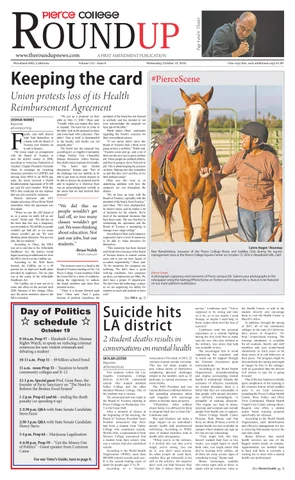
Calvin Alagot / Roundup Ravi Ramakrishna, treasurer of the Pierce College Boots and Saddles Club during his equine management class at the Pierce College Equine Center on October 12, 2016 in Woodland Hills, Calif.
Pierce Scene A photograph capturing vivid moments of Pierce campus life. Submit your photographs to the newspaper using the hashtag #PierceScene on Twitter and Instagram for a chance to be featured on our multi-platform publication.
Suicide hits LA district
2 student deaths results in conversations on mental health SKYLAR LESTER Reporter @Slesterphoto Two students within the Los Angeles Community College District (LACCD) committed suicide. One student attended Valley College and the other attended Mission College. One of the students was a veteran. The announcement was made at the Board of Trustees meeting at Pierce College on Wednesday, Oct. 5 in the Great Hall. After a moment of silence at the beginning of the meeting, the Board of Trustees President Scott Svonkin announced that there had been a student from Valley College who committed suicide. Shortly after, a representative from Mission College announced that a student from their school, who was a veteran, had also committed suicide. According to the World Health Organization (WHO), more than 800,000 commit suicide each year. It is the second leading cause of death for people ages 15 to 29. According to a Veteran’s
Association (VA) study in 2013, 22 veterans commit suicide everyday. This has led many people to post videos online of themselves completing physical challenges related to the number, such as 22 push-ups, to spread awareness on social media. The ASO President and war veteran Barbara Lombrano believes that spreading awareness about such tragedies will encourage others to become more proactive. “Oftentimes, when soldiers return home, it is difficult for them to integrate back into civilian life,” Lombrano said. War and disasters can make a large impact on an individual’s mental health and psychosocial well-being. According to WHO, rates of mental disorders tend to double after emergencies. “When you’re in the military, it is drilled into you that you’re tough, you’re strong, you can do it, you don’t need anyone. So when people do come back, weather they get [released] or are still in the military, the majority don’t seek out help because they feel that it makes them a weak
person,” Lombrano said. “You’re supposed to be strong and take on a lot, so to say maybe I need therapy, or maybe I need help, to them, makes them feel like less of a person.” Lombrano used her personal experience as a veteran fighting during the first Gulf War to make sure her son, who also enlisted in the military, was aware that help was available to him. She encouraged him to avoid suppressing his emotions and to reach out for support through the Veterans Association upon returning home. According to the World Health Organization, misunderstanding and stigma surrounding mental health is widespread. Despite the existence of effective treatments for mental disorders, there is a belief that they are untreatable or that people with mental disorders are difficult, unintelligent, or incapable of making decisions. This stigma can lead to abuse, rejection and isolation and exclude people from health care or support. Pierce College Health Center Director Beth Benne said that there are about 50 hours a week of mental health services available on campus where students can sign up for one-on-one counseling. “They might look like they haven't washed their hair in two weeks, you might begin to smell body odor, you might notice that they’re wearing dirty clothes, all of these are some serious signs of something wrong,” Benne said. Benne encourages students who notice signs such as these, to speak with an instructor, come to
the Health Center, or talk to the student directly and encourage them to visit the Health Center or Sheriff's office. In addition, through the spring of 2017, all of the community colleges in the state of California, have access to Kognito’s “AtRisk” avatar-based training. The training simulation is available for all students, faculty and staff members and uses avatar-based simulations to train users to be more aware of at risk behaviors in their peers. The program might be discontinued this spring and might no longer be free to the colleges, with no guarantee that the district will choose to pay for it going forward. One of the key features available upon completion of the training is the resource button which enables users to see local resources, including the Pierce College Health Center, West Valley, and Olive View Community Mental Health Urgent Care Center, among others. Kognito also offers a similar avatar based training program specifically for veterans. According to the World Health Organization, early identification and effective management are key to ensuring that people receive the care they need. Benne believes that mental health services are one of the biggest unmet needs on campus. Appointments are booked back to back and there is currently a waiting list to meet with a mental health care professional. [See Mental health, pg. 3]