
Moved to run towards hope
Relay for Life has home base on campus
Call it scary, a dead end, or pure panic. Call it death. It is cancer and there is no cure.
With 9 days left until the second annual Relay for Life of Woodland Hills kicks off, students, faculty and community members raise awareness and funds to fight for a cure.
The relay will be taking place on Pierce College’s soccer fields starting April 9. With 25 teams registered and 156 participants, Relay for Life has raised more than $16,000.
Currently, two members from Y’s Relay Rockstars have already raised more than $2,000 each and the team has collectively raised more than $8,000.
“Fundraising online is so easy to use and donations are easier to process,” said April Vilgera, online chair for the relay.
After last year’s event, more than $80,000 was raised, according to co-chair Elaine Pachecco, who hopes to see more than $80,000 donated this year.
“We do have money raised, but we see a majority of what is raised come in on the day of the event,” Pachecco said.
Although open to anyone, there are currently seven teams that have been created with Pierce students, clubs and sports teams. Some include the French Club, American Sign Language Club and Team Brahma.
There is a one-time fee of $10 for registration and each member is asked to commit to raising a minimum of $100 each.
Other relay teams include Relay Runts, the children whose parents are survivors, and Y’s Relay Rockstars, a top-fundraising team who has a 24-hour walking member.
Bryce Peterson, four-year-old son of Y’s Relay Rockstars’ captain said, “no matter how tired we are, people still need us to help them, so we need to be there for them.”
Breast cancer has touched the lives of more than 3.5 million people in the United States, according to the American Cancer Society. The relay has been an ongoing annual event for 26 years and takes place in 19 countries around the world.
“Everyone is there because they have [in] some way been affected by cancer,” said Pachecco. “It’s a positive way to do something about cancer. People come and it’s amazing. I love the support. ”
Relay for Life not only raises money and awareness for those affected, but also offers nearly a dozen events all day and night.
SEE RELAY ON PAGE 4
Cuts made, fees raised
California Community College students registering for fall semester will see a significant change in their tuition as a result of a $10 per unit fee increase.
JoeDETAIL: Jason Cozza, one of the Fab Three works away, welding to prepare for the state competition in San Diego.
Welding a way to win
No stranger to victory, students are headed to take state
Victor Stephen Kamont / RoundupThe Pierce College welding team won six gold medals at the regional competition in February. Their achievements garnered them the chance to compete at the Welding State Championship competition in San Diego, California in April.
“Our competitions are very challenging,” welding instructor Gary Wheeler said. “We prepare well, we come in on our off days, and Saturdays.”
The atmosphere in the welding department is clean, and full of hard working students preparing for their next competition.
The names of the winners are displayed on brass plates hanging on the wall.
“Every student has their own style, mine works for me but not for everybody, said Wheeler. “I push the buttons and they do the work, it shows in the medals they have won.”
Students praised their instructor and the freedom they have in the applications of his teachings.
“We’re given the basics, then we develop our own style,” said welding student Jason Cozza.
In this year’s state competition, Pierce will have a fabricating team
known as the Fab Three.
“I’m proud of the guys, they did it themselves, its good for my ego and it is good for theirs,” Wheeler said.
The Fab Three are given a theme, a certain amount of metal, and are then required to make a blueprint developed using a Computer-aided design (CAD) program.
“I learned about this program last year, this is our second year in this competition,” said Wheeler. “If we win the State, we will go to the Nationals in June.”
The Fab three team includes three welders: Jason Cozza, Gregg Lindlahr, and Brian Burke.
Cozza is in his sixth semester and won Gold in the medal inert gas (MIG) category.
”I love the atmosphere and the people in this great all-around program. That’s why I keep coming back to compete,” said Cozza.
The class meets every Tuesday and Thursday at 5:45 p.m. in room 3805.

“The night classes work if you have a full time job,” Cozza said. Gregg Lindlahr, one of the Fab Three, has been attending Pierce for three semesters.
“I like making things on my own, working with a team, and utilizing different skill sets,” said
Lindlahr.
Burke works with his dad as a tape welder and has been at Pierce for four years.
“It is an honor to represent the school,” said Burke. “Last years combo-welding team took first [gold] in the regional’s.”
Wheeler talked about the value of the trades, specifically welding.
“They think these buildings are built magically, they don’t realize people from these classes do that stuff,” said Wheeler. “Machine shops, auto shops, CAD drawings… they don’t realize this is how our inner city is built.”
Welding classes aren’t taught enough in high school or junior high school according to Wheeler.


“It’s not for everyone, it’s for people that like to work with their hands and get dirty and burnt,” said Wheeler.
The Pierce College Welding team is prepared and eager to put their trading and hard work to the test.
The competition will be held at the Local Iron Workers of San Diego.
“They have all the skills they need. They just have to be able to work under pressure,” said Wheeler.
Summer school ambiguous at best
California’s financial woes have cut back classes offered dramatically for the last few semesters. Summer school is not exempt from these changes.
As of now, one session of limited classes has been scheduled for summer 2011, but classes are still susceptible to revisal depending on near future decisions.

According to Barbara Anderson, dean of academic affairs, the
already reduced class options for students may be erased all together since it is in the hands of the public.
“If the voters vote in support of extending the taxes that were in place, then we’re planning on going forth with offering limited summer school,” Anderson said.
Some of the classes currently planned include English, math and speech.
The PACE program will offer a summer quarter with some of-
ferings before the PACE program shortens its semester long quarter, according to Donna- Mae Villanueva, dean of academic affairs.
“The PACE schedule is being reduced from the usual eight weeks to seven weeks in length,” said Villanueva.

The BRIDGE program will offer classes in English, math, speech and personal development classes for student success, according to Anderson.
Elizabeth Clemmons, 20, is a
pre-veterinary major. She doesn’t like the minimal options of classes available.
“It’s frustrating. The [pre-veterinary] program takes long enough to get into,” Clemmons said.
Clemmons also suggested that with the course offerings being cut, the longer it will take to complete her time in school.
“It’s going to take even longer for people to get out of Pierce,” Clemmons said.
msoto.roundupnews@gmail.com
Gov. Jerry Brown signed bills Thursday, March 24 that cut billions in California’s budget directly effecting the California Community College District; raising fees from $26 a unit to $36.
Not all students on campus were aware of the change in fees that will be affecting them directly.
“It’s crazy, I had to quit my job because it didn’t pay enough for my education,” said Noe Gomez Jr., 19, art major.
Gomez receives no financial aid and is still currently unemployed.
“There’s so many other ways to tax people, why choose education,” said Gomez.
Brown and state legislators cut $400 million from the community college system overall.
These cuts have forced students on campus to explore other options in order to fund their education.
Brittney Pasion-Perez, 22, child development major received a fee waiver from the Board of Governors for spring semester.
“I’m transferring next semester,” said Pasion-Perez after learning of the fee increase. “A couple years ago I would have been outraged.”
Pasion-Perez plans to transfer to CSU Los Angeles.
“With the prices of education I’m facing, I’m going to pay $5,000 for 12 units. I wish I was paying $36,” said Pasion-Perez.
The last time community college students saw a fee increase was in 2009, when Gov. Schwarzenegger signed bills raising the per-unit fee from $20 to $26.
In the past, students attending California Community Colleges did experience a time when postsecondary education was accessible, meaning free, to everyone.
In 1960, California Gov. Edmund G. Brown signed a ‘Master Plan for Higher Education.’ The bill committed to ensuring higher education as a major state priority and granted “tuition-free” education, according to the University of California’s office of the president.
The first bill seen that did not contain a tuition-free clause came in Sept. 1983, according to archives of the Los Angeles Times.
A random poll was conducted among students around campus and the results were as follows:
A FIRST AMENDMENT PUBLICATION
therounduponline.net Woodland Hills, California Volume 114 - Issue 5 March 30, 2011 One copy free, each additional copy 50¢
Kukuczka / Roundup
ATTENTION TO
com
vkamont.roundupnews@gmail.
Melody Soto/ Roundup
Sydney Grossman/ Roundup
Joe Kukuczka / Roundup
Opinion page 2 Time to study, not play. Photo Essay page 6 Pierceʼs beauty exposed. INSIDE SECTIONS News pages 3, 4 Election time is here for the ASO.
SPARKS FLY: Protected by gloves and goggles, heat from Wheelerʼs student welders cause sparks to fly in every direction.
83% Aware of Budget Cuts 61% Registered to Vote
kmabry.roundupnews@gmail.com Thursday 87 ° / 59 ° 0% chance of rain Friday 83 ° / 56 ° 10% chance of rain Saturday 72 ° / 51 ° 10% chance of rain Weather forecast from USA Today
Kat Mabry/ Roundup
—EDITORIAL—
Libraries are for studying, not lollygagging
With limited computers available, priority should go to students with legitimate needs
The Pierce College Library has a total of 55 computers available for students. The first 10 have a 30 minute time limit, the other 45 are located in the library lab and are available on a “first come, first served” basis.
It’s very convenient for students who do not have computers or printers at home.
However, it can be equally inconvenient when other students who are not working on academic assignments use the computers for social networking sites and watching movies; in spite of a sign posted indicating that the computers are for academic use only.
Some students lack the common courtesy and blatantly ignore the fact that they are using computers in an academic setting, they should make them available for other students with genuine academic needs.
Simply putting on headphones does not justify watching SpongeBob Squarepants greatest episodes, while tweeting and updating ones Facebook status, on a library computer.
At CSUN’s Oviatt Library there are more than 200 computers available for student use.
Due to the large number of computers in Oviatt Library, in addition to the plethora of other computer labs available on campus, CSUN can afford to allow their students to work on the computers without any time restriction, as opposed to Pierce.
We cannot afford such a luxury.
Although both the Pierce College Library and the Oviatt Library are both located on college
—COLUMN—
The sheep need a Shepard Street art has shifted from taboo to trendy
Well, Shepard, I hope you don’t mind if I call you Shepard. I mean, after all, I do feel like I’ve seen you grow as an entrepreneur.
Anyway, Shepard, any local Angeleno can tell you that street art isn’t what it used to be. What once used to make the general public cringe and was only associated with a “gang” lifestyle is now making people stop in their tracks to see the “urban” art produced by our very own locals.
RosieFatemi/SpecialtotheRoundup
Dear Shepard Fairey,
Do you remember when street art used to be taboo? When graffiti artists didn’t have a crew of people working for them? When they used to put their necks on the line to put their own work up on the streets? How about when art galleries were created by yuppies for yuppies, and graffiti artists wouldn’t be caught dead in a gallery?
Not only is there acceptance by the general public, gallery owners are catching on to this trend. The more “risky” owners are trading in their photographs of pieces of naked bodies for spray paint cans, political cartoons and hard-to-read lettering.
If you check the L.A. Times or Brand X postings for art gallery openings, it seems as though more than half of them are some sort of “street art” inspired gallery. Read the rest of this column on www. therounduponline.net.
afatemi.KPCR@gmail.com
campuses, they are both facilities that are open to the public.

CSUN library computers designated for public use on the first floor do not require a username and password for log in. However, the third floor lab requires users to log in and verify that the user is a student of the university.
The Pierce College Library should implement a reasonable time limit on all computers in the lab area.
A system should also be implemented where students are required to log in with their student I.D. number, this will prevent random library patrons from holding up the computers, such as the alleged Dr. Drew Pinsky stalker.
Charles Pearson, the alleged Dr. Drew stalker, was arrested on March 3 2010 at the Pierce College Library, after posting a status update on Facebook that revealed his location.
These systems should be active until there are more computers available for students.
We understand the library staff does not have the resources available to make these changes now
But this is something to keep in mind when the new library is built.
Most Pierce students are adults, or close to the age where they are legally identified as an adult, so the library staff should not have to look over students’ shoulders to monitor if they are using the computer for legitimate purposes.

Or maybe they do.
̶Far from perfect ̶
Corrections from last week’s issue, names misspelled
A page one story on the chair of the adriculture and natural resources had his name two different ways. His name is Leland Shapiro, Ph.D., not Sahpiro.
Another page one story referenced Kathleen Burke-Kelly. The second mention of her name was misspelled. Her name is spelled Burke-Kelly, not Buke-Kelley.
Valorie Grear, professor of theatre arts had her name misspelled on second reference in an article on ‘Born Yesterday’ in the Arts & Entertainment section of the paper.

Nam Tran, Four Corners Co-op co-founder had his name misspelled on the second reference in the article, ‘Not guilty after 17 years.’ His last name is Tran, not Tram.
Apologies to the staff:
A Roundup photographer, Jose Romero had his name misspelled in a credit to his front page photo. His last name is spelled Romero, not Ramero.
The same mistake was made with Cesar Monge’s name which was misspelled in a credit to his photo titled ‘Casting call.’ His last name is Monge not Mongew.
Credit was given to the wrong photographer on the Features page, for the 4-Corners Club in the Clubs 411 section. Devon Trammell was not the photographer, Jose Romero was.
ROUNDUP: March 30, 2011 OUNDUP: March 30, 2011 Opinion 2 Letters to the Editor 6201 Winnetka Ave. Woodland Hills, CA 91371 Room: Pierce College Village 8211 Phone: (818) 719-6427 Fax: (818) 719-6447 Web site: www.therounduponline.net E-mail: roundupnews@earthlink.net Policy: Letters and guest columns for or against any position are invited. Letters should be kept as brief as possible (300 words or less) and are subject to non-substantive editing. Letters must be signed and include a valid mailing address and telephone number. Pseudonyms or initials will not be used, but names may be withheld upon request and approval of the Editorial Board. The Roundup publishes “Letters to the Editor” that are not obscene or libelous and do not contain racial denigration. Writers are given the opportunity to revise unacceptable letters. The Pierce College Roundup will not publish, as letters, literary endeavors, publicity releases, poetry or other such materials as the Editorial Board deems not to be a letter. The deadline is noon Thursday prior to the issue date. Editorial Policy: The Pierce College Roundup position is presented only in the editorials. Cartoons and photos, unless run under the editorial masthead, and columns are the opinions of the creators and not necessarily that of the Roundup. The college newspaper is published ROUNDUP OUNDUP Editor in chief Kat Mabry Managing Editor ........Sydney Grossman Opinion Editor ..................Bryan Melara News Editor ....................Coburn Palmer Features Editor............Sydney Grossman A&E Editor ...........................James Hermon Sports Editor............................Mark Gillman Photo Editor..............................................UD Online Editor...........................Joe Kukuczka Multimedia Editor.....Victor Stephen Kamont Advisers................................. Amara Aguilar .................................... Jill Connelly ................................... Stefanie Frith .......................................Rob O’Neil Advertising Manager...................Julie Bailey [For advertising call Julie at (818) 710-2960] as a learning experience under the college journalism instructional program. The editorial and advertising materials published herein, including any opinions expressed, are the responsibility of the student newspaper staff. Under appropriate state and federal court decisions, these materials are free from prior restraint by the virtue of the First Amendment to the Constitution of the United States of America. Accordingly, materials published herein, including any opinions expressed, should not be interpreted as the position of the L.A. Community College District, the college or any officer or employee thereof. Photographers: Emad Abbasi Tatia Calhoun Crystal Endless John Gutierrez Sever Koutianov Evan Lipton Cesar Monge Megan Murphy Stephanie Pardo Jose Romero Rick Rose David Schub Devon Trammell Reporters: Alexis Antoniadis Mayra Bocanegra Rodrigo Carbonel Nelger Carrera Fanny Cano Dan Cromar Cynthia Garcia Michaia Hernandez Tracy Hernandez Sienna Jackson Navid Khoi Sage Lynn Eduardo Razo Lorrie Reyes Kevin Reynolds Brian Schwartz Melody Soto Donny Urrutia
Maria Salvador / Roundup
Radio guys: from KPCR to KNX
Former Pierce College students Tommy Jaxson and Randy Kerdoon both commercial radio broadcasters spoke to students in the Great Hall, on Tuesday March 22.

As part of the Media Arts: Speaker series, Kerdoon and Jaxson spoke to students. Both of them got their start in radio on the original broadcast station here at Pierce.
“It’s nice to see in 35-years the parking situation hasn’t changed,” said Kerdoon after himself and Jaxson arrived late to the Great Hall on Tuesday afternoon. Jaxson and Kerdoon, who both at one time worked here on campus, are now working together on KNX 1070 on a morning show.
“Pierce College Radio means so much to me,” said Jaxson. “It was a tremendous learning experience for me.”
The old broadcast radio station was run much like KLOS 95.5 at the time according to Jaxson.

Campus news

Briefings and updates on campus happenings

District going paper less
for both the public and the board members.
Chancellor Daniel LaVista recommended, during the “Report
From the Chancellor,” that the board make use of electronic devices to cut costs to the budget.
“It’s a way to save money by saving paper,” said LaVista.
The district will save $17,000 yearly by not printing out agendas


Chancellor LaVista also announced his plans to create an independent citizen panel to oversee and be responsible for construction oversight throughout the district. Plans for the panel are still in the initial stages.
An announcement is planned for April 27.
Renaming Swisher Park
The board voted unanimously to rename Swisher Park, located east of the Center for the Sciences on the Pierce College campus, Rocky Young Park after former Pierce College President Darroch “Rocky” Young.
“In honor of Rocky Young’s
extraordinary dedication to Pierce College and his tireless leadership in revitalizing the educational opportunities geared to future generations of student,” said Joy McCaslin, president of Pierce College. The date and time for the dedication ceremony was not announced.
Volleyball coach honored
Ken Stanley, a retired Pierce College coach.
The Pierce College Council voted collectively during yesterday’s meeting in the College Services Building Conference Room to name the volleyball court after
Ken Stanley started the Pierce College men’s volleyball team in 1976, and eventually led them to three state championships prior to his retirement in 1997.
Goodbye, village trailers
The company that is leasing the trailers situated in the Village, some of which have served as classrooms and offices for four years, will be removed in August and replaced by another company’s trailers.
The selection of the lease occurred in a public contract process bid. The new company will cost almost half of the amount of the current trailers.
“Classrooms that were scheduled to start in September in the Village

will probably have to be relocated,” said David Tsao, Swinerton managment team project director.
Barbara Anderson, dean of academic affairs, expressed that there was a plan to vacate the Village as soon as possible and that Pierce College was working with Swinerton to minimize the impact on students as much as possible.
“We haven’t planned any summer school classes in the area. The Outreach Program will move temporarily to what was formally the nurses area,” Anderson said.
KPCRADIO.COM
Pierce College’s student-run

Internet radio station
“We were trying to emulate the top 40 radio stations,” said Jaxson.
Kerdoon grew up wanting to be a sports commentator also attributes his success in the field to the Pierce radio.
“I wanted to do commentary on the school games so I took an old reel to reel deck to a game at El Camino College,” said Kerdoon. “Eventually I was traveling with the team to every game.”
Jaxson and Kerdoon careers in commercial broadcasting inform students of the difficulties of making it in the industry.
“The vehicle was here for us to do what we wanted to do,” said Jaxson. “But if you want to make it in this industry you have to have a lot of passion to do this job.”
They warned students of the trials of trying to make it in the industry. Both offering stories of all the years they bounced around the country from station to station before getting their big breaks.
“We love this gig,” said Kerdoon.
“If you want to do something know that, if you want to learn you have to do it.”
Jaxson and Kerdoon spent time answering questions on interviewing techniques for students and offering advice for those interested in the business.


“It was pretty insightful,” said Maksud Yusabov a 20-year-old journalism major. “When I came I didn’t think it would have this much relation to journalism.
The Media Arts: Speaker Series will be hosting its next event on May 18th at 3 p.m. in The Great Hall.
The event will feature documentary filmmaker Scott Anger.
The events are open to all students and faculty and refreshments are available.
“You have to want it,” said Kerdoon about the broadcasting industry. “If you want it bad enough you’ll find a way to get there.”
ROUNDUP March 30, 2011 OUNDUP: March 2011 News 3
Melody Soto/ Roundup
Michaia Hernandez/ Roundup
Sage Lynn/ Roundup
Sage Lynn/ Roundup
Jose Romero/ Roundup
Radio: Randy Kerdoon shows a photo of himself as a College student during the 70ʼs.
kreynolds.roundupnews@gmail.com
Kevin Reynolds/ Roundup
The race is on again for the ASO
Elections begin in 2 weeks for the 9 ASO candidates
Coburn Palmer/ RoundupIt is ASO political campaigning season once again at Pierce College.
The student government is actively involved with the growth of the campus and is heavily involved with students, faculty and staff, according to ASO website.
The student body government consists of three branches: the senate, club council, and court.

Students can run for one office by registering by the posted due date, which was March 15.
In order to run for political office the student must maintain a 2.0 GPA and be enrolled in at least 5 units, according to the ASO election code.
ASO Candidates
Campaigning ASO political candidates are eligible to post up to two posters and can also pass out fliers using the ASO template.
The total cost shall not exceed $300, according to the ASO election code.
If a Pierce student who wishes to run for office has missed the deadline, it is still possible to run as a write-in candidate.
Elections will take place outside the Student Community Center on April 11 and 12 and results will be announced the following day at 10 a.m. in the ASO Conference Room.
The newly elected officials will begin their term beginning July 1.
cpalmer.roundupnews@gmail.com
President:
Regemralph Corpuz
Gabriel Mellibosky
Kevin Sparks
Ashley Wert Vice President: Febe Ruiz
More news thatʼs fit to print
Holding hands to make a bold statement
Rodrigo Carbonel / Roundup
After orchestrating the ‘March in March’ rally and with the pressure of the state’s budget crisis, the Associated Students Organization (ASO) turns its focus towards the ‘Hands Across California’ fundraiser.
The Foundation for California Community Colleges is expecting to bring one million people including students, celebrities, and selected officials together on April 17.
All participants will join hands
in a line up and down California to help raise money that will directly benefit the California Community Colleges Scholarship Endowment (CCCSE), a permanent fund that provides annual scholarships to thousands of students every year.
“We can help so many students by participating in this,” said ASO Sen. Jonathan Fackler, Scholarship Committee chair. “If we raise enough money, we could potentially see 50 new scholarships available exclusively for Pierce College for years to come.”
The Bernard Osher Founda-
Treasurer:
Alexander Alvara
Fernando Aquino
Ronal Quintero
Club Council
President: EJ Tormes
ASO Election Timeline
April 7
Candidate forum (Noon to 2 p.m. in the Great Hall)
April 11, 12
ASO and Student Trustee Elections
(9 a.m. to 2 p.m. and 4 to 7 p.m.)
TBD
tion will match every dollar that is raised from now through June 2011.
ASO will be hosting the Scholarship Benefit Night in connection with ‘Hands Across California’ at the T.G.I. Fridays in Woodland Hills.
In order to participate in the Scholarship Benefit Night, students would have to eat at the restaurant and present the event flyer so that 20 percent of their profit will go to the Pierce College Scholarship fundraising cause.
Lower enrollment means fewer professors
Alexis Antoniadis / Roundup
During the Pierce College Council meeting Ken Takeda, vice president of Administrative Services, dropped the bomb to the members that Pierce was going to cut the enrollment.
This also means that there will be cuts to part-time faculty.
Takeda doesn’t know exactly how many classes or faculty members will be cut next year, but he knows it will be more than enough.
“Cuts can be fairly steep,” said Takeda. “We won’t know how many classes we will have until the state budget.”
After informing the council of the news, the council then ques-
tioned if Pierce was going to replace the recently retired teachers.
His response was that they were taking it into consideration.
Throughout the rest of Takeda’s report he touched on the school’s budget and stated that the state budgeted about $1.4 million to Pierce which he hopes to receive soon.
PASS gives academic seminar on college
Eduardo Razo/ Roundup
Four guest speakers from UC Berkley and one from UCLA were in the Great Hall Wednesday speaking about transferring to a four year
April 13
Ballots counted and results announced (10 a.m. in ASO Conference Room)
Ballots counted by the district election committee.
June 1 New Student Trustee begins term of office.
July 1 New ASO officers begin term of office.
The race still on to find a miracle
CONTINUED FROM RELAY ON FRONT PAGE
After opening ceremony at 9 a.m., with remarks from president Joy McCaslin, the relay has live entertainment, a taekwondo demonstration, art-n-crafts stations, food and much more.
From the ‘survivor lap’ to danc-
ing, and raffles to eating, the event never sleeps. Once dark, there is a Luminaria Ceremony where decorated bags are placed around the track in honor of, in support of, or in memory of someone who has battled cancer.
Relay for Life is still open for registering teams and members, and is always looking for more do-
nations.
“There is no rhyme or reason to why some people lose and some people win this battle,” Pachecco said. “All we do know is that early detection is key.”
university during a meeting held by the Filipino Club.
The speakers are from PASS (Pilipino Academic Student Services) and students at UC Berkley.
They touched on a variety of top-
ics from financial aid to life on the UC Berkley campus.
“A lot of this info students don’t know,” said Camile Conanan, 20-year-old sociology major, a guest speaker from UC Berkley.
Pierce ends the year, unexpected surplus
Melody Soto / Roundup
Ken Takeda, vice president of administrative services, presented the preliminary budget for the year.
The projected ending balance is $8.4 million. Takeda noted a significant growth, due to an additional $1.4 million that was awarded to community colleges by the state and that would be distributed to Pierce College next month.
For Takeda, the projected balance is, “a relatively good result for a bad year.”
It was proposed that $2 million out of the ending balance for 2011 and an additional $450,000 from a separate account would be set aside for use in 2012.
Takeda said that the decision on how many full time faculty positions will be filled would be decided March 2012 during the District
Budget Committee meeting.
President Joy McCaslin said that in the next council meeting, members were going to “at least try to do some replacements,” for the instructors who has retired last year.
One of the last topics mentioned was student enrollment.
“If the tax measures for next year don’t pass, we’re going to have to cut our enrollment far beyond this,” Takeda said.
Great Hall film festival continues in May
Melody Soto / Roundup
The film festival organized by the
Prizes in the form of gift cards for the Freudian Sip or campus bookstore will be awarded for each category.
First place winners will receive a $200 gift card, second place a $150 gift card and third place a $75 gift card.
ROUNDUP: March 30, 2011 OUNDUP: March 30, 2011 News 4
Diversity Committee for Spring 2011 will have a student empowerment theme. The festival is scheduled for the first week of May. Film screenings will take place in the Great Hall throughout the morning, evening and afternoon.
professor Diane Levine said the May 2 through May 5 dates set for the festival were still “tentative.”
ings,
and
will
place.
Anthropology
In addition to the film screen-
student contests in photography, art
short film
take
The sheriffʼs blotter will return next week. Check out therounduponline.net for breaking news. sgrossman.roundupnews@gmail.com PRODUCTSJOBS JOBS SERVICESHOUSING EVENTS HOUSING RENTALSEVENTS FREE Media Kits Available by Mail or Email. SPRING 2011 Publication Schedule Mar 02 Mar 30 May 11 Mar 09 Apr 06 May 18 Mar 16 Apr 27 May 25 Mar 23 May 04 DISCOUNTED RATES for students and campus community Email: baileyjd@piercecollege.edu Advertise in the Roundup Call: (818) 710-2960 Reachthousandsfacultyofstudents, &staff DiscountsforMultipleRunAdvertising SPECIAL PACKAGE ADVERTISING The bond that funded the ITAP card and gave Pierce College the opportunity to sell ITAP cards to students who use the Metro for only $15 is empty, according to ASO President Daniel Axelrod. “So for next year the two options are to get rid of the I-TAP card completely or have a referendum to make all students pay anywhere between $25 and $50, and whether you take the Metro or not you’re forced to buy the card, so it’s a bad situation,” said Axelrod. Starting next semester, even students who do not use the Metro might have to pay a $25-$50 fee to subsidize the ITAP card in addition to the already debated unit fee increase if the referendum is passed. Subsidizing the ITAP card program
For more than 50
years, Pierce College has produced a student-run magazine.


Direction Magazine, which offers numerous opportunties for students to have their works published, has been composing poems, short stories and photography since 1959.


Maria Bates, professor of English for seven years, teaches the English 32 class, which is the course that automatically puts students on staff.
“I think it’s getting more
elaborate,” Bates said. “We get about 2,000 submissions and only 25 to 40 works get selected.”


There are standards for the poems and stories to be published.
“We call people when they score high and if they meet the standards,” said Bates. “But [if they] lack on something we try to help them.”
Stories need to be well written and have proper grammar. Poems need to consist of imagery, rhymes schemes, etc.
“We also publish [in] different languages,” said Bates. “We look for quality work, original [work], and all kinds of representation.”

This semester, the magazine had enough money to create a DVD for the students.
Some of the conetents of the DVD contains works from students who dance or have created films.
This class meets once a week in English building 1206 on Mondays and sometimes they meet in the Computer Lab.
The students also take several fieldtrips throughout the semester and go to places like printing houses.
The trips allow them to try and get sponsored.
Eva Murray, liberal studies major, is the Art Editor for the magazine.
“We have three different sec-
Clubs 4-1-1
From ballet to battling, campus is well balanced
 Kevin Reynolds/ Roundup
Street Dance Club:

• Club is comprised of students from different dance classes on campus.

• The club competes in dance competitions against other schools. Within the team, there are 60 members.
• In order to join, auditions are held bi-annually. The next opportunity to be apart of the club will be in June, prior to their upcoming event that month.
—For info on upcoming events check out the club on facebook at www. facebook.com/undergroundswing.

tions: we have publicity, editing, and art,” said Murray, 25. They get a lot of their funding from the Associated Students Organization (ASO).
In addition to the ASO, the students create bake sales and orginize an open mic night to raise awarness to their magazine and earn more funding.
“This magazine comes out at the end of the semester in June and it is available in the Student Store for $5,” said Rebecca Rabitoy, 21-year-old English major and editor. “But get it soon because it sells quickly.”
thernandez.roundupnews@ gmail.com
Anime Club:
• The anime club at Pierce College was created as a place for fans to watch films, play video games and socialize.

• “It is not like other clubs, it’s more of a social event,” Jones said. You can meet people and just hang out.”
• The club meets for six hours but they take breaks between movie showings.
—They meet every Friday from 6 to 10 p.m. in the Center for the Sciences room 91120 and anybody can join,
ROUNDUP March 30, 2011 OUNDUP: March 2011 Features 5
Jose Romero / Roundup
Jose Romero / Roundup
Victor Stephen Kamont/ Roundup
Tracy Hernandez/ Roundup
Directioncoming in June Student editors and writers compose a yearly magazine UD / Roundup FINISHED: English professor Maria Bates takes a moment between classes to show off her studentsʼ publication ʻDirectionʼ magazine. LEARN LOCAL. THINK GLOBAL. THE CALIFORNIA LUTHERAN UNIVERSITY ADULT DEGREE EVENING PROGRAM. California Lutheran University’s Adult Degree Evening Program (ADEP) now provides convenient evening classes in business at the Woodland Hills Center. 1.888.CLU-GRAD | www.callutheran.edu/pc THREE CONVENIENT LOCATIONS: THOUSAND OAKS, OXNARD AND WOODLAND HILLS BACHELOR’S DEGREES: TRANSFER TO CLU: ADULT DEGREE EVENING PROGRAM CALIFORNIA LUTHERAN UNIVERSITY FINANCIAL AID AVAILABLE CLU WOODLAND HILLS CENTER(Now Online!)
Bold ʻnʼ Beautiful

Capturing the sites morning, noon and night
Roundup
photojour-


nalists (PJs) are always on assignment covering sports, breaking news, feature stories and more around campus, day and night, rain or shine.
Between assign-

ments, however, PJs tend to capture many amazing images that never see the light of day.
Each morning the sun peeks up over the flagpoles near the Student Services Building to bring light to a new day.

As the last rays of light cast long shadows along the Mall, the visual canvas takes on a golden hue. Look up and see, for you too may be able to find the beauty around every corner here at Pierce.
—UD/ Roundup
ROUNDUP: March 30 2011 OUNDUP: March 30, 2011 Photo Essay 6
Juan Gutierrez / Roundup
Rick Rose/ Roundup
UD /
Joe Kukuczka / Roundup
Roundup
Juan Gutierrez / Roundup
Engaging senses
Student photograhers works with the Gett y
“My favorite thing about the media department is that everything is really hands-on and run by the students”.
A spring in their step
With auditions over, rehearsals begin for 3 concerts
Students line the walls of the North Gym, South Gym and Dance Studio, each Sunday in preparation for the Pierce College Spring Dance Concert.
The rehearsals, which began March 20, will continue until the weekend of the Spring Dance Concert, scheduled for three performances May 13 - 15 in the Performing Arts Main Stage.
Various dance styles including modern dance, ballet, jazz, musical theater, tap dance, dance drama, dance improvisation, hip-hop and social dance will be showcased during the presentations.
Open auditions on March 19 welcomed Pierce College students as well as community members, all hoping for a spot in the Spring production.
Marian S. Weiser, director of the dance theater department and Jacqueline Eusanio, who teaches Middle Eastern and social dance, were on the committee that supervised the auditions.


“We had 128 people who auditioned,” said Eusanio.” “It’s the most we’ve ever had.”
Although dancers were limited to three pieces, Weiser encouraged everyone to audition for all dance numbers.
To Weiser, dance is a life-learning process.
“I know some 80-year-olds out there taking dance classes,” said Weiser. “Dance requires dedication and commitment but it’s also exiting and fun.”
The concert will feature a total of 18 dances. Students are in charge of choreographing 15 numbers. Guest companies will put on two dances.
During the fall semester, the dance department organizes an annual folk dance concert, but the Performing Arts Main Stage is scheduled to be demolished and reconstructed during that time period, one folk dance from Soviet Georgia will be included in the program and supervised by Eusanio.
In addition, Weiser, will create a nine-minute dance to the music of Samuel Barber, composed for the opera “A Hand of Bridge,” by the ItalianAmerican, Gian Carlo Menotti. Weiser puts the musical piece into a modern era. She plans on having soprano and alto vocalists, accompany dancers on stage.
One of Weiser’s big concerns was making the concert as diverse as possible.
“I balanced the concert for sight and sound,”
said Weiser.
Practices began at 8:30 a.m and ended at 6 p.m. They went on simultaneously and lasted for an hour and 30 minutes at a time.
Monica Garcia, 28, is participating in two numbers, a hip-hop and a jazz lyrical piece. She will be spending four hours every Sunday at Pierce College. She arrived early in the morning and left after attending the one hour mandatory meeting that all dancers are required to attend.
Garcia, who has been dancing off and on since she was 13-years- old, participated in the folk dance concert produced in Fall 2010.
“I had a really good time. I wanted to come back before I transfer out of here [Pierce],” said Garcia.
Like Garcia, several dancers have participated in other large-scale Pierce College dance production.

Zennetta Taylor, 22, is one of those people. Since she started attending Pierce College in 2006, Taylor has been in seven shows. This semester she is part of a jazz, hip hop and ballet number.
“I look forward to performing each piece on stage,” Taylor said.
Loui Sagastump, 28, is also participating in three dance numbers.
Although he has transferred from Pierce, he came back for another Spring concert and is now learning the steps for a contemporary, jazz and hip-hop choreography.
“It feels like home because you get to see those familiar faces,” said Sagastump.
Erik Teno, 31, is enjoying the bond he has made with fellow dancers and is awaiting the end results.
“It’s fun to see an array of dances compacted in one show,” Teno said. For more information visit http://info.piercecollege.edu/theater/
fcano.roundupnews@gmail.com
Photographers, professors and friends gathered for Engaged Students Observers photography exhibition, celebrating the culmination of Pierce students’ photography class with the Getty Center.
Ten students who were enrolled in photojournalism courses from College of the Canyons, East Los Angeles, Santa Monica and Pierce colleges had the opportunity to work on a photography project with the Getty.
Students were able to work hand-inhand with Indian photographer Sudharak Olwe who led the workshop about photography and social documentary.
“Tonight as you can see is the culmination of the projects that they[ the students] produced” said Monika Del Bosque, gallery director and the assistant professor of art as she looked around the room with a smile.
As a student at Pierce who has only taken a couple of photo classes, Lorena PerezValladares really feels like she has learned a lot and is proud of herself as well as her classmate’s work.
Having a friend that is a firefighter Valladares was able to get behind the scenes of their life.
She feels as if she was able to express that through her photos.
“I’m really excited about it all coming together, we’ve been working on it for a couple of months now and it’s good to see everyone’s work out” said Valladares.
The room was filled with photos with captions and podcast which provided history and background information each photographer experienced.
“Everyone did something that went beyond what they were already capable of” said Gerard Burkhart who teachers photojournalism at Pierce College and Santa Monica College.
Burkhart describes social documentarily as the most powerful kind of still photography story telling that there is available ever.
Amber-Rose Kelly who has been in the department for two years had 7 pieces in the show.
Students worked really closely with Olwe, an artist who was featured in the Getty Center last fall where he learned about the craft and art of documentary photography.
After that experience he then went off to do projects of his own explained Del Bosque.
The room was filled with over 30 people, food and refreshments were provided .
The event lasted from 7 to 9 p.m. in the Pierce College Art Gallery as every picture told a side to a story.
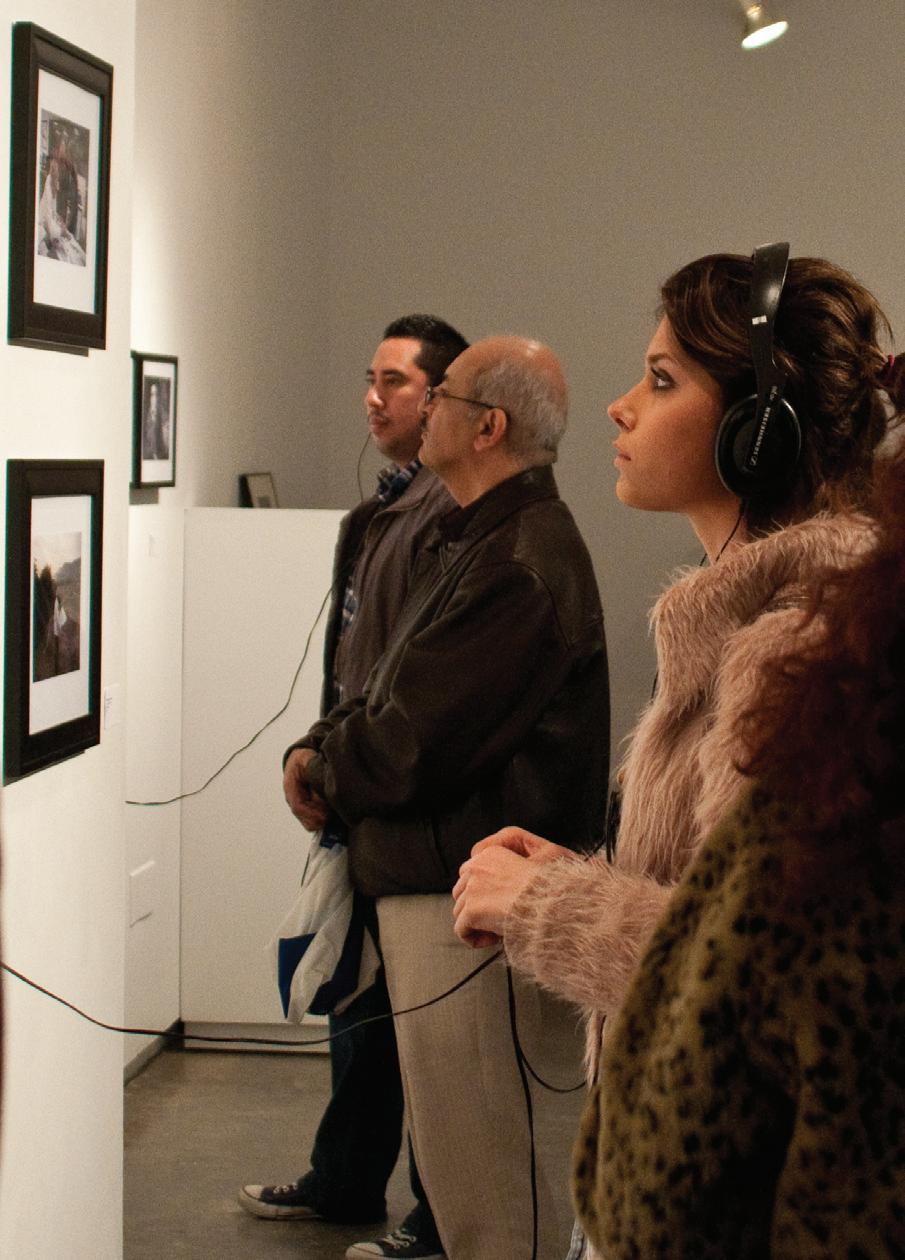
The photographs will still be on display through Thursday, April 21.
The gallery is open from 10 a.m. to 7 p.m. Monday through Thursday.
msoto.roundupnews@gmail.com
‘Engaged Student Observers’ Information
The Gallery will be up until April 21.
Addmission is free For additonal information visit www.piercemediaartsdepartment.com or call 818 710-2262
ROUNDUP March 30, 2011 OUNDUP: March 2011 Arts & Entertainment 7
May 13 & 14 : Spring Dance Concert 8 p.m. May 14 : Children’s Dance Concert Matinee at 2 p.m. May 15 : Spring Dance Concert Matinee at 2 p.m.
Jose Romero/ Roundup
TECNIQUE: Pierce College students Diana Cabrera and Staav Goldrevch practice in the North Gym on Sunday March 20
Crystal Endless/ Roundup
1-2--3-4: Denis Freehan and Dana Craig run through scenes from Act I as Harry Brock and Ed Devery during a recent rehearsal in the PAB.
Cesar Monge/ Roundup LOOK AND LISTEN: Students and members of the community partake in podcast description of photos displayed in the Pierce College gallery.
Melody Soto/ Roundup
Spring Performances: Dates and Times Complete Your Bachelor’s Degree at Azusa Pacific University AZUSA HIGH DESERT INLAND EMPIRE LOS ANGELES MURRIETA ORANGE COUNTY | SAN DIEGO VENTURA COUNTY | ONLINE CALL (626) 815-5301 CLICK www.apu.edu/explore/caps EMAIL aps@apu.edu Find out about the next HDEV or BSOL program start date. Contact us today! Choose from accelerated degrees online or on campus. LIBERAL STUDIES The B.A. in Human Development (HDEV) can prepare you for a career in education. In less than two years, you could be on your way to teaching in your own classroom. LEADERSHIP The versatile B.S. in Organizational Leadership (BSOL) makes it easy to take the next step in your career. You’ll learn relevant business strategies that can empower you to become an effective leader. ABOUT THE PROGRAMS • Complete your degree in less than two years. • Choose to earn your degree online, or attend class only one night a week at a location near you. • Applicants for the HDEV program must be at least 22 years old; BSOL program applicants must be at least 25 JOB BOARD WATCH A NEW TV PILOT & GET PAID TO GIVE US YOUR OPINION $70.00 PAID ON THE SPOT!!! Location: North Hollywood/Valley Village area Brenda’s Recruiting Service, INC. (818) 759-8021
Fanny Cano/ Roundup
Pierce squanders lead in defeat
After riding victory wave, Brahmas stumble and fall to Valley
Overconfidence and poor execution got the best of the Brahmas Saturday afternoon, resulting in another ‘L’ in the loss column.
The Pierce College baseball team led almost the entire game; up until the ninth inning, when the L.A. Valley College Monarchs (3-7, 6-16) evened the score at five to send the game into extra innings.
Sloppy defense and poor offensive execution hindered the Brahmas’ chances, as they were defeated, 7-5.
The result brings the Brahmas even with Valley College on the season, and their overall record to 1210.
Head coach John Bushart said the team had learned a hard lesson.
“I think we just relaxed. We assumed that the game was over,” said Bushart. “Once you shut it down it’s hard to get it going again.”
Starting pitcher Ryan Santhon led the early inning charge for Pierce College at the beginning of the game as he had another solid outing.
At the top of the first inning, Valley College could have taken the early lead, as they loaded the bases, but the Brahmas’ left-hander prevented them from scoring.
James Wharton hit the only home run of the game in the third inning, a two-run blast well over the wall in left-center field.
By the end of the seventh inning, the Brahmas led by four, but that changed quickly during the top of the eighth when the lead diminished, as the home Brahmas maintained the slight 5-4 advantage.
After the Monarchs scored three runs, Kevin Tolbert was brought into the game to pitch the rest of the inning.
The Monarchs evened the score with one out in the ninth, with clutch hits and well-executed approaches at the dish.
Looking to recover the lead, the Brahmas made costly mistakes and failed to capitalize when scoring opportunities were presented.
Players were left on base in the 11th, 12th and 13th
innings.
A base running error in the 11th inning proved costly when Justin Fredlender, who was coming from second base, hesitated on third and was thrown out at home plate.


“I don’t know if that was the best move,” said Brahma catcher Travis Forbes. “I don’t know if he ran through a stop sign or the coach actually sent him, we made some mistakes.”
The team relied heavily on pitching in the last four innings, according to Fredlender.

“We have to keep hitting the ball,” Fredlender said.
Forbes commented on how he will think differently during future games.
“We thought four runs was going to be enough, we should never have that attitude,” said Forbes. “We should always think we got to get more, we got to get more.”
Head coach Bushart looked to the future as well.
“We’re still playing okay, we just stumbled today. There’s a lot of season still left,” said Bushart.
Pierce will play West L.A. College Thursday at Joe Kelly Field. Game starts at 2:30 p.m.
msoto.roundupnews@gmail.com
-Brahmas of the week will return in next week’s RoundUp.

It seems like yesterday that I first held you in my hands, a new tournament, a new bracket.
Hard to believe that just two weeks later, I would be unable to stand the sight of you.
I’d taken a different approach this time, picking purely from the heart. I may not have fully believed that Notre Dame could come through, but I wanted to, so I made them my national champions.
I went with my gut, going purely by instinct.
I’d never heard of Morehead State, but they were the first to shake my confidence. Their defeat of Louisville marked the first casualty of my Sweet Sixteen, but hope still endured.
Surely, I thought, this is an isolated incident. It will all get better.
How wrong I was.
Other picks began to come undone, but as I looked upon you, the green marks still outnumbered the red. Even when those upstarts from Virginia laid another blow to what was once a Sweet Sixteen, I wasn’t worried.
Besides, it was still early, just the first round. Everything would be fine.
Then, the next dagger.
It was one of my bold predictions, one of those that I’d hoped would catapult me to the top of the pool standings. St. John’s in the Elite Eight. I remember how proud of myself I felt when I first made the selection.
I’ll look pretty smart for this one, I thought.
It took just one round for those Bulldogs from Gonzaga to make me regret it. Suddenly, where I once felt confidence, I began to feel doubt, yet hope endured.
You continued to suffer in the second round. The fall of Pittsburgh to Butler, the fall of Kansas State to Wisconsin. The red marks were finally starting to become prominent.
And then…disaster.
I couldn’t wait to watch. I got off work and came straight home. The Irish were playing the Florida State Seminoles, and I knew that it would be my redemption.
At least, I thought I knew.
It all happened so fast. Suddenly I was standing among the wreckage sifting through the rubble of what just days before had seemed so strong and indestructible.
My champion was gone, and with it, all hope of success.
I failed you.
All the hope we had is gone. Every game I watch now is a bitter reminder of what might have been.
If only I’d chosen more carefully. If only I’d kept my heart out of it. If only I’d chosen more upsets.
It will be a long year until we meet again, and I will have a chance to make things right.
Next time, it will be better. Next time, we’ll succeed.
Next time.
* Whole Chickens
* Chicken Buckets
* Peruvian Fajitas
* Ranchera Steaks
* Chicken Tacos & more
BESTWOODFIRECHICKEN INTHEWORLD Peruvian
8510 Reseda Blvd. Northridge (Between Roscoe & Plummer) 818-775-1600 POLLODELREY.COM 10% OFF for PIERCE STUDENTS With ID 10% OFF for PIERCE STUDENTS With ID


ROUNDUP: March 30, 2011 OUNDUP: March 30, 2011 Sports 8
Melody Soto / Roundup
Joe Kukuzcka / Roundup
DEJECTED: Tyler Peddicord sulks moments after Valley College ties the game Saturday Mar. 26. Valley College beat the Pierce College Brahmas in the 14th inning, 5-7.
Joe Kukuzcka / Roundup
BAD HOP: Justin Fredlender fields a line drive against Valley College Saturday Mar. 26 at Joe Kelly Field.
“I think we just relaxed. We assumed that the game was over.”
-John Bushart Pierce College Head Baseball Coach
—COLUMN—
HERE FOR GREAT FOOD
Dan Cromar / Roundup dcromar.roundupnews@gmail.com LOOK
SIDES: Peruvian Beans&Rice, Fried Plantain, French Fries, Salads, Plus Desserts Grill PolloDelRey PolloDelRey